scroll top

Known as “Jeweler to the Stars,” Harry Winston first got the attention of the public when Marilyn Monroe’s character sang his name in Gentlemen Prefer Blondes, and with his donation of the Hope Diamond to the Smithsonian Museum in 1958. 

Today, Winston is known for pioneering the concept of lending out jewelry for the red carpet — and continues to be associated with high-end, luxury jewelry by partnering with celebrities like Helen Mirren, Salma Hayek, Madonna, Rosario Dawson, Jennifer Lopez and Elizabeth Taylor, whose 69-carat Taylor-Burton diamond necklace put the jeweler on the map in 1969. 

Even more modest Harry Winston pieces tend to be a good investment, selling at a premium above simply the cost of the metal and diamonds or gemstones.

In this article, we explore the ways to sell your Harry Winston jewelry for the highest prices, including our No. 1 recommendation, online jewelry marketplace Worthy.com, which joins other fine jewelry resellers in naming Harry Winston to its list of jewelry designers that retain their value.

Worthy is our No. 1 choice because:

  • B+ rating from the Better Business Bureau and hundreds of customer testimonials
  • Worthy has been featured in top publications including the New York Times (twice), Crain’s New York Business, Washington Post, Entrepreneur, Reader’s Digest, and Woman’s Day, among others  
  • Free FedEx shipping insured by Lloyds of London up to $100,000
  • Free Gemological Institute of America (GIA) or International Gemological Institute (IGI) lab report with every sale
  • Auction platform helps drive prices to market highs

Read our Worthy.com review to learn more about our top choice for selling jewelry and watches.

Here’s what you need to know about selling your Harry Winston jewelry for as much money as possible:

Where to sell Harry Winston

How to sell Harry Winston

How much Harry Winston jewelry is worth

Where to sell Harry Winston jewelry: 5 ways

The rarity and condition of your Harry Winston necklace, ring, earrings or bracelet, along with the popularity of its style, will affect its resale price — as well as the quality and size of the diamond or gemstone. Here are five ways you can sell Harry Winston jewelry:

Sell back to a jeweler

Some jewelry stores buy fine jewelry and resell the items as estate or antique jewelry, or resell the item at a profit to another retailer. Harry Winston does not buy back its items from customers.

Before you sell Harry Winston to a jeweler, get your item appraised. The more you know, the less likely you’ll be ripped off by a jeweler who thinks you don’t understand the value of what you have. Worthy provides free GIA or IGI lab reports, along with estimated sale prices, that can help you understand what you have.

Keep in mind that local jewelers have high overhead costs and less competition than top online jewelry buyers like Worthy, so you will likely get less money if you sell Harry Winston rings or other jewelry to a brick-and-mortar jeweler vs. an online jewelry buyer. 

Or, learn more about the best ways to sell jewelry online in 2023 — including best places to sell gold and silver.

Sell on consignment

A local consignment store that deals in fine jewelry is another way to sell Harry Winston rings, necklaces or other jewelry. Show the manager your jewelry appraisal and hope for the best.

Typically, consignment stores only pay once the item sells. (Hint: That might not happen right away.)

If you want to cast a wider net, you can also sell your items to an online consignor. Companies like Mercari and TheRealReal both accept Harry Winston jewelry.

Sell at a pawn shop

Pawn shops and pawnbrokers offer immediate cash for jewelry trades, but the payout for your Harry Winston jewelry will be low.

Sell at an auction 

Major auction houses like Christie’s and Sotheby’s often sell Harry Winston jewelry in both live and online auctions. Whether or not they’ll accept your jewelry depends on the piece’s value and provenance — if your necklace, earrings, or engagement ring were once owned by a celebrity or have an otherwise glamorous history you can document, they are more likely to be of interest to any buyer. 

A downside to selling Harry Winston through a major auction house is that you won’t be paid until a month or more after your auction closes (Sotheby’s has a 45-day payout period). 

Sell to a professional jewelry buyer online

Worthy.com also auctions jewelry — but exclusively online. Worthy works only with vetted professional diamond buyers. These jewelry buyers understand the value of high-end brands like Harry Winston, and they are willing to pay what your jewelry is worth.

We like Worthy because:

  • Getting an estimate is hassle-free: Just describe your jewelry and upload some pictures
  • The company has a B+ rating with the BBB and a score of 4.6 out of 5 stars on Trustpilot (based on more than 3,500 reviews)
  • You get a free GIA or IGI lab report for each item
  • Buyers choose the minimum price they’re willing to accept for their jewelry
  • It costs you zero dollars to get things moving because Worthy pays for shipping, handling and insurance for up to $100,000 by Lloyds of London

Worthy only accepts items that will sell for at least $1,000. If you have smaller jewelry, or gold, silver, gemstone jewelry, coins or flatware, we recommend DiamondsUSA.

How to sell Harry Winston online

The best way to sell Harry Winston jewelry online is through Worthy.com. Worthy has a reputation for discriminating buyers and makes it super simple for you to sell Harry Winston rings and other jewelry.

How simple? Here’s how it works:

  1. Go to Worthy.com.
  2. Type in your contact info, then describe the Harry Winston jewelry you want to sell and upload a few photos. Worthy uses these photos to do a market analysis and will let you know what similar jewelry is selling for right now.
  3. Watch for the trackable FedEx mailer (typically within one day) to send your stuff to Worthy. No need to worry: It’ll be insured by Lloyds of London insurance for up to $100,000.
  4. Worthy will do the rest: Professionally photograph your Harry Winston jewelry, get it graded at the GIA lab and then start the bidding process.
  5. Finally: Use the live auction viewer tool to see bids come in on your jewelry. Once you’ve approved the final bid, your money will be sent to you via PayPal within 24 hours or by check if you prefer. 

I Do Now I Don’t review: Is this online jewelry seller legit?

How much is Harry Winston jewelry worth?

How much you get when you sell Harry Winston jewelry depends on factors such as:

  • The age of the piece
  • The rarity of the jewelry
  • The popularity of a particular style
  • Condition – a small amount of damage to metal or gemstone that’s barely visible to you means it can no longer be sold as “mint condition”

Worthy describes the market for Harry Winston jewelry as “strong,” adding that most Harry Winston jewelry is “quite valuable” — pieces have recently sold for more than $20,000.

Here are a few examples of Harry Winston pieces that recently sold on Worthy: 

Harry Winston white gold watch sold on Worthy.
Harry Winston cushion cut halo ring sold on Worthy.
Harry Winston bridal set sold on Worthy.
Harry Winston watch sold on Worthy.
Harry Winston emerald cut ring sold on Worthy.

Have more luxury jewelry to sell? Check out our guides for selling the following brands: 

How much is Harry Winston jewelry worth?

Worthy describes the market for Harry Winston jewelry as “strong,” adding that most Harry Winston jewelry is “quite valuable” — pieces have recently sold for more than $20,000.

Bookkeepers.com (formerly Bookkeeper Launch) is an online course launched in 2015 by Ben Robinson, a certified public accountant, and owner of his own CPA firm.

Robinson reports he has helped more than 12,000 people start their own bookkeeping businesses since 2001.

We recommend Bookkeepers.com because:

  • A+ BBB rating
  • Track record of helping thousands of people start successful bookkeeping businesses and attract high-paying clients, often earning $100,000+ per year
  • Payment plan option
  • Money-back guarantee

More on Bookkeeper Launch and why we’re fans:

Bookkeeper Launch reviews

Common complaints about Bookkeeper Launch

Bookkeeper Launch course details

Pros and cons of Bookkeeper Launch

Bookkeeper Launch FAQs

More Bookkeepers.com courses/products

Bottom line: Is Bookkeeper Launch good?

What is Bookkeeper Launch?

Bookkeeper Launch is an online bookkeeping course led by Ben Robinson, a certified public accountant and owner of his own CPA firm, through his website, Bookkeepers.com. The course is designed to help people start a virtual bookkeeping business from the ground up.

Bookkeeper Launch teaches: 

  • Modern bookkeeping skills
  • Systems to build an efficient business
  • Marketing strategies to attract clients

Bookkeeper Launch reviews

Bookkeeper Launch reviews from the BBB

Bookkeepers.com, the parent company that offers the Bookkeeper Business Launch course, is accredited with an A+ rating from the Better Business Bureau and has 5 out of 5 stars based on 98 customer reviews:

Better Business Bureau page for Bookkeeper Launch.
Better Business Bureau 5-star review for Bookkeeper Launch.
Better Business Bureau positive review for Bookkeeper Launch.
Positive review for Bookkeeper Launch posted on Better Business Bureau website.

Bookkeeper Launch reviews from Reddit

The number one concern of people looking for feedback about Bookkeeper Launch on Reddit seems to be the course’s $2,999+ price point. But course graduates have jumped in to justify the cost based on the course’s quality and large alumni network. 

Positive Bookkeeper Launch review posted on Reddit.
Positive endorsement of Bookkeeper Launch posted on Reddit.
Positive Reddit comment about Bookkeeper Launch.

This thread offers multiple reviews from people who took the Bookkeeper Launch course with no prior experience in bookkeeping or accounting: 

Bookkeeper Launch question
byu/watcherx18 inBookkeeping

Bookkeeper Launch reviews from graduates of this course

Erin Bardsley was a newly divorced single mom in Vermont when she enrolled in the Bookkeeper Launch course with no prior bookkeeping experience.

Although the course was a major investment for Bardsley at the time, she now earns $70 per hour as a bookkeeper working on her own schedule. Her roster of clients includes a bakery, yoga studio, and an arts nonprofit, which she landed through word-of-mouth referrals.

Check out our interview for her full Bookkeeper Launch review:

After a tough divorce, Kim Barnes-Edmiston had to restart her life at age 48. She needed a job where she could work from home and support her kids:

swatch

Common complaints about Bookkeeper Launch

There are currently only two complaints listed on Bookkeeper.com’s Better Business Bureau profile and none filed in the last year. 

The only complaints I could find online had to do with the course’s high price point or comments like this one on Reddit about an older version of the course:

Negative Bookkeeper Launch review posted on Reddit.

Bookkeeper Launch course details

The current course includes video lessons, worksheets, templates, quizzes, interviews, role-play scenarios, case studies, and checklists — and a dynamic closed Facebook community only for Bookkeeper Launch clients.

Here is an overview of the curriculum, according to the Bookkeeper Launch syllabus: 

Section 1 – 21st Century Bookkeeping Skills

This is where you learn the technical skills you need to become a bookkeeper. Each skill section is broken down into individual modules like these: 

Skills modules on Bookkeeper Launch course.

In this section, you’ll learn: 

  • How to clearly understand the role of a bookkeeper for businesses today
  • How to create beautiful financial reports that will blow clients’ minds (compared to the ugly spreadsheets delivered by most of your competitors)
  • Everything you need to know about:
    • balance sheets
    • income statements
    • statements of cash flows
  • Ben’s proven system of “clean up” the books of even the messiest, most chaotic client (and how to brace yourself for clients’ ecstatic reactions)
  • How to give your client hope for a better financial future
  • How to stay up-to-date on new bookkeeping technology and rules

Learn more about how to become a bookkeeper in less than a year.

Section 2 – 21st Century Clients

These modules break down how to find clients and how to get them to work with you. 

Client modules on Bookkeeper Launch course.

In this section, you’ll learn: 

  • The difference between busy vs breakthrough work — and how to use this lesson to make the big bucks
  • Identify your ideal target market
  • Craft sales copy and networking language that connects with your ideal target client
  • How to get inside prospective clients minds to understand what they’re REALLY looking for
  • The #1 mistake people make with their business card (this costs them lots of clients)
  • Word-for-word scripts to use at networking events, conferences, on sales calls to build trust, get people to like you, and help you feel professional and confident
  • The secrets to coming across as confident in a professional setting (even if you feel terrified inside)
  • Where to find high-quality clients
  • How to price your services
  • How to send proposals that prospective clients buy
  • How to quickly set up a website by yourself

Section 3 – 21st Century Business Systems

Business Systems modules show you how to do your job efficiently and effectively so you can maintain a better work-life balance. 

Systems modules on Bookkeeper Launch course.

In these modules, you’ll learn: 

  • Quick launch system to launch your business in less than one week — including a checklist to give you the confidence that you have covered everything before you open for business, including:
    • Tax setup
    • A list of licenses and permits required — and how and where to get them
    • Tips on how to set up bank and merchant accounts to avoid mistakes that cost you money and headache
  • How to onboard a client safely and smoothly
  • “The Breakthrough Framework” for getting more done (in less time)
  • Bookkeeper lifestyle hacks to help you get more done in less time, and make more money so you can enjoy your new life.

Power Units

Some units are designated as Power Units, which are designed to bring you to the next level of your business (for example, how to get clients to come to you instead of constantly searching for clients). 

Power units on Bookkeeper Launch course.

In these units, you’ll learn: 

  • Ben’s simple follow-up system to make sure no interested prospect ever gets by
  • How to build a bookkeeper business on referrals
  • How to define your niche market and double your profits
  • How to facilitate conversations and turn contacts into profits without extra time or effort
  • How to hone your advising skills for a 21st century client
  • Email Handshake template to have clients lining up to talk to you

Where to find high-paying online bookkeeping jobs

Bookkeeper Launch Resource Library

You also get access to the extensive Bookkeeper Launch “Resource Library,” which includes guides, templates and worksheets you need to start your successful bookkeeping business:

  • A detailed workbook to help you work through all of your bookkeeping practicals.
  • Tested and proven templates for Proposals, Engagement Letters and other key marketing materials so you can be confident in your sales process
  • Results-Oriented Checklists for your key systems to make sure you don’t miss any important details
  • Interviews with successful students on how they overcame key challenges in their journey so you don’t have to run into the same pitfalls
  • Study hacks to show you the most effective learning methods so you can acquire your new bookkeeping skills as quickly as possible
  • All material library materials are based on what’s working NOW for the most active and successful bookkeeper
  • Special software and tool recommendations for a virtual bookkeeping business, so you can be efficient and maximize your free time
  • Quizzes, tests and final exams so you’ve proven that you know what you’re talking about

These are some of the available templates/tools: 

Templates on Bookkeeper Launch course.

Bookkeeper Launch certificate of completion

While there is no actual bookkeeping certification required to run a bookkeeping business, Bookkeeper Launch does issue a certificate of completion, which is both helpful in marketing your new business, as well as giving you the confidence to seek out and book clients.

Also, QuickBooks Online and Xero both offer free certifications. These are not necessary to operate as a bookkeeper but can be helpful in building your skills and worth mentioning in your marketing to potential clients.

Certificate from Bookkeeper Launch course.

Bookkeeper Launch Premiere Private Coaching Group

For a premium fee, the Premiere membership level includes a private coaching group where you will receive a high-touch network of fellow bookkeeping students, as well as coaching from instructors. 

Premiere community for Bookkeeper Launch course.

All members can access the Bookkeeper Launch Family community. 

How to start a bookkeeping business

Pros and cons of Bookkeeper Launch

Bookkeeper Launch pros

  • Nearly every review for Bookkeeper Launch is positive. Its provider, Bookkeepers.com, is accredited with an A+ rating from the Better Business Bureau and 5 out of 5 stars based on 98 customer reviews. The site has had no complaints filed with the BBB in the last year. 
  • Ben Robinson is a great teacher. He breaks everything down in engaging and easy-to-follow video lessons that you can take at your own pace. For each video, you can turn on captions, listen to an audio file or read the transcription if you prefer. There is also a tool to take notes while you listen.
  • The course sequence is designed to help you start your business quickly. For example, Robinson asks you to choose a working business name in the first set of video lessons and to start prospecting for clients even before you’ve learned all of your technical bookkeeping skills. These tactics are designed to push you into action one step at a time so by the end of the course, you feel confident and ready to serve your clients.  
  • Each module lists how long it will take, so you can plan your training schedule accordingly.  
  • You can access templates/tools for marketing to prospective clients and actually conducting your business, including a pricing calculator.
  • Unit quizzes and tests test your retention and progress.
  • You get unlimited lifetime course access, so you can go back for a refresher whenever you need to. The course index lists all lessons by topic so you can easily find a specific part of the course.
  • You have access to a support team of Bookkeeper Launch graduates/current bookkeepers who also hold twice weekly live Q&As. 
  • The course isn’t just about learning bookkeeping skills — it’s about mindset, creating a work-life balance, and establishing yourself as a successful business owner from a 360-degree view. 

Bookkeeper Launch cons

  • The course’s starting $2,999 price point may be steep for some. But numerous reviews say the investment is well worth it. You can see for yourself if it is a fit by taking their free bookkeeping course.
  • The 64 modules take a suggested 90 days to complete, so if you’re not 100% sold on starting a bookkeeping business, you may want to dabble in some shorter and less expensive training to start. Check out this post for a list of bookkeeping courses at various lengths and price points.
  • Robinson asks you to take aggressive steps like searching for clients before you’ve finished the course. If you’re a perfectionist who doesn’t like to do anything until you’re 100% confident and ready, this course might not be for you.  

FAQs about Bookkeeper Launch

Is Bookkeeper Launch accredited?

Bookkeepers.com, the site that offers Bookkeeper Launch, is accredited by the Better Business Bureau with an A+ rating.

Bookkeeper Launch has not been vetted by any bookkeeping accreditation agencies. However, you don’t need an accredited degree or certification to run a bookkeeping business.

Who is Bookkeeper Launch for?

The typical Bookkeeper Launch client is drawn to these benefits of owning a bookkeeping business:

  • You want to boost your income (the average Bookkeeper Launch client reports earning $60 per hour).
  • You want to work part-time and/or remotely from home — or anywhere in the world!
  • You would enjoy helping other businesses and entrepreneurs grow and thrive
  • You don’t need a fancy degree to get started
  • You don’t need a lot of money or time to invest in launching a new business.

How much does Bookkeeper Launch cost?

Bookkeeper Launch Pro costs $2,999 (one-time payment).

The Pro program also has a payment plan of 12 payments of $299.

Pay in full, and save $589 on the pro plan.

Bookkeeper Launch Premiere costs $3499 (one-time payment).

Premiere includes everything in Pro, plus:

  • 8 LIVE group coaching sessions giving you more preparation and accountability in a small class setting
  • Led by course creator Ben Robison
  • Unlimited open mic sessions

The Premiere program also has a payment plan of 12 payments of $349.

Pay in full, and save $689 on the premiere plan.

Ben Robinson, the founder (who you will meet in all the sales and course videos, and is immensely likable) is so confident that this course works, that he offers a 30-Day Money-Back Guarantee.

“If you aren’t completely satisfied with the program (for any reason whatsoever) you can request a full refund within the 30-day refund period,” said Ben Robinson, Bookkeeper Launch founder.

Bookkeeper Launch Team costs $4,999 (one-time payment)

For those who already have a bookkeeper business and are ready to scale up. Bookkeeper Launch Team costs $499 monthly (for 12 monthly payments so long as the student continues to pay). Or save $989 when you pay in full.

Team includes:

  • Everything in Pro and Premiere, plus:
  • In-bound marketing and sales processes
  • Access to a community of elite bookkeepers to share ideas and strategies
  • 2 Knowledge Licenses for your team members (Bookkeeper Launch Skills)

Bookkeeper Launch offers a 30% military discount for active-duty members, retired service members, and spouses. To prove their eligibility, the individual must supply a copy of their orders (active) or DD214 (retired). 

How long does it take to finish Bookkeeper Launch?

The Bookkeeper Launch System includes 64 hours of coursework. The suggested pacing is about 90 days (the course provides a recommended timeline for each unit). 

More Bookkeepers.com courses/products

While Bookkeeper Launch is parent company Bookkeepers.com’s core, flagship product, the company also offers a suite of supplemental courses to help bookkeepers scale their businesses. These programs are meant to be taken alongside, not in place of, Bookkeeper Launch.

Marketing Machine

  • Cost: $2,995
  • Course designed to help bookkeepers improve and automate their marketing processes and scale their business

Build a 6-Figure Bookkeeping Business

  • Cost: $497
  • Course to make your bookkeeping business highly profitable using technology and best practices

Bookkeeper Lab Annual/Monthly

  • Cost: $370.00/year or $37/month
  • Advanced community for bookkeeping professionals that includes resources to help you grow your business, two times per month live office hours, and a private support community. Annual members also get the Cybersecurity course ($97) for free.

Outstanding Processes & People

  • Cost: $2,995
  • Learn how to document your bookkeeping processes so you can train and hire people to do the work you don’t want to do

Pricing & Packaging

  • Cost: $998
  • Course to increase your current prices to maximize profitability and get prospective clients to work with you

New Client Onboarding

  • Cost: $497
  • Course to streamline your process for bringing on new clients quickly

Cybersecurity for Bookkeepers

  • Cost: $97
  • Course to protect yourself and your clients from cyber criminals, including tips for working with passwords and login info, protecting identifying client information, and securing all of your devices without spending a lot of time and money

Advisory Services

  • Cost: $2,995
  • Course teaches you how to become a trusted advisor for your clients and how to market yourself as more than a bookkeeper

TaxBiz Membership

  • Cost: $2,995
  • Membership to become a tax professional and start your own tax preparation business, including one-year access to QuickBooks Online and listing on TaxPreparers.com

Bottom line: Is Bookkeeper Launch good?

Yes, Bookkeeper Launch is a legit course to help you start a bookkeeping business from scratch. Bookkeeper Launch has helped thousands of people start successful bookkeeping businesses and attract high-paying clients, often earning $100,000+ per year. 

Bookkeeper Launch is accredited with the Better Business Bureau and has an A+ BBB rating, payment plan, and money-back guarantee.

Other work-at-home ideas:

How to become a coder (high paying and you can work from home)

How to become a proofreader and work from anywhere

What is Bookkeeper Launch?

Bookkeeper Launch is an online course launched by Ben Robinson, a certified public accountant, and owner of his own CPA firm. It is designed to help people start a virtual bookkeeping business from the ground up.

Is Bookkeeper Launch accredited?

Bookkeepers.com, the site that offers Bookkeeper Launch, is accredited by the Better Business Bureau with an A+ rating.

Who is Bookkeeper Launch for?

The typical Bookkeeper Launch client is drawn to these benefits of owning a bookkeeping business: you want to boost your income, work part-time, and you don’t have lot of time or money to invest in a degree or a business.

How much does Bookkeeper Launch cost?

Bookkeeper Launch starts at $2,499.

How long does it take to finish Bookkeeper Launch?

The Bookkeeper Launch System includes 64 hours of coursework. The suggested pacing is about 90 days (the course provides a recommended timeline for each unit).

Is Bookkeeper Launch good?

Yes, Bookkeeper Launch is a legit course to help you start a bookkeeping business from scratch. Bookkeeper Launch has helped thousands of people start successful bookkeeping businesses and attract high-paying clients, often earning $100,000+ per year.

You don’t need to have a formal education, degree or even certification to become a bookkeeper or to start your own bookkeeping business. 

So, while you can technically start a bookkeeping business with little investment, there are some steps and costs to consider if you want to establish a legitimate business and attract quality, high-paying clients. 

Fortunately, there are numerous online bookkeeping courses available, from short introductory courses that are only a few hours long to in-depth, months-long courses that include a certification — which is helpful for your own education, as well as marketing your services to clients.

We recommend Bookkeeper Launch because it is specifically geared toward people who want to learn bookkeeping and start a bookkeeping business — and it is taught by  successful bookkeepers who has helped thousands of people launch their own successful companies. 

You could also read our Bookkeeper Launch review to learn more about what this career takes, or continue reading the steps you could take to start today:

How to start a bookkeeping business: 6 steps

  1. Find bookkeeping training online or in person.
  2. Get experience working part time or as an intern.
  3. Register your business. 
  4. Get a business checking account and insurance coverage. 
  5. Get bookkeeping software.
  6. Launch a website when you’re ready to hang your shingle and start marketing.

What does a bookkeeping business do?

How much money does a bookkeeping business make? 

Is a bookkeeping business profitable?

How much does it cost to start a bookkeeping business?

How do I find bookkeeping clients?

How to get bookkeeping clients: Is it hard?

How much should a small business bookkeeper charge?

Bottom line: How to start a bookkeeping business quickly

How to start a bookkeeping business: 6 steps

1. Find bookkeeping training online or in person.

Typically, you only need experience in accounting to find entry-level work. Many employers are also willing to hire inexperienced bookkeepers provided they have the basic math and software skills.

However, thousands of moms have gone through Bookkeeper Launch, an online video course and community to learn everything you need to know to successfully launch a bookkeeper business, including both the hard skills, selling and marketing, as well as mindset blocks that can hold you back from launching and growing into the 6-figure, at-home career that many moms dream of.

Bookkeeper Launch issues a certificate of completion, which is both helpful in marketing your new business, as well as giving you the confidence to seek out and book clients. This post details learning to become a bookkeeper.

2. Get experience working part time or as an intern.

Many bookkeepers find work with a single organization, while others work as freelance bookkeepers for a handful of clients. The high level of skill required for this career has also paved the way for wages as high as $100 per hour or more, according to sources such as the Bureau of Labor Statistics and ZipRecruiter. 

Visit hiring websites like Indeed or Ziprecruiter to see what part-time jobs or internships are available for bookkeepers.

Some online courses, like Bookkeeper Launch, will connect you with a community of other bookkeepers who may be looking to hire help.

Where to find high-paying online bookkeeping jobs

3. Register your business. 

As I mentioned before, you’ll probably want to register your business as a sole proprietorship or LLC. In most states, these are the steps: 

  1. Name your business.
  2. Register online through your state’s Department of State website as a sole proprietorship or LLC and pay the corresponding registration fee. 
  3. If you register an LLC, you’ll also have to file a Certificate of Organization laying out details of your bookkeeping business (address, employees, etc.).
  4. In some states, you have to run an ad or ads in qualifying newspapers or other publications to establish your business. 

If you want to become an official business, you’ll need to choose a business structure — likely a sole proprietorship or LLC — and pay the required fees to register in your state. How you structure your business will affect your taxes and legal liability, so you may want to hire an attorney or accountant to discuss your options. These vary state-by-state.

For example, the requirements to form an LLC in Arizona include that LLCs publish a Notice of LLC Formation in a local newspaper for three consecutive weeks, and the LLC must submit an affidavit of publication to the Arizona Corporation Commission to complete the formation process. In Delaware, there are other compliance steps, such as designating a registered agent within the state and filing annual reports.

Some states also require businesses (both sole proprietorships and LLCs) to publish an advertisement in a qualifying newspaper or legal publication as part of the registration process. 

4. Get a business checking account and insurance coverage. 

Open a business checking account to keep track of your business income and expenses, and consider investing in insurance coverage to protect your business and personal assets. If you’re self-employed, consider getting the following coverage: 

Bookkeeper Launch recommends bookkeepers get errors and omissions insurance, a type of professional liability insurance that will protect you from lawsuits if you make a mistake, don’t deliver your work on time (or at all), or otherwise fall short of expectations. According to Investopedia, most policies cost between $500 to $1,000 a year. 

5. Get bookkeeping software.

You’ll likely need to purchase software to actually conduct your business. Quickbooks is regularly cited as the most popular bookkeeping software and costs anywhere from $30 to $200 a month.

6. Launch a website when you’re ready to hang your shingle and start marketing.

At the very minimum, you will need a basic website detailing your services. To reach potential clients, you may need to invest in marketing like Facebook or Google ads, direct mail, email campaigns, networking events, or even local newspaper ads.

21 of the best jobs for stay-at-home moms

What does a bookkeeping business do?

Bookkeeping businesses help other business owners to maintain their business’ financial records. This can include recording sales, revenue, and expenses, check statements for accuracy, verify receipts, billing and account receivables and payroll.

Some businesses have bookkeepers on staff, though it’s increasingly common to hire independent bookkeepers — especially small or new businesses. Many bookkeepers have multiple clients at the same time.

Independent bookkeepers can expand and hire a roster of bookkeepers. Increasingly, both staff and independent bookkeepers can work remotely, meaning your client base can be anywhere in the world.

How much money does a bookkeeping business make? 

The Bureau of Labor Statistics lists the average salary for a bookkeeper at $42,410 per year for 2020 (the most recent data available). However, it’s unclear if this figure includes salaries from self-employed bookkeepers. 

ZipRecruiter lists the national average salary for a self-employed bookkeeper at $77,480 per year or $37 per hour. Top earners stand to make more than $250,000 annually. 

Is a bookkeeping business profitable?

Sageworks, a provider of financial risk software, ranked bookkeeping and related businesses at the top of its list of most profitable small businesses, with an average profit margin of 18.4%. 

Is it hard to start a bookkeeping business?

The process laid out by Bookkeeper Launch is simple:

  1. Decide you want to own your own bookkeeper business.
  2. Learn the basics of bookkeeping in 90 days.
  3. Set up a website with basic marketing materials
  4. Start networking in your community. Afraid? Imposter syndrome? The course helps you work through these very normal fears. Successful clients report that the Bookkeeper Launch closed Facebook community is especially helpful in inspiring new bookkeepers to launch and think big — as well as provide tactical and emotional support as you start and grow.
  5. Celebrate! You did it!

42 recession-proof jobs to keep cash flowing during economic downturn

7 recession-proof businesses to start now to earn more money

How much does it cost to start a bookkeeping business?

The cost of starting a bookkeeping business can range from $0 if you are simply using a computer and some software you already own, work from home, and get a few clients by word-of-mouth.

However, if you choose to invest in a training and certification program, buy a new laptop, invest in some specialized software, business licenses and insurance, build even a basic website to promote your services, and some marketing efforts, you can easily spend $10,000 to get off the ground.

If startup costs feel daunting—laptop, insurance, software subscriptions, website, or first marketing push—consider financing tools built for new service businesses. Options like equipment financing, a small business loan, or a revolving line of credit can bridge early cash gaps while you build your client roster. For a lender that focuses on small business financing for startups and offers fast funding and multiple products, explore Crestmont Capital; many bookkeepers use flexible capital to cover onboarding, payroll, and ad spend, then repay as receivables come in.

How do I find bookkeeping clients?

After opening a bookkeeping business, you need to find clients to bring money in. Bookkeeper Launch’s number one recommendation for finding clients is what founder Ben Robinson calls “Yakkity-Yak,” which essentially just means telling all the people you know that you’ve started a bookkeeping business. He says this is how he landed his first handful of clients.

Robinson advises his students not to try to sell themselves or even ask for referrals. Yakkity-Yak is just about planting seeds so people will think of you the next time they or someone they know needs bookkeeping services. He also recommends handing those people a business card with your website and basic contact info.

This method is also how Erin Bardsley, a Bookkeeper Launch graduate, landed most of her clients. 

“There are millions of small businesses in this country, and every single one of them needs a bookkeeper,” says Bardsley, who had no prior experience in bookkeeping when she started the course. “Just using my own personal contacts has been incredibly helpful.”

Bardsley currently works with seven clients across different industries, including a bakery, yoga studio, and art nonprofit. Check out her full interview here:

These are some places Robinson recommends informing people about your business: 

  • Bus stop
  • Book club
  • Birthday parties
  • Social media
  • Religious services
  • Kids events
  • School events
  • Clubs and activities
  • Sporting events
  • Waiting room

Second to Yakkity-Yak, Robinson recommends networking. Because bookkeepers can work virtually from anywhere in the world, your networking efforts can include in-person events and virtual forums. 

These are some ideas/places to find networking opportunities, both in person and online:  

  • Business Networking International
  • Local chamber of commerce
  • Rotary club
  • Websites like Meetup.com, eventbrite.com
  • Google “business networking events near me” 
  • Online events, groups and forums with a business focus
  • Facebook groups
  • Linkedin groups
  • Professional association websites
  • Industry-specific websites, blogs, publications

These are some other ways to find or attract bookkeeping clients from the Bookkeeper Launch course: 

Google My Business page

  • Facebook business page
  • Email marketing to high-quality leads (the people most likely to work with you)
  • Freelance sites like Upwork to find quick gigs and build your portfolio

How to get bookkeeping clients: Is it hard?

As Robinson says in his Bookkeeper Launch course, the more you put your message out there, the more likely you are to get clients. Bookkeepers.com, the site that offers the Bookkeeper Launch course, says most of its students take about 3 to 6 months to get their first clients. 

These are some things you can do to increase your chances of finding bookkeeping clients.  

  • Get training/certification from an established provider
  • Make a list of all the people you know and find ways to let them know you’ve started a bookkeeping business
  • Form relationships with referral partners (they recommend you and you recommend them)
  • Take on freelance gigs or subcontract clients from an established bookkeeper – Bookkeeper Launch has an online community of bookkeepers who offer each other help/advice about the industry
  • Build an attractive website to promote your business and include it on your business card

Robinson also recommends specializing in a niche industry so you can hone your marketing strategy. If you have past experience or specialized knowledge in a certain industry, you’ll have a leg up in landing clients in that industry. These are his top 10 recommended industries based on their simple business models:

  • Construction
  • Real estate investors
  • Dentists
  • Online product sales: Amazon, Shopify, e-commerce
  • Professional services: engineers, architects, IT, consultants
  • Agriculture
  • Trades: electricians, plumbers, painters, etc. 
  • Physicians (if you have an “in” with someone in the medical industry)
  • Veterinarians
  • Attorneys

How much should a small business bookkeeper charge?

Depending on your experience, demand for your services, and the industries you service, self-employed bookkeepers should charge between $30 and $100 per hour. 

Bottom line: How to start a bookkeeping business quickly

Bookkeeping can be a steady, in-demand career that gives you the opportunity to control your schedule, location flexibility, and work with interesting and passionate business owners and entrepreneurs. 

Bookkeeper Launch is an easy way to learn not only bookkeeping skills, but get the steps and support to actually start, grow and manage a successful bookkeeping business. 

Bookkeeping not a fit? Find more business ideas for moms

More work-at-home ideas:

How to become a dog groomer

How to become a graphic designer

How to become a coder (high paying and you can work from home)

How to become a proofreader and work from anywhere

Top at-home career-level jobs for moms

8 free online childcare training courses

What does a bookkeeping business do?

A bookkeeper typically works with either a small business or accountant clients to make sure that the client’s revenue and expense records are organized and accounted for. This helps the client with tax filings and to understand their business operations, so they can make decisions on how to grow.

How much money does a bookkeepers business make?

ZipRecruiter lists the national average salary for a self-employed bookkeeper at $77,480 per year or $37 per hour. Top earners stand to make more than $250,000 annually.

Is bookkeeping profitable?

Sageworks, a provider of financial risk software, ranked bookkeeping and related businesses at the top of its list of most profitable small businesses, with an average profit margin of 18.4%.

How much does it cost to start a bookkeeping business?

While you can technically start a bookkeeping business with little or no investment, there are some costs to consider if you want to establish a legitimate business and attract quality, high-paying clients: courses/training, establishing a business, insurance, software, and marketing.

How do I find bookkeeping clients?

Bookkeeper Launch’s number one recommendation for finding clients is what founder Ben Robinson calls “Yakkity-Yak,” which essentially just means telling all the people you know that you’ve started a bookkeeping business. He says this is how he landed his first handful of clients.

Is it hard to get bookkeeping clients?

Bookkeepers.com, the site that offers the Bookkeeper Launch course, says most of its students take about 3 to 6 months to get their first clients.

Here’s the thing with life insurance for single moms: Women often mistakenly believe that life insurance is not for them since they might not have an income today, or their income is too low to afford it. 

If this is you, Mama, you’re not alone …

A Genworth survey found that 69% of single-parent families with kids at home are without life insurance, compared with 45% of married-parent families.

The reality is that most moms need life insurance until their kids graduate college.

Here are a few situations in which you should purchase a life insurance policy:

  1. You should buy life insurance when you have a first or another baby.
  2. You should buy life insurance when you get a divorce.
  3. If you have a business, pet or philanthropic cause you want to leave money to, an investment in life insurance can benefit more than just a biological family.

Why do single moms need life insurance?

Still not sure if you need life insurance?

Life insurance FAQs

Why do single moms need life insurance?

In general, you need life insurance if other people depend on you: 

  • You are a parent to minor children 
  • Your spouse depends on you
  • Your aging parent or disabled sibling depends on you

Women need life insurance more than men do, yet they are less likely to be covered.

67% percent of women surveyed in 2019 by agency Haven Life said they had life insurance, compared to 79% of men. 

Of those who had an individual life insurance policy, the women had an average coverage amount of $231,342, compared to $423,102 for men surveyed.

Why the difference? The survey also asked whose death would have the greatest impact on the family — the primary earner or the primary caregiver. Women, who were more likely to be caregivers to children, and more likely to earn less than men, agreed with their male counterparts in the survey: Both genders say the death of a family’s primary earner would have the greatest negative impact on the family.

So why should women and moms prioritize health insurance, no matter their family status, or earning? Read on!

You need life insurance for your family

I know, we all think we are invincible, but the fact is there is always a possibility of something happening at any time. I’ve seen first-hand how families have struggled because they were not prepared for the unexpected.

Chances are, your children are financially dependent on you. If something were to happen once Social Security kicks in, your family would still need more financial support. Life insurance provides that.

Life insurance is one safety net, but when a parent dies because of someone else’s negligence, a wrongful death claim may be another way families look for financial support.

Women live longer than men

This is old news: Women outlive men. This is true in every country in the world. In the United States, male life expectancy was 73.4 years, and 80.1 years for females — a difference of 6.7 years.

Men — including those with young children living at home — die earlier than women. The reasons: more dangerous jobs, higher suicide rates (the reasons are many and complex), higher propensity for risk-taking, that leads to aggressive driving and traffic fatalities, violence, and homicide.

Biology means men are more susceptible to fatal disease, while also less likely than women to seek out medical care.

Women are more likely to be the primary caregiver to children

When fathers die, their wives, partners and exes are then left fully responsible for the care of any children or other dependents.

Because of divorce and separation, more than 25% of fathers live away from their children’s primary residence, according to recent U.S. Census data. In military families, fathers are more likely than mothers to be deployed. Fathers are more likely to be incarcerated than mothers.

In all of the scenarios, mothers are not only the primary caregiver to the children, statistically, they are also the primary financial provider, too.

Even in cases where child support is mandated by courts, less than 40% is actually received by the custodial parent, and the average sum last year was less than $400.

In other words, while we may be working on more equality between moms and dads (both in terms of financial and logistical care of kids), today the fact remains: If you are a mom, you are likely to be primarily, if not solely, responsible for your kids. 

A full financial plan includes life insurance.

Women are more likely to be the caregiver to aging or sick loved ones

Historically, and around the world, women have taken on the role of caregiver of aging and ill adults in the family.

The number of men taking on this role in the United States has risen dramatically in recent years, but the fact remains: Women still care for the dependent more than men.

Women may soon be more likely to be the breadwinner in married families

While women are the breadwinners by a landslide in single-parent families, this may soon also be the norm in families with partnered parents.

A full quarter of wives in heterosexual marriages make more than their husbands. This figure has been on the rise for decades — and is expected to continue to climb as women gain more power in the workforce and government, and men continue to struggle with unemployment at a higher rate.

Many employers offer life insurance policies as part of a benefits package and may even cover some or all of the cost. However, most employee-sponsored life insurance plans are capped, typically at one to two times your annual salary.

If you had an employee-sponsored life insurance plan before you became a single parent, remember to switch out your beneficiary if you no longer want the money to go to your ex.

We’ll discuss later why you shouldn’t name your children as beneficiaries (and what to do instead).

Life insurance is less expensive for women

Because women statistically live longer and are less likely to die than men, life insurance coverage is cheaper for us because insurance companies can spread out payment over a longer period of time. That means fewer excuses not to buy it!

The truth is, life insurance is often very affordable. For example, if you are a 40-year-old, non-smoking female and in good health, you could obtain coverage for less than $20 per month. You can always increase your coverage later, but it’s best to lock in a rate while you are young because it does get more expensive as you age.

These are top offers – see what might work for your family:

Still not sure if you need life insurance?

You think your life insurance policy through work is enough

This is a common perception, and it may be true depending on your situation, but it’s important you understand the limitations of an employer life insurance policy:  

  • They are contingent on your employment with the company (no job = no insurance!). 
  • You can’t lock in a rate with these policies, so the price is going to go up as you age, so you may be paying more in the long-run.
  • Finally, they usually only cover 1-2x your salary. How long will that last for your family? Is it enough?

You don’t totally understand how life insurance works and who gets the money

Life insurance can be really confusing and there are a lot of misperceptions. While it can cover burial expenses, as a mom, this is only part of what you need to be thinking about. 

You also need to consider how your family will survive without your income. I know it isn’t pleasant to think about, and that may be a reason why you have put it off, but you really shouldn’t.

You’re uncomfortable paying for life insurance you may never need

I’ve heard this one before as well, and although we never want to waste money, this is one time I hope you waste money (nothing ever happens to you). 

However, on the off chance something does happen, you need to be prepared. The consequences can be disastrous financially if you’re not prepared.

You let your life insurance policy lapse

If you did, your coverage will be or has been canceled and you have to start the whole application process over — and prices are likely to jump.

Life insurance FAQs

New to life insurance? Here’s what else you need to know:

What does life insurance cover?

Just like most term life insurance policies, life insurance will help your family financially when you die. It is intended to provide help to your loved ones when they can’t rely on your salary or income any longer. 

The payout can be used to pay for your kids’ child care, college, daily care, to pay off any of your debts (including mortgage), or support their lives financially.

How much life insurance should a single mom have?

Here is a quick-and-dirty formula: for most moms, multiply your income x3 to arrive at the amount of term life insurance you need.

For example, if you are a 40-year-old woman earning $50,000 per year at your job, buy a term policy with a $750,000 payout. Of course, there are many variables, including how much you have left on your mortgage, whether you want to fund your kids’ college, the age of your kids (the younger they are, the more insurance you may want to buy), whether you are responsible (or want to take responsibility for) an aged or disabled loved one.

A life insurance agent can help you find the right answer and the right policy. Use a life insurance calculator to understand how much life insurance you need, and qualify for. Items to consider:

  1. Your income — you likely want your kids or other heirs to enjoy a certain lifestyle by way of your life insurance.
  2. What do you want to pay for? If you want to make sure your kids’ college tuition is paid in full, then consider that expense. If you want to pay for college and grad school and a down payment on a house and their wedding, then that is another sum.
  3. Cost to pay off debt. This may include credit card and personal debt that will need to be settled before your estate pays out your beneficiaries. If your debt is significant, factor that in first.
  4. How much can you afford? While you likely cannot afford not to buy life insurance, buying too much that you cannot afford only makes the life you are living today that much tougher.

Beyond calculators, it helps to review objective market and regulatory insights so you’re not over- or under-insured. Tools like ABL Tech insurance data aggregate policy features, pricing benchmarks, and compliance updates, giving single parents a clearer view of coverage options and tradeoffs before you buy.

As a general rule, you want to buy enough to pay off debt and support your dependents until they are through college.

One good measure is to multiply your current income by 10 (so if you earn $80,000 per year, you would need to buy $800,000 worth of life insurance). And, if you have debt, add what you owe to this number. Boom! You have your life insurance number.

For example:

$200,000 outstanding mortgage

+$800,000 ($80,000 salary x 10 years)

_____________________________

$1,000,0000

In the above family, a $1 million term life insurance policy is a good rule of thumb, but you might want to confirm this with life insurance companies you are considering.

Your plan should pay off your debts and replace your income for the years your children are still in school. It’s as easy as that.

How much does life insurance for single moms cost?

You may assume that you can’t afford life insurance, or that a policy is a line item that you can afford to slash from a tight budget.

A recent life insurance calculator input showed that a 33-year-old woman in average health can buy $500,000 worth of 20-year term insurance for $18 per month. That same woman qualifies for a $1 million term policy for $30 per month:

Keep in mind most people really only need life insurance for the years they have dependents, but that is a personal decision and may include adult children or siblings with disabilities, a spouse who is dependent on your income, and other scenarios. So, you may not need a full 30-year traditional term policy, but a shorter one. 

Rest assured that life insurance for single moms is affordable.

What type of life insurance should a single mom get?

Life insurance comes in two main varieties—permanent life insurance and term life insurance. For single parents comparing their options, it can help to understand how term and whole life compare before choosing a policy.

Many people prefer term life insurance because it is simple, easy to understand, and serves a single purpose: protecting their loved ones should the policyholder die. 

Term life policies also tend to be much more affordable compared to whole life policies.

Whole life insurance policies, on the other hand, are more complicated than term life policies. 

You may decide that instead of a whole life policy, you prefer to have the flexibility of a money market account for your cash, or that you can earn a higher interest rate in a CD or in an index fund. While many people enjoy the lifetime duration of a whole life policy, that feature also makes it more expensive than a term life policy.

Permanent life insurance

Permanent life insurance is any policy that lasts for your whole life, while term life insurance only lasts for a specific period of time (the term). As long as you make your monthly payments, a permanent life insurance policy is permanent, meaning that whenever you die, your death benefit will be paid to your beneficiary. 

Permanent life insurance typically comes with a cash value that grows as you pay your monthly premiums, earning interest, and creating a savings account you can tap while you are still alive.

Because of these added benefits, permanent life insurance is often much more expensive compared to a term life policy with a similar payout.

Permanent life insurance can come in a number of varieties: whole life, universal life, variable life, and variable-universal life:

  • Whole life is another name for permanent life insurance.
  • Universal life consists of a death benefit which is paid out upon your death, as well as a cash component that you can tap while you’re alive
  • Variable life carries a cash value that can be invested in a fund managed by the life insurance company 
  • Variable-universal life insurance allows you to both invest the cash balance of your policy, and adjust the death benefit over time.

Term life insurance

Quick order of business: We advocate for term life insurance — which is the quickest life insurance to buy online, easiest to understand, and addresses most people’s needs to protect their loved ones in the event they die.

Term life insurance has two elements:

  • The term — or amount of time — that you will be covered. For example, if you buy a 15-year policy, you are covered from the time of signing, and for the next 15 years (assuming you pay your premiums on time). Terms are typically 5, 10, or 30 years.
  • Amount — or sum of money your loved ones will be paid should you pass. Typical sums are $100,000, $500,000 and $1 million.

A big benefit of term life insurance is that you can buy it easily, quickly and affordably online.

By contrast, whole life insurance has a cash value component, which grows at a low, but tax-deferred rate — and which you can borrow money against. Whole life insurance can be a good option, but can be complicated and more difficult to get a whole life insurance quote or policy online.

Is life insurance taxed?

No. This is a common question, and the answer is that life insurance is not taxable. What your beneficiaries receive is what they receive!

Is it worth paying for life insurance?

Statistically, you are unlikely to need life insurance, especially while your kids are young, before they graduate college. The value of life insurance really comes in the peace of mind it offers. For a few dollars each month, you can buy a basic term life insurance policy so you can sleep better and be less stressed about what would happen to your kids if you die.

Can you have multiple life insurance policies?

You can buy as many life insurance policies as you like. It is legal and possible to buy your own life insurance policy in addition to one you have through your work, or buy additional life insurance once you have a baby or go through divorce, for example.

Can you get life insurance on anyone?

You can also buy life insurance policies on other people — your kids’ dad, your ex-husband, your parents, etc. However, this process is trickier — you need to get the other person’s permission to buy life insurance on them, and you must be able to show proof that you will be impacted financially if they die.

Taking care of elderly parents? 5 tips for the sandwich generation

Who should you put as a beneficiary for life insurance?

In purchasing a life insurance policy, you must name a beneficiary, the person who will receive your death benefit in the event that you die. 

Most often, married individuals choose their spouse as the beneficiary of their life insurance policy. This isn’t your only option, though: Anyone can be listed as a beneficiary.

Instead, create and name an estate, trust, and guardianship plan, which will receive the death benefit and use the proceeds to care for your child. This estate should designate guardians who will raise your child in the event of your death, and a conservator, who will manage the finances of your estate — including ongoing care of your child.

If you name your children as beneficiaries directly, your estate will wind up in probate court. Life insurance companies can’t pay a death benefit directly to anyone under 18. In Alabama, that age is 19, and in Nebraska, it’s 21. 

If you establish a trust, you can name the trust as your primary beneficiary, and the insurance company will deposit the money into the trust. You’ll appoint someone as a trustee to ensure the money in the trust is used according to your directions.

Bottom line: Best life insurance and life insurance company for single moms

If you are a single mom without life insurance, term life insurance is the best option to protect your children in the event that you die. That’s because term life insurance:

  1. Provides coverage only for as long as you need it — until your children can financially support themselves (approximately after they graduate from college)
  2. Costs less than a whole life insurance policy
  3. Is a less complicated form of coverage that maintains the same premium throughout the life of the policy

When it comes to choosing an insurance provider, the best companies — in our opinion — have:

  • Affordable term life insurance policies
  • Quick online quotes
  • No medical exams
  • Solid reputations with positive consumer reviews

We recommend comparison shopping some companies in this space, including some we’ve reviewed:

How much life insurance should a single mom have?

Here is a quick-and-dirty formula: for most moms, multiply your income x3 to arrive at the amount of term life insurance you need.

Dating can feel like a full-time job. It takes a lot of time and energy to swipe through countless matches and attempt to form connections with strangers. 

And if you have a string of awful (or even mediocre) first dates, it’s hard to find the motivation to keep putting yourself out there. If you’re suffering from dating burnout, it could be time to call in some reinforcements — like a professional matchmaking service. 

This is why Tawkify intrigues me. It’s a matchmaking dating service that does all the searching and matching for you — without the very steep investment of traditional matchmaking services. All you have to do is show up on the first date.

Bottom line: Is Tawkify worth it?

To assess whether Tawkify is worthwhile, we scoured third-party and user reviews, and I interviewed three people who used Tawkify to see if it’s worth the hype. The definitive answer: No.

[wp-review id=”23142″]

Given the low success rates and high cost, we recommend those seeking serious relationships go to eharmony, one of the oldest dating sites/apps, and the only one that studies have found has a high rate of relationships and marriages.

Read our eharmony review.

Still wondering about Tawkify?

Is Tawkify legit?

How Tawkify works

What cities is Tawkify in?

How many members does Tawkify have?

What is Tawkify’s success rate?

How much does Tawkify cost?

Is Tawkify worth it?

Tawkify reviews

Alternatives to Tawkify

Is Tawkify legitimate?

Yes, Tawkify is legitimate. The company has an A+ rating on the Better Business Bureau website (though it’s not accredited) and has 4.4 out of 5 stars on Trustpilot based on more than 6,810 reviews — higher than most other dating services.

The matchmaking service was co-founded in 2012 by E. Jean Carroll, a former longtime advice columnist for Elle magazine, and Kenneth Shaw, a 27-year-old Microsoft employee.

What is Tawkify, and how does it work?

Tawkify bills itself as a “personal dating concierge” — which is a hybrid between a dating app and a professional matchmaking service for people looking for serious relationships. While most dating apps rely on an algorithm to scour matches, Tawkify puts your dating life in the hands of its matchmakers, who will set you up on blind dates with other users. 

Tawkify is not for hookups.

Here’s how to get started on Tawkify:

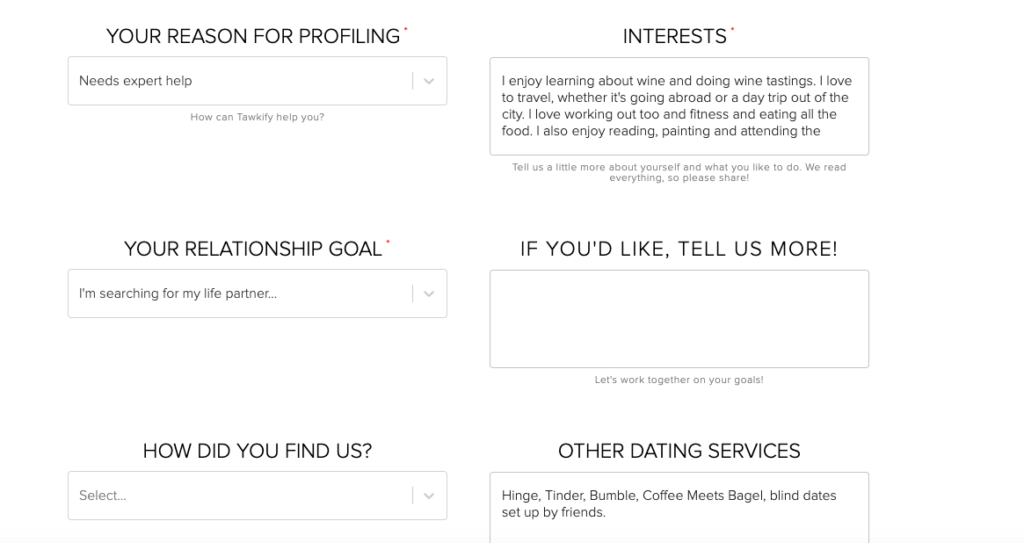
  1. Go to Tawkify.com and create a profile by filling out a lengthy (but essential) questionnaire that asks you all the basics (name, gender, sexual preference, and relationship status), plus personal questions about religion, physical appearance, income, and occupation. 
  2. There are also “free writes” where you can expand on your interests or anything else you’d like your matchmaker to know. You’ll definitely want to take advantage of this — it’ll help your matchmaker help you!
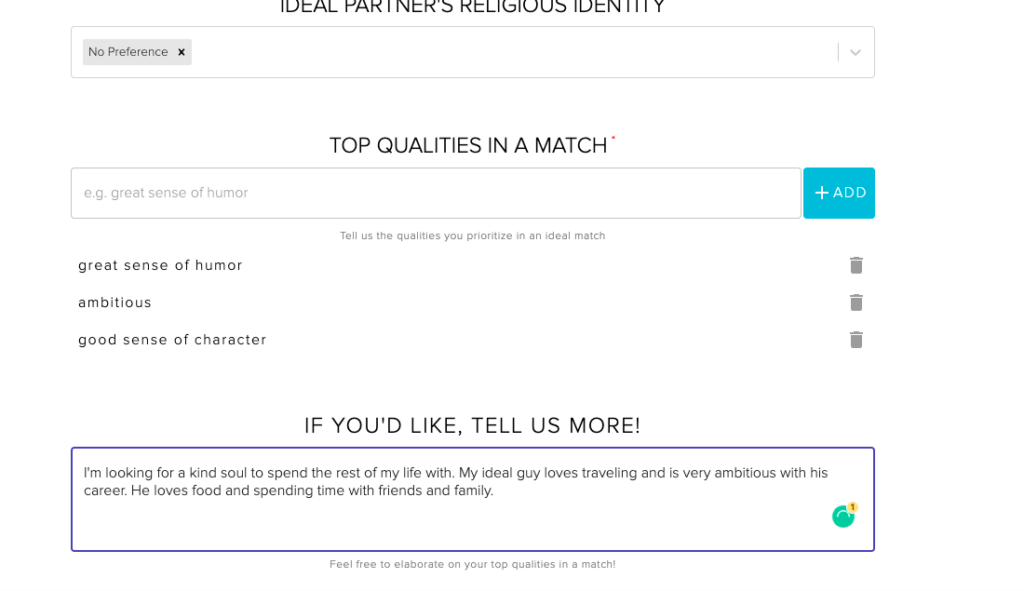
  3. Next, you’ll share details on your ideal match. You can mention specifics such as age and ethnicity and fill out the top qualities you’d like in another person.
  4. Lastly, you’ll upload at least two photos of yourself and confirm your phone number.
  5. When your information is in the system, your profile is set up.
Profile setup on Tawkify matchmaking site.
Relationship goals for Tawkify matchmaking service.

You can engage with Tawkify in two ways: 

Rolodex members join free and are only called when a matchmaker has you in mind for a client.

Paying clients are assigned a personal matchmaker who will find you dates. 

When I tried to sign up for Tawkify, it only gave me the option of joining as a Rolodex member — I assume because they have too many clients to serve.

The Phone Screening

Once you’re in the system, a matchmaker will call you for a 10- to 15-minute screening.

Your call with the matchmaker takes about 15 to 20 minutes. Most matchmakers will ask to Zoom for face-to-face interaction, but some might just call you up. 

Your assigned matchmaker will review your questionnaire and ask you to expand on your answers. For example, Sarah E., 34, a former Tawkify user from Orlando, Fla., indicated that she wanted children, and her matchmaker asked for details about how many and her timeline for having them.

For Rolodex members: If the matchmaker thinks you’re a good fit for their client, they will tell you more information about them, such as their interests, hobbies, type of work, location, age, and why they think you might be a good match, Sarah says. If you agree, they will run your info by their client, and if they approve, you’ll be set up.

For clients: After the screening, your matchmaker takes a few days to review your information and decide whether they’ll take you on as a client. While your matchmaker reviews your materials, you’ll be asked to purchase a package to hold your spot. If you get rejected, you’ll get a refund. If you’re selected, your matchmaker will line up matches for you and plan first dates. 

The Date

If the client agrees with the matchmaker’s pick, the matchmaker will set up the first date. According to Sarah, dates typically are between two to three hours long — just enough time to get to know the person you’re meeting. It’s also a blind date, so you won’t know anything about this person (not even a name or physical attributes). The dates usually start with a drink or brunch, followed by a fun activity like indoor skydiving or mini golf.

After the Date

While most first dates end with a number exchange, with Tawkify, you’re not supposed to exchange them. Instead, you and your date are emailed a survey that allows you to share what you liked and didn’t like about the other person, including any red flags, and whether or not you’d like to see them again, Sarah explains.

If you and your match both agree to see each other again, the matchmaker then swaps your personal information. If it’s not a match and you’re a Rolodex member, you probably won’t hear from a matchmaker again unless they have another client in mind. If you’re a paid client, you simply move on to the next match.

What cities is Tawkify in?

Tawkify is available in major cities, including New York, Los Angeles, Miami, Atlanta, Houston, Minneapolis, and Denver.

How many members does Tawkify have?

The site claims that more than 1 million people use Tawkify to find love — they’ve dubbed themselves the “Romance Rolodex.”

What is the success rate of Tawkify?

According to the Tawkify website, the service has an 80% success rate of creating successful relationships within 6-12 matches. Usually it takes that many matches for your matchmaker to really get a feel for your interests, what you’re looking for and match you with the right person. 

While this rate doesn’t factor in how long these matches last, there is a love stories page dedicated to Tawkify success stories, proving that some are endgame.

How much does Tawkify cost? Is Tawkify expensive?

Because of its premium service, Tawkify costs more than other dating services on the market. There are two packages for paying members (again, Rolodex members are free): Matchmaker Client and Matchable Member — the latter of which is very expensive. Below are the costs and what each offers: 

  • No set number of matches is guaranteed. You’ll only be contacted if a matchmaker has a paid client in mind.

What you get for signing up as a Matchmaker Client (packages may range between $2,000 to $40,000):

  • One date each month curated to you and your match’s interest
  • Your own personal matchmaker
  • Matches carefully selected based on your profile

There is no information on Tawkify’s website regarding monthly packaging (they only give a range between $2,000 and $40,000, so you have to call for more details).

When I tried to call Tawkify, one woman put me through to the sales team, but no one got back to me. Jamie T., 36, from Los Angeles, who joined Tawkify as a client, paid $1,600 for four dates, and Robyn M., 68, from Chicago, paid nearly $9,000 for five dates.

These prices are similar to competitor It’s Just Lunch — which only offers the high client rate.

If you’re a wealthy single looking for love, check out our review of Millionaire Match.

Pros and cons: Is Tawkify worth it?

Pros

All the work is done for you.

With Tawkify, the matchmakers are doing all the legwork, from picking out your matches to setting up the dates. All you have to do is show up. If you’re feeling burnt out by dating, I can see why the idea of having a matchmaker sounds appealing. 

You get to rate your dates when you’re finished.

As mentioned, you don’t exchange numbers at the end of the first date — a plus for those who don’t want random people who haven’t had a background check to have their number. Being able to rate your dates also gives the matchmaker insight on what works and what didn’t.

Dates are curated based on you and your date’s interests.

You’re practically guaranteed a first date that you’ll actually look forward to. Matchmakers will take into account what you and your date like to do when planning the first date. Sarah for example, went on dates that including indoor skydiving.

Cons

You might not always work with the same matchmaker. 

For Jamie, the most disappointing part of her Tawkify experience was how often she was paired with a different matchmaker. 

“I had four different matchmakers,” she says. “By the time they passed me on to the third person, I told them just to read the notes from the previous two because [the phone calls] were a waste of my time.” Ultimately, the constant change of matchmakers was a factor in Jamie not getting quality matches. 

You can’t see other members’ profiles.

Because your dating life is in the hands of the matchmaker, you don’t really know anything about your matches until the first date — not even what they look like. “What [the sales reps] don’t tell you before you pay them is that they are all blind dates,” Jamie says. “ You don’t get to see any photos or even know the guy’s name before you meet them. I never agreed to that and definitely got tricked [by the company].” 

Expensive compared to dating apps.

Tawkify is not a dating app or site, but a personalized matchmaking service — which are expensive. By comparison, sites like Bumble or eharmony cost around $30 to $50 per month.

The matches are not as personalized as they claim.

Tawkify claims that their matchmakers are skilled at pairing up their clients, but all three women I interviewed for this article agreed that while their dates have mostly been “nice,” most of them were not a good fit. 

For example, Robyn specifically told her matchmaker that she was not interested in dating a Christian man and wanted someone who loves dogs. Her first date was with a man who regularly went to church and couldn’t handle dog ownership. Her next three dates were also a poor match.

Tawkify reviews on Reddit

There are plenty of Reddit threads discussing the matchmaking service. Overall, it’s a mixed crowd. On one Reddit thread, many people felt that their dates weren’t bad, but no different than what they’d find on a dating app. Others expressed frustration with their matchmakers, saying they were being dishonest and not taking their preferences into account.

Comment
byu/strugglebusss from discussion
indatingoverthirty

Other reviewers complained about how hard it was to get a refund when they tried to cancel their membership. There are also reviews on the BBB that echo this sentiment.

Comment
byu/hafree27 from discussion
indatingoverforty

One Reddit reviewer found that Tawkify worked for her. Her biggest advice?

“Be open and honest and once you’ve completed your questionnaire, return to it often to continue adding details as you think of them. Also, be honest about any ‘deal breakers’ with your matchmaker.”

No, Tawkify is not worth the thousands of dollars it charges for matchmaking. As Sarah put it: “I just don’t see the point in paying someone to send me on bad dates.” I agree. If your matchmaker isn’t going to bother taking your profile and interests into account, you’re better off joining a reputable dating site like eharmony. You’ll save a ton of money doing so.

Alternatives to Tawkify

Check out other dating site reviews:

Plenty of FishZooskTinder
Christian MingleAdult Friend FinderMatch.com
Catholic dating sitesOKCupidElite Singles
Spiritual dating appsSingleParentMeetBumble
Is Tawkify legitimate?

Yes, Tawkify is legitimate. The matchmaking service was founded in 2012 by E. Jean Carroll, a former longtime advice columnist for Elle magazine, and Kenneth Shaw, a 27-year-old Microsoft employee. The company has an A+ rating on the Better Business Bureau website (though it’s not accredited) and has 4.5 out of 5 stars on Trustpilot based on more than 6,775 reviews.

What cities is Tawkify in?

Tawkify is available in major cities, including New York, Los Angeles, Miami, Atlanta, Houston, Minneapolis, and Denver.

How many members does Tawkify have?

The site claims that more than 1 million people use Tawkify to find love.

What is the success rate of Tawkify?

According to the Tawkify website, the service has an 80% success rate of creating successful relationships within 6-12 matches.

Is Tawkify worth it?

No, Tawkify is not worth the thousands of dollars it charges for matchmaking.

In a lot of ways, “bookkeeping” is exactly what it sounds like it would be: keeping track of financial transactions for a business, individual or organization. These jobs can pay $75 or more and is considered a growth industry.

Good news is there are fast and affordable online certifications to help you get started and finding a job.

Keep reading to learn:

1. How to become a bookkeeper and get certified online

2. How to gain bookkeeping experience

3. Where to find bookkeeping jobs

FAQs about bookkeeping as a profession

FAQs about a bookkeeper’s earning potential

FAQs about how to become a bookkeeper

Bottom line: You can learn to become a bookkeeper in less than a year and launch a new career

Or, if you’re ready to get started, check out our No. 1 recommendation for learning how to become a bookkeeper, as well as launch a profitable bookkeeping business, is Bookkeepers.com (formerly Bookkeeper Launch), an A+ BBB business founded by a CPA and taken by more than 12,000 people.

1) How to become a bookkeeper: Find an online training course

Online bookkeeping courses allow you to learn the business on your own timeline. Even if you have no formal education, you can get a bookkeeping certification online to present to future clients and employers. 

Here are some options for online bookkeeper training:

Bookkeepers.com

Bookkeepers.com is the first course specifically designed to help you:

  • Learn bookkeeping skills
  • Start your own virtual bookkeeping business
  • Grow your client list through marketing efforts
  • Scale your business to serve more clients efficiently
  • Maximize opportunities to offer additional services through e-learning
  • Add value beyond financial statements and transaction support, such as offering financial advisory services or tax preparation.

Bookkeeper Launch is still the flagship product, but Bookkeepers.com also offers a number of paid online courses. The topics range from basic to more advanced topics:

  • Cybersecurity for Bookkeepers
  • Marketing Machine
  • Build a 6-Figure Bookkeeping Business
  • Outstanding Processes & People (OPP)
  • Pricing & Packaging
  • New Client Onboarding
  • Advisory Services

Price:

Paid courses range from $97 to $2,995. You can get started with Bookkeeper Launch for as low as $249 per month for one year with unlimited access and updates.

Time required:

The Bookkeeper Launch System is made of multiple courses that total 58 hours (suggested pacing is 90 days at a rate of about 5 hours per week).

Coursera

Coursera is an online learning platform that hosts courses about a range of subjects, including bookkeeping, such as Intuit’s Bookkeeping Basics, which is designed to teach you the ropes as a beginner. It has a score of 4.6 out of 5 stars based on 6,253 reviews. 

Bookkeeping Basics is part of the four-course Intuit Bookkeeping Professional Certificate, and has a score of 4.6 out of 5 stars based on 7,387 reviews.

Bookkeeping Basics is an introductory course, but it’s not enough to get started in bookkeeping as a career. For that, you’ll want to go for the Intuit Bookkeeping Professional Certificate which prepares you to take the Intuit Academy Bookkeeping exam and get certified to demonstrate your competence to future clients.

You’ll learn:

  • The basics of bookkeeping, from accounting tasks and responsibilities to ensuring the integrity and security of financial data
  • How to understand common assets among businesses, depreciation, financial control and transaction recording
  • How to identify liabilities and equity types, understand payroll functions, and analyze the financial position of a business
  • How to reconcile cash and help clients make decision based on financial data

Unlike Bookkeepers.com, there is no help to launch a virtual bookkeeping business, but you can take advantage of free resume help, interview preparation, and use Coursera’s job search if you prefer to work for a company.

Price:

Free 7-day trial. Then, $59 per month until you cancel or pay $399 for one year. 14-day money-back guarantee. Financial aid available.

Time required:

Bookkeeping Basics takes about 16 hours to complete, and the Intuit Bookkeeping Professional Certificate takes two months to complete at the suggested pace of ten hours per week.

How to become private investigator

Udemy

Udemy is another online educational platform that offers thousands of courses on hundreds of subjects, including bookkeeping. These courses are typically inexpensive, between $50 and $200 on average. This makes them ideal for those who are on a budget, or who are perhaps interested in learning the basics before paying for a more advanced course.

The Bookkeeping Basics #1: Understand the Fundamentals program is an excellent place to start. It  has a rating of 4.6 out of 5 stars, based on more than 7,222 customer reviews.

This is an introductory course to bookkeeping. It’s approved by the National Association of State Boards of Accountancy (NASBA) and offers a continuing professional education (CPE) credit of 7.0. At least 40 CPE credits are required by certified public accountants (CPAs) each year to achieve compliance.

The course includes practical, hands-on assignments 

Price: 

$149.99 (Udemy often offers steep discounts) or you can sign up for a monthly plan starting at $20 after a 7-day free trial and a 30-day money back guarantee.

Time required:

The course above takes 4.5 hours to complete and introduces the basics of bookkeeping. There are two follow-up courses in this series that take 3.5 hours and 5 hours each. You could spend as little as a few hours or weeks taking Udemy’s various bookkeeping courses. 

Since these courses are fairly short, they may not be enough to help you launch a career right away, but you can get your feet wet and see if bookkeeping is a potential fit.

LinkedIn Learning

LinkedIn Learning is an online education platform run by the social media company LinkedIn. It used to be known as Lynda.com. LinkedIn Learning offers thousands of online courses and certifications which, once complete, you can display on your LinkedIn profile. This makes them a great option for professionals who actively use LinkedIn to network and job hunt.

LinkedIn Learning offers Accounting Foundations: Bookkeeping, which can be a good option for anyone who is just getting started or a professional who needs to sharpen skills or gain NASBA CPE credits (this course offers 2.8 CPE credits).

The course is self-paced and features video instruction.

You’ll learn:

  • How to analyze transactions
  • How to record the effects of the transactions
  • How to summarize the impact of those transactions
  • How to prepare a financial report

Completing this course can improve your understanding of bookkeeping, but you’ll need more training to get started with bookkeeping as a career. To help you, LinkedIn Learning offers a bookkeeping learning path to help you learn the craft and earn a certificate of completion that you can use to market your skills.

These courses deal strictly with education but do not offer business launch, marketing, or scaling support like Bookkeepers.com.

Price:

You can buy this course for $34.99. Or, subscribe to LinkedIn Learning and get a one-month free trial and pay $39.99 per month or $19.99 per month with an annual subscription. You’ll have access to all courses as a part of your subscription. 30-day money-back guarantee. Access courses via computer, tablet, or mobile phone.

Time required:

This course takes just over 1.5 hours to complete.

NACPB

The National Association of Certified Public Bookkeepers (NACPB) is a professional organization that caters to bookkeepers. The organization offers a number of different training programs for bookkeepers, including:

  • Accounting Fundamentals
  • Payroll Fundamentals 
  • QuickBooks Online Fundamentals 
  • Accounting Principles

You can access these courses through the NACPB Education Pathway. These courses offer CPE credits and are for those who want to learn the skill of bookkeeping as well as professionals pursuing continuing education. NACPB is known in the field, so completing their training can be beneficial to get started in your bookkeeping career NACPB also offers a Bookkeeping Certification to obtain the Certified Public Bookkeeper (CPB) license. 

Completing a course can increase your knowledge of bookkeeping, but to prepare for a career, go for the certification so you can obtain the license. You’ll have the CPB credential to add to your credibility as you pursue jobs or start your own virtual bookkeeping business.

Price:

Certifications and courses start at $100. NACPB members get 20% off. An annual NACPB membership starts at $200 (there is a pro membership for $250). 14-day money back guarantee.

Time required:

Most courses range in length from seven to 14 weeks (if you take one session per week). However, all NACPB courses are self-guided, so you could realistically complete any course in less time.

Colleges and universities

A number of colleges and universities offer online and in-person training and certificate programs to become a professional bookkeeper. Search online for “college bookkeeping classes near me” or “online college bookkeeping classes” to find available programs.

Here are a few examples:

  • Cornell University offers eCornell, an online learning platform that offers a self-paced accounting certificate course that is interactive and provides access to a community of like-minded students 
  • Penn Foster offers an online diploma in bookkeeping you can take on your own time and pace
  • Ashworth College has an online bookkeeping course to prepare you for the NACPB bookkeeper certification exam

Costs and completion times vary and are set by each institution. Contact the school directly to learn more.

2) How to become a bookkeeper: Look for internships or on-the-job opportunities while in training

Experience is key in any job market, and bookkeeping is no exception. Aspiring bookkeepers will benefit from finding a paid internship or an entry-level bookkeeping position like a bookkeeping assistant while they complete their training. 

Taking on an entry-level bookkeeping job can allow you to focus on learning the business without juggling the demands of another job. Some companies might offer paid internships.

Here’s how to find bookkeeping internships and on-the-job opportunities while you learn:

  • Check with your training program – Ask your student services office for help on finding a business that will give you a chance to practice your skills. Bookkeeper Launch’s closed Facebook group is designed to facilitate networking for jobs with some of the best virtual bookkeeping services.
  • Leverage LinkedIn – Ensure you update your LinkedIn profile to show you are seeking bookkeeping opportunities and engage with companies
  • Use job boards – Search FlexJobs, Indeed, and other online career portals to look for leads
  • Join a bookkeeping organization – Membership often has perks like career assistance
  • Contact local firms – Research firms in your area that are looking for bookkeepers and contact them to ask about part-time or internship opportunities
  • Attend career fairs – Look for fairs with financial companies in attendance and network with the representatives
  • Use an app – Apps like Handshake, Tallo, and Parker Dewey can help you find internship opportunities and freelance gigs in your field

3) How to become a bookkeeper: Find job opportunities “near me” and remote

While many large companies employ a bookkeeper full-time, smaller companies often hire part-time or freelance bookkeepers to help with finances and accounting. Many individual entrepreneurs also hire virtual bookkeepers to help them stay on top of their cash flow and prepare quarterly income tax payments. Some individuals hire bookkeepers.

According to the U.S. Bureau of Labor Statistics Occupational Outlook Handbook (BLS OOH), the demand for bookkeeping is expected to decline by 6% through 2032.1 This data refers to in-house bookkeeping jobs.

BLS data on remote jobs projects that accountants and auditors (professions parallel to bookkeeping) are the fastest growing careers among business and financial operations telework.2

Whether you’re looking for a bookkeeping job “near me” or you’d like to find a remote opportunity, there are several strategies and tips for finding a part-time or full-time bookkeeping job:

  • Reach out to local businesses to network to connect with a business owner who needs bookkeeping services
  • Ask your friends and family if they know anyone looking for bookkeeping support
  • Update your LinkedIn profile to reflect your bookkeeping skills and desire for work so your profile will show up in searches if someone looks for a bookkeeper in your area

Bookkeeper Launch has a whole section on finding jobs online, including specifically on LinkedIn.

This video shows why virtual bookkeeping is a great career, especially for single moms who want to work from home:

If you’re first starting out, or you want flexible work, part-time or freelance bookkeeping jobs might be for you. You can find entry-level bookkeeping jobs online at a number of job sites, including:

  • FlexJobs
  • ZipRecruiter
  • Indeed 
  • Networking events near you 
  • Small business organizations in your community 
  • LinkedIn
  • Through marketing efforts including social media, newspaper ads and bus stops

FAQs about bookkeeping as a profession

What does a bookkeeper do?

Bookkeepers help business owners to maintain their business’ financial records. This can include recording sales, revenue, and expenses, check statements for accuracy, verify receipts, billing and account receivables and payroll.

Some bookkeepers work on staff, though it’s increasingly common to work as an independent bookkeeper — especially small or new businesses. Many bookkeepers have multiple clients at the same time.

Who are good candidates to become a bookkeeper?

If you love numbers and math and actually enjoy tracking data in spreadsheets, a career as a bookkeeper can be a great fit for moms — especially since these high-paying jobs are often available on a part-time basis, as a work-at-home side job.

What kinds of tasks do bookkeepers do?

While the exact role of a bookkeeper can depend on the specific job they’re doing, these professionals focus on tasks that help businesses and individuals keep their finances organized. Common job duties bookkeepers perform include:

  1. Learn and use bookkeeping software, databases, and spreadsheets, including Excel, Quickbooks, and Freshbooks payroll software.
  2. Enter important financial transactions into the appropriate bookkeeping software
  3. Monitor and keep track of client payments
  4. Keep track of business expenses via bookkeeping software
  5. Reconcile discrepancies found in financial records
  6. Produce financial reports
  7. Help clients keep track of receipts that document their expenses
  8. Check financial records for accuracy
  9. Help clients stay on top of their taxes, including withholding or quarterly tax payments

If your career goals include advancing to accountant or CPA, that involves a more rigorous process. Unlike bookkeeping — where certification is optional — a CPA license requires passing demanding education, exam, and experience milestones. This guide on getting a CPA license breaks down the steps.

A bookkeeper who is self-employed running her own bookkeeping business may take on a broader range of duties than their peers. They will likely have to track their own finances including income and expenses, for example. They will also be required to make their own tax payments and make sure their business remains in compliance with local and state law.

Self-employed bookkeepers will also need to learn how to market their businesses to attract and keep new clients — not to mention keep their own books!

FAQs about a bookkeeper’s earning potential

Can you make good money as a bookkeeper?

Yes, you can make good money as a bookkeeper, and the profession has even greater earning potential as you gain experience. If you pursue a virtual practice, you’ll set your own competitive rates.

Bookkeepers.com’s Bookkeeper Launch, a course run by CPA Ben Robinson, reports many of its students earn $75 per hour in their freelance bookkeeping business.

If you pursue a position at a business, instead of freelancing, the hourly or salary-based pay will be set by the employer and can vary.

How much money can you make as a bookkeeper?

According to the BLS OOH, the median salary for a bookkeeper is $45,860 per year, or $22.05 per hour.3 

As of May 15, 2025, ZipRecruiter reports the national average income for a bookkeeper in the United States is $50,573 per year, or $24.31 per hour, with higher earners making around $74,000.4

Who needs bookkeepers?

Bookkeepers are hired by every single kind of business, nonprofit, and government agency. Many larger organizations hire full-time bookkeepers on staff. Many accountants, CPAs and tax preparers also work with bookkeepers to help support their clients.

Freelance bookkeepers and those who own their own bookkeeping businesses often report that the variety and types of businesses and organizations they support is one of the best parts of bookkeeping. This post details how to start a bookkeeping business, and find and grow clients.

Erin Bardsley was a newly divorced single mom in Vermont, and needed a new career.

Erin says that she loves that she helps a bakery, yoga studio, and an arts non-profit — especially since they are local businesses in her local community. Today she earns $70 per hour and is killing it as a bookkeeper:

FAQs about how to become a bookkeeper

What qualifications do I need to be a bookkeeper?

To get started as a bookkeeper, you do not need a college degree or a bookkeeper certification. These qualifications can help but are not necessary. You just need to be able to demonstrate that you have the skills to handle the tasks your clients need.

These skills are required to be a successful bookkeeper, whether you have your own business, or get a staff job with another company:

  1. Attention to detail
  2. Math
  3. Problem solving
  4. Ability to see the big picture
  5. Facility with technology
  6. Commitment to technology
  7. Great communicators (clients trust you with their bank account information, and trust vendors who respond quickly and thoroughly)
  8. For entrepreneurs: Good at networking, and gaining the trust of new clients

Most bookkeeper clients will look for some or all of these specific, hard skills:

  1. Spreadsheets — typically Microsoft Excel
  2. Quickbooks, or other popular accounting / bookkeeping software
  3. Basic accounting
  4. Basic understanding of bookkeeping ethics and law

In addition to technical skill, certain personality traits can also help you stand out:

  1. Having excellent attention to detail is a must for bookkeepers since they need to ensure accuracy of financial transactions and a wide range of important figures.
  2. Computer and math skills are also required since you’ll be computing numbers regularly with the help of bookkeeping software programs.
  3. The ability to communicate effectively is important since you’ll need to interact and discuss financial matters with either an employer or your clients.

Do I need a college degree in bookkeeping?

A college degree isn’t necessary to become a bookkeeper. No experience is necessary to take classes to learn bookkeeping skills. Eventually, you might want to pursue a bookkeeping certification to demonstrate your competence and increase the legitimacy of your virtual bookkeeping business.

Can I teach myself to be a bookkeeper?

You can become a self-taught bookkeeper using an online course like Bookkeeper Launch. It’s a self-paced course that teaches you the basics and helps guide you on setting up your business successfully.

Is a bookkeeping certificate worth it?

One of the beautiful things about owning your own bookkeeping business is that you do not need any specific bookkeeping certification, degree, or formal training to get started.

Coursework through a community college, or online courses like Bookkeeper Launch will teach you the basics to help you get that first job.

However, having a certification can be helpful when you are building your client base. It shows potential clients that you have taken extra steps to serve their needs.

How long does it take to become a bookkeeper?

With the Bookkeeper Launch course, you can train to become a bookkeeper in as few as 90 days. Each bookkeeping course varies in terms of completion time but most options take less than a year.

Bottom line: You can learn to become a bookkeeper in less than a year and launch a new career

Thousands of people enjoy successful bookkeeping careers, and many of them launch businesses that give them flexibility, freedom of location, a good salary, and the satisfaction of working with successful, interesting entrepreneurs. 

Online courses like Bookkeeper Launch can help you:

  • Gain skills to become a bookkeeper with no prior experience
  • Leverage tools and systems to work efficiently
  • Learn how to market yourself to gain clients
  • Grow your client base over time
  • Connect with other bookkeeping business owners to build a sense of community
  • Scale your business and expand your services as your grow

Bookkeepers.com is an excellent resource to help you launch and maintain a successful bookkeeping business. It offers free courses to give you an idea of what you can expect from a bookkeeping career, so you can determine if it’s a good fit.

Related: Bookkeeping not a fit? We have a list of jobs that pay well and do not require a degree.

What does a bookkeeper do?

Bookkeepers help business owners to maintain their business’ financial records. This can include recording sales, revenue, and expenses, check statements for accuracy, verify receipts, billing and account receivables and payroll.

Can you make good money as a bookkeeper?

Yes, you can make good money as a bookkeeper, and the profession has even greater earning potential as you gain experience. If you pursue a virtual practice, you’ll set your own competitive rates.

How much money can you make as a bookkeeper?

According to the BLS OOH, the median salary for a bookkeeper is $45,860 per year, or $22.05 per hour.

Who needs bookkeepers?

Bookkeepers are hired by every single kind of business, non-profit and government agency. Many larger organizations hire full-time bookkeepers on staff. Many accountants, CPAs and tax preparers also work with bookkeepers to help support their clients.

Sources:

  1. “Bookkeeping, Accounting, and Auditing Clerks” Bureau of Labor Statistics Occupational Outlook Handbook September 6, 2023 https://www.bls.gov/ooh/office-and-administrative-support/bookkeeping-accounting-and-auditing-clerks.htm
  2. “Working from home: Outlook and wages in occupations with telework” U.S. Bureau of Labor Statistics career Outlook September 2022 https://www.bls.gov/careeroutlook/2022/article/telework.htm
  3. “Quick Facts: Bookkeeping, Accounting, and Auditing Clerks” Bureau of Labor Statistics Occupational Outlook Handbook September 6, 2023 https://www.bls.gov/ooh/office-and-administrative-support/bookkeeping-accounting-and-auditing-clerks.htm
  4. “Freelance Bookkeeper Salary” ZipRecruiter https://www.ziprecruiter.com/Salaries/Bookkeeper-Salary#Yearly