Running a small business can feel exciting and overwhelming at the same time. You focus on getting customers, improving your product, and growing your brand. But money management often gets pushed to the side until something goes wrong. That is when small mistakes start turning into bigger problems.
The truth is, most financial issues in business are not caused by one big failure. They usually come from small habits that build up over time. The good part is that once you understand these mistakes, you can avoid them and keep your business on a steady path. Let’s look at the most common financial mistakes small business owners make and how you can stay ahead of them.
Taking a loan can help your business grow faster. You might use it to buy equipment, hire staff, or expand your operations. But many business owners jump into loans without fully understanding the repayment side.
If your monthly payments are too high, they can quickly affect your cash flow. This makes it harder to cover daily expenses and can lead to stress. Before taking any loan, it is important to estimate how much you will need to pay each month.
Using a business loan payment calculator can give you a clear idea of your monthly commitment. It helps you see the total cost and decide if the loan fits your budget. This simple step can prevent you from taking on more debt than your business can handle.
Mixing personal and business finances
Many small business owners start by using their personal accounts for business expenses. It may seem easier at first, but it creates confusion later on.
When your personal and business finances are mixed, it becomes difficult to track your spending. You may not know how much your business is really earning or where your money is going. This also makes tax filing more complicated.
Opening a separate business account is a simple step that makes a big difference. It helps you stay organized, track expenses clearly, and understand your business performance better.
Ignoring cash flow management
Cash flow is the money moving in and out of your business. Even if your business is making sales, poor cash flow can still cause problems.
Many business owners focus only on profits and ignore how cash moves daily. You might have money coming in later, but bills need to be paid now. This gap can create serious issues.
Keeping track of your cash flow helps you plan better. You can prepare for slow periods and make sure you always have enough money to run your business smoothly.
Underestimating expenses
It is easy to focus on big expenses like rent or salaries, but small costs can add up quickly. Things like subscriptions, supplies, and maintenance can slowly eat into your profits. Utility bills fall squarely into this category. A small drift in the electricity rate goes unnoticed because the bill still looks normal, even when the contract has rolled onto a higher default. Taking time to compare business electricity tariffs across suppliers is one of the simplest ways to catch costs that have quietly outgrown what they should be.
Many business owners create a budget but forget to include these smaller or unexpected costs. This leads to spending more than planned.
A good approach is to review your expenses regularly. Look at where your money is going and adjust your budget when needed. Always keep a little extra aside for unexpected costs.
Not setting aside money for taxes
Taxes are one of the biggest surprises for new business owners. If you are not prepared, they can put a heavy strain on your finances.
Instead of waiting until tax time, it is better to set aside a portion of your income regularly. This makes the process much easier and avoids last-minute stress.
You can also work with a tax professional to understand how much you should save. Staying prepared helps you avoid penalties and keeps your finances stable.
Scaling your business without financial planning
Growing your business is exciting, but it can quickly lead to financial strain if not planned properly. Many owners increase spending on staff, inventory, or operations without making sure their cash flow can support it.
When expenses rise faster than revenue, it creates pressure and can lead to unnecessary debt. Before scaling, review your finances and make sure your business can handle the added costs. A steady and well-planned approach to growth helps reduce risk and keeps your business stable.
Skipping financial tracking and reports
Some business owners avoid looking at financial reports because they seem complicated. But ignoring your numbers can lead to poor decisions.
Simple reports like monthly income and expenses can give you valuable insights. They help you understand what is working and what needs improvement.
You do not need advanced skills to track your finances. Even cash flow management software can help you stay informed and make better decisions for your business.
Not building an emergency fund
Unexpected situations are part of running a business. You might face slow sales, sudden repairs, or other challenges.
Without a financial backup, these situations can put your business at risk. Many owners rely on loans during tough times, which adds more pressure.
Building an emergency fund gives you a safety net. It helps you handle difficult periods without affecting your daily operations.
Trying to do everything alone
Running a business involves many responsibilities, and handling everything alone can lead to mistakes. Financial tasks like accounting and taxes require time and attention.
Trying to manage everything by yourself can result in errors and missed opportunities. It can also take your focus away from growing your business.
Getting help from a professional or using simple tools can make things easier. It allows you to stay organized and make better financial decisions.
Larger organizations facing complex revenue and billing processes often turn to Salesforce Revenue Cloud Advanced consulting to streamline their financial operations. Implementing these unified systems ensures smooth transaction tracking while freeing up valuable leadership time to focus on strategic growth.
Financial mistakes are common, especially when you are managing many aspects of a business at once. What matters is how you handle them and what you learn from them. By paying attention to your finances, planning ahead, and using the right tools, you can avoid many of these problems.
Small steps like tracking expenses, planning payments, and staying organized can make a big difference over time. When your finances are in order, it becomes much easier to focus on growth and build a strong, stable business.
People who love cars do not have to settle for basic mechanic work or car sales. The better opportunities are in the places where vehicles are getting more complex, more expensive to repair, harder to diagnose, and more dependent on skilled hands.
These jobs still need real-world judgment, vehicle knowledge, problem-solving, and physical work. Some are traditional car careers, but many sit in the newer corners of the industry, including EV repair, ADAS calibration, fleet operations, vehicle inspection, insurance claims, and automotive cybersecurity.
ADAS calibration technicians work on the cameras, radar, sensors, and driver-assistance systems that help modern vehicles brake, steer, park, and avoid collisions. After windshield replacement, suspension work, body repairs, or collision damage, those systems often need to be recalibrated before the car is safe to drive.
This is one of the stronger newer routes for car lovers because the work is technical, hands-on, and tied to real vehicles in real repair bays. ADAS calibration technicians average around $53,542 a year, and calibration work is becoming more common as newer vehicles age into the repair market. By 2025, calibration appeared on more than 23% of repairable appraisals, with nearly one-third of direct repair program claims including one.
EV and hybrid vehicle technician
Image Credit: Shutterstock
EV and hybrid technicians work on high-voltage batteries, electric motors, charging systems, inverters, cooling systems, and electronic controls. It is still a repair career, but it is much more specialized than general wrenching and usually requires extra safety training.
This is a smart path for someone who loves cars but wants to work where the industry is clearly heading. Electric vehicle technicians average about $61,927 a year, with top earners around $71,050. The work is not easy to automate because someone still has to inspect, isolate, test, and repair the vehicle safely.
Automotive diagnostic technician
Image Credit: Shutterstock
Diagnostic technicians are the problem-solvers shops call when the obvious repair does not fix the vehicle. They deal with electrical faults, drivability issues, module communication problems, warning lights, intermittent failures, and customer complaints that need more than a quick parts swap.
This is a better fit for car lovers than basic service work because it rewards curiosity and patience. Automotive diagnostic technicians average around $66,701 a year, and broader automotive service technician jobs are projected to have about 70,000 openings a year through 2034.
Paintless dent repair technician
Image Credit: Shutterstock
Paintless dent repair technicians remove dents without repainting the vehicle. They work with metal rods, lights, glue-pulling tools, and careful pressure to repair door dings, hail damage, parking lot dents, and minor body damage while keeping the factory paint intact.
This is a good alternative car career because it is specialized, portable, and hard to fake. Paintless dent repair technicians average about $58,996 a year, with top earners around $74,282. Every panel, dent, light angle, and access point is different, so the job still depends heavily on skill and touch.
Paint protection film and tint installer
Image Credit: Shutterstock
Paint protection film and tint installers work on the appearance and protection side of the car world. They install clear film, window tint, ceramic film, vinyl accents, and other surface protection products on daily drivers, luxury vehicles, collector cars, and performance cars.
This is a strong option for someone who loves clean cars and detail work but does not want to spend every day inside engines or transmissions. Paint protection film installers average about $56,443 a year, with many workers earning between $18.51 and $36.06 an hour. The job depends on prep, trimming, stretching, patience, and a clean finish.
Auto damage appraiser
Image Credit: Shutterstock
Auto damage appraisers inspect vehicles after crashes and estimate what it should cost to repair them. They may work for insurers, repair networks, independent appraisal companies, or claims firms, and the job suits people who understand both cars and repair costs.
This is a practical car career for someone who likes vehicles but wants less daily shop labor. Insurance appraisers for auto damage earn a median wage of $76,650 a year, with the highest 10% earning more than $104,920. The work still needs human judgment because real damage, prior repairs, parts availability, and repair quality are not always obvious from photos.
Vehicle condition inspector
Image Credit: Shutterstock
Vehicle condition inspectors check cars before auctions, lease returns, dealer sales, repossessions, fleet sales, and online vehicle listings. They look for body damage, paintwork, tire wear, warning lights, interior wear, mechanical issues, and anything that affects the vehicle’s value.
This is a good fit for people who can spot problems quickly and know when a car is cleaner on paper than it is in person. Automotive vehicle inspectors average about $48,386 a year, while motor vehicle inspectors average about $60,199 a year. The job is hard to replace because condition, wear, smell, sound, and repair clues still need a trained eye.
Automotive locksmith
Image Credit: Shutterstock
Automotive locksmiths handle lockouts, lost keys, key cutting, transponder programming, key fobs, ignition problems, and access issues. Modern cars have made this job more technical, not less, because keys and immobilizer systems are tied into vehicle electronics.
This is a solid alternative route for car lovers who like problem-solving but do not want full-time repair work. Automotive locksmiths average around $54,192 a year, while broader locksmith salary data puts the average at about $55,162 a year. It is also a very practical service because people still lose keys, break fobs, buy used cars with missing keys, and get locked out.
Fleet manager
Image Credit: Shutterstock
Fleet managers oversee the vehicles a business depends on. That can include maintenance schedules, fuel use, driver safety, repair vendors, replacement planning, telematics, insurance, downtime, and deciding when a vehicle should be repaired or retired.
This is a strong car-related career for someone who likes vehicles, systems, numbers, and logistics. Fleet managers average about $102,453 a year, with many earning between $91,142 and $117,852. The demand is steady because delivery companies, contractors, utilities, government agencies, rental companies, and service businesses all need vehicles running reliably.
Automotive cybersecurity analyst
Image Credit: Shutterstock
Cars are now connected machines with apps, sensors, infotainment systems, telematics, over-the-air updates, charging systems, and wireless entry points. Automotive cybersecurity analysts help protect those systems from hacking, data theft, remote attacks, and software weaknesses.
This is one of the best car-loving careers for someone who is more technical than mechanical. The broader information security analyst field pays a median wage of $124,910 a year and is projected to grow 29% from 2024 to 2034. The automotive angle is more niche, but connected vehicles make it a serious long-term field.
Automotive technical trainer
Image Credit: Shutterstock
Automotive technical trainers teach technicians how to repair, diagnose, and service modern vehicles. They may work for manufacturers, dealership groups, trade schools, tool companies, training centers, or aftermarket suppliers.
This is a good later-career path for experienced technicians who still love cars but want less physical wear and tear. Automotive instructors with a bachelor’s degree commonly fall between $69,611 and $76,409, while technical trainer II roles average about $73,189 a year. As cars become more complex, the need for people who can explain systems clearly does not go away.
Heavy vehicle and mobile equipment technician
Image Credit: Shutterstock
Heavy vehicle and mobile equipment technicians repair construction machines, buses, trucks, farm equipment, and other large vehicles. It is not strictly a car job, but it suits people who love engines, hydraulics, diesel systems, diagnostics, and big mechanical problems.
This path has better demand than many people realize. Heavy vehicle and mobile equipment service technicians earn a median wage of $62,740 a year, and employment is projected to grow 6% from 2024 to 2034. The work is physical, local, and machine-specific, which keeps it firmly in human hands.
Automotive service manager
Image Credit: Shutterstock
Automotive service managers run the repair side of a shop or dealership. They handle customers, technicians, parts delays, schedules, warranties, estimates, quality checks, and the constant pressure of getting vehicles fixed and returned on time.
This is a strong option for car people who understand repair work but are better suited to managing chaos than turning wrenches all day. Automotive service managers average about $107,466 a year, which works out to roughly $52 an hour. The job is not going away because shops still need someone to translate between customers, technicians, parts departments, and repair timelines.
Performance engine builder
Image Credit: Shutterstock
Performance engine builders assemble, measure, test, and fine-tune engines for race cars, restoration projects, performance shops, and specialty builds. The work can include machining, balancing, clearancing, blueprinting, and building engines to handle more power than factory setups.
This is one of the more satisfying hands-on jobs for people who genuinely love cars, but it is also a craft career. Engine builders average about $57,500 a year, while machinists earn a median wage of $56,150. Even with slower overall growth in machining, skilled performance work remains hard to replace because it depends on precision, experience, and judgment.
Collision repair technician
Image Credit: Shutterstock
Collision repair technicians fix damaged vehicles after accidents. They may repair panels, replace structural parts, work with aluminum or composites, measure frames, handle glass, prep surfaces, and make sure repaired vehicles are safe and roadworthy.
Modern collision work is more technical than many people think because newer vehicles include sensors, special materials, manufacturer repair procedures, and calibration requirements. Automotive body and related repairers earn a median wage of $51,680 a year, with the highest 10% earning more than $87,040. Damaged cars still need skilled people to bring them back properly.
Automotive engineer
Image Credit: Shutterstock
Automotive engineers help design, test, improve, and validate vehicle systems. Depending on the role, they may work on engines, EV platforms, suspension, braking, crash safety, aerodynamics, thermal systems, manufacturing, or durability testing.
This is the strongest route for car lovers who enjoy math, testing, design, and problem-solving as much as driving. Mechanical engineers earn a median wage of $102,320 a year, and employment is projected to grow 9% from 2024 to 2034. It is more academic than many car jobs, but it offers one of the clearest paths into building the vehicles of the future.
Discover job hunting tips, ways to earn more, and flexible working options:
The Roseville pottery vase you listed on eBay sold for $165. You shipped it, paid the platform fee, and walked away with $130. The same piece sat in a dealer’s booth down the street with a $310 price tag and sold in two weeks. That gap is real, it is repeatable, and it has nothing to do with luck.
eBay’s traffic works against you when you are selling antiques and collectibles. Serious collectors shop there, but so does everyone else, and your piece sits in a sea of identical search results, most of them cheaper. The buyers who know what your item is actually worth are often shopping somewhere else entirely.
These twelve venues consistently get sellers more money for antiques and collectibles. Some take a higher percentage than eBay. Most end up netting you more anyway, because the buyers they attract will pay what something is actually worth.
Ruby Lane has been the internet’s most trusted address for antiques and vintage collectibles since 1998. The platform vets every seller before they can open a shop, which keeps out the reproductions and misrepresented pieces that undermine buyer confidence on general marketplaces. That trust translates directly into higher selling prices. Buyers come here specifically looking for quality, not a deal.
The fee structure is a 9.9% commission on sales up to $2,500 per item, dropping to 5% between $2,500 and $7,500, plus a $45 monthly shop fee. The commission is capped at $250 per item, which makes it genuinely attractive for high-value pieces. A piece that sells for $8,000 nets you $7,530 after the fee cap, versus roughly $6,940 after eBay’s cut. On anything in the $300 to $800 range, the targeted audience more than compensates for the monthly maintenance cost.
Ruby Lane is best for jewelry, art glass, ceramics, porcelain, vintage dolls, fine jewelry, and small decorative arts. Furniture is harder to ship, so it gets less traction here than on other platforms. Set realistic prices based on dealer retail, not eBay’s completed listings. The buyers here know what things cost, and they are not expecting a bargain-bin discount.
Heritage Auctions
Image Credit: Public Domain via Wiki Commons
Heritage Auctions is the world’s largest collectibles auction house, with over 1.5 million registered bidders and category specialists who know their fields. When motivated bidders compete for something specific, prices go where the market actually takes them, which is almost always higher than a fixed-price eBay listing attracting the first buyer who notices it.
Seller commissions at Heritage vary by category, typically running 10% to 15% for signature live auctions. Photography, cataloging, and insurance are included in that fee with no hidden add-ons. For weekly internet auctions, the seller’s commission is around 15%. The key advantage is what those fees buy you: access to the entire Heritage buyer network, professional catalog descriptions, and the credibility that makes collectors trust what they are bidding on.
Heritage performs best for coins, sports cards and memorabilia, original comic art, vintage comics, fine art, jewelry, historical documents, Americana, wine, and Hollywood memorabilia. A common postcard or a garden-variety flatware set is not a fit. But if you have a key-date Morgan dollar, a signed game-used jersey, or a first-edition piece with solid provenance, Heritage will reach the buyers who will fight over it. Contact them through their consignment inquiry page and a specialist will tell you whether your item is appropriate for their auctions.
Chairish
Image Credit: Shutterstock
Interior designers account for a significant share of Chairish’s buying activity. That single fact explains why prices on the platform consistently outperform eBay for furniture, lighting, rugs, and decorative arts. Designers are buying for clients, not for themselves, and they are willing to pay fair retail when they find exactly what they need. A mid-century credenza priced at $1,200 on Chairish reaches a buyer who considers it a solution to a design problem. The same piece on eBay competes with twenty similar listings and draws lowball offers.
Commission rates depend on your seller plan. Basic consignors pay around 30%, which shrinks as your listing activity grows. Platinum sellers pay 20% on items up to $2,500 and 12% between $2,501 and $25,000. The commission sounds steep until you factor in that Chairish reviews every listing, edits your lead image, and handles SEO. The platform also manages white-glove freight for large pieces, which eliminates the logistics headache that keeps many sellers off furniture-friendly venues entirely.
Stick to vintage and antique furniture, lighting, rugs, mirrors, and decorative accessories with genuine style. Chipboard furniture and mass-produced items do not make it through the curatorial review. Pricing should reflect dealer retail, not eBay’s race-to-the-bottom completed sales. Chairish’s “Pink Book” provides historical sales data for comparable items and is worth reviewing before you price anything.
1stDibs
Image Credit: Public Domain via WikiCommons
1stDibs serves a buyer who already knows the difference between a Nakashima slab table and a mid-century-inspired reproduction, and is prepared to pay what the real one costs. The platform is exclusively for vetted dealers and galleries. You need to apply, provide references, and be accepted before you can list. That gatekeeping is exactly what creates the price environment that benefits sellers of genuinely high-quality pieces.
Commission rates are negotiated as part of the membership agreement and typically fall between 15% and 25% depending on category and plan. Monthly membership fees vary. The total cost of selling is higher than eBay. The prices achieved are also higher, often substantially. A piece of estate jewelry that sells for $800 on eBay regularly reaches $1,400 to $2,000 on 1stDibs when the photography and provenance documentation are handled properly.
The platform works best for high-quality vintage and antique furniture, fine jewelry, works on paper, sculpture, and decorative arts priced above $500. Below that threshold, the membership fees erode margins quickly. If you are an established dealer with documented, high-quality inventory, this is worth the application process. If you are an occasional seller clearing out an estate, the other options on this list will serve you better.
Catawiki
Image Credit: Public Domain via WikiCommons
Catawiki runs more than 600 online auctions a week across 80 categories and is the most visited curated auction marketplace in Europe. That European buyer base matters enormously for specific categories. Continental silver, antique maps, military medals, vintage watches, coins, and estate jewelry routinely outperform US auction results on Catawiki because the bidder pool includes motivated collectors who cannot easily source these items through their local market.
The seller fee is 12.5% of the final sale price, with buyers paying an additional 9% protection fee on their end. Before your item goes live, one of Catawiki’s 240-plus in-house experts reviews and approves the submission. That curation is both a filter and a signal to buyers: when something appears on Catawiki, it has been vetted. That credibility supports higher final prices than the same item would reach on an unmoderated platform where buyers are uncertain about what they are getting.
Catawiki sets minimum opening bids, which vary by category and item value. You can also set a reserve. Not every item is accepted, and the experts reject over a million submissions per year. That is not a flaw in the platform. It is what keeps the buyer pool active and confident. Submit through their website, include clear photos and provenance, and set realistic reserve prices. Shipping from the US to European buyers is the seller’s responsibility, so factor that cost into your reserve calculation.
Everything But The House
Image Credit: Shutterstock
Everything But The House, known as EBTH, is a full-service online estate auction platform. You contact them, they come to you (or you ship items to them), they photograph and catalog each piece professionally, list it on their platform, run the auction, handle payments, and ship to buyers. You receive a check. If you have ever tried to photograph, describe, list, pack, and ship fifty pieces of vintage china through eBay yourself, you understand why that full-service model has significant value.
The commission follows a sliding scale based on the final bid amount. An item that sells for $800 returns 70% to the seller. The percentage improves as the final bid climbs. EBTH’s buyer pool is nationwide, and the auction format creates competitive bidding that often drives prices above what a fixed-price listing would generate. Their category strength is broad: furniture, art, jewelry, collectibles, vintage fashion, instruments, and estate content of all kinds.
EBTH currently operates in a limited number of metro areas for in-home pickup, so check their service area before counting on that option. For sellers in covered areas, or for anyone willing to ship items to their warehouse, the trade-off of a higher commission for zero logistics headaches is often worthwhile. It also reaches buyers who never look at eBay but regularly bid on estate content through specialty platforms.
Regional auction houses via Invaluable and LiveAuctioneers
Image Credit: Invaluable, Public Domain, via WikiCommons
Every mid-sized city has auction houses that specialize in specific categories: a house in New England that focuses on American folk art, one in the Midwest that does agricultural antiques and early pottery, one in the South that handles estate silver and Victorian furniture. These specialists know their categories, they know their local collectors, and they run their auctions on platforms that broadcast to millions of online bidders through Invaluable and LiveAuctioneers. A local auctioneer’s buyer list of 2,000 becomes 2,000 local bidders plus anyone in the world who is watching the live feed.
Commission structures vary by house, but seller commissions typically run 10% to 20% for consigned property. Some auction houses charge no seller’s commission at all on high-value lots, making their money entirely from the buyer’s premium. The specialist knowledge these houses bring to the catalog description significantly affects bidding: a well-researched, accurately dated catalog entry on a piece of American art pottery draws more serious bids than a vague eBay listing from a seller who is not sure what they have.
Search Invaluable or LiveAuctioneers to find auction houses in your region that specialize in your category. Review their recent completed sales to assess whether your item fits their buyer base and what comparable pieces have sold for. Call their consignment desk directly. For a well-documented piece in the right specialty house, the final hammer price will almost always exceed what the same item achieves on eBay.
Replacements, Ltd.
Image Credit: Shutterstock
Replacements, Ltd., based in Greensboro, North Carolina, stocks more than 470,000 patterns of china, crystal, and silverware. When someone breaks a piece of their grandmother’s Gorham sterling service or chips a Wedgwood soup bowl, Replacements is where they go to find the replacement. That demand is specific, it is real, and it drives fair prices for sellers whose pieces match patterns Replacements actively needs.
This is not a consignment arrangement. Replacements makes an outright purchase offer based on the pattern, condition, and how much inventory they currently hold of that specific piece. You submit photos and descriptions through their sell request form, they evaluate and respond with an offer, and if you accept, you ship the items and receive payment. No commission, no waiting for an auction to close, no packing and shipping to a buyer who may return the item. The offer reflects wholesale, not retail, but it is a clean transaction for items that are genuinely in-demand patterns.
Replacements primarily works with china, flatware, crystal, and estate jewelry. They are selective: they do not purchase items in poor condition, and they work with a relatively small pool of regular sellers. If you have name-brand sterling flatware, vintage Wedgwood, or discontinued Lenox patterns, start here before listing on any marketplace. A quick sell request costs nothing, and if they want what you have, you will have your answer in a day or two.
Antique mall booth rental
Image Credit: ALDI
Renting a booth at an established antique mall is the closest thing to running your own shop without carrying the overhead of a standalone storefront. You set your own prices. The item sits in your booth until it sells, and you collect the proceeds minus the mall’s cut. That cut is typically 10% to 20% of each sale, plus monthly booth rent ranging from around $100 to $400 depending on size and location. The math works out very differently from eBay when you price items at actual dealer retail rather than the distressed prices that race-to-the-bottom online listing encourages.
The psychology of booth shopping also works in your favor. Buyers in antique malls are looking, browsing, touching, and making decisions based on what they see in front of them. A piece of art pottery that photographs flat on a phone camera and sells for $95 on eBay can sit in a well-arranged booth at $275 and find a buyer in three weeks. Visual appeal, condition, and placement within the booth matter more than SEO keywords and competitive undercutting.
Choose malls that attract serious collectors rather than casual browsers, which usually means better-maintained facilities in established antique districts rather than flea market hybrids. Staff at reputable malls typically allow price negotiation with buyers on your behalf using parameters you set. Walk the mall before you sign a lease, pay attention to the quality of competing booths, and look at the sold sticker patterns on other dealers’ pieces to assess turnover.
Specialty dealers (direct sale)
Image Credit: Shutterstock
A coin dealer has a customer who has been looking for a specific Morgan dollar date for eight months. An antiquarian bookseller has a standing customer for first-edition American literature. A vintage watch dealer knows exactly who will pay top dollar for the Omega Seamaster that just came in. These specialists do not work from a price guide. They know their buyers personally, and when the right piece comes in at the right price, the transaction moves immediately.
Selling directly to a dealer means accepting wholesale rather than retail. But the gap between what a specialist dealer pays and what eBay nets you after fees, returns, and the unpredictability of who is watching on any given day is often smaller than it looks. No photography. No listing. No packing and shipping to a buyer who may dispute the condition. No 10% to 15% platform fee. Cash or check, often the same day.
The key is finding the right specialist, not the nearest shop. A general pawnbroker is not the same as an established coin shop with a collector clientele. Use the resources of the American Numismatic Association for coins, the Antiquarian Booksellers Association of America for books, and the American Society of Jewelry Historians for period jewelry. Find the specialist who services collectors in your specific category, not the generalist who takes everything and knows nothing deeply. One conversation with the right dealer will tell you immediately whether you have found the correct buyer.
Collector clubs and specialty organizations
Image Credit: Shutterstock
The National Reamer Collectors Association meets annually and publishes a newsletter with a buy-sell-trade section. The American Political Items Collectors organization has an active dealer network. The Antique Doorknob Collectors of America exists and has members who will pay serious money for specific pieces. Collector organizations represent the most motivated buyers in any category: people who have been collecting for decades, who know exactly what they need, and who are not the least bit interested in bargaining something down to an eBay price.
Most collector organizations publish newsletters or maintain websites with classifieds sections available to members. Many host annual shows where dealers set up tables. Some maintain online forums where members post items for sale. Joining the relevant organization for your item’s category costs $25 to $75 in annual dues in most cases, and access to a community of buyers who will pay fair market value for items in their area of interest is worth considerably more than that.
Search for the relevant organization by category. Depression glass, pressed glass, art pottery, postcards, advertising tins, vintage kitchen items, political memorabilia, vintage sewing tools, and hundreds of other niches have active national organizations. The Collector’s Club Finder at the American Alliance of Museums is a starting point. The conversation you start there will tell you more about what your item is worth than any completed eBay search will.
Facebook collector groups
Image Credit: Facebook Inc., Public domain, via Wikimedia Commons
Facebook has a collector group for virtually every antique and collectible category, and many of them are extraordinarily active. The Vintage Pyrex Lovers group has over 100,000 members. There are groups for Depression glass, Roseville pottery, vintage cast iron, political buttons, American art pottery, vintage sewing machines, antique fishing lures, and on and on. These are not casual browsers. They are people who have been collecting for years, who know every pattern and variation, and who will pay a fair price for something they have been hunting.
Facebook charges no selling fees for transactions conducted outside of Facebook Marketplace’s payment system, meaning you and the buyer can agree on a price, they send payment directly, and you ship the item without paying a platform cut. That alone, compared to eBay’s 12% to 13% final value fee on most collectibles, is money back in your pocket on every sale. The buyer also pays actual collector value, not the lowest-common-denominator price that general marketplace browsing produces.
To sell in these groups, join the community before you post. Read the rules, which vary by group. Most require clear photos, a specific asking price, and your location. Some require documentation for high-value pieces. Sellers who participate in discussions and build credibility in the group before posting for sale consistently receive better offers and faster responses than those who appear only to sell. The community vets its own members, which is part of what makes it safe to transact there.
There’s a good chance you’ve pocketed a casino chip at some point and forgotten about it. Maybe it’s sitting in a junk drawer with old keys and takeout menus. Maybe you found a small stack in a relative’s belongings after they passed. Most of those chips are worth exactly their face value, which is nothing because they’re from casinos that no longer honor them, or just a few dollars to a casual collector. But some of them are worth considerably more, and most people have no idea the market exists.
Casino chip collecting is a genuine hobby with an established collector community, standardized grading, and published price guides. The category has a name in the numismatic world: exonumia. Five things determine whether a chip has any collector value: rarity, the casino it came from, visual appeal (a chip with a picture inlay beats a simple text stamp every time), the mold pattern pressed into the chip’s edge, and condition. Las Vegas chips command the highest prices. Nevada chips are second. Everything else is lower, with some notable exceptions.
One warning before you start getting excited: when casinos close, commemorative replica chips are often produced afterward and sold as souvenirs at conventions and dealer shops. These have the right casino name on them but were never on a gaming floor. They’re worth almost nothing to serious collectors. The chips with real value are the original house chips that actually circulated at the tables. Wear patterns, specific mold marks, and manufacturing details help identify genuine floor chips from later tributes.
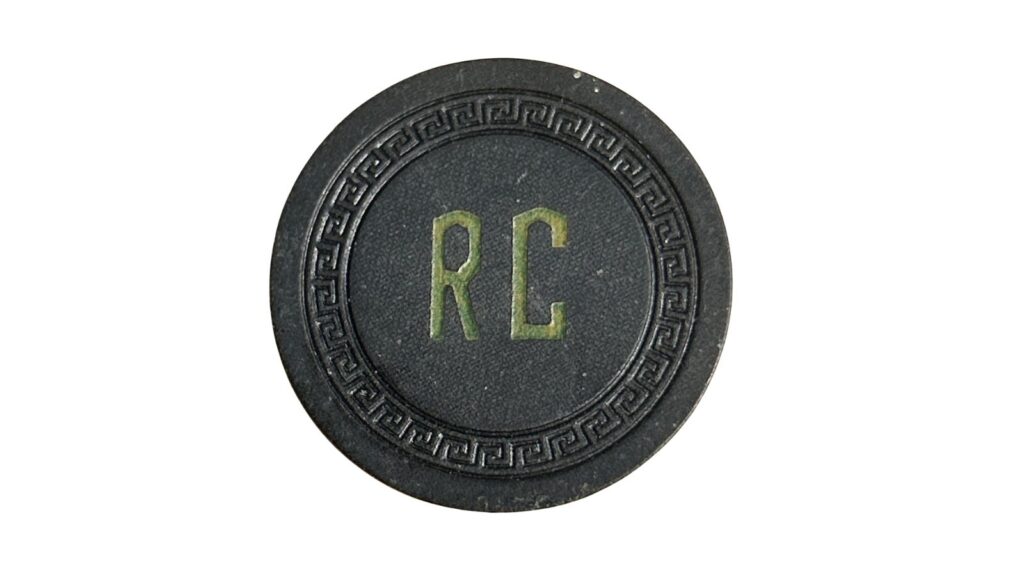
From the 1930s through the early 1960s, the Cincinnati suburb of Newport, Kentucky was one of the most openly lawless gambling towns in America. The Merchants Club, Yorkshire Club, Copa Club, Primrose Country Club, and dozens of other establishments ran full-service casino floors under political protection, complete with custom-manufactured chips made by the same suppliers that served legitimate Nevada casinos. When Senator Kefauver’s organized crime hearings broke up the scene in the early 1950s, most clubs eventually shut down and their chips became orphaned artifacts.
Individual chips from Newport’s illegal clubs sell in a wide range: worn no-denomination chips bring as little as $8, while clean chips from well-documented clubs with a denomination and legible name hot-stamped on them sell for $25 to $50 each. Chips from clubs with confirmed mob connections and specific distinguishing features push higher. The molds are characteristic of the 1940s and 1950s, small Greek key borders, flower patterns, hourglass designs, with the club’s initials or name pressed into the surface.
These show up regularly in Ohio, Kentucky, and Indiana antique shops and estate sales, because the chips were manufactured in quantity and many never made it back to the casino floor before the raids. The hobby of collecting illegal gambling chips has its own reference guides and an active subcommunity within the broader casino chip world. If you find a clay chip with initials or a club name and a dollar amount on an hourglass mold, look it up before assuming it’s worthless.
Binion’s Horseshoe $1 chip with the million-dollar display
Image Credit: genleitchbay via eBay
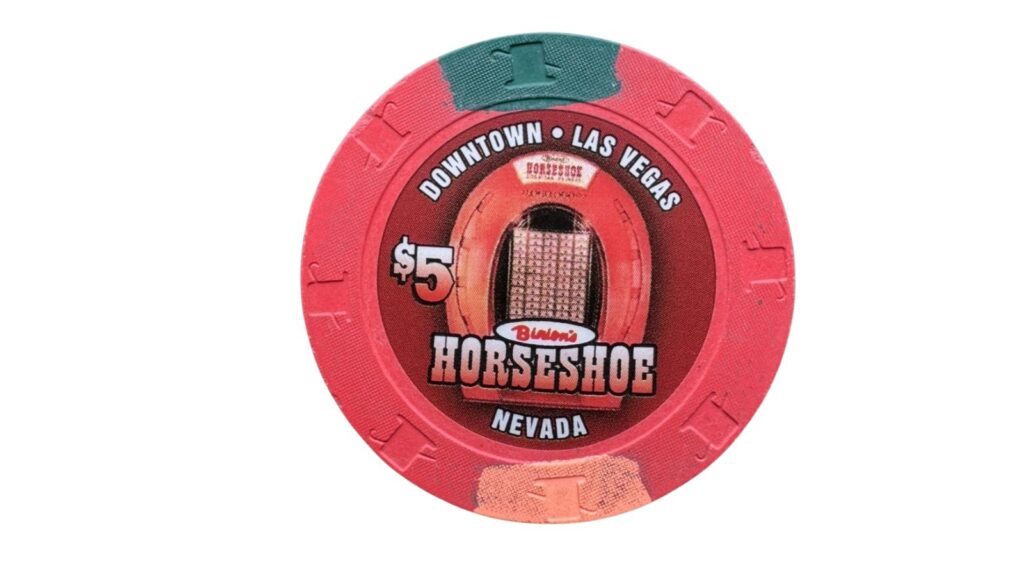
Binion’s Horseshoe Club on Fremont Street in downtown Las Vegas hosted the World Series of Poker starting in 1970 and kept a famous permanent display of one million dollars in cash mounted behind glass on the casino floor. At least one era of their $1 chip featured that image on both sides, with the cash arranged in a horseshoe of hundred-dollar bills. When Harrah’s Entertainment bought the property in 2004 and rebranded it as Binion’s, those original Horseshoe Club chips were retired from play.
Standard $1 chips from the 1990s-era Horseshoe Club bring $20 to $30 in clean circulated condition. Earlier issues made by Paulson in the 1980s carry somewhat more. These are among the chips most likely to show up at a midwestern estate sale or in a box of a Vegas-visiting relative’s souvenirs, because the Horseshoe was a destination for serious gamblers for decades and the million-dollar display made the chip instantly recognizable as a souvenir. Tournament buy-in chips specifically marked for individual World Series of Poker years are a separate and often higher-value category.
Condition is the primary variable here. The Paulson chips made during the Horseshoe’s ownership era are clay composite and hold up reasonably well, but edge nicks, surface scratches, and faded hot stamps all reduce value. A chip in slightly used condition, with clean markings and no obvious damage, is what collectors want. The Casino Collectibles Association’s ChipGuide has full photographs and documentation of every Binion’s Horseshoe issue if you want to identify what you have.
Hard Rock Las Vegas musician commemorative $5 chips
Image Credit: Westen’s Store via eBay
The Hard Rock Hotel and Casino in Las Vegas built a business model around it: issue limited-run $5 chips featuring photographs of musicians, watch them walk out of the casino in gamblers’ pockets, and book the retained face value as pure profit. The casino issued roughly one new design per month from 1995 onward, covering rock legends, specific concerts, movie premieres, and sporting events. Now that the Hard Rock’s original gaming license has changed hands and those specific designs are gone, early runs have real collector value.
Common designs in average condition sell for $15 to $25. Chips featuring recognizable legends, artists with cult followings, specific one-night events with small production runs, or concert commemoratives from acts that have since broken up or lost members bring $40 to $60 and above. The more distinctive the photography and the smaller the production run, the more a chip is worth. Event chips, issued for specific performances or movie openings at the Hard Rock, often had very limited quantities and are now harder to find.
Condition matters more here than with most chips because the photograph is the point. A chip with a scratched or faded image loses most of its appeal regardless of which artist is pictured. A clean face, crisp edge, and no warping is what collectors pay for. These are among the more accessible entry points into casino chip collecting and a natural starting point if you want to know whether the hobby is worth pursuing.
Riviera Hotel early-era chips (1955 to 1960s)
Image Credit: jo_18448 via eBay
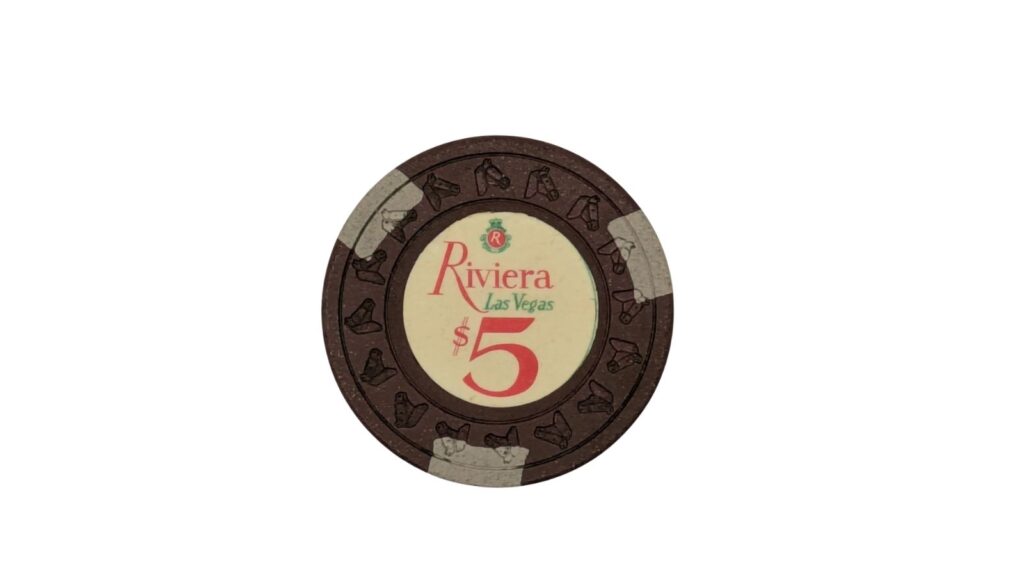
The Riviera opened on April 20, 1955, as the first high-rise hotel on the Las Vegas Strip, with Liberace as its opening night headliner. Mob money was involved in the early days, Dean Martin took an ownership stake in the 1960s, and the casino’s Crazy Girls burlesque show became the longest-running adult show in Vegas history. The Riviera closed on May 4, 2015, and was demolished the following year to make way for a convention center expansion.
Standard chips from the Riviera’s last decade of operation are worth $5 to $15, face value territory. The chips that matter are from the first fifteen years of the casino’s history. Early-issue Riviera chips from the late 1950s and 1960s, particularly those made by Paulson on the classic crest and seal mold, bring $40 to $75 in solid condition. They were produced in smaller quantities during an era when the Riviera was competing for the same high-rolling clientele as the Sands and the Desert Inn.
Anyone who visited the Riviera in its last years, or whose relatives did, may have chips from the modern era that are worth face value at best. But if you’re going through an older relative’s belongings and find chips that look noticeably different in construction and design from anything you’d see in a contemporary casino, with heavier clay composition and simpler hot-stamped lettering, the ChipGuide can help you date them quickly.
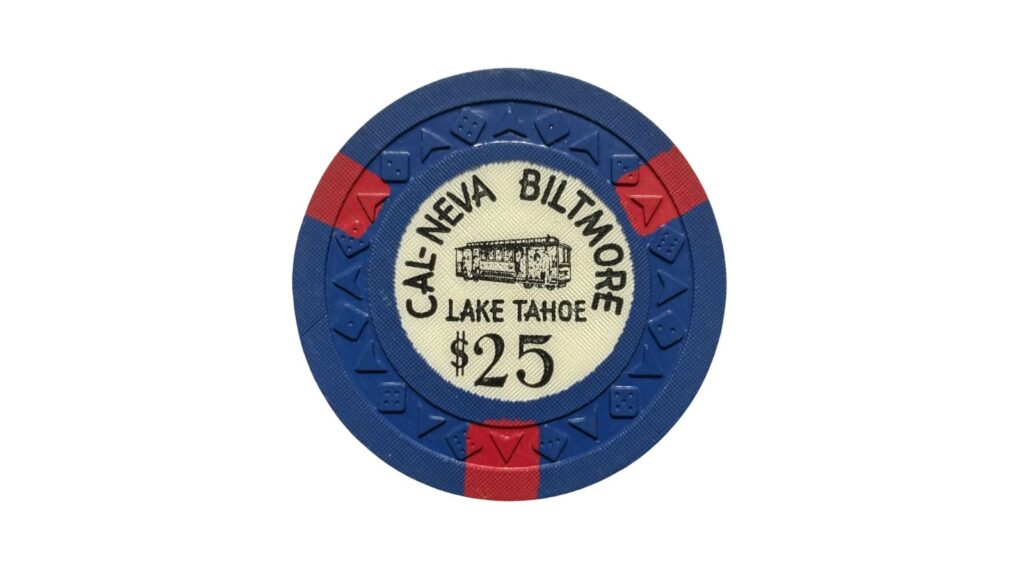
Cal-Neva Lodge chips (1960 to 1963)
Image Credit: Westen’s Store via eBay
Frank Sinatra bought into the Cal-Neva Lodge in 1960, a resort on the Nevada-California border at Lake Tahoe where he had been a regular visitor since the early 1950s. He owned the place for three years before the Nevada Gaming Commission suspended his license for allowing Sam Giancana, a Chicago mob figure, on the premises. The lodge during those three years was headquarters for the Rat Pack in the mountains: Kennedy, Monroe, DiMaggio, Garland, and Davis Jr. all passed through.
$1 chips from the Cal-Neva’s Sinatra era bring $60 to $75 in solid, unpunched condition. Higher denominations go for more, and the $100 chip from this period is genuinely scarce. The story drives the price as much as anything: this was the only casino Sinatra personally owned, and the condensed mythology of the period makes even an entry-level chip feel like a real artifact. Most chips from the Cal-Neva that survive have hole punches through the center, which is how the casino retired chips from circulation. A hole punch significantly lowers the value.
These turn up occasionally in Lake Tahoe and Northern California estate sales and antique markets. The Cal-Neva chips from the Sinatra period have a specific construction that collectors have thoroughly documented. If you find what appears to be a very old chip with “Cal-Neva Lodge” or “Cal-Neva” on it, check whether it has a hole punch and which issue number it corresponds to before assuming you know what you have.
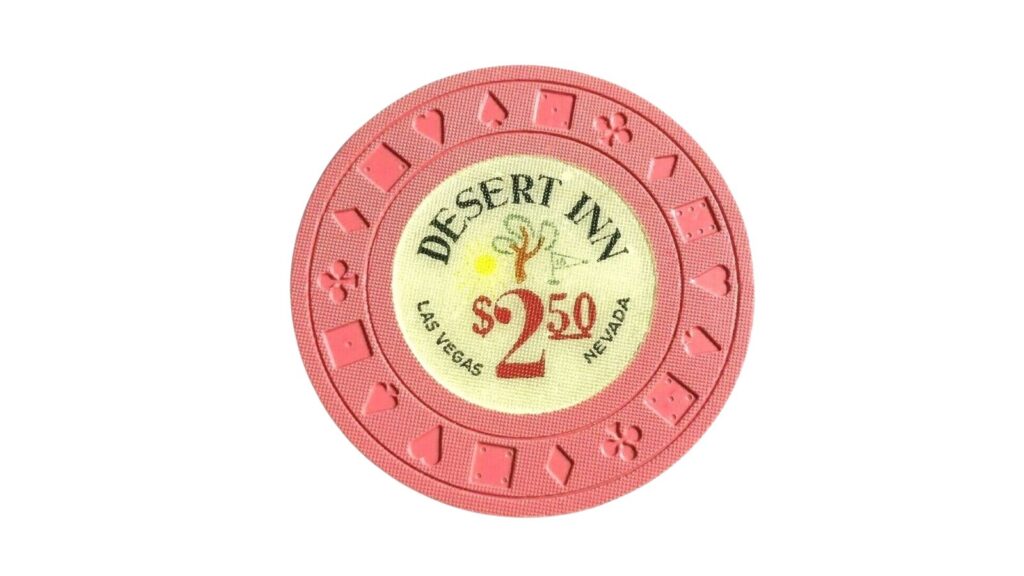
Desert Inn 1960s house chips
Image Credit: nevadacollector1947 via eBay
The Desert Inn opened in 1950 with Moe Dalitz and the Cleveland mob providing the money behind a front man named Wilbur Clark. In 1967, Howard Hughes arrived, refused to check out after his initial reservation expired, and simply bought the hotel rather than leave. He proceeded to buy six more Las Vegas casinos without ever leaving his penthouse suite. Hughes owned the Desert Inn until his death in 1976. Steve Wynn bought it in 2000, closed it, and demolished it the following year. Wynn Las Vegas opened on the site in 2005.
House chips from the Desert Inn’s 1960s era bring $40 to $80 for common denominations in solid condition. The Hughes connection and the hotel’s reputation as one of the most elegant addresses on the pre-corporate Strip attract collectors who care about what happened at a table as much as what the chip looks like. Chips specifically marked “Wilbur Clark’s Desert Inn,” referencing the casino’s founding era, are from the earliest period and worth looking up carefully.
Any Desert Inn chip from the late 1990s, after the hotel had become a standard corporate property and was heading toward closure, is worth face value or close to it. What you want are chips from the Dalitz and Hughes eras, which have a completely different construction and appearance from the 1990s chips. The molds, insert colors, and typography changed substantially over the hotel’s fifty-year run. A chip that looks noticeably old, with heavy clay composition and hot-stamped lettering, deserves a closer look.
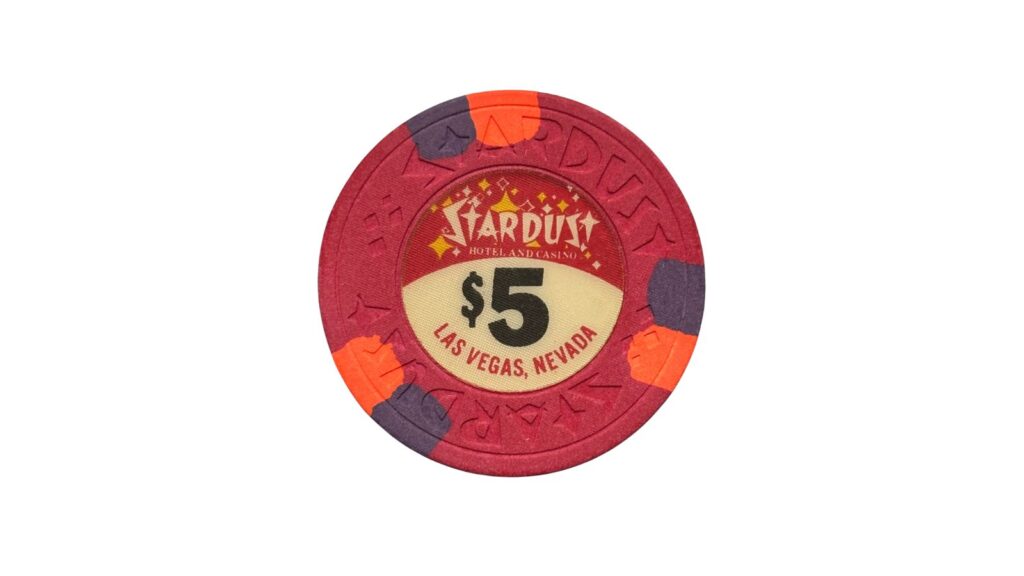
Stardust Hotel early-issue $5 chips
Image Credit: Westen’s Store via eBay
The Stardust opened in 1958 and was mob-controlled through most of its history, a fact the casino tried to obscure for decades before the FBI investigations and eventual indictments of the 1980s made it impossible. The events were fictionalized in the 1995 film Casino. MGM Mirage demolished the Stardust in 2007. The distinctive logo, hotel name spelled out in stylized planets and stars, is one of the most recognizable designs in chip collecting.
Early-issue Stardust $5 chips from the 1960s and 1970s bring $50 to $150 depending on issue number and condition. The earliest issues, from the casino’s first years of operation, are the most sought-after and increasingly hard to find. Later issues from the 1990s carry the same name and logo but are far more common and bring much less. Issue number, which correlates to when the casino placed a specific order with the chip manufacturer, is the key variable here.
Collectors track Stardust chips by issue because each manufacturing run had subtle variations in the insert colors, mold design, and specific typography. A chip listed as a first or second issue from the early 1960s is a genuinely different find from a mid-1990s chip with the same casino name. Condition matters more than with recently closed casinos because surviving first-issue chips have had sixty-plus years to accumulate edge nicks and surface wear. A clean, slightly-used first issue in solid shape is worth real money to the right buyer.
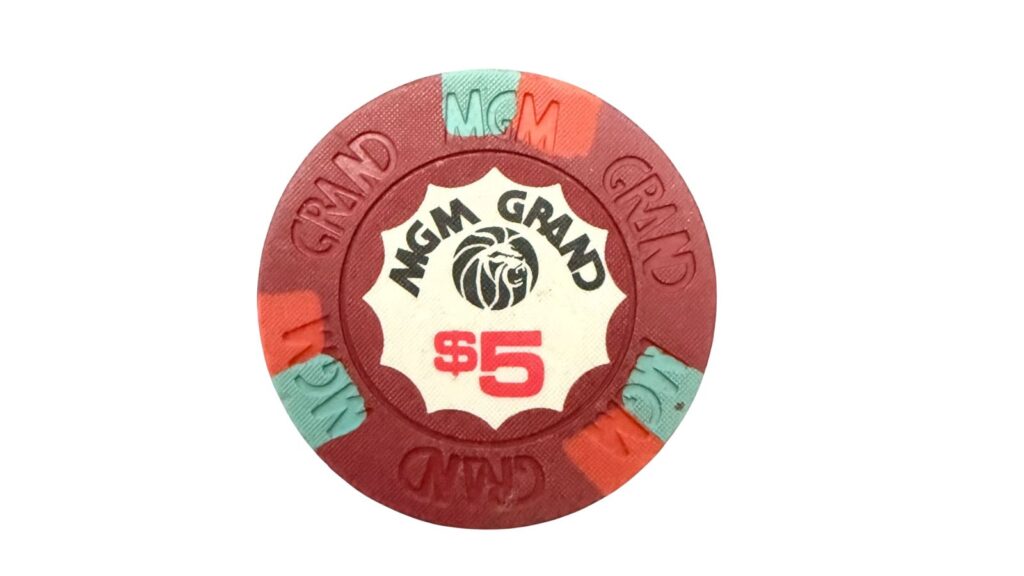
MGM Grand $5 chip from before the 1980 fire
Image Credit: pheaslo via eBay
The original MGM Grand Las Vegas opened in December 1973 as the largest hotel in the world. On November 21, 1980, a fire broke out in the casino’s Deli restaurant, killed 85 people, and destroyed much of the casino’s chip inventory when the building was evacuated and locked down. The chips that were in play when the fire broke out, or that guests and employees managed to remove from the premises, became a specific and emotionally resonant category in casino chip collecting.
A $5 chip from the MGM Grand predating the fire sells for around $95 in clean condition. The fire destroyed the majority of the casino’s chip stock in a way that a simple closure never does, which limits supply. The $1 chip from the same era is more common because gamblers were more likely to walk away from the tables with a low-denomination chip as a souvenir. The $100 chip from before the fire is extremely rare and commands a substantial premium.
The MGM Grand name continued at the same property through several ownership changes before the building became Bally’s Las Vegas in 1989. A new MGM Grand opened on a different part of the Strip in 1993 and operates today. Chips clearly marked “MGM Grand” with the original 1970s design, made before the fire and its aftermath, are what collectors want. Later chips from the same address or from the newer property are a completely different and far more common category.
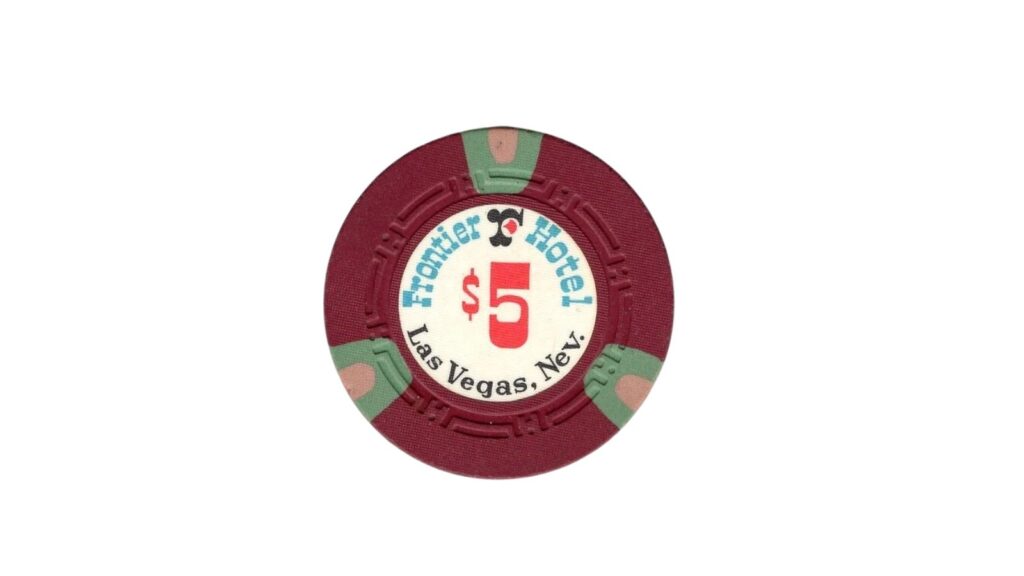
Frontier Hotel $5 chip
Image Credit: TROPCHIP 711 GALLERY via eBay
The Frontier, under various names including Hotel Last Frontier, New Frontier, and Frontier, operated on the Las Vegas Strip from 1942 until 2007, making it one of the longest-running addresses in Strip history. Elvis Presley made his first Las Vegas appearance there in 1956. Howard Hughes bought the property in 1967 as part of his buying spree. A six-year labor strike in the 1990s made national news. El Ad Properties demolished it in 2007 to make way for a project that was never built.
A Frontier Hotel $5 chip in good condition brings around $600 to $700. The casino’s long run means there are many eras of chips with varying values. The earliest chips, from the “Last Frontier” and “New Frontier” periods of the 1940s and 1950s, are naturally scarcer and command significantly more. Chips from the 1990s through the 2007 closure are more accessible, still collectible, and make up most of what surfaces at estate sales and in collections.
The name era matters when identifying a Frontier chip. “Hotel Last Frontier,” “New Frontier,” “Frontier,” and “New Frontier” again after 1999 are technically different periods of the same property, each with distinct chip designs. Any chip that predates Howard Hughes’s 1967 purchase is worth researching carefully. Chips from the hotel’s original 1940s western-theme era are rare enough that finding one at a Midwest estate sale would be a legitimate discovery.
Flamingo Hotel 1946 “Bugsy Siegel” era $5 chip
Image Credit: time2addon via eBay
Bugsy Siegel opened the Flamingo Hotel in December 1946 with mob financing and was murdered seven months later. The chips that existed during those seven months, while Siegel was still running the casino, are identifiable by their construction: orange clay with a metal wafer inlay embedded in the center, no graphics beyond the hotel name and denomination, and a specific weight and texture that predates the plastic and ceramic chip eras by decades. Every subsequent era of the Flamingo produced different chips.
A first-era Flamingo $5 chip from 1946 to 1947 in solid condition, without a hole punch, brings $1,500 to $3,000 or more depending on the specific buyer and market conditions. The no-hole-punch requirement is critical: casinos routinely drilled holes in retired chips to retire them, and most surviving Bugsy-era chips were punched. A clean, intact example commands a serious premium over one with a punch through it. Many collectors consider a punched Bugsy chip still worth owning for the provenance alone, at a fraction of the intact price.
This is aspirational for most people rather than a realistic estate sale find. But these chips have appeared in family belongings over the years, brought home by gamblers who visited the Flamingo in Siegel’s brief window and kept a $5 chip as a souvenir without any idea what they were holding. If you have what appears to be an extremely old, plain orange clay chip with a metal inlay and the Flamingo name, get it professionally examined before assuming it’s a later reproduction.
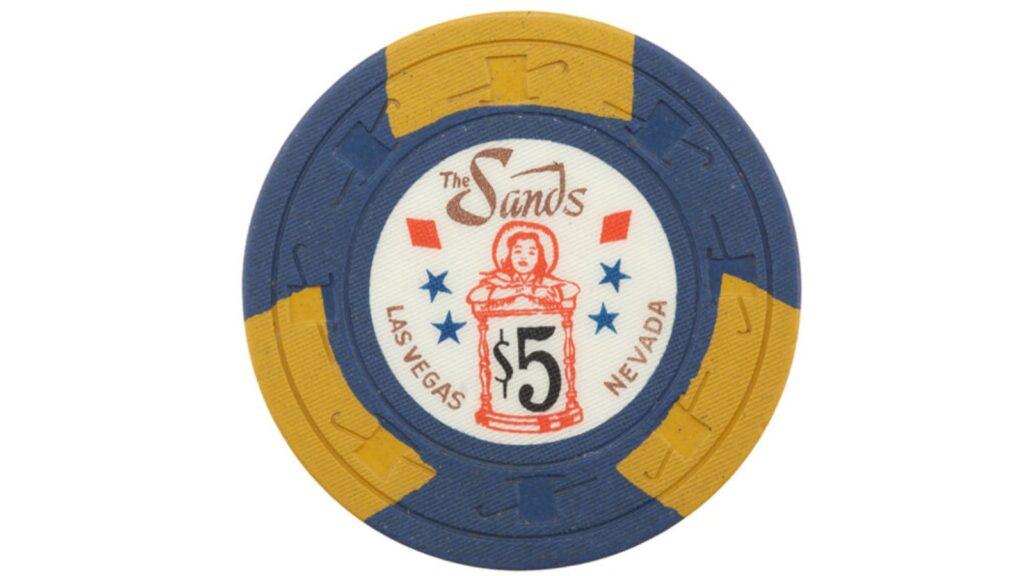
Sands Hotel first-issue $5 chip with the hourglass design
Image Credit: Heritage Auctions
The most valuable chip from a casino most people recognize is not a one-of-a-kind curiosity but it is not a casual garage sale find either. The Sands Hotel’s first-issue $5 chip from the early 1950s features the hourglass design that appeared in the casino’s early advertising, manufactured by TR King on a small crown mold. Very few of these chips survived in undamaged condition, and the ones that did have become benchmark pieces in the hobby.
Clean first-issue Sands $5 chips in solid condition have sold for $25,000 or more, a level that places them firmly in serious investment territory rather than casual collecting. Three things are required to reach that value: the correct first-issue hourglass design made by TR King, the chip in undamaged or only slightly used condition, and a buyer who wants exactly that piece. Most people who find a $5 Sands chip in an estate sale have a later-issue chip worth $45 to $100.
The distinction between issue numbers is everything here, and determining whether what you have is a genuine TR King first issue requires comparing it against reference photographs and ideally having it assessed by an experienced collector. The CC>CC has specialists who identify Sands chips regularly and can save you from missing a significant find or from mistaking a common chip for something it isn’t. If the chip looks like it might be from the early 1950s and has the hourglass design, treat it as potentially significant until you know for certain.
In recent years, discussions around weight management have evolved beyond fad diets and temporary fixes. Modern weight loss medications are increasingly recognized as clinically supported tools that help patients achieve meaningful and sustainable results. These therapies reflect a growing understanding that weight regulation involves complex biological systems, not just lifestyle choices. As a result, both healthcare professionals and patients are exploring pharmacological options as part of comprehensive health strategies.
This shift aligns with broader changes in healthcare, where weight is seen as a crucial component of metabolic and cardiovascular health. People are seeking solutions that go beyond traditional diet and exercise, and modern medications provide targeted support that can complement lifestyle interventions. The growing interest in these therapies highlights the evolving landscape of weight management and the potential for improved outcomes.
For decades, weight management primarily relied on lifestyle interventions such as calorie reduction and increased physical activity. While effective for some, these methods often produced temporary results, with many individuals regaining weight over time. Researchers have since recognized that weight regulation is influenced by hormonal, neurological, and metabolic factors, creating the need for more sophisticated approaches.
Modern weight loss medications target these underlying mechanisms, helping regulate hunger, satiety, and energy balance. By addressing the physiological drivers of weight gain, these therapies provide support beyond willpower and lifestyle modifications. They are designed to enhance the effectiveness of diet and exercise rather than replace them, enabling patients to achieve more consistent and lasting results.
This shift represents a significant development in chronic disease care, where obesity is recognized not only as a cosmetic issue but as a factor in long-term health risks. The growing availability of these medications has created a new era in weight management, one in which patients have more tools to support sustained health improvements.
What’s behind the growing interest
Several factors have contributed to the increasing attention paid to modern weight loss medications. Public awareness of obesity as a chronic health condition has risen, emphasizing the importance of sustained strategies rather than short-term fixes. This perspective encourages individuals to seek medically supported solutions alongside lifestyle changes.
Clinical evidence supporting the safety and efficacy of newer medications has also bolstered confidence among healthcare providers. Peer-reviewed studies and professional guidelines increasingly recognize these therapies as viable options for patients who meet specific criteria. While side effects exist, the overall benefit-risk profile for many individuals is favorable.
Social proof has further amplified interest. Patient testimonials, media coverage, and professional endorsements have increased awareness, prompting more individuals to inquire about these therapies. This combination of public awareness, clinical validation, and social reinforcement has driven sustained interest and adoption.
What modern weight loss medications offer
Modern weight loss medications differ from older drugs by targeting deeper physiological processes rather than focusing solely on appetite suppression or energy expenditure. Many engage hormonal pathways that regulate hunger and satiety, while others influence glucose metabolism, benefiting patients with or at risk for type 2 diabetes.
Medications such as Wegovy from Canada represent this new class of therapies. They interact with the body’s natural regulatory systems to support weight loss and metabolic health, complementing diet and exercise rather than replacing these essential components. Clinical evidence indicates that these medications can lead to significant and sustained weight loss while improving markers of cardiometabolic health.
While not a standalone solution, these medications provide patients with additional support that can make lifestyle changes more achievable. Used under medical supervision, they allow individuals to better manage hunger, maintain healthier eating patterns, and achieve measurable improvements in both weight and overall health.
Addressing concerns and misconceptions
Interest in weight loss medications comes with questions about safety, long-term use, and potential dependency. Side effects are typically manageable, and healthcare providers carefully weigh the benefits and risks before initiating therapy. By framing medication as part of a broader health strategy, patients can understand its role without feeling that personal effort is diminished.
Using medication for weight management is comparable to using pharmacological interventions for other chronic conditions, such as hypertension or diabetes. It reflects an understanding that biological processes influence outcomes, and that targeted support can improve both efficacy and patient confidence. For those considering this path, weight management consultations with qualified healthcare professionals offer a practical starting point for understanding which options may be appropriate for individual needs.
Research and clinical experience indicate that patients often report enhanced quality of life and improved self-efficacy when using these medications alongside lifestyle changes. This underscores the value of expanding treatment options rather than relying solely on traditional methods, supporting a more holistic approach to weight management.
The broader implications for public health
Obesity and metabolic disease are significant public health challenges, contributing to increased healthcare costs and reduced quality of life. Expanding access to modern weight loss medications offers potential benefits at the population level by helping reduce disease burden and improve long-term health outcomes.
These medications also support a more compassionate, evidence-based approach to weight management. By recognizing the biological factors that influence weight, healthcare providers can reduce stigma and empower patients to pursue treatment without judgment.
As part of a comprehensive health strategy, these therapies can complement public health initiatives, encouraging sustainable behavioral changes while providing pharmacological support. Their growing use reflects both individual and societal efforts to address chronic health conditions more effectively.
Conclusion
Interest in modern weight loss medications reflects a broader shift in how weight and health are understood. These therapies offer scientifically grounded tools that support sustainable weight loss, improve metabolic health, and complement lifestyle interventions. They provide patients with practical, medically supervised options to manage their weight more effectively.
As clinical evidence and public awareness continue to grow, these medications are likely to become a standard component of weight management strategies. By integrating them thoughtfully into individualized care plans, patients and healthcare providers can achieve more meaningful outcomes, promoting long-term health and well-being.
Some people shut down when the phones won’t stop ringing, the power is out, a patient is crashing, or a whole room is waiting for one clear answer. Other people get quieter, sharper, and more useful.
That kind of calm is not just a personality trait. In the right job, it can be a serious career advantage. Hospitals, airports, utilities, crisis teams, animal ERs, and security operations all need workers who can think clearly when the situation is loud, emotional, dangerous, or moving fast.
Many of these careers take training, licenses, or years of experience. But they also tend to offer stronger pay, steady need, and work that still depends on human judgment. Every job here pays at least $30 per hour and rewards people who can stay steady when things go sideways.
Emergency management directors plan for hurricanes, floods, fires, cyberattacks, public health scares, and other major disruptions. When something goes wrong, they help coordinate agencies, shelters, supplies, alerts, and recovery plans. The chaos is not always sirens and flashing lights. Sometimes it is 14 people in one room needing a decision now.
Median pay is about $41.41 per hour. This work is steady because schools, hospitals, companies, and local governments all need disaster plans that actually work. Many people enter after experience in public safety, military service, healthcare operations, government, or logistics, often with a bachelor’s degree or emergency management training.
Cybersecurity incident responder
Image Credit: Shutterstock
Cybersecurity incident responders are the people called when systems are attacked, data is exposed, or a company thinks someone has broken into its network. You may trace the breach, isolate infected systems, preserve evidence, and help leaders decide what to shut down and what to keep running.
Pay for information security analysts is about $60.05 per hour, and demand is strong as fraud, ransomware, and data theft keep rising. This is not routine tech support. You need calm thinking, documentation habits, and the nerve to work under pressure while people are angry, scared, or losing money.
Clinical perfusionist
Image Credit: Shutterstock
Clinical perfusionists run the heart-lung machine during major heart surgery and some critical care procedures. While surgeons operate, the perfusionist keeps blood moving and oxygenated. That means watching pressures, lab values, flow rates, and alarms while the room is already tense.
Average pay is about $77 per hour. This is a small, specialized field, which helps protect experienced workers from being treated as replaceable. Getting in usually means a bachelor’s degree, a perfusion program, clinical training, and certification. Hospitals need people who can stay steady when a patient’s condition changes in seconds.
Flight nurse
Image Credit: Shutterstock
Flight nurses care for very sick or injured patients in helicopters and airplanes. They may handle trauma, stroke, heart problems, ventilators, medications, and handoffs between hospitals. There is little room, plenty of noise, and no big team down the hall.
Average pay is about $46 per hour. Most flight nurses start as registered nurses and build experience in emergency, ICU, or trauma care before moving into transport. The job depends on clinical judgment, teamwork, and comfort with ugly situations, which makes it hard to hand off to software or a remote desk.
Transplant nurse coordinator
Image Credit: Shutterstock
Transplant nurse coordinators help patients move through the transplant process before and after surgery. They coordinate testing, medication plans, donor timing, family questions, surgeons, labs, and follow-up care. When an organ becomes available, the pace can change fast.
Average pay is about $53 per hour. This role usually requires an RN license, hospital experience, and strong comfort with complex patients. Transplant care is highly regulated and deeply personal, so employers need people who can manage details without losing the human side of the work.
Forensic nurse examiner
Image Credit: Shutterstock
Forensic nurse examiners care for patients after violence, abuse, assault, or suspicious injury. They may collect evidence, document injuries, testify in court, and explain care options to people who are shaken or afraid. The job calls for calm, direct communication without rushing the patient.
Average pay is about $42 per hour. Most forensic nurses are RNs who add specialized training in evidence collection, trauma-informed care, and legal documentation. Hospitals, advocacy centers, correctional facilities, and public agencies need this work because accuracy and compassion both matter when a case may become legal.
Mobile crisis clinician
Image Credit: Shutterstock
Mobile crisis clinicians respond when someone is in a mental health emergency, often outside a clinic. They may assess suicide risk, calm family members, coordinate transport, create safety plans, and connect people with urgent care. You are walking into situations that are already tense.
Average pay is about $35 per hour. Many roles require a master’s degree in counseling, social work, psychology, or a related field, plus licensure or a path toward licensure. Demand is supported by the growth of crisis response systems and the need for trained people who can de-escalate in real life.
ICU respiratory therapist
Image Credit: Shutterstock
Respiratory therapists help patients who cannot breathe well on their own. In the ICU, they manage ventilators, breathing treatments, oxygen settings, and airway support. They are often called when a patient is crashing or a nurse needs help fast.
Median pay is about $38.68 per hour, and job growth is strong as more patients live with heart and lung disease. Most respiratory therapists need an associate degree and a license. Machines can provide readings, but a person still has to assess the patient, adjust care, and work shoulder to shoulder with doctors and nurses.
Emergency medicine physician assistant
Image Credit: Shutterstock
Emergency medicine physician assistants examine patients in ERs and urgent care settings. They may order tests, close wounds, read results, start treatment, and decide who needs a higher level of care. The waiting room may be full, but the work still has to be careful. Sustaining this intense level of focus amidst unpredictable patient surges depends heavily on a hospital’s underlying medical staffing strategy. When healthcare facilities proactively manage their provider lines with flexible, on-demand staffing solutions, it relieves crushing workloads and gives frontline clinicians the breathing room they need to make accurate, high-stakes decisions safely.
Average pay is about $71 per hour. The path requires a graduate PA program, national certification, and licensing. Demand is strong because hospitals and clinics need skilled providers who can handle volume, make decisions, and work with physicians when cases turn serious.
Emergency department registered nurse
Image Credit: Shutterstock
Emergency department nurses deal with chest pain, strokes, overdoses, broken bones, infections, violence, scared parents, and people who have waited too long to get care. You may have to start an IV, comfort a family, notice a subtle change, and answer another call light in the same few minutes.
Average pay is about $54 per hour. The usual path is nursing school, passing the licensing exam, and building acute care experience. Hospitals need ER nurses because emergency care is open-ended. Nobody knows what is coming through the door next.
Emergency veterinarian
Image Credit: Shutterstock
Emergency veterinarians treat animals with poisoning, trauma, breathing problems, seizures, heatstroke, and sudden illness. They also deal with worried owners who may be scared, angry, or facing hard choices about money and care. The medicine is urgent, but the communication is just as important.
Average pay is about $58 per hour. Becoming a veterinarian requires a doctoral degree and licensing, then many ER vets add emergency experience or specialty training. Demand is strong because pet care has grown, overnight hospitals need coverage, and a real clinician has to examine the animal in front of them.
Nuclear medicine technologist
Image Credit: Shutterstock
Nuclear medicine technologists prepare and give radioactive drugs used for imaging and treatment, then operate scanners that show how organs are working. The job calls for careful dosing, radiation safety, patient calming, and close communication with physicians.
Median pay is about $46.64 per hour. Growth is steady, and openings continue as healthcare systems need imaging for cancer, heart disease, and other serious conditions. Most workers need an associate degree, certification, and comfort with strict safety rules. This is not a casual tech job. Mistakes matter.
Electrical power-line repairer
Image credit: Heri Susilo via Unsplash
Power-line repairers fix and maintain the lines that keep homes, hospitals, businesses, and traffic systems running. After storms, they may work long hours in bad weather while whole neighborhoods are waiting for power. Heights, electricity, traffic, and exhausted customers are part of the job.
Median pay is about $44.50 per hour, with stronger demand than many trades. Most workers start with technical training, line school, or an apprenticeship. This work is physical, dangerous, and local. It needs trained crews on-site, not a program trying to guess from a distance.
Elevator and escalator repair technician
Image Credit: Shutterstock
Elevator and escalator technicians install, inspect, maintain, and repair lifting systems in offices, hospitals, hotels, transit stations, and apartment buildings. When people are trapped, equipment is down, or a safety issue appears, the pressure goes up fast.
Median pay is about $51.24 per hour. Job growth is solid because buildings keep aging and cities keep relying on vertical transportation. Most people enter through a paid apprenticeship and may need licensing. The work mixes mechanical, electrical, hydraulic, and safety skills in places where a bad repair can hurt people.
Fire investigator
Image Credit: Shutterstock
Fire investigators examine burned buildings, vehicles, and outdoor scenes to figure out how a fire started. They may interview witnesses, photograph damage, collect evidence, and work with insurance companies, law enforcement, or prosecutors. The scene may still smell of smoke, and people may have lost everything.
Median pay is about $37.53 per hour. Many investigators start as firefighters, inspectors, police officers, or code enforcement workers, then add fire science and investigation training. Demand is steady because fires, explosions, fraud, unsafe buildings, and legal claims still require careful human investigation.
Industrial safety specialist
Image Credit: Shutterstock
Industrial safety specialists help prevent injuries and respond when something goes wrong at factories, construction sites, warehouses, hospitals, labs, and utilities. They inspect hazards, train crews, investigate accidents, review procedures, and speak up when work needs to stop.
Median pay is about $40.34 per hour, and growth is strong as employers face more pressure to control injuries and comply with safety rules. Some jobs require a bachelor’s degree, while others value field experience plus safety certifications. The best workers can stay calm with managers, crews, and regulators all watching.
Emergency communications supervisor
Emergency communications supervisors oversee dispatchers and call-takers who handle 911 calls, radio traffic, police, fire, and medical response. They may coach staff during tough calls, manage staffing gaps, handle complaints, and keep the room focused during major incidents.
Average pay is about $31 per hour. Many supervisors start as public safety telecommunicators, then move up after certifications and years on the console. The work is stable because communities need trained people who can listen, prioritize, and make sure the right help goes to the right place.
Discover job hunting tips, ways to earn more, and flexible working options: