scroll top

Your uncle was the world’s biggest baseball fan. Spent decades at games, card shows, and conventions, always getting things signed. Now you’re clearing out his house and there are two shoeboxes of memorabilia sitting on the kitchen table. Some of it probably isn’t worth much. A few pieces might be worth more than the car in his driveway.

The autograph market rewards exactly two things: who signed it, and whether you can prove it. The fake problem is severe. Experts estimate that somewhere between 70 and 80 percent of signed sports memorabilia on the secondary market is not authentic, and entertainment autographs aren’t much cleaner. The most famous names are always the most heavily forged because demand never stops. A paper certificate declaring authenticity means almost nothing on its own, because anyone with a printer can produce one. What actually counts is a numbered hologram from one of the three major authentication services: PSA/DNA, JSA (James Spence Authentication), or Beckett Authentication. Each maintains a searchable online database where a certificate number can be verified in seconds.

If you think you have something real, authentication typically runs $20 to $150 depending on the signer, and it can transform an unauthenticated piece worth very little into one worth several times that. The format matters too. The same person’s signature on a baseball, a photograph, a boxing glove, or a signed album cover represents four different items at four different prices, and knowing which format you have is the first step.

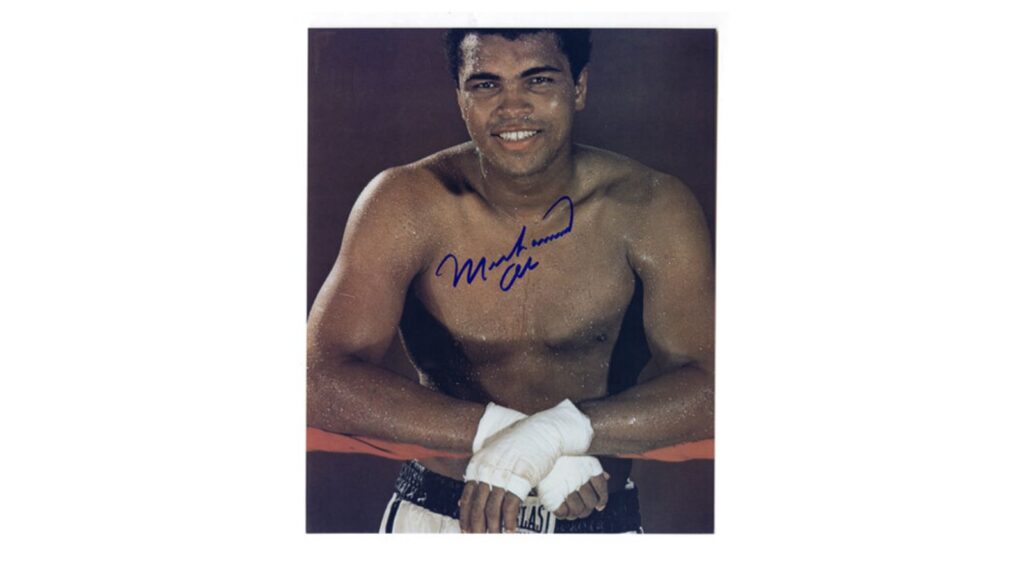
Muhammad Ali signed 8×10 photograph

Muhammad Ali signed 8x10 photograph
Image Credit: Heritage Auctions

Ali signed generously through the 1970s and 1980s, attending events and meeting fans before Parkinson’s disease made it increasingly difficult. Authenticated 8×10 photographs with a PSA or JSA numbered hologram typically bring $500 to $1,500. Earlier signatures from before his Parkinson’s symptoms became pronounced around the mid-1980s are bolder, more legible, and worth more. Later signatures are shakier and carry a lower premium.

The fake problem with Ali is extraordinary in scale. Hundreds of thousands of fake Ali signatures are estimated to circulate, and even major authentication services have made documented errors with his autograph. A signed photograph with a compelling story and no verified hologram is essentially unsellable to collectors, because no serious buyer will take the risk on something this heavily forged.

Muhammad Ali signed boxing glove
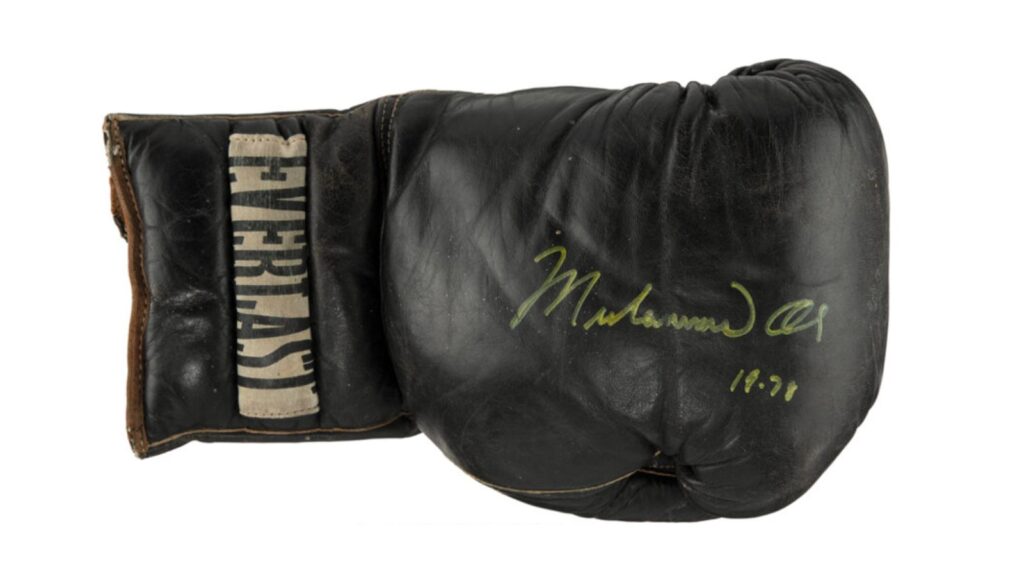
Muhammad Ali signed boxing glove
Image Credit: Heritage Auctions

A signed boxing glove is the most visually iconic Ali collectible, tied to his image in a way no photograph is. With a PSA or JSA numbered hologram, standard examples signed on an Everlast glove in good condition bring $1,000 to $2,000. Gloves signed during his championship years carry more weight than later examples, and the “The Greatest” inscription adds value when confirmed authentic.

The visual impact of a signed glove is exactly what makes it attractive to forgers. The market is flooded with fake Ali gloves, many accompanied by convincing-looking paper certificates from companies that no longer exist. Without a current numbered hologram from a major service, a boxing glove has essentially no reliable resale value regardless of the story attached to it. If you have both an authenticated photograph and a glove, the glove is typically the stronger piece.

Elvis Presley signed publicity photograph

elvis presley signed photo
Image Credit: wallsofsound2 via eBay

Elvis was genuinely accessible to fans during his early career, particularly between 1954 and the early 1960s, and he signed photographs at events and backstage after shows with real generosity. Authenticated examples from that period with clear, bold signatures and solid provenance bring $2,000 to $5,000, with particularly well-documented or sharp examples pushing higher.

Two specific problems make Elvis autographs unusually treacherous. His management routinely used autopen machines and secretarial signatures to handle the overwhelming volume of fan mail, and those are worth nothing to collectors. The forgery market for Elvis is also exceptionally active and has produced very convincing fakes over decades. Authentication from a specialist with specific Elvis expertise is essentially mandatory before you can establish any commercial value. If you have a photograph with a handwritten note, a documented occasion, or other supporting materials, preserve all of it carefully alongside any authentication work you do.

Elvis Presley signed personal check
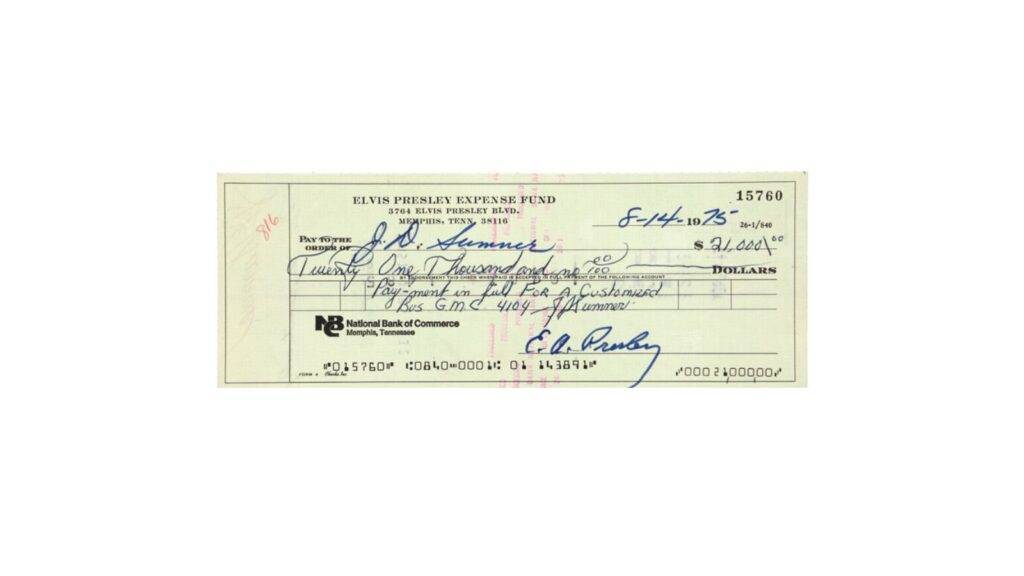
Elvis Presley Signed Cheque
Image Credit: Heritage Auctions

A signed Elvis check is one of the more reliable entry points in the Elvis market for a specific reason: checks are dated documents tied to a known bank account, which makes them significantly harder to convincingly forge than a bare photograph. Authenticated Elvis checks in good condition typically bring $3,000 to $5,000 depending on the date, condition, and who the check is made out to.

The “E.A. Presley” signature on his personal checks is a different format from the stylized fan autograph, giving authentication specialists more specific comparison material to work with. Checks from the 1960s are generally most desirable. They should still go through a specialist service before any sale attempt, but the format itself provides a layer of documentary protection that a photograph simply doesn’t carry. If you have an Elvis check and an Elvis photograph and can only afford to authenticate one, start with the check.

Mickey Mantle single-signed baseball

signed baseball
Image Credit: Heritage Auctions

Mantle signed constantly at card shows and fan events from the mid-1970s until his death in 1995, and his signature appears on large numbers of baseballs as a result. A typical clean authenticated ball with a JSA or Beckett hologram brings $500 to $1,500 in decent condition. That range is wide because signature quality matters enormously: a bold, dark, centered signature on a clean white ball is worth several times what a faded or personalized example brings.

Mantle is one of the most forged names in baseball memorabilia. Mail responses during his playing years were often answered with stamps or secretarial signatures rather than genuine ones. Paper certificates from defunct companies from the 1980s and 1990s have no real resale value regardless of how official they look. Without a current numbered hologram from a major service, a Mantle ball is a very difficult sell, and the authentication requirement is non-negotiable if you want to realize meaningful money.

Joe DiMaggio single-signed baseball

Joe signed baseball
Image Credit: Heritage Auctions

DiMaggio was famously selective about what he agreed to sign and had a difficult reputation about it in his later years, which kept supply from becoming overwhelming despite a long retirement. Authenticated DiMaggio baseballs with a clear, bold signature on the sweet spot typically bring $400 to $750 in solid condition. Faded or smeared examples bring less. An unauthenticated ball without a hologram sells for $175 to $200 at best.

His signature evolved across his lifetime. Earlier examples are more fully formed; the later card-show version was more abbreviated and quicker. If you have a ball with provenance documentation alongside it, a signed note from the person who obtained it or a photograph of the signing occasion, that context is worth preserving carefully alongside any authentication you pursue.

Willie Mays single-signed baseball

Mays signed baseball
Image Credit: Heritage Auctions

Mays attended card shows and fan events for decades and signed baseballs prolifically well into his eighties, which means authenticated examples still surface in estate sales with real regularity. A clean authenticated ball with a readable signature in strong ink typically brings $300 to $600, with cleaner examples and desirable inscriptions pushing toward the top of that range.

Mays passed away in May 2024, permanently closing the supply. Values have ticked upward since, as they typically do when a prolific signer is gone. Without a numbered hologram from a current major service, a Mays ball is nearly impossible to sell at a meaningful price. The “Say Hey Kid” inscription is commonly added to fakes because collectors associate it with higher-value examples, so if you have one with that inscription, authentication is especially important.

Michael Jordan signed photograph

Michael Jordan signed photograph
Image Credit: Heritage Auctions

Jordan signs very rarely and commands astronomical prices for game-worn items and historic cards, but signed photographs from organized signing sessions are a different category and do still appear in family collections. An authenticated 8×10 with a numbered hologram typically brings $300 to $500, depending on the clarity of the signature and which service authenticated it.

Jordan’s autograph is faked constantly, and secretarial signatures exist from certain promotional periods. Without a numbered hologram from PSA/DNA, JSA, or Beckett that can be verified online, a Jordan photograph is very difficult to sell to any serious collector. A bold, dark signature on a clean 8×10 with a verified hologram is worth pursuing. A faded signature on a small card with a paper certificate from a company no one recognizes is worth essentially nothing commercially.

Beatles all-four autographs on autograph book page or paper
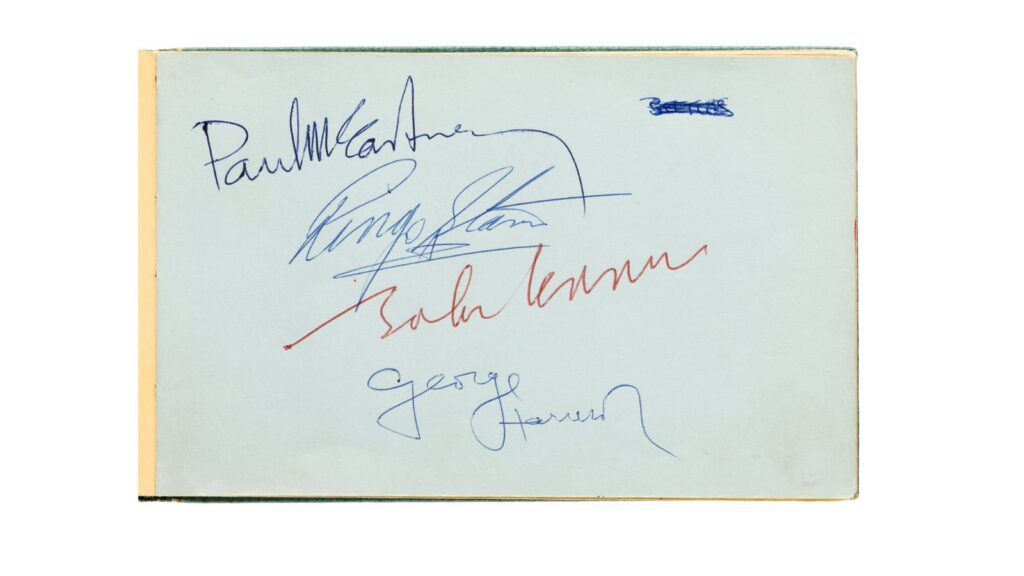
Beatles Autographs
Image Credit: Heritage Auctions

A genuine full set of Beatles signatures on a single page is exactly what a British or American fan might have obtained in person in 1963 or 1964, when the group was on tour and still accessible in ways they would never be again. A clean, clear 1963-65 set with all four signatures in good condition typically brings $5,000 to $8,000. Signatures obtained in 1967 or later, when the group stopped touring and became nearly impossible to approach as a unit, are rarer and worth considerably more.

The hard caveat: the vast majority of what circulates as authentic Beatles signatures is not. The combination of two deceased members and enormous global demand makes this one of the most heavily forged autograph sets in the world. Authentication requires specialist expertise rather than just a generic numbered hologram. If you think you have a genuine set, seek out someone with specific Beatles authentication experience rather than a general sports memorabilia service.

Beatles signed album cover
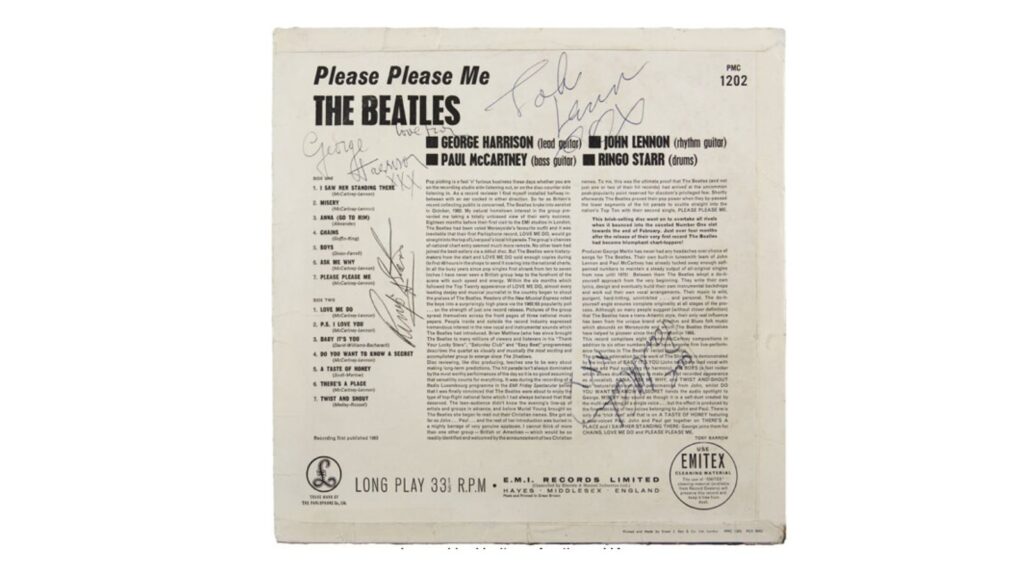
Beatles Signed Album
Image Credit: Heritage Auctions

A signed album cover is a fundamentally different proposition from a signed page. Fans rarely had albums on them when they encountered the Beatles in person, which is exactly why signed copies are so much rarer than signed autograph book pages. Authenticated early album covers signed by all four members bring $12,000 to $25,000 depending on which album it is, the clarity of all four signatures, and how well documented the signing occasion is. Later albums, from 1967 onward, are rarer still and push well above that range on the occasions they surface.

Everything that applies to signed paper sets applies here, amplified. Any all-four set includes signatures from both Lennon and Harrison, who are deceased, which means every plausible-looking fake needs to include convincing versions of both. Specialist authentication with forensic comparison is not optional at these prices. The album itself also matters: the condition of the cover, the pressing, and whether there are inscriptions alongside the signatures all affect where on the range a specific example lands.

Marilyn Monroe signed vintage photograph

Marilyn Monroe
Image Credit: Heritage Auctions

Monroe died in 1962 at 36, after a public career of about fifteen years. Genuine signed photographs from the 1950s are uncommon by any standard. Clean authenticated candid or promotional photographs from that decade with readable signatures bring $7,000 to $12,000, with particularly sharp or well-documented examples pushing well beyond that. Photographs connected to specific well-known images from her career carry a premium over generic portraits.

Monroe photographs are heavily faked and the forgeries can be convincing. The value range above assumes specialist authentication, not just a general collectibles service. A compelling family history about how a photograph was obtained is interesting context but offers no commercial protection on its own. Photographs acquired through the 1950s studio system sometimes have traceable documented histories, which provides a useful additional layer of supporting evidence if you have access to it.

Marilyn Monroe signed document or contract
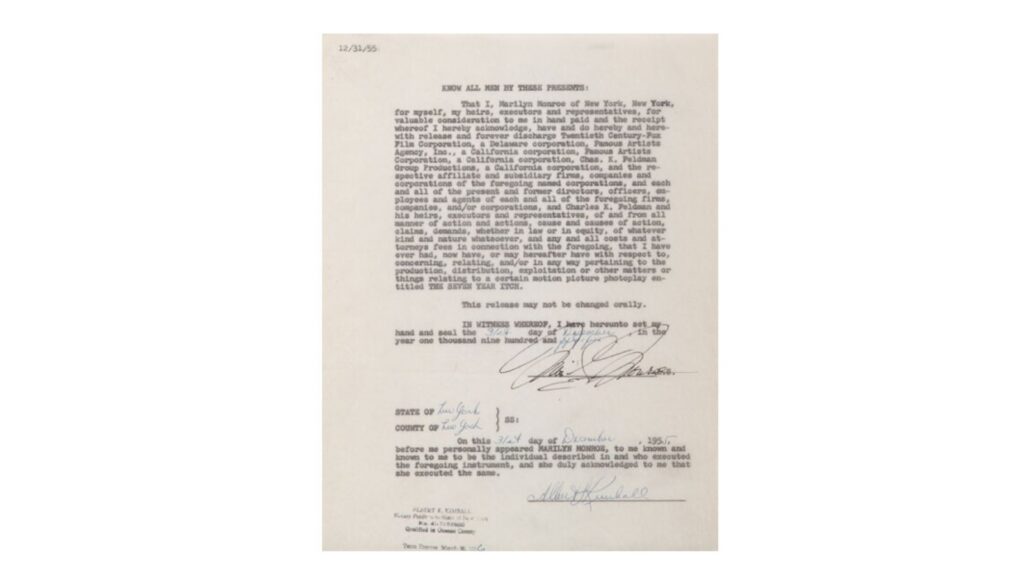
Marilyn Monroe Signed Document
Image Credit: Heritage Auctions

A Monroe document, a studio contract, a payment authorization, a personal letter, carries a specific advantage over a signed photograph: it’s harder to convincingly forge because the entire document needs to be period-appropriate, not just the signature. Authenticated Monroe documents in good condition bring $8,000 to $15,000 depending on the type of document, the date, and the clarity of the signature. Documents signed in her birth name, Norma Jeane, rather than as Marilyn Monroe, are rarer and attract their own following among specialist collectors.

The condition of the paper matters as much as the signature itself. Documents should be stored flat, kept out of light and away from moisture, and handled as little as possible until they can be professionally evaluated. If you have a Monroe document that came with a box of old papers from an estate, examine the paper itself: age-appropriate foxing, consistent yellowing, and period-correct typeface are basic authenticity indicators before the signature is even evaluated.

Led Zeppelin all-four signed album cover

Led Zeppelin all-four signed album cover
Image Credit: Heritage Auctions

Getting all four original members of Led Zeppelin to sign a single album cover was nearly impossible even during their peak years, since the group famously disdained the fan-signing culture their contemporaries participated in. Authenticated all-four examples in good condition bring $10,000 to $22,000 depending on which album is signed, the quality and legibility of all four signatures, and the provenance.

John Bonham died in 1980, permanently closing the supply of complete sets. Any all-four cover therefore includes a signature from a deceased member, which is exactly the kind of finality that attracts forgers. A cover with three genuine signatures and a forged Bonham is a plausible-looking fake at first glance. Forensic specialist authentication is not optional at these prices.

Babe Ruth single-signed baseball

Babe Ruth Baseball
Image Credit: Heritage Auctions

This is the grail category in American sports autographs. Ruth died in August 1948, and the pool of genuine authenticated examples is finite and always expensive. Most authenticated examples now bring $20,000 or more, with faded or heavily worn examples at the lower end and pristine playing-era balls well above six figures. A Ruth ball found in a family shoebox is almost certainly not authentic, but the real ones do turn up in exactly those circumstances on occasion.

The fake problem here is severe enough that even major authentication services have been criticized for errors with Ruth signatures over the years. The shellac-coating technique, where forgers apply a protective coat to make a ball look aged, is a known forgery method for Ruth items specifically. Any Ruth ball should go through a service with expertise in vintage baseball memorabilia, not just a general sports authenticator, and getting a second opinion is reasonable at these prices.

James Dean signed photograph

James Dean
Image Credit: Heritage Auctions

Dean died in September 1955 at 24, after completing exactly three films. His entire signing career was compressed into a very short window of public life, which means genuine signed photographs are genuinely rare. Authenticated examples from the East of Eden and Rebel Without a Cause era typically bring $10,000 to $15,000, with particularly strong or clearly documented examples pushing higher.

The combination of youth, early death, and enormous posthumous cultural status makes Dean one of the most commercially valuable entertainment autographs and one of the most faked. If you have a photograph you believe is genuine, the history of how it was obtained matters enormously. A black-and-white publicity still with a clear inscription and a provenance that can be traced to a specific 1950s occasion is worth pursuing through a specialist with vintage Hollywood memorabilia expertise. The number of surviving genuine Dean signatures is small enough that each one is worth taking seriously.

Most of what gets labeled a famous autograph isn’t. The authentication requirement isn’t a formality. It’s the whole thing.

Parents of struggling teenagers often face one of the hardest decisions of their lives: do they send their child to a boot camp for troubled teens, or do they pursue a therapy-based program instead? Both options promise results, but they operate on very different principles and produce very different outcomes. The gap between the two is not just philosophical. It is measurable, documented, and consequential. Understanding what each approach truly involves and what the research says about long-term success can help parents make a far more informed choice for their child.

What boot camps and therapy-based programs actually involve

To compare these two approaches fairly, it helps to understand exactly what each one looks like in practice. They are not simply “strict” versus “soft.” The differences run deeper than that.

How boot camps for troubled teens are structured

A boot camp for troubled teens is modeled after military-style discipline programs. Teens follow rigid schedules, submit to authority figures, and complete physical challenges as a form of behavioral correction. The core belief is that structure, consequence, and hard work will reshape a young person’s attitude and conduct.

These programs typically last anywhere from a few weeks to several months. Staff members use confrontational techniques, physical demands, and strict enforcement of rules to break down defiant behavior. The environment is intentionally stressful, with the idea that pressure builds character and compliance.

But many of these programs operate with limited clinical oversight. Staff may not hold mental health credentials, and the program design often does not include individualized treatment plans. For teens who carry trauma, anxiety, or depression beneath their surface behavior, this model can actually aggravate the underlying issues rather than address them.

A boot camp alternative for troubled teens in Nampa and similar communities has become a more common conversation as families seek options that are both structured and therapeutically sound. This situation also holds for families in Boise, Meridian, Caldwell, and other nearby areas of Idaho who want more supportive treatment options. Parents in places like Phoenix, Tucson, and Scottsdale are asking similar questions as they compare military-style programs with clinically guided care. As awareness grows, more families are looking for programs that combine structure with licensed therapeutic support, individualized treatment, and a safer path forward.

What therapy-based programs look like in practice

Therapy-based programs take a fundamentally different approach. Instead of targeting behavior through control and consequence, they target the root causes of that behavior through clinical intervention. These programs are led or supervised by licensed mental health professionals, including therapists, psychologists, and counselors.

A teen in a therapy-based program might participate in individual therapy sessions, group therapy, family counseling, and skills-based workshops. The goal is not obedience but self-awareness. Teens learn to identify emotional triggers, develop coping strategies, and build the internal tools they need to manage their own behavior over time.

Therapy-based programs can take several forms, including residential treatment centers, intensive outpatient programs, day programs, and therapeutic boarding schools. The format varies, but the clinical foundation remains consistent across each one.

These programs lean heavily on licensed clinicians, and the quality of that care depends partly on the systems behind it. Many psychiatric and behavioral health providers now run their practices on a customizable psychiatry EMR, which lets them tailor assessments, treatment plans, and progress notes to mental health work rather than forcing it into a generic medical template.

The role of trauma-informed care in teen treatment

One of the most significant distinctions between the two models is whether or not they incorporate trauma-informed care. Research in adolescent mental health has demonstrated clearly that a large percentage of teens who display disruptive or self-destructive behavior have experienced trauma. That trauma does not disappear under pressure. In many cases, high-stress environments like boot camps can reactivate it.

Trauma-informed care is a framework that shapes how staff interact with teens, how the program is structured, and how treatment decisions are made. It prioritizes safety, trust, and emotional regulation over compliance. Therapy-based programs that embrace this model tend to serve the full spectrum of a teen’s needs, not just the behavioral symptoms visible on the surface.

Which approach produces better long-term outcomes for teens

The real test of any teen intervention is not how a young person behaves while they are inside the program. It is how they function months and years after they leave. That distinction separates programs that produce lasting change from those that produce only temporary compliance.

What research says about boot camp recidivism rates

Multiple studies conducted over the past two decades have tracked teens after their release from boot camp-style programs, and the findings are consistent. Boot camp graduates do not show significantly lower recidivism rates compared to teens who received no intervention at all. In some studies, teens from boot camps returned to delinquent behavior at rates equal to or higher than those in comparison groups.

A 2006 analysis published by researchers who reviewed military-style youth intervention programs found no lasting behavioral advantage for boot camp participants. Follow-up assessments revealed that behavioral improvements observed during the program often did not carry over into daily life at home, school, or in the community.

This outcome makes sense when the model is examined carefully. Boot camps teach teens to follow rules under supervision, but they do not teach teens why those rules matter or how to make better decisions independently. The moment external control is removed, many teens revert to the coping mechanisms they had before.

Long-term results linked to therapy-based intervention

Therapy-based programs show a consistently stronger record in long-term outcome studies. Teens who complete structured clinical programs, particularly those with family involvement components, demonstrate meaningful improvements in school performance, relationship quality, mental health stability, and reduced substance use.

The reason for this is straightforward. Therapy gives teens transferable skills. A young person who has worked through cognitive behavioral therapy, for instance, leaves with an internalized framework for recognizing and interrupting negative thought patterns. That framework travels with them. It does not depend on a controlled environment to function.

Family involvement also plays a major role. Programs that include family therapy sessions tend to produce better outcomes because they address the relational dynamics that often contribute to a teen’s struggles in the first place. Change does not happen in isolation, and these programs account for that reality.

Factors that determine the right program for each teen

No two teens arrive at a program with the same history, diagnosis, or set of needs. Hence, the right choice depends heavily on a careful assessment of the individual. A teen with a diagnosed mood disorder, a history of trauma, or co-occurring substance use requires clinical support, not simply discipline.

Key factors to consider include the teen’s mental health history, the presence of trauma, the severity and type of behavioral issues, and whether the family is in a position to participate in treatment. A thorough evaluation by a licensed professional before placement can prevent a costly and potentially harmful mismatch between the teen and the program.

Plus, program accreditation, staff credentials, and clinical transparency matter. Parents deserve to know exactly who is treating their child, what methods are in use, and how progress will be measured. Any program that resists this level of transparency should raise concern.

These risks aren’t hypothetical — families should research a facility’s track record before enrolling, as seen in the ongoing Acadia Healthcare lawsuit, which involves allegations of abuse and inadequate supervision at residential behavioral health facilities.

Conclusion

The evidence points in a clear direction. Boot camp for troubled teens may appear decisive, but it consistently falls short in long-term outcomes. Therapy-based programs address the causes of behavior rather than just the symptoms, and the results reflect that difference.

For families navigating this decision, the priority should be finding a program that treats the whole teen, not just the behavior on the surface. Clinical evaluation, qualified staff, and a trauma-informed approach are the markers of a program worth trusting.

The transition into single motherhood is often described as a series of big, loud shifts. There’s the shifting of households, schedules, and long-term goals. But as we settle into the rhythm of managing a family on our own, it’s often the quiet, digital shifts that make the biggest difference in our daily mental health. Honestly, sometimes it’s the small things that save us.

In a world where we’re constantly accessible, our phones have become both a lifeline and a source of significant stress. We use them to coordinate school pickups, manage work projects, and stay connected with friends. However, they also serve as the gateway for less welcome interruptions. These range from persistent telemarketers to the complicated dynamics of co-parenting or the vulnerability of entering the dating world again. For many single mothers, the phone is a 24/7 open door to their private lives.

And sometimes, that door needs a better lock.

Creating a buffer for your personal life

One of the most effective ways to regain control over your digital space is to stop giving out your primary cell phone number to everyone who asks. When you think about it, your phone number is a direct line to your pocket, your bedside table, and your dinner conversations. Protecting it isn’t just about privacy. It’s about protecting your focus. You know, that rare moment of focus we actually get between laundry loads.

This is where the concept of a dedicated communication channel becomes essential. Using a virtual phone number creates a much-needed buffer between your private world and the outside world. This allows you to hand out a functional contact point for school forms, online marketplaces, or even dating apps without compromising the security of your personal device.

It’s a small change that offers a massive sense of relief.

But how often do we actually stop to think about who has direct access to us? Maybe we’ve just gotten used to being “on” all the time. You decide when that line is open and when it’s silent.

Managing the noise of modern life

The mental load of motherhood is heavy enough without the constant buzzing of notifications. 

When you’re the sole head of household, every ring of the phone feels urgent. Is it the school? Is it a work emergency? When you use a separate number for non-essential tasks, you can categorize the urgency of your life. And that’s the point. We need categories.

Imagine being able to silence your “public” number during your evening hours with the kids. 

You’d know that your “private” line is still open for family and close friends. This level of intentionality is a form of self-care. It allows you to be fully present in the moment, whether you’re helping with homework or finally sitting down for a quiet cup of tea while the house is still and the only sound is the hum of the refrigerator.

So, why do we feel the need to be reachable by everyone, all the time? I guess we forget we have a choice.

Staying safe in the modern dating world

Entering the dating scene as a single mom is a brave and often exhausting endeavor. While it can be exciting, safety and privacy are always at the forefront of our minds. We want to get to know people, but we’re also protective of our homes and our children.

Sharing your personal phone number with someone you just met online can feel like a big leap. 

Having a secondary number provides a safe middle ground. It allows you to build a connection and have those initial conversations without the fear that a stranger now has a permanent way to track or contact you if things don’t work out. It gives you the power to end a conversation completely if your intuition tells you something is off.

It’s about safety, plain and simple.

Professionalism without the overlap

For the many single moms who are also entrepreneurs or freelancers, the lines between work and home are often blurred. Running a business from your kitchen table is an incredible feat, but it shouldn’t mean that clients have access to you at all hours. Honestly, it’s exhausting to answer a work text while you’re trying to cut crusts off sandwiches.

Having a separate professional line helps maintain a sense of authority and boundaries. It tells your clients that you’re a professional with set hours. And it tells your children that when the work phone is away, you’re fully “Mom.” It’s about creating a structure that supports your success rather than letting your work spill into every corner of your life.

Have you ever felt like you were failing at both work and parenting because the notifications wouldn’t stop? I think we’ve all been there.

The power of “no” and “not right now”

Ultimately, managing your digital footprint is about the power of “no.” It’s about saying “no” to constant accessibility and “no” to the feeling that you owe everyone your immediate attention. 

As single mothers, our time is our most precious resource. Every minute spent dealing with a spam call or a stressful message from an acquaintance is a minute taken away from our own peace or our children’s joy.

Setting up these boundaries isn’t a sign of being guarded. It’s a sign of being intentional. It’s an acknowledgment that your peace of mind is worth protecting. Whether you’re filtering out the noise of the world or simply creating a safer way to navigate new experiences, taking control of your communication is a significant step toward a more balanced life.

Reclaiming your evening

The next time you find yourself reaching for your phone to check a notification that could’ve waited, consider how a simple separation of your digital life could change your perspective. 

We’re the CEOs of our homes, and every good CEO knows the value of a gatekeeper. By implementing small, smart strategies to protect your privacy, you’re not just managing a phone number; you’re protecting your privacy. You’re reclaiming your time, your safety, and your sanity.

You deserve a home that feels like a sanctuary. And that starts with deciding who gets to ring the bell.

May is when the small stuff starts adding up again. Cookouts, end-of-school snacks, summer lunches, graduation gatherings, and extra people in the house can turn a normal grocery run into a receipt you stare at in the parking lot.

The best Costco buys right now are the ones you will actually use before they expire, spill, melt, or take over a closet. Big packs only save money when they replace several smaller grocery-store trips, not when they become expensive clutter.

Prices are accurate at the time of publishing but may vary by warehouse, delivery method, location, or sell out quickly.

Kirkland Signature Ultra Clean laundry detergent

Kirkland Signature Ultra Clean laundry detergent
Image Credit: Costco

Laundry does not slow down in May. If anything, it gets worse with sports uniforms, beach towels, muddy yard clothes, and kids dragging the outside back inside. This Kirkland Signature Ultra Clean HE liquid detergent gives you 146 loads in one 194-ounce jug.

At $20.99, it works out to about 14 cents per listed load. That is the kind of household staple where buying the big size makes sense, as long as you have somewhere to store the jug.

This is especially useful for families, pet owners, or anyone who does laundry more than once a week. If you are still buying smaller bottles every few grocery runs, this is an easy place to stop overpaying.

Kirkland Signature Flex-Tech kitchen bags

Kirkland Signature Flex-Tech kitchen bags
Image Credit: Costco

Trash bags are boring until you run out, then suddenly you are paying whatever the nearest store charges. This Kirkland Signature box gives you 200 drawstring kitchen bags for 13-gallon cans.

The current price is $18.15, down from $20.15 through May 10. That comes out to just over 9 cents per bag, which is hard to beat for a household item you use all year.

This is a smart May buy because warm weather usually means more yard cleanups, cookout trash, and kitchen waste. The box is not tiny, but it is much easier to store than six smaller boxes bought at regular grocery prices.

Kirkland Signature dishwasher pacs

Kirkland Signature dishwasher pacs
Image Credit: Costco

If your dishwasher runs most nights, detergent is one of those quiet costs that adds up fast. These Kirkland Signature Platinum Performance UltraShine dishwasher pacs come in a 115-count tub and are meant for regular automatic dishwashers.

At $13.61, the cost lands around 12 cents per load. That is useful math if you are used to paying more for smaller bags or boxes when you are already out.

This buy makes the most sense for households that cook at home often. If May means more grilling, meal prep, lunch containers, and extra glasses in the sink, a bulk tub keeps you from making a last-minute detergent run.

Kirkland Signature Stretch-Tite plastic food wrap

Kirkland Signature Stretch-Tite plastic food wrap
Image Credit: Costco

Plastic wrap is not exciting, but it saves money when it keeps leftovers from drying out or stops half-used ingredients from getting tossed. This Stretch-Tite roll gives you 3,000 square feet of wrap, which is a lot of sandwich halves and covered bowls.

The roll is $19.17, and it can last months in a busy kitchen. It is a better buy for people who actually cook, pack lunches, freeze portions, or host often.

The caveat is storage. This is not a cute little roll for a shallow drawer. It belongs in a pantry, cabinet, or garage shelf. If you have the space, it helps cut food waste without making every leftover a separate container situation.

Ziploc slider storage bags

Ziploc slider storage bags
Image Credit: Costco

A big box of storage bags is useful in May because leftovers, snacks, freezer meals, and road-trip food all seem to show up at once. This Ziploc variety pack includes 144 slider bags, with both quart and gallon sizes.

The price is $14.74, which is about 10 cents per bag. You are paying for convenience here, but the variety pack helps avoid buying separate small boxes when you need both sizes.

This is a practical buy for families packing camp lunches, people freezing meat in smaller portions, or anyone trying to stop throwing out half-used produce. It is not the cheapest option if you rarely use bags, but for regular use, the bulk box earns its shelf space.

Kirkland Signature facial tissue

Kirkland tissue
Image Credit: Costco

Spring allergies are still doing their thing in May, and a 12-pack of tissues can disappear quickly in a house with kids, pets, or one person who insists it is “just a little pollen.” Kirkland Signature facial tissue comes in 12 boxes with 84 tissues each.

At $18.15, it works out to about $1.51 per box. That is a reasonable stock-up price for something you can spread around bathrooms, bedrooms, cars, and office desks.

This is worth buying if you already go through tissues regularly. If one box lasts your home three months, skip the bulk pack and save the storage space for something you use more often.

Vanity Fair everyday napkins

Everyday Napkins
Image Credit: Costco

Paper napkins are not necessary for every household, but they can be useful if May means backyard meals, kids eating outside, or relatives coming over for graduation weekends. This Vanity Fair pack includes 660 two-ply napkins.

The price is $13.61, which keeps the per-napkin cost low without making you buy restaurant-supply quantities. It is a better value than grabbing a small pack every time you host.

Buy this if you entertain, pack lunches, or have a household that treats cloth napkins like a laundry dare. Skip it if your cabinet space is tight and you already have reusable options that actually get used.

Kirkland Signature parchment paper

Parchment
Image Credit: Costco

Parchment paper can save both food and cleanup time, especially if you roast vegetables, bake, meal prep, or use an air fryer. This Kirkland Signature pack gives you two rolls, each 15 inches wide by 164 feet long.

At $15.88, it is a solid buy for anyone who goes through little grocery-store rolls too often. It also helps keep sheet pans from getting wrecked, which matters if you do not want to replace kitchen basics sooner than needed.

This is not a buy for someone who only bakes twice a year. But for roasted dinners, frozen pizzas, cookies, and batch cooking, it is one of those pantry items that quietly pays for itself.

Kirkland Signature olive oil

olive oil
Image Credit: Shutterstock

Olive oil prices can be painful, and small bottles do not go far if you cook at home most nights. Kirkland Signature olive oil comes in a 3-liter bottle made with refined olive oil and 15% extra virgin olive oil.

The bottle is $22.35, which is a strong buy for everyday cooking, roasting, marinades, and salad dressings. It is not the fancy finishing oil you save for company, and that is fine.

This makes the most sense for households that cook often enough to use it before it gets old. If you only reach for olive oil once a month, a smaller bottle is smarter, even if the unit price is worse.

S and W organic black beans

black beans
Image Credit: Costco

Canned beans are one of the easiest ways to stretch meals without making dinner feel like a punishment. This S and W pack gives you eight 15-ounce cans of organic black beans.

At $10.20, the price is about $1.28 per can. That is useful for quick tacos, burrito bowls, soups, salads, and pantry meals when you are trying not to order takeout.

This is a good May buy because beans do not demand freezer space and can sit in the pantry until you need them. If your household already eats beans, stocking up is practical. If no one will touch them, this is not the moment to pretend.

Kirkland Signature organic quinoa

quinoa
Image Credit: Costco

Quinoa is one of those foods that gets expensive fast in small bags. Costco’s Kirkland Signature organic quinoa comes in a 4.5-pound resealable bag, which is enough for a lot of bowls, sides, and meal prep lunches.

The current price is $13.04. That keeps the cost low enough to use it as a regular pantry grain instead of treating it like a specialty ingredient you bought once and forgot about.

It is a smart buy for people who pack lunches, cook vegetarian meals, or want a faster-cooking option than brown rice. The resealable bag helps, but it still needs pantry space and a household that will actually eat quinoa.

Kirkland Signature whole almonds

almonds
Image Credit: Costco

Nuts are one of the better Costco bulk buys because smaller grocery-store bags can be expensive for very little product. Kirkland Signature Supreme Whole Almonds come in a 3-pound bag.

At $14.74, this is a strong price for snacks, oatmeal toppings, baking, and homemade trail mix. It also gives you a better option than buying overpriced snack packs when you are hungry and already out of the house.

The money-saving trick is portioning them out yourself. A giant bag of almonds can disappear fast if everyone eats from the bag like it is popcorn. Put some in containers and freeze the rest if your house goes through nuts slowly.

Kirkland Signature organic maple syrup

Maple Syrup
Image Credit: Costco

Real maple syrup is not cheap, but Costco’s larger bottle helps if your household uses it regularly. Kirkland Signature organic pure maple syrup comes in a 33.8-ounce jug.

The current price is $14.29, which is a good buy compared with the tiny bottles that disappear after a few pancake breakfasts. It also works for oatmeal, yogurt bowls, baking, marinades, and homemade salad dressings.

This only saves money if you already use real maple syrup. If your household prefers regular pancake syrup, this will feel expensive no matter how good the unit price is.

Kirkland Signature Colombian coffee

coffee
Image Credit: Costco

Coffee is one of the easiest places to overspend without noticing, especially if a tired May schedule turns into extra drive-thru stops. Kirkland Signature Colombian Supremo whole bean coffee comes in a 3-pound bag.

At $24.96, it comes out to $8.32 per pound. That is a practical stock-up if you make coffee at home and have a grinder.

Whole bean coffee is not for every kitchen. If you do not grind beans or you drink coffee slowly, it may not be the best fit. For daily coffee drinkers, though, this is one of those bulk buys that can help keep small daily spending from creeping back in.

Kirkland Signature albacore tuna

tuna
Image Credit: Costco

Canned tuna is a useful pantry protein when you need lunch without cooking. Kirkland Signature albacore solid white tuna comes in an eight-count pack of 7-ounce cans.

The price is $20.42, which works out to about $2.55 per can. Each can is larger than the standard 5-ounce size, so it can stretch into sandwiches, tuna melts, pasta salad, rice bowls, or quick meal-prep lunches.

This is a good buy if tuna is already part of your routine. It is also easy to store, which matters if your freezer is full and your fridge is a rotating mess of May leftovers.

Kirkland Signature organic broccoli florets

Broccoli
Image Credit: Costco

Frozen vegetables are where bulk buying often makes more sense than buying fresh and hoping for the best. Kirkland Signature organic broccoli florets come in four 1-pound bags, so you can use one at a time.

At $10.54, the divided packaging helps reduce waste. You are not wrestling with one huge frozen block or watching fresh broccoli turn sad in the fridge drawer.

This is useful for sheet-pan dinners, stir-fries, pasta, rice bowls, and quick sides when cooking feels like one more chore. If you have freezer space, it is an easy way to keep vegetables on hand without paying fresh prices every few days.

Kirkland Signature lightly breaded chicken fillets

chicken fillets
Image Credit: Costco

Prepared freezer food can be expensive, but it can also save you from a much pricier takeout order. Kirkland Signature lightly breaded chicken breast fillets come in a 3-pound bag.

The price is $15.88, which is reasonable for quick sandwiches, wraps, salads, or easy dinners when no one wants to cook from scratch. It is still cheaper than feeding several people from a drive-thru.

This is not the same as buying plain chicken breast in bulk, but that is the point. It buys you convenience at home, which can be the difference between staying on budget and ordering dinner because everyone is hungry now.

Kirkland Signature lamb and rice dog food

dog food
Image Credit: Costco

Pet food is one of the biggest reasons a Costco membership can pay off, but only if your dog does well on the food. Kirkland Signature Lamb, Rice and Vegetable dog food comes in a 40-pound bag.

The current price is $38.58. For a large dog or multi-dog household, buying 40 pounds at once can reduce the number of expensive pet-store runs.

This is the most niche item here, and it should be. Do not switch your dog’s food just to chase a deal without checking what works for them. But if your dog already eats this formula, May is a good time to restock before summer travel, boarding, and longer days outside add more pet costs.

You started collecting Social Security at 63. The money helped, your part-time job picked back up, and several months later you got a letter saying the SSA was withholding your next few checks. Nobody mentioned any of this when you filed. Most people who get caught by the retirement earnings test find out the same way.

This rule has existed since 1935 and is genuinely not well understood. If you claim Social Security before full retirement age and continue to earn money from work, there is an income threshold that triggers a temporary benefit reduction. Cross it, and the SSA starts withholding checks. The critical word there is temporary. The money isn’t lost. You get it back. But if you don’t know the rule going in, the whole thing feels like a penalty when it isn’t one.

In 2026, the earnings threshold is $24,480. Here is exactly what that means, how the reduction works, and how to plan around it.

What the retirement earnings test actually is

sorting out retirement budget
Image Credit: Shutterstock

The retirement earnings test is a provision that limits how much you can earn from work while collecting Social Security before you reach full retirement age. It applies only to people who claim benefits early, meaning before age 67 for most workers born in 1960 or later. Once you hit your full retirement age birthday month, the test disappears entirely and you can earn any amount without affecting your benefit.

The test applies only to earned income. That means wages from a job, and net profit if you’re self-employed. The SSA also counts bonuses, commissions, and vacation pay in that total. What it does not count: pension payments, annuity income, interest, dividends, capital gains, IRA or 401(k) withdrawals, rental income, or veterans benefits. If your income outside of Social Security comes from investments or retirement accounts rather than a job, the earnings test does not apply to you.

This distinction trips people up. Someone drawing $30,000 a year from a brokerage account has no earnings test exposure. Someone earning $26,000 in wages from a part-time job does. The test is specifically about income from work.

The 2026 limit and how the math works

older person think about retirement
Image Credit: Freepik

If you are under full retirement age for all of 2026, the annual earnings limit is $24,480. Earn less than that from wages or self-employment and your Social Security checks continue without any reduction. Earn more, and the SSA reduces your benefit by $1 for every $2 you earn above the limit.

Here’s what that looks like in practice. Say you’re entitled to $900 a month in Social Security, and you earn $32,000 from your job in 2026. You’ve exceeded the $24,480 limit by $7,520. The SSA withholds half of that overage, which is $3,760, from your annual benefit. On an annual benefit of $10,800, you’d receive $7,040 for the year instead.

That $24,480 breaks down to roughly $2,040 a month. If you stay under that monthly figure, you’re clear for that month. Knowing both numbers is useful if your income varies across the year.

How the SSA actually applies the reduction

older couple on computer looking at retirement plans
Image Credit: Shutterstock

This is where people get confused. The SSA does not shave a small amount off each monthly check. Instead, it withholds entire monthly checks until the total reduction amount is covered, then resumes full payments for the rest of the year.

Using the example above: if $3,760 needs to be withheld and your monthly benefit is $900, the SSA would withhold your check for roughly four months and then resume normal payments. You’d see four months of nothing, then eight months of your full benefit. If you’re not expecting that, it looks like an error. It isn’t.

The SSA typically notifies you in advance when it expects your earnings to trigger a reduction. If your income changes significantly from what you reported when you filed, you’re responsible for updating the agency. You can’t do that online; you’ll need to call 1-800-772-1213 or visit a local office.

If you reach full retirement age in 2026, different rules apply

retirement
Image Credit: Shutterstock

The earnings test loosens considerably in the year you turn full retirement age. For 2026, the limit for people reaching full retirement age this year is $65,160, and the reduction rate drops to $1 withheld for every $3 earned over that threshold, not $2.

Critically, only your earnings before your birthday month count. If you turn 67 in September 2026, the SSA counts your wages from January through August against the $65,160 limit. From September onward, there is no cap at all. You can earn whatever you want and collect your full benefit without any reduction.

This means someone turning full retirement age in early 2026 has only a few months of earnings exposure under the test. Someone whose birthday falls in December has almost an entire year under it. Knowing your birthday month and doing the math on your expected pre-birthday earnings is worth the 10 minutes it takes.

There’s a special rule for the first year you claim

pensioners talking at computer
Image Credit: Shutterstock

If you just started collecting Social Security and you’ve already earned well above the annual limit earlier in the year before you filed, you aren’t necessarily stuck with a full-year reduction. The SSA offers a monthly earnings test for the first year of claiming that can protect you.

Under this rule, you can receive a full Social Security benefit for any month in which your earnings are $2,040 or less (if you’re under full retirement age all year), regardless of what you earned in the months before you filed. So if you retired in July 2026 after earning $50,000 in the first half of the year, you could still collect full benefits for July, August, September, and beyond, as long as your monthly earnings after filing stay under $2,040.

For people reaching full retirement age in 2026, the monthly cutoff is $5,430 under this same rule. This first-year provision only applies once, in the calendar year you start collecting benefits.

What doesn’t count as earnings

older gentleman working out retirement funds
Image Credit: Shutterstock

It’s worth being explicit here because the list of excluded income is longer than most people expect. The SSA does not count pensions, annuities, investment income, interest, dividends, capital gains, rental income, IRA or 401(k) distributions, or veterans benefits when applying the earnings test. None of those affect your Social Security check regardless of how much you’re receiving.

For self-employed people, the SSA counts net earnings, meaning your profit after deductible business expenses, not your gross revenue. Someone who brings in $35,000 in freelance income but has $12,000 in legitimate business expenses has a net of $23,000, which falls under the $24,480 limit. Tracking your deductible expenses carefully is meaningful if you’re close to the threshold.

One thing the SSA does count that surprises people: vacation payouts. If your employer pays out accrued vacation when you retire or reduce hours, that counts as wages and factors into your earnings total for the year.

The part most people miss about withheld benefits

senior couple looking up spousal benefits online
Image Credit: Shutterstock

Any benefit withheld under the retirement earnings test is not gone. When you reach full retirement age, the SSA recalculates your monthly benefit upward to account for the months that were withheld. The adjustment happens automatically. You don’t apply for it or request it.

The way it works: the SSA treats the withheld months as if you had delayed claiming for those months. That delay credit gets folded into your permanent monthly benefit going forward. If six months of checks were withheld, your monthly amount at full retirement age will be meaningfully higher than it otherwise would have been.

The honest caveat is that this is a long-term tradeoff. The higher monthly payments make up for the withheld amounts over time, but only if you live long enough to collect them. For people with shorter life expectancies or those who need the money now, that math may not work out in their favor. But framing the earnings test as a pure loss gets it wrong. It functions more like an involuntary deferral.

How to manage your income around the limit

pensioners
Image Credit: Tim Mossholder via Unsplash

If staying under $24,480 is your goal, the first step is tracking your wages across the full year, including anything that might push you over unexpectedly. Bonuses paid out in December, a vacation payout from a previous employer, or a spike in self-employment income can all tip you over the threshold without a lot of warning.

Some people negotiate with their employers to reduce hours or shift income into the following year if they’re close to the line. Others time their retirement date specifically to take advantage of the first-year monthly rule, which lets them earn heavily early in the year and still collect full benefits after they file. The SSA’s retirement earnings test calculator lets you enter your own numbers to see exactly how much of your benefit would be withheld at different income levels.

For self-employed people, the flexibility is in the expense tracking. Net profit is what the test measures, so running your business through legitimate deductions, home office, equipment, mileage, professional services, reduces your taxable net and your earnings test exposure at the same time.

When waiting to claim is the cleaner move

social security
Image Credit: Shutterstock

If you’re still working and expect to earn well above $24,480 this year, claiming Social Security early may not serve you well right now. Every year you delay claiming past 62 increases your eventual benefit, up to age 70. Waiting until full retirement age means the earnings test never applies to you at all.

This isn’t an argument against claiming early in all situations. Plenty of people need the income now and can’t wait. But if you’re pulling in a solid income from work and you’re thinking about claiming early simply to have two income streams, the numbers often don’t support it. The earnings test reduction stacked on top of the permanent early-claiming reduction can leave you worse off over a long retirement than if you had simply waited.

Running your own numbers at your actual income level, using your actual benefit estimate, is the only way to know for sure. The SSA’s mySSA portal at ssa.gov/myaccount gives you a personalized benefit estimate and lets you compare outcomes at different claiming ages.

The earnings test catches people off guard because the SSA doesn’t explain it loudly when you file. Knowing the threshold, how the reduction is applied, and that any withheld amount comes back to you as a higher monthly benefit later changes how the whole thing feels.

Learn how to stretch your retirement savings and maximize your Social Security benefits for a comfortable retirement:

planning for retirement
Image Credit: Shutterstock

18 ways to stretch your retirement savings without feeling poor: The goal isn’t to pinch every penny — it’s to protect the big stuff and trim quiet leaks. Here are simple moves that keep freedom high and stress low.

18 budgeting rules that actually work for people over 50: Money habits change as we age. In this post, discover budgeting rules that fit your income and shift of priorities when you’re over 50.

15 clever strategies to maximize your Social Security benefits: Use the facts in this post to make choices that raise your monthly check for years.

Some high-paying jobs sound exciting until you see the actual day-to-day work. A lot of it is forms, scans, checklists, policy reviews, safety reports, meetings, and the same careful decisions over and over.

That can be good news if you want work that pays well because it is specialized, regulated, and hard to staff, not because it is fun or glamorous.

These jobs are not quick pivots. Most take years of school, licensing, certification, or deep experience. But they are also the kinds of roles where employers need real human judgment, steady nerves, and people who can tolerate dull work without getting sloppy.

Overnight teleradiologist

teleradiologist
Image Credit: Shutterstock

An overnight teleradiologist reads medical images while most people are asleep. The work can be a long, quiet stream of CT scans, X-rays, MRIs, and emergency-room studies. You sit at a workstation, compare images, dictate findings, and flag anything dangerous fast. It is repetitive, screen-heavy, and not exactly social.

Average pay for a diagnostic radiologist is about $255 per hour, and overnight coverage can be especially hard for hospitals and imaging groups to staff. The path is long: medical school, residency, licensing, and board certification. Some doctors also add fellowships in neuroradiology, body imaging, or emergency radiology.

This work stays in demand because hospitals need image reads all night, not just during office hours. Imaging volume keeps climbing, and someone has to make the final call when a tiny bleed, clot, fracture, or tumor is hiding on the screen. Software can assist, but the medical and legal responsibility still lands on the physician.

Clinical pathologist

clinical pathologist
Image Credit: Shutterstock

Clinical pathologists spend much of the day behind the scenes, not in an exam room. They review lab results, tissue samples, blood tests, cultures, and quality-control reports. The work can be quiet and repetitive: check the specimen, compare the numbers, confirm the diagnosis, sign out the case, then move to the next one.

Average pay is about $156 per hour. The path is medical school, pathology residency, licensing, and board certification. Hospitals, reference labs, cancer centers, blood banks, and academic medical centers all need pathologists because lab work drives so many medical decisions.

This is a strong “boring but valuable” job because the work is controlled and methodical, but mistakes matter. Lab automation can process samples and flag odd results, but a trained physician still has to catch errors, connect the findings to the patient’s story, and take responsibility for the final diagnosis.

Dermatopathologist

Dermatopathologist
Image Credit: Shutterstock

A dermatopathologist studies skin samples under a microscope. The work is narrow by design. You may review slide after slide of moles, rashes, cysts, inflammatory skin disease, and possible skin cancers. It can be tedious, especially when most samples are routine, but the few dangerous ones make the careful review worth it.

Average pay is about $186 per hour. Getting there usually means medical school, pathology or dermatology residency, fellowship training in dermatopathology, licensing, and board certification. These specialists work for hospitals, dermatology groups, reference labs, academic centers, and large pathology practices.

The job has staying power because skin biopsies are common, and skin cancer screening is not slowing down. Image tools may help sort cases one day, but a specialist still has to tell a harmless mole from a melanoma, explain uncertain findings, and make a call that affects treatment.

Nuclear medicine physician

Nuclear medicine physician
Image Credit: Shutterstock

Nuclear medicine physicians use radioactive tracers to diagnose and sometimes treat disease. A typical day may include reading PET scans, reviewing thyroid studies, overseeing cardiac imaging, checking radiation safety details, and working with technologists on protocols. It is quiet, technical, and full of repeated image review.

Average pay is about $187 per hour. You need medical school, residency or fellowship training in nuclear medicine, licensing, and board certification. These doctors work in hospitals, cancer centers, imaging groups, and academic medical centers.

The field has staying power because cancer imaging, cardiac testing, and targeted radioactive treatments are becoming more important. It is also a small specialty, so experienced doctors can be hard to find. The work needs a person who understands medicine, imaging, radiation safety, and what a result means for the next step in care.

Radiation oncologist

Radiation oncologist
Image Credit: Shutterstock

Radiation oncologists plan and oversee radiation treatment for cancer. The job involves many meetings, scans, measurements, treatment plans, dose checks, follow-ups, and side-effect management. There are emotional parts, but the daily work can also be slow and technical, with a lot of careful review before anything touches the patient.

Average pay is about $247 per hour. The path is medical school, radiation oncology residency, licensing, and board certification. These doctors work in cancer centers, hospitals, academic programs, and large oncology groups.

Demand is tied to cancer care, which remains a major part of the health system. This role depends on precision and human judgment. Software can help design treatment plans, but a physician still has to decide the target, protect healthy tissue, weigh side effects, coordinate with other doctors, and explain hard choices to patients.

Medical physicist in radiation oncology

Medical physicist in radiation oncology
Image Credit: Shutterstock

Medical physicists make sure radiation machines deliver the right dose to the right place. The job can be deeply dull to outsiders: machine checks, treatment-plan review, calibration, safety records, quality assurance, and more quality assurance. But when radiation is involved, boring is exactly what patients need.

Average pay is about $154 per hour. This usually requires a graduate degree in medical physics or a related field, residency training, certification, and strong math and science skills. Medical physicists work in cancer centers, hospitals, equipment companies, and radiation safety programs.

The demand is stable because radiation therapy cannot run safely without physics oversight. This role is hard to automate away because it combines technical checks with clinical risk. A system can produce a plan, but a qualified physicist has to catch errors, test the machine, understand the patient setup, and stop treatment if something looks wrong.

Medical director for pharmacovigilance

Senior director of pharmacovigilance
Image Credit: Shutterstock

A medical director in pharmacovigilance reviews drug safety issues after medications are tested or sold. The job can mean reading adverse-event reports, reviewing patient narratives, checking safety signals, sitting through committee meetings, and helping decide whether a warning label needs to change. It is careful, document-heavy work.

Average pay is about $180 per hour. Most people in this role are physicians with clinical experience, strong regulatory knowledge, and a background in drug safety, clinical trials, or medical affairs. Employers include pharmaceutical companies, biotech firms, contract research organizations, and medical-device companies.

The demand is steady because companies cannot just launch a drug and walk away. Safety monitoring is required, and mistakes can hurt patients and cost companies a fortune. The work is not flashy, but it needs human judgment, medical context, and the nerve to say when a safety signal matters.

Regional health plan physician director

Regional health plan physician director
Image Credit: Shutterstock

A regional health plan physician director reviews medical policies, coverage decisions, prior authorization rules, appeals, and peer-to-peer cases. A lot of the work is not glamorous. You may spend hours reading charts, comparing requests against coverage rules, reviewing denial language, and talking with other doctors about whether a service meets medical necessity.

Average pay is about $184 per hour. This is usually a physician role, often for doctors who have years of clinical experience and want work that is less physically draining than full-time patient care. Health plans, managed-care companies, hospital systems, and government contractors hire for this kind of work.

It is boring because the same questions come up again and again: Is this covered? Is it urgent? Is there enough documentation? But the job is hard to replace because someone with a medical license has to weigh the facts, handle disputes, and own decisions that affect real care.

Medical director for clinical development

Medical director for clinical development
Image Credit: Shutterstock

A medical director in clinical development helps oversee drug trials. The day can be a long loop of protocol review, safety meetings, eligibility questions, trial data, site issues, and calls with researchers. It is not the lab-coat movie version of drug discovery. It is more like reading fine print with medical consequences.

Average pay is about $182 per hour. Most people in this role are physicians with experience in clinical practice, research, drug development, or a specialty area such as oncology, neurology, immunology, or rare disease. Employers include pharmaceutical companies, biotech companies, and contract research organizations.

This work stays in demand because new drugs need careful testing, and trial mistakes are expensive. The role depends on a doctor who can spot safety concerns, understand patient risk, and help design studies that answer the right question. Data systems help organize the work, but they do not replace medical judgment.

Senior medical director for policy and quality

Senior medical director for policy and quality
Image Credit: Shutterstick

A senior medical director for policy and quality spends much of the day inside rules, metrics, and review cycles. The job can include clinical policy updates, quality scores, patient-safety reviews, committee meetings, utilization trends, and the same arguments about documentation over and over. It is a lot of reading and careful wording.

Average pay for a senior medical director is about $171 per hour. This role usually requires a medical license, years of clinical experience, and comfort working with administrators, lawyers, insurers, nurses, and data teams. Hospitals, health systems, insurers, medical groups, and care-management companies hire for it.

The job is stable because healthcare runs on policy, quality reporting, safety rules, and payment standards. Someone has to translate messy real-world medicine into rules that can actually be used. Automation can help track measures, but it cannot replace a physician who understands when a rule makes sense and when it creates a new problem.

Chief actuary

Actuary
Image Credit: Getty Images via Unsplash

A chief actuary lives in the world of risk, pricing, reserves, and long-term promises. The work can be deeply dry: mortality tables, claim trends, loss forecasts, rate filings, pension assumptions, reinsurance reviews, and meeting after meeting about whether the numbers still hold up.

Average pay is about $192 per hour. The path usually starts with a math-heavy degree, years of actuarial exams, and deep experience in insurance, pensions, healthcare, or financial risk. Insurers, consulting firms, benefits companies, and large financial institutions need actuaries who can explain risk in plain language.

This job is not accounting or tax work. It is about predicting expensive future events and making sure a company can still pay its promises. Tools can crunch numbers, but they do not replace the person who has to defend assumptions to executives, regulators, and boards when the model says something nobody wants to hear.

Chief underwriting officer

underwriting officer
Image Credit: Shutterstock

A chief underwriting officer runs the rules for what an insurance company will cover and what it will charge. The job can be a long grind of policy language, loss ratios, risk limits, reinsurance terms, claim trends, exception requests, and meetings about why one class of business is suddenly losing money.

Average pay is about $166 per hour. People usually reach this role after years in underwriting, actuarial work, insurance operations, or specialty risk. Employers include health, life, property, casualty, cyber, commercial, and specialty insurers.

This is a strong fit for “boring but needed” because insurance runs on repeatable judgment. Someone has to decide which risks are acceptable, which need higher prices, and which could sink the book. Climate losses, cyber claims, healthcare costs, and lawsuits keep the work complicated. Automation can help screen applications, but it cannot fully replace seasoned judgment when the exposure is messy.

Chief information security officer

Chief information security officer
Image Credit: Shutterstock

A chief information security officer is responsible for keeping a company’s systems, data, and customers safe. The job can sound exciting, but much of it is dull risk work: audits, policies, vendor reviews, incident plans, board reports, training, insurance questionnaires, and arguments over who is allowed to access what.

Average pay is about $185 per hour. People usually reach this role after years in security engineering, incident response, compliance, infrastructure, or risk leadership. Certifications can help, but employers mostly want a person who has handled real breaches and can explain risk without panic.

This job keeps growing in importance because companies face constant attacks, tighter rules, and expensive fallout when security fails. Tools can detect threats, but a person still has to decide what matters, coordinate legal and technical teams, brief executives, and make uncomfortable calls when business convenience and safety collide.

legal officer
Image Credit: Shutterstock

A chief legal officer spends a lot of time preventing problems no one wants to read about later. The work can be dry: contract review, board materials, regulatory questions, employment issues, investigations, outside counsel bills, risk memos, and long meetings where every word matters. It is not courtroom drama most days.

Average pay is about $222 per hour. The path requires law school, bar admission, years of legal practice, and usually deep experience in a regulated industry or large company. Employers want someone who can protect the business without slowing every decision to a crawl.

This role is stable because companies still need accountable human judgment when money, workers, customers, regulators, and lawsuits are involved. Software can help search documents and draft first passes, but it cannot own the final risk call, negotiate a sensitive deal, manage a crisis, or explain to executives what they should not do.

General counsel and chief compliance officer

Chief compliance officer
Image Credit: Shutterstock

A general counsel who also runs compliance gets the dry work from both sides: contracts, investigations, whistleblower reports, employee issues, regulatory filings, training programs, board updates, and policy reviews. It can feel like being paid to read the warning labels on the whole business.

Average pay is about $225 per hour. This role usually requires law school, bar admission, years of legal experience, and a strong record with compliance programs. Finance, healthcare, insurance, defense, energy, tech, and public companies all use these leaders because the cost of getting rules wrong can be brutal.

The job is boring because much of it is prevention. You are looking for the bad clause, the missing disclosure, the weak investigation file, or the policy nobody followed. It is hard to replace because the person in this seat has to read people, understand risk, and make judgment calls when the rules are not neat.

Chief risk officer

risk officer
Image Credit: Shutterstock

A chief risk officer spends the day thinking about what could go wrong. That can mean credit risk, market risk, cyber risk, operational failures, vendor problems, climate exposure, fraud, or regulatory trouble. Much of the work is slow: risk reports, heat maps, controls, committee decks, model reviews, and stress-test meetings.

National pay estimates put this role around $204 per hour. People usually get there after years in finance, insurance, banking, risk analytics, compliance, audit, or operations. Banks, insurers, healthcare companies, energy firms, investment companies, and large public businesses all need leaders who can see trouble early.

The work is not easy to automate because risk is rarely clean. A model can show a number, but a person has to ask whether the number makes sense, whether leaders are ignoring it, and what happens if several bad things hit at once. Companies need someone willing to be the boring voice in the room.

Forensic pathologist

Forensic pathologist
Image Credit: Shutterstock

Forensic pathologists investigate deaths for medical examiner and coroner systems. The work may sound dramatic, but much of the day is repetitive: review records, examine the body, perform the autopsy, order tests, document injuries, complete reports, and explain findings to investigators or families.

Average pay is about $159 per hour. The path is medical school, pathology residency, forensic pathology fellowship, licensing, and board certification. Medical examiner offices, government agencies, universities, and hospital systems hire for this work, and many areas struggle to find enough qualified doctors.

It is not an easy job, and it is not for everyone. But compared with many emergency medical roles, it is more structured and less about instant bedside decisions. The work stays in demand because deaths still need official answers, courts need reliable testimony, and families need clear findings. A machine can help with records or imaging, but it cannot replace the judgment behind a cause and manner of death.

Remote medical director

Remote medical director
Image Credit: Shutterstock

A remote medical director may review cases, write policy, supervise clinical programs, advise nonclinical teams, and attend a steady stream of meetings. It can be a very screen-heavy job. Much of the day is reading charts, updating guidelines, approving workflows, and making sure a healthcare company does not drift into unsafe or sloppy practice.

Average pay for a medical director is about $178 per hour. Most roles require an active medical license, years of clinical experience, and comfort with policy, quality, compliance, or managed care. Employers include telehealth companies, insurers, care-management firms, pharmacy-benefit companies, and healthcare startups that need physician oversight.

This job is not boring because it is easy. It is boring because it repeats the same kind of judgment all day: Does this policy make sense? Is the documentation strong enough? Is the care safe? Automation can help sort cases and draft summaries, but a licensed physician still has to own the medical standard behind the work.

Global medical director

Global medical affairs director
Image Credit: Shutterstock

A global medical director usually works for a pharmaceutical, biotech, or medical-device company. The job can mean reviewing medical materials, answering product questions, training teams, checking clinical claims, and sitting through long cross-functional meetings. It is high-paying work, but much of it is controlled, cautious, and full of review cycles.

Average pay is about $182 per hour. Most people in these roles are physicians with specialty experience, research knowledge, and the ability to work with legal, regulatory, marketing, safety, and commercial teams. Employers need them because medical products cannot be explained casually or sloppily.

The demand is steady because healthcare companies need doctors who can keep claims accurate and patients safe while products move through real-world use. This is not a job where software can simply take over. Someone has to understand the medicine, catch overstatements, handle hard questions, and say no when a claim goes too far.

Discover job hunting tips, ways to earn more, and flexible working options:

Practising job interview
Image Credit: Shutterstock

21 high-paying careers that desperately need workers, but nobody wants to do them: The pay is generous, but these jobs are searching for workers.

No background check jobs: 12 background friendly jobs: If you’re struggling to find a job due to past issues, here are jobs you can get without background checks.

15 remote jobs you probably didn’t know pay $150,000+ In 2026: High income and flexible work hours from home is not a myth — here are some remote-friendly careers.