scroll top

There’s a particular kind of stress that shows up when rent is due and the numbers don’t quite line up. It’s not just about being short on cash, it’s the mental math happening in the background all day, the quiet reshuffling of priorities, the question of what can wait and what absolutely cannot. For single moms, that pressure rarely exists in isolation. It sits alongside childcare costs, groceries, school expenses, and work schedules that don’t always cooperate.

What often gets overlooked in conversations about budgeting is that many rent crunches aren’t simply about spending too much. They’re about timing. Income arrives on one schedule, bills land on another, and life has a way of filling in the gaps with unexpected costs. When everything collides in the same week, even a carefully planned budget can fall short.

Instead of treating these moments as financial failure, it helps to approach them as logistical problems that need flexible, real-world solutions.

When the numbers don’t align

A rent crunch usually reveals a mismatch rather than a mistake. Maybe a paycheck came in later than expected, a child needed something for school, or a bill was higher than usual, and these aren’t rare scenarios, they’re part of the rhythm of managing a household on a tight margin; the first step is not to panic, but to get clear. What’s due immediately, what has a grace period, and what can be adjusted without long-term consequences? Seeing the situation laid out plainly often reduces the emotional weight enough to make better decisions.

Stabilizing the immediate situation

When rent is looming, the goal shifts from perfect financial management to short-term stability. That might mean prioritizing housing above all else for the moment, while temporarily scaling back or delaying less urgent expenses.

It can also mean reaching out earlier than feels comfortable. Many landlords or property managers are more open to partial payments or short extensions when communication happens before a missed payment, not after. It doesn’t always lead to flexibility, but when it does, it can buy valuable time.

Small adjustments can also free up cash faster than expected. Canceling or pausing subscriptions, delaying a non-essential purchase, or shifting a bill by a few days can create just enough breathing room to close a gap.

Understanding short-term cash bridges

Sometimes, even after adjusting everything possible, there’s still a gap that needs to be filled quickly. This is where short-term cash solutions come into play. Borrowing from a trusted friend or family member, requesting a paycheck advance, or picking up a quick, short-term income opportunity can all serve as temporary bridges; in some cases, people consider options like same day loans to cover urgent expenses when timing is critical. These can provide fast access to funds, which is exactly what makes them appealing during a rent crunch. At the same time, they come with terms and fees that need to be understood clearly before moving forward.

Used carefully and with a clear repayment plan, they can help avoid immediate consequences like late fees or housing instability. Used repeatedly or without a plan, they can add pressure to an already tight financial situation. The difference often comes down to awareness and timing rather than the tool itself.

Creating breathing room for next month

Once the immediate pressure passes, even slightly, the focus can shift toward making the next rent cycle a little less stressful. This doesn’t require a complete financial overhaul. Small, intentional adjustments can make a meaningful difference.

Aligning bill due dates with income, when possible, can reduce the chances of another mismatch. Some service providers allow date changes, which can help create a more predictable flow.

Setting aside even a small buffer, ten or twenty dollars at a time, begins to build a cushion for future gaps. It may not feel like much in the moment, but over time, it creates options where there were none before.

Breaking the cycle of constant catch-up

The hardest part of a rent crunch isn’t always the moment itself, it’s the feeling of being stuck in a loop where each month brings the same pressure. Breaking that cycle starts with identifying patterns rather than blaming circumstances. Are there predictable times of year when expenses spike? Does income fluctuate in ways that could be smoothed out with small adjustments? Is there an opportunity, even a limited one, to bring in a bit of flexible income that can be tapped when needed?

None of these shifts happens overnight, and they don’t need to. The goal isn’t perfection, it’s progress toward a system that feels slightly more stable with each cycle.

Stability over perfection

Financial advice often assumes ideal conditions, steady income, predictable expenses, and plenty of time to plan. Real life doesn’t always cooperate with that model, especially for single moms managing multiple responsibilities at once; a rent crunch doesn’t mean something has gone wrong beyond repair. More often, it reflects the reality of managing competing priorities with limited flexibility. What matters most in those moments is having a way to think clearly, a set of options to consider, and the confidence to make decisions that protect both the present and the near future.

Stability isn’t built by avoiding every difficult month. It’s built by navigating those months with increasing clarity, intention, and a growing sense that even under pressure, there are still choices available.


Leaping into solo parenthood is easily one of the bravest things you’ll ever do. Honestly, it’s a journey marked by immense love, plenty of late nights, and a constant, quiet pressure to get everything right. But between the school runs and the career moves, there’s often a nagging shadow in the background. It is the financial weight of the past. For many of us, that weight comes in the form of student debt. It isn’t just a number on a screen. It represents the dreams we had before we became parents. And sometimes, it feels like a barrier to the dreams we have for our children right now.

Have you ever felt like you’re doing everything right, yet still running in place?

But here’s the truth. Your debt doesn’t define your worth as a parent or your potential as a provider. Reclaiming your financial future isn’t about magic tricks or overnight windfalls. It’s about taking a clear, honest look at where you stand. It’s about making small, intentional shifts that add up to a massive change.

Facing the numbers without the fear

The first step is usually the hardest because it requires us to stop looking away. We avoid the statements. We ignore the balance. We tell ourselves we’ll deal with it when the kids are older or when that next promotion finally hits. You know how it goes.

But clarity is the only way to find any real peace.

Start by gathering every single piece of info about your loans. You need to know the interest rates, the monthly minimums, and the remaining terms. It can feel totally overwhelming to see it all in one place, sitting there under the hum of the laptop at midnight, but this is the foundation of your freedom. Once you have the data, you can use tools like a student loan calculator to see how different repayment paths actually look in real life. Seeing the math can strip away the emotional weight. It turns a “scary problem” into a “math problem” that has an actual solution.

What would it feel like, actually, to have a plan instead of just a worry?

Redefining your relationship with budgeting

For a single mom, a budget isn’t a restriction; it’s a tool. It’s a roadmap. It’s the tool that ensures your hard-earned money goes toward what actually matters. When you’re the sole breadwinner, every dollar needs a job. And that’s the point.

And instead of thinking about what you can’t buy, think about what you’re choosing to prioritize. 

Are you choosing a slightly smaller grocery bill this week so you can put an extra fifty dollars toward the principal of your highest-interest loan? Are you skipping the daily convenience of takeout to fund a weekend trip with your kids? When you frame budgeting as a series of empowered choices rather than a list of “nos,” the entire energy around your finances changes.

Finding the margin in the chaos

We all have hidden leaks in our spending. It might be a subscription we forgot to cancel or a habit of impulse shopping when we’re stressed out. Finding that margin is essential. Even an extra twenty dollars a month directed toward your debt can shave months off your repayment timeline. Maybe that sounds small, but it matters.

If you find that your current monthly payments are eating up too much of your monthly income, it might be time to look at structural changes. This could mean looking into income-driven repayment plans or investigating if your career path qualifies for any forgiveness programs. So, the goal is to create enough breathing room so you aren’t living in a state of constant financial fight-or-flight.

Investing in yourself

As a single parent, you’re your family’s greatest asset. Sometimes the best way to tackle debt isn’t just by cutting costs, but by increasing your earning potential. This might mean taking a certification course, asking for a long-overdue raise, or starting a side project that utilizes your unique skills.

When you invest in your own growth, you’re essentially increasing the power of every hour you work. This creates a virtuous cycle. More income leads to faster debt repayment. Less debt leads to less stress. Less stress leads to more mental energy to devote to your career and your kids. It’s all connected.

Do you remember the last time you invested in your own potential?

Building a legacy of financial literacy

One of the most beautiful things about getting your financial house in order is the example you set for your kids. They’re watching how you handle stress. They’re watching how you prioritize. 

And they’re watching how you overcome challenges. Honestly, they see more than we think.

By being transparent about your journey, you’re giving them the tools to avoid the same traps. You’re teaching them that debt is a tool to be managed, not a life sentence. You’re showing them that it’s possible to be a present, loving parent while also being a savvy, disciplined financial leader. That’s a legacy that far outweighs the dollar amount of any loan.

The power of small wins

Financial freedom doesn’t happen all at once. It happens in the quiet moments when you choose your future self over temporary comfort. It happens when you finally hit “submit” on a payment that clears a specific loan.

Celebrate those wins.

Whether it’s paying off a small credit card or seeing your student loan balance dip below a certain milestone, acknowledge the work you’re putting in. Solo parenting is hard enough as it is. Don’t forget to be your own biggest cheerleader. You’re doing the work. You’re building the life you want. And piece by piece, you’re making it happen.

Learn how to design your dream home with practical tips that help you settle in and create a space you love.
Image Credits: Kindel Media via Pexels

Moving into a new home is a big moment. It comes with a mix of excitement, relief, and a bit of stress. You finally have a fresh space, but it may not feel like yours just yet. Boxes are everywhere, things are out of place, and you are still figuring out where everything belongs. That is completely normal.

The good news is that this stage also gives you a chance to design your home the way you truly want. Instead of rushing, you can take simple steps to turn your new place into a comfortable and personal space. With the right approach, your house will slowly start to feel like home.

Settling in after the move

The first few days after a move can feel messy and overwhelming. You might be tempted to unpack everything at once and start decorating right away. It is better to slow down and focus on settling in first.

Start by unpacking the essentials. Things like kitchen items, bedding, and daily-use products should come first. This helps you get into a routine quickly. Once your basic needs are covered, everything else becomes easier to manage.

Working with professional movers can also make a big difference during this stage. When your belongings arrive safely and are handled with care, you have less to worry about and can focus on organizing your new space.

Give yourself a few days to adjust. Walk around your home, notice how the light comes in, and think about how you want each space to function. This will help you make better design decisions later.

Start with a clear vision

Before you start buying furniture or decor, take some time to think about what you want your home to feel like. Do you want it to feel cozy, bright, simple, or modern? Your vision does not have to be perfect. It just needs to guide your choices.

You can gather ideas from photos, social media, or even homes you have visited before. Try to keep it simple. Pick a few colors or styles that you like and build from there.

Having a clear idea in mind helps you avoid buying things that do not match your space. It also makes the process feel less stressful because you are not making random decisions.

Prioritize function before style

It is easy to focus on how a home looks, but how it works is just as important. Think about your daily routine. Where do you spend most of your time? What do you need easy access to?

Arrange your furniture in a way that makes your life easier. For example, your living room should feel comfortable and open, while your kitchen should be easy to move around in.

Storage is another important part of the function. Make sure you have enough space to keep your home organized. A clean and organized space always feels better than a cluttered one, no matter how stylish it looks.

Take it one room at a time

Trying to decorate your entire home at once can feel overwhelming. It is better to focus on one room at a time. This approach helps you stay organized and reduces stress.

Start with a space you use the most, like your bedroom or living room. Once that area feels complete, move on to the next one. This way, you can give each room the attention it needs.

Working step by step also helps you stay consistent with your style. You can carry the same colors and ideas from one room to another without feeling rushed.

Make it personal

Your home should reflect who you are. Adding personal touches is one of the easiest ways to make your space feel warm and inviting.

You can display family photos, travel souvenirs, or items that have special meaning to you. These details make your home feel unique and lived in.

Avoid copying trends that do not match your personality. What works for someone else may not feel right for you. Focus on what makes you comfortable and happy.

Choose comfort over perfection

Many people feel pressure to make their home look perfect. In reality, comfort matters more than perfection. Your home should be a place where you can relax and feel at ease.

It is okay if everything does not match perfectly. Sometimes, a mix of different styles can make a space feel more natural.

Choose furniture that feels good to use. Pick fabrics and colors that make you feel comfortable. When your home feels good, it naturally looks better too.

Use lighting to transform your space

Lighting plays a big role in how your home feels. A well-lit room can feel warm and welcoming, while poor lighting can make it feel dull.

Try to use natural light as much as possible during the day. Open your curtains and let sunlight in. For the evening, use a mix of lamps and overhead lights.

Warm lighting works well in bedrooms and living areas, while brighter lighting is better for kitchens and workspaces. Small changes in lighting can make a big difference.

Stay within budget

Designing your home does not mean you have to spend a lot of money. Setting a budget helps you make smart choices and avoid unnecessary stress.

Look for simple ways to save along the way. You can reuse old furniture, shop during sales, or consider a few budget-friendly home updates that add value without overspending. Not everything has to be done at once.

Focus on what matters most to you. Spend more on items you use every day and keep the rest simple.

Be patient with the process

Creating your dream home takes time. It is not something that happens overnight.

Allow your space to grow and change as you live in it. You will learn what works and what does not. Over time, you will find the right pieces that fit your lifestyle.

Enjoy the process instead of rushing it. Designing your home should feel exciting, not stressful.

In the end, your dream home is not about having the perfect setup. It is about creating a space that feels comfortable, personal, and right for you. With a little patience and thoughtful choices, any house can become a place you truly love coming back to every day.

Learn common problems, warning signs, and how to handle them before they get worse.
Image Credits: Jim McLain via Pexels

You notice a small stain on the ceiling and tell yourself it can wait. It usually does not feel urgent in that moment, just something to keep an eye on, maybe next weekend if there is time.

This pattern repeats in many homes, and it rarely stays small for long. Roof problems tend to sit quietly in the background while daily life moves on. Then one day, the issue becomes hard to ignore, and by then it carries more weight than expected. Not just in cost, but in stress that builds slowly without being noticed.

How roof problems slowly disrupt daily life

Roof issues do not always show up in obvious ways. Sometimes it is a faint mark of water, sometimes a slight draft, or even a subtle smell that feels out of place. These are easy to dismiss, especially when everything else in the house is working fine. But the roof is part of a larger system. It protects insulation, walls, wiring, and even air quality inside the home. When something goes wrong up there, the effects spread quietly. Moisture builds up, materials weaken, and small changes start affecting comfort.

There is also the mental load. Knowing something might be wrong but not dealing with it creates low-level stress. That kind of stress is not loud, but it stays.

Deciding when to call a roofer

At some point, the issue moves past basic observation. You can only watch a stain grow for so long before it becomes clear that something needs to be checked properly. Many homeowners try to figure things out on their own first. That makes sense. People look up signs, compare symptoms, maybe even climb up to take a quick look. Sometimes it helps, but often it adds more uncertainty. 

And that’s when you should consider bringing in a professional roofing contractor. Professionals can identify problems that are not visible from inside the house. For homeowners in high-cost or weather-sensitive areas, finding a trusted local expert for roofing in San Francisco can also make the process feel less overwhelming because they understand the area’s common roof issues and repair needs.

It is not always about finding something major. Sometimes it is about confirming what is not wrong, which can be just as important.

Why delaying feels easier than fixing

There is a reason people put off roof work. It is not just about money, although that plays a part. It is also about disruption. Repairs feel like they will interrupt routines, create noise, and take time that is already limited.

In recent years, people have become more used to handling problems digitally. Ordering services, fixing small issues through quick solutions, or delaying decisions until they feel unavoidable. Roof work does not fit that pattern. It requires physical inspection and real-world time.

So, it gets pushed back. The logic is simple. If it is not leaking heavily, it can wait. If it can wait, it probably will. The problem is that roofs do not stay in one condition. They change, often slowly, but steadily.

What actually happens when issues are ignored

Ignoring a roof problem does not pause it. It continues in the background. Water finds paths, materials expand and contract, and small weaknesses become larger ones. A minor leak can spread moisture into insulation. That reduces its effectiveness, which then affects the temperature inside the house. Energy use goes up slightly. It is not dramatic, but it adds up over time.

There is also a structural impact. Wood can weaken, metal parts can rust, and connections between materials can loosen. These changes are not visible until they reach a certain point. By then, the repair is no longer simple. It is not always about worst-case scenarios. Most problems do not turn into disasters overnight. But they do become more complicated when left alone.

Handling it without letting it take over

The key is not to treat roof issues as emergencies unless they actually are. That mindset creates panic and rushed decisions. A better approach is to handle them as part of regular home care. Start by paying attention to early signs. Changes in ceilings, unusual sounds during wind, or small debris appearing after storms. These are indicators, not conclusions, but they help guide what to check next.

Scheduling an inspection before things get worse is often enough to bring clarity. It turns a vague concern into something defined. Once you know what you are dealing with, the stress usually drops. There is also value in spacing things out. Not every fix needs to happen immediately. Some can be planned over time, especially if the issue is caught early. This makes the process feel manageable rather than overwhelming.

The role of routine maintenance

Maintenance is not always exciting, and it often gets overlooked because there is no immediate reward. But with roofs, it plays a bigger role than people expect. Simple checks after major weather events can prevent surprises later. Clearing debris, checking for visible damage, and making sure drainage systems are working properly. These actions are small, but they reduce the chance of hidden problems developing.

Professionals often recommend periodic inspections, even when everything seems fine. It is not about expecting problems. It is about confirming that things are still in good condition. That kind of reassurance has its own value. In a way, maintenance reduces uncertainty. And uncertainty is a big part of the stress tied to roof issues.

Letting the process stay practical

Roof problems carry more weight than they should because they sit at the top of the house, out of sight but always present. When something feels uncertain, it is easy to imagine it being worse than it is. 

Keeping the process practical helps. Look at what is actually happening, not what might happen in the worst case. Get information when needed, but avoid overloading yourself with possibilities. It is also okay to not have everything figured out at once. Most roof issues are handled in steps. Inspection, understanding the problem, and then deciding what needs to be done and when.

The stress tends to come from the unknown, not the work itself. Once things are clear, even if repairs are needed, the situation feels more controlled. Roof issues are rarely convenient, and they rarely show up at a good time. But they are also not as unmanageable as they seem at first. When handled early and approached in parts, they become just another task, not something that takes over the entire home.

Custody can become complicated quickly, even when both parents love their children and want what is best for them. The problem is not always a lack of care. More often, it is the challenge of managing two households, two schedules, and different opinions about what children need day to day. That is why custody discussions should stay focused on practical solutions. When both adults work together, children are more likely to feel secure, supported, and protected from unnecessary stress during an already difficult time.

Learn common challenges co-parents face and how working together can lead to better outcomes.
Image Credit: Pexels

Different parenting styles and expectations

Many times, parents have different approaches to raising their children. For example, one parent could be very rigid with bedtimes, schoolwork, and television viewing while the other is much less restrictive. Differences like this can cause friction, confusion, and conflicting messages to your child. Conflicts can develop quickly if one partner feels ignored by the co-parenting arrangement, or they feel that agreements made are not honored. In many cases, children thrive when there are consistent rules and expectations in both homes.

Scheduling issues and life changes

Life changes are another reason why child custody can be difficult to maintain. The job schedule changes. Your children grow up and participate in their respective school or club sporting events, extracurriculars, and other social activities. With new romantic partners, you may move to a different location, and your children may switch schools. All of these changes to your previous arrangement will force you to revisit your original arrangement, which was working so well and now isn’t. These kinds of changes cause tension when each of them is viewed as a battle rather than a problem to be solved by both parties. Using a shared calendar, communicating with each other, and being willing to modify the terms of your prior agreement will help you navigate through this process with fewer conflicts and stress.

Emotional stress and outside challenges

Emotional stress and outside challenges add to the difficulty of custody disputes. The divorce or separation itself, as well as financial difficulties and unresolved resentment, can make it much harder for parents to communicate and make decisions about their children. Mental health problems or substance abuse in either parent can also significantly increase the emotional stress within a household by increasing the uncertainty and instability of a child’s life. A person struggling with addiction or substance abuse should seek treatment from a facility like Legacy Healing Center as a positive step in creating a healthier dynamic for their family and ultimately creating a more stable home environment. Working collaboratively with each other during this difficult time will greatly assist in reducing conflict between you two, increase stability in your respective households, and give your children a greater sense of security.

Why working together matters

Working together does not mean being close friends or agreeing on every detail. It means staying respectful, communicating clearly, and making decisions based on what helps children most. When disagreements continue, mediation or counseling may help keep issues from turning into larger legal battles. In the end, cooperation gives children a better chance to maintain strong relationships with both parents and adjust in a healthier way. That is why working through custody challenges together matters.

Some vintage posters are worth thousands of dollars, and they turn up at yard sales, estate sales, thrift stores, and storage unit auctions more often than most people realize. The challenge is knowing what to look for before you walk past a $500 find in a dusty bin.

1. Vintage Movie Posters, Especially One-Sheets from the 1930s–1970s

The Blob Poster
Image Credit: Heritage Auctions

Original one-sheet movie posters (27″ x 41″) from the studio era are among the most consistently valuable paper collectibles out there. Pre-1970 originals in decent condition regularly sell for $200 to $2,000+, and certain titles go much higher. A genuine original 1933 King Kong one-sheet sold for over $400,000, but even a solid original from a 1950s science-fiction or horror film like The Thing from Another World or The Blob can fetch $1,000–$3,000.

What makes this accessible: studios printed millions of promotional posters, and many were sent to small-town theaters that never returned them. They ended up rolled in closets, attics, and storage. A 1960s James Bond, Clint Eastwood Western, or Hammer Horror poster in good condition is worth real money and not impossible to find.

What to check: Look at the back for linen or paper backing (added by professional restorers, a good sign of value), and check for the NSS (National Screen Service) number or studio printing info at the bottom. Rolled posters fare better than folded ones. Condition matters enormously, tears, pinholes, and fading all reduce value, but don’t dismiss a poster just because it’s not perfect.

Realistic finds: $50–$500 at estate sales; $200–$2,000+ resale depending on title and condition.

2. Fillmore and Concert Posters from the 1960s and 1970s

Jimi Hendrix concert poster
Image Credit: NewDirectionClothing via Etsy

Bill Graham’s Fillmore Auditorium and Fillmore West in San Francisco produced some of the most collectible posters in American popular culture. Printed by artists like Wes Wilson, Victor Moscoso, and Rick Griffin for concerts by Jimi Hendrix, Janis Joplin, The Grateful Dead, Jefferson Airplane, and others, these psychedelic masterpieces were given away or sold cheaply at the door. Originals now go for $500 to $5,000 depending on the artist and condition.

Beyond Fillmore, concert posters from any major 1960s–70s venue, the Avalon Ballroom, the Grande Ballroom in Detroit, the Aragon in Chicago — carry real value. Even lesser-known regional concert posters from this era can sell for $100–$400.

What to check: Fillmore originals have specific printing details and paper stock. The BG (Bill Graham) and FD (Family Dog) numbering system helps authenticate them. Reproductions are common, a reprint will often say “reprint” or “reproduction” somewhere in small print, but not always.

Realistic finds: $20–$200 at estate sales; $300–$5,000+ resale for confirmed originals.

3. WWII Propaganda and Home Front Posters

WWII poster
Image Credit: peterp3031 via eBay

The U.S. government and private organizations printed hundreds of different propaganda and morale posters during World War II, and a meaningful number still circulate through estate sales and antique shops. The most famous, “We Can Do It!” (Rosie the Riveter), “Loose Lips Sink Ships,” and the various War Bonds posters, are extremely well-known, but lesser-seen official OWI (Office of War Information) or military recruitment posters in good condition can sell for $150 to $800.

The artist matters. Posters by Norman Rockwell, N.C. Wyeth, or J.C. Leyendecker command premiums. Even unsigned examples from reputable printers are collectible.

What to check: Original WWII-era posters will often have printer’s marks, government agency credits (OWI, USMC, Navy Dept.), and show age-appropriate paper discoloration. Linen-backed reproductions sold as “vintage” are a known issue in this category.

Realistic finds: $30–$150 at estate sales; $100–$800+ at auction depending on rarity and subject.

4. WPA Posters (Works Progress Administration, 1930s)

WPA Poster
Image Credit: Heritage Auctions

The WPA Federal Art Project produced thousands of silk-screened posters between 1936 and 1943 promoting national parks, health campaigns, cultural events, and travel. The Library of Congress holds a large collection, but originals outside institutional ownership are genuinely rare and command serious prices, $500 to $5,000+ for a clean example from a recognizable series.

These are long shots at a thrift store, but not impossible at a large estate sale from the right era and region. They’re immediately recognizable by their bold, flat, geometric Art Deco style and silkscreen printing technique.

What to check: Authentic WPA posters are silkscreened on poster board, not offset-printed. Look for ink layering visible at close range. Many high-quality reproductions exist, they’re sold legally and openly, but should be priced as such.

Realistic finds: Rare, but $50–$300 at antique markets; $1,000–$5,000 for confirmed originals.

5. Vintage Advertising Posters – Product, Circus, and Retail

vintage Coca Cola Poster
Image Credit: Heritage Auctions

Pre-1950 advertising lithographs for products like Coca-Cola, Red Cross, Anheuser-Busch, Cracker Jack, and major insurance companies are legitimately collectible. Circus and carnival posters, especially those printed by Strobridge Lithographing or Courier Printing, are among the most visually spectacular American commercial art ever produced and can sell for $300 to $3,000 for good examples.

These show up at estate sales more often than movie posters because they were used in businesses, not just theaters, and many were saved by proprietors who liked the artwork.

What to check: Lithographic dot patterns under magnification indicate offset printing (possibly a later reprint). True stone or plate lithographs have a different, denser ink saturation. Circus posters should be large, legitimate performance posters were printed big to be seen from a distance.

Realistic finds: $25–$150 at antique shops; $200–$3,000 resale for verified originals in good condition.

6. Blacklight Posters from the Late 1960s and Early 1970s

Blacklight poster
Image Credit: Heritage Auctions

These aren’t the highest-value posters on the list, but they’re far more findable than most, and certain examples are genuine collectibles, not just nostalgia items. Peter Max posters, Jimi Hendrix blacklight posters by artist Joe Roberts Jr. (who sold through Pro Arts), and early Head Shop-era psychedelic prints by artists like Rick Griffin and Stanley Mouse have appreciated significantly.

A common “Keep on Truckin'” poster by R. Crumb from 1969 can sell for $75–$300 in good condition. Rarer blacklight concert posters or limited-print counterculture art can go much higher.

What to check: Look for artist signatures or publisher credits. Pro Arts posters from the early 1970s are specifically collectible. Condition is especially important here since fluorescent inks fade and the paper stock was cheap.

Realistic finds: $2–$20 at thrift stores; $50–$500 resale for identified artist examples.

7. Sports Posters and Team Photographs, Pre-1980

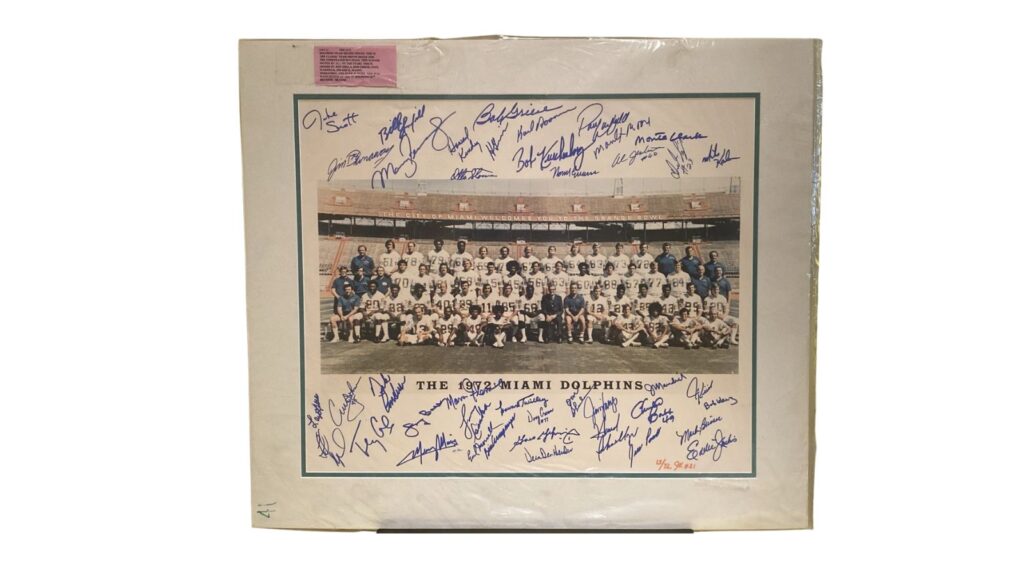
1972 Miami Dolphins undefeated season
Image Credit: Hooper Classics via eBay

Original team photo lithographs, championship broadsheets, and promotional posters from pre-1980 professional sports are a quietly growing collectibles category. An original 1969 New York Mets World Series commemorative poster, a 1972 Miami Dolphins undefeated season poster, or a large-format Muhammad Ali fight poster from a sanctioned bout can sell for $200 to $1,500.

These are more likely to surface at estate sales in sports-crazy cities, Boston, Chicago, New York, Detroit, or in collections from older sports fans.

What to check: Printing date, official team/league licensing marks, and condition. Many 1970s posters were printed on cheap paper and brown badly, pay attention to how the paper has held up.

Realistic finds: $5–$50 at estate sales; $100–$1,500 resale for the right subject in decent condition.

8. Travel Posters – Especially Airlines and Railroads from the 1930s–1950s

CHICAGO WORLDS FAIR CENTURY OF PROGRESS SKYRIDE
IImage Credit: chicago_vintage_posters via eBay

Vintage travel posters from the Golden Age of rail and early commercial aviation are among the most aesthetically prized paper collectibles, which means the market is active and better-known examples have already been picked over. However, regional railroad posters, lesser-known airline destinations, and international travel lithographs still turn up in estate collections.

A legitimate 1930s–1950s TWA, Pan Am, or United Airlines poster in clean condition: $300–$2,500. A New York Central or Southern Pacific railroad poster from the same era: $200–$1,500. Even a moderately rare destination poster for a ski resort or national park can fetch $150–$500.

What to check: Printing details, paper stock, and scale. Many travel poster reproductions are sold openly, check the back for “Printed in [year]” or reproduction credits. Original offset and lithographic examples from this period show their age in the paper and ink.

Realistic finds: $40–$200 at antique shops; $300–$2,500 resale for verified originals.