You notice it most on a weekday morning, when you are already running late, and something small slows you down again, like a drawer that sticks or a light that takes too long to turn on, and it feels minor, but it adds up in a way that is hard to ignore. It is not one big problem, just a series of small frictions that sit quietly in the background of daily life.
People today are looking for relief. They want their homes to stop getting in the way, or at least stop adding extra steps to routines that are already full.
Most homes are not broken, but they are not exactly helping either. A lot of spaces were designed for a slower pace of life, or at least a different one, and that mismatch shows up in odd ways. Storage feels slightly off, lighting is placed where it made sense ten years ago, and basic things like movement through a room can feel clumsy.
It is easy to ignore these issues because each one seems too small to justify the effort. But when you stack them together, they start to shape how a day feels. People adapt around them. They learn which cabinet to avoid or which switch to press twice. That kind of adjustment becomes normal, even though it should not have to be.
When the bathroom starts slowing you down
A lot of improvement decisions now come down to how a space supports a routine, and the bathroom is usually where that gap shows up first, not because it looks outdated, but because it does not keep up with how quickly mornings now move. Having the right professional revamp this space can make a real difference. For instance, a bathroom remodels by Leaf Home not only improves the aesthetics of the bathroom but also boosts the functionality and ensures the bathroom aligns with your lifestyle.
The goal is not perfection, but ease, and that often means a layout that removes one extra step or a fixture that works the first time without hesitation.
When convenience becomes the main goal
It used to be that home upgrades were planned around big milestones. Moving in, starting a family, or preparing to sell. Now, the timing is different. People are making changes in the middle of busy periods, not waiting for a perfect window that rarely comes.
This shift changes what counts as a “good” improvement. Speed matters more. Predictability matters more. A project that can be done with minimal disruption often wins over something more ambitious that requires a full schedule reset.
There is also growing awareness of how much energy goes into managing a home. Not just cleaning or maintenance, but the mental load of remembering what needs to be fixed or adjusted. When something is improved in a way that removes that burden, even slightly, it tends to have a longer impact than expected. The right home improvements not only make living more convenient but also quietly boost home value in the long run. What you invest in today for convenience will deliver an incredible ROI in the future.
The role of small, targeted upgrades
Not every change needs to be visible to be useful. In fact, many of the most effective updates are the ones that quietly remove friction. Consider low-effort swaps that remove friction: replacing a handle for a storm door with a smooth, well-fitted latch-and-lock set prevents sticking, speeds up exits on busy mornings, and quietly improves security. Better storage solutions, improved lighting placement, or fixtures that are easier to use can all shift how a space feels without drawing attention.
These kinds of upgrades often start small. A single drawer system that actually holds what it should. A surface that is easier to clean. A layout tweak that reduces unnecessary movement. None of these are dramatic on their own, but they build on each other.
Over time, the home begins to feel more responsive. It adapts to the person, instead of the other way around. That is usually when people realize the value of what seemed like minor changes at the start.
Why time is now part of the design
Time used to be something you worked around during a home project. Now it is part of the design itself. People are asking how long something will take, how much of their routine will be affected, and how quickly they can return to normal.
This has led to a different kind of decision-making. Instead of focusing only on materials or style, there is more attention on process. How a project is handled, how predictable it is, and whether it can fit into an already packed schedule.
It is not about rushing. It is about respecting the fact that most households do not have the flexibility they once did. Work hours are less defined, responsibilities overlap, and even downtime feels scheduled. Any improvement has to fit within that reality.
Living with less friction
At a certain point, the idea of improvement becomes less about adding something new and more about removing what does not work. That might mean simplifying a layout, replacing something that constantly causes problems, or adjusting how a space is used.
There is a quiet satisfaction in that kind of change. It does not announce itself. It just makes daily life a bit smoother. You notice it when things go right without effort, which is easy to overlook but hard to go back from once experienced.
People often expect that meaningful home changes have to be large or expensive. In practice, the opposite tends to be true. The most effective improvements are usually the ones that address very specific issues, the kind that show up every day but rarely get attention. When those are handled, even in small ways, the home starts to feel different. Not new, exactly. Just easier to live in.
College is not the only way to get to a serious paycheck. It can feel that way when every job ad asks for a degree, five years of experience, and a smile while bills keep climbing.
The jobs here are not easy shortcuts. Most require licenses, apprenticeships, physical stamina, shift work, or years of proving yourself. But they do offer real paths that do not depend on a four-year degree.
These roles also lean on judgment, safety, people skills, hands-on work, or regulated training. That makes them harder to replace than many desk jobs that are already being squeezed.
Air traffic controllers guide planes through takeoff, landing, and crowded airspace. You are watching screens, talking to pilots, tracking weather, and making fast calls when delays or emergencies hit. It is intense work, but the pay reflects the pressure. Median pay is about $144,580 per year.
You do not always need college, but the hiring path is strict. Applicants can qualify through work experience, aviation training, or a mix of approved routes, then must pass testing, medical checks, background screening, and academy training. There are also age rules, so this is not an open-ended career change for everyone.
The work is not going away because aircraft still need humans coordinating real-time movement. Automation helps controllers, but it does not take responsibility for a crowded sky full of people.
3. Commercial pilot
Image Credit: Shutterstock
Commercial pilots fly charter planes, cargo routes, medical transport, aerial survey flights, and other non-airline jobs. You plan flights, check weather, inspect aircraft, communicate with air traffic control, and carry responsibility for everyone and everything on board. Median pay for commercial pilots is about $122,670 per year.
You do not need a college degree for many commercial pilot jobs, but you do need flight training, flight hours, medical clearance, written exams, and flight tests. Training is expensive, and many pilots build hours by instructing or taking lower-paid flying jobs before moving into better routes.
This is a high-skill job with real barriers to entry. Planes have advanced systems, but pilots still make judgment calls about weather, mechanical issues, passengers, and emergencies. That human responsibility is a big reason the role remains valuable.
4. Elevator and escalator installer and repairer
Image Credit: Shutterstock
Elevator and escalator technicians install, maintain, and repair the machines that move people through office towers, hospitals, airports, hotels, and apartment buildings. The work blends electrical systems, motors, hydraulics, cables, brakes, and safety codes. Median pay is about $106,580 per year.
The usual path is a paid apprenticeship, not college. You learn on the job while taking technical instruction, and many states require licensing. It helps to be comfortable with heights, tight spaces, tools, and emergency calls when equipment fails.
This job is not generic maintenance. People get stuck, hospitals need lifts working, and older buildings need constant upgrades. New construction helps, but repair and modernization work also keeps demand steady. It is physical, regulated, and safety-heavy, which makes it hard to replace with a remote system.
6. Powerhouse, substation, and relay electrical repairer
Image Credit: Shutterstock
These technicians work on the electrical systems that keep power moving through substations, generating stations, and industrial sites. They test relays, repair breakers, inspect control panels, troubleshoot outages, and deal with equipment that can be dangerous when handled badly. Median pay is about $100,940 per year.
You do not need a college degree, but you do need serious technical training. Many people come through electrical apprenticeships, utility work, military electrical experience, or industrial maintenance jobs. Employers care about safety, testing skills, and whether you can follow procedures under pressure.
The grid is getting more complicated, not simpler. Older equipment needs upkeep, and newer systems still need people who understand power, controls, and field conditions. This is one of those quiet jobs most people never think about until the lights go out.
7. Transportation, storage, and distribution manager
Image Credit: Shutterstock
This job can mean running a warehouse, shipping yard, freight operation, port facility, or regional distribution center. You manage people, trucks, schedules, safety rules, inventory flow, delays, and customer problems. Median pay is about $102,010 per year.
The no-college path usually starts on the floor. People move up from dispatcher, warehouse lead, driver supervisor, shipping clerk, dock lead, or military logistics roles. You need to understand how freight really moves, not just how it looks on a screen.
This is not a cushy job. When storms hit, workers call out, trucks are late, or inventory is wrong, you are the one solving it. Companies still need experienced humans who can keep goods moving, manage crews, and make judgment calls when the plan falls apart.
9. Ship engineer
Image Credit: Shutterstock
Ship engineers keep a vessel’s engine room running. They inspect engines, generators, pumps, fuel systems, electrical systems, and safety gear. On larger vessels, they help manage crews and keep logs so the ship can operate safely. Median pay is about $101,320 per year.
You do not need a traditional college degree, but you do need maritime credentials, sea time, medical clearance, and technical training. Many people start as oilers, deckhands, military mariners, or engine department workers and move up as they gain documented experience.
The lifestyle can be hard. You may be away from home, work odd schedules, and deal with mechanical problems far from a repair shop. But ships still move cargo, fuel, equipment, and passengers, and someone has to keep the machinery running when the vessel is underway.
10. Electrical power-line installer and repairer
Image credit: Heri Susilo via Unsplash
Lineworkers build, maintain, and repair the power lines that feed homes, businesses, hospitals, and factories. They climb poles, work from bucket trucks, handle storm damage, and deal with high-voltage equipment. Median pay is about $92,560 per year.
The path usually starts with a lineworker program, utility trainee role, or apprenticeship. You need physical strength, comfort with heights, a clean safety mindset, and the ability to work outdoors in rough weather. Overtime and storm work can raise pay, but they also take a toll.
This is one of the clearest no-college paths to strong money. The work supports the grid, new construction, repairs, and upgrades. A computer can help locate faults, but people still have to get out there and fix the line.
11. Fire captain or firefighting supervisor
Image Credit: Shutterstock
Fire captains and other front-line fire supervisors manage crews during fires, medical calls, rescues, hazardous material incidents, and fire prevention work. They assign tasks, watch conditions, make safety calls, and train firefighters between emergencies. Median pay is about $92,430 per year.
You normally start as a firefighter, complete academy training, earn emergency medical credentials, and build years of field experience. Promotions often require exams, interviews, leadership reviews, and extra technical training. A degree can help in some departments, but it is not the core path everywhere.
The job is dangerous, physical, and emotionally heavy. It also depends on trust. Crews need leaders who know the work, read a scene, and keep people alive when the situation changes fast. That is not something you learn from a textbook alone.
12. Detective or criminal investigator
Image Credit: Shutterstock
Detectives and criminal investigators gather evidence, interview witnesses, review records, work with prosecutors, and build cases. Some handle violent crime, fraud, narcotics, missing persons, or digital evidence. Median pay is about $93,580 per year.
The no-college path is usually through law enforcement. You become an officer, complete academy training, work patrol, and earn a move into investigations. Some federal jobs require degrees, but many local and regional paths still rely on experience, testing, and performance.
This is slow, detailed work mixed with unpredictable human behavior. Interviews, field work, court testimony, and case judgment all matter. Tools can help sort data, but they cannot replace the human side of getting people to talk, spotting weak stories, or knowing when a case is ready.
13. Casino gaming manager
Image Credit: Shutterstock
Gaming managers oversee casino tables, slot areas, staff, guest issues, payouts, security concerns, and compliance rules. They watch for disputes, cheating, intoxicated customers, and mistakes that can cost the business money. Median pay for gambling managers is about $85,580 per year.
Many people enter casinos as dealers, slot attendants, floor supervisors, or security staff, then move up. You usually need licensing, background checks, sharp customer service skills, and a strong understanding of game rules. College is not the normal gatekeeper here.
Growth is not explosive, but the work is stable in places with established gaming markets. Casinos still need people who can manage money, guests, staff, and regulations in real time. It is hospitality, math, security, and people management all rolled into one loud shift.
14. Transportation inspector
Image Credit: Shutterstock
Transportation inspectors check aircraft, rail equipment, buses, trucks, ships, cargo systems, or other transportation operations for safety and compliance. They review records, inspect equipment, investigate issues, and make sure rules are being followed before small problems become big ones. Median pay is about $85,750 per year.
The path often starts with hands-on transportation experience. Former mechanics, drivers, aviation workers, rail workers, maritime workers, or military transportation specialists may move into inspection after they understand the equipment and rules. Certifications or agency training may be required depending on the specialty.
This is a good fit if you are detail-oriented and not afraid to say no when something is unsafe. The economy still depends on moving people and goods, and that movement needs oversight. It is hard to automate the judgment that comes from seeing worn equipment in person.
15. Tugboat captain or vessel pilot
Image Credit: Shutterstock
Captains, mates, and pilots of water vessels command tugboats, ferries, workboats, and other vessels. They handle navigation, crew safety, docking, cargo movement, weather calls, and communication with ports or traffic systems. Median pay is about $85,540 per year.
You do not need a college degree, but you do need Coast Guard credentials, documented sea time, medical clearance, exams, and clean safety records. Many people start as deckhands and work their way up while learning lines, navigation, vessel systems, and local waterways.
The work can mean long shifts, bad weather, and time away from home. It can also be a strong career for people who like practical responsibility over office life. Boats still need trained people who can read water, traffic, weather, and crew limits in real time.
16. Signal and track switch repairer
Image Credit: Shutterstock
Signal and track switch repairers keep railroad signals, crossings, switches, and control systems working. They troubleshoot electrical and mechanical problems, inspect trackside equipment, repair gates, test circuits, and respond when a signal failure can slow or stop trains. Median pay is about $83,600 per year.
This is a no-degree job that usually requires a high school diploma, clean safety habits, and on-the-job training. Electrical knowledge helps, and railroad employers often train workers on their specific systems. The work can involve nights, weekends, travel, and outdoor conditions.
Rail may not be flashy, but it is still a major part of freight and passenger movement. Signals are safety-critical, and a broken crossing or switch needs a person who can diagnose the problem on-site. That makes this a solid alternative trade for people who like electrical work but do not want a standard electrician path.
17. Aircraft mechanic or avionics technician
Image Credit: Shutterstock
Aircraft mechanics and avionics technicians inspect, repair, and maintain planes, helicopters, navigation systems, radios, wiring, sensors, and flight instruments. The work is exact because a small mistake can become a major safety problem. Median pay is about $78,680 for aircraft mechanics and $81,390 for avionics technicians.
You can qualify through approved technical training or enough documented work experience to test for credentials. Military aviation experience can also transfer well. You need patience, clean records, tool skill, and the ability to follow procedures without cutting corners.
Air travel, cargo, private aviation, and medical flights all depend on maintenance crews. Diagnostic software can point to a problem, but someone still has to inspect the aircraft, test the fix, sign off the work, and stand behind it.
18. Commercial diver
Image Credit: Call Me Fred via Unsplash
Commercial divers work underwater on bridges, docks, ships, pipelines, dams, salvage jobs, inspections, and repairs. They may weld, cut, photograph damage, recover equipment, or support construction crews below the surface. Median pay is lower than some jobs here, but high-end pay can reach $152,580 per year.
You do not need college, but you do need commercial dive training, medical clearance, comfort in dangerous conditions, and strong teamwork. The best money often comes after experience, travel, offshore work, inspection skills, welding ability, or saturation diving credentials.
This is not romantic scuba work. It is industrial labor underwater, often in poor visibility and tight conditions. Still, ports, bridges, energy projects, and marine construction need people who can do work where most workers cannot even go.
19. Rope access technician
Image Credit: Shutterstock
Rope access technicians inspect and repair hard-to-reach places using harnesses, ropes, anchors, and safety systems. They work on bridges, towers, wind turbines, stadiums, industrial plants, and high-rise buildings. A Level II rope access technician averages about $85,151 per year.
This is a good no-college path for people who are calm at heights and serious about safety. You usually need rope access certification, rescue training, and a second skill such as inspection, welding support, blade repair, painting, mechanical work, or nondestructive testing.
The job exists because scaffolding is not always practical and some repairs cannot wait. Wind energy, bridge maintenance, telecom, and industrial inspection all create demand for people who can reach difficult spots safely. It is not easy work, but it is a real alternative to the usual trade-school list.
20. Theatrical and performance makeup artist
Image Credit: Shutterstock
Theatrical and performance makeup artists create looks for film, television, theater, live shows, haunted attractions, commercials, and special events. They may age a character, create injuries, build prosthetics, apply wigs, or keep makeup intact under lights and sweat. Top earners make more than $157,090 per year.
You do not need a college degree, but you do need a strong portfolio, technical practice, sanitation knowledge, set etiquette, and the ability to work fast around actors and crews. Many people learn through cosmetology, short makeup programs, apprenticeships, theater work, indie film sets, or assisting established artists.
The early years can be uneven, and this is not the safest paycheck on the list. But it belongs here because the ceiling is real for skilled artists in performance-heavy markets. A filter can change a face on a screen, but live productions and close-up camera work still need human hands.
21. Professional body piercer
Image Credit: Shutterstock
Professional body piercers do more than put jewelry through skin. They consult with clients, check anatomy, mark placement, sterilize tools, explain aftercare, handle nervous customers, and follow health rules closely. The work takes steady hands and good judgment because a rushed or careless piercing can cause pain, infection, scarring, or a bad result. Established professional body piercers average about $103,520 per year, though beginners often make much less.
You do not need college, but you do need training. Most piercers learn through an apprenticeship, bloodborne pathogen training, sanitation practice, jewelry education, and local licensing or permit rules. Building a book of repeat clients takes time, and the best money usually goes to people in busy studios with a strong reputation.
Most people have more financial leverage than they realize, and no budget to use it. The 18 actions on this list require nothing but a few hours of your time. No startup money, no credit check, no subscription. Just concrete steps you can take today, most of them in under 30 minutes, that have a real shot at either putting money back in your pocket or stopping money from quietly leaving it.
Some of these are obvious moves that most people never actually make. Others are programs that millions of eligible people skip because they have no idea they exist. A few will feel uncomfortable, like calling a credit card company and asking for something. Do them anyway. The worst realistic outcome of almost everything on this list is a polite no.
Start with the three that feel most immediately relevant to your situation. None of them costs a dime.
Every American is entitled to free weekly credit reports from all three bureaus, Equifax, Experian, and TransUnion, through AnnualCreditReport.com. That program became permanent in 2023 after a pandemic-era pilot. Before that, you got one free report from each bureau per year. Now you can pull all three every week if you want to, at no cost, with no strings attached.
Most people have never looked at their credit report. That is a problem, because errors are genuinely common. Your report might show accounts you never opened, late payments that were actually on time, debts that were paid and discharged still listed as active, or old collection accounts that should have aged off your record by now. Any of those errors can suppress your credit score, which affects the interest rates you pay on everything from a mortgage to a car loan.
Set aside 30 minutes to pull all three reports and read through them carefully. Note any account you do not recognize, any payment marked late that you have documentation was on time, and any balance that does not match your records. Errors are more common in TransUnion and Equifax reports, but all three are worth reviewing. What you find there will determine whether the next step applies to you.
Dispute errors on your credit report
Image Credit: Shutterstock
If you found anything wrong in your credit report, you have the legal right to dispute it. The credit bureau must investigate your claim within 30 days and remove or correct any information it cannot verify. You do not need a credit repair company for this. You do not need to pay anyone anything. The dispute process is free and you can initiate it directly online with each bureau.
When you file a dispute, be specific. Include your account number, describe the error clearly, and attach whatever documentation you have. A W-2 showing your on-time payment, a payoff letter from a lender, a bank statement showing a charge that was not yours. The more documentation you provide, the stronger the dispute. You can file disputes simultaneously with multiple bureaus if the same error appears across more than one report.
If the bureau sides with the furnisher and the error stays, you can escalate a complaint to the Consumer Financial Protection Bureau, which often prompts faster resolution. You also have the right to add a 100-word statement to your file explaining any disputed item that was not removed. That does not fix your score, but it creates a paper trail and gives lenders context if they pull your report while the dispute is unresolved.
Freeze your credit at all three bureaus
Image Credit: Shutterstock
A credit freeze stops lenders from accessing your credit report to open new accounts in your name. That means if someone has your Social Security number and tries to take out a credit card, a loan, or a cell phone contract under your name, the application will be rejected because your report is locked. Placing, lifting, and removing a credit freeze is free at all three bureaus. You have to freeze your report at each bureau separately.
This step used to feel like an overreaction reserved for identity theft victims. At this point, given how many large data breaches have exposed consumer information over the past decade, most security professionals suggest treating it as routine maintenance rather than a response to a specific threat. Your information has almost certainly been part of at least one breach already.
When you need to apply for credit later, you can temporarily lift the freeze at whichever bureau the lender uses, then refreeze it after. The online process at each bureau takes about 10 minutes. You will need your Social Security number, address, and date of birth to verify your identity. The freeze does not affect your credit score, does not prevent existing lenders from reviewing your account, and has no downside beyond the mild inconvenience of lifting it before a planned application.
Search for unclaimed money in your name
Image Credit: Shutterstock
States are holding billions of dollars in unclaimed property: old bank accounts, forgotten security deposits, uncashed checks, stock dividends, insurance payouts, and unused gift card balances. When a company loses contact with the account holder for a period of years, it is legally required to turn that money over to the state, which holds it indefinitely until the rightful owner claims it. Approximately 1 in 7 people nationally has unclaimed property sitting in a state database right now.
The main search tool is MissingMoney.com, which is free and lets you search across almost every state simultaneously. You can also search your state’s official unclaimed property site directly through the National Association of Unclaimed Property Administrators. If you have lived in multiple states, search each one. Unclaimed property is reported to the state where the company is located, not necessarily where you lived, so cast a wide net and include former names if you have had one.
Claiming what you find is also free. The state will ask you to verify your identity and prove you are the rightful owner, which usually means submitting a copy of your ID and some documentation connecting you to the account. The process can take a few weeks to a few months depending on the state. There is no deadline and no fee. If someone contacts you offering to find your unclaimed property for a percentage of the payout, that is a scam. Do the search yourself for free.
Check your Social Security earnings record for errors
Image Credit: Shutterstock
Your future Social Security retirement benefit is calculated based on your lifetime earnings record. Every year your employer reports your wages to the Social Security Administration, which logs them in your file. If an employer ever reported your earnings under the wrong name or Social Security number, or simply failed to report them at all, those wages disappear from your record. You can see your full earnings history at ssa.gov/myaccount for free.
The financial stakes here are significant. One year of missed earnings can reduce your monthly benefit by around $100, according to the Social Security Administration. Over a 20-year retirement, that is $24,000 gone because nobody caught the mistake. Errors are most likely to occur if you changed your name, had a job where the employer went out of business, did freelance work where a client misreported your Social Security number, or worked multiple jobs with the same employer making data-entry errors.
Go through each year in your record and compare it to your W-2s or tax returns. If you find a discrepancy, act quickly. The correction window is three years, three months, and 15 days from the end of the tax year in question, though there are exceptions for certain errors. If a year is missing entirely, gather whatever documentation you have and contact the SSA. This is one of the highest-value 20-minute tasks on this entire list.
Call your credit card issuer and ask for a lower APR
Image Credit: Shutterstock
The average credit card interest rate is running around 24%. If you are carrying a balance, that rate determines how quickly your debt grows. What most cardholders do not know is that rates are often negotiable. A survey by CreditCards.com found that only about 25% of cardholders ever call to ask for a lower rate, but nearly 70% of those who do get one. The number of people leaving money on the table here is enormous.
Call the number on the back of your card. Tell the representative you have been a loyal customer, you have a good payment history, and you would like to discuss your interest rate. Mention any competing offers you have received from other issuers. If you have seen your credit score improve since you opened the account, say so. You are not asking for a favor; you are giving them the opportunity to retain your business on better terms. Be polite, be specific about what you are asking for, and ask to speak with a retention specialist if the first rep says no.
Even a reduction of three or four percentage points on a $5,000 balance saves roughly $150 to $200 a year in interest. Multiply that across multiple cards. If your issuer declines, ask whether a temporary rate reduction is available, which some banks offer for customers experiencing financial hardship. Write down the name of the representative you spoke with and the outcome of the call. If they say no, call again in three to six months.
Call your internet or phone provider and ask for a better rate
Image Credit: Shutterstock
Cable, internet, and wireless providers routinely give their best rates to new customers while charging longtime customers significantly more for the same service. The pricing on your current plan is not the floor. It is a starting point for a negotiation most providers expect and accommodate, because losing a customer entirely is more expensive for them than trimming your monthly bill by $20.
Call the retention or cancellation department directly and say you have been reviewing your bill and are considering switching providers because a competitor is offering a lower rate. Have the competitor’s current promotional rate ready when you call. Whether or not you actually intend to switch, the possibility is enough to open the conversation. Retention agents typically have more authority to discount than general customer service. They can often waive fees, match competitor pricing, or move you to a promotional rate that is not publicly advertised.
This works equally well on cell phone plans. Call your carrier, ask what promotional pricing is available for existing customers, and specifically ask whether a loyalty discount applies to your account. Verizon, AT&T, and T-Mobile all have programs like this that are not automatically applied. Many customers who have been on the same plan for three or more years are paying $15 to $40 per month more than they would pay if they just called and asked. Set a calendar reminder to do this annually.
Appeal your property tax assessment
Image Credit: Shutterstock
Between 30% and 60% of properties in the United States are over-assessed, meaning the local tax authority values the home higher than its actual market value. That gap translates directly into a higher property tax bill. Of homeowners who formally appeal their assessments, between 30% and 50% win some kind of reduction, according to the National Taxpayers Union. Successful appeals save homeowners an average of several hundred dollars a year. Only about 5% of homeowners ever bother to file.
Start by pulling your property record card from your county assessor’s website. Check the basics: square footage, number of bedrooms and bathrooms, lot size, and year built. Errors in the factual record are common and usually the easiest wins. If your home shows three bathrooms and you have two, that alone may be enough to get the assessment reduced informally without ever filing a formal appeal.
If the factual record is accurate but the value still seems too high, find comparable recent sales in your neighborhood. Your goal is to show that similar homes nearby sold for less than the value your home was assigned. Most counties have a formal appeal window each year, typically in the spring, with deadlines posted on the assessor’s website. You do not need an attorney to file. The forms are straightforward, the filing fee is usually waived for residential homeowners, and the process rarely requires more than one appointment to present your evidence.
Check which property tax exemptions you qualify for
Image Credit: Shutterstock
Property tax exemptions are entirely separate from assessment appeals. Where an appeal challenges the assessed value of your home, exemptions are fixed programs that reduce the taxable portion of that value for specific categories of homeowners. The most common are the homestead exemption, which is available in most states for a primary residence, and additional exemptions for senior citizens, veterans, people with disabilities, and surviving spouses of veterans. Many eligible homeowners never apply.
A homestead exemption in many states removes the first $25,000 to $50,000 of your home’s assessed value from the taxable calculation. On a $300,000 home with a 1.5% effective tax rate, a $50,000 exemption saves you $750 a year, every year, indefinitely, with no further action required once it is approved. Senior exemptions in many counties go further, freezing assessed values for homeowners over a certain age so they are not hit by rising market valuations.
Go to your county assessor or property tax authority website and look at the list of exemption programs. Read the eligibility criteria carefully, because income thresholds and age cutoffs vary significantly by county and state. The application is usually a short form with supporting documentation such as your driver’s license, proof of residence, or a copy of your discharge papers for veterans. Most exemptions must be applied for once and then renew automatically as long as you remain eligible.
Apply for energy bill assistance through LIHEAP
Image Credit: Shutterstock
The Low Income Home Energy Assistance Program is a federally funded program that helps qualifying households pay heating and cooling bills, prevent utility shutoffs, and in some cases cover emergency energy repairs. The money goes directly to your utility company or fuel supplier, meaning you never touch it. Eligibility is based on household income, generally set at 60% of the state median income or 150% of the federal poverty guideline, with states setting their own specific limits. Both renters and homeowners qualify.
The benefit amounts vary significantly by state and household situation. Pennsylvania offers cash grants between $200 and $1,000 per season. DC offers up to $1,800. Tennessee’s range is $174 to $750. If you are not sure whether you earn too much, check anyway. The income thresholds are wider than most people expect, and many households that assume they do not qualify actually do. Only about 17% of eligible households apply each year, which means the program is consistently underutilized by the people it is designed to serve.
Applications are typically accepted in the fall and winter months through a first-come, first-served process. Many states run out of funds before the application window closes, so earlier is better. To apply, search for your state’s LIHEAP office using the eligibility tool at benefits.gov, or call 211, the free social services hotline, which can direct you to the nearest intake office. The application usually requires proof of income, a recent utility bill, and a form of identification.
Check if you qualify for SNAP
Image Credit: United States Department of Agriculture, Public domain, via Wikimedia Commons
SNAP (the Supplemental Nutrition Assistance Program, still widely called food stamps) is the largest food assistance program in the country. Gross income eligibility is generally set at 130% of the federal poverty level, which in 2025 works out to about $20,783 a year for a single person and $35,622 for a family of three. Those limits are higher in Alaska and Hawaii. Net income limits, which account for certain deductions, are even more accommodating. Many working families with incomes above the gross threshold still qualify once deductions are applied.
Millions of eligible people do not receive SNAP. The most common reason is the assumption that they earn too much, followed closely by the belief that the application process is too complicated. The application is available online in most states and takes about 30 minutes. To find your state’s SNAP application portal and check the specific income thresholds for your household size, search for your state’s SNAP office at fns.usda.gov/snap/state-directory.
If you are approved, benefits are loaded onto an EBT card that works exactly like a debit card at most grocery stores and supermarkets. The average monthly benefit for a single-person household in 2024 was around $181. For a family of four, the average was over $700. This is money available to people who qualify for it that does not require paying anything back. If you are close to the income threshold and were rejected in the past, changes in your income, household size, or expenses may make you eligible now.
Run your information through BenefitsCheckUp
Image Credt: Shutterstock
SNAP and LIHEAP are two programs out of thousands that exist at the federal, state, and local levels. Most people have no realistic way to know which programs they might qualify for without spending hours researching each one individually. BenefitsCheckUp, run by the National Council on Aging, is a free, confidential screening tool that matches your situation against over 2,000 public and private benefits programs across all 50 states. You enter your ZIP code, age, household income, and a few other details, and it returns a personalized list of programs you may qualify for.
The tool was originally built for older adults, but it covers programs available to working-age adults and people with disabilities as well. The categories include food assistance, prescription drug assistance, utilities, housing, tax credits, veteran benefits, Medicare savings programs, and more. Many of the programs in its database are state-specific or county-specific and would never appear in a general web search.
The screening is anonymous, takes about 10 minutes, and does not require registration or an account. It does not apply for any programs on your behalf. What it does is show you a prioritized list of what you may be eligible for, with instructions for how to apply to each one. Think of it as a starting point for a benefits audit rather than a one-stop application. Billions of dollars in eligible benefits go unclaimed every year because people do not know they exist.
Look up free prescription assistance programs before refilling
Image Credit: National Cancer Institute via Unsplash
Most major pharmaceutical companies run patient assistance programs that provide free or deeply reduced medications to people who cannot afford them, regardless of whether they have insurance. These programs are not widely advertised, they are not automatically offered at the pharmacy counter, and they are not only for people who are uninsured. Many cover people with insurance who still face high out-of-pocket costs for specialty or brand-name drugs.
Two free databases aggregate these programs: NeedyMeds.org and RxAssist.org. Both let you search by medication name and return a list of assistance programs with eligibility requirements and application instructions. NeedyMeds also offers a free drug discount card that can reduce pharmacy prices by an average of 50% on medications, over-the-counter drugs prescribed by a doctor, and even some pet medications. The discount card works even if you have insurance and does not require any registration. You can print it or download it to your phone immediately.
If a medication you take regularly is not covered by an assistance program, GoodRx is a free comparison tool that shows you what that medication costs at every pharmacy near you and provides a discount coupon you can use at the counter regardless of your insurance status. Prices for the same drug vary by as much as 300% between pharmacies in the same zip code. Looking this up once before each refill takes two minutes and can save you a meaningful amount over the course of a year.
Verify you are capturing your full 401k employer match
Image Credit: Shutterstock
If your employer offers a 401k match, that match is part of your compensation. You earned it. But the match is typically conditional: you have to contribute at least a certain percentage of your salary for the full match to kick in. Many employees contribute something to their 401k but not quite enough to capture the entire employer match. The unclaimed portion is effectively a pay cut you are taking voluntarily.
Log into your 401k plan or ask HR what your employer’s match formula is. The most common structure is a match of 50% on contributions up to 6% of salary, which means contributing less than 6% leaves part of the match unclaimed. Some employers match dollar-for-dollar up to 3% or 4%. Whatever the formula, find out exactly where the threshold is and confirm you are meeting it. If you are not, increasing your contribution to the threshold point is often the highest-return financial move available to you, because the match is a 50% to 100% instant return on those additional dollars.
The adjustment costs you nothing out of pocket beyond the pretax reduction in your take-home pay, which is also reducing your taxable income. The net impact on your actual take-home is significantly smaller than the gross contribution amount. For a worker earning $55,000 who is capturing only half of a 6%/50% match, closing the gap means roughly $825 in free employer contributions per year that would otherwise be left on the table.
Audit and cancel your forgotten subscriptions
Image Credit: Shutterstock
The average American underestimates their monthly subscription spending by about $100, according to research by C+R Research. Streaming services, fitness apps, meal kit pauses that never fully cancelled, cloud storage plans, software trials, premium tiers for apps you use once a week, news sites. They accumulate silently across credit cards and bank accounts, each charge small enough not to trigger a second look in isolation.
Pull up three months of bank statements and credit card statements side by side. Go line by line and flag every recurring charge. For anything under $20 a month, ask whether you would actively sign up for it again today. Not whether it is nice to have or whether you might use it eventually. Whether you would pay for it right now if you had to re-enter your card number. That framing cuts through the inertia that keeps unused subscriptions alive.
Canceling subscriptions directly with the provider is important. Do not just stop using something; actually cancel it, because some services continue charging after account inactivity and the charge may continue even if the card on file expires and is replaced. Services like Rocket Money can automate this process, though doing it manually yourself costs nothing. Many people who do this exercise for the first time find $50 to $150 a month in recurring charges they had effectively forgotten about. That is $600 to $1,800 a year.
Get a free session with a nonprofit credit counselor
Image Credit: Shutterstock
If you are dealing with debt you cannot seem to make progress on, or a financial situation that feels too tangled to address one step at a time, a nonprofit credit counseling session is free and does not obligate you to anything. The National Foundation for Credit Counseling connects you with certified nonprofit counselors in every state who will review your full financial picture at no cost. These are not salespeople. They are accredited counselors with a fiduciary obligation to advise you in your own interest.
In a free initial session, a counselor will go through your income, expenses, and debts with you, help you understand your options, and give you a realistic picture of what a debt payoff timeline actually looks like. If you are carrying high-interest credit card debt, they can also potentially enroll you in a debt management plan, through which the NFCC negotiates directly with your card issuers. Clients on those plans have typically had their rates reduced to between 4% and 6%, down from rates near 20% to 30%, according to counselors familiar with the program.
The counseling session itself is free regardless of whether you enroll in a paid program afterward. Many people find that a single session with a clear-eyed outside perspective unlocks a path forward that they could not see on their own. You can find your nearest NFCC member agency at nfcc.org or call 844-865-2461 to speak with a counselor directly.
Ask your utility directly about low-income rate programs
Image Credit: Shutterstock
LIHEAP covers a lot of ground, but it is a government program with a fixed pool of funding that runs out every year. Your utility company itself may offer discounted rates or payment assistance programs that are separate from LIHEAP and available year-round. These programs are not announced prominently. You have to ask specifically, or look for them under names like “low-income discount rate,” “budget billing,” “CARE program,” “LITE-UP,” or “Percentage of Income Payment Plan,” depending on the utility and the state.
Many states require regulated utilities to offer income-tiered rates. In California, the CARE program reduces electricity and gas bills by 30% to 35% for qualifying households. In New Jersey, the Universal Service Fund provides a monthly bill credit. In Texas, the LITE-UP program cuts electricity bills during high-usage months. These programs are funded by small line items on every customer’s bill and exist specifically to be used. Eligibility for most of them mirrors SNAP or LIHEAP eligibility.
Call your electric company and gas company separately, since they may have different programs. Tell them you are calling to ask about any income-based assistance or low-income rate programs they offer. If the first representative does not know what you are asking about, request to be transferred to the billing assistance department. You may also find these programs listed in the small print of your utility bill or on the utility’s website under “assistance programs” or “payment options.”
Set up an automatic transfer to savings, even a small one
Image credit: Towfiqu barbhuiya via Unsplash
This one has nothing to do with how much money you currently have. It is about changing the structural relationship between your checking account and your savings account. If you wait until the end of the month and transfer whatever is left over, there is almost never anything left over. Automatic transfers remove the decision from the equation entirely. Set a recurring transfer for the day after payday so that the money moves before you have a chance to spend it.
The amount is almost irrelevant to start. $10 is fine. $25 is fine. The goal in the first three months is not accumulation; it is building a behavioral pattern. Research on savings behavior consistently shows that the single strongest predictor of whether someone builds savings over time is whether the transfers happen automatically. Discretionary transfers, where you move money when you remember to and when it feels comfortable, produce dramatically lower outcomes over time.
Open a high-yield savings account if you do not have one. Several online banks currently offer interest rates above 4% annually, compared to the 0.01% typical at large national banks. The difference between those two rates on $2,000 in savings is about $80 a year, which is not life-changing but is entirely free money that compounds over time. Most online savings accounts take about 10 minutes to open and have no minimum balance and no monthly fees.
None of this is complicated. Most of it is just not done, and not done costs money.
Pull all the loose change out of your junk drawer, check your grandmother’s coin collection, and dig through any old mint sets you’ve been ignoring for decades. Some of those ten-cent coins aren’t worth ten cents. They’re worth hundreds. A few are worth thousands. Two of them, if you happened to stumble upon the right ones, have sold for more than a major car.
The thing about dimes is that they’re easy to overlook. They’re small, they pile up in jars, and most people assume coins from the 1950s or 1960s are just pocket change from another era. A lot of them are. But some aren’t, and the difference between the two comes down to a single digit in the date, a tiny letter underneath the design, or an invisible manufacturing error you can only see under magnification.
You don’t need an expensive collection to have something valuable. A single dime tucked into an old paper roll could be worth more than the rest of your savings account. The entries below cover the full range, from coins that anyone might genuinely turn up at a yard sale or in a forgotten tin, to the kind of pieces serious collectors spend decades hunting.
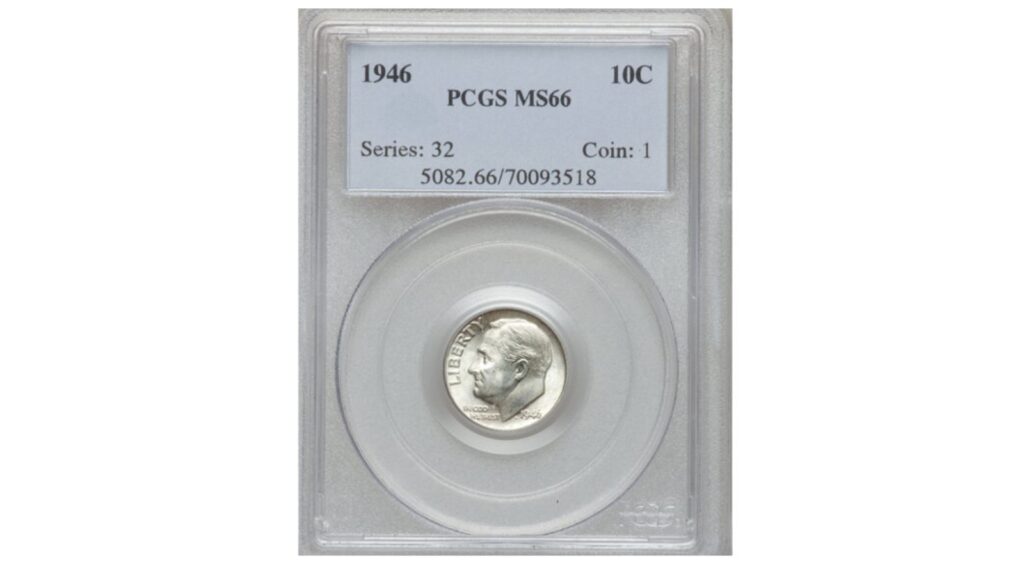
Before 1965, every Roosevelt dime was made of 90% silver. From 1965 onward, the Mint switched to a copper-nickel clad composition, and that was the end of silver in everyday circulation. The result is a very simple rule: if it’s a Roosevelt dime dated 1964 or earlier, it’s worth several dollars just for the metal it contains.
Each of those coins holds about 0.072 troy ounces of pure silver. At current silver prices, even a heavily worn example from a common date brings $3 to $5 just in melt value, with the better-date and higher-grade examples worth considerably more. Rolls of them turn up constantly in estate lots, old bank bags, and the backs of coin albums. The easiest way to spot them is the date, but you can also check the edge: a silver dime shows a solid silver rim all the way around, with no copper stripe. The clad coins have a visible orange layer on the edge.
Don’t clean them, don’t polish them, and don’t separate them from their original rolls if they’re sealed. Cleaning destroys the surface and removes the collector value above the silver floor. A common 1954-D in honest worn condition is worth roughly the silver; the same coin in untouched near-mint condition can bring $10 to $25.
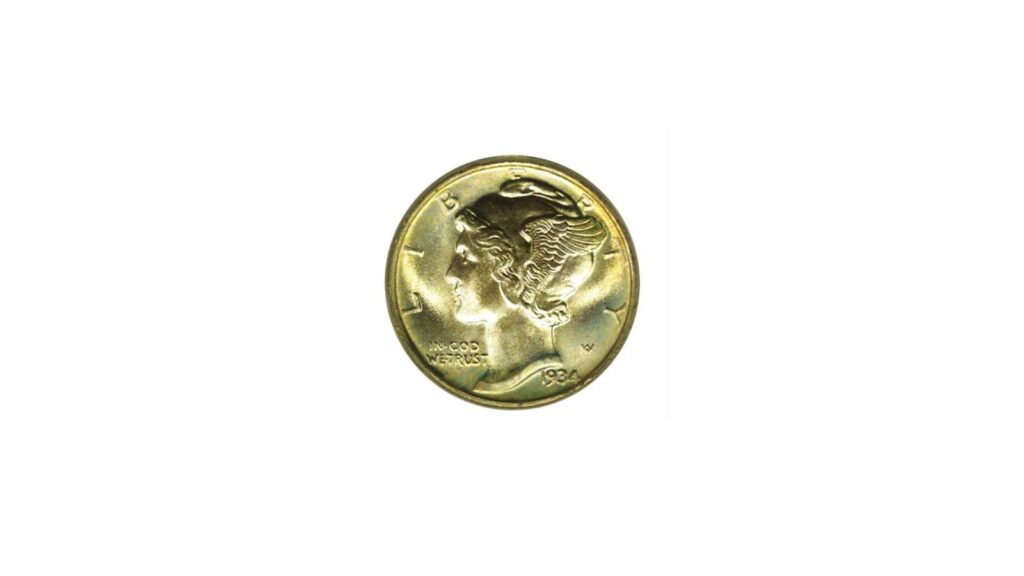
Common-date Mercury dimes, 1934 to 1945
Image Credit: Heritage Auctions
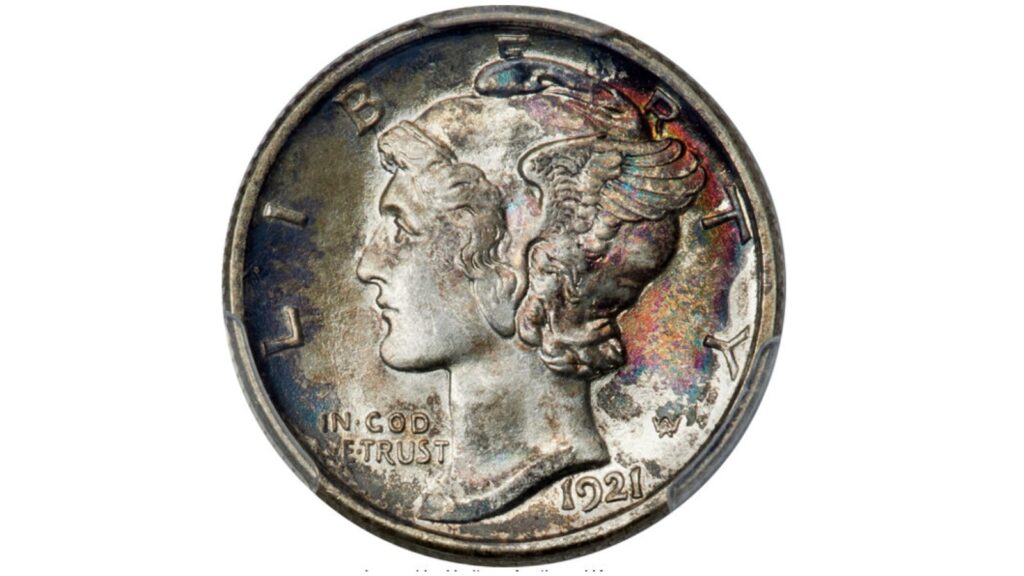
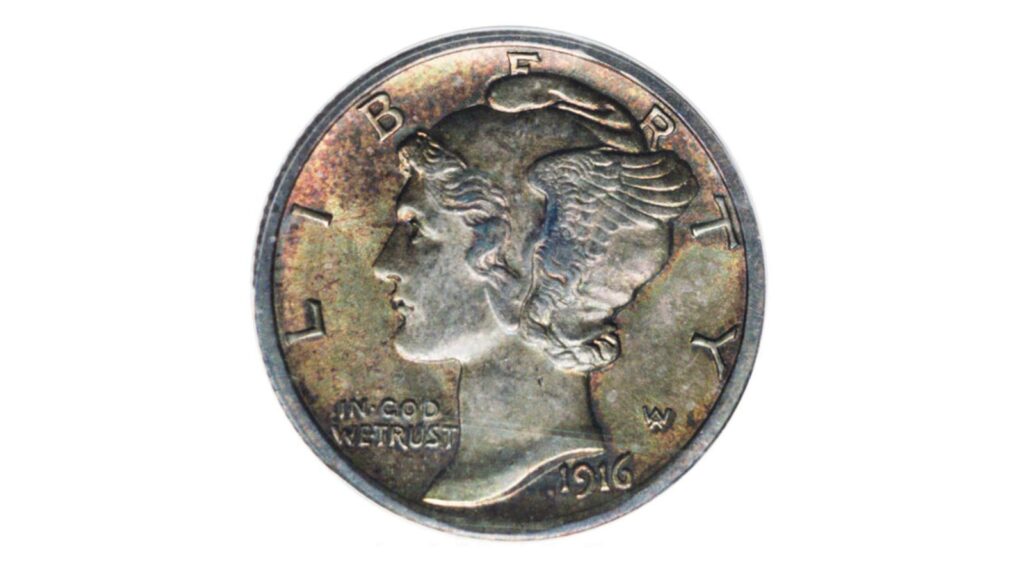
Mercury dimes, the winged Liberty Head coins minted from 1916 to 1945, are some of the most beautiful small coins the United States ever produced. The design by sculptor Adolph Weinman has a legible, specific elegance that the later Roosevelt portrait can’t match, and collectors have never stopped chasing them. The good news for anyone who turns up a roll or a collection: common dates from the mid-1930s onward are genuinely accessible and worth more than their silver content.
A worn 1940, 1941, 1943, or 1944 Mercury dime from Philadelphia or Denver brings $3 to $10 in heavily circulated condition. In better shape, with clean surfaces and no deep scratches, the same coin climbs to $15 to $30. The 1945-S “Micro S” variety, where an unusually small mintmark was used, carries a premium above regular S-mint examples. Don’t assume any Mercury dime is just silver scrap before checking the date and mint mark.
What destroys value here is cleaning. Mercury dimes in particular suffer badly from polishing or acid baths, which strip the surface and leave a bright, fake-looking sheen. An original, gently toned coin in its natural state is worth more to a collector than a scrubbed bright example even if the scrubbed one looks shinier to an untrained eye.
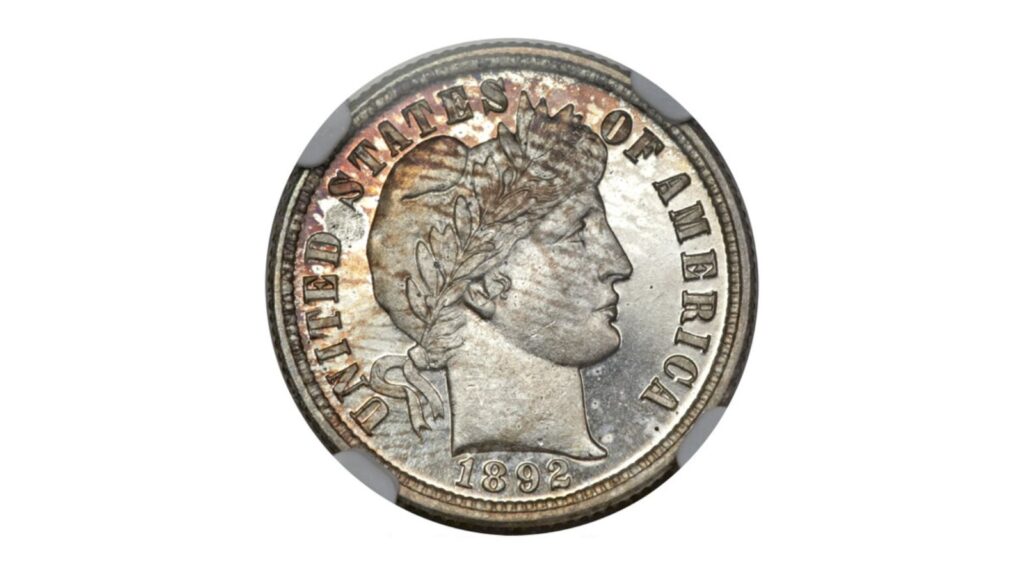
Common-date Barber dimes, 1892 to 1916
Image Credit: Heritage Auctions
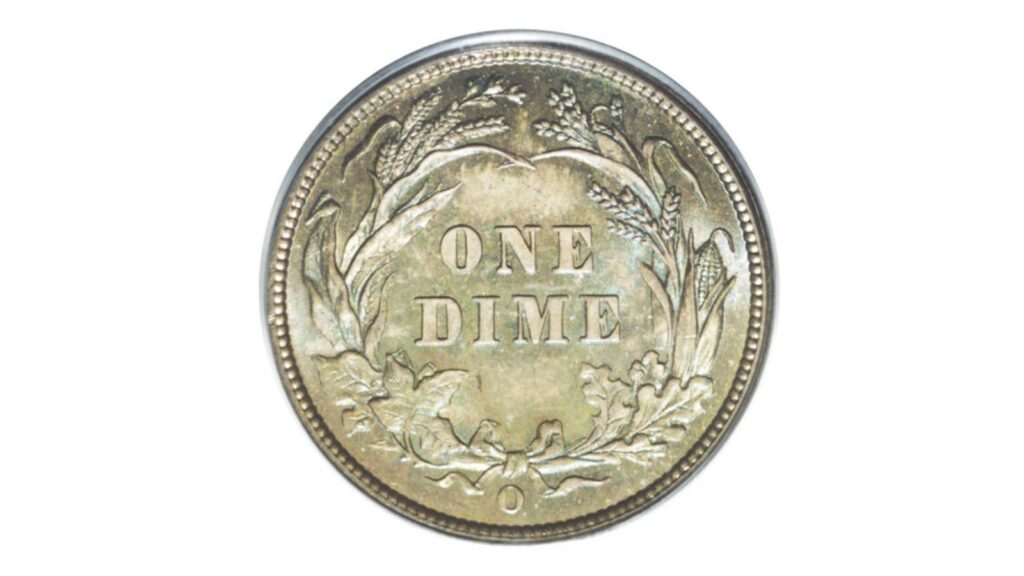
Barber dimes, the Liberty Head coins designed by Chief Engraver Charles Barber, circulated for over two decades and most of them were used hard. A heavily worn common date from the 1900s to 1910s, something like a 1907 Philadelphia or a 1908-D, brings $8 to $15 in circulated condition and reflects both the silver content and a modest collector premium for the series type.
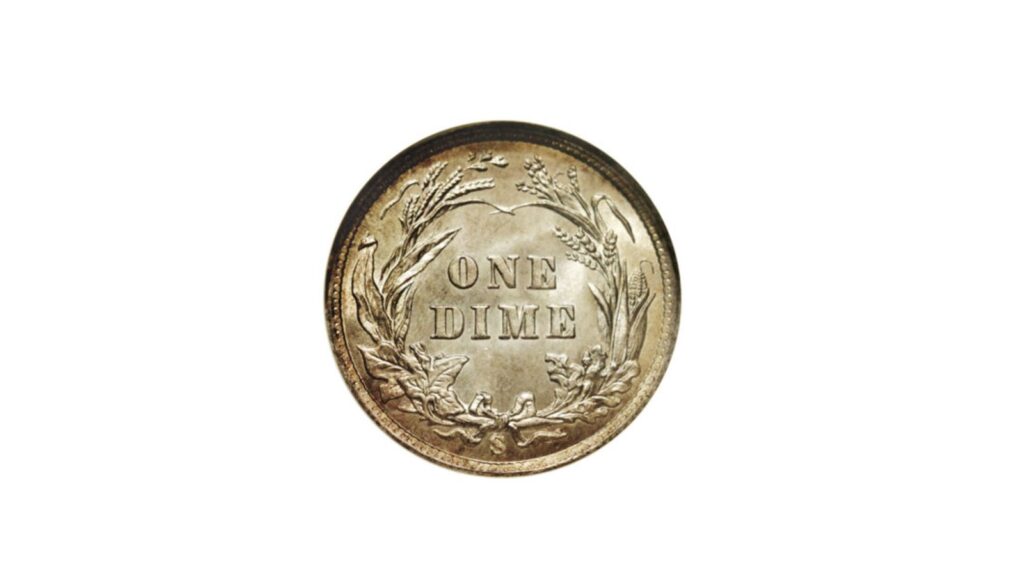
These aren’t exciting finds on their own, but they show up constantly in inherited collections and old jars of coins, and they’re easy to misidentify. The obverse design features Liberty with a laureate wreath on her head and the word LIBERTY on the headband. The reverse has a simple wreath surrounding “ONE DIME.” The mint mark, if present, appears on the reverse below the wreath, not on the front. Coins from the New Orleans Mint bear an O, San Francisco bears an S, Denver bears a D, and Philadelphia has no mark at all.
Where this gets interesting is when the date and mint mark combination falls outside the common range. Most Barber dimes from 1906 onward are relatively plentiful. Anything dated before 1900, especially from branch mints, is worth checking carefully. The difference between a common Philadelphia date and a scarce New Orleans or San Francisco date in the same condition can be a factor of ten or twenty in value.
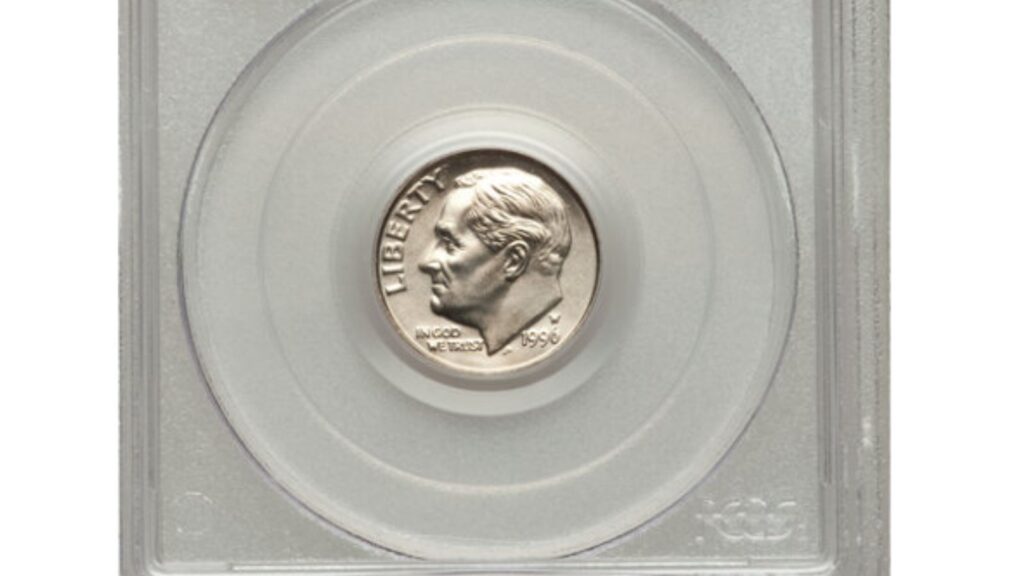
1996-W Roosevelt dime
Image Credit: Heritage Auctions
The West Point Mint produced exactly one Roosevelt dime for general release: this one. It was included exclusively in 1996 uncirculated coin sets, sold to collectors to mark the 50th anniversary of the design, and it has never been available any other way. No other non-bullion coin in the entire Roosevelt series carries a W mint mark. If you bought mint sets in the mid-1990s and held onto them, you likely have one sitting in a sealed plastic folder.
In typical circulated or lower uncirculated condition, this coin brings $20 to $40. In top grades, MS68 with Full Bands, values climb well into the hundreds. The mint mark appears on the obverse just above the date, near Roosevelt’s neck, the same location as every other post-1968 clad Roosevelt dime. Look for a W where you’d normally see a P or D.
Because it was only available in collector sets, it was never put into change. Any example you find has been kept intentionally. That also means these coins are often in better shape than their age would suggest. The most important thing to confirm is that the W is genuinely present and clearly struck, not a shadow or a grease-filled D from Denver. A jeweler’s loupe or a coin magnifier will tell you.
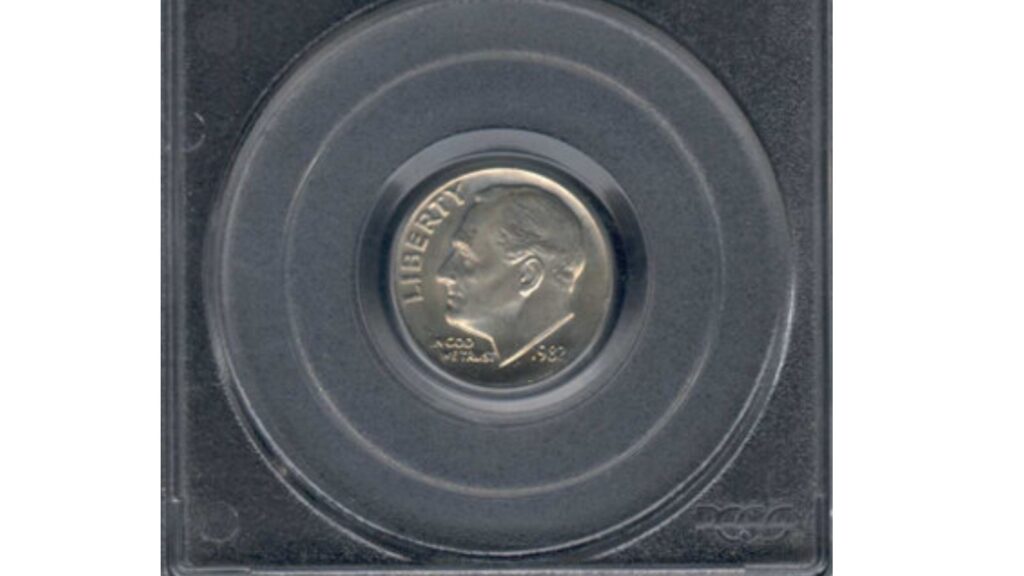
Most examples were found in Sandusky, Ohio, some reportedly recovered at the Cedar Point amusement park. Estimates put the surviving population at somewhere under 150,000, from two different die varieties: a strong strike with crisp details and a weak strike with softer lettering. Circulated strong-strike examples bring $150 to $225. Uncirculated strong-strike coins climb to $300 and above, depending on the grade. The weak strike is worth less and is easier to find.
To confirm the error, check the obverse just above the date near Roosevelt’s neck. There should be no letter of any kind. Most 1982 Philadelphia dimes carry a clear P in that spot. The absence of the mark isn’t subtle once you know to look for it. If you find one in a jar of old change or in a coin roll, get it certified by PCGS or NGC before doing anything else.
Barber dime semi-key dates: 1901-S, 1903-S, and 1913-S
Image Credit: Heritage Auctions
Three Barber dimes from the San Francisco Mint stand well above the common-date crowd and turn up unexpectedly in inherited collections, estate lots, and general accumulations of old silver coins. The 1901-S, 1903-S, and 1913-S each had lower mintages than most of the series and fewer surviving examples in collectable condition.
The 1901-S in worn circulated condition brings $55 to $250, with better-grade examples climbing considerably higher. The 1903-S follows a similar pattern, with verified sales of VG and Fine examples in the $150 to $480 range. The 1913-S runs from $55 in well-worn condition to over $900 in the best circulated grades. These coins look identical to common Barber dates at first glance, so the date and the S mint mark under the reverse wreath are the only things that distinguish them.
These aren’t coins most people deliberately seek out at estate sales. They appear because someone inherited a silver coin collection and didn’t know what they had. If you’re sorting through old dimes and find an S-mint Barber from the early 1900s, look up that specific date and mint combination before treating it as bulk silver. The difference between a 1903-S and a 1903-P in the same condition is not a small one.
1921-D Mercury dime
Image Credit: Heritage Auctions
The Denver Mint’s 1921 dime is even scarcer than the Philadelphia issue. Only 1.08 million were struck, making it the second rarest issue in the entire Mercury dime series after the 1916-D. Like the Philadelphia coin, nearly all of them circulated until they were nearly flat. The combination of low mintage and heavy wear means that even a slick, barely-dated example carries real value.
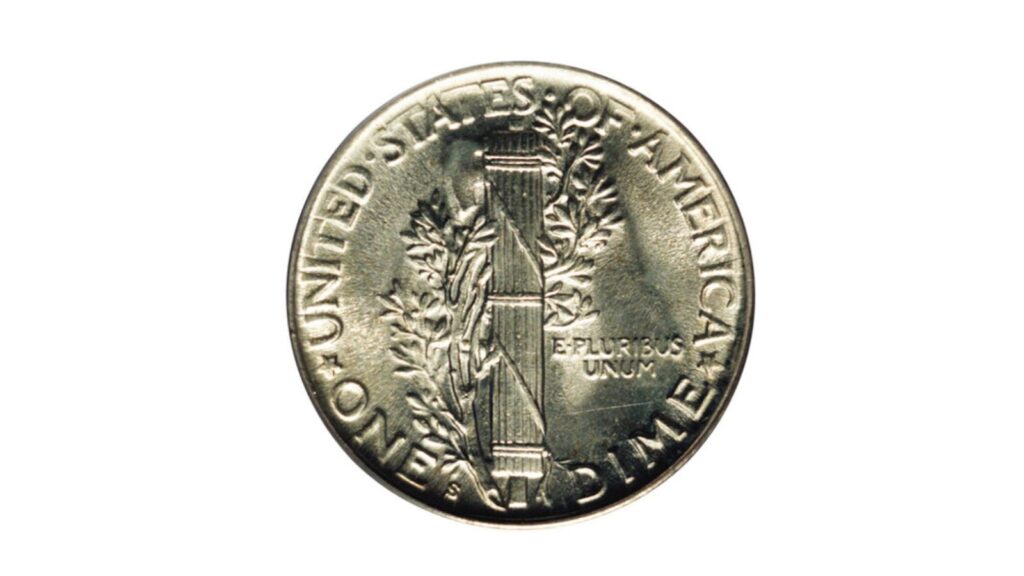
Worn circulated examples bring $80 to $150. In Very Good condition, expect $150 to $400 depending on how cleanly the details are preserved. Fine and Very Fine examples have sold in the $400 to $800 range, and anything approaching Extremely Fine commands strong four-figure prices. The mint mark is a small D on the reverse of the coin, to the right of the fasces design, just above the bottom rim.
Authentication matters here. The 1921-D and the 1916-D are the two dates in this series most likely to be faked. On a genuine example, the D mint mark uses the same punch as contemporaneous Denver cents. Any coin presented raw and described as a 1921-D should go to PCGS or NGC before money changes hands. A certified example in any grade tells you exactly what you have.
Mercury dime “Full Bands” designation on common dates
Image Credit: Heritage Auctions
This one doesn’t require owning a key date. It requires paying attention to the reverse of any Mercury dime under a loupe. On the reverse, a bundle of rods called a fasces has horizontal bands tied around it. On most Mercury dimes, those bands are weakly struck and the individual lines run together. When every horizontal line is sharp and fully separated, the coin qualifies for the Full Bands designation at certification, and the premium can be ten to a hundred times the value of a normally struck example from the same year.
A common 1944 Mercury dime in average uncirculated condition might bring $15 to $25. The same coin with certified Full Bands in MS65 can reach $200 to $400. Some dates are so consistently weak in the bands that a fully struck example barely exists in any grade, making them condition rarities regardless of total mintage. The 1919-D and 1926-S are famous for this.
Common late dates from 1940 onward are the easiest place to find Full Bands examples, because those years generally had better strikes than earlier issues. If you have a collection of Mercury dimes that haven’t been checked, run a loupe across the reverses before treating them as silver. A coin you assumed was worth $8 could be worth $300.
1916-D Mercury dime in worn circulated condition
Image Credit: Heritage Auctions
The 1916-D is the key date of the entire Mercury dime series. Denver struck only 264,000 of them before the dies were reallocated, and most that entered circulation were worn to near-nothing over the following decades. Today, roughly 10,000 are estimated to survive in all grades combined, and the large majority of those are heavily worn.
Even a coin in About Good condition, where the date is present but the rim is almost gone, brings $650 to $900. A Fine example runs $2,500 to $4,000. This is an aspirational find, not a yard sale discovery, but it’s not impossible. It shows up in inherited collections from people who assembled sets in the 1950s and 1960s, in old albums, and occasionally in unsorted silver lots where nobody knew what they had.
The problem is fakes. The 1916-D is one of the most counterfeited coins in U.S. numismatics. The most common method is adding a D mint mark to a common 1916 Philadelphia dime. On a genuine 1916-D, the D mint mark uses the same punch as 1914-D Lincoln cents: examine the shape of the D closely and compare it to a reference image. Never buy a raw, uncertified 1916-D from any source. A certified example from PCGS or NGC is the only safe purchase.
1895-O Barber dime
Image Credit: Heritage Auctions
The New Orleans Mint was operating through a severe economic depression in the mid-1890s, and its output reflected it. The 1895-O Barber dime had a mintage of only 440,000, and the coins it produced went straight into hard use. Today, the 1895-O is considered one of the four rarest dates in the entire Barber dime series, alongside the 1901-S and 1903-S.
A coin in worn circulated condition, readable but flattened from decades in commerce, brings $260 to $500 depending on how much detail survives. Better-grade examples in Fine or Very Fine have sold for $600 to $1,200. The top circulated grades push into several thousand dollars. Mint State examples are genuinely rare, and the auction records for those are much higher.
Counterfeiting is a concern here too. Check the coin carefully for any sign that the O mint mark was added after the fact: look for irregularities in the metal around the mark, differences in wear between the mark and the surrounding field, or a mark that sits at a slightly wrong angle. Certified examples remove this concern entirely. A raw 1895-O in any significant grade warrants professional authentication before you attach a value to it.
1965 silver transitional error Roosevelt dime
Image Credit: Heritage Auctions
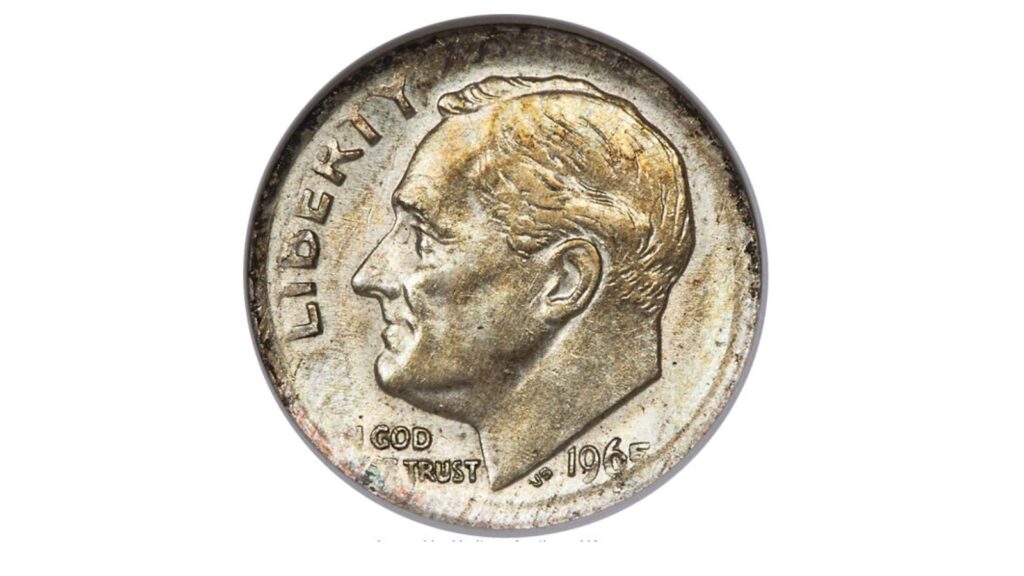
In 1965, the U.S. Mint made its most significant compositional change in decades, switching from 90% silver to copper-nickel clad. The transition wasn’t perfectly clean. A small number of dimes were accidentally struck on leftover silver planchets instead of the new clad blanks, creating coins that carry the 1965 date but have the silver content and weight of the pre-1965 series.
These transitional errors are genuinely rare, and examples in strong condition have sold around $12,000 to $13,000. The easiest way to check whether a 1965 dime is silver rather than clad is weight: a silver dime weighs 2.5 grams, while the clad version weighs 2.27 grams. A precise digital scale can tell the difference. The edge test works too: silver shows a solid rim with no copper stripe, while clad shows the orange copper layer.
Most 1965 dimes are common clad coins worth face value. The silver version is extremely rare. If your scale confirms 2.5 grams on a 1965 dime, don’t clean it, don’t test it with anything acidic, and take it directly to a professional numismatist or coin grading service. The weight reading alone is not enough to confirm authenticity; certification is required before any serious value can be established.
You’re watching every dollar, doing what feels like the responsible thing, and still coming up short at the end of the month. The budget is tight, the math doesn’t lie, and the advice you read online seems like it was written for someone with more room to breathe. Some of it probably was.
A lot of mainstream budgeting advice was built for people with stable incomes, some savings already in the bank, and access to conventional credit. When you don’t have those things, some of the same habits that make sense for a middle-income household can actually make your situation worse. The margin for error is smaller. The tradeoffs are sharper.
These are 15 of the most common budgeting habits that genuinely backfire for people on tight incomes, and what to do instead.
The minimum payment feels manageable because it’s designed to. Credit card companies set minimums low enough that you can almost always afford them, which keeps you in the system and paying interest for as long as possible. On a $2,000 balance at 20% APR, paying the minimum every month can stretch repayment out to a decade or more and cost you more in interest than the original purchases.
For low-income households, this habit is particularly damaging because the balance rarely shrinks. An unexpected bill gets added to the card, the minimum creeps up, and the debt compounds. The monthly payment starts feeling fixed, like a utility, when it’s actually growing.
If you can only pay the minimum right now, that’s reality. But it helps to treat any small windfall, a tax refund, overtime, a side hustle payment, as a chance to put a dent in the highest-interest balance rather than extra spending money. Even an extra $25 over the minimum matters when you’re fighting 20% interest.
Using payday loans when cash runs short
Image Credit: Shutterstock
A $300 payday loan to cover the electric bill feels like a solution until you see the terms. A typical payday loan carries an APR of nearly 400%, which means borrowing $300 can cost you $345 or more when you pay it back two weeks later. If you can’t cover the repayment in full, the loan rolls over and the fees compound. 80% of payday loans are rolled over or reborrowed within 14 days.
Payday lenders are concentrated in low-income neighborhoods and target people with few other options. The product is designed around the assumption that you won’t be able to pay it back on time, because that’s where the money is. Payday lenders pulled more than $2.4 billion in fees from borrowers in a single year in states where the practice is allowed.
Before going this route, it’s worth calling the utility directly and asking about a payment plan or hardship deferral. Many utility companies have programs specifically for this. Credit unions often offer small emergency loans at far lower rates than payday lenders. Some employers also offer paycheck advances. None of these are perfect, but any of them beats a 400% loan.
Buying in bulk when your cash flow is tight
Image Credit: Shutterstock
Buying in bulk looks like smart frugality on paper. The cost per unit is lower, you make fewer trips, and you feel like you’re getting ahead. For households with some financial cushion, it can be a real money-saver. For households living paycheck to paycheck, it can quietly drain the account and create a false sense of security.
Spending $80 upfront on a warehouse run when you only have $120 left for the week means you have $40 for everything else until payday. If the car needs gas or a kid needs a prescription, you’re in a bind. The bulk goods are sitting in the pantry, technically saving you money, while you’re scrambling in real time. Upfront cost matters just as much as unit price when your cash is limited.
There’s also food waste to factor in. Produce bought in bulk at a warehouse club often doesn’t last long enough for smaller households to use it all. Buying a week’s worth of fresh food from a regular grocery store, especially when it’s on sale, often beats a bulk run once spoilage is factored in. Buy in bulk only on items you will absolutely use before they expire, and only when it won’t leave you cash-strapped going into the week.
Skipping preventive medical care to save money
Image Credit: Shutterstock
Putting off a doctor’s visit, skipping the dentist, or not filling a prescription to save $30 feels like a reasonable tradeoff when every bill is a negotiation. In the short term it is. In the long term it often means a small problem becomes an expensive one. A tooth that needed a filling becomes a tooth that needs a root canal and a crown. A manageable chronic condition that goes untreated lands you in the emergency room.
About four in ten U.S. adults carry some form of medical or dental debt, and lower-income adults are disproportionately represented in that group. For many of them, the debt came from delayed care that turned into something more serious and more expensive. Emergency room visits cost dramatically more than routine care, and ER visits can’t always be negotiated down or ignored.
If cost is the barrier, there are options worth knowing about. Federally Qualified Health Centers offer sliding-scale fees based on income, and many charge very little or nothing for patients below the poverty line. Most hospitals have charity care or financial assistance programs that go unadvertised. The prescription assistance programs run by pharmaceutical manufacturers are real and genuinely cover many common drugs at little or no cost. Asking a doctor’s office or hospital billing department directly about what’s available is almost always worth the call.
Using rent-to-own stores for furniture or appliances
Image Credit: Rent-a-Center, Public Domain via WikiCommons
Rent-a-Center and similar stores offer something that’s genuinely appealing when you’re cash-poor: you take the furniture or appliance home today with no credit check and just a small weekly payment. What they don’t lead with is what it costs over time. People who use rent-to-own stores often end up paying twice the retail price or more for anything they buy. The effective interest rate is frequently 60% or higher, well above even the worst credit cards.
The math on a typical transaction is stark. A $450 television might require 52 weekly payments of $20, meaning you pay $1,040 total. If you’d bought the same TV on a credit card with a 20% interest rate and paid it off steadily, you’d have paid less than $100 in interest. Rent-to-own costs more than most credit cards, and most credit cards are already expensive.
The appeal is the flexibility, specifically the ability to return the item without it wrecking your credit if things get hard financially. That flexibility has real value when your income is unpredictable. But if you can find a used version of what you need on Facebook Marketplace, from a thrift store, or from a local buy-nothing group, you’ll own it immediately for a fraction of the rent-to-own price. For many people, saving $20 a week toward the item, rather than paying $20 a week to rent it, gets them to ownership faster than the full lease would have anyway.
People miss it for a few reasons: they don’t know it exists, they think their income is too high or too low, they didn’t file a return because they weren’t required to, or their situation changed (divorce, job loss, a new child) and they didn’t realize the credit applied to them. The credit is refundable, meaning if it exceeds what you owe in taxes, the difference comes back to you as a check. You don’t need to owe taxes to get it.
If you’re not sure whether you qualify, the IRS has a free online EITC eligibility tool at irs.gov. Many people who qualify also qualify for free tax preparation through the VITA program (Volunteer Income Tax Assistance), which is staffed by IRS-certified volunteers and available at libraries, community centers, and other locations. Claiming the EITC doesn’t require a paid preparer. It requires filing a return.
Using check-cashing services instead of a bank account
Image Credit: Austin Distel via Unsplash
For people who’ve had bank accounts go sideways, whether due to overdrafts, a ChexSystems flag, or past fees, check-cashing services can feel like the only option. They’re accessible, fast, and don’t require a credit check. They’re also expensive. Cashing one $500 check per month at a check-cashing store charging 5% costs about $300 annually. That’s money taken directly off the top of every paycheck, year after year, just for access to funds you already earned.
The cost compounds in other ways too. Without a bank account, paying bills often requires money orders, which carry their own fees. You’re carrying cash rather than using digital transfers, which is slower and less secure. You have no way to build a paper trail of payment history, which matters when you’re trying to rent an apartment or apply for credit.
Second-chance checking accounts are specifically designed for people who have been flagged by ChexSystems or who had accounts closed in the past. Many credit unions and some banks offer them with low fees and no minimum balance requirements. Some prepaid accounts now offer direct deposit and basic banking functions at little cost. Getting into any of these is almost always a better long-term move than staying in the check-cashing economy.
Slashing the food budget down to almost nothing
Image Credit: Shutterstock
Food is one of the few flexible expenses in a tight budget, so it becomes the first target when cuts are needed. That’s understandable. But taking the grocery budget below a functional level creates problems that cost more than the savings. Cheap, high-calorie, low-nutrition food is often the cheapest option per dollar, but it tends to mean more health issues over time, more energy problems in the short term, and a lower quality of life that’s hard to separate from financial stress.
There’s also a practical issue: running a household on almost no food budget requires significant time and skill. Cooking from scratch every day, tracking sales across multiple stores, using every scrap before it spoils. Not everyone has that bandwidth, especially when working multiple jobs or managing kids without help. Unrealistic food budgets often collapse under the pressure of real life, leading to expensive convenience food purchases that wreck the whole budget anyway.
A more durable approach is figuring out the actual floor, the lowest amount you can realistically spend on food and still eat adequately given your household’s schedule and capabilities, and treating that number as a floor, not a target to cut further. SNAP benefits, food banks, and community fridges can genuinely help bridge gaps without requiring you to run a micro-optimized meal plan. WIC, for households with young children, provides specific food benefits that often go unclaimed by eligible families.
Having zero emergency savings
Image Credit: Shutterstock
When every dollar has somewhere to be, saving anything feels impossible. It’s a real constraint, not a failure of will. But a household with no emergency savings is one flat tire, one missed shift, one sick day away from needing a payday loan or a credit card hit. The absence of even a small cushion turns ordinary life events into financial emergencies that take months to recover from.
The goal doesn’t have to be three to six months of expenses. That target is genuinely out of reach for many households and focusing on it can make the whole effort feel futile. A more useful immediate target is $500. Five hundred dollars covers most single-incident emergencies without requiring debt, and it changes the math significantly. A car repair that would have gone on a credit card at 25% interest instead comes out of an account that costs you nothing.
The key is making it automatic and separating it from money you can see. Even $10 or $20 transferred automatically to a second account on payday is more likely to accumulate than money you intend to save by having willpower at the end of the month. A credit union savings account or a free online account that isn’t your primary bank creates enough friction that you’re less likely to dip into it for things that aren’t genuine emergencies.
Canceling renters or auto insurance to cut monthly costs
Image Credit: Shutterstock
Renters insurance is typically $15 to $30 a month. Auto insurance is legally required in most states. When the budget is extremely tight, both can look like candidates for cancellation. The logic feels solid: nothing bad has happened yet, the money is needed now, and insurance is an expense with no visible return. Then something happens.
A fire, a theft, or a flood that damages your belongings without renters insurance means replacing everything out of pocket. A car accident while uninsured can mean liability for the other driver’s medical bills and vehicle damage, expenses that can run into the tens of thousands. One of these events erases years of saved premiums and then some. Renters insurance in particular is so inexpensive relative to its coverage that it’s one of the few financial products that actually over-delivers for low-income households.
If the cost is the problem, it’s worth calling your insurer to ask about reducing coverage rather than eliminating it entirely. Raising your deductible on auto insurance can significantly lower the monthly premium. Bundling auto and renters with the same insurer usually produces a discount. Shopping other insurers every year is often worth the time. Dropping coverage entirely should be a genuine last resort, not a first move when the budget feels squeezed.
Avoiding public benefits programs out of pride or confusion
Image Credit: United States Department of Agriculture, Public domain, via Wikimedia Commons
There’s a real and understandable reluctance to apply for public assistance. Some of it is pride. Some of it is fear about what it signals. Some of it is confusion about whether you actually qualify, or worry about how receiving benefits might affect other aspects of your financial life. A lot of people sit below eligibility thresholds for programs they’ve never applied for because they assumed they wouldn’t qualify or didn’t know the programs existed.
SNAP, Medicaid, CHIP, LIHEAP, the Children’s Health Insurance Program, the Low Income Home Energy Assistance Program, and state-level rental assistance programs collectively serve millions of households, and they have real eligibility criteria that many people assume exclude them when they don’t. The income limits for many programs are higher than people expect. Some programs cover working households with income above the poverty line. Applying costs nothing.
Benefits.gov has a pre-screening tool that identifies programs you may be eligible for based on your household situation. State 211 lines (dial 211) connect people to local assistance programs for utilities, food, housing, and healthcare. These are programs funded by taxes you’ve paid into for years. Using them is exactly what they’re there for.
Paying a commercial tax preparer every year
Image credit: Karolina Grabowska via Unsplash
Commercial tax preparation chains charge anywhere from $100 to $400 or more to prepare a basic return. Many low-income filers pay these fees every year without knowing that the same return could be filed for free. IRS Free File is available to anyone with an adjusted gross income of $89,000 or less, which covers the vast majority of lower-income households. The program provides guided tax software from trusted partners at no cost.
The VITA program (Volunteer Income Tax Assistance) goes further for households earning below $69,000 or so, offering free in-person preparation by IRS-certified volunteers. VITA sites are at libraries, community centers, and social service agencies, and they’re specifically trained to find credits like the EITC that filers sometimes miss. The people staffing these sites know what they’re doing.
Paying $150 to $300 for tax preparation when you qualify for free filing isn’t just an unnecessary expense in isolation. It’s often $150 to $300 coming directly out of the refund you just earned, before you ever see it. Filing through IRS Free File or a VITA site keeps all of that money in your hands. It’s also worth knowing that if you paid a preparer in a previous year and qualified for free filing, you may be able to amend that return and claim any credits that were missed.
Putting every extra dollar toward debt and holding back nothing for savings
Image Credit: Shutterstock
Debt repayment is important, and the instinct to attack it aggressively is a good one in principle. But directing 100% of any extra money toward debt while maintaining zero savings means the next unexpected expense goes straight back onto a credit card or loan. You’re paying down debt on one side and immediately re-acquiring it on the other every time something goes wrong.
People who maintain even a small savings cushion alongside debt repayment tend to end up with less total debt over time than people who put every extra dollar toward balances. The cushion absorbs the shocks that would otherwise become new debt. It keeps the repayment progress from being wiped out repeatedly by the ordinary unpredictability of life.
A practical split is directing a portion of any extra money, say 70% to 80%, toward the highest-interest debt and keeping 20% to 30% in a savings account that you don’t touch unless something genuinely breaks. It feels slower, but it tends to actually work over 12 to 18 months in a way that all-debt-all-the-time often doesn’t.
Skipping retirement contributions entirely
Image Credit: Shutterstock
When there isn’t enough money for this month, saving for a retirement that’s 20 or 30 years away can feel absurd. It’s not a budgeting failure that people in this position skip retirement contributions entirely. It’s a reasonable response to real pressure. But it does have a compounding cost that’s worth understanding, especially if there’s any employer match on the table.
An employer 401(k) match is the closest thing to free money that exists in personal finance. If your employer matches 50% of contributions up to 3% of your salary, not contributing means leaving that match on the table. That’s a guaranteed 50% return on those dollars, which is better than any investment available anywhere. Declining that to put the money elsewhere is one of the most expensive tradeoffs a household can make.
If there’s no employer match and retirement savings truly aren’t possible right now, that’s a situation to revisit as income improves. If there is a match, even contributing 1% to 2% to capture part of it while keeping more cash available for immediate needs is better than nothing. The Saver’s Credit also provides a federal tax break of up to 50% of retirement contributions for low-income filers, which reduces the effective cost of those contributions significantly and goes largely unclaimed.
Treating a tax refund as a windfall
Image Credit: Shutterstock
A tax refund feels like found money. It arrives in a lump, it’s often the largest single deposit of the year, and every ad you see in February is trying to get you to spend it on something. But a tax refund is just money you overpaid throughout the year and are getting back. It was yours the whole time. Treating it as a bonus leads to spending it on the same categories that usually eat into the budget, without meaningfully changing the underlying situation.
For low-income households, the tax refund is often the single best financial planning tool available precisely because it arrives as a lump sum. Paying a chunk off a credit card, establishing or replenishing an emergency fund, covering a car repair that’s been deferred, or paying ahead on rent are uses that actually shift the financial picture for the year ahead. These aren’t glamorous, but they’re the uses that prevent the next debt spiral.
If you consistently get large refunds, it’s worth adjusting your withholding to get that money in your paychecks throughout the year instead. A large refund means you’ve been lending the government money interest-free. Smaller, regular amounts that go directly into savings or toward expenses each month often do more practical good than one annual lump sum that’s easy to spend impulsively.
Keeping insurance deductibles too low to reduce premiums
Image Credit: Getty IMages via Unsplash
A low deductible on auto or health insurance feels safer because you know exactly what you’d pay out of pocket if something happened. But low deductibles mean higher monthly premiums, and for people with tight cash flow, higher monthly premiums are a guaranteed cost every single month whether or not anything ever goes wrong. High premiums with low deductibles often cost more over the course of a year than a higher deductible would have, unless you file claims frequently.
Raising an auto insurance deductible from $250 to $1,000 can meaningfully reduce the monthly premium. If you can build a $1,000 buffer in savings over several months, the lower-premium, higher-deductible option often makes more financial sense than the reverse. You’re effectively self-insuring for smaller incidents while keeping coverage for the catastrophic ones.
The same logic applies to health insurance marketplace plans if you’re choosing between tiers. A lower-premium plan with a higher deductible paired with a Health Savings Account can reduce overall annual costs for people who don’t need significant healthcare in a given year. The math depends on your actual healthcare use, so it’s worth running the numbers rather than defaulting to the lowest-deductible plan out of anxiety about what-ifs.
The coin jar on the kitchen counter probably holds nothing remarkable. But before you roll those nickels for the bank, set aside anything that looks old, struck differently, or worn in an unusual way. A few of those five-cent pieces could be worth significantly more than their face value, and some of the most valuable ones look nearly identical to ordinary change.
Nickels span four distinct design eras: Shield (1866-1883), Liberty Head (1883-1913), Buffalo or Indian Head (1913-1938), and Jefferson (1938 to today). Each series has key dates, errors, and varieties that send certain examples well above face value. Old coin collections, estate sale finds, and inherited albums are all legitimate sources for the pieces on this list.
What separates a real find from a five-cent piece is usually a combination of date, mint mark, and condition. Most heavily worn examples earn very little. Getting the right coin in decent shape, or finding a specific error that collectors actively chase, is what actually moves the number.
From mid-1942 through the end of 1945, the U.S. Mint produced Jefferson nickels from a silver alloy instead of nickel, because nickel was needed for artillery and other wartime materials. The result is a coin with a built-in silver floor: every single war nickel, no matter how worn, contains 35% silver and brings at least $1 to $5 based on the metal alone. With silver prices elevated, that floor has been rising.
The key identifier is a large P, D, or S mint mark placed above Monticello on the reverse. Regular Jefferson nickels have small mint marks in a different position; the large placement above the dome is unique to the wartime issues. The 1942 year is slightly complicated because both standard copper-nickel and silver war nickels were made that year, so checking the mint mark size and position is essential before assuming any 1942 nickel is silver. The 1943 and 1944 and 1945 dates are all silver without exception.
Within the series, condition determines how much above the silver floor a coin commands. Common worn examples don’t bring much over melt. Clean, nearly uncirculated examples of any date bring $10 to $40 and up. Fakes exist, particularly altered coins where someone has moved or added a mint mark. Weigh any suspected war nickel: authentic examples should sit at approximately 5 grams. Any significant deviation is a red flag.
1883 Liberty Head “no cents” nickel
Image Credit: Heritage Auctions
When the U.S. Mint introduced the Liberty Head nickel design in early 1883, it included a large Roman numeral V on the reverse without the word “CENTS” to spell out the denomination. Con artists quickly noticed the coin resembled a $5 gold piece in size and finish, and began gold-plating them to pass as gold. The Mint corrected the design within the year, but not before producing around 5.5 million of the “No Cents” version. These gold-plated coins became known as Racketeer Nickels and now have their own dedicated collector category.
In worn circulated condition, the 1883 “No Cents” nickel typically brings $10 to $18. In uncirculated condition, nice examples bring $43 to $61, with sharper, fully-lustrous specimens at MS64 and above commanding considerably more. Gold-plated examples with original intact plating are worth more than replated or stripped ones. Authentic original-plating pieces are a distinct category with their own collector base.
Identify a “No Cents” piece by checking the reverse. If the large V is surrounded by a wreath with no denomination word below it, you have the 1883 Type 1 issue. If it reads “FIVE CENTS,” you have the corrected later version, which is more common and worth less in typical circulated grades. Both have collector value, but the “No Cents” is the one people specifically hunt.
1866 Shield nickel with rays
Image Credit: Heritage Auctions
The Shield nickel was America’s first copper-nickel five-cent piece, replacing the silver half dime in 1866. The reverse design featured a large numeral 5 surrounded by alternating stars and rays, and the rays caused constant problems: they made the die intricate enough that cracking was frequent. The Mint removed the rays mid-1867 to reduce die failures. Every 1866 and early-1867 nickel with rays is therefore a distinct type, and the only way to get one is to find it because they stopped making them over 150 years ago.
In average circulated condition, an 1866 Shield nickel with rays typically brings $50 to $80. In nicer circulated grades, the price climbs. Uncirculated examples with original luster regularly bring $400 to $600 or more depending on strike quality and eye appeal. The design is notoriously hard to strike fully, so a sharp, well-detailed example with clean fields is genuinely uncommon even among surviving pieces.
Any old collection might have one of these tucked alongside better-known coins. They circulated for years alongside later nickel issues and many ended up in coin albums without anyone noting what they were. Carbon spots and surface problems are common on the series. A clean, problem-free examples with visible shield detail and sharp rays is rarer than the mintage suggests, because so many survivors carry some kind of damage.
Pre-1920 Buffalo nickels with a readable date
Image Credit: Heritage Auctions
Buffalo nickels ran from 1913 to 1938, and the series presents one constant frustration for collectors: the date is positioned on a high-relief area of the design that wore flat with circulation. A nickel without a readable date is essentially worthless to collectors regardless of age. A Buffalo nickel with a clear, readable date is at minimum worth $3 to $20 in average worn condition depending on date and mint mark, and specific early issues are worth considerably more.
The first year of the series, 1913, is particularly interesting. Two distinct design varieties were produced: a Type 1 with the bison standing on a raised mound and a Type 2 with the bison on a flat plain. The Type 1 mound design was changed because the denomination text on the raised area wore away too quickly. Both types are worth meaningfully more than later common dates, and the branch mint issues with a D or S mint mark below the date command the most.
Pre-1920 Buffalo nickels carry a collector premium even in worn condition simply because of their age and the surviving-date rarity that the design’s wear patterns create. Run your thumb across the lower front of any Buffalo nickel. If you can feel distinct numerals, you have something worth looking up before it goes in a jar.
1950-D Jefferson nickel
Image Credit: Heritage Auctions
The 1950-D Jefferson nickel had a mintage of just 2.63 million, the lowest of any Jefferson nickel to that point. Dealers and speculators recognized this quickly, and coin promoters aggressively marketed it as a sure-fire investment through the late 1950s and into the 1960s. Rolls sold for hundreds of dollars. Then the shift to clad coinage happened, new collector interest cooled, and the bottom fell out.
Where it earns its keep is in the Full Steps category. A 1950-D with crisp, fully-defined steps on Monticello in uncirculated condition is a genuinely scarce piece and brings significantly more than a typical example of the same date. It remains a necessary key date in any complete Jefferson set, and its value holds in higher uncirculated grades. Just don’t expect the windfall some older coin books still promise.
1939 Jefferson nickel, doubled Monticello variety
Image Credit: Heritage Auctions
There are only three major doubled die varieties in the circulation-strike Jefferson nickel series. The 1939 doubled Monticello is the most dramatic of the three, with the doubling most visible in the words “FIVE CENTS” on the reverse, where a ghost impression shifts clearly from the primary text. You don’t need sophisticated equipment to find it: 10x loupe magnification makes it obvious, and strong examples show it under good light without any magnification at all.
Well-worn circulated examples bring $20 to $30. As condition improves to lightly worn, prices climb to around $150. Nice uncirculated examples bring $300 and up, and the Full Steps designation pushes values into four figures. The coin isn’t extremely rare: experts estimate around 60,000 survive. But active collector demand means any example in decent, undamaged condition sells without difficulty.
The 1939 doubled Monticello turns up in old Jefferson nickel collections with some regularity. If you have a shoebox of old nickels or a partially assembled Jefferson set, check every 1939 Philadelphia mint nickel under a loupe. The “FIVE CENTS” text on the reverse is where to look. When the doubling is there, it’s obvious.
1943-D war nickel
Image Credit: Heritage Auctions
The 1943-D is the key date of the wartime silver nickel series. Denver produced just 15,294,000 nickels in 1943 compared to 271 million at Philadelphia that year, making it the scarcest regular-issue coin in the entire 11-piece wartime silver set. In worn circulated condition, it’s still worth its silver content plus a collector premium. The real gap opens in nicer circulated and uncirculated grades, where a 1943-D commands significantly more than a common 1943-P or 1943-S of equivalent condition.
Identify the 1943-D the same way as any war nickel: large mint mark above Monticello on the reverse. The “D” there confirms Denver. In circulated grades from Very Fine upward, expect $10 to $25 where common war nickels of the same condition might bring $3 to $5. Mid-grade uncirculated examples bring $50 to $150 depending on strike quality.
The Full Steps designation matters particularly for this date. A 1943-D with clean, fully-defined Monticello steps in uncirculated condition is significantly scarcer than the total mintage implies and brings considerably more than any common war nickel variant in any grade.
1943/2-P overdate war nickel
Image Credit: Heritage Auctions
The 1943/2-P is the only overdate in the entire Jefferson nickel series, which means it holds a specific place that date-and-variety collectors need to fill a complete set. It happened when the Mint reused a 1942 die, stamping a “3” over the existing “2,” and the trace of the original digit remained visible in the finished coin. The elongated lower curve on the “3” in the date is the key diagnostic, seen clearly at 10x magnification on any clean example.
Well-worn examples bring $40 to $100. As condition improves to lightly circulated and Extremely Fine, prices climb into the $250 to $500 range. Uncirculated examples start at several hundred dollars. About 75,000 examples are believed to survive, which makes this rare but not impossible to find in the wild.
Examine every 1943-P war nickel you have under magnification. Look at the “3” in the date. A genuine overdate shows clear remnants of the underlying “2” in the bottom curl of the “3,” and the doubling looks mechanical and consistent, not random wear or damage. If you think you have one, any experienced coin dealer can confirm it in seconds with a loupe.
Full Steps Jefferson nickels (1938-1964)
Image Credit: Heritage Auctions
The Monticello building on the reverse of a Jefferson nickel has a flight of steps at its entrance. On most examples, those steps are partially obscured by weak striking, die wear, or the general production realities of high-volume coinage. When all five or six steps are fully defined and clearly separated, grading services award the coin a Full Steps designation. That designation can multiply a coin’s value by ten to twenty times over an otherwise identical example of the same date and grade.
The concept applies across the series, but the most valuable pieces cluster around specific scarce dates. A 1953-S or 1954-S Jefferson nickel in mid-grade uncirculated condition with Full Steps typically brings $200 to $600 or more where a common circulated example of the same date might sell for $5 to $10. The 1938-D and 1938-S in Full Steps uncirculated condition command several hundred dollars each. Even common dates like the 1964 or 1962 can bring real premiums with a legitimate Full Steps designation in high uncirculated grades.
To check at home, use a loupe and a well-lit, angled surface. Tilt the coin under the light and examine the steps in front of Monticello’s entrance. If all the step lines are clearly separated and fully defined all the way across, you may have something worth sending to PCGS or NGC for grading. A coin that comes back MS65 Full Steps on a key date can justify the grading cost many times over.
1926-S Buffalo nickel
Image Credit: Heritage Auctions
The 1926-S is a genuine key date in the Buffalo nickel series, with one of the lowest mintages of any regular-issue nickel in its era: just 970,000 pieces struck at San Francisco. The general public paid no special attention when these circulated, most ended up in everyday use without being saved, and significant numbers were scrapped in wartime metal drives. Survival estimates are low in all grades, and gem mint-state examples are exceptionally rare.
In worn circulated condition, a 1926-S typically brings $55 to $80. Nice Very Fine examples climb toward $100 to $200. Higher circulated grades push further still. Uncirculated examples are scarce enough that prices vary widely by strike quality, but gem MS65 specimens have sold for $3,000 and up. The finest known examples are rarer than the mintage suggests because Buffalo nickel dies frequently produced weak strikes, and a 1926-S with strong horn and feather detail is genuinely hard to find.
The mint mark on a Buffalo nickel appears on the reverse, below the bison’s body near the bottom edge of the design. On the 1926-S, look for a clear “S.” Many nickels passed off as 1926-S are more common dates with altered or damaged digits, so examine the date carefully before getting excited. The “6” in 1926 should be clearly readable, and the “S” should be clean.
1913-S Type 2 Buffalo nickel
Image Credit: Heritage Auctions
The 1913-S Type 2 is the third-lowest mintage in the entire Buffalo nickel series, with just 1,209,000 coins produced at San Francisco in the second half of 1913 when the design switched to the flat-ground reverse. Only about 14,000 examples are believed to survive across all grades. Even heavily worn examples in Good condition bring $170 and up, which is unusual for a coin of this era. This is a piece that earns money at every grade level.
In Fine condition, expect $300 to $450. Very Fine examples bring $430 to $550. Nice Extremely Fine examples command $750 to $900. Uncirculated examples start around $825 for lower mint-state grades and climb sharply into the $1,200 to $5,000 range at MS64 and above. Gem specimens in MS65 and above are scarce and can command $3,000 to $5,000 with strong eye appeal.
The key is confirming both the date and the variety type. The Type 2 reverse shows the bison standing on a flat strip of land with “FIVE CENTS” inscribed in a recessed area below the bison’s feet. The Type 1 from earlier in 1913 shows the bison on a raised mound. Any 1913-S needs to be identified as one or the other before a price means anything. The Type 2 is worth considerably more than the Type 1 from the same mint.
1937-D three-legged Buffalo nickel
Image Credit: Heritage Auctions
A Denver Mint worker polished a damaged reverse die too aggressively, removing the bison’s foremost right leg in the process. The result is a Buffalo nickel where the animal appears to stand on three legs. It wasn’t caught before coins went into production, and approximately 10,000 examples are believed to survive. Because word spread quickly that the coin was unusual, many were pulled from circulation, so surviving examples tend to cluster in nicer circulated grades.
Worn examples in Very Fine condition bring $800 to $1,000. Nice About Uncirculated examples bring $1,250 to $2,300. Mint-state examples are rare and command $5,000 and above depending on grade. The error is obvious enough that even casual observers recognize it immediately, which drives broad collector interest well beyond the usual numismatic audience.
Fakes are a serious issue here. The most common method is grinding down the fourth leg on a genuine Buffalo nickel. On a real three-legged Buffalo, a small tuft or line of hair should remain near the position where the leg was removed. If there’s no detail whatsoever in that area, or the surface around the missing leg looks scraped or smoothed, walk away. When in doubt, send it to PCGS or NGC before putting any money on it.
1916 Doubled Die Buffalo nickel
Image Credit: Heritage Auctions
This is one of the most dramatic doubled die errors in 20th-century U.S. coinage, and it’s visible without any special equipment. During die manufacturing, the hub struck the working die multiple times with slight misalignment, leaving a “916” ghost impression hanging below and to the right of the primary date. The Indian’s profile and feathers show additional doubling. When you see it, there’s no question about what you’re looking at.
Only 200 to 500 examples are believed to survive. Even heavily worn examples in Good condition start around $4,800. Fine examples bring $9,400 and up. Extremely Fine examples push toward $19,000. Mint-state examples, of which only about 15 are known, range from $67,500 into six figures for the finest. This coin has no realistic “casual find” price level. Any grade commands serious money.
The dramatic values mean counterfeits exist. Common 1916 Buffalo nickels, of which over 63 million were made at Philadelphia alone, are sometimes altered to mimic the doubled die. On a genuine example, the doubling is mechanical and consistent throughout: the secondary impression is clean, sharply defined, and parallel to the primary. Postmint tooling or surface damage looks rough and irregular under magnification. If you think you have one, do not clean it, do not handle it more than necessary, and take it directly to PCGS or NGC.
1971 No-S proof Jefferson nickel
Image Credit: Heritage Auctions
Proof coins are struck at the San Francisco Mint and carry an “S” mint mark. In 1971, a die left the Philadelphia facility for San Francisco without the “S” punched in, and a small number of proof nickels were struck from it before anyone noticed. These coins turned up inside normal 1971 Proof Sets and represent the only proof coin in the entire Jefferson nickel series struck without its intended mint mark.
In typical mid-range proof grades from PR65 to PR67, the 1971 No-S brings around $1,000. Deep Cameo examples, with the strongest frosted devices against completely mirrored fields, are far rarer with only around 50 estimated to exist, and bring considerably more. Several hundred No-S examples are believed to exist in total, split across standard proof, Cameo, and Deep Cameo designations.
If you have old proof sets in a drawer, particularly from the early 1970s, it’s worth checking every one. The regular 1971-S proof nickel is worth a few dollars. On the regular coin, “S” appears below the date on the obverse. On the No-S variety, that space is blank. The check takes about ten seconds with a loupe, and the payoff if you find one is around $1,000 to start.