scroll top

The box in the garage has been there since the last move. Maybe the one before that. You know what’s in it, roughly, because you’re the one who packed it: old game stuff, an ugly beige computer, some kind of electronic toy with a cracked battery cover. You’ve been meaning to deal with it for years.

Before you haul it to the thrift store, pull it out and take a closer look. Certain 1980s tech has developed a serious collector market over the past decade, driven by nostalgia, genuine historical significance, and the fact that working examples are getting rarer every year. Some of it is worth exactly what you’d expect. But a handful of pieces, including things that look unimpressive and were never particularly glamorous to own, have become genuinely valuable.

The rule across nearly everything on this list is the same: condition and completeness are everything. A working unit beats a broken one by a factor of three or four. Original box and manual can double the price. And within each category there are specific versions, models, and markings that matter a great deal, while nearby versions that look almost identical are worth next to nothing. The difference is always in the details.

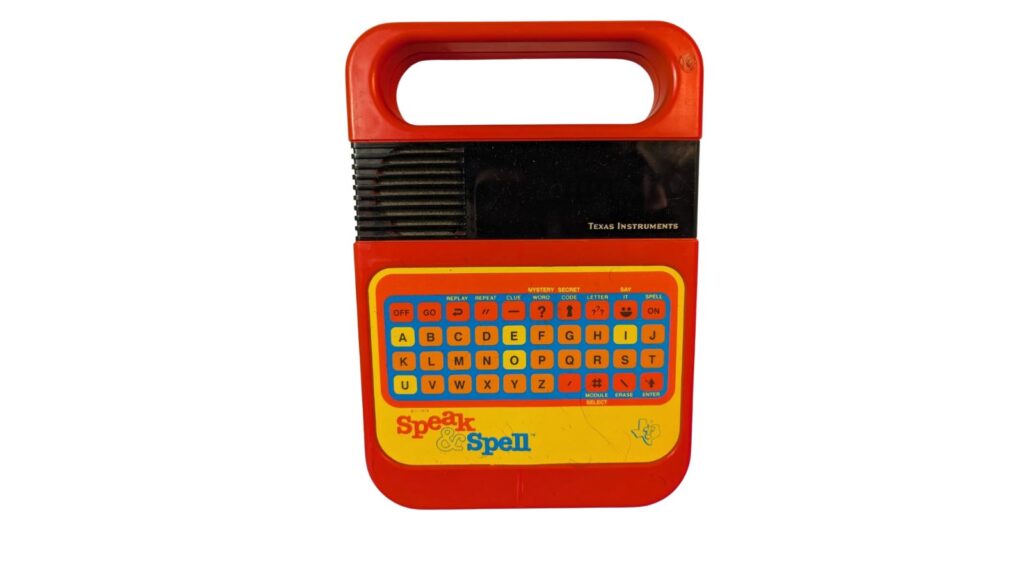
Texas Instruments Speak & Spell (1978 original, raised-button version)
Speak and Spell
Image Credit: 1000 Little things YN via eBay

The Speak & Spell was a genuine engineering landmark when it debuted in 1978. It contained the world’s first single-chip speech synthesizer, a feat that Texas Instruments engineers had once thought was years away from being achievable. For most of the kids who owned one, it was just the toy that told you when you’d spelled something wrong. But the original 1978 and early 1980 versions have developed real collector interest, partly because of the Speak & Spell’s cameo as E.T.’s improvised phone in the 1982 Spielberg film, and partly because the original hardware genuinely matters to people who care about the history of electronics.

The version that commands the most attention is the original raised-button model, where the keyboard has distinct, physical keys rather than the flat membrane keyboard introduced with the 1980 redesign. The raised-button units are distinctly earlier and feel more substantial. Working examples bring $30 to $80, with original box and cartridges pushing into the low hundreds. Broken or non-working units still fetch $10 to $20 for parts. Condition focuses on two things: does it power on and speak clearly, and are the buttons fully functional without sticking? The vacuum fluorescent display should be bright and even. Any dead segments drop value quickly. The Speak & Spell’s place in electronics history is secure, but the market is realistic about what common examples are worth. You’re not going to retire on one. You might, however, be pleasantly surprised by what a thrift store find cleans up for.

Original Nintendo Game Boy DMG-01 (1989, gray)

Game Boy
Image Credit: Ayu_happy via eBay

Nintendo sold over 118 million Game Boy units between 1989 and the early 2000s, which means an enormous number of them survived in attics, basements, and bins. So the standard gray DMG-01 isn’t rare. A working unit without a box brings $40 to $70, which is a reasonable return on something you might find in a junk drawer. The jump comes with completeness. A Game Boy with its original box, foam insert, manual, and warranty card regularly reaches $150 to $300, and particularly clean examples push higher.

There are several condition points that matter more than people expect. Yellowing of the plastic shell is very common and reduces value by 20 to 30 percent. Collectors want units that have held their original off-white color. The screen should be fully functional with no dead lines across it, which is an extremely common failure mode; horizontal or vertical lines appearing on the display indicate a loose ribbon cable and drop value sharply. The speaker should produce clean audio. Check that the battery cover is the original and not a replacement, which is surprisingly easy to spot from the plastic texture. Modifications, including backlit screen upgrades and shell replacements, are popular with players but hurt value with collectors who want an unaltered unit. The Game Boy that came in original packaging and was then put away, which some parents absolutely did, is the one worth tracking down.

Commodore 64 breadbin (1982)

Commodore 64 breadbin
Image Credit: jpeeler via eBay

The Commodore 64 is the best-selling computer model ever made, a fact that sounds like it should make it worth nothing. A few million things don’t usually become collectibles. But several factors work in its favor. The earlier “breadbin” design, named for its resemblance to a bread box, is more desirable than the later flat Commodore 64C. The very earliest examples, with a silver label and low serial numbers made in West Germany, have sold for over $600, though that’s the high end. A standard working breadbin in decent cosmetic condition brings $80 to $200, and a full setup with the original 1541 disk drive, power supply, manuals, and box can reach $300 to $500.

Condition testing requires more than a power-on check. The SID sound chip, which generated the C64’s iconic audio, is worth around $50 on its own and frequently fails. Any C64 with a silent or distorted sound chip is worth significantly less. The power supply is the bigger hazard: the original brick power supplies are notorious for failing in a way that puts excess voltage through the computer and destroys chips. Any power supply more than a few years old should be tested before use. Keys on the membrane keyboard can stick or fail. The unit should boot to the blue screen showing 38911 BASIC BYTES FREE and the READY prompt. Anything less suggests problems that will be difficult and expensive to trace. A unit that boots clean and sounds right is worth substantially more than one that “mostly works.”

Atari 2600 Heavy Sixer (1977) vs. common woodgrain consoles

Atari 2600 Heavy Sixer
Image Credit: McMiner via eBay

Not all Atari 2600 consoles are created equal, and the difference between the most desirable and the most common is larger than most people realize. The Heavy Sixer, produced from late 1977 through 1978, is the earliest version of the console. It has six switches across the top (including a color/black-and-white toggle), a rounded, thick-plastic case, and was built in Sunnyvale, California. It’s heavier than any subsequent version, hence the name. Working Heavy Sixers bring $200 to $500, with complete-in-box examples going higher.

The common woodgrain four-switch consoles from the early 1980s are a different story entirely. Working examples with controllers bring $40 to $80, which is still not nothing if you found one for free. The all-black “Darth Vader” model is worth a little less than the woodgrain. The later Atari 2600 Jr., the small, rainbow-striped version, has minimal collector value and typically sells for under $30. To identify a Heavy Sixer, look for the distinctive rounded case design, all six switches, and “Made in USA” on the bottom. Flip it over and check. The woodgrain vinyl across the front should be fully intact, since peeling or lifting reduces value on any version. A Heavy Sixer with an original joystick, power supply, and game cartridge is the setup worth bothering with.

Sony Walkman WM-2 (1981)

Sony Walkman WM-2
Image Credit: Orange cube japan via eBay

The WM-2 was the second Walkman Sony ever made, introduced in February 1981, and it sold 2.58 million units in its first year, roughly doubling the reach of its predecessor. It was significantly smaller than the original TPS-L2, coming in at about the size of a cassette case, and it came in red, black, and silver. That combination of iconic design, strong production numbers, and the sheer cultural weight of the name has made it a genuine collector piece. Working WM-2 units in good cosmetic condition bring $220 to $490, with examples described as “restored” or “serviced” pushing toward the higher end.

The single most common failure point is the drive belt, a rubber band inside the mechanism that powers the tape transport. These degrade and snap with age, meaning a WM-2 that does nothing when you press play usually just needs a new belt, a repair that costs about $15 in parts and takes an afternoon. A unit with a dead belt but otherwise good cosmetics is worth considerably less than a working one. The original carrying strap, which wraps around the WM-2’s distinctive loop hooks, adds value. So does the leather carrying case Sony sold for it. Units with any paint loss, deep scratches, or replaced battery compartment covers are worth notably less than clean examples. If the buttons still click crisply and the plastic has no warping, you have something worth pursuing.

Nintendo Power Glove (1989, with sensor bar)

Nintendo Power Glove
Image Credit: aneword via eBay

The Power Glove failed commercially and spectacularly, selling for less than a year before being discontinued. It was hard to program, imprecise in practice, and came with almost nothing specifically designed for it. The line “I love the Power Glove. It’s so bad,” delivered by the villain in the 1989 film The Wizard, has been a fixture of internet nostalgia culture ever since. None of that hurt the collector market. The Power Glove is one of the most visually distinctive objects in gaming history, and complete working examples are harder to find than you’d expect, since the sensor strips inside the fingers degrade and the sensor bar is frequently lost.

A working Power Glove with the sensor bar brings $100 to $200 depending on how well the sensors actually function. Complete in its original box with all inserts and programming chart pushes into the $200 to $350 range. Testing is essential: the glove should connect to the sensor bar with its proprietary cable, and the fingers should register flexion when bent. Units where the sensors have fully failed are worth considerably less and are primarily of interest to people who want to display them. Check that the wrist strap is intact, the arm guard is uncracked, and that the front-panel buttons are all present. Missing the sensor bar almost completely kills the value.

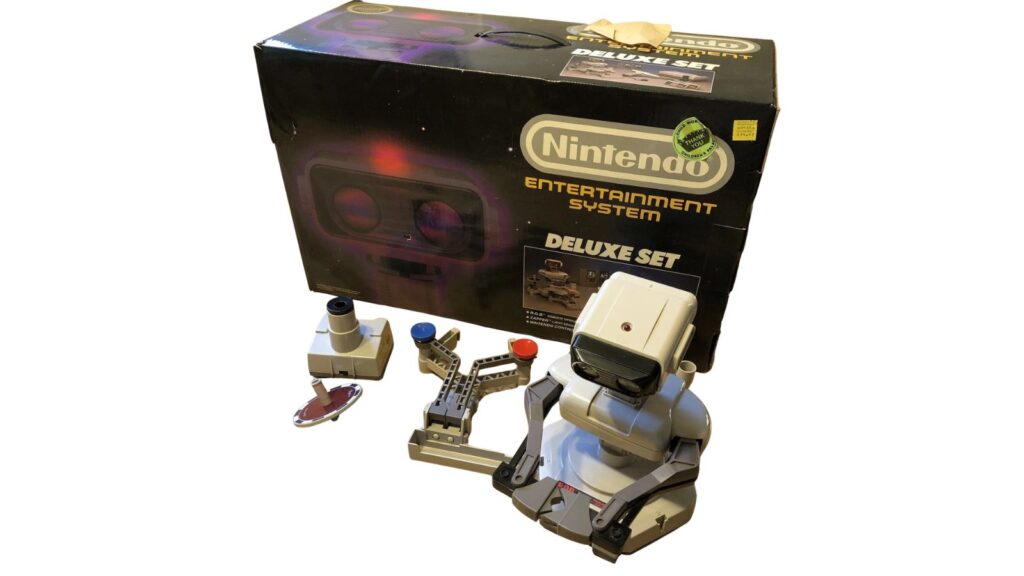
Nintendo Entertainment System Deluxe Set with R.O.B. (1985)
Nintendo Entertainment System Deluxe Set with R.O.B.
Image Credit: humblehorder via eBay

The standard NES Action Set, which included the console, two controllers, the Zapper light gun, and a Super Mario Bros./Duck Hunt cartridge, is the version most people owned. Working Action Sets in good condition bring $50 to $150. That’s useful to know because it sets a baseline. The Deluxe Set, released for the 1985 test market, is a completely different situation. It included the console, R.O.B. the Robotic Operating Buddy, Gyromite, Duck Hunt, the Zapper, and the original packaging. R.O.B. was Nintendo’s strategy for getting stores to stock the NES in the wake of the 1983 gaming crash, by positioning it as a toy rather than a video game system. It worked. And complete surviving sets are genuinely scarce.

Complete Deluxe Sets with R.O.B., both games, all gyros and stacking rings, sensor bar, original box, and paperwork bring $350 to $800 depending on how complete they are and the condition of the box. The R.O.B. alone, tested and working, is worth $100 to $200 as a standalone. The gyros are the piece most often missing; they’re small, orange, and look like toys, which they are. No gyros means no confirmed R.O.B. functionality, which hurts value. The styrofoam inserts and inner packaging are another frequent casualty. A Deluxe Set with all pieces present, working, and in its original box is an increasingly difficult find. If you have one and haven’t looked at it in 30 years, now is a good time.

GCE Vectrex console (1982)
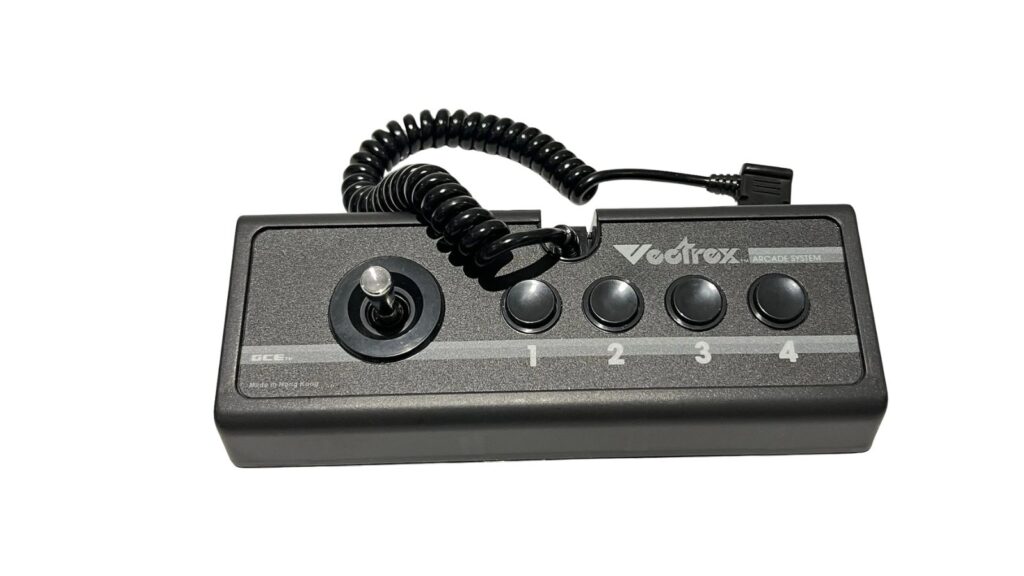
GCE Vectrex console
Image Credit: aroundthehaus via eBay

The Vectrex is the only home game console in history that came with its own built-in screen. Every other console requires a television. The Vectrex came with a 9-inch vector graphics CRT built into the unit, producing the same type of razor-sharp line graphics used in arcade games like Asteroids and Tempest. It was developed by Western Technologies/Smith Engineering, released in late 1982, and discontinued after the 1983 gaming crash. About 1.5 million units were made. The games came with plastic color overlay screens to add color to the display, and each title has its own set.

Working units without a box bring $250 to $400. Boxed examples with overlays and all original accessories push into the $400 to $700 range. The 3D Imager headset, a visor accessory that created genuine stereoscopic effects, commands $200 to $400 on its own and is considered the holy grail accessory for the system. The built-in CRT is the key concern with any Vectrex: capacitors degrade, and a system with display issues, including geometry problems, burn-in from a frozen game, or a dim image, needs significant repair. If the screen looks crisp and the Mine Storm game loads correctly from the built-in ROM, you have a working unit. The overlays for each game should be present and uncracked. Complete in box, with the overlays, the original controller, and any game cartridges, is the combination worth real money.

Sony Walkman TPS-L2 (1979)

Sony Walkman TPS-L2
Image Credit: SHOP_NINJA_TOKYO via eBay

The TPS-L2 is the original Walkman, the first one Sony ever made. It went on sale in Japan on July 1, 1979, sold 30,000 units in its first two months, and changed how people related to music and public space. The design is immediately recognizable: a blue-and-silver metal cassette player with chunky silver buttons, a distinctive orange “hotline” button, and two headphone jacks, because Sony’s research suggested people would want to listen together. They were right, at least for a while. The TPS-L2 was prominently featured in the Guardians of the Galaxy films, which drove a new round of collector interest beginning in 2014.

Working examples in good cosmetic condition bring $400 to $700, with the highest prices going to units with the original strap, leather carrying case, and both headphone jacks confirmed functional. The hotline button should engage and lower the tape volume when pressed. Drive belts almost always need replacement after four decades; a unit that simply won’t play is often just a belt away from being fully functional. The blue plastic covering on the body should be intact with no peeling or cracking. Missing the orange hotline button entirely drops value significantly. Broken or heavily worn TPS-L2 units still bring $100 to $200 because the parts market remains active. A clean, working, complete example is genuinely rare.

Apple Macintosh 128K (1984)

Apple Macintosh 128K
Image Credit: mike_russell_enterprises via eBay

Apple introduced the Macintosh 128K on January 24, 1984 with one of the most famous television commercials ever made, directed by Ridley Scott and aired once during Super Bowl XVIII. The computer itself was revolutionary: it was the first mass-market computer to ship with a graphical user interface, a mouse, and a 9-inch built-in screen. Only 372,000 were produced before it was replaced by the 512K model later that year. Fewer than 10,000 are estimated to survive in functional condition.

Working examples bring $1,500 to $2,000, with units that include the original travel bag, manuals, system disks, and keyboard pushing higher. The original packaging with its Picasso-inspired artwork is extremely rare and adds several hundred dollars by itself. The model number M0001 appears on the bottom of the unit; the 512K “Fat Mac,” which looks identical but has a different designation, is worth considerably less. Key failure points include the internal floppy drive, whose lubricant solidifies after decades of non-use, and the capacitors on the logic board, which have a known failure mode that can corrupt the video signal. A unit that boots to the desktop is worth materially more than one that shows a sad Mac face or boots to gray with no further progress. Anyone with an early Macintosh in a closet owes it to themselves to power it on carefully before assuming it’s just a decorative object.

Most of this stuff has been sitting undisturbed for so long that owners genuinely don’t know what they have. A few minutes of identification and a careful power-on test can make the difference between a donation and a meaningful windfall.


Some jobs sound fancy until you see the actual work. Then it is binders, spreadsheets, policy updates, audit trails, meeting notes, checklists, and one more spreadsheet for the spreadsheet.

That is not always a bad thing. The dullest work in a company is often the work nobody can skip. Insurance has to price risk. Drugs have to meet rules. Construction bids have to be checked. Privacy laws have to be followed. Someone has to sign off when the answer is expensive, annoying, and legally important.

These are not entry-level jobs. Most take years of experience, advanced credentials, or a specialized degree. But they can pay at least $100 an hour, and they tend to stick around because they are tied to regulation, safety, infrastructure, money, or legal risk.

1. Actuarial services director

Actuarial services director
Image Credit: Shutterstock

Actuarial services directors live in risk tables, pricing files, reserve reviews, claims history, and long model checks. It is a job for someone who can stare at assumptions for hours and still notice when one number does not make sense. Insurance companies, pension plans, consulting firms, and benefit programs need people who can price risk without guessing.

Average pay is about $115 per hour. The path usually starts with a math-heavy degree, then years of actuarial exams and experience in life, health, property and casualty, retirement, or enterprise risk. The work is boring because it is careful, slow, and checked again and again. That is also why it has staying power. Software can run models, but someone still has to question the assumptions, explain the results, and take responsibility when those numbers affect premiums, reserves, and real money.

Insurance risk director

Insurance risk director
Image Credit: Shutterstock

Insurance risk directors spend their days looking at claim trends, policy exposure, catastrophe risk, reinsurance terms, loss reports, and the weak spots that could cost a company a fortune. This is not a high-drama job most days. It is more like reading the same bad-news spreadsheet from twelve different angles until the risk is clear.

Average pay is about $106 per hour. Employers include insurance carriers, reinsurers, brokers, financial firms, and large companies that self-insure part of their risk. Many people come up through actuarial work, underwriting, claims, risk management, finance, or insurance operations. Demand stays solid because weather losses, cyber claims, lawsuits, healthcare costs, and property risks keep changing. The work is hard to hand off completely because the director has to connect numbers to business judgment, explain tradeoffs, and help leaders decide how much risk the company can afford to keep.

Chief risk officer

Chief risk officer
Image Credit: Shutterstock

Chief risk officers deal with the official list of what can go wrong. Market risk, credit risk, cyber risk, vendor risk, legal risk, operational risk, reputational risk, and board-level risk all land somewhere near this desk. A lot of the work is dry: risk registers, committee packets, board reports, control reviews, testing calendars, and follow-up on items nobody wants to own.

Average pay is about $132 per hour. Banks, insurers, healthcare companies, utilities, manufacturers, fintech firms, and public companies hire for this role because one missed risk can become a lawsuit, outage, regulatory problem, or major loss. The path usually includes years in risk, finance, compliance, legal, audit, insurance, or operations, often with advanced credentials. It is boring in the way fire drills are boring, until something actually catches fire. The job depends on judgment, independence, and the ability to tell senior leaders what they do not want to hear.

Chief compliance officer

Compliance officer
Image Credit: Shutterstock

Chief compliance officers make sure a company follows the rules that apply to its business. That can mean training records, hotline reports, investigations, policy updates, audit responses, vendor reviews, disciplinary files, and long meetings about whether one sentence in a policy is too vague. It is paperwork-heavy and often thankless.

Average pay is about $113 per hour. You will find these jobs in finance, healthcare, insurance, manufacturing, energy, higher education, government contractors, and any field with serious oversight. Many people come from law, audit, risk, HR, investigations, regulatory operations, or industry-specific compliance. Demand stays steady because rules do not enforce themselves, and companies need someone accountable when regulators ask questions. The work is not exciting, but it is hard to ignore. A good compliance officer keeps small problems from turning into fines, headlines, or criminal investigations.

Vice president of privacy

Vice president of privacy
Image Credit: Shutterstock

A vice president of privacy spends a lot of time on data maps, consent rules, breach procedures, vendor contracts, privacy notices, access requests, and employee training. If that sounds like a maze of forms and definitions, that is the job. The work is often repetitive because every new product, vendor, app, and data-sharing plan has to be checked.

Average pay is about $113 per hour. Employers include tech companies, banks, insurers, retailers, healthcare groups, education companies, ad firms, and any business that handles sensitive customer data. The path can come through law, compliance, cybersecurity, data governance, product operations, or privacy certification work. Demand is helped by privacy laws, breach risk, customer pressure, and the fact that companies collect more data than most of them can neatly explain. Software can help track requests and systems, but a senior privacy leader still has to decide what is allowed, what is risky, and what the company must fix.

Information security director

Information security director
Image Credit: Shutterstock

Information security directors are not usually the movie version of hacking. Much of the job is access reviews, security policies, vendor questionnaires, audit evidence, risk exceptions, incident plans, patch reports, and meetings about whether a control is strong enough. It is technical, but it can also be deeply boring in a very necessary way.

Average pay is about $100 per hour. Banks, hospitals, retailers, software firms, universities, utilities, government contractors, and manufacturers all need security leadership. People often move into the role after years in cybersecurity, IT operations, audit, risk, systems engineering, or security architecture. Demand is strong because cyberattacks, vendor risk, insurance requirements, and regulation keep growing. Automation can flag threats and collect logs, but it cannot own the security program, explain the risk to executives, or make the call when business leaders want an exception that could expose the company.

Data management director

Data management director
Image Credit: Shutterstock

Data management directors deal with the unglamorous question every company eventually faces: Which number is the real number? Their work can include data dictionaries, master data rules, ownership fights, cleanup projects, quality checks, system migrations, and meetings where three departments argue over one field name.

Average pay is about $101 per hour. Employers include banks, insurers, healthcare companies, retailers, manufacturers, logistics firms, research companies, and large public agencies. Many people come from data governance, analytics, operations, database work, compliance, or business systems. Demand stays healthy because companies cannot report, bill, forecast, ship, or comply if their data is a mess. The job is not just technical. It requires patience, politics, standards, and enough authority to make teams follow the same rules. Tools can clean some records, but they do not settle ownership or decide which data can be trusted.

Head of compensation and benefits

Head of compensation and benefits
Image Credit: Getty Images via Unsplash

The head of compensation and benefits manages pay bands, bonus rules, benefits renewals, job levels, executive pay files, equity plans, leave policies, and pay equity reviews. It is a job made of spreadsheets, sensitive numbers, and conversations where everyone thinks they are underpaid. A normal week can involve salary ranges, health plan costs, vendor meetings, and one more round of job-title cleanup.

Average pay is about $110 per hour. Large employers, universities, hospitals, retailers, manufacturers, tech companies, and financial firms need this role because pay mistakes are expensive and benefits are a major part of hiring. People often build toward it through HR, compensation analysis, benefits administration, finance, or consulting. Demand is stable because companies still need fair pay structures, legally compliant benefits, and clear answers when employees ask why one job pays more than another. The work is dull, but it sits right where money, law, morale, and retention meet.

Senior procurement director

Senior procurement director
Image Credit: Shutterstock

Senior procurement directors spend their days with supplier lists, contract terms, renewal dates, pricing tables, risk reviews, and vendor scorecards. It is not shopping. It is slow, careful work that decides who gets paid millions of dollars to provide parts, software, ingredients, fuel, packaging, equipment, or services.

Average pay is about $105 per hour. Employers include manufacturers, hospital systems, retailers, food companies, defense contractors, universities, utilities, and global companies with complex supply chains. Many people move up from purchasing, sourcing, supply chain, contract management, logistics, finance, or operations. Demand stays solid because supply disruptions, inflation, tariffs, vendor failures, and quality problems can hit a company fast. The job can be repetitive, especially during bid reviews and renewal cycles, but experienced procurement leaders know when the cheapest option is actually the most expensive mistake.

Director of estimating

Director of estimating
Image Credit: Shutterstock

Directors of estimating lead the teams that price big construction, engineering, manufacturing, or infrastructure jobs before anyone signs the deal. The work is heavy on takeoffs, bid sheets, subcontractor quotes, materials pricing, change orders, labor assumptions, and risk padding. It can feel like checking the same giant puzzle for missing pieces over and over.

Average pay is about $100 per hour. Construction firms, specialty contractors, engineering companies, industrial builders, and infrastructure contractors rely on this role because a bad estimate can wipe out profit before the job even starts. Many people come up through estimating, project management, quantity surveying, construction management, engineering, or the trades. Demand is tied to infrastructure, energy projects, housing, industrial work, and the constant need to bid accurately. Software can speed up takeoffs, but someone experienced still has to spot bad assumptions, challenge vendor numbers, and decide whether the bid is worth the risk.

Head of construction operations and planning

Head of construction operations and planning
Image Credit: Shutterstock

The head of construction operations and planning sits in the world of schedules, permits, crews, budgets, materials, change orders, project controls, and delay reports. It is a lot of calendars and status meetings. The job is not swinging a hammer. It is making sure hundreds of moving parts do not turn into an expensive mess.

Average pay is about $123 per hour. Employers include general contractors, developers, infrastructure firms, industrial builders, utilities, and companies that manage large capital projects. The path often starts in construction management, engineering, field supervision, scheduling, project controls, or operations. Demand stays steady because buildings, plants, roads, data centers, utilities, and public projects still need people who can keep work on track. The boring parts are the point: permit logs, budget reviews, schedule updates, and risk meetings help prevent delays that can cost more than anyone wants to admit.

Senior intellectual property attorney

 intellectual property law book
Image Credit: Shutterstock

Senior intellectual property attorneys handle the quiet paperwork behind inventions, brands, licenses, and trade secrets. The work can include contract language, invention disclosures, trademark disputes, licensing terms, research agreements, and long reviews of what a company can protect or use. It is detailed legal work, often with more redlines than courtroom speeches.

Average pay is about $118 per hour. Employers include law firms, tech companies, drug makers, universities, manufacturers, media companies, defense contractors, and consumer brands. The path requires law school, a law license, and years of experience with patents, trademarks, licensing, litigation support, or corporate IP strategy. Demand stays strong because companies still need to protect what they invent, buy, sell, and license. Software can help search documents or draft first passes, but it does not replace the attorney who weighs risk, negotiates rights, and signs off on language that can shape a company’s value.

Patent agent

Senior patent agent
Image Credit: Shutterstock

A senior patent agent or patent attorney spends a lot of time with invention descriptions, prior-art searches, claim language, examiner responses, technical drawings, and filing deadlines. This is one of those jobs that can be extremely dull to anyone outside the field. You may spend hours arguing over the meaning of one word in a patent claim.

Average pay is about $121 per hour. Employers include law firms, tech companies, engineering firms, universities, medical device companies, semiconductor companies, and manufacturers with research teams. Patent agents usually need a science or engineering background and registration to practice before the patent office. Patent attorneys also need a law degree and license. Demand holds up because companies need protection for technical work, and patent filings are full of deadlines and details. Search tools can help find prior art, but a human specialist still has to shape the claims, understand the invention, and respond when the examiner pushes back.

Head of regulatory affairs

Head of regulatory affairs
Image Credit: Shutterstock

The head of regulatory affairs is responsible for getting products through the right approval process and keeping them compliant after launch. The day can be full of submissions, labels, response letters, meeting notes, approval timelines, rule changes, and careful wording. It is slow, formal, and often about making sure every required document is in the right place.

Average pay is about $160 per hour. Drug makers, medical device companies, diagnostics firms, food companies, chemical manufacturers, energy companies, and other regulated businesses hire for this work. People often come from science, pharmacy, engineering, quality, legal, compliance, or product development. Demand stays solid because companies cannot simply sell regulated products and hope for the best. They need someone who understands the rules, talks to agencies, manages timelines, and keeps the business from making promises it cannot legally support. The boredom is built in because precision matters.

Global compliance director

Global compliance director
Image Credit: Shutterstock

Global compliance directors handle policies and controls across different countries, business units, vendors, and employee groups. The work can include training records, anti-bribery controls, trade compliance, sanctions checks, investigation files, monitoring plans, audit findings, and regional follow-up. It is repetitive because every location has its own version of the same problem.

Average pay is about $111 per hour. Multinational companies, banks, manufacturers, drug makers, logistics firms, energy companies, and government contractors need this role because one bad payment, shipment, vendor, or investigation can create legal trouble across borders. The path often runs through compliance, audit, legal, investigations, finance controls, trade operations, or risk management. Demand is steady because global business is full of rules, and those rules keep changing. The job is not exciting most days, but it calls for judgment, documentation, and the nerve to stop a deal when the paperwork does not hold up.

Corporate safety director

Corporate safety director
Image Credit: Shutterstock

Corporate safety directors deal with incident reports, safety audits, training logs, inspection records, injury trends, corrective actions, and long meetings about whether a site is following the rules. It is not glamorous work. It is often clipboards, dashboards, policies, and the same safety reminder repeated until people finally do it.

Average pay is about $105 per hour. Manufacturers, construction firms, warehouses, transportation companies, utilities, chemical plants, food processors, and large retailers hire for this role. Many people come up through safety management, operations, environmental health and safety, engineering, industrial hygiene, or military safety work. Demand stays stable because employers have to manage injuries, inspections, insurance costs, and legal exposure. The work is hard to fully automate because safety problems happen in real places with real people, equipment, shortcuts, weather, fatigue, and pressure to move faster than the rules allow.

Head of quality control

Head of quality control
Image Credit: Shutterstock

The head of quality control oversees testing, inspection records, lab results, batch records, defect trends, deviations, and release decisions. In manufacturing, this can mean asking the same questions every day: Did the product meet spec? Was the test valid? Was the equipment clean? Was the failure handled correctly? It is repetitive because quality has to be proven, not assumed.

Average pay is about $106 per hour. Employers include drug makers, biotech plants, food manufacturers, aerospace suppliers, electronics companies, chemical producers, and other regulated manufacturers. Most people build toward this through chemistry, biology, engineering, lab operations, validation, quality assurance, or manufacturing leadership. Demand holds up because bad products can trigger recalls, lawsuits, shutdowns, or harm to customers. Automated testing and tracking systems help, but someone still has to investigate failures, decide whether a product can ship, and defend the record when auditors or customers ask hard questions.

Director of business continuity

Director of business continuity
Image Credit: Shutterstock

Directors of business continuity plan for the boring disasters before they become real ones. Their work includes backup plans, recovery exercises, vendor lists, crisis playbooks, call trees, tabletop drills, risk reviews, and documentation for what happens if a system, building, supplier, or region goes down. Most of the job is planning for problems that may never happen.

Average pay is about $128 per hour. Banks, insurers, hospitals, utilities, manufacturers, universities, tech companies, and government contractors use this role because outages, cyberattacks, storms, supply problems, and facility issues can stop business fast. People often come from risk, operations, IT disaster recovery, emergency management, audit, security, or compliance. Demand is steady because leaders want proof that the company can keep running when something breaks. The job is dry by design. You are paid to think through the dull details before everyone else is panicking.

Discover job hunting tips, ways to earn more, and flexible working options:

Practising job interview
Image Credit: Shutterstock

21 high-paying careers that desperately need workers, but nobody wants to do them: The pay is generous, but these jobs are searching for workers.

No background check jobs: 12 background friendly jobs: If you’re struggling to find a job due to past issues, here are jobs you can get without background checks.

15 remote jobs you probably didn’t know pay $150,000+ In 2026: High income and flexible work hours from home is not a myth — here are some remote-friendly careers.

Last year I almost paid $189 for a Dutch oven that was sitting on another site for $112. Same brand, same color, same size. I caught it with 30 seconds to spare because I had the right browser extension open. It wasn’t luck. These days I run through the same short checklist before buying anything online that costs more than about $20, and it has saved me hundreds of dollars this year alone.

None of these apps costs anything. Most are browser extensions you install once and then forget about, at least until they pop up at checkout and quietly knock $30 off your order. A couple require you to remember to open them before you shop. The payoff is real either way.

Here are the 7 I actually use.

Rakuten

Rakuten logo
Image Credit: Kashiwa Sato, Public Domain, via Wiki Commons

Rakuten is the one I wish I had started using years earlier. It works as a browser extension and a mobile app, and it gives you a percentage of your purchase price back as cash every time you shop through it at one of its 3,500+ partner stores. We’re talking Target, Macy’s, Sephora, Nike, GameStop, Ulta, and hundreds more. The cashback percentage varies by store and changes regularly, but it adds up fast when you’re doing holiday shopping or buying something big like furniture or electronics.

The browser extension handles most of it automatically. When you land on a partner site, a notification pops up and activates the cashback. You shop exactly as you normally would, and the money accumulates in your Rakuten account. Payouts happen quarterly, either via PayPal or a mailed check. You can also convert your earnings into American Express Membership Rewards points, which is a nice option if you’re trying to stack travel rewards.

Rakuten doesn’t pay out weekly, and Amazon isn’t a partner store, which are the two main downsides. But for everything else, it’s the closest thing to free money I’ve found. One reviewer tracked 26 separate transactions over two years and walked away with $240 in cash back without doing anything unusual. New members who spend $30 within 90 days typically get a welcome bonus on top of that.

Capital One Shopping

Image Credit: Capital One, Public Domain, via Wiki Commons

Capital One Shopping is the extension that does the most heavy lifting at checkout. You don’t need a Capital One account to use it. Once it’s installed, it sits in your browser toolbar and springs into action when you’re about to pay for something. It pulls in coupon codes from its database, tests them all, and applies whichever one saves you the most. It also checks whether the item you’re buying is available for less at a competing retailer, and flags the difference in a pop-up before you finalize your order.

The price comparison piece is genuinely useful. If you’re on the Target website about to buy a blender, Capital One Shopping will tell you if that exact blender is cheaper at Walmart or Home Depot right now, factoring in shipping. It covers over 30,000 retailers and tracks price history so you can see whether the “sale” price you’re looking at is actually a sale or just the normal price with a crossed-out number.

Rewards come in the form of store credits redeemable for gift cards, not cash, which puts it a notch below Rakuten for payouts. But for coupon-finding and live price comparison, it’s the best free tool I’ve used. It works on Chrome, Firefox, Edge, and Safari, and there’s a mobile app for iOS and Android.

CamelCamelCamel

camelcamelcamel logo
Image Credit: camelcamelcamel, Public domain, via Wikimedia Commons

Amazon’s prices move constantly. A TV that’s listed at $399 today might have sold for $299 three weeks ago and may drop again before the holidays. CamelCamelCamel tracks that history for millions of Amazon products and makes it available for free. You paste an Amazon product URL into the CamelCamelCamel website, and it shows you a price chart going back months or years, with the all-time high, the all-time low, and the average.

The browser extension, called The Camelizer, is even more convenient. Install it on Chrome, Firefox, or Safari, and it adds a price history chart directly to any Amazon product page without making you leave the site. You can also set a price watch: tell it what you’d be willing to pay, and it emails you the moment the price hits that number. I use this for anything over $100 that I’m not in a rush to buy. The patience usually pays off.

CamelCamelCamel is Amazon-only, which limits its usefulness if you shop widely. But if you buy from Amazon regularly, it’s one of the most important tools on this list. Knowing that a product’s “lowest ever” price is $40 less than what’s showing today takes about ten seconds to check and can save you real money if you’re willing to wait.

Slickdeals

Slickdeals.net
Image Credit: Slickdeals.net, CC BY-SA 4.0 via Wiki Commons

Slickdeals is a community of over 12 million people whose entire hobby is finding deals and sharing them with strangers. Members post discounts, coupon codes, and price drops as they find them across thousands of retailers. Other members vote on those deals, and the best ones surface to the front page. Since 1999, the platform claims its community has collectively saved shoppers more than $10 billion. The math seems plausible when you see what people unearth, including clearance pricing errors, stacking opportunities, and limited-window flash sales that would never show up in a Google search.

The feature that makes Slickdeals genuinely useful rather than just a rabbit hole for bargain hunters is the Deal Alert system. You type in a product name or category, set your criteria, and Slickdeals notifies you the moment a matching deal is posted, by email, push notification, or both. I have one set for a specific brand of coffee I buy regularly. The last time it triggered, the deal was gone within a few hours. Without the alert, I would have missed it entirely.

The app has a bit of a learning curve and can feel overwhelming at first because there’s so much happening at once. Start with the Deal Alerts feature and ignore everything else until you’re comfortable with how it works. That one tool alone is worth installing the app for.

CNET Shopping

CNET Shopping
Image Credit: CNET Coupons, CC BY-SA 4.0 via Wiki Commons

CNET Shopping is a browser extension that does one thing simply and well: it tells you when an item you’re looking at online is available for less somewhere else. It works across thousands of retail sites and covers a wider range of purchase categories than most price-comparison tools, including flights, hotels, and rental cars in addition to physical products. Install it on Chrome, Firefox, Edge, or Safari, and it quietly checks prices in the background as you shop, surfacing a banner when it finds a better deal.

Where CNET Shopping stands out is in its retailer coverage and the fact that it’s not primarily a cashback app trying to earn affiliate commissions. Its job is specifically to compare prices and surface the lowest available, which means it has less of an incentive to steer you toward a particular retailer. You can get the extension at CNET’s site and have it running in under two minutes.

It pairs well with Capital One Shopping rather than replacing it. CNET Shopping is better at broad cross-site comparisons; Capital One Shopping is better at coupon application and rewards. Running both at the same time creates occasional conflicts when both try to pop up at checkout, but usually they don’t step on each other badly enough to cause problems.

Ibotta

ibotta logo
Image Credit: Ibotta, public domain via Wiki Commons

Ibotta gives you cashback on specific products rather than specific stores, which makes it function differently from everything else on this list. Instead of getting a percentage back on everything you buy at a given retailer, you browse Ibotta’s available offers, activate the ones you want, make your purchase at a participating store or online, and then get the cash deposited into your Ibotta account. Offers are typically on brand-name grocery and household products, like $1.50 back on a specific yogurt, or $3 back on a specific paper product brand.

It works online at Walmart, Target, and a growing list of other retailers where you can link your account and get credit automatically. It also works in-store if you submit your receipt through the app. The Ibotta website has a browser extension for desktop shopping that activates offers automatically at participating stores, which removes the step of remembering to check the app first. Minimum cashout threshold is $20, after which you can transfer to PayPal, Venmo, or gift cards.

Ibotta and Rakuten can be stacked at some retailers, which is where the savings get interesting. If Rakuten is offering 3% cashback at Walmart and Ibotta has a $2 offer on a specific item you were already buying, both can apply to the same order. Not every combination works this cleanly, but it’s worth checking both before a large grocery order or a household supply run.

Honey

Honey coupon
Image Credit: PayPal Honey, Public domain, via Wikimedia Commons

Honey used to be the first app anyone recommended for online savings, and for years it genuinely was worth having. The PayPal-owned browser extension automatically tests coupon codes at checkout on 30,000+ sites and applies whichever one saves you the most. It also tracks price history on Amazon and lets you set up a “Droplist” for products you’re monitoring. On pure functionality, it still works at a basic level.

The problem is what came out in late 2024. A widely viewed investigation revealed that Honey was doing two things users didn’t know about: replacing affiliate links from creators and websites with its own at checkout, meaning it was pocketing referral commissions it hadn’t earned, and working with some retailers to suppress better coupon codes in favor of ones the retailer preferred users to see. By the end of 2025, Honey had lost roughly 8 million Chrome users. PayPal acknowledged one of the code issues in January 2026 and said it had been disabled.

I’m listing it here because it’s still widely installed and still does find valid coupon codes at checkout. But I’d use Capital One Shopping for coupon application instead, and CamelCamelCamel for Amazon price history. Honey’s advantages over those two have narrowed considerably, and the trust issue is real. If you already have it installed and aren’t ready to uninstall, just know what you’re working with.

Many mothers reach the two-year mark after childbirth and find that their reflection no longer matches their sense of self. Loose skin remains. Abdominal muscles that separated during pregnancy never fully close. Breasts change shape and stay changed.

Some of these changes resolve on their own. But many do not, regardless of how disciplined the exercise routine becomes.

Interest in cosmetic surgery often follows, usually late at night and usually in private. That interest is understandable and deserves a thoughtful response rather than a dismissive one, and the decision tends to hold up better when a mother understands what she hopes to repair and whether surgery can reach it.

Understanding the financial picture reduces anxiety rather than feeding it

Avoiding the price question rarely protects anyone. More often it leaves an unanswered worry circulating for months while the underlying feeling continues untouched.

Costs for a mommy makeover vary according to which procedures a patient combines, whether abdominal muscle repair is required, and how long the operation takes. A breast lift paired with a tummy tuck costs differently than a breast lift paired with liposuction. 

Surgeon experience also shifts the figure, and so does geography. Practices in New York price differently than practices in Louisville.

See here the mommy makeover costs in NYC explained by Dr. Darren Smith.

Postpartum body image carries clinical weight

Body dissatisfaction after childbirth is often treated as a vanity concern. Clinicians and researchers treat it as more of a risk factor.

A 2024 systematic review of body image interventions for pregnant and postpartum women examined 1,290 participants across 11 randomized controlled trials. Psychological interventions, including cognitive behavioral counseling and self-compassion work, produced greater and more consistent improvements in body image than diet and exercise programs did. The authors also noted that fewer than a third of healthcare providers assess body image during routine prenatal care.

A separate 2025 systematic review of postpartum body dissatisfaction found associations between body image and maternal weight, depression, mode of delivery, sexual function, breastfeeding, and social support.

Body image belongs in the same conversation as maternal mental health. It does not belong in the same conversation as indulgence.

The same procedure can serve two very different purposes

Consider a mother who wants her clothing to fit comfortably again. She schedules a consultation, asks about recovery time, and returns to her week. The matter occupies perhaps 20 minutes of her attention.

Now consider a mother who checks her reflection in every darkened window she passes. She declines invitations to the pool. She underwent a breast lift last year and now researches a revision because the result stopped feeling sufficient within four months.

Surgery tends to serve the first mother well. It rarely serves the second, because her distress often lies beyond what an operating room can address.

Indicators that the concern may extend beyond the physical

Certain patterns tend to show up when appearance distress has taken on a life of its own.

Counselors usually watch for the following:

  • Avoidance of mirrors, photographs, intimacy, or changing clothes in front of a partner
  • Appearance-related thoughts occupying more than an hour of an average day
  • A reliable drop in mood after viewing other mothers on social media, followed by continued viewing
  • A previous cosmetic result that brought brief satisfaction before losing its effect
  • The belief that one physical change will resolve a marriage, a confidence issue, or a social difficulty

A single item on that list means little in isolation. Three or four appearing together suggest that a counselor would offer more benefit than a second surgical consultation. 

A deliberate waiting period protects the decision

Most surgeons ask patients to wait at least 6 months after delivery and to finish breastfeeding first. The body needs that time to settle, and operating sooner risks a result that shifts later. A second waiting period is also worth adding.

Write down your reasons before you book anything. Be specific. “My skin folds over my waistband, and I hate getting dressed” is a reason. “I want to feel like myself again” is a feeling that deserves attention but does not tell you which procedure, if any, would help.

Read what you wrote 12 weeks later. Reasons about your own daily comfort usually still apply. Reasons that trace back to someone else, a comment from your mother-in-law, a difficult stretch in your marriage, or a bad week of scrolling, tend to look smaller by then. Some disappear entirely. Either result tells you something useful.

Waiting around 12 weeks costs you nothing beyond patience. A revision procedure costs thousands of dollars, another recovery period, and the disappointment of learning that surgery was not the answer.

What counseling offers that a surgical consultation cannot

A consultation addresses tissue, incision placement, anesthesia, and recovery timelines. A surgeon is not positioned to help a patient determine whether she is grieving a former identity, managing anxiety that has attached itself to her appearance, or carrying unresolved resentment about how parenting responsibilities were distributed in her household.

Counseling addresses that directly. A therapist can help you understand what surgery will and won’t resolve.

Many women complete that work and proceed with the procedure anyway, entering it with realistic expectations and a calmer recovery. Others discover the pressure came from somewhere else entirely and set the idea aside without regret.

Surgery reshapes tissue. Grief requires something else.

A tummy tuck removes excess skin and repairs separated muscle. The result is real, lasting, and often meaningful to the woman who chooses it.

The procedure cannot return the version of herself who slept through the night, traveled without a diaper bag, and inhabited a body that answered to no one else.

Women who treat the two needs separately tend to feel better about their results. Women who ask a single operation to carry the full emotional load often feel disappointed by an outcome that was, by every technical measure, a success.

A reasonable place to begin

Schedule the surgical consultation if you’re genuinely interested. Ask about scarring, drains, and how many weeks must pass before lifting a toddler.

Then schedule one counseling session. One hour with a professional is enough to understand what surgery can fix and what it cannot.

Whatever a mother decides afterward, she will have decided it with her full attention.

You’ve already cut the obvious stuff. You make coffee at home. You skip the $15 cocktail. And yet the end of the month still sneaks up on you with that familiar hollow feeling in your checking account.

The problem usually isn’t spending on luxuries. It’s the slow drain of small, invisible costs that nobody ever flags, plus the money-building opportunities most people never bother to set up. Neither one feels dramatic enough to deal with until you add it up.

Most of the moves below take less than an hour to implement and require no ongoing willpower. A few could put hundreds, or even thousands, of dollars back in your pocket every year without you changing a single thing you actually enjoy.

Stop throwing food away

food waste in a garbage pail
Image Credit: Toa Heftibac For Unsplash+

This is the single most underrated money leak in the American household. Food waste costs the average U.S. consumer $728 a year, and for a family of four, that number climbs to nearly $2,900. A third of all food in the country never gets eaten. That’s a full month of groceries, gone.

The fix is mostly a planning problem. Before you shop, spend five minutes looking at what’s already in the fridge and building meals around it. Keep a running list of what needs to be used first. Freeze meat, bread, and leftovers before they go bad rather than after you notice they’ve turned. The produce drawer is not a storage unit.

A few other things help consistently: don’t over-serve at dinner, store leftovers where you can actually see them, and stop relying on expiration dates as a guide. “Best by” labels refer to peak quality, not safety. The sour cream that’s three days past the date is almost certainly fine.

Get (or dust off) your library card

student and library card
Image Credit: Shutterstock

A public library card is one of the most overlooked financial tools in existence. Most Americans have one and barely use it. If yours is sitting in a drawer somewhere, pull it out, because modern library systems have gone far beyond physical books.

Thousands of libraries now offer free access to streaming services through apps like Kanopy and Libby. Kanopy carries award-winning films, documentaries, and the Criterion Collection. Libby covers ebooks and audiobooks. Many libraries also offer free access to databases people routinely pay for, including Consumer Reports, LinkedIn Learning, language learning platforms, and digital magazine subscriptions. Check your library’s website to see what’s available with your card, because the list is usually longer than you’d expect.

All of it is included in your library card at no charge. If you’ve been paying separately for an audiobook subscription or a language app, this is a straightforward cancellation.

Audit your subscriptions

checking subscriptions
Image Credit: Shutterstock

Most people have no idea how much they’re spending on subscriptions. The average American spends $219 a month on subscriptions across 8.2 active services, but estimates they’re spending only $86. That’s a 2.5x gap, and it shows up as a slow, invisible drain that never triggers the discomfort of a big one-time purchase.

Pull up your last two months of bank and credit card statements. Write down every recurring charge. Then ask, for each one: have I used this in the past 30 days, and would I pay for it again today knowing what I actually use it? Most people find two or three services they’d entirely forgotten about. Streaming services are the obvious ones, but gym memberships, app subscriptions, meal kit boxes, premium news subscriptions, and Amazon add-ons all show up in these audits too.

For services you want to keep, check whether you’re on the right tier. Many streaming services offer ad-supported plans that cost several dollars less per month for essentially the same content. If you share an account with family members, a family plan almost always costs less than individual plans for everyone involved.

Switch to generic medications

pills at home
Image Credit: Shutterstock

This is one of the fastest ways to cut a monthly expense that most people never question. Generic drugs are typically sold at 80 to 85% less than their brand-name equivalents, and the FDA requires them to be bioequivalent, meaning the same active ingredient, in the same dose, with the same effect on your body.

The savings apply to everything from allergy medication and blood pressure drugs to cholesterol treatments and antidepressants. If your doctor hasn’t already switched you to generics, ask. If a pharmacist offers a generic substitute, say yes. And use a prescription discount service like GoodRx before you fill anything, because the cash price with a coupon is sometimes lower than your insurance copay, even for generics.

The one exception worth knowing: a small number of medications, particularly certain thyroid drugs and some narrow therapeutic window drugs, may require consistency between brands for clinical reasons. Your doctor or pharmacist can tell you if yours is one of them. For the vast majority of common prescriptions, generic is identical in every way that matters.

Move your savings to a high-yield account

woman holding savings jar
Image credit: Towfiqu barbhuiya via Unsplash

The national average interest rate on a regular savings account is currently 0.38%. If your savings are sitting in one of those, the bank is effectively keeping your money for free. High-yield savings accounts at online banks are offering up to 4% APY, more than ten times the national average.

On $10,000, the difference between 0.38% and 4% is roughly $360 a year in interest you’re currently not earning. That’s not life-changing by itself, but it’s also money that requires no work, no risk, and takes about 20 minutes to set up. Online banks like Marcus, Ally, Axos, and others consistently offer competitive rates, and the accounts are FDIC-insured the same as any other bank account.

Moving your emergency fund or any cash you’re holding for a near-term goal is the easiest first step. The funds stay liquid, you can move money back whenever you need to, and you stop leaving interest on the table every month that goes by.

Capture your full 401k match

A sack labeled with 401k with several coins beside it and a yellow calculator.
Image Credit: Shutterstock

If your employer offers a 401k match and you’re not contributing enough to get all of it, you are declining part of your compensation. The money exists. It’s been budgeted for you. It goes to waste if you don’t claim it. The most common 401k match formula is a dollar-for-dollar match on the first 3%, then 50 cents per dollar on the next 2%, which works out to a 4% employer contribution if you contribute 5% of your salary.

At a $60,000 salary, that’s $2,400 a year in free money. Over a career, with compounding, the difference between capturing the full match and leaving some of it behind is substantial. If you don’t know your plan’s formula, your HR department or benefits portal can tell you in five minutes what percentage you need to contribute to get the maximum match.

The pre-tax nature of 401k contributions also reduces your taxable income, so contributing more costs less than it looks like on your paycheck. If you’re currently contributing below the match threshold, bumping it up is close to the highest-return financial move available to most working people.

Buy secondhand first

buying secondhand
Image Credit: Shutterstock

The resale market has gotten very good. Furniture, clothing, electronics, kitchen gear, books, workout equipment: all of it turns up reliably on Facebook Marketplace, OfferUp, ThredUp, Poshmark, and neighborhood buy-nothing groups, usually at a fraction of retail and often barely used. The stigma around buying secondhand has largely evaporated, and for practical household items, there’s usually no quality difference.

Make it a default, not a last resort. Before buying anything new, spend five minutes checking whether a used version exists nearby. Kids’ clothing and baby gear are particularly good targets, since children outgrow things before they wear out. Exercise equipment is another category where secondhand supply is abundant, because a large percentage of it gets used six times and then sits in a garage.

For furniture especially, buying used often gets you better quality than buying new at the same price. The market for Craigslist or Marketplace furniture is full of solid-wood pieces that original owners are unloading during a move. The flatpack equivalent at the same price is almost never built to the same standard.

Cook in batches

batch cooking
Image Credit: Getty Images via Unsplash

Cooking at home is already cheaper than eating out. Batch cooking takes it further by collapsing several nights of cooking into one longer session, which removes the friction of “I’m tired, let’s just order something.” That friction is where most food budgets quietly fall apart.

Pick one day, usually Sunday or whenever your schedule allows, and cook two or three proteins, a grain, a pot of soup or beans, and a couple of sides. Combine them differently through the week. Roasted chicken becomes a grain bowl becomes a sandwich becomes a quesadilla. A pot of dried beans costs under a dollar and feeds a family multiple times. The variety doesn’t have to be elaborate; it just has to exist so that opening the fridge doesn’t mean staring at nothing and reaching for your phone.

The financial impact isn’t trivial. A restaurant meal for two averages $60 or more with tip, while the same amount of food cooked at home costs a fraction of that. If batch cooking prevents even two or three takeout nights per month, the savings are immediately real.

Negotiate your monthly bills

sorting out bills at home
Image Credit: Shutterstock

Cable, internet, phone, and insurance companies all have retention departments whose job is to keep you from leaving. Those departments have access to discounts and promotional rates that customer service representatives don’t offer unprompted. If you’ve been a customer for more than a year and your rate has crept up, a single phone call is often enough to bring it back down.

The script is simple. Tell them you’ve been looking at competing offers, name a competitor’s price if you know one, and say you’re thinking about switching unless they can match it. Most companies would rather reduce your rate than lose you. Internet service in particular has gotten competitive enough that many providers will cut $20 to $30 a month off your bill just to keep your business. On insurance, the strategy is slightly different: shopping around once a year and getting competing quotes is often more effective than negotiating with your current insurer, because new customer rates can be significantly lower than renewal rates.

Set a reminder to do this annually. The companies know that most customers never call. The ones who do call are the ones who get the discounts.
Use the employee benefits you’re ignoring

Employee Assistance Program
Image Credit: Shutterstock

Most employees use a fraction of the benefits their employer offers. Beyond health insurance and the 401k match, many employers provide access to: flexible spending accounts (FSAs) that let you pay for medical and dependent care with pre-tax dollars, employee assistance programs (EAPs) that include free therapy sessions and financial counseling, legal insurance, pet insurance, discounts on gym memberships, cell phone plans, and car purchases, and tuition assistance for continuing education.

A healthcare FSA can save you 20 to 30% on eligible medical expenses, including glasses, dental work, and over-the-counter medications, simply by paying with pre-tax money. If your employer offers a dependent care FSA and you’re paying for childcare, this is one of the highest-value benefits available to parents. Many people skip it because the enrollment window is limited and the mechanics are unfamiliar.

Log into your benefits portal and spend 30 minutes actually reading what’s there. Most HR teams will also walk you through anything you don’t understand. The total value of underused employer benefits varies widely by company, but for most full-time workers it runs into the hundreds of dollars per year.

Switch to store-brand groceries

Great Value Paper Towels, Ultra Strong, 2 Count
Image Credit: Walmart

The grocery store’s own-brand products and the national-brand equivalent are often manufactured by the same company, in the same facility, from the same recipe. The packaging is different. The markup is not. Store brands typically cost 20 to 30% less than national brands for items like canned goods, pasta, flour, spices, cleaning products, paper goods, and dairy.

The categories where brand genuinely matters to most people are pretty narrow: a few specific flavor preferences, some condiments, maybe a particular coffee. For everything else, the house brand is worth trying at least once. Staples like canned tomatoes, chicken broth, frozen vegetables, oats, vinegar, and baking supplies are almost universally indistinguishable from the name brand at a lower price.

Over the course of a weekly grocery shop for a family, consistently choosing store brands over national brands can easily save $25 to $50. Annualized, that’s real money, and unlike some frugality strategies, it requires no extra time or planning once you’ve made the switch.

Program your thermostat

Close Up Of Woman Setting Digital Smart Heating Thermostat
Image Credit: Shutterstock

Heating and cooling account for nearly half of most households’ energy bills. The U.S. Department of Energy estimates you can save up to 10% a year on heating and cooling by turning your thermostat back 7 to 10 degrees for eight hours a day, the hours you’re asleep or away from home. On an average energy bill, that’s a meaningful number.

A basic programmable thermostat costs $25 to $40 and pays for itself quickly. A smart thermostat in the $100 to $150 range does the scheduling automatically and adjusts based on your actual patterns, which is useful if you’re not home on a consistent schedule. Many utilities offer rebates on ENERGY STAR-certified smart thermostats that bring the cost down significantly, and some offer bill credits for participating in demand-response programs.

Beyond the thermostat, a few other energy habits add up: switching to LED bulbs where you haven’t already, unplugging electronics that draw power in standby mode (especially televisions, game consoles, and cable boxes), and using cold water for laundry cycles. None of these alone changes your bill dramatically, but together they put a consistent dent in it.

Use cash-back credit cards, strategically

credit card and percentage sign
Image Credit: Shutterstock

If you pay your credit card balance in full every month, you’re leaving money on the table by not using a cash-back card for daily spending. A flat-rate card that pays 1.5 to 2% back on everything requires no category tracking and returns a few hundred dollars a year on normal spending. On $2,000 a month in purchases, 2% cash back is $480 a year.

The strategic part matters. Credit cards only make financial sense if you’re not carrying a balance, because any interest charges will immediately erase whatever cash back you’ve earned and then some. The math is only good if the balance goes to zero each month. If that’s already your habit, then using a no-fee cash-back card everywhere you shop is a pure upside with no tradeoff.

A few categories reward focused card choices: groceries, gas, and travel spending often carry higher bonus rates on specific cards. But for most people, a single flat-rate card with no annual fee covers everything adequately without requiring any management.

Treat your HSA like a retirement account

HSA on wooden blocks
Image Credit: Shutterstock

A health savings account has a triple tax advantage that no other account type can match: contributions go in pre-tax, the money grows tax-free, and withdrawals for qualified medical expenses come out tax-free. Most people use their HSA like a debit card, spending it down each year on co-pays and prescriptions. That works, but it leaves a significant long-term opportunity untapped.

If you’re healthy enough to cover current medical costs out of pocket, you can invest your HSA contributions in index funds and let the balance grow for decades. After age 65, the account can be used for any expense without penalty, at which point it functions identically to a traditional IRA. Before 65, it’s still optimal for healthcare costs, which tend to be significant in retirement and are rarely fully covered by Medicare.

The 2025 HSA contribution limits are $4,300 for individual coverage and $8,550 for family coverage. If your employer contributes to your HSA, that counts toward the limit. Not everyone has access to an HSA, but if you have a high-deductible health plan and aren’t using this account to its potential, it’s worth revisiting.

Build in a waiting period before buying

man holding a clock
Image Credit: Shutterstock

Most non-essential purchases feel more urgent in the moment than they do 48 hours later. A waiting period, nothing elaborate, just a rule that you don’t buy anything over a certain dollar threshold on the same day you first see it, removes impulse spending almost entirely without requiring you to fight the urge in real time.

The specific threshold is up to you: $30, $50, $100. The point is that most things you’d impulse-buy either feel less necessary after a day’s sleep, or go on sale before you get around to buying them. Neither outcome costs you anything. If you still want the item after 48 or 72 hours, buy it without guilt. The rule isn’t about deprivation; it’s about removing the moment of heat from the equation.

A variation that works well: add items to an online cart without checking out. Revisit the cart a few days later. Retailers also frequently send discount codes to abandoned carts within 24 to 48 hours, so the waiting period sometimes yields a coupon as a bonus.

Shop your insurance every year

homeowners insurance
Image Credit: Shutterstock

Auto and homeowners (or renters) insurance rates are not static. Insurers recalculate risk constantly, your circumstances change, and competing carriers price the same coverage very differently. Most people set up their policy once and let it auto-renew indefinitely, which means they’re often paying the loyalty tax: the premium increase that loyal customers absorb while new customers get acquisition pricing.

Spending 30 minutes once a year getting two or three competing quotes through an aggregator or directly from carriers is enough to know whether you’re being overcharged. If you’ve had no claims and your credit score has improved, those factors can bring your rate down. If you’ve combined policies with the same insurer, bundle discounts often exist that don’t get applied automatically.

Homeowners and auto insurance together often run $2,000 or more a year. Finding a better rate on both, or negotiating with your current insurer based on competing quotes, can save several hundred dollars on a category most people never think to revisit.

Borrow and rent things you rarely use

renting out carpet cleaner can bring in extra money
Image Credit: Shutterstock

The camping gear that gets used once a year. The specific power tool for a one-time project. The formal dress or suit for a wedding. The ladder you need for an afternoon. All of these are things people own, store, and eventually discard while having absorbed the full retail cost for a handful of uses. Renting or borrowing changes the math entirely.

Equipment rental shops cover most tools and outdoor gear. Many neighborhoods have buy-nothing or lending groups on Facebook where residents share items freely. The library, again, lends more than books in some cities: tools, seed kits, cooking equipment, art supplies. For clothing, rental subscription services exist for formal and special-occasion wear.

The useful mental shift here is distinguishing between things you use regularly and things that feel useful to own. A drill you use every month is worth buying. A specialized tile saw you need for one bathroom job is not. The question to ask before any purchase: how many times will I realistically use this in the next two years? If the number is low, the rental case usually wins.

Automate savings before you see the money

inside of a bank
Image Credit: Shutterstock

Every personal finance strategy ultimately fails or succeeds on this question: is saving automatic, or does it require a decision every month? When saving is a decision, other priorities crowd it out. When it’s automatic, it happens quietly without requiring willpower.

The most reliable version is to set up a direct transfer from checking to savings that fires on the same day your paycheck hits, before you’ve had a chance to spend anything. Many banks let you set this up in two minutes through their app. Start with whatever amount won’t leave you scrambling, even if it’s $25 or $50 a week, and increase it gradually whenever your income increases.

The same principle applies to retirement savings: every time you get a raise, bump your 401k contribution by one or two percentage points before the higher paycheck becomes your new normal. You never feel the increase because the baseline shifts upward with it. Over time, the effect is significant, and the pain is approximately zero.

Money-saving tips on Wealthy Single Mommy:

saving money
Image Credit: Shutterstock

Free cars for low-income families: If you are struggling financially, read on to find ways to get the transportation you need.

Housing for single moms: free or affordable options now: In this post, we share the options available to you if you’re low income in need of housing.

Help with Christmas: free gifts and resources for low-income families: This is the updated list of organizations that help financially struggling families get free Christmas toys for their kids.

You open the fridge on a Wednesday night, stare at a half-used head of cabbage, some leftover roasted chicken, and two sweet potatoes you bought with the best of intentions, and think: there has to be a better way to do this. There is. It just requires shifting a couple of hours of work from the weekday scramble to one focused session earlier in the week.

Batch cooking means cooking larger amounts of food at once, then storing it in ways that make the rest of the week dramatically easier. It is not about eating the same bowl of rice for five days straight. Done right, it means your weeknight dinners take 10 minutes instead of an hour, your grocery bill shrinks, and the produce drawer stops being where vegetables go to die.

The money case is real. A family of four throws away nearly $3,000 worth of food every year, and most of that waste happens because food gets forgotten, cooked poorly, or left without a plan. Batch cooking fixes all three problems at once.

These 15 tips cover the practical mechanics, the storage rules, the shopping strategy, and the small habits that separate people who actually stick with it from those who try it once and give up.

Audit your fridge and pantry before you plan a single meal

woman looking in fridge freezer
Image Credit: Shutterstock

The single most expensive grocery habit most people have is buying food they already own. Before you plan what to batch cook this week, spend five minutes actually looking at what you have. Pull things forward. Check the dates. Note the half-used cans of coconut milk and the bag of lentils that has been in the back of the cabinet since sometime last year.

This audit changes your shopping list from a wishlist into a gap-filling exercise. You are not building a week of meals from scratch. You are building around what is already there. That bag of lentils becomes lentil soup. The slightly soft bell peppers go into the sheet pan roast. The chicken thighs you bought two days ago get cooked today, not Friday when they are borderline.

People who batch cook successfully tend to shop less often, not more. Going to the store every day or every other day to “grab a few things” is one of the main drivers of food waste and overspending. Knowing what you have before you leave the house means you come back with things you will actually use, not duplicates of what is already in the fridge.

Plan meals around overlapping ingredients, not individual recipes

meal planning
Image Credit: Diana Light via Unsplash

The smartest batch cooking sessions are not built around five separate recipes that each need their own unique set of ingredients. They are built around one or two key proteins and a set of versatile vegetables and grains that can appear across multiple meals in different forms. Buy a large pack of chicken thighs, and that protein can show up as a grain bowl on Monday, a taco filling on Tuesday, and a quick soup by Thursday.

This approach also drastically cuts prep time. If you are chopping onions for a soup, chop enough for the stir-fry, too. If you are mincing garlic, do the whole head. The efficiency is not just in the cooking, it is in the prep work, and it adds up quickly over the course of a week.

When you are planning, look for ingredients that cross categories. Cooked chickpeas work in salads, in curry, and smashed onto toast. Roasted sweet potato works as a side, in a burrito bowl, and blended into a soup. Eggs can go almost anywhere. The more flexible the ingredient, the more mileage you get from buying and cooking it in bulk.

Cook your proteins in big batches first

Rotisserie Chicken freshly cooked
Image Credit: Shutterstock

Protein is the most expensive item in most grocery carts and also the most labor-intensive to cook. It makes sense to tackle it in one big batch rather than repeating the effort three or four times throughout the week. Cook a whole roasted chicken, a sheet pan of chicken thighs, a large pot of beans, or a batch of ground meat all at once. Everything that follows becomes easier.

Roasting a whole chicken on Sunday takes about the same active effort as cooking two chicken breasts on a Tuesday evening, but you come out with three to four times the food. You can pull the meat off the carcass, use it across multiple meals, and then put the carcass to work making stock (more on that below). That is three meals and a pot of broth from one chicken.

For plant-based protein, dry beans cooked from scratch in a big pot cost a fraction of canned beans and taste noticeably better. A pound of dry chickpeas, soaked overnight and simmered for about an hour, gives you roughly three cans’ worth of cooked chickpeas for around a dollar. Cooked beans keep for 3 to 4 days in the fridge, or you can freeze them in cup-sized portions for months.

Make a pot of grains every single week

cooked rice
Image Credit: Shutterstock

Cooked grains are the backbone of fast weeknight meals. A large pot of brown rice, farro, quinoa, or barley takes about 30 to 45 minutes of mostly unattended cooking, and it provides the base for at least four or five meals. Grain bowls, fried rice, stuffed peppers, soup add-ins, grain salads: all of these go from a 45-minute project to a 10-minute assembly job when the grain is already cooked and sitting in the fridge.

Brown rice and farro are particularly good batch candidates because they hold their texture well in the fridge and do not get mushy after reheating the way white rice sometimes does. Quinoa is faster to cook (about 15 minutes) and high in protein, which makes it a useful grain if your batch also needs to stretch as a protein source. Barley is underused, cheap, and holds up extremely well in soups and stews.

The other advantage of cooking grains in bulk is that they are almost impossible to ruin and do not require much attention while they cook. You put the pot on the stove, set a timer, and go do something else. When the batch session is already asking a lot of your attention, having one task that runs itself in the background is genuinely useful.

Roast a full sheet pan of vegetables

sheet pan veg
Image Credit: Shutterstock

Roasting vegetables in a big batch transforms them from a perishable liability into a versatile, ready-to-go ingredient. A sheet pan of mixed root vegetables, or whatever is looking a little tired in the produce drawer, comes out of the oven as something that works as a side dish, a grain bowl topping, a quesadilla filling, or the base of a quick pureed soup. The key is high heat: 400 to 425 degrees Fahrenheit, cut to roughly equal sizes, spread out so nothing steams.

Anything dense, like sweet potato, beets, and carrots, works best for big batches because these vegetables hold their texture in the fridge without getting soggy. Zucchini, asparagus, and leafy greens are better cooked fresh. The general rule is the more water a vegetable contains, the worse it holds up after roasting and refrigeration. Aim for the hardier options when batch cooking.

One practical trick: roast them without much seasoning beyond oil and salt. Plain roasted vegetables are more flexible across multiple meals than vegetables that have been coated in a specific spice blend that clashes with whatever you are making on day three. You can always add the flavor when you reheat.

Build a base soup or stew that can go multiple directions

making soup
Image Credit: Shutterstock

A big pot of soup or stew is one of the most efficient things you can make in a batch cooking session, because it scales up with almost no extra effort and keeps beautifully in both the fridge and freezer. It also handles food waste in real time: vegetables that are starting to go soft, a half-used can of tomatoes, the end of a box of pasta, odds and ends of cheese rinds that would otherwise get thrown out can all go in the pot.

The most flexible approach is to make a base that can be nudged in different directions. A vegetable or chicken broth with cooked beans and greens can become minestrone with the addition of pasta and tomatoes, or a white bean stew with some sausage stirred in, or a simple pureed soup if you blend half of it. Making a neutral base and finishing it differently for different meals is the way to avoid batch cooking feeling repetitive.

Soups and stews also freeze better than almost anything else. Most cooked leftovers keep for 3 to 4 months in the freezer before quality starts to decline, and a frozen container of soup is genuinely useful on a day when there is nothing easy in the fridge. Freeze in individual or family-portion containers so you are only thawing what you need.

Use the freezer aggressively, not just as a backup

Freezer full of meals
Image Credit: Shutterstock

Most people use their freezer as a place where good intentions go to be forgotten. Batch cooking changes that relationship. The freezer is not where you put food because you cannot deal with it right now. It is where you put food because you are deliberately building a buffer against the nights when cooking is the last thing you want to do.

The practical shift is this: when you are cooking a soup, a stew, or a meat sauce, make more than you need and freeze the extra right away, before it becomes fridge leftovers. Do not wait until the container has been sitting in the fridge for three days and you are tired of it. Cook it fresh, cool it quickly, portion it, freeze it immediately. That container in the freezer is worth far more to you as an emergency dinner than a forgotten leftover.

A few things that freeze particularly well: cooked beans, soups and stews, cooked grains (freeze in flat bags to speed up thawing), ground meat with sauce, muffins and quick breads, and blanched vegetables. Things that do not freeze well: dressed salads, anything with heavy cream (it separates), cooked pasta on its own (it gets mushy), and boiled eggs. Food stored constantly at 0 degrees Fahrenheit stays safe indefinitely, though quality drops off over time, so aim to actually use what you freeze within two to three months.

Label everything with the date and a description

food in containers ready for labels
Image Credit: Diana Light via Unsplash

Unlabeled containers are where batch cooking goes wrong. You open the freezer, pull out an amber-colored frozen block, and realize you have absolutely no idea what it is, when you made it, or whether it is still worth eating. That container goes back in the freezer. Three weeks later it gets thrown out. All of that work is wasted.

A roll of masking tape and a permanent marker on the counter next to the stove is the whole system. It takes 10 seconds per container. Write the date, the contents, and any relevant notes (“needs rice,” “add cream when reheating”). You will thank yourself every time you open the fridge and can actually see what you have and when it needs to be used by.

The labeling habit also makes the first-in, first-out approach automatic. When everything has a date on it, you can see at a glance which container needs to be used this week and which can wait. That visibility is what prevents food from quietly aging out of usefulness behind newer things. It sounds minor. It is one of the highest-return habits in the whole batch cooking system.

Turn scraps and bones into stock

making a stock from chicken bones
Image Credit: Shutterstock

One of the more quietly powerful shifts that comes with batch cooking is developing a scrap habit. The onion skins, carrot tops, celery ends, herb stems, and corn cobs that would otherwise go straight into the trash or compost can be kept in a bag in the freezer and turned into stock every few weeks. It takes almost no active effort, and it produces something that would cost several dollars per quart at the grocery store.

Keep a zip-lock bag or container in the freezer and add to it as you cook. Onions, carrots, celery, leeks, parsley stems, mushroom trimmings, and any dried-out herbs all work well. Once the bag is full, dump it in a large pot, cover with cold water, add a bay leaf and a few peppercorns, and simmer for an hour. Strain, cool, and refrigerate or freeze. The resulting stock is better than anything in a carton and costs essentially nothing.

If you are roasting chicken regularly, save the carcasses too. Chicken bones make a much richer stock than vegetable scraps alone. Roast two chickens at once, strip the meat, and use both carcasses in one big pot of stock. You can freeze stock in ice cube trays and then bag the cubes for small-quantity use, or in quart containers for soups and stews.

Portion before you store, not after

portioning food for fridge
Image Credit: Shutterstock

One habit that makes batch-cooked food dramatically more useful during the week is dividing it into portions at the time of storage, not when you go to eat it. If the soup goes into the fridge as one giant pot, you have to reheat the whole thing every time. If it goes into individual portions, you grab what you need and leave the rest undisturbed.

This matters most for lunch. The main reason people do not bring lunch from home is not that they do not want to. It is that pulling out a cutting board and portioning something at 7 a.m. is more than most people are willing to do. A container that is already portioned and ready to grab from the fridge removes the last remaining obstacle. It also means food gets used more evenly, rather than half a batch being eaten in the first two days and the other half expiring before anyone gets to it.

For freezer storage, portioning is even more important. Freezing in serving-sized portions means you can take out exactly what you need and thaw it overnight in the fridge, rather than defrosting a huge container and eating the same thing four days in a row. Silicone muffin tins are useful for freezing smaller portions of soups, sauces, and purees, then bagging the frozen discs once they are solid.

Schedule a weekly fridge sweep meal

making meal from leftover food in fridge
Image Credit: Shutterstock

Every household needs one meal per week whose sole purpose is to use up what is about to expire. Some people call this a “fridge clean-out night,” some call it a “scramble dinner.” Whatever you call it, it is the most effective single habit for reducing food waste because it imposes a deadline on food that would otherwise drift toward the trash.

The usual format is flexible: fried rice made with whatever vegetables are left, a frittata or scrambled eggs that can incorporate almost anything, a grain bowl assembled from fridge odds and ends, or a soup that gets everything that is still good enough to eat. None of these requires a recipe. They require the habit of looking at what is there and making something from it rather than reaching for something new.

One practical way to set this up: when you batch cook at the start of the week, leave one night deliberately unplanned. That is your sweep night. Whatever has not been eaten by then goes into that meal. Over time, you develop a feel for which leftovers combine well and which do not, and the meals get better. The first fridge sweep dinner might be awkward. By the fifth or sixth, you will barely think about it.

Buy bulk only on shelf-stable staples

bulk cereal in dispensers
Image Credit: Shutterstock

Buying in bulk sounds like a reliable way to save money on groceries, and it is, but only when you actually use what you buy. Buying in bulk saves shoppers around 27% on average, but that savings evaporates entirely if you throw out half of what you bought. The rule for batch cooking is to buy shelf-stable and freezable items in bulk, and be more disciplined about perishables.

Good bulk buys for batch cooking: dried beans and lentils, whole grains like farro and brown rice, oats, canned tomatoes, olive oil, soy sauce, and dried spices. These items have long shelf lives, cost significantly less per unit in larger quantities, and get used up in a steady batch cooking routine without any risk of spoilage.

Where bulk buying goes wrong is with fresh produce, dairy, and fresh proteins. Buying a five-pound bag of spinach when you live alone is not a bargain. The 27% unit savings means nothing if 60% of the bag goes into the trash by Thursday. Stick to small quantities of fresh perishables and let the bulk savings come from the pantry staples, where there is no downside risk.

Embrace component cooking over full-meal prep

batc cooking vegetables for meals
Image Credit: Louis Hansel vie Unsplash

Batch cooking does not have to mean cooking complete, plated meals and stacking them in labeled containers like a meal prep influencer. That approach works for some people and produces the flattest, most repetitive eating possible for others. A more sustainable system for most households is component cooking: preparing the building blocks rather than the finished dishes.

Cooked grains, roasted vegetables, a batch of protein, a sauce or dressing, and some washed and ready-to-use greens give you the components for dozens of different meals depending on how you combine them. Monday night’s grain bowl and Thursday night’s fried rice use the exact same batch of rice. The roasted vegetables that go on top of Tuesday’s soup also end up in Wednesday’s wrap. You are not eating the same meal repeatedly. You are assembling different meals from the same prepared components.

This approach is particularly good for households where different people want different things. A batch of cooked chicken, a pot of rice, and roasted vegetables can become a kid’s simple plate and an adult’s spiced grain bowl at the same time. Nobody is locked into eating whatever was fully assembled at the start of the week.

Cook double and freeze half immediately

cooking large pot of chili
Image Credit: Shutterstock

The easiest entry point into batch cooking is also the simplest: whatever you are making for dinner tonight, make twice as much and freeze half before it ever becomes a leftover. You are already doing the prep work, already making the mess, already heating the oven or the stove. Doubling the recipe adds almost nothing to the effort and produces a ready-made dinner that will bail you out in two or three weeks.

This works especially well for things like pasta sauce, chili, curries, casseroles, meatballs, and muffins. These are all foods that freeze well, reheat well, and are just as good the second time around. They are also foods that take enough time and effort to cook that having a frozen version genuinely feels like a gift when you get it back out of the freezer on a rough Tuesday.

The key is to freeze the second portion immediately, before you serve dinner. Once it is out on the table, the portion sizes shrink, the family picks at it, and suddenly there is not enough to constitute a meal. Cook it, plate what you need for tonight, package the rest, and put it in the freezer before you sit down. That habit alone, done consistently, builds a freezer buffer that reduces both food waste and the temptation to order takeout.

Start with one dedicated session per week, not daily micro-sessions

organising batch cooking meals
Image Credit: Shutterstock

The most common reason batch cooking fails is that people try to do a little bit every day instead of one focused session once a week. Pulling out cutting boards and pots every evening adds friction to every single dinner rather than removing it. The whole value of batch cooking is the separation between the work and the eating: do the work once, then eat from it for several days.

One to two hours on a Sunday or Monday is enough to cook a pot of grains, a batch of protein, roast a pan of vegetables, and prep a soup or stew. That investment pays off every night from Tuesday through Friday. Some people find Saturday morning works better. Others prefer a Sunday evening wind-down. The specific day does not matter. The consistency does. One solid session per week, in the same slot, treated as a real commitment rather than something you will get to if you have time, is what builds the habit.

One thing to calibrate early: the batch size has to match your household. A solo cook typically does well with batches that produce four to six servings, not eight to ten. Two people can usually work with six to eight before variety fatigue sets in. If your routine consistently produces food that does not get eaten, cook less per session or freeze more aggressively. The goal is to reduce waste, not to trade a produce waste problem for a leftover waste problem. Once the system is dialed in, the session gets faster, the freezer stays useful, and the whole approach starts to feel natural rather than effortful.

Groceries are expensive, time is short, and throwing out food that you paid for feels genuinely bad in a way that is hard to shake. Batch cooking does not require a perfect kitchen, a lot of equipment, or hours of free time. It requires a plan, a few hours once a week, and the willingness to treat cooking as an investment rather than just a daily obligation.