scroll top

The healthcare jobs most people dream about are noisy, high-stakes, and built around crisis. The ones that look good in a medical drama.

The ones that pay just as well and almost nobody talks about are the opposite. Scheduled appointments. Medication check-ins. Chart audits. Sleep study downloads. Forms for employers, insurers, and nursing facilities. Long-term patients with conditions that need the same careful attention, visit after visit, sometimes for years.

These 18 specialties pay between $100 and $130 per hour, which works out to roughly $200,000 to over $260,000 annually for work built on routine rather than adrenaline. Most require years of training, licensing, specialty certification, or fellowship. That barrier is also the protection: these roles sit inside regulated, high-need corners of healthcare where demand is structural. Aging populations, rising rates of chronic disease, and complex billing rules don’t soften in a recession. Neither does the need for people filling these jobs.

If you’re weighing a healthcare path, thinking about switching specialties, or just trying to figure out where the stable, well-paid work actually lives in medicine, this is where to look.

Occupational medicine physician

Occupational medicine physician
Image Credit: Shutterstock

Occupational medicine physicians deal with work injuries, return-to-work forms, physical exams, drug testing rules, and fitness-for-duty decisions. It is not glamorous. A lot of the day can mean checking backs, wrists, knees, lungs, and hearing tests, then writing clear notes that employers, insurers, and workers can all understand.

Average pay is about $112 per hour. Doctors usually enter this field after medical school, residency, and related board training. The work stays steady because employers still need licensed medical decisions tied to safety, workers’ compensation, and job restrictions. Software can help organize files, but it cannot examine a patient, defend a work restriction, or take legal responsibility for the call.

Telemedicine physician

Telemedicine physician
Image Credit: Shutterstock

Telemedicine sounds modern, but the work can be very routine. Many visits are rashes, sinus symptoms, medication refills, lab follow-ups, mild infections, birth control questions, and “do I need to be seen in person?” decisions. You sit, listen, document, prescribe when appropriate, and redirect people when a screen is not enough.

Average pay is about $112 per hour. Most employers want a licensed physician with primary care, urgent care, internal medicine, or family medicine experience. Demand remains solid because patients like access, insurers like lower-cost visits, and many routine problems do not need a hospital. It is still medical care, though, so judgment, licensing, and liability keep it from becoming a simple chatbot job.

Physician advisor

Physician advisor
Image Credit: Shutterstock

Physician advisors spend much of the day inside charts instead of exam rooms. They review hospital stays, denied claims, observation status, discharge timing, documentation, and whether care meets medical necessity rules. It is one of the least flashy physician jobs around, but hospitals and insurers rely on it heavily.

The lower end of the common pay range lands around $125 per hour, while more senior jobs can pay above this band. Many physician advisors come from internal medicine, hospital medicine, emergency medicine, or family medicine, then move into utilization review and case management work. This job is stable because healthcare billing is complicated, regulated, and expensive. A bad decision can mean lost revenue, denied care, or compliance trouble, so employers still need licensed doctors making the call.

Sleep medicine physician

Sleep medicine physician
Image Credit: Shutterstock

Sleep medicine is often quiet, scheduled, and deeply repetitive. You review sleep studies, diagnose sleep apnea, adjust CPAP settings, check machine downloads, talk through insomnia habits, and follow patients who are tired but not usually crashing. A normal day can feel like a long run of airway numbers, mask problems, and follow-up notes.

Lower-paid employed roles in this specialty sit around $128 per hour, while some jobs pay more. Physicians usually enter through internal medicine, family medicine, neurology, psychiatry, pediatrics, or pulmonary training, then add sleep medicine fellowship or board certification. Demand is helped by obesity, aging, fatigue, trucking and safety rules, and the long-term health risks tied to poor sleep. Machines collect data, but people still need a doctor to connect symptoms, test results, safety, and treatment.

Medical director of wound care services

Medical director of wound care services
Image Credit: Shutterstock

Wound care is slow, careful, and not exactly dinner-table conversation. These doctors oversee treatment plans for pressure sores, diabetic foot wounds, venous ulcers, surgical wounds, and wounds that simply will not close. A lot of the work is measurement, cleaning plans, dressing orders, infection checks, and making sure everyone follows the same protocol.

Average pay is about $108 per hour. Physicians may come from family medicine, internal medicine, surgery, podiatry, or rehab backgrounds, then add wound care training and leadership experience. Demand is steady because diabetes, poor circulation, immobility, and aging all feed this field. It is hard to automate because wounds have to be seen, touched, measured, cleaned, and judged in the context of the whole patient.

Addiction medicine physician

Addiction medicine physician
Image Credit: Shutterstock

Addiction medicine can be repetitive in a very real way. Doctors manage medication-assisted treatment, urine screens, relapse plans, refill timing, counseling coordination, liver labs, pain history, and risk checks. The work can be emotionally heavy, but the daily rhythm is often scheduled follow-up, documentation, and careful prescribing.

Average pay is about $102 per hour. Most addiction medicine physicians start in family medicine, internal medicine, psychiatry, emergency medicine, or another licensed medical field, then add addiction-focused training or board certification. Demand stays strong because substance use disorders are chronic, common, and tightly regulated. Clinics, hospitals, correctional health programs, and community treatment centers need doctors who can prescribe safely, watch for risk, and keep care moving without turning every visit into a crisis.

Geriatric physician

Geriatric physician
Image Credit: Shuttestock

Geriatric physicians handle the medical problems that come with aging: falls, memory loss, weak bones, medication overload, infections, weight loss, dizziness, and family questions about safety. The work is usually slow and detail-heavy. A single visit can mean reviewing ten medications, three specialists, two caregivers, and one very confusing hospital discharge.

Average pay is about $115 per hour. Doctors usually train in internal medicine or family medicine first, then complete geriatric medicine training or certification. This field has stable demand because the older population keeps growing and many patients need help staying out of the hospital. It is not easy work to replace with software because the job is about tradeoffs: safety versus independence, side effects versus benefit, and what kind of care actually makes sense for an older person.

Hospice physician

Hospice physician
Image Credit: Shutterstock

Hospice physicians do not spend their day chasing dramatic cures. They review eligibility, manage pain and breathing symptoms, adjust comfort medications, speak with families, and sign careful documentation. A lot of the job is calm, repetitive, and paperwork-heavy, even when the subject matter is serious.

Average pay is about $115 per hour. Many doctors come from family medicine, internal medicine, geriatrics, oncology, or palliative care. Demand remains steady because more families need help managing serious illness at home, in nursing facilities, and in hospice programs. This role depends on judgment, communication, prescribing authority, and trust. A tool can flag symptoms, but it cannot sit with a family, weigh comfort against side effects, or take responsibility for end-of-life medical orders.

Pediatric infectious disease physician

Pediatric infectious disease physician
Image Credit: Shutterstock

Pediatric infectious disease doctors handle the germ problems that are too specific for a regular pediatric visit. They review fevers that will not quit, unusual lab results, immune system issues, vaccine questions, hospital infections, travel-related illness, and long antibiotic plans. Much of the job is reading cultures, adjusting medications, and answering very careful questions.

Average pay is about $110 per hour. This path usually means medical school, pediatric residency, and infectious disease fellowship. The work is narrow, but it stays needed because children with cancer, transplants, immune disorders, and complex hospital stays require careful infection care. It is also hard to replace because every child’s age, weight, immune status, medicine dose, family situation, and lab pattern can change the decision.

Pediatric nephrologist

Pediatric nephrologist
Image Credit: Shutterstock

Pediatric nephrologists care for children with kidney disease, high blood pressure, electrolyte problems, dialysis needs, urinary problems, and transplant follow-up. It can be deeply technical, but much of the day is routine lab review, medication adjustment, fluid rules, growth tracking, and family education.

Average pay is about $129 per hour. Doctors train in pediatrics first, then complete a nephrology fellowship. This is a small specialty, which helps job security because hospitals and children’s systems cannot easily go without it. Kidney disease often lasts for years, so patients need repeated visits and careful monitoring. The work depends on licensed judgment, exact dosing, and long-term relationships with families, especially when dialysis or transplant care is involved.

Pediatric allergist

Pediatric allergist
Image Credit: Shutterstock

Pediatric allergists spend a lot of time on asthma plans, food allergy forms, skin testing, allergy shots, eczema, chronic hives, and school paperwork. It is a specialty built around repeat visits and careful checklists. There can be emergencies, but much of the job is controlled testing, prevention, and telling families what to avoid.

Average pay is about $121 per hour. The usual path is medical school, pediatric residency, and allergy and immunology fellowship. Demand is steady because allergies, asthma, and immune concerns are common, and parents need clear plans for schools, camps, travel, and daily life. This work is not easy to hand off to software because testing can trigger reactions, medication plans need judgment, and a child’s history often matters as much as the lab result.

Endocrinologist

Reproductive endocrinologist and fertility specialist
Image Credit: Shutterstock

Endocrinologists deal with hormones, which often means very long-term, very repetitive care. Common visits cover diabetes, thyroid disease, osteoporosis, adrenal problems, pituitary issues, and medication adjustments. A normal day can be lab values, glucose logs, refill questions, insurance forms, and small dose changes.

Average pay is about $130 per hour. Doctors usually train in internal medicine first, then complete an endocrinology fellowship. Demand stays strong because diabetes and thyroid disease are common, and many patients need care for decades. While apps can track blood sugar and reminders, people still need doctors to spot patterns, change treatment safely, and handle side effects, pregnancy, kidney disease, heart risk, and other complications.

Infectious disease physician

 Infectious disease physician
Image Credit: Shutterstock

Infectious disease physicians often do quiet detective work. They review blood cultures, fever patterns, antibiotic history, immune status, wound results, and hospital infection rules. Some days are full of consult notes and calls about which antibiotic should be used, stopped, or changed.

Average pay is about $126 per hour. Doctors usually complete internal medicine training, then an infectious disease fellowship. This field has steady demand because hospitals need infection control, antibiotic stewardship, transplant infection care, travel medicine, HIV care, and help with unusual cases. The job is not flashy most of the time, but it carries real responsibility. Choosing the wrong drug, dose, or treatment length can harm patients and fuel resistance, so licensed judgment still matters.

Non-ICU hospitalist

Non-ICU hospitalist
Image Credit: Shutterstock

Hospitalists take care of admitted patients who are sick enough to be in the hospital but not necessarily in an operating room or emergency bay. The boring version is rounds, medication reconciliation, discharge planning, lab review, family updates, and endless notes. Much of the job is making sure nothing important gets missed.

Average pay for internal medicine hospitalists is about $130 per hour. Most hospitalists train in internal medicine or family medicine, then work inside hospital systems. Demand stays steady because hospitals need doctors on-site every day to manage admissions, discharges, complications, and care teams. The work is protected by licensure, liability, and real-time clinical judgment. Someone has to decide whether the patient can safely go home, and that decision is rarely simple.

Internal medicine physician

General internal medicine physician
Image Credit: Shutterstock

Internal medicine can be boring in the most dependable way. These doctors manage high blood pressure, diabetes, cholesterol, kidney issues, anemia, medication side effects, screenings, and follow-up after hospital stays. It is a lot of slow problem-solving and repeat visits with adults who have more than one thing going on.

Average pay is about $126 per hour. The path is medical school, internal medicine residency, licensing, and board certification for many jobs. Demand is stable because adults keep aging into chronic conditions, and the healthcare system needs doctors who can manage the whole picture instead of one body part. Software can remind patients and organize records, but it cannot replace the medical responsibility of changing meds, weighing risks, and catching what does not fit.

Chronic care family medicine physician

Chronic care family medicine physician
Image Credit: Shutterstock

Family medicine is often the opposite of exciting. A regular day can mean blood pressure checks, diabetes follow-ups, medication refills, back pain, vaccines, annual exams, school forms, work forms, and reminders about screenings. The job is broad, but the rhythm can be very predictable in an outpatient clinic.

Average pay is about $118 per hour. Doctors complete medical school, family medicine residency, licensing, and often board certification. This role stays in demand because patients need a front door into the healthcare system, especially in primary care shortages. It is not easy to replace because family doctors know the patient’s history, family situation, risks, medications, and what “normal” looks like for that person.

Orthodontist

Orthodontist
Image Credit: Shutterstock

Orthodontists straighten teeth and correct bite problems, which can mean years of braces checks, aligner reviews, retainers, X-rays, small adjustments, and patient instructions. It is precise and repetitive. Many visits are short, scheduled, and focused on whether the teeth are moving the way they should.

Average pay is about $117.13 per hour. Orthodontists go through dental school and specialty training before practicing. Demand is fairly steady because kids, teens, and adults continue to seek bite correction and cosmetic alignment, and many cases need hands-on exams and device adjustments. Digital tools can help plan movement, but a real specialist still checks fit, gum health, tooth response, pain, and whether the plan is actually working.

Prosthodontist
Prosthodontist
Image Credit: Shutterstock

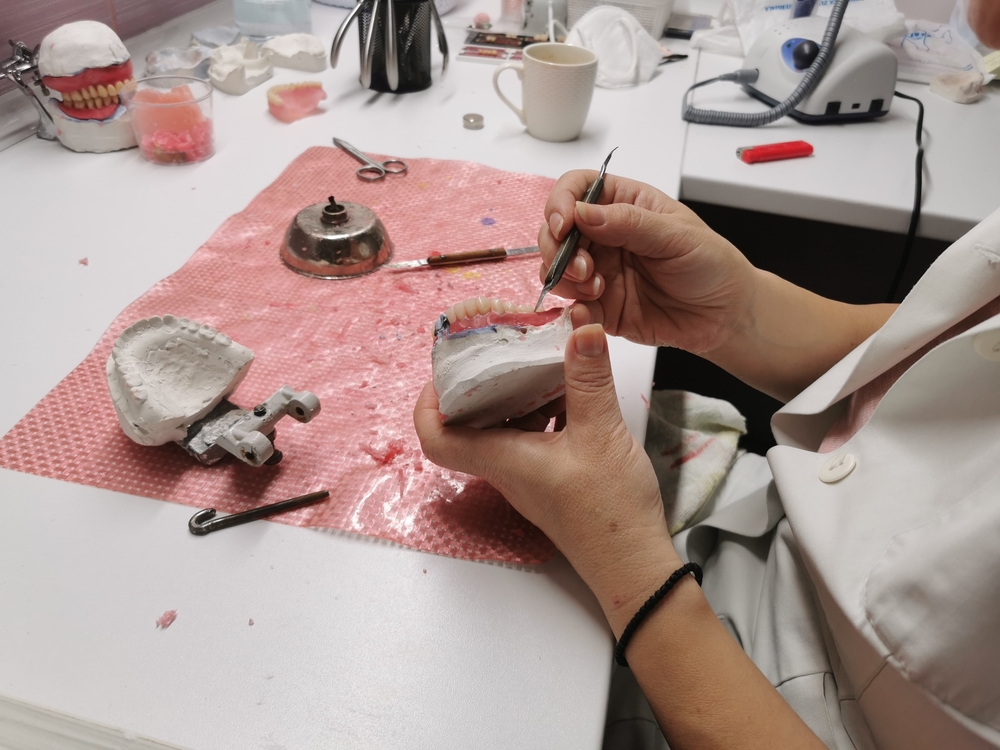
Prosthodontists focus on replacing and restoring teeth. Think dentures, crowns, bridges, implants, bite problems, worn teeth, and complex mouth repairs. The work can be slow, detailed, and repetitive, with lots of measuring, fitting, adjusting, and sending cases back and forth with dental labs.

Average pay is about $115.75 per hour. Prosthodontists complete dental school and advanced specialty training. The work stays useful because aging, tooth loss, cancer care, accidents, and long-term dental damage keep creating need. It is also a hands-on field. Scans and lab technology help, but the final fit, bite, comfort, speech, chewing, and patient expectations still need a trained human in the chair.

Discover job hunting tips, ways to earn more, and flexible working options:

Practising job interview
Image Credit: Shutterstock

21 high-paying careers that desperately need workers, but nobody wants to do them: The pay is generous, but these jobs are searching for workers.

No background check jobs: 12 background friendly jobs: If you’re struggling to find a job due to past issues, here are jobs you can get without background checks.

15 remote jobs you probably didn’t know pay $150,000+ In 2026: High income and flexible work hours from home is not a myth — here are some remote-friendly careers.

The coin jar on the dresser. The change rolled up in your grandfather’s bureau drawer. That handful of pennies you’ve been meaning to take to a machine at the grocery store. The odds that any individual coin hides a mint error worth real money are slim, but they aren’t zero, and the collector market for U.S. error coins runs deep enough that a single mistake at the federal mint has turned into life-changing money for people who knew what they were looking at.

Error coins, sometimes called misprints, cover a wide territory: blanks struck on the wrong metal, coins struck with mismatched dies, designs pressed twice at a slight angle, dies polished so aggressively that a detail got ground away entirely. The Mint catches most of these before they leave the building. Not all of them.

What separates a minor oddity from a real find comes down to how dramatic the error is, how few coins were affected, and whether you can prove it. For anything worth more than a few hundred dollars, professional grading by PCGS or NGC is non-negotiable. Fakes and altered coins are a serious problem in this space, and a certified coin in a grading service holder sells for substantially more than an identical raw example in a plastic bag.

1943 copper wheat penny

1943 copper wheat penny
Image Credit: Heritage Auctions

In 1943, the U.S. Mint switched penny production from copper to zinc-coated steel to conserve copper for the war effort. Almost every 1943 penny is silver-gray and magnetic. The exceptions are the ones struck on leftover copper planchets that hadn’t been cleared from the presses after 1942, and those are among the most valuable error coins in American history. Fewer than 30 are confirmed to exist across all three mints, with the single known Denver example standing alone as the rarest.

In average circulated condition, a 1943 copper penny from the Philadelphia Mint typically brings $100,000 to $500,000 depending on grade and provenance. The Denver example has reached seven figures in private transactions. Before you get excited: the vast majority of people who think they have one don’t. The easiest test is a magnet. A genuine copper 1943 penny won’t stick. A standard steel version will. The coin should also weigh approximately 3.1 grams, heavier than the steel at 2.7 grams. Copper-plated steel fakes are common, convincing to the eye, and worthless.

Authentication by PCGS or NGC is the only way to confirm the genuine article. No serious buyer will look at an unslabbed example at these prices, and the fakes are good enough that the very first step before any sale conversation is professional certification. The coin also needs specific reverse die markers to authenticate correctly, which the grading services verify as part of their process.

1944 steel wheat penny

1944 steel wheat penny
Image Credit: Shutterstock

The reverse of the 1943 story, and rarer. When the Mint switched back to copper in 1944, a small number of zinc-coated steel planchets left over from the prior year got fed into the presses alongside new copper blanks. The Philadelphia issue is the most common of the three mints, and “most common” here means roughly 25 to 30 confirmed examples across all grades. The San Francisco mint produced only two known examples.

Circulated examples from Philadelphia typically bring $10,000 to $75,000 depending on grade, with San Francisco examples in a category of their own at six figures. One authentication shortcut that works immediately: a genuine 1944 steel penny will stick to a magnet, while a normal 1944 copper penny won’t. Weight matters too, since steel planchets are lighter at approximately 2.7 grams versus copper’s 3.1 grams. The most common counterfeit approach is altering a 1948 penny by grinding down the 8 into a convincing 4, which is why die marker authentication matters beyond the magnet test.

Anyone claiming a 1944 steel penny needs it slabbed before the conversation goes anywhere useful. The grading services apply specific diagnostics to distinguish genuine examples from the fakes and altered coins that circulate through this market, and the value gap between certified and uncertified is enormous.

2000-P Sacagawea dollar/Washington quarter mule

2000-P Sacagawea dollar Washington quarter mule
Image Credit: Heritage Auctions

A mule is an error coin struck with dies that were never supposed to be paired together. The most famous American example has a Washington State Quarter obverse and a Sacagawea dollar reverse, both pressed onto a dollar coin planchet. It technically carries a combined face value of $1.25. The error was produced at the Philadelphia Mint during a staff changeover in 2000, and the first example surfaced in a bank roll of uncirculated dollar coins a few months after issue.

About 20 examples are known to exist, and most are now in a single private collection. Individual certified examples have sold for $125,000 to $194,000, making this among the most expensive modern U.S. errors ever offered publicly. Three distinct die pairs are recognized based on specific diagnostic marks, and attribution to a particular die pair is part of the documentation that accompanies any legitimate sale.

The coin’s story resonates with collectors partly because real examples have entered the market through ordinary channels, including circulation and bank rolls. That makes the theoretical possibility of discovery feel real, even though the actual odds are extremely low. A coin presented without recognized grading service attribution and die-pair identification will face significant skepticism from serious buyers regardless of appearance.

1969-S doubled die Lincoln cent

1969-S doubled die Lincoln cent
Image Credit: Heritage Auctions

When these coins were initially discovered in 1969, federal agents initially believed they were counterfeits because the error was so obvious. The doubling on “IN GOD WE TRUST,” “LIBERTY,” and the date is visible without magnification. It was real, produced when a working die at the San Francisco Mint was hubbed twice at a slight rotational offset. Approximately 30 examples are known across all grades, and in the decades since, individual coins have been found in rolls, in circulation, and in bank bags that hadn’t been searched.

Typical circulated examples bring $10,000 to $20,000 depending on grade. Uncirculated examples command considerably more, and the finest certified examples are in six-figure territory. What separates this from the better-known 1955 doubled die isn’t the visual drama of the error but the quantity released. Around 30 confirmed examples exist versus the roughly 24,000 that reached the public from 1955, and scarcity is almost always the dominant price driver.

Machine doubling, which mimics the look at a glance, is a common phenomenon on many Lincoln cents and worth close to nothing. On the genuine 1969-S, the doubling shows clear separation between the two images, not the flat, shelf-like effect of machine doubling. The mint mark is also not doubled on the genuine variety. If the “S” appears doubled, it’s machine doubling.

1955 doubled die Lincoln cent

1955 doubled die Lincoln cent
Image Credit: Heritage Auctions

This is the error coin that most Americans have heard of even if they don’t collect. The doubling on the date, “LIBERTY,” and “IN GOD WE TRUST” is dramatic enough to see with the naked eye, and the story of coins being discovered in cigarette vending machine change packets turned it into a household name in the hobby. About 24,000 examples were accidentally released through Philadelphia-area distribution channels, which is why the majority of surviving examples circulated before being pulled by collectors who recognized them.

Typical circulated examples in XF to AU condition bring $2,500 to $3,000. Lower-grade examples with significant wear are less, but even heavily circulated coins with legible doubling move at $1,000 or above. Uncirculated examples in full red color start in the low thousands and escalate sharply at the highest grades. The coin sits at the ideal intersection of fame and accessibility: rare enough to command real money, common enough that the market stays liquid and prices are well established.

Fakes are a significant and documented concern. One diagnostic specific to all genuine examples: vertical die polishing lines appear to the left of the letter “T” in ONE CENT on the reverse. Any coin without those lines needs serious scrutiny before purchase. Professional authentication is mandatory before any sale at these prices.

1937-D three-legged Buffalo nickel

1937-D three-legged Buffalo nickel
Image Credit: Heritage Auctions

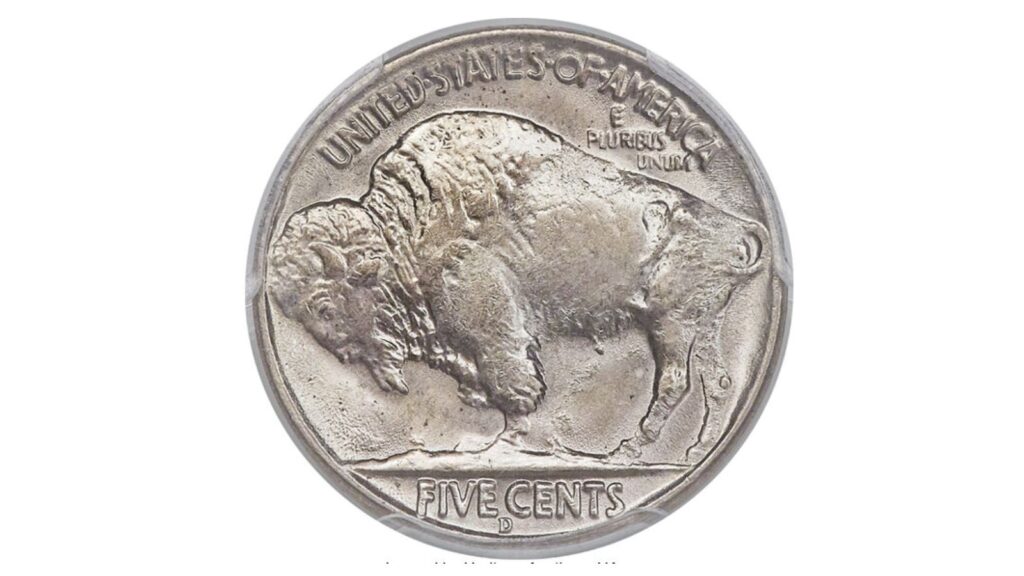
The name is slightly misleading because the Denver Mint didn’t design a three-legged bison. A worn reverse die developed clash marks, and whoever polished it to remove them went too far, grinding away almost the entire front right foreleg of the animal. The hoof remains, which makes the error look odder the more carefully you examine it. All genuine examples come from a single die, and the surviving population is estimated at roughly 10,000 pieces in all grades combined.

Circulated examples in VF to XF condition typically bring $800 to $1,500, with nicer about-uncirculated examples pushing toward $2,500 or higher. Mint state pieces are genuinely scarce and expensive. A specific authentication risk: some normal 1937-D nickels have had the leg filed off to create a counterfeit three-legger. The primary diagnostic on genuine examples is a faint horizontal line running beneath the bison’s belly, what specialists call the “stream,” visible on every authentic piece. No stream, significant doubt.

Many genuine examples show deep rust pitting across the surfaces, a result of the badly worn die condition at the time of striking. Moderate pitting is typical for the variety and doesn’t signal damage. Cleaning, however, collapses value substantially, and any example that looks unnaturally bright or polished should be viewed with skepticism.

1972 doubled die Lincoln cent (type 1)

Front and back of the 1972 doubled die obverse Lincoln Memorial cent. 15 coins worth money in 2024: Do you have any at your house?
Credit: USA Coin Book

About ten different doubled die varieties are documented for 1972 Lincoln cents, but only the Type 1 is considered a major variety. The doubling shifts southwest across the date, “IN GOD WE TRUST,” and “LIBERTY” and is clearly visible to the naked eye. It was catalogued in the standard reference guides as soon as it was identified. A few thousand examples are estimated to exist, making this the most accessible of the major Lincoln cent doubled dies by sheer supply.

Circulated examples bring $200 to $400, with choice uncirculated examples in the $1,500 range and top-grade certified pieces reaching several thousand. The southwesterly shift in doubling on the Type 1 is distinct enough from machine doubling that most collectors can learn to recognize it with a loupe and a few comparison examples. Machine doubling shows a flat, shelf-like appearance on the doubled portion; genuine hub doubling shows clear separation between the primary and secondary images with visible depth between them.

Because multiple 1972 doubled die types exist and carry different premiums, variety attribution on any grading service holder matters when you’re buying or selling. Type 1 is the one the market pursues.

1942/1 Mercury dime overdate

1942-1 Mercury dime overdate
Image Credit: Heritage Auctions

Overdates happen when a die receives impressions from two different date hubs, one on top of the other. On the 1942/1 Mercury dime, a 1941 hub was used to begin a working die before the 1942 hub was applied over it. What remains is a “1” clearly visible on the left side of the “2” in the date, and doubling in the middle digits visible with a decent loupe. The error happened simultaneously at Philadelphia and Denver in late 1941 when dies for both years were being produced side by side and some blanks got switched between hubs.

About 3,600 Philadelphia examples and 3,200 Denver examples are estimated to survive. In average circulated grades, both bring $400 to $700, with Denver commanding a modest premium in uncirculated grades. Uncirculated examples with Full Split Bands on the torch reverse push considerably higher, with MS63 examples bringing $2,750 to $3,000 depending on the mint. The silver content keeps the floor price from falling too far, but it’s the collector premium that makes it worth hunting.

To check for the variety: look at the left side of the “2” in the date with a 5x loupe. The undertype “1” should be clearly visible. Doubling at the base of the “4” is a secondary marker. Both should be present on a genuine example.

2004-D Wisconsin state quarter extra leaf

Front and back of the 2004 Wisconsin State Quarter extra leaf. 15 coins worth money in 2024: Do you have any at your house? Visit this link.
Credit: USA Coin Book

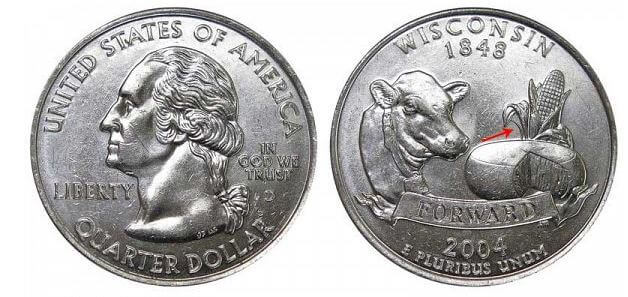
This one lives somewhere between a die variety and a genuine minting accident, and the hobby has been arguing about it for years. The corn stalk on the Wisconsin quarter’s reverse acquired an extra leaf on a small number of Denver Mint dies, pointing either up (high leaf) or down (low leaf). Because both varieties appeared on different dies at the same location on the design, some specialists have suggested the extra leaves may have been deliberately cut by someone at the Denver facility. The Mint has never confirmed anything either way.

The high leaf version is slightly scarcer and typically brings $100 to $300 in typical circulated and lower uncirculated grades, with certified high-grade examples reaching more. The low leaf is more common and sells in the $75 to $150 range for standard grades. Peak certified sales for exceptional examples have reached several thousand dollars. These quarters still surface in rolls and $1 coin bins, which makes them a genuinely accessible entry point into state quarter error collecting.

The error exists only on Denver-minted examples. The extra leaf sits below the large main leaf on the left side of the corn stalk. Philadelphia 2004 Wisconsin quarters do not have this variety.

1982 no-P Roosevelt dime

1982 no-P Roosevelt dime
Image Credit: Heritage Auctions

In 1980, the Philadelphia Mint began adding a “P” mint mark to all its coins for the first time in the denomination’s history. Before that, Philadelphia coins carried no mark. So a 1982 Roosevelt dime missing the “P” was immediately identifiable as wrong when the first examples surfaced near Sandusky, Ohio, where a regional distribution point had received them. An estimated 10,000 or so reached circulation, all produced from a die that was never punched with the required mint mark.

Typical examples in MS65 condition bring $200 to $400, with higher grades pushing toward $600 to $700 and the finest certified examples reaching $2,000 or above. The coin is still theoretically findable in circulation, though the chance of encountering one without specifically searching is low. The identification takes five seconds: look at the right side of the date on a 1982 Roosevelt dime. A Philadelphia coin from any other year in the modern era carries a “P.” One without any letter is the error.

The variety comes in two strengths based on how far the die was from being properly punched. Both Strong and Weak versions are valuable. One practical concern for collectors: a heavily worn “P” is different from a genuinely missing one, and if the letter looks faint rather than absent, it may not be the error. Certified attribution from PCGS or NGC removes that ambiguity.

11. 1983 copper Lincoln cent

Every 1983 Lincoln cent is supposed to be struck on copper-plated zinc. The Mint had completed the composition change mid-year in 1982, and by 1983 the old 95% copper planchets should have been gone entirely. A very small number weren’t. Whether leftover copper blanks from 1982 sat undetected in a hopper, or whether they came from the Philadelphia Mint’s simultaneous contract work striking Belgian coins on similar planchets, a handful of 1983 cents ended up struck on solid copper.

The visual difference between copper and copper-plated zinc is unreliable, so the weight test is the first diagnostic: genuine copper planchets weigh 3.11 grams versus 2.50 grams for the zinc version. A calibrated digital scale is the tool. Any 1983 cent hitting 3.1 grams or above is worth submitting to PCGS or NGC immediately. Certified examples have sold from $5,000 for circulated grades to $29,250 for the finest known example in MS65 Red condition. The total authenticated population remains very small, meaning new discoveries continue to matter.

Do not clean any suspected example. The original copper surface condition affects both grade and authenticity determination. The test takes thirty seconds. If you have a jar of old pennies, this is worth running.

12. 1995 doubled die Lincoln cent

The most accessible of the major Lincoln cent doubled dies, and the last one that will ever be produced. The Mint switched to single-hub production in the late 1990s, a process that eliminated this error type from the production line entirely. The 1995 Philadelphia version is the final chapter in a series of major doubled dies stretching back to 1909. The doubling on “IN GOD WE TRUST” is visible to the naked eye, and hundreds of thousands of examples are estimated to exist across multiple dies, which keeps prices within reach of ordinary collectors.

Circulated finds typically bring $20 to $40, and uncirculated examples in MS65 red condition sell in the $35 to $55 range. The Denver version is a different story: approximately 100 examples are known, it wasn’t discovered until years after the Philadelphia version, and it sells for hundreds of dollars even in circulated grades. On any roll of 1995 cents, if you find one with clear doubling on the motto, check the mint mark before assuming it’s the common version. A “D” changes the conversation significantly.

These coins are still found in change occasionally, making the 1995 DDO one of the few classic Lincoln cent errors where a pocket change discovery remains within the realm of possibility.

13. 1999 Wide AM Lincoln cent

A production mistake where a proof reverse die, intended exclusively for collector sets, was accidentally loaded into a press striking regular circulation coins. The difference shows in the spacing between the “A” and “M” in “AMERICA” on the reverse. On standard 1999 cents, those letters nearly touch. On the Wide AM version, there’s a distinct visible gap between them that matches the proof die spacing, which was never supposed to appear on a business strike.

The 1999 version is the scarcest of three recognized Wide AM dates, with 1998 and 2000 also carrying the same error. Circulated examples of the 1999 bring $100 or more, with uncirculated grades in MS66 and above pushing into the low thousands. The 2000 version is far more common and brings much less. To identify it: look at the “AM” in AMERICA on the reverse under a loupe. The gap between the letters should be obviously wider than on a standard cent from the same era. A secondary check is the designer’s initials “FG” on the reverse, which sit further from the Lincoln Memorial building on the Wide AM die.

These coins are still in circulation, which means roll searching with a loupe remains a legitimate approach for finding them.

14. 2007 presidential dollar missing edge lettering

Starting in 2007, the Mint moved the date, mint mark, “IN GOD WE TRUST,” and “E PLURIBUS UNUM” from the face of the coin to the edge of the new Presidential dollar series. That was also the year the Mint discovered that tens of thousands of coins were leaving the edge-lettering machine without going through it at all. The first release, the George Washington dollar, produced the largest number of missing-edge-lettering errors.

The 2007 Washington version is common enough that certified examples typically bring $50 to $100 and sometimes less. The interesting side of this error is which president and which year: some later releases in the series are substantially scarcer, with certain 2009 and 2010 issues bringing several hundred dollars or more in certified condition. The same error type affected all four annual releases through at least 2010, and populations vary significantly by president and mint.

The identification is immediate. Hold the coin up and examine the edge. A genuine missing-edge-lettering example has a completely smooth, blank edge with no text and no ornamentation. Coins with even partial or faint lettering are different, less valuable varieties. These still turn up at coin shows in $1 bins, making them one of the few modern Presidential dollar errors with genuine accessibility.

15. Off-center Lincoln cent (40% to 60% off center, date visible)

The most broadly accessible category in U.S. error coin collecting, and a genuine entry point for anyone starting out. Off-center strikes happen when a planchet doesn’t seat properly between the dies before the press fires, leaving a crescent-shaped blank area and compressing the struck design into a smaller portion of the coin. The results range from barely noticeable, worth almost nothing, to dramatic, with the design crammed onto one side and nearly half the coin blank.

For Lincoln Memorial cents from the 1960s through 2001, a coin that’s 40% to 60% off center with the date clearly visible typically brings $50 to $200 in average condition, with uncirculated examples and cleaner strikes bringing more. The date has to be visible for the coin to be properly attributed and sold at full value. A heavily off-center coin without a date is worth significantly less. The larger the denomination, the scarcer the off-center error and the higher the premium for equivalent quality. A similarly off-center Kennedy half dollar or Eisenhower dollar is worth several times the equivalent cent.

One thing to verify before assuming you have one: post-mint damage can look superficially like an off-center strike. Genuine off-center coins have a smooth, clean blank crescent where the metal flowed naturally outward from the struck portion. Damage from a vise or press shows different surface characteristics, usually with irregular tool marks or distorted design elements on the struck side.

If the coin market for errors is new to you, off-center strikes are where most collectors start, and for good reason: the errors are visually obvious, they’re affordable enough to build a real collection, and they still surface at coin shows and in estate lots with enough regularity that the hunt stays interesting.

You log into your Social Security account and check your estimated benefit. It’s lower than you expected, maybe quite a bit lower. You worked for 26 years, took time off when the kids were small, figured that would be fine. It is not a mistake.

Social Security doesn’t calculate your benefit based on your last paycheck, your best decade, or even your career average. Your benefit amount is based on your 35 highest-earning years, adjusted for inflation, averaged together, and run through a formula to produce a monthly payment. If you have fewer than 35 years of earnings on record, each missing year gets a zero. Those zeros are averaged in like any other year, pulling your monthly check down permanently.

The average retired worker collected $2,071 a month in January 2026. A few gaps make more difference than most people expect.

How the 35-year formula actually works

retired couple working out finances on computer
Image Credit: Shutterstock

The Social Security Administration takes every year of your earnings, adjusts each one upward to account for wage growth over time (a process called indexing), then picks the 35 best years. It adds those 35 years together and divides by 420, which is the number of months in 35 years. The result is called your Average Indexed Monthly Earnings, or AIME.

If you only worked 28 years, the formula doesn’t divide by 336 months. It still divides by 420. Your seven missing years are assigned zeros, those zeros are added to your real earnings, and the whole sum is divided by 420. You are being averaged over a longer window than you actually worked, which is what drives the benefit down.

Your AIME then gets fed into a formula that applies different percentages to different income tiers. In 2026, the first $1,286 of monthly AIME is replaced at 90 cents on the dollar. Earnings between $1,286 and $7,749 are replaced at 32 cents. Anything above $7,749 earns only 15 cents. Add those amounts together and you get your Primary Insurance Amount, which is the benefit you’d receive at full retirement age. The maximum possible benefit in 2026 is $4,152 at full retirement age, or $5,181 for those who wait until 70, but reaching that requires 35 years of maximum earnings.

Who ends up with the gaps

older person alone worried at the computer
Image Credit: Shutterstock

Women are disproportionately affected. Careers interrupted by caregiving, time at home with children, or following a spouse through job relocations show up as literal zeros in the earnings record. A worker who spent six years out of the workforce to raise children and another three working part-time has up to nine low or zero years dragging down her average.

Late starters run into the same problem from a different angle. Someone who went through graduate school and didn’t enter the workforce until 27 or 28 may simply not reach 35 full working years before a typical retirement age. A career that begins at 28 and ends at 62 covers 34 years. One short, and it shows in the math.

Job losses, serious illness, periods of unpaid caregiving for aging parents, and time spent on disability before qualifying for SSDI are all common sources of gaps. The formula doesn’t distinguish between a zero year because you chose not to work and a zero year because you couldn’t. Both count the same way.

More years of work directly improves the math

senior people with calculator
Image Credit: Shutterstock

More work years solve the zero-year problem directly, and you do not need 35 consecutive years to get there. Returning to work after a gap fills in zeros and raises your AIME. A single year of part-time work in your early 60s can replace one of those zeros and push your monthly benefit up for the rest of your life.

Self-employment counts, as long as you file a Schedule SE and pay the 12.4 percent Social Security tax on your net earnings. Cash income that isn’t reported doesn’t go into your earnings record and doesn’t help your benefit. For self-employed workers, this is worth paying attention to, because underpaying or skipping that tax in a given year creates a zero just as effectively as not working at all.

The math works differently once you already have 35 years of earnings on record. At that point, each additional work year can only improve your average if the new year outearns your existing lowest year, which it often does for people still working at peak salary. But if you’re still filling in zeros, any new year of positive earnings provides a direct lift.

Your earnings record may have mistakes in it

working out new wages in 2026
Image Credit: Shutterstock

Social Security calculates your benefit from wages your employers reported, and that record is not always accurate. Employer reporting errors, name changes after marriage or divorce that were never updated with the SSA, periods of self-employment where taxes weren’t filed, and plain data entry mistakes can all create gaps in the record that lower your benefit without you knowing.

You can check your full earnings history by creating a free account at SSA.gov and reviewing your Social Security statement. Look for years where you know you worked but the record shows $0 or an amount that seems obviously too low. This is worth doing every few years, not just when you’re close to retirement, because errors are easier to correct when documentation still exists.

If you find a discrepancy, you’ll need proof. W-2 forms, pay stubs, and tax returns are the standard documentation. IRS tax transcripts can cover self-employment income. Corrections made closer to the year of the error are usually smoother, but older corrections are still possible in many cases. The SSA has a correction request process and can be reached by phone or in person if you can’t resolve it through your online account.

A spousal or divorced spouse benefit can fill a thin record

divorce
Image Credit: Freepik

If your own benefit is low because of a limited earnings history, and you are married or were married for at least 10 years, a spousal benefit is worth understanding before you file. A spouse who waits until full retirement age is entitled to up to 50 percent of the higher earner’s Primary Insurance Amount. If your own monthly benefit would be $700 and 50 percent of your partner’s PIA comes to $1,100, Social Security pays $1,100. You don’t receive both; the system compares and pays the higher amount automatically.

Claiming the spousal benefit before full retirement age reduces it. At 62, the earliest you can claim, a spousal benefit is reduced to 32.5 percent of the worker’s PIA. The spousal benefit also does not grow with delayed retirement credits the way your own earned benefit does, so there’s no advantage to waiting past full retirement age on the spousal side.

Divorced spouses qualify under the same rules if the marriage lasted at least 10 years, you have not remarried, and you are at least 62. If you have been divorced for at least two years, you can file even if your ex has not claimed benefits yet. Claiming a divorced spouse benefit has no effect on your former partner’s own benefit amount.

Delaying when you claim amplifies whatever benefit you’ve built

older couple looking at social security
Image Credit: Shutterstock

If your benefit is smaller because of gaps in your record, one way to partly offset that is to delay claiming. For every year you wait past your full retirement age, your benefit grows by 8 percent, up to age 70. Full retirement age is 67 for anyone born in 1960 or later. Waiting until 70 instead of claiming at 67 produces a benefit that is 24 percent higher for the rest of your life.

That increase applies to whatever base benefit you have built, including a reduced one. If your PIA is $1,200 at full retirement age, claiming at 70 instead of 67 brings it to about $1,488 a month. Over a 20-year retirement, the difference is more than $68,000. The tradeoff is that you receive no checks during those three extra years of waiting, so the calculation depends on your health and how long you expect to collect.

There is no benefit to waiting past 70. Delayed retirement credits stop accumulating at that point regardless of how long you continue to work.

A 2025 law changed Social Security for millions of public sector workers

couple looking on laptop at social security rules
Image Credit: Shutterstock

If you spent part of your career working for a state or local government employer that did not withhold Social Security taxes, this matters. Teachers, police officers, and firefighters in many states fall into this category. For decades, two rules called the Windfall Elimination Provision (WEP) and the Government Pension Offset (GPO) reduced or eliminated Social Security benefits for workers who also received a pension from one of those non-covered jobs. The WEP was particularly punishing for people with mixed careers, since it reduced the 90 percent replacement rate in the lowest income tier of the benefit formula.

The Social Security Fairness Act, signed into law on January 5, 2025, repealed both provisions, effective retroactively to January 2024. The SSA distributed more than $17 billion in retroactive payments to over 3.1 million affected beneficiaries by mid-2025. If your monthly benefit was being reduced by WEP or GPO, those adjustments should have already taken effect. If you never applied for Social Security because the WEP or GPO reduction made it seem not worth pursuing, filing now may produce a benefit you weren’t expecting to have.

Not every teacher or public employee is affected. About 72 percent of state and local government workers are in Social Security-covered positions and paid into the system normally. The change only applies if your pension comes from a job where Social Security taxes were not withheld.

The 35-year rule is not changing, and its effects on any individual depend on what the earnings record actually shows and what options are still on the table. Both are worth checking well before you file.

Learn how to stretch your retirement savings and maximize your Social Security benefits for a comfortable retirement:

planning for retirement
Image Credit: Shutterstock

18 ways to stretch your retirement savings without feeling poor: The goal isn’t to pinch every penny — it’s to protect the big stuff and trim quiet leaks. Here are simple moves that keep freedom high and stress low.

18 budgeting rules that actually work for people over 50: Money habits change as we age. In this post, discover budgeting rules that fit your income and shift of priorities when you’re over 50.

15 clever strategies to maximize your Social Security benefits: Use the facts in this post to make choices that raise your monthly check for years.

You find it in a shoebox under a bed or at the back of a closet shelf: a palm-sized plastic compact in pink or purple, hinged in the middle, with a logo stamped on the bottom that says Bluebird Toys. Whatever you do next, don’t donate it before checking what’s inside and what year it was made. The Bluebird-era Polly Pocket collector market has grown sharply over the past few years, and some individual sets are worth hundreds of dollars in good condition. A handful are worth thousands.

The split that matters for value runs through 1998, when Mattel acquired Bluebird Toys and redesigned the line completely. The original dolls were under an inch tall and snapped into the compact itself. Mattel’s redesign made them bigger, gave them removable clothes, and eventually embedded magnets in their hands and feet before recalling over four million sets in 2006 due to injury reports from swallowed magnets. The tiny original format was gone. The date stamped on the underside of any compact places it on one side of that line or the other. Bluebird pieces from 1989 to 1998 are what collectors want. Most post-1998 Mattel product carries no meaningful premium.

Within the Bluebird era, price comes down to three things: completeness, condition of the case, and whether any lights still work. A set with its original figures, accessories, and functioning light-up feature is worth several times what a stripped or broken example brings. The case itself matters too: hinges crack, exterior paint fades, and a compact that doesn’t close flat anymore loses value fast.

1992 Babysitting Stamper compact (Bluebird)

1992 Babysitting Stamper compact
Image Credit: Gold-Collectors via eBay

The Babysitting Stamper is one of the more entertaining pieces Bluebird made, and for collectors, it’s one of the more valuable accessible sets. The compact opens to reveal a babysitting scene with a doll, three babies, a teddy bear, and a bicycle. What makes it distinct from a standard compact is the stamping mechanism on the exterior: colored ink pads and small stamps that let kids print figures onto paper. The stamps are small enough to fit in one hand, and the whole thing folds shut.

What drives value here is whether the stamping mechanism still works. Sets with functioning, non-dried ink pads are worth substantially more than sets where the ink is long gone. A complete example with working stamps and all figures brings $60 to $150. Incomplete sets or those with dead ink pads trade for much less. The compact itself should close cleanly and show no cracking on the exterior.

The Babysitting Stamper also appeared in a lot alongside the 1992 Starlight Castle in many collection sales, suggesting both were popular in the same era and both have active collector interest. If you have the stamper and are uncertain about the ink, test it gently on paper before listing it. Working ink is the single biggest differentiator on price.

1993 Seashine Mermaid Locket (Bluebird)

1993 Seashine Mermaid Locket
Image Credit: pollypocketpalace via eBay

Bluebird produced a range of wearable playsets in the early 1990s, including lockets and ring cases that functioned as both jewelry and tiny compact scenes. The Seashine Mermaid Locket from 1993 is one of the most recognizable in the category: a gold-colored clamshell locket on a cord that opens to reveal a mermaid figure with a teal metallic tail, a seabed interior, and a small window where the owner could place a photograph.

Complete examples with the original mermaid figure, cord, and interior intact bring $50 to $90. The cord is the piece most often missing or replaced; an original cord in good condition is worth noting in any listing. Light scratches on the gold-colored exterior are expected and don’t significantly reduce value, but a broken hinge or missing photo window frame does. The mermaid figure itself should be present and undamaged: small as it is, a missing or broken doll cuts the value substantially.

The locket category broadly is one of the more accessible entry points for Bluebird collectors. Sets like the Seashine Mermaid and the Stardream Dangling Earrings set were designed to be worn, which means many were lost or damaged in childhood use. Complete, intact examples in reasonable condition are not hard to find but are appreciated. Sealed or new-in-package examples are genuinely rare and worth significantly more.

1992 Starlight Castle light-up compact (Bluebird)

1992 Starlight Castle light up compact
Image Credit:
thethriftyfoxshop via eBay

The Starlight Castle is a pink heart-shaped compact from 1992, one of the first light-up sets Bluebird produced. It opens to reveal a miniature castle interior with a prince and princess figure, a horse and carriage, and a swan. The light-up feature is central: the castle interior illuminates and the moon and stars on the upper panel glow when the lid opens in a darkened room. It was one of the more elaborate and visually impressive sets of the early Bluebird catalog, and collectors treat it that way.

Complete examples with all original figures, the horse, carriage, and swan, and working lights bring $80 to $150. The horse and carriage are the pieces most commonly lost, so verify they are present before assuming you have a complete set. Light functionality matters here more than on most sets: the whole design is built around the illumination, and a compact where the lights no longer work is less desirable regardless of condition.

Sealed or mint-in-box examples push toward $300 and above. The Starlight Castle was relaunched in updated form by Mattel in 2021 as part of their Keepsake Collection, so buyers should confirm the year stamped on the underside of the compact. The 1992 Bluebird original is what the collector market values. The Mattel remake is not.

1993 Fairy Light Wonderland (Bluebird)

1993 Fairy Light Wonderland
Image Credit: pollypocketpalace via eBay

The Fairy Light Wonderland takes the light-up concept further than the Starlight Castle. The compact is shaped like a pink star case with a star-shaped interior ballroom. Three fairy figures are included. When the lid opens in the dark, tiny lights illuminate the ballroom floor and walls in a way that was genuinely impressive for a toy the size of a makeup compact. Bluebird called it the Fairylight Ball and marketed it around the idea of Polly’s fairy friends dancing in a glowing room.

What matters most for value is whether the lights work and whether all three fairy figures are present. Working-light complete examples in good condition bring $80 to $175. Non-working light examples or sets missing figures trade for significantly less, often well under $50. The star-shaped case is visually distinctive and the exterior paint can fade with sun exposure, which reduces value further. If you have the original outer packaging too, value increases substantially: the box identifies the set clearly and adds to the collectibility.

Mint or near-mint examples in original packaging, where the lights are confirmed working and figures are undamaged, have sold for $300 and above. The light mechanism runs on small batteries and should be tested before sale. If the lights don’t work and the battery compartment is free of corrosion, the issue is often just a dead battery rather than a failed mechanism, which is worth checking before writing it off.

1994 light-up Magical Mansion, Pollyville (Bluebird)

1994 light up Magical Mansion
Image Credit: B&B Heirlooms via eBay

By 1994, Bluebird had shifted part of the line toward larger, freestanding structures called Pollyville sets rather than palm-sized compacts. The Magical Mansion is the most elaborate piece in that format: a multi-level purple and dark pink mansion with a spinning dance floor, a stable, a pool patio, a rooftop garden, and a garage whose mechanism ejects the car when you press a bush next to the tree. Three dolls are original to the set, along with a small car. The ballroom and tanning area also light up.

Complete working examples with all three original dolls, the car, flags, and functional lights bring $100 to $250. The flags are the most commonly missing element: each turret had a small plastic flag that was easy to lose. A missing flag is noted in most listings and dents the value slightly but not catastrophically. A missing doll or non-working light feature is a more significant deduction. Any crack in the purple casing reduces value substantially.

It’s worth noting that this is a Pollyville piece, not a standard compact. It doesn’t close or fold. It’s a small dollhouse designed to sit on a shelf or table, which means storage and display were easier than for the tiny compacts, and clean surviving examples are relatively more common than for some other sets from the same period.

1995 Bluebird Disney Beauty and the Beast compact

1995 Bluebird Disney Beauty and the Beast compact
Image Credit: Vintage Classic Solutions via eBay

Starting in the mid-1990s, Bluebird produced a series of Disney-licensed compacts featuring characters from the studio’s animated films. These sets are among the most actively sought in the Bluebird catalog. The Beauty and the Beast compact from 1995 is one of the signature pieces in that series. Belle and the Beast are the central figures, along with additional characters and furniture; the Beast figure has a magnetic feature that allows Belle to move around the castle interior. The exterior of the compact is illustrated with scenes from the film.

Complete examples with all original characters and working magnetic function bring $350 to $600. Condition of the exterior illustration matters as much as completeness: the printed imagery fades and chips with heavy play, and a case with badly faded art is worth noticeably less than a bright clean one. The magnetic mechanism should be tested if possible, as a non-functioning one is a clear deduction.

New or sealed examples push considerably higher. Buyers should be aware that later Mattel-era Disney Polly Pocket pieces also exist and are not the same thing. Bluebird Disney sets are stamped with the Bluebird Toys name on the base and were made between approximately 1994 and 1998. The Mattel-era versions that followed the 1998 acquisition are made to a different scale and carry no collector premium.

1995 Bluebird light-up Children’s Hospital

1995 Bluebird light up Children Hospital
Image Credit: pollymart via eBay

The Children’s Hospital is among the rarest and most discussed sets in the Bluebird catalog. It was produced in 1995 in a compact roughly four inches square that opens to reveal three complete floors: a reception and examination area on the ground level, a nursery with scale and crib on the second, and a rooftop garden and play area at the top. There is also a ramp, an elevator, and a wheelchair. Polly can function as a full-time pediatric health system in approximately 1.5 square inches.

Because of the complexity of the set and the number of small accessories, complete surviving examples are genuinely uncommon. Average used complete examples bring around $250 to $400. Exceptional examples in near-mint condition, particularly with original packaging, have sold for considerably more. What matters most is that all small accessories are present: the wheelchair, the scale, the rooftop garden furniture. Missing even one or two pieces drops the price noticeably. Light functionality is a secondary but relevant factor: the hospital has a light-up feature and working examples are more desirable.

This is a set where a serious collector will pay a premium for a truly complete, unplayed example. If you have one in exceptional condition, it’s worth getting a second price opinion before pricing it as a standard used find.

1996 Disney Alice in Wonderland, Tiny Collection (Bluebird)

1996 Disney Alice in Wonderland Tiny Collection
Image Credit: pollypocketpalace via eBay

The Disney Alice in Wonderland compact from 1996 is the most sought-after individual Disney Bluebird set. It is shaped like the White Rabbit’s house and opens to reveal a wonderland interior with Alice, the White Rabbit, the Mad Hatter, and the Queen of Hearts figures, along with a tea party table and chairs and two small flip-up playing cards. The exterior detailing is meticulous. It was produced as part of the “Tiny Collection” format, which used a somewhat smaller scale than standard Bluebird compacts.

Used complete examples with all figures and accessories in clean, undamaged condition bring $400 to $700. The Alice figure is the most essential; a set missing Alice is missing its centerpiece. Both playing cards should be present, as small card-shaped accessories are easily lost. Sticker detailing on the exterior chips and peels over time, and a compact with clean intact stickers is worth noticeably more than one showing heavy wear. New or sealed examples have sold for $2,000 to $3,000. There is also a rare white variant of the compact exterior that brings a premium over the standard version.

Bluebird made Disney Alice in Wonderland in multiple formats across several years. The 1996 Tiny Collection version is the one the collector market focuses on. Check the underside of the compact for the year and confirm the Bluebird Toys mark before pricing any Alice set.

1995 Pollyville Supersets (Bluebird)

1995 Pollyville Supersets
Image Credit: Adorkable via eBay

By 1995, Bluebird was selling Pollyville sets as multi-structure gift sets called Supersets, bundling several individual buildings into a single package. The 1995 Supersets each included multiple freestanding Pollyville structures with figurines, small vehicles, and accessories across all of them. These are substantial collections in their original state: the more complete versions included a mansion, clubhouse, hotel, stables, and additional buildings along with more than a dozen figurines. They were originally priced as premium gift sets and are now treated the same way by collectors.

Complete used Supersets in good condition with most or all original structures and figures bring $500 to $800. The light-up structures within any Superset should ideally have working battery compartments with no corrosion. A Superset missing more than one or two buildings is a significantly reduced find. Sealed or near-mint boxed examples are exceptional: a two-set Pollyville Weekend configuration in original sealed packaging has sold for over $2,200. The difference between a played-with lot and an untouched gift set is the largest pricing gap in this entire category.

Storage is a practical issue with these. They are large relative to standard compacts and individual Pollyville buildings, and many owners dispersed them into separate pieces over time. If you have all the original structures together, that provenance matters and is worth documenting when selling.

1996 Partytime Stampers Special Edition (Bluebird)

1996 Partytime Stampers Special Edition
Image Credit: pollymart via eBay

The Partytime Stampers Special Edition is a birthday-themed stamper set from 1996 that combines Bluebird’s birthday compact format with a full set of stampers, ink pads, and stationery cards. Like the Babysitting Stamper it builds on, the appeal to collectors lies in the combined completeness: the compact, all stamps, all ink pads in working condition, and the original stationery. The “Special Edition” designation marks it as a limited release, which is exactly what has driven prices upward.

Used complete examples with functional ink bring $150 to $300. The stationery cards are almost always missing from played-with examples, and their presence makes a significant difference to serious collectors. New-in-package examples are rare and have sold for over $2,000. As with all stamper sets, the working condition of the ink pads is the central pricing variable: dried pads substantially reduce value, while fresh or functional ink is a meaningful positive detail worth calling out clearly in any listing.

It is worth noting that the standard 1989 Partytime Surprise compact is different from this set and considerably more common. The 1996 Special Edition is what commands the premium prices. The year stamped on the underside confirms which version you have. If you find a set in original packaging with all contents intact, photograph everything before touching anything.

Ninety dollars an hour doesn’t usually come attached to a job you’d describe at a dinner party. The roles on this list are heavy on checklists, compliance documents, risk registers, and detail work that makes most people’s eyes glaze over. That’s not a coincidence.

Companies struggle to fill these jobs because they need people who can sit inside complexity for years without needing it to be exciting. The person who can read a 40-page plan document, flag what’s wrong, and defend it in a meeting is genuinely hard to find. That scarcity shows up in the pay.

All 18 roles sit at or above $90 an hour. Most require experience, and a few require credentials or licensing. None are shortcuts. But if you’re already working in finance, HR, law, IT, or healthcare, some of these may be closer than you think.

1. Patent prosecution attorney

Patent prosecution attorney
Image Credit: Getty Images via Unsplash

Patent prosecution attorneys spend their days writing and revising patent applications, answering examiner questions, and arguing over very specific wording. It is dry work. You may read drawings, invention notes, technical reports, and long rejection letters for hours before changing a few lines that matter.

The pay can make the grind worth it. A patent prosecution attorney IV earns about $96 per hour. Employers need this role in medical devices, software, manufacturing, semiconductors, clean energy, and biotech. You usually need a science or engineering background, law school, bar admission, and patent bar registration. Software can help search and draft, but companies still need a licensed person who understands invention risk, legal wording, and business stakes.

2. Government contracts attorney

Government contracts attorney
Image Credit: Getty Images via Unsplash

Government contracts attorneys deal with bid protests, contract clauses, compliance files, pricing rules, subcontractor disputes, and endless agency paperwork. The job is not glamorous. A lot of it is reading dense language and telling a company whether one sentence creates a major problem.

Experienced lawyers in this pay tier can make around $104.50 per hour at the upper end of the national wage range. This work is steady because contractors, hospitals, defense firms, construction companies, and technology vendors keep selling to public agencies. The path usually starts with law school and bar admission, then contract, procurement, litigation, or compliance experience. The work is hard to automate because every contract has facts, deadlines, people, and risk behind it.

3. General dentist

dentist showing patient an xray
Image Credit: Shutterstock

General dentistry is often repetitive by design. Dentists examine teeth, fill cavities, treat gum problems, read X-rays, numb patients, check crowns, and explain the same home-care basics over and over. It is careful hand work, patient talk, chart notes, and small decisions all day long.

Average pay for general dentists is about $95 per hour. Demand is steady because people still need exams, fillings, dentures, crowns, infection care, and pain relief. The job requires dental school and a license, and many dentists work in private practices, community clinics, dental groups, or public health settings. Technology can improve imaging and records, but a human dentist still has to diagnose, treat, reassure patients, and do the physical work inside someone’s mouth.

4. Prosthodontist

Prosthodontist
Image Credit: Shutterstock

Prosthodontists focus on crowns, bridges, dentures, implants, bite problems, and rebuilding damaged teeth. That may sound specialized, but the day-to-day work is often slow and exact. It means impressions, measurements, lab slips, shade matching, bite checks, and small adjustments until something fits right.

Average pay is about $95 per hour. Demand is supported by aging adults, damaged teeth, cancer recovery, accidents, and patients who need complex restoration rather than a simple filling. The path is long: dental school, licensure, and specialty residency. This is not work that gets handed to a machine, because fit, pain, speech, chewing, facial structure, and patient trust all matter. Employers include specialty practices, dental schools, hospitals, and large dental groups.

5. Airline captain on routine passenger or cargo routes

non commercial airline pilot
Image Credit: Shutterstock

Airline captains get the title, but much of the job is routine. They review weather, fuel, maintenance logs, route changes, checklists, crew briefings, and procedures. On many days, the job is less adventure and more doing the same safety steps exactly right every time.

Median pay for airline pilots, copilots, and flight engineers is about $226,600 a year, which places many experienced captains in the $90 to $110 per hour neighborhood. Employers need pilots for passenger airlines, cargo carriers, charter operations, and corporate aviation. The path requires flight training, ratings, medical exams, flight hours, and years of lower-paid experience first. Planes have advanced systems, but regulators, insurers, airlines, and passengers still require trained humans responsible for judgment and safety.

6. Air traffic controller

air traffic controller
Image credit: CreativeDesign295 via Freepik

Air traffic control can be intense, but the actual work is built on repetition. Controllers watch screens, track aircraft, issue clearances, repeat phrases, manage spacing, and follow strict procedures. It is boring in the way safety-critical work should be boring: precise, controlled, and unforgiving of sloppy habits.

Top earners in this field make about $96.63 per hour. The job is stable because planes still need safe separation on the ground and in the air. Most controllers work for the federal aviation system, with strict hiring rules, medical standards, training, and age limits. Automation helps with radar, routing, and alerts, but a trained controller still has to manage real-time changes, weather problems, delays, emergencies, and human pilots who need clear instructions fast.

7. Harbor pilot

Harbor pilot
Image Credit: Shutterstock

Harbor pilots guide large ships through ports, channels, bridges, tides, and tight turns. It sounds dramatic, but the work is mostly local knowledge, checklists, radio calls, weather reading, and cautious movement through the same waterways again and again.

Average pay is about $95 per hour. This is a hard job to break into because pilots usually come from years of maritime experience, licensing, ship handling, and local apprenticeship. Employers and port authorities need them because one mistake can damage cargo, bridges, terminals, the environment, and lives. Navigation systems help, but they do not replace a person who knows the harbor, reads the current, talks to the bridge team, and makes judgment calls in real conditions.

8. Industrial-organizational psychologist

Industrial-organizational psychologist
Image Credit: Shutterstock

Industrial-organizational psychologists study workplace behavior. The boring version is a lot of surveys, job analyses, testing plans, interview scoring, performance data, and reports about whether hiring or promotion systems are fair and useful.

Experienced industrial-organizational psychologists can earn around $105.48 per hour at the 75th percentile. Employers include large companies, consulting firms, government agencies, test publishers, hospitals, and law firms that need defensible hiring systems. Most roles require a graduate degree in psychology or a closely related field. The work is not easy to replace because people are messy, workplaces are political, and employers need someone who can explain data without ignoring human behavior, fairness, and legal risk.

9. Experienced actuary

Actuary
Image Credit: Getty Images via Unsplash

Actuaries spend their days inside risk models, insurance pricing, claim patterns, pension assumptions, and reserve reviews. It is quiet work with spreadsheets, code, meeting notes, and careful explanations of what might go wrong financially.

Experienced actuaries can earn about $105.48 per hour at the upper end of the wage range. Demand is strong in insurance, health plans, retirement work, reinsurance, climate risk, and enterprise risk teams. Getting there usually means a math-heavy degree and years of professional exams. Tools can speed up modeling, but employers still need actuaries who can challenge assumptions, defend the numbers, and explain risk to people who do not live in statistics all day.

10. Pharmacometrician

Pharmacometrician
Image Credit: Getty Images via Unsplash

Pharmacometricians use math and drug data to study how medicines move through the body and how different doses may work for different people. Most of the day is not exciting. It is data cleaning, model runs, charts, study documents, and long meetings about dose decisions.

Average pay is about $103 per hour. Drug companies, research organizations, and clinical teams need this work because dosing mistakes can delay a trial or harm patients. The path usually requires advanced training in pharmacology, statistics, engineering, pharmacy, or a related science field. Automation can run parts of the model, but a person still has to know whether the model makes clinical sense, whether the data is clean, and whether the recommendation is safe enough to defend.

11. SAP Basis architect

SAP Basis architect
Image Credit: Shutterstock

SAP Basis architects keep large SAP systems running. The work is deeply unglamorous: upgrades, transports, user access, system copies, performance logs, backups, patches, and downtime planning. If everything goes well, most people never notice the work happened.

Average pay is about $105 per hour. Employers need these workers in manufacturing, retail, utilities, healthcare, chemicals, food, aerospace, and any company running big enterprise systems. The path often starts in SAP administration, systems work, databases, Linux, cloud infrastructure, or ERP consulting. This job is hard to replace because old systems, custom business processes, audit needs, and outage risk all collide. Someone still has to know what will break before a patch goes live.

12. Workday senior integration architect

person on laptop
Image Credit: Getty Images via Unsplash

Workday senior integration architects connect HR, payroll, benefits, finance, identity, and vendor systems. It is mostly mapping fields, fixing failed feeds, checking security, documenting changes, and explaining why one system says a worker exists and another one does not.

Average pay for a senior integration architect in this ecosystem is about $96 per hour. Demand is steady because large employers keep changing payroll vendors, benefits carriers, finance systems, reporting rules, and internal structures. People usually come from HR systems, payroll systems, integration development, enterprise software, or consulting. Tools can generate parts of an integration, but they do not know a company’s messy history, payroll deadlines, union rules, security needs, and exception cases.

13. Technical architect for old and messy business systems

Technical architect
Image Credit: Shutterstock

Technical architects often spend their time on the least glamorous parts of technology. They review diagrams, document system dependencies, sit in change meetings, compare vendor claims, and decide how one old system should talk to another old system without breaking payroll, billing, orders, or reporting.

Average pay is about $102 per hour. Employers need this role in banks, insurers, hospitals, utilities, retail, logistics, and government contractors. The path usually runs through software engineering, systems administration, database work, cloud work, or enterprise applications. It is not easily replaced because the hard part is not drawing a clean diagram. It is understanding why the real system is ugly, what cannot go down, and which shortcut will create a bigger mess later.

14. Principal security architect

Security Architect
Image Credit: Getty Images via Unsplash

Principal security architects design the boring guardrails that keep companies out of trouble. They review access rules, network designs, encryption plans, vendor systems, cloud setups, incident lessons, and audit findings. A lot of the job is saying “no” with documentation.

Top pay for principal security architects reaches about $97 per hour. Demand is strong because employers are still dealing with ransomware, customer data, remote access, vendor risk, and regulators. The path often starts in security engineering, network engineering, systems administration, audit, or incident response. Security tools can flag problems, but they do not replace the person who decides what risk matters, what fix is realistic, and how to keep the business running while closing the hole.

15. NERC compliance specialist

NERC compliance specialist
Image Credit: Shutterstock

NERC compliance work is about keeping electric utilities aligned with reliability rules. It is audits, evidence files, access lists, training records, system-change documentation, incident reports, and many meetings about whether the proof is good enough.

Top earners in this niche make about $97 per hour. Employers need these workers because the electric grid has to be reliable, secure, and documented. This is a good fit for people coming from utilities, power operations, cybersecurity, engineering, audit, or compliance. The work is not easy to hand off to software because the evidence has to match real operations, the rules change, and someone has to explain gaps before they become expensive problems.

16. Data center operations manager

Data center operations manager
Image Credit: Shutterstock

Data center operations managers keep servers, power, cooling, vendors, maintenance windows, badges, spare parts, incident logs, and shift handoffs under control. The work is boring until something fails, which is exactly why employers pay for careful people.

High-end pay reaches about $95 per hour. Data centers are growing because companies need cloud services, storage, streaming, payments, healthcare records, and internal systems running all the time. Many workers enter through facilities, electrical, mechanical, network, server, or operations roles. Automation monitors equipment, but it does not replace the person who decides how to handle a cooling alarm, a vendor mistake, a failed generator test, or a maintenance window that could knock customers offline.

17. Facilities engineering manager

Facilities engineering manager
Image Credit: Shutterstock

Facilities engineering managers handle the dull but critical systems inside large buildings and plants. That can mean boilers, chillers, electrical rooms, clean rooms, compressed air, maintenance schedules, safety inspections, vendor contracts, and capital repairs.

Average pay is about $91 per hour. Employers need them in hospitals, manufacturing plants, labs, data centers, universities, airports, and large office campuses. The path often starts in engineering, maintenance, plant operations, HVAC, electrical work, or facilities supervision. This job has staying power because buildings still break, regulators still inspect, and people still need heat, power, air, water, and safe equipment. Software can track work orders, but it cannot walk the plant and smell a problem before the system goes down.

18. Benefits manager

benefits manager
Image Credit: Shutterstock

Benefits managers deal with health plans, retirement plans, leave programs, open enrollment, vendor files, employee questions, plan changes, invoices, and compliance deadlines. It is one of the most boring jobs in HR, and also one of the easiest places for a company to make expensive mistakes.

Top pay for benefits managers reaches about $95 per hour. Employers need this role because healthcare costs keep rising, workers expect better benefits, and rules around leave, coverage, and retirement plans do not stay simple. Many people start in HR, payroll, benefits administration, insurance, or compensation work. Benefits software can process forms, but employees still need a person who can fix messy cases, question vendors, protect private information, and explain hard choices without making everything worse.

Discover job hunting tips, ways to earn more, and flexible working options:

Practising job interview
Image Credit: Shutterstock

21 high-paying careers that desperately need workers, but nobody wants to do them: The pay is generous, but these jobs are searching for workers.

No background check jobs: 12 background friendly jobs: If you’re struggling to find a job due to past issues, here are jobs you can get without background checks.

15 remote jobs you probably didn’t know pay $150,000+ In 2026: High income and flexible work hours from home is not a myth — here are some remote-friendly careers.

As a mom, I take most of my family’s photos with my iPhone. It’s always within reach, which means it’s usually the camera that captures birthdays, vacations, school events, and all those little everyday moments in between. Over the years, I’ve learned that getting better photos isn’t about having the newest iPhone. A few simple settings, camera modes, and photography habits can make a surprisingly big difference.

Here are the best iPhone photography hacks that have helped me take better family photos and preserve memories I’ll always want to look back on.

Prepare your iPhone before you start taking photos

Before we get into how to take cool pictures with iPhone, let’s talk about preparation. There’s nothing worse than pulling out your iPhone to capture a special moment only to see a storage warning, a cluttered camera roll, or a smudged lens.

I try to spend a few minutes preparing my iPhone before vacations, birthdays, school events, holidays, and other occasions where I know I’ll take many photos. It makes the whole experience much smoother.

A few things I recommend:

  • Check your available storage in Settings > General > iPhone Storage.
  • Wipe the camera lenses with a soft microfiber cloth.
  • Remove unnecessary clutter from your photo library so you have room for new memories.

The last step is usually the most time-consuming. Family photo libraries tend to fill up with duplicate photos, near-identical shots, screenshots, Live Photos, and large videos that quietly consume gigabytes of storage.

When I want to clean things up quickly, I use Clever Cleaner. It’s a free iPhone cleaning app that helps with the types of files that usually pile up after years of family photos:

  • Similars identifies duplicate and similar-looking photos so you don’t have to compare them manually.
  • Heavies finds large videos and other files that consume a lot of storage.
  • Screenshot Cleanup helps remove screenshots that no longer serve a purpose.
  • Live Photo Cleanup converts Live Photos into regular still photos, which can significantly reduce storage use while preserving the image itself.
  • Video Compression reduces the size of videos without major quality loss.
  • Swipe Mode lets you quickly sort photos by swiping left to delete and right to keep.

Here’s how to clean up duplicate and similar iPhone photos with Clever Cleaner:

  1. Download Clever Cleaner from the AppStore. Install the app and allow it to access your photo library.
  2. Open Clever Cleaner and allow access to your photo library.
  3. Wait for the initial scan to finish.
  4. Use Smart Cleanup to remove unnecessary copies automatically, or review each group manually and choose which photos to keep.

5. Or you can review the groups of duplicate and similar photos the app identifies.

  1. Confirm the cleanup.
  2. Empty the Recently Deleted album in the Photos app to free the storage permanently.

One feature I especially appreciate as a parent is that all processing happens directly on the device. My photos don’t get uploaded to a server, which is reassuring when your camera roll contains the photos of your children.

A little cleanup before a big event can free up several gigabytes of storage, give you more room for photos and videos, and make it much easier to find your favorite shots later.

5 iPhone camera tips and tricks every mom should know

Over the years, I’ve picked up a few simple iPhone photography tricks that have helped me take better photos without spending hours editing or learning complicated camera settings. Here are the iPhone photography tips I find myself using most often.

Tip 1: Use the right iPhone mode instead of only default photo mode

Image credit: Sóc Năng Động vía Pexels

If you’re anything like me, you probably spend most of your time in the default Photo mode. There’s nothing wrong with that, but your iPhone includes several other camera modes that can make certain types of photos much easier to capture.

To access them, open the Camera app and swipe left or right near the shutter button. On newer versions of iOS, you’ll see Photo and Video by default, but a quick swipe reveals additional options such as Portrait, Pano, Cinematic, Slo-Mo, and Time-Lapse, depending on your iPhone model.

Here is how to take better family photos with different camera modes:

  • Use Portrait for photos of one person or a small group when you want the background to appear softer and less distracting. It works especially well for photos of children, grandparents, and holiday portraits.
  • Use Live Photos for children, pets, or anyone who refuses to sit still. Tap the Live Photo icon in the Camera app to turn it on. Later, you can choose a different key frame if someone blinked or looked away.
  • Use Burst for sports, playground visits, dance recitals, or any situation with lots of movement. Press and hold the shutter button, then drag it to the left to capture multiple photos in quick succession.
  • Use Pano for vacation views, large family gatherings, scenic landscapes, or tall subjects such as Christmas trees and buildings. You can also rotate your phone and use Pano vertically.

A quick swipe to a different mode often works better than trying to fix the photo later. Once you get used to these options, you’ll probably find yourself switching between them much more often than you expected.

Tip 2: Check iPhone camera settings before you shoot

Before you start taking photos, it’s worth spending a few minutes reviewing your camera settings. Most of these only need to be configured once, but they can make shooting easier and help you get more consistent results.

Here are the settings I recommend checking:

  1. Turn on Grid and Level in Settings > Camera. These tools make it much easier to keep horizons straight and compose family photos.

2. Enable Preserve Settings so your preferred camera settings don’t reset every time you reopen the Camera app.

3. Turn on Lens Cleaning Hints if your iPhone supports it. A smudged lens can make photos look soft or hazy without you realizing why.

4. Leave Live Photos enabled so you always have the option to pick a better frame later.

5. If you have a Pro model, enable ProRAW so it’s available when you need maximum detail for important photos.

Once your settings are configured, here are a few adjustments and iPhone photography tricks I regularly use:

  • Use 1x zoom for most family photos. It usually produces the sharpest and most natural-looking results. Switch to 2x zoom for portraits when you want a more flattering perspective without standing too close to someone’s face. Stick to the built-in zoom levels such as 0.5x, 1x, 2x, and 5x (depending on your iPhone model) whenever possible. These generally produce better image quality than zooming to something like 2.3x or 4.7x, which relies more heavily on digital cropping.
  • Turn the flash off unless it’s absolutely necessary. In my experience, natural light almost always creates more flattering family photos.
  • Use the default 4:3 aspect ratio for most photos because it captures the full image from the camera sensor. You can always crop it later.
  • If your iPhone supports Photographic Styles, experiment with them to find a look you like. I usually prefer styles that keep skin tones looking natural rather than overly saturated. For example, Standard is a great choice for everyday family photos because it produces balanced, realistic colors, while Rich Contrast can work well for vacations and outdoor scenes where you want a little more depth and drama.
  • For birthdays, vacations, holidays, or other important memories, consider switching to 48 MP resolution (if available) to capture extra detail for printing or future editing.

You don’t need to change every setting for every photo, but a few small adjustments can help you get more consistent results and get the most out of your iPhone camera.

Tip 3:  Learn to control focus and exposure

For the longest time, I assumed my iPhone would automatically handle focus and brightness perfectly. Usually it does a pretty good job, but once I learned how to adjust these settings myself, my photos immediately started looking better.

Fortunately, it only takes a few seconds:

Tap on the most important subject in the frame, whether that’s your child, your partner, or the entire family group. This tells the iPhone where to focus.

  1. Look for the small sun icon that appears next to the focus box.
  2. Drag the sun icon up to brighten the image or down to darken it.
  3. If the photo looks too bright or the sky is losing detail, lower the exposure slightly before taking the shot.
  4. If the photo looks too bright or the sky is losing detail, lower the exposure slightly before taking the shot.
  5. Press and hold on the screen until you see AE/AF Lock if you want the focus and exposure to stay locked while you recompose the photo.

One of the most common mistakes I see in family photos is overexposure. Bright skies turn completely white, faces lose detail, and everything looks a little washed out. When that happens, I usually lower the exposure slightly before taking the photo. It may look a little darker at first, but it often preserves much more detail and gives you a better starting point if you decide to edit the photo later.

Tip 4: Use a tripod, timer, and movement to improve family photos

Source

One thing I’ve learned as a mom is that family photos become much less stressful when you’re not trying to hold the phone and direct everyone at the same time. A simple tripod or phone stand can make a huge difference, especially if you want to be in the photos yourself.

Here are a few iPhone picture tricks that work well for family photos:

  • Use a tripod, phone stand, or stable surface whenever possible.
  • Turn on the timer so you have enough time to get into the frame.
  • If you have an Apple Watch, use it as a remote shutter so you can see exactly when the photo is being taken.
  • Take multiple photos instead of relying on a single shot. The chances of everyone looking good in the same frame are much higher.
  • For large groups or younger children, record a short video and pick the best frame afterward.
  • Give everyone something to do instead of asking them to stand perfectly still. Walking together, holding hands, or interacting naturally often works much better.
  • Use simple prompts to keep things relaxed. Ask a lighthearted question, tell a joke, or have everyone look at the youngest family member for a moment.

I started doing this after one too many family gatherings where I realized I had dozens of photos of everyone else and almost none with me in them. Setting up a tripod and timer felt awkward at first, but now it’s become part of our routine whenever we’re on vacation, celebrating a birthday, or getting the family together. It takes a little extra effort in the moment, but I’m always grateful later when I find a photo that includes everyone.

Tip 5: Improve your photos with better lighting and composition

The final tip is less about iPhone settings and more about your approach to taking photos. I’ve found that paying attention to lighting, composition, and the overall atmosphere of a photo often makes a bigger difference than any camera feature.

Here are a few iPhone photography hacks to remember:

  • Look for soft natural light whenever possible. A shady spot outside or a large window indoors can make photos look much more flattering.
  • If you’re planning family photos, try scheduling them closer to sunrise or sunset when the light is warmer and softer.
  • Take a brief look at the background before taking the photo. Sometimes moving a few steps to the side is all it takes to remove distracting objects from the frame.
  • Get down to your child’s eye level. Photos often feel more personal and engaging when you’re seeing the world from their perspective.
  • Don’t be afraid to try different angles, distances, and compositions. Some of my favorite photos happened simply because I crouched down, stepped back, or moved to a different spot.
  • Browse Pinterest, TikTok, or Instagram for family photography inspiration. You don’t need to copy poses exactly, but seeing how other people use light and composition can give you plenty of ideas.

Most importantly, don’t feel like every photo needs to be perfectly posed. Some of the photos I treasure most weren’t planned at all. They were taken while the kids were laughing, playing together, making a mess, or doing something completely ordinary. Of course, there’s nothing wrong with taking a few posed family photos. Just don’t stop there. Once you’ve captured the photo everyone is smiling for, keep shooting. The moments that happen right before or right after are often the ones that end up being your favorites years later.

Closing notes

If you’re still wondering how to take better photos with iPhone, don’t overcomplicate it. The right camera mode, a few helpful settings, and some simple photography habits can make a bigger difference than any expensive accessory.

Before you put your phone away:

  • Back up your photos to iCloud, Google Photos, an external drive, or your computer.
  • Make a few quick edits to exposure, contrast, and cropping if needed.
  • Use Clever Cleaner if storage starts to fill up after a photography session.

The best part about iPhone photography is that your camera is always with you. You don’t need a special occasion, a professional setup, or perfect conditions to capture meaningful photos. Sometimes all it takes is noticing a moment worth remembering and taking out your phone before it passes.