Who are single moms today?
In 2022, the Centers for Disease Control and Prevention (CDC)1 found that 39.8% of all births reported in the U.S. that year were by unmarried women, down from a high of 41% in 2009.
The U.S. Census Bureau2 cites that 80% of single-parent family groups are led by moms — but that statistic is often misconstrued to mean that fathers are not involved with the children in those families. Instead, most dads are actively involved, even when the parents live in two households. Nonetheless, this reflects a broader trend where traditional nuclear families, consisting of two married heterosexual parents, are now a minority in the U.S. family structure.
A study conducted a decade ago by Johns Hopkins researchers3 found that 64% of millennial moms have children outside of marriage. In 2016, millennials surpassed all other generations in the number of households headed by single mothers, according to Women in the Housing & Real Estate Ecosystem (NAWRB).4
At the time, NAWRB found that in the U.S. there were about 8.6 households headed by a single mom and around 4 million of those moms were millennials.
This shift is largely due to declining marriage rates among young people and an increasing societal acceptance of having children outside of traditional marriage settings.
The United States saw 673,989 million divorces in 2022, according to the CDC,5 contributing to the high number of single-parent households. However, the decline in marriage rates among younger generations is a more significant factor.
Traditional nuclear families are now less common, with single motherhood being a major influence. Other family structures on the rise include multigenerational families, blended families, adoptive and foster families, and families headed by same-sex parents.
This post aims to provide recent statistics on single-parent households and their children, highlighting the nuances of single parenthood and evolving family structures, as well as the trends in equal co-parenting.
Single motherhood rate by race
Single mothers’ statistics: Education and income
Single moms are overwhelmingly doing it all alone
Challenges of single-parent families
Takeaways from these single mom statistics
- There are more single moms because it is more acceptable to be a single mom
- More gender equality at home — including in separated families
Single mom statistics
There were 10.9 million single mother-headed households in the United States in 2022, according to Census data.6 This is 3x the number in 1960. In addition:
- 40% of babies born in the United States were born to an unmarried mom in 2022, according to the CDC.8
- 25% of U.S. families are headed by a single parent. Government documents that 80% of single-parent households are moms according to Census data.7 However, three-quarters of children in these homes have meaningful relationships with their fathers.
“A study that used data from the Children of the National Longitudinal Survey of Youth database found that about a quarter of dads dropped out of theirkids’ lives when they lived separately, while three-quarters had either significant or moderate interaction with their kids. But the census only counts kids as living in one home, so even kids who live with their dads half the time are likely to be counted as living with their mothers only.”
The 50/50 Solution: The Surprisingly Simple Choice that Makes Moms, Dads, and Kids Happier and Healthier after a Split
Millennial single mom statistics
A Pew Research Center9 report published in 2020 found that millennials are having babies outside of marriage more than any previous generation.
According to the report, roughly 33% of millennial moms living with their own children are unmarried, compared with 29% of Gen X mothers, 23% of Boomer moms and 9% of Silent moms at the same age.
Another study published in the National Academy of Sciences10 found that more educated millennials are having babies outside of marriage. Nearly a quarter of highly educated women in their mid-30s had their first babies outside marriage.
However, there is still a stark division between single millennial moms who have college degrees and those who do not. Millennial moms with a college education (14%) are much less likely to be unmarried than those with less than a college degree (44%), Pew Research reported.
Throughout history, marriage and parenthood have been linked milestones on the journey to adulthood.
But for the young adults of the Millennial Generation, these social institutions are becoming delinked and differently valued.11 As of 2011:
- 52% of Millennials believe that having children is one of the most important goals in their lives
- Only 30% say that marriage is a lifetime goal
Gen Z single mothers statistics
Generation Z — children born in the mid to late 1990s to early 2010s — are mostly descendants of Gen X.
According to an article by the Annie E. Casey Foundation,12 Gen Z women were more likely to graduate from high school and pursue higher education, with nearly 50% of adults ages 18 to 24 enrolled in or finishing college since Gen Zers reached age 18 in 2015, compared to 36% in 2000.
According to Pew Research Center,13 Gen Z are poised to be the best-educated generation to date. As of 2018, 57% were enrolled in 2- or 4-year colleges compared with 52% of Millennials in 2003 and 43% of Gen Xers in 1987.
In 2019, 44% of Gen Z, ages 7 to 17 were growing up with a parent who graduated with a bachelor’s degree or pursued higher education. As the educational level of parents has increased, a significant drop in births to mothers without a high school diploma among the youngest Gen Z members — born between 2006 and 2012 — from 26% to 17%, according to Pew Research Center.
In 2019, 44% of Gen Z, ages 7 to 17 were growing up with a parent who graduated with a bachelor’s degree or pursued higher education.
A 2022 Forbes article14 asserts that Gen Z women are delaying motherhood in favor of work and a desire to have a flexible life with protected time just for themselves.
This could be because Gen Zers were more likely to have been raised by a single parent, according to The Survey Center on American Life.15
Older single mom statistics
Today, there are far more older mothers overall, including more older single moms.
The average age of first-time mothers in the U.S. reached 27.3 years old in 2021. This is up from 25.6 years old in 2011, according to the Pew Research Center.16
Women with higher educational attainment tend to have children later in life and have fewer children overall compared to those with lower educational attainment
By comparison, there has been a 78% drop in teen births since 1991, with 13.6 births per 1,000 reported in 2021, down 2%
from 2021 (13.9 births per 1,000) and another record low.1
These are the number of births per 1,000 unmarried women for the following age groups:
- Ages 35-39: 38.8 per 1,000 (historic high)
- Ages 40-44: 11.6 per 1,000
While the rate of babies born to single mothers has declined slightly, there is a notable rise in babies born to single moms by choice – women who tend to be older, more educated, and with higher income.
Single motherhood rate by race
Single mother numbers in the United States have always been higher among African American women. At the hands of slavery, black women’s consensual relationships and marriages bore no legal rights, and black women had no legal rights to the children they bore at the hands of rape of their white slave owners.
These are the birth rates among unmarried mothers by race for 2022, the most recent data available:
| Race of mother | Percentage of nonmarital births |
| White | 27.1% |
| Black | 69.3% |
| Hispanic | 53.2% |
| Asian | 12.3% |
| Native American/Alaska Native | 68.1% |
| Native Hawaiian/Pacific Islander | 53.2% |
Single mothers’ statistics: Education and income
Among millennial moms who have babies outside of marriage, 67% have some college education, and 32% have four or more years of higher education, according to a Pew report18 published in 2020.
What percent of single mothers live in poverty?
- 32% of single moms earn $40,000+
- 10% of single moms earn $80,000+
Another Pew Research Center analysis17 found the poverty rate by household head was:
- 30% of solo mothers
- 17% of solo fathers
- 16% of families headed by cohabiting couples
- 8% of married couple families
From the report:
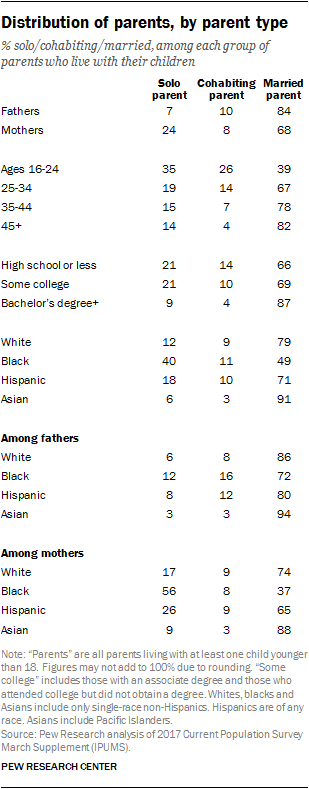
Cohabiting parents tend to be younger, less educated, and less likely to have ever been married compared to solo parents. Solo parents typically have fewer children and are more likely to live with one of their own parents (23% vs. 4%), Pew found.
Solo moms are more than twice as likely to be black as cohabiting moms (30% vs. 12%), and roughly four times as likely as married moms (7% of whom are black). About 40% of solo mothers are white, compared with 58% of cohabiting moms and 61% of married moms.
There are virtually no racial and ethnic differences in the profiles of solo and cohabiting fathers.
Single motherhood pay gap
Single mothers earn significantly less than married mothers.
In 2021, the median income for single-mother families was $51,168, compared to $106,921 for married couples, according to Pew.19 This income disparity is influenced by lower educational qualifications and the younger age of single mothers, who are also more likely to be black or Hispanic.
Pew also found that single-mother families are much more likely to live in poverty, with a rate of 31.3% in 2021. Among black female-headed families, the poverty rate is 37.4%, and 35.9% for Hispanic families.
This is likely a consequence of the lower educational qualifications of single mothers, as well as the fact that they are younger and more likely to be black or Hispanic. Married mothers tend to be older and are disproportionately white and college-educated.
Mothers overall suffer a pay gap of 29%, earning an average of 71 cents for every $1 earned by a dad — or an average of $16,000 less per year, according to the National Women’s Law Center.20
This motherhood penalty is dramatically worse for single mothers at 35%. According to Pew Research, single moms with a household of three earn just $26,000 per year on average, compared with $40,000 per year for single dads.
Parenthood tends to have a different impact on earnings for men and women. Fathers often receive a “fatherhood wage premium,” meaning they earn more after having children.
In contrast, mothers, especially single mothers, face decreased earnings due to career breaks and reduced work hours to manage childcare responsibilities, according to a 2024 report by the National Partnership for Women and Families (NPWF).
Single-mother households are more likely to be economically insecure compared to other family structures. Approximately 60% of mother-only families were economically insecure in 2021, with nearly a third living below the federal poverty line, NPWF found.
Another report that year found that the median income for families led by a single mother was $51,168, significantly lower than the $106,921 median for married couples. This large income disparity contributes to the economic hardships faced by single-mother households, according to the National Women's Law Center.
I conducted a survey of 2,279 single moms and found a direct correlation between time-sharing between single parents, and single moms’ include. The 2021 white paper outlining the findings of the Single Mom Income and Time-Sharing Survey are here:
Survey highlights:
- Moms with 50/50 parenting schedules are 54% more likely to earn at least $100,000 annually than moms whose kids are with them most of the time (with “visits” with the dad), and more than three times (325%) more likely to earn $100,000+ than single moms with 100% time responsibility.
- Moms with 50/50 parenting schedules are more than twice as likely to earn $65,000+, and nearly three-times as likely to earn that sum than moms with 100% parenting time.
- 13% of single moms have a 50/50 parenting arrangement, and 51% have their children 100% of the time.
- 9 in 10 single moms say they could earn more money if they had more equality in their co-parenting schedules.
- Moms with 50/50 parenting time are 34% more likely to say they feel “awesome and proud” of being a mom when compared with moms who care for their kids 100% of the time.
More details about the survey project.
I also founded Moms For Shared Parenting, an organization devoted to advancing parenting policy and culture.
11 surprising facts about 50/50 parenting
Single mothers on food stamps and public assistance
Roughly 15.7 million children were living in single mother-headed households in the United States, according to U.S. Census data21 published in 2022. This reflects a significant portion of the overall child population in the country:
- About 11.1 million children lived below 100% of poverty
- Nearly 14.4 million children were in the food stamp program
- Roughly 2.1 million children received public assistance
Single parents by country
A 2019 Pew Research Center study22 of 130 countries and territories finds the United States has the world’s highest rate of children living in single-parent households, at 23%. By comparison:
- Russia 18% of children live in single parent-headed households
- Uganda 10%
- Germany 12%
- Japan 7%
- Mexico 7%
- India 5%
- China 4%
- Worldwide: an average of 7% of children under age 18 live with a single parent
Children in single-parent families by race in the United States
According to the most recent U.S. census data,21 these are the percentages of children per race in single-parent homes:
- American Indian or Alaska Native – 52%
- Asian and Pacific Islander – 15%
- Black or African American – 64%
- Hispanic or Latino – 42%
- White (Non-Hispanic) – 24%
- Two or more races – 40%
Single moms are overwhelmingly doing it all alone
- 50% of custodial parents have child support agreements (informal or formal), but only 44% received all child support owed, according to a 2018 U.S. Census Bureau report.23 About 24% receive partial payments, while 30% receive none of the support they are owed
- The median amount of child support due is about $480 per month, translating to about $5,760 annually. However, the actual median amount received by custodial parents is significantly lower, at around $1,800 per year
- Child support can be a critical source of income for single-parent families. It helps lift many children out of poverty, providing essential financial resources to support their upbringing, The Annie E. Casey Foundation24 wrote in a 2023 report.
- Of fathers who live apart from their children, 22% of dads see their kids more than once per week.
But, how many of those fathers choose not to see their kids more, and how many of them are forced out of their kids’ lives completely, or marginalized to a weekend dad?
The answer to this question is complicated and hotly debated. A sexist culture and family court system that marginalizes fathers is a real force, as is parental alienation, mass incarceration of African American men are all real forces.
According to data from the Pew Research Center,25 about 29% of fathers who live apart from their children see their kids at least once a month, while 21% visit several times a year, and 27% do not visit at all.
Challenges of single-parent families
Children in single-parent families are more likely to face challenges stemming from the breakup of their parents.
According to another article by the Annie E. Casey Foundation,26 over 50% of children born to cohabiting couples will experience a parent leaving the home. And 20% of children whose parents are married will experience a divorce by the time they turn 9 years old.
This equates to a disruption in routines, living spaces, education, and household income.
For divorcing couples, parenting classes are a great first-step to restoring stability for children in the midst of a split. Learning how to co-parent is essential to better outcomes for children of divorce.
As research continues to evolve on this topic, several factors are clear: children excel in stable, safe nurturing environments where their emotional and physical needs are met.
High levels of parental stress are common among single parents due to the dual burden of providing for and caring for children alone, according to a Pew report.19 This stress can negatively impact both the parent’s and the child’s well-being. Strategies such as prioritizing self-care and seeking professional counseling can be beneficial.
An article by The Gentle Parent27 also discusses the solos of solo parenting and writes that single parents frequently experience a lack of support from family, friends, or society. Building a support network through local community organizations, support groups, or online forums can provide much-needed emotional and practical assistance.
Single parents often face the difficulty of balancing work responsibilities with parenting duties, according to The Gentle Parent. Establishing clear boundaries and seeking flexible work arrangements can help, but the lack of affordable and reliable childcare remains a significant hurdle.
Solo parenthood can also lead to feeling isolated due to the overwhelming responsibilities of raising children alone. Engaging in community activities, joining parenting groups, and maintaining connections with friends and family can help reduce feelings of loneliness, The Gentle Parent wrote.
Takeaways from these single mom statistics
There are more single moms because it is more acceptable to be a single mom
Single moms are growing in number, in part, because women have more financial opportunities, and can more comfortably afford to have children without the full-time financial support of the children’s father.
At the same time, the rise in single motherhood has severely lessened the stigma of being an unmarried mom, a fact that has been attributed to the drop in abortion rates in recent decades.
The rise and general acceptance of single motherhood across all demographics (young, African American and Hispanic moms make up the majority of this trend, but older, more affluent single-moms-by-choice is the fastest-growing segment of the single-mom population), is part of a larger trend of redefining what family and healthy family means.
It was a few years ago that headlines announced that the married, heterosexual parent household with children is now the statistical minority in the United States. Today, about a quarter of married couples who live with children under age 18 are in these Leave it to Beaver families where only the father works — down 47 percent in 1970.
How to be a successful single mother
While gay, multi-generational, blended and adoptive families are on the rise, single-mom-led households made up the bulk of that new majority of “non-traditional” families (enter eye-rolling of many, including this writer!). Paired with news that young adults increasingly find marriage an obsolete institution, this made sense.
However, this new acceptance of family does not preclude romantic partnerships, as most Millennial moms are in committed romantic partnerships, even if they are not legally married.
More gender equality at home — including in separated families
Today’s expectations of the role that men and women will play in parenting is different from older moms. Millennial mothers are most likely to have children with men who are more inclined to share household and childcare duties.
To wit: a 1982 study28 found 43 percent of fathers never changed a diaper. By 2000 another study showed this figure had fallen to 3 percent.
Fatherhood, as we know, goes far beyond keeping little butts clean. While the bulk of care of children still falls on women, a Boston College Center for Work & Family study found that 66% of Millennial dads believe that child care should be shared equally (even if just 29% conceded that that work is actually shared equally in their family), and the number of hours dads today spend with their kids tripled to 7 hours weekly in 2015 from 1965, while they spend an average of nine hours on housework, up from four hours half a century earlier.
These trends are reflected in separated families, where the number of hours that dads spend with children has increased regardless of whether the dad is a part of the same household. Only about 35% percent of child custody cases29 rule to give fathers primary residence, but there is a huge new movement towards shared parenting, in which it is presumed that both parents have equal legal custody and approximately half time with each parent in the event of a separation.
In fact, in 2017 alone, shared parenting legislation has been introduced in 25 states, and counting. This makes sense, as there are 60 peer-reviewed studies30 that find that shared parenting — in which each parent has the kids about 40 percent of the time — is best for children.
Fathers now spend significantly more time with their children than in the past. The average time dads spend with their kids has tripled from 2.5 hours per week in 1965 to about 7 hours per week in 2015. Additionally, fathers' involvement in housework has increased from 4 hours per week in 1965 to 9 hours per week in recent years, according to the Pew Research Center.31
Shared parenting is also great for moms. After all, if with more parenting and time support from another parent means more time to nurture other parts of your life — including your career. After all, we can’t have equality at work if we don’t have equality in your family — regardless of what your family looks like.
Why is child support so unfair to fathers? A case for needed reform
More reading:
What is a single mom? A solo mom? How to determine which one you are
Why is child support so unfair to fathers? A case for needed reform
As Millennials Near 40, They’re Approaching Family Life Differently Than Previous Generations (Pew Research Trends)
For Millennials, Out-of-Wedlock Childbirth Is the Norm (Slate)
The Luxury of Waiting for Marriage to Have Kids (The Atlantic)
Dramatic increase in the proportion of births outside of marriage in the United States from 1990 to 2016 (Child Trends)
Related documentary and books on shared parenting:
Recommended shared parenting documentary: Divorce Corp
Kickass Single Mom, Be Financially Independent, Discover Your Sexiest Self, and Raise Fabulous, Happy Children, By: Emma Johnson
Blend, The Secret to Co-Parenting and Creating a Balanced Family, By: Mashonda Tifrere
Co-parenting with a Toxic Ex: What to Do When Your Ex-Spouse Tries to Turn the Kids Against You, By: by Amy J. L. Baker, PhD and Paul R Fine, LCSW Divorce Poison: How to Protect Your Family from Bad-mouthing and Brainwashing, By: Dr. Richard A. Warshak
SOURCES:
- “Births: Final Data for 2022,” National Vital Statistics Reports: Volume 73, Number 2. April 4, 2024. Center for Disease Control. https://www.cdc.gov/nchs/data/nvsr/nvsr73/nvsr73-02.pdf
- “America’s Families and Living Arrangements: 2022,” November 17, 2022. United States Census Bureau. https://www.census.gov/data/tables/2022/demo/families/cps-2022.html
- “Most Millennial moms who skip college also skip marriage, data shows,” by Jill Rosen. Johns Hopkins University. June 16, 2014.
- “2017 Women Housing Ecosystem Report,” Women in the Housing & Real Estate Ecosystem (NAWRB). https://www.nawrb.com/2017-women-housing-ecosystem-report/
- “National Marriage and Divorce Rate Trends for 2000-2022,” National Center for Health Statistics. CDC. https://www.cdc.gov/nchs/data/dvs/marriage-divorce/national-marriage-divorce-rates-00-22.pdf
- “Annual Social and Economic Supplements,” United States Census Bureau. https://www.census.gov/data/datasets/time-series/demo/cps/cps-asec.2022.html#list-tab-165711867
- “Current Population Survey (CPS),” United States Census Bureau. https://www.census.gov/programs-surveys/cps.html
- “Cohabitation and children's living arrangements: New estimates from the United States,” National Center for Health Statistics. CDC. https://www.cdc.gov/nchs/fastats/unmarried-childbearing.htm
- “As Millennials Near 40, They’re Approaching Family Life Differently Than Previous Generations,” by Amanda Barroso, Kim Parker and Jesse Bennett. Pew Research Center. May 27, 2020. https://www.pewresearch.org/social-trends/2020/05/27/as-millennials-near-40-theyre-approaching-family-life-differently-than-previous-generations/
- “Rising nonmarital first childbearing among college-educated women: Evidence from three national studies.” by Andrew J. Cherlin. 2021. Proceedings of the National Academy of Sciences. https://www.pnas.org/doi/full/10.1073/pnas.2109016118
- “For Millennials, Parenthood Trumps Marriage,” by Wendy Wang and Paul Taylor. Pew Research Center. March 9, 2011. https://www.pewresearch.org/social-trends/2011/03/09/for-millennials-parenthood-trumps-marriage/
- “What The Statistics Say About Generation Z,” The Annie E. Casey Foundation. Updated Nov. 1, 2023. https://www.aecf.org/blog/generation-z-statistics
- “On the Cusp of Adulthood and Facing an Uncertain Future: What We Know About Gen Z So Far,” by Kim Parker and Ruth Igielnik. Pew Research Center. https://www.pewresearch.org/social-trends/2020/05/14/on-the-cusp-of-adulthood-and-facing-an-uncertain-future-what-we-know-about-gen-z-so-far-2/
- “Gen Z Women Postpone Motherhood Because Of The Challenges Working Millennial Moms Encounter,” by Christine Michel Carter. Forbes. June 21, 2022. https://www.forbes.com/sites/christinecarter/2022/06/20/gen-z-women-postpone-motherhood-because-of-the-challenges-working-millennial-moms-encounter/?sh=4191f2152b90
- “The Childhood Loneliness of Generation Z,” by Daniel A. Cox for the Survey Center on American Life. April 4, 2022. https://www.americansurveycenter.org/the-lonely-childhood-of-generation-z/#
- “Key facts about moms in the U.S.,” by Katherine Schaeffer and Carolina Aragão. Pew Research Center. https://www.pewresearch.org/short-reads/2023/05/09/facts-about-u-s-mothers/
- “The Changing Profile of Unmarried Parents,” by Gretchen Livingston. https://www.pewresearch.org/social-trends/2018/04/25/the-changing-profile-of-unmarried-parents/
- “As Millennials Near 40, They’re Approaching Family Life Differently Than Previous Generations,” by Amanda Barroso, Kim Parker, and Jesse Bennett. Pew Research Center. May 27, 2020. https://www.pewresearch.org/social-trends/2020/05/27/as-millennials-near-40-theyre-approaching-family-life-differently-than-previous-generations/
- “Parenting in America Today,” by Rachel Minkin And Juliana Menasce Horowitz. Pew Research Center. Jan. 24, 2023. https://www.pewresearch.org/social-trends/2023/01/24/parenting-in-america-today/
- “Data on Poverty and Income,” National Women’s Law Center. https://nwlc.org/issue/data-on-poverty-income/
- “America’s Families and Living Arrangements: 2022,” U.S. Census Bureau. Nov. 17, 2022. https://www.census.gov/newsroom/press-releases/2022/americas-families-and-living-arrangements.html
- “Religion and Living Arrangements Around the World,” Pew Research Center. Dec. 12, 2019. https://www.pewresearch.org/religion/2019/12/12/religion-and-living-arrangements-around-the-world/
- “44 Percent of Custodial Parents Receive the Full Amount of Child Support,” U.S. Census Bureau. https://www.census.gov/newsroom/press-releases/2018/cb18-tps03.html
- “Less than 1 in 4 single-mother families receive child support,” The Annie E. Casey Foundation. Oct. 26, 2023. https://www.aecf.org/blog/less-than-1-in-4-single-mother-families-receive-child-support
- “A Tale of Two Fathers,” by Gretchen Livingston and Kim Parker. Pew Research Center. https://www.pewresearch.org/social-trends/2011/06/15/a-tale-of-two-fathers/
- “Child well-being in single-parent families,” The Annie E. Casey Foundation. April 6, 2024. https://www.aecf.org/blog/child-well-being-in-single-parent-families
- “Common Challenges Faced by Single Parents: Exploring the Hurdles of Solo Parenthood,” by Larabeth Fitzroy-Smith. TheGentleParents. https://thegentleparents.com/2023/08/common-challenges-single-parents-face/
- “Research punctures ‘Modern' fathers myth – except for nappies that is…” Warwick. https://warwick.ac.uk/newsandevents/pressreleases/research_punctures_modern/
- “What does Dad really want? More time with his kids,” Star Tribune. June 16, 2018. https://www.startribune.com/what-does-dad-really-want-more-time-with-his-kids/485607642/
- “Joint versus sole physical custody: Outcomes for children independent of family income or parental conflict,” by Linda Nielsen. Journal of Child Custody. Jan. 24, 2018. https://static1.squarespace.com/static/5154a075e4b08f050dc20996/t/5a6a58370d9297962b6ef1fd/1516918840631/2018+Child+Custody+60+studies+.pdf
- “Key facts about dads in the U.S.,” by Katherine Schaeffer. Pew Research Center. June 15, 2023. https://www.pewresearch.org/short-reads/2023/06/15/key-facts-about-dads-in-the-us/