scroll top

If you’re a single mom in Wyoming struggling to make ends meet, keep reading for resources that help with: 

We also put together resources specifically for:

Statistically, families benefit most with cash assistance (vs through benefits programs).1 Here is our guide to single mom grant programs, including our own.

Every month, I give out $500 cash to one single mom struggling with money, health, stress, child care, illness or loneliness — no strings attached. 

Qualifications are simple:

1. You're a single mom.

2. You need the money right now.

Fill out this form to apply:

(Note that the figures and information in this post are current as of publication date.)

Number of people in family/householdAnnual income
1$15,960
2$21,640
3$27,320
4$33,000
5$38,680
6$44,360
7$50,040
8$55,720

For families/households with more than 8 people, add $5,680 for each additional person.each additional person.

You can also look up your area median income (AMI) here.

Want to buy a home in 2026? See what mortgage you qualify for.

Emergency cash for low-income families in Wyoming

If you need cash to pay bills, buy gas, feed your family, or for any other reason, these resources can help:

Temporary Cash Assistance in Wyoming

Wyoming’s Temporary Assistance for Needy Families (TANF) program provides cash assistance for qualifying families.

There are two forms of TANF in Wyoming: 

  • The POWER Work program
  • The POWER Caretaker Relative program
    • Provides cash assistance to family members or caregivers to children 
    • Provides free child support assistance

The amount paid out varies depending on household income. However, a family of three with no income could receive $781 monthly through the POWER Work Program. Through the POWER Caretaker Relative Program for one child with no income or resources, households could receive $259 monthly. 

Qualifications:

  • Must be a U.S. citizen or a qualified non-citizen
  • Wyoming resident
  • Have children under 18 in the household 
  • Household must have $5,000 or less in resources
  • Meet income requirements 

How to get help:

Wyoming Rapid Response Fund

The Wyoming Rapid Response Fund, run by Volunteers of America Northern Rockies, provides one-time emergency assistance to families who:

  • Lost a home or are at risk of homelessness
  • Experience domestic abuse
  • Have healthcare challenges
  • Can't pay for a funeral
  • Need essential home repairs

Qualifications:

  • Resident of Wyoming experiencing financial hardship due to the emergency situations listed above

How to get help:

More emergency cash help in Wyoming: 

Single moms in Wyoming can visit 211.org or dial 2-1-1 to ask for assistance.

Check out these posts for more ways to get emergency cash: 

These are some more tips for getting cash quickly: 

Housing help for single moms in Wyoming

If you need help finding a place to live or paying your rent/mortgage, these programs can help:

Public Housing and Housing Choice Vouchers (Section 8)

The U.S. Department of Housing and Urban Development (HUD) offers affordable housing and vouchers to help low-income households pay their rent.

Qualifications:

Vouchers and housing are based on household income and family size. You can find your county’s income limits on the HUD website

How to get help: 

Contact your local public housing agency and ask how to apply for assistance

Mortgage assistance in Wyoming 

If you need help buying a home paying your mortgage in Wyoming, these programs can help: 

Wyoming Homeowner Assistance Fund

The Wyoming Homeowner Assistance Fund (HAF) helps Wyoming homeowners who have been financially impacted by COVID-19 and meet eligibility criteria to stay in their homes. 

Eligible homeowners can receive up to $17,000 as a one-time award to cover past-due mortgage payments, utility bills, taxes, and more. 

Qualifications:

  • Wyoming homeowner
  • Currently occupy the property as the primary residence
  • Financially affected by COVID-19 
  • Must not have received a previous HAF award 
  • Annual household income at or below 150% of the AMI

How to get help: 

Spruce Up

Spruce Up offers financing for both the purchase and rehabilitation of a home in one loan, with 3.125% interest for a term of 30 years.

Households can use Spruce Up for:

  • Minor remodeling and non-structural repairs
  • Repairing or replacing plumbing, heating, AC and electrical systems
  • Making changes for improved functionality and modernization
  • Repairing or replacing roofing
  • Making energy conservation improvements
  • Creating accessible features for persons with disabilities

Qualifications:

  • First-time homebuyer or have not owned a property in the last three years
  • Adhere to purchase price and income limits
  • Must be owner occupied as a primary residence
  • May be subject to Federal Recapture Tax (contact WCDA for more information)
  • FHA, VA, and RD financing acceptable
  • Home must sit on 10 acres or less
  • Single family homes, no option for rental income
  • Manufactured homes on permanent foundations must meet FHA requirements
  • First-time homebuyers are required to complete the homebuyer education class through Wyoming Housing Network, Inc.

How to get help: 

Wyoming down payment assistance

Wyoming Community Development Authority helps with down payment and closing costs through the following programs: 

WCDA’s Down Payment Assistance (DPA)

Down Payment Assistance (DPA) loans help borrowers in Wyoming pay for their down payments and closing costs. Each DPA loan product has these basic features:

  • $15,000 maximum loan amount
  • 620 minimum credit score
  • $1,500 minimum borrower contribution required

Home$tretch DPA Loan Product

  • Must be used with First-time Homebuyer and Spruce Up products only
  • 0% interest rate and 0.080% APR based on an average loan amount of $5,500
  • No monthly payment
  • Due upon sale of the home, refinance or 30 year maturity

Amortizing DPA Loan Product

  • May be used with HFA Preferred and Advantage products only
  • Fixed interest rate
  • Fully amortizing, low monthly payments
  • Maximum 10-year term

Qualifications: 

Must meet income and purchase price requirements for household and area. 

How to get help: 

Welcome Home Wyoming 

Welcome Home Wyoming (WHWY) provides a 30-year, fixed rate home loan or a down payment assistance loan. Down payment assistance loans can also go towards closing costs, reducing the principal, or prepayment. This program is open to first-time and repeat homebuyers. 

Qualifications:

  • Qualifying credit score (must be above 640)
  • Must be a primary residence in Wyoming
  • Household income falls within program limits (below $131,600 regardless of household size)
  • Completion of homebuyer education program
  • Buying new or existing residential property (one/two units, detached, townhome, condo, or manufactured)

How to get help:

  • Call 720-673-3955 or 720-673-3948
  • Email eva@welcomehomewy.org or diana@welcomehomewy.org

Check today's mortgage loan rates >>


My Front Door

My Front Door helps Wyoming residents walk through the process of becoming and remaining a homeowner. The nonprofit currently has a 98% success rate with program participants through its seven-year program. As a member, you will receive:

  • A 12-week class that educates you about the homebuying process and financial literacy to help you prepare for homeownership
  • An 18 to 24-month mentorship to help you save money for your 3.5% down payment for the home you desire
  • A five-year program on home maintenance where you learn how to take care of your home, increase its value, and plan for the future

Qualifications:

How to get help:

  • Call 307-514-5831 (Cheyenne) or 307-745-4130 (Laramie)
  • Email hello@myfrontdoor.com

Homeless assistance in Wyoming 

Wyoming Homeless Services Program and the Wyoming Homeless Collaborative work together to assist those experiencing homelessness. They connect people with:

  • Emergency shelters
  • Transitional housing
  • Permanent housing
  • Counseling to acquire the necessary life skills to maintain permanent housing

Qualifications: 

Requirements are set by individual agencies and programs. 

How to get help: 

Contact Program Manager Karla McClaren at 307-721-1973.  

More housing help: 

Transportation help for low-income families in Wyoming

If you need free or low-cost transportation or financial assistance for car repairs, there are many resources available to low-income families in Wyoming.

Free or discounted rides in Wyoming

Here’s a resource for free or discounted rides:

Ride United Transportation Access (RUTA)

United Way and Wyoming 211 have partnered to offer free and discounted Lyft rides to people who need help getting to medical appointments, school, work, job interviews and more. This is meant to be an occasional service when other modes of transport are not possible for the rider. Eligible users can get up to 10 one-way rides per month.

This service is available in the following counties:

  • Laramie
  • Albany
  • Natrona 

Qualifications:

  • Rider lives in one of the service areas
  • Has an eligible reason for a ride (this is determined over the phone by a Wyoming 211 agent)

How to get help:

  • Dial 211 on your landline or cell phone

Discounts on public transportation in Wyoming

Wyoming has public transit options in each county. Many of those services cater to the needs of Wyoming seniors. Here are some options that may help depending on where you live:

Jackson Wyoming START Bus

The START Bus provides free shuttles throughout the town of Jackson, Wyo. Free bus rides are available for all students in grade 12 and below in Teton County, Wyo. Children 8 and under can ride free with a paying adult and there are half-price fares for seniors 60 and over and for children 12 and under who are riding without an adult. All buses have free Wi-fi.

Qualifications:

  • Open to residents of Jackson

How to get help:

  • Call 307-733-4521
  • Email info@startbus.com

Share a Ride Wyoming

Share a Ride Wyoming is a shuttle service that connects people who need to travel throughout the state to save money and provide safe transport. The fares are reduced when multiple riders need to travel to the same areas. For example, the fare from Riverton to Casper is $195 for one person, but $49 per person if there are four or more passengers.

Qualifications:

  • Open to anyone traveling within Wyoming

How to get help:

  • Book online
  • Call or text 307-330-3322
  • Email sharearidewyo.2022@gmail.com

Nonemergency medical transportation (NEMT) in Wyoming

If you need NEMT in Wyoming, check out the following:

NEMT for Medicaid members in Wyoming

If you have Medicaid, you may be eligible for a subsidy to help pay for nonmedical and nonemergency medical transportation. The subsidy may be in the form of reimbursement or Medicaid will purchase the transportation ticket on behalf of the member.

This coverage can include payments for: 

  • Use of your own car
  • Taxis
  • Shuttles
  • Public transit
  • Intrastate and interstate bus fare (such as Greyhound)
  • Airfare
  • Overnight lodging at a hotel

Qualifications:

  • Wyoming resident
  • Medicaid member with travel assistance coverage

How to get help:

Free cars in Wyoming

This nationwide charity offers free cars to those who cannot afford to buy one:

Free Charity Cars 

Free Charity Cars awards free vehicles to selected applicants in all 50 states. The nonprofit charity group has been awarding free vehicles to low-income American families since 1996 and has gifted more than 9,000 cars. The charity group notes that they do not have an inventory of vehicles readily available as they award cars as soon as they get them, so there can be extensive waiting periods for those selected for the free car program. 

Qualifications:

  • Be a resident of the U.S.
  • Be 18 years of age or older
  • Have a valid driver’s license
  • Be at or below 200% of the Federal Poverty Level
  • Have a genuine need for a vehicle 
  • Have access to a Computer and Internet Service
  • Sign up for an online account 
  • Complete an online application for a vehicle
  • Have the financial means to pay for the fees, including the tag, title, emissions, insurance, etc.,
  • Take financial responsibility for maintaining insurance and upkeep on the vehicle if awarded 

How to get help:

Car repair help and donation in Wyoming

If you are looking for car repairs on a budget, check out these options:

Backwards Mechanic Auto Center LLC

The Backwards Mechanic Auto Center in Casper, Wyo. offers three levels of repair service at different base prices:

  • You Fix It: At $39.95, plus parts (or you may bring your own) this option is for people who know how to make car repairs but just need access to equipment and a car bay
  • Fix It Together: At $59.95, plus parts and labor, you will work with a certified mechanic to perform the repair
  • We Fix It: At $99.95, plus parts and labor, the show will make the repairs for you

Qualifications:

  • Anyone is welcome to choose the level of service they desire

How to get help:

  • Call 307-797-8336

Good Vibes Garage

Good Vibes Garage in Laramie, Wyo. offers sliding scale rates on car repairs for single moms, students, and people experiencing hardship.

Qualifications:

  • Proof of income 

How to get help:

Les Schwab Tires

If you have a flat tire, Les Schwab Tires offers free repair if your tire can be fixed. This service is for passenger vehicles and is available at Les Schwab Tires locations in Wyoming. If you want to purchase new tires, they offer financing options and free services to maintain or fix your tires.

Qualifications:

  • These services are available to anyone near a Les Schwab location

How to get help:

  • Call 833-896-9953

If you're ready to buy a car, but you have low or no credit, Auto Credit Express is a quality lender:

  • Better Business Bureau rating of A+
  • In business since 1999
  • For new or used cars
  • Auto loans and refi for buyers who have low or no credit, or who have gone through bankruptcy or had a vehicle repossessed
  • Pre-approval within 30 seconds

24 hours to a car loan with Auto Credit Express >>

Electric bill assistance in Wyoming

If you are struggling to pay your utility bills in Wyoming, check out the following programs:

Low-Income Home Energy Assistance (LIHEAP) in Wyoming

LIHEAP helps qualifying households with home heating and cooling costs, paid directly to utility companies. The agency does not assist with water, sewer, or telephone services. 

Qualifications:       

  • Meet income guidelines 
  • Responsible for paying your home heating or cooling bills
  • Wyoming resident
  • U.S. citizen, qualified alien, or permanent resident of the U.S.

How to get help:

  • Apple online
  • Call 800-246-4221
  • Email lieapinfo@thealignteam.org 

Energy Share of Wyoming

Energy Share of Wyoming is a nonprofit that provides emergency, one-time funding to help you pay energy bills. This assistance is available after all other utility bill resources (such as LIHEAP) have been exhausted. If eligible, you can get up to $400 in assistance.

Energy Share partners with local Salvation Army locations to qualify applicants. Applications are accepted between December and April, based on the availability of funding.

Qualifications:

How to get help:

  • Call 303-860-5572

Weatherization Assistance Program (WAP)

WAP helps low-income families lower their monthly energy bills by making their homes more energy efficient. Types of assistance include:

  • Installing carbon monoxide detectors
  • Removing mold
  • Replacing inefficient or unsafe heating units 
  • Insulating a single family home for energy efficiency

Qualifications:

  • U.S citizen or a qualified alien
  • Wyoming resident 
  • Meet income guidelines 
  • Automatically eligible if you are receiving SSI, TANF or Aid to Families with Dependent Children benefits

How to get help:

  • Apple online
  • Call 800-246-4221
  • Email lieapinfo@thealignteam.org 

Energy Share of Wyoming

Energy Share of Wyoming provides emergency financial assistance to help families pay utility bills. The nonprofit assists with gas, electric, and propane bills. This one-time help is only available to households with proof of financial hardship and no other means to pay for the overdue bills. Eligible families can receive up to $400 in assistance.

Qualifications:

  • Income is at or below 185% of the FPL for household size
  • Proof of financial hardship

How to get help:

Enroll Wyoming

If you need help figuring out the health insurance marketplace, Enroll Wyoming is a free service that will help you review coverage options, answer questions, and assist you with enrollment. 

Qualifications:

  • Anyone in Wyoming is eligible to use this free service.

How to get help:

  • Use the online form
  • Call 307-214-0785
  • Email bandagedan@enrollwyo.org

More electric bill help: 

Free money to help pay bills

Medical insurance and dental help for single moms in Wyoming

The following medical and dental services are available to qualifying individuals and families:        

Health Resources & Services Administration (HRSA) in Wyoming

HRSA, an agency of the United States Department of Health and Human Services, funds health centers that provide free or subsidized health and dental care to low-income people and those otherwise unable to access quality health care, like people living in rural areas.

HRSA also offers a 24/7 free and confidential mental health hotline for pregnant and new moms. Dial 833-943-5746 (833-9-HELP4MOMS) if you are struggling.

Qualifications: 

Each health center sets its own eligibility criteria for free or reduced cost care. 

How to get help:

Find an HRSA health center in Wyoming by typing in your address on HRSA’s search tool.

Wyoming Medicaid

Medicaid provides medical coverage for low-income individuals and families. In Wyoming, the program includes:

  • Managed Medical Assistance (MMA) – Covers medical services like doctor visits, hospital care, prescription drugs, mental health care, and transportation for medical needs
  • Long-term Care (LTC) – Covers care in a nursing facility, assisted living, or at home (must be at least 18 years old and require nursing home-level care or hospital-level care if you have cystic fibrosis)
  • Dental – Covers all dental services for children and adults

Qualifications:

Plus, you must meet at least one of the following requirements:

  • Pregnant
  • Caretaker for a child 18 or younger
  • Member of the household has a disability, including blindness
  • 65 or older

How to get help:

  • Apply online 
  • Email applications to wesapplications@wyo.gov
  • Call 855-294-2127 

Wyoming KidCare 

Wyoming Kid Care CHIP — part of the national Children's Health Insurance Program (CHIP) — provides health and dental care coverage for Wyoming children whose families do not qualify for Medicaid. 

Most families pay nothing, and many pay as little as $4 a month.

KidCare provides both health and dental services with a choice of local doctors, dentists, hospitals, and pharmacies. Benefits include:

  • Doctor visits
  • Surgeries
  • Vaccines
  • Vision and hearing 
  • Hospital stays

Qualifications:

  • Meet household income guidelines — $3,839 for a family of three
  • Wyoming resident
  • Under age 19
  • U.S. citizen or legally lived in the U.S. for at least 5 years 
  • Have not had insurance for at least 30 days

How to get help:

  • Apply online 
  • Email applications to wesapplications@wyo.gov
  • Call 855-294-2127 

Wyoming Hand in Hand (WHH)

The Wyoming Hand in Hand Home Visitation Program is available to all women, during pregnancy and following the birth of the baby for assessment, information and referral to community agencies.

Families are partnered with a trained registered nurse during pregnancy or after birth and receive home visits that continue through the child’s 2nd birthday. This program consists of at least 25 home visits. 

Services cover:

  • Prenatal care and parenting 
  • Conception 
  • Stress management
  • Local resources and assistance

Qualifications: 

Pregnant women and parents of children under 2 years old are eligible. 

How to get help: 

Contact your local Hand in Hand location

More medical/dental help: 

Food help for low-income families in Wyoming

A number of federal and state food and nutrition programs are available across the state:

Wyoming Food Assistance Program (SNAP)

USDA’s Supplemental Nutrition Assistance Program (formerly known as the Food Stamp program) provides food benefits and nutrition education to low-income households. 

SNAP recipients are issued an EBT card that can be used like an ATM card in retail food stores to purchase food, including:

  • Breads
  • Cereals
  • Fruits
  • Vegetables
  • Meats
  • Fish
  • Poultry
  • Dairy
  • Plants and seeds to grow food 

Qualifications:

  • Wyoming resident
  • Current bank balance (savings and checking combined) under $2,500 or under $3,750 and share your household with one of the following:
    • Person or persons age 60 and over
    • Person with a disability (child, spouse, parent, yourself
  • Meet income guidelines — $2495 for a family of three

How to get help: 

Call or visit your local Department of Family Services office. 

Women, Infants, and Children (WIC)

The Special Supplemental Nutrition Program for Women, Infants, and Children is a nutrition program that provides free baby formula and nutritional food items to low-income mothers and their babies. 

Qualifications:

  • Low-income, pregnant, breastfeeding, and postpartum women, for up to one year postpartum
  • Women up to six months postpartum who are not breastfeeding
  • Infants and children under 5 years old, including foster children
  • Low-income sole provider parents of children under age of 5 who are at nutritional risk and who are below 185% of FPL
  • If you are currently receiving Medicaid, Temporary Assistance, or Food Assistance help, you are also eligible for WIC

How to get help: 

National School Lunch Program (NSLP) and School Breakfast Program

NSLP serves healthy, well-balanced, reduced-price or free meals to children in school. 

An extension of the NSLP, the School Breakfast Program provides free or low-cost breakfast to eligible students. Schools with at least 80% of the students eligible for free or reduced-price meals must provide breakfast at no cost to all students. 

Qualifications: 

Household income must fall at or below the limits of the federal income eligibility guidelines.

How to get help: 

  • Contact your child’s school to enroll
  • Call 307-857-9256

Wyoming’s Summer Food Service Program

The Wyoming Department of Education serves nutritious meals at no cost to children during summer break. Food is distributed at local schools, nonprofits, parks, and libraries. 

Qualifications: 

These are the current income guidelines for the Summer Food Service Program: 

How to get help: 

Wyoming food banks

Food banks in Wyoming provide meals for individuals and families who are struggling to put food on the table. 

Qualifications: 

Each food bank sets its own eligibility and proof of need requirements. 

How to get help: 

To find a food bank near you and for additional information, visit the Food Bank of Wyoming  website.

More food help: 

Child care help for low-income families in Wyoming

There are multiple federally funded education programs and resources in Wyoming:

Wyoming Head Start and Early Head Start

Head Start is a free federal preschool program for children aged 3 to 5 from low-income families. Early Head Start serves pregnant women and children under age 3. 

The programs focus on cognitive, social, and emotional development and prepare children for school. 

Qualifications: 

  • Children from birth to 5 
  • Income is falls within FPL 
  • Children in foster care, homeless children, and children from families receiving public assistance (TANF, SSI, etc.) are eligible regardless of income
  • Some programs accept kids with incomes above the Poverty Guidelines
  • Pregnant women can also receive prenatal and postpartum information, education, and services through Early Head Start

How to apply: 

Wyoming Child Care Subsidy

The Child Care Subsidy program, under the Wyoming Department of Family Services, provides financial help for low-income families to pay for child care. The program pays a portion of the cost and most families are required to offer  co-pay based on a sliding fee scale

Qualifications:

  • Wyoming resident
  • Have a household income between 100% and 225% of the FPL

How to get help:

  • Call 307-777-7564
  • Email dfs-directorsoffice@wyo.gov

More child care help

Education help for single moms in Wyoming

If you’re a single mom who wants to further her education, here are some helpful resources: 

Get a GED in Wyoming

If you are at least 18 years old in Wyoming, you can take the GED test. You may also be able to take the test at 16 or 17 with special permission from the school district where you live. 

The GED test is broken into four exams on different subjects, which can be spaced out and taken at your own pace (though each individual exam has a time limit):

  • Mathematical reasoning – 115 minutes
  • Reasoning through language arts – 150 minutes
  • Social studies – 70 minutes
  • Science – 90 minutes

You have two options for taking the test in Wyoming: 

  • Online at-home test: $36 per subject
  • In person at a test center: $20 per subject

Wyoming residents can also take the HiSET to earn high school equivalency. 

Grants and scholarships in Wyoming

The Wyoming Community Foundation connects students and prospective students with grants and scholarships available in Wyoming.

Individual schools also offer need-based and academic scholarships for their students. If you’ve been accepted to a higher education institution, contact their office of financial aid to learn how to apply. 

More education help:

Employment help for single moms in Wyoming

Workforce programs in Wyoming provide training and assist with employment:

Climb Wyoming job training programs

Climb Wyoming provides free job training for single moms to help them earn more in a new career, such as healthcare, truck driving, and office support. Students learn new marketable workplace skills but also get help with lifestyle topics like parenting, budgeting, and preparing healthy meals.

Thousands of program graduates are self-sufficient, work full time, have doubled their monthly income, and have decreased their Supplemental Nutrition Assistance Program (SNAP) benefits.  

Climb Wyoming offers job placement to graduates thanks to its relationships with reputable employers. The program serves:

  • Casper
  • Cheyenne
  • Gillette
  • Laramie
  • Sweetwater
  • Teton

Qualifications:

Climb Wyoming encourages all single mothers in the program service areas to apply. Kerry Lloyd, Statewide Communications Manager says they keep eligibility requirements general to offer a personalized selection process that considers the needs of each individual.

How to get help:

  • Complete the contact now form online
  • Call 307-316-1470

Wyoming Reemployment Assistance (Insurance) Program

Unemployment Insurance provides unemployment compensation to eligible Wyoming workers who are out of work through no fault of their own.

The amount of unemployment benefits varies depending on how much you have earned in your base period. The maximum weekly benefit amount is $560, and the minimum weekly benefit is $40.

Qualifications: 

  • Wyoming resident 
  • Unemployed
  • Previously employed for the past 12 months
  • Earned a certain amount of wages
  • Actively looking for another job

How to get help: 

Wyoming Works at WWCC

The Wyoming Works program at Western Wyoming Community College (WWCC) offers resources to help you learn new skills and find a job to use those skills. You may be eligible for a grant of up to $3,360 per year to help pay for your education if you select an approved program

Qualifications:

  • U.S. citizen and Wyoming resident
  • Complete the FAFSA
  • Enrolled in an approved program

How to get help:

  • Call 307-382-1884
  • Email financialaid@westernwyoming.edu

American Job Centers

American Job Centers offer employment and training services, career counseling, and job search assistance. 

How to get help: 

  • Search for a location on the American Job Center website
  • Call 877-872-5627 
  • Email info@careeronestop.org 

More employment help: 

Charity organizations in Wyoming

There are a number of charitable organizations throughout Wyoming that offer support to single moms:

The Salvation Army of Wyoming

The Salvation Army wears many hats. Chapters assist with:

  • Food, shelter and clothing
  • Medication costs
  • Education and job training
  • Christmas presents
  • Rent and utility bills
  • Substance abuse rehabilitation
  • Youth services
  • Emergency disaster response

Qualifications: 

Each Salvation Army branch determines its own eligibility criteria for different programs. 

How to get help: 

Visit the Salvation Army website to find your local chapter. 

Catholic Charities of Wyoming

Catholic Charities assists with:

  • Housing
  • Utility assistance
  • Food assistance
  • Health care assistance

Qualifications: 

Each Catholic Charities branch determines its own eligibility criteria for different programs. 

How to get help: 

United Way of Wyoming

The United Ways of Wyoming connects people in need with local resources like: 

  • Food
  • Shelter
  • Child care services
  • Housing
  • Health care
  • Support groups

How to get help: 

Help for single moms in Cheyenne, Wyoming

The following resources serve residents of Cheyenne, Wyo.:

Housing help in Cheyenne

These housing resources can help if you are homeless or at risk of homelessness:

Project Hope

The Project Hope Self Sufficiency program of Laramie County helps people get back on their feet after homelessness or housing instability. The program requires a one-year commitment and involves working closely with a case manager to secure housing, build life skills, and create and accomplish goals. There is a waiting list for the program and eligible families are accepted in order of application date.

Qualifications:

  • Income is at 125% of the FPL for household size
  • Minimum annual income of $15,075
  • Homeless or at risk of homelessness
  • Able to pass a background check

How to get help:

  • Call 307-635-9291

Family Promise of Cheyenne

Family Promise works with community partners to make sure that families with children have the proper resources to increase housing stability.

Qualifications:

  • Cheyenne resident
  • Homeless or at risk of homelessness

How to get help:

  • Call 307-772-8770
  • Email fpc@familypromiseofcheyenne.org

Transportation help in Cheyenne

Here is help if you need a ride in Cheyenne:

Cheyenne Transit Program

Cheyenne Transit Program (CTP) offers a free, fixed route bus service that runs Monday through Saturday. CTP also offers free paratransit (door-to-door) options for disabled persons and on-demand transit for $1.50. 

Qualifications:

  • Fixed route service is open to all Cheyenne residents
  • Paratransit services are for disabled persons and requires an application

How to get help:

  • Call 307-637-6253 

Electric bill assistance in Cheyenne

If you need utility bill assistance, this resource may be a great help:

Cathedral of St. Mary Assistance

The Cathedral of St. Mary provides financial support to pay past due rent and utility bills at a current residence. Payments are made directly to the utility company or landlord.

Qualifications:

  • Resident of Laramie County
  • Proof of income for every household member
  • Rental agreement and/or utility bill

How to get help:

  • Call 307-635-9261
  • Email stewardship@stmaryscathedral.com

Education help in Cheyenne

If you are looking for education options for your children in Cheyenne, consider the following:

Cheyenne Classical Academy

Cheyenne Classical Academy is a tuition-free public charter school scheduled to open for grades K-4 in 2024. There are plans to expand to additional grade levels in the future. Open enrollment is from January 2, 2024 through February 29, 2024. The lottery to attend the school will occur on March 1, 2024.

Qualifications:

  • Households in Cheyenne with students in K-4 for the 2024-2025 school year

How to get help:

Medical and dental care help In Cheyenne

If you need medical and or dental care for your family, this resource can help: 

HealthWorks

HealthWorks provides primary care, dental care, mental and behavioral health care, and a pharmacy in one location. In addition, they offer a mobile clinic that visits Cheyenne-area schools to offer minor health services. 

HealthWorks offers a sliding fee scale to help low-income families pay for care. And you may be eligible for discounts on care depending on your income. Services are available to the insured, uninsured, and underinsured.

Qualifications:

  • Anyone in Cheyenne may use this health service
  • Households at or below 200% of the FPL may be qualified to receive additional discounts

How to get help:

  • Call 307-635-3618

Food help in Cheyenne

Here is a resource if you need help feeding your children on the weekends in Cheyenne:

Cheyenne Friday Food Bag

If you are looking for nutritious food for your children on the weekends, Cheyenne Friday Food Bag offers single meals delivered to schools in Laramie County school districts 1 and 2.

Qualifications:

  • Child attending a Laramie County school in district 1 or 2
  • Recipient of free or reduced meals at school

How to get help:

  • Call 307-287-3315

St. Paul’s Lutheran Church Free Little Pantry

St. Paul’s Lutheran Church in Cheyenne, has a small outdoor pantry where you can find canned and other packaged food goods.

Qualifications:

  • This pantry is available to anyone in need

How to get help:

  • Visit the church at 218 E. 19th Street in Cheyenne

Help for single moms in Casper, Wyoming

The following resources serve residents of Casper, Wyo.:

Housing help in Casper

If you need housing help as a single mom in Casper, check out these resources:

The McKenzie Home

The McKenzie Home offers single moms and their children a safe place to stay. This transitional faith-based housing program also provides resources to help single moms reach self-sufficiency and stability.

Qualifications:

  • Single mom in Casper Wyoming with housing instability

How to get help:

  • Apply online
  • Call 307-267-8394
  • Email debra@themckenziehome.org

Seton House

Seton House offers 22 apartments and a learning center for children. It’s a safe space to accommodate single moms and their children who do not have a home. The program helps single moms transition from homelessness to having a permanent place to live. Residents may remain at Seton House for up to two years while they work through the self-sufficiency program.

Qualifications:

  • Homeless single mom
  • Must enroll in school or job program or seek employment if unemployed
  • Willing to meet weekly with a Seton House coach
  • School-aged children must be enrolled in and attend school

How to get help:

  • Apply online
  • Call 307-577-8026
  • Email office@setonhousecasper.org

Transportation help in Casper

Here is help if you need a ride in Casper:

Casper Area Transit

Casper Area Transit offers a subsidy program that provides free tickets and tokens to eligible riders. 

Qualifications:

  • Casper resident
  • Does not exceed the income limit for household size

How to get help:

  • Call 307-235-8214 or 307-235-8261

SafeRide

If you are under the influence of alcohol in Natrona County and unable to drive home, you can ask your server or bartender for a SafeRide voucher. A participating taxi cab company will take you home.

Qualifications:

This service is available 24/7 and serves:

  • Casper
  • Evansville
  • Mills
  • Paradise Valley
  • Parts of Bar Nunn

How to get help:

  • Call 307-266-7233

Food help in Casper

Here are is food resource in Casper:

Joshua’s Storehouse

Joshua’s Storehouse provides a food pantry, diapers, infant formula, milk, and women’s hygiene items to families in need.

Qualifications:

  • Casper resident

How to get help:

  • Call 307-265-0242

Education help in Casper

If you are looking for education assistance in Casper, Wyo., check out the following:

Casper College Single Parent Program

The Neil and Doris McMurry Single Parents Program at Casper College offers resources to support single parents pursuing a degree program. To be eligible for help, you must complete a FAFSA for the current school year. 

Qualifications:

  • Proof of being the custodial parent of your children
  • Does not have an associate degree or higher
  • Must maintain a GPA of 2.0 and a 67% term completion rate

How to get help:

  • Call 307-268-2604

SOURCES

  1. “The Long-Term Impacts of Cash Assistance to Families,” by Kevin Werner, The Urban Institute, Jan. 31, 2024 https://www.urban.org/research/publication/the-long-term-impacts-of-cash-assistance-to-families


Not your state? Select yours here:

If you’re a single mom in Georgia struggling to make ends meet, keep reading for resources that help with: 

Statistically, families benefit most with cash assistance (vs through benefits programs).1 Here is our guide to single mom grant programs, including our own.

Every month, I give out $500 cash to one single mom struggling with money, health, stress, child care, illness or loneliness — no strings attached. 

Qualifications are simple:

1. You're a single mom.

2. You need the money right now.

Fill out this form to apply:

(Note that the figures and information in this post are current as of publication date.)

Number of people in family/householdAnnual income
1$15,960
2$21,640
3$27,320
4$33,000
5$38,680
6$44,360
7$50,040
8$55,720

For families/households with more than 8 people, add $5,680 for each additional person.each additional person.

You can also look up your area median income (AMI) here.

Want to buy a home in 2026? See what mortgage you qualify for.

Emergency cash for low-income families in Georgia

If you need cash to pay bills, buy gas, feed your family, or for any other reason, these resources can help:

Temporary Assistance for Needy Families (TANF)-Georgia

TANF provides a monthly cash allowance for qualifying low-income families with children under the age of 18 and children age 19 who are full-time high school students. 

The maximum amount paid out depends on household size: 

Family sizeMaximum benefit
1$155
2$235
3$280
4$330

Cash assistance is available for a lifetime total of 48 months for adults, though extensions may be granted in cases of domestic violence and physical/mental incapacity. 

Qualifications:

  • Must be a U.S. citizen or a qualified non-citizen
  • Have children under 18 or under 19 if a full-time student
  • Children must have experienced:
    • Continued absence from the home of at least one parent
    • Physical/mental incapacity of at least one parent
    • Death of a parent
  • Mother must apply for and accept other benefits such as:
    • Unemployment Compensation
    • Workman’s Compensation
    • Supplemental Security Insurance (SSI)
    • Child Support
  • Children and mother must have social security number
  • Children ages 6 to 17 who have not graduated high school or received equivalent certificate must attend school 
  • Preschool children must be immunized
  • Paternity of child must be established at application and when a child is added
  • Adult recipients are required to participate in work activities for at least 30 hours/week
  • You must cooperate with Office of Child Support Services

Fairell Firm in Metro Atlanta specializes in child support filing and related matters.

These are the current income limits based on family size: 

Family sizeMaximum income limit
1$435
2$659
3$784
4$925

How to get help:

Find a Department of Human Services office near you:

google-maps-usa-image

More emergency cash help in Georgia: 

Single moms in Georgia can visit 211.org or dial 2-1-1 to ask for assistance.

Check out these posts for more ways to get emergency cash: 

These are some more tips for getting cash quickly: 

Housing help for single moms in Georgia

If you need help finding a place to live or paying your rent/mortgage, these programs can help: 

Rental assistance in Georgia

There are multiple programs in Georgia to help renters find housing and pay their rent:

Georgia Rental Assistance (GRA) 

While the overall GRA is no longer accepting new applicants, Cherokee County, Cobb County, and Henry County are still accepting applications.  

Qualifications:

  • Renter qualifies for unemployment or has reduced household income, has significant costs, or experienced financial hardship due to COVID-19
  • Demonstrates risk of homelessness or housing instability
  • Has household income at or below 80% of AMI
  • Resident of county in which application is processed

How to get help: 

Contact your local ERA program and ask how to apply. Some counties may not offer rental assistance. 

Public Housing and Housing Choice Vouchers (Section 8)

The U.S. Department of Housing and Urban Development (HUD) offers affordable housing and vouchers to help low-income households pay their rent.

Qualifications:

  • Meet income limits specified by HUD-less than 50% of median income for the county in which you live. You can find your county’s income limits on the HUD website 
  • Must be a U.S. citizen or eligible immigrant
  • Be 18 years of age or older
  • Georgia resident

How to get help: 

  • Contact your local public housing agency and ask how to apply for assistance
  • Preliminary applications are accepted through the DCA Applicant Portal
  • Call 888-858-6085
  • To apply you will need your social security number, income documentation, application form, and signed consent forms

Mortgage assistance in Georgia

If you need help with your mortgage in Georgia, these programs can help: 

Georgia Mortgage Assistance

The Georgia Mortgage Assistance was created to help those who suffered financial hardship caused by the pandemic. 

The following programs can be combined but cannot exceed $50,000 in assistance. Most homeowners will receive less than $50,000:

  • Mortgage reinstatement:
    • One-time payment to lender for payment due or in forbearance
    • At least 3 payments must be owed
  • Principal curtailment:
    • One-time payment to lender to reduce mortgage balance
    • Only considered for homeowners with permanent loss of income such as COVID-caused death or disability 
    • Additional 3 months of mortgage payments may be considered
  • Housing expense assistance:
    • Payments may be available to help delinquent non-escrowed property taxes, homeowner’s insurance, condo/HOA fees, utilities in conjunction with mortgage assistance
    • Assistance limited to amount owed on billing statement

Qualifications:

  • Georgia resident 
  • Property must be in Georgia and purchased prior to pandemic
  • Significant loss of income or increase in expenses caused by pandemic:
    • Occurred after January 21, 2020
    • Documentation may be required (death certificate, disability award, receipt of unemployment benefits, paid invoices, etc.)
    • Hardships NOT considered: storm damage, car repair, non-pandemic medical expenses
  • Amounts over $50,000 or due prior to July 1st, 2019, are not eligible 
  • Mortgage lender must participate in program
  • Mortgage must have met conforming loan limits
  • Total household income equal to or less than 100% AMI OR equal to or less than 150% AMI for socially disadvantaged individual (people who have been subjected to racial or ethnic prejudice or cultural bias in the U.S.)

How to get help: 

Georgia Dream Homeownership Program

The Georgia Dream Homeownership Program provides affordable financing options, down payment/closing cost assistance, and homebuyer education to Georgia residents. 

Qualifications:

  • Must be a first-time homebuyer, have not owned a home in past 3 years, or purchased a home in certain area of Georgia
  • Household income lower than maximum household income (varies by area)
  • Liquid assets of $20,000 or less or 20% of sales prices (whichever is greater)
  • Meet mortgage loan credit requirements
  • Home sales price does not exceed county limit
  • Attend Housing Counseling classes
  • Minimum of $1,000 put toward home purchase

How to get help:

Check today's mortgage loan rates >>


Homeless and special needs housing assistance in Georgia 

Emergency Housing Voucher (EHV) Program 

Vouchers through the America Rescue Plan Act (ARPA) assist those who are: 

  • Homeless
  • At risk of homelessness
  • Attempting or fleeing domestic issues

This program does not provide immediate assistance. 

How to get help:

Emergency Solutions Grants and Continuum of Care Program

The Emergency Solutions Grants (ESG) provide: 

  • Street outreach
  • Emergency shelter
  • Re-housing
  • Homelessness prevention
  • Other related services for those experiencing or at risk of becoming homeless

The Continuum of Care Program (CoC) helps rehouse homeless individuals.

How to get help:

Contact the CoC network that serves your area.

Other Homeless and Special Needs Housing Programs

  • The GHFA Permanent Supportive Housing (PSH):
    • The GHFA PSH provides permanent housing and services to homeless individuals who have a disability such as mental illness, AIDS, and/or chronic substance abuse
  • Home Access Program:
    • Promotes independence in persons with disabilities to reside in their own homes
    • Contact: HomeAccess@dca.ga.gov
  • Housing Opportunities for Persons with AIDS (HOPWA):
    • Offers a variety of solutions and support services for low-income persons living with HIV/AIDS
    • Contact: HOPWA2@dca.ga.gov
  • Reentry Partnership Housing Program:
    • Provides housing for up to 6 months to qualified individuals under parole or probation
    • Contact: RPH@dca.ga.gov

Qualifications:

How to get help:

More housing help: 

Electric bill assistance in Georgia

If you are struggling to pay your utility bills in Georgia, check out the following programs:

Low-Income Home Energy Assistance (LIHEAP) in Georgia

LIHEAP helps eligible households with their home heating and cooling bills through energy bill payment assistance, energy crisis assistance, and long-term weatherization assistance. 

Qualifications:       

  • U.S. Citizen or legally admitted immigrant
  • Total gross annual household income at or below 60% of state median income
  • Responsible for paying cost of energy bills
  • Resident of Georgia

How to get help:

Weatherization Assistance Program (WAP)

WAP helps qualifying households lower their monthly energy bills by making their homes more energy efficient, with an average of $350 per year in energy savings. Types of assistance may include:

  • Air and duct sealing
  • Wall, floor, attic insulation
  • Heating, ventilation, air conditioning system improvements
  • Lighting efficiency 
  • Hot water tank insulation
  • Water conservation devices

How to get help:

To apply for weatherization services, contact your local weatherization agency

Low-Income Household Water Assistance (LIHWAP) in Georgia

LIHWAP was created in response to COVID-19 and helps eligible households pay for drinking and waste water. Payments are applied directly to the water account and paid to the vendor. 

Qualifications:

  • Receive water through public pipelines from participating vendor
  • Total gross income at or below 60% of state median income
  • Responsible for paying the water bill
  • U.S. Citizen or legal immigrant

How to get help:

More electric bill help: 

Free money to help pay bills

Medical insurance and dental help for single moms in Georgia

The following medical and dental services are available to qualifying individuals and families in the state of Georgia:

Health Resources & Services Administration (HRSA) in Georgia

HRSA, an agency of the United States Department of Health and Human Services, funds health centers that provide free or subsidized health and dental care to low-income people and those otherwise unable to access quality health care, like people living in rural areas.

HRSA also offers a 24/7 free and confidential mental health hotline for pregnant and new moms. Dial 833-943-5746 (833-9-HELP4MOMS) if you are struggling.

Qualifications: 

Each health center sets its own eligibility criteria for free or reduced cost care. 

How to get help:

Find an HRSA health center in Georgia by typing in your address on HRSA’s search tool.

Georgia Medicaid

Medicaid is a medical assistance program that helps low-income families pay for some or all medical bills. 

Qualifications:

  • Resident of Georgia
  • U.S. national citizen, permanent resident, or legal alien
  • You think you are pregnant
  • Breast or cervical cancer diagnosis
  • Child or teenager 18 or under
  • Over the age of 65
  • Blind or have disabilities
  • Need nursing home care
  • Leaving TANF and need coverage
  • Family with children under 19 and have very low or no income
  • If your income is higher than the limits but you have medical bills you owe
  • If a child is in foster care or adopted
  • Meet income requirements

How to get help:

  • Apply at your local DFCS office
  • Apply online 
  • If you think you are pregnant, contact 404-657-2700 to find out where to apply

PeachCare for Kids

PeachCare for Kids is Georgia's version of the Children's Health Insurance Program (CHIP), which provides health insurance coverage for uninsured children in Georgia. 

Current coverage costs $11 to $36 per month for one child and $16 to a maximum of $72 for two or more children living in the same household. Co-pays may apply for select services.

There are no premiums or co-payments for: 

  • Children younger than 6
  • Children In foster care
  • American Indians and Alaskan Natives

Services covered include:

  • Sick visits
  • Preventative services
  • Specialist care
  • Dental care
  • Vision care-screenings and glasses
  • Hospitalization
  • Emergency room services
  • Prescription medications
  • Mental healthcare

Qualifications: 

  • Children age 18 and under who are U.S. Citizens or legal immigrants
  • Children must not have current coverage or be eligible for Medicaid 
  • Requires verification of income at application and annual renewal
  • Meet the income limits:
Family sizeMonthly income limitAnnual income limit
1$3,002$36,013
2$4,060$48,708
3$5,118$61,404
4$6,175$74,100
5$7,233$86,796
6$8,291$99,492
7$9,349$112,187
8$10,407$124,883
Each additional personAdd $1,058Add $5,140

How to get help:

RSM Group

P.O. Box 786 

Alma, GA 31510

Planning for Health Babies (P4HB)

  • Program to reduce the number of low birth weight births in Georgia
  • Provides no-cost family planning services to eligible Georgia residents
  • Covers:
    • Annual physical exams and pap smears
    • Birth control and multivitamins with folic acid
    • Family planning counseling
    • Primary care, dental visits, substance abuse treatments, mental health services
    • If you had a low birth weight baby you can receive primary/dental services

Qualifications:

  • Women ages 18-44 who meet income limits
  • Do not receive Medicaid
  • Do not receive Medicaid or are losing coverage and delivered a baby weighing less than 3lbs 5oz you are eligible for IPC services

How to get help:

Division of Family and Children Services

Customer Contact Center

P.O. Box 4190

Albany, GA 31706

  • Call 877-427-3224 

Georgia Oral Health Program

The Georgia Oral Health Program is an initiative of the Georgia Department of Public Health that assists with preventative dental care for all Georgians. Payments at Georgia Oral Health clinics are based on a sliding scale based on your ability to pay. 

Clinics offer basic dental services like:  

  • Exams
  • Cleanings
  • Dental sealants
  • Fillings
  • Stainless steel crowns
  • Minor nerve treatments
  • Extractions

Qualifications: 

  • First priority treatments given to children who need emergency services
  • Eligible for Free and Reduced Meal Program (185% of FPL)

How to get help: 

More medical/dental help: 

Food help for low-income families in Georgia

A number of federal and state food and nutrition programs are available across the state:

The Georgia Supplemental Nutrition Assistance Program (SNAP)

USDA’s Supplemental Nutrition Assistance Program (formerly known as the Food Stamp program) provides food benefits and nutrition education to low-income households. 

SNAP recipients are issued an EBT card that can be used like an ATM card to purchase food in retail food stores, including:

  • Breads
  • Cereals
  • Fruits
  • Vegetables
  • Meats
  • Fish
  • Poultry
  • Dairy
  • Plants and seeds to grow food 

Qualifications:

  • Georgia resident
  • Current bank balance (savings and checking combined) under $2,001 or under $3,001 and share your household with one of the following:
    • Person or persons age 60 and over
    • Person with a disability (child, parent, yourself)

You must also have an annual household income below these amounts: 

Household sizeMonthly net incomeMonthly gross income
1$1,133$1,473
2$1,526$1,984
3$1,920$2,495
4$2,313$3,0007
5$2,706$3,518
6$3,100$4,029
7$3,493$4,541
8$3,886$5,052
Each additional family memberAdd $394Add $512

How to get help: 

  • Apply online
  • Mail your completed application or apply in person at any DFCS office
  • Once your application is filed, a DFCS case manager will interview you

The Emergency Food Assistance Program (TEFAP) 

TEFAP funds food banks that serve low-income individuals in Georgia. 

Qualifications: 

Each food bank sets its own eligibility and proof of need requirements. 

How to get help: 

Visit the Feeding America website to find your local food bank. 

Georgia’s Women, Infants, and Children (WIC)

WIC serves mothers and babies across the United States with: 

  • Checks to buy healthy foods, baby formula, and baby food
  • Information about nutrition and health
  • Support and information about breastfeeding

Qualifications:

  • Low-income, pregnant, breastfeeding, and postpartum women, for up to one year postpartum
  • Women up to six months postpartum who are not breastfeeding
  • Infants and children under 5 years old, including foster children
  • Low-income sole provider parents of children under age of 5 who are at nutritional risk and who are below 185% of FPL
  • If you are currently receiving Medicaid, Temporary Assistance, or Food Assistance help, you are also eligible for WIC

How to get help:

National School Lunch Program (NSLP) and School Breakfast Program (SBP)

NSLP serves healthy, well-balanced, reduced-price or free meals to children in school. An extension of the NSLP, the School Breakfast Program provides free or low-cost breakfast to eligible students. 

Qualifications: 

Household income must fall at or below the limits of the federal income eligibility guidelines.

How to get help: 

Seamless Summer Option (SSO)

Allows districts to offer meals to students during vacation periods and summer months. 

Qualifications:

Children 18 or under OR older with a physical/mental disability who meet federal income guidelines (same chart as above)

How to get help:

How to get help:

  • Georgia schools will send an application home with every child at the beginning of the school year
  • You can apply any time during the year by submitting application directly to district

More food help: 

Child care help for low-income families in Georgia

There are multiple federally funded education programs and resources in Georgia:

Georgia Head Start and Early Head Start (GHSA)

Head Start is a free federal preschool program for children ages 3 to 5 from low-income families. Early Head Start serves pregnant women and children under age 3. The programs focus on cognitive, social, and emotional development and prepare children for school. 

Qualifications: 

  • Children from birth to 5 
  • Meet federal poverty guidelines 
  • Children in foster care, homeless children, and children from families receiving public assistance (TANF, SSI, etc.) are eligible regardless of income
  • Some programs accept kids with incomes above the Poverty Guidelines
  • Pregnant women can also receive prenatal and postpartum information, education, and services through Early Head Start

How to apply: 

Georgia’s Childcare and Parent Services (CAPS)

Georgia’s CAPS program provides child care to low income families so a parent can work or attend a training or education program.

Qualifications: 

  • Parent must be working or attending school
  • Georgia resident
  • Children must be 12 years of age or younger or 17 years or younger with qualifying needs
  • Children must be U.S. citizen or legal immigrant
  • Immunization verification required for children who do not receive TANF, do not attend school, and do not attend a licensed child care provider
  • Parent must prove identity through federal/state ID, Social Security award letter, voter registration card
  • Meet household income limits

How to get help: 

  • Apply online
  • Call 833-442-2277

More child care help

Education help for single moms in Georgia

If you’re a single mom who wants to further her education, here are some helpful resources: 

Get a GED in Georgia

If you are at least 18 years old in Georgia, you can take the GED test. You may also be able to take the test at 16 or 17 with special permission from the Office of Adult Education in Georgia.  

The GED test is broken into four exams on different subjects, which can be spaced out and taken at your own pace (though each individual exam has a time limit): 

  • Mathematical reasoning: 115 minutes
  • Reasoning through language arts: 150 minutes
  • Social studies: 70 minutes
  • Science: 90 minutes

You have two options for taking the test in Georgia: 

  • Online at-home test: $40.00 per module
  • In person at a test center: $46 per subject

Grants and scholarships in Georgia

The Georgia Student Finance Commission (GSFC) increases access to higher education through various scholarships and loan programs, which each have their own eligibility requirements.

More education help: 

Employment help for single moms in Georgia

Workforce programs in Georgia provide training and assist with employment:

Unemployment Insurance

This program provides temporary unemployment compensation to eligible Georgia workers who are out of work through no fault of their own.

Qualifications: 

  • Georgia resident
  • Unemployed through no fault of your own
  • Previously employed for the first four quarters of the last five calendar quarters
  • Able to work, available to work, actively seeking work 

How to get help: 

American Job Centers

The American Job Centers offer employment and training services, career counseling, and job search assistance. 

How to get help: 

More employment help: 

Charity organizations in Georgia

There are a number of charitable organizations throughout Georgia that offer support to single moms:

The Salvation Army of Georgia

The Salvation Army wears many hats. Chapters assist with:

  • Food, shelter and clothing
  • Medication costs
  • Education and job training
  • Christmas presents
  • Rent and utility bills
  • Substance abuse rehabilitation
  • Youth services
  • Emergency disaster response

Qualifications: 

Each Salvation Army branch determines its own eligibility criteria for different programs. Visit Georgia’s branch to find out more information. 

How to get help: 

Visit Georgia’s Salvation Army website to find out more information. 

The Empty Stocking Fund (ESF)

The Empty Stocking Fund  is all about brining joy to disadvantaged children in Georgia. The total financial impact of the items you can receive for your children ranges from $150 to $250 per child each year.

They provide:

  • Toys and gifts during the holiday season
  • Core essential supplies throughout the year
  • Student supply kits with at least 16 core school supplies
  • A free teacher store for Title I school teachers
  • Support for positive social and emotional development
  • Resources for academic success

Qualifications:

Eligibility criteria may vary depending on the specific program, but it’s likely you will need to upload proof that you are receiving or eligible for governments benefits, such as Medicaid, SNAP, and SSI/disability income.

How to get help:

Visit the Empty Stocking Fund website to learn more about their programs and how to receive assistance.

More help for Christmas and the holidays here

Catholic Charities of Georgia

Catholic Charities assists with:

  • Housing
  • Utility assistance
  • Food assistance
  • Health care assistance

Qualifications: 

Each Catholic Charities branch determines its own eligibility criteria for different programs. 

How to get help: 

United Way of Georgia

The United Way of Georgia connects people in need with local resources like: 

  • Food
  • Shelter
  • Child care services
  • Housing
  • Health care
  • Support groups

How to get help: 

SOURCES

  1. “The Long-Term Impacts of Cash Assistance to Families,” by Kevin Werner, The Urban Institute, Jan. 31, 2024 https://www.urban.org/research/publication/the-long-term-impacts-of-cash-assistance-to-families


Not your state? Select yours here:



Gold prices keep hitting new highs, thanks in part to market turmoil amid tariff wars. Spot gold hit a record April 14 at $3,245.42 — a 23% increase for 2025.

If you want to sell your bullion while prices are high, this post outlines the best, safest ways to sell — both locally and online.

We also go into detail about why our No. 1 recommended gold bullion buyer is CashforGoldUSA, which pays within 24 hours and has an A+ rating with the BBB, plus 100% free, trackable FedEx insurance.

Another quality gold buyer that accepts all weight and karat of gold is Alloy Market.

We also explain the process of how to sell gold bars and bullion, if you've never done that before:

Understanding gold bullion

How to trade gold bullion

How to know what your gold bullion is worth

Where to sell gold bullion locally

Where to sell your gold bullion online

Is it a good time to sell bullion? Where can I sell safely?

Understanding gold bullion

First: What is gold bullion?

Bullion is physical gold and silver of high purity (99%+) that is usually kept in the form of bars, ingots, or coins for the purpose of investments.

Bullion can sometimes be considered legal tender, and is often held as reserves by central banks or held by institutional investors. However, the gold standard is not currently used by any government, and the United States abandoned the system in 1933.

Learn more about understanding whether your coin is more valuable as scrap, a collectible or bullion.

15 coins worth money now: Do you have any at your house?

How to trade gold bullion

Those who actively trade in bullion typically do so through dealers with access to one of the gold bullion markets, though it is simpler to trade through futures contracts or ETFs, such as iShares Gold Trust Micro ETF of Benef Interest (IAUM), VanEck Merk Gold Trust (OUNZ) or Goldman Sachs Physical Gold ETF (AAAU).

More casual, individual investors may chose to buy and sell gold bullion through gold bullion dealers, pawn shops, and online gold buyers. Costco has made headlines for selling gold bullion recently.4

How to know what your gold bullion is worth

To assess the value of your gold bar or ingot, multiply the current spot price of gold times the weight of the bar or ingot.

The weight of a gold bar or bullion is typically stamped on its surface. However, you can also use a digital scale to find its weight, use the scale at your local post office, or ask to use a scale at a local jeweler or pawn shop.

A gold buyer should pay 90% or more gold bullion (while the percent will be less for scrap, jewelry or dental gold).

How much is one gold bullion bar worth?

The most common gold bullion bar — a.k.a. a gold brick — weighs 400 ounces. At a spot price of $3,200 per ounce, it would be worth about $1,28 million.

How much is a 1kg gold bar worth? 

At a price of $104 per gram, a 1kg gold bar — 1,000 grams — would be worth about $104,000. 

What is a 5 lb gold bar worth?

At a price of $3,200 per ounce, a 5 lb gold bar would be worth about $256,000.

How much is one 24k gold bar worth?

That depends on its weight. A 24K gold bar is 99.99% pure and will be worth its weight times the current spot price of gold.

Where to sell gold bullion locally

If you prefer to sell locally, or want to get a quote, this post explains how to find a reputable pawnbroker in your community. A gold buyer, jeweler or recycler can also be a good place to sell. Check local Yelp and Google reviews and ask friends and family for recommendations.

Do banks buy gold bars?

For the most part, the answer is no. When the United States operated on the gold standard — a system in which the value of money maintained a stable rate in exchange for gold — banks often accepted gold bars and gold bullion. 

Since that went away, banks don't deal in precious metals anymore.

CashforGoldUSA display ad

Where to sell your gold bullion online

Learn about all the top online gold buyers for selling your gold bullion online.

The process to sell gold bars and bullion to a reputable online gold bullion buyer typically works like this: 

  1. Request a quote online through the gold bullion buyer. Gold bars and gold bullion are nearly always 24k gold, so you’ll likely be able to sell close to the spot price of gold. 
  2. A quality gold bullion buyer will send you a free FedEx or USPS mailer, along with a tracking number. Most buyers will insure your gold bullion up to a certain amount.
  3. Within a few days of receipt, the gold bullion buyer should make you an offer, which you can accept or reject. 
  4. A gold bullion buyer should then pay within a couple business days via PayPal or send a check overnight. CashforGoldUSA pays within 24 hours.
  5. A quality online gold buyer should also return your item for free via a trackable shipper if you reject the offer. 

CashforGoldUSA is our recommendation for the best place to sell gold bullion and gold bars, based on our criteria for very high reputation, history of paying a fair price, speed, and overall intent to treat customers well.

In addition to paying within 24 hours, CashforGoldUSA offers a 10% bonus if you ship your gold bullion within a week of receiving your mailer. No minimum weight or resale value. Learn more in our CashforGoldUSA review.

google-maps-usa-image

Bottom line: Is it a good time to sell bullion? Where can I sell safely?

As gold prices have hit two record highs in the past few months, it is an excellent time to sell any gold. Gold bullion is easy to sell and for a low commission.

Always shop around locally and/or online for a reputable gold buyer who guarantees a minimum payout for your bullion, offers free shipping and insurance.

If you choose to sell your bullion online, we recommend selling to CashforGoldUSA for a few reasons:

  • Payouts within 24 hours
  • Better Business Bureau A+ rating
  • Insured up to $150,000 by Lloyds of London while held
  • Price-match guarantee
  • Free return guarantee
  • 10% bonus if you ship within 7 days

Get a quote with CashforGoldUSA now >>


How do I sell my gold bar?

The process to sell gold to any reputable gold bullion buyer typically works like this: Request a quote online through the gold bullion buyer. Gold bars and gold bullion are nearly always 24K gold, so you’ll likely be able to sell close to the market price of gold. Make sure to get a written offer from a buyer.

How much does gold bullion sell for?

Gold bullion typically sells for 90% to 95% of the current resale value of gold. In comparison, most gold buyers offer between 70% and 80% for gold jewelry and other gold items, which are not usually pure gold.

Is gold bullion easy to sell?

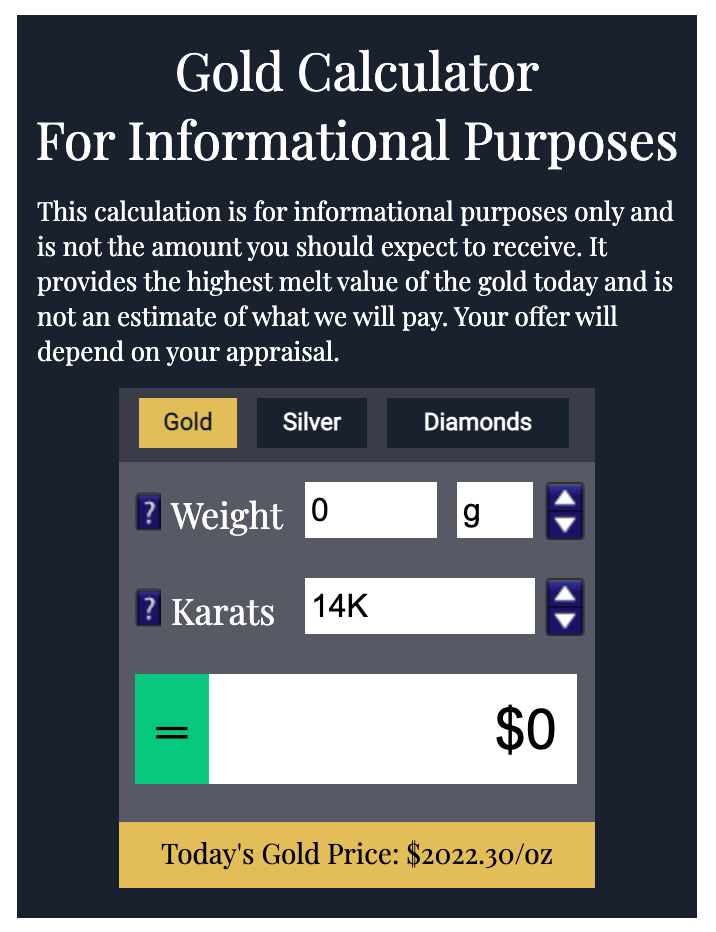
Selling gold bullion is no harder than selling any other gold item. You can get an estimate on the price of your gold bullion gold calculator that is based on the current price of gold.

Will banks buy gold bars?

Banks nor credit unions buy gold anymore, including bars and bullion.

What is bullion gold worth?

Gold bullion — whether in bars or coins — is the price of 24K gold. Reputable gold bullion buyers will pay you close to the current price of gold, since the buyer stands to make money as the value of gold appreciates.

How much is a gold bar worth?

The value of a gold bar is the spot price of gold times its weight. For example, at a spot price of $3,245 per ounce (April 15, 2025 price).

Ladder Life insurance promotes its low premiums with an easy online signup process and no medical exam for policies up to $3 million. 

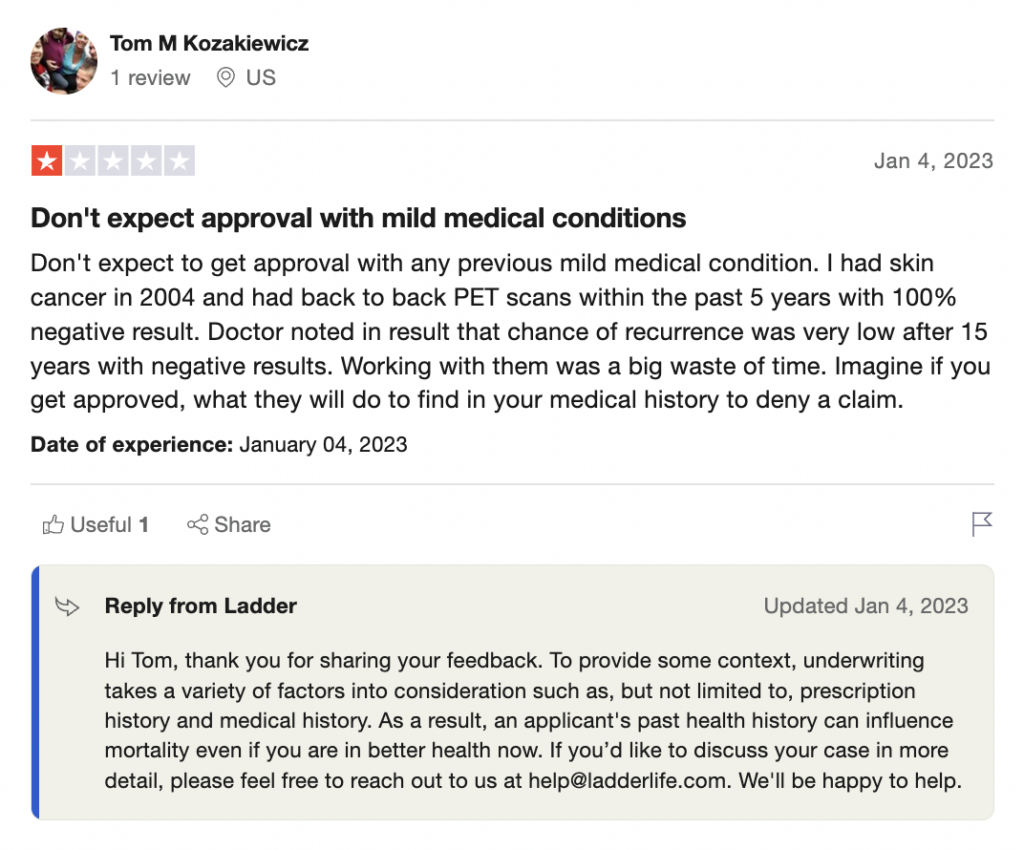
These claims are accurate. However, if you have any medical conditions or you’re overweight — like me — you may not be able to get coverage through Ladder.

While Ladder is one of the newer life insurance brands, its coverage is backed by long-established and reputable life insurance providers. 

Or, keep reading for our full Ladder Life insurance review:

What we found when reviewing Ladder Life

  1. Ladder is a legit life insurance company
  2. Ladder is not for everyone
  3. No medical exams
  4. Flexible policies

How we evaluated and rated Ladder

Ladder customer reviews

How much does life insurance from Ladder cost?

How does Ladder Life insurance work?

Pros and cons of Ladder

My Ladder Life insurance experience 

Ladder alternatives

What we found in our review of Ladder Life: 4 things to know

These are the main things you need to know if you’re considering Ladder Life insurance coverage, based on our deep research and personal interaction with the product: 

1. Ladder is a legit life insurance company

Ladder Life insurance policies are issued by A+ Better Business Bureau-rated insurance providers, who have been paying out claims for decades: 

  • Fidelity Security Life Insurance Company, A.M. Best rated A
  • Allianz Life Insurance Company of New York, A.M. Best rated A+
  • Allianz Life Insurance Company of North America, A.M. Best rated A+

2. Ladder is not for everyone

Ladder only issues new policies to people who are between the ages of 20 and 60 in relatively good health (your age is determined by your nearest birthday). You may be denied coverage if you: 

  • Have a high BMI 
  • Suffer from chronic medical conditions
  • Have financial issues (for instance, if you are unemployed)

Ladder will not cover you past 70 years of age. If you are 55 years old, for example, the longest term you can get is 15 years.

Ladder Life insurance only covers U.S. citizens or lawful permanent residents who have lived in the United States for more than 2 years.

A representative from Ladder said the company has no set criteria to determine a person’s eligibility, and each application is considered on a case-by-case basis. However, after inputting my height and weight in the initial form, I was instantly directed on the next page to check out another life insurance company, TruStage, one of Ladder’s partner insurers. 

This wasn’t an outright denial but rather a suggestion that Ladder likely wouldn’t be able to cover me if I submitted my questionnaire. 

3. No medical exams

Ladder does not require a medical exam for policies less than $3 million. The company uses a pre-screening questionnaire to weed out unqualified candidates, so you don’t have to waste your time going to a health check only to be denied coverage. That said, not everyone will pass this stage and be offered a policy.

4. Flexible policies

A unique feature, Ladder gives people the option to change their coverage level overtime as their financial needs change. They call this “laddering up” or “laddering down,” which can be requested at any time from your online account, no extra fees involved.

Ladder promotes this feature as being as easy as a few clicks on your smartphone. However, the process is really more manual and old-fashioned than that.

If you request to ladder up your coverage, it will likely take time for the underwriting team to process your application, since they treat the request like a new application. If you are not instantly approved, it could take anywhere from two weeks to two months to hear back about a decision.

This new policy will be based on information you submitted in your initial application, though Ladder’s underwriting team may follow up with questions about your previously submitted or current health/financial information. You may not be approved for the increased coverage. 

However, if you choose to ladder down your coverage, there is no waiting period, and the change is effective immediately.

Note that changing your coverage options will increase or decrease how much money you pay for your policy.

How we evaluated and rated Ladder

We evaluated Ladder in comparison to other online life insurance companies based on:

  • Coverage – Amount of coverage available, variety of coverage options
  • Ease of application – Online questionnaire, medical exams, overall user experience
  • Price – Cost of coverage
  • Customer service – BBB reviews/my personal experience with customer service
  • Customer reviews – Customer ratings across major review sites 

These are our ratings:

Our Ladder Life ratings:
  • Coverage
  • Ease of application
  • Price
  • Customer service
  • Customer reviews
4.4

What others say about Ladder

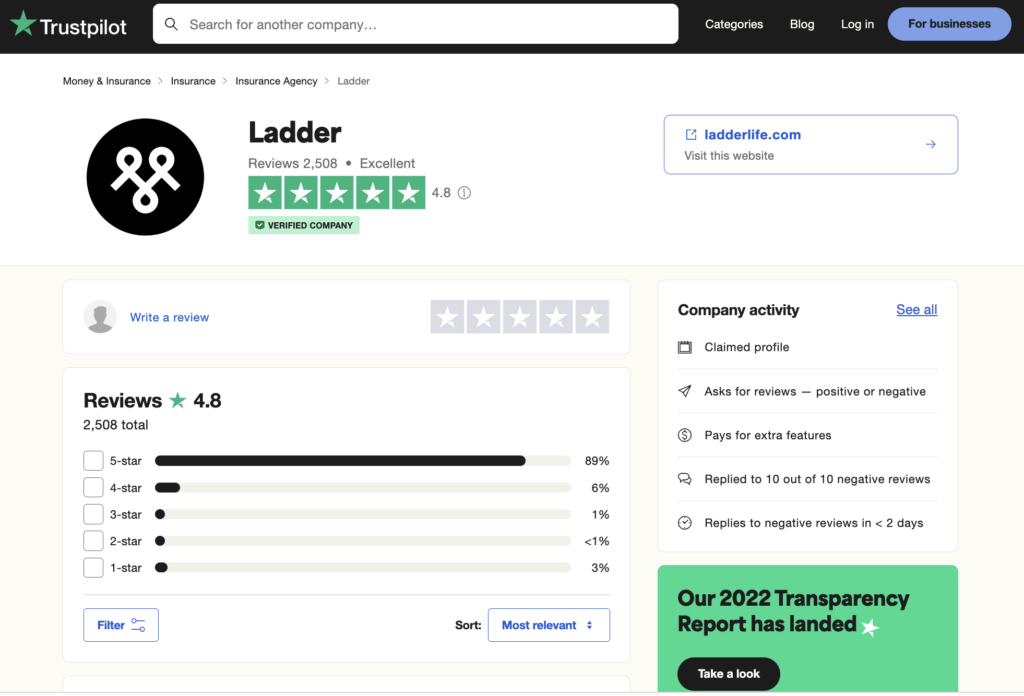
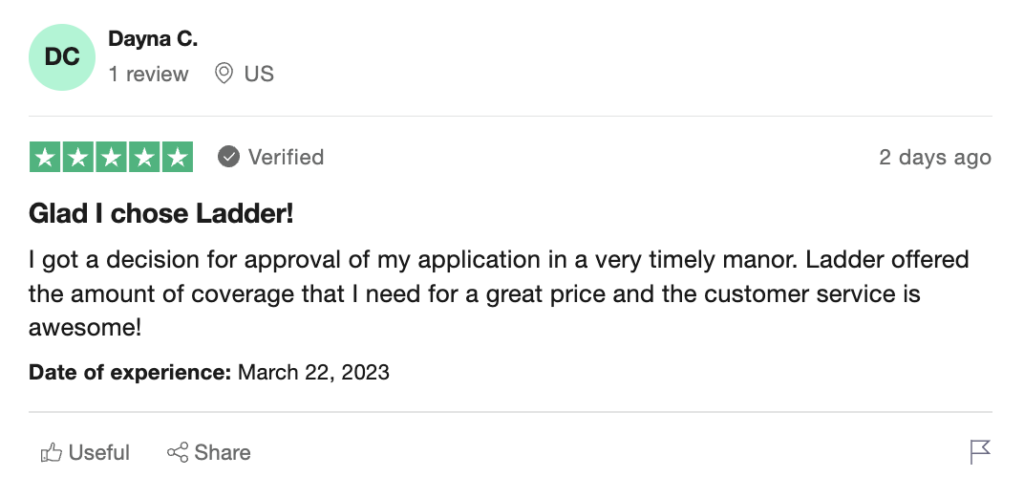
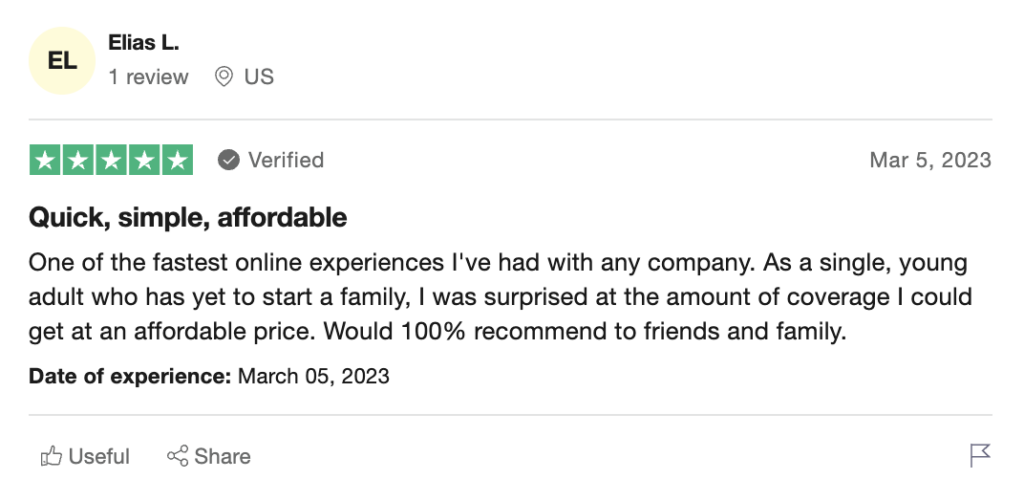
Online Ladder Life insurance reviews are overwhelmingly positive:

BBB rating and reviews

Ladder itself does not have a Better Business Bureau profile. However, its policies are issued by three insurers that all have an A+ BBB rating:

  • Fidelity Security Life Insurance Company
  • Allianz Life Insurance Company of New York
  • Allianz Life Insurance Company of North America

None of the reviews on these pages specifically mention Ladder. 

Trustpilot rating and reviews

Ladder has 4.8 out of 5 stars on Trustpilot based on more than 2,500 reviews, most of which are 5 stars. 

Ladder Insurance review Trustpilot page.

Reviewers note the ease of application and low policy pricing. The rare negative reviews are typically from people who were denied coverage based on a medical condition: 

5-star Ladder Insurance review on Trustpilot.
5-star Ladder Insurance review posted on Trustpilot.
1-star Ladder Insurance review posted on Trustpilot.

What Redditors think about Ladder

There is a Ladder_Life_Insurance subreddit that appears to be run by Ladder, since most of the content is informative and advertises the benefits of signing up for Ladder.

Other Reddit threads are individual users scoping out life insurance policies, though few users have responded: 

Ladder Life + Marijuana Use
byu/rideonup inLifeInsurance
How many are using Life Insurance Ladders to save money?
byu/DoctorLinus inFinancialPlanning

Common complaints

Most complaints about Ladder are from people who were denied coverage. Others note that it may take a long time to get a coverage decision if you aren’t instantly approved — one person claimed to have waited 8 weeks before being denied. 

1-star Ladder Insurance review complaint posted on Trustpilot.

How much does life insurance from Ladder cost?

Ladder life insurance premiums start at just $5 per month, with coverage ranging from $100,000 to $8 million.

As a real-life example, I sought policy estimates for a 50-year-old male with the following stats: 

  • 6’ tall
  • 250 pounds
  • Used tobacco/nicotine products weekly in the last 12 months
  • Income of $100,000 
  • 2 children
  • Remaining mortgage balance of $100,000

Based on $100,000 of coverage (which is the only amount this man was recommended), this is his estimated price if approved for a policy: 

  • 10 years – $2.62/day
  • 15 years – $3.13/day
  • *20 years – $3.81/day

*This is the longest policy he would be able to purchase through Ladder since they don’t issue coverage past 70 years.

Ladder Insurance review estimate for 50-year-old man.

As a cost comparison, I requested an estimate for a 30-year-old woman with the following stats: 

  • 5’5” tall
  • 150 pounds
  • Non-smoker
  • Income of $40,000/year
  • No children
  • No mortgage balance

This woman’s suggested coverage range was between $400,000 and $1.2 million. However, for the purpose of direct comparison, I set her coverage at $100,000:

  • 10 years – $0.34/day
  • 15 years – $0.37/day
  • 20 years – $0.40/day
  • 25 years – $0.51/day
  • 30 years – $0.52/day
Ladder Insurance review estimate for 30-year-old woman.

How does Ladder Life insurance work?

Ladder uses a simple online application process to determine eligibility for life insurance coverage. Based on your answers to their questionnaire, you’ll either be: 

  1. Instantly denied or approved
  2. Notified if you qualify after a thorough underwriting process, which may take anywhere from two weeks to two months

Ladder’s questionnaire asks information about:

  • Medical history
  • Income/financial status
  • Beneficiaries
  • Other life insurance policies you have in place
  • How much coverage you need and for how long
Ladder Insurance review estimate for one million dollars.

If you are approved for coverage, Ladder will pay out your coverage amount — known as a death benefit — to your beneficiaries in the event you die while covered. 

Details about Ladder life insurance policies

If you’re considering a Ladder Life insurance policy, here’s what you need to know: 

What kind of insurance is Ladder Life?

Ladder Life only offers term life insurance coverage, which means they cover you for a set period of time at a fixed rate, with a specific sum paid to your beneficiaries at the time of your death. 

This differs from whole life insurance coverage, which provides permanent coverage that builds cash value over time. Forbes did a cost comparison of whole vs. term life insurance policies and found that whole life policies were about 5 to 7 times more expensive, depending on the person applying for coverage.

What policies does Ladder offer?

Ladder offers term life insurance coverage from $100,000 to $8 million for a period of 10,15, 20, 25, or 30 years. 

Use Ladder’s life insurance calculator to determine how much life insurance you need. 

Does Ladder offer riders?

Ladder does not offer riders — add-on provisions that provide additional insurance coverage — because they “believe that riders complicate life insurance and do not provide a significant benefit for their added cost.” 

Examples of life insurance riders include guaranteed insurability, accidental death, waiver of premium, family income benefit, accelerated death benefit, child term, long-term care, and return of premium riders.

Self-employed? You need disability insurance

Does Ladder Life pay out?

Ladder policies are issued by insurers with long, proven histories of paying claims. As long as the death occurs within the policy term, your beneficiaries will be paid your death benefit at the time of your passing in one lump sum. If you die after the policy term, there will be no payout. 

Ladder does not pay out claims for deaths by suicide within the first two years of coverage and in cases of fraud. 

Pros and cons of Ladder

These are some of the benefits and drawbacks of Ladder Life insurance coverage: 

Pros

  • No medical exams for policies less than $3 million
  • Policies up to $8 million
  • Quick questionnaire that takes less than 20 minutes to complete
  • Instant decisions if you don’t have major health concerns
  • Locked-in pricing that doesn’t increase if your health status changes or as you age
  • Ability to “ladder up” or “ladder down” coverage based on your needs
  • App available for iOS devices
  • Live chat customer service option (with actual human people) from 7 a.m. to 4 p.m. PT
  • No cancellation fees
  • $50 referral credit given for each friend you refer who receives a coverage offer (not available in Louisiana, Michigan, Mississippi, Montana, New Mexico, Washington or West Virginia)

Cons

  • Does not cover people with certain health conditions, including obesity
  • Approval may be delayed if your application needs further review — for instance, if you have medical conditions that don’t automatically disqualify you from coverage
  • If you are older than 60, you cannot be covered, and you can only purchase coverage that lasts until age 70
  • Only offers term life insurance 
  • No riders or supplementary coverage
  • Live chat and customer service only available weekdays from 7 a.m. to 4 p.m. PT

Can’t afford health insurance? 5 health insurance options for single moms

My Ladder Life insurance experience 

Before I started Ladder’s application process, I was pretty positive I would be denied coverage based on my high BMI and medical conditions — namely asthma, PCOS, and a condition called IIH. I have tried and failed to apply for life insurance coverage in the past through other online providers. 

For reference, I am a 32-year-old, non-smoking woman. I want life insurance to replace my income for my husband and two children (4 and 9) in the event that I die before they are financially independent. 

It’s frustrating not being able to provide that safety net for my family, but I know I’ll have a tough time getting life insurance from any provider until I lower my weight. I’m not sure if my medical conditions alone would disqualify me from coverage. 

I’ve previously applied for coverage from Ethos Life Insurance and was instantly denied after going through the questionnaire, which included questions about my health history and financial status (income, debt, mortgages, etc.).  

I applied for Ladder on my laptop computer, though they do have a mobile-friendly site and mobile app available for iOS if you prefer. 

After inputting my age, weight, height, sex, and smoking status, I got a screen that suggested one of Ladder’s partner insurers, TruStage, might be a better fit for me. (Spoiler alert — it wasn’t. I was denied.) 

Ladder Insurance review referral to TruStage.

I was curious if changing my weight on Ladder’s application would change my result, and when I did, I was allowed to continue through the rest of the questionnaire. (Note that I did this strictly for research purposes, with no intention of actually starting a policy. If you open a life insurance policy with false information, you can be charged with fraud or your loved ones may be denied a payout at the time of your death if the information you provided isn’t accurate.) 

After I finished answering the questions, I wasn’t given an instant decision but was instead told that Ladder’s underwriters needed more time to review and verify my information, a process they said usually takes about two weeks but could take up to two months.

Ladder Insurance review application complete.
Ladder Insurance review waiting period.

Ladder vs. other life insurance companies

While most life insurance coverage is relatively the same, Ladder stands out because of its: 

  • Low premiums
  • Easy online application process
  • No medical exam for policies less than $3 million
  • Ability to increase and decrease coverage as your needs change

You can also check out our reviews of Bestow Life Insurance and Ethos Life Insurance, two other online insurance providers that offer term life insurance coverage with no medical exams.

Bottom line: Ladder is worth considering if you need to buy life insurance

If you are a relatively healthy adult between the ages of 20 to 60, Ladder is a solid life insurance option.

If you’re not sure how much life insurance you need or you want to learn more how to choose the best policy for your needs, check out our guide to life insurance for single parents.

Does Ladder Life require medical exam?

No medical exam for policies up to $3 million.

Does Ladder Life pay out?

Ladder policies are issued by insurers with long, proven histories of paying claims. As long as the death occurs within the policy term, your beneficiaries will be paid your death benefit at the time of your passing in one lump sum. If you die after the policy term, there will be no payout. Ladder does not pay out claims for deaths by suicide within the first two years of coverage and in cases of fraud.

Gold teeth and caps, gold dental implants, gold fillings, bridges, bridges, gold inlays and onlays are valuable dental scrap that can add up to a nice profit.

As gold prices in general have skyrocketed in the past few years, dental gold is worth more than ever.

At current spot gold prices, a 3-gram, 16K gold tooth is worth about $300, and a 10-gram, 16K gold bridge is worth about $1,000+, before buyer commissions.

Tip: If you're having gold fillings redone, ask your dentist for the dental scrap. Legally, it's yours.

What you need to know about selling dental scrap:


Gold prices keep hitting new highs, thanks in part to market turmoil amid tariff wars. In January, 2026, gold is hitting new record highs near $4,700, nearly double a year earlier:

Yahoo finance ticker price of gold gold futures january 19 2026

Below are different ways you can sell your dental gold, answer commonly asked questions about gold dental scrap, and details on our No. 1 one recommendation for places to sell dental gold:

CashforDentalScrap, whose parent company has an accredited A+ BBB rating, and pays within 24 hours. Free FedEx or USPS shipping. Get a free quote now (no minimum value).

3 types of dental gold scrap buyers

Read more about selling gold scrap of all kinds and learn about the best ways to sell your gold for the most money possible, safely:

1. Online dental gold scrap buyers

Online gold buyers offer a more private and convenient process if you don't want to sell your dental gold in person.

Our number one recommendation for dental gold buyers is CashforDentalScrap.com because they’re known to pay top dollar, fast, especially since they offer a highest price guarantee.

Here are a few of the biggest reasons we we think CashforDentalScrap.com is the best dental scrap buyer:

  • A+ rating with the BBB
  • Free shipping
  • Insured up to $150,000
  • Payment in as little as 24 hours
  • 10% bonus payment if you send your dental gold in for appraisal within 7 days of receiving your mailer
  • Buys gold in any form: Gold crowns or caps, gold teeth, gold bridges, PFMs — porcelain fused to metal — or PFGs — porcelain fused to gold — as well as jewelry and coins
  • Buys gold, silver, diamonds, or platinum: CashforDentalScrap.com has sister sites that will buy those materials from you, all with the same guarantees.

Read more about this family-run company in our CashforGold review post.

Other online gold buyers you might consider include:

  • Abe Mor
  • American Bullion
  • APMEX
  • CashforGoldUSA
  • Goldco Precious Metals
  • Gold Geek
  • JM Bullion
  • Kitco
  • Liberty Gold and Silver
  • Luriya
  • Money Metals Exchange
  • Royal Refining
  • SellYourGold.com

2. Search for: “Dental scrap buyers near me”

If you would specifically like to deal with a local business when selling your dental gold, doing an online search for “dental scrap buyers near me” or “where to sell dental gold near me” will give you a list of local buyers you can consider. This will most likely include pawn shops, gold exchanges, and maybe even jewelry shops. 

Read more about our investigation of selling gold scrap locally and online.

It’s important to note that not all pawn shops or gold exchanges will purchase dental gold, as it can be more difficult to determine the purity of the gold quickly. If they do buy dental scrap, you can expect them to pay less than an online buyer. Do your research when you are looking for who buys dental gold “near me.”

Read more about our investigation of selling gold scrap locally and online.

3. Local cash for gold businesses

Searching for “cash for gold places near me” will most likely return a similar list to the one above, including pawn shops, jewelry stores and gold exchanges. The upside of businesses is you will get cash quickly — usually immediately. Depending on the business, you may also get a good price.

How to value dental gold

Learn how to value dental gold.

Ultimately, the dental gold value of your dental scrap depends on its purity, weight, and how much work must go into extracting it from the dental component.

Gold buyers, including CashforDentalScrap.com, buy:

  • Dental sweeps
  • Gold crowns
  • Gold bridges
  • Silver crowns
  • Silver bridges
  • Platinum crowns
  • Platinum bridges
  • Palladium crowns
  • Palladium bridges
  • Mixed precious metal dental work
  • Bridges
  • PFM’s (Porcelain Fused Metal)
  • PFG’s (Porcelain Fused Gold)
  • Inlays
  • Onlays
  • Caps
  • Gold partials
  • Casting grain
  • Polishings

What karat is dental gold?

The purity of your dental scrap is essentially its karat value, which determines exactly what percentage of gold the metal contains. Dental gold is most commonly an alloy of 16K, but can range from 10K to 22K. If you are unsure about the purity of your gold, it’s even more important for you to choose a trustworthy dental scrap buyer who you are confident will be honest with you as they complete their analysis.

Karats% of gold purityApprox. value per gram (spot gold = $4,665/oz Jan. 2026)Fineness
9K37.5%$56375
10K41.7%$63416 / 417
12K50.0%$75500
14K58.3%$88583 / 585
18K75.0%$113750
22K91.7%$138916 / 917
24K99.9%$150999

You can get an idea of the value of your scrap dental gold with CashforGoldUSA's gold calculator, which factors in the current price of gold, before the gold buyer's commission:

CashforGoldUSA informational gold calculator

How to tell if your gold is real

Is dental gold worth more than regular gold?

Gold value is based on weight and purity, whether it is dental gold, a necklace, coin, or gold bar. However, sometimes dental gold is worth slightly less than these other assets if the buyer needs to work to extract the tooth from the other materials.

How much is a gold tooth worth?

At a spot price of about $150 per gram of pure gold, before the buyer’s commission, the estimated melt value of a gold tooth ranges from about $300 to $600, depending on weight.

WeightGold purityEstimated melt value*
3 grams16K / 67%$300
4 grams16K / 67%$400
5 grams16K / 67%$500
6 grams16K / 67%$600


How much are gold grills worth (to resell)?

A grill, or grillz, is a decorative metal fitting across the front of your teeth — they can be fitted with gold, silver or gemstones. Learn more about selling your diamonds. Grillz can be any karat gold, and are weighed based on the number of teeth in the grill x ~1 gram per tooth. Based on a spot price of $150 per gram, your 6-tooth grill may be worth about:

Based on a spot price of $150 per gram of pure gold, a 6-tooth grill (6 grams total) may be worth approximately:

Karat Gold purity Estimated melt value (6 teeth)
10K 41.7% $375
12K 50.0% $450
14K 58.3% $525
16K 67.0% $603
18K 75.0% $675
22K 91.7% $825


How much is a gold dental crown, filling or dental bridge worth in scrap?

A typical gold crown or filling weighs 2–5 grams of alloy at 60%–85% purity. Larger crowns and caps can weigh 5–20 grams.
At a spot price of about $150 per gram of pure gold, before the buyer’s commission, the estimated melt value of a 16K (67%) gold crown or cap is approximately:

WeightGold purityEstimated melt value*
2 grams16K / 67%$201
3 grams16K / 67%$302
4 grams16K / 67%$402
5 grams16K / 67%$503
10 grams16K / 67%$1,005
15 grams16K / 67%$1,508
20 grams16K / 67%$2,010

How much is a porcelain fused metal (PFM) tooth worth?

PFM is very low value, worth only up to $10 per gram and bought in large batches from dentists and dental labs.

FAQs about selling dental gold scrap

What's dental gold, anyway?

Dental gold is typically an alloy, which means it's a mixture of pure gold with another metal such as silver, palladium, nickel or chromium. Dental gold can be used as a crown, filling, or other restorations. In the last couple of decades, some pop culture icons have adopted gold “grills” or “grillz,” which are, basically, dental jewelry.  

What do dentists do with gold crowns and dental scraps they remove?

Dentists should offer the gold to their patients and let them know that the gold can be sold for scrap. According to our research, most patients say no thank you. It could be because they don't realize there is no difference between dental gold vs real gold!

Many dentists sell the scrap gold back to the labs that make gold fillings, gold teeth, gold crowns and gold dental overlays.

How do dental gold buyers make money?

Dental gold buyers make money using a pretty simple business model. 

First, they buy gold dental scrap from dentists and dental offices — or directly from individuals. Then, they process the scrap, if necessary, to separate the metal from any other components (such as teeth, porcelain, etc.). Next, they must melt the dental scrap down in order to separate the pure gold from any other metals which were added to make it stronger, or sell the alloy to a refinery who takes on this step.

What remains is pure gold, which will typically be cast into an ingot, bar, or other form and then sold on to a buyer who will use it to create something brand new with the gold. 

Dental gold buyers ultimately make money by reselling the gold that they purchase and process. For this reason, when a dental gold buyer buys your scrap gold, they’ll never pay you the full value of your gold. If they did that, they wouldn’t be able to turn a profit themselves, and there’d be no reason for them to be in business. 

The question then becomes: How much money should you expect for your gold? What percentage of the value of your gold is a good deal? 

The answer to that question will depend on the buyer you ultimately sell your gold to.

What are dental gold buyers paying?

How much money you’re paid for your dental gold will depend on the current spot price of gold.

Online buyers typically pay more for your gold than other buyers, like pawn shops or in-person gold exchanges. A good deal will pay somewhere between 70% and 90% of the dental gold value.

Bottom line: Sell dental gold online to get the best price from a scrap gold buyer

Online buyer CashforDentalScrap.com is our No. 1 recommendation thanks to:

  • Better Business Bureau A+
  • In business since 2005
  • Get paid within 24 hours of accepted offer
  • Free, insured shipping up to $150,000
  • Free, no-questions-asked returns
  • Buys all gold of any purity and weight

Get started selling your dental gold with CashforDentalScrap.com now.

CashforDentalScrap and its sister sites CashforGoldUSA, DiamondsUSA and CashforSilverUSA buy all quantities and quality of gold, diamonds, silver, flatware, coins, jewelry and fine watches.


How can I sell my dental gold?

You have three options for selling dental gold: online gold buyers, local gold buyers like jewelry shops, and cash for gold shops like gold exchanges.

What karat is dental gold?

Most commonly, dental gold will be 16 karats.

How much is dental gold worth?

Ultimately, the value of your dental scrap will depend on three key factors: Purity, weight, and how much work must go into extracting it from the dental component. A gold tooth can be worth $300 to $1,000

What are dental gold buyers paying?

How much money you’re paid for your dental gold will depend on the current spot price of gold.

How much is a gold dental crown worth in scrap?

A typical gold crown will be 2 to 5 grams of alloy at 60% to 85% purity can fetch $350 to $2,000 in scrap.

How much is a gold dental bridge scrap worth? 

A typical gold bridge will be 5 to 20 grams of alloy at 60% to 85% purity, and fetch $250 to $1,400 in scrap gold.

Can you ever be truly prepared for divorce? While you can’t see the future, there are some key steps you can take to get ready for the process, according to top divorce experts. 

Below, experts share their best advice on how to prepare for divorce, providing you with a detailed roadmap before proceedings are underway.

Wondering how to prepare for divorce? Here’s what you should know:

Table of contents

How to prepare for divorce: Decide if you are ready

If you’re on the fence about getting or preparing for a divorce, there are some telltale signs you might be ready. Ultimately, speaking with a divorce lawyer for women can provide early clarity on your position, helping you understand your rights, options, and what a fair outcome may look like. This kind of guidance can also make it easier to plan your next steps with confidence, particularly if there are children or complex dynamics involved.

“Overall, it's a question of personal happiness that includes not only relationship satisfaction but also child and financial considerations,” says Susan A. Hansen, partner at Hansen & Hildebrand, S.C., based in Milwaukee. Hansen is also the co-founder of the Family Mediation Center, which provides collaborative divorce and mediation services.

In this section, we’ll review the most common signs and causes of divorce:

Should I get a divorce? Signs you might be ready

  • You stop arguing
  • You prefer to spend more time with your friends or family than your husband or wife
  • You stop making future plans
  • You regret getting married
  • You have reason to be secretive about your phone
  • You start worrying about money in the event you find yourself single
  • Your spouse is showing signs he or she is ready for divorce

Hansen recommends anyone contemplating divorce to consider joint therapy with a professional who has experience in marriage discernment counseling. 

“A skilled couples counselor can help couples consider what needs to change to remain married or what is needed to move forward with divorce with dignity and compassion,” Hansen says. 

More in this post if you're thinking about divorce.

Common causes of divorce

Here are common causes of divorce, according to studies and polls, including those published in a 2020 edition of Journal of Sex & Marital Therapy, as well as Journal of Divorce & Remarriage and a 2019 edition of Journal of Divorce & Remarriage

  • Money
  • Lack of respect
  • No sex or bad sex
  • You grew apart
  • Cheating
  • Parenting disagreements
  • Addiction
  • Irreconcilable differences

Katherine Eisold Miller, founding attorney at the Miller Law Group in New York, says in a lot of divorces, there is a breakdown in communication, where each person feels misunderstood and maligned by the other.

“That mistrust — whether or not it is based on reality — is malignant, and if left unaddressed for too long will poison the relationship beyond repair,” Eisold Miller says.

Some states require divorcing couples to legally separate for a set period of time. Other states, including Texas, do not offer legal separation as an option at all — you are either married or not married.

If you are 100% ready to end the marriage, you are ready to divorce. However, there are some financial and legal advantages to both being legally separated as well as divorced.

Reasons people stay legally married, but attain a legal separation include:

  • Uncertainty about ending the marriage
  • Health insurance that one spouse can get for free or lower cost through his or her spouse's employer or business
  • Staying married for a certain period longer allows one spouse to be eligible for the other’s pension, Social Security, or other retirement benefits
  • One or both spouses want to avoid divorce for religious reasons
  • Tax reasons

How to prepare for divorce: Steps to take if you're ready

Once you’ve decided you want to move forward and start preparing for divorce, there are some things you should do before filing:

1. Make a self-care plan

Enlist a trusted therapist for support. “Divorce is emotionally and mentally draining,” says Statesville, NC-based divorce lawyer Dustin S. McCrary, who was recognized by Super Lawyers as a Rising Star in 2019. “You need to be proactive in taking care of yourself.” 

Family and friends can act as sounding boards, but you need an objective professional to confide in, according to divorce and family lawyer Raiford Dalton Palmer, author of the best-selling divorce guide I Just Want This Done.

Affordable therapy options, even free ones, can help reduce the financial burden of counseling. Connect with a certified mental health professional through BetterHelp.com. Read our review.

Take care of yourself: take walks outdoors, eat nourishing meals, get proper sleep, and engage in relaxing practices like meditation or yoga.

2. Set goals

McCrary suggests proactively setting goals for the divorce to help keep you on track. “You must know what you want before you can start on the journey,” he says. Write down what you want from the proceedings and revisit these goals throughout the process to help you stay focused. 

Whether you want to start a business, buy a home, or invest and build wealth, give yourself something to work toward post-divorce.

3. Lead with your head, not your heart

It takes work and some self-control to have an amicable divorce. 

“Strong emotions come up, and what you do with those feelings will have a big impact on how amicable a divorce will be,” Eisold Miller says. 

Try not to get too nostalgic about your spouse either. “Don’t underestimate your spouse and don’t trust their threats,” says Jill Spielberg, the matrimonial and family law partner at Abrams Fensterman, LLP in White Plains, N.Y., who specializes in high-net worth cases and high conflict custody litigation.

“Do not let your spouse scare you into staying married. They are likely trying to manipulate you.”

4. Get familiar with the process

Every state has its own rules and processes for filing for divorce. Familiarize yourself with the divorce process in your state. 

“Before filing, bone up on your state’s laws governing divorce,” advises award-winning financial journalist Margaret Price and financial planner Jill Gianola, co-authors of Single Women and Money: How to Live Well on Your Income. “Find out what legal steps are required to file, and which rules cover distribution of assets and allocation of alimony and child support.”

Also assess the pros and cons of alternative dispute resolution (ADR), such as mediation or collaborative practice, versus going to court. Although avoiding court may seem tempting, you can’t predict how amicable your spouse will be before proceedings begin.

5. Set up a P.O. box, change your email, phone, and computer passwords

You will need to be able to privately and confidentially communicate with your lawyer, as well as anyone else you might speak to about your divorce.

To receive correspondence from lawyers, and other important and private information, get your own personal address via a P.O. Box. This is especially important if your spouse does not know that you are considering a divorce and if you would prefer to keep it that way.

Also get a separate email address, if you and your spouse share one.

Changing your passwords can also protect any electronic evidence you may need for the divorce, Spielberg says. “Spouses often try to delete proof of wrongdoing when they see a divorce is imminent,” she explains. 

According to a Pew Research report, 67% of spouses share passwords. Protect your information and privacy by securing your online accounts. 

6. Locate and secure important documents and valuables 

Aside from gathering financial documents, put your passport, your children's passports, and any jewelry or valuables you want to ensure possession of in a secure place.

“Spouses can take these items and temporarily hold them as leverage,”  Spielberg says. “This step prevents that from happening.” 

Bank accounts.

These include checking, savings accounts, CDs, money market accounts.

List of all assets of any value

If there is any question, get them appraised. These can include:

  • Real estate
  • Jewelry
  • Art
  • Cars and other vehicles of significant value. Check the value at KellyBlueBook.com
  • Time share
  • Any personal items of significant resale value, such as clothes, handbags, sports equipment, furniture, furs, electronics

If you’re self-employed or missing recent pay records, using an online pay stub maker can help you generate accurate pay stubs for income verification and budgeting during divorce.

Names and birth date of minor children you have together

If you and your spouse share children, you’ll need to collect the following:

  • Birth certificates
  • Social Security Numbers
  • Dates of Birth
  • Medical records (including for eye doctor and dentist)
  • Allergy information
  • List of prescriptions and any special care instructions 
  • School records (including their current class schedule and extracurricular schedule)
  • Current childcare arrangements (daycare, preschool, etc)
  • Current custody arrangements and child support arrangements (if applicable)
  • Child-specific expenses, such as tuition, medical bills, and the cost of extra-curricular activities

Co-parenting with a narcissist

Financial information

Collect the account numbers and current balances of each of the accounts below for the past year. Ensure that you have the correct login information for joint accounts.

  • Savings and checking accounts.
  • List of the contents in any safety deposit boxes
  • Inheritance details (what was inherited, from who, when)
  • Credit cards
  • Health Savings Accounts (HSA)/Flexible Spending Accounts (FSA)
  • Retirement accounts (401ks, IRAs, 403bs, pension,etc.) and other investments, such as brokerage accounts, bonds, etc.
  • Life/disability insurance policies
  • A copy of your and your spouse’s credit report

Payment history

Make a list of all of the monthly bills paid by you or your spouse and copy a year’s worth of statements. Be sure to write down the account numbers and current balance.

  • Mortgage / home equity line of credit
  • Any non-mortgage debt (car loans, student loans, personal loans)
  • Utilities (electric, water, phone, cable, etc)

Marital home information

Your marital house is likely the most valuable asset and its value will be a big part of how you divide assets in your divorce.

  • Take photos of each room in your home, being sure to detail any damage, current conditions, etc.
  • Obtain an appraisal of the home
  • Copy of the deed
  • Final escrow statement from close of escrow/settlement statement
  • Renters or homeowners insurance policy
  • Leasing agreements
  • Real estate/property tax bill for the past year

Vehicles

You will need a copy of the title, registration, and loan statements (if necessary) for any vehicles owned by you and your spouse, including:

  • Automobiles
  • Boats
  • Trailers
  • Motor Homes
  • Machinery such as tractors, excavators, bulldozers, and the like

Personal property

If you have any valuable property not already discussed, be sure to document them in a list alongside the purchase price, estimated resale value, ownership records, appraisal value, receipts of purchase (if possible). It can also be beneficial to photograph the items. This should include:

Retirement accounts

Retirement accounts that you need to consider include IRAs, Roth IRAs, 401(k)s, SEP IRAs, 403(b)s, 457's Thrift Savings Plans, TIAA-CREF,  pensions and Social Security benefits.

This will all need to be discussed and likely divided, in your split.

Income information: Pay stubs, tax returns

  • Copies of state and federal tax returns for the previous three (3) years and all corresponding W-2 or 1099 statements.
  • Copies of corporate tax returns for the previous three (3) years if one or both spouses have a business.
  • Paystubs for you and your spouse (past six months is fine)
  • A list of any employer-provided benefits such as employer-provided health insurance, life insurance, disability insurance, stock-options, etc. 
  • Related post: What single moms and dads need to know about taxes

Life and disability policies

Every parent of a minor-aged child should consider life insurance, no matter how much money you earn, or whether you are dependent on child support, public benefits or others' generosity. Fortunately, there are affordable, and easy ways to find affordable life insurance for almost every budget.

You need disability insurance. Those who do not have disability insurance through a job, including the self-employed, can find individual coverage through reputable companies for an affordable price. Learn more about disability insurance and how to buy it if you are self-employed.

Will and estate document

Even more important now than ever, as a single parent, if you do not have a will, you need a last will and testament (also known as a legal will), as well a living will.

Related: Rocket Lawyer review

7. Assemble your divorce team

These are some professionals you may need to hire during the divorce process: 

As you prepare for divorce, assembling a reliable team of professionals, including legal and financial experts can help you navigate the process more effectively.

For guidance through the legal steps and to ensure your rights are protected, consider consulting experienced divorce lawyers in Newcastle who can help navigate the process.

8. Focus on low-conflict and equality

“How you start a divorce will have a profound impact on whether it is amicable or high conflict,” Hansen says.

She says it helps to view divorce as a restructuring of family and finances rather than a win-lose battle.

Studies find that when parenting time is shared equally between parents, the kids fare better, there is less conflict in the divorce overall, and both men and women fare better as single parents.

Learn as much as you can about co-parenting, and consider taking a parenting or co-parenting class.

Beware of these 18 sneaky divorce tactics so you can overcome them

9. Focus on earning more

Often divorcing spouses find ways to lower their incomes, forego promotions or raises, hide money or otherwise make it appear on the books that their income is lower than it actually is — all to angle for paying less alimony or child support — or qualifying for more.

Once exposed this will look bad in court or result in any negotiations breaking down. I advise divorcing women not to fall into the trap of financial dependency — but focus on earning and financial independence.

“The whole point of divorce is to move on into a new and better life — and you can't do that if you spend your energy trying to be financially tied to this man,” says Johnson, who wrote The Kickass Single Mom (Penguin), a No. 1 Amazon bestseller.

Check out these posts for ways to make more money: 

10. Gather your financial records

Molly Ward, a certified financial planner (CFP) and certified divorce financial analyst (CDFA) with Equitable Advisors in Houston, says you should gather important documents such as: 

  • Tax returns
  • Pay stubs
  • Employee benefits
  • Current statements for all bank, investment, and retirement accounts
  • Insurance information
  • Pension estimates
  • Credit reports from the three major bureaus (Equifax, TransUnion, and Experian) 

11. Create a post-divorce budget

You need to know as soon as possible what your new financial situation will look like and you need to be realistic — including if you are a stay-at-home mom, McCrary adds. “There is going to be a change in your standard of living,” he says. “Be prepared for that.” 

How can you best prepare? Price suggests setting up a budget your expected costs of necessities, which includes food, clothing, housing, and transportation for both you and your children, and then compare that cost with your expected post-divorce income.

You should also consult Social Security for details about claiming your entitlements as a divorced spouse and take changing health insurance options into account if you’re on your spouse’s plan.

12. Evaluate the true value of your assets 

Know what your assets are really worth.

“For example, a traditional $10,000 IRA may be worth only $7,500 after you pay taxes on the withdrawals, while qualified withdrawals from a Roth IRA are tax-free,” Gianola explains.

This goes for your valuing and selling your house, too. “Don’t request to keep your home unless you can afford to,” Gianola says. “Instead, use cash from your share of the home as a down payment on a more affordable residence.” She adds that by giving up the house, you could receive a larger portion of joint savings and investments.

Jay Mota, a CFP and CDFA based in New York City, says it’s important to understand what all of your assets are worth, even if you don’t necessarily want them. 

“If you know an asset has a value and you have no interest in that asset, you could still use it as leverage in the negotiation,” Mota says.

Learn more about jewelry appraisals, including diamond appraisals.

13. Separate your income

Once separated, transfer your income into an account that your spouse can't access. Consider withdrawing half, or all, funds from your joint accounts into this one, Spielberg says.

“Angry spouses who are surprised by divorce filings typically drain the bank accounts as a first act of retribution, so get ahead of that possibility,” she advises. 

How to prepare for divorce: When to start the divorce process

When you’re finally ready to get divorced, here’s how you should approach it:

When it becomes real: How to start the divorce process

If you are initiating divorce, or just learned that your spouse is ready to separate:

  1. Get money in your own name, in your own account that no one else has access to. However, do NOT take money that is legally both of yours (which may mean that income from your job may be legally your husband or wife’s, too). Open a checking and savings account in your name only, as well as a credit card. If you need to move quickly, some banks allow you to open a checking account online instantly
    Ward also suggests freezing your credit so that your name can’t be added to new loans. 
  2. Make sure your bills are paid, and paid on time. Keep an eye on your credit score.
  3. Call a few attorneys in your area to understand what you can expect. You don’t necessarily need to hire a divorce lawyer, but insight from attorneys in your area will be very helpful.
  4. Do not do anything rash. Do not move out of the house (yet). Do not take the kids away from their other parent. Do not quit your job, spend a bunch of money, or flaunt a new girlfriend or boyfriend publicly. Be an adult.
  5. Be kind and decent at all costs. This is horrible for everyone. Keep the drama as low as possible — at least for now.
  6. Download this free divorce worksheet to help you get started.

12 tips on how to have a happy, friendly divorce

Amicable or friendly divorce does not mean that the spouses are friends, or even friendly — but they are not at war, either.

Eisold Miller says it takes work and some self control to have an amicable divorce. 

“Strong emotions come up, and what you do with those feelings will have a big impact on how amicable a divorce will be,” she says.

  1. Focus on being fair and honest, and aim for compromise.
  2. Be kind — to our ex (this is hard for him, too), yourself, and those around you. This is a loss and change for everyone.
  3. Expect it to be hard. “Amicable” is nice word, and sometimes this process is referred to as a “friendly” divorce — or you may seek mediation or a collaborative process. A positive vernacular, but all very hard and painful.
  4. Commit to full financial disclosure, and no sneaky business to keep your income low.
  5. Do not threaten or aim for majority time with the kids. Studies show equally shared parenting is best for children — and moms' income
  6. Set up a co-parenting plan, and consider parenting classes for divorced families.
  7. Aim for no child support or alimony — women and men can now support themselves financially, and should. Best work-careers for moms
  8. Commit to self-care. Divorce will go down as one of your most difficult and painful experiences.
  9. Find a positive tribe. One study found that when divorcing couples receive negative feedback from their friends and family (“Take him for all he’s worth!” “I always hated that bitch! Make her pay!”) the divorce conflict was higher than in separating couples who had kinder support networks.
  10. Open yourself up to rewriting your ideas about who you are — and who you will be going forward. Let go of your old identity as a married person. 5 limiting beliefs that keep single moms broke, angry and alone.
  11. Work through any guilt you may have about leaving him/her.
  12. Recognize that this process establishes the tone of your new relationship going forward. If you share children, your husband or wife will be in your life for a long time.

How to prepare for divorce: Choosing what’s right for your situation

Depending on your relationship with your soon-to-be ex, you may be able to try for an amicable divorce, which will likely save you time, money, and a lot of stress. Here are common modes of divorce:

Uncontested or amicable divorce 

Marina Shepelsky, CEO and founding attorney of Shepelsky Law in Brooklyn, N.Y., says an uncontested or amicable divorce is a divorce in which both spouses mutually agree to end their marriage without contesting any issues. 

In an uncontested divorce, couples may be able to get divorced without a lawyer.

Free legal aid help

Collaborative divorce

In a collaborative divorce, both parties work together to create a settlement agreement by addressing common divorce issues like child custody and support, equitable distribution of property, and alimony. Collaborative divorce can be handled with or without attorneys. 

“Uncontested divorces are private, focused on the couple's unique circumstances, and can be settled out of court, making it a more cost-effective and convenient way to divorce,” Shepelsky says.

Divorce mediation

Divorce mediation is a process where divorcing spouses meet with a trained, neutral professional to work through dissolving their marriage and drafting a divorce agreement.

Contested divorce or divorcing with a lawyer

If you’ve made up your mind and there’s no alternative but divorce, talking to at least a few lawyers is always a good idea. The first consultation is sometimes free, so you’ve got nothing to lose. And you can gain a lot of information during divorce attorney interviews if you head into the conversation armed with the right questions.

If you're based in New South Wales, speaking with a Sydney divorce lawyer can also help you understand local laws and the best strategy for your situation.

These are some reasons to hire a divorce lawyer:

  • You have a very high-conflict divorce with someone who is abusive, addicted, suffers extreme mental health issues.
  • You have a very complicated financial picture that requires an expert to untangle.
  • You and your ex are committed to a low-conflict uncontested divorce, but want an attorney to look over your final divorce settlement.

DIY divorce

You can always sort out the details of your divorce between the two of you. Divorce papers are available or free from your local court house, or you can use an affordable online divorce service.

In any of these scenarios, you can always hire a mediator if you get stuck on an issue or two, as well as pay an attorney for a couple hours of their time to go over the paperwork to ensure everything is legal.

How to prepare for divorce: Who can file for divorce online?

Yes! In most states it is possible to file some or all of your divorce papers online. Nearly everyone who files online has an unmessy, uncontested divorce. Before you sign with an online divorce service, make sure the company has:

  • High Better Business Bureau rating
  • Some kind of money-back guarantee
  • Clear instructions for filing
  • Strong customer service
  • Clarity about what is included in the fee

5 steps for how to get a divorce without a lawyer

If you plan to get a divorce without a lawyer, Molly Rosenblum, founding attorney of The Rosenblum Allen Law Firm in Las Vegas, Nev., recommends following these steps: 

1. Familiarize yourself with the laws in your jurisdiction

This is some basic information you should know before filing on your own: 

  • Whether your state is a community property state, where nearly all assets acquired during the marriage (property, debts, income, etc.) are split 50-50
  • Whether your state considers fault in divorce, which can affect how property is divided and whether alimony is granted
  • How child support is calculated
  • Whether your jurisdiction has a preference for joint physical custody
  • How your state handles dividing pensions/retirement savings

2. Review required documents in your jurisdiction

To find the documents you need to file for divorce, search “YOUR COUNTY/STATE divorce forms,” then click on the link to your county or state’s judicial website (these websites usually end in .us, .gov, .org, or with your state’s abbreviation — i.e. .pa or .ca). 

You can also get divorce documents by visiting your local courthouse in person (search “courthouse COUNTY/STATE” to find the address). 

In most cases, you can download the forms from these sites for free, though you will have to pay the corresponding fees to file them with your local court. If you cannot afford the filing fees, you may be able to have them waived after showing financial eligibility.

3. File and serve paperwork

In most cases, a copy of the divorce petition or complaint must be filed first with the court — in person or online — then served to your spouse. 

Some states require your spouse to be served in person, typically by a third person not related to either individual or involved in the divorce case. This might be a sheriff/officer or process server, a person who delivers legal documents under a specific direction for a fee. 

Other jurisdictions allow service by mail, which means you mail the documents and complete a declaration to the court stating the date you mailed the paperwork.

4. Wait for your spouse to respond

Once your spouse is served, you will need to wait the required period of time in your jurisdiction for them to respond. 

If your spouse agrees to the main terms of the divorce, your divorce will be considered uncontested. If your spouse does not agree to one or more of the main terms of your divorce — for example, how to divide shared property, or a custody arrangement — it will be considered a contested divorce and require court or attorney intervention.

5. If the divorce is uncontested, complete and submit paperwork.

If your divorce is uncontested, you may be able to submit final paperwork to the judge and be divorced quickly, depending on where you live. 

You and your spouse can discuss and decide the terms of your divorce on your own, or you can work with a mediator, a trained, neutral professional (typically a lawyer) who can help you divide assets, set up custody schedules and child support agreements, and more. 

How online divorce services can help with your paperwork

Legit online divorce services can help you complete and prepare your paperwork for filing in the appropriate court in your state.

Typically, either you, or an online divorce service described below, will download and prepare the documents according to your state guidelines.But before that, there must be a discussion — typically several discussions — between you and your ex-husband or ex-wife to discuss and agree upon many points of the end of the unhappy marriage. These agreements are then summarized in a settlement agreement, and filed with the court.

How to prepare for divorce: Understanding the financial side

“Divorce is a difficult season to prepare for, and I have seen so many clients positively change the course of their life and their family's life when they are financially prepared,” Ward says.

Mota says assets should be divided based on: 

  • What makes the most sense for the future
  • How the asset will play into your lifestyle post-divorce
  • How the assets being divided in conjunction with other benefits such as social security in retirement will benefit you

He adds that taxes should always be considered when dividing assets, as well as the timing of when the assets may be of use to you.

Property and assets division guide

These are some answers to common questions about dividing assets that should be included in a divorce agreement

Who gets the house in a divorce?

The marital home is most commonly considered an asset that is divided equally in divorce. Aside from situations where one spouse pays for the house before marriage and keeps it after, specific marital circumstances, including children and finances, usually dictate the fate of the couple’s home. 

Who owns the engagement and wedding rings in a divorce?

Jewelry is marital property if purchased during the marriage. If the jewelry in question was a gift or a form of inheritance, it’s separate property and not divisible. Jewelry acquired before marriage is also separate property. This can include a watch given as an engagement or anniversary gift to a man, or fine jewelry given to the wife as a gift — including an engagement ring and other jewelry.

Who gets everything else in a divorce?

Divorce law varies by state, and every divorce differs. If you wonder who will get what when you and your spouse break up, the answer will depend on many factors, including where you live, how long you were married, and what each of you brought to the marriage in terms of property.

However, no one ever gets “everything” in a divorce. At a minimum, each spouse will get to leave with any assets or possessions that they brought into the marriage, and barring any prenuptial agreement, half of any assets like equity in a home or retirement investments acquired during the marriage.

What is the difference between community property and equitable distribution?

Community property states split any assets or debts acquired during the marriage 50/50, while equitable distribution states divide the assets and debt equitably — but not necessarily equally.

For example, in a community property state like Arizona, any assets in the house would be split 50/50. In an equitable distribution state like Illinois, the equity in a home would be split according to various factors, including:

  • The sum of money each spouse put towards the downpayment, mortgage payments, or renovations.
  • Whether either spouse’s family contributed to the downpayment
  • Etc.

Marital property vs separate property—what is the difference?

Marital property is anything that is owned jointly by both spouses. This can include real estate, cars, savings, checking and investment accounts, jewelry, furniture or businesses. Marital property can also include debt that was acquired during the marriage, including credit cards, mortgages, business and personal loans, and sometimes student debt.

Separate property is typically not subject to division during divorce. This means that any property or debt acquired by each spouse before the marriage, as well any inheritance and gifts acquired by a spouse during the marriage, will most likely remain their own after the divorce is finalized. 

Are assets always split 50-50?

In community property states, theoretically, the answer is yes—assets acquired during the term of the marriage are split 50-50. 

In practice, marital property cannot always be divided exactly 50/50. Typically, spouses and attorneys and sometimes judges work together to divide the property in a way that complies with standard practices in that jurisdiction, as well as — hopefully — is fair and reasonable. Spouses may still also maintain some personal property.

What to ask for in a divorce settlement agreement

  • The house, or proceeds of a sale
  • A co-parenting plan
  • Relationship building
  • Documentation
  • Money

Learn more about things to ask for in a divorce and how to ask for a divorce.

How to get through divorce without going bankrupt

Fact: Divorce is one of the leading predictors of both bankruptcy and home foreclosure.

Women are especially prone to a long-term financial fallout from divorce, according to the Institute for Financial Literacy.

Mota says the easiest way not to go bankrupt during divorce is to minimize the expenses of divorce. 

“I call it the price of peace,” he says. “All too often, couples will argue over something in the divorce and spend more money paying their attorneys or mediators than what the item being disputed is worth.”

Mota offers these tips to avoid going bankrupt during divorce: 

  • Remove the emotions when negotiating a settlement
  • Work with a financial professional to help understand what assets are worth and understanding what you are reasonably entitled to
  • Take time to itemize your income, expenses, and debt

He says before divorcing, you should consider whether you can pay back your debts as a single person. 

“If you cannot, perhaps you work on paying down the debts before you divorce or find a higher paying job that will allow you to afford your lifestyle and debts post-divorce,” Mota says.

Insurance after divorce: How to handle life, health and auto policies

Ward says you need to know what types of financial protection you have in the form of life insurance, disability, and long-term care insurance and what coverages are on your soon-to-be ex-spouse, especially if you are going to be depending on child support or spousal support.

Life insurance after divorce

There are two types of life insurance: term and permanent. Term life insurance has no cash value and simply pays out a tax-free death benefit to a named beneficiary upon the passing of the insured person.

This means that until and unless the insured person passes away, there is no financial value in the policy. As such, term policies will not be considered a financial asset subject to division in divorce.

Read our roundup of top term life insurance policies.

Health insurance after divorce

Health insurance is one reasons unhappy couples stay together — and some platonic friends get married in the first place! That said, if one spouse has enjoyed being on the other’s health insurance, or you have a lower rate of insurance bought on the marketplace as a married couple, then you have to make some adjustments. 

If your ex-husband or ex-wife maintains a health insurance plan through their employer that covers you, it is likely that you will no longer be eligible to stay on their plan.

If you maintain the health insurance plan that covers your spouse, it is likely that they will no longer be eligible to stay on your plan. However, children will be able to stay on your (or your spouse’s) plan until they reach the age of 26.

Car insurance after divorce

Car insurance is an often overlooked component of a divorce and because the consequences can be so costly, it is important to know the risk of not doing it correctly. 

Driving a vehicle without car insurance is illegal, so removing your ex-spouse or their vehicle from your insurance policy is not allowed without their consent, and they cannot remove you from their policy.

How much does divorce really cost?

For many years, the figure $15,000 per spouse has been tossed around as a general rule of thumb for how much it costs to get divorced in the United States. However, as a journalist who has covered divorce for more than a decade, I believe this number is misleading and inflated. Here are some things to consider:

  • The cost of divorce varies greatly by geography — attorneys in coastal cities charge more per hour than other parts of the country, but people in those areas also earn more.
  • Expensive divorces are usually had by people more likely to afford them. Keep in mind that your attorney will have access to all of your financial information — the more money you and your spouse have, the more likely your attorney is incentivized to drag out your divorce.
  • The more money you have, the more you have to fight over — both in terms of assets to divide, and child support and alimony.
  • Overall, the trend of divorce is moving away from high-conflict, lawyered-up battles, to more collaborative, amicable, mediated and uncontested divorce — as it should.

Fewer young people are marrying and more moms are unmarried when they have babies. These families tend to be younger, with less education and lower incomes than families that stay married, so even if they do go through family court and/or use a family law attorney, there is less to fight over and usually a simpler legal process that costs less.

What is the cheapest you can get a divorce?

The cheapest divorce you can get is a $70 filing fee (average throughout the state) in Wyoming — assuming you and your spouse agree to the terms and file yourself without any outside counsel or support. 

The cost of divorce can quickly go up as hourly attorney fees can average $300 or more in costal cities, bringing even an average divorce bill to $20,000 or more per spouse. 

If your divorce is uncontested, you can get an affordable divorce online through a service that fills in your divorce papers based on your answers to a questionnaire, like these. Check out our reviews of the best online divorce services.

However, you do not need to pay for divorce papers because you can find free divorce papers at your local courthouse.

How to prepare for divorce: Time required

The length of time it takes to get your final divorce decree after filing for a divorce depends on your state laws, how backed up your local courts are, and whether you filled out all the paperwork properly.

In most states, it takes at least 30 days from the date you file to finalize your divorce.

Divorce: Moving on after you’ve filed

There is no one-size-fits-all path you’re supposed to take after divorce. The post-divorce period is all about discovering what you want and need from your future. These are some tips for moving on after divorce:

  • Get therapy — or at least try some self-help books and courses
  • Get a physical, and maybe a makeover
  • Co-parent like a Paltrow
  • Make new friends
  • Date, when you’re ready
  • Get your finances together, and make sure your kids are protected

Divorcing a cheater? How to get over your cheating husband

“A breach of trust makes the divorce process more challenging, but, depending on state law, it may not carry weight in determining the legal outcome,” Mota says.

These are some tips for getting over a cheating spouse: 

  • Put your spouse’s cheating into perspective with therapy
  • Make it your goal to forgive the infidelity, heal and thrive
  • Take responsibility for the dissolution of the marriage and forgive yourself
  • Realize that worse things have happened to people (no matter how much this hurts)
  • Invest time, self-care and perhaps therapy to rebuild your self-confidence, and remember that you are a lovable woman
  • Recognize that repeating and focusing on the story of his unfaithful acts ultimately hurts you, and holds you back
  • Focus on rebuilding your own incredible life post-divorce

How to catch a cheat

Change your name

Changing your name officially can take a lot of steps if you want to do so with the state and federal governments. Here's how:

Name change with Social Security Administration

To change your name on your Social Security Card, download all the documents and follow the steps on this SSA name change page, which include:

Show original or certified documents proving your legal name change and identity. If you are a U.S. citizen, you also must show us a document proving your U.S. citizenship.

To prove your legal name change, you must show one of the following:

  • Marriage document
  • Divorce decree
  • Certificate of naturalization showing a new name
  • Court order for a name change

To prove your identity, you must show an unexpired document showing your name, identifying information, and photograph, such as one of the following:

  • U.S. driver’s license
  • State-issued non-driver’s identification card
  • U.S. passport

If you don’t have one of those documents available, we may be able to accept your:

  • Employer identification card
  • School identification card
  • Health insurance card
  • U.S. military identification card

To prove your U.S. citizenship, you must show one of the following:

  • U.S. birth certificate
  • U.S. Consular Report of Birth Abroad
  • U.S. passport (unexpired)
  • Certificate of Naturalization
  • Certificate of Citizenship

Name change with DMV

Each state has its own process for changing your name officially with its motor vehicle department, and on your driver's license. Typically, you will need:

  • Application
  • Your most recent driver's license or learner's permit
  • Divorce degree, marriage license, or court order reflecting the name change

Name change for passport

To change your name on a U.S. passport, this State Department page has all the information and forms you need, including:

  • Your original passport
  • An original or certified name change document, such as a marriage certificate, divorce decree, or court order
  • Color passport photo

There may be a fee associated with your name change on your passport, depending on your situation.

Name change services

  • LegalZoom
  • UpdateMyName.com

How to prepare for a divorce FAQs

How do you silently prepare for a divorce?

To quietly and even secretly prepare for divorce, you can consult with an attorney about your options, shore up some cash, ensure you have a way to earn a living to support yourself, be mindful of your spending, debt and credit score, and seek emotional support through a therapist, and your social community.

These steps will help you feel strong and ready when you do initiate divorce, and set you up for long-term success.

What is the first thing I should do if I want a divorce?

Meeting with an attorney to understand what your divorce options are is a good first step — but be sure to seek out several consultations to find a lawyer who will truly look out for your best interest: In most cases a very low-conflict, amicable divorce in which assets are split fairly and custody is shared equally.

How to emotionally prepare for divorce?

Focus on what a positive, independent post-divorce life will look like: Earning and spending your own money, financial and social independence, a lower-stress home life, freedom, and a new romantic life.

How do I protect myself when preparing for divorce?

  • Get access to all financial accounts, and keep statements
  • Make sure your name is on any shared property, vehicles and businesses
  • Invest in your own career, and make sure you will be able to financially support yourself long-term
  • Invest in friendships, community and social support for yourself and your kids

What is a good divorce preparation checklist?

Here are the basics of what you will need to file for divorce:

  • Your marriage certificate or domestic partnership certificate
  • Pre- or post-nuptial agreements
  • Any divorce-related documents, such as a restraining order, child custody order, visitation order, or separation agreement
  • Drivers licenses, passports, or other official IDs
  • Social Security Numbers and most recent statement (you and your spouse)
  • Date of birth/ birth certificate
  • Estate planning documents, such as wills, living wills, powers of attorney, durable powers of attorney, advance health care directives, trust, etc

2. Child information

If you and your spouse share children, you’ll need to collect the following:

  • Birth certificates
  • Social Security Numbers
  • Dates of Birth
  • Medical records (including for eye doctor and dentist)
  • Allergy information
  • List of prescriptions and any special care instructions 
  • School records (including their current class schedule and extracurricular schedule)
  • Current childcare arrangements (daycare, preschool, etc)
  • Current custody arrangements and child support arrangements (if applicable)
  • Child-specific expenses, such as tuition, medical bills, and the cost of extra-curricular activities

Co-parenting with a narcissist

3. Pet information

If you have pets, make sure you have a copy of:

  • The bill of sale
  • Adoption records
  • Registration
  • Medical/veterinary records
  • List of medication and/or care instructions

4. Financial Information

Collect the account numbers and current balances of each of the accounts below for the past year. Ensure that you have the correct login information for joint accounts.

  • Savings and checking accounts.
  • List of the contents in any safety deposit boxes
  • Inheritance details (what was inherited, from who, when)
  • Credit cards
  • Health Savings Accounts (HSA)/Flexible Spending Accounts (FSA)
  • Retirement accounts (401ks, IRAs, 403bs, pension,etc.) and other investments, such as brokerage accounts, bonds, etc.
  • Life/disability insurance policies
  • A copy of your and your spouse’s credit report

5. Income history

Ideally, you should have copies of each of the documents listed below, going back at least three years. This helps with calculations for child support, alimony and property division.

  • Federal income tax returns
  • State income tax returns
  • Your and your spouse’s W-2s or 1099s
  • Paystubs for you and your spouse (past six months is fine)
  • A list of any employer-provided benefits such as employer-provided health insurance, life insurance, disability insurance, stock-options, etc. 

Best career-level jobs for moms

6. Payment history

Make a list of all of the monthly bills paid by you or your spouse and copy a year’s worth of statements. Be sure to write down the account numbers and current balance.

  • Mortgage / home equity line of credit
  • Any non-mortgage debt (car loans, student loans, personal loans)
  • Utilities (electric, water, phone, cable, etc)

7. Marital home information

Your marital house is likely the most valuable asset and its value will be a big part of how you divide assets in your divorce.

  • Take photos of each room in your home, being sure to detail any damage, current conditions, etc.
  • Obtain an appraisal of the home
  • Copy of the deed
  • Final escrow statement from close of escrow/settlement statement
  • Renters or homeowners insurance policy
  • Leasing agreements
  • Real estate/property tax bill for the past year


Colorado readers may benefit from local guidance that keeps your home and kids’ routines front and center while minimizing conflict. Experienced Colorado family and divorce lawyers can help you evaluate options for the marital home and create a custody and property plan that protects stability, privacy, and long-term family well-being.

8. Vehicles

You will need a copy of the title, registration, and loan statements (if necessary) for any vehicles owned by you and your spouse, including:

  • Automobiles
  • Boats
  • Trailers
  • Motor Homes
  • Machinery such as tractors, excavators, bulldozers, and the like

Find low-cost car insurance

9. Personal property

If you have any valuable property not already discussed, be sure to document them in a list alongside the purchase price, estimated resale value, ownership records, appraisal value, receipts of purchase (if possible). It can also be beneficial to photograph the items. This should include:

  • Vacation/second home
  • Rental properties
  • Vacant land
  • Furniture
  • Electronics
  • Appliances
  • Jewelry, gems, and precious metals
  • Art
  • Antiques
  • Collectibles and coin collections
  • Firearms

Beware of these 18 sneaky divorce tactics so you can overcome them

Bottom line: Preparing for divorce does not have to be overwhelming

Here are five steps for a quick divorce:

  1. Agree to settle out of court, without lawyers
  2. File your own divorce papers 
  3. Share custody equally
  4. Go to divorce / co-parenting counseling
  5. Do not fight over child support

Although you may never be fully prepared for divorce, being as ready as possible allows you to go into the process more confident and less worried about the outcome. Take care of yourself as best as you can, McCrary says.

“The legal process is the easy process,” he explains. “The hard part is the emotional and mental drain that it can take on person. You need to be proactive in taking care of yourself so that you can be a better person each day.” 

Putting yourself and your financial health first will help you get through the divorce process.