scroll top

So you’re swiping through online dating profiles and come across your ideal match — attractive, well educated, eye-catching bio, not a mirror selfie in sight. There’s just one thing that stops you from immediately swiping right… this person is a widower. 

What’s it like to date a widower? Will it be complicated? Can this person ever really love me? Are they really ready to date?

John Polo, author of how to date a widow 101 and two other books, had those same questions when his mom tried to set him up with a widow when he was 22 years old. 

Polo couldn’t wrap his head around competing with a former spouse and ultimately decided not to meet her. 

“I’m not competing with a ‘dad’ man,” Polo told her.

Five years later, Polo reunited with his high school sweetheart, Michelle. 

After two years together, Michelle was diagnosed with a rare and aggressive form of cancer and ultimately passed away at the age of 30. Polo was 31.

“To say that I have changed as a human would be an understatement,” he says. “And to say that the way I see the world has changed, would be the same.”

Are you ready to date a widow?

Living up to the legacy of a former spouse can feel like an insurmountable challenge — especially knowing that in another reality, your partner would probably still be with that person. 

The honest truth is that dating a widower will be complicated. There will likely be pain, good and bad memories, and potentially complicated family dynamics. 

But that doesn’t mean widows are undateable.

If you are dating a widower or thinking about dating a widower, here are some things you should know:

  1. They will always love their spouse.

  2. Those feelings are not a reflection on you.
  3. You have to be patient.
  4. Try not to compare yourself to their spouse.
  5. Your partner needs room to be open.
  6. The loss will always be a part of them.

Dating a widower FAQs

1. They will always love their spouse.

A couple. The man is embracing the woman from behind and kissing her. Tips on dating a widower: 6 things you need to know. Click here.

Polo says the love of his late wife and the loss of his late wife will walk with him for the rest of his life. 

That doesn’t mean, however, that a widower will love someone new any less.

“Yes, we can love deeply again. Very deeply,” Polo says. 

Real-life advice from a widow:  

“I dated a widow (and I am a widow). Be prepared to see things still around the house that reflect the passed spouse. I don’t think you can be jealous and date a widow. My BF still had pictures of the wife all over the house. Be prepared for family/friends to disapprove.” — Bethany

2. Those feelings are not a reflection on you.

A woman facing away in a field. Tips on dating a widower: 6 things you need to know. Find them all here.

About a year ago, Polo made this social media post to explain how a widower might approach a new relationship:

“My wife was AMAZING. Absolutely amazing. But the truth is she is not the only amazing woman to ever be born. As I hope to fall in love again one day, I don’t compare new love interests to her. That would be a disservice to them. To me. AND to her. She was 1 in 7 billion. Just as I am. Just as you are. There will never be another Michelle. Just as there will never be another John. Or another “John and Michelle.” When looking for love again, I’m not looking for another Michelle. I’m simply looking to find another human, whom I adore.”

Real-life advice from a widow:  

“Know they will bring up fond memories of places or things that remind them. That there is enough love to keep our dead spouse in our heart and someone new. That we might be scared to get too attached at first in fear of losing them too. I lost my husband when my son was just 6 months old. So the thought of spending time away from him to date is anxiety causing. I need someone flexible that can understand that my son comes first.” — Ellen

3. You have to be patient.

Nancy Landrum, MA, author, and relationship coach, is a widow whose second husband was a widow. She says coming from a similar place helped her understand her partner’s grief. 

“On a few dates when his energy was low, I didn’t take it personally,” Landrum says. “I understood that it had been less than a year since Jim’s wife of 22 years had passed, and some days, he just missed her.”

Landrum recognized that cycling in and out of missing the past relationship is a normal part of the grieving process.

“I gave him time to move through the grieving process at a speed that was needed so that he could emotionally close the door on his love for his first wife and be able to give his whole heart to me,” she says.

She says the friendship she and her husband built in the first few months of dating was the very best foundation for their remarriage. 

Real-life advice from a widow:  

“There’s a big disparity between moving on and moving forward. No one simply stops loving our late spouses. We make room to love again. Triggers will happen, without warning — it’s uncomfortable and feels like a giant herd of elephants sitting on our chest.” — Lana 

4. Try not to compare yourself to their spouse.

Polo says it is a widow’s responsibility to get to a place where they do not compare potential partners to their late spouse. As someone who is dating a widower, it is also your responsibility not to compare.

“Standing on your own two feet and being the best version of yourself that you can be is always the best approach,” he says. 

While it’s normal and human to be uncertain or even insecure about dating a widower, Polo offers this very raw perspective: 

“As a widowed person, our person died. They are dead. They are not coming back. It’s not like they are an ex of ours who lives a few miles away.” 

His advice?

Communicate about your insecurities in a kind, caring, and loving way. Any sign of jealousy can be extremely off-putting to a widowed person.

“Don’t show any jealousy if there are pictures of the family with the other spouse,” Polo says. “It’s important for the children and doesn’t mean they care any less for you.” 

Real-life advice from a widow:  

“It takes a long time to heal from losing the person you thought you’d spend your life with. Also, try not to judge if compared to the deceased. Again, it takes a long time to unlearn habits/familiarity.” — Kate

5. Your partner needs room to be open.

Polo says that while you should never push the widower to speak about their late spouse or the loss in general, the more you give that person the space to do so, the more they will appreciate you. 

“And if we’re being honest, the more he will fall for you, as well,” Polo says. “There is something just so beautiful about any human opening the door for us to speak about our lost loved ones, but especially when the person we are now dating opens that door for us to speak about our deceased partners.”

He says speaking positively about the late spouse can also go a long way. 

Landrum says dating a widower requires empathy and acceptance. She recommends following the other person’s lead: 

“I looked for his willingness to create a new future, whether it was with me or someone else.”

While you can comfort your partner, remember, you are not their therapist. If your partner needs help to cope with a loss, they might benefit from therapy.

Real-life advice from a widow:  

“My two best friends were married and the husband was killed in a car accident when their baby was 5 months old. Her new husband has been nothing short of incredible. They’ve had a second child. He adopted her first child. They all have the same last name now, which includes the deceased husband’s last name. And every year for Thanksgiving, they host the deceased husband’s family. The deceased husband’s father walked my friend down the aisle for her second marriage. It is one of the most beautiful things I’ve ever witnessed. There is no jealousy or having to choose. Only love and support and inclusivity.” — Tricia

6. The loss will always be a part of them.

Another important thing to remember about dating a widower is that the pain of the past never truly goes away, even if the widow finds someone new who makes them happy. 

“As widowed people, we live in a society where many act like once we find love again, we should be ‘good to go,’ Polo says. “That’s just not how it works, though.”

Polo says just as the love of his late spouse changed him, so did her passing — but that’s not necessarily a bad thing. 

“I am a kinder, more loving and more caring person today than ever before,” Polo says. “The ability to enjoy life more, after realizing just how short and precious it can be, is something that is now my truth.” 

But Polo says that the pain, trauma and loss he endured will not magically go away no matter what level of inner-peace he obtains or happiness he is able to find. He offers this comparison: 

“Imagine a parent who loses a child, and then has another child. They are going to love that second child with all of their heart. All of it. But the pain of losing that first child is also going to walk with them.”

Real-life advice from a widow:  

“While yes we may tend to put the dead spouse on a pedestal, there is often A LOT more going on for a widow…reassessing priorities, money, protecting kids, family/community dynamics, a need to find a cause to channel what you’ve learned/give back. I would say, be willing to acknowledge, embrace, even support the presence of those dynamics. If you find yourself judging/resisting them, it’s best for you to move on. On the other hand, a widow knows how precious life and you ARE. She’s going to really appreciate the right person for her.” — Kate

Into older men? Do’s and don’ts for dating an older man

Dating a widower FAQs:

What do I need to know about dating a widower?

Polo says these are the basic things to know about dating a widower: 

  • They are always going to love their spouse. Always. 
  • That love is NOT a reflection in any way, shape, or form of the feelings they have (or will develop) for you.
  • That love does not mean they will love you less.
  • Widows can love again, just as deeply as they once did. 

“We don’t expect you to always get it,” Polo says. “In fact, we know that there is no way for you to always get it. We do, however, expect you to try, to be loving and caring.” 

He says it’s important to allow a widow to speak about their late partner and have the space to keep their memory alive. 

“Doing so will not in any way, shape or form take away from what we have,” Polo says. “If anything, it will simply make us adore you that much more.”

How long should a widow wait before dating?

There really is no set amount of time a widow should wait before dating because no one grieves in the exact same way. Polo implores people to reject the idea that there is an “acceptable” amount of time a widow should refrain from dating. 

“Each of us is unique, and creating a ‘they shouldn’t date for a year’ rule for all widowed people can be a very slippery slope,” Polo says. 

He says some widows are ready to date within a few months, and some will never date again. 

“The choice is so incredibly personal, and each person’s loss and grief are so incredibly different, just as their desire to date again, or not date again, is different,” Polo says. 

Why is dating a widower so hard?

Amanda Rose, CEO and founder of Prestige Connections, a matchmaking service with locations across the U.S., says it can be harder to date a widower than someone who has gone through a divorce or breakup for several reasons: 

  • Widow didn’t choose to end the relationship
  • Traumatic ending of the relationship can make it harder to move on
  • Widow may have been with their spouse for a long time and created a full life together

“It’s hard for the widow to move forward and start a life with someone new because they’re so used to a certain way of living with a partner,” Rose says. 

The widower may also put unrealistic expectations of their former spouse on the new partner — maybe even unintentionally — which can put unhealthy pressure on the relationship.

“I’ve worked with widows that have been single for 5+ years, and they still compare current potential partners with their former spouse,” Rose says. “It creates a disconnect with the new partner because they feel like they have to live up to the former spouse, and that’s just not fair to the new partner.”

Rose says it’s crucial for a widower to seek deep healing after a spouse’s death before they decide to date again. That includes learning how to separate the expectations of the new partner from the old partner. 

Polo says it’s normal and human to compare ourselves to others, but what we do with those comparisons is key. 

“Not living in the land of comparisons should definitely be the goal we all strive for,” he says.

He says that while dating a widower can be very hard, but it can also be amazing. His advice? Keep an open mind. 

“Do not assume anything just because they are widowed, but rather look at the individual for who they are before making an assessment,” Polo says. 

He says for every widowed person who is ready to love again, there is a widowed person who is not ready to love again. The same can be said for whether a widow is a good partner or a toxic partner.

Dating a single parent? 5+ challenges you need to know

What percentage of widows remarry?

According to Pew Research data, about 64% of men and 52% of women who were widowed remarry.

Interested in exploring dating? This is our overview of best dating sites for single parents, and here is a run-down on Christian, Jewish and spiritual dating sites.

If you are a widow looking to find love again — or just looking for love, period — we recommend eharmony for meaningful, long-term relationships. Here’s why: 

  • A- Better Business Bureau rating
  • The only major dating app devoted specifically to serious partnership
  • One of the largest dating apps of its kind — over 2 million people have found love on eharmony (the larger the dating pool, the greater the chance of love)
  • Free basic plan
  • Vetted profiles (to make sure you’re talking to a real, unmarried person)
  • According to a study, couples on eharmony are more likely to get married and less likely to get divorced compared to other online dating sites

Check out our eharmony review here.

What do I need to know about dating a widower?

John Polo, author of how to date a widow 101, says these are the basic things to know about dating a widower: They are always going to love their spouse. Always. That love is NOT a reflection in any way, shape, or form of the feelings they have (or will develop) for you. Widows can love again, just as deeply as they once did.

How long should a widow wait before dating?

There really is no set amount of time a widow should wait before dating because no one grieves in the exact same way. John Polo, author of how to date a widow 101, implores people to reject the idea that there is an “acceptable” amount of time a widow should refrain from dating. 

Why is dating a widower so hard?

Amanda Rose, CEO and founder of Prestige Connections, a matchmaking service with locations across the U.S., says it can be harder to date a widower than someone who has gone through a divorce or breakup for several reasons: widow didn’t choose to end the relationship, traumatic ending of the relationship can make it harder to move on, and a widow may have been with their spouse for a long time and created a full life together.

What percentage of widows remarry?

According to Pew Research data, about 64% of men and 52% of women who were widowed remarry.

If you want to make money on your unwanted items, there are literally thousands of options — but not all of them are created equal.

Mercari is one of the top online resale sites, having helped millions of people unload items they no longer want — everything from shoes to holiday decor. But is worth it? Here’s what we think:

What is Mercari?

Mercari is an online consignment shop. The company bills itself as “The Selling App,” a place for users to list items for sale that they no longer want or use. The platform accepts most items, as long as they are capable of being shipped.

Is Mercari legit?

How does Mercari work? What sellers should know

Mercari fees for sellers

Selling on Mercari? 6 tips to be more successful

Can you get scammed on Mercari?

Mercari reviews in 2024

Sites like Mercari

Is selling on Mercari worth it?

Is Mercari legit?

Launched in 2013, Mercari is a legit business with 2020 revenue of $636.8 million. With more than 644 customer reviews, the company has an A rating with the BBB. Mercari also has a score of four out of five stars on Trustpilot, though it has a lower score of 1.5 out of five stars on SiteJabber. So, is Mercari legit? Yes.

How does Mercari work? What sellers should know:

When you sell on Mercari, you can choose to sell on their traditional online marketplace, but you can also sign up for  Mercari Local if it is available in your area.

If so, you’ll get a prompt during signup to opt in to Mercari Local, a subset of the marketplace that only displays your items to people within a certain radius of your home. 

Mercari Local is an option for many sellers
Mercari Local is an option for many sellers.

The process of selling on Mercari is similar to selling on Poshmark. All you need to do is create an account.

Mercari signup screen on a computer

You can sign up using your Facebook profile or use an email and password, and then you can immediately get started.

To list an item, you’ll need to:

  1. Click “Sell.”
  2. Upload up to 12 photos of the item you want to list. Try to include photos of any damage.
  3. Enter a title and description for your item. You should be as descriptive as possible. 
  4. Tag the item with hashtags that buyers might search.
  5. Select a category for your item.
  6. Enter the brand.
  7. Select the condition of the item, from Poor to New.
  8. Select the color for the item.
  9. Enter shipping information (where you will be shipping from, whether you will pay for shipping, if you want to use Mercari Local).
  10. Enter a listing price.

After your item sells, you will need to package and ship your item to the buyer. If you choose the local option, Mercari will schedule a day/time to pick up your item and deliver it to the other person (no packaging required). 

In both cases, you’ll receive payment once the buyer rates your item. 

Mercari also has a mobile app available on iOS and Android devices.

Here is Raven410’s experience as a new Mercari seller:

Signing up with Mercari was easy, but it took me about 30 minutes to create my listing, update my profile and get verified. Verification means you have linked your email, phone number, and submitted a government-issued ID (driver’s license, passport, or state ID).

You can also choose to link your seller profile to Facebook, but I didn’t want to do that. I prefer to keep that separate.

Since I signed up on my desktop computer, I had to download the app to verify my government ID. In retrospect, it would have been easier to sign up through the app. But, it’s nice to know I can use the app or my browser on my desktop to buy or sell on Mercari.

After I took pictures of my ID and a photo of myself through the Mercari app, it took about five minutes for my verification to be approved. Then, I got a Profile Verified badge. I figured that would add to my credibility.

Example of a verified Mercari seller profile

I took seven pictures of my item (you can add up to 12), uploaded them and filled out the details. 

Mercari detailed listing

Even though I signed up for Mercari Local, I decided to skip offering it on my listing because it costs $10.99. Since my item is not expensive it did not make sense to me to pay the $10.99 fee and it didn’t seem reasonable to ask the buyer to pay it, especially with free shipping being the norm these days. 

However, if I had a pricier item, I’d try Mercari Local. It seems like a hassle-free option, since you don’t need to pack the item or ship it. A Mercari driver picks it up from your home and delivers it on your behalf. 

I liked that Mercari showed me how much I would make on the sale before listing the item. It helped me to price the item for what I was willing to sell it for. I also did a quick check for the item on Mercari and Amazon to make sure my price was competitive.

Who pays shipping on Mercari? 

When you sell on Mercari, you can choose to pay for shipping or charge the buyer for shipping. 

If you pay for shipping through Mercari, you can print the prepaid label and send your package; if not, you will need to purchase your own label. Note: If you provide your own label, you must provide Mercari with the tracking information so that they can track the status of the shipment.

If you choose to have the buyer pay, the cost of the label will be added to their total at checkout. A prepaid label will be created and sent to your email (or you can download it from the Order Status page). 

Mercari protects shipments up to $200, unless you choose to ship with your own label.

How do you get paid on Mercari?

When a buyer confirms they’ve received your order and you both rate the transaction, money will be deposited into your Mercari account. There are a few things you can do with the money: 

  • Purchase items on Mercari
  • Transfer the money to your bank account ($2 fee if amount is under $10)
  • Transfer the money to your debit card via Instant Pay ($2 fee)

How much does the average Mercari seller make?

What you make on Mercari depends on the value, quantity, and quality of the items you sell. A 2021 Parade article reported ​​the average U.S. seller on Mercari makes $114 per month or $1,300 per year.

33 things to sell to make money from the stuff around your house

Mercari fees for sellers

Listing an item on Mercari is free. However, when your item sells, there are Mercari fees to pay. Mercari charges 2.9% plus $0.30 for each payment received from the buyer. You will also pay a $2 fee if you choose to direct deposit a payment under $10 to your bank account and if you choose the Instant Pay option. 

Mercari selling fee: How much does Mercari take?

Among the Mercari fees is the selling fee. Mercari does take a cut of your sale once your listing is bought. This fee currently starts at 10% of the listing price.

As the seller, you must also cover any shipping fees to get your item to the buyer. You can choose to ship the item on your own, or purchase shipping through Mercari’s partnerships with USPS, FedEx, or UPS.

As you think about what to sell your stuff for, consider the Mercari fees you will be charged.

Selling on Mercari? 6 tips to be more successful

  1. Be descriptive. When selling on Mercari, the more descriptive you can be, the more likely you’ll sell your item. Why? Because you remove any doubt in the buyer’s mind. Make sure your headlines, descriptions, and photos are very detailed. And if your item has any damage, include photos of it!
  2. Include measurements and details about material. Buyers won’t buy an item if they’re not sure what it’s made out of or whether or not it’ll fit. That only makes sense! Whenever possible, include this information. 
  3. Offer free shipping. While not a requirement, offering free shipping will definitely increase the chances that your item will sell fast. 
  4. Add 10% to your listing price. If you’re listing an item that you’re confident will sell (and sell quickly) then consider adding 10% to your list price. This will help you cover your fees and shipping, meaning more money in your pocket.
  5. Consider dropping prices. If you list an item and it doesn’t sell quickly, consider dropping the price. Some buyers only buy after an item is marked down. That’s another reason to list for higher at first: It gives you the opportunity to drop prices later without actually forfeiting much money.

Clearly document your items in pictures, including any damage. Clearly showing the damage to your item will help safeguard you from scammers who try to claim your item has unreported damage.

Can you get scammed on Mercari?

Mercari acts as an online marketplace that connects sellers with buyers. That means you can rest assured that Mercari is legit and is not a scam. That being said, unscrupulous buyers and sellers alike can be found on Mercari just as they can be found on other marketplace websites.

For this reason, Mercari has put in place a number of buyer and seller protections to reduce the likelihood of being scammed or taken advantage of.

Protection against scams on Mercari

If you are a buyer, Mercari protects you by not releasing your payment to the seller until you receive the item you have ordered and confirm that it meets your expectations. If you don’t receive the item, or receive an item that doesn’t match the description in the listing, then you can request a full refund within three days of receipt. 

If you are a seller, Mercari recommends that you use their prepaid labels, as these include shipping protection up to $200 for items that are damaged, lost, or stolen in transit. 

In order to reduce the likelihood that a buyer will request a refund, it’s important that you are very clear in your item’s listing/description. Mercari will always side with the buyer in cases where the item was not described correctly or contains undisclosed damage like a rip, etc. With this in mind, be as detailed as possible and if your item has any damage, try to include photos that highlight this damage to remove any chance of the buyer complaining in the future.

Avoid these common Mercari scams

If you feel a transaction isn’t on the up and up, involve Mercari customer service immediately. It’s important to act fast to get the best possible outcome.

Keep an eye out for the following known scams:

  • False condition description of item – Always take time to read the description thoroughly. Words that attempt to hard-sell an item like “perfect” or “amazing” are red flags. Descriptions that sound too good to be true usually are. Look for realistic descriptions and lots of pictures from different angles.
  • Selling fakes as a high-end brand – It’s OK to ask for more pictures or information if you suspect an item is misrepresented. But when in doubt, pass on the item and keep looking.
  • Seller ships the wrong item but tells you you can keep it – If you receive a different item and the seller claims it was a mistake, but asks you to accept and keep that item while they ship you the correct one, refuse. Mercari will assume you got what you paid for if you accept it. 
  • Buyer wants to purchase your items outside of Mercari – Keep all buying and selling on the platform. Avoid giving out your personal contact information. Mercari offers no protection for buyers and sellers outside of the app.
  • Buyer returns a different item – Some buyers receive an item but process a return and send back a different item. Unfortunately the burden of proof is on the seller. Check buyer ratings and refuse a sale if you feel uneasy. Some people make videos of opening returned packages for proof.
  • Address changes during the shipment – Since Mercari allows flexibility in shipping, sellers can use whatever carrier they prefer. But keep an eye on the tracking information they send. If you notice that the delivery address changes during the shipment, that is a sign of a scam. They are likely shipping a box of worthless items or trash shown as delivered so they can claim you received it.
  • Delayed resolution – If you have an issue with a seller, create a case so you can get customer service involved early in the process. Some scammers are trying to delay the response so that buyers will miss the three-day window to report an issue.
  • Instant flagging of new listings – If your listing is reported as soon as you create it, it might be a competitor selling the same item who is trying to sell the same thing. Consider listing the item on another site because multiple flags will limit your selling on Mercari.

Mercari reviews 2024

Mercari reviews on BBB 

Mercari has been accredited with the BBB since 2014, and has an A rating with the organization. 

Mercari has closed a total of 4,806 complaints from customers  in the past three years. The vast majority of complaints come from issues with product quality (i.e., the buyer was not happy with the quality of their purchase). Mercari has received more than 1,400 customer reviews, with an average score of 1.08 out of 5 stars.

Mercari reviews on BBB

Mercari reviews on Reddit

While you can find discussion threads on Reddit talking about Mercari, it is important to note that many of them are at least two or three years old. Be sure to check dates when you read Reddit, as some of them may be outdated opinions. That being said, you’ll find a mix of positive and negative reviews on Reddit about Mercari. Sellers especially have left very positive reviews about the website.

Reddit users reviews and experiences about using Mercari.
Comment
byu/InternetStoleMyLife from discussion
inMercari
GUYSSSSSS!!! 😭😭 i took a chance and bought the groove pant from a seller on mercari with zero reviews and only one post (for the groove pants) and they came in PERFECT CONDITION! I ONLY GOT THEM FOR $90!!!!! screaming crying throwing up
byu/cl4rksw4g inlululemon

 
Mercari reviews on Trustpilot

Mercari has an average rating of 2.8 stars out of 5 on Trustpilot, based on a total of 18K+ reviews. 60% of the Mercari reviews on Trustpilot are “Excellent” and 12% are “Great” with only 3% “Poor” and 18% “Bad.”

5-star Mercari review on Trustpilot.
3-star Mercari review on Trustpilot.
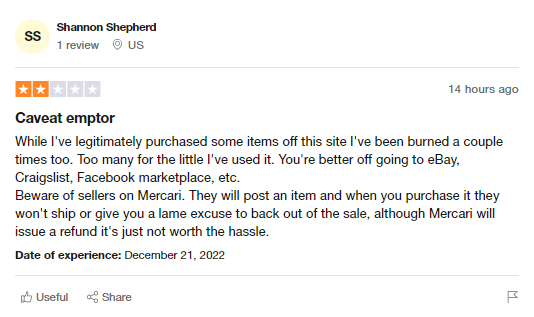
2-star Mercari review on Trustpilot.

Is Mercari legit FAQs

Is Mercari a good place to sell?

Short answer: Yes! If you have clothing, shoes, or handbags that you no longer wear or use, selling them on Mercari can be a great way to bring in some extra cash that you can use to pay down debt, fund your emergency savings, or treat yourself to a new outfit that you actually want. 

Is Mercari safe to purchase from?

Yes, Mercari is a safe platform to use. It offers the following protections:

  • Escrow payment system (money is not released until buyer receives item and rates seller)
  • Buyer and seller ratings
  • Secure payments and protection of user data
  • Automatic detection of use violations
  • Dedicated customer service team to resolve buyer and seller issues
  • Fraud detection

How do I know if a Mercari seller is legit?

Check the seller’s profile before making a purchase. Legit sellers have good reviews, are verified, and will accept and answer questions without a hassle.

Also, if the listing seems too good to be true, it probably is. Avoid items with rock-bottom pricing and vague or hard-sell descriptions that push for a fast sale.

Will Mercari refund me if I get scammed?

It depends. You are eligible for a refund as long as you:

  • Keep your transaction within the Mercari app
  • Create a return request within three days of receipt if you have an issue
  • Don’t rate the seller (rating the seller completes the transaction)

How to get rid of junk: 24+ free and cheap junk removal options

3 sites like Mercari

There are lots of other sites like Mercari to sell your unwanted items. Here are a few: 

eBay

eBay was one of the first online marketplaces to buy and sell unwanted items, and it still remains the industry gold standard. eBay boasts an A+ accredited rating from the Better Business Bureau, though customer reviews are less favorable.

eBay chargers sellers 12.9% of the sale price or lower, plus $0.30 per order. Combined with Mercari’s transaction fee of 2.9% for sellers, their fees are the same. However, eBay doesn’t require buyers to rate their items before paying its sellers. If you sell on eBay, your payment will be directly deposited into your checking account once the buyer submits payment and you ship the item. You can choose from a daily, weekly, biweekly, or monthly payout schedule. Mercari holds the money in your Mercari account until you spend it on the site or initiate a transfer.

Poshmark

Poshmark and Mercari are similar in many ways. Both websites act as an online consignment shop designed to connect buyers with sellers. Both are fairly straightforward to use. Both accept clothing, jewelry, and other items.

But there are certain key differences. While both Poshmark and Mercari are legit businesses that have been around for years, Mercari has much more favorable reviews, and a higher BBB score than Poshmark, implying that both buyers and sellers are happier with Mercari than Poshmark.

Poshmark charges 20% of the list price of a sale — twice what Mercari charges. That being said, for that fee Poshmark handles all transaction fees, shipping, and customer service, while selling through Mercari will require the seller to provide shipping at their own expense or request the buyer pay for shipping.

Poshmark review

Thredup

thredUP is different from Mercari and other online consignment shops for a couple reasons: 1. thredUP is exclusively a resale site for clothing and accessories, while Mercari’s marketplace includes clothing, electronics, decor, and other items. 2. thredUP sells your items for you. 

When you want to sell with thredUP, you send in your items, and they professionally photograph and list them on their site, setting the price they think your items will sell for on the site. 

Because they “do the work for you,” thredUP fees are much higher, ranging from 20% to over 90% of the selling price depending on the price of the item (the higher the price of the item, the lower the commission fee). 

thredUP has an A- rating from the Better Business Bureau, slightly lower than Mercari’s A rating, and customer reviews on the BBB and Trustpilot are slightly less positive.

Thredup review

How to thrift at the 8 best thrift stores

Bottom line: Selling on Mercari, is it worth it?

Based on its mostly positive reviews, low commission fees, and an A Better Business Bureau rating, selling on Mercari is worth it as long as you take precautions to avoid scam buyers, which you should do on any online consignment site.

Mercari is a great option because:

  • It’s easy to get signed up and list an item for sale
  • You can choose how you want to ship or deliver the item(s), choosing from Mercari Shipping that offers a discounted prepaid shipping label for purchase, Mercari Local delivery for $10.99, or shipping the items with your carrier of choice (costs vary)
  • You can sell on the app or on your computer
  • If you choose SMS notifications, you’ll get a text message when your item sells
  • You get paid once the buyer confirms receipt of your item and you both rate the transaction
  • You have a choice of instant pay (verified profiles with a linked debit card), direct deposit, or you can use your balance to purchase items on Mercari

Mercari is a legit site to make money selling your unwanted clothing, electronics, and other goods.

What is Mercari?

Mercari is an online consignment shop.

Is Mercari legit?

Launched in 2013, Mercari is a legit business with 2020 revenue of $636.8 million. With more than 644 customer reviews, the company has an A rating with the BBB.

How does Mercari work?

When you sell on Mercari, you can choose to sell on their traditional online marketplace, but you can also sign up for  Mercari Local if it is available in your area. Create an account and start listing immediately.

Who pays shipping on Mercari?

When you sell on Mercari, you can choose to pay for shipping or charge the buyer for shipping.

How do you get paid on Mercari?

When a buyer confirms they’ve received your order and you both rate the transaction, money will be deposited into your Mercari account. There are a few things you can do with the money: purchase items on Mercari, transfer the money to your bank account, or transfer the money to your debit card.

How much does the average Mercari seller make?

What you make on Mercari depends on the value, quantity, and quality of the items you sell. A 2021 Parade article reported ​​the average U.S. seller on Mercari makes $114 per month or $1,300 per year.

How much does Mercari take?

Mercari does take a cut of your sale once your listing is bought. This fee currently starts at 10% of the listing price.

Can you get scammed on Mercari?

Mercari acts as an online marketplace that connects sellers with buyers. That means you can rest assured that Mercari is legit and is not a scam. That being said, unscrupulous buyers and sellers alike can be found on Mercari just as they can be found on other marketplace websites.

Is Mercari a good place to sell?

Short answer: Yes! If you have clothing, shoes, or handbags that you no longer wear or use, selling it on Mercari can be a great way of bringing in some extra cash.

How do I know if a Mercari seller is legit?

Check the seller’s profile before making a purchase. Legit sellers have good reviews, are verified, and will accept and answer questions without a hassle. Also, if the listing seems too good to be true, it probably is. Avoid items with rock-bottom pricing and vague or hard-sell descriptions that push for a fast sale.

Is selling on Mercari worth it?

Based on its mostly positive reviews, low commission fees, and A Better Business Bureau rating, selling on Mercari is worth it as long as you take precautions to avoid scam buyers, which you should do on any online consignment site.

In a perfect world, blending families would be as simple as “The Brady Bunch” made it seem (maybe with a few less bell bottoms and backyard sack races). 

The reality? Blending families can be critically difficult, no matter how well everyone gets along before the wedding. In fact, the presence of children from existing relationships is one of the reasons cited for the exceptionally high divorce rates for second and third marriages. 

If you’re entering into a new marriage or relationship with kids — either yours, your partner’s, or both — know that creating a new family unit won’t happen overnight. It will take work, it will be hard, and you’ll probably make some mistakes along the way.

Ron Deal, a licensed marriage and family therapist, has written more than 20 books and resources on blended families and single parenthood. He says it’s not unusual for families to spend the first five to 10 years of a new family arrangement trying to figure out its rules, roles, and general rhythm. 

“Couples in blended families have to lead their family through this unknown, unclear territory so that family members can ultimately define themselves as family with one another,” he says. 

We recently spoke with Deal and other experts to get their blended family advice. Here’s what they had to say:

Advice from an expert on blending families

Advice from Emma Johnson on blending families

9 steps to making a blended family work

  1. Clearly define parenting roles and expectations. 
  2. Decide who will handle discipline. 
  3. Make sure children’s needs are met.
  4. Communicate openly and intentionally.
  5. Expect that things will be messy. 
  6. Lower your expectations. 
  7. Be patient. 
  8. Work as a team.
  9. Don’t lose yourself in the relationship. 

How to fix a broken blended family

  1. Call a “time out” to avoid disrespectful communication.  
  2. Keep your marital love alive. 
  3. Refrain from criticism. 
  4. Seek help through family counseling. 

Examples of successful blended families

Examples of dysfunctional blended families

FAQs about blended families

Blending families: Experts weigh in

A large blended family embraces in front of their house.

Deal, who is also the director of the FamilyLife Blended podcast and president of Smart Stepfamilies, an online resource for stepfamilies and stepfamily ministries, says to successfully create a blended family, couples have to “get smart” to navigate the uncharted territory of stepfamily living — and get comfortable being uncomfortable.

“You will step on each other’s toes a little — not intentionally, of course — but you will,” Deal says. “And each of those relational missteps will give you a chance to further define your expectations of each other, what you need, and the logistics of life.”

He says this “live-and-learn” aspect of blending families cannot be avoided and is ultimately beneficial. 

“I believe it’s a necessary evil that ultimately helps bring definition to ambiguous relationships and over time helps to create rituals and traditions that form family identity,” Deal says. 

Co-parenting tips for blending families, from Emma Johnson

Blending families is a struggle, no matter how wonderful all parties are. But there are some general guidelines for melding step- and blended families after a divorce or single parenthood:

  • Parents make the rules and lead, not children.
  • Take it slow. No need to rush.
  • Children’s feelings and concerns should be listened to, addressed and prioritized. But that does not mean that kids are in charge.
  • In a healthy family involving two parents in the household (of course healthy families can consist of any configuration), the romantic couple puts each other first, before kids.
  • Keep communication open with your co-parent and his new partner, if possible.

How to make a blended family work in 9 steps 

The reality is, there’s no “one-size-fits-all” approach to making a blended family work. Deal says what is helpful for a stepfamily preceded by death might not be helpful for one preceded by divorce (or two divorces). 

“Grief is universal in blended families, but the substance of things grieved over by children, for example, varies widely based on circumstances,” he says. 

Stepparents have different expectations depending on whether they:

  • Have biological children of their own 
  • Serve as a part-time or full-time caregiver to their step-children
  • Are step-parenting children whose other parent is still living or deceased
  • Whether or not the kids’ other parent is involved — and how involved?

However, there are steps you can take in most circumstances to give your family a better chance at blending successfully:

1. Clearly define parenting roles and expectations. 

A mom holding a crying baby while the dad is getting annoyed. Blending families? How to make a blended family work is resolved here.

Kendall Rose (her pen name), author of The Stepmoms’ Club (Sourcebooks) says the most important part of establishing parental expectations is to be on the same page as your partner. 

Depending on your family, that might include conversations about chores, meals, bedtime routines, family time, and discipline (which we’ll talk about more in Step 2).  

“Understanding what’s important to them — the parent who has the child or children — and you yourself coming into the blended family, how do you want to work as a unit?”

She says blended families should tread slowly, as you would in any new relationship, to learn what each person needs. 

“It’s kind of like putting your toe into a cold pool,” Rose says. “You’re not just going to jump in, right? You need to allow the relationship to develop.”

She says the way you approach blending families will also depend on the age of the children.

“If a family has older children, that’s going to be very different than if you’re coming into a blended family when they’re young,” Rose says. 

Valerie Mummert of Phoenix, Ariz., has been married for 30 years with a blended family of seven children, most of whom are now adults. She says parents need to decide in advance the non-negotiables in their families and the areas they are willing to compromise.  

“You may have different personalities and ways of dealing with conflict, but you need to have the same goals,” she says.

Mummert says it’s important to remember that you are now one family, not a compound sentence, so you have to build your new family identity together.

2. Decide who will handle discipline. 

Learning how to make a blended family work includes talking about who will discipline the children.

Deciding how to discipline children is a major part of forming a blended family, one that often leads to conflict, Rose says. She recommends families sit down and discuss how involved or uninvolved each parent will be and communicate expectations with the children. 

“If one parent is home and the other isn’t, somebody needs to enforce rules within your household,” Rose says. 

For example, if a child comes home from school and makes a mess in the kitchen, they should know it’s their responsibility to clean it up. The stepparent shouldn’t have to wait until the biological parent returns to make sure they do.

“If you and your partner are not on the same page, it’s not going to work,” Rose says. 

If the kids’ other parents are involved, the ideal situation would be a group discussion about consistent discipline between biological parents and stepparents. But Rose says in most cases, that’s not realistic. 

“If it is contentious and there’s not an opportunity to do that, then you need to create the rules in your own household,” Rose says.

Mother of three Christy posted on Facebook that she sometimes feels torn between being loyal to her son and supporting her husband. Her son recently messed up their yard with his truck, and his lack of initiative in fixing the damage has caused friction in the family.

“My significant other has higher expectations of responsibility for him than I do,” Christy says. “It is especially hard when I know my significant other is correct and my son should take the initiative to fix our yard.”

She says that until her son matures, she thinks there will continue to be strain between him and her partner.

Tabatha Pittman, a mom of three from Metro Detroit, Michigan, says her family actually benefited from her and her husband’s differing parenting styles.     

“I am more the disciplinarian versus my husband who is more talkative,” Pittman says. “Incorporating my husband helped my son talk through frustrations, and I learned a different approach to help my son learn from his mistakes.”

Advice from a single mom who blended families:

“Communicate with all parties at the same time to go over rules about other spouses’ children, like moms meet moms and fathers meet fathers if this is possible. Usually, there will be a communication error along the line that will turn ugly. The kids need to listen because they’re kids, but all parents should be on same page.” — Latoya

3. Make sure children’s needs are met. 

Learning how to make a blended family work includes making sure children’s needs are met.

Andrea Blindt, a registered nurse and holistic health practitioner from Los Angeles, grew up in a blended family and formed her own blended family with her second husband, her two sons, and their shared twins.

She says that in any family, children have basic needs of feeling safe, loved, and emotionally connected to their caregivers. She believes blending families is an opportunity to create relationships that can last a lifetime if handled correctly. 

“This looks like honoring each child where they are,” Blindt says. 

For example, a toddler might be more receptive to playing and bonding with someone new than a teenager. 

“Set expectations that are realistic to each child and their unique needs,” she says. “Family routines and special activities also increase success for blended families and help children feel secure in knowing what to expect (family meal times, chores, movie nights, parent date nights, church, etc.).”

Consider taking your kids on a solo road trip to ensure they’re getting quality time with their biological parent.

Advice from a single mom who blended families:

“Listen, discuss, and act accordingly when your child feels you spend more time/care about/love their step siblings more. You may feel like you aren’t, and maybe that is true. But it is a real feeling that should not be ignored or negated and rather treated with empathy, love, and increased attention.” — Cheryll

Taking care of elderly parents? 5 tips for the sandwich generation

4. Communicate openly and intentionally.

A couple and a toddler smiling. Blending families? Learn how to make a blended family work.

Deal says couples must be proactive in their family communication to gauge each family member’s level of openness and constantly reevaluate to see if anything has changed. 

He offers this as a positive example to set expectations and boundaries: 

“Imagine a stepdad saying, ‘It’s OK that there’s some things you want to talk to your mom about and not me. I get that. Just know I’m cool with it when you are.’”

Deal says proactively defining the boundaries of your relationships lets everyone know where they stand and what to expect, and gives some clarity in the midst of uncertainty.

Grace Baena, mom and director of brands at furniture resale site Kaiyo, says parents shouldn’t underestimate their children’s ability to be a part of the blended family conversation. 

“Many people think it will be way too hard for children to accept a new family, so they keep things from them in order to protect them,” Baena says. 

She suggests communicating with children about family goals and expectations to make the transition into a blended family a more smooth and positive experience.

5. Expect that things will be messy. 

A troubled family and a therapist. Blending families? Learn how to make a blended family work.

Deal says there’s ultimately no way to avoid the pain of the past when you’re forming a blended family, so it’s best to embrace and learn from it.

A sense of family identity — what Deal calls “familyness” — does not happen right at the wedding. 

“It comes after surviving the trials, after bringing clarity to family ambiguity,” he says. “Those days are full of confusing questions. But when it finally comes, it’s good.”

Rose says it’s normal and OK for each relationship in the home to be different. 

“You might not blend with all of the kids, and your partner might not blend with all of your kids because each kid has a different personality,” she says. 

Her advice? Let relationships develop at their own pace.

9 toxic parenting signs you should know

6. Lower your expectations. 

Learning how to make a blended family work includes lowering your expectations.

Couples attempting to blend their families often do so with unrealistic expectations, Deal says. 

“For example, assuming that because you love your spouse and want your family members to ‘blend,’ that the children want that equally as much,” he says. “They generally do not, at least not at first.”

Advice from a single mom who blended families:

“Our kids are older (19, 20 & 21), but one of the lessons I have learned is to have no expectations because you really cannot prepare for what to expect. I also learned to be kind to myself. I am doing my best! Try to see it from the kids’ perspective and be open to their thoughts and feelings. I have to remember that no one is perfect, and no family is perfect. The goal is to be present, be there whenever we need each other and for each kid to know they will always have a place to call home.” — Christy

7. Be patient. 

Learning how to make a blended family work includes being patient.

Deal equates blending a family with cooking in a crockpot.  

“What’s happening inside the pot is that the ingredients are slowly warming, softening, and then choosing to share themselves with other ingredients,” Deal says. 

8. Work as a team.

A family huddled together as a team. Blending families? How to make a blended family work can be done. Check here.

At the helm of a blended family are the two people in the relationship. Deal says that becoming a marital team is critical to helping your family through the uncertainty of merging. 

“Work toward supporting one another, listening carefully to your perspectives, and strive to be a well-oiled parental team,” he says. 

9. Don’t lose yourself in the relationship. 

A mirror image of a tired-looking couple. Blending families? How to make a blended family work can be challenging. Here's some help...

Rose says that too often, stepparents (stepmothers especially), get caught up in trying to create a cohesive blended family and trying to fix issues within the family. 

“You stop seeing your friends; you don’t work out; you don’t get your hair done; you don’t go through your daily walks; you get sucked in,” Rose says. “We call it the stepmom’s vortex, and you lose who you were.”

She cautions stepparents to remember who they were before and when they fell in love with their partner. The blended family aspect was just a byproduct of that relationship.

“Don’t change who you are because you’re now in this blended family,” Rose says. “You can adapt, but still have your friend time, still have your workout time, still go do the things and be the person you were before the blended family.”

How to fix a broken blended family

Nancy Landrum, author of Stepping TwoGether: Building a Strong Stepfamily, says stepfamilies often have more sources of stress than a nuclear or first family, which can lead to more conflicts. These conflicts can threaten a blended family’s foundation.

Because the success of the stepfamily is largely dependent on the success of the marriage, Landrum offers these suggestions to fix a broken blended family: 

1. Call a “time out” to avoid disrespectful communication.  

Disrespectful language is anything that feels attacking to your partner, usually beginning with the word, “You.” Instead, speak from your own point of view, ie., “When ___ happens, I feel ____.” 

2. Keep your marital love alive. 

Take time to regularly have fun couple dates to recall why you fell in love and to keep the love alive during the difficult days of stepfamily adjustments. The rule is that nothing controversial is allowed to come up on a fun date.

3. Refrain from criticism. 

Stop yourself from criticizing your partner’s parenting style or from criticizing your partner’s child. Criticism will only trigger defensiveness. Be in charge of parenting your own child, and allow your partner to be fully in charge of parenting his/her child, unless you agree on a different arrangement.

4. Seek help through family counseling. 

Jessica Latin, a licensed professional counselor with JL Counseling in Shreveport, La., says blended family issues are one of the top reasons families seek counseling.

“Family counseling provides a safe space with an unbiased mediator for families to discuss their thoughts and feelings and find solutions to their problems, as well as improve their communication with each other so that they can live more harmoniously,” Latin says.  

She says family counseling allows everyone in the family the opportunity to be heard, which may be difficult in the home setting.

“The goal of the family therapist is to not take sides but to let everyone see their role in the family and how they can do the best in their role to help the family ‘win’ as a team,” Latin says.  

Check out our review of BetterHelp online therapy. 

Examples of successful blended families

When she met her second husband, Blindt was a single mother of two young children (2 years and 5 months) who had recently separated from her first husband.

“I didn’t have the desire to date or even remarry again at the time, but the universe had other plans,” Blindt says. “He had a beautiful heart and was beautiful with my children.” 

Her new partner had never been married before and didn’t have children of his own but had always wanted to be a father. Blindt thought she was unable to have more children and communicated that early on in the relationship. 

“After contemplating what was right for him, he told me that he felt honored to be able to play the role of stepdad to my two children,” Blindt says. 

Because they were so young at the time, Blindt says her children took to her new partner easily and welcomed him as another father figure in their lives. 

Blindt unexpectedly became pregnant with twins while they were dating, though the pregnancy was high risk and her babies had to spend 106 days in the hospital.  

“During that time, my now husband cared for my two children at home, brought them to visit me daily in the hospital and loved them as though they were his blood children,” Blindt says. 

The pair married shortly after, bought a house together, and navigated raising 3-year-old, 2-year-old, and newborn twins. 

“There have been many gifts in our blended family journey, but also many challenges,” Blindt says. “With each adversity, we grow stronger and more connected to one another.”

She offers this advice for creating a successful blended family: 

  1. Ensure all kids feel included, seen, heard, and valued as members of the family. She makes a point to spend individual time with each child. 
  2. Remember you are a team, so do your best to be a united front. Kids are smart and often push against their parents. By joining forces as a team, children know their boundaries and are better able to build respectful relationships. 
  3. Get along with your partner’s ex whenever possible. This will make your life smoother and help your children establish secure relationships with both families. 
  4. Communicate expectations and roles of each family member in age-appropriate ways to reduce the anxiety associated with the unknown. That can mean going over manners, rules, and ways to show respect to one another. 
  5. Give children the time and space to hear them out, and affirm their positive behaviors. A big argument can be avoided by simply being still and listening to the child instead of assuming you know what is happening and disciplining them. Having open conversations about feelings, changes and goals is also important to do regularly. 

“Having parents set aside their own feelings in order to do what’s best for the children is critical,” Blindt says. “This doesn’t always happen, and it really shakes a child’s sense of security, self- worth, and confidence.

She urges people to remember that blended families bring more people into a child’s life who are able to share love. 

Pittman says her family made a point to nurture new relationships within the family. She says doing fun things as a group, like going to an amusement park or Chuck E. Cheese, helped the family bond. Pittman also made a point to allow her children to spend quality one-on-one time with her boyfriend (now husband of 10 years).   

“An example for me was going to class in the evening and leaving my then-7-year-old with my boyfriend for short periods or allowing them to go to the barbershop without me,” Pittman says. “These things cultivated bonding time.”

You can find more examples of successful blended families on Reddit: 

Does anyone have a really GREAT blended family?
byu/sleeplessinco instepparents
Comment
byu/Party-Pizza-2071 from discussion
instepparents

Examples of successful blended families with teenagers

Landrum has her own experience forming a successful blended family. But unlike Blindt, her family didn’t immediately become a cohesive unit. 

Landrum and her late husband, Jim, agreed to separately parent the teens they each brought to the marriage but wanted to co-parent his 8-year-old son. She believes this arrangement lowered the teens’ resistance to their new step-parent.

“Any arguments our children had were targeted at their birth parent, not the step-parent,” Landrum says. 

However, when it came to the 8-year-old, they quickly realized their co-parenting arrangement wasn’t working. After talking to a professional who taught them effective anger management and respectful speaking skills, Landrum and her husband decided he would go back to parenting all of his children, which completely changed their family’s trajectory.

“We thought we were terrible failures to have to resort to this strategy, but a few years later, learned that this is the method recommended by step-family experts whenever there is conflict over parenting,” she says.

Landrum says her teen sons eventually developed great relationships with her husband, and she still treasures the friendship she has with his three children.  

“A general rule of thumb that we learned about later was that it often takes roughly twice the age of a child at the time the stepfamily was formed before they are fully integrated and accepting of the new family,” she says. “We found that statistic to be amazingly accurate.”

A definitive list of 7 co-parenting boundaries you need to know

Examples of dysfunctional blended families

There are unfortunately plenty of examples of dysfunctional blended families on Reddit. Here are just a few from the r/blendedfamilies subreddit. 

When to give up
byu/repete inblendedfamilies
Having a parent choose their spouse over you
by inblendedfamilies
Help please. Fixing ganging up on one child when all the kids are mixed.
byu/Inafray19 inblendedfamilies

FAQs about blended families

Why is a blended family so hard?

Blending families is hard because there are so many moving parts, different personalities, and family dynamics to contend with. These are some of the many reasons blended families struggle, according to real stepfamilies: 

  • Step-parents are asked to parent kids that are not their own
  • Step-parents can feel sidelined when the bio parent and kids have a long history as one unit
  • Step-parents can be unsure how to fit in in a co-parenting arrangement 
  • Uncertainty about who has the final say in parenting decisions 
  • Different parenting styles trying to meld, with children of varying ages who need different things
  • Bio parents struggling to shift from focusing on children to focusing on new spouse as primary bond
  • Complications with the other co-parent and his/her new partner/kids, like parenting with a narcissist.
  • Differing behavioral expectations between households, and the children going back and forth
  • Dealing with court orders, custody arrangements, court-ordered communication, and child support 

Deal says the hardest part about forming a blended family is the uncertainty. 

In his most recent book, Preparing to Blend, Deal shares this analogy: 

“When the pandemic hit, no one really knew how the world should respond. All we were told was to pull back and lock down with those we know and trust the most. We then had to figure out how to do life from home and gradually moved through various strategies for managing closeness and distance in society.”

Deal says you will make mistakes and learn from them. 

“You will feel discouraged and perhaps disillusioned about how quickly you’re moving forward,” Deal says. But each step is progress; you must be patient with the progress.”

What is considered a blended family?

The most basic criteria for a blended family is that one or both partners have their own child or children that they’re bringing to a new union. 

Partners in a blended family might be divorced, widowed, single with children, or single without children (entering into a partnership with someone who has them).

Who comes first in a blended family?

While married couples in biological families put one another “first” for a lifetime, they often spend the majority of their childrearing years investing in their children. Deal says the same is true in blended families, except that new partners and children often feel in competition with each other. 

“A stepmom, for example, might wonder if she’s valued by her husband if he spends a Saturday afternoon with his children (just like he did for years before she came into the picture),” Deal says.  

In a biological family, both parents would likely be spending this time together with their children or see the value in their partner’s individual time with the children. Step-parents don’t often share this mutual investment in their partner’s children, so they compete for affection and time. 

“Marriage, by nature, requires an exclusive allegiance to your spouse,” Deal says. “At the same time, children are to be valued, loved, and invested in. Both are important.”

Balancing the time and energy between marital and parental love is the tricky part.

Deal suggests couples clearly articulate their love for each other, privately and in ways that let children know of their loyalty to one another. That includes spending exclusive date time together and honoring one another above all else within the home. 

“At the same time, make sacrifices for the children, cheerlead them through life, and pour into their lives,” Deal says.  

Don’t be a helicopter mom: Overprotective parents can hurt their kids

What is the success rate of blended families?

The divorce rate has been widely publicized at 40-50% for single marriages, 60-67% for second marriages, and 73-74% for third marriages, though there is no legitimate reported data that backs up these statistics. Nor do they specifically address whether those marriages involved children from previous relationships. 

“In the end, I estimate the divorce rate for blended family couples to be 45-50%, but I believe that 80% of smart step couples can not only go the distance, but thrive in their family,” Deal says.

Why do blended families fail?

Deal says some of the most common pitfalls of blended families are: 

  • Not helping children cope with loss
  • A stepparent who tries to “erase and replace” the biological parent
  • Biological parents who are paralyzed by guilt over the past
  • Combining holiday and special day traditions and rituals, etc. 

He says smart couples learn about these pitfalls and get smart about how to manage them.

Why is a blended family so hard?

Blending families is hard because there are so many moving parts, different personalities, and family dynamics to contend with.

What is considered a blended family?

The most basic criteria for a blended family is that one or both partners have their own child or children that they’re bringing to a new union.

Who comes first in a blended family?

Balancing the time and energy between marital and parental love is the tricky part. While married couples in biological families put one another “first” for a lifetime, they often spend the majority of their childrearing years investing in their children.

What is the success rate of blended families?

“In the end, I estimate the divorce rate for blended family couples to be 45-50%, but I believe that 80% of smart step couples can not only go the distance, but thrive in their family,” Ron Deal, a licensed marriage and family therapist, says.

According to the Council On International Educational Exchange, a typical school day in the U.S. starts around 7:30 a.m. and ends at 3 p.m. A typical workday doesn’t end until 5 or 6 p.m. 

After-school programs give working parents the peace of mind that their children are safe and engaged while they’re still at work.

However, the nonprofit Afterschool Alliance reports that more than 25 million children lack access to crucial after-school programs — and they disproportionately come from low-income or minority families. 

Need after-school care? You have options

Fortunately, there are free and low-cost after-school programs available across the country. Several of these programs offer financial help for qualifying families.

If you’re in need of free or low-cost after-school care, check out these  options for working parents and families:

1. Local school districts offer after-school programs

Often the best place to start for free or low-cost after-school care is your own school district or a nearby campus, such as the East Mesa Legacy Traditional campus, where structured programs may already be available for enrolled students. Most public school districts have an established after-school program that also includes before-school care for elementary, middle school, and high school students. 

For example, New York City boasts more than 900 after-school programs for K-12 students. Through the city’s after-school system, COMPASS NYC, eligible students benefit from free programs in a variety of locations, from schools and community centers to churches and public housing facilities.

Talk to your child’s principal, teacher, or guidance counselor to learn what after-school care options are available near you. 

2. Local governments

Your state, city, county, municipality, or township might also offer free or affordable age-based after-school programs for children of all ages.

In California, for example, Think Together is a nonprofit offering free or low-cost after-school programs across the state, with a focus on academic enrichment and college readiness.

In Orlando, Fla., elementary and middle school students can enroll in an after-school program, get homework help, and participate in activities such as music or dance classes. The Orlando program costs $40 per month, per child, for city residents and $120 per month for non-city residents. Qualifying students can also attend for free.

The Pennsylvania-based Cranberry Township Kids Club offers two hours of care before or after school for K-6 students. It costs $50 to register, then $15 daily for before- or after-school care (if you want both, it is $30 per day, per child). Non-residents pay $17.25 per day or $34.50 for both programs. Payment plans are available and there are discounts for multiple days of care.

Trackers Earth in Portland, Or. offers after-school programs for K-5 students that includes transportation from local elementary schools. Students learn skills like archery, rock climbing, and martial arts and play games and make crafts. Tuition starts at $36 per day for K-1 and $32 per day for grades 2-5.

Boston-based TeenLife provides connections to hundreds of after-school programs for teenagers. Your child can choose from a variety of options from learning a language to playing an instrument. Pricing ranges from free up to $999.

When school is out, many of these programs also offer summer camp or day camp options. Reach out to your local parks and recreation department, city office, or county seat to find resources in your community, or search for their after-school programs.

3. Local nonprofit organizations

Depending on where you live, you might be able to find a nonprofit that offers free or low-cost before- and after-school care. 

During the school year, kids have a routine that keeps them busy and occupied — but once summer rolls around, some kids just need somewhere safe and engaging to spend their days. The key is to research summer camp ideas so that you can find an option that works well with your schedule and your child’s social and emotional needs. Some parents look at program evaluation resources, which help them find fantastic options that align with their schedules and daily routines.

Kids After Hours, for example, has 26 locations that offer care throughout Montgomery County and Carroll County, Md., for children in kindergarten through 5th grade. Care is available from 7 a.m. to 6:30 p.m. during weekdays when school is in session. KAH also hosts summer camps. Tuition cost is based on location and how many days your children require care. KAH offers a tuition calculator for budgeting. 

How to find nonprofit after school programs near you

If you’re looking for a program like this in your area, try:

  • Your child’s school (since some nonprofits partner with school districts)
  • Your local library or community resource center
  • Afterschool Alliance resource map
  • Local religious or community organizations
  • Fraternal and civic organizations

You can also search Google for “nonprofit after-school programs near me” to get a quick list of local resources.

4. Local libraries

Many public libraries now offer Homework Help Clubs, STEM workshops, and Arts & Crafts Programs for school-aged children. These options are often free and can supplement after-school care

For example, the New York Public Library (NYPL) has expanded its NYPL After School program to 50 locations across the Bronx, Manhattan, and Staten Island for the 2024–25 academic yearTK. This free drop-in program, available Monday to Thursday when school is in session, provides homework assistance, reading suggestions, creative writing resources, and STEAM activities for students aged 6–12.

Other library systems also offer similar programs. For instance, the Free Library of Philadelphia provides the Literacy Enrichment After-School Program (LEAP), which offers homework help, computer literacy training, and multicultural enrichment activities at various locations throughout the city. The Oak Park Public Library in Illinois offers after-school programs for middle and high school students. They have dedicated spaces for grades 6-8 and 9-12, as well as virtual homework help services.

Find after-school programs at your local library:

  1. Visit your local library’s website or call them directly to inquire about their after-school offerings.
  2. Check for programs like homework help, STEAM activities, reading clubs, or specific interest groups.
  3. Ask about any registration requirements or age restrictions for the programs.
  4. Inquire about the schedule and duration of the programs, as they often follow the academic calendar.
  5. Look for any special events or workshops that might be offered in addition to regular after-school activities.

5. 4-H

About 4-H

Founded in Clark County, Ohio, in 1902, 4-H is a nonprofit organization available in every state — in rural, urban, and suburban areas. The organization offers in-school and after-school programs for students ages 5-18 at minimal cost to parents. There are no national registration fees, and some program materials are as low as $5. Individual clubs may choose to charge membership fees.

You can choose a 4-H project that fits your family’s budget and suits your child’s interests. For example, you can choose projects for art, science, or healthy living. Children can learn at 4-H clubs or at partner schools when the school day is over.

Find a 4-H in your county

Each 4-H program has its own transportation policy and registration process. Find your local 4-H to get connected.

6. Boys & Girls Clubs of America

About Boys & Girls Club

With over 4,700 clubs nationwide, Boys & Girls Clubs are a valuable community resource for after-school care and summer programs. Most locations serve kids and teens between the ages of 6 and 18.

Boys & Girls Clubs of America offers a safe place for kids to explore their interests after school. Membership fees vary by club, but usually include a one-time registration fee and a weekly cost for your child’s participation. Some clubs offer scholarship programs for a free membership if your child is eligible for free or reduced-price lunches at school.

Some clubs, like the one in Sarasota County, Fla., provide bus transportation between school and local Boys & Girls Club locations. That specific program has fees that start at $50/month.

Boys & Girls Clubs offer the following activities and programs:

  • Education
  • Arts
  • Sports and recreation
  • Health and wellness,
  • Career readiness
  • Character and leadership

Find a Boys & Girls Club

Find a Boys & Girls club near you to inquire about after-school and summer programming, costs, and transportation. 

7. Salvation Army

The Salvation Army offers and supports a variety of after-school programs. These programs provide crucial academic support, including homework assistance, tutoring, and access to educational resources such as computer labs, all aimed at improving students’ academic performance. 

About the Salvation Army after school programs

Enrichment activities form a significant part of the offerings, with children able to participate in diverse pursuits like art, music, STEM (science, technology, engineering, and math), martial arts, sports, and culinary arts. Physical fitness is also emphasized, as well as arts education, especially in areas where schools have reduced funding for the arts. 

To ensure accessibility, some Salvation Army locations provide transportation services, picking up children from schools and even driving them home in the evening. Perhaps most importantly, The Salvation Army is committed to making these services available without discrimination, offering no-fee or low-cost options to ensure that families in need can access these valuable after-school programs.

Find out more information about The Salvation Army’s after-school programs:

  1. Contact your local Salvation Army center: Call or visit the nearest Salvation Army location to inquire about their specific after-school offerings. 
  2. Use the online locator: Visit The Salvation Army’s official website and use their location finder to identify the nearest center offering youth services
  3. Attend an information session: Some locations may offer informational meetings for parents interested in their after-school programs 
  4. Inquire about financial assistance: Ask about sliding scale fees, scholarships, or acceptance of childcare vouchers if cost is a concern
  5. Request a tour: Some centers may offer tours of their facilities and after-school program areas.
  6. Speak with program coordinators: Contact the youth services or after-school program coordinators directly for detailed information.

8. Camp Fire USA

Camp Fire USA is a national youth development organization that offers a variety of after-school programs designed to help young people connect with nature, each other, and themselves. Their programs focus on creating safe spaces where youth can have fun and be themselves.

Key features:

  • School-year programs
  • Teen service and leadership opportunities
  • Camps and outdoor education
  • Inclusive environment welcoming all young people

Camp Fire USA has 1,300 program sites across 24 states, with 46 affiliate locations. Since 2017, they have impacted 613,000 youth and families through 4,600 program sites.

To register or find out more:

  1. Visit the Camp Fire USA website (campfire.org)
  2. Use their affiliate locator to find a program near you
  3. Contact your local affiliate for specific program details and costs

Costs vary by location and program type. Some affiliates offer financial assistance or sliding scale fees to ensure accessibility.

9. Police Athletic League (PAL)

The Police Athletic League (PAL) is a national organization dedicated to fostering positive relationships between law enforcement and youth through recreational, educational, and mentoring programs. With over 300 chapters nationwide, PAL serves more than 2 million young people annually.

Key features:

  • Recreational and sports programs
  • Educational support
  • Mentoring opportunities
  • Focus on juvenile crime prevention

PAL recently launched a youth mental health initiative and partnered with the Department of Homeland Security for an online safety campaign called Know2Protect.

To register or find out more:

  1. Visit the National PAL website (nationalpal.org)
  2. Use their chapter locator to find a PAL program in your area
  3. Contact your local chapter for specific program information and registration details

Costs vary by chapter and program. Many PAL programs are low-cost or free to ensure accessibility for all youth.

10. After-School All-Stars (ASAS)

After-School All-Stars is one of the largest nonprofit organizations in the United States working to close the opportunity gap for low-income youth. They operate at 728 school-year sites and summer camps in 78 cities across the country.

Key program pillars:

  • Health & Wellness
  • STEM
  • Visual & Performing Arts
  • Career Exploration
  • Academic Readiness
  • Mental Health Support

ASAS focuses on providing adult mentorship, social-emotional learning, and safe spaces for students to catch up on schoolwork.

To register or find out more:

  1. Visit the After-School All-Stars website (afterschoolallstars.org)
  2. Use their location finder to identify programs in your area
  3. Contact your local ASAS chapter for registration information and program details

Costs are typically low or free, as ASAS aims to serve low-income youth. They rely on donations and partnerships to keep their programs accessible.

11. Daycare centers

For a fee, many daycare centers provide before and after-school care for elementary school-aged children, as well as transportation to and from school and nutritious meals. 

Find daycare near you

To find local centers, you can do a Google search for: “daycare centers near me.” States often provide subsidized child care assistance to families who meet certain income requirements. Search “child care assistance” followed by your state to learn how to apply. 

Use Wealthy Single Mommy to find free daycare

Need more help? Try Care.com. When you create a free account, you can search Care.com’s database of reputable daycares and find screened caregivers if you prefer to have in-home after-school care.

A free membership allows you to:

  • Search for daycares in your zip code
  • View caregiver profiles, certifications, and training
  • Post and receive applications for an after-school care job
  • Use Care.com tools like hourly rate calculators

A paid, premium membership allows you to communicate directly with caregivers, schedule interviews, and request enhanced background checks for an additional fee. Plans start at $38.95 for month-to-month access, $24.95 per month for quarterly access, or $12.95 per month for an annual plan.

Check out our Care.com review.

12. Junior Achievement

About Junior Achievement

Junior Achievement (JA) is a nonprofit providing multiple programs taught by trained volunteers in classrooms, virtually, and in after-school locations. The in-school programs are available to K-12 students at no cost. Program sessions vary, ranging from one-day events to multiple one-hour sessions.

JA offers after-school programs that teach children financial literacy, how to start a business, and prepare for a career in their chosen field. Sessions are age-appropriate to  meet the needs of elementary, middle, and high school students. 

Find a Junior Achievement office

There are over 100 JA locations across the country, some of which offer scholarships for Junior Achievement students. Find your local JA office to learn more.

13. Online after-school programs

If your children are home with you or a caregiver during after-school time, you can sign them up for an online after-school program like Outschool, which has classes that start around $5 per session.

Outschool offers more than 140,000 interactive classes for children ages 3-18. Your child can engage in a variety of activities from learning how to draw to connecting with fellow gamers.

Vetted, experienced educators on Outschool teach small, online group sessions. Classes are available at various start times and days throughout the week. Set up a free account with Outschool. In addition to live classes, some after-school programs also provide academic support tools — and students sometimes use services like EssayPro essay writing service to help with writing assignments when parents are busy.

Families of high schoolers can also leverage online learning during summer break. Many choose summer high school programs that are self-paced, video-based, and teacher-supported, allowing teens to recover credits or get ahead without sacrificing jobs or camps. Verify your district accepts transfer credits and have transcripts sent directly to your school counselor.

14. YMCA before and after care

Recognized by the National Association of Elementary School Principals (NAESP) as an after-school program partner, the YMCA has long been a place for quality before- and after-school care. The organization takes 500,000 children at roughly 10,000 sites each year.

After-school programs are available on site at YMCA locations and at outside organizations. YMCA membership costs and services vary by location, but typically include a one-time registration fee and monthly fee.

Some locations provide bus transportation to or from the YMCA to school for before- and after-school programs. If your program is in your child’s school, YMCA counselors often escort students from their classrooms to the after-school space.

You must be at least 13 years old to have your own membership, but younger children can get access through a family plan.

Find your local YMCA to get after-school care.

15. YWCA

Another great resource for before or after-school care? Your local YWCA. There are over 200 YWCA locations in 45 states and the District of Columbia that partner with schools for after-school care for elementary, middle school, and high school students, but age requirements vary by location.

For example:

YWCA before and after-school programs require registration and payment. Each location determines its own costs. Contact your local YWCA for specific pricing.

Find your nearest YWCA

The YWCA primarily places its staff in schools to help parents who need transportation after school. But after-school services vary depending on the location. Find your local YWCA to inquire about before and after-school programs.

16. Girls Who Code Clubs

Girls Who Code is a nonprofit organization dedicated to closing the gender gap in technology by providing free after-school programs for girls in grades 3-12 to learn coding and computer science skills. These clubs offer an excellent opportunity for single moms raising tech-savvy kids to introduce their daughters to the world of coding in a supportive environment.

Key features of Girls Who Code Clubs:

  • Free after-school programs
  • Open to girls in grades 3-12
  • Focus on coding and computer science skills
  • Welcoming to students of all gender identities
  • Curriculum covers various programming languages like Scratch, Python, HTML, CSS, and JavaScript

Find a Girls Who Code club:

  1. Visit the Girls Who Code website (girlswhocode.com)
  2. Use their Club locator to find a program near you
  3. Click “Get In Touch” and contact the Club Facilitator 

17. The Homework Club

Found in many states, these programs provide structured spaces where kids can complete homework with tutoring support. Many are free or low-cost through libraries or community centers. 

For example, the Kenilworth Recreation Center in New Jersey offers a structured Homework Club for grades 6–8, providing daily supervision, tutoring, and enrichment activities. In New York City, the New York Public Library (NYPL) runs the NYPL After School program, which provides free drop-in homework help for children ages 6–12 at over 50 library branches throughout the city. In California, the LOT318 Homework Club offers tutoring and academic support with donated supplies and resources, serving students in the Placentia area.

How to find a Homework Club near you:

  1. Check local schools: Many schools host Homework Clubs as part of their after-school programs. Contact your child’s school office or visit their website to inquire.
  2. Visit local libraries: Libraries often provide free or low-cost homework help through Homework Clubs or tutoring programs. For example, the New York Public Library offers free drop-in homework help at various branches.
  3. Explore community centers: Community recreation centers or organizations like the YMCA may run Homework Clubs as part of their youth programs.
  4. Search online: Use search engines with terms like “Homework Club near me” or include your city/state for localized results.
  5. Contact national organizations: Programs like Boys & Girls Clubs of America offer homework help through initiatives like “Power Hour,” which may serve as a Homework Club in your area.

Other options for after school activities and care

Thinking about your child’s interests can help you pursue other options for after school activities and care. For example, dance academies like Dance to Unite in NYC work with local schools to provide a dance program during the week. 

Some ideas to help you find the right fit:

  • School clubs: If your student participates in clubs, the program may have after school options to help them develop their interests
  • Community clubs: Similar to school clubs, except offered by civic organizations, nonprofits, churches to engage youth in educational and extracurricular activities
  • Sports: Sports leagues may offer after school clinics to practice skills
  • Hobbies/Gaming: Look into groups that help your child gain mastery of gaming or a hobby that offer after school care
  • Tutoring: If your child needs guidance with school subjects, a homework club or tutor could be a good option after school, especially when paired with structured learning activities like holiday reading exercises to help reinforce skills outside the classroom.
  • Learning a skill: Some groups may offer training on how to code speak a language, or another skill that interests your child
  • Mentoring: Older children who like helping younger kids can look for programs where they can mentor youth after school

For military families: Childcare Aware

Childcare Aware is a great resource to locate affordable child care programs in your area, including those that participate in state subsidy programs. They provide tools to help single parents navigate child care costs.

For kids with special needs: Easterseals after-school programs 

Many Easterseals locations provide after-school care tailored for children with disabilities or special needs. These programs often include social skill-building and recreational activities.

Easterseals offers after-school programs tailored to children with disabilities, with costs and financial assistance varying by location. For instance:

  • Easterseals South Florida provides free after-school and summer camp programs for children with autism and other developmental delays.
  • Easterseals Central and Southeast Ohio offers no-cost after-school programs to families who qualify for TANF benefits, such as Ohio Works First, SNAP, or Medicaid.

Some programs may offer financial assistance or operate on a sliding scale based on income. For example, Easterseals Redwood‘s Medical School-Age Child Care Program provides tailored care and education for children, with the possibility of receiving services at no cost for those with medical needs.

Given the variability in program offerings and funding sources, it’s a great idea to contact your local Easterseals affiliate to inquire about specific after-school programs, associated costs, and available financial aid options in your area.

When can kids stay home alone?

After school programs are a great way to support children’s development while you are working, and there are many affordable or free options available. However, depending on your child’s age, you may also be wondering if staying home alone is an option.

Few states have laws that define the minimum legal age for a child to be at home alone such as Illinois (14 years old), Maryland (8 years old), and Oregon (10 years old).1 

A source for legal resources and information advises:2

  • Don’t leave children 7 and under home alone for any reason
  • Children 8-10 should not be left alone for more than 1.5 hours and only during daylight or early evening
  • Children 11-12 may be left alone for up to three hours but not late at night
  • Children 13-15 may be left alone but not overnight
  • Children 16-17 can be left alone, even overnight but not for more than two nights

To get clarity on state child protection laws, and to learn ways to keep your children safe at home, contact your state child welfare agency:

AlabamaMontana
AlaskaNebraska
ArizonaNevada
ArkansasNew Hampshire
CaliforniaNew Jersey
ColoradoNew Mexico
ConnecticutNew York
DelawareNorth Carolina
FloridaNorth Dakota
GeorgiaOhio
HawaiiOklahoma
IdahoOregon
IllinoisPennsylvania
IndianaRhode Island
IowaSouth Carolina
KansasSouth Dakota
KentuckyTennessee
LouisianaTexas
MaineUtah
MarylandVermont
MassachusettsVirginia
MichiganWashington
MinnesotaWest Virginia
MississippiWisconsin
MissouriWyoming

In Washington, D.C. you can contact the Child and Family Service Agency for help.

If your child is a teenager, consider allowing your child to go home alone after school. Of course, many factors come into play to determine if that’s a good decision for your family, such as:

  • State laws about children being left alone at home
  • Safety of your neighborhood and relationships with neighbors
  • Maturity of the child being left alone and likelihood of obeying rules for safety
  • Whether your child is responsible enough to keep track of your house key
  • Child’s comfort level with being left alone

If you are considering sending your child or children home after school with adult supervision, here are some guidelines from the American Academy of Pediatrics:

  • Emergency plan: Have a plan in place with emergency contacts, supplies, first aid, and what you expect your child to do when an emergency arises
  • House rules: Establish what you child can and can’t do when at home such as studying, gaming, cooking, having friends over, or going outside to play
  • Entering/leaving the house: Talk with child about how to safely enter the house, including how to disarm or set an alarm
  • Contact plan/check-ins: Figure out how you want your child to communicate (phone call, text, app, etc.) and share that plan so he or she knows what is expected

It’s a good idea to do a test run and quiz your child on what to do in different scenarios. You can start with allowing them to be alone for an hour and build until both of you are comfortable.

Check out more helpful and free resources for low-income families:

Help for single moms: 16+ resources$500 monthly single mom grant
Free laptopsFree clothes
Free carFree daycare
Free smartphoneTutoring and homework help
Free wifiJobs for teens
Free toys10+ charities that help single mothers
Free preschoolFree gas
  1. “Leaving Your Child Home Alone” US Department of Health and Human Services Child Welfare Information Gateway https://www.childwelfare.gov/pubpdfs/homealone.pdf
  2. “When Can You Leave A Child At Home Alone? FindLaw https://www.findlaw.com/family/parental-rights-and-liability/when-can-you-leave-a-child-home-alone-.html

Ever since he was a tiny boy, my son has been a little dude. By this, I mean he takes on typically masculine roles. Even when he was 3 years old, he would make sure his older sister and I stood behind the orange safety line while waiting for the subway train — maneuvering his stout little body like an Australian Shepherd herding dog.

Since that age, while teaching my kids to partner dance in the kitchen to Motown, he somehow knew that he was the one who was supposed to spin me — and never the other way around.

When both he and his sister recoiled in terror when faced with immunizations at the pediatrician’s office, it was Luke who did an about-face, calmed himself, then volunteered to hop onto the exam table where he yanked up his T-shirt sleeve, facing the shot — a clear exertion of bravery on his face.

Despite my efforts to never instruct either of my kids on gender-specific behavior, and certainly never suggest that anyone but me is the boss of the house, seeing my son exert these typical “manly” qualities made me wonder: Is this just how he is? Or am I somehow informing that he is the ‘man of the house??

What does it mean to be the man of the house?

How and why single moms destroy their sons

Tips for single moms raising boys: How can a single mom raise a boy?

Tips for single moms raising teenage sons: Can a single mom raise a good son?

Books for mothers raising sons

What does it mean to be the man of the house?

I know plenty of men who were raised by single moms, and were told by these women and other people in the kid’s orbit that because there wasn’t a dad around, he was the man of the house. 

The message is:

Every house needs a man.

Women need protecting.

Your gender renders you the boss. 

You do not have a boss or childhood.

You are an adult now because there is no man around.

You have responsibilities of a man. 

That is all so messed up. Wrong.

Yes, children benefit from the influence of positive adult women and men in their lives. Both genders is ideal. In a perfect world, all children would have competent, involved mothers and fathers in their lives at least weekly, if not daily.

That is not the case for most families.

Single parents without a co-parent can raise healthy, dynamic members of society, and you are, every single day! Mothers can and do thrive without a man in the house.

But these are the kids who know when they are the kid, and they have adults in their lives on whom they can count. These are children whose adult loved ones cultivate authority in their families and homes, and that makes children feel safe. Clear power lines in a family are what give children the foundation to grow into adult men and women who then thrive in relationships and communities. Men who are taught to respect the role of his mother (and other women in his life) grow up to respect women as their equals — not incomplete beings requiring male supplementation.

When you tell a child he is the “man of the house,” you tell him: It is your responsibility to take care of this house and family.

That is terrifying to that child, because he can’t take care of the family.

He can’t earn money to pay the bills.

He can’t keep his family safe.

He can’t pay taxes, run family members to school and activities, or make sure everyone is healthy.

So not only are you giving him responsibilities he is not developmentally able to process, you are telling him he is repressible for things he has no control over.

It’s like if I told you it is your responsibility to turn around global warming, and every time a polar bear died, you faced 5 years in jail.

Don’t be a helicopter mom: Overprotective parents can hurt their kids

How and why single moms destroy their sons

It’s a fascinating exercise to raise both a son and a daughter. The experience of having both male and female children gives me so much insight into the genders, my own issues and relationships with each, and myself. I find that I write a lot more about my daughter Helena, 6, than my son, Lucas, 4. Maybe I spend more time thinking about the female role model I want her to have. And it is only natural that I see so much of myself in her, being that we are not only both females but also happen to share a lot of personality traits (assertive, curious, prone to emotional extremes, and love of storytelling in all its forms).

I also, of course, love Lucas just as much. And I am just as important of a parent to him as I am to his sister. It is also important I also be a strong, female role model for him — for all the reasons you should, too. That he will one day choose to surround himself with other smart, strong women. That he will expect for women to be his equal. And because, well, that is just what is going on in our house, so get used to it, kid!

What to tell your child when his father is not involved.

But with boys, something else is at play. Both Helena and Lucas see a mom who “does it all” — work, family, home. He doesn’t see a man doing that every day. This is the story for millions of boys.

That is not to say that Lucas doesn’t have a lot of great men in his life. He has awesome uncles, soccer coaches, my boyfriend, male teachers. But not the all-day, everyday, every-part-of-life stuff. There’s a difference. There just is.

He has a loving and caring dad who teaches him all kinds of important life skills (shoe laces, speaking multiple languages, soccer playing). But his father chooses to be a weekend dad.

As a mom and primary, residential parent, there are lots of challenges in general that come with parenting without a full-time, live-in romantic partner. My kids don’t organically learn what it means to be in a romantic partnership. They don’t have the benefits of two parents supporting each other — thus making more space and energy for good things to happen in a family.

Boys do benefit from their fathers, and fatherlessness is associated with every social ill: addiction, dropout rates, incarceration, early sexual activity and teen pregnancy, poor academics, aggression and violence.

Warren Farrell, an early leader of National Organization of Women, and now a leading activist on behalf of boys, shared this on the Institute for Family Studies blog, about how single moms of boys can help their sons thrive:

Single moms are among society’s most devoted, giving people. So for their sons to often have so many problems is heart-breaking. Here’s why it is not the fault of the mom, but there is something crucial moms can do.

A boy looks at his dad and sees the man he could become. If his dad is minimally present, that doesn’t give him much hope that marriage with children will lead to him having the emotional satisfaction of being a fully involved dad. Some dad-deprived boys see their dad living in a small apartment after divorce, and having to fight in court to be more involved with them, even as their dads are working a job they don’t like to pay for the children they can’t see as much as they’d like. That reinforces their purpose void and an abyss of hopelessness.

The solution is for a mom to become a pioneer in understanding what dads contribute, and why their more-frequent propensities toward rough-housing, tough-love, boundary enforcement, and letting boys work it out on their own often seem like insensitive parenting when in fact they are a crucial balance to a mom’s contribution to children’s development in general, and to boys’ development in particular. The Boy Crisis gives a lot more detail, but I hope this gives a clue.

Therapy can be a helpful tool for moms, teens and whole families. Online therapy is a powerful tool used by millions of Americans, and can be very cost-effective, convenient, and give you access to a wide variety of experts and specialists, no matter where you live. Learn more about the top online therapy sites for 2023.

But when a child doesn’t have a same-sex role model for life, does that relay the message that life doesn’t need him?

It’s a slippery slope, but single moms raising boys — especially those who handle the vast bulk of responsibility — can raise empowered men:

Tips for single moms raising boys: How can a single mom raise a boy?

If you have found your family slipping into “You’re the man of the house,” here is what you can do:

  • Stop trying to do it all, because no one can do it all. People are not meant to be autonomous robotrons. If you haven’t already, build a community. This might be an old group of friends you see often. Maybe a new group of friends you know through your kids’ school and activities. If you are lucky enough to have a great extended family nearby — celebrate it! For me, my immediate community is a combination of friends and neighbors who live in the area, plus my brother and sister-in-law who live in my building. This grows and changes as our lives change, and extends to family and friends who live afar. Let your children see that you are human, vulnerable and require support. Let them see you ask for support. That is not only OK, it is good — because that support comes in the form of loving people who are now a part of your kids’ lives, too.
  • Careful with the pride. On one hand I feel very proud of the life I’ve created for my family. I’m proud of my kids, my business, our community and the life we live. It is not easy, and in fact it is downright rotten with difficulty some days. Express gratitude for your riches, but check your ego and avoid espousing that you do it all (even though you’re likely are doing most of it!).
  • Emphasize the positive qualities your son shares with other men in their lives. Especially their dads. The other day Helena was upset at bedtime, owing to some scratches she acquired rolling down a hill. Lucas got out of bed, fetched her favorite Jessie doll and quietly brought it to his big sister. “You are such a sweet and thoughtful boy,” I said to him. “You know who else is sweet like that? Daddy.”
  • Work on your issues with men. Do you kinda secretly hate men? Say generalizing, negative things about the male sex? Your kids pick up on that. Work through it. Heal yourself.
  • Date. Not every week or every day, if you don’t want to. But make it clear to your son that a romantic partner is an important part of a family. Even if you are not yet ready to date, or burnt out on dating, let your kids know you believe life would improve with the right guy in your lives — all your lives.
  • Tell your children — all of them — that they are enough.
  • Make it clear that you are the parent, and they are the kids. That is the rule, no exceptions. That means that you make the decisions on important matters, and you will protect them in times of trouble.
  • Point out the other loving adults in your lives — especially the men. Uncles, neighbors, grandparents, friends, teachers, coaches. Express gratitude for the wide net of love, care and support that benefits your whole family.
  • Be cognizant of chores you assign. Girls can take out stinky garbage, wield power tools  and clean gutters just as well as boys. And boys can learn to hem jeans, bake pastries and babysit younger siblings just as well as girls.
  • Take on “male” chores around the house. If you’re not inclined to mow, repair, build, make it a family project to learn. Home Depot and community colleges offer courses on basic car repair, electrical and pluming and woodworking.
  • Recognize that boys and girls need different things. Boys, for example, tend to have more energy to burn — consider a Bouncy Castle Hire Bridgend.
  • Advocate for equally shared parenting in your relationship, and all relationships. When parenting is shared equally in separated families, fathers are far less likely to drop out of their kids’ lives. Even if 50-50 parenting is not at play in your family now, push for it. Work on your co-parenting arrangement and skills. If that is not possible, support lawmakers and advocates who fight for shared parenting time, and encourage people you know to equally split physical custody with their child’s other parent.
  • Call out anyone who tries to “You’re the man of the house” your son, right there in front of your son. Even when a well-intentioned person says such nonsense, reply with: “He is a child and I am the adult. We don’t say that in our house.”

And that’s the end of that. Because you’re the adult.

Related: A father explains why he doesn’t see his child

Tips for single moms raising teenage sons: Can a single mom raise a good son?

Liz Jane, 40, is a physician and single mom of a 12-year-old daughter and 15-year-old son. Even without a consistent male figure in his life, Jane says her son started taking on household responsibilities around the age of 12. At just 15, he is currently enrolled in college.

This is her advice for raising teenage sons:

  • When her son needs time away from his mom and sister, she gives him the space. 
  • During school breaks, she lets her son stay with his uncles so he can spend time around men.
  • She consults her son whenever she wants to make household decisions.

Grace Alvarez of Deland, Fla., is the chief editor at Best LLC Services, and single mother of a now 22-year-old son, whom she raised on her own since he was 10. Like Jane, Alvarez believes in the value of giving teenage sons their space. 

“Teenagers need to figure out lots of things about themselves,” Alvarez says.

At the same time, she made a point when her son was growing up to spend quality time together doing simple things like playing games and going out to eat. 

“That’s how I made a bond with my teen and helped us understand each other,” Alvarez says. 

She says she didn’t expect her son to be the man of the house but instead encouraged him to be responsible for himself.

Male role models for sons

Books for mothers raising sons

Raising Boys to Be Good Men: A Parent’s Guide to Bringing up Happy Sons in a World Filled with Toxic Masculinity – June 16, 2020

by Aaron Gouveia  

Mother to Son: Letters to a Black Boy on Identity and Hope – March 24, 2020

by Jasmine L. Holmes  (Author), Jackie Hill Perry (Foreword)

Strong Mothers, Strong Sons: Lessons Mothers Need to Raise Extraordinary Men – April 7, 2015

by Meg Meeker

Mother and Son: The Respect Effect – April 5, 2016

by Dr. Emerson Eggerichs 

How can a single mom raise a boy?

If you have found your family slipping into “You’re the man of the house,” here is what you can do: Stop trying to do it all, because no one can do it all. Careful with the pride. Emphasize the positive qualities your son shares with other men in their lives. Work on your issues with men. Be cognizant of chores you assign.


As of end of October, 2026, silver continues to make record prices thanks to industrial demand, low supply and investors seeking safe havens as the stock market goes bananas.1 Year-over-year, the price of silver is up 12% YTD at $53.95 per ounce.

This is good news if you’re looking to unload old silverware, jewelry or coins.

This post will help you understand the value of your silver and answer common questions about selling it, including:

What is the best way to sell silver?
How silver prices work — spot price vs what you will actually get in cash

How to sell silver: 3 steps

  1. Understand how metals dealers work
  2. Check the markings on your silver
  3. Find a reputable buyer

How much do you get for selling silver?

What is the best way to sell antique silver?
Where to find antique silver buyers near me?
FAQs about the value of silver
Bottom line: Is it a good time to sell silver now?

What is the best way to sell silver?

We have extensively researched the top silver buyers, and our recommendation is this:

  • If you need cash ASAP, research quality local pawnshops, jewelers and gold and silver buyers. The value is getting cash right away when you need it and working with a local business that you trust. However, every community is different and businesses vary — so shop around. And no matter who you sell to, negitate.
  • Online silver buyers make it easy to get a quick quote for your 925 sterling silver jewelry, silver scrap, silverware, flatware or coins today. Selling from home by USPS or Fedex is now very safe — and many people prefer the convenience and privacy. Quality online silver buyers insure your item and pay a fair price.

Learn more in this post about the most common buyers of silver: pawn brokers, jewelers and coin dealers, and the top online silver buyers.

Based on our research, we recommend CashforSilverUSA. The family-run parent company CJ Environmental has an A+ Better Business Bureau rating, Trustpilot 4.8 stars with 2,377 reviews, and length of time in business.

How silver prices work — spot price vs what you will actually get in cash

silver price 2026 january Yahoo finance ticker

However, not all silver is the same — and spot price is not what you will get if you sell your silver.

The term “spot price” refers to the price per troy ounce that someone pays for raw silver before it has been converted into jewelry, coins, bars or some other format. It’s how much they pay “on the spot.” Spot prices are used in other metal commodities, including silver, gold, copper and platinum. 

Everyday consumers looking to buy silver jewelry or sell silver flatware don’t buy and trade silver at spot prices.

Instead, wholesalers, jewelers and traders might purchase silver at spot prices, which is usually one Troy ounce of metal, or 1.097 ounces of silver. When you see 1 oz silver spot price or 24 hour spot silver price, refers to that on-the-spot price that a metals trader pays per troy ounce.

Market price refers to a price that someone is willing to pay for something. So, spot price is a market price that a commodities trader would pay, but a pawn broker or an online silver buyer would pay a different market price (a pawn broker typically pays about 50% to 80% of the retail value of your item).

Silver that is stamped with the markings 950, 925, 900, 800, Sterling, or Coin all contain high amounts of silver and will be worth the most. Learn more about symbols stamped on jewelry, as well as details about selling sterling silver.

Items marked Plate will be worth the least — or nothing at all — as these items are not pure silver and only have a thin coat of silver on their outer layer. Most silver flatware, jewelry and scrap are worth the scrap silver value. Occasionally, very desirable silverware brands, some branded jewelry like Tiffany and David Yurman or collectible silver coins have a higher value.

This video goes into more detail about how to value silver:

Value of fine or pure silver vs. sterling 

Sterling silver is an alloy of 92.5% pure silver and other metals (typically copper or nickel). Therefore, sterling silver is worth 92.5% of the spot price of fine, a.k.a. pure silver.

Value of silver plated vs. sterling 

Silver plating has no real silver value, while sterling silver is worth 92.5% of the spot price of pure silver. 

Learn more about silver plated vs. sterling silver vs white gold.

Value of silver vs. white gold

Sterling silver and white gold are both alloys made up of different metals: 

  • Sterling silver = 92.5% pure silver + other metals (like copper or nickel) 
  • White gold = 58.3%-99% pure gold (varies) + other metals (like silver, nickel, palladium, or zinc)

White gold is also usually plated with a layer of rhodium, which makes it appear white and prevents the gold from scratching. 

Value of argentium silver vs sterling

Argentium silver is a silver alloy developed in London in 1990. It is a mixture of 93.5% pure silver or 96% pure silver combined with germanium. Therefore, it is worth 93.5% or 96% of the spot price of silver. 

Sterling silver, on the other hand, is made of 92.5% pure silver and 7.5% of other metals like nickel and copper. Its value is 92.5% of the spot price of silver. 

Argentium silver is considered more durable, is fire-stain resistant, and has a higher melting point than sterling silver. It is also seven times more tarnish resistant.

How to sell silver: 3 steps

Just as you might sell gold or platinum, you can sell silver in a number of ways. The most common of these is to bring your silver to a local pawn shop, a silver exchange, a local jeweler, or through an online silver buyer. 

Here are the steps to increase your chances of selling your silver for the highest price:

1. Understand how metals dealers work

Before selling your silver, it’s important to understand how businesses that buy and sell precious metals work.

It is very simple: Metals dealers like to buy low, sell high, and make as much money as they can.

A gold or silver buyer of any type will weigh your silver, note any markings to understand its purity, and then calculate its value based on that day’s spot silver price.

You’ll never get the full spot price (the buyer needs to be able to make money reselling it, after all), but you can shop around to find the buyer who is willing to give you as much as possible for your metal. Expect to pay a commission of 20% (online silver buyer) to 50% (local pawnshops and metals exchanges).

2. Understand what you have and its approximate value

You’re less likely to get swindled if you understand the value of your silver before you start dealing with a buyer.

If you have coins or jewelry, note the markings, called stamps or hallmarks are small marks left in silver objects by the silversmith who created the item.

This is our complete guide to jewelry stamps and markings.

Note the grade of silver, and check against the day’s spot price.

Kitco’s exchanges provide a widely accepted market spot price for precious metals, including silver prices. Silver prices are also updated daily here on Wealthysinglemommy.com:

November 12, 2026, silver futures closed at $50.07, compared with $30 at the beginning of 2025.

3. Find a reputable buyer

Where you sell your silver depends on a few personal preferences:

  • How fast you need cash (if you need it within 1-2 days, go for a pawnshop)
  • If you have a local company you like to do business with (pawn, local jeweler, coin dealer, etc.)
  • You like the privacy of doing business online, from home and have a few days to spare (online silver buyer)

CashforSilverUSA is a reputable buyer and our top choice. Here’s why we recommend using this online silver buyer:

  • A+ BBB rated
  • Pay within 24 hours — by Paypal, print-at-home check, direct deposit, personal check by Fedex or First Class USPS or Virtual Visa credit card
  • Trackable, free FedEx or USPS shipping
  • In business since 2005
  • Insurance up to $150,000
  • No minimum weight or value
  • Also buys diamonds, gold, coins, fine watches
  • Trustpilot 4.8 stars with 2,377 reviews, and length of time in business.

How much do you get for selling silver?

How much you will get for selling your silver depends on the quality of your silver (sterling, or plated), whether your item demands a premium price or will be sold for melt value, the price of silver the day you sell, and the offer you agree to.

Silver flatware and service pieces

Learn more about selling sterling silver flatware, where we outline the going rate for various silver brands, and how much you can fetch for a full, 32-piece set of sterling silver at melt — which will be about $1,000 to $2,000.

Silver flatware is usually 90% sterling silver, though that percentage can vary substantially. Silver-plated flatware will contain much less silver has very low resale value — just what you could get for the piece at a thrift, consignment or antiques store.

Silver bullion

Silver bullion is typically 99.9% pure silver.

November 12, 2026, silver futures closed at $50.07, compared with $30 at the beginning of 2025.

A 10-ounce silver bar goes for about $800 (February 2026 prices).

Silver bullion can be sold in the same places as silver jewelry, flatware, or coins. Pawn shops, silver exchanges, and online silver buyers like CashforSilverUSA will give you cash for your silver bullion.

CashforSilverUSA recently paid $4,290 for these fine silver bars:

CashforSilverUSA recently paid $4,290 for these 999 fine silver bars.

Silver coins

Silver coins can also be sold to pawn shops, silver exchanges, and online silver buyers, each of which will give you cash in exchange for your coins (based on the weight of the coin) and then proceed to melt them down. 

Most silver coins contain 90% silver. Learn more about selling your silver coins.

This collection of Kennedy silver half dollar coins sold to CashforSilverUSA for $1,956:

Silver jewelry

If your silver silver rings, necklaces, bracelets and jewelry are mass-produced (vs. hand-crafted or by a known brand) or simply do not have value outside of the silver it contains, then you will want to find a silver buyer who will pay the melt (scrap) value of your silver.

If the jewelry is by a famous designer, is an antique, or is truly unique, then it might be of interest to an estate jeweler or antique dealer, or someone shopping on Facebook Marketplace, ebay or another online consignment platform.

What is the best way to sell antique silver?

Depending on what you’re trying to sell, an antique dealer, coin dealer or jewelry store that deals in antique jewelry may be the best option to sell antique silver.

However, very few silver pieces, no matter how old or how sentimental they are to you or your family, are worth more than their scrap value. So be prepared to be paid a fair price based on the purity of the silver x the spot price of the day, minus any buyer’s commission. For this reason, an antique dealer is not always the best place to sell your antique silver — a pawn broker, online sliver buyer or other trusted metals buyer is just as likely to give you a fair, legitimate price for your silver.

Collectible silver coins sold to a coin dealer or private collector are the most common exceptions to this scrap silver rule-of-thumb.

Where to find antique silver buyers near me?

You can Google “antique silver buyers near me” to find local pawn shops, antique stores or dealers, and jewelry stores that deal in antique jewelry.

FAQs about the value of silver

Below are some frequently asked questions about silver that can help you better understand whether you can and should sell your silver.

How much does silver sell for? What is the melt value of silver?

As with platinum and other precious metals, the price of silver can fluctuate widely. This is due to the fact that silver has two primary uses: As both a store of value and as an industrial commodity. While silver often trades in line with gold, silver melt value can be sensitive to industrial demand, rising during times of economic prosperity and falling when consumer demand falls. 

What silver is worth money?

All silver is worth money, but that doesn’t mean you’ll get a lot of money for any silver item. The purer your silver, the more you’ll get for it. The markings that your silver is stamped with will tell you how much silver it contains.

The most valuable silver will be stamped with one of the following markings:

  • 950: 95% silver
  • 925: 92.5% silver
  • Sterling: 92.5% silver
  • 900: 90% silver
  • COIN: 90% silver
  • 800: 80% silver

Silver-plated items, on the other hand, do not contain a lot of silver and merely have a thin coat of metal on top. These items are commonly marked with the stamp “PLATE” and are not worth much money. Similar for “hotel” silver.

How much is silver bullion worth?

Silver bullion is silver that is in the form of either coins, bars, ingots, or rounds. Like all other silver, its value or price is determined by its weight and purity. 

How much is silver worth per gram?

November 12, 2026, silver futures closed at $50.07, compared with $30 at the beginning of 2025.

How much is silver worth per ounce?

Silver prices have hovered at record highs of $80 February 2026..

How many grams are in an ounce of silver?

Silver is typically measured in something called a troy ounce, which is slightly heavier than a standard ounce (imperial ounce) used to measure a substance. This means that there are 31.10 grams of silver in a troy ounce, compared to 28.35 grams of silver in an imperial ounce.

What is the finest grade of silver?

Fine silver is 99.9% pure and is the purest grade of silver. 

Is Argentium silver real silver? 

Yes. Argentium silver is an alloy of 93.5% or 96% pure silver combined with other metals like germanium.

Is sterling silver real silver?

Yes, sterling silver is real silver. Sterling silver is an alloy of 92.5% pure silver combined with other metals like nickel and copper.

Bottom line: Is it a good time to sell silver now?

Silver is reaching record highs in 2025 and expected to continue to trend, due in part to its role in solar energy, which is positioned to grow long-term. Silver prices are already very high (as are gold) so it is a solid time to sell — especially if you need the money now.


SOURCE

“Reason For A 2026 Gold And Silver Surge That’s Predicted To Blow Up The Bitcoin Price,” by Billy Bambrough, Forbes.

What is the best way to get cash for silver?

Online silver buyers make it easy to get a quick quote for your 925 sterling silver jewelry, scrap, silverware, flatware or coins. There are quality options that provide free insurance, shipping and pay within 24 hours. If you need immediate cash, local pawn shops and metals exchanges are also good choices.

How much is silver worth?

As of Dec. 26, 2025, the silver resale value in the United States was at $79 per ounce.

What silver is worth money?

All silver is worth money, but that doesn’t mean you’ll get a lot of money for any silver item. The purer your silver, the more it’s worth. Bullion, coins and silver flatware offer the highest resale price for silver.

Can you make money selling silver?

No matter the price of silver, you are almost guaranteed to always be able to find a buyer interested in paying you cash for your metal. This means that yes, you can always make money by selling your silver — though the actual profits depend on how much you paid for your silver, and the market price.

How can I sell my silver?

Silver can be sold to a pawn shop or jeweler near you, a local gold or silver exchange or metals recycler, or a quality online jewelry or metals buyer.

What is the finest grade of silver?

Fine silver is 99.9% pure and is the purest grade of silver.

Is Argentium silver real silver?

Yes. Argentium silver is an alloy of 93.5% or 96% pure silver combined with other metals like germanium.

Is sterling silver real silver?

Yes. sterling silver is an alloy of 92.5% pure silver combined with other metals like nickel and copper.