scroll top

Heirloom, inherited, estate and antique jewelry, as well as jewelry you received as a gift but never wear, broken chains and divorce-tainted wedding bands are often best sold instead of collecting dust — especially since gold prices reached record highs nearing $4,400 this year.

In this guide, we present an overview of how to sell your gold, diamond, pearl and gemstone rings, necklaces, chains and earrings, and unpack at the best places to sell jewelry.

Quick take: Our top choices for selling jewelry

selling jewelry for cash
Image Credit: Shutterstock
  • Best for immediate cash: A pawnshop or gold buyer in your community can offer helpful service and a very fairprice.
  • Best online jewelry buyer: CashforGoldUSA. It’s family-owned, based in the United States and pays fast. In a related post, we explain how CashForGoldUSA works and what the selling experience was like for our writer.

Tips for selling your selling your jewelry

Here is how to assess the value of your gold, diamond, gemstone or other jewelry:

1. Understand what your jewelry is worth

appraising jewelry
Image Credit: Shutterstock

It's important to understand exactly what your jewelry is made of, and the approximate market value of the karat of gold and/or diamonds, weight, and in some instances, the brand.

If your item is worth about $1,000 or more, it can be worthwhile to invest in a jewelry appraisal or, for diamonds, a lab report  — documents that spell out the value of your item. 

Selling gold jewelry

selling gold jewelry
Image Credit: Shutterstock

Most gold jewelry, unless it very significant in size, a special design or made by a noteworthy brand like Tiffany or Cartier, is likely to be bought for its scrap gold value. This includes gold chains and necklaces, gold wedding bands and most gold charms and brooches.

This is good news if your item is dated, broken or small — it is still always valuable and will get you cash.

Familiarize yourself with gold hallmarks, or stamps, that signify the karat — even if you think you know what you have.

This guide explains how to understand the value and price of your gold, as well as where to sell it for the highest price.

Is my gold real? How to tell

Selling diamond jewelry

Familiarize yourself with the market value of diamonds (which have dramatically fallen in recent years), as well as understand the cut, carat, clarity and other qualities of your stone.

If your chain features diamonds of at least .5 carat center stone, a diamond appraisal will evaluate the stones on the 4 C’s: color, cut, clarity, and carat and can be helpful in the sales process — though they cost around $200 or more.

We published a guide to selling diamonds: More on how to sell diamonds and diamond jewelry.

You can always take your jewelry to a pawnshop or jewelry store where they can weigh your necklace and give you an estimate — or a quote to buy.

As for pearl or gemstone jewelry, unless your ring, earrings or necklace are very special with a very large and valuable center stone, or by a famous designer, the stone is likely worthless, though the precious metal will be worth the spot value.

2. Work with a reputable buyer

appraising gold ring
Image Credit: Shutterstock

Sources of information on buyers include:

  • Better Business Bureau
  • Trustpilot
  • Yelp!
  • Google searches
  • Friends
  • Family

The next section explains where to find gold buyers.

3. Don’t accept the first offer + negotiate

When it comes to selling your necklaces for cash, you can always negotiate any offer, including with online buyers. Here are some tips for how to negotiate prices:

  1. Express appreciation: Start by thanking the buyer for their offer. Being polite and respectful can create a more positive relationship for negotiation.
  2. Ask for clarification: Politely ask the buyer to explain how they arrived at their offer. This can help you understand their perspective and give you an opportunity to point out any unique or valuable aspects of your necklace.
  3. Mention any special features or history: Your sentimental attachment to the piece won't add value, but if your necklace has unique features, such as a rare design, special craftsmanship, or historical significance, be sure to mention them.
  4. Research current market prices: Knowledge of the current market price for gold can be a powerful negotiating tool. You can say, “I've done some research, and I know that the current market price for gold is [mention the price]. Can you match or come close to that?”
  5. Mention competitive offers: If you've received other offers or have the option to sell to multiple buyers, bring in documentation. Saying something like, “I have another offer from a different buyer for [mention the offer amount], but I'd prefer to sell to you if we can work out a better deal” may encourage them to offer more.
  6. Be willing to walk away: Express your willingness to walk away from the deal can put pressure on the buyer to make a better offer. Try: “I appreciate your offer, but I was hoping for something closer to [your desired amount].” The pack up to leave.
  7. Negotiate incrementally: Instead of outright rejecting the offer, you can propose a counteroffer that's slightly higher than their initial offer but still reasonable. Show a willingness to compromise.

6 places to sell your jewelry safely

There are pros and cons of selling to different types of business. Rest assured there are many quality buyers both locally and online.

Our recommendations are based on:

  • Online reviews from customers
  • Speed to cash
  • Better Business Bureau ratings
  • Reports from reputable publications
  • Age of the company
  • Location of the jewelry buyer (based in the U.S.)
  • Ease of use of their websites
  • Transparency into their process
  • Overall sentiment that these are quality businesses that care about their customers

1. Sell to pawnshops

pawn shop sign
Image Credit: Shutterstock

Most pawn shops do buy jewelry, including scrap gold like broken necklaces and inherited jewelry. If you need cash immediately — or are interested in a pawn loan — a reputable pawn broker can be a good option.

  • Pro: Quick money, possibility to get your necklace back within 30 days, could get a fair price working with a trusted local business. 
  • Con: Might get a low-ball offer, you may feel embarrassed dealing with a pawnbroker or being seen in public selling your valuables

2. Sell your jewelry online

There are numerous quality online buyers that will pay you money for your gold, silver, and platinum jewelry. You can consult the Better Business Bureau, Yelp, Reddit and Trustpilot to read customer reviews. 

Pros of selling online: Convenience, as with some buyers, you can complete the entire process from home. Some have best-price guarantee, and any quality online jewelry or metals buyer will send a free round-trip mailer and jewelry insurance.

Cons: Takes a few days or more (depending on the buyer)

Based on our exhaustive review, CashforGoldUSA.com is our top choice to sell your gold chain online and the best place to sell your gold necklace period. Read our review of CashforGoldUSA.

A couple recent sales to CashforGoldUSA:

14k gold chain necklace sold for $1,773.45:
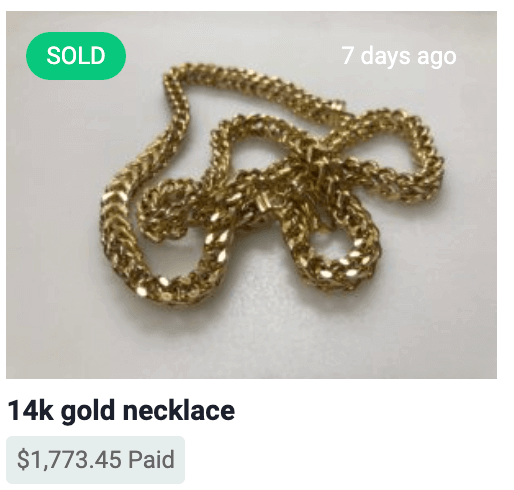
14k gold necklace sold for $1,773 on CashforGoldUSA.
Image Credit: CashforGoldUSA

10k gold chain necklace sold for $430.69:
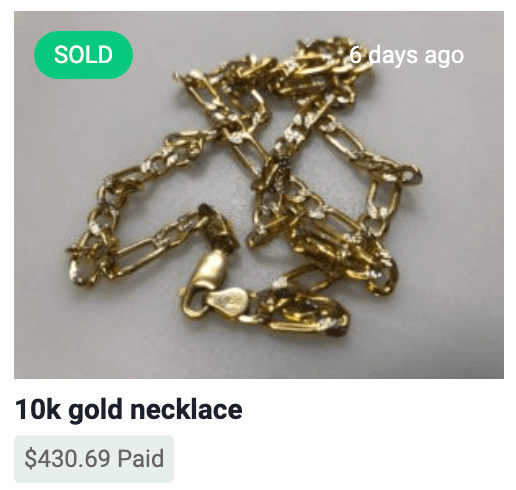
14k gold necklace sold for $430 on CashforGoldUSA.
Image Credit: CashforGoldUSA

3. Sell your jewelry to your local jeweler

We understand that some people have an urgency, and the best jewelry buyer might be the one that offers the fastest turnaround. In that case, a local jeweler you find “near me” may give you a fair value of your jewelry in cash on the spot.

Selling your gold chain, diamond ring or other jewelry at a local jewelry store is a good option, especially if you know a business you trust. 

  • Pro: Could be a fair payout, quickly. Some jewelers offer trade-in deals.
  • Con: Might not get highest offer, and it can be embarrassing to have to sell your jewelry before people you know.

4. Sell to cash-for-gold stores

Cash for gold stores can give you quick cash but have a reputation for low payouts. You can always get a quote, negotiate and shop around.

  • Pro: Immediate cash, local
  • Con: Payout may be low 

5. Local or online auctions

If your gold necklace or chain is pretty standard, nothing special, a gold buyer will most likely offer a payout based on the day's spot gold price, and send it to a refinery to melt down.

However, if you have a significant piece of jewelry or a loose diamond that will sell for at least $1,000, or is a special antique, a marked brand or is a popular style,  it is possible a local or online jewelry auction platform may be interested — especially if your necklace is part of a larger estate collection.

  • Pro: Possibly could fetch a higher price 
  • Con: Not immediate cash, may not sell for as much as you like

6. Sell directly

You can always post your chain and try to sell it directly to individuals, or through antique or consignment stores. Check out sites like:

Pros and cons, of course:

  • Pro: You may get a higher price, and you can do business locally if you prefer 
  • Con: A lot of work dealing with flaky people, possibly having to package and shipping your item, or it not selling it all. 

21 apps for selling stuff online or locally

7 online jewelry buyers

Unless you need the cash immediately, an online jewelry buyer can be the best position to offer you the highest price, as they benefit from not needing expensive retail rent, and you benefit from the competitive online market.

Other benefits of selling to an online buyer include that a quality buyer will provide free, door-to-door shipping, the privacy of never leaving your house, and full insurance. Many rural communities do not have many local options.

Here are some of the most reputable online buyers:

1. CashforGoldUSA

We like this family-owned company for many reasons, including that they give a 10% bonus when you send in your shipment within a week and have helpful customer service and have many options for shipping and payment.

Pricing and payment

  • Get paid within 24 hours
  • 10% bonus if you send your item within 7 days
  • 100% highest price guarantee

Reputation

  • Better Business Bureau rating of A+
  • Founded 2005
  • 4.4/5 Trustpilot stars

Safety and insurance

  • Free, secure mailer or FedEx package sent to your home
  • Buys gold, silver, platinum jewelry, watches, coins and scrap
  • Insurance up to $150,000

Value add

  • Guaranteed highest price
  • If you do not accept their offer, you can get your item back immediately, free of charge
  • Your choice of shipping: USPS or FedEx, or print label at home for fastest process
  • Accepts all diamonds, gold, sterling silver and gemstones regardless of size or quality (other jewelry buyers have minimum diamond size or resale value)

Read our CashforGoldUSA review.

2. Abe Mor

Founded in 1964, New York-based and family-run Abe Mor has one of the largest presences in the online diamond buyer market.

They accept only diamond jewelry and loose diamonds of at least .50 carats, including designer diamond jewelry — like engagement rings from Tiffany & Co, Cartier, and Harry Winston — but they will pay you for the gold and platinum content of your jewelry if it's set with eligible diamonds.

Abe Mor pros

  • A+ BBB rating, zero customer complaints
  • Free shipping 
  • Free insurance up to $50,000 with additional available for purchase

Abe Mor cons

  • Does not buy other types of jewelry or gemstones
  • Only accepts diamond jewelry at least 0.5 carats in size
  • Appraisals are conducted by in-house Abe Mor staff, though you can request GIA authentication
  • May reject diamonds if it does not need them in its inventory
  • Typical time from shipment to payment is longer than other sites, though Abe Mor will overnight a check upon request
  • Pays within 2 to 4 days upon acceptance of an offer

Check out our Abe Mor review.

3. Circa

Circa accepts high-end branded jewelry, as well as diamonds of at least .4 carats, and engagement rings. They will also purchase historical or estate jewelry including pieces such as: Antique, Edwardian, Georgian, Art Nouveau, Belle Epoque, Art Deco, Retro and Modern.

Whether in-person at one of their 23 locations internationally or online, if you accept Circa’s offer, you will be paid immediately via check, bank transfer, or gift card (worth up to 120% of the purchase offer) toward a jewelry purchase from Circa.

If you provide a grading report from the GIA, EGL, IGI, AGS, GSI, GCAL, IIDGR, or HRD, Circa provides a guaranteed offer range.

Circa pros

  • A+ Better Business Bureau rating
  • Works in partnership with diamond retailer Blue Nile
  • Promises to offer a high price to you by cutting out the middleman
  • Website's videos and posts create transparency
  • Fully insured FedEx delivery — both from you to Circa, as well as returns, when relevant
  • 14 physical locations (11 in the U.S. and 3 international)
  • Claims that more than 90% of its customers receive a final offer price higher than the midpoint of the guaranteed range (which includes shipping and insurance)

Circa cons

  • This buyer only deals in jewelry with a diamond of at least .4 carats
  • If you do not have a lab report, you must send in your item for evaluation and grading before an offer is made
  • That offer is good for just 7 days, after which you have to start the whole process over again

In short, Circa is a solid company that brings the Blue Nile experience full circle, promising to offer jewelry sellers high prices by removing the middleman.

4. myGemma, formerly WP Diamonds

myGemma, formerly WP Diamonds, has a solid reputation as an online luxury jewelry buyer, and promises to get you a fair price for your diamond or designer jewelry, loose stones (diamonds of at least .5 carats), handbags, watches, and luxury accessories.

However, theirs is a more traditional buyback platform, in that myGemma's in-house team of GIA-trained gemologists and industry veterans will evaluate your jewelry, then make an offer. Take it or leave it.

myGemma pros

  • Reputable buyer with an A+ BBB rating
  • Clean, easy-to-use site
  • Pays cash for your jewelry
  • Easy process, including FedEx round-trip shipping, and insurance for the full value of your items
  • Choose to do business via email or phone
  • Sell in as little as 24 hours: myGemma buys your jewelry directly, which means there are no online listings or auctions to wait for, no haggling or negotiating — simply their best price upfront
  • No fees are deducted from your final offer — the amount you hear is the amount you get paid.

myGemma cons

  • Evaluation is done by an internal appraiser, not a neutral third-party laboratory like GIA, which Worthy uses
  • There is just one offer, not a price set by a dynamic marketplace

In summary, myGemma is a reputable online diamond and jewelry buyer, that has been around for a long time. It is the fastest way to sell diamonds safely online to the experts.

Read our myGemma review to learn more.

6. The RealReal

Image Credit: Shutterstock

The RealReal is an online marketplace for luxury resale items, including fine jewelry. The site prices your consigned jewelry based on current market trends, and you get paid a commission up to 70% depending on the list price of your items.

Pros of The RealReal

  • Accredited by the Better Business Bureau with an A+ rating
  • 4/5 stars on Trustpilot

Cons of The RealReal

  • Numerous customer complaints on the BBB site about long wait times to process consigned items, items not being returned in the same condition they were sent, unapproved markdowns, and difficulty resolving issues with customer service
  • No guarantee your item will sell — most successful jewelry sales are by professional jewelers or others who have the ability to professionally photograph, display and market their jewelry
  • Must schedule an appointment to meet with a representative and be accepted to sell

7. Worthy

If you have jewelry valued at $1,000 or more, including a diamond engagement ring, other diamond or gemstone jewelry, or branded items from Tiffany, Cartier or another high-end jeweler, then consider Worthy.com, an online marketplace where hundreds of vetted buyers bid on your item.

Typically, the center diamond of an engagement ring of at least .5 carats will sell for $1,000. Worthy also accepts lab-grown diamonds of at least 3 carats. Worthy is A+ BBB rated, and insures your item up to $100,000 with Lloyds of London.

Worthy pros

  • A+ BBB rating
  • 4.6 rating with Trustpilot
  • High consumer reviews
  • Free lab GIA report
  • Cool website that helps you understand the value of your jewelry

Worthy cons

  • Takes longer than other platforms
  • Some users find the process overly complicated
  • Focused exclusively on diamond and high-end branded jewelry
  • Strict minimum of items that will sell for at least $1,000

Read our Worthy review.

FAQs about selling jewelry

What is the best way to sell expensive jewelry?

In the past, we have recommended selling expensive jewelry, especially those with large diamonds, or branded, luxury jewelry such as those from Tiffany, Cartier or Buglari through a reputable online jewelry platform like Worthy or myGemma — national companies that can efficiently evaluate your diamond or other jewelry, safely ship it, evaluate it by trusted experts and appraisers.

Before you get too excited, however, note that diamond prices have dropped about 40% since their peak in summer 2022, and buyback prices reflect this change:2

IDEX December 11, 2024 report
Image Credit: IDEX

For that reason, we recommend online buyer Diamonds USA, which buys all sizes and qualities of diamonds, quickly, and has a strong reputation, or Worthy.com, which specializes in larger diamonds and name-brand pieces.

Complete guide to symbols stamped on jewelry

Can you sell jewelry to a jewelry store?

Working with a local jeweler can be a solid choice if you have a jeweler you know and trust. This can also ensure a quick, cash sale, and many jewelers offer you a bonus if you chose to take store credit.

However, it may be worth the time to also get a quote from a local pawnshop or send in your jewelry to an online jewelry buyer get a second or third offer.

Is it better to sell jewelry to a pawn shop or jewelry store?

Pawnbrokers have a bad reputation for ripping off sellers — but jewelry stores can short-change jewelry sellers, too. The only way to know which is better is shop around, ask local friends and neighbors for recommendations and compare. Getting a quote does not commit you to selling at any of these options.

Is it safe selling jewelry online?

Selling jewelry online with a reputable buyer that insures your item, gives you a FedEx or USPS tracking number and has a robust online presence including Better Business Bureau and other online review sites. Since the online jewelry buyers rely on these reputation sites, they live and breathe customer service and reviews. I feel confident that the buyers listed on this site are honest and safe.

How much is my gold chain worth? What about a broken chain, or a gold ring?

Basic gold items are generally worth the spot price of gold, minus the buyer's commission — which should be around 20% at most reputable places.

For example, a simple gold chain — broken or in-tact — could fetch you $100 to $200. A men's gold wedding band may get you $100 to $200 as well.

Is it worth selling jewelry online?

Selling jewelry online with a reputable buyer that insures your item, gives you a FedEx or USPS tracking number and has a robust online presence including Better Business Bureau and other review sites. 

Sell jewelry online can net a higher payout, convenience of not having to leave your home, and total privacy, since your friends and neighbors won’t see you selling your items in town.

Platinum vs white gold: Which is more valuable?

White gold vs yellow gold: What’s the difference, which is worth more?

Sterling vs plated vs white gold: How to tell the difference

What is the best website to sell used jewelry?

CashforGoldUSA buys all gold, silver, diamond and gemstone jewelry, coins, flatware and tableware via overnight shipping. The Boston-based company has an A+ Better Business Bureau rating and hundreds of high Trustpilot reviews, and promises to pay within 24 hours of accepting terms.

Bottom line: It’s OK to sell your jewelry

Many relationships involve precious jewelry — investments that represented care, love, tradition. These may be romantic or family relationships. Your jewelry may be a gift or an inheritance.

Those engagement rings, watches, necklaces, earrings, gold chains, and bracelets can linger in velvet-lined jewelry boxes for years — or even the remainder of the new owner’s life!

Even if that jewelry is worth tens of thousands of dollars, it is still clutter to you.

It all holds energy, good or bad.

Cleanse out the bad energy, welcome the good.

Even if you are unsure whether the value of the gold or diamonds may go up soon, money in your pocket today is 100% guaranteed, vs the unknown of future prices. Plus, you can pay off debt which saves money in interest, or put money into a 401k or 529, which saves money on taxes — guaranteed.


Costco doesn’t hide deals, but some of the best savings come from knowing the rules behind the signs, services, and membership perks. A few smart moves like using a Shop Card, timing a price adjustment, or letting Concierge Services do the heavy lifting can turn a routine run into real value. These tips lean on official policies, not rumor, so they work nationwide with only minor local quirks. Keep this list handy in your phone and you’ll shop faster, skip fees, and stretch that Kirkland cart farther.

1. Watch for the asterisk and odd price endings

Asterisk on wood sign
Image Credit: Shutterstock

That tiny asterisk in the upper-right corner of a shelf tag signals an item likely won’t be reordered at that warehouse, so stock up if you love it. Price endings can also hint at deals: .99 often means regular price, while off-endings like .97 can indicate a markdown specific to that location. Clearance isn’t guaranteed to drop further, so if supply looks thin, don’t wait. Because these quirks aren’t shouted from the food court, they’re a quiet edge for shoppers who know the code.

2. Use the 30-day price adjustment instead of returning

sale text
Image credit: Tamanna Rumee via Unsplash

If something you bought just went on sale, request a price adjustment rather than lugging it back. For eligible purchases that drop in price within 30 days, Costco will credit the difference no restocking drama, no repacking the SUV. You can submit the request online for Costco.com orders, and warehouses can help with in-store purchases. It’s the cleanest way to match promos you miss by a week, and it keeps hot sellers in your cart instead of the return line.

3. Know where returns are limited, electronics and a few others

return policy written on wooden blocks
Image Credit: Shutterstock

Costco’s satisfaction guarantee is famous, but a handful of categories do have clocks: most major electronics carry a 90-day return window, and some special items have specific rules. For almost everything else, returns stay flexible and easy, especially if you saved your receipt or can pull it up in your account. Skimming the short list of exceptions saves time and keeps surprises off the customer-service counter.

4. Add a free household card for a second shopper

loyalty grocery card in womans hand
Image Credit: Shutterstock

One membership can carry two adults at the same address: the primary member and one free household member (16+). That extra card means someone else can legally do the midweek Costco run, pick up prescriptions, or grab gas without you. Set it up online in Account Details, then the household member can snap a photo at the membership desk and they’re set. It’s the easiest way to share perks without sharing a wallet.

5. Let non-members shop with a Costco Shop Card

young college student shopping
Image Credit: Shutterstock

Got a friend or college kid who isn’t a member? Load a Costco Shop Card for them. Non-members can use Shop Cards to buy in the warehouse, at the pump, and on Costco.com, even though only members can reload them. It’s a tidy workaround for occasional shoppers, gift-givers, or visitors who just need one big stock-up trip.

6. Save your carts and your time with the digital membership card

costco app on phone
Image Credit: Marques Thomas via Unsplash

The Costco app puts your membership barcode, rewards info, and even payment (when linked to an eligible card) on your phone. It also shows in-warehouse receipts for the past two years and helps you find hours for each department before you drive. If you’re prone to forgetting your wallet or paper card, this keeps the line moving and your rebates visible.

7. Executive members: stack the 2% reward (and know the fine print)

inside wholesale store
Image Credit: Albert Stoynov via Unsplash

Executive Membership adds a 2% annual reward (up to $1,250) on qualified Costco, Costco.com, and Costco Travel purchases. If your year’s reward doesn’t beat the upgrade cost, remember Costco’s membership guarantee you can downgrade. It’s a simple math check most shoppers forget, and it can turn big seasonal purchases into real money back at renewal.

8. Costco Travel can pay twice 2% reward plus card cash back

Travel Tips
Image credit: Precondo CA via Unsplash

Booking through Costco Travel often brings bundled perks, and Executive Members earn the 2% reward on qualifying travel (applied after the trip). Use the Costco Anywhere Visa® by Citi and you can stack additional cash back on those purchases. Check the exclusions taxes and third-party add-ons typically don’t count, then let the rewards cover some of your next renewal.

9. Skip guesswork at the pump and yes, Shop Cards work for fuel

a parking meter on the side of a street
Image credit: Egor Komarov via Unsplash

Costco’s fuel stations are member-only, but there’s an exception: anyone can buy gas with a Costco Shop Card. The lanes run one-way and the hoses reach either side of your vehicle, which keeps lines moving during rush hours. It’s a quiet way to share low gas prices with non-member family or help a teen driver fill up without handing over your main card.

10. Free air for your tires, same hours as the gas station

a garage with a large stack of tires
Image credit: Ruben Valenzuela via Unsplash

Most warehouses have a self-inflation station at the Tire Center, and it’s open the same hours as the gas station. That means you can top off tires right after fueling instead of hunting down a paid air machine across town. Tiny habit, real savings, and better mileage and tread life.

11. Pharmacy access without a membership (in store and online)

women's red button-up collared long-sleeved shirt
Image credit: National Cancer Institute via Unsplash

You don’t need to be a member to fill prescriptions at Costco’s pharmacy counters or via Costco’s online pharmacy options. Members do get extra perks, but if a friend or parent needs a one-off fill, they can head straight to the pharmacy window and pay with common methods. It’s a little-known exception that can save time and money.

12. Same-day delivery has a markup, 2-day pantry often doesn’t

a man wearing a red hat
Image credit: Fotos via Unsplash

Costco’s Same-Day delivery (powered by Instacart) prices are higher than warehouse prices and include service and delivery in the item costs. The 2-Day option for non-perishables ships to your door and waives the per-item surcharge on orders $75+, which can be cheaper for heavy pantry restocks. Know the difference before you click, Same-Day is speed; 2-Day is value.

13. Use Concierge Services for a free extra year of warranty

call center
Image Credit: Shutterstock

On many electronics and major appliances, Costco extends the manufacturer’s warranty to two years and offers free tech support through Concierge Services. That’s on top of Costco’s 90-day electronics return window and any optional Allstate plans you buy. If something glitches in year two, call Concierge first, they handle a lot before you ever need a service visit.

14. Pull up in-warehouse receipts in your account

costco receipt
Image Credit: Shutterstock

No more shoebox of slips: link your membership in your Costco.com account to view and print in-warehouse receipts for the past two years. It’s perfect for appliance warranties, HSA records, or big returns when the paper went missing. Check the In-Warehouse tab under Orders & Purchases and change the date filter to find what you need.

15. Don’t price-match, just compare channels

mother shopping with child
Image Credit: Shutterstock

Warehouse and Costco.com prices can differ, and Costco doesn’t price-match other sellers or even match warehouse to online. Instead of chasing matches, compare totals yourself: factor in shipping on Costco.com and the 2-Day delivery surcharges, or use Same-Day when speed matters. If a deal pops up after you buy, that’s what the price-adjustment window is for.

Pay day feels great—and that rush can lead to quick, costly decisions. A steady set of habits protects you: move money first, cover essentials, and then spend what’s left with a plan. These rituals don’t require fancy apps or hours of work; most take minutes and run on autopilot once set up. Done every pay period, they smooth out surprises, cut fees and interest, and help you hit goals without stress. 

1. Split your paycheck the moment it lands

red and white love neon light signage
Image credit: Mary Rodriguez via Unsplash

Set your direct deposit to send a fixed amount or percent straight into savings and the rest into checking. When saving happens first, your day-to-day spending naturally fits what remains. Many payroll systems let you add multiple accounts, so you can fund an emergency stash or a specific goal without lifting a finger. If your employer can’t split deposits, schedule an automatic transfer for the same day the money arrives so you don’t “accidentally” spend it. (Source: Consumer Financial Protection Bureau)

Keep rule-of-thumb targets in mind: start small (even $25–$100 per paycheck) and step up after raises. Label the destination account with the goal’s name to reduce temptation, and keep it at a different bank if needed for extra friction. Treat this like a fixed bill you owe yourself, not a “nice to have.” Over time, the automatic split builds savings without constant decisions or willpower. (Source: Consumer Financial Protection Bureau)

2. Automate “pay yourself first” for every pay period

a pay me sticker on the side of a building
Image credit: Claudio Schwarz via Unsplash

When money hits, trigger a recurring transfer into a savings or high-yield account. Automation turns saving into the default and spending into a conscious choice. Tie the transfer to the deposit date so it fires no matter when payday falls. Start with a number you won’t notice, then bump it by 1–2% after each raise or when a bill drops off. This slow, steady build keeps your budget stable while your savings grows.

Make separate “buckets” for different goals—emergency, travel, car repairs—and fund each on a schedule. If your bank supports sub-accounts, nickname them to stay organized. This structure gives every dollar a job before you can spend it and reduces the urge to raid savings for impulse buys. Over months, you’ll feel the difference in lower stress and fewer money “fires.”

3. Top off your emergency fund

emergency fund
Image Credit: diwdom5355 via Freepik

Use payday to push a little more into your “break-glass” cash. A small, regular deposit adds real protection against flat tires, medical bills, or short paychecks. Parking this money in a separate, easy-access account keeps it available but out of sight. If you’re starting from zero, aim for your first $500, then one month of expenses, and build from there as your budget allows.

Make the transfer automatic and scheduled for the same day as your deposit so it never depends on mood or memory. When a true emergency hits, use the fund guilt-free, then refill it with your next few paychecks. This habit prevents high-interest debt from filling the gap and keeps your budget steady after life’s bumps.

4. Feed sinking funds for known, irregular costs

a dollar sign on top of a round object
Image credit: Paris Bilal via Unsplash

Some expenses aren’t monthly, but they’re certain—insurance premiums, holidays, car tags, or back-to-school. On payday, move a set amount into labeled “sinking funds” so those big bills don’t blow up a future month. Work backward: total the cost, divide by the number of paychecks until it’s due, and transfer that figure every time.

Use separate sub-accounts or a simple tracking sheet to keep each fund clear. When the expense arrives, you’ll pay in full from the right bucket—no scrambling, no credit card surprise. Over a year, this single habit smooths your cash flow and keeps you from “borrowing” from next month to survive this one.

5. Pay essentials first with a bill calendar

white calendar
Image credit: Mille Sanders via Unsplash

Before any fun spending, lock in housing, utilities, insurance, and minimum debt payments. A simple bill calendar (dates and amounts) turns chaos into a checklist. On payday, schedule those payments or move the money into a dedicated “bills” account so it’s ready to go. Covering needs first protects you from late fees and keeps the lights on even in a busy month.

Match due dates to your pay cycle where possible by asking creditors for adjustments. Then set reminders a few days before each draft. With the big stuff handled up front, you can spend what’s left without guessing or worrying you’ll dip into bill money by mistake.

6. Schedule an extra debt payment (snowball or avalanche)

paying off debts
Image Credit: Shutterstock

After minimums, send a small extra payment toward one target debt the day you’re paid. The avalanche method (highest rate first) saves the most interest; the snowball (smallest balance first) delivers quick wins. Pick one and automate it so progress happens every period without fresh decisions. This trims interest and shortens payoff time without a crash diet budget.

When a balance is gone, roll that extra amount to the next debt. If cash is tight one period, keep the minimums, then resume your extra next payday. Consistency beats size here; even $20–$50 per check lowers interest costs and builds momentum you’ll feel in a few months.

7. Check your paycheck withholding

W4 Form
Image Credit: Shutterstock

Use the IRS Tax Withholding Estimator to see if your current W-4 fits your situation. Too little withholding risks a surprise bill and penalties; too much locks up cash you could use for bills or savings. Recheck after life changes like marriage, a new job, side income, or a new child. Adjusting now keeps your take-home pay and tax bill in balance.

Run the tool with your latest paystub and last year’s return for best results, then submit a new W-4 to HR if needed. Put a note on your calendar to revisit midyear and each January. This quick tune-up on payday helps you avoid sending an interest-free loan—or facing a nasty surprise next spring.

8. Turn on autopay and account alerts

stressed over paying the bills
image Credit: Shutterstock

Autopay prevents missed due dates on recurring bills, while alerts keep you in the driver’s seat. Set drafts for essentials and enable low-balance, deposit, and large-transaction alerts on your accounts. You’ll catch problems fast and avoid late fees or overdrafts. Choose draft dates that match your pay cycle so money is there when bills hit.

Pair autopay with a “bills” account funded on payday and use alerts as your safety net. If a bill is variable (like a credit card), schedule an autopay for the statement balance to avoid interest, with a backup alert for unusually high charges. This blend of automation and awareness saves money with minimal effort.

9. Use separate accounts to firewall your spending

A hand holds a virtual bank
Image Credit: Shutterstock

Create two checking accounts: one for fixed bills and one for everyday spending. On payday, fund the bills account first, then move your planned spending amount to the other card. When the “spend” account is empty, you’re done—no risk of tapping rent money. This simple wall removes mental math and keeps priorities in line.

Keep the bills debit card out of your wallet and use the spending card for daily purchases. Review the bills account monthly to adjust transfers as prices change. This low-tech setup brings clarity fast, especially if you’ve struggled with overspending after pay day.

10. Do a 10-minute budget check-in

woman budgeting her money
Image Credit: Shutterstock

Right after your deposit, look at the last pay period: where did money go, and what one tweak would help this time? Update your plan, set a small improvement (like trimming takeout by $20), and assign that savings to a goal. Short, regular check-ins beat long, stressful overhauls and keep your plan realistic.

Use any simple tool you’ll actually open—paper, a spreadsheet, or your bank’s tracker. Focus on habits you control this week, not guilt about last month. This quick loop builds awareness without burnout and makes each pay period a little smoother than the last.

11. Plan this pay period’s groceries with a list

Woman shopping in a grocery store with a cart.
Image credit: Vitaly Gariev via Unsplash

Food is a top budget line—and an easy place to overspend. Before shopping, plan meals for this pay period, check your pantry, and write a list that fits your budget. Stick to the list, buy store brands where it makes sense, and use unit prices to compare sizes. Fewer trips mean fewer impulse buys.

Batch-cook a few flexible staples (like rice, beans, roasted veggies) on payday weekend so weekday dinners are fast and cheap. Freeze portions and rotate leftovers so nothing goes to waste. A plan on paper keeps meals steady and your wallet calm.

12. Boost retirement contributions when you can

Retirement Plan written on blackboard
Image Credit: Shutterstock

Use payday to nudge your workplace plan up by 1%—especially if you’re not getting the full employer match yet. Small increases barely move take-home pay but compound for decades. If you don’t have a plan at work, set an automatic transfer to an IRA the day you’re paid and treat it like any other bill.

When you get a raise or bonus, raise your contribution the same day before lifestyle creep sets in. Check current contribution limits annually and coordinate with your spouse if you’re both contributing. This simple “set and escalate” rhythm builds long-term security without constant tinkering.

13. Put federal student loans on autopay

wooden letters spell student loan
Image Credit: Shutterstock

Enroll in Auto Pay with your servicer so monthly payments draft automatically. This helps you avoid missed due dates, and many federal loans include a 0.25% interest rate reduction when you use auto-debit. Choose a draft date that follows your payday so funds are in place.

Pair Auto Pay with an income-driven plan if your budget is tight; you can recertify income each year and update if it changes midyear. Turn on email and text alerts so you’ll see any changes to the draft amount before it hits. Fewer late fees and a lower rate add up over time.

14. Make (at least) one extra credit card payment

a person is holding a blue credit card
Image credit: CardMapr.nl via Unsplash

If you carry a balance, send an extra mid-cycle payment right after payday. Many issuers use your average daily balance to compute interest; lowering that balance sooner means less interest accrues. Even a small extra payment each pay period speeds payoff and reduces how much you hand over in finance charges.

Set a recurring extra amount—say $25–$100—so you don’t rely on memory. When a card is paid off, redirect that extra to the next highest-rate card. Over a few months, you’ll see balances drop faster and minimums shrink, freeing cash for savings.

15. If you’re self-employed, sweep money for taxes

w2 tax
Image Credit: Shutterstock

Taxes are pay-as-you-go. Each time a client pays you, move a set percentage into a separate tax account and make quarterly estimated payments. This prevents a big April bill and possible penalties. Use last year’s return and current income to estimate, then adjust as business picks up or slows down.

Put the sweep on a rule: every deposit triggers a transfer. Mark quarterly due dates on your calendar and set reminders a week ahead. Keeping tax cash walled off makes it easier to price jobs correctly and sleep at night when payments come due.

Gen Z grew up with calculators in their pockets and price changes in real time, so a lot of “rules” from earlier decades don’t land the same. They’re weighing fees, unit prices, and long-term trade-offs instead of repeating slogans. Some classic advice still holds save, invest, avoid high-interest debt but many one-size-fits-all rules were never laws of money. Below are the myths younger workers question most, plus the smarter take. Use these as conversation starters with family, not fight-starters.

1. Renting is throwing money away

Image credit: Aaron Sousa via Unsplash

Rent isn’t “wasted” if it buys flexibility, outsized location value, or time to save. Buying carries upfront costs (down payment, closing), ongoing costs (maintenance, taxes, insurance), and market risk. The better frame is total cost of housing vs. your income and timeline. If you’ll move soon or need to build a cash buffer, renting can be the smarter financial move. The key is running the numbers for your city, not following a slogan.

2. You must put 20% down on a house

Image credit: Jakub Żerdzicki via Unsplash

Twenty percent avoids private mortgage insurance but it’s not required. Many conforming loans allow 3–5% down with PMI, and some programs (VA loans) require no down payment for eligible borrowers. The real decision is total monthly cost, cash cushion after closing, and rate/fee trade-offs, not chasing a single down payment number.

3. Never talk about your salary

Image credit: Mathieu Stern via Unsplash

Talking pay helps spot inequities and negotiate fair offers. In the U.S., most private-sector workers have a protected right to discuss wages with coworkers, and many states now require pay ranges in job postings. Secrecy serves employers; transparency helps workers plan and bargain.

4. College is the only path to a good career

Image credit: Felipe Gregate via Unsplash

Degrees open doors, but paid apprenticeships and targeted certificates also lead to solid, growing jobs often with lower or no debt and strong wage ladders. Electricians, lineworkers, CNC machinists, coders in apprenticeships, EMT-to-paramedic tracks these are real, structured pathways with credentials employers value.

5. Keep a small balance on your credit card to build credit

Image credit: Jim Chen via Unsplash

Carrying a balance doesn’t boost your score and it costs you interest. What matters most is on-time payment history and keeping your utilization (balance/limit) low. Pay in full by the due date to avoid interest; you’ll still build credit as the issuer reports your on-time payments.

6. Close old credit cards to raise your score

Image credit: Jim Chen via Unsplash

Shutting a long-standing card can shorten your average account age and raise your utilization ratio, both of which may hurt scores. If a no-fee card isn’t causing problems, leaving it open and unused is often better for your credit profile.

7. Buy the biggest house the bank will approve

Image credit: Kostiantyn Li via Unsplash

Lenders set a maximum; your budget needs margin for repairs, insurance, taxes, and the rest of your life. Many households end up “house poor” by stretching to approval limits. Use debt-to-income guidelines as guardrails, not goals, and stress-test your budget for higher utilities, HOA fees, and surprise fixes.

8. Cash or debit gives you the best protection

Image credit: Kostiantyn Li via Unsplash

Cash is untraceable, and debit pulls money from your account immediately. Credit cards carry strong federal protections for fraud and billing errors and allow you to dispute charges before paying. Used responsibly (paid in full each month), credit can be safer for big or online purchases than cash or debit.

9. Beating the market means picking winning stocks

Image credit: Robb Miller via Unsplash

Broad index funds give instant diversification at low cost, and many investors underperform the market when they trade frequently or chase hunches. Costs and concentration risk matter over decades; diversified funds reduce both. If you want to pick, treat it as a small, capped slice of your plan.

10. Bonds can’t lose money

Image credit: Markus Winkler via Unsplash

Bonds carry interest rate risk: when rates rise, existing bond prices fall. If you sell before maturity or if you hold bond funds during sharp rate moves you can lose principal. Bonds can still reduce volatility versus stocks, but “safe” isn’t the same as “can’t drop.”

11. Everyone needs a fixed three-month emergency fund

Image Credit: diwdom5355 via Freepik

Three to six months is a useful rule of thumb, not a mandate. The “right” buffer depends on job stability, dependents, health costs, and access to credit. Many people do better starting smaller (even $500–$1,000), then automating regular transfers to grow the cushion over time.

12. Medical bills can’t be negotiated

Image credit: Marek Studzinski via Unsplash

You can ask for itemized bills, correct coding errors, request financial assistance, and arrange zero- or low-interest payment plans with providers. Many billing offices will discount for prompt pay or set up manageable schedules if you ask. Don’t ignore statements call early and keep records.

13. Tax refunds are free money

Image credit: Markus Winkler via Unsplash

A big refund usually means you over-withheld all year an interest-free loan to the government. If your refund is large or you owed a lot, adjust your W-4 so paychecks match your actual tax. The goal is “about right,” not max refund.

14. Health savings accounts are only for people with big medical bills

Image credit: Marek Studzinski via Unsplash

HSAs offer triple tax advantages: deductible contributions, tax-free growth, and tax-free withdrawals for qualified medical expenses. You can also invest HSA funds and reimburse yourself later if you save receipts, turning health costs into long-term, tax-advantaged savings. Eligibility requires a qualifying high-deductible health plan.

15. 401(k) fees don’t matter

Image Credit: Shutterstock

Even small fee differences compound over decades. Two funds that both earn 7% before fees can end thousands apart if one costs 0.90% and the other 0.05%. Review your plan’s expense ratios and any administrative fees; shifting to lower-cost options can raise your net returns without extra risk.

16. Social Security won’t be there for you

Image credit: Markus Winkler via Unsplash

The program faces funding gaps without changes, but it’s not “going away.” Even if trust fund reserves are depleted in the future, ongoing payroll taxes are projected to cover most scheduled benefits unless Congress acts. Plan as if benefits will exist with potential adjustments, and save independently too.

17. The only way to build credit is with a traditional credit card

Image credit: Markus Winkler via Unsplash

Other tools can help: secured cards, credit-builder loans, and (in some models) reported rent and utility payments. What matters is consistent on-time payment and low balances relative to limits. Choose products that report to the major bureaus and avoid fees that eat your progress.

18. Loyalty is the best way to get a raise

Image credit: Sasun Bughdaryan via Unsplash

Staying can pay, if your employer moves you with the market. But data often show job switchers seeing faster wage growth than job stayers, especially in tight labor markets. Track your market rate and be ready to negotiate or change roles when the gap widens.

19. Buying new cars is always smarter than buying used

Image credit: Erik Mclean via Unsplash

New cars depreciate fastest in the first years. Many late-model used cars (especially certified pre-owned) offer strong reliability with a lower price and slower depreciation. The best value is the car that fits your needs, budget, and ownership costs not automatically “new.”

20. All debt is bad debt

Image Credit: Shutterstock

High-interest debt is dangerous; strategic, low-cost debt can be useful. A simple rule: first, make minimums on every account; second, kill high-rate balances; third, weigh low-rate borrowing against savings and investment goals. The goal isn’t “no debt at any cost” it’s using credit intentionally.

21. Payday loans are fine for short-term cash

Image credit: Dan Dennis via Unsplash

These loans are extremely expensive and designed to roll over, trapping borrowers in a cycle of fees. Before using one, look at alternatives: payment plans with creditors, advance pay through employers, credit unions, or community assistance. If you’re already in a payday loop, ask about extended payment plans available in many states.

22. Renters don’t need insurance

Image credit: Bingqi Huang via Unsplash

Your landlord’s policy usually covers the building, not your stuff or your liability. Renters insurance is often inexpensive and can protect belongings, temporary housing after a covered loss, and personal liability. If cost is tight, raise the deductible and inventory essentials first.

Discover job hunting tips, ways to earn more, and flexible working options:

Practising job interview
Image Credit: Shutterstock

21 high-paying careers that desperately need workers, but nobody wants to do them: The pay is generous, but these jobs are searching for workers.

No background check jobs: 12 background friendly jobs: If you’re struggling to find a job due to past issues, here are jobs you can get without background checks.

15 remote jobs you probably didn’t know pay $150,000+ In 2026: High income and flexible work hours from home is not a myth — here are some remote-friendly careers.

More benefits advice and news from Wealthy Single Mommy:

A couple doing paperwork together
Image Credit: Shutterstock.

Legit single mom hardship grants — This is an updated list of dozens legitimate hardship grants for single mothers — from private charities, businesses and individual donors.

SNAP in 2026: New max benefits, rule changes, and the exact moves to raise your payout — For the 2026 fiscal year, the caps go up in most places, deduction amounts change, and other changes affect how much you receive. Below you’ll find the new numbers in plain English, a quick way to estimate your own benefit, and how to maximize your sum.

7 surprising EBT benefits — If you receive EBT card benefits you can qualify for more than free groceries and other essential items. In this post, you'll find places to go for EBT card holders, including free entrance, discounts and other free stuff.

California divorced mom Marissa Forrester's 1.5 carat diamond engagement ring had a retail value of $10,000 in 2012. Eleven years later in 2023, she sold it online for a quarter of that — $2,500.

“I thought I'd get something close to $5,000 or $6,000,” Forrester told me. “I was disappointed, but glad to finally get rid of it!”

While the resale value of a diamond has always been very low — 50% or even far less — prices have plummeted in the last two years as inexpensive lab-grown diamonds compete with natural stones, and the global economy is depressed.

While it may be disappointing to sell such an expensive item for such a small sum, it may make sense to sell now before prices drop even further.

Common mistakes women make when selling an engagement ring

engagement ring in box
Image Credit: Jackie Tsang via Unsplash

Most jewelry is a gift, and therefore an emotional possession — even if the gold, diamond or other material is really just a commodity. Engagement rings are the most emotional of all.

Before you figure out how and where to sell your engagement ring, let's knock out some common emotional barriers that may be standing in the way:

1. Waffle about whether to sell or keep your engagement ring

I meet a lot of women who hold on to their engagement rings for a years, which in this market, means that they are losing money every day — all while holding on to a momento from what was likely a sad breakup.

Others similarly hold on to their ring for their children to use for their own engagement ring one day. I try not to judge, but that is nothing but bad mojo.

Others repurpose the center stone of their engagement ring into a necklace or other jewelry. Many seem happy with that choice, but again — there are plenty of other diamonds that don't carry the negative baggage of your divorce.

In general, women are happier once they get rid of their engagement rings — whether they sell (and use the funds to pay off debt, go on vacation, invest in a business or education), or, in the case of Mallory in Oregon, climbed the summit of a local mountain, wrapped the ring in a scrunchie and tossed it off a cliff. “Never felt better,” she told me.

2. Assume your ring is worth more than it is

This post spells out how to understand what your engagement ring is really worth on the resale market. Dig into that ASAP — know what you are dealing with.

Word to the wise from Jessica in Lumberton, N.C.:

I thought about keeping my bridal set for my kids. However, I know there are a lot of superstitious people in our world. Plus, there was no way of knowing if either of my children would want the rings. So I finally decided to sell them to a pawn shop, mainly because my ex was not helping financially.

The pawnshop owner told me the diamonds are fake and they're not even quality crystals! So I asked about selling the set for the gold scrap value. They tell me it's gold-plated!

I was mad, but I didn't know if my ex knew or if he was scammed. The jewelers where he bought the rings had closed down because people were finding out when they were bringing in real diamond jewelry to be sized or cleaned that their real diamonds were being taken out and were replaced with fake cheaply made stones. I went to another pawn shop and jewelry store hoping that the first place was wrong, but that was not the case. I did find someone that would take the set, but I literally got $10 for it, which at least replaced the gas I had burned going to all the different places for quotes. 

How to tell if your gold is real

One of the reasons many women choose not to sell their engagement ring is that the price they are quoted from a jeweler or auction site is much lower than what they believe their ring is worth.

There are several reasons diamonds lose so much value:

  1. Wholesale ring buyers need to make a profit when they resell your ring or earrings, so they like to buy low.
  2. Diamond values are down at least 30% from their peak in summer 2022.
  3. A common misunderstanding is that the engagement ring owner believes that, for example, she has a 1-carat engagement ring, when in reality, the center stone is .5 carats, and the surrounding smaller stones total .5 carats. Most jewelers or ring buyers value the smaller stones very little — perhaps less than $100 total in this case — and are only interested in the center stone.

Diamonds do not hold their value the same way that commodities like gold and silver do. Typically, the resale value of diamond jewelry is 30% to 50% of what you paid for it. 

One online diamond buyer told me that the resale value can be as little as 5%.

“People are always surprised by how little their diamond is worth, but diamond retail prices have always been inflated, and now prices are dropping like crazy,” he said.

Prices have fallen nearly 30% since their peak in summer 2022, according to IDEX, which tracks global diamond trends:

IDEX December 11, 2024 report

3. Try to sell your ring without documentation

Now, many people, especially those with smaller stones, do not have a proper diamond appraisal, and that is OK.

Nonetheless, do your best to learn everything you can about what your diamond is worth. If you have a GIA certificate for your engagement ring or other lab report, the original box, receipt, and any documentation of the size and quality of the stones and metal, send or bring it with you when you sell.

The resale value of your engagement ring depends on the size, cut, clarity and color of the stone, as well as the market value of the precious metal in which it is set. Plus, yours might be worth more if it's from a designer jewelry brand. All of these can be documented in a lab report or even a jewelry appraisal or diamond appraisal

These reports typically cost between $100 and $300, so they're only worth it if your item is worth at least $1,000.

4. Take the first offer for your engagement ring

engagement ring to sell
Image Credit: Micah & Sammie Chaffin via Unsplash

It's always worthwhile to get at least two offers for your engagement ring (or any jewelry for that matter).

You can always start with a quote from a jewelry store, diamond buyer, or local pawn shop. 

No matter where you end up selling — even if you are not a skilled negotiator, the buyer will typically respond to your suggestion for a higher price. As my mom used to say: They won't respect you unless you negotiate!

It’s easy to obtain multiple offers from online diamond buyers. Here's how the process typically works:

  1. Online diamond buyers will ask you for some basic information about your engagement ring, either online or over the phone.
  2. They'll give you an initial estimate, either via email or over the phone.
  3. A quality online buyer will send a free FedEx, UPS, or USPS mailer that includes insurance (you should be able to track your item all the way to the buyer — and back if you decide not to sell).
  4. The diamond buyer will make a final offer after evaluating your engagement ring in person, which you can accept or reject. Again: negotiate! Many of the top diamond buyers offer payouts within 24 hours or less.

Best places to sell a diamond engagement ring

Based on our criteria and extensive research in the diamond-buying space, we've determined these are the four best options for selling your ring, based on what makes the most sense for you:

  • Pawn shop: Where to sell diamonds for immediate cash
  • DiamondsUSA: Best place to sell most wedding and engagement rings online
  • Worthy: Good choice for designer engagement rings
  • Diamond Banc: Best way to get cash without selling your engagement ring (jewelry loans)

Keep reading to learn about each of these options:

Best place to sell your diamond engagement ring for immediate cash: Local pawn broker near you

Pawnshops can have a bad reputation for paying pennies on the dollar. There are many local pawnbrokers that are honest, reputable business and will pay you a fair price for your diamond — or extend a pawn loan, allowing you to maintain ownership of your diamond and secure a short-term loan if you need money.

Pros:

  • Immediate cash
  • Do business with a local company in your community
  • Possibility of pawn loan

Cons:

  • Unlikely to get highest price for your engagement ring

This post outlines how to find a reputable, legit pawnshop in your community, and sell for the highest price (tip: know the value of your ring and always negotiate).

Find a pawnbroker near you:

google-maps-usa-image

Best place to sell most diamond engagement rings: Diamonds USA

Selling your engagement ring to a local jeweler or pawn shop may give you quick cash, which is important to a lot of people. However, local jewelry buyers typically pay less than online buyers — plus also require you to leave your house (annoying), and have a much less private process than online diamond buyers.

DiamondsUSA is one of the best gold and jewelry buyers on the market and buys any and all sizes of gold and diamond jewelry, including lab-grown diamonds. We also like Diamonds USA because:

  • A+ BBB rating
  • Payouts within 24 hours of an accepted offer
  • Fully insured shipments from your home
  • Guarantee they will beat any written price for your engagement ring

Most other buyers require a minimum size and value of diamond engagement ring or loose diamond, typically .5 carats and $1,000.

These are some recent Diamond USA sales:

January 2024 — White gold engagement ring set with 1.29 carat center stone with a clarity I1 with color J-K w strong fluorescence, paid $1,500:

You can sell an engagement ring on CashforGold, like this 2.89 total carat weight ring, which sold for $903.
Image Credit: Diamond USA

January 2024 — 1.16 total carat weight engagement ring set, paid $445:

Image Credit: Diamond USA

January 2024 — 1.78 total carat weight engagement ring set, paid $550:

Image Credit: Diamond USA

January 2024 — 2.89 total carat weight engagement ring set, paid $903:

Image Credit: Diamond USA

DiamondsUSA is also a good option for selling gold and platinum wedding rings. Actually, DiamondsUSA and its sister sites, CashforGoldUSA and CashforSilverUSA, can help you sell the following:

  • Diamond engagement ring with a center stone of any size
  • Wedding ring with lots of small diamonds in the setting (known as melee diamonds)
  • Engagement ring with small diamonds or other gemstones in the setting
  • All other diamond, gold, gemstone, or even silver jewelry, coins and bullion

Where to sell a designer engagement ring: Worthy

If you have something that’s high value because you have large diamonds or a designer engagement ring (Tiffany & Co, Cartier, Harry Winston, Van Cleef & Arpels, etc.), and you don't need the money immediately, consider Worthy.

Worthy accepts engagement rings if the largest diamond is at least 0.90 carat in weight and auctions them to a network of more than 1,000 professional buyers.

These are some recent auction payouts for engagement rings on Worthy.com:

October 2024 — 2.27 ct. Round Cut Solitaire Ring, K, SI2, sold for $5708

Image Credit: Worthy

October 2024 — 1.41 ct. Round Cut Solitaire Ring, G, VS2, sold for $2625

Image Credit: Worthy

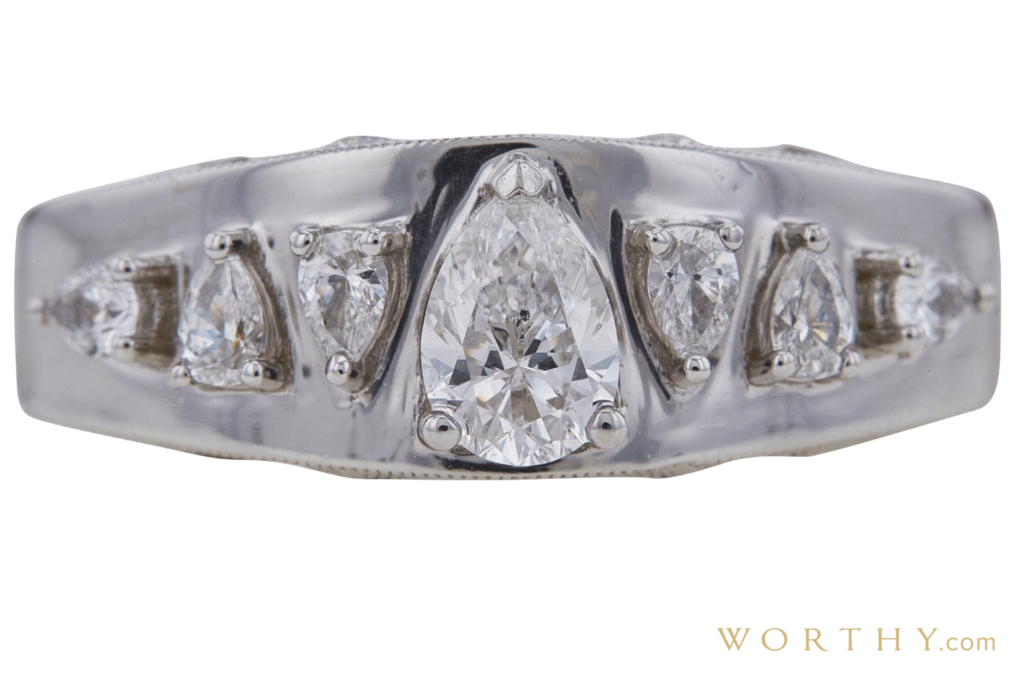
October 2024 — 0.71 ct. Pear Cut Solitaire Ring, G, SI2, sold for $1000

Image Credit: Worthy

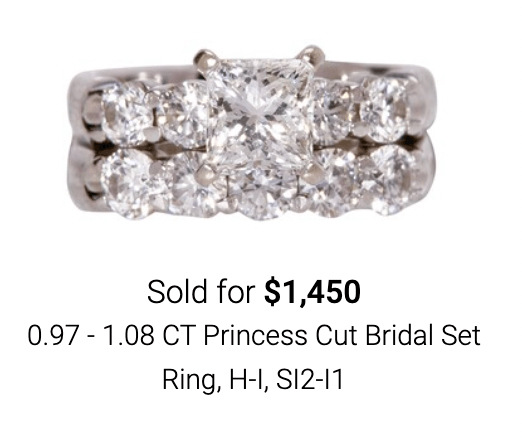
March 2024 — 0.97-1.08 carat princess cut bridal set, sold for $1,450

Image Credit: Worthy

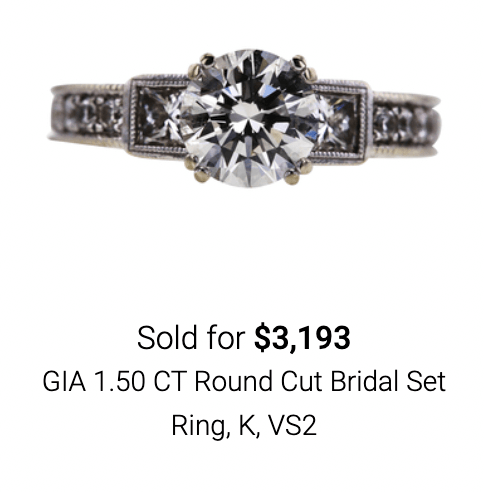
March 2024 — 1.5 carat round cut bridal set, sold for $3,193

Image Credit: Worthy

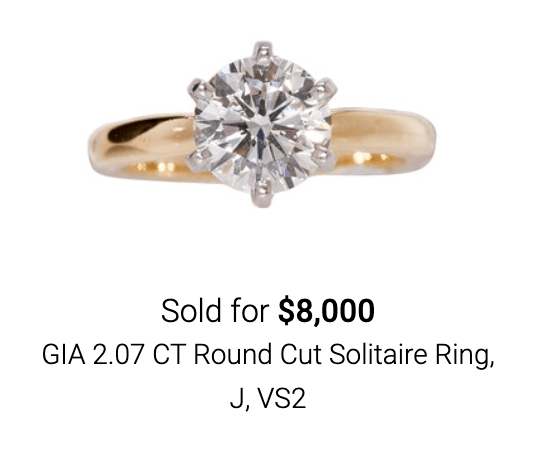
March 2024 — 2.07 carat round cut solitaire ring, sold for $8,000

Image Credit: Worthy

Check out my Worthy review to learn more about my personal experience selling an engagement ring with the auction platform.

Where to get cash for your engagement ring without selling: Diamond Banc

If you need to get the most money for your engagement ring today, but you don’t really want to sell it, then consider a jewelry loan from Diamond Banc. A jewelry loan allows you to send in your engagement ring (or other jewelry) as collateral against a loan, in exchange for interest.

Learn more about how jewelry loans work and read our Diamond Banc review.

Moissanite vs diamond: What to know about resale value this year

Cubic zirconia vs diamonds: What to know before you buy

FAQs about selling an engagement ring

Can I legally sell my engagement ring?

In all states, any item that was gifted to you, you own. Typically, an engagement ring is a gift from one person to the other — the receiver of the ring in this case has full legal ownership and has the right to sell, trade or trash it.

Should I get my engagement ring appraised before selling?

An appraisal from a local jeweler is useful for insurance resale value, or perhaps to understand the quality of your engagement ring. A lab report can be very helpful in selling your engagement ring, or for getting a loan against your ring, but will cost $100 to $300, so this only makes sense for more valuable items.

How much will I get if I sell my diamond ring? How much is a diamond worth?

Your engagement ring is worth the current market price for the diamond and metal.

The real value in selling your wedding or engagement ring or other jewelry you don’t wear is that it frees up all that negative energy attached to the item, stewing indefinitely in your jewelry box. It felt good to rid my home and mind of that significant marriage memento.

Even if you loved the ring, loved your ex, loved being married, love any kids that came from that union (yes, yes, yes, yes for me), it is time to move on and free the mental energy attached to the ring — not to mention the money!

How much will a jeweler pay for an engagement diamond ring or wedding ring set?

A jeweler will likely pay you anywhere from 5% to 50% of the retail value of your ring, similar to pawn shops. Again, this may be less than what you would get from an online buyer, as a jeweler will have a higher markup. Shop around to ensure you get the best price and always negotiate. 

A 1-carat diamond and gold engagement ring will fetch resale prices ranging from $1,000 to $5,000, depending on the cut, quality and setting. Platinum setting and large side stones can mean higher prices, as can name brands like Tiffany or Cartier.

Bottom line: Is it worth it to sell an old engagement ring?

A couple years after my divorce, I sold my engagement ring and wedding band at a fine jewelry buyer in New York City, where I lived.

I only received a fraction of what my now ex-husband and I paid for it, but I felt I got a fair price and used the proceeds to fund a trip my kids took to Europe with their dad to visit family — which I felt good about.

You can get a quote for your engagement ring within a day at DiamondsUSA.

How about you? Do you still have your engagement ring? Do you feel you understood the true resale value of your jewelry?

Share in the comments!

Where can I sell my engagement ring for the most money?

Selling your engagement ring to a local jeweler or pawn shop may give you quick cash, which is important to a lot of people. However, brick-and-mortar jewelry buyers typically pay less than online buyers, so I recommend considering a reputable diamond buyer online.

Do engagement rings hold their value?

While over time, diamonds have historically risen in value from a retail price point, do not expect to get your money back on an engagement ring. Typically, resale value of fine gemstone jewelry is one-third to one-half of what you pay for it. Diamond prices have been declining over the past year.

How much can you sell an engagement ring for?

A 1-carat diamond and gold engagement ring will fetch resale prices ranging from $1,000 to $5,000, depending on the cut, quality and setting. Large side stones can mean higher prices, as can name brands like Tiffany or Cartier.

How much will a jeweler pay for a diamond ring?

A jeweler will likely pay you anywhere from 20% to 50% of the retail value of your ring. Shop around to ensure you get the best price.

Should you sell your engagement ring?

Overall, I am a huge fan of selling your engagement ring in the event that your relationship ends, and I did so myself. Diamond prices are declining, so best to sell now before your ring is worth less in the future.

Methodology
Image Credit: Shutterstock

The analysis from Homebase focused on wage data from May 2024 through January 2025, covering more than 5.4 million hourly positions across the country. For each state, the single hourly job with the biggest pay advantage over the national average was identified. The difference was calculated by comparing the state’s hourly pay to the national average for that same role.

Methodology

National averages came from the Bureau of Labor Statistics’ Occupational Employment and Wage Statistics, using the latest data from May 2024. Rankings of the highest-paying hourly jobs nationwide were also built from this dataset, focusing on the 100 most common hourly-paid roles.

Paychecks aren’t equal across the map. In some states, a job that pays modestly nationwide suddenly jumps into a much higher bracket. These wage differences usually come down to demand, shortages, or regional costs of living. By looking at state-level pay against national averages, you can spot where certain careers stretch a lot further than you might expect.

1. Alabama

Nurse jobs are in demand, worker shortage
Image Credit: Freepik
  • Job title: Certified Nursing Assistant (CNA)
  • National average hourly wage: $19.84
  • Alabama average hourly wage: $25.22
  • Percentage difference: 27.1%

Alabama’s top-paying hourly role is in healthcare, where certified nursing assistants are pulling in nearly 30% more than the national norm. With an aging population and a shortage of trained workers, CNAs here are vital in long-term care facilities and hospitals. The extra pay reflects both the demand and the strain on the system.

For anyone considering the field, CNA work is a tough but steady path. Many use it as a stepping stone toward higher licenses, but even at this level the pay in Alabama is competitive compared with other states.

2. Alaska

vet technician
Image Credit: Shutterstock
  • Job title: Veterinary Technician
  • National average hourly wage: $22.25
  • Alaska average hourly wage: $30.99
  • Percentage difference: 39.3%

Animals are big business in Alaska, from sled dogs to livestock. That shows up in wages for vet techs, who earn nearly 40% more than the national average. Distance plays a role too as there are fewer clinics spread across wide areas, the people who take on this work cover a broader scope of duties than they might elsewhere.

For workers drawn to animal care, the job combines decent pay with a unique lifestyle. It’s also one of the careers where the high cost of living in Alaska is partly offset by stronger-than-average hourly wages.

3. Arizona

Security officer
Image Credit: Shutterstock
  • Job title: Security Guard
  • National average hourly wage: $20.62
  • Arizona average hourly wage: $25.38
  • Percentage difference: 23.1%

In Arizona, security guard work pays off better than almost anywhere else. Expanding cities like Phoenix and Tucson have fueled demand for guards across shopping centers, events, and private communities. The added need pushes wages more than 20% above the national baseline.

It’s not glamorous work, but it’s steady. For many, it offers an entry point into law enforcement or private security fields while paying more competitively than in other parts of the country.

4. Arkansas

physical therapy assistant
Image Credit: Shutterstock
  • Job title: Physical Therapy Assistant
  • National average hourly wage: $32.29
  • Arkansas average hourly wage: $37.99
  • Percentage difference: 17.7%

Arkansas pays physical therapy assistants well above the national average, reflecting high demand in both urban and rural areas. PTAs help patients recover from injury and surgery, which is critical in a state with significant healthcare needs and fewer specialists than larger metro areas.

The role offers a reliable paycheck and close interaction with patients. It also provides a stepping stone into higher-earning therapy positions, making it appealing for people interested in growing a healthcare career without starting with a four-year degree.

5. California

A woman getting her hair cut by a hair stylist
Image credit: nastiia nikitenko via Unsplash
  • Job title: Med Spa Nurse
  • National average hourly wage: $29.59
  • California average hourly wage: $43.28
  • Percentage difference: 46.3%

California’s booming cosmetic and wellness industry has pushed med spa nursing wages to nearly half again the national level. From Botox to laser treatments, demand for these services continues to grow, particularly in major metro areas like Los Angeles and San Francisco.

The field blends healthcare training with a lifestyle-focused niche, giving nurses the chance to earn strong wages while working outside traditional hospital settings. The big pay gap highlights how consumer demand drives earnings in California.

6. Colorado

local delivery driver
Image Credit: Getty Images via Unsplash
  • Job title: Delivery Driver
  • National average hourly wage: $18.45
  • Colorado average hourly wage: $26.21
  • Percentage difference: 42.1%

In Colorado, delivery drivers take home significantly more than the national average. The surge of e-commerce and the challenge of covering long distances in mountainous terrain both contribute to higher wages in the state.

For workers with a clean driving record and a willingness to put in long hours, this is steady, well-paying work. As home delivery continues to grow, the pay gap between Colorado and the rest of the country may remain wide.

7. Connecticut

childcare
Image Credit: Getty Images via Unsplash
  • Job title: Childcare Worker
  • National average hourly wage: $15.93
  • Connecticut average hourly wage: $20.77
  • Percentage difference: 30.4%

Childcare is expensive everywhere, but in Connecticut the wages for childcare workers are notably higher than the national average. Families in the state often have both parents working, creating constant demand for reliable childcare support. That demand has pushed wages higher than most parts of the country.

Although the work can be demanding and sometimes underappreciated, the pay bump in Connecticut makes it a more sustainable career compared with many other states, where childcare wages still lag behind the cost of living.

8. Delaware

a group of men working out in a gym
Image credit: René Ranisch via Unsplash
  • Job title: Fitness Instructor
  • National average hourly wage: $26.20
  • Delaware average hourly wage: $40.00
  • Percentage difference: 52.7%

Fitness instructors in Delaware earn an eye-catching premium, more than 50% above the national rate. That spike reflects strong demand for wellness services in a smaller state with a dense population. People continue to invest in fitness, even during economic downturns, and instructors benefit from that consistency.

The job provides flexibility, with opportunities in gyms, studios, and private coaching. For those who enjoy active work and helping others stay healthy, Delaware offers unusually high rewards for the field.

9. Florida

childcare worker
Image Credit: Getty Images via Unsplash
  • Job title: Childcare Worker
  • National average hourly wage: $15.93
  • Florida average hourly wage: $19.11
  • Percentage difference: 19.9%

Florida’s large and growing population means childcare jobs are plentiful, and wages sit nearly 20% above the national benchmark. The state’s mix of working families and retirees who often rely on childcare services for grandchildren has helped keep the field steady.

While the pay difference isn’t as dramatic as some states, the combination of higher-than-average wages and constant demand makes childcare a dependable role here.

10. Georgia

Woman working in a textile factory, operating machines.
Image credit: EqualStock via Unsplash
  • Job title: Fabricator
  • National average hourly wage: $21.57
  • Georgia average hourly wage: $27.03
  • Percentage difference: 25.3%

Georgia’s manufacturing and industrial sectors give fabricators strong opportunities, with wages more than 25% higher than the national norm. Fabricators cut, shape, and assemble metal and other materials, a skill set in demand across industries from construction to aerospace.

The role offers hands-on work with steady pay, making it attractive for people who prefer a trade that provides tangible results and consistent job opportunities.

11. Hawaii

white ceramic cup with brown liquid
Image credit: hosein charbaghi via Unsplash
  • Job title: Barista
  • National average hourly wage: $15.55
  • Hawaii average hourly wage: $19.10
  • Percentage difference: 22.8%

In Hawaii, even coffee work comes with a higher paycheck. Baristas make nearly a quarter more than the national average, partly because of the state’s high cost of living and heavy reliance on the tourism industry. With visitors fueling constant demand for cafés, skilled baristas can command stronger wages.

It’s not a career that makes headlines, but for many locals and seasonal workers, the pay boost helps offset Hawaii’s famously steep expenses.

12. Idaho

limo driver
Image Credit: Getty Images via Unsplash
  • Job title: Limo/Town Car Driver
  • National average hourly wage: $18.79
  • Idaho average hourly wage: $22.65
  • Percentage difference: 20.5%

Chauffeur work tops Idaho’s list, with limo and town car drivers earning over 20% more than the national standard. Tourism and business travel create steady demand for private transportation in the state, especially in growing cities like Boise.

While it may not be the first job people think of when picturing high-paying hourly roles, Idaho shows how niche transportation work can deliver solid earnings.

13. Illinois

General Maintenance
Image Credit: Shutterstock
  • Job title: Janitor/Maintenance
  • National average hourly wage: $18.01
  • Illinois average hourly wage: $23.98
  • Percentage difference: 33.2%

Janitors and maintenance workers in Illinois earn a healthy premium, more than a third above the national figure. The state’s large number of schools, offices, and industrial buildings creates steady demand for maintenance staff.

It’s often overlooked as a career, but the numbers here highlight how essential these roles are in keeping workplaces and public facilities running smoothly.

14. Indiana

Certified Nursing Assistant
Image Credit: Shutterstock
  • Job title: Certified Nursing Assistant (CNA)
  • National average hourly wage: $19.84
  • Indiana average hourly wage: $26.71
  • Percentage difference: 34.6%

In Indiana, CNAs bring in pay that’s more than a third higher than the national average. Nursing homes and hospitals lean heavily on CNAs to cover basic patient care, and the state’s workforce shortages have translated into stronger wages.

For many workers, this entry-level healthcare job offers both security and a chance to move into higher-paying roles with additional training.

15. Iowa

Data Entry Clerk
Image Credit: Shutterstock
  • Job title: Data Entry Clerk
  • National average hourly wage: $20.22
  • Iowa average hourly wage: $27.28
  • Percentage difference: 34.9%

Iowa’s standout is data entry work, which pays more than a third above the national rate. Businesses across the state rely on clerks to manage records, handle administrative tasks, and process information accurately.

The role may not require advanced credentials, but the higher pay makes it a stable and practical option for workers with strong attention to detail and computer skills.

16. Kansas

A vase filled with purple and yellow flowers
Image credit: Miyah Blish via Unsplash
  • Job title: Florist
  • National average hourly wage: $18.13
  • Kansas average hourly wage: $28.80
  • Percentage difference: 58.9%

Kansas stands out with florists earning close to 60% more than the national average. Weddings, events, and local shops keep floral design in demand, and fewer competitors in smaller markets can push wages higher.

For creative workers who enjoy hands-on artistry, Kansas shows that floristry can be more than a passion project, it can also be a well-compensated trade.

17. Kentucky

hotel housekeeper
Image Credit: Curated Lifestyle via Unsplash
  • Job title: Hotel Housekeeper
  • National average hourly wage: $17.57
  • Kentucky average hourly wage: $22.92
  • Percentage difference: 30.4%

Tourism and hospitality give Kentucky’s hotel housekeepers an edge, with wages coming in about 30% higher than the national baseline. From Louisville’s growing convention business to the state’s famous bourbon trail, the demand for clean, well-kept hotels is constant.

The work is physically demanding, but the numbers show it can be rewarding too, especially in a region where hotel stays continue to rise year after year.

18. Louisiana

Dispatcher
Image Credit: Shutterstock
  • Job title: Dispatcher
  • National average hourly wage: $21.16
  • Louisiana average hourly wage: $27.65
  • Percentage difference: 30.6%

Dispatchers in Louisiana, particularly in transportation and emergency services, earn a premium compared with the rest of the country. The state’s reliance on shipping, trucking, and energy means communication hubs are busy and well-compensated.

Behind the scenes, dispatchers keep the wheels turning, whether it’s cargo moving along the Mississippi, or emergency services reaching people in need and the pay reflects that responsibility.

19. Maine

security guard
Image Credit: Shutterstock
  • Job title: Security Guard
  • National average hourly wage: $20.62
  • Maine average hourly wage: $27.44
  • Percentage difference: 33.1%

Maine’s security guards earn roughly a third more than the national average. The state’s tourism industry, along with healthcare and education sectors, creates steady demand for on-site security staff.

It’s not flashy work, but in Maine, it’s stable and pays better than many other hourly roles. For those looking for reliability, it’s a strong option.

20. Maryland

janitor emptying bins
Image Credit: Getty Images via Unsplash
  • Job title: Janitor/Maintenance
  • National average hourly wage: $18.01
  • Maryland average hourly wage: $27.09
  • Percentage difference: 50.5%

Maryland stands out for how well it compensates janitors and maintenance workers. With wages more than 50% above the national figure, the state recognizes the importance of keeping schools, government buildings, and businesses operating smoothly.

Often undervalued, this work becomes much more appealing when paired with higher pay and the job stability that comes from being indispensable in every sector.

21. Massachusetts

waitress in coffee shop
Image Credit: Getty Images via Unsplash
  • Job title: Waiter/Waitress
  • National average hourly wage: $16.02
  • Massachusetts average hourly wage: $24.29
  • Percentage difference: 51.6%

In Massachusetts, waiting tables is far more lucrative than the national average, thanks to a combination of strong tipping culture and higher menu prices. With Boston’s restaurant scene and a steady stream of visitors, servers are earning wages that put them near the top of the state’s hourly jobs list.

It’s proof that service jobs can look very different depending on where you live. In Massachusetts, waiting tables isn’t just a side gig as it can be a solid paycheck.

22. Michigan

a person wearing a blue shirt with a white circle on it
Image credit: Nappy via Unsplash
  • Job title: Certified Nursing Assistant (CNA)
  • National average hourly wage: $19.84
  • Michigan average hourly wage: $28.23
  • Percentage difference: 42.3%

Healthcare support workers, especially CNAs, earn well above national levels in Michigan. The state’s aging population and hospital demand ensure CNAs remain vital and well-compensated, with pay more than 40% higher than the U.S. average.

For many, this role is also a stepping stone toward more advanced nursing positions, giving it both stability and upward mobility.

23. Minnesota

a woman sitting in a chair reading a book
Image credit: Centre for Ageing Better via Unsplash
  • Job title: Caregiver
  • National average hourly wage: $15.84
  • Minnesota average hourly wage: $23.07
  • Percentage difference: 45.7%

Caregivers in Minnesota earn nearly half again the national average, reflecting the state’s investment in elder care and disability support services. Families and facilities rely heavily on these workers, and the pay reflects both the demand and the essential nature of the work.

Though emotionally demanding, the job provides a steady income and a clear sense of purpose for those who choose it.

24. Mississippi

waitress
Image Credit: Carol Highsmith's America via Unsplash
  • Job title: Waiter/Waitress
  • National average hourly wage: $16.02
  • Mississippi average hourly wage: $22.09
  • Percentage difference: 37.8%

Servers in Mississippi enjoy pay nearly 40% higher than the national standard, which might come as a surprise in a state with a lower overall cost of living. Local restaurants, casinos, and tourism spots drive that higher earning potential.

While the hours can be long and the work unpredictable, the financial upside is clear for those who thrive in hospitality.

25. Missouri

man crouching in front of boy running
Image credit: Shawn Liew via Unsplash
  • Job title: Childcare Worker
  • National average hourly wage: $15.93
  • Missouri average hourly wage: $20.67
  • Percentage difference: 29.8%

Childcare workers in Missouri earn close to 30% above the national average. Families across the state depend on affordable, reliable care, and wages have risen to reflect that reliance. It highlights how even traditionally low-paid roles can see significant boosts in certain states.

Though often overlooked as a career path, childcare here pays competitively enough to make it a realistic long-term option for many workers.

26. Montana

group of children wearing blue shirts and pants climbing on wood during daytime
Image credit: Randy Fath via Unsplash
  • Job title: Laborer
  • National average hourly wage: $18.42
  • Montana average hourly wage: $25.12
  • Percentage difference: 36.4%

Montana pays general laborers well above the national figure, which may reflect the state’s reliance on physical trades and outdoor industries. With construction, ranching, and seasonal projects, reliable hands are always in demand.

The job is tough and often outdoors in challenging conditions, but the higher wages make it a viable option for those who prefer physical work over desk jobs.

27. Nebraska

housekeeper
Image Credit: Shutterstock
  • Job title: Housekeeper
  • National average hourly wage: $17.57
  • Nebraska average hourly wage: $21.90
  • Percentage difference: 24.7%

Nebraska’s housekeeping staff earn almost a quarter more than the national average. Hotels, hospitals, and assisted living facilities all keep steady demand for this work, and higher wages help with retention in a competitive labor market.

It’s a steady paycheck that doesn’t require advanced training, which makes it accessible for many workers entering or reentering the job market.

28. Nevada

Cocktails LED signage
Image credit: Guillaume Henrotte via Unsplash
  • Job title: Bartender
  • National average hourly wage: $16.49
  • Nevada average hourly wage: $21.40
  • Percentage difference: 29.8%

No surprise here: bartenders in Nevada earn nearly 30% above the national average. Las Vegas, Reno, and the state’s many resort towns create nonstop demand for skilled bartenders who can handle busy shifts and high-end service.

For those comfortable with late nights and fast-paced environments, bartending in Nevada can be a highly profitable gig.

29. New Hampshire

person in green long sleeve shirt washing stainless steel sink
Image credit: Marek Studzinski via Unsplash
  • Job title: Dishwasher
  • National average hourly wage: $14.83
  • New Hampshire average hourly wage: $20.07
  • Percentage difference: 35.3%

Dishwashers don’t usually top pay charts, but in New Hampshire the role pays over a third more than the national average. Strong restaurant demand and fewer available workers mean wages have been pushed higher to attract staff.

It’s not glamorous work, but it’s steady, and the higher pay makes it a better deal here than in most of the country.

30. New Jersey

carer
Image Credit: Shutterstock
  • Job title: Caregiver
  • National average hourly wage: $15.84
  • New Jersey average hourly wage: $23.82
  • Percentage difference: 50.4%

New Jersey caregivers earn more than 50% above the national average, a striking difference that reflects both the cost of living and demand for home health and eldercare. Families and agencies compete for trained workers, and wages have risen accordingly.

The work is demanding but meaningful, and in New Jersey it comes with financial compensation that makes it more sustainable long term.

31. New Mexico

vet
Image Credit: Getty Images via Unsplash
  • Job title: Veterinary Technician
  • National average hourly wage: $22.25
  • New Mexico average hourly wage: $27.80
  • Percentage difference: 25.0%

In New Mexico, veterinary technicians make a solid 25% more than the national average. The wide rural areas and the state’s strong ranching culture mean both pets and livestock require constant care. That translates into higher wages for those with the skills to provide it.

For people who love working with animals, this is a job that combines passion with financial reward, especially in a state where veterinary services are stretched thin.

32. New York

teachers aide
Image Credit: Shutterstock
  • Job title: Teacher’s Aide
  • National average hourly wage: $16.27
  • New York average hourly wage: $24.15
  • Percentage difference: 48.4%

Teacher’s aides in New York are earning nearly half again the national average. With large class sizes and a strong union presence, support staff in schools are compensated more competitively here than in much of the country.

The role provides steady hours tied to the school calendar and benefits from the state’s investment in public education, making it a stable choice for those interested in working with children.

33. North Carolina

caregiver
Image Credit: Getty Images via Unsplash
  • Job title: Caregiver
  • National average hourly wage: $15.84
  • North Carolina average hourly wage: $21.28
  • Percentage difference: 34.4%

Caregivers in North Carolina earn over a third more than the national figure. With a growing retiree population and many families relying on in-home support, demand for caregiving work has risen quickly, pushing wages upward.

The work can be emotionally challenging, but it offers steady employment and makes a clear difference in people’s lives, which adds meaning alongside the paycheck.

34. North Dakota

man by the roof
Image credit: Bianca Sbircea-Constantin via Unsplash
  • Job title: Construction Worker
  • National average hourly wage: $22.11
  • North Dakota average hourly wage: $30.85
  • Percentage difference: 39.6%

Construction workers in North Dakota take home almost 40% more than the national average. Ongoing energy projects and infrastructure needs keep demand high, and the smaller labor pool drives wages upward.

It’s demanding work in tough weather, but the state’s reliance on construction means steady jobs and paychecks for those willing to take it on.

35. Ohio

Customer Service Representative
Image Credit: Shutterstock
  • Job title: Customer Service Representative
  • National average hourly wage: $18.57
  • Ohio average hourly wage: $24.31
  • Percentage difference: 30.9%

Ohio’s customer service reps are earning nearly a third more than the national figure. The state’s mix of call centers, financial firms, and healthcare companies means these roles remain essential across industries.

For workers with strong communication skills, the job offers solid pay without advanced training, making it a dependable option in the region.

36. Oklahoma

food server
Image Credit: Shutterstock
  • Job title: Server
  • National average hourly wage: $16.02
  • Oklahoma average hourly wage: $21.36
  • Percentage difference: 33.4%

Servers in Oklahoma make more than a third above the national average. Between a steady flow of travelers on the interstate system and the state’s lively dining scene, there’s constant demand for restaurant staff.

It’s fast-paced work, but the higher wages here make it worthwhile for those who thrive in hospitality.

37. Oregon

dishwasher in restaurant
Image Credit: Shutterstock
  • Job title: Dishwasher
  • National average hourly wage: $14.83
  • Oregon average hourly wage: $21.39
  • Percentage difference: 44.3%

Dishwashers in Oregon earn nearly 45% more than the national figure, a reflection of the state’s strong restaurant and café culture. Portland in particular has a booming food scene, and kitchens need reliable staff to keep running smoothly.

Though often considered entry-level, in Oregon the pay helps make this role a viable job choice rather than just a stopgap.

38. Pennsylvania

medical assistant on phone
Image Credit: Shutterstock
  • Job title: Medical Assistant
  • National average hourly wage: $20.19
  • Pennsylvania average hourly wage: $27.04
  • Percentage difference: 33.9%

Medical assistants in Pennsylvania earn about one-third more than the national rate. The state’s large network of hospitals, clinics, and specialty practices keeps these roles in high demand. From Philadelphia to Pittsburgh, healthcare systems lean heavily on assistants for both clinical and administrative support.

It’s a job that doesn’t require years of schooling but provides steady pay and a clear path to grow into other healthcare careers.

39. Rhode Island

a man pouring a drink into a glass
Image credit: Daniel via Unsplash
  • Job title: Bartender
  • National average hourly wage: $16.49
  • Rhode Island average hourly wage: $22.46
  • Percentage difference: 36.2%

Bartenders in Rhode Island are making more than a third above the U.S. average. Tourism along the coast and a strong restaurant scene in Providence keep business brisk year-round. High turnover in the industry also means employers often boost wages to hold onto experienced staff.

It’s late-night, customer-facing work, but the higher paychecks in Rhode Island make it an appealing gig for many.

40. South Carolina

A man cooking food in a commercial kitchen
Image credit: Dave Head via Unsplash
  • Job title: Cook
  • National average hourly wage: $17.45
  • South Carolina average hourly wage: $23.05
  • Percentage difference: 32.1%

South Carolina’s cooks earn over 30% more than the national average, thanks to the state’s busy hospitality industry. Charleston in particular has a booming dining scene that keeps kitchens fully staffed and pay rates higher than the national norm.

For those willing to handle the heat and pressure of a kitchen, the job here pays better than most places in the country and offers plenty of opportunities to grow into higher-end culinary roles.

41. South Dakota

cashier
Image Credit: Getty Images via Unsplash
  • Job title: Cashier
  • National average hourly wage: $14.19
  • South Dakota average hourly wage: $18.93
  • Percentage difference: 33.4%

Cashiers in South Dakota earn about a third more than the national average. With fewer workers to cover retail jobs in a sparsely populated state, wages are pushed upward to attract and retain staff. Local stores, supermarkets, and gas stations all rely heavily on this role.

It’s still entry-level work, but the higher hourly rate makes a noticeable difference compared with other parts of the country.

42. Tennessee

Customer Service Representative
Image Credit: Getty Images via Unsplash
  • Job title: Customer Service Representative
  • National average hourly wage: $18.57
  • Tennessee average hourly wage: $23.64
  • Percentage difference: 27.3%

Customer service representatives in Tennessee are paid more than a quarter above the national rate. With call centers, healthcare providers, and banks all clustered in the state, employers compete for people who can handle high call volumes and client needs.

For workers with solid communication skills, this role offers better pay in Tennessee than in most other regions.

43. Texas

FedEx delivery driver
Image Credit: Obi via Unsplash
  • Job title: Delivery Driver
  • National average hourly wage: $18.45
  • Texas average hourly wage: $25.27
  • Percentage difference: 36.9%

Texas has one of the largest networks of delivery routes in the country, and drivers here earn nearly 37% more than the national figure. From booming e-commerce to sprawling metro areas, the need for reliable drivers keeps wages high.

It’s demanding work in terms of hours and traffic, but the pay gap shows why many stick with it long term.

44. Utah

security guard on the phone
Image Credit: Shutterstock
  • Job title: Security Guard
  • National average hourly wage: $20.62
  • Utah average hourly wage: $26.59
  • Percentage difference: 28.9%

Utah’s rapid growth has meant more malls, schools, and offices needing security, and guards here earn almost 30% more than the U.S. average. The role ranges from monitoring cameras to patrolling large campuses.

It’s not always easy work, but the higher pay in Utah shows just how much demand has grown alongside population increases.

45. Vermont

woman in black shirt sitting on bar counter
Image credit: Cams Campbell via Unsplash
  • Job title: Bartender
  • National average hourly wage: $16.49
  • Vermont average hourly wage: $23.65
  • Percentage difference: 43.4%

Bartenders in Vermont earn well above the national norm, with wages nearly 45% higher. The state’s vibrant craft beer and tourism scene helps fuel steady demand, especially in ski towns and college areas.

For those who enjoy the social side of the job, the higher paychecks make bartending here a strong option.

46. Virginia

food server
Image Credit: Shutterstock
  • Job title: Server
  • National average hourly wage: $16.02
  • Virginia average hourly wage: $21.60
  • Percentage difference: 34.8%

Servers in Virginia earn nearly 35% more than the national figure. With Washington D.C. commuters, tourists, and a strong local dining culture, restaurants across the state keep demand for experienced servers high.

Though the hours can be irregular, the pay gap makes hospitality work in Virginia more rewarding than in many other regions.

47. Washington

man in blue long sleeve shirt and blue denim jeans holding dslr camera
Image credit: Volker Repke via Unsplash
  • Job title: Laborer
  • National average hourly wage: $18.42
  • Washington average hourly wage: $27.45
  • Percentage difference: 49.1%

General laborers in Washington earn close to 50% above the national average. From construction to agriculture, the state’s industries rely heavily on physical workforces, and higher pay helps fill the demand.

It’s physically taxing, but the money here makes it much more appealing than similar jobs in other states.

48. West Virginia

janitor changing lightbulb
Image Credit: Shutterstock
  • Job title: Janitor/Maintenance
  • National average hourly wage: $18.01
  • West Virginia average hourly wage: $25.23
  • Percentage difference: 40.1%

Janitorial and maintenance staff in West Virginia earn about 40% more than the national average. Schools, public buildings, and private businesses all rely on them daily, and wages have climbed to reflect the need.

It’s steady, behind-the-scenes work that often doesn’t get much attention, but in West Virginia, it pays considerably better than in most states.

49. Wisconsin

man in white and blue checked dress shirt standing beside woman in pink shirt
Image credit: Jomarc Nicolai Cala via Unsplash
  • Job title: Caregiver
  • National average hourly wage: $15.84
  • Wisconsin average hourly wage: $22.28
  • Percentage difference: 40.7%

Caregivers in Wisconsin take home more than 40% above the national average. The state’s aging population and emphasis on community-based care have boosted demand and wages in the sector.

Though the work is demanding, both physically and emotionally, the higher pay in Wisconsin makes it a sustainable path for many.

50. Wyoming

cook in restaurant
Image Credit: Getty Images via Unsplash
  • Job title: Cook
  • National average hourly wage: $17.45
  • Wyoming average hourly wage: $25.88
  • Percentage difference: 48.2%

Cooks in Wyoming are earning nearly 50% more than the U.S. average. Restaurants serving both locals and tourists in places like Jackson Hole and Yellowstone keep kitchens busy and wages higher than expected for the role.

While the pace is tough, the strong earnings make kitchen work a realistic and rewarding job choice here.

Discover job hunting tips, ways to earn more, and flexible working options:

Practising job interview
Image Credit: Shutterstock

21 high-paying careers that desperately need workers, but nobody wants to do them: The pay is generous, but these jobs are searching for workers.

No background check jobs: 12 background friendly jobs: If you’re struggling to find a job due to past issues, here are jobs you can get without background checks.

15 remote jobs you probably didn’t know pay $150,000+ In 2026: High income and flexible work hours from home is not a myth — here are some remote-friendly careers.

More benefits advice and news from Wealthy Single Mommy:

A couple doing paperwork together
Image Credit: Shutterstock.

Legit single mom hardship grants — This is an updated list of dozens legitimate hardship grants for single mothers — from private charities, businesses and individual donors.

SNAP in 2026: New max benefits, rule changes, and the exact moves to raise your payout — For the 2026 fiscal year, the caps go up in most places, deduction amounts change, and other changes affect how much you receive. Below you’ll find the new numbers in plain English, a quick way to estimate your own benefit, and how to maximize your sum.

7 surprising EBT benefits — If you receive EBT card benefits you can qualify for more than free groceries and other essential items. In this post, you'll find places to go for EBT card holders, including free entrance, discounts and other free stuff.