I just googled “number of children without father in home” and the top results included these titles:
“View Heartbreaking Statistics”
“Number of Kids Living Only with Mothers”
“The Fatherless Generation”
What I was actually looking for was just this stat: 22 million children, or one in three kids in the United States.
Now, depending on who is citing these U.S. Census figures, the numbers may be spun in a few different ways:
22 million children have no contact with their father.
Fathers of 22 million kids abandoned their children.
The courts and malicious mothers have alienated 22 million children from their loving dads.
The actual truth is that we have no broad way of measuring how many U.S. kids live part-time with their dads and moms, because the Census Bureau only tracks these categories:
Children living with married parents
Children living with unmarried parents
Children living with a mother
Children living with a father
Children living with grandparents or other relatives
Whether children live with biological, adoptive, or stepparents
Just because those 22 million children live primarily with their mom does not mean that they are not also cared for by their dad. Increasingly, those parents split parenting responsibilities and time 50/50. Yet just one parent is counted as the caregiver for national and state records.
Thankfully, there is a wonderfully booming field of studying fathers of all kinds, which has been gathering speed for more than thirty years. Science’s findings? Dads are just as important as moms and most fathers are compelled to parent — including when they live separately from the kids’ mom. Systematic sexism, racism and poverty stand in the way of families benefiting from maximum equal father-mother involvement.
Best of all? Single dads are more involved than ever before and fatherless figures are misleading at best — often bastardized for political gain. In the equal parenting movement, this figure is tossed around in an effort to highlight how a lack of family court reform hurts families. But the lack of accurate reporting about how involved dads actually are, how moms really do want equal parenting and more father involvement (and less child support) only holds us back.
While it was true that back in the 1950s and 1960s, about half of divorced dads did slip out, moved away, and often started new families, many of today’s so-called fatherless kids do have a relationship with their dads — even when the men are incarcerated. A study that used data from the Children of the National Longitudinal Survey of Youth database found than about a quarter of dads dropped out of their kids’ lives when they lived separately, while three-quarters either had significant or moderate interaction with their kids.1 But the census only counts kids as living in one home, so even kids who live with their dads half the time are likely to be counted as living with their mothers only.
Why inaccurate fatherless figures are harmful
Failure to document dads is more than just symbolic evidence that our society doesn’t value fatherhood. The hard fact that when only one parent is counted as a caregiver, separated dads are largely erased …
The landscape of modern dating has changed drastically in the last decade. Apps once used for casual hookups are now sending more and more people down the aisle. According to eharmony, 20% of current committed relationships began online.
But whether you’re looking for happily ever after or something more casual, you need an enticing online dating profile to attract the right people.
According to the latest dating trends and insights from Bumble's 2025 dating trends report1, 95% of singles consider “future stability” in their matches. What does this mean for you and your dating profile?
Find a way to incorporate your desires about your future into your profile “without coming off too inflexible,” recommends Angela Nicole Holton, a dating and relationship expert and author of Date Night Ideas for Couples.
“Remember that a dating profile is a quick snapshot into somebody's life,” she says. “It should reveal enough about a person to keep the reader curious and engaged and more likely to swipe right, but leave enough mystery for the person to want to set up an in-person date to learn more about the person. If we reveal too much about ourselves and our ‘requirements' it may give off a lack of adaptability, flexibility, and compromise — all which are needed for successful long-term relationships.”
Holton offers these examples when it comes to weaving in signals about what kind of future stability you can offer — and are looking for:
If budgeting is important to you: “I really geek out over budgeting my finances and I'm looking for — or I'd match really well with — someone who also geeks out over budgeting.”
If you want to align on career goals: “I'm a hardworking person and I'm very driven by X. In 5 or 10 years I see myself doing X. The perfect partner for me is someone who also has a career they love and are proud of and has a 5-10 year career goal. A partnership where we both support one another in our career and achieving our dreams and goals.”
If you want to be a little more vulnerable about your dreams and aspirations:
“I've never owned my own home but it's one of my biggest life goals over the next X years.”
“I’m open to a partner who desires home ownership or [fill in the blank: living abroad, having a secondary home, or a nomadic lifestyle, etc.]
“Housing is a big part of lifestyle so it's important to share some ideas around how we envision our lives in our profiles,” says Holton.
Profile “icks” to avoid
A Forbes Health survey2 published in October 2024 revealed the top dating profile turn-offs and attractions among dating app users. The study, which involved 1,000 U.S. adults who used dating apps in the past year, found that people typically spend about two and a half minutes deciding whether to match with someone. Surprisingly, 20% of participants reported taking over five minutes to make this decision.
“Collaborating with Talker Research the survey uncovered what the biggest ‘icks’ (a modern dating term used to express information we deem unpleasant) are with dating profiles—and what makes someone more inclined to match,” reported Forbes Health. Just what were those top icks?
Negativity or bitterness in the bio (70%)
Heavily edited or filtered photos (63%)
Overemphasis on material possessions (62%)
Lack of effort in profile creation (60%)
Poor grammar and spelling (60%)
The more you know!
Holton says these “icks” line up with what she sees in her work as a dating and relationship expert — starting with negativity. “Dating apps aren’t the place for us to lament about our past dating experiences or the turn-offs with modern digital dating,” she says. “We all know it's not easy nor always fun. But, we want to put forth energy of excitement, curiosity, and enthusiasm. Remember someone is seeing your profile for the first time and first impressions go a long way. Despite any negative past dating experiences, bring your best light.”
When it comes to the “heavy editing” complaint, Holton notes, “Ladies are overly editing or filtering their photos with Snapchat and I often hear men complain that they look like Disney or cartoon characters.”
“Light filtering is acceptable but completely altering how we look lacks authenticity and is deceptive,” she says. “Men are finding after meeting in-person that the woman looks nothing like her profile photo, which in turn, can create an awkward or embarrassing moment for both parties. What's most attractive to men from women is confidence!”
Tinder bio: Good examples for females
Tinder has 50 million monthly active users as of 2025.3 Seventy five% of Tinder users are male, while 24% are female. The average age of Tinder users is 26 years old (45% of Tinder users are between 25-34 years old), and users spend an average of 35 minutes per day on the app. A 2019 study published in Frontiers in Psychology found that, on Tinder, men spend an average of 5.7 seconds before swiping right on the profiles they find attractive, and women spend only 3.19 seconds
So how can you make a positive first impression in such a short amount of time with your Tinder profile?
“The key to a good profile is positivity and specificity. You want to paint a picture of who you uniquely are,” says Emyli Lovz, co-founder of emlovz, a coaching and matchmaking service.
“Don’t try and appeal to the masses,” she says. “You’re only looking for one person to spend forever with. The more specific and polarizing your profile is, the better you’ll be able to get the dating app algorithms to work for you in pairing you with a deeply compatible match.”
Lovz offered some examples of successful female bios she’s worked on:
Listen – I know I’m just a poor man’s Zooey Deschanel and I can’t even promise you love or sex or even affection, but I can guarantee:
a very public Celine Dion serenade with elaborate arm choreography
a deep-fake English accent if you’re American or absolutely nothing but shame if you’re British
a medium-rare steak so nice it would make Ron Swanson weep
a collection of useless pub trivia that is 72% accurate most of the time
a conversation filled with fun and laughter
Vaccinated | ENTJ
I’m friendly, funny, nice & happy. I prioritize exercise daily & am committed to self growth/development. I enjoy spending time with family/friends, adventures, traveling, playing games, eating, etc. Ready to date seriously and find my person making sober sexy – don’t let it scare you away
What not to do: Lovz says it’s important not to point out what you don’t want and to avoid speaking negatively in your Tinder bio.
Alyssa Dinnen, author of The Art of Online Dating and founder of the Style My Profile coaching service, stresses the importance of using every photo slot available on your profile and choosing quality photos.
“The more people can see of you, the better,” Dinnen says. “So if you don’t have at least five or six photos, grab a friend to take more photos.”
She says photos that most often make people swipe right are clear and show a person from the waist or shoulders up, smiling and without sunglasses on. Photos that make people swipe left are often grainy or blurry, obviously old, have someone crossed out of the photo or include a large group of people.
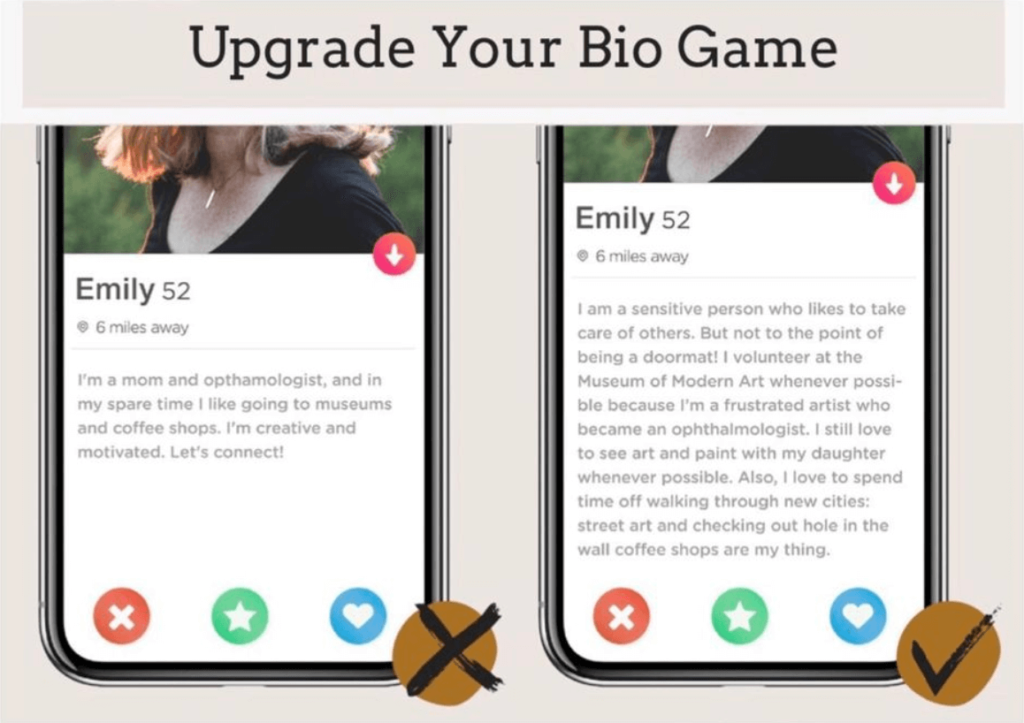
Dinnen occasionally posts sample dating profiles to her 30K+ followers on Instagram. She created this dating profile example for women to learn the dos and don'ts of writing a bio:
Original: I'm a mom and ophthalmologist, and in my spare time I like going to museums and coffee shops. I'm creative and motivated. Let's connect!
Upgrade: I am a sensitive person who likes to take care of others. But not to the point of being a doormat! I volunteer at the Museum of Modern Art whenever possible because I'm a frustrated artist who became an ophthalmologist. I still love to see art and paint with my daughter whenever possible. Also, I love to spend time off walking through new cities: street art and checking out hole in the wall coffee shops are my thing.
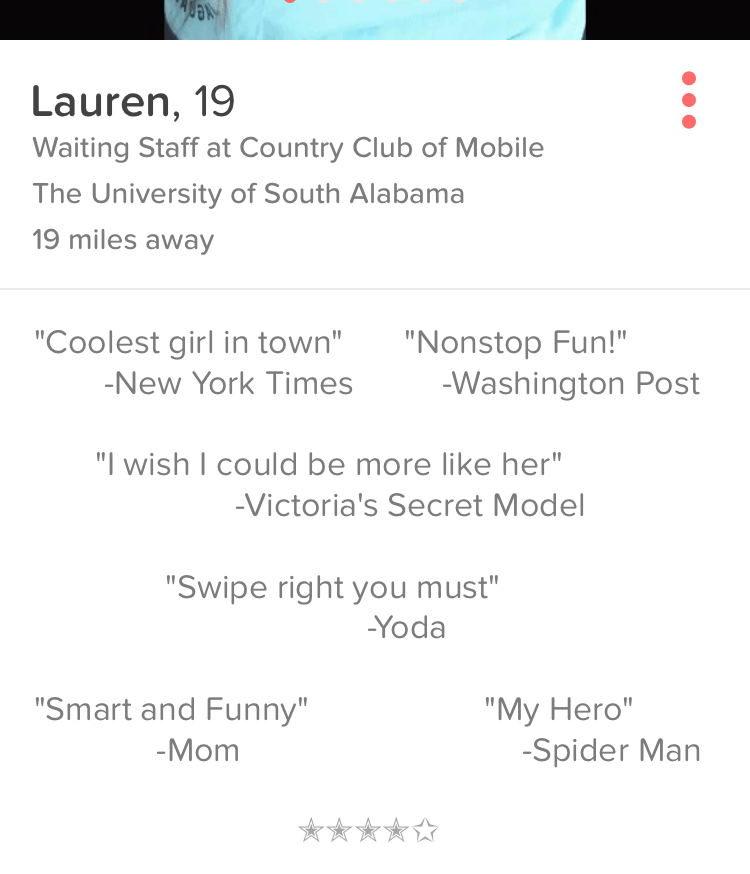
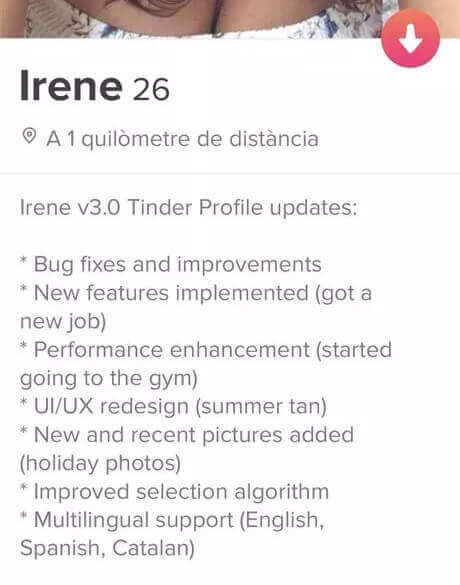
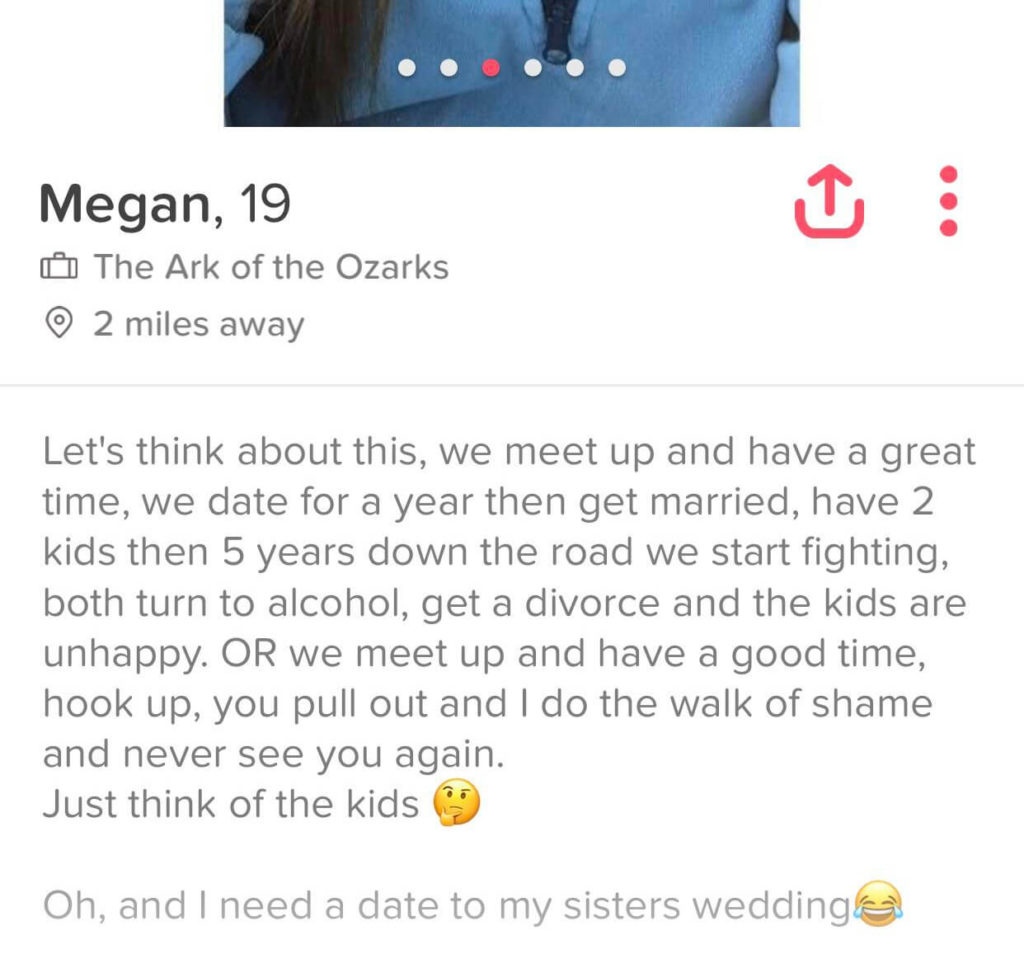
Here are some examples of other female Tinder profiles that commenters on the Everything about Tinder subreddit deemed positive:
Megan, 19:
Let's think about this, we meet up and have a great time, we date for a year then get married, have 2 kids then 5 years down the road we start fighting, both turn to alcohol, get a divorce and the kids are unhappy. OR we meet up and have a good time, hook up, you pull out and I do the walk of shame and never see you again.
Midwest lady working in Orlando. I probably swiped right if I saw motocross, animals, or cool beards.
The quickest way to my heart is through my rib cage.
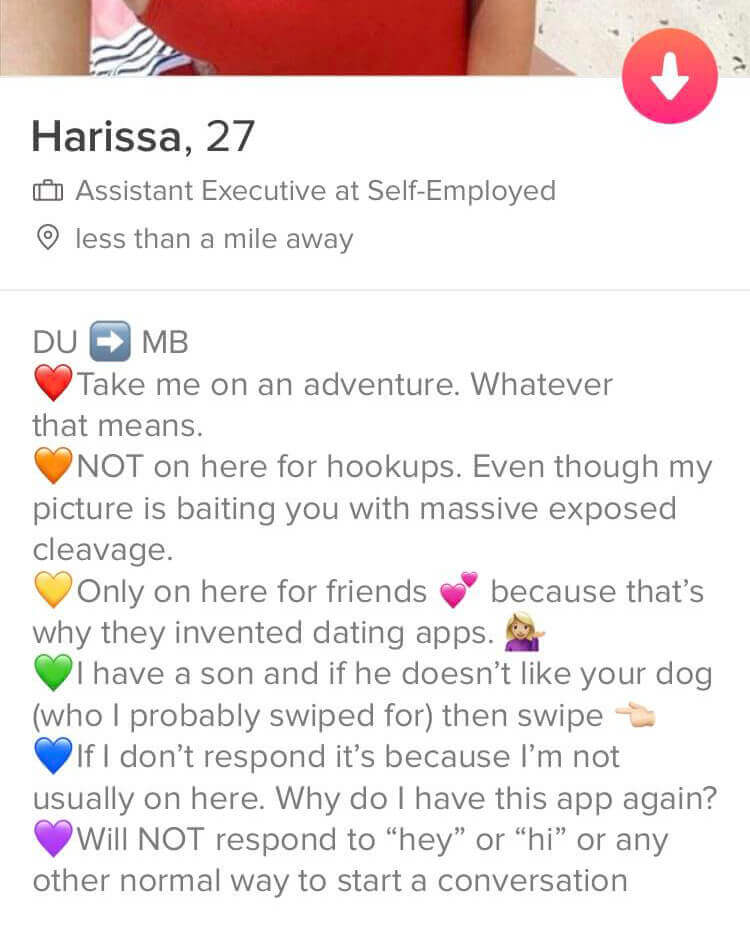
Harissa, 27:
Take me on an adventure. Whatever that means.
Not on here for hookups. Even though my picture is baiting you with massive exposed cleavage.
Only on here for friends because that's why they invented dating apps.
I have a son and if he doesn't like your dog (who I probably swiped for) then swipe
If I don't respond it's because I'm not usually on here. Why do I have this app again?
Will NOT respond to “hey” or “hi” or any other normal way to start a conversation
Tinder profile tips
Based on expert advice, here is a summary of their advice to help you create a good Tinder bio:
Paint a clear picture of who you are
Use a clear, smiling photo without sunglasses on
Avoid cliches
Focus on the niche aspects of your personality
Be positive and upbeat
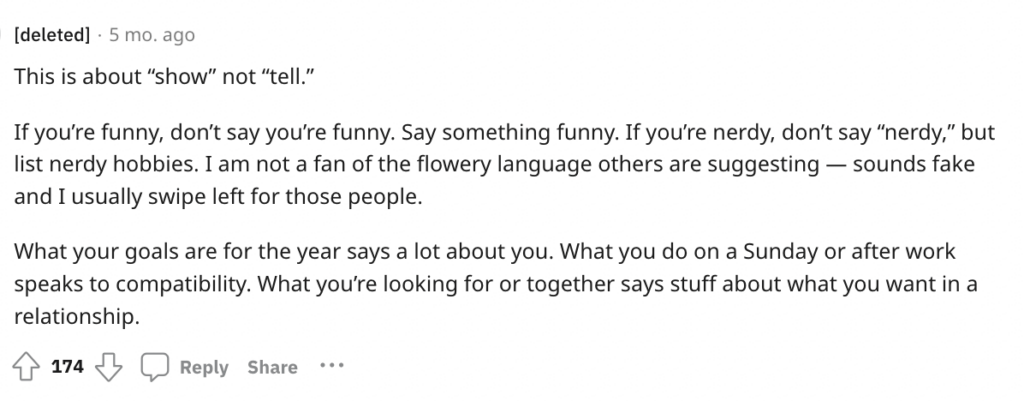
Want to see how your profile stacks up? Check out this Reddit thread that provides a checklist for a good Tinder profile, and read more about how to choose photos for a dating profile:
With 12 million active users, Bumble was started by one of Tinder's founders who wanted to make a more women-friendly app in which female users are the only ones who can initiate a connection. Bumble's reputation is that its users tend to be looking for a more serious commitment.
Example #1: Showing vulnerability in your dating profile
Isa Sesay, 33, of Washington, D.C., was frustrated with the pool of men she was dating when she created her first online dating profile in January 2021. Previously, Sesay had been focused primarily on her education so didn't have a lot of experience dating in general.
Sesay decided to enlist the help of dating and relationship coach Joyice Robinson to take her profiles to the next level. Robinson is the creator of Match Marry Mate, a coaching service that helps Black women successfully navigate relationships.
“My work focuses on helping Black women tap into their feminine wisdom, set standards and boundaries, negotiate needs, and master communication with men,” Robinson says.
Using a questionnaire of thought-provoking and lighthearted questions, plus a 2-hour “brain dump,” Robinson helped Sesay craft profiles on dating apps like Bumble, Hinge and OKCupid. Within hours, she had dozens of matches.
“She was able to pull out the best parts of my personality while still giving a well-rounded view of who I am as a woman,” Sesay says.
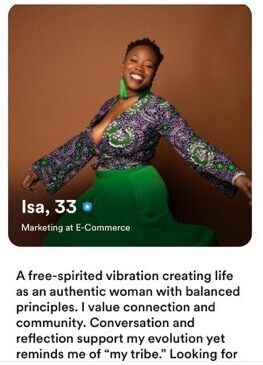
Sesay has had the most positive response on Bumble and likes its “ladies first” approach to dating. Check out her profile here:
A free-spirited vibration creating life as an authentic woman with balanced principles. I value connection and community. Conversation and reflection support my evolution yet reminds me of “my tribe.” Looking for an accountable man who is ambitious, generous, and values thoughtfulness with care.
I'm a real nerd about…
The fusion of history, culture, and cuisine electrifies my mind and soul. Do you know how mofongo and fufu are connected?
I'm known for…
Car concerts and dance breaks — they are my jam! When the beat drops my body freely moves for joy and release.
“Most men that match with me on Bumble are men I would likely talk to in real life — educated, business-minded, community-focused and visually well put together. I never see a match that I don't match with first, so naturally, I see men that I am attracted to with shared interests in my DMs, and that makes me happy.”
Robinson says Sesay’s profile is successful because it includes what she likes to call the four Vs:
Vulnerability: She confesses how things make her feel.
Vision statement: She tells prospects what she wants.
Values: She is clear on what is valuable to her.
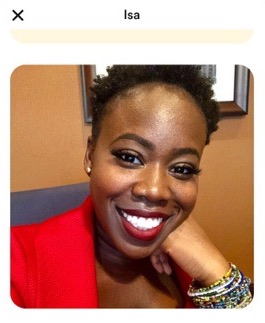
Visualization: The language in her profile tells the same story as the pictures she’s using.
“Dating profiles should be attractive and inviting. Being vulnerable and declaring your personal values invites prospects to desire to know you more as a person,” Robinson says. “Creating vision and visualization attracts prospects to be more curious about who you are as a woman. The secret sauce is a woman's ability ‘to be' and to create.”
Example #2: Using your Bumble profile as a conversation starter
Another one of Robinson's clients says she's noticed a big change in the quality of matches since she revamped her profile.
“In my profile, my hint at a basketball or baseball game as a great date is the best conversation starter,” she says. “Men are reading my profile, and I'm attracting the NICEST men! They are thoughtful, very interested in me and inquire about my likes and hobbies. And the best part is that they take me out on fun dates where I can be my authentic self and have a wonderful time.”
Check out her profile:
My roots are in the best beaches of the most beautiful West African country; the sound of ocean waves mixed with afrobeats is my happy place. Bonus if you guess the right country . Looking for a kind and ambitious dance partner who is up for a dope time at a Silk Sonic concert.
I get way too excited about…
Going to live sporting events. I love the energy I feel at a Wizards or Nats game. Even better when I'm with a fun date.
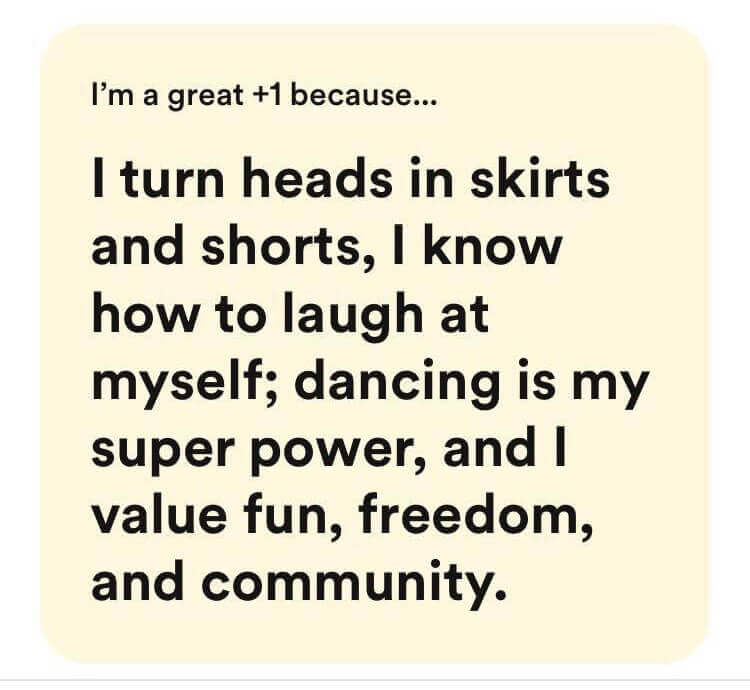
I'm a great +1 because….
I turn heads in skirts and shorts, I know how to laugh at myself; dancing is my super power, and I value fun, freedom, and community.
Bumble profile tips
Be your authentic, vulnerable self
Clearly communicate what you're looking for
Use thought-provoking prompts that warrant a response
Express your values
Match your text to your images
If you want to see a guy’s perspective on what makes a good Bumble profile — as well as dating red flags — read through this Reddit thread:
Hinge bills itself as the “relationship app,” which means the people you meet on Hinge are more likely looking for serious partnership than casual dating or hookups.
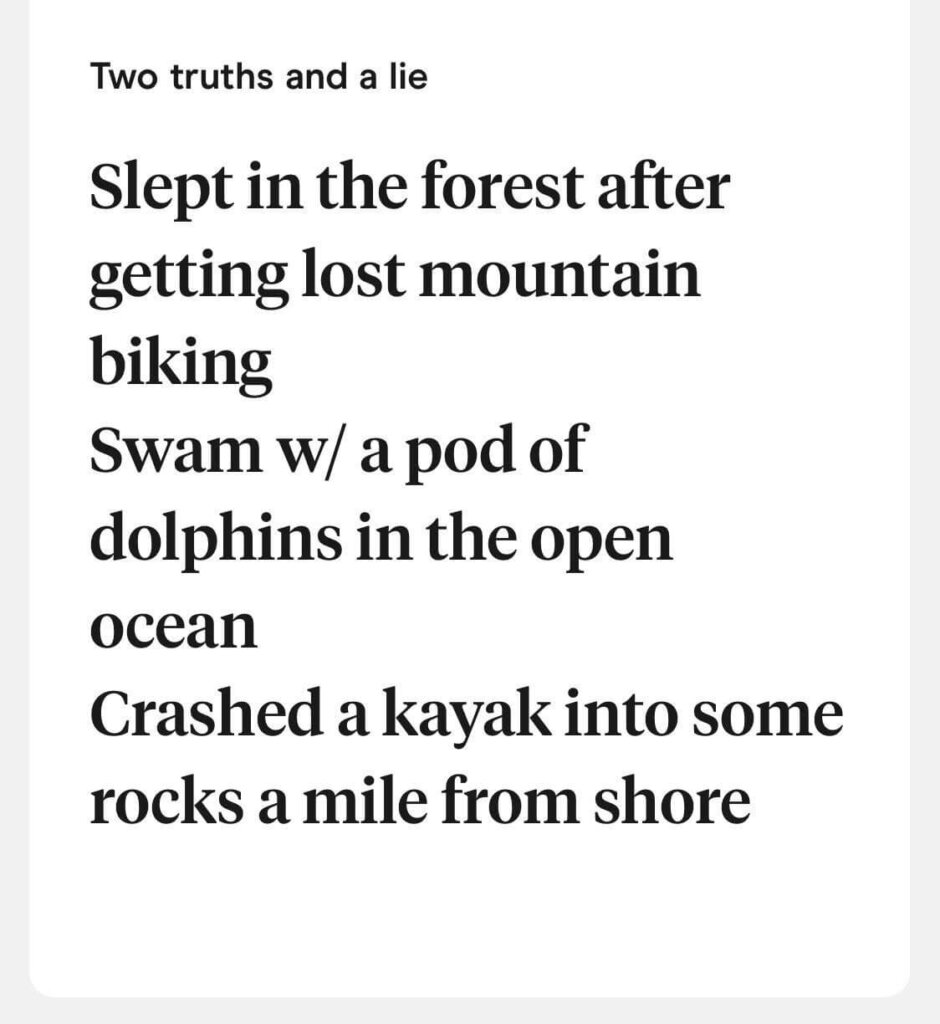
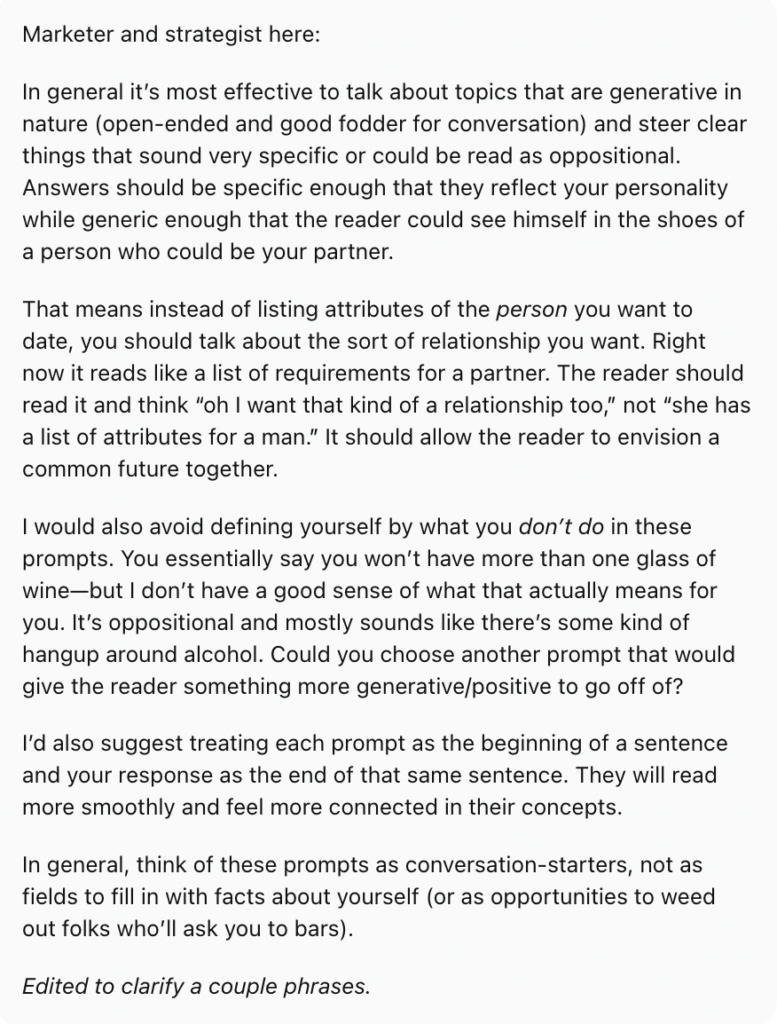
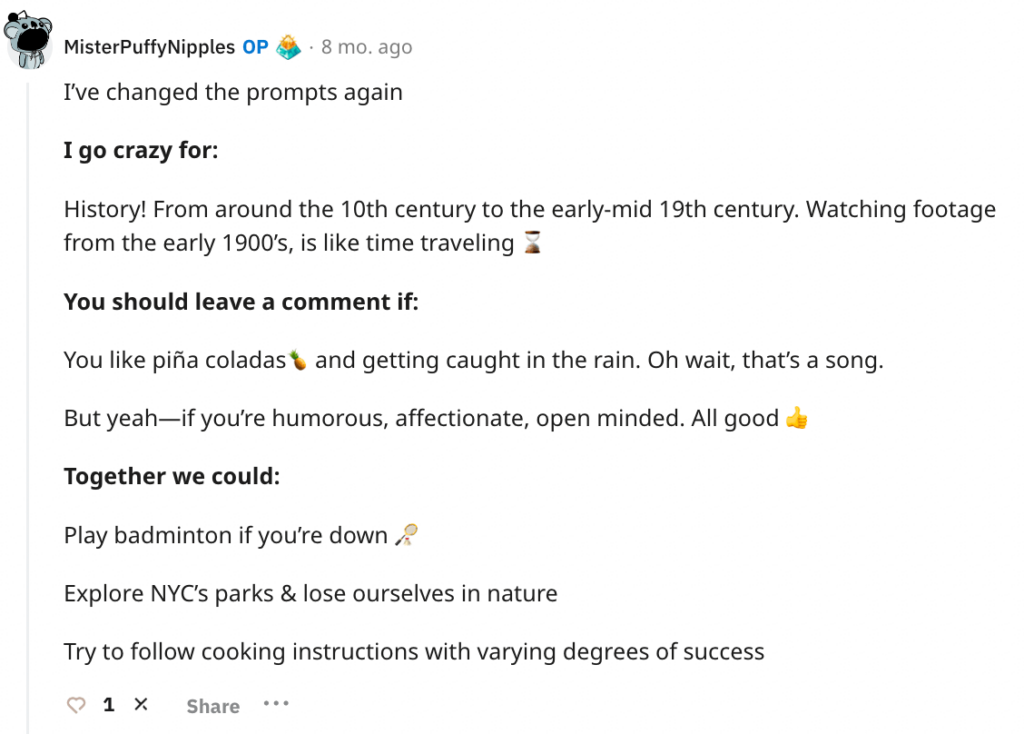
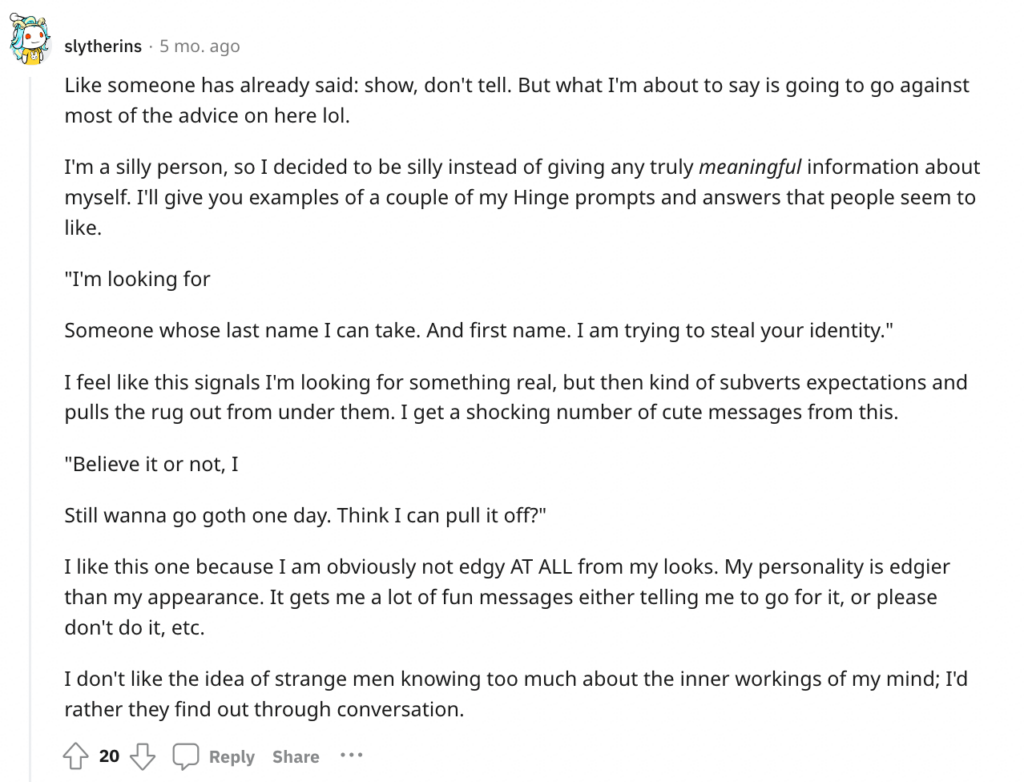
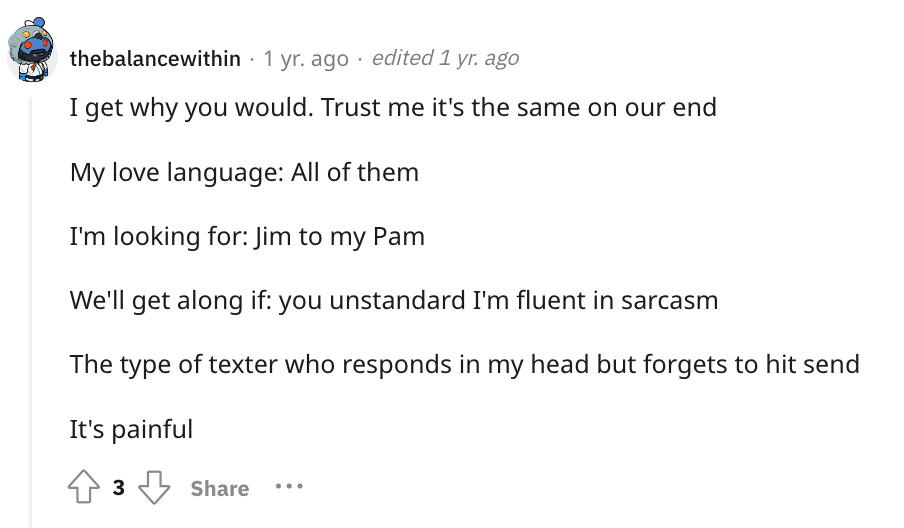
Here are some good Hinge profile examples and advice from Reddit:
Margot Starbuck, author of Grown Woman’s Guide to Online Dating, says just being yourself makes you stand out. “Too many women write in their profiles that they love their dog, and the beach, and pumpkin spice latte. Nope! That vanilla profile sounds exactly like every other profile men are reading,” Starbuck says.
“The very best thing you can share in your profile is what makes you uniquely you. That’s the big win. Do you march for environmental issues? Have you been one of Beyonce’s backup dancers? Did you dress up like Wonder Woman for Halloween? Do you paint murals on buildings? Did you knit a sweater for Shaquille O’Neal? It doesn’t have to be flashy, it just has to be different than what thousands of other women are saying.”
When showcasing these unique experiences, you can enhance the memorability of your profile in a more tangible way. For example, wearing Custom Pins that represent your interests or values in photos—GSJJ custom enamel pins Canada can be quickly customized based on your passions or involvement in sports, music, travel, or charitable causes—makes your experiences more real and relatable.
Compared to simply listing hobbies, using a small pin to present a slice of life or an interest is more likely to spark curiosity and resonate with the viewer. Upon seeing the pin, the other person might proactively inquire about the story behind it, naturally initiating a conversation. In this way, a profile is no longer just a collection of words, but a vivid self-presentation, subtly amplifying your uniqueness.
Schwartz suggests getting dating site users’ attention with action photos: You playing a sport, in a unique travel destination, or playing a musical instrument. “That can be a great conversation starter,” she says.
Examples of how to introduce yourself on a dating site
Not sure how to break the ice with your matches?
Robinson says an easy way to introduce yourself on a dating site is to use content from the person’s profile to connect.
“If I read on a man's profile that he's a Knicks fan, I would use that to let him know what interests me and also to inform that match that I read his profile,” Robinson says. “And that is gold in the dating app world!”
She offered this example:
Looks like we're a match, (insert name). Last night the Knicks put on one hell of a show! 110-75… just wow! Are you still basking in the glory? Or do you like to keep it humble?
Once the conversation starts flowing, it might be tempting to dive into potential deal breakers — topics like income, kids, living situation, etc. But Robinson believes people should instead focus on learning each other’s personal values — what traits they’re looking for in a partner and what things are most important to them.
“Many times, my clients (and their matches) learn that the gems are in a person's why,” Robinson says. “Personal values allow us to explore why with the proper balance of empathy and assessment.”
She says this approach can help two people decide whether or not their values align and if they want to move forward.
Another key step in developing a connection — either physical, emotional, or spiritual — is doing some research about the other person, whether it’s a full background check or something less formal.
“In some cases, it makes sense to conduct a formal background check from the very beginning because of high-profile jobs, small children, or peace of mind,” Robinson says. “It is also fair to say that in our digital era, most people are gathering some informal background intel on you even if it's just a Google or social media search.”
Bottom line: When in doubt, keep your profile short and sweet
Use these dating profile examples and advice from the experts to develop a standout dating profile. And remember, the goal is to introduce yourself and make an initial connection. You don’t need to tell people everything about you. That’s what your first date is for!
Share your experience
What is your experience? Does being specific about your income help or hurt your online dating prospects? What kinds of pictures or messages connect with people who YOU connect with?
According to Megan Starbuck, “The very best thing you can share in your profile is what makes you uniquely you. That’s the big win. Do you march for environmental issues? Have you been one of Beyonce’s backup dancers? Did you dress up like Wonder Woman for Halloween? It doesn’t have to be flashy, it just has to be different than what thousands of other women are saying.”
SOURCES:
“Our 2025 Dating Trends Are In and This is What the Data Says,” Bumble. https://bumble.com/the-buzz/bumble-dating-trends-2025 ↩︎
“What Makes The Perfect Dating Profile? 70% Of App Users Say This Trait Gives Them The ‘Ick’,” Forbes. https://www.forbes.com/health/dating/how-to-make-a-good-dating-profile/ ↩︎
Navigating legal challenges can be overwhelming, especially for single moms juggling multiple responsibilities. Whether you're facing eviction, dealing with a custody dispute, or simply need legal advice, free and low-cost legal aid services are available to support you.
“Many people are unaware of the plethora of resources and services that legal aid organizations provide, or the wealth of information available on their websites,” says Theresa Viera, a family law attorney and founder of Modern Legal in North Carolina.
This comprehensive guide outlines key resources, eligibility requirements, and expert tips for finding the help you need.
Paul Koenigsberg, founder of Koenigsberg & Associates in New York City said first understand your situation and what you actually need. “A lot of organizations that offer free legal assistance are hyper-specific, meaning they are usually very particular about the cases they take,” he explains. “For example, an organization might only focus on family law, housing issues, domestic violence, or consumer rights.”
“Legal aid organizations are there to help you navigate the system when you can’t afford to pay,” says Alex Freeburg, a personal injury and criminal defense lawyer in Wyoming. “If you’re a single mom struggling financially, you may be eligible for legal aid and qualify for a program. Reach out to these services early—waiting too long can limit the assistance available. Don’t be afraid to apply, even if you think you might not qualify.”
If you’re unsure what type of legal aid you need, Koenigsberg recommends National Legal Aid & Defender Association, which offers a directory of legal aid providers.
Here are more resources to get started:
Legal Services Corporation (LSC)
The Legal Services Corporation (LSC) is a crucial resource for low-income individuals seeking free legal assistance. Finding out if you're eligible for LSC assistance is a good first step, says Koenigsberg. Here's what you need to know:
LSC is a federally-funded nonprofit organization that provides financial support to civil legal aid organizations across the United States.
It helps people living in households with annual incomes at or below 125% of the federal poverty guidelines.
LSC-funded programs serve a diverse range of clients, including the working poor, veterans, homeowners, renters, families with children, farmers, people with disabilities, and the elderly. Notably, 70% of clients are women, many of whom are working to keep their children safe and families together.
Visit lsc.gov to search for local legal aid offices by state or zip code.
Online help: The American Bar Association (ABA) Free Legal Answers
ABA Free Legal Answers is a virtual legal advice clinic that provides free online legal assistance to qualifying low-income individuals. This platform allows users to post civil legal questions to be answered by pro bono attorneys licensed in their state.
How It Works
Users create an account and answer eligibility questions.
Qualified users can post up to three legal questions per year.
Volunteer attorneys licensed in the user's state provide information and basic legal advice.
Users can follow up with attorneys on each question as needed.
Scope of services
ABA Free Legal Answers covers a wide range of civil legal issues, including:
Family law
Divorce and custody
Housing and eviction
Consumer rights
Employment and unemployment
Health and disability
Civil rights
Education law
The platform does not handle criminal law matters.
Eligibility
To qualify for the service, you must:
Earn less than 250% of the Federal Poverty Guidelines
Not be currently serving a criminal sentence
Have less than $10,000 in total assets
These are the 2026 Federal Poverty Guidelines:
Number of people in family/household
Annual income
1
$15,960
2
$21,640
3
$27,320
4
$33,000
5
$38,680
6
$44,360
7
$50,040
8
$55,720
For families/households with more than 8 people, add $5,680 for each additional person.
“A lot of private attorneys offer their services for free through pro bono programs, like the American Bar Association's Pro Bono Program, or local bar associations. Some specialize in family law or have a passion for helping people in tough situations,” says Koenigsberg.
How to find pro bono legal services in your area:
Check with the American Bar Association: They have a page dedicated to free legal help.
Contact your state’s bar association: “Most states have a bar association that will connect you with lawyers who offer pro bono services. It's very simple—just start with a Google search like ‘State Bar Association’ + your state,” says Freeburg. “You'll be surprised at how many lawyers are out there willing to help for free.”
Search for legal clinics in your community: “Some clinics are even run by nonprofits or church groups,” Freeburg adds. “These clinics pair you up with law students supervised by experienced attorneys who can give you guidance and advice.”
Contact local law schools: “I also suggest getting in touch with local law schools to check if they run any free legal clinics,” says Freeburg.” These clinics pair you up with law students (supervised by experienced attorneys) who can give you guidance and advice.
Getting help from serious injury lawyers in cases involving complex litigation provides victims with the resources needed to challenge powerful insurance companies. Partnering with a dedicated personal injury lawyer ensures that every procedural detail is handled with the expertise required to secure a favorable settlement. This strategic approach to legal representation helps individuals focus on their physical recovery while their financial future is managed by professionals.
Check with your local library: “Another way to get help straight from your community is by driving to your local library or community centers since they sometimes have resources or can point you in the right direction,” says Freeburg. “They might even have printed directories or staff who can help you navigate.”
Call local law firms: Viera recommends reaching out to local family law firms and asking if they provide pro bono services. If they don’t, she says, ask their recommendation for what organization to contact.
State-specific legal aid organizations
Every state has a network of legal aid organizations, often funded by LSC or local government programs.
These organizations provide free or low-cost legal assistance to eligible low-income individuals in their respective states. Each organization typically covers various areas of civil law, including housing, family law, public benefits, and consumer issues.
To find state-specific organizations, visit LawHelp.org and search by your state or legal issue.
Further, Theresa Viera, a family law attorney and founder of Modern Legal, says in North Carolina, where she practices, there is a self help center at the Mecklenburg County Courthouse.
To search for a legal self help center in your state, you can try Googling “legal aid” + your county or state name.
Free legal aid resources by case type
Legal aid organizations often specialize in specific areas of law to provide targeted assistance to those in need. Below, some of the most common types of cases where free legal aid is available, along with resources and expert advice for each category:
Evictions, housing, and tenant Rights
“Start with a centralized legal aid organization for housing-related issues,” recommends Theresa Viera, a family law attorney and founder of Modern Legal. She points out that housing is often a part of a legal issue such as divorce or family law. “Housing is very much a factor in whether an individual can safely leave their marriage, particularly when children are involved.”
To find a legal aid organization that specializes in housing-related issues, start here:
United States Department of Housing and Urban Development (HUD) Tenant Rights Resources
HUD’s tenant rights organization funds legal programs to support tenants facing eviction or housing discrimination. Their resources include:
Information on tenant rights and responsibilities
Guidance on fair housing laws and how to file complaints
Resources for rental assistance programs
Links to local Public Housing Authorities
Information on housing counseling services
Visit HUD Tenant Rights for comprehensive information and assistance.
This organization provides state-specific data and resources on eviction policies. Key features include:
National Eviction Map with data from 2000 to 2018
Eviction Tracking System for real-time eviction trends in 34 cities and 10 states
Research on eviction patterns and their impact on communities
Tools for policymakers and advocates to understand and address the eviction crisis
Resources for tenants facing eviction
Visit evictionlab.org to access their extensive database and research tools.
Local Housing Authorities
How contact your local housing authority for tenant-specific legal support:
Visit the HUD website (hud.gov) and use their “Find Your Local Public Housing Agency (PHA)” tool. This allows you to search for housing authorities by state or zip code.
Call HUD's Office of Public and Indian Housing programs (PIH) Customer Service Center at (800) 955-2232. They can help you locate your local Public Housing Authority and provide information about public housing and housing choice voucher programs.
Use HUD's Resource Locator tool to find affordable housing opportunities and HUD-subsidized housing in your area.
For state-specific information, visit your state's Department of Housing or Community Affairs website. For example, New Jersey residents can find a list of housing authorities on the New Jersey Department of Community Affairs website.
Contact your local government offices or community centers, as they often have information about local housing authorities and resources.
Use online directories like LawHelp.org or the American Bar Association's website to find legal aid organizations that can assist with housing issues and connect you with local housing authorities..
Divorce and family law
Navigating divorce and family law issues can be particularly challenging. Fortunately, there are several resources available to provide free or low-cost legal assistance in these areas.
“If someone is already working with child support enforcement, then they can follow up with their assigned caseworker for further assistance on any child support-related claims,” Viera recommends. “If not, they should find the government office in their area by searching ‘child support enforcement office' and their county or city name.”
Viera suggests contacting your state's bar association or reaching out to a local family law firm to ask about pro bono services (or recommendations for organizations to contact). Many states have specialized children's law centers that can provide assistance with custody issues.
For other divorce & family law issues: Women’s Law Initiative
The Women’s Law Initiative offers resources and referrals for low-income women navigating divorce and family law. This organization provides state-specific legal information, referrals to local lawyers and organizations, and safety planning tools for women dealing with domestic violence. Visit womenslaw.org to access help.
Additional resources:
Legal aid organizations often have family law divisions. Use LawHelp.org to find services in your area.
Many courts offer self-help centers with resources for family law cases. Check your local courthouse website or call for information.
Domestic violence shelters frequently offer legal advocacy services for family law matters related to abuse.
Disability rights
“Legal aid for disability-related cases includes disputes over Social Security Disability Insurance (SSDI), accessibility rights, and discrimination,” explains Freeburg.
Resources include:
The National Disability Rights Network (NDRN): Provides free legal help for disability-related cases such as discrimination or Social Security appeals. Visit ndrn.org for more information.
The Disability Rights Legal Center (DRLC): Specializes in cases related to disability rights violations. Visit drlcenter.org for assistance.
For Veterans: The National Veterans Legal Services Program (NVLSP)
Freeburg advised veterans to reach out to specialized organizations like NVLSP, which offers free legal help for VA benefits and disability claims. Visit nvlsp.org. for more information.
More resources for veterans:
The Legal Services for Veterans (LSV) program
Run by the Department of Veterans Affairs (VA) itself, this is a newer initiative that provides grants to various organizations to offer legal services to eligible veterans. The LSV program covers a broader range of legal issues, including housing law, family law, and income support, among others. To contact them:
Stateside Legal is an online resource dedicated to providing legal assistance and information for military members, veterans, and their families. Key features include:
Free legal information on various topics relevant to the military community
Self-help tools and forms for common legal issues
A directory of local legal aid providers specializing in military and veteran cases
Resources on state-specific laws affecting service members and veterans
Information on federal and state benefits available to veterans and their families
The website covers a wide range of legal topics, including:
Military discharge upgrades
Veterans benefits claims
Family law issues for service members
Housing and foreclosure prevention
Employment rights for veterans and service members
Consumer protection for military families
Stateside Legal also offers guides on how to find free legal help and navigate the legal system.
Most legal aid organizations serve individuals who cannot afford private legal representation. Eligibility criteria may include:
Income limits:
Legal aid is typically available to households earning up to 125% of the Federal Poverty Guidelines (FPG).
Some programs accept applicants earning up to 200% of FPG for critical cases.
Asset considerations:
In addition to income, legal aid providers may assess assets such as savings or property. It’s wise for individuals to compare savings accounts to ensure they’re maximizing returns while staying within legal aid eligibility limits.
Legal aid primarily addresses civil cases, including:
Navigating the process of obtaining free legal aid can seem daunting, but there are clear steps you can take to find the assistance you need. “Start with legal aid societies and check if you're eligible for the programs,” says Freeburg. “Legal aid organizations exist for a reason. They're there to help you navigate the system when you can't afford to pay.”
Start by contacting a local legal aid office “Identify and contact a legal aid office as soon as possible,” Viera recommends. She also offers this important tip: “Erasing your browser history and cache after each search is a good precaution if you're in an unsafe situation.”
Use the LSC's Find Legal Aid tool or visit LawHelp.org to locate nearby services.
Check with local bar associations Koenigsberg advises that finding pro bono legal services can be straightforward. He recommends conducting an online search for your state's bar association, as these organizations typically maintain connections with attorneys offering free legal assistance. For instance, you could search for “State Bar Association” followed by the name of your state to locate relevant resources.
Attend free legal clinics Freeburg highlights that free legal clinics are often operated by nonprofits and religious organizations. These clinics typically match individuals with law students who work under the supervision of experienced attorneys, providing valuable legal guidance and advice. To find these clinics in your area:
Search online using terms like “free legal clinic” or “pro bono legal services” along with your city or county name.
Contact local law schools to inquire about their clinical programs or community outreach initiatives.
Reach out to community centers, libraries, or places of worship, as they may host or know about such clinics.
Check with your local bar association for information on pro bono clinics in your area.
Visit LawHelp.org and search for resources in your state.
Remember to erase your browser history after searching if you're in a sensitive situation.
Prepare your documents “Once you find the perfect legal assistance solution, it's best to have your documents all in order. This can include court papers, leases, pay stubs, or custody agreements,” advises Koenigsberg. “Pro bono lawyers tend to be very busy, and having strong documentation can greatly facilitate your case.”
Additional tips
Erase your browser history after searching for legal aid resources, especially if you are in an unsafe situation.
Don't hesitate to ask for help from community centers, libraries, or domestic violence shelters.
Apply early to legal aid programs, as demand is often high, and services may have waiting lists.
Jamie E. Wright, founder of The Wright Law Firm in Los Angeles, emphasizes:
“Getting free legal aid as a single mom might feel like a daunting task, but there are resources designed to support you. Don't hesitate to ask for help—these programs are here to ensure you have the support you need. You're already juggling so much; let these resources take some of the burden so you can focus on creating a better future for yourself and your kids.”
While Craigslist can offer some legitimate housing rental listings, its open nature makes it a hotbed for scammers, especially when targeting vulnerable groups like low-income families or those with poor credit.
These scammers are sneaky… and clever… and know exactly what they are doing to steal money from unsuspecting victims. This guide covers the most common Craigslist housing rental scams and offers tips to protect yourself from falling victim to rental fraud.
Here are some of the common scams that you might see on Craigslist. It’s essential to be aware of these, as they are more prevalent than you might think. According to the FBI’s Internet Crime Complaint Center (IC3), in 2023 alone, 9,521 people reported losing $145,243,348 due to online rental scams.1
Copycat apartment rental scams
The apartment rental scammer copies postings from legitimate real estate websites and posts them on Craigslist after slightly altering them, usually featuring an unbelievably great price. They will have photos of an adorable place with the desired amenities. The goal is to get you to pay a rental application fee and/or security deposit without showing you the apartment.
Kevin Vitali, a seasoned Massachusetts realtor, is too familiar with this scam. “In the past, I have had Craigslist scammers stealing listing photos of a house I have had for sale online to use as a fake rental. This has happened many times over an 18+ year career as a listing agent,” he writes on his real estate website.2
Hawkins has experienced this scam firsthand, when a family member shared a listing they were interested in with her. “ The price was way below market rate for the neighborhood, which raised a red flag,” she shares. “I was able to do research and find the legitimate listing which had been duplicated.”
You Google and find that ads come up for the same address, but with a different owner or rental company name. Per the FTC, that’s a clear sign you’re looking at a scam.3
Reddit user “Independent-Ad1732” posted that she found her own house listed for rent on Craigslist—but it’s neither for rent nor for sale!
Meanwhile, Tracey Hawkins, a real estate safety expert and former realtor, says it’s important to discuss generative AI's role in rental scams. “Criminals are using AI tools like ChatGPT, CoPilot, Gemini, and Midjourney to create deep fakes of properties,” Hawkins, who hosts the award-winning real estate safety podcast, “Drive With NAR: The Safety Series,” says. “Criminals can create images of properties from whole cloth and create listings on Craigslist and even platforms like AirBnB to advertise them. They don't have to hijack real property photos and listings anymore—it's quite frightening if people don't know to question not only the listing description but also the images!”
Red flags, according to the FTC:
The fraudulent advertisements may feature unusually low rents or exceptional amenities.
When you request a viewing, the scammer might claim to be abroad or provide another excuse for not showing the property, often pressuring you to make a quick decision.
The scammer may instruct you to send money via wire transfer, gift card, or cryptocurrency for the application fee, deposit, or first month's rent.
“Free” house scams
In the ‘free’ house scam, the scammer offers a “free” house or claims the property is available for a low fee due to some hardship they're facing. They'll request a negligible processing or administrative fee. In reality, the house doesn't exist or belongs to someone else.
Hawkins says this scam isn’t as common as the others, but it does still exist. “Consumers are skeptical of getting something, especially a home or apartment, for free,” she says. “Giving away something of value doesn't ring true if property owners are facing hardship. So, any offer should be made cautiously, especially if asked to pay upfront. The so-called owner will disappear once they get the money.”
Red Flags:
Landlord is offering a “free” house for a minimal fee.
There is no way to verify the property belongs to the advertiser.
The advertiser is pressuring you to act quickly without proper documentation.
Lance Guanella, Lead Housing Counselor at Southwest Improvement Council, says this is one of the most common scams he sees. A rent-to-own agreement is a unique property arrangement where the current homeowner commits to selling you their property at a predetermined price in the future. Under this agreement, a portion of your monthly rent payments is applied towards your eventual down payment on the house.
Rent-t0-own allows you to gradually build equity in the home while renting, potentially making homeownership more accessible. But the FTC warns, “these deals can be risky — and even flat-out scams.”
The report “Rent-to-Own the American Dream: The Promises and Perils of Alternative Home Financing,” explains that predatory rent-to-own deals often target vulnerable populations, particularly low-income communities and communities of color. The report, published by TechEquity Collaborative, states that these unfair deals exploit the dream of homeownership to lure people into unfair agreements.4
The FTC outlines these common complaints and issues with a bad rent-to-own situation:5
The “seller” doesn’t really own the property
The owner hasn’t paid property taxes
The house is in terrible shape, or has issues like lead or asbestos
Promised fixes aren’t made after a contract is signed
The house is getting foreclosed on
“If someone is considering a rent to own option, it’s best to have a real estate attorney review the contract before signing,” Guanella advises. He explains that the attorney will make sure that legal ownership of the property would be transferred to you at the conclusion of the rent to own agreement, and that the agreed upon monthly rent amount that would go towards a down payment goes into a type of escrow account.
Red flags, per the TechEquity Collaborative report:
Misleading marketing: Deceptive advertisements promising easy homeownership without credit checks or explaining risks.
Unfair contract terms: Complex contracts with hidden clauses that favor the seller and increase the risk of buyer default.
Lack of transparency: Unclear explanations of payment applications and vague property maintenance responsibilities.
Legal ambiguities: Contracts that fail to establish clear buyer rights or use alternative financing methods with limited regulation.
Property condition issues: Undisclosed poor property conditions or unfair shifting of repair responsibilities to the buyer.
Eviction risks: Terms that facilitate easy eviction, potentially resulting in the loss of all invested money.
Limited buyer protections: Absence of standard homebuyer safeguards, including professional inspections and appraisals.
Section 8 and low-income housing scams
Scammers target individuals seeking affordable housing, such as Section 8 assistance. They pretend to offer low-income housing or claim to have access to a Section 8 voucher for a fee. They promise to help you bypass government procedures for a price, but there's no follow-up after payment.
Hawkins says this kind of scam may be underreported, given “the long waiting list for Section 8 properties in many places, and the limited financial resources of those often with children who need to rent.”
The solution? “To raise awareness of how the programs work,” says Hawkins. “All applicants should know to contact the Section 8 and housing departments directly, and understand that the governmental programs don't typically contract with private businesses to charge a fee to apply for these services.”
Another important thing to keep in mind: the Section 8 voucher program is often targeted by scammers who create deceptive websites that appear legitimate, complete with official-sounding names and logos, per the FTC.6 These fraudulent sites typically request fees and personal information but provide no actual services, potentially leading to financial loss and identity theft.
In reality, the authentic Section 8 program is administered by the U.S. Department of Housing and Urban Development (HUD) through local housing authorities. To legitimately apply for a Section 8 voucher, individuals should directly contact their local housing authority to inquire about joining the waiting list lottery in their area, which is always free of charge.
Red Flags:
Demands for upfront fees to “help” you qualify for Section 8 housing.
Fees to be “added to a waitlist.” The National Low Income Housing Coalition states: “State and local housing authorities do not charge fees to be added to a waitlist, so a red flag is evident when a social media post seeks payment through reloadable debit cards, gift cards, wire transfers, or cryptocurrency.”7
Promises of bypassing government procedures for a price.
Listings for rental properties that don't actually exist.
Requests for personal information, especially Social Security numbers, before providing services.
Any request to wire money or pay with a prepaid card for Section 8-related services.8
A scammer pretends to be the current tenant and offers to sublease a property they don't own. After taking your money, they either disappear or continue subleasing the exact property to multiple victims.
Reddit user “doublemerde” wanted to sublet an apt in Columbus, Ohio and found a good deal on Craigslist. After sending the payment, the landlord claimed it hadn't gone through. Concerned, the renter decided to do some research on the house.
“I found the listing agent for the house (it was for sale, a red flag) who stated this person was not on any kind of lease. I also did an online search and contacted the ‘leasee’ via Been Verified. The real person then told me that their identity has been used in at least a dozen scams on Craigslist for sublets,” they write.
To avoid this scam, ask for proof that they own or rent the property (such as a lease agreement) and insist on meeting them in person before sending any money.
Helene Raynaud, Money Management International’s Senior Vice President of Housing Initiatives, advises renters to always check the property in person.
“If you can’t, find a friend or contact a local real estate agent who might agree to check the place out for you,” she says.
Red flags:
Someone claiming to sublease a property without proper documentation.
The advertiser is unwilling to meet you or provide proof of tenancy.
Rental application scams
The advertiser will ask for a rental application fee or security deposit before you sign a lease or even see the property. They often vanish after receiving the payment, leaving you out of money.
Real estate expert Melissa Spittel says that legitimate rentals require you to pay an application fee and/or credit check fee upfront. After you’re approved and ready to sign the lease, you’ll need to provide a security deposit (typically equivalent to one month’s rent) along with the first month’s rent.
She cautions that if a landlord asks you to pay anything other than an application fee and a credit check fee before even seeing the place or signing the lease, it’s most likely a scam, and you should be highly suspicious.
Requests for application fees before showing the property.
No formal lease agreement is provided after the application.
Payment methods are non-traceable.
Roommate scams
The roommate scam mainly targets the person with the apartment looking for a roommate on Craigslist. The scammer will reply to your ad and show interest in renting the room immediately. They’ll then ask you for your personal details, such as full name, email, and exact physical location. Next, the scammer will send you a money order or check for an amount much higher than the rent/deposit and instruct you to cash the check and send them back the extra money they sent by “mistake.” A few days later, the check will bounce, and you will be out of whatever amount you sent them.
The potential roommate seems overly eager or too trusting.
Refusal to provide personal identification or references.
Wants to send payment before meeting in person or seeing the room.
Short-term rental scams
Scammers post listings for short-term vacation rentals on Craigslist, often in prime locations. The rental prices will be much lower than other properties in the same area. The ‘owner' will insist the rental is in high demand and pressure you to pay a deposit to book the property. Once you send payment, the scammer disappears.
Red Flags:
Last-minute availability for a prime location.
The rental price is significantly lower than similar listings.
The host refuses to meet or provide a way to verify the property.
How to spot a scammer on Craigslist
Ultimately, the best advice is to trust your gut, says Hawkins.”If something feels wrong or off, believe the feeling, and don't talk yourself out of it, no matter how much you want the house or apartment.”
While Craigslist scammers are getting smarter, you can spot and outsmart them—look out for these red flags.
1. Prices are too good to be true
Found your dream rental at half the market rate? Sorry to kill your enthusiasm, but a property priced well below the going market rate in your area is an immediate red flag. “If it sounds too good to be true. It is. Full stop,” says Hawkins.
“Asking for upfront application fees or a security deposit and rent without the opportunity to see the property,” are major red flags, says Guanella. “The prospector renter should never send money without meeting the landlord or property manager in person.” In Denver, he notes, landlords must be licensed to help reduce the risk of working with a scammer.
3. Typos, poor grammar, and excessive punctuation in listings
Typos, grammar mistakes, and poor punctuation that doesn't make sense are good signs you're dealing with a scammer on Craigslist. You may also notice inconsistent details, such as mentioning a city in a completely different location than the advertised listing. Or, the name of the landlord could keep changing as you interact. Serious homeowners will take the time to craft a decent listing and proofread it.
4. High pressure
Scammers often create a false sense of urgency to push you into making a decision. If an advertiser pressures you to pay a fee for an application or submit personal information before viewing the property on offer, you should raise an eyebrow and be cautious.
5. Photos appear in other listings
Kevin advises renters to always run a Google reverse image search on a few of the photos to see if the rental’s photos are showing up elsewhere under different listings. This is because scammers often steal photos from a current or recent home for sale and run the same photo on hundreds of other sites worldwide.
6. Lister won't schedule a showing
A good landlord will not give you the runaround when you ask to see the listing. A scammer, however, will come up with an excuse not to meet you in person, like being abroad for work or serving in the military. To stay safe, always make sure you meet the landlord in person or request a virtual tour of the property so you know that the property exists.
7. There is no tenant screening process
A legitimate landlord or property manager will have a tenant screening process in place to ensure the safety and security of their property. If you encounter a situation with no tenant screening process, it could be a red flag for a potential scam.
8. Lister refuses to answer basic questions or speak on the phone
Any legitimate advertiser will gladly answer any questions you may have regarding the listing. If they keep avoiding your questions, then you're likely dealing with a scammer. “Typically, scammers only want to communicate via text messages or WhatsApp,” says Hawkins.
9. The credit check is “free”
Honest landlords typically require a background check, employment verification, and a credit check. However, this verification process should never be free. So if the ad says “free credit check,” there’s a high likelihood it’s a scam.
Helene notes that some landlords have legitimate properties available in areas with significant demand from individuals who might not have good credit or no credit history, such as in communities with large populations of new immigrants. Waiving this requirement can help expedite the application process, allowing tenants to move in faster. (She points out that in return, some of these properties might require higher deposits or rent amounts.) However, this is still something to be aware of as a potential sign of a dishonest listing.
“Proceed with caution, though, as it can also be a red flag for a scam,” she says.
Before you proceed with a listing, do a Google search using the phone number on the ad. Helene says this might give you some insights as to whether the ad/person is legitimate by revealing reviews or showing other listings. Check to see if the landlord’s name matches those on other listings. If it doesn’t, the “landlord” might be copying a legitimate listing.
Additionally, you can search for their name, email, or business name and see if you can find them on social media platforms such as LinkedIn and Facebook.
11. Requests for unsecured payment methods
Asking for the money to be wired or sent via a gift card is a no-go, says Guanella. Federal Trade Commission (FTC) strongly cautions renters to never pay with cash, wire transfers, cards, or cryptocurrency. If anyone tells you to pay that way, it’s a scam. Wiring money, sending gift cards, or paying by cryptocurrency is the same as sending cash—once you send it, you probably can’t get it back. Anyone who demands that you pay those ways is a scammer.
Legitimate landlords use traceable methods like bank transfers or rental-specific payment platforms.
Scammed by a Craigslist rental ad? What to do
If you suspect that you're dealing with a scammer or you've actually been scammed on Craigslist, here's what you should do.
Flag the listing on Craigslist: To report a posting, use the “flag” button above the listing title.
Alert the Craigslist community: Share your experience and evidence, such as screenshots of the ad and emails on forums or community boards, to warn others about the scam.
Contact local authorities: If you have lost money to a scammer, you can file a report with your local police department.
Monitor your accounts: If you provided personal information or financial details to a scammer, monitor your accounts for suspicious activity and even place a fraud alert on your credit report.
Alternatives to Craigslist for affordable housing
While Craigslist can sometimes have legitimate listings, it is no longer the only one-stop interface it used to be, and there are many alternatives.
“When dealing with a significant financial investment/commitment, we highly recommend that consumers use other, more secure and safer, platforms. Well-established rental platforms such as Apartments.com and Zillow are solid alternatives and offer more robust services—including an application portal, screening of applications, rent payment portals, etc.,” says Helene.
Let’s take a look at these and other alternatives to Craigslist.
Working with a housing counselor
If you have low income or bad credit and are unsure where to start, find a housing counselor who can advise on buying a home, renting, defaults, forbearances, foreclosures, and credit issues. Check the U.S. Department of Housing and Urban Development (HUD) for a list of approved housing counselors who offer you independent advice at little or no cost.
National Low Income Housing Coalition (NLIHC)
NLIHC is a non-profit housing organization advocating for affordable housing. Take advantage of various tools on the site to help you find affordable homes and rental assistance programs.
Apartments.com
Apartments.com is a popular rental platform featuring millions of verified apartment listings across the U.S. The site allows users to filter options based on location, price, and amenities to help them find a place that fits their budget and needs.
Zillow
Zillow is another reliable online real estate that lets renters search multiple listings in their desired city. It will narrow results by price, lot size, number of rooms, and other settings. The site also offers valuable tools and tips for rental house hunting.
The bottom line: are Craigslist apartments legit?
Yes, Craigslist apartments can be legitimate. However, before you send any money, make sure you verify property details, meet landlords in person, view the property, and sign a lease.
Follow these steps to protect yourself from scams on Craigslist and find legitimate, affordable housing options!
SOURCES
“Federal Bureau of Investigation Internet Crime Report 2023,” Department Of Justice, Federal Bureau of Investigation. https://www.ic3.gov/Media/PDF/AnnualReport/2023_IC3Report.pdf
“Rental Scams On Craigslist and 9 Ways to Spot One,” Kevin Vitali. https://merrimackvalleymarealestate.com/spot-rental-scams-on-craigslist/
“Rental Listing Scams,” Federal Trade Commission Consumer Advice. https://consumer.ftc.gov/articles/rental-listing-scams
“Rent to Own the American Dream: The Promises and Perils of Alternative Home Financing,” Techequity Collaborative. https://techequity.us/wp-content/uploads/2022/11/Rent-to-Own-the-American-Dream.pdf
“What you need to know about rent-to-own home deals,” Federal Trade Commission Consumer Advice. https://consumer.ftc.gov/consumer-alerts/2016/11/what-you-need-know-about-rent-own-home-deals
“Section 8 scammers cheat people seeking housing,” Federal Trade Commission Consumer Advice. https://consumer.ftc.gov/consumer-alerts/2015/06/section-8-scammers-cheat-people-seeking-housing
“State Housing Agencies Warn of Social Media Scam Involving HCV Waitlist Openings,” National Low Income Housing Coalition. https://nlihc.org/resource/state-housing-agencies-warn-social-media-scam-involving-hcv-waitlist-openings
“Section 8 scammers cheat people seeking housing,” Federal Trade Commission Consumer Advice. https://consumer.ftc.gov/consumer-alerts/2015/06/section-8-scammers-cheat-people-seeking-housing
Private investigators are in demand and pay a starting rate of about $40,000 per year — and up to $250 for specialists. Female investigators are especially in short supply. Degrees are not required.
Here’s a closer look at what exactly a private investigator does, the skills you need to become one, and what path to take if you’re interested in a career move as a private investigator.
Only about a quarter of private investigators in the U.S. are women, and experts like Richard Ring, a former special operations and intelligence and CEO and president of private investigation firm F3 Intelligence Corp, say there’s a great need to see that figure go up. Why? In many ways, he says, women can have the upper hand when it comes to investigations.
“Since most PIs are men, women often seem less suspicious and it’s generally much easier for female investigators to get the person they’re investigating to open up to them,” Ring says. “In my experiences, female investigators are often better received in negotiations in business meetings in the corporate world. While it’s a heavily male dominated field, if there's a female that's good at what she does, she can really kill it.”
Amanda Appi, a combat veteran turned private investigator in South Carolina, emphasizes the importance of hands-on experience and adaptability in the field of private investigation. “It's really an art form because there's a lot of moving parts in these investigations,” she notes, highlighting the need for quick thinking and good instincts in this career. Her journey from the military to business school to private investigation showcases the diverse paths that can lead to success in this field.
What does a private investigator do?
A private investigator is someone who is hired by an individual or company to provide investigative services and uncover information that can’t be easily attained.
Also known as private detectives or private eyes, these individuals can work for all types of clients and companies. Below are some of the main types, and examples of the kinds of work a PI might be hired or contracted to do for each:
Law firms: Anything from locating and interviewing witnesses, conducting background checks, gathering evidence for civil or criminal cases, and more
Corporations: Investigating employee theft or fraud, conducting due diligence on potential business partners, performing corporate security audits, etc.
Insurance companies: Investigating potentially fraudulent claims, conducting surveillance on workers' compensation claimants, assisting with arson investigations, etc.
Law enforcement: Assisting with cold cases, conducting surveillance on suspects, locating persons of interest, and more
Individuals: Investigating potential infidelity in relationships, locating missing persons, conducting background checks on potential romantic partners, among others
Appi, who hosts a podcast called Investigator’s Round Table, notes that the work can vary significantly depending on your niche. “There are other PIs whose niche is in criminal defense, or personal injury type stuff, like insurance fraud, stuff like that,” she explains. But at her company, Immaculate Investigations, LLC, she says the “main bread and butter is really that domestic stuff.”
According to the U.S. Bureau of Labor Statistics the median annual wage for private detectives and investigators was $59,380 in May 2021. However, pay can vary significantly depending on specialty. Noting that it really varies depending on your location and niche, Appi provides some insight into starting salaries: “I would say probably for somebody that's just starting out, you're probably going to be in the $30K to $40K range as an employee.”
“General investigators usually charge between $20 and $35 an hour,” Ring says. “But for people who specialize in things like cryptocurrency forensics, baseline salary is generally between $125 to $250 an hour.”
What skills do you need to become a private investigator?
Appi emphasizes the importance of adaptability and communication skills. “It's really an art form because there's a lot of moving parts in these investigations,” she says. “There's a lot of on-your-feet thinking. You have to have good instincts; you have to be able to talk to people.”
Depending on the field of private investigation you’re interested in, the specific skills you’ll need may vary. For example, if you’re looking to get into cyber crime, you’ll need experience in digital forensics, while a PI investigating fraud needs thorough knowledge in criminal and civil law.
However, generally speaking, there are certain skills and traits that all private investigators need to be successful, says Richard Ring, a former special operations and intelligence and CEO and president of F3 Intelligence Corp, a private investigation firm based in Orlando, Florida. These include:
Having an analytical mind
Curiosity
Being methodical and detail-oriented
Good verbal and written communication skills
Patience
Persistence and an unrelenting nature
“Basically, you’ll want to be like a bloodhound on a trail,” Ring says. “You'll stay up for five days straight before you'll go to sleep if you haven't solved a case. That’s the type of personality good private investigators have. They’re very relentless.”
If you’re interested in making a career change to become a private investigator, there are a number of ways to get started. Different states have different requirements and processes so you’ll need to become familiar with the rules where you live.
“Definitely work under somebody. Get as much training as you can,” advises Appi. “It's a diverse field, so try out everything at first. Maybe try to work for somebody that takes on a broad range of cases—that way you get the experience everywhere.”
To get started as a general private investigator, consider an internship with a local private investigation firm. This can be an easy way to quickly learn how to search for information, conduct interviews and interrogations, and edit surveillance videos. You’ll likely have access to veteran PIs and can pick their brains about working in the field.
If you have a speciality, such as fraud investigations, arson investigations, digital forensics, or corporate investigations like mergers and acquisitions, Ring recommends looking for internships at hedge firms, corporations, or financial institutions. You might also consider law firms, insurance companies, security firms, identity protection services, and retail businesses.
Does a private investigator need a license?
Most states require professional private investigators to be licensed. Usually, a dedicated PI licensing board operates under an umbrella licensing body run by the state. This board oversees and regulates licenses for PIs. For example, Colorado licenses private investigators through the Office of Private Investigator Licensure, which is under the Department of Regulatory Agencies. Tennessee PIs receive their license from the Private Investigative and Polygraph Commission, within the Department of Commerce and Insurance. In other states like New Jersey, the regulation and licensing of PIs is the responsibility of the state police.
Currently, all but five states require PI licenses at the state level. The states without this requirement includes:
Alaska
Mississippi
Idaho
South Dakota
Wyoming
Still, Wyoming and Alaska have licensing requirements at the local level. The remaining three states have professional associations dedicated to upholding codes of ethics for private investigators.
Find out the private investigator requirements in your state
Each state has its own set of minimum requirements to obtain licensure as a private investigator.
Generally, these minimum requirements include:
United States citizenship or legal residency
A high school diploma or GED certificate
Being at least a certain age, usually between 21 and 25
No history of felony convictions
No history of dishonorable discharge from the U.S. military
Check here to learn more about individual state licensing requirements for PIs.
Each state has its own education and experience requirements for PI licensing. Most states don’t require a certain degree to become a private investigator, but many professionals in the field choose to pursue a bachelor’s or associate’s degree in criminal justice or a related area.
Experience is often required to become a private investigator, though many states allow candidates to substitute education for experience. PI-related experience can include working as a claims investigator, risk manager, insurance claims specialist, director of security, or law enforcement officer.
Appi stresses the value of practical experience over formal education. “Any way you can get hands-on experience, even if it's just interning somewhere, is going to be your best bet,” she says. “It is such a unique field.”
While certification is not a requirement to work as a private investigator, it can provide you with independent confirmation of your skills and also offer a resume boost.
One option is the Certified Legal Investigator (CLI) certification from the National Association of Legal Investigators (NALI). To become a CLI, applicants must meet a number of requirements, including passing a written and oral exam and completing five years of professional experience, although one year of work experience can be substituted with completion of 60 semester hours or 90 quarter hours of course work at an accredited college or university.
ASIS International offers the Professional Certified Investigator (PCI) certification, which validates your knowledge and specialized skills in security investigations, including the effective use of surveillance, interviews, and interrogations. Earning a PCI certificate requires three to five years of investigations experience, as well as passing the PCI exam.
Consider enrolling in weapons and self-defense training
While weapons training might seem necessary, Appi notes that it's not always required, depending, again, on the type of work you’re doing. “I've never pulled a weapon on anyone or anything like that,” she says. “I mean, there is a danger factor of obviously getting caught, but a lot of times you'll be in your car and it's better to just drive away at that point.”
Some states allow PIs to carry firearms. In these states, candidates must pass mandatory firearms training to obtain certification. Firearm training can be done through the Federal Bureau of Investigation, the National Rifle Association, or an accredited police standards and training council firearms instructor school.
Pass state exam and background check
To become a licensed private investigator, some states require candidates to take and pass a state exam. These exams typically cover rules and regulations for working as a PI or running a private investigative business.
Additionally, you’ll need to pass a background check and submit a full set of fingerprints to obtain a PI license. Most states also require proof of a surety bond (similar to insurance) of no less than $10,000. You’ll need to submit all your documentation, along with necessary fees to your state’s licensing board.
Bottom line: Companies need more women investigators
Appi emphasizes the unique advantages women bring to private investigation, particularly in family court cases. She notes that female investigators, especially those who are mothers, often have a keen eye for details that others might miss in child custody situations. This intuition can be invaluable when assessing child safety and well-being.
Appi also highlights the emotional intelligence that women often bring to the job. Many clients seek out private investigators during difficult times in their lives, and a nurturing, empathetic approach can be particularly effective. This communication style not only puts clients at ease but also encourages them to share more information, ultimately benefiting the investigation process
For those considering this career path, Appi offers this final advice: “I would say try it. That dream is in your heart for a reason and you don't know until you try it. If you're not ready to give up your full-time job or something like that, then just intern somewhere, or contact PIs in the area—maybe they'll talk to you.”
How to become a private investigator FAQs
1. How long does it take to become a private investigator?
The length of time it takes to become a private investigator in the U.S. will vary from state to state, as each state has different education and experience requirements. For example, some states, like New Hampshire, require four years of experience in investigations for licensure, but two of those years may be substituted with education for candidates who have an associate’s or bachelor’s degree in criminal justice.
2. What are the types of private investigators?
Private investigators are hired for a number of reasons and there are a wide variety of specialities in the field. Some of the most common types of PIs include:
Accident investigation
Arson / fire investigation
Asset search
Background checks
Bounty hunter
Cell phone records
Cyber crime
Crime scene
Corporate
General investigators, whose services can include marital infidelity, child support / custody, missing persons, and debt collecting
Electronic / video surveillance
Fraud
Identity theft
Mystery shopper
Protection of celebrities or executives
Repossessions
Social media
Workers compensation
Wrongful death
3. What are good backgrounds for private investigators?
Private investigators come from a number of different backgrounds including:
Law
Criminal justice
Law enforcement
Military
Information technology (IT)
Business and marketing
Sales
According to Ring, having a science or healthcare background also lends itself to a career in private investigating.
“People with medical or science degrees are very analytical and driven,” he says. “They know how to conduct research and how to use the scientific method, which is similar to the intelligence cycle. So I think people that are in healthcare, healthcare adjacent career fields or science career fields, make excellent detectives.”
He also notes that the methodical nature of working in accounting or finance makes these fields excellent backgrounds for private investigators.
Amanda Appi’s advice for aspiring private investigators:
Gain hands-on experience by working under an experienced investigator. She recommends trying to work for someone who takes on a broad range of cases to get diverse experience.
Focus on becoming a skilled field investigator and technician first, developing abilities in surveillance and other practical aspects of the job.
Be prepared to think on your feet and develop good instincts. Appi emphasizes that private investigation is “an art form” requiring creativity and adaptability.
Develop strong communication and people skills. Appi notes that the ability to talk to people and “sell yourself” to get information is often more valuable than law enforcement experience. (She says this is why people with a sales background can do really well in this field!)
Consider studying business rather than criminal justice if pursuing formal education. Appi suggests a business degree may be more useful, especially if you plan to start your own agency.
Be prepared for a challenging field. Appi warns that the industry can be “brutal” and “not for the faint of heart,” requiring thick skin and courage.
If unsure if this is the right field for you, try interning or contacting local PIs to learn more about the profession before fully committing.
Have realistic expectations about the work, understanding that much of it involves long periods of waiting and observation rather than constant action.
SOURCE
“Private Investigator Demographics and Statistics in the United States,” Zippia. Accessed Nov. 22, 2024 https://www.zippia.com/private-investigator-jobs/demographics/
I blindly grew up and into my 30s assuming the standard-issue feminist party line:
Women's work is uncompensated and undervalued. When women become stay-at-home mothers, that benefits men's careers, and when the marriage ends, she should be compensated for that lost earning potential. Both partners' lifestyles should be the same when the marriage ends!
Then, I watched my friend get divorced, and face alimony.
He had a high-earning career, and after spending her 20s in low-paid retail jobs, his wife stayed home full-time until the kids were in high school, then worked part-time retail, tried to start a couple of craft businesses that went nowhere, and then started sleeping with her massage therapist.
When they divorced, this couple stayed on mostly friendly terms and would get together with the kids, who were by then in college.
His career continued on while she struggled bitterly. Since they broke up in the middle of the housing and stock market bust, there weren't many assets to divide.
The kids were out of the house, so there was no child support. When they split, he had been laid off and was unemployed, so there was no alimony.
She went from a very comfortable life as a suburban housewife, to struggling very hard to get by, living in a shared apartment.
At the time, I was incredulous about this. He should support her, I screamed in my head. Her lifestyle is so compromised compared with his.
Today, I recognize alimony as a dated, sexist construct that has grown out of its intended purpose, and only holds women and gender equality back.
First, some basics on why and how stay-at-home motherhood hurts gender equality:
When I push back against the stay-at-home mom fantasy — the myth that children fare better when mothers do not work, and that this lifestyle benefits anyone at all — I am often met with: “What do you care? We should respect all women's choices in the spirit of sisterhood!”
Wrong.
When women choose to stay home full time, abandon career and earning, in the name of better mothering, or commitment to family, we all lose, most especially women.
Why alimony is wrong, sexist, and unfair:
“As much as we would like to think the court is blind when it comes to alimony and gender, at least in Las Vegas, I would tend to disagree,” says Molly Rosenblum, founding attorney of The Rosenblum Allen Law Firm in Las Vegas, Nev.
In her Nevada practice, which handles family law, criminal defense, and civil cases, Rosenblum sees more women asking for alimony, about 90/10 women to men. And 95% of women receive alimony compared to 5% of men.
In Nevada, there is no set formula for alimony. It’s decided on a case-by-case basis considering factors like:
Length of marriage
Age
Health and well-being of both parties
Financial need of the alimony-seeking spouse
Employment status of the seeking spouse
Income disparity of both parties
Rosenblum leans toward the idea that Nevada’s alimony statutes compensate spouses who have truly been in long-term marriages, setting aside their own careers for the betterment of the wage-earning spouse. And although it’s not perfect, she believes it is equitable.
But there are definitely unfair scenarios that play out, depending on the couple.
“My overall sentiment about alimony is that it is risky business,” Rosenblum says. “In Nevada, if the receiving spouse remarries, they no longer get alimony.”
Rosenblum says the receiving spouse often loses financially when they move on to a new relationship — especially if he or she stayed home to raise the kids while their ex earned a ton of money.
“My personal opinion is that a spouse who may be entitled to alimony should look to be compensated elsewhere,” Rosenblum says.
Other options might be asking for a larger share of the house equity or a bigger piece of the savings or retirement accounts. Rosenblum says if handled correctly, these options can put them in a better financial position long after alimony payments end.
1. You model a stereotypical female roles, which informs your children, spouse, friends and neighbors
If you, woman, are home, your children equate housekeeping, child care and other unpaid ‘women's work' with women. They see their father, a man, earn in the world. That informs their ideas about gender and what is expected of women and men.
That is why Harvard professor Kathleen McGinn found, in her study of 34,000 people across 24 countries, that girls raised by mothers who worked outside the home for pay, achieved more academically and grew up to be women who achieved more professionally and financially than their peers who had stay-at-home moms.
Boys raised by working moms were more caring for children and older people living in the home than their SAHM peers, and grew up to be men who were the same — all while achieving as much academically and professionally as those raised by SAHMs. In short: kids grow up to be what they see.
2. Stay-at-home moms influence sexism in workplaces
Men — especially the white variety — still very much control corporate and government policy, and are far more likely to advocate for policy that supports working parents if they themselves share in family responsibility because their wives work, too.
“Employed husbands in traditional marriages, compared to those in modern marriages, tend to (a) view the presence of women in the workplace unfavorably, (b) perceive that organizations with higher numbers of female employees are operating less smoothly, (c) find organizations with female leaders as relatively unattractive, and (d) deny, more frequently, qualified female employees opportunities for promotion.”
3. Stay-at-home moms hurt the economy
When you do not participate in the labor force, the world misses out on your unique talents
You consumed educational resources that were designed for the benefit of all of society. You worked hard to earn positions, raises or build a business.
When you drop out for any significant period, all those collective skills and network are paused — or tossed out. That is a brain drain that we, as a society and world, cannot afford to lose.
4. The choice to stay home with children hurts the hiring and promotion of other women
Your departure from the workforce discourages managers and companies from hiring, training and promoting women since it sets the precedence that women of a certain age will just drop out indefinitely to have babies. Read: “Motherhood Penalty Affects Women Who Never Have a Child” (NBC).
5. Staying home with kids means you abandon the women who stay and fight for equality
My friend Maria, a divorced mom, has fought her way into an executive position at the male-dominated accounting industry where she's worked for 22 years.
She told me: “Every time a woman in my company drops out to stay home and ‘be a mom,' I want to scream. I think, ‘I and every other woman in this big company need you to be here in these meetings and fight for them.' I feel let down and, frankly, abandoned. They left me here to fight alone.”
6. Stay-at-home moms shame working moms
Culturally, Americans believe children need stay-at-home moms. Pew found that 60 percent of Americans believe it is best for kids when a parent is home full-time, and a full 40 percent of Americans say that children are harmed (!) when mothers work outside the home.
A full 70 percent of U.S. mothers work, and the majority of those who do not would like to work, but do not because child care is so prohibitive, studies find.
The majority of moms who work do so because they need to eat, and their children need to eat — not because it is a lifestyle choice. In other words,
When women say, “I don't want to go back to work because I love my children,” that means, “I love my children more than you do. I am a better mom.” We all love our children. Here a very important fact you need to hear right now:
The University of Maryland’s very important meta-study, “How Does the Amount of Time Mothers Spend with Children Matter?” found that for children ages 2 to 11, it makes no difference the number of hours a mother spends with her when it comes to the child’s academic or psychological success.
7. Stay-home moms perpetuate the myth that motherhood is enough to fulfill us
Instead, here are studies that show that mothers who work are happier and healthier, and less sad and angry, than their peers who work for pay. This is old news.
Betty Friedan's 1963 blockbuster The Feminine Mystiqueestablished this five decades ago. We are having the exact same emotion vs fact debate today. Let's move this conversation forward.
8. Stay-at-home moms are more prone to poverty
Whether you stay married for the rest of your life, divorce, or your spouse passes away before you do (statistically likely), you are more likely to be poor.
A financial plan in which an entire family is dependent on one income is simply bad planning. After all, you know you should buy life insurance in the unlikely event that you or your partner dies.
The chances of that happening are far, far lower than divorce, disability, illness or unemployment — all situations in which a second career could mean the difference between staying in your home or living out of your car.
The fewer women living in poverty means good things for all women — and members of the world.
9. Women who do not work are less likely to be involved in family finances
Knowing everything about your household finances is critical in the event that you divorce, or otherwise are forced to manage the money in the absence of your spouse (he becomes disabled, unemployed, dies, is incarcerated or any other horrible things that happen every single day).
One study found that women's involvement in household finances is directly proportionate to their contribution to family income. In other words, the more a woman contributes to the family finances, the more involved she is with managing them.
The more involved a woman is with managing money, the more security she and her whole family have. this contributes to making wiser, empowered decisions, and being safe in every sense of the word.
10. Women who do not earn their own money are more likely to suffer domestic violence
A full THIRD of U.S. women will be abuse victims at the hands of an intimate partner, and in 99 percent of those cases, financial abuse is part of the equation. You are in physical, emotional and sexual danger when you do not have your own money.
11. When you divorce, stay-at-home wives and moms are screwed
You have the same ~50 percent chance as the rest of us (though some studies suggest the divorce rate is higher in marriages when one spouse is financially dependent on the other).
Alimony reform is underway in every state, and while you may get short-term maintenance (think about that term: a man who you are no longer involved with is forced to maintain you), you are now expected to earn a living.
Statistically women wind up poorer after divorce than men — typically because we have less earning power to start with. Take away any recent work experience, you are s-c-r-e-w-e-d.
The challenges for divorced women with no recent work history run deep. Want to keep your house in your name? Without two years work history, you can't get a mortgage.
You also likely can't get a car loan or credit card with a decent interest rate. In short: the pay gap, wealth gap and women's choices overall plummet without earning power.
This calculator created by the Center for American Progress projects the potential impact to a woman’s lifetime earnings when she takes a break mid-career.
A 26-year-old woman earning $50,000 per year stands to lose more than $800,000 in wages, raises and retirement benefits over her lifetime when she steps off the career path for just five years. You also can't get a decent car loan or credit card or mortgage.
13. SAHMs' post-divorce / separation life is tumultuous
When you are in financial straits post-divorce/separation, you are understandably afraid, and acting in fear leads to bad decisions and poor behavior.
Any family attorney or divorce court judge will tell you that terrified women and angry men then spend a lot of very contentious time and lots of money with lawyers and judges arguing over money.
This conflict bleeds deeply into your co-parenting. It is impossible to share parenting time and decisions in a healthy way if you are duking it out in court. Your children suffer the most.
These are the same children who were supposed to benefit from the countless hours you spent with them at home.
As a citizen, I am affected because courts are jammed up with petty arguing over custody and alimony, while actual abuse and neglect cases are marginalized.
As a society, we all suffer, because statistically, when men are marginalized in custody cases — and they are in 80 percent of cases that go to court, in favor of giving mothers primary custody, despite 55 reviewed studies that prove that equally shared time with kids is best for children, once again following in those gender-stereotype — they tend to drop out of kids' lives all together.
This is good for no one. Not you, not me, not the kids, dads or penal systems, which are full of kids who did not grow up with involved dads. Ladies, be part of the solution.
There is a lot of pressure on women in the workforce to forsake their economic power in lieu of family.
Pew found that an astonishing 40 percent of Americans believe that children suffer when their mother works outside of the home.
And study after study finds that the 21% gender pay gap is a result not of rich white men in C-suite keeping competent women down, but rather women choosing to compromise their careers to care for loved ones.
This pressure is so great that women who actually earn a living, falsely label themselves “stay-at-home moms.”
I know a blogger who earns $80,000 per year and calls herself a stay-at-home mom — a disconnect that is both common and destructive, since it perpetuates the economically oppressive pressure to abandon our livelihoods and lives for our children and husbands.
Meanwhile, all research confirms: It makes zero difference how much time a parent spends with a kid after age 2, and the greatest indicators of a child's future wellbeing is her mother's education and income level.
Let us not forget: Working mothers are far less prone to depression and anxiety, and divorce rates are 50% higher for families in which one spouse does not work.
In other words: We glamorize stay-at-home moms, when science proves again and again that everyone is happier, healthier and more financially secure when both parents work.
After all: Divorce rates have been more or less steady at 50% for 40 years. The other 50% of couples? Unemployment, disability, death and other catastrophes mean a one-career family is a precarious financial agreement indeed.
And when these families do divorce or separate, the new paradigm is likely to be very sexist indeed, with the mom having primary care of the kids, and being financially dependent on her ex's child support and/or alimony payments.
So this is what you will do to make sure we break this cycle of women sabotaging their own wellbeing, and that of their children, marriage and for women and society overall:
You will identify a girl. Maybe it is your daughter, or granddaughter. Niece, student, mentee or neighbor. She might be 6 or 16 or a young woman of 26. You will tell her with zero nuance or caveat:
Always have your own money.
Never give up your ability to earn.
You are not an adult if you chose to be financially dependent on another person.
In my research, I have found it only takes telling a young person this critical message one time. The message taps into such a primal, visceral need for freedom, power and independence, even very young girls understand it intuitively.
But do not tell her just one time. Tell her again and again. Like you make sure your child knows to be kind, and say thank you and not to chew with her mouth open. Just as you make sure that young people know how to swim and must eat vegetables, this is a non-negotiable.
Because when a child is raised to reap the magnificent bounty that is the education, professional, political and financial equality that women in this country in the 21st century enjoy, and understand that she will never, ever chart her own course in this world until she embraces it as her duty to exercise it in its fullest, you set her on a certain course.
On the right course. It is a course that affects every single vertical of her life:
The choices she makes in where she attends college, and how she will pay for it (because when you are wise about your education and related finances, and do not assume that a man will take care of you and your debt eventually, you make better choices).
The career path she pursues.
The relationships she forges with friends and colleagues (because these are the spine of her entire life).
The way she sees herself in the world, the value she brings to her partner, her children, friends, and the world around her.
By saying: “Always have your own money,” to a girl you are saying:
“You are powerful. And I believe that you will never, ever give up that power.”
She gets it. She will thank you. And women everywhere, forever, will thank you.
Alimony contributes to the wealth gap
When women earn their own money and think like breadwinners, the wealth gap will shrink. One study found that women’s involvement in household finances is directly proportionate to their contribution to family income.
One-third of women feel confident about their investment allocation, vs half of men
66% of women report a general knowledge of investing, vs 85% of men
63% of women report having a handle on cash management, vs 78% of men
47% of women indicate that they have an emergency fund, vs 62% of men
One, a stay-at-home mom told me at our kids' bus-stop that if she ever got a divorce, her husband would have to pay her out the nose for all her “sacrifice.” Never mind he was perpetually unemployed in a middle-class job.
Where did she think that all that money would come from? Bottom line is she was relaying the common assumption that men always pay women when they have children together, and this woman had no money, a neglected career and a low-income husband.
Ending alimony would be a boon for family financial security, ringing a clear, screaming alarm that you, woman, must plan for the very real chance that both spouses’ income will be likely critical to the family.
What will it take for people to realize — and plan for — the fact that divorce rates have hovered around 50% for decades? Divorce is just one risk.
Maintaining a career is about being a responsible member of your family. Even if you have the hottest, most committed marriage that lasts until the end of one of your lives, there are other realities you must plan for.
And if you are divorced and dependent on income from your ex, never forget that he could lose his job, die, become disabled, chose a lower-paying career, see his business tank, or go MIA.
You have no control over that, and if you depend on his income, you live in fear every single day it will go away. Shift that energy into your own income and career, which you do have control over, and watch your life change.
Unemployment. Nearly four out of five U.S. adults will face severe joblessness, near poverty or being on welfare. Men in recent history have been far more likely to suffer in an economic downturn.
During the recession – from December 2007 to June 2009—men lost 5.4 million jobs while women lost 2.1 million. Again, this is a numbers game. Betting on your husband to support you and your family simply is not a good financial move.
Disability. Nearly 5% of all eligible adults receive disability insurance benefits.
Life. Crap happens. Accidents, psychotic breaks, natural disasters and fires. You have no idea what is in store. So you do smart things. Like keep a career going, which boosts your family’s financial security by 2x at least.
15. Alimony is legislated dependence for women
An end of alimony would force each able-bodied person to be financially responsible for themselves.
Suffragists and feminists before us fought bitterly (and sometimes joyously, one would hope) so you and I have financial and legal parity with men.
We have a ways to go, but for the most part in this country women have the opportunity to support themselves. With opportunity comes responsibility. You choose to be financially dependent on someone else (like a husband), you take a risk.
If that marriage ends and you have little career equity and low earning potential as a result, you must pay the consequences of the downside of that risk. Taking that responsibility away from women, and perpetuating a model in which women are financially dependent on men, infantizes all women.
We are not infants. We are capable adults with untold professional and financial opportunities.
Take alimony out of the career-planning equation and we force women to take full responsibility for their careers and finances from the beginning of adulthood.
This is critical if we are going to close the pay gap, which has little to do with workplace sexism, and more to do with women choosing lower-paying professions and stepping away from careers to devote to family life — all in the name of being a “better” mother who spend countless time with her children, even though all the search proves that children fare better when they have moms who work, and benefit none from endless hours with their parents.
Harvard professor Kathleen McGinn found, in her study of 34,000 people across 24 countries, that girls raised by mothers who worked outside the home for pay, achieved more academically and grew up to be women who achieved more professionally and financially than their peers who had stay-at-home moms.
Boys raised by working moms were more caring for children and older people living in the home than their SAHM peers, and grew up to be men who were the same — all while achieving as much academically and professionally as those raised by SAHMs. In short: kids grow up to be what they see.
I talk about this on this blog, my podcast, and book, The Kickass Single Mom (Penguin), and am very proud to say I have converted many moms to getting off the alimony gravy train (one of my favorite reader book reviews: “Thanks for ruining alimony for me forever, Emma!”).
Many women say that this message has propelled them into a life of autonomy independent of the man to whom they were once married.
Nonetheless, there continue to be lots of vintage thinking about money, marriage, family, and gender, and in this post, I explain why all the typical arguments in favor of alimony are wrong.
Listen to my interview with McGinn
16. Alimony makes divorce so much harder, more expensive, and dragged out
Alimony adjustments, enforcements and arguments, are the No. 1 reason that divorced couples return to divorce court, or otherwise spend money on expensive family lawyers. Think about it:
There are countless ways to fight about alimony:
You suspect or know his income increased, and therefore believe you are entitled to more.
He suspects or knows you are earning more (good for you!) and therefore he should be paying less.
He believes (or says) his income decreased, or his living expenses went up, so he should pay less.
One of your remarried, or is in a relationship or living with a girlfriend or boyfriend, and therefore your financial situation has changed, and one of you believes the payments should be adjusted, too.
Someone believes income is earned under the table, is not reported, or otherwise being hidden.
And on and on. It's exhausting, toxic, keeps you enmeshed in the emotional part of the divorce for ever and ever, and the only people who benefit from this are the divorce lawyers, who laugh all the way to the bank.
Take alimony out of the equation, the co-parenting relationship improves, and the divorce is far more amicable from the start. In fact, you may even be file a no-contest, DIY divorce, for a few hundred dollars.
17. Alimony and child support keep you passionately attached to your ex
I have a friend who abandoned a thriving small business she’d built for 15 years when she married a successful New York City tax attorney and had a baby.
The marriage ended. He pays her a sum each month that keeps her in an Upper East Side two-bedroom, three-story townhouse, while she struggles to rebuild her business. “Tell your readers to never stop working,” she told me recently. “There is nothing worse than being dependent on a man who you are trying to separate from.”
Also, there is nothing better than knowing that your own life is entirely of your making. That is the definition of empowerment — gender or otherwise.
I was on WCCO CBS in Minneapolis speaking about this win my friend, anchor Jordana Green who receives alimony. “Isn't it unfair if you're used to living in a $500,000 house but have to move into an apartment when you divorce?” she asked.
My answer? “If you want a $500,000 house, pursue a career that affords you one.”
As one alimony reform activist emailed me: “Alimony law was created to ‘keep the lesser earning spouse in the lifestyle in which they are accustomed.' Using that logic, wealthy parents should be legally obligated to support their kids throughout their lives.” I agree.
18. Alimony makes co-parenting very contentious
Alimony and child support are the main reasons that people return to family and divorce courts again and again. There has never, ever in the history of divorce been a person who pays money to another person who they believe is capable of supporting themselves.
Since your ex is angry about paying alimony (and child support), that anger will manifest in all sorts of ways in your relationship, which has now been reduced to coparents. May not be fair, may be court-sanctioned, but you are lesser co-parents because this money came between you.
Dana Lin was a stay-at-home mom for most of her marriage, and admits there was a measure of pride in not pursuing alimony or child support in her divorce, even though she could barely support herself — selling her wedding and heirloom jewelry to make ends meet, and not eating for days on end when her children spent time with their dad. She was entitled to $3,000 in monthly support alimony.
Lin, the mother of two grade-school daughters at the time, also didn’t want money complicating her relationship with her children’s father.
“I never wanted him to be able to say, ‘I can’t spend time with the kids because I have to work long hours to support you,’” says Lin, who at the time of the split worked part-time as a school office manager for $20 per hour.
Today, she says, she has a very friendly relationship with her ex, who “is an amazing father now,” while he was only marginally involved while married.
If you receive alimony, your ex is likely really angry about it. He will question all your lifestyle choices, want to know why you are not earning more yourself, and be resentful of any man who comes into your life — especially if you live together or otherwise share expenses.
All of this makes it so much harder to co-parent. So much more tension, suspicion, and anger — all of which you both need to shed in order to move on with your own lives and come together for your kids.
19. Alimony holds you back professionally, personally and financially
In most courts, you only get child support or alimony if you earn less than your ex. If that is always on your mind, it is easy to consciously or unconsciously earn less in order to qualify for alimony.
That money often makes women less ambitious, less professionally fulfilled, and more resentful of your ex. This is bad for you, a bad example for your children, bad for women, and bad for the pay and wealth gaps.
Meanwhile, plenty of women flip the script. Dana Lin was guaranteed alimony as a stay-at-home mom with a high-earning ex-husband. But she turned it down.
“I was very ambitious and had great earning potential,” says Lin, 43. “I didn’t want anyone to say I couldn’t make it without him.”
Lin pursued her dream of being a screenwriter, today working as a script doctor and ghostwriter. Two years ago with a partner she launched Zen Life Services, which provides stress training management skills to law enforcement employees.
“Living lean taught me to be more disciplined,” she says. “Sometimes if you have too much of a cushion you’re not as aggressive in pursuing your dreams.”
The takeaway? Keep a foot in the workforce, even when your kids are babies.
Accept as fact you have a 50 percent chance of being divorced, and even if your husband seems to fully support heading a one-income household, deep down he likely feels very differently — or eventually will.
Regardless of what everyone feels, the only feelings that really matter are the judge's. And as more women take the ranks of the courts, there is less legal inclination for alimony — especially when the petitioner is an educated woman who chooses not to earn a living.
Bottom line: Get off the alimony gravy train because your choices affect me, and my choices affect you
Nearly 400,000 divorced women receive alimony — a critical topic when considering post-divorce life, feminism, the pay gap, and women's empowerment — financial or otherwise.
I feel very strongly that every single woman (indeed, 97 percent of people who get spousal support are women) should turn down any opportunity for alimony, aka spousal support, as it is a took to keep women to be dependent on men and not take full responsibility for themselves.
None of us live on an island. This is community and society and we are all intertwined. Choices matter, and when you make choices that hurt gender equality, I am hurt by that. All women, children and men are hurt by that. I am responsible to you, and vice versa.
I get the challenges. I appreciate very much that childcare is prohibitively expensive. I recoil at the fact that the United States has some of the worst maternal leave, child care, and health care policies when it comes to working parents.
I work very hard in both my personal and professional lives to change that. I also understand very much the incredible social pressure to stay at home full time with children.
This pressure is rooted in the misconception (some of the numerous relevant studies cited below) that this is what is best for children. I meet many women who make the decision to fully abandon their earning power and become dependent on husbands with genuine belief that this is what is good for their families.
Many others leave the workforce because child care costs make employment unaffordable.
The United States needs vast policy change.
But votes and calls to legislators are not enough.
Each of us is called to make choices for our lives and families that aim for the greater good — including equality for all people. The more educated you are, the more money, access, privilege you have, the more responsibility you have to others to live a life that pushes the envelope for positive change in the world.