scroll top

Traditional personal finance advice from advisors and bloggers gets repetitive: 

  • Follow a budget
  • Pay down debt strategically
  • Build an emergency fund
  • Ask for a raise or get a new job
  • Sell items you no longer need

While those are all solid means to improve your financial stability, some people believe in a more spiritual approach: Manifesting money.

Anita Mae Aguilar, host of the Manifesting Money Podcast on Apple Podcasts, says manifesting is when something in your mind comes to the physical reality. 

“It is something that is always ‘working,’ like the law of gravity,” Aguilar says. “​​Consciously manifesting is allowing yourself to have a say in things you want to experience, create and feel.”

However, Aguilar clarifies that manifestation isn’t as simple as wishing for something and getting it. For instance, you can’t just want to win the lottery and win the lottery.

She says there needs to be action behind whatever you want to manifest. That includes letting go of any ego preventing you from talking about money with other people. 

“When you ask for financial help, whether it's talking about money with your partner for the first time or going to an advisor, you are opening yourself up in a spiritual realm as well, receiving support from all areas of your life,” Aguilar says.

Keep reading to learn more about manifesting and how to manifest financial stability: 

What is manifesting money? What does research say? 

Manifesting vs prayer

How do you manifest wealth and abundance?

  1. Money mantras
  2. Create a vision board
  3. Use journaling to manifest your goals

Manifesting money FAQs

What is manifesting money? What does research say? 

Manifesting money means believing through the power of positive thinking — also known as the Law of Attraction — that money will come to you. 

According to the Journal of Applied Cognitive Psychology,1 the Law of Attraction is based on the idea that positive thoughts lead to positive experiences in our lives, while negative thoughts result in negative outcomes.

Although the Law of Attraction is a centuries-old concept, U.S. attorney and author William Walker Atkinson is recognized as the first person to write about it in detail in his 1907 book, “Thought Vibration or the Law of Attraction in the Thought World.”

According to a New York Times article,2 interest in manifestation rose during the pandemic, as part of a general increase in “online spiritualism and self-help philosophy.” Google searches for “manifesting” spiked more than 800% between March and July 2020.3 Today, search volume is listed at a 29 on a scale of 1-100 based on all-time popularity, while it was at a 15 five years ago. 

Aguilar says she has mixed feelings about manifestation becoming a popular trend, which she attributes in part to the 2006 documentary “The Secret,” starring Katie Holmes and Josh Lucas and based on the popular book by the same name. The film consists of a series of interviews with scientists, authors, and philosophers about the Law of Attraction. 

“I’m excited, of course, because more people are becoming aware that they have a say in co-creating their reality, but I’m bummed because there are so many misconceptions about the word ‘manifestation,’” says Aguilar, who also credits TikTok with more people talking about and practicing manifestation.

Aguilar says manifesting isn’t necessarily an “act,” but rather something that is always happening based on the energy you’re putting into the world. However, practices like meditation and daily affirmations can help you maintain a positive mindset and lead to successful money manifestation.

How do you actually manifest money?

Before you can start to manifest money, Aguilar says you need to get to a neutral place, which means being at peace with the worst-case scenario.

“When you accept the worst-case scenario, you release all the resistance you have toward the things you don't want to happen and truly become at peace with the outcome,” Aguilar says.

When it comes to money manifestation, this means understanding that you may not get the raise or new position you want and accepting that your life will be OK if you don’t. 

This solid neutral foundation allows you to build and dream about what you want to achieve. 

“Your positive thoughts have a higher frequency than your negative thoughts and are more likely to manifest simply because they bring you more joy,” Aguilar says.

Does manifestation really work?

While there are no studies that scientifically prove the concept of manifestation or the Law of Attraction, a study published in the journal of Personality and Social Psychology Bulletin4 found that people who believed in manifestation have these characteristics: 

  1. Perceived themselves as more successful
  2. Had stronger aspirations for success
  3. Believed they were more likely to achieve future success

However, the same study found that those who believed in manifestation were also more likely to consider risky investments, experience bankruptcy, and to believe they could achieve an unlikely level of success more quickly. 

Some people have also connected manifestation to the study of quantum mechanics in physics, which explains how matter and energy behave on an atomic and subatomic level. In an article published by the American Association for the Advancement of Science,5 researchers detail the “observer effect,” which explains how the act of observing or measuring particles at the quantum level can change the way a particle behaves.

Aguilar says to be successful at manifesting, you will almost always need to put action behind your mental efforts. 

“The problem is that most people are acting out of scarcity or unconscious habits, creating the same reality time and time again,” she says. 

In other words, even if you want to manifest something good, you may be subconsciously blocking your success because you don’t truly believe you can achieve it. Likewise, having a scarcity mindset can make you so focused on the things you don’t have — like enough time or money — that you aren’t able to manifest those things you desperately want.

Aguilar shared one of her client’s success stories as an example of a time positive mindset led to financial reward:

On the r/lawofattraction subreddit, people regularly share stories of successfully manifesting money and material items they wanted: 

Manifestation Success Stories – July 2024
byu/AutoModerator inlawofattraction
Comment
byu/AutoModerator from discussion
inlawofattraction
Comment
byu/AutoModerator from discussion
inlawofattraction
Comment
byu/AutoModerator from discussion
inlawofattraction
Comment
byu/AutoModerator from discussion
inlawofattraction

Aguilar says in her experience, manifestations are more likely to come to fruition when you are going after something you truly desire and are not willing to mentally take “no” for an answer.

“I find it's easier for me to follow through when things get challenging when I am passionate about the manifestation,” Aguilar says. 

How long does manifestation take?

Aguilar says consciously manifesting can take as much or as little time as our subconscious minds believe it is possible.

“There are some of us who don't believe it's possible to land a new job at all,” Aguilar says. “Others may think it's possible but don't believe it will happen in a certain timeframe.”

What are some blockages to successful manifestation?

“The biggest blockage I see around consciously manifesting money is that we are more scared of something happening than we desire the positive outcome,” Aguilar says.

This means that often the actions we take contradict the outcome we’re hoping to manifest. 

“An example of this is wanting to start your own business but not sharing the price of our services with others because it makes us feel ‘salesy’ or ‘pushy,’” Aguilar says. 

Manifesting vs prayer

Aguilar says manifesting is allowing yourself to have a say in things you want to experience, create and feel. It involves visualization, affirmations and a positive mindset to guide you toward specific outcomes. Prayer involves requesting your desires and giving up the outcome to a higher power, whatever you believe in.

“I had been so wrapped up in learning to co-create my reality for the past few years that I stopped giving things up to a higher power,” Aguilar says. 

She says learning about the Law of Attraction and manifestation was the missing puzzle piece to understanding why some things she prayed for worked out, while others didn’t.

How do you manifest wealth and abundance?

1. Money mantras

One way to manifest wealth and abundance is to recite money mantras aloud, say them in your head or write them down. You can choose to make up your own money mantras or use these if they resonate with what you desire:

  • “I create wealth effortlessly and use it to make a positive impact in the world.”
  • “Money flows to me easily, bringing me joy and financial freedom.”
  • “I am open to receiving all forms of abundance and opportunities for wealth.”
  • “I am worthy of financial abundance and success, and I attract it effortlessly.”
  • “My wealth and abundance grow every day, in every way.”
  • “I am a magnet for money and wealth.”
  • “I am grateful for the wealth and prosperity in my life.”
  • “I am financially free and empowered to live the life of my dreams.”
  • “Money comes to me in unexpected and joyful ways.”

The website/app 17seconds generates mantras for you to recite based on what you’re trying to manifest. 

Check out more mantras from people on Reddit: 

Manifesting money as a stay at home mom.
byu/Trinity788 inlawofattraction
I have been manifesting money the past 7 days using this method
byu/goddess-nonetheless inNevilleGoddard
I manifested a lot of money while broke and I am SHOOK. The LOA is REAL!
byu/AwkwardAvocado-_- inlawofattraction
Comment
byu/Myterious-Vee from discussion
inlawofattraction

2. Create a vision board

Another way to manifest wealth and abundance is by creating a vision board. Here’s some advice on how to create a vision board that from Cosmopolitan6

  1. Start with a printable poster or foam board to create a physical vision board, or use a design tool like Adobe Express to create a digital version. 
  2. Look in magazines or online to find images that represent manifesting money, such as stacks of cash. 
  3. Add money-related words, phrases or mantras to your board.
  4. Once completed, put the vision board where you will see it each day, such as on the wall near your bed or set it as the wallpaper on your phone. 

3. Use journaling to manifest your goals

A final way to manifest wealth and abundance is through manifestation journaling. Use the journal to write down your thoughts, dreams, goals and plans about money. 

Berkeley Well-Being Institute,7 which staffed by wellness experts and researchers who create science-based content, courses and tools to promote well-being, recommends these steps when manifestation journaling: 

  1. Freewrite to make yourself aware of your goals and passions. 
  2. Write down your specific goals. 
  3. Write about your “why,” such as “Why is having more money meaningful to you?” and “How will you feel once you’ve achieved the goal of having more money?”
  4. Write about times when you learned new things or built new skills to help you cultivate a positive growth mindset. 

Other suggestions from Berkeley Well-Being Institute include writing down positive affirmations starting with “I am…” and showing gratitude by writing down all of the positive things that occur, which are related to your goals — kind of like a gratitude journal. 

Some people turn to tarot readings as a way to gain insight into financial intentions, overcome blockages, or clarify next steps toward manifesting abundance.

If you’re curious about how a seasoned reader structures the process, what questions are helpful to ask, or simply want to understand what to expect during your first session with an expert, this guide on what to expect from a professional tarot reading offers clarity on the experience and how it may fit alongside your manifestation tools.

Manifesting money FAQs

What do you say when manifesting money?

Aguilar suggested the following money mantras to say when you want to manifest money: 

  • “I am so happy and grateful that I have money for everything that I need and everything I desire.”
  • “It's OK for me to be rich and successful. I know it's allowing me to impact millions of people in a positive way.”
  • “Money flows to me more when I am having fun.”

How can I attract money?

Attracting money is a multistep process. According to Andres Pira, author of “Homeless To Billionaire: The 18 Principles of Wealth Attraction and Creating Unlimited Opportunity,” you should take the following steps, which he says complement the law of attraction, to attract money:  

  1. Face your fears related to failure or success.
  2. Create reminders of your affirmations that you can see, such as on sticky notes.
  3. Take action to execute your big ideas.
  4. Find a mentor who inspires you.
  5. Improve your physical health with regular exercise.
  6. Give money to others to bring them happiness.
  7. Stay positive and refuse to entertain negativity.

How do you attract sudden wealth?

To attract sudden wealth — say, a lotto winning or other windfall — try using related money manifesting mantras, such as “Money is on its way to me right now” or “Money effortlessly falls into my lap,” in addition to putting action behind whatever you want to manifest. 

That could mean applying to jobs with high salaries, starting a potentially lucrative business, or making wise investments. We also have written articles on finding a side hustle and about earning passive income.

A word of caution, however: Many people who come into sudden wealth just as quickly pilfer it away. There is also a psychological condition called “sudden wealth syndrome,” where the overwhelming pressures of quickly coming into wealth can lead to issues like depression, anxiety and insomnia.

Conclusion: careful what you wish for / manifest! 


SOURCES

  1. “The effect of source credibility on bullshit receptivity,” Sandra Ilić and Kaja Damnjanović. The Journal of Applied Cognitive Psychology. June 3, 2021. https://onlinelibrary.wiley.com/doi/10.1002/acp.3852
  2. “The Long, Strange History of ‘Manifesting,’” by Tara Isabella Burton for the New York Times. https://www.nytimes.com/2024/03/09/opinion/manifesting-spirituality-america-reality.html#
  3. Google Trends. https://trends.google.com/trends/explore?date=today%205-y&geo=US&q=manifesting&hl=en
  4. “‘The Secret’ to Success? The Psychology of Belief in Manifestation,” by Lucas J Dixon, Matthew J Hornsey and Nicole Hartley for the Personality and Social Psychology Bulletin. July 8, 2023. https://pubmed.ncbi.nlm.nih.gov/37421301/
  5. “Quantum mechanics and the consciousness connection,” by Susan Borowski for the American Association for the Advancement of Science. July 6, 2012. https://www.aaas.org/taxonomy/term/10/quantum-mechanics-and-consciousness-connection
  6. “How to Use a Vision Board for Manifestation,” by Jessica Estrada for Cosmopolitan. Aug. 27, 2021. https://www.cosmopolitan.com/lifestyle/a37417551/how-to-make-a-vision-board/
  7. “Manifestation Journaling: A Complete Guide (+ Prompts),” by Tchiki Davis, MA, PhD for the Berkeley Well-Being Institute. https://www.berkeleywellbeing.com/manifestation-journaling.html#:~:text=A%20manifestation%20journal%20is%20a,goals%20and%20manifest%20your%20dreams

Nearly a century after the De Beers Company put diamonds on the map with its 1930s marketing campaign featuring popular movie stars,1 demand for mined diamonds has plummeted, as more couples opt for less expensive and ethically sourced diamond alternatives.

According to the IDEX Diamond Index, diamond prices have fallen more than 36% since their peak in spring 2022:

IDEX diamond prices from July 18, 2024.

If you are shopping for a diamond alternative, there are several types of “fake diamonds” available at multiple price points, including lab-grown diamonds, which have the same chemical and physical properties as mined diamonds and are technically not fake diamonds at all — but are skyrocketing in popularity.2

In this post, we’ll explore popular diamond alternatives so you can make an informed decision before you purchase one:

Types of fake diamonds

How to tell if a diamond is real

FAQs about fake diamond vs real diamonds

Here's a quick side-by-side comparison of natural diamonds with the “fake diamonds” covered in this post:

Natural diamondsCubic zirconiaLab diamondsMoissaniteWhite spinel
Composition99.95% carbon (0.5% trace elementsMade of zirconium dioxide (ZrO2) in a lab100% carbonNaturally occuring or made in a lab from silicon carbideMagnesium and aluminum — MgAl₂O₄ is their chemical formula
Mohs Hardness Scale rating108-8.5109.258
AppearanceTend to have a more clear, white sparkle and can range in color from yellowish to whiteSparkles more than a real diamond, though it typically reflects rainbow lightGraded on the same color scale as natural diamondsDoubly refractive quality which causes them to give off a rainbow “disco ball” lightComes in a variety of colors based on the presence of trace elements
Retail value$4,330 (based on Brilliant Earth pricing above)Most cubic zirconias are available for less than $30$1,160 (based on Brilliant Earth pricing)$525 (based on Brilliant earth pricing)$300 to $3000 per carat, depending on the vibrancy and rarity of the color, though some stones sell for less than $20
Resale valueMost diamonds are worth about 50% or less of their retail valueVirtually no resale valueMost fetch as little as 20% of their retail value, if you can resell them at allVirtually no resale valueSpinel isn’t as widely known as other gemstones, so you may have more difficulty selling it or getting a fair price if you do

Types of fake diamonds

For each of the fake diamond options below, we will cover: 

  • Composition
  • Color
  • Hardness
  • Brilliance
  • Conductivity
  • Retail price
  • Resale value

While diamond prices can vary widely between retailers and based on the quality and size of the diamond, for the purpose of this article, we will compare the price of each type of fake diamond to the price of a 1-carat round diamond from online jeweler Brilliant Earth with the following attributes:

  • Cut: Super ideal
  • Color: D
  • Clarity: VS2 

A representative from Brilliant Earth told me these specs would be most comparable to those of a moissanite stone, one of the fake diamonds on this list. Brilliant Earth prices this natural diamond at $4,330 as of July 2024:

Cubic zirconia

The cheapest type of fake diamond on this list, cubic zirconia are primarily used in inexpensive fashion jewelry and in general aren’t recommended for engagement rings or fine jewelry pieces because of their low durability. 

Cubic zirconia are denser and heavier than diamonds. A 6.5-mm diamond is about 1 carat, while a 6.5-mm cubic zirconia is about 1.7 carats.

Here’s how they stack up against mined diamonds: 

Cubic zirconiaMined diamonds
CompositionMade of zirconium dioxide (ZrO2) in a lab99.95% carbon (0.5% trace elements that don’t impact the diamond’s composition but can impact its color)
ColorCubic zirconia is not graded on the diamond scale (based on color, cut, clarity, carat size) but may be graded on an overall quality scale from 1A to 5A (with 5A being the highest quality)Colorless diamonds are considered the most valuable — the less yellow their appearance, the higher their value (with the exception of colored diamonds)
Hardness (based on the Mohs Scale of Hardness)8-8.510
Brilliance2.15 to 2.18 refractive index, which means cubic zirconia may appear to sparkle more than a real diamond, though it typically reflects rainbow light2.42 refractive index; Tend to have a more clear, white sparkle; Singly refractive
ConductivityCan become electrically conductive as it approaches temperatures of 500°CDiamonds cannot conduct electricity
Retail valueMost cubic zirconias are available for less than $30$4,330 (based on Brilliant Earth pricing above)
Resale valueVirtually no resale valueMost diamonds are worth about 50% or less of their retail value

Learn more about the differences between cubic zirconia and diamonds.

Lab-grown diamonds

In 2023, 46% of engagement ring center stones sold were lab-grown, according to a survey by wedding website The Knot.3

The primary difference between natural and lab diamonds is that lab diamonds are manufactured in a lab using one of two methods: 

  1. High Pressure High Temperature (HPHT)3: Applies high temperatures and pressure to a small diamond seed crystal to make a diamond grow around the seed
  2. Chemical Vapor Deposition (CVD)3: A diamond seed crystal is placed in a chamber filled with carbon gas and heated to a high temperature; then, a microwave beam creates a plasma cloud that deposits carbon precipitation onto the diamond seed, forming a diamond

Here’s how they compare to mined diamonds: 

Lab-grown diamondsMined diamonds
Composition100% carbon; Natural diamonds contain trace amounts of nitrogen and other elements, while lab-made diamonds do not.99.95% carbon (0.5% trace elements that don’t impact the diamond’s composition but can impact its color)
ColorLab diamonds are graded on the same color scale as natural diamonds (with colorless stones being the most valuable)Colorless diamonds are considered the most valuable — the less yellow their appearance, the higher their value (with the exception of colored diamonds)
Hardness (based on the Mohs Scale of Hardness)1010
BrillianceSame as natural diamonds2.42 refractive index; Tend to have a more clear, white sparkle; Singly refractive
ConductivityWhile most lab diamonds cannot conduct electricity, it is possible to introduce trace materials during the production process to make them conduct electricityDiamonds cannot conduct electricity
Retail value$1,160 (based on Brilliant Earth pricing)$4,330 (based on Brilliant Earth pricing above)
Resale valueMost fetch as little as 20% of their retail value, if you can resell them at allMost diamonds are worth about 50% or less of their retail value

A 1-carat lab-grown diamond from Brilliant Earth with the same attributes as the mined diamond above costs $1,160, a price difference of more than $3,000:

Learn more about the similarities and differences between lab diamonds and natural diamonds.

Moissanite

Moissanite has risen in popularity by 10% since 2019, according to The Knot survey, with 3 in 10 couples who selected a non-diamond stone choosing moissanite over other gemstones or diamond alternatives. 

Next to lab diamonds, they are the most similar option to natural diamonds: 

MoissaniteMined diamonds
CompositionMoissanite was discovered as a naturally occurring mineral, though most moissanite sold today is a lab-created gemstone made of silicon carbide99.95% carbon (0.5% trace elements that don’t impact the diamond’s composition but can impact its color)
ColorMost are colorless, though some moissanites exhibit a faint green, yellow, or gray hue, especially in sunlightColorless diamonds are considered the most valuable — the less yellow their appearance, the higher their value (with the exception of colored diamonds)
Hardness (based on the Mohs Scale of Hardness)9.2510
Brilliance2.65 refractive index; doubly refractive quality which causes them to give off a rainbow “disco ball” light2.42 refractive index; Tend to have a more clear, white sparkle; Singly refractive
Conductivity25% more thermally conductive than diamonds and can conduct electricityDiamonds cannot conduct electricity
Retail value$525 (based on Brilliant earth pricing)$4,330 (based on Brilliant Earth pricing above)
Resale valueVirtually no resale value, though you may be able to sell them independently on sites like Facebook Marketplace or Craigslist, or to a local consignment shopMost diamonds are worth about 50% or less of their retail value

Brilliant Earth classifies moissanite into two categories based on quality — Premium (comparable to a G or H on the diamond color scale) and Super Premium (comparable to diamonds in the D-F range).4

This 6.5 mm super premium moissanite is comparable to the Brilliant Earth natural diamond, but costs nearly $4,000 less: 

Learn more about moissanites vs. diamonds.

White spinel

Spinel is a gemstone that comes in a variety of colors, including white. The color of the stone is affected by trace elements — for example, the presence of chromium creates red spinel, while iron and cobalt create blue spinel. Spinel is available in both natural and lab-grown forms, though it is primarily sold by lesser-known and independent retailers on sites like Etsy.

While white spinel can be used in place of a diamond, it generally reflects light in a less obvious way and is fairly distinguishable from a real diamond:

MoissaniteMined diamonds
CompositionSpinels are made up of magnesium and aluminum — MgAl₂O₄ is their chemical formula99.95% carbon (0.5% trace elements that don’t impact the diamond’s composition but can impact its color)
ColorComes in a variety of colors based on the presence of trace elementsColorless diamonds are considered the most valuable — the less yellow their appearance, the higher their value (with the exception of colored diamonds)
Hardness (based on the Mohs Scale of Hardness)810
Brilliance1.712 – 1.736 refractive index (varies by color); spinel is singly refractive like a diamond2.42 refractive index; Tend to have a more clear, white sparkle; Singly refractive
ConductivitySpinels exhibit electrical conductivity at high temperaturesDiamonds cannot conduct electricity
Retail value$300 to $3000 per carat, depending on the vibrancy and rarity of the color, though some stones available on Etsy are worth less than $20$4,330 (based on Brilliant Earth pricing above)
Resale valueNatural spinel's supply is somewhat limited, so its  rarity means it’s likely to retain value over time; however, spinel isn’t as widely known as other gemstones, so you may have more difficulty selling it or getting a fair price if you doMost diamonds are worth about 50% or less of their retail value

There were no white spinels available for sale on Brilliant Earth’s website, so we pulled several white spinels available from Etsy, which range in price from $15.75 to $135.

There were no exact 1-carat white spinels for sale, so we pulled one that was close to a carat and examples that were slightly higher and lower in carat weight:

Composite diamond

Composite diamonds aren’t a type of fake diamond but rather a cluster of diamonds set closely together to resemble a larger stone. Composite diamonds can be made up of mined diamonds, lab-grown diamonds, or diamond simulants like moissanite and cubic zirconia.

Jewelry with composite diamond designs are typically less expensive than those with larger carat center stones.

For example, this ½ carat composite diamond ring from Zales is on sale for $799.99 (originally priced at $1,229): 

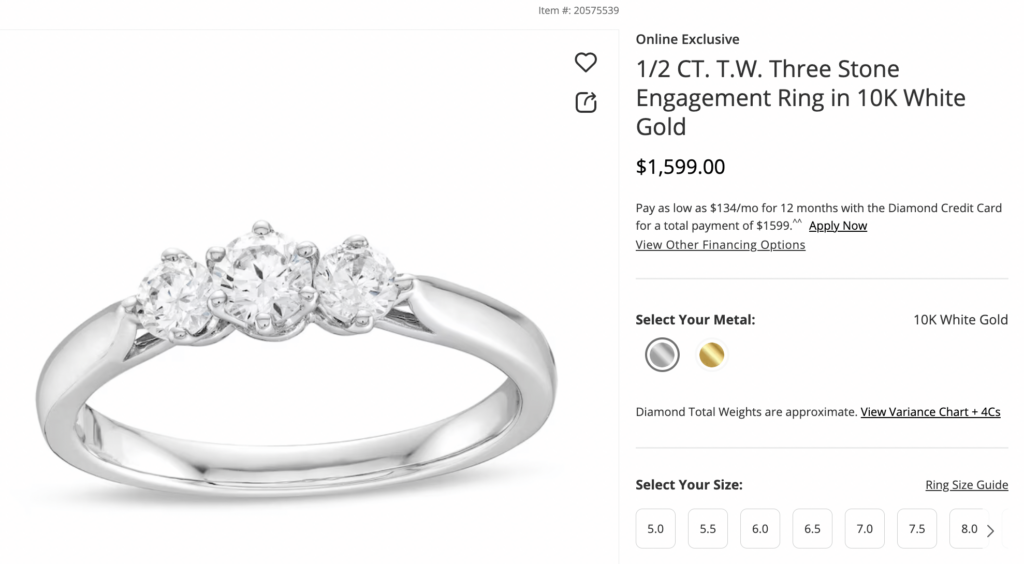
A comparable ½ carat engagement ring with three larger stones from Zales costs $1,599: 

Likewise, this 1-carat composite diamond necklace is on sale for $1,728.35 vs. this 1-carat diamond necklace with a solitaire diamond pendant for $2,443.35:

Both are set in 14k yellow gold.

Fools diamond

A “fool’s diamond” is just another name for a fake diamond, or diamond simulant. People may also refer to diamond simulants as imitation diamonds. 

Replica / travel diamond

Some people choose to purchase a fake diamond version of their natural diamond engagement ring to wear while traveling or exercising at the gym as a precaution against theft or damage. 

Some people also choose to wear silicon or rubber rings in place of their diamond rings when they are exercising or doing outdoor activities, like the ones in this set from Amazon for just $9.58

What's the best diamond alternative?

In terms of durability and similarity to natural diamonds, lab diamonds are the best alternative for engagement rings and other fine jewelry and are available at about a fourth of the price of natural diamonds of the same size. 

Moissanite is also a highly durable and less expensive imitation diamond, though its rainbow light is often fairly distinguishable from the white light of a lab or natural diamond. 

How to tell if a diamond is real

If you aren’t sure whether a piece of jewelry you own contains a diamond or fake diamond, here’s how to tell if a diamond is real at home: 

  1. Look for imperfections – Natural diamonds often contain small imperfections, called inclusions. Look for small indentations, fractures, dark spots, and cloud or needlelike formations inside and on the surface of the stone. Visible imperfections on moissanites or even lab diamonds are less common because they are created in a lab under controlled conditions. 
  2. Reflection test – Diamonds reflect white light, while diamond simulants like moissanite and cubic zirconia give off a distinct rainbow color when exposed to natural or artificial light.
  3. Water test – Diamonds are denser than water and will sink to the bottom of a cup filled with water. Cubic zirconia and moissanite stones typically do not sink unless they are particularly large and heavy. For this test to be most effective, you will have to remove the stone from its setting, since gold and silver also sink and may weigh down any stone set in them. 
  4. Fog test – Diamonds are good heat conductors, so if you breathe on one closely, any fog formed should clear up quickly. However, this is also true of moissanites. 
  5. Dot test or newspaper test – The idea behind this test is that a diamond’s high refractive index will prevent you from seeing or reading text or a drawing behind it. You can either place the loose gemstone flat side down on top of text in a newspaper or book, or draw a dot on a piece of paper smaller than the size of the stone. If you can see the text or dot through the stone, it is likely not a diamond. This test is not foolproof, however, since moissanites also have a high refractive index, and you may still be able to see text through a diamond that isn’t perfectly cut. 
  6. Heat test – Fake diamonds cannot tolerate changes in heat the way a real diamond can. Only perform this test if you are OK with damaging a non-diamond stone. Place the stone on a fireproof surface or hold it with tweezers, then hold a lighter over the stone for 30-45 seconds. Immediately after, drop the stone into a cold glass of water. Real diamonds will sink to the bottom, while stones like cubic zirconia will likely shatter. However, moissanite has a higher level of heat resistance than a diamond and would pass this test.
  7. Scratch test – As the quality of cubic zirconia and moissanite stones have improved, this test has become less effective. It involves scraping the stone in question against a mirror, stone, or glass to see if it leaves a scratch mark. However, this test can damage your stone, even if it is a diamond. 

Note that a lab diamond will also pass most of these tests because it is compositionally the same as a natural diamond. 

The most effective way to determine if a diamond is real is to bring it into a professional jeweler who can examine and test it. You can also get a lab report from a professional organization like the Gemological Institute of America. 

There are also at-home diamond testing tools you can purchase, like this testing kit from Amazon for $23.39

Are fake diamonds worth anything?

While they do not hold their value as well as natural diamonds, “fake diamonds” like moissanite and cubic zirconia can be sold on consignment or through sites like ebay, Craigslist, or Facebook Marketplace. However, you shouldn’t expect to make close to what you initially paid for them.

Answers to FAQs about fake diamond vs real diamonds

What are fake diamonds called?

Fake diamonds are called diamond simulants because they simulate the look of a real diamond. 

What is a good fake diamond called?

Moissanite and cubic zirconia are popular diamond simulants available at a fraction of the cost of natural and even lab-grown diamonds.

What is the meaning of simulated diamond?

Also called imitation diamonds, simulated diamonds are gemstones that look similar in appearance to a diamond but are compositionally different.

What is simulated moissanite?

Moissanite is a rare, naturally occurring mineral made of silicon carbide. However, most moissanite sold today is created in a lab as a diamond simulant. 

How can you tell if a diamond is real?

The best way to determine if a diamond is real at home is to look for visible inclusions like dark marks, hairline fractures, or needle-like inclusions. Also, if you hold a diamond up to light, you should see mostly white light reflected, while diamond simulants like moissanite and cubic zirconia reflect rainbow light. 

However, the only foolproof way to determine if a diamond is real is to take it into a professional jeweler or send it to a lab like GIA to have it evaluated. 

Do fake diamonds shine?

Some diamond stimulants shine even more than traditional mined diamonds — moissanite, for example, is doubly refractive and has a higher refractive index than a diamond. However, a diamond’s shine is unique in that it reflects white light, rather than rainbow light like other diamond lookalikes.

Bottom line: Are fake diamonds worth it?

If you are shopping for a less expensive alternative to a natural diamond, lab-grown diamonds and diamond simulants like moissanite are highly durable and similar in appearance to natural diamonds, at least to the untrained eye. However, cubic zirconias, while extremely affordable, often lose their luster within about two years and will need to be regularly replaced. 

If your partner doesn’t have their heart set on a diamond, a ring with a diamond simulant or lab-grown diamond may be the best option if you are limited on funds or want to be able to purchase a larger stone than you could afford as a natural diamond. 

However, if you are looking for an investment piece, neither natural diamonds nor diamond simulants are a good choice. Unlike precious metals like gold and silver, diamonds are only worth about 50% of their initial purchase price on the resale market, and fake diamonds like moissanite are worth even less. Cubic zirconia is worth virtually nothing, unless you can find an independent buyer who likes the jewelry it’s set in.

If you do have a diamond to sell, A+ BBB-rated DiamondsUSA accepts all sizes of natural and lab-grown diamonds and offers a highest price guarantee.


SOURCES

  1. “The History of the Diamond as an Engagement Ring,” American Gem Society. https://www.americangemsociety.org/buying-diamonds-with-confidence/the-history-of-the-diamond-as-an-engagement-ring/
  2. “Is There a Difference Between Natural and Laboratory-Grown Diamonds?” by Russell Shor for the Gemological Institute of America Inc. https://www.gia.edu/gia-news-research/difference-between-natural-laboratory-grown-diamonds
  3. “The Knot 2023 Real Weddings Study,” by The Knot Research & Insights Team. The Knot. https://www.theknot.com/content/wedding-data-insights/real-weddings-study
  4. “Diamond Color Chart: The Official GIA Color Scale,” Gemological Institute of America. https://4cs.gia.edu/en-us/blog/diamond-color-chart-official-gia-color-scale/

If you want to make some extra money as a single mom, there are ways to do it without getting a second (or third!) job.

Aja Dileah, a single mom in Chicago, started renting out rooms in her home in 2017 to college students volunteering on the South Side of Chicago. 

What began as a way to bring in some extra money has since become a lucrative passive income stream. Dileah is now a licensed real estate agent in the state of Florida, and she has purchased six properties to rent out as Airbnbs. Depending on the property, she earns anywhere from $1,000 to $4,000 per month in gross rental income. She and her children relocated to Puerto Rico in 2023.

While her investment properties do require some work upfront, Aja sometimes hires a property manager and pays around 20% to a management company to run her rentals.

“It’s not 100% passive for me since I’ve managed a lot on my own, but I’ve also worked with a property manager at times and it’s been very flexible in terms of the time I put in, so I don’t consider real estate investing 100% active income either,” Dileah says.

Dileah uses her rental income to either save up for new investment properties or to build more equity in her existing properties by paying down the mortgages. She says investing in real estate has been a complete game-changer in her life. 

“It has provided an additional stream of income, which allows me to work less and eventually retire earlier than I would have without it.”

Keep reading for a list of ways to earn passive income for single moms: 

What is passive income?

7 passive income ideas for single mothers

  1. Affiliate marketing
  2. Car advertising
  3. Flipping retail products
  4. Investments
  5. Real estate
  6. Selling printables
  7. Selling your stuff

Pros and cons of passive income

Avoid passive income scams

FAQs about passive income

What is passive income?

Passive income is money you earn without actively working for it. The idea behind passive income is that you put in the work, time, and effort upfront, then continue to earn income over time from that initial work. Passive income often doesn't require regular effort to keep the money flowing in.

Any income you earn/receive can still be taxed, and you will be responsible for reporting it to the IRS. If you have investments, for example, or a rental property, you will receive tax documents each year that you need to include in your tax return. 

Earning passive income on top of your regular salary or wages, like through a side gig, could also bump you into a higher tax bracket depending on how much you make. 

It’s important to talk to a tax professional if you have questions or concerns about how earning passive income may affect your personal tax situation. 

Learn more about filing for taxes as a single mom and about free help with tax preparation. Also, learn about ways to manifest money.

Passive income vs active income

Active income is any money you earn by actively doing work — either for yourself or someone else — and is typically paid out as a salary, hourly wage, or commission. It's income that requires you to actively complete work in exchange for payment.

Passive income, on the other hand, is money you earn without active involvement, though you may have to do some work upfront to begin receiving it. An example of passive income is money you earn from an Etsy shop that sells printable downloads. 

While you have to put in the initial work to create the printables, once they’re listed for sale, you don’t have to do regular work to earn money.

Types of passive income

There are different levels of passive income, based on how much regular work you have to do to earn money: 

  • Full passive. This is income you bring in without any active effort, such as dividends from investments. Completely passive income can take a long time to earn and often requires money upfront to establish an income stream.
  • Semi-passive. Semi-passive income is a common form of passive income that requires some upfront effort and some level of ongoing work and maintenance. However, you can frontload a lot of the work and set up systems to earn money in the future without your direct involvement. This is appealing to people who are looking for a flexible way to make money on their own schedule. Examples of semi-passive income include affiliate marketing and selling items online. 
  • Residual income. Residual income is a form of passive income where you earn a regular amount of money after you’ve put in the initial time and resources. Residual income can be something like a monthly subscription you charge for people to access certain materials that are valuable to them. Or perhaps you decide to renovate and rent out your garage or outdoor shed to someone for a monthly fee.

7 passive income ideas for single mothers

Here are some great passive income ideas for single moms that can help you make extra money while still being able to spend quality time with your kids:

1. Affiliate marketing

Affiliate marketing involves promoting someone else's products and earning a commission on the sales you make. You can promote products through your blog, social media, or through other channels. You can join affiliate programs through retailers like Amazon, ebay, and Walmart or through affiliate networks like Commission Junction and ShareASale. 

One Reddit user pointed out some of the most common mistakes people make with affiliate marketing:

Anyone actually make money doing this
byu/SpecialistCicada3083 inAffiliatemarketing

Learn about more business ideas for single moms

2. Car advertising

Companies like Carvertise and Wrapify pay you to wrap your car in advertising decals. Some let you choose the types of advertisements you’re willing to display, and you just drive as you normally would. 

One Reddit user makes $100 per month advertising with Carvertise:

I'm making $100 per month in truly passive income with Carvertise
byu/SyntheticBanking inpassive_income

Drivers who are interested in participating sign up on the Carvertise platform. You usually need to meet certain criteria, such as driving a certain number of miles per day, having a clean driving record, and owning a car that fits the advertiser's requirements (often a newer model and in good condition).1

Carvertise matches drivers with advertisers based on their location, driving habits, and the target audience of the ad campaign. If selected, the driver brings their car to a designated location, where professionals install the advertisement wrap. These wraps are vinyl decals that can be easily removed without damaging the car's paint.

3. Flipping retail products

Flipping retail products involves purchasing items at a discount and reselling them for a profit. You can purchase items at thrift stores, garage sales, and through online marketplaces like ebay and Amazon. You can then sell them through your own website or online marketplaces. 

Many argue that flipping retail products is not entirely passive income, which is true. You still have to do some work upfront and maintain this income stream, so it falls more in the semi-passive category. 

One Reddit user explains it best with their experience:

Comment
by from discussion
inFlipping

4. Investments

You can invest in individual stocks, bonds, or mutual funds, and many online brokerage firms allow you to make regular investments automatically so you don't have to actively manage anything. You can also set up a dividend reinvestment plan, which allows you to reinvest your dividends automatically. This can compound your earnings and help you build wealth over time.

Investing takes time, and how much you make depends on the amount you’ve invested, as well as the level of growth in the market over time. 

One Reddit user was able to earn more than $300 per month in passive income after investing for five years.

After 5 years of investing, I have achieved a passive income of more than $ 300 per month from dividends
byu/mizinin individends

5. Real estate

You can purchase a rental property and earn rent every month. You can also invest in a real estate investment trust (REIT), which is a company that invests in real estate and passes on the profits to its shareholders. Another option is to participate in real estate crowdfunding, where you can invest in real estate projects with other investors.

Ashley Hamilton, who runs the Instagram page Detroit Investor, is a single mom and serial real estate investor bought her first rental property in 2009 at 22 years-old. 

Hamilton says real estate can be a great option for single moms because you can have a flexible schedule and you can set your own budget in terms of how much you can afford to invest. 

She bought her first investment properties with help from her annual tax refunds and says you need an abundance of either time, money, or knowledge to get started. 

“If money is a struggle, I suggest you learn as much as you can and maybe even work with a mentor to figure out creative finance strategies,” Hamilton says. “If you have a credit score over 700, you have options and can also look to networking and real estate events in your area to get more established.”

Hamilton now owns 35 residential rental properties, and 14 of those properties are owned free and clear with no debt. She gives her followers and coaching students tips on how to afford getting into real estate, such as obtaining a hard money loan, which is a short-term loan usually funded by private investors or companies. 

6. Selling printables

Holly Hanna, a blogger and founder of The Work at Home Woman, has been earning passive income for the past few years by selling printable templates on her blog and marketing her products in blog posts, on social media, and to her email list.

“My assistant is highly skilled in graphic design, so I paid her to create my printables and templates, but I also recommend using Canva to create your own printables as well,” Hanna says. “I originally sold my printables using a popular e-commerce platform, but I didn’t like paying the annual fee, so I created a shop on my website using custom Gutenberg blocks and ThriveCart.”

Hanna makes $1,000 to $2,000 per month selling her printable templates and adds that if you don’t have a website, you can also start selling on Etsy for just $0.20 per listing.

7. Selling your stuff

You can sell your old clothes, furniture, jewelry, and other items that you no longer need for cash. Websites and apps like eBay, Craigslist, and Facebook Marketplace allow you to sell your items online. You can also sell them in person at consignment stores or garage sales. 

While selling items might sound like an easy way to make money, Brittani, founder of the Essential Endeavors YouTube Channel, says it’s really a lot of upfront and ongoing work. 

Brittani became a part-time seller four years ago while she was pursuing a graduate program for Mechanical Engineering. When the pandemic hit in 2020, she used the extra time she had to grow her reselling business and start her YouTube Channel. Brittani has now been selling items primarily through Poshmark live shows full time for the past two years. 

“I earn anywhere from $8,000 to $10,000 per month with my reselling business, but I am also working 40 hours per week,” Brittani says. “In my opinion, the only way to bring in passive income is through social media if someone wants to use that as a platform to grow their business and sales organically.”

She says she’s still reaping the fruits of her labor from three to four years ago through ad revenue and affiliate income from her resale business.

Brittani says reselling clothes online has a very low barrier to entry and can be scaled over time.

“Getting to work for yourself is so freeing, and I feel incredibly fulfilled being a work-at-home dog mom while getting to set my own hours and work as much or as little as I may want or need.”

Check out this video where she packs up $2,750 worth of items she sold on Poshmark: 

Pros and cons of passive income

Passive income sounds great on the surface, but there are still some potential drawbacks to consider. It’s best to carefully weigh the pros and cons of generating passive income before you decide if this is the right path for you.

Pros:

  • Make more money with little to no effort after a while
  • Have more flexibility and control of your time
  • Easier to diversify your income and maintain more than one stream of income, setting you up for more financial independence

Cons:

  • Requires initial effort and time investment
  • Can be unreliable and unpredictable
  • It may not work out even after putting in time, money and effort (high risk)

Avoid passive income scams

Passive income has been a hot topic online for a while now. Beware of passive income scams designed to take advantage of people in difficult situations. Some red flags include opportunities that promise to pay a significant amount of cash but don’t require you to do any work. 

Another red flag is an opportunity that requires you to pay money upfront to get started. Some job ads or business opportunities ask applicants to pay for a startup kit, training or marketing materials, but you should always exercise caution with these types of companies. 

If you’re interested in investing as a passive income stream, it’s important to know where your money is going and to confirm you’re working with a legitimate firm. The L.A. Times shared an article2 about how a man from Columbus, Ohio, sent $25,800 to a fake cryptocurrency investing website after receiving a WhatsApp message and getting to know a stranger online. 

The Federal Trade Commission3 found that investing scams and job and employment scams were among the top five most common types of fraud committed in 2022. They also found that losses to investment scams totaled $3.8 billion that year.

Always avoid opportunities that promise unrealistic returns or require you to pay a significant upfront investment. Do your research and read third-party reviews to make any opportunity is legit. 

Answers to FAQs about passive income 

Is passive income legit?

Many people are often skeptical about the idea of passive income. They may think it's too good to be true or that it goes against traditional values of working hard for a living. However, passive income is a legitimate way to earn money and can be a great option for single moms who want to make some extra cash.

At its core, passive income is simply a way to earn money without actively doing work to get it. This can include things like purchasing rental properties, investing in dividend stocks, or creating and selling digital products. The point is that once the initial work is done, you continue to earn money without putting in additional (or much) effort.

What is the easiest way to earn passive income?

There is no one-size-fits-all easiest way to earn passive income. However, we gathered some solid ideas people shared on Reddit about their experiences. 

If you’re looking for the easiest and quickest way to earn passive income, you should start by figuring out how to use your existing skills rather than trying to learn new ones, and market your expertise. 

This could involve writing an ebook about a topic you’re knowledgeable and passionate about and selling it. Or, you can create a digital product that helps people solve a common problem. Love to organize your home? You can create weekly cleaning schedules or chore charts that people can print out and sell them on Etsy or Shopify.

Comment
byu/ajesusfreak from discussion
inpassive_income

Saving and investing your money is one of the most basic ways to earn passive income over time. You just need to start out by having some money to set aside, so you’d be relying on your active income earned from a job to get started.

High-yield savings accounts pay interest each month, and you can also invest in the stock market long-term to receive a return when the market goes up.

Comment
byu/ajesusfreak from discussion
inpassive_income
Comment
byu/ajesusfreak from discussion
inpassive_income

Another option is to create a digital product you can share, such as an ebook, printable worksheet, or templates. How much you make will vary depending on the product, the price you set, and how well you market your digital product:

Comment
byu/Mobile_Mission1932 from discussion
inpassive_income

Is passive income a lazy way for moms to make money?

Not necessarily. Depending on which passive income stream you choose, earning money may require a lot of time and effort upfront. Sometimes, it may even require a significant investment to get started. Typically, you will need to work consistently to set up your income stream before you start seeing any passive income.

Can you earn passive income on Amazon?

Amazon has become a popular platform for people looking to earn passive income. With millions of products available for sale, it may seem like a great opportunity for single moms to make some extra cash. However, earning passive income on Amazon is not as simple as just listing products and waiting for the money to roll in.

To be successful on Amazon, you need to put in the time and effort to research, source, and market your products. This can involve finding the right niche, competitive pricing, and effective marketing strategies. Once your products are listed, you also need to continuously monitor and update them to stay relevant and competitive in the market.


SOURCES

  1. Carvertise. https://carvertise.com/drivers/
  2. “Investment scams are everywhere on social media. Here’s how to spot one,” by Cora Lewis for the Associated Press. Aug. 17, 2023. https://apnews.com/article/investment-scams-crypto-fraud-social-media-f9e053a6c555c25c90e5f7330607d90c
  3. “New FTC Data Show Consumers Reported Losing Nearly $8.8 Billion to Scams in 2022,” Federal Trade Commission. Feb. 23, 2023. https://www.ftc.gov/news-events/news/press-releases/2023/02/new-ftc-data-show-consumers-reported-losing-nearly-88-billion-scams-2022

With the average cost of college tuition topping $23,000 for public and $42,000 for private institutions,1 earning a scholarship or grant can significantly reduce the cost of obtaining a college education.

If you are a woman in college or going to college, these are some scholarship opportunities you can apply for:

  1. AAUW grants and scholarships
  2. CustomersFirst Academy Scholarship for Moms
  3. Deana Kendrick Foundation Scholarship
  4. Executive Women International Scholarships
  5. Go Girl! Grant
  6. Ignite Fellowship
  7. Jeanette Rankin Women’s Scholarship Fund
  8. National Hook-up of Black Women, Inc.
  9. P.E.O Program for Continuing Education Grant
  10. P.E.O. STAR Scholarship
  11. The Society of Women Engineers Scholarship
  12. The Soroptimist Live Your Dreams Award

  13. Veterans United Foundation Scholarship
  14. WID Scholar Program
  15. Women’s Independence Scholarship Program
  16. Worthy Women Scholarship

You may want to check out this post on 12 grants for single moms, including our $500 monthly Kickass Single Mom giveaway.

What scholarships are available to women?

The following 16 scholarships are available to women, with some having specific residency or other requirements:

AAUW grants and scholarships

The American Association of University Women (AAUW) has a number of fellowships and grants for women pursuing higher education and supports community projects that empower women of all ages.

Awards range between $2,000 and $50,000. Deadlines and requirements vary based on the scholarship or grant.

CustomersFirst Academy Scholarship for Moms

The CustomersFirst Academy Scholarship for Moms is for mothers who attend or are planning to attend an accredited college or university in the U.S. or Canada.

The award is $1,000 and can be used for tuition, books, transportation, or child care.

Deana Kendrick Foundation Scholarship

The Deana Kendrick Foundation Scholarship is for women over 30 who are enrolled in or returning to an accredited college anywhere in the U.S.

Scholarship awards are up to $500 per semester or $125 per quarter or summer semester. Preference is given to students attending Foothill/DeAnza College or Ozarks Technical Community College.

Executive Women International Scholarships

Executive Women International (EWI) offers two scholarship programs: ASIST and EWISP:

  • ASIST awards range from $2,000 to $10,000 and are for adults seeking higher education who need assistance due to financial, social, or physical challenges.
  • EWISP is for high school seniors and provides more than $100,000 in scholarship money each year. Applicants must live near a participating EWI chapter.

Go Girl! Grant

The Go Girl Grant! is provided by the Girlfriend Factor, an organization that aims to make sure higher education and occupational training are financially accessible to all women. To date, they have awarded more than $700,000 to 180 women.

Applicants for the Go Girl! Grant must be 25 years old or older and must live and go to school in the Coachella Valley in California. Women must demonstrate how this educational path can help them achieve a specific employment goal.

Ignite Fellowship with Teach for America

Women looking for flexible income and experience impacting students can also consider a paid for the the Ignite Fellowship, a paid remote teaching fellowship that enables you to tutor underserved children online while continuing your own studies or parenting.

This program is part of Teach for America and pays up to $1,200 per semester.

The Ignite Fellowship is a rewarding, meaningful way to gain unique, hands-on experience as you put your passion for educational excellence into action.

Jeanette Rankin Women’s Scholarship Fund

The Jeanette Rankin Women’s Scholarship Fund is an award-winning financial aid program bolstering income-challenged women aged 35+ seeking a degree or trade certificate. The program supports continuing education efforts with a focus on inclusion for all who identify as women. Open to U.S. residents and permanent citizens.

National Hook-up of Black Women, Inc.

National Hook-up of Black Women, Inc. offers two scholarships:

  • Dr. Anita Young Boswell Scholarship – $1,000 awarded to African-American students who excel academically and demonstrate care for their community while continuing a postsecondary education
  • Dr. W. A. Frazier “Sister-to-Sister” Scholarship – $1,000 to provide financial help mature African-American women who are pursuing a postsecondary education.

P.E.O. Program for Continuing Education Grant

The P.E.O. Program for Continuing Education Grant is offered by the Philanthropic Education Organization (P.E.O.) to provide need-based grants in the U.S. and Canada for up to $4,000.

This education grant is for women whose education has been interrupted who are now looking to continue their education to enhance job skills for employment and better their lives and their families' lives.

To be eligible for the Program for Continuing Education (P.C.E.) Grant, you must be a citizen or legal permanent resident of the United States or Canada and must be enrolled in an education program. 

You must be in within 18 consecutive months of completing your education program. You must also have the sponsorship of a local chapter of the P.E.O. Sisterhood.

P.E.O. STAR Scholarship

The P.E.O. STAR Scholarship is for young women in their last year of high school for tuition, fees, books, room and board or other qualified college expenses. The $2,500 scholarship is not renewable and can be paid directly to the recipient or the school of choice.

The Society of Women Engineers Scholarship

For those who identify as a woman and are interested in pursuing a degree in Engineering, the Society of Women Engineers Scholarship is valued from $1000 to $5000.

Interested applicants only have to submit one application, but they will be considered for all of the scholarships they are eligible for. 

SWE also offers scholarships in India, provided that the students are enrolled in SWE India Affiliate School and Washington-accord accredited program.

The Soroptimist Live Your Dreams Award

The Soroptimist Live Your Dreams Award is for women who are breadwinners in their families. Soroptimist provides up to $16,000 for the Live Your Dreams Award finalist to use toward tuition fees, books, transportation, and child care.


The Live Your Dreams Award aims to help women continue their education to transform their lives and communities. Applications are open from August 1 to November 15 each year. 

To apply, you must not have a graduate degree and must have a financial need. Recipients must be passionate about achieving their educational career and goals. You must be enrolled in or have been accepted to an undergraduate degree program or vocational training program.

Veterans United Foundation Scholarship

The Veterans United Foundation Scholarship awards scholarships to surviving spouses or children of deceased service members and veterans. If you are a veteran with a 100% service-connected disability, you may also be eligible. These needs-based scholarships are for those who are enrolled or enrolling in an accredited college or university.

WID Scholar Program

The WID Scholar Program is offered by the Women in Defense (WID) National Security Organization and is for women who are pursuing careers supporting U.S. national security.

Prospective applicants must be pursuing an undergraduate degree and must have attained junior status by the fall of 2024. Graduate students are also eligible.

Applicants must carry a GPA of at least 3.25, be a citizen of the United States, and must demonstrate interest in pursuing careers related to national security or defense.

Women’s Independence Scholarship Program

For female victims of intimate partner violence who have successfully separated from their partners, the Women's Independent Scholarship Program was founded in 1999 and has helped hundreds of women and their children.

Awards range from $500-$2,000 per semester or quarter for undergraduate students and $1,000 per semester or quarter for master’s degree students.

Worthy Women Scholarship

Every year, the jewelry buyback auction site Worthy.com gives away three scholarships — for $2,500, $1,500 and $1,000 — to women aged 30+ enrolled in school. Essay required. Learn more at Worthy Women Scholarship.

If you are a single mom, check out our list of scholarships for single moms and our advice for whether you should help your kids pay for college.

Need more help? Check out our other helpful and free resources for low-income women and families:

Help for single moms: 16+ resources$500 monthly single mom grant
Free laptopsFree clothes
Single mom loansGovernment assistance for single moms
Free smartphoneFree wifi
Free tabletFree gas
Free child careFree preschool
10+ charities that help single mothersTutoring and homework help
Free moneyFree school supplies
Free housingLow-income home loans

SOURCES

  1. “See the Average College Tuition in 2023-2024,” by Emma Kerr and Sarah Wood for U.S. News and World Report. Sept. 20, 2023. https://www.usnews.com/education/best-colleges/paying-for-college/articles/paying-for-college-infographic

According to Pew Research Center data,1 about 22% of people over 40 in committed relationships first met their partner on a dating site or app. But what about the other 78%?

While the idea of meeting someone “IRL” (in real life for the non-Gen Zers) can be daunting, there are plenty of places to meet quality singles in person.

One major benefit of meeting face to face instead of behind a screen? You can immediately establish whether you have a connection, rather than spending hours getting to know each other online only to meet in person and realize you have no spark.

Plus, you get to analyze that person’s communication style, body language, and overall level of interest.

Want to meet someone IRL? Here are some of the best places to connect: 

Golfing for a dating ‘hole in one’

Tennis…match?

Wine tasting

Other places to meet men over 40

Golfing for a dating ‘hole in one’

One of the most popular ways to meet singles in real life is through golf — whether you’re actively learning and playing the sport or just attending tournaments. Golf is an excellent place to meet single, available men, often those who have the means and disposable income to play this relatively expensive sport. 

I’ve had my hand at swinging the clubs surrounded by testosterone. It didn’t matter that I was terrible at it; many were delighted to see me making the effort as a solo single female. I opted for a few lessons, then made a beeline to the club restaurant, which served as a watering hole for groups who had completed their games. 

With the ubiquitous social lubricant of alcohol, I found it easy to strike up conversations with avid players and would often use my bad golf game as an icebreaker.

Me asking for advice tended to make their faces light up, and once I got them started, it was easy to steer the conversation to other topics to gauge compatibility. While I never met a man I felt the urge to continue exploring, I couldn’t ignore the potential future opportunities.

Tennis…match?

Similarly, tennis is a great way to meet single men who value fitness. Like golf, tennis has a certain cachet, and the likelihood of meeting a fit, single, and upwardly mobile partner is high. 

As a Southern California native, access to some sort of activity related to tennis is everywhere — especially the tournaments. I recently attended a tennis open in Desert Hot Springs, where I met people to chat with simply by grabbing a cocktail or food. 

We sparked conversations over the progress of our favorite players and any drama surrounding specific matches. Tennis events often provide opportunities to mix and mingle after the matches are over.

If tennis is too strenuous or not your cup of tea, one of the most popular new sports, especially for older adults, is pickleball. As of 2021, the majority of pickleball players were 55, with an average age of 38. From 2014 to 2021, pickleball has nearly doubled in popularity, and six out of 10 pickleball players are male.

Wine tasting

As a resident of a city with more than 51 wineries, I can tell you that these places are a bastion of socializing and fun. Besides meeting someone who loves wine and the finer things in life, wineries often host a variety of events like concerts, wine pairing classes, and wine education.

These are just a few locales I’ve tried out for myself, but others have reported success in finding viable romantic partners at MeetUp events where participants share a common interest (e.g., running, hiking, gaming). Some other popular in-person opportunities include:

  • Fitness classes: Yoga, pilates, or spin classes can be great social environments.
  • Farmers' markets: Shop for fresh produce and strike up conversations with other visitors.
  • Comedy clubs: Share laughs and connect with others who have a good sense of humor.
  • Workshops and seminars: Learn something new and meet people with similar interests.
  • Festivals and fairs: Explore local culture and meet a diverse group of people.
  • Travel groups: Join a group tour or adventure trip to bond with fellow travelers.

Meeting someone with a common interest has its benefits. You can immediately establish if there is chemistry and connection between you and get a better sense of a person’s personality and communication style. 

But there is a downside. Virtually every opportunity to meet a potential romantic connection depends on quickly establishing whether the person is single and available. Many people attending these kinds of events are already coupled, especially if you live in the suburbs or country, where the marriage rate is higher.2

If you still prefer to meet people online, check out my list of the best dating sites for people over 40 and our reviews of top dating sites:

eharmonyTinder
Match.comHinge
BumbleMillionaire Match
Elite SinglesBest single parent dating apps

Other places to meet men over 40:

From Wealthysinglemommy.com founder Emma Johnson:

Your kids’ schools and social networks are a goldmine! Plenty of moms I know have met nice guys who are either dads or love kids through the natural age-appropriate network of similarly educated parents: Dads at sports events, afternoon pickup and event volunteering, coaches, teachers and cute fathers at the playground. Lots of divorces and breakups happening, lots to talk about

Confirms Erin Michelle Silber: “I met my boyfriend of almost 6 years at a PTA back to school parents social. We had a friend in common.”

Via the Millionaire Single Moms Facebook group:

“Community events. I volunteer with organizations that mean a lot to me. The positive side to stuff like this is that it fills your cup. So if you don't meet anyone you still will feel fulfilled and you may end up in a situation like me where dating just falls lower down on the priority list. If not, you're bound to meet someone.” — Jannell Johnson 

“Local sports clubs — running, softball, pickleball.” — Marissa Rose

“I just returned from a Virgin Voyages cruise and met lots of single men my age (43). Handsome ones I'd add.” — Tiffany Lambert

Via daters on Reddit:

Singles on Reddit also shared these ideas for meeting in real life: 

Comment
byu/Creative_Airport_218 from discussion
indating_advice
Comment
byu/Creative_Airport_218 from discussion
indating_advice
Comment
byu/Creative_Airport_218 from discussion
indating_advice
Comment
byu/Creative_Airport_218 from discussion
indating_advice
Comment
byu/Creative_Airport_218 from discussion
indating_advice

Also, check out our list of apps to meet friends

California’s historic Gold Country is experiencing a resurgence, spurred by recent hotel renovations and an influx of new residents during the COVID-19 pandemic,1 likely because of an increase in people participating in outdoor activities.2

While it’s been nearly 200 years since the Gold Rush drove 300,000 people to that region, panning for gold remains a well-loved pastime shared by hobbyists and professionals alike.

But is gold panning a lucrative venture? Or just a fun hobby from a bygone era?

John Anderson, President of the Gold Searchers of Southern Nevada, a prospecting club based in Las Vegas, says most of the members of his club don't prospect to make money, though some sell their gold to local stores at spot value.

“All the gold I have found is still in my safe,” says Anderson, who has been prospecting for 16 years. “Unless you prospect full time, it is just basically a hobby.”

I recently posed the same questions and more to members of the r/Prospecting subreddit, and the general consensus was this:

If you’re looking to make money prospecting for gold, you have to be willing to drop some serious cash upfront and make prospecting a full-time venture. Even then, you’re not likely to make a fortune.

“Typically, you spend more on the adventure than you’ll recover in gold,” Reddit user Grayme4 wrote. “There are rare exceptions, but in North America, hobbyist gold mining is just that — a hobby.”

In this post, we’ll cover: 

History of gold panning in the U.S. (and why it has nothing to do with panning today)

Panning for gold: The basics

How to sell raw gold or panned gold

  1. Determine the value of any gold you find
  2. Check raw gold prices

FAQs about raw gold

History of gold panning in the U.S. (and why it has nothing to do with panning today)

While gold mining started as far back as 4000 B.C. in Eastern Europe, the first gold discovered in the United States was at Little Meadow Creek, N.C., in 1803, which set off the first U.S. gold rush.3 By 1825, North Carolina was supplying all of the domestic gold coined by the U.S. Mint in Philadelphia.

In 1848, a man named John Marshall found flakes of gold while he was building a sawmill for Swiss immigrant John Sutter in Colona, Calif., about 40 miles east of Sacramento. His discovery at Sutter’s Mill ushered in the California Gold Rush, which lasted until 1855. 

However, even though more than 300,000 people uprooted their lives to strike it rich in California, very few actually did. According to the California State Parks department,4 most miners brought home between $10 and $15 worth of gold dust per day, the equivalent of about $400 to $600 today, though the cost of living in the mine fields was quite high. These were typical prices for common items in the gold fields in 1851: 

ItemPrice in 1851
Beef$10 per pound
Butter$20 per lb
Cheese$25 per lb
Coffee beans$0.15 per lb
Cracker$0.15 per tin
Eggs$3 each
Flour$13 per bag
Oranges$0.15 each
Rice$8 per lb
Boots$6 per pair
Flannel shirts$1.50 each
Blanket$5 each
Shovel$36 each

As competition increased and the amount of surface gold dwindled, many men started working for larger mining companies that sought to extract gold beneath the surface. Anglo-American miners forced other nationalities from the region using violent tactics, and an estimated 120,000 Native Americans died of disease, starvation and homicide during the California Gold Rush.

The final gold rush of the 19th century was in 1898 in Klondike, Alaska, where two prospectors discovered gold while they were fishing.

Today, panning for gold is just a fun side gig or hobby for the majority of people. There are hundreds of gold-panning clubs across the U.S., the largest of which — the Gold Prospectors Association of America5 — has 89 chapters in 31 states.

Panning for gold: The basics

If you’re new to gold prospecting, here’s a quick overview of the process and what tools you need to buy to get started:

How do you pan for gold?

Panning for gold, a form of placer mining, is based on the principle that gold is heavier than most other particles. According to the Environmental Protection Agency,6 these are the basic steps involved in panning for gold: 

  1. Place sediment or ore in a pan and submerge in water. You can also use a sifting pan to separate larger rocks from smaller particles. 
  2. Move the pan in a circular motion so the gold particles sink to the bottom of the pan, removing lighter materials and water as you go. 
  3. Repeat this process until you can see and collect gold particles at the bottom of the pan. 

You can see this process in action in this video from Vo-Gus Prospecting: 

What tools do you need to pan for gold? How much do they cost?

“For a hobbyist you just need a shovel, pan, and something to suck up the gold in the pan,” wrote Reddit user ConfidenceKitchen216, who told me privately he lives in Southern California and goes panning for gold about twice a month. He said he spent about $50 on tools to get started. 

These are some gold-panning kits available on Amazon, ranging in price from $24 to $116: 

Sluice Fox Gold Rush panning kit with carry bag, $24.99

Stansport Mining Kit, $53.89

VEVOR Complete Sluice Box Gold Panning Kit, $129.99

If you use a sluice to pan for gold like the last kit above, you’ll place the sluice in running water and scoop gravel and dirt into the top. As the water travels through the sluice, lighter materials will flow back into the water and heavier particles, like gold, will get trapped in the sluice’s pockets. 

Types of raw gold you can find panning for gold

Gold nuggets 

Most gold nuggets are between 75% (18k) and 91.7% (22k) pure gold, combined with other minerals like silver and quartz. Gold nuggets are typically smooth, thanks to many years of water erosion.

A gold nugget that weighs 1 troy ounce at 91.7% pure gold would be worth about $2,418 as of December, 2024.

Gold flakes

Gold flakes are also a form of high-purity raw gold, but it takes a lot of gold flakes to reach a substantial amount of gold.

Gold flakes are often sold in vials or jars on sites like ebay because they have a higher value as a souvenir or keepsake than they do based solely on gold content. 

These vials of 1 gram of gold flakes were on sale for $15 on ebay in April, 2025: 

Where should you look for raw gold?

Gold deposits are typically found along riverbeds and streams or in the dirt in the crevices of bedrock, particularly where water is obstructed or changes course. 

ConfidenceKitchen216 says you should research where people have previously found gold to set yourself up for the greatest chance of success. 

“While new deposit discoveries are possible, it isn't likely a hobbyist will find a brand new productive area,” he wrote.

The Gold Prospectors Association of America (GPAA) has a search tool on their website to find prospecting locations. If you become a GPAA member, you can see comments other members have made about each location and what they’ve found there. 

Reddit user ChewyRib says there are some businesses that will take you on a tour and show you how to pan for gold and what to look for. He recommends Gold Prospecting Adventures or Roaring Camp Gold if you are in California (or willing to travel there). 

How hard is it to find gold?

Finding gold is difficult and time-consuming, which is why it’s not a lucrative venture for most people. The measure of gold in the earth’s crust is between 0.001 to 0.006 parts per million, according to USGS.7 

That being said, your best chance at finding gold is to look where other people have found gold before. That could be on public land or private claims with the owner’s permission. 

Where are the best places in the U.S. to pan for gold?

Reddit user Grayme4 said the best places in the U.S. to find gold are places that have historical records of gold.

These are some popular locations for gold panning, according to Reddit users: 

  • Sierra Nevadas (California/Nevada)
  • American River in California (origin site of the California Gold Rush)
  • Offshore Alaska
  • Talladega National Forest in Alabama
  • Goldvein, Va.
  • Thermal City, N.C. (east of Asheville)
  • Prescott, Ariz.
  • Georgia Gold Belt (eastern Alabama to Rabun County, Ga.)
  • Western and Southern Oregon

Note that most states have regulatory laws that restrict where you can prospect for gold and which tools you can use. For example, California State Parks8 dictate that “tools and equipment may not be used in rockhounding, except gold pans.” Rockhounding is the recreational gathering of stones and minerals that occur naturally on the undisturbed surface of the land.

Likewise, rocks or minerals found in California State Parks may not be sold or used commercially for profit, and each person is limited to 15 pounds of mineral material per day.

On some federal public lands, you need to stake a mining claim with the Bureau of Land Management (BLM) or National Forest System (NFS) before you can pan for gold, which means you claim the right to extract minerals from that area. You can also get permission from a current claim owner to pan for gold on their land.

Anderson says most places that have good amounts of gold deposits are already under a mining claim. When you join a prospecting club, you can often gain access to mining claims the club owns.

Claims are typically marked at their corners by small monuments made of wood, metal, or stone. Some people use piles of rocks, known as cairns, to mark their claims.

Anderson's club, the Gold Searchers of Southern Nevada, has a 120-acre claim in Nevada and 800 acres claimed in Arizona, where they also own 60 acres of land. Members have 24-7 access to all of these claims, and prospective members can join the club on one of their monthly outings to get a feel for whether it's right for them.

“The biggest advice I can give you is not to buy a lot of equipment before you check out a mining claim,” Anderson says.

Research laws on gold panning in whatever state you plan to pan for gold to make sure you aren’t breaking the law or infringing on land that has already been claimed.

According to the Bureau of Land Management,9 there are federally administered lands in 19 states where you can locate or stake a mining claim: 

  • Alaska
  • Arizona
  • Arkansas
  • California
  • Colorado
  • Florida 
  • Idaho
  • Louisiana
  • Mississippi
  • Montana
  • Nebraska
  • Nevada
  • New Mexico
  • North Dakota
  • Oregon
  • South Dakota
  • Utah
  • Washington
  • Wyoming

However, you do not need to stake a claim to pan for gold on public land as long as it hasn’t been previously claimed. You can find a database of existing claims on the USGS website. These are the types of mine claims available in these states: 

  • Placer claims give the claim owner the right to search for valuable minerals in loose material. This is the type of claim that covers gold panning. 
  • Lode claims give the claim owner the right to extract valuable minerals from rock veins in the earth. 

If you find eligible unclaimed land you’d like to claim, these are the costs associated with registering for both types of mining claims via the Mineral & Land Records System (MLRS):

Claim typeClaim fee
Placer Claims$165 for each 20 acres, then a $165 annual maintenance fee
Lode Claims$230, then a $165 annual maintenance fee

It is illegal to stake a mining claim on the following lands: 

  • National parks
  • National monuments
  • Indian reservations
  • Reclamation projects under the Bureau of Reclamation
  • Military reservations
  • Scientific testing areas
  • Wildlife protection areas managed by the U.S. Fish and Wildlife Service

How much can you make panning for gold?

If you are panning for gold as a recreational activity, you shouldn’t expect to make much, if any money. 

“To make money, you would need a large investment for heavy machines to show a profit,” Anderson says.

While gold prices remain near record highs, the amount you’d have to pan to make a livable income would require you to commit to panning as a full-time job. Even then, you would still likely make less than minimum wage unless you found a highly lucrative claim. 

ConfidenceKitchen216 said he’s made “less than nothing” panning for gold.  

“I have definitely spent more money on gas and equipment than I made in profit,” ConfidenceKitchen216 wrote. “You have to be 100% dedicated to research and hard work to find consistently productive grounds that will yield enough gold to cover the costs of your equipment and fuel. In the end, you still will make less money than if you worked at McDonalds.”

For reference, the average hourly wage at McDonalds is $16 ($32,342 annually for 40 hours a week) as of November 2024, according to Ziprecruiter.10

Most of the Reddit users who responded to my post said they prefer to keep the gold they find, and some plan to turn what they’ve found into jewelry one day. One joked that you can make a lot of money panning for gold — if you spend twice as much to get started: 

Article on gold prospecting
byu/LB-pitt inProspecting

Grayme4 says you may be able to make more than the spot gold value on particularly beautiful or unusual gold nuggets, like those of an exceptional size or character of nugget, gold in quartz, or crystalline gold.

For example, this  86.1 grams Australian golden nugget was for sale on ebay for $13,255.55 in April, 2025

How can you make a career out of panning for gold?

“I know people who make a living from prospecting, but it’s a hard life and you do it for the joy of being in nature, not for early retirement,” Grayme4 wrote.

ChewyRib says if you don't have a good claim, no amount of time or money would be worth your investment:

“To make some real money, you need money upfront to pay for drilling to get reports on what is under the ground. Heavy equipment, a crew of people to run it, etc. You could also get a job with an established gold mine.”

How to sell raw gold or panned gold

If you do decide to sell gold you’ve panned, the first step is determining the value of what you have: 

1. Determine the value of any gold you find

Any gold you find panning is worth the spot value of its pure gold content. Most raw gold is between 18k and 22k (75% and 91.7% pure gold, respectively). 

Purity

You can determine the purity of your gold using at-home tests, like this gold and silver jewelry testing solutions kit from Amazon:

Gold prospector Dan Hurd explains how to test gold at home in this video: 

Weight

We recommend investing in a high-quality digital scale that will give you an accurate reading, like this one on Amazon that sells for about $10.

Likewise, you can bring your raw gold into a local jewelry store or send it to a reputable online gold buyer, who will determine its purity and weight, whether you choose to accept or reject their offer. 

2. Check raw gold prices

You can see the value of your raw gold using CashforGoldUSA's gold calculator, based on the current price of gold. 

CashforGoldUSA informational gold calculator

Check out our guide on how to sell gold for an overview of online and local gold buyers and learn more ways to determine if your gold is real.

FAQs about raw gold

What is raw gold? Is it the same as natural gold?

The term raw gold, also known as natural gold or gold ore, refers to any gold alloy (mixture of gold and other metals) that is found in nature and that has not yet gone through a refining process. It can come in many forms, including gold nuggets, gold dust, and gold flakes.

What does gold look like in raw form?

Raw gold is typically bright, shiny, and dark yellow in color. The yellower the metal, the more gold it likely contains; the paler or whiter the metal, the more silver or other metals it likely contains. Raw gold with other impurities can appear in other colors, as well.

How pure is raw gold?

Most raw gold found in nature is between 75% and 91.7% pure, and always contains some kind of impurities.

What carat is raw gold?

Raw gold is commonly between 18k and 22k gold, though it can be as low as 14k in purity.

The most common metal to be found with gold is silver, but gold can also be found with copper, iron, and lead impurities.

How can you tell real raw gold?

Real raw gold is very heavy, has a deep yellow luster, and is not magnetic.

This video does a good job explaining how to identify real raw gold vs fool's gold:

Can you sell pure gold?

Pure gold is most often found in the form of gold bullion bars or gold coins, which are worth nearly the market value of gold.

Can you sell gold that you find?

You can typically sell your raw gold the same way that you would sell refined gold products like jewelry, coins, or bullion — though keep in mind that gold found through prospecting, or other raw gold, does not fetch the same high price as government-backed gold products. 

Depending on where you found the gold, there may also be restrictions in place on whether you can sell it.

Pawn shops, gold exchanges, and online gold buyers all purchase raw gold, though certain establishments may have their own policies.

Bottom line: Is panning for gold worth it? 

As a money-making venture, panning for gold likely isn’t worth the investment of your time or money. If you want to make money selling gold, you’re better off searching through your jewelry box or finding unwanted gold jewelry at a local thrift store

However, if you’re just looking for a fun hobby and to join a community of like-minded people, panning for gold is absolutely worth it, Grayme4 wrote. 

“I love camping in the wild, spending a weekend at a river, digging and finding shiny metal. Some of the best days of my life.”


SOURCES

  1. “California gold rush towns are booming again. Here’s what to see and do,” by Barbara Noe Kennedy for National Geographic. Nov. 30, 2023. https://www.nationalgeographic.com/travel/article/sierra-mountains-gold-rush-historic-hotel-trails
  2. “Increase in outdoor activities due to COVID-19,” Outdoor Industry Association. https://outdoorindustry.org/article/increase-outdoor-activities-due-covid-19/
  3. “The History of Gold,” National Mining Association. https://www.nma.org/pdf/gold/gold_history.pdf
  4. “Gold Rush Prices Worksheet,” California State Parks. https://www.parks.ca.gov/pages/22922/files/worksheet-goldrushprices.pdf
  5. Gold Prospectors Association of America. https://www.goldprospectors.org/Community/AboutGPAAChapters
  6. “Artisanal and Small-Scale Gold Mining Without Mercury,” United States Environmental Protection Agency. https://www.epa.gov/international-cooperation/artisanal-and-small-scale-gold-mining-without-mercury
  7. “Gold in meteorites and in the earth's crust,” by Robert Sprague Jones. USGS Numbered Series. https://www.usgs.gov/publications/gold-meteorites-and-earths-crust
  8. “Gold Panning Regulations,” California State Parks. https://www.parks.ca.gov/?page_id=30708#:~:text=Gold%20Panning%20Regulations
  9. “Mining Claim Fees,” U.S. Bureau of Land Management. https://www.blm.gov/programs/energy-and-minerals/mining-and-minerals/locatable-minerals/mining-claims/fees
  10. “McDonalds Employee Salary,” Ziprecruiter. https://www.ziprecruiter.com/Salaries/Mcdonalds-Employee-Salary
How much does raw gold sell for?

The value of your raw gold depends on the same factors as other types of gold: How much gold you have, and how pure it is. Most raw gold is about 18K and is often combined with other metals like silver, copper, and lead.

Can you sell gold that you find?

You can typically sell your raw gold the same way that you would sell refined gold products like jewelry, dental scrap, coins, or bullion, though keep in mind that gold found through prospecting, or other raw gold does not fetch the same high price as government-backed gold products.

Can you sell pure gold?

Pure gold is most often found in the form of gold bullion bars or gold coins, which are worth nearly the market value of gold.

How pure is raw gold?

Raw gold is commonly found as 18 karat (18K) gold. It can be as low as 14 karats in purity.

Where is raw gold found?

Gold can be found all over the world. China, Australia, Russia, the United States, Canada, and South Africa are commonly mentioned as top gold-producing countries.

What does gold look like in raw form?

Raw gold is typically bright, shiny, and dark yellow in color. The yellower the metal, the more gold it likely contains; the paler or whiter the metal, the more silver or other metals it likely contains. Raw gold with other impurities can appear in other colors, as well.

What is raw gold?

The term raw gold, also known as natural gold or gold ore, refers to any gold alloy (mixture of gold and other metals) that is found in nature and that has not yet gone through a refining process. It can come in many forms, including gold nuggets, gold dust, and gold flakes.

How much are gold flakes worth?

Gold flakes are a form of high-purity raw gold, but it takes a lot of gold flakes to reach a substantial amount of gold.

How much are gold nuggets worth?

Most gold nuggets are between 85% and 95% pure gold, which means you’ll get a higher price for nuggets than most other forms of raw gold.