scroll top

If you can’t afford a cell phone or wireless service, there are programs that can help you get a free smartphone or cellphone. Here’s the best way to get a free phone or a discounted one:

Best way to get a free phone: Lifeline Assistance Program

Don’t qualify for ACP? Where to find discounts for cell phones and low income cell phone plans

FAQs about free smartphones and discount plans for low-income families

Bottom line: How can I get a free phone without paying?

Best way to get a free phone: Lifeline Assistance Program

The Lifeline Assistance Program is the main program that provides free smart phones and free or reduced-price wireless cell phone plans and landline service to low-income people. Lifeline is a federal program available in every state, territory, and on Tribal lands. 

When you sign up for Lifeline, you can choose a free smartphone from many of the participating providers in this post. But Lifeline also helps you pay for your cell phone bill.

Lifeline gives you up to $9.25 per month to pay your cell phone bill. If you live on Tribal land, you can get up to $34.25 per month. This benefit applies to already discounted, low-income plans. In some cases, there is zero cost to Lifeline subscribers, as outlined through the different programs listed below.

You are eligible for the Lifeline Assistance Program if:

  • Your income is at or below 135% of the federal poverty guidelines based on your household size.
  • You receive Tribal assistance.
  • You receive assistance such as an EBT card, SNAP, Medicaid, or SSI.

How to get free phone service from Lifeline:

Apply online through a Lifeline administrator (list below).

Once you are approved for Lifeline, you are good to go for one year. Just use it at least once a month to keep it active. After a year, you must reapply to keep the service.

You can use your Lifeline benefit for one service per address and you can’t transfer your benefit to someone else.

Learn more about free or discounted internet service and free wifi.

Wireless providers with free or discounted phones

Here are some of the wireless providers that work with the federal Lifeline Assistance Program to provide free or discounted government smartphones and wireless service:

  1. Access Wireless
  2. AirTalk Wireless
  3. American Assistance
  4. Assurance Wireless
  5. AT&T
  6. Cintex Wireless
  7. Easy Wireless
  8. enTouch Wireless
  9. Infiniti Mobile
  10. Life Wireless
  11. Q Link
  12. SafeLink Wireless
  13. SafetyNet Wireless
  14. StandUp Wireless
  15. TAG Mobile
  16. Tempo Wireless
  17. TerraCom Wireless
  18. T-Mobile
  19. TruConnect
  20. Verizon Wireless

1. Access Wireless

Lifeline’s Access Wireless is a legit service that offers free nationwide cell phone service for qualified Lifeline recipients. Buy a discounted iOS smartphone for as low as $149 or an Android cell phone for as low as $39. Bring your own compatible device and pay just $9.99 for a SIM card.

Access Wireless has an A+ rating with the Better Business Bureau (BBB).

Apply to Access Wireless to get free service.

2. AirTalk Wireless

AirTalk Wireless makes it possible for qualified Lifeline/ACP recipients to get a free touchscreen iOS or Android smartphone or wireless phone. AirTalk offers service and plans in 37 states and Puerto Rico.

AirTalk offers three plans:

  • Lifeline: 4.5GB of data, 1,000 talk minutes and unlimited texting, and free SIM that you can put in an existing smartphone (no free phone)
  • Lifeline/ACP: 15GB of data, unlimited talk and text, and free upgraded smartphone
  • ACP: 8GB of data, unlimited talk and text, and a free basic smartphone

AirTalk requires no deposit or activation fee.

AirTalk does not have a BBB profile.

To get started, apply at AirTalk Wireless.

3. American Assistance

American Assistance provides qualified applicants with a free government touch-screen smartphone with a new monthly plan. The Lifeline/ACP program covers subscribers in 20 states and Puerto Rico. The ACP-only program covers seven states and Puerto Rico. 

American Assistance also works with California Premium Lifeline, a state-based cell phone assistance program that offers free unlimited voice, text and 6GB of data monthly.  There are no activation fees, contracts, or device deposits.

American Assistance does not have a BBB profile.

Apply to American Assistance to check availability and benefits.

4. Assurance Wireless 

Assurance Wireless (now part of T-Mobile) offers new Lifeline and/or ACP Assurance Wireless customers a free Android smartphone. 

The Assurance Wireless Lifeline/ACP plan gives you free data, and unlimited text messages and minutes. The Lifeline-only plan hooks you up with unlimited data, texts, 1,000 minutes, and 4.5GB of data  with no activation fee or device deposit.

Assurance Wireless serves low-income residents in 42 states and has an A+ rating with the BBB.

Apply to Assurance Wireless by entering your zip code.

5. AT&T

AT&T works with ACP to deliver free and affordable high-speed data and unlimited talk and text on prepaid phone plans, including:

  • Free 5GB of data and unlimited talk and text
  • $10 per month for 15Gb of data and unlimited talk and text
  • $20 for unlimited data, talk and text (when you sign up for autopay) 

AT&T doesn’t offer a free phone, but you can get a free SIM shipped at no charge when you bring your own compatible device. Or shop for a new prepaid phone through Walmart, AT&T’s mobile device partner. Activation fees vary by phone choice.

In addition, Access from AT&T is the carrier’s low-cost internet service that costs $30 per month or less. Available in 21 states, AT&T’s low-income program is available to those who meet ACP income requirements or who receive benefits from SNAP, SSI (only for California residents), or the National School Lunch Program (NSLP).

No contract or deposit. Free installation.

AT&T has a B+ rating with the BBB.

Check availability and apply for Access from AT&T.

6. Cintex Wireless

Cintex Wireless will give you a free Android or Apple smartphone of your choice with a $0/month plan with 15GB of data and unlimited talk, text, and picture messaging if you qualify for Lifeline and ACP.

Cintex Wireless offers this plan nationwide. There are no deposit or activation fees.

Plus, Lifeline/ACP-eligible customers get unlimited calling to Canada, Mexico, Argentina, Brazil, Colombia, Costa Rica, Guadeloupe, Paraguay, Peru, and Venezuela.

Separate Lifeline-only and ACP-only plans are still free, but have different features:

  • Lifeline customers can bring their own device and get a free SIM card. The free plan provides 4.5GB of data each month, plus 1,000 talk minutes and unlimited texting. 
  • If you are only eligible for ACP, you’ll get 8GB of data plus unlimited talk and text.  

Cintex Wireless has a profile but is not rated by the BBB.

Apply now at Cintex Wireless with your zip code to view plan options.

7. Easy Wireless

Easy Wireless provides eligible Lifeline and ACP customers free or discounted smartphones and free talk, text, and data. 

If you qualify for:

  • Lifeline and ACP, you can get the Unlimited Plan. It comes with a free smartphone and unlimited talk, text, and data.
  • Lifeline-only, the Base Plan includes $25 smartphones and free text, 1,000 talk minutes, and 25 MB of data.
  • ACP only, you can get the Plus Plan that features a free smartphone, unlimited text and talk and 5 GB of data.

All Tribal Lifeline and ACP plans offer a free smartphone. Most include unlimited talk, text, and data. 

Even if you don’t qualify for Lifeline or ACP, Easy Wireless has plans that start at $5.25 a month with 1,000 talk minutes, unlimited texting, and 25 MB of data.

If you already have a phone, you can bring it over to Easy Wireless. It only takes a few minutes to find out if your phone is compatible. There is no deposit or activation fee. 

Easy Wireless has an A+ rating with the BBB.

Apply at Easy Wireless with your email and zip code to see all plan options.

8. enTouch Wireless

If you qualify for Lifeline and/or ACP, enTouch Wireless offers a free Android smartphone with options for free unlimited data, talk, and text, or limited data plans with 5.6-11GB of data. There are no activation or device fees.

enTouch Wireless is available in 34 states and on Tribal lands. You can view eligibility requirements on the state list.

In some states, if you only qualify for Lifeline, enTouch offers a free SIM card for unlocked phones. The features of these $0/month plans and data limits vary by state.

This provider also offers free international calling from the United States to Canada, Mexico, the United Kingdom, India, China, Vietnam, and South Korea.

enTouch Wireless has an F rating with the BBB.

Visit enTouch Wireless and click enroll now to choose your state to see available plans.

9. Infiniti Mobile

Infiniti Mobile provides free, nationwide mobile and broadband internet service for customers eligible for Lifeline and ACP. If qualified, you can get unlimited talk, text, and data on your own device or get a free phone with service.

Infiniti Mobile pricing on phone plans varies by state. With Lifeline and ACP, plans are free or at a reduced cost after applying the benefits. There are no activation fees and you can bring your own compatible device and keep your number.

Infiniti Mobile has an A+ rating with the BBB.

Sign up with Infiniti Mobile to learn if you qualify for free service.

10. Life Wireless

If you qualify for Lifeline and ACP, you may be eligible for a free touchscreen government phone and a free or discounted monthly plan. Life Wireless’s Lifeline plans are offered in 36 states and Puerto Rico and U.S. Virgin Islands. ACP plans are available in 13 states and the District of Columbia.

Lifeline/ACP plans offer a free smartphone, a hotspot and free unlimited data, talk and text. Lifeline-only plans vary, but most give you 500 minutes per month or unlimited talk and text. 

If you have ACP, you can get free unlimited talk, text, data, and up to 6GB of hotspot data use. No activation or device fees.

Life Wireless has an F rating with the BBB.

Q Link offers Lifeline/ACP nationwide, unlimited, free monthly cell phone service including data, minutes and text and picture messaging. If you qualify for ACP you can also get a new tablet. There is a one-time device fee of $10.01 for the tablet.

Q Link does not provide cell phones or smartphones, so you’ll need to bring your own phone to the wireless provider and you can keep your existing number. There are no activation fees.

Q Link has a profile with the BBB but it is being updated as of January 2024.

Apply to Q Link now to see your offers. 

SafeLink Wireless works with Lifeline and ACP and is one of the largest low-income cell phone service providers in the nation, operating in most states and territories with no activation or device fees.

As a new eligible customer, you can get a Safelink free smartphone and unlimited phone calls, texting, high-speed data, and 10GB of hotspot data. If you already have a phone you like, you can transfer your number to SafeLink Wireless and still get free service.

SafeLink Wireless has been accredited with the BBB since 2014 and carries an A+ rating.

Plans differ depending on where you live, so apply for SafeLink Wireless with your zip code to see what’s available.

13. SafetyNet Wireless 

SafetyNet Wireless offers prepaid, free, and discounted smartphone plans. This company provides cell phones to low-income people through its participation with Lifeline, ACP, and California Lifeline. 

SafetyNet Wireless is available in California, Colorado, Georgia, Kentucky, Louisiana, Michigan, Missouri, New York, Oklahoma, Pennsylvania, and Wisconsin. 

California Lifeline plans costs range from $0 to $25 per month and offer unlimited talk and text and up to 12 GB of data. In other states, the monthly prices and data limits vary.

ACP plans offer free and discounted broadband internet service. This service also comes with a tablet that has a one-time device fee of between $10 and $50 depending on the device you choose.

SafetyNet Wireless has an A+ rating with the BBB.

Apply now at SafetyNet Wireless. 

14. StandUp Wireless 

StandUp Wireless works with Lifeline and ACP to offer a free or discounted government smartphone by mail you can self-activate with unlimited talk and text, unlimited extra data, and 10 GB of high-speed data each month.

Lifeline/ACP plans range from $30 to $110 per month (before your Lifeline/ACP discount) and offer unlimited talk, text, and data with up to 60GB of high-speed data.

If you are eligible for ACP, you can get a new tablet for as low as $10.01. StandUp Wireless does not offer phones for purchase, but you can bring your own compatible device and keep your number. StandUp Wireless offers 5G/4G LTE nationwide coverage. Use your zip code to see if it is available in your area.

StandUp Wireless was BBB-accredited in 2016 and has an A+ rating.

Apply now to get connected with StandUp Wireless.

15. TAG Mobile

TAG Mobile participates with Lifeline and ACP and leverages Verizon wireless and T-Mobile networks. It’s available in 19 states and 11 cities in California.

In California, you can get a free smartphone with unlimited talk and text and up to 8GB of data each month. In other states, TAG Mobile provides a free monthly plan with unlimited voice, text, and 8.5GB of data. If you qualify for ACP you can purchase a tablet for as little as $10. There are no activation fees.

The program allows you to bring your own compatible phone, transfer your number, choose prepaid or monthly plans, and shop for phones all online.

TAG Mobile has an F rating with the BBB.

Enroll with TAG Mobile and get your benefits.

16. Tempo Wireless

Low-income people who qualify for the Lifeline program can get a free or discounted cell phone, free minutes, texting, data, 4.5GB of data, and nationwide calling every month with Tempo Wireless.

Tempo Wireless covers 22 states. Prepaid plans are available and there are no activation or device fees.

Tempo Wireless has an A+ rating with the BBB.

Sign up with Tempo Wireless using your zip code.

17. TerraCom Wireless 

TerraCom Wireless offers a free smartphone and free monthly cell phone service to those who qualify for Lifeline in 21 states. Each state has different caps on monthly minutes, text messages, and data.

You can bring over your phone if you prefer to keep it. There is no activation or device fee. Broadband plans are also available.

TerraCom Wireless does not have a BBB profile.

Sign up with TerraCom Wireless.

18. T-Mobile

T-Mobile provides free and discounted cell phone options and participates in Lifeline and ACP. For Lifeline-eligible customers, T-Mobile offers cell phone plan discounts to subscribers in Florida, Kentucky, Minnesota, Mississippi, Pennsylvania, Virginia, Washington, and Puerto Rico. Fill out and submit the T-Mobile form for Lifeline discounts.

For ACP recipients, you can get a free cell phone with a plan that ranges from $0-$30 per month (with ACP discount) through Metro by T-Mobile. All plans contain unlimited talk and text but data ranges between 5GB and unlimited depending on the plan you choose.

T-Mobile has an A rating with the BBB.

Check your eligibility or sign up with Metro.

19. TruConnect

TruConnect offers cell phone plans, prepaid plans, broadband service, and hotspots, as well a range of Android and Apple phones and tablets at steep discounts or for free, and administers Lifeline and ACP wireless and cell phone programs.

With TruConnect, those qualifying receive a free Android phone, unlimited talk, text, and data, and free international calling to Mexico, Canada, China, South Korea, and Vietnam if you are eligible for Lifeline and/or ACP. ACP recipients get access to up to 8GB of data.

TruConnect serves 37 states, Puerto Rico, and the U.S. Virgin Islands. There are no activation fees, but there is a minimum cost of $10.01 for a tablet from TruConnect.

All TruConnect plans come with two months of free Amazon Prime. Upgrade to a TC+ plan for just $1/month or purchase a tablet, and you’ll get Amazon Prime free every month as long as you have an active TruConnect subscription.

Qualify for TruConnect if you are enrolled in:

  • Medicaid / Medi-Cal
  • SNAP / CalFresh
  • Federal Public Housing Assistance or Section 8
  • Supplemental Security Income (SSI)
  • Veteran and Survivors Pension Benefit
  • Multiple Tribal Assistance Programs
  • And more

TruConnect is BBB-accredited since 2021 and carries an A+ rating.

20. Verizon Wireless

Verizon Wireless offers Lifeline-discounted free government smartphone service in nine states and the District of Columbia. Plans range in price by state. You can bring your own compatible device or choose a free or discounted cell phone online (options vary but are from top brands like Apple, Samsung, and Motorola).

Verizon also offers Lifeline plans for home phone and Fios internet in 11 other states.

Verizon Wireless is not rated by the BBB. However, Verizon Communications has been accredited with the BBB since 1929 and carries an A+ rating.

Learn more about Verizon Lifeline discounts.

Don’t qualify for ACP? Where to find discounts for cell phones and low income cell phone plans

Here are additional programs and providers who offer discounted or free phones for low-income households, along with cell service:

Mint Mobile 

Mint Mobile offers an introductory 3-month phone plan for as low as $15/month on the T-Mobile 5G network. After the three-month period, customers can choose between 3-, 6-, and 12-month plans starting at $15/month. Plans include unlimited talk and text. Data ranges from 5GB to unlimited based on the plan you select. You’ll pay taxes, fees, and shipping to get set up.

Mint Mobile allows its customers to keep their current phone, phone number, and contacts as long as the device is unlocked and compatible with T-Mobile service. You can also buy a new iOS or Android phone starting at $99. 

You can upgrade your Mint Mobile plan at any time if you need more data, and you can switch to a smaller plan when it’s time to renew.

Mint Mobile is not rated by the BBB.

Red Pocket

You can buy a Red Pocket prepaid plan starting at $2.50 per month through eBay and keep your old phone, number, and contacts. These plans include a high-speed SIM card and activation code to connect with one of Red Pocket’s three networks, which include AT&T and Sprint coverage.

Red Pocket also offers monthly plans starting at $20/month for AT&T compatible and most unlocked phones. New phones through Red Pocket start at $349.

Red Pocket is BBB-accredited since 2013 and carries an A+ rating.

FAQs about free smartphones and discount plans for low-income families

Can you get free phones online?

Yes, you can get free phones online. Providers mentioned in this post like AirTalk, StandUp Wireless, and Assurance Wireless allow you to sign up for service online and choose a free phone and free or discounted phone plan. Your phone will be mailed to your address along with instructions for activation.

How can I get a free government phone?

Apply with the Lifeline National Verifier. You will need to show proof of income and any government or Tribal assistance you receive.

Once accepted, you can apply directly with a participating wireless provider of your choice to receive a free phone or a discounted cell phone and/or service. 

Can I get a free government iPhone?

While there are thousands of people each month who want to know if they can get a free government iPhone, the answer is likely no, unless your provider offers free iPhones as part of its Lifeline Assistance program, available in 36 states, Puerto Rico, and the U.S. Virgin Islands.

AirTalk Wireless is one of those programs that offers a free government iPhone, but it is an older model. As of January 2024, the current offerings are:

  • iPhone SE
  • IPhone SE 2
  • iPhone 6
  • iPhone 6s
  • iPhone 6s Plus
  • iPhone 7
  • iPhone 7 Plus
  • iPhone 8

iPhone offerings are subject to change.

However, qualifying individuals can get a free Android phone or a discounted iPhone through the FCC’s TruConnect program, which includes 14 GB of monthly data. Customers who qualify for Lifeline Assistance also receive unlimited talk, text, and free international calling to select countries.

Can you get a free phone with EBT or food stamps?

While you can’t get a free phone with EBT (Electronic Benefits Transfer), having an EBT card means you have SNAP benefits. People with SNAP benefits qualify for the Lifeline and ACP programs which offer free phones to eligible applicants.

Can I get free phones for my kids?

Yes, you can get free phones for your kids.

Assurance Wireless, T-Mobile, and SafeLink participate with Lifeline and ACP making it easy to get a free phone if you qualify based on income. However, you can only use one Lifeline/ACP benefit per household. If you are using that benefit for yourself, you still have options to get a free phone for your kids:

Bottom line: How can I get a free phone without paying?

There are a few ways to get a new, free phone. If you meet income requirements for Lifeline, many of those plans come with a free smartphone.

If you don’t qualify, you still have options:

  • Sign up for a new cell phone plan with a different wireless provider and a new phone is often part of the deal, however it may require a new phone number and you won’t get the latest model
  • Use a service like Best Buy Trade-In or Amazon Trade-In to get cash for your old phone and then use that money to buy your new phone
  • Check with different wireless providers about phone exchange programs where you can turn yours in and get a new phone when you become a customer
  • Research special shopping events like Black Friday, Cyber Monday, and after Christmas sales for free phone deals

Need more resources? Check out these helpful articles:

Help for single moms: 16+ resources$500 monthly single mom grant
Free laptopsEnergy assistance
Free wifiFree car repairs
Government assistance for single momsBest jobs moms can do from home
Free money for bills10+ charities that help single mothers
Free moneyFree home repairs
Free appliancesFree cable
Free streamingSmartwatch from insurance
Can you get free phones online?

Many wireless carriers that provide free phones allow you to sign up for service online. Your phone will be mailed to your address along with instructions for activation.

How can I get a free government phone?

Apply with the Lifeline National Verifier. You will need to show proof of income and any government or Tribal assistance you receive. Once accepted, you can apply directly with a participating wireless provider of your choice to receive a free phone or a discounted cell phone and/or service.

Can I get a free government iPhone?

While there are thousands of people each month who want to know if they can get a free government iPhone, the answer is likely no, unless your provider offers free iPhones as part of its Lifeline Assistance program, available in 36 states, Puerto Rico, and the U.S. Virgin Islands.

What is the best free government phone company?

The best free government phone company is the one that meets your specific needs for communication. That said, SafeLink Wireless is one of the best free wireless and smartphone providers. SafeLink has an A+ rating with the Better Business Bureau, serves a wide coverage areas, and has a useful  an app to help manage your account.

What cell phone companies offer free phones?

These wireless providers, among others, offer free phones: American Assistance, Assurance Wireless, SafeLink, and more.

How can I get a new phone for free?

If you struggle to pay for a phone or phone plan, apply for the federal Lifeline Assistance Program using the Lifeline National Verifier.

Wondering how to make money as a teenager? Or get your kid out of the house and learning real life skills?

Whether you have to get a traditional part-time job to help your family pay bills or you’re looking for a flexible side hustle so you can save money for college, there are plenty of good jobs for teens. 

We put together a list of the best jobs for teens so you can start earning money now:

Why it’s good to make money as a teenager

Making money as a teenager can be a great way to learn important skills, like budgeting and time management. Having a job also allows you to contribute to your family’s bills if needed and save money for your future. 

Learn life lessons

“Doing odd jobs and part-time work can help teenagers build a portfolio of skills that pushes their careers forward,” says Pareen Sehat, a registered clinical counselor at Well Beings Counselling, a private practice based in Canada with multiple locations and telemedicine services. 

“These jobs help them learn time management, communication and often teamwork. All of these are crucial professional skills,” Sehat says.

A study by the Employment Policies Institute found that teens who worked a part-time job experienced long-term benefits like: 

  • Higher future hourly wages (20% higher 6-9 years after graduation)
  • Increased annual earnings
  • Less time spent out of work

Joanne Frederick, a licensed mental health counselor in Washington, D.C., who works with adults, families, and children, says having a job may help a teen determine what they want to do in the future, another valuable life lesson. 

“They have insight and experience, which allows them to scope out what they potentially want to pursue,” she says. 

Frederick adds that teens can gain confidence and independence from earning money.  

“Getting a job as a teen is a self-esteem booster,” she says. “Teens feel more empowered and have a feeling of accomplishment. It paves the way to becoming more independent.” 

Plus, teenagers who work and earn their own money tend to be more financially literate than teens who don’t, Sehat says. 

“They’re able to make better decisions and have more control over their expenditures,” she says. “This gives them an edge when they move into their professional lives.”

Learn value of money

A part-time job can also teach you about the value of money. If you work, you can learn about concepts like saving and budgeting. 

“Money doesn’t grow on trees, and having a job as a teen allows one to understand that,” Frederick says. “You have to make your own decision on whether you want to purchase an item or save for something else. You are taught to budget and prioritize finances.”

Build character

“When taking on a job, you are understanding responsibility and accountability,” Frederick says. She says a job can help you learn important life skills like: 

  • Overcoming obstacles and managing problems
  • Become more responsible with time management
  • Improve social skills

Families and kids are poor and need money

According to U.S. Census data, 16.1% of U.S. children ages 18 and younger were living in poverty in 2020, nearly 2% more than in 2019.

“A teen may come from a family where a parent is deceased and there is only one income, or there may have been a divorce where alimony is not being paid or is very limited,” Frederick explains. 

She says even in a dual-income home, both incomes may not be enough to cover all family expenses, especially if there are numerous children.

Frederick adds that if a parent has a serious illness or a child with special needs, then money and resources might be required for their care. And if a parent is dealing with substance abuse disorder or has lost a job, then that might also necessitate additional income from a teen, Frederick says. 

If your family is struggling financially, we put together a list of resources to help:

Help for single moms: 16+ resources$500 monthly single mom grant
Free laptopsScholarships for single moms
Free carFree Christmas gifts
Free smartphoneBest jobs moms can do from home
Free wifiFree and low-cost prescriptions
Free formulaFree clothes
Free toysGovernment assistance for single moms
Free gasFree daycare
Free preschoolFree prescription glasses
10+ charities that help single mothersTutoring and homework help
Health insuranceFree food
Low-income home loans

Traditional jobs for teens

Traditional jobs for teens, like fast food and retail jobs, usually come with set hours — so they’re good options if you have time to dedicate to a job after school or on the weekends. Side hustles, like babysitting and lawn care, are typically more flexible. 

All of the salary estimates in this section are from Payscale.com.

Fast food

About 30% of fast food job workers are teens ages 16 to 19, according to Hireteen, a resource for teen jobs. Popular fast food jobs for teens include cashier, cook, and crew member. 

National average hourly pay: $9.40

Restaurant server/host/hostess

Another traditional job for teens is working at a restaurant. At a restaurant, you might be asked to serve food, greet customers as a host, bus tables, wash dishes, or check customers out at the cash register. 

National average hourly pay: $9.71

Retail sales

Working at a retail store is a good way to earn money as a teen. At a retail job, you may be asked to operate the cash register, fold clothes, stock shelves, or assist customers. 

National average hourly pay: $11.83

Grocery store

Grocery stores are another good place to look for a job if you’re a teen. As a grocery store clerk, you may be asked to stock merchandise, take inventory counts, or bag groceries for customers. 

National average hourly pay: $11.88

Movie theater

If you love movies, then consider getting a job at your local movie theater. As a movie theater associate, you might be asked to man the cash register, collect tickets, sell concessions, set up displays, or clean up the theater. 

National average hourly pay: $11.82

Side hustles for teens

A side hustle is a small job you can do to make extra cash. It usually requires just a few hours of your time a week, unlike a full-time job. You usually get paid quickly, and some of the jobs fluctuate by season. For example, shoveling snow for neighbors is an excellent way to make extra money during the winter. 

It’s a good option for teens because it teaches them how to earn money, helps them build a good work ethic, and improves their level of responsibility. Plus, it gives them the opportunity to try a lot of different things and find something they might want to pursue on a more full-time basis. 

Here are some of the best side hustles for teens:

Babysitter

Babysitting can be a good side hustle for teens if you like to work with children. You can find clients through friends and relatives, by putting up flyers around your neighborhood, or by creating a profile on Care.com. 

If you’re reliable, your clients may recommend you to other families — resulting in more business for you. 

National average hourly pay: $8 to $18, depending on age and experience

Mow lawns

You can earn cash by offering landscaping services, like lawn-mowing, around your neighborhood. Mowing lawns is an activity that many homeowners don’t like doing because it’s time-consuming and labor-intensive. Most lawns need to be mowed every one to two weeks, so this can be steady work. 

National average hourly pay: $10 to $15

Rake leaves

Another landscaping service that can make for a good side hustle is raking leaves in the fall. Similar to mowing lawns, it’s something many homeowners don’t like doing — so they’re usually happy to hire a teen to do the work. 

National average hourly pay: $10 to $15

Shovel snow

If you live in a colder area, consider shoveling snow in the winter. People usually dislike having to clean the snow out of their driveways and front sidewalks since it’s labor-intensive — and potentially dangerous for older homeowners — so this can be a steady side hustle for teens in the colder months. 

National average hourly pay: $10 to $15

Walk dogs

Walking dogs can be a good side hustle for teens, especially if you like animals. Dogs need to be walked every day, sometimes multiple times a day — and pet-owners often need help with this while they’re at work. 

As with babysitting, you can find dog-walking clients by putting up flyers or asking friends and family to recommend you. You can also download an app like Wag! or Rover to find dog-walking and dog-sitting gigs in your area. If you’re reliable, you may be able to grow your business by word of mouth. 

National average hourly pay: $10 to $25

Summer jobs for teens

If you don’t have time to work during the school year but would like to make some extra money during the summer, there are plenty of seasonal gigs you can get. 

Some government agencies also collaborate with businesses to offer summer work programs. States may use funds from community block grants to create a summer jobs program. Check with your local social service agency to learn more.

Check out these popular summer jobs for teens:

Concession stand worker

One of the most popular summer jobs for teens is working at a concession stand. Places like amusement parks, sports arenas, swimming pools, and concert venues have concession stands that sell foods like hot dogs, popcorn, and cotton candy. As a concession stand worker, you may be asked to take orders, handle payments, or greet and serve guests. 

National average hourly pay: $11.28

Lifeguard

Working as a lifeguard at your local pool can be a great summer job for teens. Just keep in mind that becoming a lifeguard requires special training. You’ll need to get certified, which you can do through an organization like the YMCA or Red Cross. Training involves passing a pre-swimming skills test and getting certified to do CPR. Certification costs are usually in the $100 to $200 range. 

Because working as a lifeguard requires certification and comes with a lot of responsibility, you can usually earn more than minimum wage at this seasonal job. 

National average hourly pay: $14.28

Camp counselor

Working as a camp counselor during the summer can be a fun way to earn money as a teen. As a camp counselor, you may be asked to supervise a group of kids and participate in activities, like swimming, sports, and arts and crafts, with them.

National average hourly pay: $10.23

Golf caddy

Golf courses often hire teens as golf caddies during the summer months. As a golf caddy, you may be asked to carry a golfer’s bag and clubs around the golf course, keep their clubs clean, and locate their golf balls. This is one of the better-paying summer jobs for teens. 

National average hourly pay: $19 (Ziprecruiter)

Amusement park employee

An amusement park could be another fun place to get a summer job, especially if you love rollercoasters. As an amusement park employee, you may be asked to operate rides, issue and collect tickets at the front gate, work a concession stand, or man the cash register in the gift shop.

National average hourly pay: $14.73

Ice cream shop

You can make money over the summer by scooping ice cream at your local ice cream shop. As an ice cream shop employee, you may be asked to greet and serve customers, suggest flavors to customers, and collect payments at the cash register. 

National average hourly pay: $11.91

Farm help

If you enjoy doing physical labor and don’t mind working in the heat, then you might like working on a farm in the summer. As a teenage farm worker, you may be asked to feed and/or milk animals, plow fields, clean animal stalls, sow seeds, and harvest crops. 

National average hourly pay: $15

Online jobs for teens

Unlike traditional jobs for teens — which have set hours you have to commit to — online jobs for teens can be a lot more flexible since you can do them from home on your own time. 

Web designer

If you know how to do graphic design, then you may be able to get work as a web designer. You can also teach yourself about web design by taking a free course online, like this free web design tutorial from Udemy.  

You can advertise your services and find clients on a platform like Fiverr. You can also reach out to local businesses to see if they need help with their websites. 

National average hourly pay: $15 to $20 for entry-level jobs, $30+ with more experience

Social media assistant

If you’re a whiz at social media platforms like Instagram and TikTok, you can get paid for it. Many small businesses need help managing their social media accounts. As a social media assistant, you may be asked to create and schedule posts for a company’s social media accounts. 

Similar to web design, you can find clients by advertising your services on Fiverr or reaching out to local businesses.

National average hourly pay: $8 to $12, $20+ with more experience

Virtual assistant

Another online job for teens is working as a virtual assistant. In this role, you’ll help someone with various administrative tasks. These tasks might include scheduling meetings, organizing and replying to emails, arranging travel, and keeping track of finances. 

You can find clients by advertising your services on a platform like Fiverr.

National average hourly pay: $10 to $27 per hour, depending on experience

Freelance writer

Freelance writing can be a good way to earn money as a teen if you’re a talented writer. Many businesses publish articles on their websites and need help creating content. You may also be able to find freelance opportunities for copywriting and creative writing. 

You can advertise your services on Fiverr to find clients. Once you have a portfolio, you may be able to grow your business and get higher-paying gigs. 

National average hourly pay: $24.74

Online tutor

If you like the idea of helping younger students improve their grades, consider becoming an online tutor. 

With reliable internet, a laptop, and a good mic/speaker, you can advertise on Fiverr or apply to work for a site like Tutorpeers, which accepts tutors as young as 13 years old to help fellow students with subjects like math, English, science, and history.

National average hourly pay: $24.59

Data entry jobs for teens

With strong attention to detail, a comfort level with typing, and an ability to stay focused while completing repetitive tasks, you could be the perfect fit for a data entry job. 

You’ll find a variety of data entry jobs on sites like Indeed. You can also look on Upwork (but you must be 18 to create a free account). You can also advertise your data entry services on Fiverr.

National average hourly pay: $20.09

Start a YouTube channel

If you have a smartphone or access to a computer, you can start a YouTube channel for free. You can create a channel based on a hobby, knowledge you want to share (like teaching other teens how to cook), or talk about your daily life (vlogging). As your content grows, learning how to edit video clips effectively can help make your videos more engaging and professional.

If you meet YouTube requirements, you can apply to be a paid YouTube partner (reach 1,000 subscribers, 4,000 hours of videos watched, no copyright claims, account in good standing).

National average hourly pay: $28.85

Teen hobbies that make money

You can turn certain hobbies, like photography and playing music, into money-making activities. Here’s how to get paid for the things you like to do:

Photograph events

Love snapping pictures? You could make money as a teenager by photographing events like birthday parties and family gatherings. 

You can get started by asking family, friends, neighbors, or local businesses if they have any upcoming events they’d like photographed. Once you build up a portfolio, you may be able to grow your business through word of mouth and earn higher-paying gigs like weddings.

National average hourly pay: $11 to $58, depending on experience

Get gigs for your band

If you know how to play an instrument, sing, or you’re in a band, you can earn money by booking live gigs. To get started, reach out to local venues and organizations to see if they have any upcoming events where you could perform. For example, some towns have summer fairs and may pay your band to play (an audition process may be involved). 

You can promote your band on social media to help get more gigs and grow your business. Most bands get paid on a per-gig basis, and how much you’ll be able to make will vary based on your experience and what kind of event you’re playing. Musicians can make anywhere from $50 to $1,000 a night, depending on the gig. 

Sell clothes on Poshmark

Poshmark is an online marketplace where people buy and sell new or gently-used clothing. 

If you have a closet full of clothes you rarely or never wear, you can sell them on Poshmark to earn money. How much money you’ll be able to make on Poshmark depends on what you’re selling. 

You may be able to make anywhere from $100 to $2,000 a month on Poshmark, depending on the clothing brands and types of items you’re selling. Make sure to tag your items with relevant keywords and take high-quality photos so people can find them. 

While Poshmark is free to join, keep in mind that the company takes a $2.95 commission for items that sell for under $15 and a 20% commission for items that sell for over $15. 

Sell services on Fiverr

Fiverr is an online marketplaces for freelancers where you can advertise your services and find clients. Some of the popular categories on Fiverr are graphic design, virtual assistant, and writing. After signing up (it’s free), you can create a profile and list your services and how much you charge. Clients can then find your profile and hire you for work.

How much money you make on Fiverr depends on your experience and the services you offer. According to a report from Earnest, the average Fiverr user earns $103 per month. 

How to make money as a teen FAQs

How to make money as a teenager without a job?

There are a lot of different ways to make money as a teenager without a job. You can look for a flexible side hustle like babysitting or dog walking, do freelance work like writing or graphic design online, sell your clothing on Poshmark, or even turn hobbies such as photography into cash. 

Good jobs for 14 year olds?

If you’re looking into how to make money as a 14 year old, ask if family, neighbors, or local businesses need help with things like babysitting, dog walking, or creating social media posts. These are flexible side hustles that can be great for younger teens. 

You can also look for online jobs such as a virtual assistant or freelance writer. Teens 13 years and older can use Fiverr, an online marketplace for freelancers. Just note that if you’re under 18, you can only use an account set up by a parent or legal guardian with their permission. 

You can also get a traditional part-time job working at a restaurant or fast food establishment as a 14 year old. However, keep in mind that you’ll be limited to 18 hours of work total during the school week, per the Fair Labor Standards Act (FLSA). You can work up to 40 hours a week when school isn’t in session. 

Good jobs for 15 year olds?

If you want to know how to make money as a 15 year old, you can find any number of side hustles, from babysitting to mowing lawns and shoveling snow. Start by asking neighbors, friends, or family members if they, or anyone they know, need help with these tasks. 

You can also get paid to do work like graphic design or freelance writing online. You can sign up for Fiverr as young as 13 years old (as long as you have permission from a parent or legal guardian) to advertise your services and find clients.

You can also get a traditional part-time job at a restaurant or fast food chain. Per the FLSA, 14 and 15 year olds are limited in how many hours they can work one of these traditional part-time jobs. You can work 18 hours max during the school week and up to 40 hours a week when there’s no school. 

How to become rich as a teenager?

Want to know how to get rich as a teenager? There are some jobs for teens that pay more than others. For example, online jobs like web designer, freelance writer, and virtual assistant can earn you over $20 per hour, depending on your experience. 

Babysitting and dog walking, meanwhile, can be lucrative side hustles if you build up a client base. These flexible side hustles can net you $20 or more per hour based on experience. 

You can also turn certain hobbies, like photography and playing music, into money-making activities. If you photograph events or play live gigs with your band, you could potentially earn $50 or more per hour. You can even sell your clothes on Poshmark and potentially make $100 per month or more, depending on the kinds of items you have to sell. 

Finally, you can find a summer job to make a lot of money. Popular summer jobs for teens include lifeguard, golf caddy, camp counselor, and amusement park employee. You may be able to make between $13 and $20 an hour working one of these summer jobs — if you work eight hours a day, five days a week, that money will add up. 

How to make $1,000 as a teenager?

If you’re trying to find out how to make $1,000 as a teenager, focus on landing higher-paying gigs. You can typically earn a lot by working full-time hours over the summer. Lifeguarding and golf caddying are two summer jobs that pay well. 

For example, the average lifeguard makes $14.28 per hour  — if you work eight hours a day, five days a week, you’ll take home around $570 a week. If you work eight weeks during the summer, that’s over $4,500 for the season.  

You can also earn $1,000 over time by finding a flexible side hustle or online gig. For example, as a dog walker, you could make up to $25 per hour. If you walk dogs for 10 hours a week, that’s $250 per week. As a virtual assistant, meanwhile, you could make up to $27 per hour. If you work 10 hours a week, that’s $270 per week.

Monetizing your hobbies could also net you $1,000 over time. You can potentially earn $50 an hour or more photographing events or playing a live gig with your band. And If you have a lot of clothes in your closet you don’t wear, you can sell them on Poshmark and potentially earn upwards of $100 per month. 

Bottom line: There are so many ways to make money as a teen

When it comes to making money as a teenager, you have a lot of options.

Whether you want to work a traditional job for teens like working in a restaurant, pick up a side hustle like babysitting, or find an online job like freelance writing, there are many different ways to earn money as a teenager.

There are a number of hobbies that make money. Think about what skills you have, what interests you, and what works best with your schedule to find the right job for you.

How to make money as a teenager without a job?

There are a lot of different ways to make money as a teenager without a job. You can look for a flexible side hustle like babysitting or dog walking, do freelance work like writing or graphic design online, sell your clothing, or even turn hobbies such as photography into cash.

How to get rich as a teenager?

There are some jobs for teens that pay more than others. For example, online jobs like web designer, freelance writer, and virtual assistant can earn you over $20 per hour, depending on your experience.

How to make $1,000 as a teenager?

If you’re trying to find out how to make $1,000 as a teenager, focus on landing higher-paying gigs. You can typically earn a lot by working full-time hours over the summer. Lifeguarding and golf caddying are two summer jobs that pay well.

Quick question — what comes to mind when you hear the term “dumpster diving?” 

A sketchy stranger in the night, feeling down on their luck, scrounging around in desperation for someone’s grimy box of leftover French fries? 

Well, that’s one way to think of it. But in reality, dumpster diving can be a way to score premier goods and even make some great money — and those in the know aren’t always willing to share their secrets…

Much like the practice of dumpster diving itself, you’ve gotta be willing to do a little digging to get the good stuff. 

For me, it all started when I joined a social media group for dumpster divers, hoping to gain some insight for this article. 

As soon as I posted my query, however, the (very unexpected) response was a mob of angry dumpster divers, chastising me for daring to spill their secrets:

“We have to wait in line to get to the dumpsters now!”

“You are ruining this for the longtime divers!”

“Wonderful [Insert sarcasm emoji]!”

Fortunately, I was able to connect with two of the best divers out there, who shared their tips for successful dumpster diving:

What is dumpster diving?

Is dumpster diving illegal?

What is an example of dumpster diving?

What are the best stores to dumpster dive at?

How do you dumpster dive safely?

Can you make money dumpster diving?

Is it worth it to dumpster dive?

What is dumpster diving?

The term “dumpster diving” has been around since the early 1980s, when Life Magazine coined the term in a piece about two guys rummaging for food in a trash bin. 

By its simplest definition, dumpster diving is the practice of obtaining unwanted items from dumpsters or other trash receptacles. That can include food, clothing, household items, electronics, and other practical and luxury items. Reasons people choose to dumpster dive include financial necessity and a desire to live a more environmentally sustainable lifestyle. 

While dumpster diving might not be for everyone, its appeal is more practical than ever:

For one, we waste a whopping 40% of the food produced in the United States each year, according to the FDA2. That’s the equivalent of every person in the country throwing away 650 apples annually. 

The EPA3 reported that landfills received 11.3 million tons of textiles in 2018. That figure includes discarded clothing, furniture, carpets, tires, footwear, sheets, towels, and other nondurable goods (products with a lifetime of less than three years).

Pair all of this with the ability to make money — like one New York couple, who rakes in $3,000 in additional income each month through dumpster diving1 — and the thought of diving into a heap of trash sounds a lot more appealing.

Is dumpster diving illegal?

No, dumpster diving is not illegal, according to federal law. Once something is discarded and considered trash, it becomes fair game and is not subject to fourth amendment protection5 — that’s the amendment that protects you and your belongings from unreasonable searches and seizures. 

But not so fast. Even though you’re in the clear as far as Uncle Sam and the 50 states are concerned, certain counties, towns and cities still have laws about dumpster diving, so you should check those out before you plunge into the nearest trash receptacle. 

You can find local codes and ordinances by searching the name of your county or municipality followed by the word “ordinances.” You can also check with your local public library or clerk of court. 

Keep in mind that individual businesses might have signs posted to keep the public away from their dumpsters. In these cases, you can get yourself in a heap of trouble even if you’re just throwing something away – it happened to me once, at an Eagles Beachwear store next to a rental beach house, where I was innocently trying to discard a bag of garbage. 

A guy came barreling out, demanding I take my personal trash elsewhere. It was a harrowing lesson I haven’t forgotten. 

A woman named Tiffany, better known as @dumpsterdivingmama on TikTok, shares tips for dumpster diving with her 2 million+ followers. She confirms you have to be careful choosing where to dumpster dive.

“You can’t raid dumpsters that have either a ‘No Trespassing’ sign or a ‘Private Property’ sign displayed on them,” she says. “Other than that, you’re good to go!” 

Maricela, a single mother of four who shares her dumpster diving adventures on TikTok under the name @sweetthriftlife, suggests anyone who is curious about dumpster diving call the non-emergency phone number in their area to verify it is legal.

What is an example of dumpster diving?

In theory, dumpster diving is fairly simple: First you make sure it’s legal in your area, pick a dumpster that doesn’t have any signs telling you not to be there — then get to diving. 

You can check out this YouTube video from a “Dumpster Diving Momma of 2” located in Pennsylvania, who regularly donates her findings to those in need:

These thrilled ladies got a “haul” from a local Dollar General dumpster filled with “food, drinks and more” during a thunderstorm.

Why do stores throw away merchandise?

It sounds too good to be true, doesn’t it? Stores throwing away perfectly good stuff? So why does it happen, anyway? 

Well, believe it or not, sometimes it’s more cost-effective to throw items away than to inspect and reshelve them. In an interview with NPR4, journalist Adria Vasil explains how returned items can actually cost a company more than they’re worth. 

According to Vasil, companies have to foot the bill for inspecting a product once you return it. So in some situations, it’s actually easier and cheaper just to trash the item than to actually put it back on shelves.

So what about groceries? Yes, some items in dumpsters are close to their sell-by date, but items are often tossed just because of defective packaging or overstocked shelves. 

Plenty of savvy dumpster divers have scored big — one Whole Foods diver6 was able to feed her entire community with discarded meat that was kept “refrigerated” in 33-degree winter weather. 

What are the best stores to dumpster dive at?

Think about all of your prized possessions — electronics, beauty products, clothing, whatever they might be. The stores where you’d find those products are great places to start your dumpster diving journey. 

As far as the best places to dumpster dive, online members of the dumpster diving community7 cite the following hot spots: 

  1. Bakeries and grocery stores
  2. Corporate retail store chains
  3. Pet stores
  4. Electronic stores 

“I honestly love Bath & Body Works because I like candles,” Tiffany says. “But if you’re just starting out, I would suggest CVS or Five Below. They typically throw a lot of the good stuff into huge bags, and it’s easy to spot!”

Maricela suggests scoping out and checking dumpsters often until you learn their “dumping schedules,” That might involve stopping by on different days and times to learn when items are discarded. 

And what places should novice divers avoid? 

These might seem like no-brainers, but Redditers recommend staying away from thrift stores (they only throw out the bottom of the barrel), hospitals (no thanks) and restaurants. Stick to grocery stores and bakeries instead.

Comment
byu/spoopy_elliot from discussion
inDumpsterDiving

How do you dumpster dive safely?

If you’re reading this and feeling excited but a little apprehensive about dumpster diving, don’t worry. These are some tips to stay safe during your dumpster dive:

  1. Take a buddy with you, especially at night. Not only is there safety in numbers, but you might need an extra set of hands. 
  1. Have “getaway” transportation just in case. “I always park right in front of the dumpster that I’m checking,” Tiffany says. 
  1. Wear old clothing, and protect your skin as needed. While protective gloves might not be necessary — both Tiffany and Maricela say they don’t bother with gloves or “grabbing” tools — definitely don’t wear your nicest outfit. 
  1. Bring supplies to clean the items and yourself. Maricela suggests bringing along hand sanitizer.
  2. Check expiration/sell-by dates on any food items or pet food, and make sure none of the items have been recalled, Maricela says. 

Can you make money dumpster diving?

Yes! You can definitely make some money dumpster diving. While you can always keep your haul or donate items you don’t need, plenty of people make actual money diving. 

Maricela says she makes decent money for herself and her kids selling found items.

“I started selling items off the curb initially, making anywhere from $500 to $1000 doing just that,” she says. 

“On @sweetthriftlife, I sell items that I find to my followers and list part [of the haul] online and sell some stuff at my yard sales.”

She says she once found a Baby Jogger City Select double stroller and sold it for $300. She also regularly finds Wallflowers plug-in air freshener refills at Bath & Body Works, which she sells in bundles for up to $75. She also once found a stroller and carseat combo and sold it for $175. 

If you have items you want to unload (whether you got them from a dumpster or not), check out our post on how to thrift. You can also sell items on consignment, at pawn shops, and through online resale sites like Mercari, Thredup, or Poshmark.

Tiffany says when it comes to a dumpster diving side hustle, your “business overhead” is quite low. 

“It’s all profit,” she says. “Besides gas and time!”

How much time? It depends, Tiffany says, on how much you’d like to commit. 

“I usually dive while the kids are in school, so maybe three or four hours at a time,” she shares. “And how many days I go really depends on what all I have going on that week. Sometimes two days, sometimes every day!”

Dumpster diving tips

Here are a few tips that will help you score exactly what you’re looking for: 

Dumpster diving for food

Here are a few food-diving tips from Tiffany:

  • Panera Bread (and other similar bakeries) throw out a lot of still-tasty baked goods daily. 
  • Low-cost grocery store chain Aldi is a good option for finding food.
  • CVS is a good place to find packaged snacks. 

Dumpster diving for electronics

Best Buy isn’t a place to dumpster dive because they use trash compactors, Tiffany says, but she suggests trying places like Burlington Coat Factory and Five Below, which both carry some electronic items. 

Dumpster diving for scrap metal

The best way to get valuable scrap metal, including scrap gold? Wait until stores renovate, Tiffany says. “They usually have a big roller dumpster that they dump old scrap parts into.” 

Dumpster diving for toys

Again, Tiffany recommends Burlington and Five Below to find toys for the kids.

“I don’t even remember all the stuff I’ve found,” she says. “Everything from baby dolls, trucks, play foods, and Legos to play makeup, art kits, and bathtub toys.”

Bottom line: Is it worth it to dumpster dive?

Dumpster diving is absolutely worth it if you want to save — or even make — some money. Of course, you have to be willing to put in the effort and potentially get a little dirty. 

A lot of businesses throw away perfectly good food and merchandise, and dumpster diving is an economical and sustainable way to ensure it doesn’t go to waste. Here’s one example of what Anna Sacks (@trashwalker on TikTok) found.

If you’re struggling with money, we put together a list of resources for low-income individuals and families:

Help for single moms: 16+ resources$500 monthly single mom grant
Free laptopsScholarships for single moms
Free carFree Christmas gifts
Free smartphoneBest jobs moms can do from home
Free wifiFree and low-cost prescriptions
Free formulaFree clothes
Free toysGovernment assistance for single moms
Free gasFree daycare
Free preschoolFree prescription glasses
10+ charities that help single mothersTutoring and homework help
Health insuranceFree food
Jobs for teensLow-income home loans
Free or cheap dental careFree gift cards
Free money for bills

SOURCES

  1. businessinsider.com/how-a-new-york-couple-makes-3000-month-dumpster-diving-2021-7
  2. fda.gov/food/consumers/food-loss-and-waste
  3. https://www.epa.gov/facts-and-figures-about-materials-waste-and-recycling/textiles-material-specific-data
  4. npr.org/2019/12/29/792146756/report-many-returned-products-thrown-out-instead-of-resold
  5. constitution.congress.gov/constitution/amendment-4/
  6. thetakeout.com/1000-dollars-whole-foods-groceries-found-dumpster-diver-1847900353
  7. quora.com/What-are-some-stores-that-you-can-go-for-dumpster-diving
What is dumpster diving?

By its simplest definition, dumpster diving is the practice of obtaining unwanted items from dumpsters or other trash receptacles. That can include food, clothing, household items, electronics, and other practical and luxury items. Reasons people choose to dumpster dive include financial necessity and a desire to live a more environmentally sustainable lifestyle.

Is dumpster diving illegal?

No, dumpster diving is not illegal, according to federal law. Once something is discarded and considered trash, it becomes fair game and is not subject to fourth amendment protection — that’s the amendment that protects you and your belongings from unreasonable searches and seizures.

What is an example of dumpster diving?

In theory, dumpster diving is fairly simple: First you make sure it’s legal in your area, pick a dumpster that doesn’t have any signs telling you not to be there — then get to diving.

What are the best stores to dumpster dive at?

As far as the best places to dumpster dive, online members of the dumpster diving community cite the following hot spots: bakeries and grocery stores, corporate retail store chains, pet stores, and electronic stores.

Can you make money dumpster diving?

Yes! You can definitely make some money dumpster diving. While you can always keep your haul or donate items you don’t need, plenty of people make actual money diving.

Is it worth it to dumpster dive?

Dumpster diving is absolutely worth it if you want to save — or even make — some money. Of course, you have to be willing to put in the effort and potentially get a little dirty.

Are you a single mom? Single mom by choice? What advice do you give women thinking of having a baby on her own? 

Not a week goes by that I don’t find myself in conversation with a childless woman in her 30s worried about whether to have kids, wondering if she should become a single mom by choice.

The typical scenario: She’s not dating anyone she really likes, or is in a relationship she’s not sure about, but really wants to be a mom.

She worries that:

  1. She won’t find the right partner.
  2. If she does marry and they have a kid, it will end in divorce.
  3. Having a baby on her own will turn out terribly because single motherhood is universally terrible.

She asks: How hard is it to be a single mom?

My advice is always the same to women thinking about being a single mom by choice:

Why women become single mothers by choice

How do I prepare to be a single mom by choice?

This is some advice single moms by choice shared on Reddit:

What you should know before becoming a single parent by choice

Are there any single mother by choice regrets?

When deciding to be a single mom by choice, consider these facts

Bottom line: You’re not getting any younger—don’t wait for a husband before having a baby because you can be a single mom by choice

My advice is always the same to women thinking about being a single mom by choice:

Have a baby! You will never regret having a baby! Yeah, divorce is hard. Being a mom alone is hard. But it is not full of regret.

Having kids in a tough situation is way, way easier than denying the very thing that your body is biologically designed to do and is screaming at you to manifest. Some women’s bodies do not scream that at them. Yours is. Listen to that! 

Do not live with regret. 

Regret is the worst. 

Have a baby!

Here’s the thing with babies. You have no idea how much you will love them. I know one or two moms who will occasionally say they wish they didn’t have kids. Or so many kids. I appreciate that. Totally human. But 99% of the moms I know will tell you:

Your love for your baby will blow your fucking mind. You think you have been in love with men. You think you love your family. You think you love Patrick Dempsey and Sephora.

You don’t know shit.

Wait until you have a baby.

Mind = Blown.

What about waiting around to marry “the one,” or whatever? Read my How many divorce stories started with ‘I knew he was the one!’ Your fertility is finite. The years you will have the energy to parent little kids are limited.

So go ahead and have a kid or three with your really nice boyfriend you’re not 100% sure about because, listen — you have no idea how you will feel when you see him changing poopy pants, or when he steps in and takes over when you have crippling postpartum depression and your milk won’t come in and you haven’t washed your hair for 11 days and he spoons you in bed anyway.

And that man of your dreams you’re waiting for with whom you just instantly connect? Well, he might just check out and not really be interested in family life or start spending long nights at the office with that really pretty colleague. In short, you have no way of knowing what life with that guy will be like.

And if there isn’t a really nice guy on the scene, well, you are an adult woman and you know the ways you can have a baby.

Because life is about taking risks. Marriage is a risk. Having babies is a risk. There are no guarantees. The best things are hard. All cliches. All true.

Have the baby.

Then you will be a single mom. And that is scary, and you will be afraid of being poor and messing up your kids. But married moms worry about that, too. And half of married moms end up single moms.

And you have so many amazing opportunities as a woman to earn a great living and control your schedule and bring up awesome children and still find romantic love. So just do that. I’m here for you. And other moms, too.

Why women become single mothers by choice

Dr. Jennifer Roelands, an integrative medicine trained OB/GYN who runs a telehealth practice based in Los Angeles, says there are a lot of reasons a woman might choose to become a single mother:

  1. She hasn’t found the right partner and wants to have a child (or children) before her fertility window ends.
  2. She’s invested a lot of money and time into a successful career.
  3. She doesn’t want to devote effort into a relationship but wants to be a mother.
  4. She never wants to get married but still wants to be a mother.
  5. She had a bad relationship and feels like she’d prefer to parent alone.

How do I prepare to be a single mom by choice?

To prepare to be a single mom by choice, get advice from women who have already made the decision.

Mikki Morrissette is a publisher and editor at Minnesota Women’s Press and is the author of numerous books about becoming a single mom by choice, including Choosing Single Motherhood: The Thinking Woman’s Guide. 

She says there is no perfect formula for deciding to be a single mom by choice, but you can ask yourself these questions to determine if it’s the right decision for you:

1. Can you afford it? 

Research the costs to conceive, adopt, and any other method you plan to explore. Consider the monthly budget you will need to raise the child, including child care, education, medical needs, clothing, and more.

2. Do you have support?

Morrissette says that no one can become a single mom by choice without a village, no matter how self-sufficient, strong, and excited they may be about the journey. Her advice? Begin to build your support system.

You can reach out to family and friends and seek help from professionals like doulas, nannies, and other child care professionals. Care.com is a great resource to find help.

3. Have you researched first-hand experiences?

Find other moms who have already become mothers by choice and get insight from:

  • Reddit – The subreddits r/SingleMothersbyChoice and r/Parenting offer a forum where you can ask questions and read posts from single moms who decided to have children without a partner
  • Facebook groups – Search Facebook groups for “single moms by choice”
  • Apps – Friend apps like Meetup and Nextdoor can possibly connect you with single moms in your area
  • YouTube – One mom, Alicia Latrice, shares her journey here about how she decided to become a single mother by choice:

Stats about single mothers in the United States.

Jennifer A. Salem, Esq., founder and owner of Origins Legal Group, LLC in Las Vegas, adopted her infant daughter at the age of 41.

She offers this advice for women preparing for single motherhood: 

  • Find a job with a flexible schedule: Salem owns her own business so she can dictate her own hours. It helps if you can find a work-from-home job like bookkeeping, or a position with flexible hours.
  • Seek help: Salem’s mom took care of her daughter when she first went back to work full time. Figure out a plan for child care before you have to scramble to find someone. 
  • Go with the flow: Salem says she decided early on to have fun and go with the flow, knowing she wouldn’t always have a sitter and would have to bring her child along for errands and time with friends. 
  • Consider adoption: Salem says some women think they cannot adopt if they are single, but she is proof that it’s possible.

Another single mom by choice offered this advice:

“Get a strong community together, and ask for help! Save money as a cushion. Before baby comes, food prep so it’s easy to heat and serve. Make sure your car is in good working order, and get backup car seats and bases for your community. It’s really doable!”

Beth, SMBC of a 6-year-old

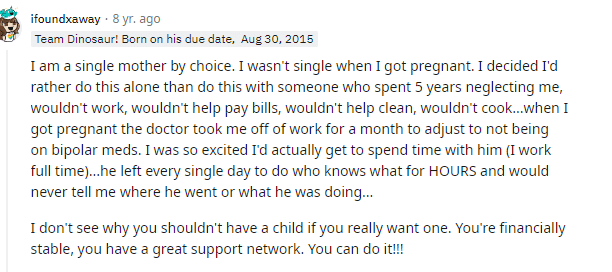
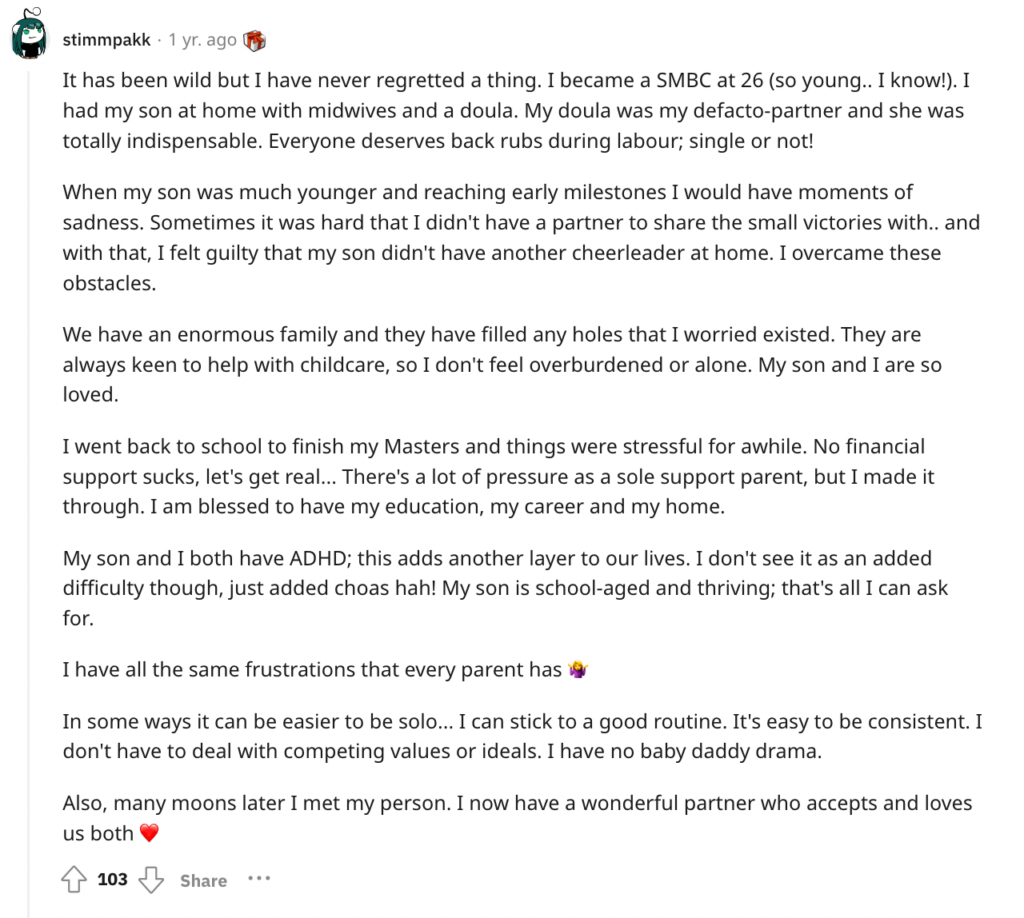
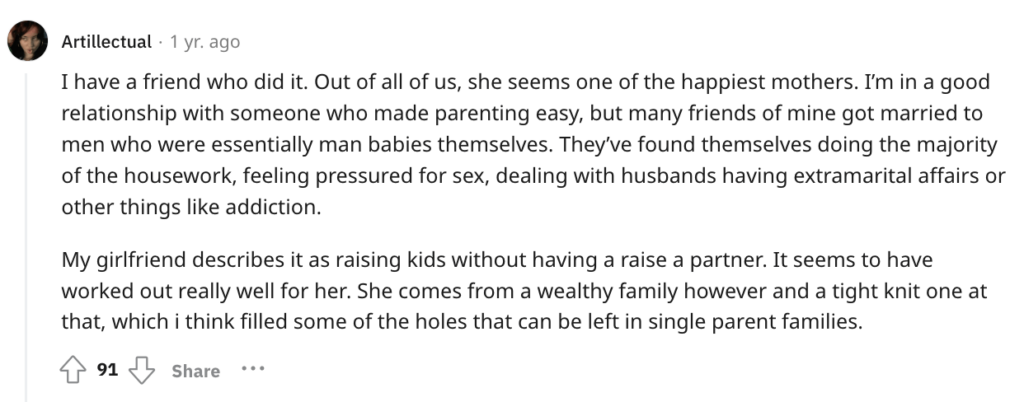
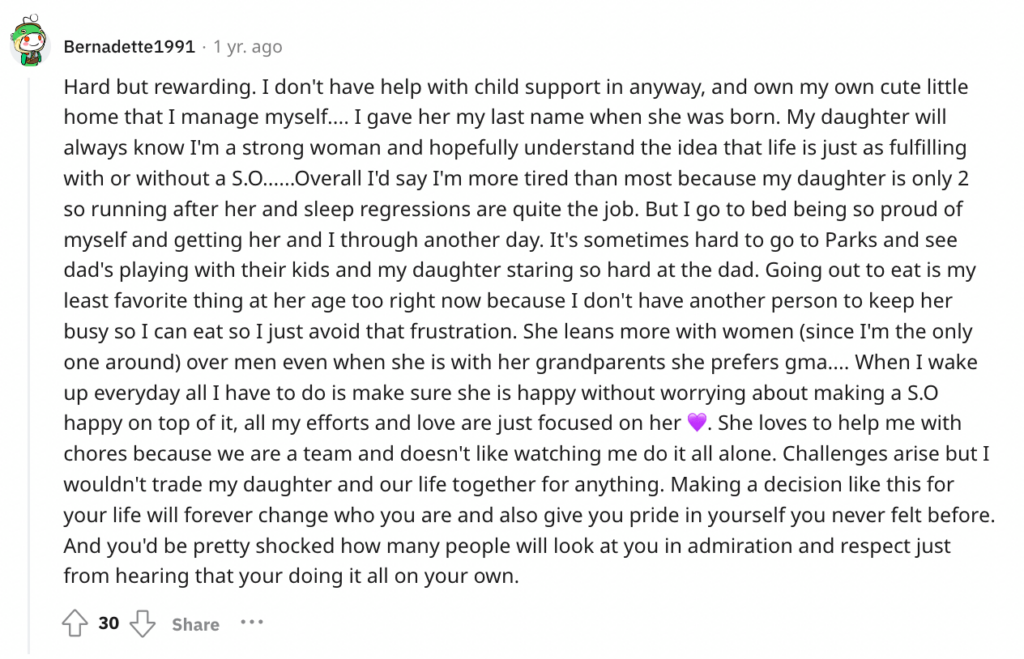
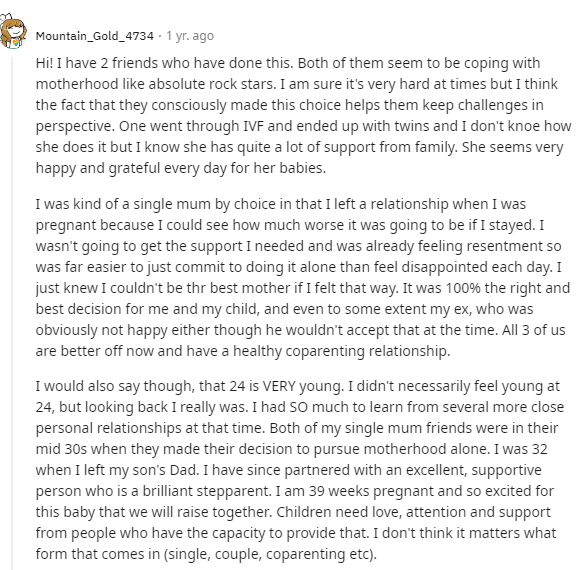
This is some advice single moms by choice shared on Reddit:

Advice from a Reddit thread about becoming a single mom by choice.

What you should know before becoming a single parent by choice

If you’re considering becoming a single parent by choice, Roelands says these are some questions to ask yourself first: 

  1. How do you see your role as a parent?
  2. How do you want to raise your child(ren)?
  3. Are you emotionally and financially ready to take on the responsibilities of parenthood?
  4. Do you have a support system to help?

Above all, Roelands says, “it is simply your choice.”

What is the best age to get pregnant and have a baby biologically?

When it comes to straight fertility, it is easiest to get pregnant in your late teens and early 20s, when fertility is at its highest, according to the Cleveland Clinic1.

As women age, the risks of birth defects increase. Fertility declines starting at age 32, and starts to plummet starting at age 37, according to the American College of Obstetrics and Gynecology2.

The risk of birth abnormalities, including chromosomal abnormalities, increases as a mother ages.

Will you choose IVF and use a sperm donor?

In vitro fertilization or IVF involves collecting eggs from the mother and using sperm to fertilize them in a lab. A healthcare provider, like OBGYN Alpharetta, can guide you through this process, including evaluating your fertility and discussing whether IVF or donor sperm is appropriate. The fertilized egg(s) are placed into the mother’s uterus or frozen for later use.

A less expensive alternative to IVF is intrauterine insemination (IUI), where the sperm is injected into the uterus. Of the two fertility treatments, IVF has a higher success rate, according to the Cleveland Clinic3.

You can choose your sperm donor for IVF or IUI — either someone you know or a named or anonymous donor you don’t know.

Here are some factors to consider before choosing IVF vs IUI:

IVFIUI
Success rate50-75% with one round40-50% after several rounds
CostCan be $20,000 or more per IVF round, according to GoodRX Health4Between $500 and $4,000
ProcedureMore complex, involves multiple procedures over time, including medication, bloodwork, ultrasounds, and anesthesia for egg retrieval before the fertilized egg is implanted in the uterusLess invasive, performed during ovulation, takes a few minutes as an outpatient procedure, may require some medication to improve success
RisksAccording to the Mayo Clinic5, some risks include multiple births, birth defects, low birth weight, premature delivery, miscarriage, and other health risksRisks include multiple births, spotting, and possible infection of the area being treated
TimeOne round of IVF can take two or three weeks (you may require more than one round)Procedure takes a few minutes, and the office visit might take about 20 minutes (you might need more than one round)
Pre-screening the embryo for genetic disordersYes, because embryos are developed in an incubator, they can be tested for genetic diseasesNo, there is no access to the fertilized embryo in IUI

What about egg freezing for single moms?

For the last decade, feminists have been loving the new push for young, professional women to freeze their eggs to give them more flexibility in finding a romantic partner while prioritizing professional success with abandon.

Google, Apple and Facebook all offered this expensive procedure as an employee perk — one heralded as an excellent step towards gender equality in the workplace.

Harsh facts about egg freezing

However, the Washington Post6 published an extensive article broadcasting what fertility experts have long known: egg freezing is successful only a small percentages of the time, a fact that the burgeoning fertility industry keeps under wraps.

Taking care of elderly parents? 5 tips for the sandwich generation

Are there any single mother by choice regrets?

There are plenty of famous women who became single moms by choice: Sandra Bullock, Charlize Theron, and Mindy Kaling, to name a few. While Bullock and Theron both adopted their children, Kaling has two biological children and hasn’t revealed their father’s identity. 

Bullock told People after her daughter’s adoption in 2015 that there’s no doubt in her mind she was meant to adopt her children: “I can tell you absolutely, the exact right children came to me at the exact right time.”

Several women on Reddit have sought — and shared — advice about becoming a single mother by choice:

Comment
byu/Brocolli_rabebabe from discussion
inAskWomenOver30
Comment
byu/jahanny from discussion
inAskWomen

Most had no regrets about their decision to become a single mom:

Single moms by choice on Reddit share their experiences.

Are single mothers by choice happy?

Overwhelmingly, single moms on Reddit said they didn’t regret their decision to become a single mom by choice. However, that doesn’t mean single mothers by choice are always happy and never struggle:

Roelands says she had a patient who decided to undergo IVF to have a child. 

“She decided that she wanted a baby and was in her early 40s and did not want to miss the chance,” Roelands says.

The woman had supportive friends and her mother backing her up throughout the process. 

“She is a wonderful mother and happy with her choice,” Roelands says.

When deciding to be a single mom by choice, consider these facts

It is unfair that women have a devastatingly smaller fertility window than men. But the science is there. Embrace it. Inform your daughters and friends accordingly.

Support single moms and all women as we navigate these unprecedented waters, as we seek out fulfillment for ourselves and our families, and equality and choice for women everywhere.

Your uterus and ovaries take a turn for the worse at age 27. Age 35? Yours is officially a high-risk pregnancy. Come 40 — forget it. Your chances of having a baby without significant fertility treatments are slim. Women who find themselves facing those chances often also find themselves devastated and broke7.

These are facts. Not trends or social movements. You cannot change biology.

Other facts: humans find relationships with other humans to be the most important and enjoyable parts of their lives. Relationships with romantic partners. Relationships with children. Another force of biology.

And yet I once read with horror a New York Times Magazine article8 about college women and the hookup culture, which found:

  1. Young women are so busy pursuing their careers that they don’t have time for real boyfriends, and instead have “hookup buddies” and dole out copious numbers of blow jobs as the sole way they connect with men
  2. Wome are not factoring in a husband or children into near-term goals.
  3. College guys get what they want sexually because they are now the minority, and market economics dictates they have the power to get what they want sexually. And what they want are BJs.

This article made me a little sad, and a lot angry. If in your parenting you relegate family planning to an afterthought, you denigrate your children, their innate dreams and desires, and stunt their potential to truly achieve fulfillment in both work and family that we all strive for.

Yes, we have a lot of work to do on the front of gender equality at work. Yes it is fantastic that young women see a clear connection between their hard work and smarts and professional potential.

But this article quotes numerous college students and experts who say that pressure from parents and society is for young women to focus on professional achievement above all else — and far above marriage and children. A few quotes:

“I positioned myself in college in such a way that I can’t have a meaningful romantic relationship, because I’m always busy.”

“They envisioned their 20s as a period of unencumbered striving, when they might work at a bank in Hong Kong one year, then go to business school, then move to a corporate job in New York. The idea of lugging a relationship through all those transitions was hard for many to imagine.”

“Increasingly many privileged young people see college as a unique life stage in which they don’t — and shouldn’t — have obligations other than their own self-development.

“A. said that she did not want to settle down until she could choose a partner knowing that his goals and values were fixed.” 

“[The women] tried very hard to separate sex from emotion, because they believed that getting too attached to someone would interfere with their work. They saw a woman’s marrying young as either proof of a lack of ambition or a tragic mistake that would stunt her career.”

I admit that I have held that latter attitude. I was 28 when I married, 31 when I had my first child. People — and by “people,” I mean New York City liberals — often remark how young I was when I married, even though I was a full year older than the national average for women, and pushing my fertility luck when I got pregnant.

Once, when I was in my early 20s, my mom casually said: “You should have your kids by the time you’re 30.” At the time that struck me as sexist and old-fashioned. Today, it sounds to me simply sensible and respectful of nature.

Don’t be a helicopter mom: Overprotective parents can hurt their kids

Which is exactly the message that I will impart on my daughter. It goes without saying that my daughter’s intellectual interests and aptitude will be nurtured.

But what about her personal ones? The standard-issue advice for college-bound women is to establish a career first, then start a family. But the laws of fertility include a time limit. Career does not. 

The laws of the heart demand spontaneity and serendipity. Women need love — romantic love, maternal love. Career is but one part of a young woman’s development. As a mother, it is my obligation to encourage my daughter to develop every part of herself.

What to tell your child when his father is not involved.

Bottom line: You’re not getting any younger—don’t wait for a husband before having a baby because you can be a single mom by choice

There are no guarantees. Even if you meet that great guy, there are still no guarantees.

Take the pressure off yourself to have a “perfect,” life. Embrace that that might not make you happy in the first place.

Embrace the power of your career, economic, and legal opportunities as a woman— which are unprecedented in history. Embrace the growing social acceptance of having a child outside of that Ozzie and Harriet fantasy. Embrace your choice.

At the end of the day, you cannot predict the future.

Life happens, and you have to take control when you can.


SOURCES

  1. “What’s the Best Age To Get Pregnant?” January 21, 2022. Cleveland Clinic. https://health.clevelandclinic.org/best-age-to-get-pregnant/
  2. “Having a Baby After Age 35: How Aging Affects Fertility and Pregnancy” February 2023. American College of Obstetrics and Gynecology. https://www.acog.org/womens-health/faqs/Having-a-Baby-After-Age-35-How-Aging-Affects-Fertility-and-Pregnancy?utm_source=redirect&utm_medium=web&utm_campaign=otn
  3. “What’s the Difference Between IVF and IUI?” January 31, 2022. Cleveland Clinic. https://health.clevelandclinic.org/iui-vs-ivf/
  4. “IUI vs. IVF: Which Is Right for You?” June 13, 2022. GoodRx Health. https://www.goodrx.com/conditions/fertility/iui-intrauterine-insemination-vs-ivf-in-vitro-fertilization
  5. “In vitro fertilization (IVF)” Sept. 10, 2021. Mayo Clinic. https://www.mayoclinic.org/tests-procedures/in-vitro-fertilization/about/pac-20384716
  6. “The struggle to conceive with frozen eggs” January 27, 2018. Washington Post. https://www.washingtonpost.com/news/national/wp/2018/01/27/feature/she-championed-the-idea-that-freezing-your-eggs-would-free-your-career-but-things-didnt-quite-work-out/?utm_term=.73a6b96a1e1a
  7. “Dear Fertility Doc: Should I Be Worried About My Biological Clock?” Jun 23, 2022. Forbes Health. https://www.forbes.com/health/family/biological-clock-impact-on-fertility/?ss=forbeswoman#304181a95d92
  8. “Sex on Campus: She Can Play That Game, Too” July 12, 2013. New York Times. https://www.nytimes.com/2013/07/14/fashion/sex-on-campus-she-can-play-that-game-too.html?pagewanted=all

When I first divorced, I felt soooooooo lonely. Even though I’d been miserable in my marriage, I was used to someone else being in the house and being part of a couple. 

Today, 13 years later, I still feel lonely from time to time, even though I am in a relationship, have many friends and am engaged in my community. I remember that I often felt lonely when I was married, and when I was single before I was married, but have always found not only deep friendships, but also an active social life and romantic connection at every stage. 

In other words, loneliness and marriage really have no automatic correlation. 

“Even if your ex was the worst person ever, it is so human to experience loneliness,” says Brianna Sanders, a dating coach and a licensed professional counselor in Silver Spring, Md. 

Loneliness is considered a health epidemic, with a February 2021 Harvard study finding that 36% of all Americans—including 61% of young adults and 51% of mothers with young children—feel “serious loneliness.” A survey of 10,000 American adults by insurer Cigna found an uptick of 18% in loneliness between 2018 and 2020 — a rise linked to depression, anxiety and even physical illness.

Sanders says that when a marriage or relationship ends, you lose more than your actual partner, but the relationship itself. 

“Think about who you were in the partnership, any mutual connections, the dreams you had for your marriage’s future — all of that is either lost or needs to be redefined,” Sanders says. “Losing so much is enough to make anyone feel lonely.”

After a divorce or separation, you will become a lonely single mom

As a lonely single mom, you will face several challenges

Break from single mom loneliness by surrounding yourself with these 7 kinds of friends

  1. A trusted friend
  2. A motherly mentor
  3. The dude
  4. Wing-woman
  5. A friend who is close
  6. Your ex (you heard me)
  7. A FWB (yeah, you know me)

How do single moms cope with loneliness? 5 ways

How do single moms overcome loneliness and find happiness?

After a divorce or separation, you will become a lonely single mom

Bonnie Scott, a licensed therapist in San Antonio, Texas, and founder of Mindful Kindness Counseling, a private therapy practice, says even if a single mom doesn’t specifically miss being with their ex, she might feel lonely because she’s used to having a partner around.

“A divorce or separation is the end of something a person, at some point, felt hopeful about,”  Scott says.

Having a wide range of emotions about your divorce — everything from loneliness to relief — is completely normal, she says.

Is it normal to feel lonely as a single mom?

Even if you have a lot of friends and a loving family, wonderful kids, you may feel lonely as a single mom. Why?

  • Humans need human contact, and if you are used to having an adult companion full-time, that is now gone. You feel that loss. It is a form of grief.
  • You are used to being part of a couple and now you are not. You still have to find your identity as a single person. It can take time, trial and error, trying on new personas and habits.
  • You may have lost friends and connections to family members through your divorce or breakup. That is a real loss you must mourn.
  • You spend too much time with kids, and not enough time with adults.

Some Reddit posts on this topic of loneliness and single motherhood:

I am a single mom drowning in my loneliness.
byu/throwthrowthrowyb inoffmychest
Fellow single parents, how do you deal with the isolation?
byu/gimpeye916 inSingleParents

Single mom statistics and data

Overcome the myth you will be lonely for the rest of your life

Here are some comments I heard when I divorced, most of them from people who love me:

Too bad. And it will be hard to meet men now that you’re a mom.

Better hurry up and get married while you’re still young and cute.

Only really neurotic / poor / loser men are interested in single moms.

A quality man will never commit to a single mom. They consider them used goods.

To one of the above, I actually said, square in her face (we were in a small elevator, crowded by myself, a toddler, baby in stroller, her and her dog): “FUCK YOU.”

Not only are all of those messages rude and unhelpful — they are untrue!

I have met hundreds and hundreds of single moms who have successfully found love and partnership. I have had a few great boyfriends in my single-mom tenure, including my current partner of two years — who loves the fact that I am a mom. In fact, he (like many men I know) prefers to date women with children. The reasons include:

  • They are single dads, and feel the shared experience of parenthood is critical to relating to a woman.
  • They missed the boat on being a father, and hope to enjoy that experience through step-children.
  • They can quickly assess a woman’s character by observing her parenting.
  • Some younger men are really into older women and moms. 
  • They just really fucking like you and want to date you.

Other times, great men simply fall for women who happen to have children!

Taking care of elderly parents? 5 tips for the sandwich generation

As a lonely single mom, you will face several challenges

If you’re feeling like a lonely single mom, those feelings might be heightened when you’re faced with certain situations or when you’re dealing with the realities of single motherhood. 

These are some reasons single moms might feel lonely:

They will have to make decisions by themselves

When you have a partner, you often rely on the other person as a sounding board and make major decisions together. Taking on the responsibility and pressure of making those decisions alone can make you feel lonely.

They might crave adult interaction

Even if she doesn’t miss her ex as a person, a single mom might miss having another adult around. This lack of adult interaction can be isolating. 

In addition to losing the companionship of her ex, Scott says single moms might find that their social circles change or that it’s harder to coordinate time with friends or family.

Might not have anyone to rely on

If you’re co-parenting with an ex who doesn’t share equal parenting responsibilities — or you’re a solo mom — the weight of single motherhood and lack of support can be suffocating. 

“A single mom might find that the person who’s supposed to be her co-parent is not showing up in meaningful ways, and that can feel really lonely, too,” Scott says.

Sanders says many single moms, especially new ones, believe they have to do everything alone. 

“It’s OK to need help, and it’s OK to want help,” Sanders says. “You deserve it.”

If you’re a single mom who needs financial assistance and access to free resources, we’ve written a number of articles that can help: 

Help for single moms: 16+ resources$500 monthly single mom grant
Free laptopsScholarships for single moms
Free carFree Christmas gifts
Free smartphoneBest jobs moms can do from home
Free wifiFree and low-cost prescriptions
Free formulaFree clothes
Free toysGovernment assistance for single moms
Free gasFree daycare
Free preschoolFree prescription glasses
10+ charities that help single mothersTutoring and homework help
Health insuranceFree food

Loneliness will be heightened when kids are with your ex

Feelings of loneliness can develop when your kids are out of the house and you’re left alone. 

“When you are faced with your own thoughts and silence before falling asleep, that’s when feelings like to make themselves apparent,” Scott says. 

Scott says celebrations, holidays, and birthdays can be particularly difficult times if your kids are with your ex. 

Feelings of depression when no one is there to comfort you

Sanders says if your loneliness feels like a heavy cloud that you cannot shake, that may be a sign you’re depressed. 

“Depression doesn’t always mean crying all the time,” she says. “In fact, depression more often looks like having zero interest in things, finding it hard to find excitement, or otherwise not feeling much of anything.” 

Scott says these are some signs you may be depressed: 

  • Trouble sleeping (not enough or too much) 
  • Changes in eating patterns (not enough or too much)
  • Increased substance use
  • Tearfulness
  • Forgetfulness
  • Uncontrollable feelings of anger

“It could be a feeling of disconnection from people who are important to us or to our own feelings and emotions,” Scott says.  

She says if a pattern is new, happens more days than not, and sticks around for more than a couple of weeks, you should check in with a medical or mental health provider.

Break from single mom loneliness by surrounding yourself with these 7 kinds of friends

Combatting single mom loneliness is no joke — but surrounding yourself with good friends can help. 

Here are seven friends a single mom should have: 

1. A trusted friend

Sanders says above all, it’s important to surround yourself with people who are present, emotionally available, non-judgemental, and validating — but also willing to call you out if you’re self-sabotaging. 

“It can be majorly difficult for single moms to find friends because a lot of people don’t understand what single motherhood really is, so they say a lot of unintentionally insensitive things that do more harm than good,” Sanders says. 

2. A motherly mentor

Having a friend who has “been there, done that” can be invaluable when you’re a newly single mom. This friend can give you a glimpse of what it’s like to weather the storm of loneliness and come out stronger. 

3. The dude

Single dad friends will tell it like it is and give you a man’s perspective on dating, parenting, and getting along with your ex. 

4. Wing-woman

This is a non-judgmental friend who will get you out of the house and help you explore the world of post-divorce dating.

5. A friend who is close

After divorce, sometimes you just need someone who can be there — to help you pick up your kids, grab groceries, or babysit in a pinch. Scott recommends finding someone you can count on for emotional support, fun, and stress relief.

“Single moms need community, and that might be made of friends, family, fellow parents from schools or daycares, or faith organizations,” Scott says.

6. Your ex (you heard me)

No, I’m not joking! If you didn’t have a toxic or abusive relationship, you can be friends with your ex — it just might take some time. 

Forming a positive post-divorce relationship with your ex is a great way to establish healthy co-parenting. Research shows that equally shared parenting is best for kids — as well as gender equality.

7. A FWB (yeah, you know me)

After divorce, sometimes you just need to have fun (and have good sex). A casual relationship can help you move past your ex without a serious commitment. Find a FWB and forget about being a lonely single mom.

How do single moms cope with loneliness? 5 ways

Here are some ways to mitigate loneliness as a single mom:

  • Lean into alone time with the goal of enjoying your company.
  • Make new and meaningful connections outside of your current social circle. This can be through a new hobby, new faith community, fitness group, or even online like our Facebook group Millionaire Single Moms.
  • Date.

Discover a sense of belonging

Join a local sports league, get involved at your church, volunteer at an animal shelter, and just get out there. 

Read: How to make friends after divorce

Nurture friendships

When it comes to combating loneliness, there is no stronger medicine than spending time with good friends. Surround yourself with people who understand your struggle and offer you judgment-free support when you’re feeling lonely.

Seek connections through apps

If you’re looking to make friends after divorce, consider downloading an app.

Find a friend with benefits

There’s no shame in having some adult fun after divorce, especially if you find someone you like and trust to call on when you just want to have good sex. 

Read: Friends with benefits? 8 rules to know

Consider a hookup

If you’re not ready for another serious commitment, ease into the dating world with something casual.

How do single moms overcome loneliness and find happiness?

Finding happiness after divorce is all about taking care of yourself. Remember to invest in self-care, meditate, and seek help from a licensed therapist like through BetterHelp.

And if you’re ready to start looking for love again, we recommend joining eharmony, one of the top dating sites for connecting singles who want meaningful partnership. We recommend eharmony because: 

  • A Better Business Bureau rating
  • Free basic plan
  • One of the largest dating apps of its kind (responsible for more than 2 million love connections)
  • Only major dating app devoted specifically to serious partnership
  • Vetted profiles (so you know you’re talking to a real, single person)
  • According to a study, couples on eharmony are more likely to get married and less likely to get divorced compared to couples who met on other online dating sites

How to get over your ex and find love again

Is it normal to feel lonely as a single mom?

Humans need human contact, and if you are used to having an adult companion full-time, that is now gone. You feel that loss. It is a form of grief.

Most people who use a co-parenting app do so because a judge ordered them to or because they’ve agreed to do so in divorce negotiations or family court mediation.

While the app may have come into your life in a negative context, co-parenting apps can make communication, finance, scheduling and parenting in general a better experience for your whole family. 

OurFamilyWizard is our top choice co-parenting app for court-monitored communication. Why?

  • Parent company Avirat has an A+ Better Business Bureau rating
  • Great user experience and seamless (or close to it) interface
  • Widely used and recognized by courts  
  • Competitive cost, with military discount, financial assistance, and money-back guarantee,

Here is what you need to know court-monitored communication:

What you need to know to prepare for court

Co-parenting apps for communication

Why and how to use a co-parenting app for court-monitored-communication

Co-parenting app features

Frequently asked questions about Our Family Wizard and court-monitored communication

Court-monitored communication: What you need to know to protect yourself in court

Molly Rosenblum, owner and founding attorney of The Rosenblum Allen Law Firm in Las Vegas, says court-monitored communication provides a safeguard when you’re interacting with your former spouse. 

“Having all the communications in one place keeps it all there and avoids parents pointing fingers at each other,” Rosenblum says. 

She says using an app that both parties know is being monitored by a judge usually keeps everyone on their best behavior.

Co-parenting apps for court-monitored communication

Rosenblum says courts typically recommend co-parenting apps like Our Family Wizard and TalkingParents in high-conflict divorce cases. 

Judges and attorneys can access these apps to track communication between former spouses and use what was said in the event of a parental conflict. 

“We, as the attorneys, like that it keeps all communication in one place, which makes it easy to follow and eliminates a ton of wasted time trying to track down messages,” Rosenblum says. 

These are some other apps used for court-monitored communication: 

  • Whatsapp
  • coParenter
  • Custody X Change
  • 2Houses
  • Cozi
  • WeParent

Check out our full list of co-parenting apps here.

What are co-parenting apps and what do co-parenting apps do?

Co-parenting apps help you and your ex juggle the craziness that is parenthood: 

  • Equally shared parenting schedule, including vacation and summer schedules
  • Expenses
  • Contacts for babysitters, grandparents, friends, the pediatrician, nanny, etc. 
  • Extracurricular and random appointments, including dentist  appointments, school functions, sleepovers, music lessons, soccer games, parent-teacher conferences

Most apps for divorced parents to communicate are mobile-based, although some rely on website-based versions.

Why (and how) to use a co-parenting app for court-monitored communication

Rosenblum says there are a few reasons co-parenting apps are great for court-monitored communication: 

  • Keeps all communication in one place
  • Keeps track of communication threads about a particular subject
  • Tone meter (available on some apps like OurFamilyWizard) let the writer know when their communication is pushing a bad or aggressive tone
  • Eliminates “he said/she said”
  • Keeps communication civil since both parties know the app is monitored by a judge

A definitive list of 7 co-parenting boundaries you need to know

So how do co-parenting apps work for court-monitored communication? 

Both parents download the specified co-parenting app and create connected accounts. Judges and attorneys involved in the co-parenting agreement also have accounts to access and monitor the parents’ communication.

Whether you are using a co-parenting app by choice, the recommendation of your lawyer, or a court mandate, the same rules apply.

Using an app for co-parent communication is not just to comply with a custody agreement, but to actually get along with your ex — or at least to model respectful adult behavior for your kids, and minimize drama and conflict. Separation and divorce are tough, even if you were the one who initiated the split. Sometimes even basic, necessary communication feels like walking through a minefield.

Court-monitored communication tips

1. Be consistent. Do not use your iPhone’s text function. Stick to always communicating with your co-parent within the app. Likewise with scheduling: Do not send your ex a calendar invite to change the schedule from your iCalendar, but use the agreed-upon co-parenting app’s functions. Make a habit of always documenting any child expenses immediately, including taking photos of receipts. 

2. If you use an app like Our Family Wizard with a vault feature, scan and store important information like:

  • Birth certificate
  • Passport (and, if need be, a letter authorizing you to travel abroad with the kids)
  • Information on allergies or dietary issues/restrictions and any medications your children take
  • Insurance card 

3. Be as helpful as you can and fill out contact information for people like coaches, doctors, teachers, school administrators, kids’ friends’ parents, babysitters and others — even if your co-parent does not reciprocate or thank you.

4. Do not add other people to the app without consulting with your other parent. For example, if you’d like to add your mom to the app to help with child care, but your ex and your mom have an ugly history, check with him first. Likewise, be practical and forgiving with your ex’s requests. 

5. Use the co-parenting app as a neutral tool — not a weapon. While most co-parenting apps allow you to download and export time-stamped communication, calendar and expense histories for court submission, do not threaten your ex with these consequences. Instead, focus on the benefits of using an app to reduce conflict, confusion and misunderstandings. Similarly, if things do get ugly, the facts will be on your side with minimum conflict. 

6. Respect your ex as an equal parent who’s just as responsible for your kids as you are. In other words, treat them the way you want to be treated: by staying in touch, and by sharing need-to-know info (“Kiddo had a fight with her best friend, so she might be feeling sad”).

7. Be nice. OurFamilyWizard’s ToneMeter is a unique tool that points out that a text you just wrote (but have yet to send) may be nastier than you intended. Even if you are not using an app, keep language and tone neutral or positive. “Kids are due back at 7 o’clock – don’t be late again, dickhead,” should give way to, “See you guys at 7.”

Better yet, by using a co-parenting app consistently, you will no longer need to remind each other of schedules or appointments since you will each be accustomed to referencing the shared calendar first.

Co-parenting app features

Apps vary, of course. But some features are universal:

  • Calendar 
  • Communication / chat / text / messaging 
  • Expense tracking and request feature 
  • Requesting and tracking of schedule changes 
  • Storage for sharing documents and contacts 

Co-parent court-monitored communication 

Communication is central to successful co-parenting. If you’re still feeling raw about the split it can be hard even to look at your ex, let along talk with them. Yet you know it’s best for the kids if their parents get along.

Can’t talk in person without wanting to cry or rage? The app lets you say what needs to be said, such as “Parent-teacher conferences are coming up” or “The kids need flu shots.”

But don’t stop there. Try actual communication. For example, you could message, “Do you think our son is ready for sleepaway camp?” 

And if you’re making a serious effort to be the best co-parent ever, send a well-done-you! note: “Glad you took the kids sledding – they can’t stop talking about how much fun it was.” OurFamilyWizard allows you to share a pic.

These kinds of messages will get you in the habit of talking to your ex. They’ll also remind you that you’re no longer a couple but you are co-parents.

Co-parent and shared parenting plans  

Some couples set up a parenting plan through their lawyers, and some create their own. Depending on how your separation and divorce shook down, you might be required to have regular check-ins with your ex, or even to take co-parenting classes online or parenting classes near me.

Whether you share 50-50 parenting time, or a 3-3-4-4 days, 2-2-5-5, 2-2-3 days, or the old every-other-weekend special, you can plug these parenting schedules into any of the co-parenting apps.

Often, a judge will mandate you use a co-parenting app to work with your ex, including using one like Our Family Wizard that allows you to create a PDF of text exchanges, a record of on-time or missed visitations and expense sharing.

7 benefits of parenting classes and where to find them

Co-parent and shared parenting schedules 

Once your plans are in the app everything will be easy, right? Riiiight. Life happens, and sometimes the unexpected, or honest miscommunication wrecks your carefully organized co-parenting schedules.

The co-parenting app makes it easier to plan and adjust. Suppose your 20th high school reunion is announced. You check the app and sure enough, you’ll have the kids that weekend. Plenty of time for the two of you to arrange a trade.

Or maybe you have to head to an industry conference in three months. As soon as you have the dates, check the app to see if you need to switch days with your ex. Many co-parenting apps have a function within the calendar to request a swap or trade, with the times of request and response being documented for future references.

Co-parent calendar

Drop-off and pick-up times, field trips, music lessons, the school play – goof-ups are a lot less likely when everything’s in one place. Even the most well-intentioned parent sometimes flakes out on a PTA meeting. Joint-custody schedules can help. When it’s on the shared child custody calendar, you and your ex can either negotiate who has to go this time, or agree to attend together — whether you have a 50/50 custody schedule, or something else.

The calendars can often be synced with personal calendars like iCal or Google Calendar. Generally, they can be shared with other people, too. That way, Grandma won’t miss the piano recital, and your babysitter will know what nights your ex will be picking up the children.

You can share the calendar with your kids, too.

Frequently asked questions about Our Family Wizard and court-monitored communication

Here are some common questions about OurFamilyWizard, one of the top apps for court-monitored communication:

Is OurFamilyWizard monitored?

If the court requires you to use OurFamilyWizard as part of your co-parenting agreement, professionals involved in your case (i.e. lawyers, judge) may be able to monitor your OurFamilyWizard account. 

Is OurFamilyWizard admissible in court?

OurFamilyWizard can be used in court if needed. The app records communications between parents on the app and makes it easier to share a calendar, documents, and important information.

Does OurFamilyWizard record phone calls?

No. OurFamilyWizard only records communications made directly through the app. These include:

  • Secure messaging 
  • Shared family calendar
  • Check-in journal
  • Shared memories
  • Expense log
  • File sharing

Stop calling your kid all the time when they are with their dad

Is OurFamilyWizard monitored?

If the court requires you to use OurFamilyWizard as part of your co-parenting agreement, professionals involved in your case (i.e. lawyers, judge) may be able to monitor your OurFamilyWizard account.

Is OurFamilyWizard admissible in court?

OurFamilyWizard can be used in court if needed. The app records communications between parents on the app and makes it easier to share a calendar, documents, and important information.

Does OurFamilyWizard record phone calls?

No. OurFamilyWizard only records communications made directly through the app.