
scroll top

Standing at the pharmacy counter, it can feel like every visit ends with another bill. Co-pays, over-the-counter meds, and gas just to get there all add up. When money is tight, you might grab your prescription and leave as fast as you can.

What most people don’t realize: pharmacies are one of the easiest places to get genuinely free health help. You’ve already “paid” for a lot of it through your insurance, taxes, or the store’s marketing budget. They just don’t always put a big sign on it.

If you’re willing to ask a few simple questions, here are 15 things you can often get for free at the pharmacy. You won’t get every perk at every store or in every state, but all of these are realistic “just ask” wins.

Free blood pressure checks and basic heart screenings

a person with a blood pressure meter on a table
Image credit: Mufid Majnun via Unsplash

Many pharmacies have self-serve blood pressure machines you can use for free. Some stores also host special health events where you can get your blood pressure checked by staff and go home with your numbers in writing. A major retailer reported more than 5 million free health screenings, including blood pressure, at in-store wellness events since 2014.

This is a simple way to keep tabs on your heart health without paying for an extra doctor visit, especially if you’re uninsured or have a high deductible. When you pick up a prescription, ask, “Can I use your blood pressure machine?” or “Do you ever do free blood pressure checks?” Many pharmacists are happy to help you take a reading and explain what the numbers mean.

Use these checks as a habit, not a one-time thing. Take a photo of the screen or keep a small notebook in your bag so you can track trends over time. If your numbers are high, your pharmacist can tell you if it’s something to watch or a “call your doctor today” situation, all without an extra bill.

No-copay vaccines through your insurance

woman injecting woman's arm carrying child
Image credit: CDC via Unsplash

If you have Medicare, Medicaid, or most private insurance, a long list of adult vaccines is supposed to be covered with no co-pay when you use an in-network provider, which often includes retail pharmacies. Vaccines like flu, shingles, RSV, and Tdap are included on the national preventive list, which means the plan has to pay the full cost when the rules apply.

That’s a big deal for older adults. Until recently, some people skipped shots like shingles because even “covered” vaccines came with painful copays. From 2023 on, Medicare prescription plans must cover vaccines recommended by national experts with no deductible or co-pay, including shingles and RSV. If you use Medicaid, recommended adult vaccines are also supposed to be free at the point of care.

At the counter, say: “Is this vaccine fully covered under my plan here, or is there any copay?” If you’re uninsured, ask the pharmacist about state programs, vaccine clinics, or kids’ programs that offer shots at low or no cost. The price can change a lot depending on where you go, but the pharmacist can often steer you toward the cheapest option.

Free health screenings at pharmacy wellness events

Having BMI checked
Image Credit: Shutterstock

Many big chains run “wellness days” a few times a year. During these events, you can often get free blood sugar, cholesterol, BMI, and blood pressure checks, no appointment, no bill. One national retailer offers these screenings at about 4,600 pharmacy locations in a single day, completely free to customers.

Screenings like this can flag early diabetes, high cholesterol, or weight-related issues long before you end up in an ER. You usually get results in minutes and can talk through them with a pharmacist right there. For people who don’t see a primary care doctor regularly, these events might be the only checkup they get all year.

Ask your pharmacy, “Do you ever host free screening days? How can I get notified?” Some stores post flyers at the counter or in the app. Others partner with local health departments or nonprofits. If you’re juggling work, kids, and money stress, planning around one or two of these free days a year is an easy way to keep an eye on your health without another bill.

Free prescription discount cards

free prescriptions
Image Credit: Shutterstock

Prescription discount cards can feel sketchy, but many are legit savings tools, and the basic versions are free. One well-known card lets you save up to around 80% on some medications at more than 70,000 pharmacies across the U.S.. You can print a card, save it in an app, or just show a code on your phone.

You don’t pay to use these cards, and you don’t have to switch pharmacies. The catch is that you usually can’t combine a discount card with your insurance, the pharmacist runs it as a “cash” price, and you pick whichever is cheaper (card or insurance). That means the cost may not count toward your deductible, which matters if you have expensive meds or expect to hit your out-of-pocket max.

At the counter, try: “Can you check the price with this discount card and with my insurance, and tell me which is cheaper?” For one-time or generic prescriptions, the card price often wins. For long-term, pricey brand drugs, your insurance might be better. Taking 30 seconds to ask can easily save you $20–$50 on a single fill.

Free medication reviews for people on many prescriptions

blue and white medication pill
Image credit: Madison Agardi via Unsplash

If you juggle several prescriptions, you may be eligible for a free, sit-down medication review. For people on Medicare drug plans, “medication therapy management” (MTM) is a required benefit for those who meet certain risk criteria, and it’s provided at no extra cost.

In a typical medication review, a pharmacist looks at every pill, inhaler, and supplement you take including over-the-counter stuff. They check for duplicate drugs, dangerous combinations, or dosages that no longer make sense. If something looks off, they can fax or call your doctor to suggest changes. For someone seeing multiple specialists, this can fix issues that slip through the cracks.

Call or ask at the counter: “Do you offer free medication reviews or MTM? Do I qualify?” Bring all your bottles in a bag. You might walk out with a simpler schedule, fewer pills, and fewer side effects, without paying an extra visit fee. Even if you don’t meet formal MTM criteria, many pharmacies will still schedule a shorter, informal review as a courtesy.

Free pharmacist advice for everyday health problems

Flu medicine
Image Credit: Shutterstock

You don’t have to spend money to ask questions. Pharmacists are trained to advise on minor symptoms, side effects, and over-the-counter options, and answering those questions is part of their job, not an extra bill. Many big chains even advertise 24/7 pharmacy chats or phone advice at no cost to you.

If you’re not sure whether to see a doctor, this is a good first stop. Think coughs, colds, rashes, stomach bugs, or new side effects from a prescription. A pharmacist can tell you which OTC product is worth the money, what dose to use, and when symptoms are serious enough for urgent care instead. Sometimes that five-minute conversation saves you a wasted copay on something that won’t help.

Try walking up to the counter and saying, “I’m not sure what to take for this, can I ask the pharmacist?” Be honest about other meds you’re on, alcohol use, and health issues. They can’t replace a doctor for big problems, but they can help you avoid bad combos and choose the cheapest option that actually works.

Free safe medication disposal

orange and white medication pill
Image credit: Towfiqu barbhuiya via Unsplash

Old opioids, leftover antibiotics, and expired pills shouldn’t sit in your bathroom cabinet, and you don’t have to pay to get rid of them safely. Thousands of pharmacies now have permanent drop boxes where you can leave unwanted medicines for free, no questions asked.

If your local store doesn’t have a kiosk, it may hand out free drug deactivation packets when you pick up an opioid prescription. You pour the powder into the pill bottle, add water, and toss the sealed bottle into the trash, the chemicals inside make the medicine unusable. Twice a year, there are also national “take back days” where many pharmacies and police stations accept unused meds at no charge.

Ask, “Do you have a medication disposal bin or free packets?” This protects kids, pets, and anyone in your home who could struggle with addiction, and it keeps drugs out of the water supply. You’re doing a good thing for your community, and it shouldn’t cost you a cent.

Free naloxone (Narcan) in many areas

a box of pills sitting on top of a white table
Image credit: NEXT Distro via Unsplash

Naloxone is a rescue medicine that can reverse an opioid overdose and save a life. You can buy it over the counter now, but in many places you don’t have to pay. A recent guide lists numerous state and local programs that mail Narcan for free or supply it at no cost through clinics, libraries, and pharmacies.

Some states let residents get naloxone free and anonymously from participating pharmacies or community sites. For example, state programs in places like New Jersey allow people 14 and older to pick up Narcan at certain pharmacies at no charge. Others run vending machines stocked with free Narcan in libraries, colleges, or near county jails. You don’t have to prove addiction or give a reason; the goal is simply to prevent deaths.

If anyone in your home uses prescription pain medicine, has a history of opioid use, or lives around street drug use, naloxone is smart to have on hand. Ask your pharmacist, “How can I get naloxone here? Are there any free programs in this state?” They can usually point you to the cheapest or free option, even if they don’t give it away directly.

Free prescription delivery

Free prescription delivery
Image Credit: Shutterstock

You might not have to spend gas money or drag kids into the store just to refill your meds. Some pharmacies and mail-order services offer free prescription delivery, especially if you use their app or meet certain conditions. One online pharmacy advertises free, same-day prescription delivery in many major cities. Another well-known service bundles free two-day delivery with some paid membership plans.

Grocery store pharmacies are getting into delivery, too. One large chain lets customers schedule prescription delivery through its “My Prescriptions” platform, and in some areas that service is available at low or no extra cost. For people with mobility issues, tight schedules, or limited transportation, this can be the difference between taking meds on time and skipping doses.

At the counter, ask, “Do you deliver prescriptions? When is it free?” The answer might be “for 90-day supplies,” “for certain meds,” or “with our store membership.” Even if you only use delivery when you’re sick or caring for a baby, having it set up in advance can save you time, money, and stress later.

Free vitamin programs

person holding medication pills
Image credit: Kayla Maurais via Unsplash

Some pharmacies quietly offer free vitamins if you sign up. One national independent-pharmacy network runs a program that gives members a free 30-day bottle of select children’s, adult, or prenatal vitamins every month, as long as they pick them up at a participating store Programs like this are usually underwritten by manufacturers and store marketing budgets, so the vitamins cost you nothing.

These programs often focus on kids, pregnant people, and adults who might not be getting enough nutrients from food. You may see a small sign at the counter or nothing at all. Sometimes you just fill out a quick form to get a card or digital account, then show it when you pick up your free bottle.

When you’re already at the pharmacy, say, “Do you have any free vitamin programs for kids or prenatal vitamins?” Even if your store doesn’t, the pharmacist may know a nearby independent pharmacy that does, or a clinic or WIC office that offers free prenatal vitamins. If you’re trying to eat well on a tight budget, every freebie helps.

Free diabetes tools and coaching

white and blue click pen beside teal tablet computer
Image credit: Towfiqu barbhuiya via Unsplash

Managing diabetes can get expensive fast. The good news: some pharmacy-linked programs offer free tools and extras. One supermarket pharmacy program, for example, provides a free blood glucose meter, free lancet device, and free lancets for enrollees in its diabetes program, along with certain free or deeply discounted medications.

Meter makers also run their own offers. One major brand allows patients to request a free blood glucose meter voucher online, which they can then redeem at a participating pharmacy. For people on tight incomes, these programs can wipe out the upfront cost of a meter and basic supplies, leaving only strips and ongoing supplies to manage.

If you’ve just been diagnosed or your doctor is changing your regimen, ask the pharmacist, “Are there any free meter or diabetes programs I qualify for?” Bring your insurance card and a list of your meds. You may leave with a free meter, training on how to use it, and referrals to free or low-cost diabetes education classes in your area.

Free pill organizers and packaging help

person about to pick medicine from medicine organizer
Image credit: Laurynas Me via Unsplash

If you or a family member keeps mixing up doses, a simple plastic pill organizer can be as powerful as a new medication, and sometimes it’s free. Some community pharmacies and nonprofit clinics run projects that hand out free pillboxes and teach people how to use them, especially for those taking several daily meds.

Certain pharmacies also offer multi-dose blister packaging at no additional charge for patients on many medications or those with cognitive issues. Instead of separate bottles, your meds are packed by date and time, easing the mental load. Whether that service is free depends on the store and your insurance, but it never hurts to ask.

Start the conversation with, “Do you offer pill organizers or special packaging? Is there a cost?” Explain if you’re caring for an older parent, have ADHD, or simply keep forgetting doses. Pharmacies want you to take meds correctly; giving you a free organizer or packaging help is often cheaper for the system than dealing with complications from missed doses.

Free sharps containers and safe disposal

sharps containers
Image Credit: Shutterstock

If you inject insulin, fertility meds, or other drugs at home, you’re supposed to use a sharps container, not the regular trash. Buying containers and paying for disposal can get pricey, but you may not have to. Several drug manufacturers offer free sharps containers and mail-back disposal kits for patients on their medicines.

Some state programs will even mail you a free sharps container and take-back mailer, or let you pick one up at a local health site. In California, for example, residents can order free sharps waste containers with prepaid mail-back through a state stewardship program. Federal guidance also notes that local drop boxes for sharps at hospitals, pharmacies, or health departments may be free or very low cost.

Ask your pharmacist, “How can I get a sharps container and dispose of it for free?” They can tell you if your medication brand offers a container, if the store takes filled sharps, or if your state has a mail-back program you can enroll in. That way you stay legal, safe, and out of pocket for $0.

Coupons, gift cards, and grocery savings with vaccines

grocery coupons
Image Credit: Shutterstock

Sometimes getting a shot actually puts money back in your pocket. Grocery and drugstore pharmacies regularly run promotions that give you coupons or grocery savings when you get vaccinated. One large chain has offered $5 in grocery savings for a flu shot, and $20 when you get a flu shot plus another vaccine in the same visit, simply by mentioning the offer at the pharmacy.

Another partnership between an in-store pharmacy and a big-box retailer has advertised a coupon for $10 off a $20 purchase when you get any vaccine there, subject to the usual restrictions. Other grocery chains have offered 10% off a future grocery trip if you get your flu or COVID shots in their pharmacy. These deals change every year, but some version of them pops up almost every fall.

Before you book a shot, check your store’s weekly ad, app, or website, or just ask: “Are there any vaccine coupons or grocery deals right now?” If several pharmacies are in your network and the shot is free everywhere, you might as well pick the one that throws in $5–$20 off groceries.

Free digital tools, refill reminders, and price helpers

pharmacy app on phone
Image Credit: Shutterstock

Pharmacy apps and text programs are free to download and use, and they can quietly save you money. Major chains let you refill prescriptions, track order status, and get refill alerts without any extra charge. Some apps even include pill reminders and a chat feature where you can message a pharmacy expert 24/7.

One big grocery-pharmacy app, for example, lets you manage prescriptions for your family, set up auto-refill, pay online, and even schedule delivery where it’s available. Another national chain recently redesigned its health app to add reminders to refill meds and highlight savings opportunities on your home screen. These tools don’t change your insurance, but they can stop you from wasting money on late refills, missed doses, or duplicate trips.

If apps feel overwhelming, ask the tech or pharmacist, “Can you help me set up text alerts for refills and ready-for-pickup messages?” It usually takes a minute, and from then on you only drive to the pharmacy when something is actually waiting. Less wasted time, fewer missed doses, and more control, all for free.

You don’t need special status or insider connections to get these freebies. You just need to start asking, every time you go: “Is there a free version of this? Any programs I should know about?” A two-minute conversation at the pharmacy counter can turn into real savings and better health over time.

Money-saving tips on Wealthy Single Mommy:

saving money
Image Credit: Shutterstock

Free cars for low-income families: If you are struggling financially, read on to find ways to get the transportation you need.

Housing for single moms: free or affordable options now: In this post, we share the options available to you if you’re low income in need of housing.

Help with Christmas: free gifts and resources for low-income families: This is the updated list of organizations that help financially struggling families get free Christmas toys for their kids.

You probably hear a lot about flashy careers, startups, influencers, “doing what you love.” Meanwhile, plenty of quiet, office-y jobs are cranking out six-figure paychecks and struggling to hire enough people.

Many of these roles don’t look exciting from the outside. Lots of meetings, spreadsheets, compliance work, or behind-the-scenes problem solving. But the money is real, and so is the demand. Most pay well over $120,000 a year, which works out to $60+ an hour if you’re full time.

Below are 12 jobs that fit that “boring but loaded” description, using national median pay and growth data from the Bureau of Labor Statistics for 2024. Pay will be higher or lower depending on your location, experience, and industry, but this gives you a solid starting point.

Computer and information systems manager: running the IT shop

person using computer on table
Image credit: ThisisEngineering via Unsplash

Computer and information systems (CIS) managers plan and oversee all the tech inside an organization. They set IT strategy, choose software, manage cybersecurity and data, and supervise the tech team. Day to day, it’s meetings, budgets, and project plans not glamorous, but absolutely critical.

CIS managers had a 2024 median pay of about $171,200 per year, or roughly $82 an hour. Employment is projected to grow about 15% from 2024–2034, much faster than average, with more than 55,000 openings a year as companies upgrade systems and older managers retire or move on.

Most CIS managers start with a bachelor’s in computer science, information systems, or a related field, then move up from roles like systems analyst or network administrator. Many people step into this work in their 30s or 40s after years of hands-on IT experience. If you like organizing projects, solving tech problems, and don’t mind living in email and dashboards, this “just IT” job can quietly fund a very comfortable life.

Financial manager: watching the money for big organizations

man putting hands on pocket while standing in front of glass wall
Image credit: Nathan Dumlao via Unsplash

Financial managers are the grown-ups in the room when it comes to money. They create financial reports, direct investment strategies, manage risk, and help leadership decide what the company can afford. The work is often routine, closing the books, reviewing forecasts, checking ratios, but the decisions affect millions of dollars.

The median pay for financial managers was about $161,700 in 2024, roughly $78 an hour. Jobs in this field are projected to grow around 15% from 2024–2034, much faster than average, adding almost 129,000 new positions.

You typically need a bachelor’s in finance, accounting, economics, or business plus several years in roles like accountant, analyst, or auditor. Professional designations (like CFA or CPA) can help. If you’re comfortable with spreadsheets, regulations, and risk and you like the idea of being the person leadership calls before any big move, this “spreadsheet job” can pay very well.

Actuary: pricing risk with math

a close up of electronics
Image credit: Anoushka Puri via Unsplash

On paper, actuarial work sounds dull: using statistics to price risk for insurance companies, pension plans, and big employers. In practice, it’s a lot of modeling worst-case scenarios, building tables, and presenting numbers to executives. If you enjoy math and long, quiet work sessions, this is about as “boring and lucrative” as it gets.

Actuaries earned a median of about $125,770 in 2024, around $60 an hour. The field is projected to grow about 22% from 2024–2034, much faster than average, as insurers and businesses rely more on data-driven risk models.

Most actuaries hold a bachelor’s degree in math, statistics, or actuarial science and pass a long series of professional exams. The exams are tough, but you can often work in junior roles while you’re testing, with employers paying for materials and giving study time. Once you’re credentialed, you’re part of a small, very well-paid club that employers are actively trying to hire from.

Information security analyst: locking down networks

brown padlock on black computer keyboard
Image credit: FlyD via Unsplash

Information security analysts guard an organization’s computer systems and data. Think firewalls, intrusion detection, responding to hacks, and writing security policies. The work can feel repetitive with logs, alerts, reports, but every company that uses computers (so…everyone) needs this skill set.

These analysts had a 2024 median pay of about $124,910 per year, just over $60 an hour. Employment is projected to jump 29% from 2024–2034, with roughly 16,000 openings a year, as cyberattacks grow and more systems move online.

Most workers start with a bachelor’s in computer science or a related field and experience in IT support, systems administration, or networking. Security certifications (like Security+, CISSP, or cloud-based credentials) are a big plus. If you’re detail-oriented, like solving puzzles, and don’t mind being on call sometimes, this “quiet” back-office role can pay like a high-end tech job.

Computer network architect: building the plumbing of the internet

a box with a red cord connected to it
Image credit: Steve Johnson via Unsplash

Computer network architects design and build the data networks that keep a business running. Local networks, wide-area networks, and cloud connections. Most of the work is planning, documenting, and slowly upgrading hardware and software. Not flashy, but when the network goes down, everyone suddenly knows your name.

Network architects had a 2024 median pay of about $130,390 per year, or roughly $63 an hour. Jobs are projected to grow 12% from 2024–2034, much faster than average, with about 11,200 openings a year.

You usually need a bachelor’s in a computer-related field and several years working as a network or systems administrator before moving up. Vendor certifications (Cisco, AWS, etc.) help prove you can handle complex networks. If you like structured work, diagrams, and long-term projects, this “wires and boxes” job can pay serious money.

Software developer: building business tools, not just apps

black flat screen computer monitor
Image credit: James Harrison via Unsplash

Not every developer job is at a flashy tech startup. A huge share of software developers build and maintain internal tools, databases, and business applications that never hit an app store. It’s lots of tickets, code reviews, and bug fixes, steady work that most people outside IT never see.

Software developers had a 2024 median pay of about $133,080 per year, close to $64 an hour. The role is expected to add around 267,700 new jobs from 2024–2034, putting it near the top of the list for total new openings in the next decade.

Most developers earn a bachelor’s in computer science or learn through bootcamps and self-study, then start in junior roles. You don’t have to be a genius, just comfortable with logic, debugging, and constant learning. If you’re okay sitting at a computer most of the day and working through problems step by step, this “heads-down” job can easily cross the $60-an-hour mark with a few years of experience.

Computer and information research scientist: doing deep tech R&D

a man sitting in front of a computer on a desk
Image credit: Flipsnack via Unsplash

Computer and information research scientists work on advanced computing problems, things like improving algorithms, building new AI tools, or making networks faster and more secure. Much of the job is research reports, experiments, and writing technical papers. It’s not glamorous day to day, but it’s at the cutting edge.

In 2024, these scientists earned a median pay of about $140,910 a year, or around $68 an hour. Employment is projected to grow roughly 20% from 2024–2034, much faster than the 3% average across all jobs.

You typically need a master’s or Ph.D. in computer science or a related field. Many people work in research labs, big tech companies, or government agencies. If you’re the kind of person who enjoys academic-style work and long, focused projects more than constant meetings, this quiet, brain-heavy role can pay extremely well.

Advertising and marketing manager: strategy, budgets, and reports

white printing paper with Marketing Strategy text
Image credit: Campaign Creators via Unsplash

When people imagine marketing, they think of viral campaigns and creative work. Marketing and advertising managers do some of that, but much of the job is planning budgets, reading market data, managing staff, and sitting in strategy meetings. It’s more PowerPoint than Super Bowl ad.

Advertising, promotions, and marketing managers had a combined 2024 median pay of about $159,660 per year, or roughly $77 an hour. Overall employment is projected to grow about 6% from 2024–2034, faster than average, with around 36,400 openings a year.

Most managers start with a bachelor’s degree in marketing, communications, or business and work their way up from roles like marketing coordinator or analyst. If you’re good with people, comfortable with data, and don’t mind juggling multiple projects at once, this behind-the-scenes leadership job can be both stable and very well paid.

Human resources manager: managing people processes

Two businessmen shaking hands outside modern building
Image credit: Vitaly Gariev via Unsplash

Human resources (HR) managers handle hiring, conflict resolution, benefits, pay structures, and compliance with labor laws. A lot of the work is policy, documentation, meetings, and email. It can look boring from the outside, but it’s central to how a company runs, and pays accordingly.

HR managers had a 2024 median pay of about $140,030 a year, or roughly $67 an hour. Jobs are projected to grow around 5% from 2024–2034, faster than average, with nearly 18,000 openings a year as companies expand and current managers retire.

You typically need a bachelor’s degree in HR, business, or a related field, plus several years as an HR specialist or generalist. Certifications can help you move into management. If you’re comfortable handling tough conversations, interpreting policies, and being the calm person in the room, this “policy and paperwork” job can quietly clear $60 an hour.

Pharmacist: clinical work with a lot of routine

women's red button-up collared long-sleeved shirt
Image credit: National Cancer Institute via Unsplash

Pharmacists do important clinical work, checking prescriptions, counseling patients, and catching dangerous interactions. But much of the day is very routine: verifying orders, managing inventory, dealing with insurance rejections, and supervising technicians.

The median annual pay for pharmacists was about $137,480 in 2024, around $66 an hour. Employment is projected to grow about 5% from 2024–2034, faster than average, with roughly 14,200 openings a year from growth and replacement needs.

Becoming a pharmacist requires a Doctor of Pharmacy (Pharm.D.) degree and passing licensing exams. It’s a long school path, but once you’re in, you can work in retail, hospitals, mail-order pharmacies, or industry. If you like healthcare but prefer structured, protocol-driven work to bedside care, this high-paying “behind the counter” job might fit.
Physician assistant: high pay without med school

doctor and physician assistant
Image Credit: Shutterstock

Physician assistants (PAs) practice medicine under the supervision of doctors. They examine patients, diagnose illnesses, prescribe medications, and perform many of the same tasks as physicians. It’s very meaningful work, but in many settings the day-to-day can be fairly predictable: clinic visits, charting, and following established protocols.

PAs earned a 2024 median pay of about $133,260 per year, around $64 an hour. Employment is projected to grow about 20% from 2024–2034, one of the fastest rates of any occupation, as demand for healthcare rises.

You’ll need a bachelor’s degree, then a master’s-level PA program and national certification. It’s a heavy education load, but still shorter and cheaper than medical school. If you want a clinical role with strong pay and high job security, and you’re okay with long days and lots of charting, this “assistant” title seriously understates the earning power.

Nurse practitioner: advanced nursing with huge demand

brown bear plush toy with white and blue school uniform
Image credit: Alex Khaizeman via Unsplash

Nurse practitioners (NPs) are advanced practice registered nurses who can diagnose, treat, and in many states prescribe medications independently. The work can be intense, but often follows a steady clinic rhythm, seeing patients, reviewing labs, adjusting meds, and handling follow-ups.

Nurse practitioners are among the fastest-growing jobs in the country, with projected growth around 40% from 2024–2034 and a 2024 median pay near $129,210 a year, about $62 an hour. The broader advanced practice nursing group, which includes nurse anesthetists and nurse midwives along with NPs, shows a 2024 median pay of about $132,050 and 35% projected growth.

To get there, you usually need a BSN, RN experience, then a master’s or doctoral NP program and state licensing. If you’re already in nursing and want more autonomy and higher pay, this is one of the strongest paths out there, even if much of the day is routine primary-care work.

Computer and information research wrap-up: why this matters for you

Laptop screen displaying lines of code with a coffee mug.
Image credit: Daniil Komov via Unsplash

One theme in all these jobs: they’re not about being a star. They’re about being reliable, detail-oriented, and willing to learn systems that other people find tedious.

If you’re trying to change careers, go back to school, or help a teen or young adult pick a path, these roles are worth a closer look. Most require degrees or credentials, but many also offer clear ladders: entry-level support or analyst work, plus certifications and experience, can get you there over time.

And while $60+ an hour sounds out of reach, remember: these are median numbers, not top pay. With the right skills, you don’t have to chase a “dream job” to build real wealth. You can pick a solid, “boring” role that’s quietly desperate for someone exactly like you.

Discover job hunting tips, ways to earn more, and flexible working options:

Practising job interview
Image Credit: Shutterstock

21 high-paying careers that desperately need workers, but nobody wants to do them: The pay is generous, but these jobs are searching for workers.

No background check jobs: 12 background friendly jobs: If you’re struggling to find a job due to past issues, here are jobs you can get without background checks.

15 remote jobs you probably didn’t know pay $150,000+ In 2025: High income and flexible work hours from home is not a myth — here are some remote-friendly careers.

Retirement opens up time for adventure, but travel expenses can quickly add up. Fortunately, airlines, hotels, cruise lines, and attractions recognize the value of senior travelers and offer discounts that can save hundreds or even thousands of dollars per trip.

Many of these deals aren’t advertised prominently online, so knowing where to look and what to ask for makes all the difference. Whether you’re planning a weekend getaway or a bucket-list vacation, these senior discounts can help stretch your travel budget further.

1. United Airlines senior fares for travelers 65 and older

a united airlines plane on a runway with a city in the background
Image credit: David Syphers via Unsplash

United Airlines offers discounted senior fares on select flights for passengers aged 65 and above, though these deals aren’t always visible on their website.

You’ll need to select “Senior 65+” when booking online to see if your flight qualifies, or call their customer service line directly to inquire about available routes. The discounts vary by destination and aren’t offered on every flight, so flexibility with your travel dates helps.

Some travelers report savings of 10 to 15 percent on qualifying fares. Book early and compare prices, as standard promotional fares sometimes beat the senior rate.

2. American Airlines senior discounts on select international routes

An american airlines plane flying in the sky
Image credit: Izyan Sultanali via Unsplash

American Airlines provides senior discounts for travelers 65 and older, but only on certain Latin American routes and select international flights.

These fares typically offer 10 to 15 percent off the base ticket price, though the exact savings depend on route, fare class, and availability. The discounts don’t appear in standard online searches; you’ll need to visit AA.com, select “Advanced Search,” and choose “Senior Citizen Discount” from the dropdown menu, or call reservations directly to check multiple dates and routes.

One Reddit user noted the discounts are “about as predictable as any other airfare,” so comparing them against regular promotional fares is smart.

3. Southwest Airlines senior discounts for ages 65 and up

a blue and white airplane flying in the sky
Image credit: Lukas Souza via Unsplash

Southwest Airlines offers senior fares for passengers 65 and older, though you’ll need to call the airline directly to apply the discount since it’s not available through their website.

These discounts aren’t offered on every flight, and availability depends on the route and travel dates. Southwest’s already competitive pricing combined with their two-free-checked-bags policy makes them a solid choice for seniors even without the discount. You’ll need to provide verification of age when booking.

Their Wanna Get Away and Wanna Get Away Plus fares also let you earn points for future travel, which can add value over time.

4. British Airways AARP member discounts up to $200

white and red UNK airplane under blue sky during daytime
Image credit: Isaac Struna via Unsplash

AARP members can save between $65 and $200 on British Airways flights depending on the fare class. $200 off business class round-trip tickets and $65 off economy fares for transatlantic travel to over 130 destinations worldwide.

The discount applies to round-trip tickets purchased online through the AARP Travel Center, and you must book by January 31, 2026, for outbound travel by June 30, 2025. Phone bookings and travel agent reservations don’t qualify.

This partnership stands out because it’s available to any AARP member regardless of age, unlike most airline senior discounts that require you to be 65 or older.

5. Marriott senior discount of 15 percent for ages 62 and up

seniors in hotel on holiday
Image Credit: Shutterstock

Marriott Hotels offers travelers aged 62 and older savings of up to 15 percent off standard rates at participating properties worldwide.

Some locations sweeten the deal with complimentary breakfast and late checkout, though these perks vary by property. You’ll need to present age verification at check-in, and the discount covers a maximum of two rooms per stay.

Revenue data shows senior travelers save an average of $45 per night when combining this age-based discount with Marriott’s loyalty programs. Always compare the senior rate against other promotions, as seasonal specials sometimes offer better savings.

6. Choice Hotels senior rates up to 10 percent off for ages 60 and up

black and white hotel sign
Image credit: Firstname Lastname via Unsplash

Choice Hotels, which includes Comfort Inn, Clarion, Sleep Inn, Quality Inn, and other brands, offers seniors aged 60 and above or AARP members up to 10 percent off their stay when booking with advance reservations.

Simply select “Senior/AARP” from the special rate dropdown when booking online, or call 800-4CHOICE and request the senior rate. The discount applies at thousands of locations across the U.S. These hotels often sit near highways and attractions, making them convenient for road trips. Booking directly through Choice Hotels rather than third-party sites ensures you get the discount.

7. Best Western 5 percent discount for guests 55 and older

hotel sign
Image Credit: Marcel Strauß via Unsplash

Best Western offers 5 percent or more off room rates for AARP members or senior guests aged 55 and above at over 4,000 participating properties.

Members of Best Western Rewards for AARP Members earn 10 percent more bonus points per stay, which adds up quickly if you travel regularly. The properties range from budget-friendly options to upscale hotels, and many include complimentary breakfast.

You’ll find Best Western locations in nearly every U.S. state and many international destinations. Check the property details before booking, as amenities and exact discounts vary.

8. Hertz car rental discount of 20 percent for ages 50 and up

a sign on a covered area
Image credit: Luca Merz via Unsplash

Hertz offers up to 20 percent off base car rental rates for travelers over 50 through their Fifty Plus Program, no membership required. Use discount code CDP# 2007815 when booking online or at the counter.

The program works on both domestic and international rentals, making it useful for various trip types. Some AARP members report finding even better rates through Hertz’s AARP partnership, which can save up to 35 percent with “Pay Now” options and includes perks like free additional drivers.

Always compare both the age-based discount and any membership discounts you have to find the best deal.

9. Budget Rent-A-Car everyday savings of 10 to 25 percent for AARP members

row of cars available to rent
Image Credit: Shutterstock

Budget offers AARP members aged 50 and older everyday savings of 10 to 25 percent on all vehicles, both domestic and international rentals. Use Budget Customer Discount (BCD) code Y508537 when booking to access the lowest available rates.

If you pay when you reserve the car, you can save up to 35 percent on base rental rates, compared to 30 percent if you pay at pickup. The deal includes a 3 percent credit toward future rentals, a free additional driver, and free upgrades on compact through full-size vehicles when available.

10. Amtrak 10 percent senior discount on most rail fares for ages 65 and up

Amtrack train
Image Credit: Arthur via Unsplash

Amtrak offers travelers aged 65 and older a 10 percent discount on most rail fares across the country, including scenic routes like the California Zephyr and Southwest Chief.

For cross-border services operated jointly with VIA Rail Canada, the discount kicks in at age 60. When booking online or through the Amtrak app, select “Senior” as your passenger type and the discount applies automatically.

Just have a government-issued ID ready when you travel. The discount doesn’t cover sleeping accommodations, Business Class (except Acela Business Class), or certain Thruway connecting services. Select California routes offer 15 percent off for seniors 62 and older.

Some retirees also take on small freelance or seasonal work to help cover travel costs. If you’re curious how much time that actually takes, you can calculate how many hours you spend working with gigacalculator.com to see the total hours add up.

11. Royal Caribbean senior pricing for travelers 55 and older

a woman sitting on a beach next to a chair
Image credit: Trent Erwin via Unsplash

Royal Caribbean offers reduced rates for travelers aged 55 and above on selected sailings, though the cruise line doesn’t advertise a fixed percentage and discounts vary by season and availability.

When booking online, click “Apply a promo code and exclusive rates” at the guest selection step, choose “Seniors (Age 55+),” and click apply to see qualifying voyages. Some passengers report substantial savings. One traveler received $259 off a September cruise, while another saved $842 per cabin on a Symphony of the Seas voyage.

At least one guest per stateroom must meet the age requirement, and noncompliance results in re-pricing at the lowest available fare.

12. Carnival cruise senior fares for passengers 55 and older

Carnival cruise
Image Credit: jonathan leonardo via Unsplash

Carnival Cruise Line provides dedicated senior fares for passengers aged 55 and above, though discounts aren’t available on every sailing and rates vary by destination and travel dates.

Visit Carnival’s “Cruise Deals for Seniors” calendar on their website to view available discounted trips, then filter results by date, departure port, destination, and other preferences. When you reach the “Tell Us About Yourself” page during booking, check the “55+ years old” box to apply the discount.

Since availability changes regularly, checking the calendar frequently helps you identify the best opportunities for savings on your preferred routes.

13. America the Beautiful senior pass for national parks

green grass field near lake and mountain range
Image credit: Sterling Lanier via Unsplash

U.S. citizens or permanent residents aged 62 and older can purchase a lifetime America the Beautiful senior pass for $80 or an annual version for $20.

The pass grants unlimited entry to over 2,000 federal recreation sites managed by six agencies, including national parks, forests, and wildlife refuges. Passholders also receive 50 percent discounts on amenities like camping, boat launches, and guided tours at participating locations.

A $10 processing fee applies for online orders, but in-person purchases at federal sites avoid this charge. Regular visitors to major parks like Yellowstone, which charges $35 per vehicle, recover the lifetime pass cost within three visits.

14. AARP Travel Center powered by Expedia member discounts

aerial view of a cruise ship
Image Credit: Shutterstock

AARP members aged 50 and above access exclusive discounts through the AARP Travel Center powered by Expedia, including savings on vacation packages, hotels, car rentals, and cruises.

Members who book flight packages receive a $50 gift card of their choice about one week before travel, and cruise bookings earn up to $100 in extra onboard credits on more than 15 cruise lines. The platform also offers up to 35 percent off on select cruises and reduced deposits on various bookings.

Filter search results using the “AARP Member-Exclusive Deals” box to find properties with an additional 10 percent off. At just $12 for the first year of membership, AARP discounts often pay for themselves in a single booking.

15. Wyndham Hotels 10 percent discount for AARP members

Wyndham hotel frontage
Image credit: Adrian Hernandez via Unsplash

AARP members receive a 10 percent discount when booking at Wyndham Hotels & Resorts properties, which includes brands like Days Inn, Howard Johnson, Ramada, Super 8, and La Quinta.

The discount applies to participating locations, and availability varies by property and travel dates. Wyndham operates thousands of hotels across the U.S. and internationally, giving you plenty of options for both everyday travel and vacation destinations.

Book directly through Wyndham’s website or call to ensure you receive the AARP rate. Some properties also offer additional perks like free breakfast or late checkout, so check the details before finalizing your reservation.

16. Grand European Travel $100 off guided vacations for AARP members

Belgium Europe Travels
Image Credit: Shutterstock

AARP members save $100 per person on guided vacations through Grand European Travel, which offers more than 300 itineraries across Europe, Asia, Africa, and the Americas. For luxury river cruises, members receive $100 off the total booking.

Popular destinations include Italy, Great Britain, Australia, and South Africa, with tours designed for mature travelers who want hassle-free planning and cultural immersion. The company handles logistics, accommodations, and guided tours, so you can focus on enjoying the experience.

Book online at the Grand European Travels website or call to speak with a representative about available trips and confirm your AARP discount.

17. Vacations By Rail 5 percent discount on rail travel for AARP members

train through the forest
Image credit: Austin Curtis via Unsplash

AARP members save 5 percent on select rail vacations, tours, train tickets, and cruises through Vacations By Rail. The company specializes in well-planned itineraries featuring scenic train routes through destinations like the Canadian Rockies, America’s national parks, and various European countries.

These packages combine rail travel with hotels, tours, and sometimes meals, taking the stress out of planning complex multi-stop trips. The discount applies to both domestic and international journeys.

Book online at the Vacations By Rail website or call the company to speak with a rail travel specialist who can help design the perfect itinerary based on your interests and budget.

18. AMAC cruise discounts with no booking fees and 5 percent off excursions

AMAC cruise
Image Credit: Shutterstock

AMAC (Association of Mature American Citizens) partners with major cruise lines including Carnival, Crystal, Norwegian, Princess, and Royal Caribbean International to offer members discounts, bonuses, and free upgrades.

Member perks include no booking fees, 5 percent off onshore excursions, and price monitoring to ensure you get the best deal. To access these benefits, visit TravelPerks.com/AMAC and enter your membership information during booking. AMAC membership costs less than AARP and provides comparable travel discounts, making it a solid alternative for seniors.

The association caters specifically to conservative-leaning older Americans but welcomes anyone who values their approach to advocacy and benefits.

Heirloom, inherited, estate and antique jewelry, as well as jewelry you received as a gift but never wear, broken chains and divorce-tainted wedding bands are often best sold instead of collecting dust — especially since gold prices reached record highs nearing $4,400 this year.

In this guide, we present an overview of how to sell your gold, diamond, pearl and gemstone rings, necklaces, chains and earrings, and unpack at the best places to sell jewelry.

Quick take: Our top choices for selling jewelry

selling jewelry for cash
Image Credit: Shutterstock
  • Best for immediate cash: A pawnshop or gold buyer in your community can offer helpful service and a very fairprice.
  • Best online jewelry buyer: CashforGoldUSA. It’s family-owned, based in the United States and pays fast. In a related post, we explain how CashForGoldUSA works and what the selling experience was like for our writer.

Tips for selling your selling your jewelry

Here is how to assess the value of your gold, diamond, gemstone or other jewelry:

1. Understand what your jewelry is worth

appraising jewelry
Image Credit: Shutterstock

It’s important to understand exactly what your jewelry is made of, and the approximate market value of the karat of gold and/or diamonds, weight, and in some instances, the brand.

If your item is worth about $1,000 or more, it can be worthwhile to invest in a jewelry appraisal or, for diamonds, a lab report  — documents that spell out the value of your item. 

Selling gold jewelry

selling gold jewelry
Image Credit: Shutterstock

Most gold jewelry, unless it very significant in size, a special design or made by a noteworthy brand like Tiffany or Cartier, is likely to be bought for its scrap gold value. This includes gold chains and necklaces, gold wedding bands and most gold charms and brooches.

This is good news if your item is dated, broken or small — it is still always valuable and will get you cash.

Familiarize yourself with gold hallmarks, or stamps, that signify the karat — even if you think you know what you have.

This guide explains how to understand the value and price of your gold, as well as where to sell it for the highest price.

Is my gold real? How to tell

Selling diamond jewelry

Familiarize yourself with the market value of diamonds (which have dramatically fallen in recent years), as well as understand the cut, carat, clarity and other qualities of your stone.

If your chain features diamonds of at least .5 carat center stone, a diamond appraisal will evaluate the stones on the 4 C’s: color, cut, clarity, and carat and can be helpful in the sales process — though they cost around $200 or more.

We published a guide to selling diamonds: More on how to sell diamonds and diamond jewelry.

You can always take your jewelry to a pawnshop or jewelry store where they can weigh your necklace and give you an estimate — or a quote to buy.

As for pearl or gemstone jewelry, unless your ring, earrings or necklace are very special with a very large and valuable center stone, or by a famous designer, the stone is likely worthless, though the precious metal will be worth the spot value.

2. Work with a reputable buyer

appraising gold ring
Image Credit: Shutterstock

Sources of information on buyers include:

  • Better Business Bureau
  • Trustpilot
  • Yelp!
  • Google searches
  • Friends
  • Family

The next section explains where to find gold buyers.

3. Don’t accept the first offer + negotiate

When it comes to selling your necklaces for cash, you can always negotiate any offer, including with online buyers. Here are some tips for how to negotiate prices:

  1. Express appreciation: Start by thanking the buyer for their offer. Being polite and respectful can create a more positive relationship for negotiation.
  2. Ask for clarification: Politely ask the buyer to explain how they arrived at their offer. This can help you understand their perspective and give you an opportunity to point out any unique or valuable aspects of your necklace.
  3. Mention any special features or history: Your sentimental attachment to the piece won’t add value, but if your necklace has unique features, such as a rare design, special craftsmanship, or historical significance, be sure to mention them.
  4. Research current market prices: Knowledge of the current market price for gold can be a powerful negotiating tool. You can say, “I’ve done some research, and I know that the current market price for gold is [mention the price]. Can you match or come close to that?”
  5. Mention competitive offers: If you’ve received other offers or have the option to sell to multiple buyers, bring in documentation. Saying something like, “I have another offer from a different buyer for [mention the offer amount], but I’d prefer to sell to you if we can work out a better deal” may encourage them to offer more.
  6. Be willing to walk away: Express your willingness to walk away from the deal can put pressure on the buyer to make a better offer. Try: “I appreciate your offer, but I was hoping for something closer to [your desired amount].” The pack up to leave.
  7. Negotiate incrementally: Instead of outright rejecting the offer, you can propose a counteroffer that’s slightly higher than their initial offer but still reasonable. Show a willingness to compromise.

6 places to sell your jewelry safely

There are pros and cons of selling to different types of business. Rest assured there are many quality buyers both locally and online.

Our recommendations are based on:

  • Online reviews from customers
  • Speed to cash
  • Better Business Bureau ratings
  • Reports from reputable publications
  • Age of the company
  • Location of the jewelry buyer (based in the U.S.)
  • Ease of use of their websites
  • Transparency into their process
  • Overall sentiment that these are quality businesses that care about their customers

1. Sell to pawnshops

pawn shop sign
Image Credit: Shutterstock

Most pawn shops do buy jewelry, including scrap gold like broken necklaces and inherited jewelry. If you need cash immediately — or are interested in a pawn loan — a reputable pawn broker can be a good option.

  • Pro: Quick money, possibility to get your necklace back within 30 days, could get a fair price working with a trusted local business. 
  • Con: Might get a low-ball offer, you may feel embarrassed dealing with a pawnbroker or being seen in public selling your valuables

2. Sell your jewelry online

There are numerous quality online buyers that will pay you money for your gold, silver, and platinum jewelry. You can consult the Better Business Bureau, Yelp, Reddit and Trustpilot to read customer reviews. 

Pros of selling online: Convenience, as with some buyers, you can complete the entire process from home. Some have best-price guarantee, and any quality online jewelry or metals buyer will send a free round-trip mailer and jewelry insurance.

Cons: Takes a few days or more (depending on the buyer)

Based on our exhaustive review, CashforGoldUSA.com is our top choice to sell your gold chain online and the best place to sell your gold necklace period. Read our review of CashforGoldUSA.

A couple recent sales to CashforGoldUSA:

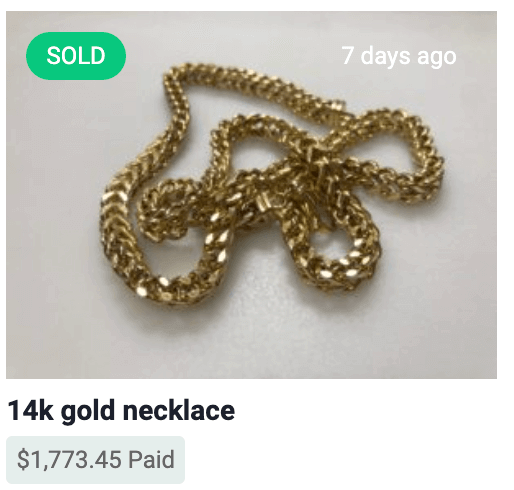
14k gold chain necklace sold for $1,773.45:

14k gold necklace sold for $1,773 on CashforGoldUSA.
Image Credit: CashforGoldUSA

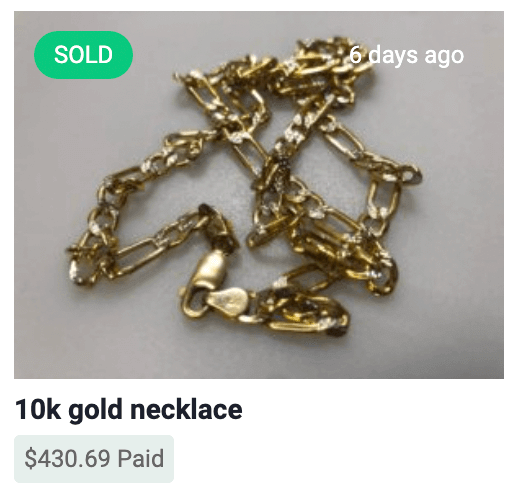
10k gold chain necklace sold for $430.69:

14k gold necklace sold for $430 on CashforGoldUSA.
Image Credit: CashforGoldUSA

3. Sell your jewelry to your local jeweler

We understand that some people have an urgency, and the best jewelry buyer might be the one that offers the fastest turnaround. In that case, a local jeweler you find “near me” may give you a fair value of your jewelry in cash on the spot.

Selling your gold chain, diamond ring or other jewelry at a local jewelry store is a good option, especially if you know a business you trust. 

  • Pro: Could be a fair payout, quickly. Some jewelers offer trade-in deals.
  • Con: Might not get highest offer, and it can be embarrassing to have to sell your jewelry before people you know.

4. Sell to cash-for-gold stores

Cash for gold stores can give you quick cash but have a reputation for low payouts. You can always get a quote, negotiate and shop around.

  • Pro: Immediate cash, local
  • Con: Payout may be low 

5. Local or online auctions

If your gold necklace or chain is pretty standard, nothing special, a gold buyer will most likely offer a payout based on the day’s spot gold price, and send it to a refinery to melt down.

However, if you have a significant piece of jewelry or a loose diamond that will sell for at least $1,000, or is a special antique, a marked brand or is a popular style,  it is possible a local or online jewelry auction platform may be interested — especially if your necklace is part of a larger estate collection.

  • Pro: Possibly could fetch a higher price 
  • Con: Not immediate cash, may not sell for as much as you like

6. Sell directly

You can always post your chain and try to sell it directly to individuals, or through antique or consignment stores. Check out sites like:

Pros and cons, of course:

  • Pro: You may get a higher price, and you can do business locally if you prefer 
  • Con: A lot of work dealing with flaky people, possibly having to package and shipping your item, or it not selling it all. 

21 apps for selling stuff online or locally

7 online jewelry buyers

Unless you need the cash immediately, an online jewelry buyer can be the best position to offer you the highest price, as they benefit from not needing expensive retail rent, and you benefit from the competitive online market.

Other benefits of selling to an online buyer include that a quality buyer will provide free, door-to-door shipping, the privacy of never leaving your house, and full insurance. Many rural communities do not have many local options.

Here are some of the most reputable online buyers:

1. CashforGoldUSA

We like this family-owned company for many reasons, including that they give a 10% bonus when you send in your shipment within a week and have helpful customer service and have many options for shipping and payment.

Pricing and payment

  • Get paid within 24 hours
  • 10% bonus if you send your item within 7 days
  • 100% highest price guarantee

Reputation

  • Better Business Bureau rating of A+
  • Founded 2005
  • 4.4/5 Trustpilot stars

Safety and insurance

  • Free, secure mailer or FedEx package sent to your home
  • Buys gold, silver, platinum jewelry, watches, coins and scrap
  • Insurance up to $150,000

Value add

  • Guaranteed highest price
  • If you do not accept their offer, you can get your item back immediately, free of charge
  • Your choice of shipping: USPS or FedEx, or print label at home for fastest process
  • Accepts all diamonds, gold, sterling silver and gemstones regardless of size or quality (other jewelry buyers have minimum diamond size or resale value)

Read our CashforGoldUSA review.

2. Abe Mor

Founded in 1964, New York-based and family-run Abe Mor has one of the largest presences in the online diamond buyer market.

They accept only diamond jewelry and loose diamonds of at least .50 carats, including designer diamond jewelry — like engagement rings from Tiffany & Co, Cartier, and Harry Winston — but they will pay you for the gold and platinum content of your jewelry if it’s set with eligible diamonds.

Abe Mor pros

  • A+ BBB rating, zero customer complaints
  • Free shipping 
  • Free insurance up to $50,000 with additional available for purchase

Abe Mor cons

  • Does not buy other types of jewelry or gemstones
  • Only accepts diamond jewelry at least 0.5 carats in size
  • Appraisals are conducted by in-house Abe Mor staff, though you can request GIA authentication
  • May reject diamonds if it does not need them in its inventory
  • Typical time from shipment to payment is longer than other sites, though Abe Mor will overnight a check upon request
  • Pays within 2 to 4 days upon acceptance of an offer

Check out our Abe Mor review.

3. Circa

Circa accepts high-end branded jewelry, as well as diamonds of at least .4 carats, and engagement rings. They will also purchase historical or estate jewelry including pieces such as: Antique, Edwardian, Georgian, Art Nouveau, Belle Epoque, Art Deco, Retro and Modern.

Whether in-person at one of their 23 locations internationally or online, if you accept Circa’s offer, you will be paid immediately via check, bank transfer, or gift card (worth up to 120% of the purchase offer) toward a jewelry purchase from Circa.

If you provide a grading report from the GIA, EGL, IGI, AGS, GSI, GCAL, IIDGR, or HRD, Circa provides a guaranteed offer range.

Circa pros

  • A+ Better Business Bureau rating
  • Works in partnership with diamond retailer Blue Nile
  • Promises to offer a high price to you by cutting out the middleman
  • Website’s videos and posts create transparency
  • Fully insured FedEx delivery — both from you to Circa, as well as returns, when relevant
  • 14 physical locations (11 in the U.S. and 3 international)
  • Claims that more than 90% of its customers receive a final offer price higher than the midpoint of the guaranteed range (which includes shipping and insurance)

Circa cons

  • This buyer only deals in jewelry with a diamond of at least .4 carats
  • If you do not have a lab report, you must send in your item for evaluation and grading before an offer is made
  • That offer is good for just 7 days, after which you have to start the whole process over again

In short, Circa is a solid company that brings the Blue Nile experience full circle, promising to offer jewelry sellers high prices by removing the middleman.

4. myGemma, formerly WP Diamonds

myGemma, formerly WP Diamonds, has a solid reputation as an online luxury jewelry buyer, and promises to get you a fair price for your diamond or designer jewelry, loose stones (diamonds of at least .5 carats), handbags, watches, and luxury accessories.

However, theirs is a more traditional buyback platform, in that myGemma’s in-house team of GIA-trained gemologists and industry veterans will evaluate your jewelry, then make an offer. Take it or leave it.

myGemma pros

  • Reputable buyer with an A+ BBB rating
  • Clean, easy-to-use site
  • Pays cash for your jewelry
  • Easy process, including FedEx round-trip shipping, and insurance for the full value of your items
  • Choose to do business via email or phone
  • Sell in as little as 24 hours: myGemma buys your jewelry directly, which means there are no online listings or auctions to wait for, no haggling or negotiating — simply their best price upfront
  • No fees are deducted from your final offer — the amount you hear is the amount you get paid.

myGemma cons

  • Evaluation is done by an internal appraiser, not a neutral third-party laboratory like GIA, which Worthy uses
  • There is just one offer, not a price set by a dynamic marketplace

In summary, myGemma is a reputable online diamond and jewelry buyer, that has been around for a long time. It is the fastest way to sell diamonds safely online to the experts.

Read our myGemma review to learn more.

6. The RealReal

Image Credit: Shutterstock

The RealReal is an online marketplace for luxury resale items, including fine jewelry. The site prices your consigned jewelry based on current market trends, and you get paid a commission up to 70% depending on the list price of your items.

Pros of The RealReal

  • Accredited by the Better Business Bureau with an A+ rating
  • 4/5 stars on Trustpilot

Cons of The RealReal

  • Numerous customer complaints on the BBB site about long wait times to process consigned items, items not being returned in the same condition they were sent, unapproved markdowns, and difficulty resolving issues with customer service
  • No guarantee your item will sell — most successful jewelry sales are by professional jewelers or others who have the ability to professionally photograph, display and market their jewelry
  • Must schedule an appointment to meet with a representative and be accepted to sell

7. Worthy

If you have jewelry valued at $1,000 or more, including a diamond engagement ring, other diamond or gemstone jewelry, or branded items from Tiffany, Cartier or another high-end jeweler, then consider Worthy.com, an online marketplace where hundreds of vetted buyers bid on your item.

Typically, the center diamond of an engagement ring of at least .5 carats will sell for $1,000. Worthy also accepts lab-grown diamonds of at least 3 carats. Worthy is A+ BBB rated, and insures your item up to $100,000 with Lloyds of London.

Worthy pros

  • A+ BBB rating
  • 4.6 rating with Trustpilot
  • High consumer reviews
  • Free lab GIA report
  • Cool website that helps you understand the value of your jewelry

Worthy cons

  • Takes longer than other platforms
  • Some users find the process overly complicated
  • Focused exclusively on diamond and high-end branded jewelry
  • Strict minimum of items that will sell for at least $1,000

Read our Worthy review.

FAQs about selling jewelry

What is the best way to sell expensive jewelry?

In the past, we have recommended selling expensive jewelry, especially those with large diamonds, or branded, luxury jewelry such as those from Tiffany, Cartier or Buglari through a reputable online jewelry platform like Worthy or myGemma — national companies that can efficiently evaluate your diamond or other jewelry, safely ship it, evaluate it by trusted experts and appraisers.

Before you get too excited, however, note that diamond prices have dropped about 40% since their peak in summer 2022, and buyback prices reflect this change:2

IDEX December 11, 2024 report
Image Credit: IDEX

For that reason, we recommend online buyer Diamonds USA, which buys all sizes and qualities of diamonds, quickly, and has a strong reputation, or Worthy.com, which specializes in larger diamonds and name-brand pieces.

Complete guide to symbols stamped on jewelry

Can you sell jewelry to a jewelry store?

Working with a local jeweler can be a solid choice if you have a jeweler you know and trust. This can also ensure a quick, cash sale, and many jewelers offer you a bonus if you chose to take store credit.

However, it may be worth the time to also get a quote from a local pawnshop or send in your jewelry to an online jewelry buyer get a second or third offer.

Is it better to sell jewelry to a pawn shop or jewelry store?

Pawnbrokers have a bad reputation for ripping off sellers — but jewelry stores can short-change jewelry sellers, too. The only way to know which is better is shop around, ask local friends and neighbors for recommendations and compare. Getting a quote does not commit you to selling at any of these options.

Is it safe selling jewelry online?

Selling jewelry online with a reputable buyer that insures your item, gives you a FedEx or USPS tracking number and has a robust online presence including Better Business Bureau and other online review sites. Since the online jewelry buyers rely on these reputation sites, they live and breathe customer service and reviews. I feel confident that the buyers listed on this site are honest and safe.

How much is my gold chain worth? What about a broken chain, or a gold ring?

Basic gold items are generally worth the spot price of gold, minus the buyer’s commission — which should be around 20% at most reputable places.

For example, a simple gold chain — broken or in-tact — could fetch you $100 to $200. A men’s gold wedding band may get you $100 to $200 as well.

Is it worth selling jewelry online?

Selling jewelry online with a reputable buyer that insures your item, gives you a FedEx or USPS tracking number and has a robust online presence including Better Business Bureau and other review sites. 

Sell jewelry online can net a higher payout, convenience of not having to leave your home, and total privacy, since your friends and neighbors won’t see you selling your items in town.

Platinum vs white gold: Which is more valuable?

White gold vs yellow gold: What’s the difference, which is worth more?

Sterling vs plated vs white gold: How to tell the difference

What is the best website to sell used jewelry?

CashforGoldUSA buys all gold, silver, diamond and gemstone jewelry, coins, flatware and tableware via overnight shipping. The Boston-based company has an A+ Better Business Bureau rating and hundreds of high Trustpilot reviews, and promises to pay within 24 hours of accepting terms.

Bottom line: It’s OK to sell your jewelry

Many relationships involve precious jewelry — investments that represented care, love, tradition. These may be romantic or family relationships. Your jewelry may be a gift or an inheritance.

Those engagement rings, watches, necklaces, earrings, gold chains, and bracelets can linger in velvet-lined jewelry boxes for years — or even the remainder of the new owner’s life!

Even if that jewelry is worth tens of thousands of dollars, it is still clutter to you.

It all holds energy, good or bad.

Cleanse out the bad energy, welcome the good.

Even if you are unsure whether the value of the gold or diamonds may go up soon, money in your pocket today is 100% guaranteed, vs the unknown of future prices. Plus, you can pay off debt which saves money in interest, or put money into a 401k or 529, which saves money on taxes — guaranteed.


Costco doesn’t hide deals, but some of the best savings come from knowing the rules behind the signs, services, and membership perks. A few smart moves like using a Shop Card, timing a price adjustment, or letting Concierge Services do the heavy lifting can turn a routine run into real value. These tips lean on official policies, not rumor, so they work nationwide with only minor local quirks. Keep this list handy in your phone and you’ll shop faster, skip fees, and stretch that Kirkland cart farther.

1. Watch for the asterisk and odd price endings

Asterisk on wood sign
Image Credit: Shutterstock

That tiny asterisk in the upper-right corner of a shelf tag signals an item likely won’t be reordered at that warehouse, so stock up if you love it. Price endings can also hint at deals: .99 often means regular price, while off-endings like .97 can indicate a markdown specific to that location. Clearance isn’t guaranteed to drop further, so if supply looks thin, don’t wait. Because these quirks aren’t shouted from the food court, they’re a quiet edge for shoppers who know the code.

2. Use the 30-day price adjustment instead of returning

sale text
Image credit: Tamanna Rumee via Unsplash

If something you bought just went on sale, request a price adjustment rather than lugging it back. For eligible purchases that drop in price within 30 days, Costco will credit the difference no restocking drama, no repacking the SUV. You can submit the request online for Costco.com orders, and warehouses can help with in-store purchases. It’s the cleanest way to match promos you miss by a week, and it keeps hot sellers in your cart instead of the return line.

3. Know where returns are limited, electronics and a few others

return policy written on wooden blocks
Image Credit: Shutterstock

Costco’s satisfaction guarantee is famous, but a handful of categories do have clocks: most major electronics carry a 90-day return window, and some special items have specific rules. For almost everything else, returns stay flexible and easy, especially if you saved your receipt or can pull it up in your account. Skimming the short list of exceptions saves time and keeps surprises off the customer-service counter.

4. Add a free household card for a second shopper

loyalty grocery card in womans hand
Image Credit: Shutterstock

One membership can carry two adults at the same address: the primary member and one free household member (16+). That extra card means someone else can legally do the midweek Costco run, pick up prescriptions, or grab gas without you. Set it up online in Account Details, then the household member can snap a photo at the membership desk and they’re set. It’s the easiest way to share perks without sharing a wallet.

5. Let non-members shop with a Costco Shop Card

young college student shopping
Image Credit: Shutterstock

Got a friend or college kid who isn’t a member? Load a Costco Shop Card for them. Non-members can use Shop Cards to buy in the warehouse, at the pump, and on Costco.com, even though only members can reload them. It’s a tidy workaround for occasional shoppers, gift-givers, or visitors who just need one big stock-up trip.

6. Save your carts and your time with the digital membership card

costco app on phone
Image Credit: Marques Thomas via Unsplash

The Costco app puts your membership barcode, rewards info, and even payment (when linked to an eligible card) on your phone. It also shows in-warehouse receipts for the past two years and helps you find hours for each department before you drive. If you’re prone to forgetting your wallet or paper card, this keeps the line moving and your rebates visible.

7. Executive members: stack the 2% reward (and know the fine print)

inside wholesale store
Image Credit: Albert Stoynov via Unsplash

Executive Membership adds a 2% annual reward (up to $1,250) on qualified Costco, Costco.com, and Costco Travel purchases. If your year’s reward doesn’t beat the upgrade cost, remember Costco’s membership guarantee you can downgrade. It’s a simple math check most shoppers forget, and it can turn big seasonal purchases into real money back at renewal.

8. Costco Travel can pay twice 2% reward plus card cash back

Travel Tips
Image credit: Precondo CA via Unsplash

Booking through Costco Travel often brings bundled perks, and Executive Members earn the 2% reward on qualifying travel (applied after the trip). Use the Costco Anywhere Visa® by Citi and you can stack additional cash back on those purchases. Check the exclusions taxes and third-party add-ons typically don’t count, then let the rewards cover some of your next renewal.

9. Skip guesswork at the pump and yes, Shop Cards work for fuel

a parking meter on the side of a street
Image credit: Egor Komarov via Unsplash

Costco’s fuel stations are member-only, but there’s an exception: anyone can buy gas with a Costco Shop Card. The lanes run one-way and the hoses reach either side of your vehicle, which keeps lines moving during rush hours. It’s a quiet way to share low gas prices with non-member family or help a teen driver fill up without handing over your main card.

10. Free air for your tires, same hours as the gas station

a garage with a large stack of tires
Image credit: Ruben Valenzuela via Unsplash

Most warehouses have a self-inflation station at the Tire Center, and it’s open the same hours as the gas station. That means you can top off tires right after fueling instead of hunting down a paid air machine across town. Tiny habit, real savings, and better mileage and tread life.

11. Pharmacy access without a membership (in store and online)

women's red button-up collared long-sleeved shirt
Image credit: National Cancer Institute via Unsplash

You don’t need to be a member to fill prescriptions at Costco’s pharmacy counters or via Costco’s online pharmacy options. Members do get extra perks, but if a friend or parent needs a one-off fill, they can head straight to the pharmacy window and pay with common methods. It’s a little-known exception that can save time and money.

12. Same-day delivery has a markup, 2-day pantry often doesn’t

a man wearing a red hat
Image credit: Fotos via Unsplash

Costco’s Same-Day delivery (powered by Instacart) prices are higher than warehouse prices and include service and delivery in the item costs. The 2-Day option for non-perishables ships to your door and waives the per-item surcharge on orders $75+, which can be cheaper for heavy pantry restocks. Know the difference before you click, Same-Day is speed; 2-Day is value.

13. Use Concierge Services for a free extra year of warranty

call center
Image Credit: Shutterstock

On many electronics and major appliances, Costco extends the manufacturer’s warranty to two years and offers free tech support through Concierge Services. That’s on top of Costco’s 90-day electronics return window and any optional Allstate plans you buy. If something glitches in year two, call Concierge first, they handle a lot before you ever need a service visit.

14. Pull up in-warehouse receipts in your account

costco receipt
Image Credit: Shutterstock

No more shoebox of slips: link your membership in your Costco.com account to view and print in-warehouse receipts for the past two years. It’s perfect for appliance warranties, HSA records, or big returns when the paper went missing. Check the In-Warehouse tab under Orders & Purchases and change the date filter to find what you need.

15. Don’t price-match, just compare channels

mother shopping with child
Image Credit: Shutterstock

Warehouse and Costco.com prices can differ, and Costco doesn’t price-match other sellers or even match warehouse to online. Instead of chasing matches, compare totals yourself: factor in shipping on Costco.com and the 2-Day delivery surcharges, or use Same-Day when speed matters. If a deal pops up after you buy, that’s what the price-adjustment window is for.

Gen Z grew up with calculators in their pockets and price changes in real time, so a lot of “rules” from earlier decades don’t land the same. They’re weighing fees, unit prices, and long-term trade-offs instead of repeating slogans. Some classic advice still holds save, invest, avoid high-interest debt but many one-size-fits-all rules were never laws of money. Below are the myths younger workers question most, plus the smarter take. Use these as conversation starters with family, not fight-starters.

1. Renting is throwing money away

Image credit: Aaron Sousa via Unsplash

Rent isn’t “wasted” if it buys flexibility, outsized location value, or time to save. Buying carries upfront costs (down payment, closing), ongoing costs (maintenance, taxes, insurance), and market risk. The better frame is total cost of housing vs. your income and timeline. If you’ll move soon or need to build a cash buffer, renting can be the smarter financial move. The key is running the numbers for your city, not following a slogan.

2. You must put 20% down on a house

Image credit: Jakub Żerdzicki via Unsplash

Twenty percent avoids private mortgage insurance but it’s not required. Many conforming loans allow 3–5% down with PMI, and some programs (VA loans) require no down payment for eligible borrowers. The real decision is total monthly cost, cash cushion after closing, and rate/fee trade-offs, not chasing a single down payment number.

3. Never talk about your salary

Image credit: Mathieu Stern via Unsplash

Talking pay helps spot inequities and negotiate fair offers. In the U.S., most private-sector workers have a protected right to discuss wages with coworkers, and many states now require pay ranges in job postings. Secrecy serves employers; transparency helps workers plan and bargain.

4. College is the only path to a good career

Image credit: Felipe Gregate via Unsplash

Degrees open doors, but paid apprenticeships and targeted certificates also lead to solid, growing jobs often with lower or no debt and strong wage ladders. Electricians, lineworkers, CNC machinists, coders in apprenticeships, EMT-to-paramedic tracks these are real, structured pathways with credentials employers value.

5. Keep a small balance on your credit card to build credit

Image credit: Jim Chen via Unsplash

Carrying a balance doesn’t boost your score and it costs you interest. What matters most is on-time payment history and keeping your utilization (balance/limit) low. Pay in full by the due date to avoid interest; you’ll still build credit as the issuer reports your on-time payments.

6. Close old credit cards to raise your score

Image credit: Jim Chen via Unsplash

Shutting a long-standing card can shorten your average account age and raise your utilization ratio, both of which may hurt scores. If a no-fee card isn’t causing problems, leaving it open and unused is often better for your credit profile.

7. Buy the biggest house the bank will approve

Image credit: Kostiantyn Li via Unsplash

Lenders set a maximum; your budget needs margin for repairs, insurance, taxes, and the rest of your life. Many households end up “house poor” by stretching to approval limits. Use debt-to-income guidelines as guardrails, not goals, and stress-test your budget for higher utilities, HOA fees, and surprise fixes.

8. Cash or debit gives you the best protection

Image credit: Kostiantyn Li via Unsplash

Cash is untraceable, and debit pulls money from your account immediately. Credit cards carry strong federal protections for fraud and billing errors and allow you to dispute charges before paying. Used responsibly (paid in full each month), credit can be safer for big or online purchases than cash or debit.

9. Beating the market means picking winning stocks

Image credit: Robb Miller via Unsplash

Broad index funds give instant diversification at low cost, and many investors underperform the market when they trade frequently or chase hunches. Costs and concentration risk matter over decades; diversified funds reduce both. If you want to pick, treat it as a small, capped slice of your plan.

10. Bonds can’t lose money

Image credit: Markus Winkler via Unsplash

Bonds carry interest rate risk: when rates rise, existing bond prices fall. If you sell before maturity or if you hold bond funds during sharp rate moves you can lose principal. Bonds can still reduce volatility versus stocks, but “safe” isn’t the same as “can’t drop.”

11. Everyone needs a fixed three-month emergency fund

Image Credit: diwdom5355 via Freepik

Three to six months is a useful rule of thumb, not a mandate. The “right” buffer depends on job stability, dependents, health costs, and access to credit. Many people do better starting smaller (even $500–$1,000), then automating regular transfers to grow the cushion over time.

12. Medical bills can’t be negotiated

Image credit: Marek Studzinski via Unsplash

You can ask for itemized bills, correct coding errors, request financial assistance, and arrange zero- or low-interest payment plans with providers. Many billing offices will discount for prompt pay or set up manageable schedules if you ask. Don’t ignore statements call early and keep records.

13. Tax refunds are free money

Image credit: Markus Winkler via Unsplash

A big refund usually means you over-withheld all year an interest-free loan to the government. If your refund is large or you owed a lot, adjust your W-4 so paychecks match your actual tax. The goal is “about right,” not max refund.

14. Health savings accounts are only for people with big medical bills

Image credit: Marek Studzinski via Unsplash

HSAs offer triple tax advantages: deductible contributions, tax-free growth, and tax-free withdrawals for qualified medical expenses. You can also invest HSA funds and reimburse yourself later if you save receipts, turning health costs into long-term, tax-advantaged savings. Eligibility requires a qualifying high-deductible health plan.

15. 401(k) fees don’t matter

Image Credit: Shutterstock

Even small fee differences compound over decades. Two funds that both earn 7% before fees can end thousands apart if one costs 0.90% and the other 0.05%. Review your plan’s expense ratios and any administrative fees; shifting to lower-cost options can raise your net returns without extra risk.

16. Social Security won’t be there for you

Image credit: Markus Winkler via Unsplash

The program faces funding gaps without changes, but it’s not “going away.” Even if trust fund reserves are depleted in the future, ongoing payroll taxes are projected to cover most scheduled benefits unless Congress acts. Plan as if benefits will exist with potential adjustments, and save independently too.

17. The only way to build credit is with a traditional credit card

Image credit: Markus Winkler via Unsplash

Other tools can help: secured cards, credit-builder loans, and (in some models) reported rent and utility payments. What matters is consistent on-time payment and low balances relative to limits. Choose products that report to the major bureaus and avoid fees that eat your progress.

18. Loyalty is the best way to get a raise

Image credit: Sasun Bughdaryan via Unsplash

Staying can pay, if your employer moves you with the market. But data often show job switchers seeing faster wage growth than job stayers, especially in tight labor markets. Track your market rate and be ready to negotiate or change roles when the gap widens.

19. Buying new cars is always smarter than buying used

Image credit: Erik Mclean via Unsplash

New cars depreciate fastest in the first years. Many late-model used cars (especially certified pre-owned) offer strong reliability with a lower price and slower depreciation. The best value is the car that fits your needs, budget, and ownership costs not automatically “new.”

20. All debt is bad debt

Image Credit: Shutterstock

High-interest debt is dangerous; strategic, low-cost debt can be useful. A simple rule: first, make minimums on every account; second, kill high-rate balances; third, weigh low-rate borrowing against savings and investment goals. The goal isn’t “no debt at any cost” it’s using credit intentionally.

21. Payday loans are fine for short-term cash

Image credit: Dan Dennis via Unsplash

These loans are extremely expensive and designed to roll over, trapping borrowers in a cycle of fees. Before using one, look at alternatives: payment plans with creditors, advance pay through employers, credit unions, or community assistance. If you’re already in a payday loop, ask about extended payment plans available in many states.

22. Renters don’t need insurance

Image credit: Bingqi Huang via Unsplash

Your landlord’s policy usually covers the building, not your stuff or your liability. Renters insurance is often inexpensive and can protect belongings, temporary housing after a covered loss, and personal liability. If cost is tight, raise the deductible and inventory essentials first.

Discover job hunting tips, ways to earn more, and flexible working options:

Practising job interview
Image Credit: Shutterstock

21 high-paying careers that desperately need workers, but nobody wants to do them: The pay is generous, but these jobs are searching for workers.

No background check jobs: 12 background friendly jobs: If you’re struggling to find a job due to past issues, here are jobs you can get without background checks.

15 remote jobs you probably didn’t know pay $150,000+ In 2026: High income and flexible work hours from home is not a myth — here are some remote-friendly careers.

More benefits advice and news from Wealthy Single Mommy:

A couple doing paperwork together
Image Credit: Shutterstock.

Legit single mom hardship grants — This is an updated list of dozens legitimate hardship grants for single mothers — from private charities, businesses and individual donors.

SNAP in 2026: New max benefits, rule changes, and the exact moves to raise your payout — For the 2026 fiscal year, the caps go up in most places, deduction amounts change, and other changes affect how much you receive. Below you’ll find the new numbers in plain English, a quick way to estimate your own benefit, and how to maximize your sum.

7 surprising EBT benefits — If you receive EBT card benefits you can qualify for more than free groceries and other essential items. In this post, you’ll find places to go for EBT card holders, including free entrance, discounts and other free stuff.










