scroll top

When your children move out, you and your partner face a major life change that can feel both exciting and challenging. After years of focusing on parenting duties, many couples discover they have grown apart or feel like strangers living in the same house. This transition offers a unique opportunity to rebuild your connection and create a stronger relationship than ever before.

The shift from active parenting to an empty nest requires you to rediscover who you are as a couple. You might find that couples feel disconnected once the kids move out because children often act as a buffer in relationships. Now you can focus on shared experiences and rekindling the romance and brought you together in the first place.

1. Schedule Regular Date Nights Without Distractions

wine bottle beside wine glass on brown wooden table
Image credit: Liza Pooor via Unsplash

Now that your house feels quieter, you can finally focus on each other again. Regular date nights help strengthen your relationship and bring back the connection you may have lost during busy parenting years.

Put your phones away during these dates. Giving your partner your full attention is one of the simplest yet most powerful ways to connect.

Pick a schedule that works for both of you. Weekly or monthly dates work best when you treat them as non-negotiable time together.

Date nights don’t need to be fancy dinners out. A simple walk in your neighborhood works just as well for reconnecting.

2. Take a Weekend Trip Together Without Children

romantic getaway
Image Credit: Paulina Herpel for Unsplash+

A weekend getaway gives you uninterrupted time to focus on each other. You can sleep in, eat meals without distractions, and have real conversations again.

Choose a destination within driving distance to keep things simple. Beach towns, mountain cabins, or city hotels all work well. The key is picking somewhere you both want to explore.

Romantic getaways for couples can be budget-friendly weekend escapes or longer retreats. Book a place with room service or nearby restaurants so you don’t spend your time cooking and cleaning.

Leave your phones in the hotel room during dinner. Walk around new neighborhoods together. Try activities you used to enjoy before kids took over your schedule.

3. Enroll in a Cooking or Dance Class as a Couple

middle aged couple dancing
Image Credit: Getty Images via Unsplash+

Taking a class together gives you both something new to focus on. You’ll learn skills while spending quality time together.

Dance classes help couples strengthen their connection through physical movement and teamwork. You’ll laugh at mistakes and celebrate small wins together.

Cooking classes teach you to work as a team in the kitchen. You’ll try new foods and bring fresh recipes home to enjoy.

Both activities get you out of your usual routine. You’ll meet other couples and create shared memories that have nothing to do with parenting.

4. Create a Shared Hobby or Project

black and silver dslr camera on white textile
Image credit: Laura Chouette via Unsplash

Starting a new hobby together gives you both something exciting to focus on. Pick something neither of you has tried before so you learn at the same pace.

Consider activities that match your interests and energy levels. Hobbies for couples can range from rock climbing to cooking, giving you plenty of options to explore.

Working on a project creates natural conversation and teamwork. You might renovate a room, build a garden, or learn photography together. The key is choosing something you both genuinely want to do.

5. Discuss and Set New Relationship Goals

couple travelling
Image Credit: Freepik

Empty nest life gives you fresh chances to create shared goals and vision for the future. Talk about dreams you put on hold while raising kids.

Maybe you want to travel more or learn new skills together. Write down three goals you both care about.

Setting relationship goals can strengthen your partnership when you work toward them as a team. Pick one small goal to start with this month.

Check in monthly about your progress. This keeps you both focused and connected to your shared future.

6. Write Letters to Each Other Expressing Feelings

red rose bouquet beside white printer paper
Image credit: Pongracz Noemi via Unsplash

Put pen to paper and write heartfelt letters to your partner. This simple act creates deeper connection than quick texts or rushed conversations.

Writing letters allows you to express thoughts and feelings that might feel awkward to say out loud. You have time to choose your words carefully.

Share specific memories you cherish together. Write about dreams you want to pursue now that you have more freedom.

Couples who regularly express their feelings report 50% higher relationship satisfaction. Letters give you both space to be vulnerable without interruption.

Exchange letters weekly or monthly. Keep them private between you two to build trust and intimacy.

7. Attend Couples Therapy or Counseling Sessions

Mature couple, therapist and support in house for relationship for depression in health, stress and advice. Man, woman and psychologist for talking, hug or embrace in lounge with counsellor in home.
Photo Credit; The Yuri Arcurs Collection

Professional guidance helps couples navigate relationship changes after children leave home. Couples therapy techniques focus on improving communication and rebuilding trust between partners.

Many couples find that therapy sessions improve communication patterns and increase emotional intimacy. A trained therapist provides neutral ground to discuss concerns and learn new relationship skills.

Effective couples therapy activities can strengthen your relationship through structured exercises. These activities help you practice better communication and build deeper emotional connections with your partner.

Not all therapy approaches work the same for every couple. Different couples need different therapy types based on their specific relationship challenges and goals.

8. Establish Technology-Free Zones During Time Together

Mature, coffee or happy couple talking in home living room for conversation or communication in marriage. Smile, drinking tea or woman speaking to man in retirement or discussion to relax together.
Photo Credit: The Yuri Arcurs Collection via Freepik

Phones and tablets can kill romance faster than you think. When you’re both scrolling through different screens, you’re not really together at all.

Creating tech-free zones in your home helps you focus on each other without digital distractions. Pick specific areas like the bedroom or dining room where devices stay out.

Try the screen basket method during your time together. Both of you put your phones in a basket before dinner or movie night.

Setting clear boundaries around screen time makes conversations flow better. You’ll actually listen to each other instead of checking notifications every few minutes.

Start with one hour of tech-free time each evening. This small change can transform how you connect as a couple.

9. Reconnect Through Daily Meaningful Conversations

older couple chatting and laughing
Image Credit: Freepik

Empty nest couples often discover they’ve forgotten how to talk beyond schedules and logistics. Daily meaningful conversations help rebuild that deeper connection you once shared.

Start with simple questions about each other’s day. Ask about feelings, not just events. “How did that meeting make you feel?” works better than “How was your meeting?”

Meaningful conversation helps spouses reconnect through shared thoughts and emotions. Set aside 15 minutes daily without phones or TV distractions.

Share childhood memories, future dreams, or current worries. These topics create emotional intimacy that busy parenting years often push aside.

10. Plan Surprise Gestures or Small Gifts

Loving senior man giving gift box to woman, making great surprise for St. Valentines Day, celebrating holiday at home interior. Husband congratulating wife on her birthday or marriage anniversary
Image Credit: Freepik

Small surprises work better than grand gestures after the kids leave. Your partner will notice when you pay attention to their daily habits and preferences.

Leave encouraging notes in unexpected places like their coffee mug or car dashboard. Pick up their favorite coffee on your way home from work.

Plan a weekend getaway to somewhere you both enjoyed before having children. Book the same restaurant from your early dating days.

Buy concert tickets for a band they mentioned months ago. These thoughtful acts demonstrate care and show you listen during conversations.

11. Revisit Favorite Places From Your Early Relationship

a couple sitting on a stone wall
Image credit: Ben Iwara via Unsplash

Going back to places that hold special meaning can bring back powerful memories from when you first fell in love. These spots trigger emotions and stories you may have forgotten.

Start with the restaurant where you had your first date. Order the same meal you shared back then.

Visit the park where you took long walks together. Walk the same paths and sit on the same bench.

Drive to the coffee shop where you spent hours talking. Notice how it’s changed over the years.

Return to the movie theater where you saw your first film together. Check if that same screen is still there.

These visits work because familiar places spark specific memories. Your brain connects locations to emotions from the past.

12. Practice Active Listening to Understand Each Other Better

active listening coffee date
Photo Credit: The Yuri Arcurs Collection via Freepik

After years of focusing on kids’ needs, many couples forget how to truly hear each other. Active listening builds deeper connections between partners.

Put away your phone when your partner talks. Look at them directly and focus on their words instead of planning your response.

Ask questions about what they share. Simple phrases like “tell me more” or “how did that make you feel” show you care about their thoughts.

Active listening requires being fully present during conversations. This means avoiding distractions and giving your complete attention to your partner’s words and feelings.

13. Engage in Joint Volunteer Work or Community Service

men and women in a fun run activity
Image credit: Roman Synkevych via Unsplash

Working together for a good cause creates new shared experiences. You’ll see different sides of each other while helping others.

Volunteering delivers health and wellness benefits while creating meaningful connections. Many couples find this work brings them closer together.

Choose causes you both care about. Animal shelters need dog walkers. Food banks sort donations. Libraries need reading volunteers.

Community volunteer work helps people share common goals and interests. This shared purpose strengthens your bond as a couple.

Start small with monthly commitments. Build up to weekly activities if you enjoy the work together.

14. Designate Time for Physical Intimacy and Affection

woman and man hand holding
Image credit: Hunters Race via Unsplash

Physical touch builds stronger connections between partners. Schedule regular time for intimacy just like you would any important appointment.

Start small with daily hugs, hand-holding, or brief massages. These simple acts release oxytocin, which helps you feel closer to your partner.

Physical intimacy encompasses multiple aspects of your relationship. Set aside uninterrupted time each week for deeper physical connection.

Remove distractions during intimate moments. Put phones away and focus entirely on each other.

15. Celebrate Milestones and New Traditions Together

couple celebrating anniversary
Photo Credit: A. C. For Unsplash+

Empty nesters have fresh chances to mark special moments without kid schedules getting in the way. Your relationship enters a new phase where you can focus on each other again.

Start by celebrating relationship milestones you might have missed during busy parenting years. Pick dates that matter to you both, like your first date or when you moved in together.

Create new traditions that fit your current life. Maybe you take a weekend trip every season or try a new restaurant monthly. These small rituals give you something to look forward to together.

Mark achievements outside your relationship too. Celebrate work promotions, fitness goals, or learning new skills. Supporting each other’s wins builds connection and shows you’re still a team.

Every grandparent wants the best for their family, but sometimes good intentions go sideways. Without meaning to, grandparents can step on their adult kids’ toes or unintentionally hurt feelings. Even loving grandparents can trigger stress or friction when they don’t realize how their words and actions land. Avoiding these common pitfalls helps keep family bonds strong, open, and respectful.

1. Ignoring House Rules

Three children sitting on a pink couch in front of a christmas tree
Image credit: Tati Odintsova via Unsplash

Being relaxed around your grandkids is one of the joys of grandparenting, but bending the rules can create stress for your adult kids. If parents limit sugary snacks or electronics, quietly handing over sweets or devices sets up unnecessary conflict. While it’s tempting to spoil grandchildren, backing up the parents’ decisions shows respect and consistency. Supporting their rules makes grandchildren feel secure and helps parents trust your involvement.

2. Giving Unsolicited Financial Advice

a wallet with money sticking out of it
Image credit: Kostiantyn Li via Unsplash

Money is sensitive territory. And, even though 74% of grandparents provide financial support to grandchildren, offering your opinion about how your adult children handle their finances can feel intrusive, even when well-intentioned. Comments about their spending habits or financial choices might come across as judgmental. It’s better to wait until your opinion is sought out, showing respect for their independence and judgment.

3. Critiquing Parenting Decisions

a typewriter on a table
Image credit: Markus Winkler via Unsplash

Grandparents often have valuable parenting experience, but unsolicited advice can feel undermining. Pointing out how you’d do things differently might subtly suggest your adult children aren’t capable. Instead, support their decisions openly and reserve advice for when it’s requested. Doing so shows trust and helps your relationship grow stronger.

4. Stepping in Too Quickly During Problems

grandparents helping grandchildren
Image Credit Kateryna Hilznitsova for Unsplash

When grandkids face minor setbacks, jumping in immediately to help seems natural, but doing it repeatedly denies your adult kids a chance to problem-solve. Solving every little issue for them sends a message that you don’t believe they can handle challenges themselves. Giving them room to tackle issues independently builds their confidence and makes your support more meaningful when truly needed.

5. Sharing Family Information Without Permission

a family posing for a picture
Image credit: Daria Trofimova via Unsplash

Posting grandchildren’s photos online or sharing family updates publicly without first checking can cause tension. Even casual sharing might cross privacy boundaries parents have set. Checking first shows you respect their wishes and ensures everyone’s comfortable with what’s being shared.

6. Overdoing Generosity with Gifts

A group of red boxes with black bows
Image credit: Maria Kovalets via Unsplash

Giving lavish gifts feels generous, but can put pressure on your adult kids. They might feel uncomfortable accepting expensive presents or worry about reciprocating. Thoughtful, smaller gestures that align with their lifestyle and values mean just as much, if not more. Keep the lines of communication open to gauge what’s welcome.

7. Speaking Negatively About Their Partners or Friends

two women sitting on a park bench smoking a cigarette
Image credit: Ernst-Günther Krause (NID) via Unsplash

Even casual comments about your adult child’s partner or friends can cut deeply. Negative remarks may unintentionally make your child feel defensive or protective of their relationships. If you have genuine concerns, approach these conversations gently and privately, or wait until they seek your input.

8. Undermining Their Authority in Front of the Grandkids

A group of people sitting around a wooden table
Image credit: Tati Odintsova via Unsplash

Correcting your adult kids or questioning their decisions in front of grandchildren weakens their authority. Even well-intended corrections can give grandkids mixed signals about who’s in charge. If you disagree with a choice, address it privately later, ensuring your kids maintain authority in their children’s eyes.

9. Assuming Control During Visits

group of people beside coffee table
Image credit: National Cancer Institute via Unsplash

Stepping into your adult children’s home and immediately taking charge, whether by cooking, rearranging items, or initiating tasks without asking, can feel intrusive. Your desire to help is wonderful, but respect their household routines by offering assistance rather than taking control. Asking what’s most helpful builds goodwill rather than resentment.

10. Voicing Constant Worries and Concerns

a woman holding her head in her hands
Image credit: engin akyurt via Unsplash

Expressing frequent anxiety or worry over your adult kids’ choices or lifestyle can leave them feeling scrutinized. Your concerns come from love, but constant reminders may imply you doubt their judgment. Trust their decisions by stepping back occasionally and offering your ear rather than your opinion.

11. Avoiding Important Conversations About the Future

man wearing black collared top sitting on chair in front of table and woman wearing multicolored top
Image credit: Matt W Newman via Unsplash

Difficult conversations around finances, health, and end-of-life plans may be uncomfortable, but avoiding them can leave your adult kids unprepared for tough times. Initiating these conversations early ensures clarity and reduces stress when decisions must be made. Approaching these talks honestly and openly fosters mutual respect and understanding.

12. Comparing Their Experiences to Yours

black and white photo of parenting past
Photo by Library of Congress on Unsplash

Comments like “When you were a child, things were harder” or “You have it easy compared to our generation” might seem harmless but diminish your adult child’s experiences. Everyone faces unique challenges. Instead, acknowledge their struggles and validate their achievements without comparisons.

13. Expecting Your Traditions to Be Maintained

group of person eating indoors
Image credit: National Cancer Institute via Unsplash

Insisting family traditions remain unchanged can create unintentional pressure. Your adult children may feel obligated to keep up customs that no longer fit their lifestyle or values. Letting traditions evolve naturally, or creating new ones together, can strengthen family bonds without pressure.

14. Ignoring Boundaries Around Discipline

a man and a child walking on a sidewalk
Image credit: Sebastiano Piazzi via Unsplash

Stepping in to discipline grandchildren without permission can quickly strain relationships. Your intervention may make your adult kids feel undermined or criticized. Respect their preferred methods by discussing discipline privately, allowing them to lead in managing behavior.

15. Forgetting to Ask What Kind of Help Is Needed

an older man and a young boy playing with a toy car
Image credit: Tamara Govedarovic via Unsplash

Grandparents who help generously often assume what’s needed rather than asking. While your intentions are kind, making assumptions can sometimes cause inconvenience or frustration. Checking in to see exactly what assistance your adult kids want or need keeps your help genuinely useful and appreciated.

Single, low-income moms are not signing up for child support, and this is a very good thing. Less formal child support means more and improved co-parenting, higher rates of father involvement, better child outcomes and increased gender equality.

This trend makes sense:

Child support laws were created to support divorced mothers who solely raised the children and had far lews earning potential than the divorced dads. Today, the majority of separated families were never married, single moms earn as much as men (or more), equal co-parenting is on a rapid rise, and the majority of eligible participants are just over child support.

Child support has never had any success in its intended goals of equalizing income between parents’ households or improving poverty rates, but it has contributed to fatherlessness, male poverty and family conflict. Anecdotally, I see women holding themselves back professionally and financially to qualify for child support — and then thrive once they let go of that dependence.

Nonetheless, legislators and the public still have the hots for child support, believing more is more. In my state of Virginia, legislators (Democrat) and the governor (Republican) this year passed a bill increasing child support percentages (the Black Caucus opposed it).

On the ground, poor moms are quietly doing away with this broken, toxic program, and it is a beautiful sign of progress. These women are replacing a brokent, expensive, destructive government program with co-parenting and father involvement.

In this post:

Current child support stats

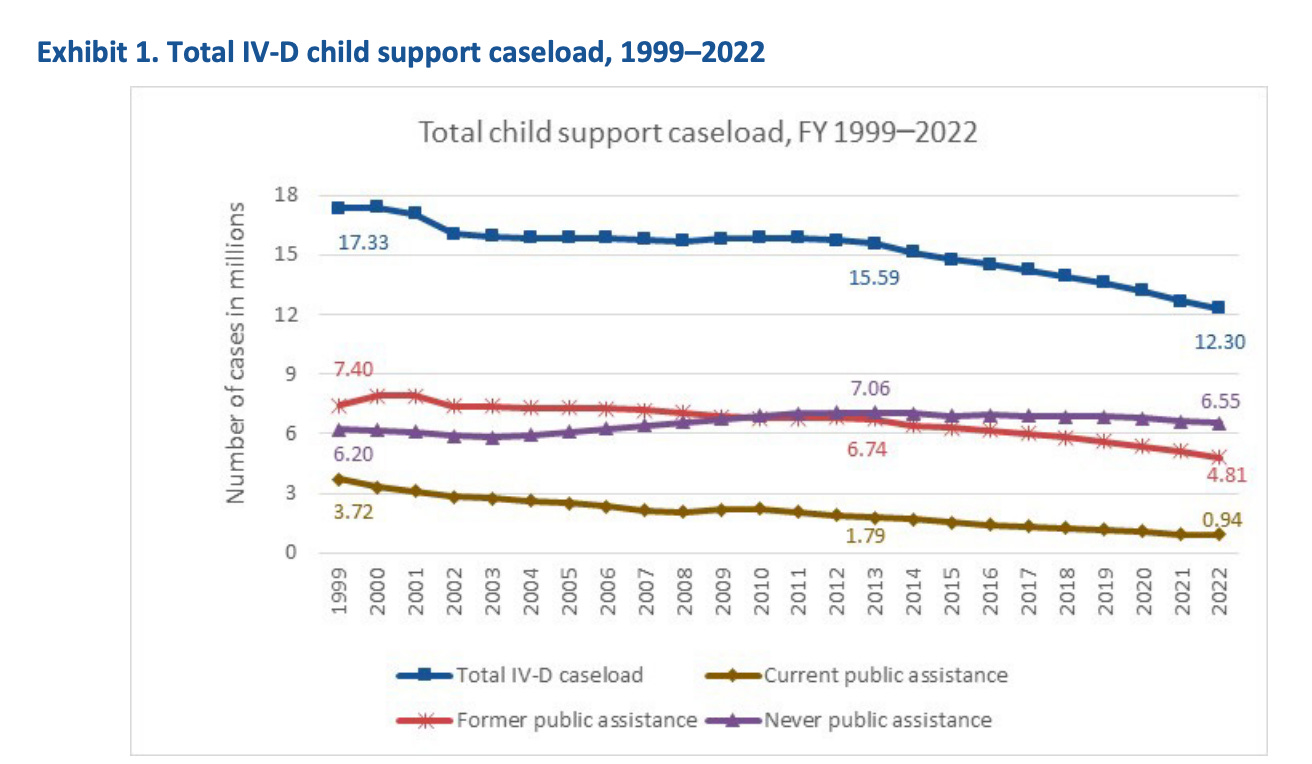
In the 23 years ended 2022, total child support cases filed through the state dropped by 29%. Rates of poor moms filing for support fell at an even more accelerated rate further while women who are not or have never been on public assistance are more likely than ever to file:

  • 74% drop for filers on public assistance
  • 42% drop for moms who were formerly on assistance
  • 6% increase for moms who were never on assistance
Source: Office of Child Support Services Annual Reports to Congress

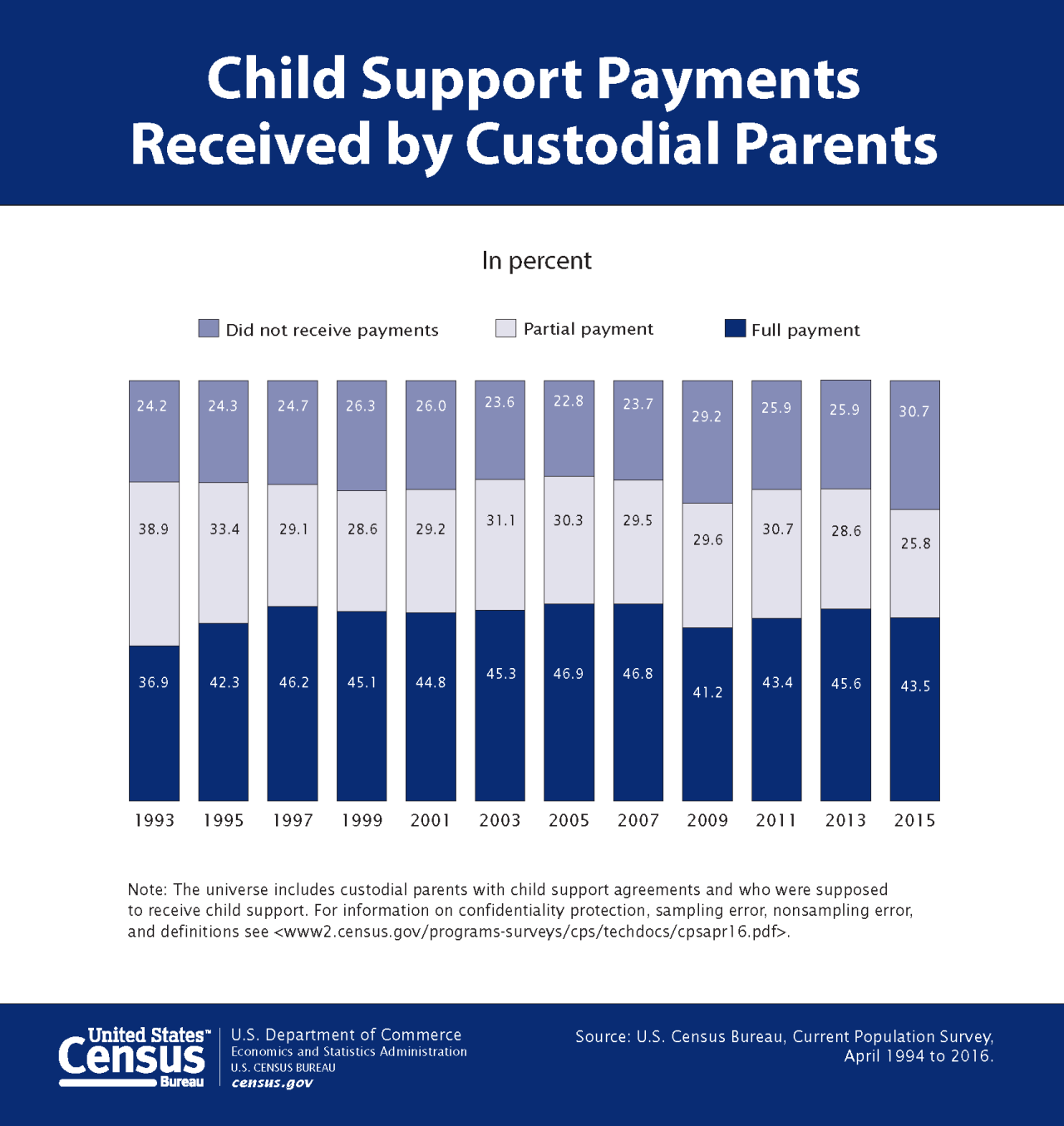
Meanwhile child support compliance has never exceeded 30% in all its history and arrearage totals for the program have grown each year.

Child Support Payments Received by Custodial Parents

Why are poor moms skipping child support?

1. Moms know child support hurts co-parenting

According to a Census survey, moms’ attitudes about child support have shifted to viewing the child support program as frivolous, intrusive and even toxic, and they now extend grace and common sense to their co-parents. Moms also want to retain financial and relationship decisions within their families and keep the government out of their business.

Top reasons cited by parents (80% of child support applicants are women) not filing child support through the state:

Keep reading …

I just googled “number of children without father in home” and the top results included these titles:

“View Heartbreaking Statistics”

“Number of Kids Living Only with Mothers”

“The Fatherless Generation”

What I was actually looking for was just this stat: 22 million children, or one in three kids in the United States.

Now, depending on who is citing these U.S. Census figures, the numbers may be spun in a few different ways:

22 million children have no contact with their father.

Fathers of 22 million kids abandoned their children.

The courts and malicious mothers have alienated 22 million children from their loving dads.

The actual truth is that we have no broad way of measuring how many U.S. kids live part-time with their dads and moms, because the Census Bureau only tracks these categories:

  • Children living with married parents
  • Children living with unmarried parents
  • Children living with a mother
  • Children living with a father
  • Children living with grandparents or other relatives
  • Whether children live with biological, adoptive, or stepparents

Just because those 22 million children live primarily with their mom does not mean that they are not also cared for by their dad. Increasingly, those parents split parenting responsibilities and time 50/50. Yet just one parent is counted as the caregiver for national and state records.

Thankfully, there is a wonderfully booming field of studying fathers of all kinds, which has been gathering speed for more than thirty years. Science’s findings? Dads are just as important as moms and most fathers are compelled to parent — including when they live separately from the kids’ mom. Systematic sexism, racism and poverty stand in the way of families benefiting from maximum equal father-mother involvement.

Best of all? Single dads are more involved than ever before and fatherless figures are misleading at best — often bastardized for political gain. In the equal parenting movement, this figure is tossed around in an effort to highlight how a lack of family court reform hurts families. But the lack of accurate reporting about how involved dads actually are, how moms really do want equal parenting and more father involvement (and less child support) only holds us back.

While it was true that back in the 1950s and 1960s, about half of divorced dads did slip out, moved away, and often started new families, many of today’s so-called fatherless kids do have a relationship with their dads — even when the men are incarcerated. A study that used data from the Children of the National Longitudinal Survey of Youth database found than about a quarter of dads dropped out of their kids’ lives when they lived separately, while three-quarters either had significant or moderate interaction with their kids.1 But the census only counts kids as living in one home, so even kids who live with their dads half the time are likely to be counted as living with their mothers only.

Why inaccurate fatherless figures are harmful

Failure to document dads is more than just symbolic evidence that our society doesn’t value fatherhood. The hard fact that when only one parent is counted as a caregiver, separated dads are largely erased …

Keep reading on Best Interest, the publication for Moms for Equal Parenting.

The landscape of modern dating has changed drastically in the last decade. Apps once used for casual hookups are now sending more and more people down the aisle. According to eharmony, 20% of current committed relationships began online.

But whether you’re looking for happily ever after or something more casual, you need an enticing online dating profile to attract the right people.

Keep reading to learn more:

Profile-writing tips from dating experts

How to talk about the “future”

According to the latest dating trends and insights from Bumble’s 2025 dating trends report1, 95% of singles consider “future stability” in their matches. What does this mean for you and your dating profile?

Find a way to incorporate your desires about your future into your profile “without coming off too inflexible,” recommends Angela Nicole Holton, a dating and relationship expert and author of Date Night Ideas for Couples. 

“Remember that a dating profile is a quick snapshot into somebody’s life,” she says. “It should reveal enough about a person to keep the reader curious and engaged and more likely to swipe right, but leave enough mystery for the person to want to set up an in-person date to learn more about the person. If we reveal too much about ourselves and our ‘requirements’ it may give off a lack of adaptability, flexibility, and compromise — all which are needed for successful long-term relationships.”

Holton offers these examples when it comes to weaving in signals about what kind of future stability you can offer — and are looking for:

  • If budgeting is important to you: “I really geek out over budgeting my finances and I’m looking for — or I’d match really well with — someone who also geeks out over budgeting.” 
  • If you want to align on  career goals:  “I’m a hardworking person and I’m very driven by X. In 5 or 10 years I see myself doing X. The perfect partner for me is someone who also has a career they love and are proud of and has a 5-10 year career goal. A partnership where we both support one another in our career and achieving our dreams and goals.”
  • If you want to be a little more vulnerable about your dreams and aspirations:
    • “I’ve never owned my own home but it’s one of my biggest life goals over the next X years.”
    • “I’m open to a partner who desires home ownership or  [fill in the blank: living abroad, having a secondary home, or a nomadic lifestyle, etc.] 

“Housing is a big part of lifestyle so it’s important to share some ideas around how we envision our lives in our profiles,” says Holton.

Profile “icks” to avoid

A Forbes Health survey2 published in October 2024 revealed the top dating profile turn-offs and attractions among dating app users. The study, which involved 1,000 U.S. adults who used dating apps in the past year, found that people typically spend about two and a half minutes deciding whether to match with someone. Surprisingly, 20% of participants reported taking over five minutes to make this decision.

“Collaborating with Talker Research the survey uncovered what the biggest ‘icks’ (a modern dating term used to express information we deem unpleasant) are with dating profiles—and what makes someone more inclined to match,” reported Forbes Health. Just what were those top icks?

  1. Negativity or bitterness in the bio (70%)
  2. Heavily edited or filtered photos (63%)
  3. Overemphasis on material possessions (62%)
  4. Lack of effort in profile creation (60%)
  5. Poor grammar and spelling (60%)

The more you know! 

Holton says these “icks” line up with what she sees in her work as a dating and relationship expert — starting with negativity. “Dating apps aren’t the place for us to lament about our past dating experiences or the turn-offs with modern digital dating,” she says. “We all know it’s not easy nor always fun. But, we want to put forth energy of excitement, curiosity, and enthusiasm. Remember someone is seeing your profile for the first time and  first impressions go a long way.  Despite any negative past dating experiences, bring your best light.”

When it comes to the “heavy editing” complaint, Holton notes, “Ladies are overly editing or filtering their photos with Snapchat and I often hear men complain that they look like Disney or cartoon characters.”

“Light filtering is acceptable but completely altering how we look lacks authenticity and is deceptive,” she says. “Men are finding after meeting in-person that the woman looks nothing like her profile photo, which in turn, can create an awkward or embarrassing moment for both parties. What’s most attractive to men from women is confidence!”

Tinder bio: Good examples for females

Tinder has 50 million monthly active users as of 2025.3 Seventy five% of Tinder users are male, while 24% are female. The average age of Tinder users is 26 years old (45% of Tinder users are between 25-34 years old), and users spend an average of 35 minutes per day on the app. A 2019 study published in Frontiers in Psychology found that, on Tinder, men spend an average of 5.7 seconds before swiping right on the profiles they find attractive, and women spend only 3.19 seconds 

So how can you make a positive first impression in such a short amount of time with your Tinder profile?

“The key to a good profile is positivity and specificity. You want to paint a picture of who you uniquely are,” says Emyli Lovz, co-founder of emlovz, a coaching and matchmaking service.

“Don’t try and appeal to the masses,” she says. “You’re only looking for one person to spend forever with. The more specific and polarizing your profile is, the better you’ll be able to get the dating app algorithms to work for you in pairing you with a deeply compatible match.”

Lovz offered some examples of successful female bios she’s worked on: 

Listen – I know I’m just a poor man’s Zooey Deschanel and I can’t even promise you love or sex or even affection, but I can guarantee: 

  • a very public Celine Dion serenade with elaborate arm choreography
  • a deep-fake English accent if you’re American or absolutely nothing but shame if you’re British
  • a medium-rare steak so nice it would make Ron Swanson weep
  • a collection of useless pub trivia that is 72% accurate most of the time
  • a conversation filled with fun and laughter

Vaccinated | ENTJ

I’m friendly, funny, nice & happy. I prioritize exercise daily & am committed to self growth/development. I enjoy spending time with family/friends, adventures, traveling, playing games, eating, etc. Ready to date seriously and find my person making sober sexy – don’t let it scare you away

What not to do: Lovz says it’s important not to point out what you don’t want and to avoid speaking negatively in your Tinder bio.

Alyssa Dinnen, author of The Art of Online Dating and founder of the Style My Profile coaching service, stresses the importance of using every photo slot available on your profile and choosing quality photos. 

“The more people can see of you, the better,” Dinnen says. “So if you don’t have at least five or six photos, grab a friend to take more photos.”

She says ​​photos that most often make people swipe right are clear and show a person from the waist or shoulders up, smiling and without sunglasses on. Photos that make people swipe left are often grainy or blurry, obviously old, have someone crossed out of the photo or include a large group of people.

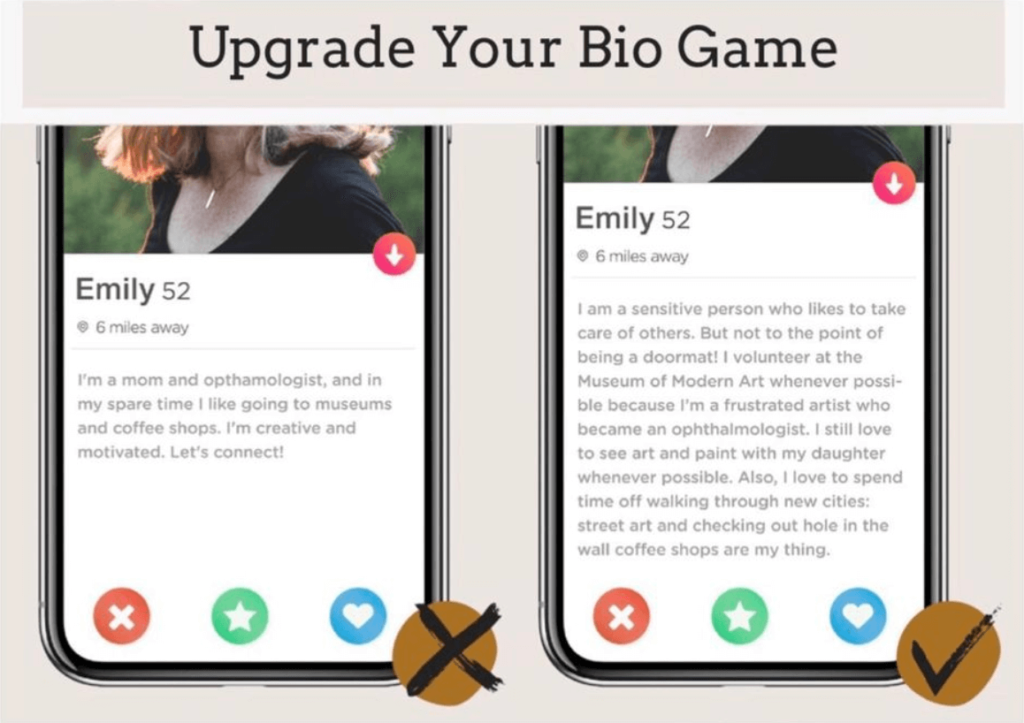
Dinnen occasionally posts sample dating profiles to her 30K+ followers on Instagram. She created this dating profile example for women to learn the dos and don’ts of writing a bio:

Upgrade your online dating profile.

Original: I’m a mom and ophthalmologist, and in my spare time I like going to museums and coffee shops. I’m creative and motivated. Let’s connect!

Upgrade: I am a sensitive person who likes to take care of others. But not to the point of being a doormat! I volunteer at the Museum of Modern Art whenever possible because I’m a frustrated artist who became an ophthalmologist. I still love to see art and paint with my daughter whenever possible. Also, I love to spend time off walking through new cities: street art and checking out hole in the wall coffee shops are my thing.

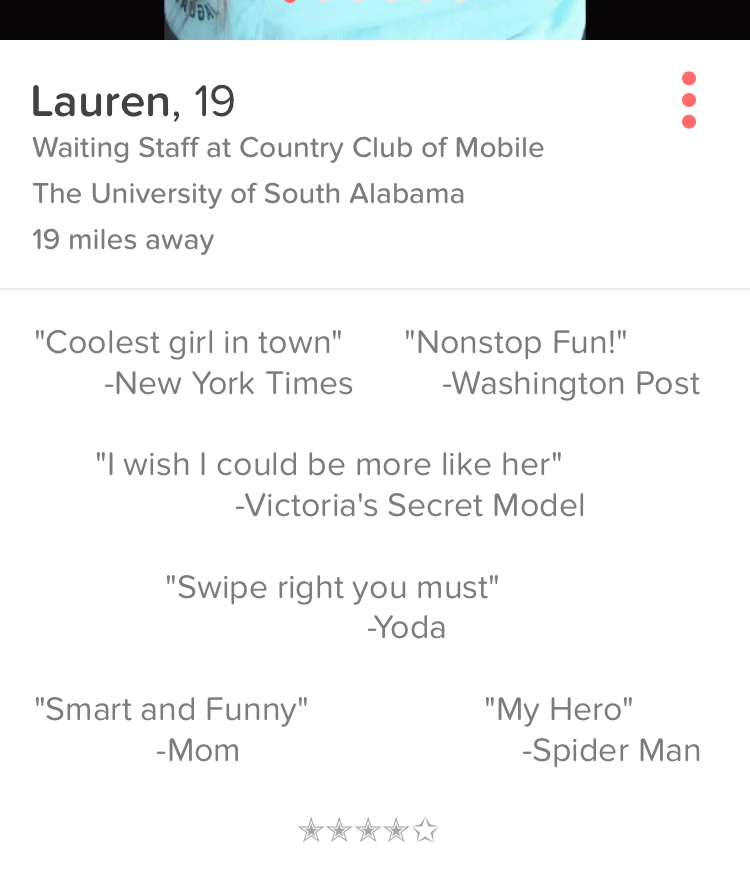
Here are some examples of other female Tinder profiles that commenters on the Everything about Tinder subreddit deemed positive:

Some examples of good dating profiles.

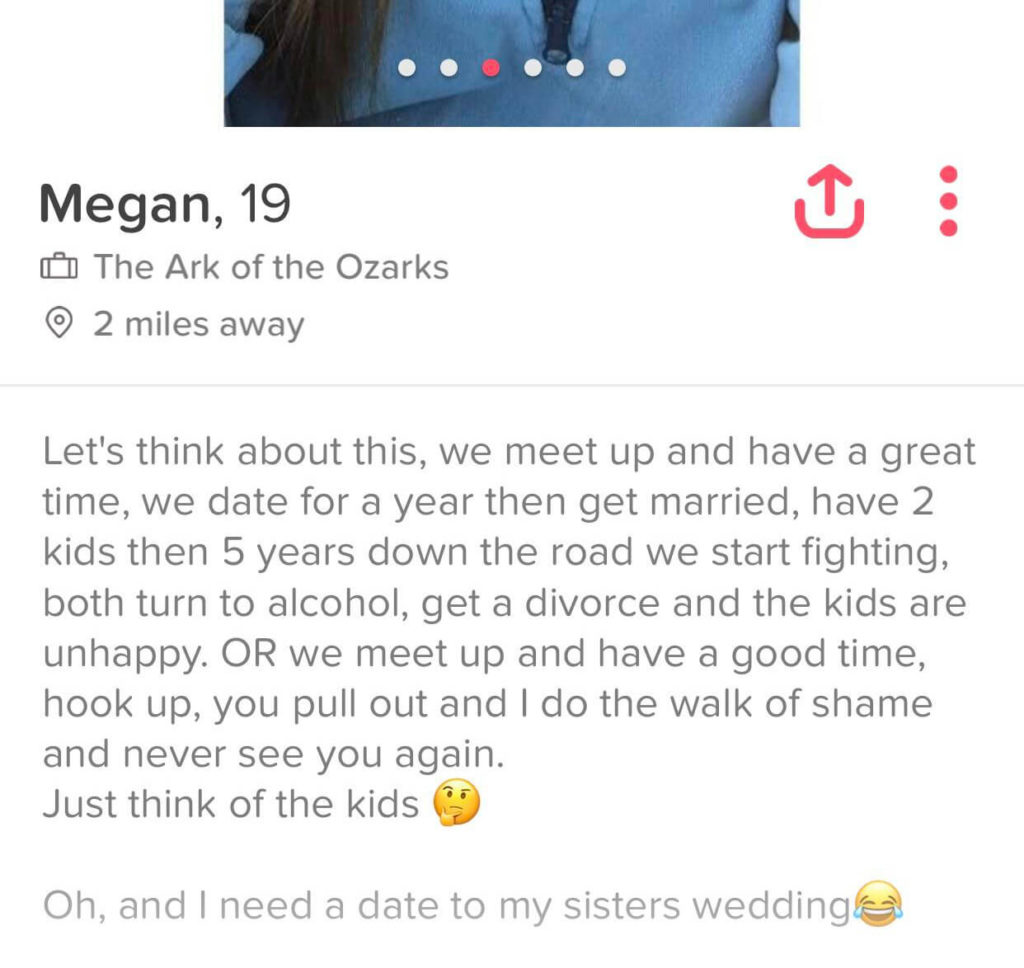
Megan, 19:

Let’s think about this, we meet up and have a great time, we date for a year then get married, have 2 kids then 5 years down the road we start fighting, both turn to alcohol, get a divorce and the kids are unhappy. OR we meet up and have a good time, hook up, you pull out and I do the walk of shame and never see you again.

Just think of the kids

Oh, and I need a date to my sisters wedding

Some examples of good dating profiles for Tinder.

Worried about online dating safety? You can always run a background check.

Liz, 21:

Midwest lady working in Orlando. I probably swiped right if I saw motocross, animals, or cool beards.

The quickest way to my heart is through my rib cage.

Some examples of good dating profiles for Bumble.

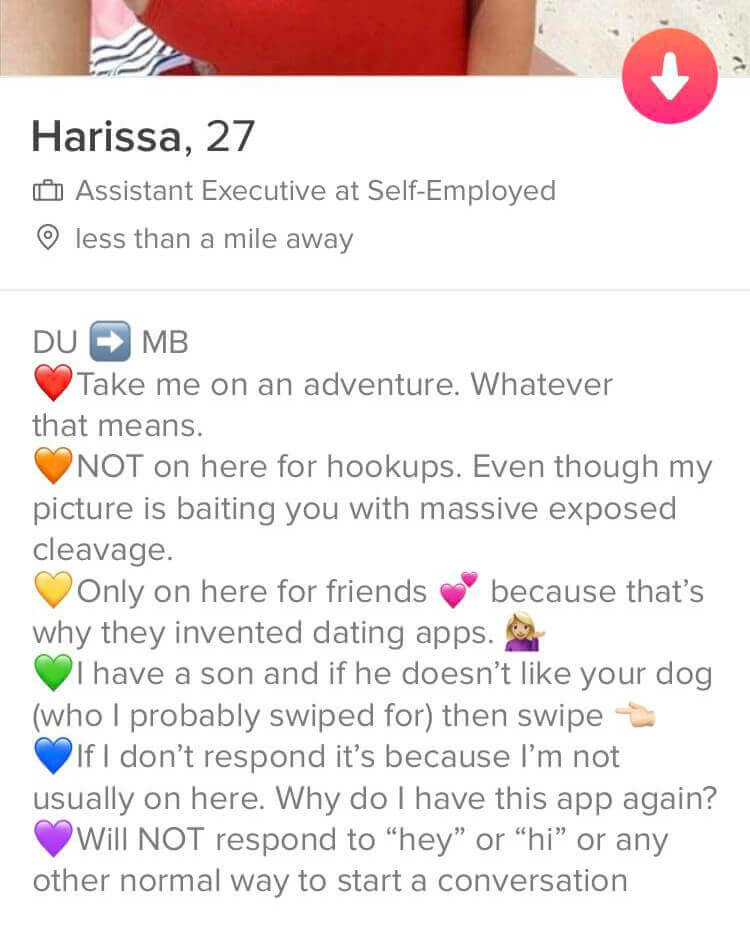
Harissa, 27:

Take me on an adventure. Whatever that means.

Not on here for hookups. Even though my picture is baiting you with massive exposed cleavage.

Only on here for friends because that’s why they invented dating apps.

I have a son and if he doesn’t like your dog (who I probably swiped for) then swipe

If I don’t respond it’s because I’m not usually on here. Why do I have this app again?

Will NOT respond to “hey” or “hi” or any other normal way to start a conversation

Some examples of good dating profiles.

Tinder profile tips

Based on expert advice, here is a summary of their advice to help you create a good Tinder bio:

  • Paint a clear picture of who you are
  • Use a clear, smiling photo without sunglasses on
  • Avoid cliches
  • Focus on the niche aspects of your personality
  • Be positive and upbeat

Want to see how your profile stacks up? Check out this Reddit thread that provides a checklist for a good Tinder profile, and read more about how to choose photos for a dating profile:

Posts from the tinder
community on Reddit

Tinder reviews — is this dating app worth it?

20 Tinder bios for guys: Best profile examples

Bumble bio: Good examples for females

With 12 million active users,Bumble was started by one of Tinder’s founders who wanted to make a more women-friendly app in which female users are the only ones who can initiate a connection. Bumble’s reputation is that its users tend to be looking for a more serious commitment. 

Example #1: Showing vulnerability in your dating profile

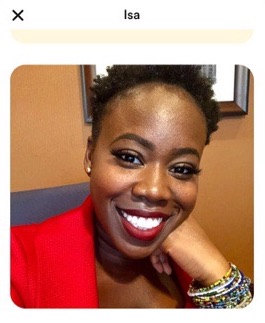
Isa Sesay, 33, of Washington, D.C., was frustrated with the pool of men she was dating when she created her first online dating profile in January 2021. Previously, Sesay had been focused primarily on her education so didn’t have a lot of experience dating in general. 

Sesay decided to enlist the help of dating and relationship coach Joyice Robinson to take her profiles to the next level. Robinson is the creator of Match Marry Mate, a coaching service that helps Black women successfully navigate relationships. 

“My work focuses on helping Black women tap into their feminine wisdom, set standards and boundaries, negotiate needs, and master communication with men,” Robinson says. 

Using a questionnaire of thought-provoking and lighthearted questions, plus a 2-hour “brain dump,” Robinson helped Sesay craft profiles on dating apps like Bumble, Hinge and OKCupid. Within hours, she had dozens of matches.

“She was able to pull out the best parts of my personality while still giving a well-rounded view of who I am as a woman,” Sesay says. 

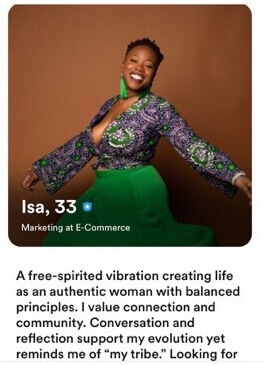
Sesay has had the most positive response on Bumble and likes its “ladies first” approach to dating. Check out her profile here: 

This is a screenshot of a woman's Bumble dating profile.
This is a full body photo from a woman's online dating profile wearing a yellow and black dress.
This is an excerpt from a woman's Bumble dating profile about what she's known for.
This is an example of a Bumble dating profile and picture.
This is an excerpt from a woman's Bumble dating profile about her hobbies.
This is a headshot photo from a woman's online dating profile.

A free-spirited vibration creating life as an authentic woman with balanced principles. I value connection and community. Conversation and reflection support my evolution yet reminds me of “my tribe.” Looking for an accountable man who is ambitious, generous, and values thoughtfulness with care.

I’m a real nerd about…

The fusion of history, culture, and cuisine electrifies my mind and soul. Do you know how mofongo and fufu are connected?

I’m known for…

Car concerts and dance breaks — they are my jam! When the beat drops my body freely moves for joy and release.

“Most men that match with me on Bumble are men I would likely talk to in real life — educated, business-minded, community-focused and visually well put together. I never see a match that I don’t match with first, so naturally, I see men that I am attracted to with shared interests in my DMs, and that makes me happy.”

Bumble also has a friendship feature —one of the best friendship apps.]

Robinson says Sesay’s profile is successful because it includes what she likes to call the four Vs:

  1. Vulnerability: She confesses how things make her feel.
  2. Vision statement: She tells prospects what she wants.
  3. Values: She is clear on what is valuable to her.
  4. Visualization: The language in her profile tells the same story as the pictures she’s using.

“Dating profiles should be attractive and inviting. Being vulnerable and declaring your personal values invites prospects to desire to know you more as a person,” Robinson says. “Creating vision and visualization attracts prospects to be more curious about who you are as a woman. The secret sauce is a woman’s ability ‘to be’ and to create.”

Example #2: Using your Bumble profile as a conversation starter

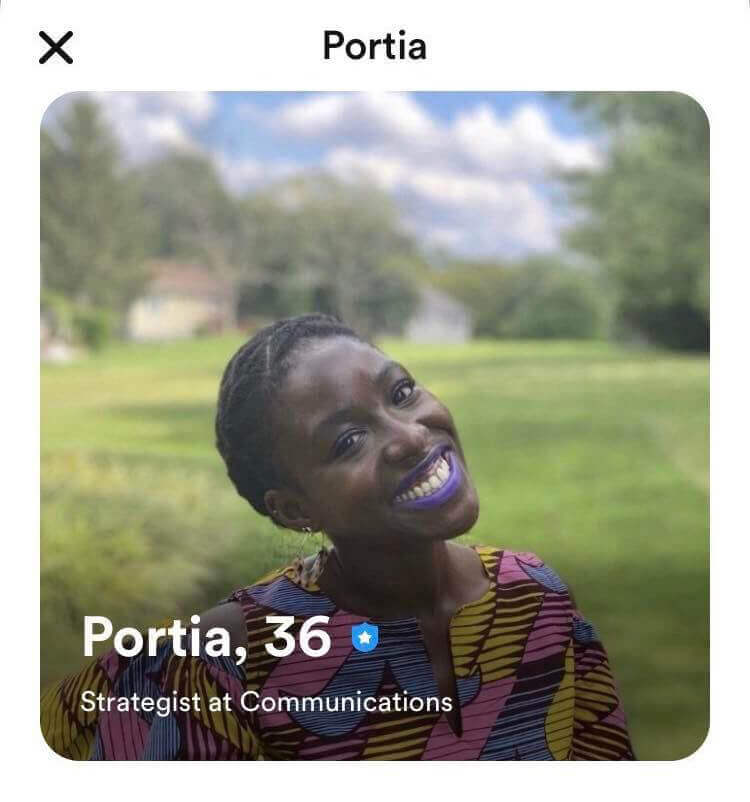
Another one of Robinson’s clients says she’s noticed a big change in the quality of matches since she revamped her profile.

“In my profile, my hint at a basketball or baseball game as a great date is the best conversation starter,” she says. “Men are reading my profile, and I’m attracting the NICEST men! They are thoughtful, very interested in me and inquire about my likes and hobbies. And the best part is that they take me out on fun dates where I can be my authentic self and have a wonderful time.”

Check out her profile:

This is a photo of a smiling woman with purple lipstick in an online dating profile.
This is a photo of a woman in a purple dress from an online dating profile.
This is a screenshot of a woman's Bumble dating profile about her interests.
This is a screenshot of a woman's Bumble dating profile about her best qualities.
This is a screenshot of a woman's Bumble dating profile bio.

My roots are in the best beaches of the most beautiful West African country; the sound of ocean waves mixed with afrobeats is my happy place. Bonus if you guess the right country . Looking for a kind and ambitious dance partner who is up for a dope time at a Silk Sonic concert.

I get way too excited about…

Going to live sporting events. I love the energy I feel at a Wizards or Nats game. Even better when I’m with a fun date.

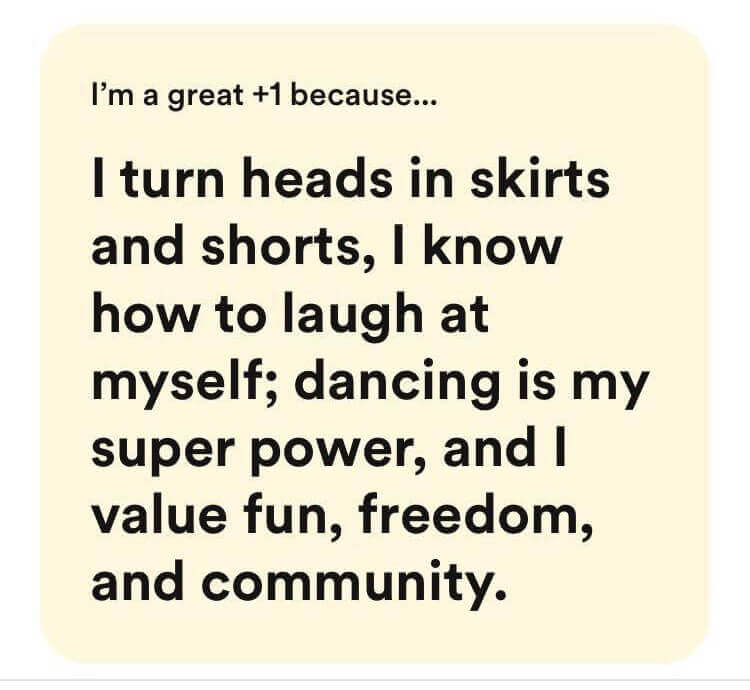
I’m a great +1 because….

I turn heads in skirts and shorts, I know how to laugh at myself; dancing is my super power, and I value fun, freedom, and community.

Bumble profile tips

  • Be your authentic, vulnerable self
  • Clearly communicate what you’re looking for
  • Use thought-provoking prompts that warrant a response
  • Express your values
  • Match your text to your images

If you want to see a guy’s perspective on what makes a good Bumble profile — as well as dating red flags — read through this Reddit thread:

Top 5 profile tips for girls from the other side
byu/Seatrout1738 inBumble

Interested in checking out other dating sites and apps? Here are some dating app reviews:

eharmonyZooskMatch.com
Elite Singles Adult Friend FinderBumble
Plenty of FishOKCupidChristian dating apps
Catholic dating sites

Also, check out our roundup of best dating apps and sites for single parents, as well as 11 hookup sites if that is your jam.

Hinge profile examples

Hinge bills itself as the “relationship app,” which means the people you meet on Hinge are more likely looking for serious partnership than casual dating or hookups. 
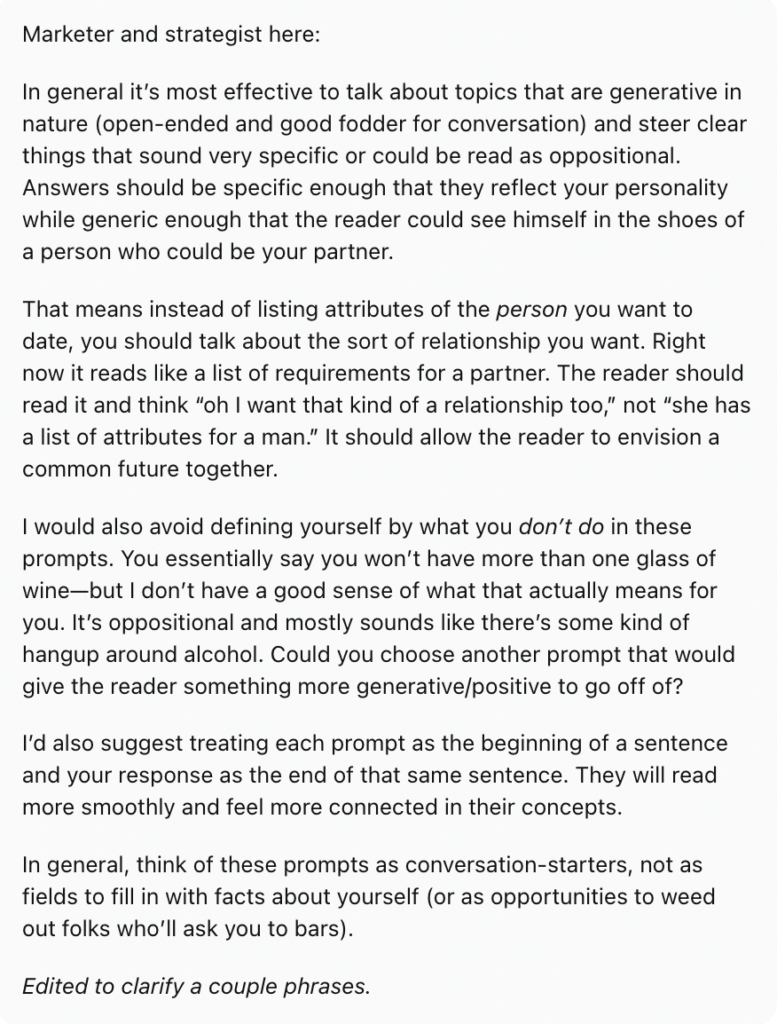
Here are some good Hinge profile examples and advice from Reddit:

Hinge profile example "my good side."
Hinge profile example "slept in the forest."
Hinge profile example about clean sheets.
How I got better quality matches
byu/justForFun957 inhingeapp
How to write effective prompts, a walkthrough
byu/aapox33 inhingeapp

This woman offered solid advice for a woman who was seeking feedback on her profile: 

Advice on Hinge profile example.

Worried about being catfished — or worse? How to catch a cheat and tips for safe online dating.

Examples of dating profile headlines for Hinge profiles

Hinge uses prompts to help you fill out your profile. 

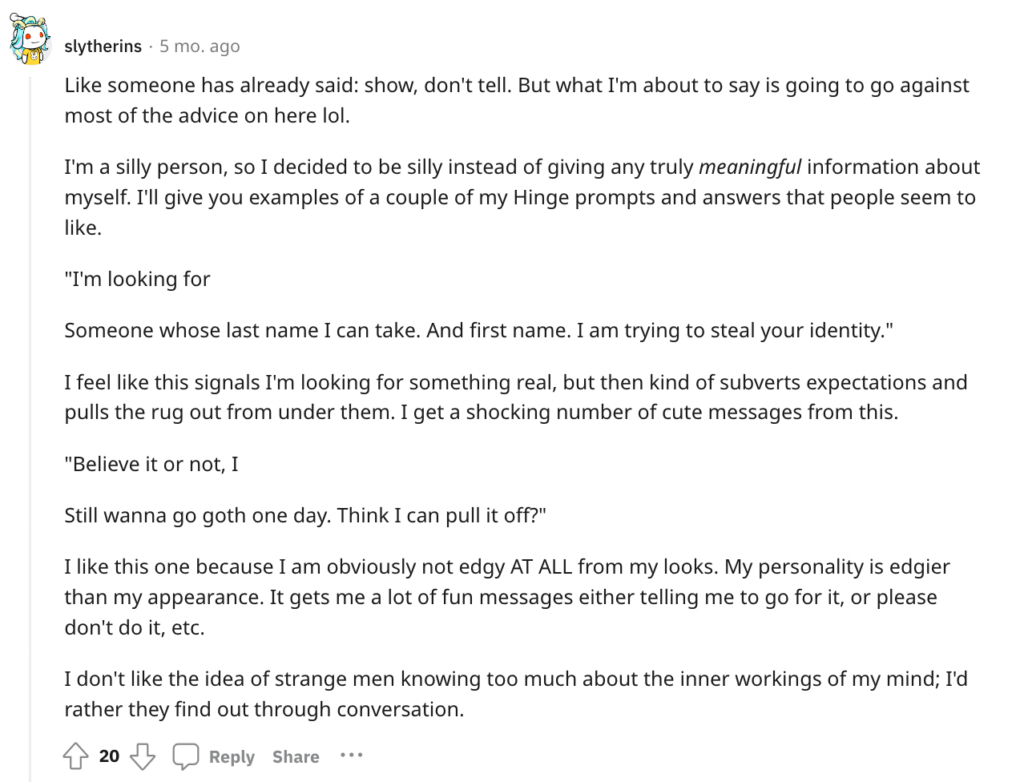
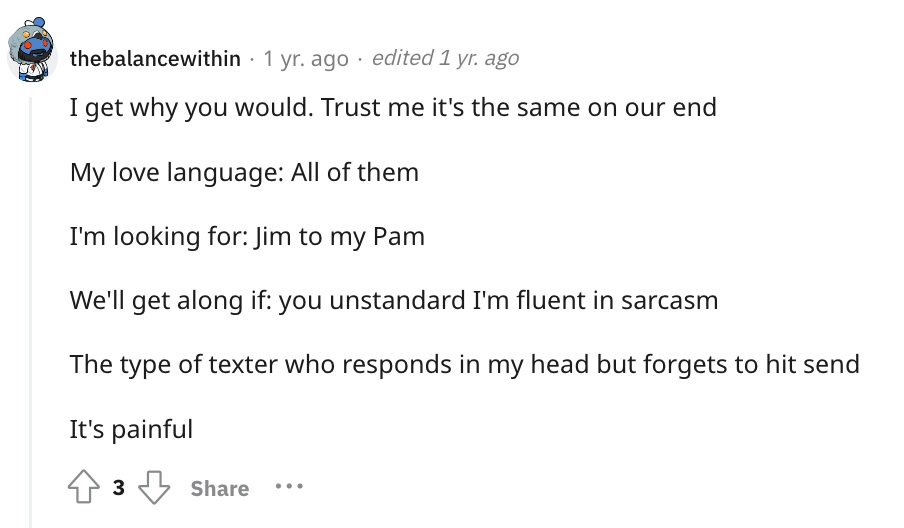
These are some of the best prompt responses and advice on how to write a good prompt, according to Redditors: 

Examples of dating profile headlines for Hinge.
Funny examples of dating profile headlines for Hinge.
Successful examples of dating profile headlines for Hinge.
Advice for dating profile headlines on Hinge.
Advice from Reddit for dating profile headlines on Hinge.

People also shared advice for what not to write in a Hinge prompt: 

Advice from Reddit for writing dating profile headlines on Hinge.
The Art of Storytelling: Your Comprehensive Guide to Prompt & Photo Selections for the Perfectionist
by inhingeapp
Advice for what not to say from Reddit on dating profile headlines for Hinge.
Advice for what not to write on dating profile headlines for Hinge.

Hinge profile tips

  • Use prompts that will start a conversation
  • Avoid cliches like loving to travel and exercise 
  • List niche interests to weed out unqualified matches
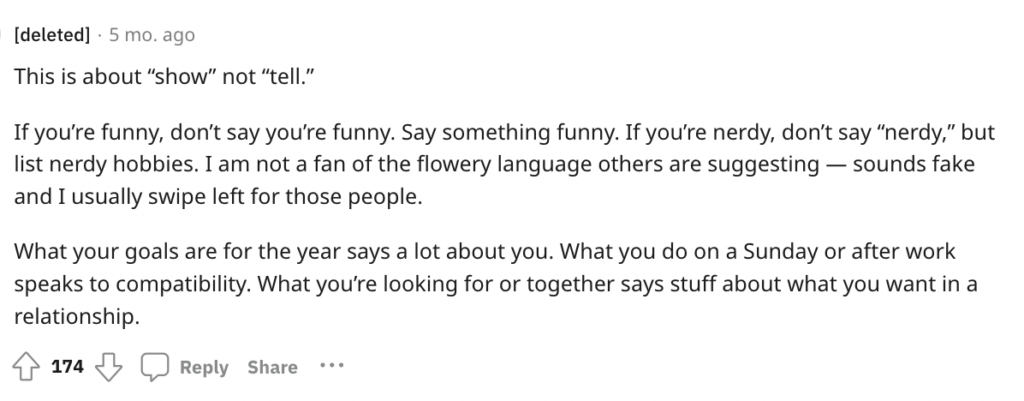
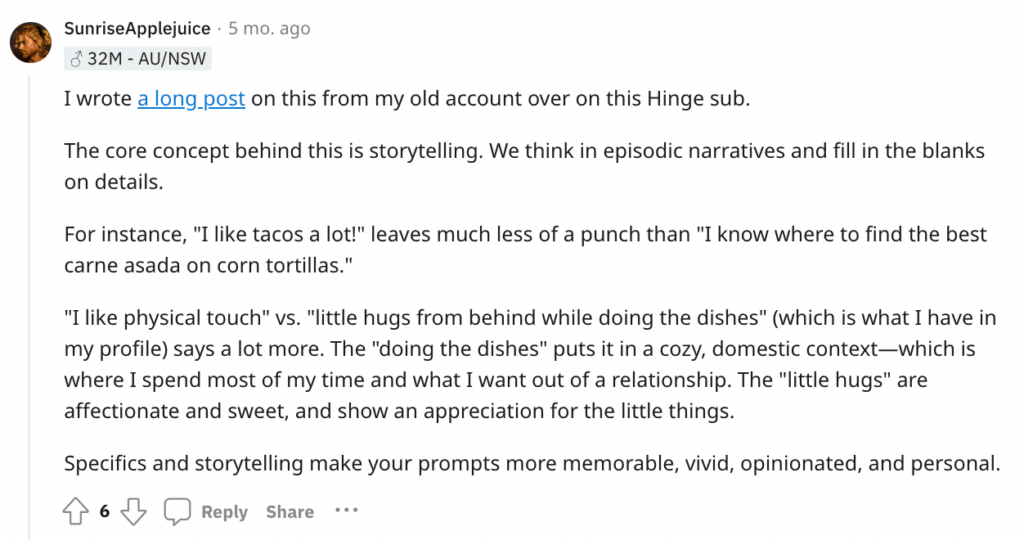
  • “Show” don’t tell what you like and who you’re looking for

Check out our post on how to write a dating profile bio.

[Older single moms dating younger men: What you need to know]

How do I make my dating profile stand out?

Margot Starbuck, author of Grown Woman’s Guide to Online Dating, says just being yourself makes you stand out. “Too many women write in their profiles that they love their dog, and the beach, and pumpkin spice latte. Nope! That vanilla profile sounds exactly like every other profile men are reading,” Starbuck says.

“The very best thing you can share in your profile is what makes you uniquely you. That’s the big win. Do you march for environmental issues? Have you been one of Beyonce’s backup dancers? Did you dress up like Wonder Woman for Halloween? Do you paint murals on buildings? Did you knit a sweater for Shaquille O’Neal? It doesn’t have to be flashy, it just has to be different than what thousands of other women are saying.”

When showcasing these unique experiences, you can enhance the memorability of your profile in a more tangible way. For example, wearing Custom Pins that represent your interests or values in photos—GSJJ custom enamel pins Canada can be quickly customized based on your passions or involvement in sports, music, travel, or charitable causes—makes your experiences more real and relatable. 

Compared to simply listing hobbies, using a small pin to present a slice of life or an interest is more likely to spark curiosity and resonate with the viewer. Upon seeing the pin, the other person might proactively inquire about the story behind it, naturally initiating a conversation. In this way, a profile is no longer just a collection of words, but a vivid self-presentation, subtly amplifying your uniqueness.

Schwartz suggests getting dating site users’ attention with action photos: You playing a sport, in a unique travel destination, or playing a musical instrument. “That can be a great conversation starter,” she says.

Why single parents should not put their kids first in dating

Examples of how to introduce yourself on a dating site

Not sure how to break the ice with your matches?

Robinson says an easy way to introduce yourself on a dating site is to use content from the person’s profile to connect. 

“If I read on a man’s profile that he’s a Knicks fan, I would use that to let him know what interests me and also to inform that match that I read his profile,” Robinson says. “And that is gold in the dating app world!”

She offered this example: 

Looks like we’re a match, (insert name). Last night the Knicks put on one hell of a show! 110-75… just wow! Are you still basking in the glory? Or do you like to keep it humble?

Once the conversation starts flowing, it might be tempting to dive into potential deal breakers — topics like income, kids, living situation, etc. But Robinson believes people should instead focus on learning each other’s personal values — what traits they’re looking for in a partner and what things are most important to them. 

“Many times, my clients (and their matches) learn that the gems are in a person’s why,” Robinson says. “Personal values allow us to explore why with the proper balance of empathy and assessment.”

She says this approach can help two people decide whether or not their values align and if they want to move forward. 

Another key step in developing a connection — either physical, emotional, or spiritual — is doing some research about the other person, whether it’s a full background check or something less formal. 

“In some cases, it makes sense to conduct a formal background check from the very beginning because of high-profile jobs, small children, or peace of mind,” Robinson says. “It is also fair to say that in our digital era, most people are gathering some informal background intel on you even if it’s just a Google or social media search.”

Bottom line: When in doubt, keep your profile short and sweet

Use these dating profile examples and advice from the experts to develop a standout dating profile. And remember, the goal is to introduce yourself and make an initial connection. You don’t need to tell people everything about you. That’s what your first date is for!

Share your experience

What is your experience? Does being specific about your income help or hurt your online dating prospects? What kinds of pictures or messages connect with people who YOU connect with?

Share in the comments!

How do I make my dating profile stand out?

According to Megan Starbuck, “The very best thing you can share in your profile is what makes you uniquely you. That’s the big win. Do you march for environmental issues? Have you been one of Beyonce’s backup dancers? Did you dress up like Wonder Woman for Halloween? It doesn’t have to be flashy, it just has to be different than what thousands of other women are saying.”

SOURCES:

  1. “Our 2025 Dating Trends Are In and This is What the Data Says,” Bumble.
    https://bumble.com/the-buzz/bumble-dating-trends-2025 ↩︎
  2. “What Makes The Perfect Dating Profile? 70% Of App Users Say This Trait Gives Them The ‘Ick’,” Forbes.
    https://www.forbes.com/health/dating/how-to-make-a-good-dating-profile/ ↩︎

Navigating legal challenges can be overwhelming, especially for single moms juggling multiple responsibilities. Whether you’re facing eviction, dealing with a custody dispute, or simply need legal advice, free and low-cost legal aid services are available to support you. 

“Many people are unaware of the plethora of resources and services that legal aid organizations provide, or the wealth of information available on their websites,” says Theresa Viera, a family law attorney and founder of Modern Legal in North Carolina. 

This comprehensive guide outlines key resources, eligibility requirements, and expert tips for finding the help you need.

General legal aid resources
Legal Services Corporation (LSC)
Online help: American Bar Association (ABA) Free Legal Answers
Pro bono legal services
State-specific legal aid organizations
Free legal aid resources by case type
Evictions, housing, and tenant Rights
Divorce and family law
Disability rights
For Veterans: National Veterans Legal Services Program (NVLSP)
Eligibility for Legal Aid
Steps to access legal aid
Additional tips
A final word

Paul Koenigsberg, founder of  Koenigsberg & Associates in New York City said first understand your situation and what you actually need. “A lot of organizations that offer free legal assistance are hyper-specific, meaning they are usually very particular about the cases they take,” he explains. “For example, an organization might only focus on family law, housing issues, domestic violence, or consumer rights.”

“Legal aid organizations are there to help you navigate the system when you can’t afford to pay,” says Alex Freeburg, a personal injury and criminal defense lawyer in Wyoming. “If you’re a single mom struggling financially, you may be eligible for legal aid and qualify for a program. Reach out to these services early—waiting too long can limit the assistance available. Don’t be afraid to apply, even if you think you might not qualify.” 

If you’re unsure what type of legal aid you need, Koenigsberg recommends National Legal Aid & Defender Association, which offers a directory of legal aid providers. 

Here are more resources to get started:

The Legal Services Corporation (LSC) is a crucial resource for low-income individuals seeking free legal assistance. Finding out if you’re eligible for LSC assistance is a good first step, says Koenigsberg.  Here’s what you need to know:

  • LSC is a federally-funded nonprofit organization that provides financial support to civil legal aid organizations across the United States.
  • It helps people living in households with annual incomes at or below 125% of the federal poverty guidelines. 
  • LSC-funded programs serve a diverse range of clients, including the working poor, veterans, homeowners, renters, families with children, farmers, people with disabilities, and the elderly. Notably, 70% of clients are women, many of whom are working to keep their children safe and families together.

Visit lsc.gov to search for local legal aid offices by state or zip code.

ABA Free Legal Answers is a virtual legal advice clinic that provides free online legal assistance to qualifying low-income individuals. This platform allows users to post civil legal questions to be answered by pro bono attorneys licensed in their state.

How It Works

  1. Users create an account and answer eligibility questions.
  2. Qualified users can post up to three legal questions per year.
  3. Volunteer attorneys licensed in the user’s state provide information and basic legal advice.
  4. Users can follow up with attorneys on each question as needed.

Scope of services

ABA Free Legal Answers covers a wide range of civil legal issues, including:

  • Family law
  • Divorce and custody
  • Housing and eviction
  • Consumer rights
  • Employment and unemployment
  • Health and disability
  • Civil rights
  • Education law

The platform does not handle criminal law matters.

Eligibility

To qualify for the service, you must:

  • Earn less than 250% of the Federal Poverty Guidelines
  • Not be currently serving a criminal sentence
  • Have less than $10,000 in total assets

These are the 2026 Federal Poverty Guidelines:

Number of people in family/householdAnnual income
1$15,960
2$21,640
3$27,320
4$33,000
5$38,680
6$44,360
7$50,040
8$55,720

For families/households with more than 8 people, add $5,680 for each additional person.

Visit abafreelegalanswers.org for more information.

“A lot of private attorneys offer their services for free through pro bono programs, like the American Bar Association’s Pro Bono Program, or local bar associations. Some specialize in family law or have a passion for helping people in tough situations,” says Koenigsberg. 

Check with the American Bar Association: They have a page dedicated to free legal help. 

Contact your state’s bar association: “Most states have a bar association that will connect you with lawyers who offer pro bono services. It’s very simple—just start with a Google search like ‘State Bar Association’ + your state,” says Freeburg. “You’ll be surprised at how many lawyers are out there willing to help for free.”

Search for legal clinics in your community: “Some clinics are even run by nonprofits or church groups,” Freeburg adds. “These clinics pair you up with law students supervised by experienced attorneys who can give you guidance and advice.”

Contact local law schools: “I also suggest getting in touch with local law schools to check if they run any free legal clinics,” says Freeburg.” These clinics pair you up with law students (supervised by experienced attorneys) who can give you guidance and advice. 

Getting help from serious injury lawyers in cases involving complex litigation provides victims with the resources needed to challenge powerful insurance companies. Partnering with a dedicated personal injury lawyer ensures that every procedural detail is handled with the expertise required to secure a favorable settlement. This strategic approach to legal representation helps individuals focus on their physical recovery while their financial future is managed by professionals.

Check with your local library: “Another way to get help straight from your community is by driving to your local library or community centers since they sometimes have resources or can point you in the right direction,” says Freeburg. “They might even have printed directories or staff who can help you navigate.”

Call local law firms: Viera recommends reaching out to local family law firms and asking if they provide pro bono services. If they don’t, she says, ask their recommendation for what organization to contact.

Every state has a network of legal aid organizations, often funded by LSC or local government programs. 

Examples:

These organizations provide free or low-cost legal assistance to eligible low-income individuals in their respective states. Each organization typically covers various areas of civil law, including housing, family law, public benefits, and consumer issues.

To find state-specific organizations, visit LawHelp.org and search by your state or legal issue. 

Further, Theresa Viera, a family law attorney and founder of Modern Legal, says in North Carolina, where she practices, there is a self help center at the Mecklenburg County Courthouse. 

To search for a legal self help center in your state, you can try Googling “legal aid” + your county or state name.

Legal aid organizations often specialize in specific areas of law to provide targeted assistance to those in need. Below, some of the most common types of cases where free legal aid is available, along with resources and expert advice for each category:

Evictions, housing, and tenant Rights

“Start with a centralized legal aid organization for housing-related issues,” recommends Theresa Viera, a family law attorney and founder of Modern Legal. She points out that housing is often a part of a legal issue such as divorce or family law. “Housing is very much a factor in whether an individual can safely leave their marriage, particularly when children are involved.”

To find a legal aid organization that specializes in housing-related issues, start here:

United States Department of Housing and Urban Development (HUD) Tenant Rights Resources

HUD’s tenant rights organization funds legal programs to support tenants facing eviction or housing discrimination. Their resources include:

  • Information on tenant rights and responsibilities
  • Guidance on fair housing laws and how to file complaints
  • Resources for rental assistance programs
  • Links to local Public Housing Authorities
  • Information on housing counseling services

Visit HUD Tenant Rights for comprehensive information and assistance.

Free and affordable housing for single moms

Help with security deposits

Eviction Lab at Princeton University

This organization provides state-specific data and resources on eviction policies. Key features include:

  • National Eviction Map with data from 2000 to 2018
  • Eviction Tracking System for real-time eviction trends in 34 cities and 10 states
  • Research on eviction patterns and their impact on communities
  • Tools for policymakers and advocates to understand and address the eviction crisis
  • Resources for tenants facing eviction

Visit evictionlab.org to access their extensive database and research tools.

Local Housing Authorities

How contact your local housing authority for tenant-specific legal support:

  • Visit the HUD website (hud.gov) and use their “Find Your Local Public Housing Agency (PHA)” tool. This allows you to search for housing authorities by state or zip code.
  • Call HUD’s Office of Public and Indian Housing programs (PIH) Customer Service Center at (800) 955-2232. They can help you locate your local Public Housing Authority and provide information about public housing and housing choice voucher programs.
  • Use HUD’s Resource Locator tool to find affordable housing opportunities and HUD-subsidized housing in your area.
  • For state-specific information, visit your state’s Department of Housing or Community Affairs website. For example, New Jersey residents can find a list of housing authorities on the New Jersey Department of Community Affairs website.
  • Contact your local government offices or community centers, as they often have information about local housing authorities and resources.
  • Use online directories like LawHelp.org or the American Bar Association’s website to find legal aid organizations that can assist with housing issues and connect you with local housing authorities..

Divorce and family law

Navigating divorce and family law issues can be particularly challenging. Fortunately, there are several resources available to provide free or low-cost legal assistance in these areas.

For child support & child custody issues

State organizations involved in child support issues, like the North Carolina Department of Health and Human Services Child Support Enforcement department, can refer you to low-cost or pro bono family law attorneys. 

“If someone is already working with child support enforcement, then they can follow up with their assigned caseworker for further assistance on any child support-related claims,” Viera recommends. “If not, they should find the government office in their area by searching ‘child support enforcement office’ and their county or city name.”

Viera suggests contacting your state’s bar association or reaching out to a local family law firm to ask about pro bono services (or recommendations for organizations to contact). Many states have specialized children’s law centers that can provide assistance with custody issues. 

On a national level, Viera notes that the American Bar Association has a state-by-state list of children’s law centers 

How to prepare for divorced without an attorney

Credit repair after divorce

Best online divorce services

For other divorce & family law issues: Women’s Law Initiative

The Women’s Law Initiative offers resources and referrals for low-income women navigating divorce and family law. This organization provides state-specific legal information, referrals to local lawyers and organizations, and safety planning tools for women dealing with domestic violence. Visit womenslaw.org to access help. 

Additional resources:

  • Legal aid organizations often have family law divisions. Use LawHelp.org to find services in your area.
  • Many courts offer self-help centers with resources for family law cases. Check your local courthouse website or call for information.
  • Domestic violence shelters frequently offer legal advocacy services for family law matters related to abuse.

Disability rights

“Legal aid for disability-related cases includes disputes over Social Security Disability Insurance (SSDI), accessibility rights, and discrimination,” explains Freeburg.

Resources include:

  • The National Disability Rights Network (NDRN): Provides free legal help for disability-related cases such as discrimination or Social Security appeals. Visit ndrn.org for more information.
  • The Disability Rights Legal Center (DRLC): Specializes in cases related to disability rights violations. Visit drlcenter.org for assistance.

For Veterans: The National Veterans Legal Services Program (NVLSP)

Freeburg advised veterans to reach out to specialized organizations like NVLSP, which offers free legal help for VA benefits and disability claims. Visit nvlsp.org. for more information.

More resources for veterans: 

Run by the Department of Veterans Affairs (VA) itself, this is a newer initiative that provides grants to various organizations to offer legal services to eligible veterans. The LSV program covers a broader range of legal issues, including housing law, family law, and income support, among others. To contact them:

  • Visit the VA’s LSV website at www.va.gov/homeless/lsv.asp for the most up-to-date contact information.
  • Email LSVGrants@va.gov for general inquiries about the LSV grant program.
  • Use the VA locator tool at www.va.gov/directory to find your nearest VA Medical Center and contact them for information about local LSV services.

Low-income home loans (VA)

Stateside Legal is an online resource dedicated to providing legal assistance and information for military members, veterans, and their families. Key features include:

  • Free legal information on various topics relevant to the military community
  • Self-help tools and forms for common legal issues
  • A directory of local legal aid providers specializing in military and veteran cases
  • Resources on state-specific laws affecting service members and veterans
  • Information on federal and state benefits available to veterans and their families

The website covers a wide range of legal topics, including:

  • Military discharge upgrades
  • Veterans benefits claims
  • Family law issues for service members
  • Housing and foreclosure prevention
  • Employment rights for veterans and service members
  • Consumer protection for military families

Stateside Legal also offers guides on how to find free legal help and navigate the legal system.

Visit statesidelegal.org for resources.

Most legal aid organizations serve individuals who cannot afford private legal representation. Eligibility criteria may include:

Income limits:

  • Legal aid is typically available to households earning up to 125% of the Federal Poverty Guidelines (FPG).
  • Some programs accept applicants earning up to 200% of FPG for critical cases.

Asset considerations:

  • In addition to income, legal aid providers may assess assets such as savings or property. It’s wise for individuals to compare savings accounts to ensure they’re maximizing returns while staying within legal aid eligibility limits.

Legal aid primarily addresses civil cases, including:

  • Housing and eviction disputes
  • Family law issues (divorce, custody, child support)
  • Public benefits disputes (e.g., Medicaid, SSI)
  • Consumer rights and employment issues
  • Immigration cases (asylum, deportation defense)

Navigating the process of obtaining free legal aid can seem daunting, but there are clear steps you can take to find the assistance you need. “Start with legal aid societies and check if you’re eligible for the programs,” says Freeburg. “Legal aid organizations exist for a reason. They’re there to help you navigate the system when you can’t afford to pay.”

  1. Start by contacting a local legal aid office
    “Identify and contact a legal aid office as soon as possible,” Viera recommends. She also offers this important tip: “Erasing your browser history and cache after each search is a good precaution if you’re in an unsafe situation.”

Use the LSC’s Find Legal Aid tool or visit LawHelp.org to locate nearby services.

  1. Check with local bar associations
    Koenigsberg advises that finding pro bono legal services can be straightforward. He recommends conducting an online search for your state’s bar association, as these organizations typically maintain connections with attorneys offering free legal assistance. For instance, you could search for “State Bar Association” followed by the name of your state to locate relevant resources.
  1. Attend free legal clinics
    Freeburg highlights that free legal clinics are often operated by nonprofits and religious organizations. These clinics typically match individuals with law students who work under the supervision of experienced attorneys, providing valuable legal guidance and advice. To find these clinics in your area:
  • Search online using terms like “free legal clinic” or “pro bono legal services” along with your city or county name.
  • Contact local law schools to inquire about their clinical programs or community outreach initiatives.
  • Reach out to community centers, libraries, or places of worship, as they may host or know about such clinics.
  • Check with your local bar association for information on pro bono clinics in your area.
  • Visit LawHelp.org and search for resources in your state.
  • Remember to erase your browser history after searching if you’re in a sensitive situation.
  1. Prepare your documents
    “Once you find the perfect legal assistance solution, it’s best to have your documents all in order. This can include court papers, leases, pay stubs, or custody agreements,” advises Koenigsberg. “Pro bono lawyers tend to be very busy, and having strong documentation can greatly facilitate your case.”

Additional tips

  • Erase your browser history after searching for legal aid resources, especially if you are in an unsafe situation.
  • Don’t hesitate to ask for help from community centers, libraries, or domestic violence shelters.
  • Apply early to legal aid programs, as demand is often high, and services may have waiting lists.


Estate planning and wills for single parents: What you need to know now

A final word

Jamie E. Wright, founder of The Wright Law Firm in Los Angeles, emphasizes:

“Getting free legal aid as a single mom might feel like a daunting task, but there are resources designed to support you. Don’t hesitate to ask for help—these programs are here to ensure you have the support you need. You’re already juggling so much; let these resources take some of the burden so you can focus on creating a better future for yourself and your kids.”