scroll top

A flight attendant with a few years at a major airline can clear $60,000 a year while spending half her nights in hotel rooms across four continents, and none of it required a ring light or a single sponsored post. A cruise ship steward pulls in modest base pay, but rent, food, and a plane ticket home are already covered, which is why crew members who work the tip-heavy jobs can bank almost everything they earn.

Social media travel content made it look like there were only two ways to see the world for free: get famous enough that brands pay you to post from a beach, or save for years and take two weeks off. There’s a whole category of ordinary jobs that most people scroll straight past: real paychecks, real employers, and travel built into the job description instead of bolted on as a side hustle.

None of these require an audience. Some need a specific license. A few need nothing more than a clean background check and a willingness to live somewhere your mail can’t find you for a few months at a time.

Flight attendant

Flight attendant
Image Credit: Shutterstock

Airlines need people in the sky constantly, and they’ll train almost anyone who clears the background check and completes a few weeks of FAA-mandated safety instruction. The median flight attendant earns $63,580 a year, a number that sits comfortably above the median wage for all U.S. occupations before you even count the flight benefits.

Those benefits are the real draw. Most airlines let flight attendants and their immediate family fly standby for free on nearly any route the airline serves, plus discounted travel on partner carriers. A flight attendant based in Chicago can work a three-day trip to Tokyo, then use a day off to catch a nearly empty flight to Rome. The job itself is physical: pushing beverage carts, lifting bags into overhead bins, standing for hours, and managing passengers who are tired, drunk, or terrified of flying. Schedules are unpredictable, and holidays off are rarely guaranteed.

Airlines hire in waves, and application windows open and close with little warning, so getting in takes patience. Once hired, seniority decides nearly everything: better routes, better schedules, and first pick of the destinations everyone else is still hoping to land.

Cruise ship crew member

Cruise ship crew member
Image Credit: Shutterstock

Cruise lines hire tens of thousands of people a year for jobs that have nothing to do with steering the ship: bartenders, cabin stewards, spa staff, entertainers, photographers, and dozens of other hospitality roles that keep a floating city running. Average pay for cruise ship crew runs around $49,000 a year, which looks modest next to a land-based salary until you account for what it doesn’t include: rent, groceries, utilities, or a commute.

Contracts typically run six to eight months at sea, followed by weeks or months off between assignments. Crew live in shared cabins below deck, eat in a crew mess, and work long hours with few days off during a contract, which is the tradeoff for near-zero living expenses. Service roles like servers and bartenders often earn more from pooled gratuities than from base pay, so a fast, friendly crew member on a busy ship can out-earn the posted average by a wide margin.

The itinerary changes every week or two, and crew usually get shore leave in port, which means a cabin steward on a Caribbean route can see six or seven countries a month without ever booking a flight of her own.

Travel nurse

Travel nurse
Image Credit: Shutterstock

Hospitals nationwide run short-staffed in specific units at specific times, and travel nursing exists to fill that gap fast. Staffing agencies place registered nurses on 13-week contracts wherever a hospital needs coverage, and the average travel nurse currently earns around $2,052 a week, with housing stipends, travel reimbursement, and often a completion bonus stacked on top of that base pay.

The requirements are steeper than most jobs on this list: an active RN license, usually a year or two of hospital experience, and the flexibility to relocate every three months. High-demand specialties like ICU, operating room, and labor and delivery tend to command the highest weekly rates, while general medical-surgical assignments pay somewhat less. Nurses can request specific states or cities, chase warm weather in winter, or simply follow wherever the pay is best that quarter.

The lifestyle isn’t for everyone. Moving every three months means learning a new hospital’s systems, new coworkers, and sometimes a new state’s licensing rules from scratch. But for a nurse willing to live out of a couple of suitcases, it’s one of the few healthcare jobs that pays extra specifically for being willing to go.

English teacher abroad

English teacher abroad
Image Credit: Shutterstock

Countries across Asia and the Middle East have spent decades recruiting native and fluent English speakers to teach in public schools, private academies, and universities, usually asking for nothing more than a bachelor’s degree and a TEFL certificate. In South Korea, one of the most established markets for this kind of work, teachers typically earn $1,500 to $2,500 a month with free housing included, which stretches further than it sounds once rent is off the table entirely.

Contracts usually run a full year, with flights reimbursed at the start or end of the term and national health insurance included in many public school placements. The tradeoff is a real commitment: this isn’t a working holiday, it’s relocating for twelve months minimum and learning to navigate a new culture, and often a new alphabet, just to read a menu.

Pay varies widely by country and school type. Public school programs tend to offer stability and a slower pace, while private language academies pay more per hour but demand evening and weekend classes. Gulf countries like the UAE pay the most, often tax-free, but usually require a licensed teaching credential rather than a TEFL certificate alone.

Au pair in Europe

Au pair in Europe
Image Credit: Shutterstock

Host families across Europe hire au pairs, mostly young adults in their late teens through twenties, to help with childcare in exchange for a private room, meals, and a modest monthly allowance. In France, the standard rate for a legally registered au pair is around 320 euros a month, or roughly $329, on top of free housing and meals, with a visa built specifically for this kind of cultural exchange rather than a standard work permit.

The money alone won’t make anyone rich. This is a lifestyle arrangement more than a career move: months spent living with a family, picking up a new language through daily immersion, and using free afternoons to explore a new country on foot instead of through a bus window. Most host families expect 25 to 30 hours of childcare a week, well under a standard full-time schedule.

Placement runs through agencies or platforms that match au pairs with families, and requirements vary widely by country: some cap working hours tightly, others mandate language classes as part of the arrangement. Germany, Spain, and Sweden are among the more accessible options for first-timers.

Yacht crew

Yacht crew
Image Credit: Shutterstock

Private and charter yachts anchored in the Mediterranean, the Caribbean, and increasingly Southeast Asia need deckhands, stewards, chefs, and engineers willing to live aboard for months at a stretch. An entry-level deckhand with no prior experience can start around 2,500 to 3,000 euros a month, tax-free, with accommodation, food, and uniforms covered by the yacht.

No formal education is required to get started, though most crew complete a short, mandatory safety course before their first contract. What actually gets people hired is a strong work ethic and the ability to follow instructions under a captain who runs a tight ship, literally. Deckhands scrub, polish, drive tenders, and help guests with water toys; stewards and stewardesses handle interior cleaning, laundry, and formal table service for owners and charter guests who expect five-star treatment.

The lifestyle is intense. Crew often work six or seven days a week during charter season with limited personal time, and quarters below deck are tight. But the destinations are the appeal: a season on a Mediterranean charter yacht means waking up in a different port, from Monaco to Sardinia to Mykonos, every few days, without paying for a single night’s accommodation.

Tour director

Tour director
Image Credit: Shutterstock

Tour companies that run multi-day guided trips, think escorted bus tours through Europe, national park loops, or river cruises, need someone on board full time to manage logistics, solve problems, and keep a group of strangers moving smoothly from one stop to the next. Median pay for tour and travel guides sits around $38,000 a year, which is modest, but the job comes with meals, lodging, and transportation covered for every day spent on tour.

Tour directors typically work seasonally or by contract, moving from one group to the next for weeks or months at a time before a break between assignments. The role demands patience above almost anything else: managing 20 to 40 travelers with different expectations, fielding complaints about hotel rooms, and staying calm when a bus breaks down three hours from the next city. Fluency in a second language and deep knowledge of a specific region both make candidates far more competitive.

Companies that specialize in one destination, say Italy, Peru, or Southeast Asia, often prefer directors who’ve spent real time living there, which makes this a job that tends to reward people who already travel independently before turning it into a paycheck.

Touring crew member

band crew member
Image Credit: Shutterstock

Every concert tour, from a theater run to a stadium spectacle, travels with a crew of technicians who load equipment in and out of venues, run sound and lighting, and keep the show on schedule night after night. Union touring crew positions on Broadway national tours, for one recent example, have posted weekly pay around $1,700, with travel and lodging covered by the production for the length of the run.

The work is physically demanding: long load-in days, overnight bus travel between cities, and shows that don’t stop for illness or a bad mood. Most crew members build specific technical skills first, audio engineering, lighting design, rigging, or backline work for musicians’ instruments, then land a touring gig through industry connections rather than a job board. Experience on smaller regional tours usually opens the door to bigger productions with better pay.

A tour can run for months, hitting dozens of cities across the country or overseas, which means crew members see more of a country’s mid-size cities than most residents do, just from inside a venue loading dock and a tour bus window.

Wind turbine technician

Wind turbine service technician
Image Credit: Shutterstock

Wind farms don’t get built near where the workers live, and once turbines are up, they need constant inspection and repair, often in remote stretches of the country far from any city. Median pay for wind turbine technicians was $64,120 a year in the most recent government wage data, in an occupation projected to grow faster than almost any other job the federal government tracks.

Technicians typically train through a postsecondary program lasting a year or two, then get hired by wind energy companies or specialized service contractors who send crews to project sites across multiple states or even internationally as new wind farms come online. Commissioning crews, the technicians who handle startup and testing of new turbines, travel the most, often spending weeks at a single site before moving to the next project.

The work itself isn’t for anyone afraid of heights: climbing hundreds of feet up a tower in a harness, working in tight nacelles at the top, and troubleshooting mechanical and electrical systems in every kind of weather. It pays well for a job that doesn’t require a four-year degree, and it puts technicians in rural corners of the country most people never see.

Merchant mariner

Merchant mariner
Image Credit: Shutterstock

Cargo ships, tugboats, ferries, and research vessels all need licensed crew to keep them running, and the maritime industry has struggled for years to find enough qualified sailors, engineers, and officers to fill open positions. Median pay across water transportation occupations was $71,860 a year in the most recent federal wage data, with captains and engineers earning considerably more than entry-level deckhands.

Entry doesn’t require a four-year degree. Many mariners start through a union apprenticeship or a maritime academy, then work their way up through Coast Guard-approved training and sea time toward higher licenses and better pay. Schedules typically alternate weeks or months on a ship with an equal stretch of time off, unlike almost any land-based job, which appeals to people who want long, uninterrupted breaks rather than a standard two weeks of vacation a year.

Routes vary from domestic inland waterways to deep-sea voyages that touch multiple continents in a single trip. Meals and berths are provided aboard ship, so living expenses drop close to nothing while on contract. It’s isolating work, weeks without setting foot on land, but for people who don’t mind their own company, it’s one of the more overlooked ways to see the world and bank real money doing it.

Airline pilot

Airline pilot
Image Credit: Shutterstock

Every commercial flight needs at least two pilots in the cockpit, and airlines have spent years working through a pilot shortage that’s kept demand, and pay, elevated. Median pay for airline pilots, copilots, and flight engineers was $232,140 a year in the most recent government wage data, making it one of the highest-paying jobs on this entire list.

Getting there takes real time and money up front: a private pilot’s license, instrument and commercial ratings, and enough flight hours, usually 1,500 under federal rules, to qualify for an airline transport pilot certificate. Most pilots build those hours as flight instructors or at regional carriers before moving to a major airline, where seniority eventually determines routes, schedules, and pay.

Once established, a pilot’s life is built around travel: multi-day trips with overnight layovers in different cities, flight benefits that extend to immediate family, and a schedule built in blocks rather than a standard five-day week. It isn’t a job anyone falls into casually. The training pipeline takes years and real money before the first airline paycheck arrives, but for people willing to put in that time, it remains one of the most reliable paths to both a six-figure income and a life spent airborne.

Foreign Service officer

Foreign Service officer
Image Credit: Shutterstock

The State Department hires career diplomats to staff embassies and consulates at more than 270 posts worldwide, rotating officers through new countries every two to three years for their entire career. Entry-level pay ranges from $45,290 to $132,354 a year depending on grade, education, and experience, with housing at most overseas posts covered separately from salary.

Getting hired is a long process: candidates pass a written exam, an oral assessment covering judgment and language ability, and extensive medical and security clearances before landing on a hiring register. Officers choose from five career tracks, political, economic, management, consular, or public diplomacy, and are expected to serve wherever the department needs them, which sometimes means a comfortable capital city and sometimes means a post with real hardship pay attached.

The perks are substantial for anyone who wants a life built around international travel: free or subsidized housing overseas, cost-of-living adjustments, home leave, and a pension after enough years of service. The tradeoff is control. Officers rank their preferences, and the department decides, which means saying yes to Manila one tour and Reykjavik the next, wherever the country actually needs someone.


While being a single mom can be very stressful, a few lifestyle adjustments can reduce daily decision fatigue. From parenting to household chores to work decisions, you can reduce unnecessary tasks to become more productive and enjoy time for yourself.

Support your mind and body

You can’t function well with brain fog and hunger pains, so get the right nutrition. Starting with a solid protein for breakfast means you’ll have a more sustainable morning meal that won’t make you crash.

Coffee can give you a nice perk, but it’s not a substitute for sleep. Time your caffeine intake well and ease down for 7 to 9 hours of restorative sleep each night.

If your balanced diet still isn’t providing all the vitamins, minerals, and antioxidants you specifically need, a good protein powder or supplemental gummy may help fill some gaps.

Based on research on common nootropic ingredients, switching to Mind Lab Pro may provide cognitive and performance support. Consider it for focus, decision-making, and clarity during a busy day.

Set some daily defaults

Forget trying to be Martha Stewart daily. Use a meal plan where you rotate a select number of ingredients and prep things ahead of time for the week. Consider meal services like HungaryRoot or Daily Harvest for a mix of prepped meals and raw ingredients tailored to your dietary needs.

Use the same streamlined approach with your morning routine. Create a capsule closet with 10 to 20 pieces you can mix and match in different combinations.

Automation can also be your friend. Quickly save by having chunks transferred to your checking account each pay period. Never worry about late fees again by automating recurring house bills.

Create your if-then rules and stick to them

Instead of repeated deliberation and arguments, have set if-then parenting rules. For example, if chores and homework aren’t done by a certain time, no phone or PlayStation for the night or week. ​

Establish communication channels for a co-parenting situation, as you both should both be on the same page.

For example, it’ll be more productive if both parents have similar or the same rules regarding:

  • Screen time
  • Curfews
  • Chores
  • Teen dating
  • Dietary restrictions like sugar-based treats

Utilize project batching

Instead of running around all day everyday, set a time for batch tasks. Select a day and a block of time to do errands. Give yourself an hour in the morning to respond to email or text messages.

Sunday evening may be a good time to do meal prep for the week. Monday morning may be a good start to the week by getting main paperwork and other administrative tasks out of the way.

Give yourself a 10- or 15-minute shutdown each night to make tomorrow’s start easier.

You may want to:

  • Set out your outfit
  • Get the coffee pot ready
  • Star the three most important tasks on tomorrow’s list

Make your days more chill

As a single mother, you have a lot on your plate, but you don’t have to stress yourself unnecessarily. Understand what to consolidate, what to remove from your life, and how to make things easier, so you have time to enjoy the big and the little moments.

​

You pay every bill, keep your balances low, and still get handed a mediocre interest rate on your car loan, while someone with a similar income and messier habits gets approved in minutes at a better rate. That difference usually isn’t luck. The scoring models behind the three-digit number a lender pulls before they ever talk to you drive 90% of lending decisions in the U.S., and that number is built almost entirely from your habits, not your paycheck.

Lenders can’t sit across from you and ask whether you’re responsible with money, so they read it off a report instead: how consistently you pay, how much of your available credit you’re actually using, how long your accounts have been open, how your bank account behaves when things get tight. Payment history carries more weight than anything else on that report, and it’s the easiest place to start.

Paying every bill on time, without exception

paying utility bill
Image Credit: Shutterstock

Payment history makes up 35% of your FICO Score, more than any other factor. That single number tells a lender almost everything they want to know before they read another line of your file. Not whether you carry debt, not how much you earn, just whether you do what you said you’d do, on time, month after month, across every account type you hold.

A single late payment doesn’t wreck a strong credit history, but it does register, and the damage gets worse the further behind you fall and the more accounts it happens on. What lenders are actually watching for is a pattern. One missed payment from years ago sitting next to years of on-time payments reads very differently than three missed payments in the last year. If you’ve had a rough stretch, the fix isn’t complicated. Get current, stay current, and let time do the rest. Late payments generally fall off your report after seven years, and the older they get, the less weight they carry against you in the meantime.

Keeping credit card balances well below the limit

credit card
Image Credit: Shutterstock

How much of your available credit you’re using counts almost as much as whether you pay on time. It’s the second biggest factor in your score, and most guidance says to stay under 30%, with anything under 10% providing an extra boost. A card with a $5,000 limit and a $4,000 balance says something very different to a lender than the same card sitting at $500.

This number gets recalculated every billing cycle, which is part of why it’s one of the fastest things you can improve. Paying a balance down before your statement closes, rather than just before the due date, can drop your reported utilization within a single month. If you’re carrying balances across several cards, spreading them thin looks better on paper than maxing out one and leaving the others untouched, even if the total dollar amount owed is identical. Scoring models look at both your overall utilization and the utilization on each individual card, so one maxed out account can drag your score down even while your total balance across every card looks reasonable.

Letting your oldest accounts stay open

close up of credit card
Image Credit: Shutterstock

Closing a credit card you don’t use anymore seems like harmless housekeeping, but it can quietly work against you. Length of credit history factors into your score, and an account closed in good standing stays on your credit report for 10 years anyway, so shutting it down early doesn’t erase anything. It just removes a card that was helping your average account age and your available credit.

Someone with three cards opened ten years, seven years, and two years ago has an average account age of roughly six years. Close the oldest one and that average drops noticeably, which can move your score more than people expect for something that looks like harmless cleanup.

If the card carries an annual fee you resent paying, that’s a fair reason to close it. If you’re closing it purely out of habit or because you’re not using it, consider leaving it open with a small recurring charge on it instead, like a streaming subscription, then paying it off automatically. That keeps the account active and the history intact without costing you anything extra.

Spacing out applications for new credit

Every time you apply for a credit card, a loan, or a limit increase, the lender pulls your file and it shows up as a hard inquiry. One inquiry usually costs you as little as five to ten points, and the effect fades within a few months even though the inquiry itself sits on your report for up to two years. On its own, that’s not much to worry about.

The problem shows up when several inquiries land close together. A cluster of new applications tells a lender you might be about to take on debt they don’t know about yet, which is exactly the kind of risk they’re paid to price in. If you’re shopping for a mortgage, auto loan, or student loan, most scoring models group inquiries made within a couple of weeks into one, so it pays to do that comparison shopping in a tight window rather than spreading it across months.

Carrying more than one type of credit over time

Credit mix, the variety of loan types on your file, makes up about 10% of your FICO Score. Lenders like to see that you can manage a revolving account, like a credit card, alongside an installment loan, like a car payment or a mortgage, because the two behave differently and require different kinds of discipline to keep current.

This isn’t a reason to take out a loan you don’t need just to diversify your file. It’s a small factor, and it matters far less than payment history or utilization. But it explains why someone who has only ever had one credit card, even a well managed one, sometimes scores lower than a person with a similar balance and payment record but a more varied file. If you already have a mix through an auto loan, a mortgage, or student loans, that’s working in your favor without you having to do anything else.

Automating your bill payments

Missed payments are rarely a money problem. They’re usually a memory problem. Only about 41% of Americans use autopay for their bills, and more than half of missed payments happen because someone simply forgot the due date, not because the money wasn’t there. Automating recurring bills removes that risk without requiring you to be more disciplined, just less reliant on memory.

The one real risk with autopay is overdrafting, especially if a payment posts on a day your account is running low. Stagger your due dates around payday if you can, keep a small buffer in checking, and set a low balance alert so you’re never caught off guard. Autopay isn’t a set it and forget it decision so much as a set it and check it occasionally one.

Start with the accounts that actually report to the credit bureaus, credit cards, auto loans, personal loans, before worrying about smaller recurring subscriptions that don’t affect your score either way. Those are the payments where consistency does the most work for you.

Paying more than the minimum whenever you can

pay of debt written on paper
Image Credit: Shutterstock

The average credit card interest rate sits around 19.56%, which means a balance you only pay the minimum on can take years to clear and cost far more than the original purchase. Beyond the cost, lenders and scoring models read a pattern of minimum-only payments as a sign you’re stretched thin, even if you never miss a due date.

On a $5,000 balance at that rate, sticking to minimum payments alone can stretch repayment past a decade and roughly double what you originally charged once interest is added up.

Paying extra, even a modest amount above the minimum, does two things at once. It shrinks your utilization faster, which helps your score directly, and it shortens how long you’re carrying a balance that’s working against you every month. If you can only put a little extra toward one card, put it toward the one with the highest rate first. That’s where the added cost is doing the most damage.

Keeping your debt-to-income ratio in check

Your debt-to-income ratio compares your monthly debt payments to your monthly income before taxes. If you pay $1,500 for housing, $100 for a car, and $400 on everything else, and you earn $6,000 a month before taxes, your debt-to-income ratio is 33 percent. This number doesn’t show up on your credit report, but it’s one of the first things a mortgage or auto lender calculates once you apply.

Unlike your credit score, debt-to-income isn’t a mystery you have to guess at. You can calculate it yourself in a few minutes, and lowering it comes down to two levers: pay down debt or increase income. Of the two, paying off a car loan or a personal loan usually moves the ratio faster than a raise does, because the whole payment disappears rather than being partially offset by taxes. Mortgage lenders in particular tend to want this ratio under 36 percent, though some loan programs allow more with a strong credit score or a larger down payment to offset the risk.

Building even a small emergency fund

emergency fund
Image Credit: Shutterstock

Lenders don’t see your savings account balance the way they see your credit report, but the habit still shows up indirectly, in how you handle a surprise expense without missing a payment somewhere else. Right now, just 47% of Americans have enough liquidity to cover a $1,000 emergency without going into debt for it.

An emergency fund doesn’t need to be six months of expenses to be useful. Even $500 or $1,000 sitting in a separate savings account is often the difference between a car repair that’s mildly annoying and one that turns into a missed rent payment or a maxed out card. Building that cushion protects the very routines, on-time payments and low balances, that lenders are already scoring you on.

The easiest way to start is the same trick that makes bill payments reliable: automate it. A recurring transfer of even $25 or $50 on payday builds this fund quietly, without asking you to remember or decide anything each month.

Keeping a steady, well-documented income

paying bills
Image Credit: Getty Images via Unsplash

Lenders want to see that your paycheck is going to keep showing up, not just that it showed up once. For a mortgage in particular, most guidelines call for reviewing about two years of employment history to judge whether your income is stable and likely to continue.

This is one reason a job change right before a big application can complicate things, even if the new role pays more. It matters even more if you’re self-employed or paid on commission, since lenders typically want two full years of tax returns before they’ll count that income at all, and any dip in earnings year over year invites more questions than a steady climb ever will. Staying in the same field, keeping documentation like pay stubs and tax returns organized, and being ready to explain any gaps in your work history all make an underwriter’s job easier. An easier file to underwrite is, in a very real sense, a more approvable one.

Keeping your housing payment proportionate to your income

The 28/36 rule is one of the oldest habits lenders look for, even when it isn’t a hard requirement. It suggests spending no more than 28% of your gross monthly income on housing costs, and no more than 36% on all your debt combined. Staying inside those numbers signals that you built in room for the unexpected instead of stretching to the top of what you could technically qualify for.

Plenty of people get approved above these ratios, especially with strong credit or a large down payment, but that approval comes with less flexibility every single month. Someone earning $6,000 a month who keeps housing near $1,680 has room left for a car repair or a slow month at work. Someone at $2,600 doesn’t. Keeping your housing cost proportionate to your income isn’t just a lender preference, it’s the difference between a mortgage payment you can absorb during a rough year and one that forces hard choices the moment anything else goes wrong.

Building reserves beyond your emergency fund

woman with savings
Image Credit: Shutterstock

Mortgage lenders often want to see cash reserves on top of your down payment and closing costs, measured in months of housing payments rather than a flat dollar figure. Dividing your eligible reserves by your monthly principal, interest, taxes, and insurance payment tells you how many months of reserves you have, and the requirement can range from none at all to six months depending on the loan and property type.


A borrower with $12,000 in eligible reserves and a $3,000 monthly housing payment has four months covered. Double the reserves and you’ve doubled the cushion without changing anything else about the loan.

These reserves don’t have to sit in a checking account earning nothing. Retirement accounts, investment accounts, and the cash value of life insurance can all count, which means this is less about hoarding cash and more about not being financially maxed out the moment you close. A borrower with a thin margin looks riskier than one with the same income and a visible cushion behind it.

Checking your own credit reports on a regular basis

You’re entitled to see exactly what lenders see, and it costs nothing. Free weekly credit reports from all three bureaus became a permanent program in 2023, which means there’s no good reason to go into a loan application without having already looked at your own file.

That matters because mistakes are more common than most people assume. One in five consumers has an error on at least one of their three credit reports, and some of those errors are serious enough to affect the interest rate they’re offered. Catching a wrong late payment or an account that isn’t yours before a lender does saves you from having to explain it under pressure during underwriting, or worse, getting quietly declined without knowing why.

Disputing an error costs nothing and starts with the credit bureau, not the original creditor. Pull all three reports rather than just one, since an error on one bureau’s file doesn’t necessarily show up on the others.

Thinking twice before co-signing anyone else’s loan

co-signed loan
Image Credit: Shutterstock

Co-signing looks like a favor with no real cost to you as long as the other person keeps paying, but the loan shows up on your credit report as if it were yours the moment you sign. If they miss payments, your score takes the hit too, and getting your name removed later is harder than most people expect. Private lenders reject about 90% of requests to release a co-signer from a loan.

That doesn’t mean co-signing is always a mistake. It means it should be treated with the same seriousness as taking out the loan yourself, because that’s essentially what you’re doing. Your income and existing debt get counted against the new loan too, so co-signing can quietly raise your own debt-to-income ratio right before you need it clean for something else. If you do co-sign, ask the lender in writing what the release process actually requires, and check in on the account regularly rather than assuming no news is good news.

Keeping your checking account in good standing

checking account
Image Credit: Shutterstock

Your banking history gets tracked separately from your credit history, through a reporting agency called ChexSystems, and it can follow you the same way. A history of overdrawn accounts can block you from opening a new checking account, much the way a history of loan defaults makes lenders unwilling to extend credit.

This one is easy to overlook because it doesn’t show up on the credit reports most people check. Repeated overdrafts, unpaid negative balances, and accounts closed by the bank itself for suspected fraud all get reported and can stay on file for years. Once a bank denies you an account over this history, most other banks that use the same reporting agency will too, which can leave you stuck with a second-chance account that charges more and offers less. Keeping a buffer in checking, setting up low balance alerts, and closing accounts properly rather than just walking away from them protects a part of your financial reputation that’s easy to forget exists.

Steering clear of payday loans and similar short-term credit

Payday loan application form
Image Credit: Shutterstock

Payday loans are marketed as a quick fix for a cash flow shortfall, but the cost is severe. The average annual percentage rate runs around 400%, largely because a flat two-week fee gets annualized into a number most borrowers never see written out plainly at the counter.

On-time repayment of a payday loan generally isn’t reported to the credit bureaus, so it does nothing to build your credit even if you pay it back exactly as agreed. A default, on the other hand, can land in collections and stay on your report for years. Borrow $400 with a typical fee and you can owe $460 in two weeks, and if you can’t cover that and roll it over, another fee stacks on top before you’ve touched the original amount. If you need short-term cash, a credit union payday alternative loan, a cash advance app, or a personal loan almost always costs a fraction of what a payday lender charges.

Building credit deliberately if you’re starting from zero

You can’t show a pattern of responsibility that doesn’t exist yet, so if you have thin or no credit history, the first move is building one on purpose rather than waiting for it to happen. Roughly 26 million U.S. adults have no credit record at all, and a secured credit card or a credit builder loan are two of the more reliable ways out of that position.

A credit builder loan works backward from how most loans work: you make payments first, into a locked account, and get the money at the end, with each payment reported to the credit bureaus along the way. In one CFPB study, participants without existing debt who opened one saw their scores rise about 60 points more than those who already carried debt. A secured card works similarly, using your own deposit as the credit line, and most issuers return that deposit once you’ve built enough history to graduate to a standard card.

Paying down debt in an order that actually saves you money

woman paying off her debt
Image Credit: Shutterstock

When you’re juggling more than one balance, the order you attack them in changes how much interest you end up paying, sometimes by hundreds of dollars. The debt avalanche method, paying extra toward whichever balance carries the highest interest rate first, is the cheapest way to get out of debt on paper, even when it doesn’t deliver the quick wins of paying off your smallest balance first.

This matters to lenders indirectly. A shrinking total balance, paid down with intention rather than drifting along on minimums, shows up as falling utilization and a debt-to-income ratio that keeps improving instead of stalling, both of which lenders notice the next time you apply for anything. If watching a big balance shrink slowly kills your motivation, there’s nothing wrong with paying off one small account first for the psychological win, sometimes called the snowball method, then switching to the highest-rate balance for the rest. The goal is progress you’ll actually stick with.

Keeping your savings easy to document

savings accoount
Image Credit: Shutterstock

If you ever apply for a mortgage, a lender will want to know where every large deposit in your bank statements came from, not because they assume you’re hiding something, but because they have to rule out undisclosed loans that would change your real debt load. Deposits of 25% or more of your monthly gross income typically get flagged for explanation.

Money you’ve saved gradually over months of paychecks rarely causes a problem. A single large, unexplained deposit right before you apply usually does, even if it’s completely legitimate, because now you need a gift letter, a bill of sale, or a paper trail to prove it. Building savings in small, regular, traceable amounts instead of big irregular windfalls means one less delay when you actually need the loan to close on time.

Most of these routines cost nothing and take a few minutes a month. Do them consistently long enough, and the file a lender pulls on you starts telling that story on its own.

Empty a jar of old coins onto the table and most people check the date and the mint mark. Flip that logic around. Sometimes the interesting part of a coin is what isn’t there. A letter that got polished off a die, a mint mark nobody punched into place, a date worn down to a smooth blank spot. All three can mean a coin is worth checking twice before it goes back in the jar or gets spent at the gas station.

Missing text on a coin happens for different reasons, and the reason matters for value. Some letters and mint marks disappeared because a Mint worker ground down a damaged die and took the mark off with it. Others went missing because a die clogged with grease and never transferred the full design. A few are just worn smooth from decades of hands and pockets, and that kind of missing usually doesn’t mean money.

Not every coin below is a windfall. Several are common enough that you’ll only get face value or a small premium for one. A handful are genuinely rare and worth four, five, even six figures in the right grade. Read the specifics before you get your hopes up, and don’t clean or polish anything until you know what you actually have.

1. 1922 no D Lincoln cent, strong reverse

1922 no D Lincoln cent
Image Credit: Heritage Auctions

Denver was the only mint striking Lincoln cents in 1922, so every genuine coin from that year should carry a small D under the date. A number of dies got so clogged with grease and dirt that a Mint worker ground one down to fix it, and ground the D clean off in the process. The result is a 1922 cent that looks like it came from Philadelphia, even though Philadelphia made no cents at all that year.

The real version, known to collectors as the strong reverse, shows crisp wheat ears and lettering on the back even though the front looks soft and mushy. Worn examples in Very Fine condition bring $1,200 to $1,600, and coins with light circulation climb past $4,000. Truly uncirculated examples are rare enough that they regularly reach the tens of thousands.

The catch is fakes. People have spent a century grinding the D off ordinary 1922-D cents and passing them off as the real thing. A genuine strong reverse example has a second 2 in the date that looks bolder than the first, and the word TRUST is sharp and clear. If the reverse looks weak too, you likely have a much cheaper variety, not the jackpot version. Get anything promising certified before you get attached to a number.

2. 1922 weak D Lincoln cent

1922 weak D Lincoln cent
Image Credit: The LoveThatCoinGuy coin store via eBay

Not every 1922 cent missing its D is the rare one. As the dies that produced the true no D cents kept wearing down, they passed through a middle stage where the D is faint but still visible up close, known as the weak D. It’s a real variety collectors track, but it’s nowhere near as valuable as the strong reverse version, and mixing the two up is an easy way to overpay or undersell.

A weak D cent in typical circulated grades like Good or Very Good brings $60 to $120, and problem-free uncirculated examples can reach $900 or more. That’s a real premium over an ordinary 1922-D cent worth just a few cents in low grades, just a much smaller one than the headline variety commands.

The tell is in the reverse. On a weak D cent, the wheat ears and lettering on the back look soft too, not sharp like the strong reverse version. If you can make out any trace of the D under magnification, even a ghost of it, you’re likely looking at this variety rather than the rare one. Still worth pulling aside, just don’t expect thousands.

3. 1990 no S proof Lincoln cent

1990 no S proof Lincoln cent
Image Credit: Heritage Auctions

Proof coins from 1990 were supposed to carry a small S below the date, marking them as San Francisco Mint products made for collectors. At least one obverse die that year left the shop without the S ever being punched into it, and a small run of proof cents went out in sealed proof sets missing their mint mark entirely.

Fewer than 200 examples are known to exist, and some are likely still sitting undiscovered inside unopened 1990 proof sets that have gone unchecked for decades. Certified examples in typical proof grades bring $3,000 to $10,000, and the finest known Deep Cameo pieces reach more than $20,000.

If you or a relative bought a 1990 proof set directly from the Mint, it’s worth pulling out and checking under a loupe. The space below the date should be blank, not just faint. A worn or scratched S can look absent to the naked eye, so don’t get excited over a coin that just needs cleaner glasses rather than a jeweler’s loupe. Get it certified by a major grading service before assuming you’ve found one of the real ones.

4. 1982 no P Roosevelt dime

1982 no P Roosevelt dime
Image Credit: Heritage Auctions

Philadelphia started stamping a P onto its dimes in 1980, ending two centuries of Philadelphia coins carrying no mark at all. In 1982, one obverse die never got that P punched into it, and an estimated 75,000 dimes went into circulation looking like they came from an era before mint marks existed on dimes at all.

This is one of the most findable coins on this list, since examples have turned up in ordinary pocket change and bank rolls for decades. Circulated pieces carry a modest premium, and coins in better condition bring $75 to $150 in average circulated grades, climbing well past $500 in choice uncirculated condition with strong details.

The check takes seconds. Look at the right side of the date on any 1982 dime. It should say P. If that spot is blank, flip it over and confirm it isn’t just worn smooth, since a heavily circulated dime can look like it’s missing a mark it actually has. A crisp, clearly blank space next to a sharp date is the real thing, and it’s one of the few coins here you could genuinely find by checking your own change tonight.

5. 1968 and 1970 no S proof Roosevelt dimes

1970 no S proof Roosevelt dime
Image Credit: Heritage Auctions

San Francisco resumed striking proof coins in 1968 after a three year gap, and at least one obverse die that year left the shop without its S mint mark. A handful of proof dimes went out in sealed proof sets missing the mark completely, the first in what became a run of similar mistakes across several years.

The 1968 version is the scarcer of the two, with only a couple dozen examples believed to exist. Certified pieces bring $20,000 to $45,000 depending on grade and cameo contrast. The 1970 version turns up more often and typically brings four figures in strong proof grades rather than five.

Both live inside sealed proof sets from their respective years, not in circulation, so the place to look is old Mint proof sets tucked away by a parent or grandparent who bought one when it was new. The S should sit directly below the date on the obverse. If that space is smooth and blank rather than simply hard to see, it’s worth a trip to a grading service before you do anything else with it.

6. 1983 no S proof Roosevelt dime

1983 no S proof Roosevelt dime
Image Credit: Heritage Auctions

The last and most common entry in this run of missing S proof dimes happened in 1983, when yet another San Francisco die went into production without its mint mark. It’s still a genuine rarity by any normal coin’s standard, just a far more attainable one than its siblings from 1968, 1970, and 1975.

Certified examples bring $400 to $3,000 in typical Deep Cameo proof grades, with the finest known examples reaching past $10,000 at the top of the market. That makes it the realistic entry point for anyone who wants to own one of these missing mint mark dimes without spending a fortune.

As with the other years, this coin only exists inside sealed 1983 proof sets, never in circulation. If a set has been reopened at any point, be cautious, since substituting a regular dime into an opened set is a known scam. The mint mark spot below the date should be completely smooth with no trace of an S under magnification. Given how much cheaper this one is than its siblings, it’s the most sensible year to actually go looking for.

7. 1975 no S proof Roosevelt dime

1975 no S proof Roosevelt dime
Image Credit: Heritage Auctions

Of every coin on this list, this is the one that turns a coin collection into national news. Only two examples of the 1975 proof dime missing its S mint mark are confirmed to exist, making it one of the scarcest coins struck in the last hundred years, genuine mint error or not.

Both known examples are valued well into six figures today, with one placed at more than $450,000. This is not a coin you should expect to find. It’s here because the story is remarkable, and because the underlying idea, that a proof set from a closet could theoretically hold a fortune, is part of what makes checking old coins fun in the first place.

If you own a 1975 proof set, checking costs nothing and takes thirty seconds. The odds are enormous against you, but they aren’t literally zero, and thousands of these sets are still sitting unchecked in attics and safe deposit boxes. Just know going in that this is the longest shot on this entire list, and treat any apparent find with heavy skepticism until a major grading service confirms it.

8. 1945-S Micro S Mercury dime

1945 S Micro S Mercury dime
Image Credit: Heritage Auctions

San Francisco struck the final year of Mercury dimes with two different sized S mint marks, and almost nobody noticed until a collector spotted the difference two years later. The smaller version, called the Micro S, used a punch originally made decades earlier for Philippine coinage under U.S. administration and pulled out of storage during the wartime production crunch.

It’s a common coin in worn condition, and circulated examples sell for under $25, so this isn’t one that will make anyone rich in typical pocket condition. The real money sits in high grade uncirculated examples with fully struck bands on the torch, where prices climb into the thousands, and the finest known example reaches more than $25,000.

Comparing the S mint mark on a 1945-S dime against a normal 1945-S is the whole test. The Micro S is noticeably smaller with crisper, sharper serifs than the regular mark’s rounder shape. It’s an easy side by side comparison once you know to look, and a fun variety to hunt through old silver dime rolls even though most examples you’ll find are worth silver melt plus a small premium.

9. 1971 no S proof Jefferson nickel

1971 no S proof Jefferson nickel
Image Credit: Heritage Auctions

A die intended for San Francisco left the Philadelphia die shop in 1971 without its S mint mark punched in, and a small number of proof nickels were struck and sold before anyone at the Mint noticed. It’s the only nickel in the entire Jefferson series struck without its intended mint mark, a genuine one-off story rather than one of several similar errors.

Typical proof examples in the PR65 to PR67 range bring around $1,000, and rare Deep Cameo pieces, with only around 50 believed to exist, bring considerably more. A few hundred examples total are thought to survive, split across standard, Cameo, and Deep Cameo grades.

The place to look is inside old 1971 proof sets, since this coin never circulated. The space below the date on the obverse should be completely blank rather than faintly marked. It’s a ten second check with a loupe, and one of the more accessible entries on this list given how many 1971 proof sets are still sitting in dresser drawers from people who bought them new and never opened them again.

10. 1883 no cents Liberty Head nickel

1883 Liberty Head no cents nickel
Image Credit: Heritage Auctions

When the Liberty Head nickel debuted in 1883, its reverse carried a large Roman numeral V for five, with the word CENTS nowhere in sight. Within months, people noticed the coin was almost exactly the size of a five dollar gold half eagle, and a wave of con artists began gold plating the nickels and passing them off as five dollar coins to unsuspecting shopkeepers and travelers.

The Mint added the word CENTS to the design before the year was out, but the original no cents version had already been struck by the millions and remains common today. Circulated examples bring $6 to $30 depending on grade, with choice uncirculated pieces reaching $50 or more.

The real fun is the gold plated ones, still nicknamed racketeer nickels today. Genuine period examples with old, worn plating carry a modest premium over a plain example, though the honest reality is most gold plated no cents nickels floating around now were plated decades later purely to recreate the novelty. Either way, it’s a nickel with a genuinely funny history behind that missing word, worth keeping even if it never made anyone rich.

11. Barber quarter with a worn LIBERTY headband

Barber quarter with a worn LIBERTY headband
Image Credit: Heritage Auctions

Charles Barber’s Liberty design puts the word LIBERTY on a narrow headband above her forehead, and it’s one of the first details to wear away on a circulated coin. Grading services use it as the dividing line for the whole series: a Barber quarter where the headband is worn completely smooth grades Good or worse, and dealers routinely price coins at that level as junk silver worth roughly its melt value rather than as a collectible coin.

The difference a few visible letters make is real. Once even a couple of letters in LIBERTY become legible, a common date Barber quarter crosses into collectible territory and its value jumps to $15 or $20 instead of $12 or so in melt. Not life changing money, but a genuine multiple for essentially the same worn coin.

Tilt the coin under a strong light and look at the headband before writing off an old Barber quarter as scrap silver. If you can make out even part of the word, it’s worth holding onto rather than selling by weight. Scarcer dates like the 1901-S or 1913-S are worth vastly more in any grade, so check the date too before deciding what you’re holding.

12. Dateless Standing Liberty quarter

Dateless Standing Liberty quarter
Image Credit: Heritage Auctions

Hermon MacNeil’s Standing Liberty quarter has the opposite date problem in a different spot. The year sits on a raised pedestal at Liberty’s feet, an area so exposed to wear that huge numbers of these quarters lost their dates within a decade or two of leaving the Mint. It was such a common complaint that the Mint redesigned the date area in 1925 specifically to fix it.

A dateless Standing Liberty quarter is 90 percent silver, so it still carries real value regardless of the missing date. At current silver prices, melt value runs around $11 to $12 per coin, and that’s the realistic floor for most examples you’ll find. Without a visible date, there’s no way to confirm a rarer year, so treat any dateless example as bullion rather than a collectible.

Don’t use chemicals to try to bring back the date. It doesn’t reliably work on silver coins the way some sellers claim, and it damages the surface permanently either way. If you have a stack of old silver quarters and some are dateless, separate them out and weigh them for silver content instead of guessing at a date that isn’t coming back.

13. 1982 no FG Kennedy half dollar

1982 no FG Kennedy half dollar
Image Credit: Heritage Auctions

The same missing initials problem that hit the 1972-D half dollar happened again in 1982, this time at the Philadelphia mint and on a larger scale. Excessive die polishing wore Frank Gasparro’s FG initials completely off the reverse of a meaningful number of 1982 halves, alongside a similar 1966 Special Mint Set version and a smaller run in 1983.

This is a far more attainable variety than its 1972 counterpart. Examples in decent condition bring $20 and up, and they genuinely still turn up in bank-wrapped half dollar rolls and old coin jars rather than living exclusively in dealer inventory. A realistic find for anyone willing to spend an afternoon going through rolls of half dollars.

The check is the same as the 1972 version: look just below the eagle’s leg for the FG initials, and confirm they’re entirely gone rather than just weak. Genuine no FG examples usually show some softness in the surrounding feather and star details from the same over-polished die. Given how affordable this one is compared to its scarcer siblings, it’s a good entry point for hunting these varieties yourself.

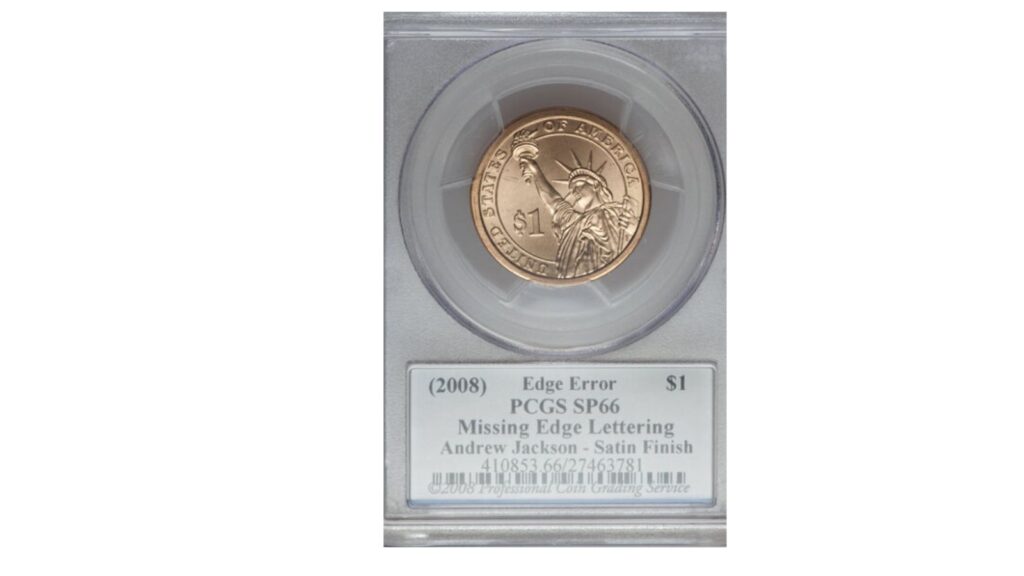
14. Presidential dollar with missing edge lettering

Presidential dollar with missing edge lettering
Image Credit: Heritage Auctions

Starting in 2007, the Presidential dollar series moved the date, mint mark, and mottos off the coin’s face and onto its edge, a first for circulating American coinage in decades. The Mint’s new edge lettering machines skipped that step entirely on tens of thousands of coins in the program’s early years, sending smooth-edged dollars straight into circulation before anyone caught the problem.

Common examples, especially the first release honoring George Washington, bring $100 to $300 in certified uncirculated condition. Scarcer presidents and mints command considerably more, with special mint set versions of William Henry Harrison and Martin Van Buren reaching $1,500 to $2,450 in top condition, since far fewer of those particular combinations escaped with the error.

The check couldn’t be simpler. Run your finger and your eyes around the edge of any Presidential dollar. A genuine example has raised text running around it. A missing edge lettering error has a completely smooth, blank edge with no text at all. These coins came out during the height of the series’ popularity, so plenty of people saved rolls without checking closely, and unsearched boxes and bags still turn up the error today.

You’re 54. Nobody at your company has mentioned a pension in years, because there isn’t one. Whatever you retire on will come entirely out of your 401(k), and that balance moves up and down with the stock market whether you’re ready to stop working or not.

A bill sitting in the House right now would change one specific piece of that picture. If it passes, workers 50 and older could move part of their 401(k) directly into an annuity that pays a fixed amount every month for the rest of their life, all while they keep working, keep contributing, and keep collecting their employer match.

Nobody’s voted on it yet. It’s parked in committee, and the more likely path to becoming law runs through a bigger retirement package Congress hasn’t finished writing. It already has support from both parties, though, and it’s worth understanding now, before it moves any further.

What the bill in Congress would actually change

bill in Congress
Image Credit: Shutterstock

The bill is called the Retirement Simplification and Clarity Act, introduced in the House as H.R. 6324. Reps. Jimmy Panetta, a Democrat from California, and Darin LaHood, a Republican from Illinois, reintroduced it in late November 2025, and other members from both parties signed on as cosponsors.

The core change is narrow but real. Right now, if you’re under 59 and a half and still working for the company that sponsors your 401(k), your own paycheck contributions are mostly locked in place. This bill would carve out one specific exception: workers 50 and older could roll part or all of that money directly into an individual retirement annuity, a contract with an insurance company that turns your savings into a monthly check for life.

Fifty isn’t a random cutoff. It’s the same age the IRS already uses to let workers put extra money into a 401(k) through catch-up contributions, which climb to an extra $8,000 in 2026 on top of the standard $24,500 limit, and to $11,250 for anyone 60 through 63. The bill borrows that same age line and applies it to a different kind of flexibility.

The bill also rewrites the notice you get today when you leave a job and have to decide what to do with your 401(k). A federal audit found that roughly 80% of workers eligible for a rollover didn’t understand all four of their distribution options, partly because the required notice is dense and legalistic. Under the bill, the IRS would have to redo that notice in plain language, spelling out what happens if you cash out, roll over, or leave the money where it is.

Why you can’t do this already

401K
Image Credit: Shutterstock

Under current law, the money you defer from your own paycheck into a 401(k) is mostly locked in place while you’re still working for that employer. Age 59 and a half is the earliest point most plans are allowed to release that money without you quitting first, and it’s also the age the 10% early withdrawal penalty stops applying. Some plans allow in-service withdrawals of other account types, like old employer contributions or money rolled in from a previous job, before that age. Your own paycheck deferrals almost never qualify.

This bill targets exactly that restriction, and only for one purpose. It wouldn’t lower the age 59 and a half threshold across the board or open your 401(k) up for general withdrawals. It would add a narrow exception: if you’re 50 or older and you want to move money specifically into an annuity for guaranteed income, your plan could let you, even while you’re still years away from that ordinary threshold.

What guaranteed lifetime income actually buys you

An annuity, in this context, is a plain trade. You hand an insurance company a lump sum, and in exchange, it sends you a fixed check every month for as long as you live, no matter what the stock market does or how long you end up needing the money. It’s the same basic idea behind an old-style pension, just built by an insurer instead of an employer.

There’s real demand for this. In a recent survey of workers between 40 and 60, 92% said they wanted their employer to offer some kind of guaranteed income option, and 70% ranked guaranteed lifetime income as their single most important retirement feature. But only 3% of that same group had actually heard of an in-plan annuity before being asked about one. Even where these products exist, adoption inside 401(k) plans is still low, with anywhere from 6% to 16% of plans currently offering any kind of guaranteed lifetime income feature at all.

The trade-offs before you say yes

401K
Image Credit: Shutterstock

None of this comes free. Annuities carry fees, and the guarantee only holds up if the insurance company behind it stays solvent decades from now. Once your money is in an annuity, it typically stops being liquid. You can’t tap it for a new roof or a medical bill the way you might with a regular 401(k) balance, and depending on the contract, if you die earlier than expected, some of that money may not pass to your family. Even the trade groups pushing hardest for this bill have raised one open question of their own: whether workers will get the right advice before moving part of a retirement account into an annuity, or whether they’ll be sold a product that benefits an insurance agent more than it benefits them.

The size of the decision matters too. The median 401(k) balance for workers age 55 to 64 sits at just over $107,000. For someone in that position, moving a meaningful slice of that account into an annuity isn’t a small choice. It deserves the same scrutiny you’d give any other five or six figure financial decision, not a quick yes because a plan administrator made it sound simple.

Where the bill stands right now

The bill sits in the House Ways and Means Committee right now, and no floor vote is scheduled. Bills like this rarely become law standing alone. The more realistic path is getting folded into a larger retirement package that lawmakers have started calling SECURE 3.0, following the same pattern as the 2019 and 2022 laws that already reshaped 401(k) rules once each. That larger package is still being drafted, so there’s no real timeline yet. It could move this year, or it could sit until a future Congress picks it back up.

If you’re 50 or older and this idea appeals to you, the honest move right now is to keep saving the way you already are and keep an eye on it. Your 401(k) doesn’t change until Congress actually passes something, and even then, your employer’s plan would still have to choose to offer it.

For a single mother, entertainment spending is rarely a simple question of affordability. A UFC card, family outing or streaming subscription may fit within one month’s cash flow, but that does not automatically make it compatible with longer-term priorities such as emergency savings, debt reduction or school expenses.

The solution is not to eliminate everything enjoyable. A budget that allows no room for recreation can become difficult to maintain and may encourage impulsive spending after long periods of restriction. A more sustainable approach gives entertainment a defined place alongside essential bills and financial goals.

UFC fandom illustrates the challenge particularly well. Watching events from Canada can involve subscriptions, premium broadcasts, food, merchandise and occasional travel to a live card. Each expense may appear manageable alone, yet together they can consume a meaningful part of a household’s discretionary income.

Build UFC spending into the budget before fight night

Entertainment works best as a planned category rather than whatever remains after other spending. Once rent, food, transport, childcare, insurance and minimum debt payments are covered, a single mother can decide how much of the remaining money should support savings and how much can be used without guilt.

Interest in a major card may build through interviews, predictions and services such as ufc betting canada, but the spending decision should be made before the event reaches its emotional peak. A fixed monthly amount prevents a highly promoted fight from displacing a more important obligation.

Budget categoryPrioritySuggested treatment
Housing and utilitiesEssentialFund first and in full
Groceries and transportEssential but variableUse realistic monthly averages
Childcare and school costsEssentialInclude irregular expenses
Debt paymentsContractual and strategicPay minimums plus planned extra amounts
Emergency savingsFinancial protectionAutomate where possible
UFC and entertainmentDiscretionarySet a firm monthly limit
Event travel or premium ticketsOccasional goalSave gradually in a separate fund

The entertainment allowance does not need to be identical every month. A quieter period can leave more money available for a major event later. What matters is that the total remains visible.

A simple rule is to separate the decision from the purchase. Choose the limit at the beginning of the month, then decide which events offer enough value to deserve part of it.

Separate watching costs from betting money

UFC entertainment and sports betting should never share the same mental budget. Streaming a card has a known cost. Betting introduces the possibility of loss and should not be treated as a method of paying for subscriptions, tickets or household expenses.

Mobile access through services such as the melbet app can make transactions feel separate from ordinary spending, particularly when they occur in small amounts. A safer structure records every deposit as entertainment spending the moment it is made, regardless of whether any money is later won.

Useful boundaries include:

  • Never betting with rent, grocery or childcare money.
  • Keeping betting separate from the UFC viewing budget.
  • Setting a loss limit before opening an account or event.
  • Avoiding attempts to recover losses during later fights.
  • Not using credit cards or borrowed money to continue.
  • Treating withdrawals as irregular money rather than expected income.
ExpenseCost certaintyAppropriate budget category
Streaming subscriptionPredictableRegular entertainment
Premium event purchasePredictablePlanned event spending
Food for a watch partyMostly predictableSocial or entertainment budget
MerchandisePredictableOptional purchase
Sports betCan be lost completelySeparate high-risk entertainment
Expected winningsUncertainShould not appear as planned income

Provincial rules, available operators and consumer protections differ across Canada. Anyone who chooses to bet should use only services legally available where they live and should check local requirements rather than assuming that access means authorisation.

The cleanest financial principle is that a UFC event should remain enjoyable even if no wager is placed.

Choose a UFC viewing strategy that matches actual use

Subscription costs often grow quietly because each individual service appears inexpensive. A household may pay for a sports package, general streaming, children’s content and music without reviewing how often each platform is used.

UFC viewers in Canada should begin by identifying which content matters most:

  1. Numbered events and championship fights.
  2. Fight Night cards.
  3. Preliminary bouts.
  4. Archived fights and documentary content.
  5. Other sports included in the same package.
  6. French- or English-language coverage preferences.

A fan who watches every week may receive value from continuous access. Someone interested only in selected championship cards may spend less by subscribing strategically or choosing social watch parties.

Viewing patternMost practical approachMain risk
Watches nearly every cardMaintain the most relevant sports packagePaying for overlapping services
Follows only major eventsPlan purchases around selected cardsImpulse buying heavily promoted fights
Watches with friendsRotate hosting and food costsHost repeatedly absorbs the expense
Enjoys archived boutsUse a library-focused subscriptionKeeping it after interest declines
Attends sports barsSet a total food and transport limitSpending more than home viewing
Has unpredictable free timeAvoid long commitmentsPaying for months with little use

Review subscriptions every three months. A service that was valuable during one part of the UFC calendar may no longer justify its cost. Cancelling is not a permanent rejection; it is a way to pay only when the household is actually using the content.

Treat a live UFC event as a savings goal

When the UFC stages an event in Canada, attending can be far more expensive than the ticket price suggests. Transport, accommodation, meals, childcare, venue fees and merchandise can turn one evening into a significant household purchase.

The full cost should be estimated before tickets go on sale:

  • Ticket and mandatory service charges.
  • Travel to the host city.
  • Hotel or late-night transport.
  • Food before and during the event.
  • Childcare for the full period away.
  • Event merchandise.
  • A buffer for unexpected costs.

If the expected total is CAD 900 and the event is nine months away, saving CAD 100 per month shows immediately whether the plan is realistic. If that contribution would interrupt emergency savings or require new debt, a home watch party may provide better value.

Live-event costLower-cost alternative
Premium seatingUpper-level seats with a clear view
Hotel near the arenaSame-day travel where practical
Venue foodEat beforehand
Official event merchandiseBuy one planned item or none
Solo travel costsShare transport with trusted friends
Last-minute childcareArrange care well in advance

Buying early is not always saving. A ticket purchased before calculating the full trip can lock the household into several additional expenses. The decision should be based on total cost, not fear of missing the initial sale.

Create separate funds for different time horizons

One entertainment account can become confusing when it contains money for weekly viewing, family outings and a future UFC event. Separating goals makes trade-offs clearer.

A practical system may use three small categories:

  • Monthly entertainment for streaming, inexpensive outings and watch-party food.
  • Family experiences for cinemas, festivals or children’s activities.
  • A UFC event fund for tickets, travel and childcare.

These can be separate bank subaccounts, digital savings spaces or simple categories in a budgeting app. The method matters less than keeping the money distinguishable.

Irregular income, tax refunds or gifts should not automatically become entertainment money. A predetermined split can direct part toward savings, part toward debt and a smaller amount toward enjoyment. This protects long-term goals while still allowing progress toward a memorable event.

Make watch parties economical rather than competitive

A UFC night at home can offer much of the social value of attending live without the same cost. However, hosting can become expensive when one person repeatedly pays for food, drinks and access.

A shared system is more sustainable:

  1. Rotate hosting duties.
  2. Ask each guest to bring one item.
  3. Decide the menu before shopping.
  4. Avoid buying decorations or merchandise for every card.
  5. Set an end time that works with childcare and sleep.
  6. Use food already in the household where practical.

For a single mother, the best watch party may be small and predictable. Inviting one or two trusted friends can reduce pressure while creating a safer childcare arrangement if children are present.

It is also reasonable to skip some cards. UFC promotion is designed to make each event feel urgent, but not every card needs to become a paid social occasion.

Protect financial goals with clear red lines

Entertainment spending becomes a problem when it depends on debt, delays essential bills or repeatedly consumes money intended for savings. These signs matter more than the exact percentage of income being spent.

Red lines may include:

  • No entertainment purchases when the credit card cannot be paid as planned.
  • No premium event if the emergency fund contribution has been skipped.
  • No new subscription until an unused one is cancelled.
  • No live-event travel financed through instalments.
  • No betting deposits after the monthly limit has been reached.
  • No withdrawing from a child-related savings goal for a fight card.

These boundaries remove difficult decisions from emotionally charged moments. They also make enjoyment easier because the purchase has already passed a financial test.

Canadian households face different housing costs, childcare arrangements and income levels, so no single entertainment percentage works for everyone. A realistic budget should be adjusted when actual spending repeatedly differs from the original estimate.

UFC fandom can fit into a responsible single-parent budget when it is treated as a planned interest rather than an exception to normal rules. The aim is not to minimise every enjoyable expense, but to choose the experiences that provide the most value.

Streaming selectively, sharing watch-party costs and saving gradually for live events can preserve the excitement of the sport without creating financial stress after the final round. The household remains protected because essential expenses and long-term goals are funded first.

As UFC distribution in Canada continues evolving, fans will need to review which subscriptions and event options still make sense. The strongest budget is not permanently fixed; it changes with prices, viewing habits and family priorities.

Entertainment should support a sustainable life, not compete with it. When spending is planned in advance, a major UFC card can remain what it is meant to be: an enjoyable event rather than a financial setback.