
You’re getting ready to dump the change jar into a coin counter. It might be worth spending ten minutes looking first. Silver came out of everyday circulation in the mid-1960s, but those coins never stopped circulating in coin jars, inherited collections, and junk drawers. At current silver prices, a single 1964 Kennedy half dollar is worth more than twenty-five dollars in metal alone. That coin counter machine will give you fifty cents.
Beyond the silver, collectors pay serious money for specific minting errors, date varieties, and low-production issues that look identical to common coins until you know what to check. Most of the coins on this list are still findable. Some turn up in pocket change. Others surface in estate sale bins priced at face value by people who had no reason to think twice.
What they have in common: they’re specific, identifiable, and worth knowing.
Table of contents
- Any pre-1965 dime
- Any pre-1965 Washington quarter
- 1964 Kennedy half dollar
- 1965-1970 Kennedy half dollar (40% silver)
- 1943 steel penny (and the copper ones that aren’t supposed to exist)
- 2004-D Wisconsin state quarter, extra leaf error
- 1979-P Susan B. Anthony dollar, wide rim variety
- 1970-S small date Lincoln cent
- 1972 doubled die Lincoln cent
- 1932-D Washington quarter
- 1955 doubled die Lincoln cent
- 1916-D Mercury dime
- 1992 Close AM Lincoln cent
- 1969-S doubled die Lincoln cent
- 1943 copper penny
Any pre-1965 dime

The United States stopped putting silver in circulating dimes in 1965. Every dime made before that year, from the Mercury dimes that ran from 1916 through 1945 to the Roosevelt dimes that started in 1946, is 90% silver. Each coin contains about 0.072 troy ounces of the metal. With silver trading around $76 per ounce as of May 2026, the melt value alone sits around $5.50 per coin, and common circulated examples sell for $7 to $12 at coin dealers. Not dramatic per coin, but people routinely dump rolls of them without looking.
The practical check is fast. Look at the edge of the coin. Pre-1965 dimes have a solid silver edge with no visible copper stripe. Post-1965 dimes show a reddish copper layer sandwiched between silver-colored clad. You can also look at the date: any Roosevelt dime dated 1964 or earlier is silver, and any Mercury dime is silver regardless of year. Within the Mercury series, certain dates from the 1920s and early 1930s carry premiums well above silver value, particularly the 1921, 1921-D, and 1926-S. Don’t clean any of them. Cleaned silver coins sell for less than uncleaned ones in equivalent condition.
Any pre-1965 Washington quarter

The same rule applies to quarters. From 1932 through 1964, Washington quarters were struck in 90% silver. Each coin contains about 0.18 troy ounces of silver, which at current prices puts the melt value at roughly $13 to $14. Common circulated examples typically sell for $15 to $18 at coin shops, and lightly circulated ones go higher. These show up constantly in inherited collections and old change jars, priced at face value by people who aren’t looking at the edge.
Check the edge the same way you would a dime: pre-1965 quarters show a solid silver edge with no copper layer visible. Once you’ve confirmed the date, look at the mint mark. Most years are common and worth close to melt, but a handful of earlier dates, particularly from the 1930s and 1940s, carry premiums above silver value. The 1932-D and 1932-S are the key dates and are worth considerably more than metal, which is covered separately later in this list. For any Washington quarter dated 1964 or earlier, the floor value is the silver.
1964 Kennedy half dollar

The first year of the Kennedy half dollar is also the last year the circulating version was struck in 90% silver, the same composition used in dimes and quarters before 1965. Each coin contains about 0.36 troy ounces of silver. At current prices, the melt value sits around $27 to $28. Common circulated examples from both Philadelphia and Denver sell for $28 to $35 depending on condition, and nice uncirculated examples bring meaningfully more.
These show up constantly in coin jars and estate sales, sometimes loose and sometimes tucked into folders or tubes. Most examples are common, with Philadelphia striking more than 270 million in 1964. What does carry a premium is the “Accented Hair” variety, where the hair detail above Kennedy’s ear is sharper than on standard strikes, a version Jacqueline Kennedy reportedly asked the Mint to soften. Those bring several times common prices in comparable condition, but require professional authentication. For any 1964 half dollar that doesn’t show the accented hair detail, the silver value is the story, and it’s a real one.
1965-1970 Kennedy half dollar (40% silver)

When the Mint reduced silver content in 1965, the half dollar kept a partial silver composition that dimes and quarters lost entirely. Kennedy halves dated 1965 through 1970 are 40% silver, with about 0.148 troy ounces per coin. At current prices, each one carries a melt value of roughly $11 to $12, more than 20 times face value. Circulated examples typically sell for $12 to $15 at coin shops.
These are easy to overlook because they look almost identical to the post-1970 clad versions. The edge check still works, though more subtly: a 40% silver half dollar shows a darker gray edge without a visible copper stripe, unlike the clad versions that show copper clearly. The surefire method is the date. Any Kennedy half dated 1965 through 1970 contains silver. After 1970 and before the special collector issues that started in the 1990s, they’re clad with no silver content. The 1970-D is a separate matter entirely, a low-mintage coin sold only in mint sets that never entered regular circulation and worth considerably above silver value even in well-worn condition.
1943 steel penny (and the copper ones that aren’t supposed to exist)

In 1943, the Mint temporarily switched penny composition from copper to zinc-coated steel to preserve copper for the war effort. The result is a silvery-gray coin that sticks to a magnet. Circulated steel pennies are common and worth $0.10 to $1 in typical condition, though well-preserved examples certified in the MS67 range and above bring considerably more.
What makes this entry worth reading carefully is the copper version. A small number of copper planchets from 1942 got mixed into the 1943 production run and struck by accident. These 1943 copper pennies have a real reddish-brown color, no magnetic attraction, and weigh 3.11 grams rather than the steel penny’s 2.7 grams. They’re extraordinarily rare and worth serious money when authenticated. The test is straightforward: hold a magnet to your 1943 penny. If it doesn’t stick, weigh it. If the weight comes in at 3.11 grams, take it to a professional grader before anything else, and do not clean or polish it. Also be aware that copper-plated steel pennies exist and can fool a quick magnet test if the plating is thick; a precise scale is the more reliable filter.
2004-D Wisconsin state quarter, extra leaf error
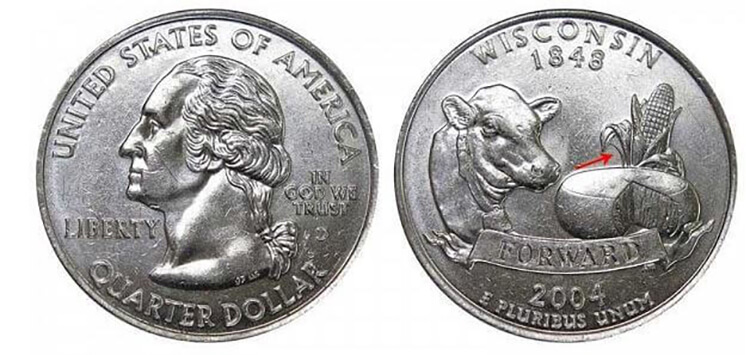
During production of the Wisconsin state quarter in Denver, an unauthorized mark appeared on certain dies, creating what looks like an extra leaf on the corn husk on the reverse. Two versions exist: one where the extra leaf points up (“Extra Leaf High”) and one where it points down (“Extra Leaf Low”). Both were struck before anyone caught the problem, and both entered regular circulation alongside the normal coins.
In circulated condition, these error quarters still turn up in change and sell for $50 to $300 depending on the variety and how well preserved they are. Certified examples in higher grades push beyond that range. The identification is visible to the naked eye: look at the ear of corn on the reverse. A standard 2004-D Wisconsin quarter shows two leaves curving from the base of the corn. The error coins show a third leaf that clearly doesn’t belong, either pointing up or angling down. Only Denver-mint pieces show this variety. Philadelphia strikes do not.
1979-P Susan B. Anthony dollar, wide rim variety

The Susan B. Anthony dollar had a short and unpopular run, minted from 1979 to 1981 and briefly revived in 1999. Most 1979-P examples are common and worth face value. But partway through that first year, the Philadelphia Mint modified its dies, widening the rim and pulling the date closer to it. The resulting “Wide Rim,” or “Near Date,” variety looks nearly identical to the standard issue unless you know what to compare.
The tell is the gap between the “9” in the date and the coin’s rim: on the Wide Rim, there’s visibly less space. Circulated examples typically sell for $25 to $50, compared to essentially face value for the common narrow rim version. Certified uncirculated examples in higher grades bring more, with top-tier pieces reaching several hundred dollars. These still turn up in rolls and jars where someone saved a pile of SBA dollars in the 1980s without examining them. Side-by-side comparison photographs of Wide Rim versus Narrow Rim coins are widely available online and make attribution fast once you know what the difference looks like.
1970-S small date Lincoln cent

The San Francisco Mint struck Lincoln cents in both a “Large Date” and a “Small Date” variety in 1970, a distinction that’s easy to miss and creates a real value difference. The quick way to tell them apart: on the Small Date, the top of the “7” in the date sits level with the tops of the “1” and “0” on either side. On the Large Date, the “7” sits noticeably lower. The word LIBERTY also appears weaker on the Small Date due to a different die characteristic.
Both varieties exist in circulated and uncirculated condition, but the Small Date is considerably scarcer, especially at higher grades. Circulated examples typically bring $5 to $15, a meaningful premium over a common penny. Certified uncirculated examples in MS65 Red grade around $75 to $160, and the few known MS67 examples have sold for $600 and above. These turned up in circulation for years and still appear in rolls from the early 1970s. The LIBERTY weakness is often visible to the naked eye on a clean coin, making attribution easier than most error varieties once you know to look for it.
1972 doubled die Lincoln cent

The 1972 Philadelphia doubled die is one of the more accessible error coins in the series, accessible being relative. The doubling affects the date, the word LIBERTY, and the motto IN GOD WE TRUST, and on the strongest examples it’s visible without any magnification. The error comes from the die being struck twice at slightly different angles during manufacture, impressing two offset versions of the lettering into the die that then stamped coins.
Circulated examples bring $100 to $300 depending on how well the doubling shows and how worn the coin is. Certified uncirculated pieces in higher grades have sold considerably above that range. There are roughly ten recognized doubled die varieties from 1972, but only the FS-101 “Type 1” shows the strong, obvious doubling described here; the others require magnification and bring much less. When checking a 1972 cent, look for rounded, raised doubling on the letters. Flat, shelf-like offsets are machine doubling, a different and far more common phenomenon worth nothing to collectors.
1932-D Washington quarter

The Washington quarter series launched in 1932. Philadelphia struck five million that first year. Denver struck 436,800. San Francisco struck 408,000. Those two low-mintage branch mint issues are the key dates of the entire series, and decades of collector demand have kept them firmly in premium territory. In circulated condition, the 1932-D typically brings $140 to $400 depending on how much design detail remains, and uncirculated examples in certifiable condition go considerably higher.
The condition issues to watch for are the same as any silver quarter that old: wear on the design elements, rim damage, and cleaning. Cleaned examples with an unnaturally bright sheen sell for much less than original-surface coins in the same technical grade. The 1932-D also attracts counterfeits, most commonly made by adding a “D” mint mark to a common Philadelphia example. On a genuine 1932-D, the “D” should appear naturally struck into the coin’s surface, not added afterward. The font and placement should be consistent with other Denver-mint quarters from the 1930s. Professional authentication from PCGS or NGC is worth the cost at these prices, both when buying and when selling.
1955 doubled die Lincoln cent

This is probably the most famous error coin in American numismatics. When a die at the Philadelphia Mint was struck twice at misaligned angles in 1955, the doubling on the obverse was so dramatic that the date and LIBERTY appear printed twice. The error wasn’t caught in time, roughly 20,000 examples entered circulation, many as change from cigarette vending machines in New England. Around 10,000 to 15,000 are estimated to survive.
The doubling is visible to the naked eye on any genuine example. Even a heavily worn, well-circulated coin with a readable date typically brings $1,000 to $2,500. Nicer examples in the AU-50 to MS-62 range bring $2,500 to $5,000, and certified gem uncirculated pieces with original red color reach five figures and above. Counterfeits are common and have been circulating in the hobby for decades. A genuine 1955 doubled die has vertical die-polishing lines visible to the left of the T in “ONE CENT” on the reverse; all authentic examples show this. Professional authentication is worth doing before buying or selling.
1916-D Mercury dime
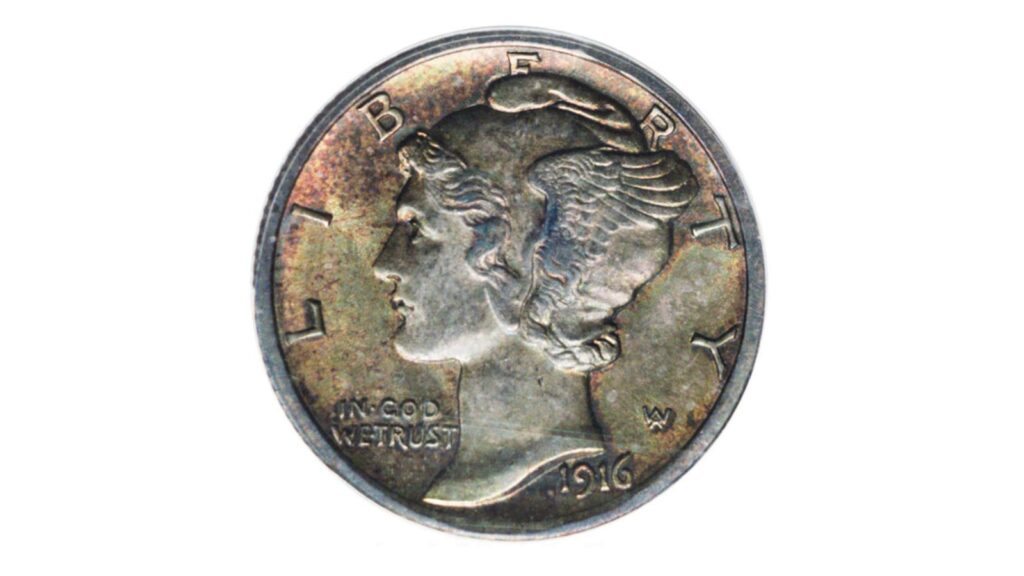
The Denver Mint shifted its production focus partway through 1916, cutting the dime run short and producing just 264,000 examples. It’s one of the lowest production figures in the Mercury dime series, which ran through 1945. The coin looks exactly like any other first-year Mercury dime in design. What makes it the key date is purely that production number.
In heavy, worn circulated condition, the 1916-D Mercury dime brings around $1,500 to $3,000. Fine-condition examples fetch $3,750 to $5,000. Uncirculated pieces reach $15,000 and above. The critical authentication issue is that people have been adding “D” mint marks to common Philadelphia 1916 dimes for a very long time. On a genuine 1916-D, the small raised “D” appears on the reverse near the bottom of the torch. The font and position should look consistent with other Denver-mint Mercury dimes from the same era. Microscopic examination can detect added mint marks, which is why professional grading is essential on any example that looks like it has survived in decent shape.
1992 Close AM Lincoln cent

On the reverse of every Lincoln Memorial cent, the inscription “UNITED STATES OF AMERICA” runs around the top. The letters “A” and “M” in “AMERICA” are the tell here. On standard business strike coins from 1992, those two letters have a visible gap between their bases: the “Wide AM.” The Mint switched to a “Close AM” design for 1993, where those letters nearly touch. A small number of 1992 pennies, from both Philadelphia and Denver, were accidentally struck with the 1993-style Close AM reverse before the change was official.
The 1992 Close AM is one of the rarest modern Lincoln cent varieties, with fewer than ten Philadelphia examples and around 30 to 50 Denver examples known. Confirmed pieces bring $10,000 to $25,000 and beyond depending on condition. The identification is simple: flip the coin and look at the bases of the “A” and “M” in AMERICA. If they nearly touch or do touch, it’s worth a trip to a professional grader. Most 1992 pennies are Wide AM and worth one cent. The rarity of the Close AM is what makes them worth examining, precisely because they look like every other penny in the jar.
1969-S doubled die Lincoln cent
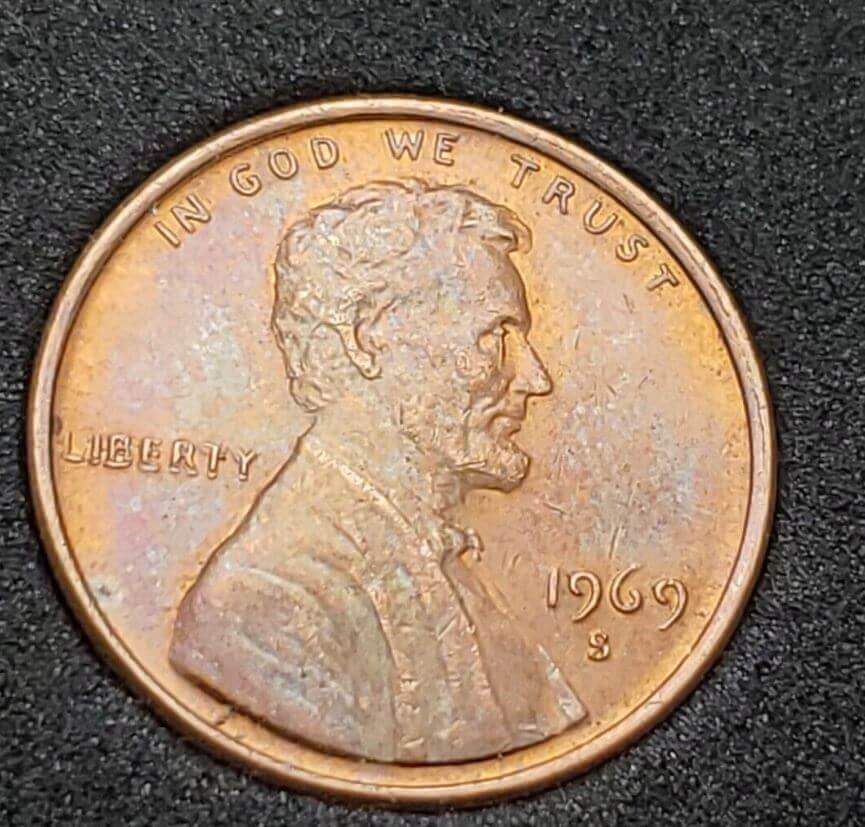
The 1969-S doubled die is rarer and more valuable than the 1955 version but considerably less well known because fewer people have seen one. Under 100 examples were made at the San Francisco Mint, and a portion of those were accidentally destroyed during a Secret Service counterfeiting investigation in the 1970s, shrinking an already tiny population further. The doubling runs southeast from the main impression and is visible on the date, LIBERTY, and IN GOD WE TRUST.
Confirmed examples command serious prices: circulated pieces bring $30,000 to $60,000 depending on grade, and the handful of near-mint examples have reached six figures. The authentication point is essential: machine-doubled 1969-S cents exist and look superficially similar to the real thing. The difference is that machine doubling affects the mint mark too, while a genuine doubled die will not show doubling on the “S.” Any 1969-S that appears to have doubled lettering and an unaffected mint mark should go to PCGS or NGC before any other action.
1943 copper penny
The rarest entry on this list is a minting accident. When the Mint transitioned to steel pennies for 1943, a small number of copper planchets from 1942 remained in the presses and were struck with 1943 dies by mistake. These are not steel coins with copper plating. They are genuine copper alloy pennies bearing a 1943 date, and they are extraordinarily rare: roughly 30 to 40 are known across all three mints, with the Denver and San Francisco versions the hardest to find.
The identification test from entry 5 applies here: magnet, then scale. Steel holds to a magnet; copper does not. Steel weighs 2.7 grams; copper weighs 3.11 grams. If your 1943 penny passes both tests, take it to a professional grading service, not a local coin shop, not an online listing. Authenticated copper 1943 pennies have sold for $100,000 to over $500,000, and the unique 1943-D copper is believed to have traded privately above a million dollars. The counterfeiting risk is high enough that even PCGS and NGC use specific gravity testing beyond a standard weigh-in. The stakes are high enough to do it right.











