Emergency cash for low-income families in South Carolina
If you need cash to pay bills, buy gas, feed your family, or for any other reason, these resources can help:
Temporary Cash Assistance in South Carolina
South Carolina’s Temporary Assistance for Needy Families (TANF) program — provides cash assistance for qualifying families with children or to relatives who have court-ordered custody of a child placed in their home. Benefits are limited to 24 months in a 10-year time period.
The amount paid out varies depending on household income, size and location. Contact your local Department of Social Services (DSS) office to find how much your family can get per month.
In addition to the cash aid, benefits can also include child care and transportation assistance, job training and more.
Qualifications:
Must be a U.S. citizen or a qualified non-citizen
Permanent South Carolina resident
Have children under 18
Low-income South Carolina families with a dependent child, to whom they are related, living in the household
Individuals that agree to pursue child support from parent(s) absent from the home
Children and mother must have social security number
Gross income must be less than 50% of the federal poverty level — you can check your eligibility here
$2,000 or less and licensed vehicles needed for individuals subject to the work requirement may not exceed $8,500.
If you need help finding a place to live or paying your rent/mortgage, these programs can help.
Rental assistance in South Carolina
There are multiple programs in South Carolina to help renters find housing and pay their rent:
SC Stay Plus
South Carolina’s Rent and Utility Assistance Program is accepting applications for its waitlist. The SC Stay Plus program is a rental and utility assistance program for those who are experiencing financial hardships and housing challenges as a result of the COVID-19 pandemic.
Qualifications:
Household must be obligated to pay rent on a residential dwelling
One or more members of the household must demonstrate risk of experiencing homelessness or housing instability
Total household income at or below 80% of the AMI as defined by the federal government
One or more members of the household must meet one of the following:
Qualified for unemployment benefits
Experienced a reduction in household income
Incurred significant costs
Experienced other financial hardship due to the COVID-19 outbreak
If you need help buying a home in South Carolina, these programs can help:
South Carolina Homebuyer Program
South Carolina Housing offers a home buyer program with 30-year fixed rate mortgage loans for home buyers. These loans can be offered as FHA, VA, USDA, and conventional loans.
County First is a rural initiative designed to provide potential homebuyers with additional resources. The program includes up to $8,500 in forgivable down payment assistance and special fixed-rate financing. Borrowers can choose FHA, Conventional, USDA, or VA financing.
Qualifications:
The program requirements are the same as the SC Homebuyer Program for income and home price limits. Properties that can be financed include:
Single-family residences
Condominiums
Townhomes
Modular homes
County First funding is available to homebuyers in the following counties:
Palmetto Home Advantage offers Conventional, FHA, VA and USDA loan options for first-time and repeat buyers with no first-time home buyer requirements in South Carolina.
Qualifications:
All program options require a minimum 640 credit score, have no sales price limits, and have a borrower income limit of $115,000.
If you are struggling to pay your utility bills in South Carolina, check out the following programs:
Low-Income Home Energy Assistance (LIHEAP) in South Carolina
LIHEAP helps qualifying households with home heating and cooling costs, paid directly to utility companies. The agency does not assist with water, sewer, or telephone services.
Medical insurance and dental help for single moms in South Carolina
The following medical and dental services are available to qualifying individuals and families:
Dental Access Carolina
Dental Access Carolina is a mobile clinic that travels to businesses and schools to offer dental treatment. It’s a helpful option if you're struggling to take off work or adjust your schedule to seek dental treatment for yourself or your child. Dental Access Carolina works with schools and businesses throughout the state.
The mobile clinic works with the following insurance plans:
HRSA, an agency of the U.S. Department of Health and Human Services, funds health centers that provide free or subsidized health and dental care to low-income people and those otherwise unable to access quality health care, like people living in rural areas.
HRSA also offers a 24/7 free and confidential mental health hotline for pregnant and new moms. Dial 833-943-5746 (833-9-HELP4MOMS) if you are struggling.
Qualifications:
Each health center sets its own eligibility criteria for free or reduced-cost care.
How to get help:
Find an HRSA health center in South Carolina by typing in your address on HRSA’s search tool.
Food help for low-income families in South Carolina
A number of federal and state food and nutrition programs are available across the state:
South Carolina Food Assistance Program (SNAP)
USDA’s Supplemental Nutrition Assistance Program (formerly known as the Food Stamp program) provides food benefits and nutrition education to low-income households.
SNAP recipients are issued an EBT card that can be used like an ATM card to purchase food in retail food stores, including:
The Special Supplemental Nutrition Program for Women, Infants, and Children is a nutrition program that provides free baby formula and nutritional food items to low-income mothers and their babies.
Qualifications:
Low-income, pregnant, breastfeeding, and postpartum women, for up to one year postpartum
Women up to six months postpartum who are not breastfeeding
Infants and children under 5 years old, including foster children
Low-income sole provider parents of children under age of 5 who are at nutritional risk and who are below 185% of FPL
If you are currently receiving Medicaid, Temporary Assistance, or Food Assistance help, you are also eligible for WIC
How to get help:
Call your local WIC office or 855-472-3432 and say you want to apply for WIC.
National School Lunch Program (NSLP) and School Breakfast Program
NSLP serves healthy, well-balanced, reduced-price or free meals to children in school.
An extension of the NSLP, the School Breakfast Program provides free or low-cost breakfast to eligible students. Schools with at least 80% of the students eligible for free or reduced-price meals must provide breakfast at no cost to all students.
This program provides nutritious meals at no cost to children during summer break. Food is distributed at local schools, nonprofits, parks and libraries.
There are multiple federal and state-funded education programs and resources in South Carolina:
South Carolina K-12 scholarship program
South Carolina will launch the Education Scholarship Trust Fund program in the 2024-2025 school year. The program will offer a $6,000 scholarship to give underserved children from low-income families affordable access to private school, tutoring, learning technology, and other paid educational services.
Applications will begin between January 15 and March 15, 2024. The first phase of the program will accept 5,000 students growing to 15,000 students by the 2026-2027 school year.
Qualifications:
South Carolina resident
First-time kindergartner or attended public school in 2023-2024 school year
Household income does not exceed 200% of the FPL based on size
Head Start is a free federal preschool program for children aged 3 to 5 from low-income families. Early Head Start serves pregnant women and children under age 3. The programs focus on cognitive, social, and emotional development and prepare children for school.
Qualifications:
Children from birth to 5
Meet federal poverty guidelines
Children in foster care, homeless children, and children from families receiving public assistance (TANF, SSI, etc.) are eligible regardless of income
Some programs accept kids with incomes above the Poverty Guidelines
Pregnant women can also receive prenatal and postpartum information, education, and services through Early Head Start
South Carolina Department of Social Services COVID-300 scholarship
DSS’s Covid-300 scholarship helps S.C. families with the costs of child care. The scholarship amount your household is eligible for will be determined by factors including your provider’s tuition rate and your child’s age. A scholarship may cover all or some of your child care costs.
Qualifications:
Have a child or children between birth and 12 years of age
Work at least 15 hours per week or attend school or a training program
Child care scholarships are also available to support children ages 13 to 18 in certain circumstances: those who have disabilities, developmental delays, or who are in foster care
If you’re a single mom who wants to further her education, here are some helpful resources:
Get a GED in South Carolina
If you are at least 19 years old in S.C., you can take the GED test. You may also be able to take the test at 16, 17, or 18 with special permission from the school district where you live.
The GED test is broken into four exams on different subjects, which can be spaced out and taken at your own pace (though each individual exam has a time limit):
Mathematical reasoning – 115 minutes
Reasoning through language arts – 150 minutes
Social studies – 70 minutes
Science – 90 minutes
You have two options for taking the test in South Carolina:
Online at-home test – $43.50 per subject
In person at a test center – $37.50 per subject
Grants and scholarships in South Carolina
The South Carolina Commission on Higher Education provides direct support to students pursuing higher education through a number of need-based and merit-based scholarships and grants. You must be a South Carolina resident to apply.
Employment help for single moms in South Carolina
Workforce programs in South Carolina provide training and assist with employment:
S.C. Department of Employment and Workforce
The Department of Employment and Workforce exists to help people who are unemployed find employment. The department matches job seekers with employers and provides unemployment insurance benefits, among other services.
Qualifications:
South Carolina resident
Unemployed
Not your fault you lost your job from your most recent employer
Able to work
Available for work and willing to take any suitable offer
Report to your local comprehensive SC Works center as required
Must actively search for suitable work each week that you file a weekly certification for unemployment insurance benefits.
Suitable work includes any trade, occupation, or business in which you are qualified based on your training or experience and which pays at least 90% of your previous salary during your first eight paid weeks of unemployment and 75% of your previous salary after eight paid weeks of unemployment.
Must complete at least two work searches through SC Works Online Services each week that you file a certification
To be financially eligible for UI benefits, you must:
Have at least $1,092 in covered employment (with an employer who paid UI taxes) during the base period’s* highest quarter
Have earned at least $4,455 from covered employment during the base period*
Have total base period* wages that are equal to, or exceed, 1.5 times the amount you earned during your highest-earning quarter of the year
*The base period is defined as wages earned doing one year of insured work
There are a number of charitable organizations throughout South Carolina that offer support to single moms:
Raising Up the Lowcountry Foundation
This charity helps single moms in the Charleston, S.C. area with emotional, educational, and short-term financial support. There are several coaching programs that teach skills to improve health, money management, parenting, career advancement, and more.
Qualifications:
Single moms in the Charleston area are encouraged to apply for help
“The Long-Term Impacts of Cash Assistance to Families,” by Kevin Werner, The Urban Institute, Jan. 31, 2024 https://www.urban.org/research/publication/the-long-term-impacts-of-cash-assistance-to-families
Not your state? Select yours here:
If you’re a single mom in Rhode Island struggling to make ends meet, keep reading for resources that help with:
Statistically, families benefit most with cash assistance (vs through benefits programs).1 Here is our guide to single mom grant programs, including our own.
Every month, I give out $500 cash to one single mom struggling with money, health, stress, child care, illness or loneliness — no strings attached.
Qualifications are simple:
1. You're a single mom.
2. You need the money right now.
Fill out this form to apply:
(Note that the figures and information in this post are current as of publication date.)
Number of people in family/household
Annual income
1
$15,960
2
$21,640
3
$27,320
4
$33,000
5
$38,680
6
$44,360
7
$50,040
8
$55,720
For families/households with more than 8 people, add $5,680 for each additional person.each additional person.
Emergency cash for low-income families in Rhode Island
If you need cash to pay bills, buy gas, feed your family, or for any other reason, these resources can help:
Rhode Island Works
RIW helps families with children with cash assistance while they look for work. Families can receive up to 48 months of assistance. A family of three can get up to $721 per month.
Qualifications:
U.S. citizen
Rhode Island resident
Have a dependent child or be pregnant
Willing to look for jobs giving at least 20-30 hours per week
If you need help finding a place to live or paying your rent/mortgage, these programs can help:
Public Housing and Housing Choice Voucher Program (Section 8) in Rhode Island
The Housing Choice Voucher Program gives Rhode Islanders cash vouchers to help them pay rent. The program generally subtracts 30% of a family’s adjusted gross income from the rent amount or standard rent rate for the area to calculate how much assistance they receive.
If you need help buying a home in Rhode Island, these programs can help:
Homeowner Assistance Fund Rhode Island (HAF-RI)
HAF-RI helps Rhode Island homeowners pay mortgages that they can’t afford due to a pandemic-related financial hardship. The program can also help with homeowner’s association fees, utility payments, and property taxes. Homeowners can get up to $50,000 in aid.
Qualifications:
Rhode Island homeowner
Primary residence only
Financial hardship affecting your ability to pay your housing-related costs
Homebuyers in Rhode Island can get the lower amount of up to 6% of their purchase price or $15,000 as a second-lien loan to help pay a down payment. The loan’s interest rate will be the same as the interest rate on your first mortgage in most cases.
Qualifications:
First-time homebuyer buying a primary residence
Minimum 620 credit score
Take a homebuyer education course
Eligible for and participate in the First-Time Homebuyer Loan program
The RI Statewide DPA Grant pays up to $17,500 for first-time homebuyers to use toward down payment assistance or closing costs. Homebuyers do not need to repay the grant money.
Qualifications:
First-time homebuyer buying a primary residence
Minimum 660 credit score
Take a homebuyer education course
Eligible for and participate in the First-Time Homebuyer Loan program
If you are homeless or at risk of homelessness, you may be able to get help from the following programs:
Rhode Island Coalition to End Homelessness
This organization oversees Rhode Island’s homelessness call center and other programs to help people who are homeless or at risk of being homeless. The Coordinated Entry System (CES) and Continuum of Care program connect families to housing resources.
IHSP helps families in need of permanent housing. They provide a case management team to give families the support they need, like affordable rental homes and rental assistance.
Transportation help for low-income families in Rhode Island
If you need transportation help, here are some resources available to low-income families in Rhode Island:
Discounts on public transportation in Rhode Island
The Rhode Island Public Transit Authority (RIPTA) is the state’s mass transit provider. If you are a senior aged 65 or over or a disabled person with a low income, you may be eligible for free rides for two years.
Qualifications:
Rhode Island resident
65 or over or disabled
Income at or below 200% of the FPL
RIPTA also offers discounted fares during off-peak hours for seniors and disabled persons regardless of income.
Nonemergency medical transportation (NEMT) in Rhode Island
MTM provides NEMT for the state of Rhode Island. The service provides free rides or bus passes for eligible riders.
Qualifications:
Medicaid recipients who cannot get to Medicaid-covered health appointments
People who qualify for the MTM Elderly Transportation Program (60 and over with no access to transportation)
Working TANF (RI Works) recipients
How to get help:
Email saharrison@mtm-inc.net
Free cars in Rhode Island
This charity provides cars to qualified applicants in Rhode Island:
Free Charity Cars
Free Charity Cars awards free vehicles to selected applicants in all 50 states. The nonprofit charity group has been awarding free vehicles to low-income American families since 1996 and has gifted more than 9,000 cars. The charity group notes that they do not have an inventory of vehicles readily available as they award cars as soon as they get them, so there can be extensive waiting periods for those selected for the free car program.
If you are struggling to pay your utility bills in Rhode Island, check out the following programs:
Low-Income Home Energy Assistance Program (LIHEAP) in Rhode Island
LIHEAP helps low-income families pay their utility bills on time. The program offers a one-time payment to the family’s energy company or crisis assistance for families who are at risk of a heating shut-off for past-due payments.
Weatherization Assistance Program (WAP) in Rhode Island
WAP makes energy-efficient upgrades to the homes of enrolled families. The program pays for upgrades and repairs, like fixing air ventilation problems and controlling air drafts in the home.
Qualifications:
Families who qualify for LIHEAP in Rhode Island also qualify for WAP.
Rhode Island Energy provides electricity for most of the state. The energy company offers multiple programs to help you pay your bill if you are having trouble, including:
Discounted energy rates: Get up to 30% off of your monthly energy bill if you receive government assistance such as SNAP, SSI, or Medicaid
Payment plans: Get an extension to pay your bill in installments
Bill forgiveness: If you have a past due balance of $300 and are more than 60 days late, you may be eligible to have up to $1,500 forgiven if you follow a payment plan
Budget billing: Based on your annual usage, this options breaks your bill into 12 equal payments so you know what to expect each month
Protection from shut-off: If your household members include an infant, seniors 62 and over, disabled or seriously ill persons, you may be able to avoid shut-off
Qualifications:
Each program has its own guidelines and process, so check with a Rhode Island Energy representative for details
Medical insurance and dental help for single moms in Rhode Island
Rhode Island families who need help paying for medical or dental services can see if they’re eligible for the following programs.
Dental Lifeline in Rhode Island
Rhode Island’s Dental Lifeline works with more than 200 volunteer dental professionals to provide free or affordable dental services to people who need necessary care.
Molar Express is a traveling dental clinic that visits participating schools around Rhode Island to give school children affordable dental services. Families with insurance will have their insurance billed with no out-of-pocket costs. Families without insurance pay an affordable sliding scale fee based on their income.
Qualifications:
Under age 21
Attend a participating school or Head Start program
How to get help:
Call 866-665-2797.
Seal RI
This free program provides dental sealants to children during school hours. The program bills your insurance for the cost, but if you don’t have insurance, you won’t pay a fee.
Qualifications:
Students must attend an eligible school or program.
Rite Care and Rite Share (Medicaid in Rhode Island)
Rite Care and Rite Share are Medicaid programs for families with children in Rhode Island who earn more than the amounts allowed by Medicaid. Pregnant women can also get coverage.
Rite Care is full health coverage, while Rite Share is supplemental coverage that helps families afford an employer’s health care plan. Rite Share pays all of the family’s health plan costs if their income is 150% or below the FPL. Families with higher incomes pay a cost share fee.
The Rhode Island Mission of Mercy (RIMOM) is a free two-day dental care event offered by the Rhode Island Oral Health Foundation. All patients are seen on a first-come, first-served basis. Yearly event is announced on the RIMOM site.
The dental staff educate patients about oral health and provide the following care:
Cleanings
Fillings
X-rays
Extractions
Root canals (front teeth only)
Qualifications:
At least 12 years old (all patients 12-18 must be with a parent or guardian)
A number of federal and state food and nutrition programs are available across the state:
Rhode Island Food Assistance Program (SNAP)
USDA’s Supplemental Nutrition Assistance Program (formerly known as the Food Stamp program) provides food benefits and nutrition education to low-income households.
SNAP recipients are issued an EBT card that can be used like an ATM card in retail food stores to purchase food, including:
Breads
Cereals
Fruits
Vegetables
Meats
Fish
Poultry
Dairy
Plants and seeds to grow food
Click here for a list of what you can and cannot buy. A family of three in Rhode Island can receive up to $740 per month, depending on their income.
Qualifications:
Rhode Island resident
U.S. citizen
Gross income at or below 185% of the federal poverty level
Gross income at or below 200% of the federal poverty level if someone 60 or older is part of the household
Women, Infants, and Children (WIC) in Rhode Island
Rhode Island moms and pregnant women can get help from WIC to pay for infant formula and nutritious foods for themselves and their children. WIC also offers development screenings, breastfeeding support, and help finding health care resources.
Qualifications:
Low-income, pregnant, breastfeeding, and postpartum women, for up to one year postpartum
Women up to six months postpartum who are not breastfeeding
Infants and children under 5 years old, including foster children
Low-income sole provider parents of children under age of 5 who are at nutritional risk and who are below 185% of FPL
If you are currently receiving Medicaid, Temporary Assistance, or Food Assistance help, you are also eligible for WIC
The school lunch and breakfast programs give Rhode Island students free or reduced meals if their family income qualifies.
Kindergarteners who do not have access to these programs can still participate in the Special Milk Program, which provides free milk during school meals.
Children participating in after-school programs can also get a free snack or meal from the Child & Adult Care Food Program (CACFP).
Qualifications:
Attend a participating school
Income at or below 185% of the federal poverty guidelines
How to get help:
Contact your child’s school for more information
Call 401-222-4269
Email jennifer.goodwin@ride.ri.gov
Summer Food Service Program in Rhode Island
Children attending participating schools or programs can get free meals throughout the summer.
Qualifications:
Children must be 18 or younger. Participating sites can determine their own requirements for meals.
Project Hand Up is a nonprofit that rescues food and provides it to Rhode Islanders in need. For $6, you can receive groceries worth about $200. This is a drive through pantry. They offer contact-free curbside pickup, and volunteers will load your food into your vehicle.
If you are a veteran or a senior aged 62 and over you can shop on any of the three grocery days, other shoppers can get groceries as follows:
Tuesday: From 3-5 p.m. if your last name starts with A through K
Thursday: From 3-5 p.m. if your last name start with L through Z
Friday: From 3-4:30 p.m. anyone regardless of last name or age
Qualifications:
Any Rhode Island resident is welcome to shop at Project Hand Up
Child care help for low-income families in Rhode Island
The following programs can help single moms in Rhode Island afford child care while they work or go to school.
Child Care Assistance Program (CCAP) in Rhode Island
CCAP pays for some or all of a family’s child care costs while parents/caregivers attend work or school. Monthly co-pays are between 0%-7% of your child care costs, depending on your family’s income. For instance, a three-person family can receive up to $23,030/year with no co-pay or up to $46,060/year with a co-pay up to $62.
Head Start is a free federal preschool program for children aged 3 to 5 from low-income families. Early Head Start serves pregnant women and children under age 3. The programs focus on cognitive, social, and emotional development and prepare children for school.
If you’re a single mom who wants to further her education in Rhode Island, here are some helpful resources:
Adult Education in Rhode Island
Rhode Island offers the General Educational Development (GED) test and National External Diploma Program (NEDP) for people who haven’t finished high school.
The GED test includes four testing areas, each costing:
$30 for an in-person test
$36 for an online test
You can apply for a fee waiver through the Rhode Island Department of Education. Applicants must be 18 to apply with no restrictions, but 16 and 17-year-olds can participate if they’re homeschooled or have an alternative learning plan through their school.
NEDP grades a student’s high-school-level skills through real-world activities over several weekly small group appointments. You must be 21 or older to participate in NEDP.
All recent high school graduates are eligible to attend the Community College of Rhode Island tuition free to pursue an associate degree. You must attend college the first semester after graduation or earning a GED.
RIScholarships is an online database of scholarships to use for your college education in Rhode Island.
Rhode Island Foundation offers grants and scholarships to Rhode Islanders pursuing a college program. Browse and apply for scholarships through Rhode Island Foundation.
Workforce programs in Rhode Island provide training and assist with employment:
Rhode Island Unemployment Benefits
Rhode Island pays unemployment benefits to eligible residents who have lost a job, been laid off, or who have had their hours cut at work. Rhode Islanders can get benefits for each week they qualify.
Register an account and file your weekly claims online at UI Online.
Rhode Island Works
While this program offers cash assistance for people with low incomes, it also provides employment and training opportunities. The program can help with job readiness, job placement, and retention services.
Qualifications:
U.S. citizen
Rhode Island resident
Have a dependent child or be pregnant
Willing to look for jobs giving at least 20-30 hours per week
Mail an application to or visit your nearest DHS office
We Make RI
We Make RI offers free training to learn skills that can help you launch a career in the manufacturing industry. You can choose from three programs:
General manufacturing: Learn the basics about manufacturing and get real-life experience working in a manufacturing role on projects and order processing
Materials handling: Learn how to move and track materials in a factory environment using inventory and control systems, forklifts, and processes for packing, shipping, loading and unloading
Industrial sewing: Learn how to use an industrial sewing machine
As a graduate of this program, you will have a job coach to help you find full-time work with an employer that partners with We Make RI. The program also holds a monthly job fair and free resume consultation to ensure you are prepared to meet with employers.
Qualifications:
Each program has its own requirements, but in general you need to be:
There are a number of charitable organizations throughout Rhode Island that offer support to single moms:
Sojourner House
Soujourner House operates across Rhode Island to help people who need shelter, job training, or sexual health support. It also helps victims of domestic abuse.
How to get help:
Call the office at 401-861-6191 or the 24/7 hotline at 401-765-3232
Email info@sojournerri.org
Parent Support Network of Rhode Island
The Parent Support Network of Rhode Island is made up of parents and community members committed to helping families find the resources they need for behavioral health challenges.
Qualifications:
Open to all families in Rhode Island
How to get help:
Call 401-467-6855
Moms on Missions
Moms on Missions provides a supportive community to help single moms set and reach career, education, and life goals.
The nonprofit provides:
Career counseling
Job search assistance
Resume and cover letter help
Interview coaching
Guidance for pursuing higher education
GED enrollment
Youth social development activities
Qualifications:
Single moms in Rhode Island
How to get help:
Call 401-346-2975
Email info@momsonmissions.net
Project Undercover
Project Undercover provides free diapers, wipes, underwear and socks to families with children who are in need. They distribute these much needed resources through partner agencies.
Qualifications:
Any Rhode Island family with children experiencing financial hardship
The United Way of Rhode Island helps the state’s communities in numerous ways. The organization raises money for charities, hosts workplace training events, and runs book drives for kids. Families can receive help through sponsored programs, like food banks, education scholarships, and rental assistance.
The following resources serve residents of Providence, R.I.:
Housing help in Providence
If you need transitional housing support, check out this resource:
Crossroads of Rhode Island
Crossroads offers multiple programs for families in need including housing, emergency shelter, health care, and education/employment services to families in Providence.
Qualifications:
Homeless or at risk of becoming homeless
How to get help:
Call 401-277-4316
Transportation help in Providence
If you need help with purchasing a vehicle, this program provides financial support in Providence:
Keys to Success
The Genesis Center is a nonprofit that helps immigrants, refugees, and low-income families in Providence find resources for education and career advancement. The Keys to Success vehicle savings program helps Providence residents purchase a car by matching up to $2,000 through a special savings account.
In six months to a year, participants commit to regular savings to meet a goal. So, if your goal is to save $2,000 to purchase a car, once you reach your goal, you can get an additional $2,000 from the program.
Qualifications:
Must be a Providence metro area resident
Income is at or below 80% AMI for household size
How to get help:
Call 401-781-6110
Email cackley@gencenter.org
Food assistance in Providence
Here are some food resources in Providence, R.I.:
Amos House
Amos House provides free weekly meals, as follows:
Breakfast 7 – 8 a.m., Monday through Friday
Lunch 11 a.m. – 12:30 p.m., Monday through Friday
Lunch 11 a.m. – 12 p.m., Saturdays (no lunch on the first Saturday of each month)
Meals are served at 460 Pine Street in Providence. There are some alternative options available for diners who have food requirements based on health concerns or religious practices.
Qualifications:
This service is available to anyone in need in the Providence area
How to get help:
Call 401-272-0220
Farm Fresh RI
Farm Fresh RI is a nonprofit that offers several programs to make food accessible and affordable, reduce food waste on local farms, and encourage Rhode Islanders to use fresh local ingredients in their meals.
The nonprofit offers:
Farmer’s markets: Markets are placed in areas where locals have less access to fresh, whole foods with year-round and seasonal options and EBT is accepted
Education programs: Farm to School and Community Education deliver food education to kids inside of K-12 schools and in the community in public places such as libraries
Bonus Bucks: This program allows SNAP recipients to get $1 of free Bonus Bucks to spend on fresh fruit, vegetables and herbs for every SNAP dollar spent through EBT
Hope’s Harvest: A volunteer program that harvests excess fruits and vegetable from local farms, pays growers, and distributes the food to relief agencies
Harvest Kitchen: A job training program for youth aged 16-19 that allows them to learn culinary arts using food from local farms and sell what they make in local farmer’s markets and in the Farm Fresh RI cafe
Market Mobile: A food delivery and pickup service that benefits businesses and families who want fresh local produce
Qualifications:
You must be a SNAP recipient to use the Bonus Bucks program, but all other options are open to any Rhode Island resident
How to get help:
Call 401-312-4250
Electric bill help in Providence
If you need help with your heating bill, check out the following resource:
Keep the Heat On
The Roman Catholic Diocese of Providence offers last resort help for families in Rhode Island that are behind on heating bills.
Qualifications:
Experiencing financial hardship
Past due heating bill
Proof of denial from other heating assistance providers like LIHEAP and Salvation Army
How to get help:
Call 401-421-7833
Email ktho@dioceseofprovidence.org
Education help in Providence
Check out this free resource to support children in PreK-12:
Inspiring Minds
If your child needs extra help in school, Inspiring Minds provides multiple programs to support your child’s learning. The nonprofit offers tutoring, mentoring, afterschool programs, and summer learning programs.
These employment resources in Providence can help you train for a new career:
Providence Public Library Workforce Classes
The Providence Public Library (PPL) offers free adult education classes for all skill levels. You can use these classes for personal development, to help you pursue a job, or get knowledge to change careers. Some classes may require a one-time registration fee.
The PPL offers the following classes:
English as a Second Language (ESL)
Computer Science
Excel
Coding
Qualifications:
These classes are open to all adults but may have requirements, such as proficient English or basic Excel knowledge
How to get help:
Call 401-455-8000
Providence ¡CityArts!
Providence ¡CityArts! provides free afterschool arts programs for youth in the spring, fall and winter during the school year. Class sizes are small, and are first-come, first serve. You must register your child to participate.
Students can choose from the following arts programs:
The Rhode Island Department of Labor and Training has multiple free training programs that have an 80% success rate of job placement after completion. There are also reduced cost education programs and apprenticeships available.
Here are some of the programs you can choose from:
The Rhode Island Department of Education’s Enroll RI offers access to several free education resources for students K-12 and adults including:
Adult Education: Free classes to help adults complete a GED, get job training, improve English, increase digital literacy, and prepare for U.S. citizenship
All Course Network: Free courses available online or at colleges and schools across the state for students in PreK-12 (Uses a lottery system for placement)
Career and Tech Education (CTE): Free training in over 200 CTE programs available to high school students who seek technology careers upon graduation
Charter public schools: Free enrollment at a charter public school, giving parents a choice of schools for their children (Uses a lottery system for placement)
Qualifications:
Rhode Island resident
Each program will have its own requirements, so check with the program of your choice
This local charity provides free and low-cost bikes for children:
Recycle-A-Bike
Recycle-A-Bike is a community bike shop that sells refurbished bikes, offers free bikes for children, and space to work on your bike among other bike enthusiasts in your community.
Qualifications:
Free bikes are available for children in sizes 12”-20” based on availability
How to get help:
Call 401-525-1822
Email shop@recyclebike.org
SOURCES
“The Long-Term Impacts of Cash Assistance to Families,” by Kevin Werner, The Urban Institute, Jan. 31, 2024 https://www.urban.org/research/publication/the-long-term-impacts-of-cash-assistance-to-families
Not your state? Select yours here:
If you’re a single mom in South Dakota struggling to make ends meet, keep reading for resources that help with:
Statistically, families benefit most with cash assistance (vs through benefits programs).1 Here is our guide to single mom grant programs, including our own.
Every month, I give out $500 cash to one single mom struggling with money, health, stress, child care, illness or loneliness — no strings attached.
Qualifications are simple:
1. You're a single mom.
2. You need the money right now.
Fill out this form to apply:
(Note that the figures and information in this post are current as of publication date.)
Number of people in family/household
Annual income
1
$15,960
2
$21,640
3
$27,320
4
$33,000
5
$38,680
6
$44,360
7
$50,040
8
$55,720
For families/households with more than 8 people, add $5,680 for each additional person.each additional person.
Emergency cash for low-income families in South Dakota
If you need cash to pay bills, buy gas, feed your family, or for any other reason, these resources can help:
Temporary Cash Assistance in South Dakota
South Dakota’s Temporary Assistance for Needy Families (TANF) program provides cash assistance for qualifying families with children or to relatives who have court-ordered custody of a child placed in their home.
The amount paid out varies depending on household income and whether the child is living with a parent in an independent or shared living arrangement (which means the parent isn’t solely responsible for housing costs). For a family of three in an independent living arrangement, the payout is $668, and for a shared living arrangement, it’s $483. See full payout guidelines.
Cash assistance is available for a lifetime total of 60 months.
Qualifications:
U.S. citizen or a qualified non-citizen
Permanent South Dakota resident
Have children under 18 or under 19 if still enrolled in high school
Pregnant women in third trimester if unable to work or in 9th month of pregnancy
Children and mother must have social security number
South Dakota Housing’s SD CARES program is a rental and utility assistance program for those who are experiencing financial hardships and housing challenges as a result of the COVID-19 global health emergency.
Email Mike Harsma, Director of Single-Family Development, at mike@sdhda.org
South Dakota Housing down payment assistance
South Dakota Housing Authority’s Fixed Rate Plus loan program offers those who qualify 3% or 5% in down payment and closing cost assistance in the form of a second mortgage.
The loan has a 0% interest rate, no payments or additional fees, and is repayable either at the time of sale or upon repayment of the mortgage.
South Dakota Housing’s First-Time Homebuyer Program helps residents build or buy homes in the state. Applicants must not have owned a home in the last three years.
The home property and house purchase limit is $340,000.
The South Dakota Housing for the Homeless Consortium aims to prevent South Dakota residents from becoming homeless — or from having to return to homelessness. It connects people with services, including:
Emergency shelters
Transitional housing
Permanent housing
Counseling to acquire the necessary life skills to maintain permanent housing
Transportation help for low-income families in South Dakota
South Dakota offers multiple transportation resources for single moms and low-income families:
Free and low-cost transportation
You may be eligible for these free and low-cost transportation options if you meet the eligibility criteria:
South Dakota Medicaid Community Transportation
The Community Transportation program, covered by South Dakota Medicaid, provides free non-emergency transportation to or from necessary medical appointments when the services are covered by Medicaid.
Covered transportation includes from home or school to a medical provider, between medical providers or from a medical provider to home or school. A home does not include a hospital, prison, detention center, campus setting, nursing facility or an intermediate care facility for the intellectually or developmentally disabled.
Transportation is covered only to the closest facility or provider capable of providing the necessary services unless the individual has a referral.
This charity provides cars to eligible applicants in South Dakota:
Free Charity Cars
Free Charity Cars awards free vehicles to selected applicants in all 50 states. The nonprofit charity group has been awarding free vehicles to low-income American families since 1996 and has gifted more than 9,000 cars. The charity group notes that they do not have an inventory of vehicles readily available as they award cars as soon as they get them, so there can be extensive waiting periods for those selected for the free car program.
If you are struggling to pay your utility bills in South Dakota, check out the following programs:
Low-Income Home Energy Assistance (LIHEAP) in South Dakota
LIHEAP helps qualifying households with home heating costs, paid directly to utility companies. The agency does not assist with water, sewer, or telephone services.
Qualifications:
Under maximum income limit for household size — $11,501 every three months for a family of three
Responsible for paying your home heating bills
Resident of South Dakota
U.S. Citizen, qualified alien, or permanent resident of the U.S.
Medical insurance and dental help for single moms in South Dakota
The following medical and dental services are available to qualifying individuals and families:
South Dakota Dental Association
The South Dakota Dental Association (SDDA) has a list of numerous programs offering free or low-cost dental care in the state.
The SDDA also offers the Sunshyne Smiles Program — a statewide program that provides orthodontic treatment to South Dakota children who may not otherwise receive care. Children accepted to the program must be referred by their dentist.
Eligibility is determined based on the severity of the child's orthodontic needs and their family's financial situation.
Qualifications:
Each individual clinic or program sets its own eligibility requirements.
How to get help:
Search the SDDA website for a list of clinics across South Dakota
Health Resources & Services Administration (HRSA) in South Dakota
HRSA, an agency of the United States Department of Health and Human Services, funds health centers that provide free or subsidized health and dental care to low-income people and those otherwise unable to access quality health care, like people living in rural areas.
HRSA also offers a 24/7 free and confidential mental health hotline for pregnant and new moms. Dial 833-943-5746 (833-9-HELP4MOMS) if you are struggling.
Qualifications:
Each health center sets its own eligibility criteria for free or reduced cost care.
How to get help:
Find an HRSA health center in South Dakota by typing in your address on HRSA’s search tool.
South Dakota Medicaid
Medicaid provides medical coverage for low-income individuals and families. In South Dakota, most Medicaid recipients are enrolled in benefits that include:
Managed Medical Assistance (MMA): Covers medical services like doctor visits, hospital care, prescription drugs, mental health care, and transportation for medical needs
Long-term Care (LTC): Covers care in a nursing facility, assisted living, or at home (must be at least 18 years old and require nursing home-level care or hospital-level care if you have cystic fibrosis)
Dental: Covers all dental services for children and adults
South Dakota Children’s Health Insurance Program — part of the national Children's Health Insurance Program (CHIP) — provides both health and dental services to children whose families do not qualify for Medicaid. Benefits include:
Doctor visits
Surgeries
Vaccines
Vision and hearing
Hospital stays
Many families pay nothing, and many pay as little as $15 or $20 a month for all children in the household.
Qualifications:
Must be under age 19 and current residents of South Dakota
Bright Start's free personal nurse program helps moms focus on their health during pregnancy by connecting them with a registered nurse. This nurse will work one-on-one with moms to offer support, advice, and information throughout pregnancy and until the child turns 2.
A number of federal and state food and nutrition programs are available across the state:
South Dakota Food Assistance Program (SNAP)
USDA’s Supplemental Nutrition Assistance Program (formerly known as the Food Stamp program) provides food benefits and nutrition education to low-income households. The amount of SNAP benefits a person or family receives is based on household size, income and allowable expenses.
SNAP recipients are issued an EBT card that can be used like an ATM in retail food stores to purchase food, including:
Breads
Cereals
Fruits
Vegetables
Meats
Fish
Poultry
Dairy
Plants and seeds to grow food
Qualifications:
South Dakota resident
Households must not have more than $2,750 in countable resources, such as a bank account
$4,250 if at least one person in the household is a person with a disability or age 60 or older
Household gross monthly income must be 130% or less of the federal poverty guidelines
Net monthly income must be 100 percent or less of the Federal poverty guidelines.
Most able-bodied adult applicants must meet certain work requirements
All household members must provide a Social Security number
The Special Supplemental Nutrition Program for Women, Infants, and Children is a nutrition program that provides free baby formula and nutritional food items to low-income mothers and their babies. In South Dakota, the program also offers nutrition education courses, breastfeeding support and more.
Qualifications:
Low-income, pregnant, breastfeeding, and postpartum women, for up to one year postpartum
Women up to six months postpartum who are not breastfeeding
Infants and children under 5 years old, including foster children
Low-income sole provider parents of children under age of 5 who are at nutritional risk and who are below 185% of FPL
If you are currently receiving Medicaid, Temporary Assistance, or Food Assistance help, you are also eligible for WIC
National School Lunch Program (NSLP) and School Breakfast Program
NSLP serves healthy, well-balanced, reduced-price or free meals to children in school.
An extension of the NSLP, the School Breakfast Program provides free or low-cost breakfast to eligible students. Schools with at least 80% of the students eligible for free or reduced-price meals must provide breakfast at no cost to all students.
Apply online or contact your child’s school to enroll.
South Dakota’s Summer Food Service Program
The South Dakota Department of Education serves nutritious meals at no cost to children during summer break. Food is distributed at local schools, nonprofits, parks, and libraries.
Qualifications:
These are the current income guidelines for the Summer Food Service Program.
Child care help for low-income families in South Dakota
There are multiple federally funded education programs and resources in South Dakota:
South Dakota Child Care Assistance
The South Dakota Department of Social Services offers financial help to pay for child care. You must meet eligibility requirements and use an approved provider. Depending on your income, you may have to provide a co-payment for child care based on a sliding fee scale.
Qualifications:
Household income does not exceed 209% of the FPL and you meet one of the following conditions:
Working at least 80 hours per month
TANF recipient and you are working in an approved work activity
Vocational/technical student in a program that is up to two years and your school and work activity equals at least 80 hours per month
College student attending school for a minimum of 80 hours or working and attending school for a minimum of 80 hours per month
Attending a college, university or technical institute with a minimum of 12 credit hours per semester
Head Start is a free federal preschool program for children aged 3 to 5 from low-income families. Early Head Start serves pregnant women and children under age 3. The programs focus on cognitive, social, and emotional development and prepare children for school.
If you’re a single mom who wants to further her education, here are some helpful resources:
Get a GED in South Dakota
If you are at least 18 years old in South Dakota, you can take the GED test. You may also be able to take the test at 16 or 17 with special permission from the school district where you live.
The GED test is broken into four exams on different subjects, which can be spaced out and taken at your own pace (though each individual exam has a time limit):
Mathematical reasoning – 115 minutes
Reasoning through language arts – 150 minutes
Social studies – 70 minutes
Science – 90 minutes
Testers must score a minimum of 145 (out of a possible 200) points on each of the four subtests to earn a credential.
You have two options for taking the test in South Dakota:
Online at-home test – $37.50 per subject
In person at a test center – $$37.50 per subject
How to get help:
Call the Department of Labor and Regulation at 605-773-5821.
Uplifting Parents
Catholic Social Services of Rapid City, S.D. offers the Uplifting Parents program for single parents who desire mentoring and financial help to pursue a college degree. If selected, you can receive up to $4,800 to fund educational pursuits and guidance from a mentor, one-on-one. Preference is given to low-income applicants, but all single parents are welcome to apply.
Qualifications:
Single parent seeking higher education
Currently parenting or expecting
Able to complete your degree program within 24 months
Able to travel to Rapid City for meetings and classes
Not currently struggling with addiction or substance abuse
How to get help:
Call 605-348-6086
Email css@cssrapidcity.com
Grants and scholarships in South Dakota
The South Dakota Department of Education connects students and prospective students with grants and scholarships available in South Dakota. To find out which scholarships and grants you may be eligible for, visit the DOE website.
Individual schools also offer need-based and academic scholarships for their students. If you’ve been accepted to a higher education institution, contact their office of financial aid to learn how to apply.
There are a number of charitable organizations throughout South Dakota that offer support to single moms:
Fairy Godmother’s Fund
The South Dakota Community Foundation provides short-term help to women who have critical needs such as fuel help for emergency travel, furniture after fleeing domestic violence, or help fixing a car. The money is a grant and does not have to be repaid. Grant amounts vary depending on need and availability of funds.
Qualifications:
Women in South Dakota who have an emergent financial need
How to get help:
Call 800-888-1842
Email info@sdcommunityfoundation.org
The Salvation Army of South Dakota
The Salvation Army wears many hats. Chapters assist with:
Food, shelter and clothing
Medication costs
Education and job training
Christmas presents
Rent and utility bills
Substance abuse rehabilitation
Youth services
Emergency disaster response
Qualifications:
Each Salvation Army branch determines its own eligibility criteria for different programs.
The following resources serve residents of Sioux Falls, S.D.:
Emergency assistance in Sioux Falls
If you need emergency cash for expenses like utilities, rent, and groceries, here are some helpful resources to consider in the Sioux Falls area:
The Community Outreach
The Community Outreach provides emergency financial help to Sioux Falls residents at risk for utility shutoff or eviction. The Crisis Care program offers assistance with rent and mortgages, utilities, transportation and more. The nonprofit also offers financial and homebuyer mentoring.
Qualifications:
Must have an eviction or termination of utilities notice
St. Francis House helps people in the Sioux Falls area avoid homelessness by offering a warm place to stay and assistance in locating community resources to address individual needs, such as childcare, healthcare, a vehicle, and more. St. Francis House also offers numerous services and programs, including:
Providing short-term housing
Providing food and clothing
Individual case management
Assistance setting up and managing savings and debt
Guests of St. Francis House can stay up to a year.
Qualifications:
Must find and maintain full-time employment during stay
Must deposit all wages into an established savings account
No drug or alcohol use
How to get help:
Call 605-334-3879
Email info@stfrancishouse.com
Housing help in Sioux Falls
If you need housing help in Sioux Falls, here is an option:
The Safety and Home Repair Grant
This grant offered by the Sioux Falls Housing Division provides financial help to low- or moderate-income households for home and sidewalk repairs. Each household is eligible for a maximum $5,000 grant for qualifying health and safety repair projects.
This is a short-term program with limited funding, ending on December 31, 2024, or when all of the funds have been obligated to homeowners.
The grant program can help with tasks, including:
Repair or replacement of faulty plumbing, heating systems, electrical work, roofs, windows and doors, and stoops and stairs
Necessary painting
Insulation and winterization
Handicapped accessibility
Necessary sidewalk and concrete repairs
Qualifications:
Applicants must own the home
Property must be located within the city limits of Sioux Falls
If you are looking for help with medical or dental care in Sioux Falls, check out these resources:
Delta Dental Mobile Program
Delta Dental Mobile Program offers free dental services for children. The program uses mobile dental clinics fully equipped to provide preventive, diagnostic, and restorative care. The calendar for the dental trucks is online.
Qualifications:
Must be under age 21
Haven't seen a local dentist in two or more years or live more than 85 miles from a dentist
How to get help:
Call 877-841-1478
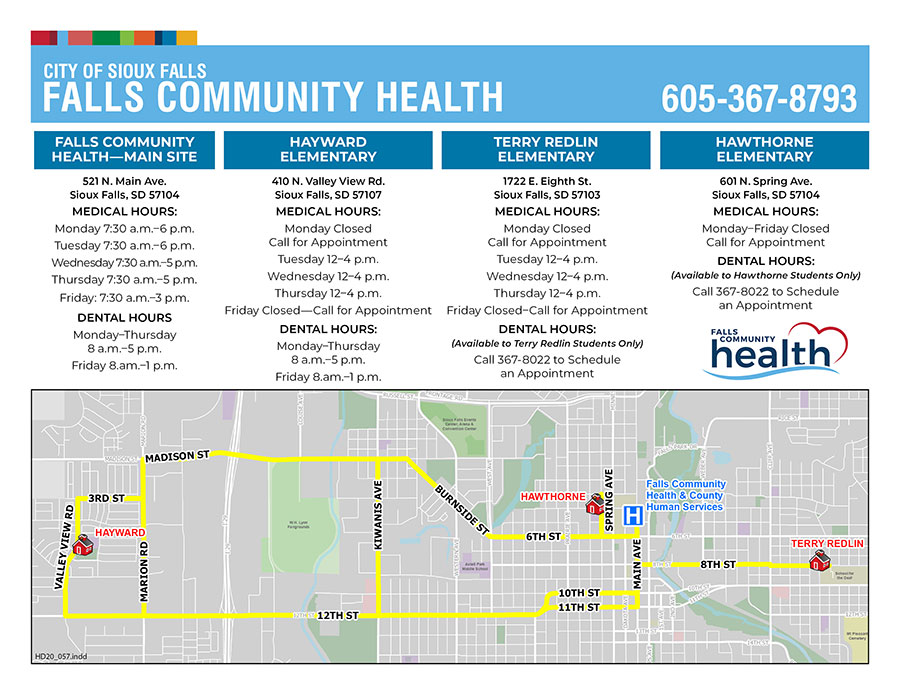
Falls Community Health
Falls Community Health provides affordable primary care, dental services and other health services at a downtown clinic or three neighborhood locations throughout Sioux Falls.
The dental clinic offers emergency services, routine dental care, school-based preventative dental care, cleanings, extractions, and fillings.
Qualifications:
Falls Community Health offers a sliding fee scale to patients based on annual household income for our services. Acceptable forms of verification are:
Income tax forms
One month's worth of pay stubs
Statements from Social Security/Disability
Notice of action from food stamps or unemployment
Other forms pertaining to child support, TANF, student class schedule, etc.
Letters from other organizations that may be helping you
Falls Community Health fees are based on the federal government’s poverty guidelines and vary based on household size and income. A nominal charge per visit of $15 for medical and $35 for dental is expected at time of service.
How to get help:
Call 605-367-8793
Visit one of the four Falls Community Health locations
Food help in Sioux Falls
Here are food resources local to Sioux Falls, S.D.:
Faith Temple Food Giveaway
Faith Temple offers multiple food giveaways in South Dakota by offering. The schedule is online.
How to get help:
Call 605-332-2303
Email staff@faithtemplefood.com
Food to You
Food to You, a mobile food pantry, is a monthly food distribution ministry in Sioux Falls. You can receive food from Food to You one time per calendar month. The schedule and locations are available online.
Qualifications:
Must attend a Food to You distribution event to pick up the items
How to get help:
Call 605-271-2163
Email foodtoyousiouxfalls@gmail.com
Education help in Sioux Falls
Here is an education resource in Sioux Falls:
Sioux Falls Area Community Foundation
The Sioux Falls Area Community Foundation awards more than 150 scholarships to local students each year. The foundation has an interactive search-and-match tool to help you find scholarships you are eligible for.
To get started, you must first:
Complete the FAFSA
Select the appropriate button below to use our search-and-match feature
Enter your SAI (Student Aid Index), found on your FAFSA, to find scholarships you qualify for
Additional qualifications vary by application.
How to get help:
Call 605-336-7055
Email info@sfacf.org
Employment help in Sioux Falls
Check out this employment resource in Sioux Falls:
South Dakota Job Corps
Job Corps provides free education and training for multiple career paths. If accepted, your child will receive a bi-weekly stipend and a transition allowance after graduation with career placement help. There are residential (live on campus) and nonresidential options.
As a student, your child will receive:
Free housing
Free meals
Free medical care
Living allowance
Free books and supplies
Free uniforms and safety equipment
Qualifications:
U.S. citizen or lawful resident
Aged 16-24
Must have proof of a low income such as SNAP or free/reduced-price lunch
Proof of barriers to education and employment such as dropping out of high school, homelessness, trafficking, or aging out of foster care
“The Long-Term Impacts of Cash Assistance to Families,” by Kevin Werner, The Urban Institute, Jan. 31, 2024 https://www.urban.org/research/publication/the-long-term-impacts-of-cash-assistance-to-families
Not your state? Select yours here:
If you’re a single mom in Tennessee struggling to make ends meet, keep reading for resources that help with:
Statistically, families benefit most with cash assistance (vs through benefits programs).1 Here is our guide to single mom grant programs, including our own.
Every month, I give out $500 cash to one single mom struggling with money, health, stress, child care, illness or loneliness — no strings attached.
Qualifications are simple:
1. You're a single mom.
2. You need the money right now.
Fill out this form to apply:
(Note that the figures and information in this post are current as of publication date.)
Number of people in family/household
Annual income
1
$15,960
2
$21,640
3
$27,320
4
$33,000
5
$38,680
6
$44,360
7
$50,040
8
$55,720
For families/households with more than 8 people, add $5,680 for each additional person.each additional person.
Emergency cash for low-income families in Tennessee
If you need cash to pay bills, buy gas, feed your family, or for any other reason, these resources can help:
Temporary Assistance for Needy Families (TANF) in Tennessee
Families First, Tennessee’s version of the TANF program, provides a monthly cash allowance for qualifying low-income families with children under the age of 18 and children age 18 and older who attend school full-time.
Families First helps participants with:
Temporary cash assistance
Transportation
Child care assistance
Educational support
Job training
The amount paid out varies depending on household income. For example, Families First pays a maximum of $387/month to a family of three.
Qualifications:
U.S. citizen or a qualified non-citizen
Have children under 18 or under 19 if a full-time student
Continued absence from the home from at least one parent
Physical/mental incapacity of at least one parent
Death of a parent
Apply for and accept other benefits such as:
Unemployment Compensation
Workman’s Compensation
Supplemental Security Insurance (SSI)
Child Support
Children and mother must have social security number
Children ages 6 to 17 who have not graduated high school or received equivalent certificate must attend school with satisfactory attendance
Preschool children must be immunized
Meet income requirements (linked above)
Paternity of child must be established at application and when a child is added
Adult recipients are required to participate in work activities for at least 30 hours/week
Must cooperate with Office of Child Support Services
Cash assistance is available for a lifetime total of 60 months for adults, though extensions may be granted in cases of domestic violence and physical/mental incapacity.
If you need help finding a place to live or paying your rent/mortgage, this program can help:
Public Housing and Housing Choice Vouchers (Section 8)
The U.S. Department of Housing and Urban Development (HUD) offers affordable housing and vouchers to help low-income households in Tennessee pay their rent.
If you need help buying a home in Tennessee, these programs can help:
Hope Credit Union Home Loans
Hope Credit Union Enterprise Corporation offers multiple loan options whether you are a first-time homebuyers, looking to refinance, or have been denied lending because of poor credit. Hope has specific loan products that cater to low- to moderate-income families:
FHA loan – Best for families with low to moderate income who cannot afford a large down payment
Hope loan – An affordable housing loan from Hope Credit Union you can apply for even if your credit score is as low as 580
Hope has loan options for any income level and credit standing.
Tennessee Housing offers Great Choice Home Loan programs with 30-year fixed-rate mortgage loans for first-time homebuyers. These loans can be offered as FHA, VA, USDA, or conventional loans.
Must meet IRS definition of a first-time homebuyer, which means you can not have owned any other principal residence for three years prior to the date of purchase of the new principal residence
The main goal of the Office of Housing and Homeless Services is to prevent Tennessee residents from becoming homeless — or from having to return to homelessness. The office helps people find stable housing in:
Emergency shelters
Transitional housing
Permanent housing
Counseling to acquire the necessary life skills to maintain permanent housing
Medical insurance and dental help for single moms in Tennessee
The following medical and dental services are available to qualifying individuals and families:
Health Resources & Services Administration (HRSA) in Tennessee
HRSA, an agency of the United States Department of Health and Human Services, funds health centers that provide free or subsidized health and dental care to low-income people and those otherwise unable to access quality health care, like people living in rural areas.
HRSA also offers a 24/7 free and confidential mental health hotline for pregnant and new moms. Dial 833-943-5746 (833-9-HELP4MOMS) if you are struggling.
Qualifications:
Each health center sets its own eligibility criteria for free or reduced cost care.
How to get help:
Find an HRSA health center in Tennessee by typing in your address on HRSA’s search tool.
Tennessee Medicaid
TennCare, Tennessee’s Medicaid program, provides medical coverage for low-income individuals and families. Benefits include:
Managed Medical Assistance (MMA) – Covers medical services like doctor visits, hospital care, prescription drugs, mental health care, and transportation for medical needs
Long-term Care (LTC) – Covers care in a nursing facility, assisted living, or at home (must be at least 18 years old and require nursing home-level care or hospital-level care if you have cystic fibrosis)
Dental – Covers all dental services for children and adults
Mail applications to: TennCare Connect P.O. Box 305240 Nashville, TN 37230-5240
Tennessee CoverKids
CoverKids — part of the national Children's Health Insurance Program (CHIP) — is for children whose families don’t qualify for Medicaid.
Families who meet the income guidelines don’t pay a monthly premium for CoverKids, but they may have to pay copays for some services depending on their income level.
CoverKids benefits include:
Vaccinations and well-child visits
Physician services
Hospitalizations
Mental health services
Physical, speech and occupational therapy
Vision and dental care
Qualifications:
Tennessee residents
Under 19 years of age on the date of application
Not eligible for or enrolled in TennCare
Household income is at or below 250% of federal poverty level
Mail applications to: TennCare Connect P.O. Box 305240 Nashville, TN 37230-5240
CoverRx
CoverRX is a prescription drug program for Tennesseeans who have no pharmacy coverage. Members pay no monthly premiums, but copays of $3 to $5 are required for most prescriptions. CoverRx provides the following benefits:
Access to more than 200 generic medications, insulin, diabetic supplies and select mental health drugs
Up to five prescriptions per month (insulin, diabetic supplies, and vaccines — COVID-19 antivirals and at-home tests do not count against the monthly limit)
Discount for many non-covered drugs
CoverRx is notinsurance and will not cover doctor's visits or hospitalizations
Qualifications:
Tennessee resident for at least six months
U.S. citizen or qualified legal alien
Age 18-64
Income at or below 138% of the federal poverty level
A number of federal and state food and nutrition programs are available across the state:
Tennessee Food Assistance Program (SNAP)
USDA’s Supplemental Nutrition Assistance Program (formerly known as the Food Stamp program) provides food benefits and nutrition education to low-income households.
SNAP recipients are issued an EBT card that can be used like an ATM card to purchase food in retail food stores, including:
Breads
Cereals
Fruits
Vegetables
Meats
Fish
Poultry
Dairy
Plants and seeds to grow food
Qualifications:
Tennessee resident
Most people between 16 and 59 years old
Must register for work
Participate in the Employment & Training Program if offered
Accept offers of employment
Cannot quit a job
Asset limit under $2,750 or under $4,250 and share your household with one of the following:
Person or persons age 60 and over
Person with a disability (child, spouse, parent, yourself
Low-income, pregnant, breastfeeding, and postpartum women, for up to one year postpartum
Women up to six months postpartum who are not breastfeeding
Infants and children under 5 years old, including foster children
Low-income sole provider parents of children under age of 5 who are at nutritional risk and who are below 185% of FPL
If you are currently receiving Medicaid, Temporary Cash Assistance, or Food Assistance help, you are also eligible for WIC
How to get help:
Call your local WIC office or 800-342-5942 and say you want to apply for WIC.
National School Lunch Program (NSLP) and School Breakfast Program
NSLP serves healthy, well-balanced, reduced-price or free meals to children in school.
An extension of the NSLP, the School Breakfast Program provides free or low-cost breakfast to eligible students. Schools with at least 80% of the students eligible for free or reduced-price meals must provide breakfast at no cost to all students.
Apply online or contact your child’s school to enroll.
Tennessee’s Summer Food Service Program (SFSP)
The SFSP is a partnership between the USDA Food and Nutrition Service, the Tennessee Department of Human Services, and community organizations to provide free meals to children throughout the summer. Parents can find meal sites nearby using the location finder online here.
Food is distributed at local schools, nonprofits, parks and libraries.
Qualifications:
Children 18 and younger
People with disabilities over age 18 can also qualify
Child care help for low-income families in Tennessee
There are multiple federally funded education programs and resources in Tennessee:
Tennessee Head Start and Early Head Start
Head Start is a free federal preschool program for children aged 3 to 5 from low-income families. Early Head Start serves pregnant women and children under age 3. The programs focus on cognitive, social, and emotional development and prepare children for school.
Qualifications:
Children from birth to 5
Meet federal poverty guidelines
Children in foster care, homeless children, and children from families receiving public assistance (TANF, SSI, etc.) are eligible regardless of income
Some programs accept kids with incomes above the poverty guidelines
Pregnant women can also receive prenatal and postpartum information, education, and services through Early Head Start
Call the Head Start Collaboration Office at 615-741-4849
Tennessee Child Care Payment Assistance
Tennessee’s Child Care Payment Assistance Program provides aid covering the cost of child care so a parent can work or attend a training or education program.
Parents who have children six weeks to 5 years old and who work or go to school, or both, for 30 hours or more a week
High school or middle school mothers who stay in school who participate in the Teen Parent program
Parents in the Families First program who need child care to complete work activities in their personal responsibility plan
Non-parental guardians in the Families First program who need child care for a related child IF the guardian does 30 or more hours of work, training, or education a week.
If you’re a single mom who wants to further her education, here are some helpful resources:
If you are at least 18 years old in Tennessee**, you can take the HiSET test (which replaced the GED in the state). If you are a resident, you might be eligible for a voucher that allows you to take the HiSET exam for free if you meet the requirements established through your local Adult Education program.
**If you are 17 years old, you must have an age waiver signed by your local director of schools and present it at the time of your test.
The College Pays TN connects students and prospective students with grants and scholarships available in Florida. To find out which scholarships and grants you may be eligible for, check out the College Pays website.
Tennessee Student Assistance Award
The program provides non-repayable financial assistance to low-income undergraduate students who are residents of Tennessee. Applicants must be enrolled or accepted at an eligible postsecondary institution in Tennessee. The TSAA is a state-funded grant program.
The amount of the award is based on the institution indicated on the student’s FAFSA. Award amounts for an academic year are:
Individual schools also offer need-based and academic scholarships for their students. If you’ve been accepted to a higher education institution, contact their office of financial aid to learn how to apply.
“The Long-Term Impacts of Cash Assistance to Families,” by Kevin Werner, The Urban Institute, Jan. 31, 2024 https://www.urban.org/research/publication/the-long-term-impacts-of-cash-assistance-to-families
Not your state? Select yours here:
If you’re a single mom in Pennsylvania struggling to make ends meet, keep reading for resources that help with:
Statistically, families benefit most with cash assistance (vs through benefits programs).1 Here is our guide to single mom grant programs, including our own.
Every month, I give out $500 cash to one single mom struggling with money, health, stress, child care, illness or loneliness — no strings attached.
Qualifications are simple:
1. You’re a single mom.
2. You need the money right now.
Fill out this form to apply:
(Note that the figures and information in this post are current as of publication date.)
Number of people in family/household
Annual income
1
$15,960
2
$21,640
3
$27,320
4
$33,000
5
$38,680
6
$44,360
7
$50,040
8
$55,720
For families/households with more than 8 people, add $5,680 for each additional person.each additional person.
Emergency cash for low-income families in Pennsylvania
If you need cash to pay bills, buy gas, feed your family, or for any other reason, these resources can help:
Temporary Assistance for Needy Families (TANF) in Pennsylvania
TANF-Pennsylvania provides emergency funds to qualifying individuals and families in need, including pregnant women, single mothers, and low-income families.
TANF is designed to help single mothers and low-income families cover the costs of food, rent, clothing, and bills.
You can receive cash assistance through TANF for up to 60 months (5 years) throughout your lifetime. The amount of money you receive depends on which county you live in, as well as the number of people in your household. Your household income may also affect your payout amount.
Pennsylvania Family Assistance, provided through the PA Department of Human Services (DHS), offers resources to families and single mothers in need of financial assistance.
Qualifications:
U.S. citizen or a qualified non-citizen
Pennsylvania resident
Unemployed or underemployed
Low or very low income
One of the following:
have a child 18 years of age or younger, or
be pregnant, or
be 18 years of age or younger and head of your household
Pennsylvania offers housing programs and services that help individuals and families with low incomes, older adults and people with disabilities, and those at risk of or experiencing homelessness.
If you need help finding a place to live or paying your rent/mortgage, these programs can help:
Rental assistance in Pennsylvania
There are several programs in Pennsylvania to help renters find housing and pay their rent based on the county in which they live:
Public Housing and Housing Choice Vouchers (Section 8)
The U.S. Department of Housing and Urban Development (HUD) offers affordable housing (rental apartments) and vouchers to help low-income households pay their rent.
Qualifications:
Meet income limits specified by HUD: less than 50% of medium income for the county in which you live. You can find your county’s income limits on the HUD website.
Call 800-955-2232 (housing choice voucher program in Pennsylvania)
To apply, you will need your Social Security Number, third-party documentation of income, preliminary application form, and signed consent forms
Contact your local HUD rental assistance agency and ask how to apply. Some counties may not offer rental assistance.
Please note: Some PHAs have long waiting lists, so you might want to apply at more than one. Your PHA can also give you a list of locations where your voucher can be used.
Subsidized apartments
HUD allows apartment owners to offer reduced rent to their low-income tenants. To apply, contact or visit the management office of the apartment building(s) that interest you.
The Pennsylvania Housing Finance Agency’s (PHFA) housing search tool helps people search for housing by rent amount, area of interest, accessibility, etc.
You can also find additional statewide information and resources, including a rental checklist, rent calculator, and information on services and transportation.
If you need help with your mortgage in Pennsylvania, or you need help buying a home, these programs can help:
The Pennsylvania Housing Finance Agency (PHFA)
PHFA offers several homebuyer and mortgage assistance programs, including down payment and closing cost assistance. You can find information on:
Foreclosure prevention and assistance
Home improvement & repairs
Refinancing options
This is one of their programs:
K-FIT
The Keystone Forgivable in Ten Years Loan Program (K-FIT) helps qualified homebuyers with a down payment and/or closing costs by providing a second mortgage loan. Eligible borrowers may receive 5% of the lesser of the purchase price or appraised value with no maximum dollar limit. The loan is forgiven annually over 10 years at 10% interest per year.
Qualifications:
Buyers must meet the requirements of the applicable PHFA first mortgage program and the K-FIT requirements, most of which are listed below:
Minimum credit score of 660
Maximum assistance will be based on the lesser of the purchase price or appraised value
Assistance must be used for down payment and/or closing costs
Minimum loan amount is $500.
K-FIT may not be combined with any other PHFA assistance program, except the ACCESS Home Modification Loan Program.
K-FIT may be used for conventional, FHA, VA, or RD loans
Homeless and special needs housing assistance in Pennsylvania
The following housing programs help homeless and special needs individuals in Pennsylvania:
Emergency Housing Voucher (EHV) Program
The EHV program helps those who are homeless, at risk of homelessness, and/or attempting to flee or fleeing domestic issues. Note: This program does not provide immediate assistance.
The EHV program helps families and individuals experiencing homelessness by helping them find affordable housing in the short term and establishing housing stability in the long term.
Qualifications:
EHVs are limited to individuals and families who are:
Homeless or at risk of homelessness
Fleeing, or attempting to flee, domestic violence, dating violence, sexual assault, stalking, or human trafficking
People who are recently homeless or for whom rental assistance will prevent homelessness
Transportation help for low-income families in Pennsylvania
Pennsylvania offers multiple transportation resources for single moms and low-income families:
Free and low-cost transportation
You may be eligible for these free and low-cost transportation options if you meet the eligibility criteria:
Medical Assistance Transportation Program
The Pennsylvania Department of Human Services offers the Medical Assistance Transportation Program (MATP), which allows Medicaid recipients in the state to schedule free or low-cost rides to medical appointments.
The cost and type of transportation vary by county. In places where public transportation is available, the program offers free or discounted passes or reimbursement to cover the fare.
If public transportation is not an option, MATP also has options for vehicle mileage reimbursement of 12 cents per mile as well as paratransit options where those in need of a ride can be picked up and dropped off at their medical appointment.
This nationwide charity provides free cars to eligible applicants in Pennsylvania:
Free Charity Cars
Free Charity Cars awards free vehicles to selected applicants in all 50 states. The nonprofit charity group has been awarding free vehicles to low-income American families since 1996 and has gifted more than 9,000 cars. The charity group notes that they do not have an inventory of vehicles readily available as they award cars as soon as they get them, so there can be extensive waiting periods for those selected for the free car program.
If you’re struggling to pay your utility bills in Pennsylvania, check out the following programs:
Low-Income Home Energy Assistance (LIHEAP) in Pennsylvania
LIHEAP helps eligible households with their home heating and cooling bills through energy bill payment assistance, energy crisis assistance, and long-term weatherization assistance.
Grants range from $300 to $1,000 based on household size, income, and fuel type.
Qualifications:
U.S. citizen or legally admitted immigrant
Responsible for paying cost of energy bills
Resident of Pennsylvania
Total gross annual household income at or below 60% of the state median income
WAP helps qualifying households lower their monthly energy bills by making their homes safer, healthier, and more energy efficient. Types of assistance include:
Air and duct sealing
Wall, floor, attic insulation
Heating, ventilation, air conditioning system improvements
Lighting efficiency
Hot water tank insulation
Water conservation devices
The average expenditure per household is $7,669.
Qualifications:
Low-income individuals (at or below 200% of FPL), with priority given to higher-risk residents such as the elderly, disabled individuals, families with children, and high energy users.
Low-Income Household Water Assistance (LIHWAP) in Pennsylvania
LIHWAP was created in response to COVID-19 and helps eligible households pay for drinking and wastewater. Payments are applied directly to the water account and paid to the vendor.
Qualifications:
Receive water through public pipelines from participating vendor
Total gross income at or below 60% of state median income
Medical insurance & dental help for single moms in Pennsylvania
The following medical and dental services are available to qualifying individuals and families in Pennsylvania:
Health Resources & Services Administration (HRSA) in Pennsylvania
HRSA, an agency of the U.S. Department of Health and Human Services, funds health centers that provide free or subsidized health and dental care to low-income people and those otherwise unable to access quality health care, like people living in rural areas.
HRSA also offers a 24/7 free and confidential mental health hotline for pregnant and new moms.
Qualifications:
Each health center sets its own eligibility criteria for free or reduced-cost care
How to get help:
Find an HRSA health center in Pennsylvania by typing in your address on HRSA’s search tool.
Call 833-943-5746 (833-9-HELP4MOMS)
Medical Assistance in Pennsylvania
Medical Assistance (Pennsylvania’s Medicaid program) is an assistance program that pays for health care services for low-income individuals and families.
Qualifications:
Resident of Pennsylvania
U.S. national citizen, permanent resident, or legal alien
Children 18 and under
Pregnant women
Parents and caretakers of children under 21
Individuals ages 65 and older
Blind and/or disabled
Individuals receiving long-term care or home and community-based services
If your income is higher than the limits but you have medical bills you owe
Adults ages 19-64 with incomes at or below 133% of the Federal Income Poverty Guidelines (FPIG):
Household size
Monthly pregnant women and infants under age 1 (215% FPIG*)
Children’s Health Insurance Program (CHIP) in Pennsylvania
CHIP provides health coverage for kids and teens who are uninsured and not eligible for or enrolled in Medical Assistance.
CHIP is free for most families, though families with incomes above the free CHIP limits can pay low monthly premiums, starting at $53/month, plus co-pays for some services.
Qualifications:
18 years and younger
U.S. citizen, U.S. national, or qualified alien
Resident of Pennsylvania
Uninsured and not eligible for Medical Assistance
These are the income limits for free and reduced-cost coverage, plus premium/co-pay costs for those not eligible for free coverage
The DHS provides people with access to quality dental services through Medical Assistance (MA, or Medicaid). Dental services are based on your eligibility category, age, and need.
MA covers all medically necessary dental services for enrolled children, including:
Teeth cleaning
X-rays
Cavity fillings
Crowns
Other services
Adults enrolled in MA are eligible at minimum for surgical procedures and emergency services related to treatment of symptoms and pain.
Qualifications:
You must apply for MA first to see if you are eligible
If you need help finding a dentist that accepts MA, visit www/enrollnow.net or call 800-537-8862
Family Planning Program
Pennsylvania’s Family Planning Program provides health and medical support to statewide family planning clinics and aims to prevent high-risk pregnancies among sexually active adolescents 17 years and younger.
Clinical services provided at local clinics include:
Physical exams
Routine gynecological care
Pregnancy testing
Contraceptives
Cancer screening and examinations
Sexually Transmitted Disease diagnosis, treatment, education, and counseling
A number of federal and state food and nutrition programs are available across the state:
Pennsylvania Supplemental Nutrition Assistance Program (SNAP)
SNAP is a federally funded program that helps low-income households buy healthy foods through funds loaded on an Electronic Benefits Transfer (EBT) ACCESS Card.
These are the maximum monthly SNAP benefits in Pennsylvania:
Family Size
1
2
3
4
5
6
7
8
Each additional person
Maximum benefit
$281
$516
$740
$939
$1,116
$1,339
$1,480
$1,691
Add $211
Qualifications:
To be eligible for SNAP in Pennsylvania, you must meet income requirements and meet one of the following requirements:
Current bank balance (savings and checking combined) under $2,001, or
Current bank balance (savings and checking combined) under $3,001 and share your household with one of the following:
Person or persons age 60 and over
Person with a disability (child, spouse, parent, or yourself)
These are the current income guidelines for SNAP in PA:
The Emergency Food Assistance Program (TEFAP) is a federal program that helps low-income individuals in Pennsylvania by providing emergency nutrition at no cost.
Qualifications:
Each food bank sets its own eligibility and proof of need requirements.
How to get help:
Visit Find Food Banks in Pennsylvania to find your local foodbank.
Pennsylvania’s Women, Infants, and Children (WIC)
The Special Supplemental Nutrition Program for Women, Infants, and Children is a nutrition program that provides free baby formula and nutritional food items to low-income mothers and their babies.
National School Lunch Program (NSLP) & School Breakfast Program (SBP)
NSLP serves healthy, well-balanced, reduced-price, or free meals to children in school. An extension of the NSLP, the SBP provides free or low-cost breakfast to eligible students.
Qualifications:
Household income must fall at or below the limits of the federal income eligibility guidelines:
Household size
Maximum income level (per year)
1
$26,973
2
$36,482
3
$45,991
4
$55,500
5
$65,009
6
$74,518
7
$84,027
8
$93,536
For households with more than eight people, add $9,509 per additional person.
Pennsylvania also offers other child nutrition programs to low-income households with students 18 and under attending schools, including the Afterschool Snack Program, Fresh Fruit & Vegetable Program (FFVP), Special Milk Program, and Seamless Summer Option (SSO).
Pennsylvania’s Summer Food Service Program
The Pennsylvania Department of Agriculture and Consumer Services serves nutritious meals at no cost to children during summer break. Food is distributed at local schools, nonprofit organizations, parks, and libraries.
Qualifications:
These are the current income guidelines for the Summer Food Service Program:
Child care help for low-income families in Pennsylvania
There are several federally funded education programs and resources in Pennsylvania:
Pennsylvania Head Start and Early Head Start
Head Start is a free federal preschool program for children aged 3 to 5 from low-income families. Early Head Start serves pregnant women and children under age 3. The programs focus on cognitive, social, and emotional development and prepare children for school.
Qualifications:
Children from birth to 5
Meet federal poverty guidelines
Children in foster care, homeless children, and children from families receiving public assistance (TANF, SSI, etc.) are eligible regardless of income
Some programs accept kids with incomes above the Poverty Guidelines
Pregnant women can also receive prenatal and postpartum information, education, and services through Early Head Start
Child Care Works helps low-income families in Pennsylvania find and afford child care near their home or work. The Child Care Works Subsidized Child Care Program helps low-income families pay their child care expenses. You must submit an application to the Early Learning Resource Center (ELRC) in your county to apply.
Qualifications:
Pennsylvania resident
Have a child or children requiring child care while you work or attend an education program
Work 20+ hours/week or 10+ hours and attend school/training 10+ hours/week
Have a promise of a job that will start within 30 days of your application for subsidized child care
Teen parents must attend an education program
Child who needs care must be a U.S. citizen or an alien lawfully admitted for permanent residency
Proof of identification for each parent or caretaker in the home
Meet income guidelines for your family size, 200% or less of FPL:
Family Size
Maximum yearly family income
2
$36,620
3
$46,060
4
$55,500
5
$64,940
6
$74,380
7
$83,820
8
$93,260
How to get help:
Visit Child Care Works for more information, including additional guidelines and eligibility requirements
Call the Child Care Works helpline at 877-4-PA-KIDS (877-472-5437)
If you’re a single mom who wants to further her education, here are some helpful resources:
Get a GED in Pennsylvania
Pennsylvania uses two options for high school equivalency testing: the GED and the HiSET exams, which test Language Arts (reading and writing), Mathematics, Science, and Social Studies. Test-takers can take the GED exam online or at one of Pennsylvania’s official test centers. The HiSET exam is also available in an online format.
These are the costs for each test type:
GED exam (in person): $120 for full exam / $30 per subject
GED exam (online): $144 for full exam / $36 per subject*
HiSET exam (online): $93.75
HiSET exam (paper/pencil version): $115
*To qualify for the online GED exam, you must first achieve a “green zone” score (likely to pass) on the GED Ready test, which is available on the GED website for $6.99 per subject ($28 total).
Qualifications:
In Pennsylvania, the minimum age to qualify for GED or HiSET testing is 16; however, underage applicants must sign an official age waiver and have parental consent
Pennsylvania requires GED and HiSET test-takers to be state residents
Test-takers cannot have a high school or equivalent diploma
Test-takers cannot be signed up for another school program
Pennsylvania does not require test-takers to first attend a prep course or pass the GED Ready practice test, unless the GED exam is taken online
Through Pennsylvania Higher Education Assistance Agency (PHEAA), Pennsylvania offers both grants (State Grant Program) and loans (Forward Student Loan) to help fund post-secondary education.
State Grant Program qualifications:
Pennsylvania resident
High school graduate
Attend a PHEAA-approved post-secondary school
Enrolled at least half time
Enrolled in a PHEAA-approved study program of at least two academic years that allows at least 50% of study in the classroom (medical disability exception)
Have made satisfactory academic progress
Not have already earned a bachelor’s degree or equivalent
Have satisfactory character (e.g., not be incarcerated)
Not have received the maximum number of PA State Grants permitted
Not be in default or pending default on an educational loan
Forward Student Loan qualifications:
U.S. citizen or permanent resident
Pennsylvania resident, or live in an approved state (MD, OH, NY, NJ, VA, WV, and DE)
Attend a Pennsylvania school (if not Pennsylvania resident)
Attend an eligible school in a degree-, diploma-, or certificate-seeking program
Secure a co-signer (if applicable)
How to get help:
Visit PHEAA for more information, definitions, more specific eligibility requirements (such as if you’re studying outside Pennsylvania), how to apply, application deadlines, etc.
Workforce programs in Pennsylvania provide training and assist with employment and education:
PAsmart
PAsmart is a workforce development initiative that helps connect Pennsylvanians with resources for working and training in Pennsylvania through:
Education
Training and apprenticeships
Career guidance
PAsmart prepares Pennsylvania students and workers for well-paid jobs in high-growth industries.
How to get help:
Check out Working and Training in PA for more information, to check your eligibility for each sector (Education / Training & Apprenticeships / Career Paths) and for more area-specific contact information
The following resources serve residents of Pittsburgh, Pa.:
Emergency assistance in Pittsburgh
If you need emergency cash for expenses like utilities, rent, and groceries, here are some helpful resources to consider in the Pittsburgh area:
Allegheny Valley Association of Churches
Allegheny Valley Association of Churches offers an Emergency Assistance program that provides cash help to residents of Allegheny and Westmoreland Counties. The program offers emergency cash to help with household expenses, including rent and utility payments, food, clothing and shoes, gasoline, bus passes and prescriptions. The amount awarded varies.
Qualifications:
Must be a resident of either Allegheny or Westmoreland county
Household monthly income must be 200 percent or below the Federal Poverty Income Guidelines
How to get help:
Call 724-226-0606 x10
Email avac@avaoc.org
YWCA Greater Pittsburgh
The YWCA Greater Pittsburgh helps women and children in the Pittsburgh area who are experiencing an emergency or crisis by offering several grants. The funds can be used to help families avoid eviction by helping cover the cost of rental arrears, utility arrears, and security deposits. Other financial assistance includes grants to cover tuition and training expenses, medical bills and more. The programs available include:
The Housing Stabilization Program helps Pittsburgh residents stay in their homes and avoid eviction by offering grants to contribute to housing costs such as security deposits or back-due rent and utility bills
The Liz Prine Memorial Fund offers grants of up to $1,000 to women working towards long-term goals. The funds can be used to pay for education expenses, job training, professional fees, books, test fees, uniforms, laptops, trade tools, and childcare costs
Qualifications vary based on the program and are based on the applicant’s need and situation.
How to get help:
Email resourcecenter@ywcapgh.org
Lazarus Fund Ministry Team
The Pittsburgh Presbytery’s Lazarus Fund Ministry Team offers emergency cash assistance to Pittsburgh residents in need of help with housing-related costs, including rent or mortgage payments, security deposits and utilities.
Pittsburghers interested in help from the Lazarus Fund Ministry Team need to apply.
How to get help:
Call 412-697-7390
Housing help in Pittsburgh
If you need housing help in Pittsburgh, here are some options:
The Housing Authority City of Pittsburgh
The Housing Authority City of Pittsburgh (HACP) offers cash assistance to first-time homebuyers through the Homeownership Program. Eligible families can receive closing cost assistance of up to $7,000.
Qualifications:
Applicants must own the home
Applicants must be first-time homebuyers
Property must be located within the city limits of Pittsburgh
Applicants must currently be a HACP Low-Income Public Housing resident or a Housing Choice Voucher Program voucher holder or eligible for one of the programs
Household annual income must be between 50% -80% AMI
For those who own a mobile home, a separate program and application are found here.
The Housing Assistance Resources Portal (HARP) is an online guide for people living in Pittsburgh to help those in need find housing-related resources. HARP allows people to search for resources and services based on their income, age, household size and housing needs or situation.
The Housing Resource Finder can help Pittsburghers who are:
Allegheny County Connect helps moms and children who are experiencing a housing crisis find a place to stay through access to emergency shelters and housing programs.
Here is a helpful transportation resource to consider in the Pittsburgh area:
North Hills Community Outreach Transportation
North Hills Community Outreach’s Transportation Assistance Program offers numerous services and financial help for Allegheny County residents who don’t have access to reliable transportation to get to and from work, job searching or education and vocational training. The program offers financial assistance for transportation-related expenses, including:
Car repairs
Gas
Port Authority CONNECT fare
Insurance payments
Loan payments
PennDOT Services
AAA memberships
Car seats
Qualifications:
Must reside in the Allegheny County areas served by North Hills Community Outreach, South Hills Interfaith Movement or Allegheny Valley Association of Churches
Household monthly income must be 200% or below the FPL
Must be experiencing hardship, crisis or other financial difficulties
How to get help:
Call 412-487-6316 x 3225
Email djwonders@nhco.org
Medical and dental care help in Pittsburgh
If you are looking for help with medical or dental care in Pittsburgh, check out these resources:
Catholic Charities Free Health Care Center
The Diocese of Pittsburgh’s Catholic Charities Free Health Care Center offers free medical and dental care to adults in the Pittsburgh area. Services offered at the center include primary care visits, dental exams, preventative care and specialty services such as physical therapy, gynecology and dermatology. Appointments are required.
Qualifications:
Must be 19 or older
Income less than 250% of the FPL
How to get help:
Call 412-456-6911
Free Care Clinics
The University of Pittsburgh’s Program for Health Care to Underserved Populations (PHCUP) operates two free clinics that offer medical and pharmacy services to Pittsburghers who don’t have health insurance. The two community clinics include:
The Birmingham Free Clinic is located on the South Side of Pittsburgh and provides numerous medical services to adults and children. A full list of medical and dental care offered can be found online
The Women’s Center and Shelter Clinic provides medical services to women staying in a shelter who are recovering from intimate partner violence
Once per month, UPMC’s Heart and Vascular Institute offers free cardiology services at the Birmingham Free Care Clinic, which includes health screenings, specialty consult services, chronic disease management for heart-related conditions and medication access and management. Appointments are required.
How to get help:
Call 412-246-3053
Mission of Mercy Pittsburgh
Mission of Mercy Pittsburgh hosts a two-day clinic that provides free dental, vision and hearing services for adults and children. All services are provided by local professionals and offered at no cost to the patient. There are no eligibility or insurance requirements. The next Mission of Mercy Pittsburgh clinic is scheduled for November 1 and 2, 2024 at the David L. Lawrence Convention Center. The doors will open at 6 a.m. each day and patients are seen on a first-come, first-served basis.
Here are some food resources local to Pittsburgh, Pa.:
Greater Pittsburgh Community Food Bank
Greater Pittsburgh Community Food Bank offers a variety of ways that families in the Pittsburgh area can get free food. The Food Bank’s online Food Finder Tool allows people to search for free food that fits their needs. Other Food Bank services include:
The Market: The free store is located at 1 North Linden Street in Duquesne and families can shop for grocery items such as fresh fruits, vegetables, meats and a variety of boxed and canned goods at no cost. The Market’s hours are online.
The Summer Youth Cafe: The cafe is part of the federal Summer Food Program and provides free meals to children while school is out for the summer. Locations will be posted on the Food Bank’s Food Finder Tool closer to summer.
Food Distributions: Distribution events provide a variety of grocery items to those in need through either walk-in or drive-up events where people can get between 30 and 50 pounds of food. During the drive-up events, volunteers will load up your vehicle’s trunk. Anyone is eligible to receive food. The schedule of distribution events can be found here.
How to get help:
Call 412-460-3663 ext. 655
North Hills Community Outreach Pantries
North Hills Community Outreach (NHCO) runs three food pantries located in Allison Park, Millvale and Bellevue. All three food pantries offer a variety of grocery items for families in need. In addition to the grocery staples, the Millvale pantry offers a gluten-free section for people with dietary restrictions.
How to get help:
Call 412-487-6316 x3144
Email jsjordan@nhco.org
Education help in Pittsburgh
Here are some education resources in Pittsburgh:
North Hills Community Outreach Education Assistance Program
North Hills Community Outreach (NHCO) offers grants to adult students who are enrolled in a college, university or vocational school through its Education Assistance Program (EAP). The program is for nontraditional students who live in northern Allegheny County. Applications for the fall semester are being accepted until June.
Check out these employment resources in Pittsburgh:
Pittsburgh Partnership
The Pittsburgh Partnership offers numerous training and employment services for Pittsburghers looking for a job. The programs offered include:
Employment, Advancement and Retention Network (EARN): This program, or TANF recipients, provides help searching for jobs, paid work experience and community service, training sessions and more
Learn and Earn Summer Employment Program: A six-week summer job for teens and young adults ages 14 to 21 that includes a variety of jobs that will help young adults obtain work experience, new skills and training
Partner4Work is an organization that helps connect job-seeking Pittsburghers with employers that have job openings. Partner4Work offers multiple services, including career training, job search help, resume writing tips, resources on how to obtain a GED and a summer job program. Partner4Work provides services to Pittsburghers who are 14 and older.
How to get help:
Call 412-552-7090
Email info@partner4work.org
Pennsylvania Women Work!
Pennsylvania Women Work is a Pittsburgh organization that helps women in the Pittsburgh area who are searching for a new job or in need of career advice. Pennsylvania Women Work offers numerous free programs, including job search and networking help, mock interviews, mentoring and career coaching, training, and more. The schedule of upcoming events can be found online.
How to get help:
Call 412-742-3262
Email info@pawomenwork.org
Charity organizations in Pittsburgh
There are a number of charitable organizations throughout the Pittsburgh area that offer support to single moms:
The Western Pennsylvania Diaper Bank
The Western Pennsylvania Diaper Bank distributes diapers and baby formula to numerous community partners where families can pick them up at no cost. The Diaper Bank does not directly hand out diapers and works with partner agencies where families can receive 25 diapers, 15 pull-ups and 15 adult diapers. Some partner agencies offer feminine hygiene products as well.
Off the Floor Pittsburgh is an organization that provides free second-hand furniture to Pittsburgh families who are unable to afford to furnish their homes, including women and children leaving shelters or transitioning from homelessness. Off the Floor does not take applications directly and works with dozens of partner agencies in the area.
Qualifications:
Those interested in free furniture must work with an Off the Floor partner agency
How to get help:
Call 412-926-5053
Jeremiah's Place
Jeremiah’s Place provides free emergency childcare for children ages 0 to 6. The amount of time children can stay at Jeremiah’s Place varies from a few hours to a few days depending on the family’s needs. While Jeremiah's Place offers childcare 24/7, it is not a drop-in facility. Families interested in free emergency childcare must call to make an intake appointment.
How to get help:
Call 412-924-0726
Help for single moms in Philadelphia, Pennsylvania
The following resources serve residents of Philadelphia, Pa.:
Emergency assistance in Philadelphia
If you need emergency cash for expenses like utilities, rent, and groceries, here are helpful resources to consider in the Philadelphia area:
Catholic Social Services of Philadelphia Emergency Assistance
Catholic Charities of Philadelphia offers multiple services and partners with numerous community groups to provide emergency assistance programs to families in need. Services available include help with rent or utility bills, free clothing and food, housing referrals, counseling and emotional support.
How to get help:
Call 267-331-2490
Email csshelp@chs-adphila.org
BenePhilly
BenePhilly offers free, one-on-one help with signing up for public benefit programs that can help families afford vital expenses. A BenePhilly counselor will work with individuals to help them find assistance based on their family’s needs and qualifications. The programs can help cover the cost of household expenses, including:
If you need housing help in Philadelphia, here are some options:
UESF
UESF is a Philadelphia nonprofit that offers numerous programs to help families stay in their homes. The programs help Philadelphia residents in need by assisting with household expenses such as utility bills and arrearages. UESF also offers services to help families create a plan and build skills that fit their housing, career and financial needs, such as self-sufficiency workshops and job training. Eligibility is determined based on the applicant’s submission form.
How to get help:
Call 215-972-5170
Women’s Community Revitalization Project
Women’s Community Revitalization Project (WCRP) offers numerous programs and services for moms and children by providing low-cost housing options, resources and supportive services.
WCRP has several properties where families can pick between affordable two to four-bedroom apartments, all equipped with in-unit laundry. There is a long waitlist and application process and it can take between one to four years before families would be able to move into a unit.
The Philly First Home program offers a grant of up to $10,000 to help first-time homebuyers reduce the principal and cover down payments and loan closing costs of a home they’re buying. The property must be a single-family home or duplex located in Philadelphia.
Qualifications:
Must be a first-time buyer or cannot have owned property in the last three years
Here is a helpful transportation resource to consider in the Philadelphia area:
Zero Fare
The City of Philadelphia’s Zero Fare program provides free Southeastern Pennsylvania Transportation Authority (SEPTA) transit for Philly residents living near or below the poverty level. The Zero Fare program does not take direct applications and does a random selection of applicants. Zero Fare accepts referrals from community partner agencies.
Eligibility is determined by age and income. Participants selected for the program receive a card that covers all SEPTA rides for one year.
Qualifications:
Must reside in the Allegheny County areas served by North Hills Community Outreach, South Hills Interfaith Movement or Allegheny Valley Association of Churches
Household monthly income must be 200% of the FPL
Must be experiencing hardship, crisis or other financial difficulties
How to get help:
Call 215-686-4419
Email zerofare@phila.gov
Medical and dental care help in Philadelphia
If you are looking for help with medical or dental care in Philadelphia, check out these resources:
City Health Centers
The City of Philadelphia has a City Health Centers, operated by the Department of Public Health, where adults and children can access low-cost medical and dental services. While the health centers accept urgent care and walk-in patients, some services require appointments. Call ahead to make sure the service is available before dropping in. Families do not need to have health insurance to receive care.
The centers offer dozens of services, including:
Treatment for illnesses
Checkups
Prenatal care and breastfeeding support
Pediatric care for infants, children and teens
Immunizations and vaccines
STD screenings and treatment
Lab tests and x-rays
Dental exams and emergency dental care
Follow-up appointments and specialty care referral
The Sayre Health Center provides healthcare to people in need regardless of their ability to pay. The center is open Monday through Friday from 8 a.m. to 5 p.m. and is located at 227 South 59th Street in Philly. Services offered at the center include:
Same-day appointments
Immunizations
Covid-19 rapid tests
Physicals
Laboratory services
Gynecology
Counseling
Sayre Health Center also operates a Mobile Care Unit (MCU), which is a traveling doctor’s office that comes to those seeking preventative medical services such as blood pressure testing, glucose screening and mental health evaluations. The MCU is a large van outfitted with medical equipment where patients can see a licensed physician and social worker.
Proof of income is required to determine each patient’s cost of services.
How to get help:
Call 215-474-4444
Project HOME's Healthcare Services
Project HOME's Healthcare Services offers low-cost health and dental services to adults and children in Philly at the Stephen Klein Wellness Center. The price for services varies based on household income but ranges from $5 to $20. Patients will not be turned away if they are unable to pay. The Stephen Klein Wellness Center is open Monday through Friday from 9 a.m. to 5 p.m. Same-day and next-day appointments are offered but people seeking care must call beforehand.
Services available to children include:
Well Child Visits for newborns to age 18
School and sports physicals
Immunizations
Services available to adults include:
Dental emergencies
Wellness exams
Reproductive services, including prenatal care
Behavioral health services
How to get help:
Call 215-320-6187
Food help in Philadelphia
Here are some food resources local to Philadelphia, Pennsylvania:
Philly Food Finder
Philly Food Finder’s Food Access Guide helps local families find ways to get free food. Philly Food Finder’s online food access map allows people to search for free food that fits their needs. Other services include:
Share Food Program: Allows families to pick up boxes packed with meat, fresh fruit and vegetables and other grocery items at dozens of partner pantries
Nice Roots Farm: A garden that shows people how to grow food in the city and provides free and low-cost produce to Philadelphia residents
Philabundance helps local families find free food through distribution events and the Philabundance Community Kitchen. Philabundance does not hand out food directly and works with several partner locations across the city where families in need can find food.
Catholic Social Services (CSS) offers a variety of ways that women and children who live in Montgomery County can get free food. CSS operates a market where people can pick foods they want and need in addition to several food pantries throughout the area. CSS provides several programs including:
Mercy Café helps women experiencing homelessness and low-income families. The cafe provides weekday lunches and access to clothing, showers and toiletries.
Martha’s Choice Marketplace is a large food pantry that is operated like a grocery store where families can pick from a variety of items at no cost. Families can visit the marketplace, which is located at 353 East Johnson Highway in Norristown, 16 times per year.
The marketplace is open Wednesdays from 3 p.m. to 6 p.m., Thursdays from noon to 3 p.m. and Fridays from noon to 2 p.m.
CSS provides food for families in need at six free food pantries located throughout the county. A list of pantry locations can be found online.
Qualifications:
Must be a Montgomery County resident
Must have a household income at or below 200% of the FPL
How to get help:
Call 267-331-2490
Email csshelp@chs-adphila.org
Education help in Philadelphia
Here are some education resources in Philadelphia:
College Savings Account Program
UESF, in partnership with United Way of Greater Philadelphia and Southern New Jersey, offers the College Savings Account Program, which helps local families save up to $2,000 for post-secondary education. United Way will match $3 for every $1 saved by program participants who save up to $500 for a total contribution of $1,500. The savings account funds can be used for tuition, books and test prep courses.
Qualifications:
Must live in Philadelphia, Delaware or Montgomery counties
Must have a household net worth of less than $10,000
Must have a household income at or below 350% of the FPL
Must attend three hours of financial literacy, such as savings, budgeting and credit
Must make minimum deposits and participate in the program for at least six months before funds will be matched
Minimum 2.5 GPA
Senior in high school planning to attend a 4-year college or university or a freshman enrolled in a 4-year degree program at a college or university
How to get help:
Call 215-732-8373
Email family@uesfacts.org
Employment help in Philadelphia
Check out these employment resources in Philadelphia:
Project HOME's Education and Employment Services
Project HOME offers numerous adult education and employment programs to help homeless and low-income Philadelphians. Project HOME’s programs include training classes with certifications and individual career support. Project HOME also has a public computer lab.
The career training certification classes offered include:
Certified Peer Specialist
Community Health Worker
Customer Service
Forklift Operator
ServSafe Food Handler
ServSafe Manager
Creative arts classes offered include:
Digital Audio, such as music production and recording beginner and advanced students
PA CareerLink provides free career development services to help Philadelphia residents who are looking for a job. Some services offered by CareerLink include free workshops, training, mock interviews, career support and advice, career and skills coaching and more. There are four career centers in Philly and they are open Monday through Friday from 8 a.m. to 4:30 p.m.
There are several charitable organizations throughout the Philadelphia area that offer support to single moms:
University City Hospitality Coalition
The University City Hospitality Coalition (UCHC) helps homeless people in West Philadelphia by providing hot meals, toiletries, free medical and dental clinics, a legal clinic, and referral services for shelter, housing, food, and clothing. The medical clinic, which is staffed by Penn Medicine students, physicians, and pharmacists, offers numerous services such as acute and emergent care, diabetes and hypertension screenings, STD testing, dermatology consultations, flu shots and referrals to social services.
The medical clinic is open on Wednesdays from 5:30 p.m. to 6:45 p.m.
The legal clinic is open on Wednesdays from 5:30 p.m. to 6:30 p.m. and can help with a variety of services, including landlord and tenant disputes, taxes, birth certificates and other identification and benefits assistance.
UCHC hands out free toiletries, such as shampoo, soap and lotion, on the last Wednesday of each month at 6:30 p.m.
The UCHC meal schedule and free food locations can be found online.
How to get help:
Call 267-297-4736
UCHC is located at PMB 410, 3720 Spruce Street in Philadelphia
Beautiful Beginnings
The Beautiful Beginnings program of Catholic Social Services helps pregnant women, new moms and mothers with young children find access to numerous resources including free pregnancy testing, support services, education, free diapers, free toiletries and baby boutiques. At the baby boutiques, pregnant women and new moms can get baby items such as clothing, bottles, books, bouncers, car seats, cribs and more.
“The Long-Term Impacts of Cash Assistance to Families,” by Kevin Werner, The Urban Institute, Jan. 31, 2024 https://www.urban.org/research/publication/the-long-term-impacts-of-cash-assistance-to-families
Not your state? Select yours here:
SOURCES
“The Long-Term Impacts of Cash Assistance to Families,” by Kevin Werner, The Urban Institute, Jan. 31, 2024 https://www.urban.org/research/publication/the-long-term-impacts-of-cash-assistance-to-families
If you’re a single mom in Texas struggling to make ends meet, keep reading for resources that help with:
Statistically, families benefit most with cash assistance (vs through benefits programs).1 Here is our guide to single mom grant programs, including our own.
Every month, I give out $500 cash to one single mom struggling with money, health, stress, child care, illness or loneliness — no strings attached.
Qualifications are simple:
1. You're a single mom.
2. You need the money right now.
Fill out this form to apply:
(Note that the figures and information in this post are current as of publication date.)
Number of people in family/household
Annual income
1
$15,960
2
$21,640
3
$27,320
4
$33,000
5
$38,680
6
$44,360
7
$50,040
8
$55,720
For families/households with more than 8 people, add $5,680 for each additional person.each additional person.
If you need cash to pay bills, buy gas, feed your family, or for any other reason, these resources can help:
Temporary Assistance for Needy Families in Texas
The Temporary Assistance for Needy Families (TANF) program offers monthly cash payments to help eligible Texas families pay for:
Food
Clothing
Housing
Utilities
Furniture
Transportation
Phone
Laundry
Supplies for the home
Medical supplies not paid for by Medicaid
Other basic needs
The monthly amounts given for TANF in Texas vary by family size and the number of parents/caretakers in the home. The family size refers to the number of people qualifying for TANF whose income is counted to calculate TANF payments, such as an eligible child or an eligible child and parent. In child-only cases, only the eligible children are counted in the family size:
Family Size
Child-Only Cases
Home with 1 Parent or Caretaker
Home with 2 Parents or Caretakers
1
$112
$136
N/A
2
$161
$283
$216
3
$226
$327
$358
4
$269
$393
$402
5
$345
$436
$466
Families can also receive a one-time TANF payment of $1,000 in the event of a crisis such as:
Loss of a job
Loss of financial support for a child (child support, rental assistance, etc.)
Not being able to find a job after graduating from a university, college, junior college or technical training school
Not being able to get a job because vehicle is not working
Loss of home
Medical emergency
This payment can only be given once in a 12-month period to those who qualify. Families who receive monthly TANF benefits do not qualify.
Relatives (grandparents, aunts, uncles, sisters, brothers) taking care of a child who receives TANF benefits can also receive a once-in-a-lifetime $1,000 payment if they are not receiving monthly TANF themselves, are at least 25 years old, and don’t have a lot of money or a way to get more money.
Qualifications:
For monthly TANF benefits:
Must be a U.S. citizen or a qualified non-citizen
Permanent Texas resident
Have at least one child 18 or younger living in the home
Parents or caretakers must be willing to search for work, take parenting classes, and avoid abusing drugs and alcohol
TANF-eligible children must be attending school and receive mandated vaccinations
A parent or blood relative of the child must be managing the household
Additionally, children may qualify for child-only TANF benefits in certain circumstances when a parent or caregiver is not eligible for the program for a reason other than income. For instance, parents receiving Supplemental Security Income or immigrant parents who are ineligible for the program will not affect their child’s ability to receive TANF.
These are the maximum monthly income limits to qualify for TANF in Texas, though they note that some people might be able to get benefits with higher incomes on a case-by-case basis:
Family Size
Child-Only Cases
Home with 1 Parent or Caretaker
Home with 2 Parents or Caretakers
1
$64
$78
N/A
2
$92
$163
$125
3
$130
$188
$206
4
$154
$226
$231
5
$198
$251
$268
Relatives receiving a one-time TANF payment of $1,000 should meet these income limits:
If you need help finding a place to live or paying your rent/mortgage, these programs can help:
Rental assistance in Texas
There are multiple programs in Texas to help renters find housing and pay their rent:
Section 811 Project Rental Assistance Program
Section 811 helps low-income individuals with a disability find affordable, subsidized housing. The program also connects members to relevant community services and agencies. Eligible individuals may have dependent children in the home.
Qualifications:
To qualify for Section 811, a household must have at least one eligible household member with a disability over age 18 and under 62. This person may or may not be the main provider of the household. Recipients must live in one of the following areas of Texas:
Austin-Round Rock
Brownsville-Harlingen
Corpus Christi
Dallas-Fort Worth-Arlington
El Paso
Houston-The Woodlands-Sugar Land
McAllen-Edinburg-Mission
San Antonio-New Braunfels
Households also must meet the following income limits to qualify:
How to get help:
Download an application packet from the Texas Department of Housing and Community Affairs to submit to an agent. You’ll need an agent’s referral to qualify for the program.
Public Housing and Housing Choice Vouchers (Section 8)
The U.S. Department of Housing and Urban Development (HUD) provides vouchers to help low-income individuals and families pay rent.
Qualifications:
HUD determines how much a household gets using their income and family size. Visit the HUD website to find income limits for your Texas county.
How to get help:
Contact a referral agent in your county to check for availability.
Mortgage assistance in Texas
If you need help buying a home in Texas, these programs can help:
Texas Homeowner Assistance (TXHAF)
The Texas Homeowner Assistance program was introduced to assist families financially impacted by COVID-19. The program helps homeowners pay up to three months of mortgage or related housing payments and up to three months of utility payments.
TXHAF allows for up to $65,000 in funds per eligible household, with a maximum of $10,000 for utility assistance and up to $25,000 for property charges, like property taxes or homeowners insurance.
Qualifications:
Texas homeowners can qualify for Texas Homeowner Assistance if they:
Occupy their home as their primary residence
Have an income at or below 100% of AMI or the median national income
Were financially impacted by the pandemic
Have trouble making payments on their mortgage, property insurance, utilities, or other housing-related expenses
How to get help:
Register for the online portal to fill out and submit your application and required documents.
Texas State Affordable Housing Corporation (TSAHC)
TSAHC helps Texas residents purchase homes by providing fixed-rate home loans and down payment assistance to qualifying individuals.
For mortgage loans, you’ll apply directly through an approved lender.
Down payment assistance can be given as a grant that doesn’t have to be repaid, or a deferred, forgivable second lien loan that only has to be repaid if you sell or refinance within three years. Homebuyers choosing the loan option can benefit from lower interest rates and, therefore, a lower monthly mortgage payment.
Qualifications:
Homebuyers must be eligible for a TSAHC mortgage loan program to receive down payment assistance. TSAHC offers two loan programs:
Homes for Texas Heroes Program: Individuals in specific community service professions qualify for this program:
Full-time public school educators (teachers, teacher aides, school librarians, school counselors, and school nurses)
Police officers and public security officers
Firefighters and EMS personnel
Veterans or active military
Correction officers and juvenile corrections officers
Nursing faculty and allied health faculty
Candidates need a minimum credit score of 620 and must meet the program’s income requirements. Learn more about whether you qualify for a VA loan.
Home Sweet Texas Home Loan Program: Candidates for this program also need a minimum 620 credit score and income within the program’s limits (same as above). Prospective Texas homeowners who do not have a “hero” profession necessary to qualify for the Homes for Texas Heroes Program should apply for this program.
How to get help:
Before applying, you can take an eligibility quiz to find out if you qualify. If you do, the website will provide contact information for participating lenders.
Homeless assistance in Texas
The following programs help homeless
Permanent Supportive Housing Program
The Permanent Supportive Housing Program helps people who are currently homeless or who may become homeless find affordable permanent housing. The program can also assist with job readiness and independent living skills to prevent homelessness in the future.
Qualifications:
A Texas HHS-approved local mental health authority or behavioral health authority determines individual eligibility.
Similar to the Permanent Supportive Housing Program, this program helps individuals with temporary house-related funds, such as utilities and rent payments. It is for people who are already homeless or at risk of becoming homeless.
Qualifications:
Texas residents must be eligible for mental health services with their local mental health or behavioral services authority. Some applicants may also need to apply for Section 8.
How to get help:
Speak to your mental health or behavioral services authority representative about applying or locate your local agency to determine your eligibility.
Transportation help for low-income families in Texas
Texas provides several transportation resources that eligible single moms can use for free or low-cost rides to work, school, or doctor’s appointments.
Free and low-cost transportation
Learn more about the following free and low-cost transportation programs in Texas:
Medical Transportation Program
Medicaid recipients in Texas may qualify for free nonemergency medical transportation for themselves and their children by taxi, bus, or public transportation. Participants can call for a ride at least two business days before their appointment.
The program can also pay for gas to and from medical appointments and meals and lodging needed for children’s appointments.
Qualifications:
Enrolled in Medicaid, Children with Special Health Care Needs, or Transportation for Indigent Cancer Patients
Texas has 76 public transit agencies serving its metropolitan, urban, and rural areas. Listed below are those with free and/or low-cost fares:
B Metro
Covers: Brownsville
Offers: $1 general fare, $0.50 fare for people with disabilities, $0.75 fare for students, children under 6 ride free
Beaumont Transit
Covers: Beaumont
Offers: $0.75 fare for children 6-18, free fare for children five and under
CityLink
Covers: Abilene
Offers: On-demand ride scheduling, free connecting transfers, $1 fare for youths age 5-18, free fare for children 4 and under
Concho Valley Transit
Covers: Tom Green County
Offers: Free Medicaid rides, children under 6 ride free, adults with disabilities can get reduced fare for $0.50
Corpus Christi Regional Transportation Authority
Covers: Nueces County, San Patricio County
Offers: $0.75 single-way fare, $1.75 day passes, $0.10 reduced fare for people with disabilities during off-peak hours or $0.25 for peak hours, free rides for students from pre-K to 12th grade
Dallas Area Rapid Transit (DART)
Covers: Dallas and its 12 surrounding cities
Offers: Half-price fares ($1.25 for single ride or $3 day passes) for youth, seniors, and people with disabilities
Gulf Coast Transit District
Covers: Brazoria County, Galveston County
Offers: $1 one-way fare, $0.50 fare for students
El Aguila Rural Transit System
Covers: Webb County
Offers: $1 one-way fares, $0.50 fares for students
El Metro Transit
Covers: Webb County
Offers: Children under 5 ride free, $0.75 fare for children 5-11
EZ-Rider
Covers: Ector County, Midland County
Offers: $1 fare for youth 6-18 and students with ID, seniors ride for $0.60, and free rides for children 5 and under
Falls Ride
Covers: Wichita Falls
Offers: Free rides for children under 7, $0.75 fares for children 7-18, seniors 65 and over, Medicaid card holders, and adults with disabilities
Island Transit
Covers: Galveston
Offers: One-way reduced fares of $0.50 rides for students, seniors, disabled persons, and Medicaid card holders, and children under 6 ride free with an adult
Longview Transit
Covers: Longview
Offers: $3 all-day passes, reduced fares of $0.65 fare for children 6-14 and $0.60 for seniors, disabled persons and Medicare recipients, and children 5 and under ride free
Metropolitan Transit Authority
Covers: Harris County
Offers: Free fares for children 5 and under riding with an adult and reduced fares for seniors 70 and over veterans, jurors, and METROLift riders
Offers: Free pre-scheduled rides based on availability for medical appointments, recreation, shopping, and social services
Port Arthur Transit
Covers: Port Arthur
Offers: Free rides for children 5 and under, $0.75 fare for K-12 students, seniors, disabled persons and Medicare card holders
Sun Metro
Covers: El Paso
Offers: Free rides for children 5 and under, $0.50 fare for seniors and disabled persons, and $1 fare for students and children 6-18
The Hop
Covers: Bell County, Coryell County
Offers: One-way rides for $1, and monthly passes for $25
Tyler Transit
Covers: Tyler
Offers: $1 fares for riders 12 and up, $0.50 fares for children 6-11 and people with disabilities, free rides for children 5 and under
Valley Metro
Covers: Lower Rio Grande Valley
Offers: $1 fares for students, free rides for children 7 and under
Via Metropolitan Transit
Covers: Bexar County
Offers: Reduced fares ($0.65) for elementary, middle, and high school students and people with disabilities, free rides for children 4 and under, free transfers, monthly passes as low as $19
Look to these resources if you need a vehicle or assistance getting your vehicle repaired in Texas:
God’s Garage
God’s Garage combines ministry with charity by gifting women in need donated vehicles or repairing their vehicles for free. Many of the women God’s Garage helps are single moms who are struggling financially.
Qualifications:
Single mom, widow, or wife of a deployed military member
Valid driver’s license
Do not own a vehicle title if applying for a donated car
Own the title to a vehicle if applying for repairs
Autocare Haven is a charity operated by donation that offers free auto repair to single parents and low-income families in the Dallas-Fort Worth area. Anyone receiving assistance can have their car repaired through a vetted mechanic in Autocare Haven’s network.
Qualifications:
Proof of auto insurance
Valid driver’s license
Verifiable income
Live in Dallas County, Denton County, Collin County, Tarrant County, or Rockwall County
If you are struggling to pay your utility bills in Texas, check out the following programs:
Comprehensive Energy Assistance Program (CEAP) in Texas
CEAP is Texas’s version of LIHEAP, a federal program that helps eligible households pay their heating and cooling bills. The program pays funds directly to the household’s energy company to help with electric bills in Texas.
Qualifications:
Resident of Texas
Meet the income threshold for the program:
Family Size
150% of FPL
1
$21,8870
2
$29,580
3
$37,290
4
$45,000
5
$52,710
6
$60,420
7
$68,130
8
$75,840
More than 8 people
Add $7,710 for each additional person
How to get help:
Visit the Texas Department of Housing and Community Affairs website. Click ‘Utility Bill Payment Help.’ Fill out your city or county, and click ‘Find Help’ to locate your nearest agency to apply. Or, call 2-1-1 Texas at 877-541-7905.
Weatherization Assistance Program (WAP) in Texas
Texas WAP helps low-income families reduce their energy bills by weatherizing their homes. The program can provide electric bill assistance in Texas by providing services like caulking, weather-stripping, replacing worn-out heating units, and completing energy audits.
Qualifications:
Resident of Texas
Meet current income guidelines based on family size:
Family Size
100% of FPL
150% of FPL
200% of FPL
1
$14,580
$21,870
$29,160
2
$19,720
$29,580
$39,440
3
$24,860
$37,290
$49,720
4
$30,000
$45,000
$60,000
5
$35,140
$52,710
$70,280
6
$40,280
$60,420
$80,560
7
$45,420
$68,130
$90,840
8
$50,560
$75,840
$101,120
Families with more than 8 persons
Add $5,140 for each additional person
Add $7,710 for each additional person
Add $10,280 for each additional person
How to get help:
Visit the Texas Department of Housing and Community Affairs website. Select ‘Weatherization’ and fill out your city or county to find your local agency for application assistance. You can also dial 2-1-1 or call 877-541-7905.
Medical insurance and dental help for single moms in Texas
Single moms in Texas may qualify for assistance with medical and dental care through the following programs:
Title V Maternal and Child Health Fee-for-Service Program
Women who do not qualify for Medicaid and other low-cost medical services may get help from this program for prenatal health and dental services. Qualifying children can also receive affordable child health and dental services.
Qualifications:
Texas resident
Must not be eligible for Medicaid, CHIP, or other healthcare plans
Women must be carrying a pregnancy or be no more than three months postpartum
Youth must be 21 or younger
Income should be at or below 185% of FPL
How to get help:
Call 800-222-3986
Visit the 2-1-1 Texas website or call 877-541-7905
Dental Hygiene Clinics and Schools
Some dental hygiene clinics and schools in Texas offer free or low-cost dental care to the public, such as the University of Texas School of Dentistry at Houston and the Texas A&M University College of Dentistry in Dallas.
Qualifications:
Each individual clinic or school sets its own eligibility requirements.
Health Resources & Services Administration (HRSA) in Texas
HRSA, an agency of the United States Department of Health and Human Services, funds health centers that provide free or subsidized health and dental care to low-income people and those otherwise unable to access quality health care, like people living in rural areas.
HRSA also offers a 24/7 free and confidential mental health hotline for pregnant and new moms. Dial 833-943-5746 (833-9-HELP4MOMS) if you are struggling.
Qualifications:
Each health center sets its own eligibility criteria for free or reduced-cost care.
How to get help:
Find an HRSA health center in Texas by typing in your address on HRSA’s search tool.
Texas Medicaid
Medicaid is one of many health care-related Texas programs for low-income families, providing medical coverage and services for eligible adults and children. The state offers a few variations of its Medicaid program for parents and families:
Children’s Medicaid – Covers well-child visits, routine immunizations, vision and hearing care, and other typical health services for children, including dentist visits
Health Insurance Premium Payment Program – Pays premiums for a job-related health insurance plan for families with at least one person on Medicaid
Medicaid for Parents and Caretakers – Allows low-income parents or caretakers who care for a child on Medicaid to receive Medicaid benefits
Women-Focused Medicaid – Covers services for women, such as prenatal care, cervical screenings, and care for women with breast or cervical cancer
Apply for benefits or find a local office on the Your Texas Benefits website, or call 2-1-1.
Texas Children's Health Insurance Program (CHIP)
Texas has its own version of the national CHIP program, which provides affordable health coverage for children in families with income higher than the typical Medicaid threshold. CHIP covers the same services as Medicaid, including dental visits, routine health care, and services for children with disabilities or special needs.
Families receiving CHIP do not pay premiums for services.
Qualifications:
U.S. citizen or qualified non-citizen
Texas resident
Child must be 18 or younger, though some children with disabilities may qualify up to age 20
Meet income guidelines based on family size:
Family Size (including adults and children)
Monthly Family Income
1
$1,510
2
$2,034
3
$2,559
4
$3,083
5
$3,607
6
$4,132
7
$4,656
8
$5,180
Each additional person
$525
How to get help:
Apply for CHIP or find a local office on the Your Texas Benefits website, or call 2-1-1.
Healthy Texas Mothers and Babies
Healthy Texas Mothers and Babies offers free resources for parents or soon-to-be parents to prevent preterm births and help babies have a healthy first year. The program connects parents to community education and support programs, like breastfeeding support services and affordable health care for babies.
Qualifications:
Healthy Texas Mothers and Babies makes resources available for parents, employers, health care providers, and agencies. Each program has its own process to determine eligibility.
A number of federal and state food and nutrition programs are available across the state:
Texas Supplemental Nutrition Assistance Program (SNAP)
Previously known as food stamps, USDA’s Supplemental Nutrition Assistance Program (SNAP) gives eligible Texas families funds to buy food. The benefits reload to an issued Lone Star Card each month for families to buy fresh produce, meat, pantry items, and other eligible food and drinks from brick-and-mortar or online stores accepting SNAP benefits.
SNAP benefits cannot be used to buy alcohol, tobacco, or non-food items.
Qualifications:
Texas parents qualify if they have eligible children in the home and meet the income guidelines shown below. Qualifying individuals 16 and older may be required to have a job or be looking for work to maintain benefits.
Family Size
Maximum Monthly Income
1
$1,869
2
$2,518
3
$3,167
4
$3,816
5
$4,465
Each additional person
$649
How to get help:
Apply for benefits on the Your Texas Benefits website or call 2-1-1 for assistance.
Women, Infants, and Children (WIC) in Texas
Texas WIC provides education and resources for pregnant women and women with young children. Through the program, moms can receive breastfeeding support, nutrition advice, and healthy foods for themselves and their babies or children through age 5.
Qualifications:
Women who are pregnant, breastfeeding, or have a child younger than 5 and qualify based on income may be eligible for WIC. Women can qualify for the program if they or their children already qualify for Medicaid, TANF, or SNAP benefits. More on the income guidelines for WIC.
How to get help:
Apply on the Texas WIC website, call 800-942-3678, or use the website to find a local WIC office.
National School Lunch Program (NSLP) and School Breakfast Program
Eligible public school children can receive free or reduced-price nutritious lunches and breakfasts at their schools through these programs. Meals must meet federal guidelines for nutritional value.
Texas schools are required to participate in the School Breakfast Program if at least 10% of their students qualify for these affordable meal programs based on income.
Contact your child’s school for more information or call 877-TEX-MEAL.
Texas Summer Meal Program
The Texas Department of Agriculture provides free, nutritious meals to children 18 and younger or children with disabilities up to age 21 when they’re on summer break from school.
Qualifications:
Family income must meet the following guidelines:
How to get help:
Call 877-TEX-MEAL to find a Summer Meal Program near you.
Find a tutor using your Texas education funds:
The Texas Education Freedom Accounts (TEFA) program launches for the 2026–27 school year with a $1 billion budget and an estimated 90,000 students in year one. Families can use TEFA funds to pay for approved educational expenses, including personalized online tutoring. Learner is an approved tutoring provider for the TEFA program, making it easy for Texas families to put their education funds toward 1:1 academic support. Learner is an approved tutoring provider for the Texas Education Freedom Accounts (TEFA) program.
Texas food banks
Food banks distribute food to Texas families in need.
Qualifications:
Each food bank sets its own eligibility requirements.
There are multiple federally funded education programs and resources in Texas:
Texas Head Start and Early Head Start
Head Start provides free preschool for children ages 3 to 5 from families meeting income guidelines. Pregnant women and families with children under 3 can receive services for their children from Early Head Start in Texas.
Qualifications:
Children from birth to 5
Meet federal poverty guidelines
Children in foster care, homeless children, and children from families receiving public assistance (TANF, SSI, etc.) are eligible regardless of income
Some programs accept kids with incomes above the Poverty Guidelines
Pregnant women can also receive prenatal and postpartum information, education, and services through Early Head Start
Texas Child Care Solutions connects parents with resources to help them afford child care. Parents can use the website to find quality child care providers, browse educational information, and apply for financial help for child care.
If you’re a single mom who wants to further her education, here are some helpful resources:
Get a GED in Texas
Texas residents who are 18 or older can pursue a GED in place of a high school diploma. Some 16 and 17-year-olds may also qualify if they have permission from a parent or guardian or are in the care of the state.
The complete Texas GED test costs $145 for a computer-based exam or $169 with an online proctor. The test is broken into reasoning through language arts, math, science, and social studies. Test-takers must score at least 145 on each subject to pass.
Grants and scholarships in Texas
The Texas Comptroller oversees Texas finances, like budgeting and taxes. Learners can find state-specific grants and scholarships through its website to help pay for college.
Prospective students can also fill out the FAFSA for federal financial aid and check with their school’s financial aid office for information on school-sponsored grants, scholarships, and work-study programs.
Jeremiah Program
Jeremiah Program operates in several states including out of Austin to offer grants and other support to low-income single mothers committed to earning a college degree.
The American Job Center Network is sponsored by the U.S. Department of Labor. The agency helps people in Texas and across the country find jobs and develop their skills through job training and career counseling.
There are a number of charitable organizations throughout Texas that offer support to single moms:
Gracewood
Gracewood is a charity that supports single moms and their children who find themselves in a crisis situation. The charity offers residential and counseling services to help women get back on their feet.
Qualifications:
Must be 18 or older and have at least one child under 18 in their full-time care
Not be involved in a CPS case
No criminal history
Valid driver’s license with reliable transportation
The Salvation Army has locations across the United States, including Texas. The charity organization helps local communities and families with multiple kinds of support, including:
Disaster relief
Shelter for domestic abuse situations
Rent
Utility payments
Holiday gift help
Food
Life skills
Religious or spiritual support
Job training
After-school programs
Qualifications:
Each Salvation Army location in Texas has its own services and determines eligibility for each of its services and programs.
How to get help:
Visit the Salvation Army website to find your local chapter.
Catholic Charities of Texas
Catholic Charities is a faith-based charity that helps individuals and families in need across Texas and in other states. The organization provides:
Counseling
Financial services
Immigration services
Disaster response services
Qualifications:
Eligibility varies for each Catholic Charities office.
How to get help:
Visit the Catholic Charities website of the branch closest to you to find contact information:
Get help from the following resources geared toward single moms in Houston, Texas:
Emergency cash assistance in Houston
If you’re in need of cash assistance in Houston to pay for your housing, clothing, or food, these resources can help:
Harris County Recovery Assistance
The Memorial Assistance Ministries of Houston offers a $1,500 one-time payment to families experiencing a financial hardship due to the COVID-19 pandemic. The money can be used to pay rent, utilities, or other basic necessities.
Qualifications:
Harris County
At least 18 years old
Financial hardship resulting from the pandemic
Enrolled in public assistance program or income at or below 60% of area median income
U.S. citizen
How to get help:
Call 281-982-4357
disasterhelp@mamhouston.org
Prince of Peace (POP) Houston’s Emergency Financial Assistance Program
POP Houston provides cash assistance to help pay for housing or utilities for families experiencing financial hardship. Applicants must complete an interview before receiving assistance.
Qualifications:
Live in one of these zip codes: 77070, 77069, 77066, and 77064
Financial hardship due to unexpected emergency
How to get help:
Call 281-982-4357
disasterhelp@mamhouston.org
Housing help in Houston
Get help from the following housing-related programs in Houston, Texas:
Harris County Community Services Department Rental Assistance
Harris County residents who have experienced a temporary inability to pay their rent or who have fallen behind on their rent may qualify for a one-time rental assistance payment. Payment amounts vary by household.
Qualifications:
Valid state or federal ID and social security card
Houston offers homeownership financial assistance of up to $50,000 to first-time homebuyers. The assistance is in the form of a no-interest loan that’s forgiven after five years as long as the homeowner remains in the home for the full five years. Applicants must complete a homebuyer education class through a HUD-approved agency.
Maximum purchase price of $261,000 for an existing home or $268,000 for new construction
Live in home for five years for awards up to $14,999, or 10 years for higher awards
Minimum credit score of 580
How to get help:
Call 713-578-2000
Medical and dental care help in Houston
Find free dental care in Houston through the following program:
Houston Health Department Dental Services
The Houston Health Department provides basic and preventative dental services to children and adults from six months old to 21 years old. The program helps families schedule appointments with partnered dental clinics and provides educational resources to maintain healthy teeth.
Qualifications:
Have Medicaid, CHIP, or no dental insurance
Six months through 21 years old
How to get help:
Call 832-393-5427
Food help in Houston
These resources can provide you and your family with food in Houston, Texas:
Houston Food Bank
Houston Food Bank provides several programs for families in Houston to get nutritious ingredients and meals:
Backpack Buddy: This program brings sacks of food to participating schools in the Houston area, allowing eligible children to take home food for the weekend.
Food Scholarship: Eligible families can get a food “scholarship” to get up to 60 pounds of food twice a month.
Kids Cafe: Kids Cafe provides healthy snacks and meals for free to low-income children at partnered community sites.
School Market: School Market works with area middle and high schools to teach students how to eat and serve nutritious food.
Curbside Food Pickup: Families can visit the Community Resource Center for a curbside food pickup to get the food they need.
Qualifications:
Varies by program
How to get help:
Call 713-223-3700
West Houston Assistance Ministries
West Houston Assistance Ministries has a food pantry with food distribution once a week for families in need. Families can use the drive-through service or visit a monthly food fair where the first 200 families receive free food.
Look to these resources if you need help finding a job or training for a career in Houston, Texas:
Turnaround Houston!
Turnaround Houston! is a free resource for Houston workers offering job training, counseling, social services, and tattoo removal to prepare people to work. The program also hosts job fairs with top companies in Houston.
SERJobs is a workforce training center with a Houston location providing free webinars, workshops, apprenticeships, and job search assistance to workers.
How to get help:
Call 713-773-6000
Email info@serjobs.org
Transportation help in Houston
This charity transportation program assists people in Houston, Texas:
Houston Ground Angels
Houston Ground Angels is a volunteer transportation service that provides free rides to people in Houston to get back and forth to their medical appointments.
RaiseUp Families offers financial assistance for families to meet their basic expenses, like rent and food, while attending school or getting on their feet financially. The HandUp program lasts nine months, providing guidance, training, and support through an individualized care plan. Then, families can participate in an after-care program for up to two years to help them maintain a healthy financial status through support groups and financial education.
Qualifications:
Difficulty paying rent or basic necessities
Legally able to work
No drug or alcohol abuse or domestic violence
Legal guardian of a child
Live in Fort Bend, Montgomery, Brazoria, or Harris County
Mother’s Help Foundation is dedicated to helping single moms in Houston get the services and assistance they need for their families through the following:
Diaper and wipes drives
Giveaways of baby products
Donation events
Shared living affordable homes with all-inclusive rent and counseling services
Qualifications for housing help:
Low income
On the verge of homelessness or in a domestic violence situation
How to get help:
Call 832-865-2363
Email mothershelpfoundation@gmail.com
Help for single moms in San Antonio, Texas
Browse the following resources available for single moms in San Antonio, Texas:
Emergency cash assistance in San Antonio
The following program helps needy families in San Antonio, Texas, with emergency cash and other services:
Society of St. Vincent de Paul Southwest Texas Council
This organization helps families in the San Antonio area who have low income and are at risk of becoming homeless. In addition to providing food, clothing, and basic necessities, the organization helps the neediest families with emergency cash assistance based on their needs. Families with children under five have priority.
Qualifications:
Income at or below 150% of the FPL
How to get help:
Call 210-225-7837
Housing help in San Antonio
Consider the following resources if you need help buying or repairing your home in San Antonio:
Green and Healthy Homes
Green and Healthy Homes assists parents who are homeowners in San Antonio with energy-efficient improvements and repairs on their homes. The program pays for eligible upgrades.
San Antonio’s HIP programs help homebuyers in San Antonio with the purchase price of their homes.
HIP 80 is for lower-income individuals and families, with a two-person household making no more than $56,200. The program pays up to $30,000 toward the down payment of an existing home costing $244,000 or less or a new home purchased for $257,000 or less.
HIP 120 allows higher income, with the max income for a two-person household set at $84,300. This program pays up to $15,000 for the down payment on a $283,200 or less existing home or a $301,200 new construction home.
Work with a participating lender to start the process
Electric bill help in San Antonio
The program below can help you pay for your electric bill in San Antonio, Texas:
Residential Energy Assistance Partnership (REAP)
REAP pays eligible households up to $400 per year, based on their income, to help pay their utility bills. Households can apply for assistance twice per year.
Qualifications:
Income at or below 125% of FPL
Live in San Antonio or Bexar County
Are 60 and over, disabled, require equipment for critical care, or have at least one child under 16 years old living at home
How to get help:
Call 210-207-7830 if you live in San Antonio
Call 210-335-3666 if you live in Bexar County
Medical and dental care help in San Antonio
If you’re in need of affordable medical or dental care, get help from the following resources:
UT Health Student Run Clinic
The UT Health Student Run Clinic is a teaching clinic for medical students in which students learn while providing quality medical care for adults and children. Students visit clinics around the San Antonio area to provide basic medical, dental, and dermatological care.
El Bari Community Health Center provides free primary care services for adults, including chronic disease management and specialist referrals.
Qualifications:
No medical insurance
Have low income
How to get help:
Call 210-888-0671
San Antonio Christian Dental Clinic
This dental clinic operates from donations to offer free dental services for adults, like exams, fillings, cleanings, and extractions.
Qualifications:
At least 18 years old
Bexar County resident
Income at or below 100% of FPL
How to get help:
Call 210-220-2300
Food help in San Antonio
This resource helps San Antonio residents get the food they need for their families:
San Antonio Food Bank
The San Antonio Food Bank hosts food distributions for needy families, has a mobile food unit to bring food to food deserts, provides nutrition education for healthier meals, and operates farmers markets for low-cost, fresh food. The food bank also provides job training to help community members support themselves financially.
Children can also benefit from the food bank’s programs, like its Back Pack Program, which sends at-risk youth home with fresh food on weekends and holidays, and the Summer Food Service program which offers fresh meals to children throughout the summer break.
Qualifications:
Varies by program
How to get help:
Call 210-431-8326
Child care help in San Antonio
These programs offer financial assistance for child care in San Antonio:
Our City Cares
Our City Cares is an emergency child care program in San Antonio for parents who are facing an emergency, like becoming the sudden guardian for a child or being at risk for homelessness. The program pays for temporary child care throughout the situation.
Qualifications:
Live in San Antonio
Qualifying emergency
How to get help:
210-230-6343
Child Care Subsidy
San Antonio’s Child Care Services Division manages subsidies to help Bexar County and surrounding area residents pay for child care. Subsidies are based on a sliding scale according to income. For example, a single mom with one child making $2,000 a month would pay $75 a month for her child’s daycare.
Qualifications:
Income at or below 85% of state median income
Live in Bexar County or a surrounding area
Child under 13
Single parent who is working or attending school
How to get help:
Call 210-230-6300
Education help in San Antonio
If you’re enrolled in or interested in attending college but need financial help, look to the following resources in San Antonio:
San Antonio Education Partnership (SAEP)
SAEP awards a scholarship to San Antonio college students who attend a participating school:
Northwest Vista College
Palo Alto College
St. Philip's College
San Antonio College
Texas A&M University at San Antonio
University of Texas at San Antonio
UT Health Science Center at San Antonio
Our Lady of the Lake University
St. Mary's University
Trinity University
University of the Incarnate Word
The scholarship is $300/semester for students attending a community college, $425/semester for a public university, and $750/semester for a private university.
Qualifications:
Demonstrate a financial need via the FAFSA
Enrolled in a participating college full-time
95% attendance rate
Overall 80 grade average
Graduate from participating high school
How to get help:
Call 210-207-8198
UTSA Bold Promise
The University of Texas at San Antonio provides four years of tuition-free schooling to qualifying first-time college attendees. The tuition assistance covers tuition and mandatory fees.
Qualifications:
Live in Texas
Family income up to $70,000
Graduated in top 25% of high school class
Enroll full-time
Admitted to UTSA
How to get help:
Apply and get admitted to UTSA
Call 210-458-8000
Email onestop@utsa.edu
Employment help in San Antonio
These resources can assist you in finding work or brushing up your skills for a new career in San Antonio, Texas:
Ready to Work San Antonio
This program is funded by the San Antonio government to help residents learn the skills necessary to find and maintain employment. Ready to Work San Antonio offers the following:
This agency offers job searches, virtual training, and hiring events for people in and around San Antonio, Texas. Some workers may also qualify for a child care subsidy through the agency to help them pay for child care while working or training.
Qualifications for child care assistance:
Live in one of the following counties: Atascosa, Bandera, Bexar, Comal, Frio, Gillespie, Guadalupe, Kendall, Kerr, Karnes, Medina, McMullen, Wilson
If you’re in need of help commuting to work in San Antonio, check out the following program:
Alamo Commutes
Alamo Commutes provides free transportation to residents in Bexar, Comal, Kendall, and Guadalupe Counties so that they can get to and from work. The organization customizes commute plans for everyone who signs up, giving them reliable and affordable transportation to continue working.
You can also get emergency rides home for unexpected events for free up to four times a year.
How to get help:
Call 210-227-8651
Email aampo@alamoareampo.org
Charity organizations in San Antonio
Several charities exist in San Antonio, Texas that can help single moms and their children:
Valor Never Alone
Valor Never Alone’s mission is to help single moms get and stay on their feet through financial assistance for gas and food, counseling services, and mortgage and rent assistance.
Guadalupe Home is operated by the Catholic Charities Archdiocese of San Antonio, Inc. The home provides shelter and parenting and skills training for pregnant women and mothers and guides them toward finding jobs that will support their families.
Qualifications:
18 or older
Homeless or at risk of being homeless
Pregnant or have at least one child under the age of three
Willing to complete high school or get a GED
Employed or seriously seeking employment
How to get help:
Call 210-476-0707
Seton Home
Seton Home assists teen mothers and their children in the San Antonio area receive supportive services, like tutoring, school enrollment, childbirth education, life skills training, financial literacy education, and child development screenings.
Qualifications:
U.S. citizen or qualified resident
Pregnant or have a child under 36 months
How to get help:
Call 210-533-3504
Email info@setonhomesa.org
Driving Single Parents
Driving Single Parents is a San Antonio charity that gifts vehicles to parents in need. Vehicles are donated or sponsored by area partners.
Fairweather Family Lodge operates 20 efficiency apartments for single moms who have a disability and face homelessness to get adequate and reliable shelter. The charity also assists with case management, life skills training, and meeting children’s educational needs.
Qualifications:
Single mom with a disability
Experience chronic homelessness
How to get help:
Call 210-431-6466
Get a referral from your Coordinated Entry agency
Magdalena House
Magdalena House provides transitional homes for single moms and their children who have escaped domestic violence situations. In addition to housing, the program provides basic necessities and therapy services.
Qualifications:
Be at least 18 with no more than three children under 8 years old
Mom who is a domestic violence or human trafficking survivor, aged out of foster care, or involved in a CPS reunification plan
Little to no income
How to get help:
Call 210-561-0505
Email info@maghouse.org
Help for single moms in Dallas, Texas
These resources are geared toward residents of Dallas, Texas:
Emergency cash assistance in Dallas
Get help paying your bills or buying the food, clothing, and basic necessities you need with the following programs that serve Dallas residents:
Dallas County Health and Human Services (DCHHS) Welfare Assistance
DCHHS provides temporary financial assistance to those who cannot currently work and are struggling to pay their bills. The money can go toward their housing, utilities, transportation, or food needs.
Qualifications:
18 years or older
Dallas County resident
U.S. citizen or legal resident
Not receiving housing assistance
Limited income and resources
How to get help:
Call 214-819-1800
Social Services & Support Program
Dallas’s Office of Community Care offers this program to residents in need of temporary financial assistance to pay for rent or utilities.
Qualifications:
Live in Dallas
Temporary financial crisis
How to get help:
Schedule an appointment with a caseworker by calling 214-670-8416
Saint Vincent de Paul North Texas Financial Assistance
Saint Vincent de Paul North Texas is a volunteer organization that provides temporary financial assistance to families in need. The money can be used toward rent or utilities.
The following program offers financial help for Dallas residents looking to purchase a home in the city:
Dallas Homebuyer Assistance Program (DHAP)
DHAP helps homebuyers with low to moderate incomes buy a home in the Dallas area by providing up to $60,000 in financial assistance toward the purchase of the home. The assistance is a second mortgage on the home that’s forgiven after a certain number of years of the homeowner remaining in the home, which varies by loan.
Two months of mortgage payments in savings and contribution of at least $1,000
Debt-to-income ratio 45% or lower
How to get help:
Call 214-670-3644
Email dhaploans@dallascityhall.com
Medical and dental care help in Dallas
Consider using these clinics to get free and affordable health care services in Dallas, Texas:
Agape Clinic
The Agape Clinic is a donor-supported medical clinic in Dallas, Texas, that provides primary care to adults and children in need. The clinic doesn’t require patients to meet certain income or qualifying guidelines for care.
Qualifications:
None, although the clinic suggests a monetary donation of $50
How to get help:
Call 972-707-7782
The Doctor Spot Free Health Clinic
The Doctor Spot is a mobile unit that offers free medical care to children in the Dallas-Fort Worth area, including:
Sick and wellness visits
Immunizations
Obesity screenings
Asthma management
Sports physicals
X-rays
Basic laboratory tests
Qualifications:
Uninsured children 0-18
How to get help:
Call 972-834-2473
ICNA Relief Medical Clinic Dallas
This medical clinic is open every Saturday to give Dallas residents free primary care, specialty care, and psychiatric and counseling services.
Qualifications:
Age 18-64
Uninsured
Income at or below 250% of FPL
How to get help:
Call 469-291-7411
Email dallasclinic@icnarelief.org
Food help in Dallas
Contact this program if you need food for your family:
North Texas Food Bank
North Texas Food Bank provides mobile food distribution to locations around the Dallas area to families in need, and families do not need to register to pick up food. The food bank also has a backpack program for school-aged children to take home food on the weekends and provides summer meals to eligible school children.
Qualifications:
Varies by program
How to get help:
Call 214-330-1396
Email info@ntfb.org
Education help in Dallas
If you’re planning to attend college and live in the Dallas area, you may qualify for financial assistance to pay tuition from this program:
Dallas County Promise
Dallas County Promise gives tuition assistance to eligible students attending a participating college. The money varies by student and is attended to cover any gap between the amount of financial aid the recipient qualifies for and the amount of tuition they owe. The program can cover tuition for a student until they complete their degree.
This Dallas resource helps residents find and keep employment that can support their families:
Workforce Dallas
Workforce Dallas is an initiative to improve the skills of the Dallas workforce through education, training, and breaking down barriers that can prevent someone from finding and maintaining employment, like accessing reliable child care.
The organization works with each individual enrolled in the program to provide a customized solution to help them find a job they qualify for and be a productive member of the workforce.
Homeless mothers with a mental health diagnosis or substance abuse problem and their children can get shelter and supportive services from Hopeful Solutions. The charity offers these programs:
Jump Start: This program gives needy moms and their children emergency housing for up to six months while they get on their feet. The program also provides life skills and vocational training.
New Directions: New Directions helps moms become self-sufficient by offering financial literacy resources, case management, and rental assistance for a full year.
Out and About: This program provides socialization opportunities for enrolled moms and their children to enjoy community activities together.
The Gatehouse is a Christian charity that helps women support themselves and their children through education and career services.
Women can participate in the education track or career track. The education track gives moms and their children rent-free housing while they complete a college degree, plus a monthly stipend to pay for their necessities.
The career track also provides a rent-free space for women and their children to focus on working full-time while building up enough income to support themselves financially. The program includes weekly coaching sessions, skills classes, child care, basic medical care, and counseling services.
Qualifications for education track:
Single mom at least 21 years old
Dependent child at least one year old
U.S. citizen
Live in Dallas-Fort Worth metro area
Within two years of graduating with an associate, bachelor’s, or master’s degree
Currently enrolled in approved school (Parker University, Texas Woman’s University, or The University of Texas at Arlington) and have at least a 3.0 GPA
FAFSA approval
No active addictions
Valid driver’s license
Qualifications for career track:
Single mom at least 21 years old
With or without dependent child (children must be at least one year old, and no more than two children)
If you live in Austin, Texas, and need financial assistance or support with housing, medical care, food, and more, check out these resources:
Housing help in Austin
The following options are available for Austin residents in need of help paying their rent or affording a new home.
Emergency Rental Assistance
Austin’s emergency rental assistance program provides money for rent to residents who are at risk of facing eviction due to not being able to afford their rent.
St. Austin Catholic Church and School Rent and Utility Assistance
This Austin-based church has rent and utility assistance drawings every week to help local residents pay their housing-related bills.
How to get help:
Attend services on Thursdays to be entered into the drawings
Call 512-477-9471
Email sacp@staustin.org
Down Payment Assistance
The City of Austin offers up to $40,000 in down payment assistance to first-time homebuyers who are buying a home within Austin. The payment can also cover closing costs.
Qualifications:
Buying a home within Austin’s city limits
First-time homebuyer
Qualify for a mortgage loan through participating lender
The Home Rehabilitation Loan Program gives loans of up to $75,000 to eligible homeowners to make necessary home improvements to bring their homes to code, such as upgrading plumbing or electrical systems. The loan acts as a second mortgage loan but has 0% interest and no monthly payments and is partially forgiven when the home is sold.
The Plumbing Program offers free funding for eligible plumbing repairs, like fixing toilets, sinks, or water heaters. Assistance can range up to $15,000.
Contact the following programs if you need help paying your electric or utility bills in Austin, Texas.
Customer Assistance Program (CAP)
The City of Austin offers an average of $560 in discounts on utility bills for low-income residents. The discount can go toward electric, water, and sewage charges.
Qualifications:
Participate in a qualifying assistance program, like SNAP, CHIP, or Medicaid
Austin’s Plus 1 Program is for emergency financial assistance toward utility bills if you’re facing an unexpected financial hardship that affects your ability to pay your utilities.
Find free and low-cost medical and dental care in Austin through these organizations.
Volunteer Healthcare Clinic
The Volunteer Healthcare Clinic is a part-time medical clinic that runs by donation and provides primary care services and chronic disease management. The clinic assists both adults and children. Although not required, the clinic suggests a $10 donation per visit.
Qualifications:
Uninsured
Income at or below 200% of the FPL
Live in Travis County
Valid ID
How to get help:
Call 512-459-6002, option 0
Email info@volclinic.org
People’s Community Clinic
People’s Community Clinic provides free and low-cost healthcare and dental services to adults and children in Austin, Texas. Patients must make an appointment before visiting and will not be turned away due to their ability to pay. You’ll need to update your income information once a year.
The clinic offers numerous services, including pregnancy care, gynecology, chronic disease management, nutrition education, basic dental care, and laboratory services.
Hope Clinic is a free healthcare clinic for refugees, immigrants, and underserved individuals and families in Austin. Children and adults are accepted. Patients must make an appointment to receive primary care services, but appointments are by donation only, with a suggested donation of $10.
Qualifications:
No health insurance
Live in Austin area
How to get help:
Call 512-766-9979
Text 512-768-8609
Email guptexas@gmail.com
St. David’s Foundation Mobile Dental Program
This mobile dental program includes nine vehicles that travel to schools within the Austin area to provide needy students with free dental care. The program also assists adults with basic dental care if they’re referred by a community agency.
Qualifications:
Children: Attend participating school and have a consent form signed by a parent or guardian
Adults: Receive a referral from a community agency
How to get help:
Call 512-879–6231
Email sdfdental@stdavidsfoundation.org
Food help in Austin
These food-focused programs can help you and your family get groceries.
Central Texas Food Bank
Central Texas Food Bank provides fresh food and produce to needy families monthly through its Fresh Food for Families program, which distributes food to local food banks. It also runs school backpack programs and summer food programs for school-aged children to get healthy food on the weekends and during summer break. Additionally, single moms can enroll in the Home Delivery Program to receive a box of groceries each month.
Qualifications:
Children in participating schools can take advantage of the backpack and summer food programs. For the Home Delivery Program, households must have a food need and a child aged 0-18.
Hope Food Pantry Austin runs food drives to donate groceries to needy families in the Austin, Texas area. The pantry is open every Thursday and Friday and the first Saturday of each month from 9-10:30 AM.
How to get help:
Email info@hopefoodpantryaustin.org
Employment help in Austin
Get help searching for a new job or training for a new career in Austin, Texas, through this agency.
Workforce Solutions Capital Area
Workforce Solutions Capital Area has free online training and hosts events and workshops to help people find jobs and build skills for future employment. It can also connect workers to apprenticeships to help them gain on-the-job experience.
This organization also provides childcare scholarships to cover some or all of the costs of childcare for low-income families while the parent works or attends school.
Qualifications for childcare assistance:
Live in Travis County
Single parent working or training for at least 25 hours weekly
Anyone needing help finding a job or training for employment can qualify for other employment assistance.
How to get help:
Apply online or call 512-597-7091 for childcare scholarships
Call 512-485-3734 for employment services
Transportation help in Austin
Utilize the following transportation service with low-cost and free rides in Austin, Texas and its surrounding areas:
CARTS
CARTS provides public transportation in Bastrop, Blanco, Burnet, Caldwell, Fayette, Hays, Lee, Travis and Williamson counties. Children under 12 ride free, and people with disabilities can pay fares as low as $1.
CARTS also offers free rides to and from medical-related appointments for people on Medicaid.
How to get help:
Email info@ridecarts.com
Call 512-478-7433
Charity organizations in Austin
These Austin-based charities can support single moms with various services.
Caritas of Austin
Caritas of Austin helps people in the Austin area who are at risk of homelessness by providing food, education and employment services, and housing support. Some clients may qualify for transitional housing until they can support themselves and their families.
Qualifications:
Client of Caritas
How to get help:
Call 512-479-4610
Saint Louise House
Located in Austin, Saint Louise House assists single moms and their children with affordable subsidized housing, utility assistance, and case management services to help them support their families.
Qualifications:
Single mom at risk of homelessness
How to get help:
Email an application to admissions@saintlouisehouse.org
Call 512-326-2774
Austin Diaper Bank
The Austin Diaper Bank gives needy moms diapers and wipes for their children.
SAFE Austin is an organization dedicated to helping people escape from abusive and violent situations. Families can get affordable housing, life skills education, employment help, parental support, and counseling.
How to get help:
Call 512-267-7233
SOURCES
“The Long-Term Impacts of Cash Assistance to Families,” by Kevin Werner, The Urban Institute, Jan. 31, 2024 https://www.urban.org/research/publication/the-long-term-impacts-of-cash-assistance-to-families