
Somebody’s grandmother had a drawer like this. A tangle of bangles, a few orphaned clip-on earrings, maybe a brooch shaped like a dog. Most of it got donated or boxed up without a second look, because plastic jewelry doesn’t scream “valuable” the way a diamond ring does.
But a lot of that plastic is Bakelite, the first fully synthetic plastic, and the costume jewelry made from it between the 1920s and the early 1940s has one of the strongest collector markets in vintage fashion. Color, carving depth, and the specific shape of a piece decide whether it’s a five dollar flea market bangle or a four figure brooch, and the gap between those two outcomes can come down to details most people would never think to check.
1. Scalloped-edge carved butterscotch bangle
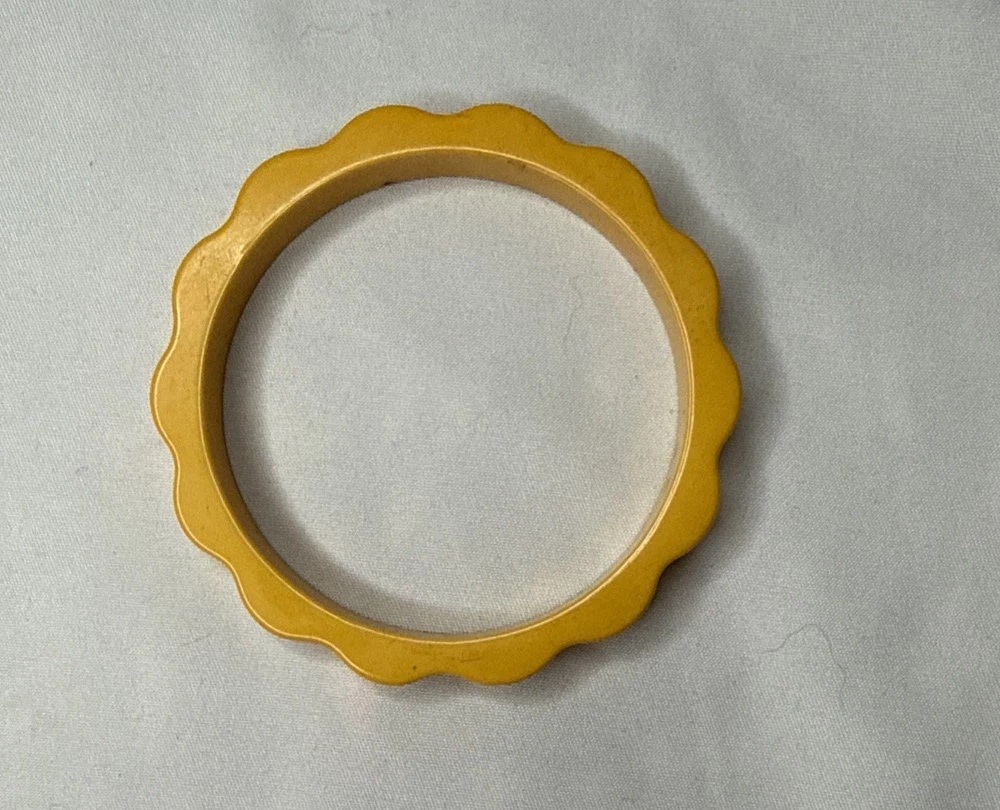
Butterscotch, the warm honey-yellow shade Bakelite is probably best known for, is also the color collectors see most often, which keeps prices for a plain example modest. A scalloped-edge bangle, carved with a rippled or wave-cut rim rather than a flat one, is a step up from the bare, uncarved bangles that show up constantly at estate sales, because the extra handwork took a skilled carver real time to cut.
Clean examples with crisp scalloping and no chips along the rim bring $35 to $90, with the higher end reserved for pieces where the carving stays sharp rather than worn soft from decades on someone’s wrist. Butterscotch darkens with age and UV exposure, which collectors generally don’t mind since it reads as patina rather than damage, but a bangle that’s gone orange or brown in blotches rather than evenly has usually been stored near heat or sunlight and is worth checking closely for hairline cracks. The two standard identification checks are a dab of Simichrome metal polish on a cotton swab, which turns yellow on genuine Bakelite, and running the piece under hot water, which should release a faint formaldehyde smell that newer plastics don’t have. Reproduction bangles in Bakelite-style resin are everywhere in current costume jewelry and won’t pass either test.
2. Scottie dog figural brooch
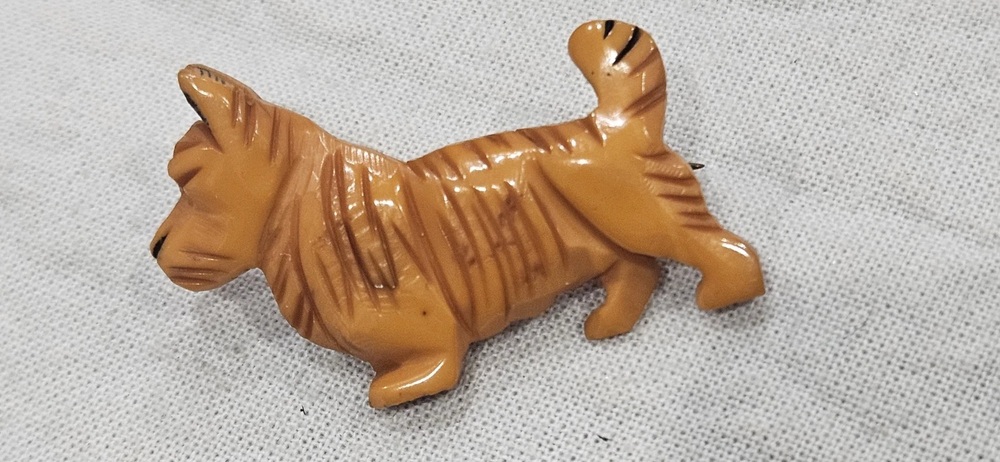
The Scottish terrier was everywhere in 1930s design, from advertising to home goods, and Bakelite carvers turned out scottie brooches in enormous numbers as a result. That volume means they’re genuinely findable, but color and carving quality separate the ordinary ones from the pieces people actively compete for.
A simple, flat-carved scottie in a common color like butterscotch or black typically brings $75 to $150 in clean condition, while examples with more dimensional carving, a less common color, or an articulated moving head reach higher. Check the pin mechanism on the back first, since a replaced or glued-on pin back instead of the original C-clasp or safety catch lowers the price noticeably to anyone who knows what to look for. The nose, ears, and tail are the most exposed points on a carved dog and the first places chips show up, so run a fingertip around the edges in good light before assuming a piece is flawless. Painted details, like a collar or eyes, should show real wear consistent with age rather than crisp, fresh paint, which can signal a later touch-up that collectors factor into their offer.
3. Philadelphia-pattern laminated cuff bracelet
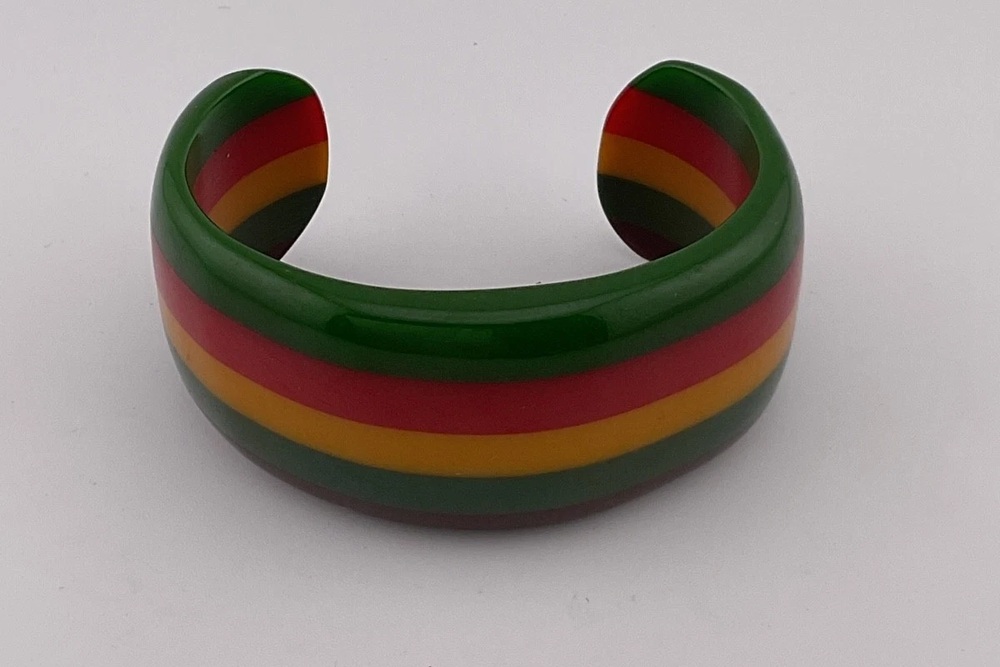
Most Bakelite bangles are carved from a single block of color. A smaller category was built instead by laminating thin layers or wedges of different colored Bakelite together before shaping, and the most famous result of that technique is what collectors call the Philadelphia bracelet, a name that stuck after a dramatic sale of two of these pieces decades ago. The hallmark is a hinged cuff with individually colored slices, usually in green, red, and yellow, set against a butterscotch body.
Genuine, well-preserved examples in the classic multicolor pattern can bring $2,000 to $3,000, and that number surprises most people who assume anything made of plastic has a ceiling. Simpler laminated bangles, with just two colors in a basic stripe rather than the full multicolor wedge pattern, are far more common and worth a small fraction of that, so the specific lamination pattern matters enormously here. The lamination itself is the thing to examine closely: individual slices that have separated or lifted at the seams, rather than sitting flush, reduce value substantially, and a repaired seam is usually visible as a slightly uneven line if you look at the bracelet under strong light.
4. Carved button clip earrings
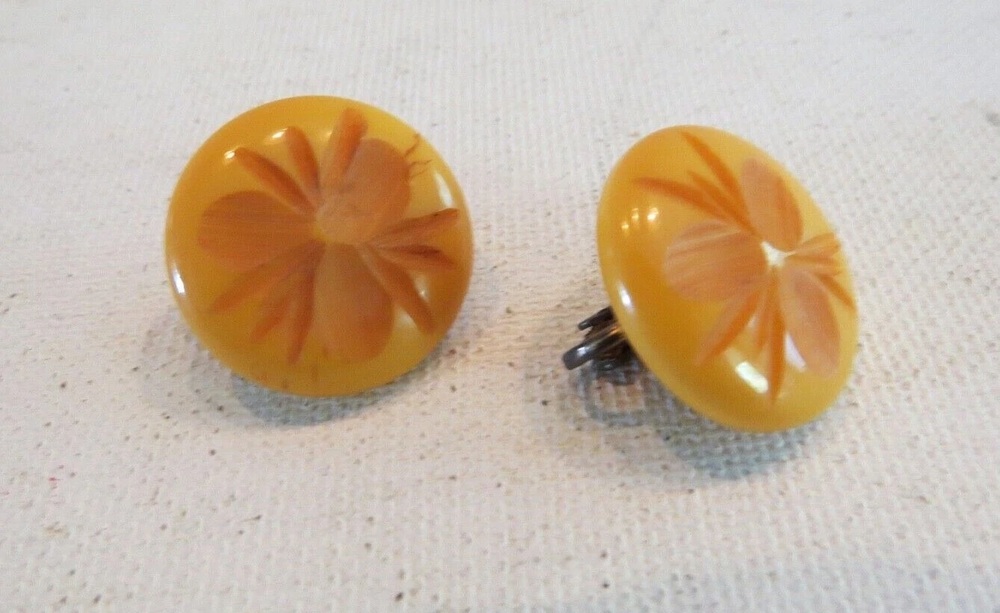
Earrings get overlooked constantly, partly because so many surviving pairs are missing their mate and partly because Bakelite jewelry books tend to focus on bangles and brooches. A matched pair of carved button-style clip earrings, round or faceted and roughly an inch across, is an easy, low-cost way into the category for anyone starting a collection.
Plain carved pairs in good color and matching condition generally bring $20 to $60, with carved floral or geometric detailing at the top of that range and smooth, uncarved buttons at the bottom. The clip mechanism should be original spring-back metal rather than a later plastic or glued replacement, and both earrings need to match in color and carving depth exactly, since Bakelite’s natural color variation means a mismatched pair sold as a set is a common and easy mistake to make without comparing them side by side. Clip backs that have been bent, re-glued, or swapped for screw-backs knock down the price even when the Bakelite itself is in excellent shape. Earrings see less wear than bangles because they aren’t knocking against hard surfaces all day, so look instead for sun fading on one side, which happens when a pair sat in a display case or window for years.
5. Apple juice reverse-carved bangle
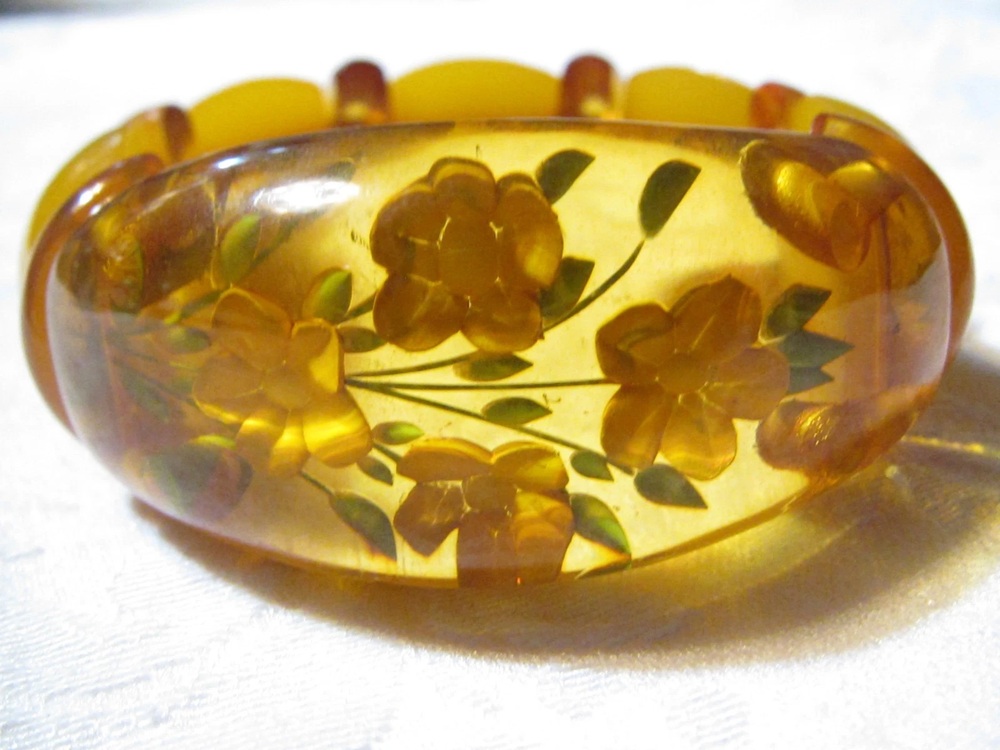
“Apple juice” is the collector term for clear to lightly tinted translucent Bakelite, and it was used for a specific carving technique called reverse carving, where the design is cut into the back of the piece so it reads as a crisp, almost three-dimensional image when viewed from the front. Floral motifs, in particular, show up often on reverse-carved apple juice bangles from the late 1930s and early 1940s.
Well-executed examples with the carving still crisp and no cloudiness in the clear Bakelite bring $200 to $450, with wider bangles and more elaborate carved scenes toward the top of that range. Clarity is the first thing to check, since apple juice Bakelite clouds and yellows unevenly with age and sun exposure, and a bangle that’s gone milky throughout has lost some of its visual impact even if structurally sound. Painted detail added within the reverse-carved lines, often in gold or a contrasting color, should be checked for flaking, since any loss there is difficult to repair convincingly. This is also one of the more imitated looks in current costume jewelry, so the hot water and Simichrome tests matter more here than on an opaque colored piece, where the material itself is more obviously old.
6. Men’s Art Deco cufflink set
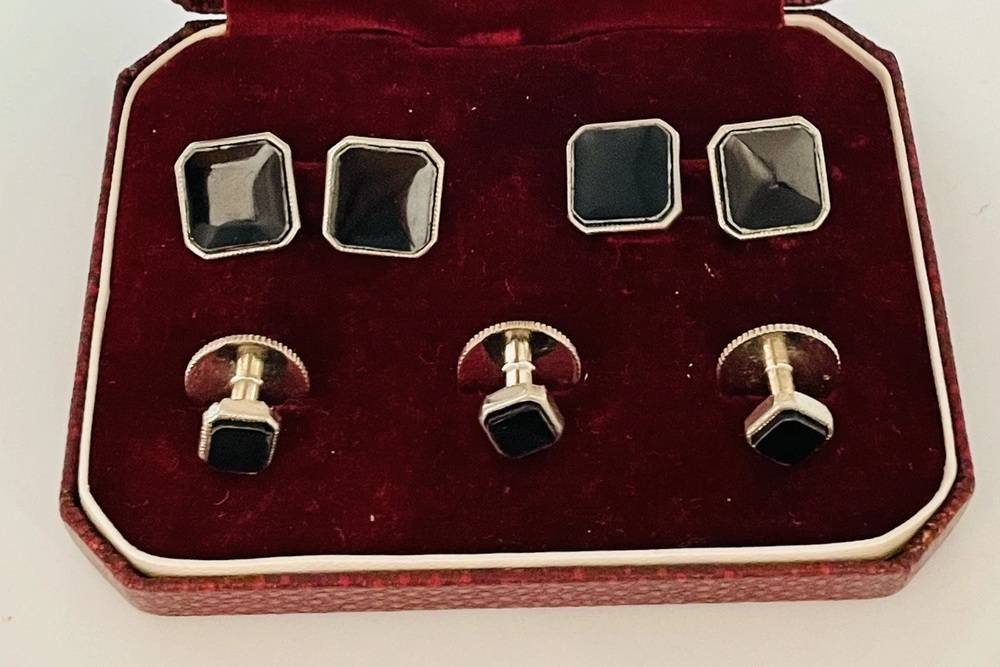
Men’s Bakelite jewelry gets far less attention than women’s pieces, which keeps prices low and makes a matched cufflink set a genuinely easy find for anyone willing to look past the women’s jewelry cases at an estate sale. Geometric Art Deco shapes, stepped rectangles and faceted ovals in particular, are the most common surviving style.
A clean matched pair with the original metal fittings still intact typically brings $20 to $60, with sets that include a matching tie clip or collar studs bringing more as a complete grouping. The metal findings, usually chrome or brass, often show more wear than the Bakelite itself, since the hinge and toggle mechanisms took the daily stress of being fastened and unfastened. A mismatched pair, where the two Bakelite pieces are close in color but not identical, is common enough that it’s worth holding them side by side in consistent light before buying. Because men’s accessories from this era were handled daily and heavily, chips along the edges of the Bakelite face are more common here than on jewelry that saw occasional wear, so check the perimeter of each piece closely rather than just the front face.
7. Carved dangling fruit brooch
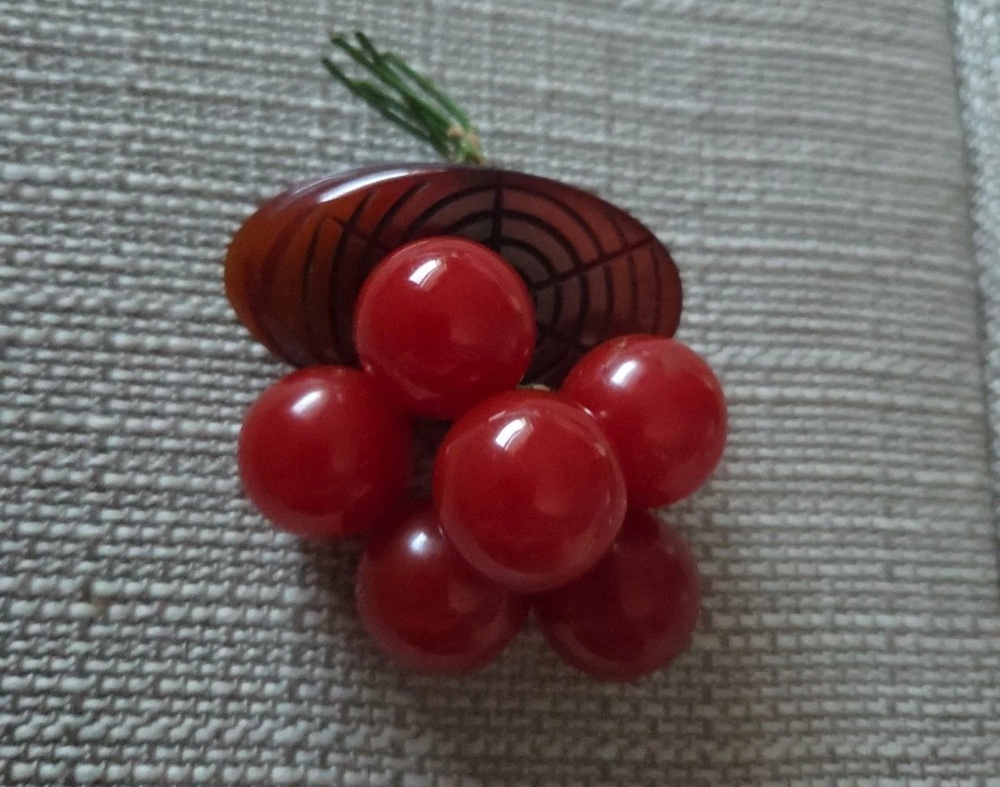
Fruit was one of the most popular carving subjects in 1930s Bakelite jewelry, with cherries getting most of the collector attention today. Less common fruit, like clusters of strawberries, bunches of grapes, or a mix of several fruits dangling from a central bar pin, carries its own following and tends to be easier to find simply because it’s less picked over by specialist buyers.
Clean examples with all the carved pieces present and no cracks bring $75 to $225 depending on the complexity of the carving and how many individual fruit pieces survive intact, since these brooches were built with multiple dangling elements that are easy to lose one at a time over ninety years. Count every piece against what the design should include before buying, since a brooch missing even one cherry or strawberry from an otherwise full cluster sells for noticeably less. The connecting jump rings or wire links between the dangles are usually base metal and prone to weakening with age, so check that each piece swings freely rather than hanging loose or threatening to drop off. Painted details, like the green of a strawberry’s leaves, fade faster than the Bakelite itself and are a reasonable, expected sign of age rather than damage.
8. Stack of graduated spacer bangles
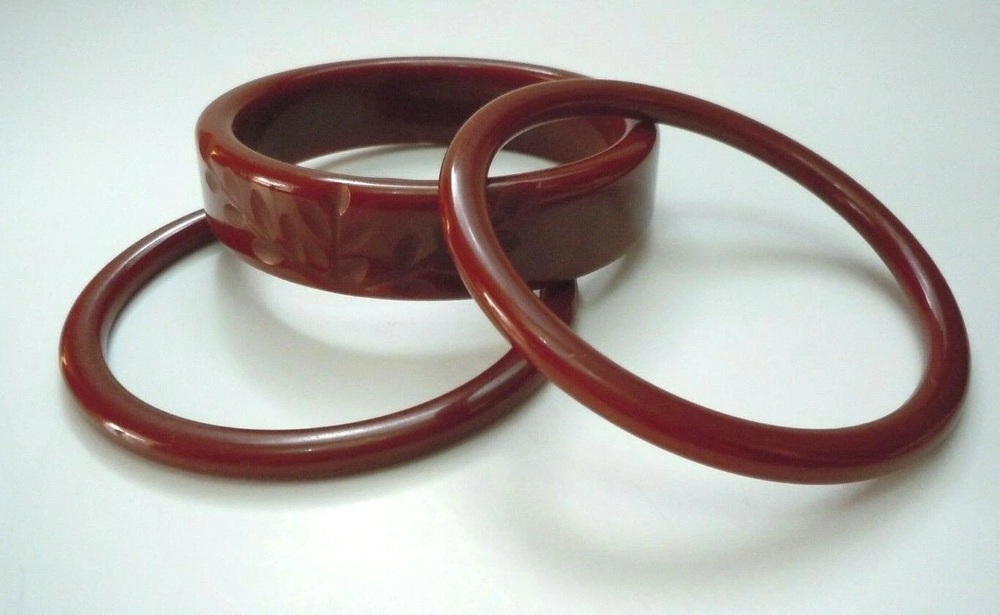
Narrow “spacer” bangles, thinner than a standard bangle and designed to be worn stacked together rather than alone, were sold both individually and as pre-matched sets. A graduated run of three to five, moving from a wider bangle down to a thin spacer, shows up regularly at estate sales because people tended to keep sets together rather than scattering them.
A matched or well-coordinated set in complementary marbled or solid colors brings $150 to $450 as a group, considerably more than the same number of unrelated spacer bangles sold separately, since collectors specifically look for stacks that work together. The color relationship between the pieces matters as much as the condition of any individual bangle, so a set where the colors genuinely complement each other is worth more than several unrelated spacers sold together as a lot. Each bangle in the stack should be checked individually for hairline cracks, since spacers are thinner than standard bangles and more prone to stress fractures from the flexing it takes to get them on and off over the hand. A set that’s been broken up and reassembled from unrelated bangles, rather than sold as an original matched group, is common and worth meaningfully less.
9. Elephant figural brooch
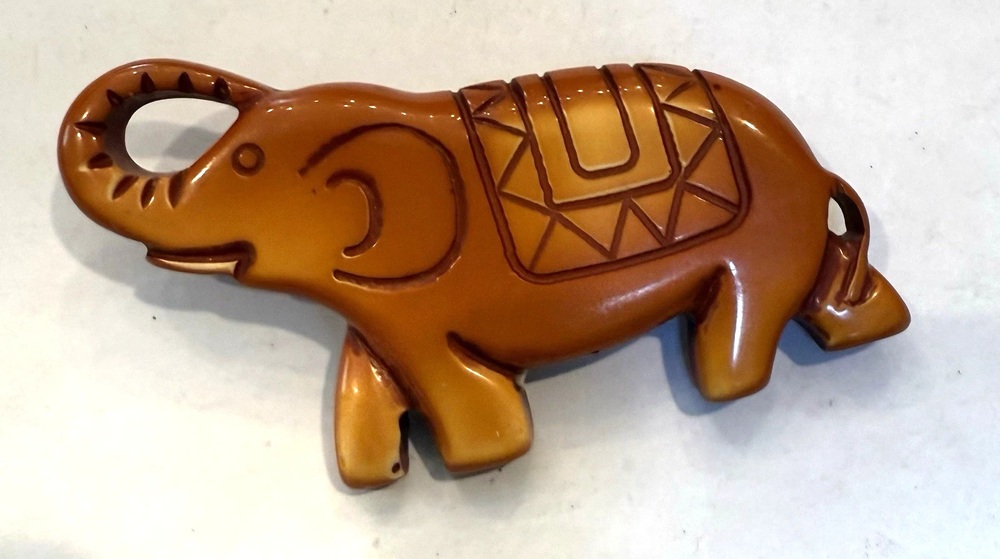
Elephants with trunks raised, a traditional symbol of good luck, were a popular figural subject for Bakelite carvers, and several were made with an articulated trunk or dangling tusks that add visual movement to the piece. Designer Martha Sleeper, a former film actress who turned to jewelry design in the 1930s, is associated with some of the more elaborate figural elephant pieces from the period, though most surviving examples are unsigned and can’t be attributed to a specific maker.
Carved examples in good color with the moving parts still intact bring $100 to $250, with butterscotch and other warm tones generally more desirable than darker colors on this particular subject. The dangling trunk or tusk pieces are the most fragile part of the design and the first thing to check, since a stiff or missing dangle changes both the visual effect and the value meaningfully. As with the fruit brooches, the connecting mechanism is usually a small jump ring or wire loop prone to metal fatigue, so test that any moving element swings freely rather than catching or hanging at an odd angle. Painted eyes or tusks should show age-appropriate softening rather than crisp, bright paint, which can indicate later restoration that collectors generally price lower than an untouched original.
10. Graduated marbled bead necklace
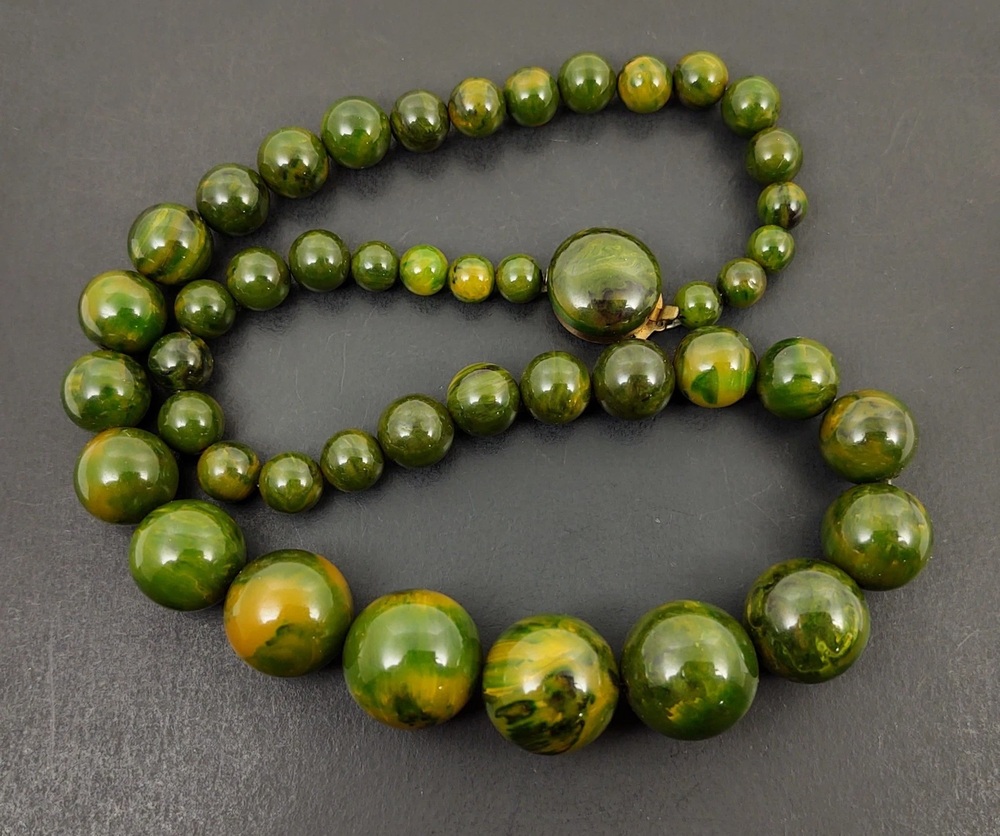
Strands of large, graduated Bakelite beads, marbled rather than solid colored and strung to taper from a bigger central bead down to smaller ones near the clasp, were a staple of 1930s and 1940s costume jewelry. They’re heavier and more substantial in the hand than most glass bead necklaces from the same era, which is often the first clue to what they’re made of.
A full-length strand with consistent marbling and an intact original clasp typically brings $100 to $200, with unusual color combinations and larger bead sizes pushing toward the top of that range. Restringing is common on necklaces this old, since the original cord or elastic degrades over decades, and a professionally restrung necklace isn’t a dealbreaker as long as the original beads are intact and in their original graduated order. What does matter is whether all the beads actually match in color and marbling pattern, since a strand assembled from mismatched loose beads to replace lost originals is a frequent and often hard to spot substitution. Check the clasp closely too, since a modern replacement clasp on an otherwise vintage strand is common and worth noting, even if it doesn’t disqualify the piece entirely.
11. Carved Art Deco dress clip pair
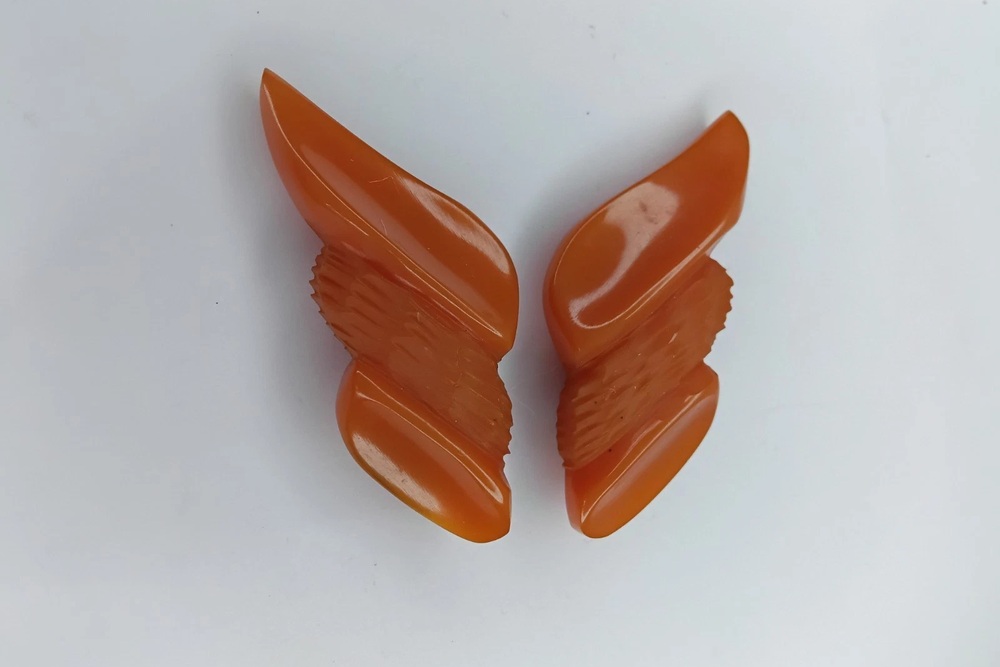
Dress clips, worn as a pair pinned to the neckline or collar of a dress rather than as a single brooch, were an Art Deco staple that fell out of fashion after the 1940s and have been quietly collectible ever since. Geometric carving and bold color combinations, rather than figural subjects, are typical of the style.
A single clip in deep, crisp two-tone carving with no chips typically brings $65 to $95 on its own, and a genuinely matched pair commands close to double that, since clips are far more often found and sold one at a time than as an intact matching set. The spring-back clip mechanism on the reverse is original metal hardware, usually a simple two-pronged clamp, and a replaced or stiff mechanism is worth checking before buying since it affects both how the piece functions and how collectors value it. As with earrings, the two clips in a pair need to match closely in color and carving, and slight mismatches are common enough on genuinely original pairs that a small difference isn’t automatically a red flag, but a dramatic one usually means the pair was assembled after the fact from two unrelated clips. Edge chips are the most common damage on dress clips, since the corners took the brunt of being pinned and unpinned from fabric repeatedly.
12. Carved hair barrette
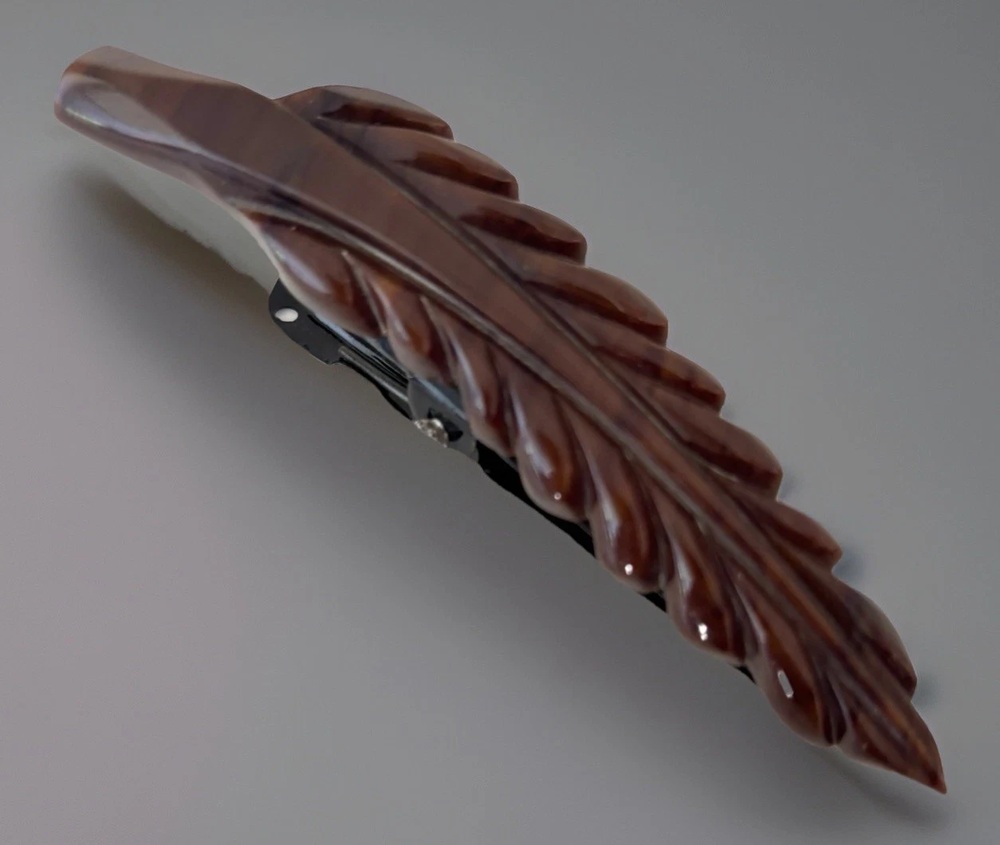
Hair accessories are one of the more overlooked corners of the Bakelite market, which works in a buyer’s favor since prices have stayed lower than comparable brooches or bangles despite similar carving quality. Barrettes with brass floral rosettes or other metal accents set into the carved Bakelite body are the more desirable end of the category.
Clean examples with intact spring mechanisms bring $20 to $55, with cherry amber and other warm translucent colors generally outperforming the more common opaque browns and blacks. The spring clasp underneath is usually base metal and the most failure-prone part of the piece, so test that it still snaps shut with tension rather than hanging loose, since a non-functional spring is difficult and often not worth repairing on a piece this modestly priced. Brass accents should be checked for looseness or missing elements, since they’re typically set with small prongs or glue that weaken over time. Because barrettes sat against hair and scalp oils for years, look for any dulling or haze across the surface, which usually buffs out with a gentle polish but is worth factoring into an offer if the seller hasn’t already addressed it.
13. Carved floral clamper bracelet
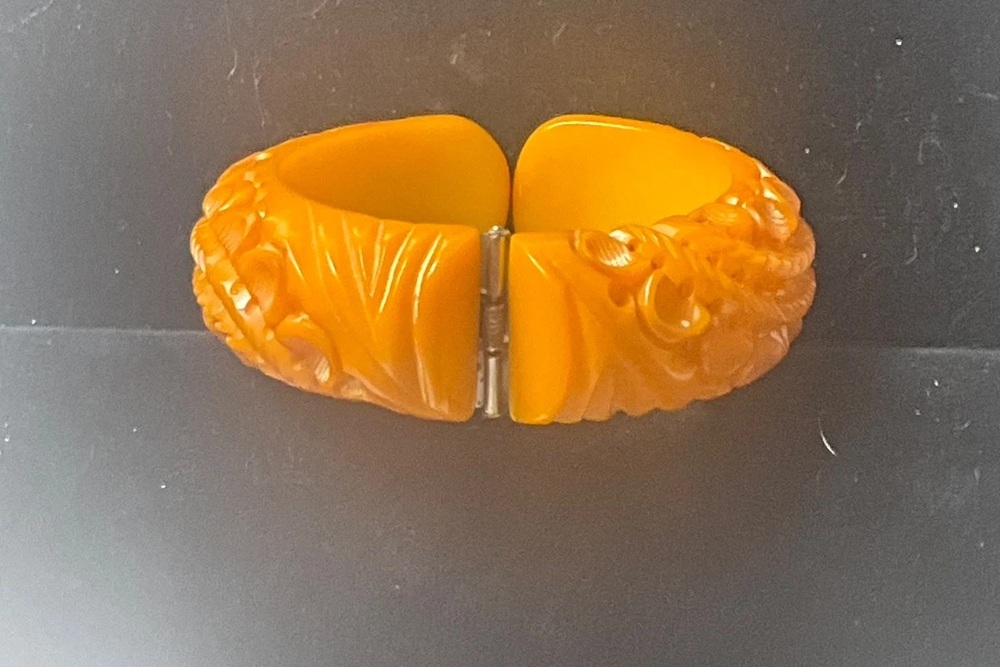
A clamper, or hinged bangle, opens on one side and clamps shut around the wrist rather than sliding on over the hand, which allowed carvers to work with wider, heavier blanks of Bakelite than a standard bangle could use. Deeply carved floral wreath designs, wrapping continuously around the whole piece, are among the most labor-intensive examples of the form.
Wide, deeply carved examples in good color with a working hinge bring $200 to $500, with exceptional carving and less common colors reaching toward the higher end. The hinge and clasp mechanism is the single most important thing to test on any clamper, since it’s a metal fitting under constant stress and the most likely point of failure on an otherwise undamaged piece; it should open and close smoothly and latch with real tension rather than popping open on its own. Because clampers use a thicker wall of Bakelite than standard bangles, they’re somewhat more resistant to cracking, but the carved high points, where the design stands proudest off the surface, are still vulnerable to chips if the piece has been dropped. A clamper with a replaced or repaired hinge is still collectible but worth less than one with all original hardware intact.
14. Carved dome cocktail ring
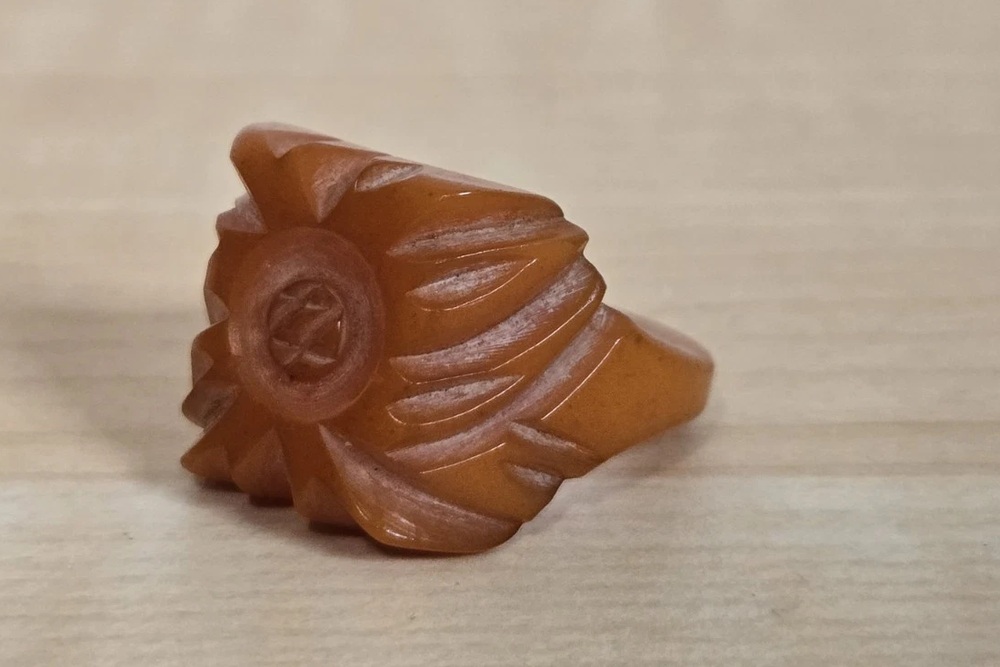
Bakelite cocktail rings, carved into a rounded dome shape rather than flat, were a bolder, more sculptural take on everyday jewelry and remain an accessible entry point into the category since rings used less material and generally sold for less even when new. Carved concentric circles, floral motifs, and faceted dome shapes are the most common surviving designs.
A well-carved dome ring with no cracks around the band typically brings $25 to $100, with larger dome sizes and more intricate carving pushing toward the higher end. The band itself, being the narrowest and most load-bearing part of the ring, is also the most likely place for a hairline crack to develop, especially if the ring was ever forced onto a finger slightly too large for it, so check the inside of the band closely under good light rather than relying on the dome’s appearance alone. Color consistency across the whole ring matters too, since Bakelite can develop uneven staining from skin oils and metals worn alongside it over decades. Rings in genuinely rare colors or with unusual faceted carving patterns occasionally sell well above the typical range, though a plain, lightly worn dome in a common color is the far more likely find.
15. Charm bracelet with fruit and novelty charms
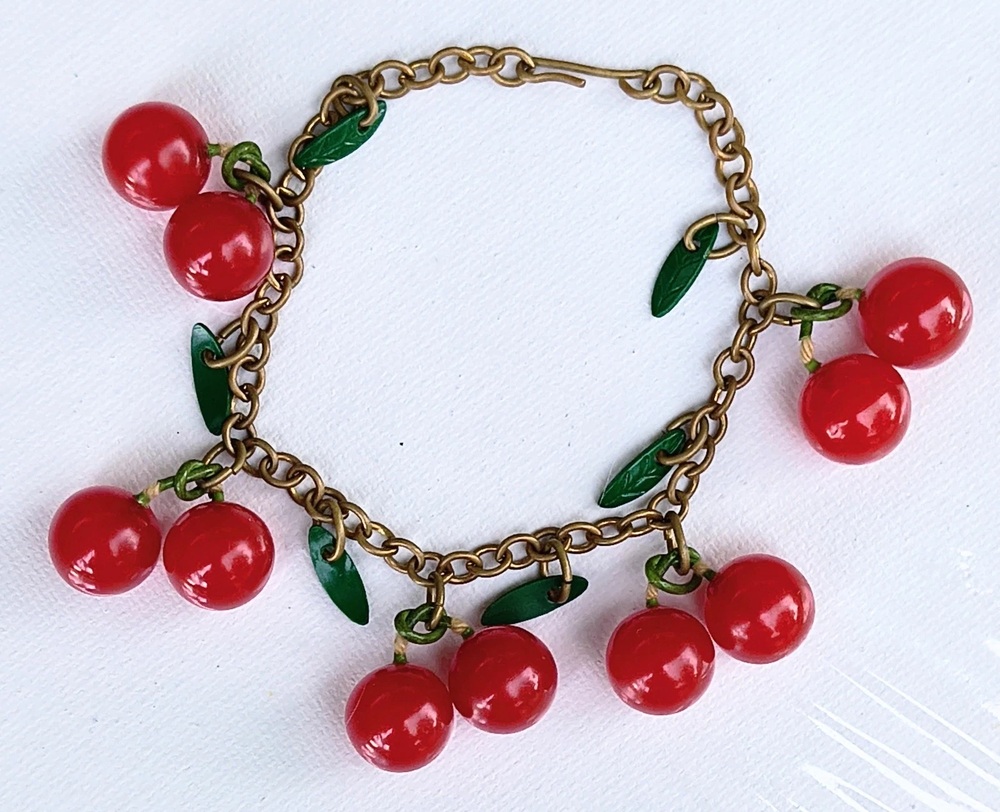
Bakelite charm bracelets, strung with small carved fruit, animals, or novelty shapes dangling from a chain, were a playful, less formal alternative to a single statement bangle and were produced in real volume through the 1930s and 1940s. The charm variety is part of the appeal, since no two surviving bracelets tend to carry quite the same combination.
A bracelet with five or more matching-era charms in good condition brings $40 to $100, with unusual or figural charms, rather than simple geometric shapes, adding the most value. Because these bracelets were worn actively and the charms took regular knocking against each other, chips on the charm edges are extremely common and worth checking individually rather than judging the bracelet as a whole from a quick glance. The metal chain and jump rings connecting each charm are usually the weakest link, literally, and a bracelet with a few charms reattached on non-original jump rings is common and not necessarily a dealbreaker as long as the charms themselves are period Bakelite. Mixed-era bracelets, where later plastic charms have been added to fill gaps from lost originals, are worth meaningfully less than a fully consistent original set.
16. Rhinestone-studded bangle
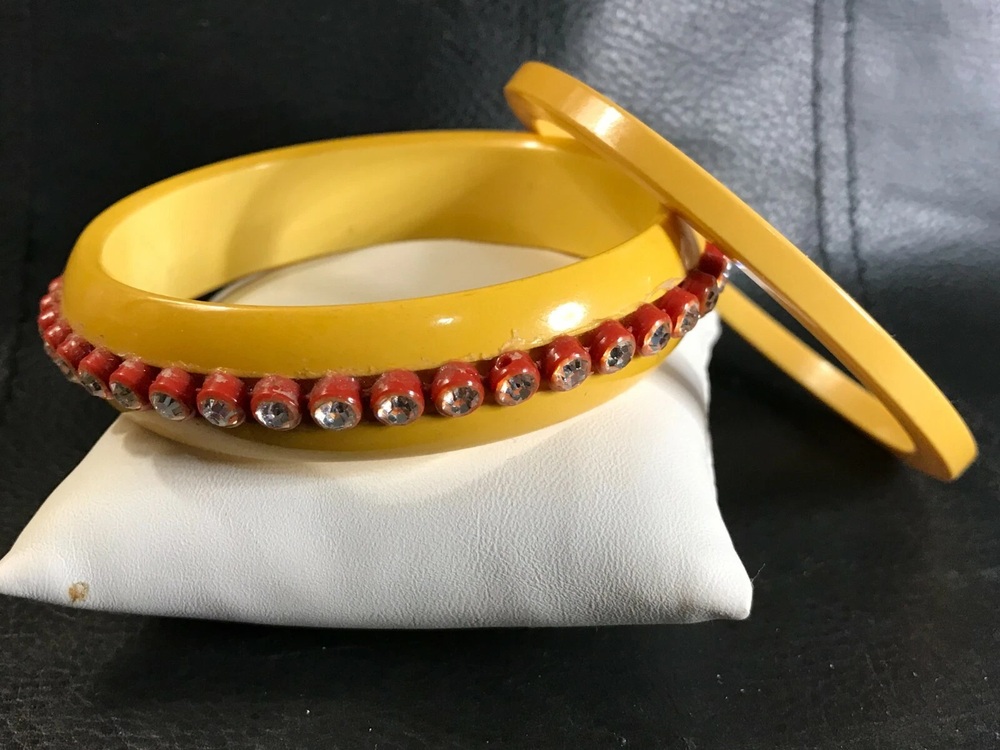
Bangles set with small rhinestones or diamantes, either in a single decorative band or scattered across the carved surface, combined Bakelite’s bold color with a bit of genuine sparkle and were marketed as a dressier option than a plain carved bangle. The rhinestones are typically set into drilled holes in the Bakelite rather than glued on top.
Clean examples with all the original stones intact bring $200 to $450, with denser stone-setting patterns and rarer Bakelite colors underneath pushing toward the top of that range. Missing stones are the single most common issue, since the prong or glue settings holding each rhinestone loosen with age, and a bangle missing even a few stones from an otherwise dense pattern sells for noticeably less than a complete one. Cloudy or dull rhinestones, as opposed to missing ones, usually clean up with gentle polishing and aren’t a major concern on their own. Because the drilled stone settings create small points of structural weakness in the Bakelite itself, these bangles are somewhat more prone to hairline cracks radiating out from a stone setting than a plain carved piece, so check closely around each stone rather than just the overall surface.
17. Carved dangle clip earrings
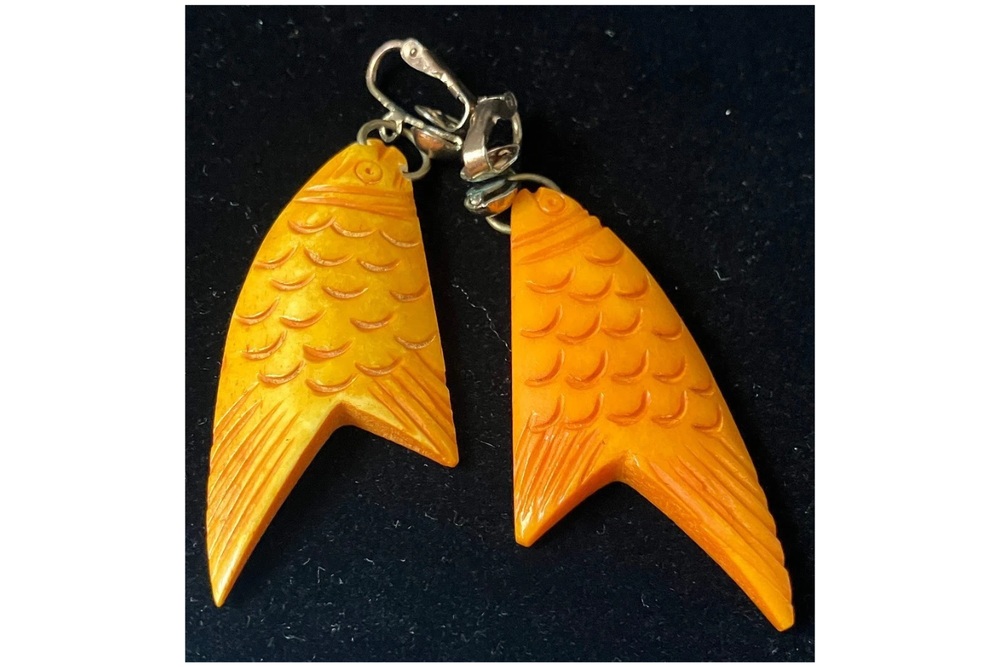
Longer than the simple button style, dangle earrings swing a carved drop, often a disc, teardrop, or small figural shape, below the clip. They photograph beautifully and were a popular evening accessory, which means surviving pairs tend to be in better condition than everyday jewelry, since they weren’t worn as constantly.
Matched pairs with both dangles intact and swinging freely bring $50 to $150, with figural dangle shapes and two-tone color combinations toward the higher end of that range. The connection point between the clip and the dangle, almost always a small metal jump ring, is the part most likely to have failed over the decades, so check that both earrings swing the same way and neither dangle has been reattached at an odd angle or with a mismatched ring. As with button earrings, color matching between the pair is essential, and dangle length should be identical, since a pair with dangles of visibly different lengths usually means one has been shortened after a break or the two were never a true matched set. Clip mechanisms that have been converted to pierced posts are common on pieces that were altered for more modern wear and are generally valued lower than earrings with their original clip hardware.
18. Carved Art Deco belt buckle
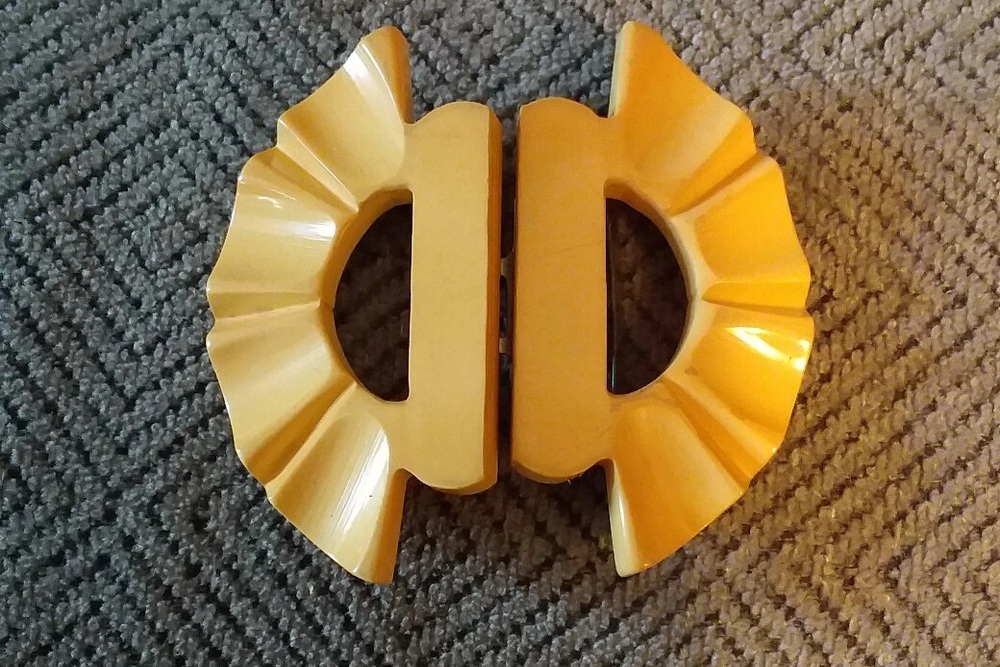
Bakelite belt buckles, usually a single carved piece or a two-part buckle that clips together at the front, were sold both on their own and attached to fabric or leather belts. Geometric Art Deco patterns and deeply carved florals are the two styles that show up most often today.
A clean single or two-piece carved buckle typically brings $25 to $100, with apple juice and other translucent colors generally bringing more than opaque ones in comparable carving depth. Buckles still attached to their original fabric or leather belt are worth checking carefully, since the belt material usually degrades badly long before the Bakelite does, and most buyers value the buckle on its own rather than as part of the belt. The metal prongs or clips that attach it are a common failure point, so test that the hardware still functions before assuming full value. Deep carving holds up well on buckles compared with bangles, since they were never flexed the way a bracelet is, though the corners and edges still chip if the piece was dropped or stored loosely with other jewelry.











