
If you’re raising kids on one income, furniture isn’t something you want to buy twice. Yet the couch is usually the first thing to suffer: juice spills, muddy paws, a toddler who’s discovered markers, and a dog who thinks the middle cushion is his.
The good news is that a couch that holds up doesn’t have to be the most expensive one. It just has to be the right one. Here’s how to spend smart.
Think “cost per year,” not price tag
A $600 couch that’s worn out in three years costs you $200 a year. A $1,500 couch that lasts ten years costs $150 a year, and you only have to shop, haul and dispose of it once.
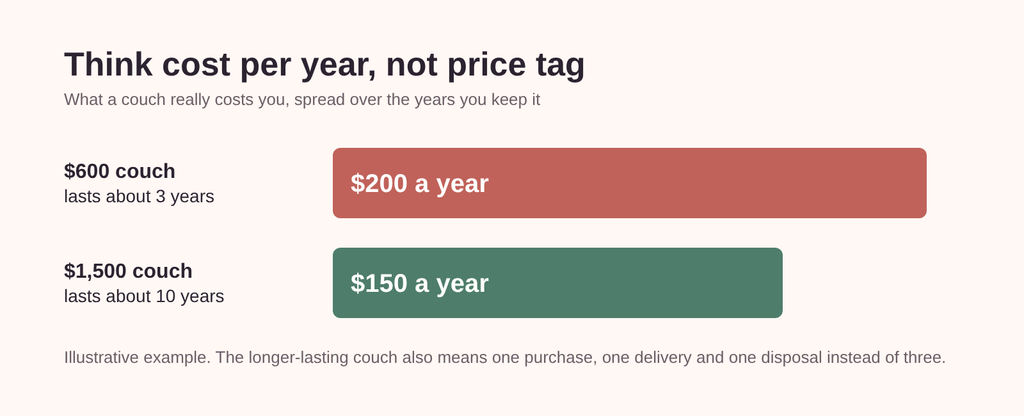
Bar chart: a $600 couch lasting 3 years costs $200 a year; a $1,500 couch lasting 10 years costs $150 a year
That doesn’t mean you should stretch beyond what you can afford. It means it’s worth asking how long a couch is built to last before you compare prices, and putting your money into the parts that matter most. Thinking in cost per year is the same habit that helps you build wealth as a single mom: spend once on what lasts, rather than over and over on what doesn’t.
Where to spend: the parts that take the beating
The fabric
This is the single biggest decision for a home with kids and pets.
Look for:
- Tight weaves. Claws and small fingers catch on loose, loopy fabrics, so avoid bouclé, chunky tweeds and anything with visible loops.
- Performance fabrics. These are designed to resist stains and wear. Ask what the fabric has been treated with and how you’re meant to clean it.
- Velvet, surprisingly. Many pet owners find that velvet’s short, dense pile resists snagging better than you’d expect, although it does show pet hair.
- Mid-tones and patterns. Pure white shows everything, and so does solid black. Heathered grays, warm taupes and subtle patterns hide a lot of everyday life.
Be cautious with leather. It’s easy to wipe clean, but cat and dog claws can leave permanent scratches.
Removable, washable covers
If the cushion covers zip off and can go in the wash, a spill becomes a laundry job instead of a disaster. Check the care label before you assume a cover is machine-washable. Some need dry cleaning, which adds up fast.
The frame
A sturdy frame matters more in a busy home, because kids climb, jump and use the arms as a launch pad. Ask what the frame is made of. Kiln-dried hardwood or good-quality plywood will stand up to far more than particleboard.
Where you can save
- Style details. Tufting, nailheads and decorative trim look lovely, but they also trap crumbs and give pets something to chew on. Simpler designs are easier to clean and often cheaper.
- The biggest size. Measure your room and buy the size you need, not the biggest you can fit. A smaller couch costs less and is easier to move when you do.
- Extra pieces. Throw pillows, footstools and side tables can wait. Good blankets and a washable throw protect the couch for a fraction of the price of a new one.
Is second-hand worth it?
A used couch can be a great deal, but check it carefully before it comes home. Sit on it, lift a corner to test the frame, and unzip a cushion to look at the foam. Look closely at seams and under the cushions for any sign of pests, and give it a good sniff, because smoke and pet odors are hard to get out of upholstery. If anything feels off, walk away. A cheap couch that has to be thrown out a month later isn’t a bargain.
Simple habits that add years
You don’t need to turn your home into a museum. A few small routines go a long way:
- Keep a throw on the pet’s favorite spot. It’s easier to wash a blanket than a couch.
- Treat spills straight away. Blot, don’t rub. Keep a small spray bottle of the cleaner recommended for your fabric within reach.
- Flip and rotate cushions. If your cushions are reversible, turn them every few weeks so they wear evenly.
- Vacuum weekly. Crumbs and pet hair work into fabric over time, and a quick pass with an upholstery attachment keeps it from building up.
- Trim nails. Regular nail trims for cats and dogs save a lot of fabric.
Questions to ask before you buy
Before you hand over your card, ask:
- What is the frame made of?
- Is the fabric stain-resistant, and how should I clean it?
- Are the cushion covers removable and washable?
- What does the warranty cover, and does it exclude pet damage? (Many do.)
- What is the return policy if it doesn’t work out?
Some brands now make the search easier by grouping their couches designed for homes with pets on one page, so you can compare fabrics and styles side by side instead of checking every listing.
Make your old couch pay you back
If you’re replacing a couch that’s still in decent shape, don’t just haul it to the curb. Used furniture sells well on local marketplaces, and the money can go straight toward the new one. Furniture is one of the easier things to sell to make money, especially if you take clear photos in daylight and list the measurements.
Don’t forget to measure
It sounds obvious, but measure your room and your doorways before you order. A couch that doesn’t fit through the front door can mean return fees you weren’t expecting, and that’s money better spent on almost anything else.
The bottom line
You can’t stop life from happening on your couch, and you shouldn’t have to. Pick a tightly woven, easy-to-clean fabric, a solid frame and covers you can wash, then protect it with a few simple habits. Spend where it counts, save where it doesn’t, and your couch should still be standing long after the markers have been taken away.










