
That box in the garage has been sitting there since you cleared out your mom’s kitchen, and you still haven’t opened it. Somewhere in there is a stack of plates you ate a thousand breakfasts off of, a plastic pie carrier that smells faintly of every potluck you were ever dragged to, and probably a jelly jar glass with a cartoon character worn almost invisible from the dishwasher.
None of it looks like money. Most of it isn’t. But collectors have quietly built real markets around the specific patterns, brands, and colors that filled American kitchens from the 1940s through the 1980s, and a fair number of them are sitting in that box.
Table of contents
- Hall China Autumn Leaf canister set
- Franciscan Desert Rose dinnerware
- Fire-King turquoise blue dinnerware
- Fire-King peach lustre dinnerware
- Corelle spring blossom dinnerware
- Royal China blue willow dinnerware
- Original turquoise Fiestaware
- Homer Laughlin Harlequin animal figurines
- Metlox Poppytrail California Ivy dinnerware
- Pfaltzgraff Yorktowne stoneware
- Bauer Pottery ringware
- Descoware Belgian enamel Dutch oven
- Shawnee Corn King salt and pepper shakers
- Tupperware pie and cake carrier
- Ball Perfect Mason blue canning jars
- Welch’s jelly jar character glasses
- Vintage Toastmaster chrome toaster
Hall China Autumn Leaf canister set
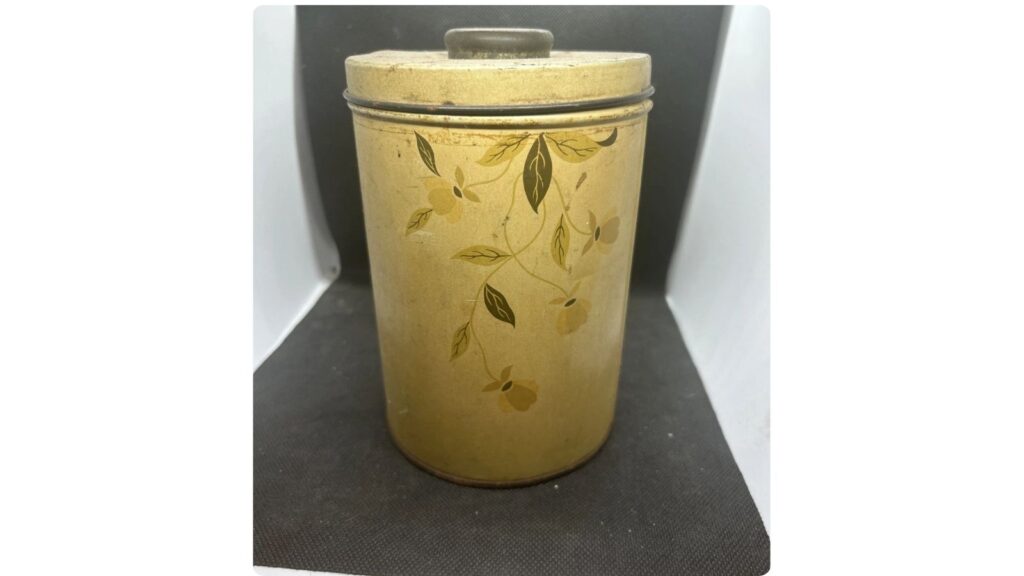
Autumn Leaf was never sold in stores. From 1933 to 1978, the Jewel Tea Company gave it away as a premium to home-delivery customers across the Midwest, which is why it still turns up constantly at estate sales in Ohio, Indiana, and Illinois. The rust and gold leaf pattern on ivory china is instantly recognizable to anyone whose grandmother had a full set for holidays.
Individual plates and cups are common and worth very little on their own, usually $10 to $20 a piece. The pieces worth hunting for are the ones Jewel Tea offered as extras rather than everyday dinnerware. A matching four-piece canister set in good condition typically brings $200 to $500, and a batter bowl with its original lid, which rarely survived intact, can bring $150 to $400.
Check the backstamp before you get excited. Original pieces say “Jewel” or “Hall.” Reissues made since 1984 for the National Autumn Leaf Collectors Club carry a separate NALCC mark and sell for a fraction of the original price, usually $20 to $80. Also look for crazing, the fine web of cracks that develops on the glaze with age and heavy dishwasher use, since it knocks the value down even on rare pieces.
Franciscan Desert Rose dinnerware
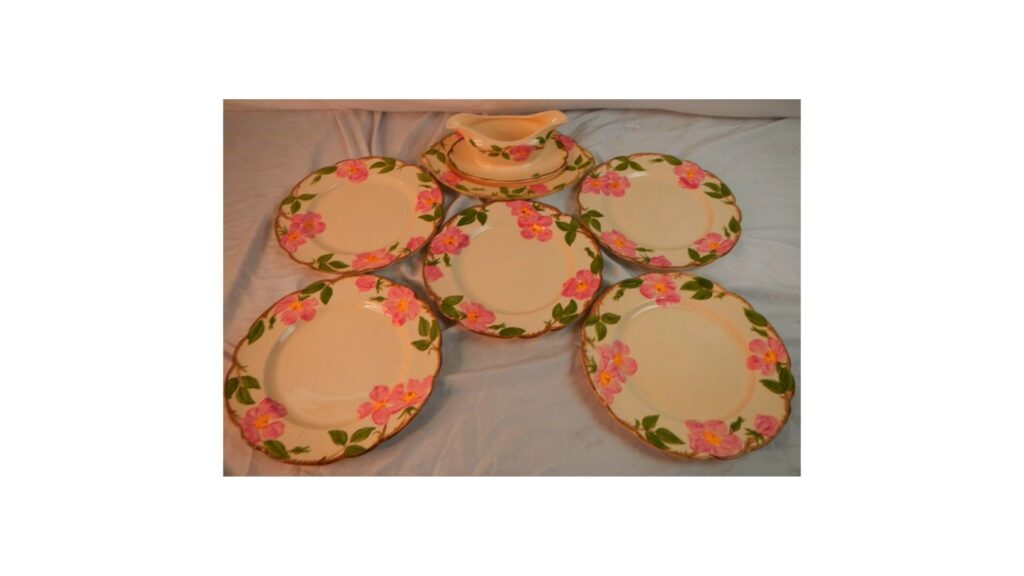
Desert Rose is the best-selling dinnerware pattern in American history, which is both good and bad news if you find some. Good, because it’s genuinely well made and still handsome. Bad, because well over 500 pieces show up for sale in any given week, so most of what you’ll find is common.
The hand-painted pink rose design, introduced in 1941 by California’s Gladding, McBean and Company, was popular enough to end up on Air Force One and in the Kennedy White House. Individual plates and cups in ordinary condition sell for modest prices, often under $20. But the very best matched sets in the earliest production reach close to $2,000, and single serving pieces alone are worth nearly $100.
The backstamp tells you the era. “USA” marks the original California production, made until the mid-1980s and the most desirable. “England” marks the Wedgwood-era production that followed. Anything marked Portugal or Thailand is later and worth less. Check the rose design under good light for wear, since dishwasher use fades the hand-painted color and flattens what should be a slightly raised, textured surface.
Fire-King turquoise blue dinnerware
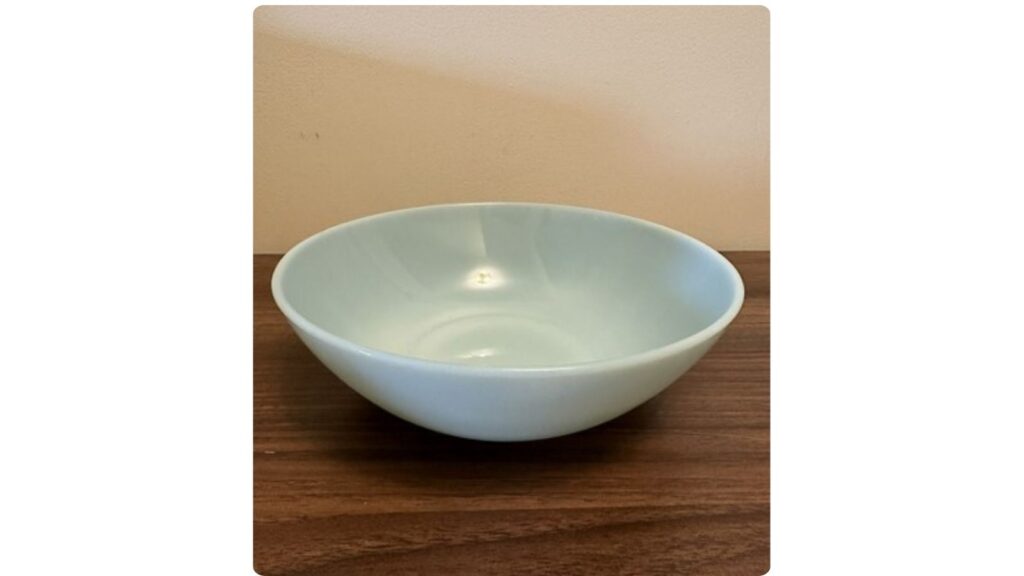
Everyone knows Fire-King’s jade-ite. Fewer people notice the turquoise blue line Anchor Hocking made through the 1950s, which used the same opaque milk glass base in a completely different color. Anchor Hocking produced Fire-King from 1942 into the 1970s, so what’s left is a fixed supply that isn’t getting bigger.
Individual turquoise dinner plates and serving bowls in clean condition typically sell for $15 to $30, and specialty pieces like the deviled egg plate bring closer to $40 to $50 because fewer were made and fewer survived without a chip. A matched run of six dinner plates is genuinely hard to find complete and commands well above what the individual plates would add up to.
The color should be a solid, even turquoise with no cloudiness. Chips along the rim are common on glass this old and cut the value sharply, so run a finger around every edge before buying. Reissued Fire-King from the 2000s exists but is stamped with a recent date, so check the base if the piece looks suspiciously bright or new.
Fire-King peach lustre dinnerware
my_route_66 via eBay
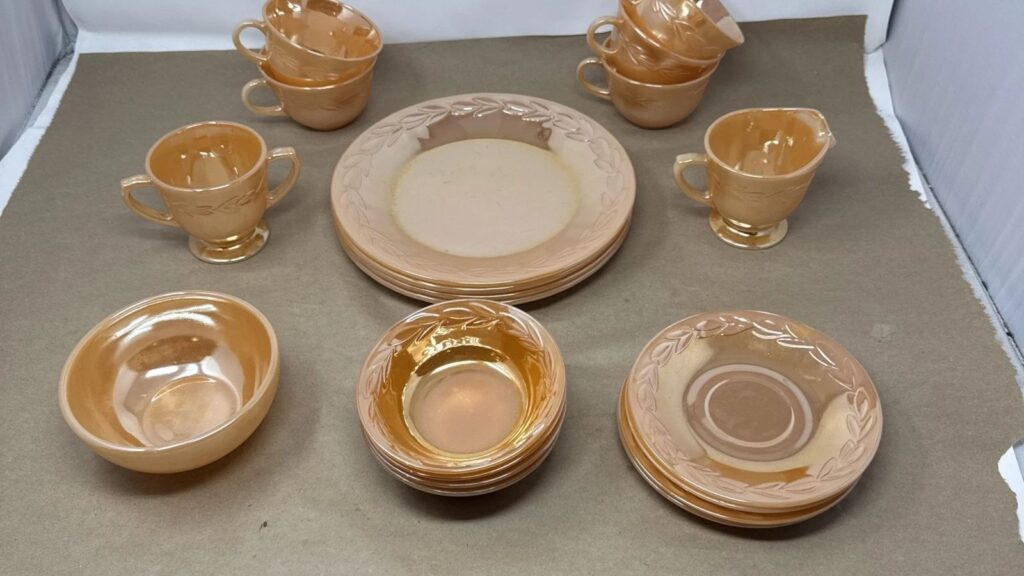
Peach lustre is the shimmer that makes this one easy to spot from across a thrift store aisle. Anchor Hocking produced the Laurel Leaf pattern in this iridescent peach glaze from 1952 to 1963, and the finish still catches light the way it did new, which is part of why it photographs so well for resale.
Small pieces like the 5-ounce custard cups and dessert bowls are common and inexpensive, usually $10 to $20 for a set of four. A ten-piece starter set of plates and bowls in excellent condition, no cloudiness and no chips, typically brings around $80, and larger matched sets in the thirty-plus piece range go well beyond that.
The lustre finish is the whole appeal, so inspect it closely. Dishwasher detergent dulls the iridescent sheen over time, and a piece that’s gone cloudy or flat is worth noticeably less than one with a bright, almost oily shimmer. This pattern is oven safe, which is unusual for decorative glass of this age, so genuine examples should show the Fire-King Oven Ware mark on the base.
Corelle spring blossom dinnerware
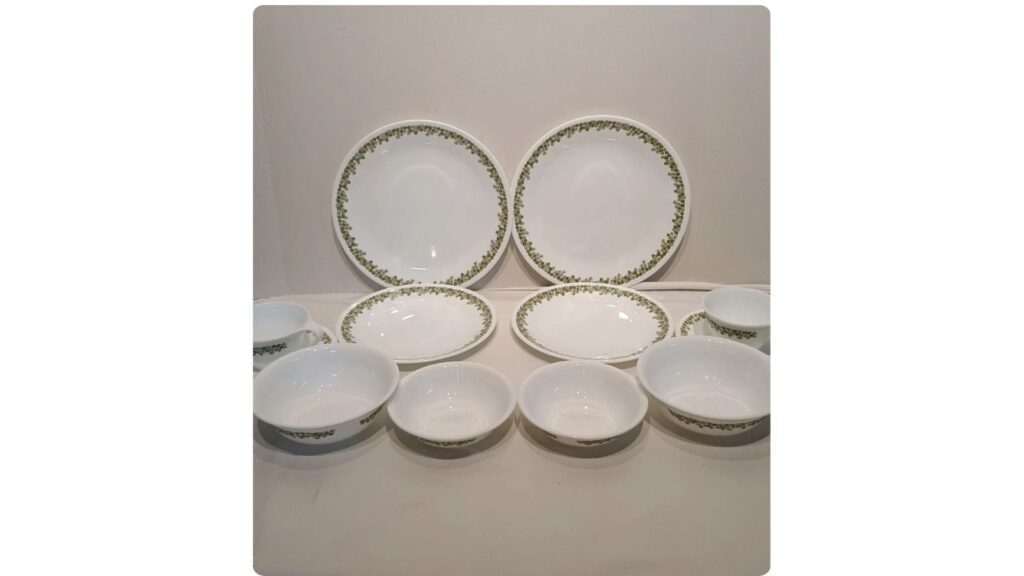
Most people know this one by its nickname, Crazy Daisy, rather than its official name. Corning introduced the green daisy pattern on its shatter-resistant Corelle line in the 1970s, and it ended up in more American kitchens than almost any other everyday dish set, which keeps individual piece values low.
A single plate or bowl typically sells for $2 to $10, and that’s the honest range for most of what you’ll find. The value is in volume and completeness. A matched lot of two dozen or more pieces, plates, bowls, cups, and saucers together, carries a value of around $60, a real premium over what the same pieces would bring sold individually.
Corelle is nearly unbreakable by design, so condition issues are usually cosmetic rather than structural. Look for scratching from years of stacking and cutlery use, which shows as a network of fine gray lines across the surface and dulls the pattern. Don’t confuse this with Corelle’s Butterfly Gold pattern, a similar-era design in yellow rather than green, which is a separate collectible in its own right.
Royal China blue willow dinnerware
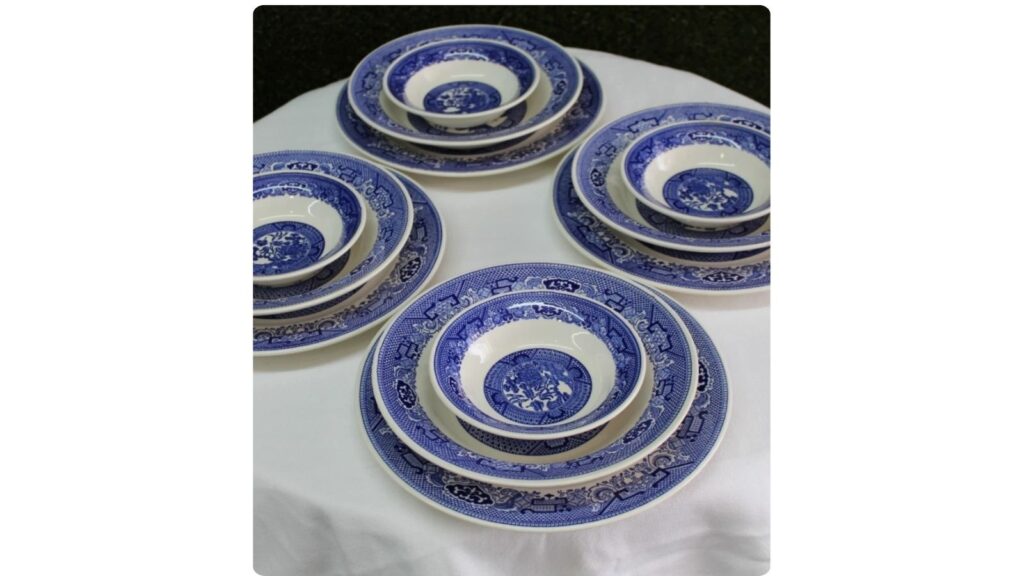
Blue Willow has been made by dozens of companies for two centuries, and that long history is exactly why prices swing wildly depending on who made your piece and when. The American-made version by Royal China, produced through the mid-20th century, is the one most people actually grew up eating off of, and it sits at the accessible end of the Blue Willow market.
A set of small plates in good condition typically brings around $30, and individual cups, saucers, and bread plates typically bring $10 to $20 each. Teapots and covered vegetable dishes are harder to find intact and bring more, often $50 to $90, since lids get lost or chipped over decades of use.
Check the base for the Royal China mark before assuming you have something rare. Antique English Blue Willow from the 1780s through the early 1800s can be worth serious money, but that’s a different, much older category entirely. Chips on the scalloped rim edges are the most common damage and reduce value noticeably, so run your fingers along every edge.
Original turquoise Fiestaware
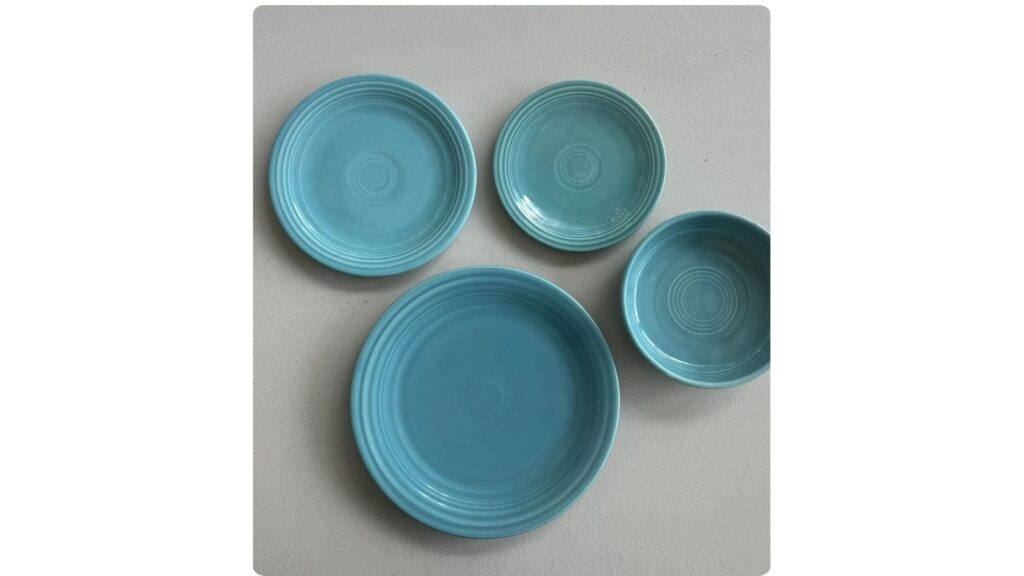
Fiesta’s original run from 1936 to 1969 is a different animal from the Fiesta you can still buy new today, and turquoise was one of the standout colors added to the line in 1938. The bold, saturated glaze still looks striking against a plain kitchen counter, which is a big part of why collectors keep chasing it.
A medium teapot in original turquoise typically brings around $165, the ten and a half inch compartment plate runs $40 to $95 depending on condition, and the water tumbler, only made for nine years, brings $60 to $75. Rarer colors like medium green push well past these numbers, but turquoise is the color most people are likely to actually find.
Genuine vintage Fiesta has a rounded backstamp reading “Fiesta” with “Homer Laughlin” from the 1930s and 1940s, shifting to simpler script marks by the 1950s. The line was reintroduced in 1986 under new ownership with a bolder, all-capitals “FIESTA” mark, and those pieces, while collectible in their own right, don’t carry the same premium. Crazing and chips along the footring are the main condition issues to check.
Homer Laughlin Harlequin animal figurines
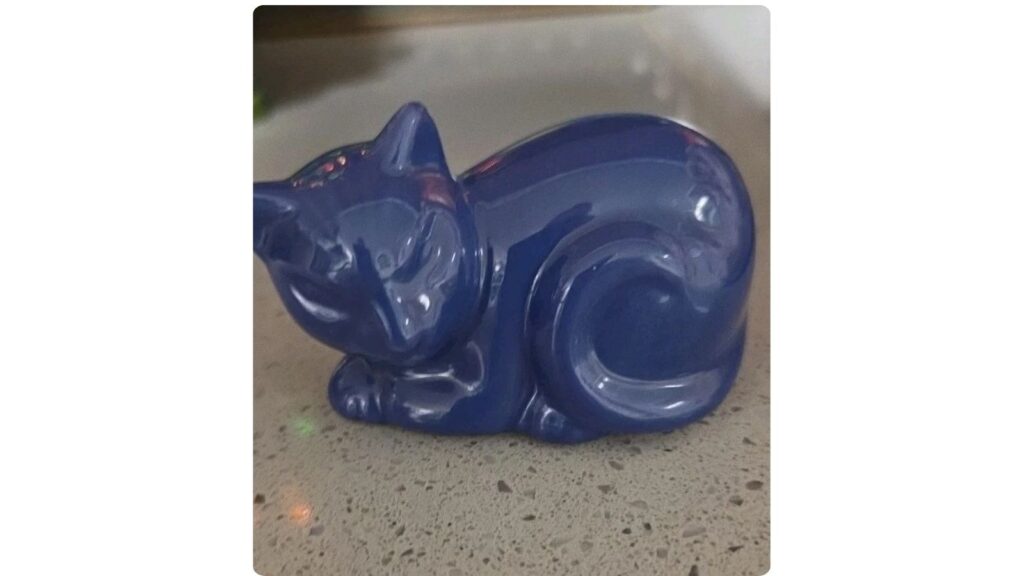
Harlequin dinnerware was Homer Laughlin’s budget answer to Fiesta, sold without a trademark exclusively through Woolworth’s dime stores starting in 1938. Most of it is genuinely inexpensive today. The exception is a set of seven novelty animal figurines the company introduced in 1939, shaped like a fish, duck, penguin, cat, donkey, lamb, and one more, and those are a completely different market.
A yellow penguin figurine typically sells for around $90, a duck in gold color brings about $100, and the fish figurine in the right color and condition can reach $180. Rarer colors like maroon or spruce green push toward the higher end of that range, while common yellow and turquoise examples sit closer to the lower end.
These are small, solid pottery pieces, so check carefully for hairline cracks around the base and chips on protruding features like the fish’s fin or the duck’s bill, which are the first spots to get knocked in storage. A figurine with strong, unfaded glaze and no repairs is worth meaningfully more than a dull or chipped one.
Metlox Poppytrail California Ivy dinnerware
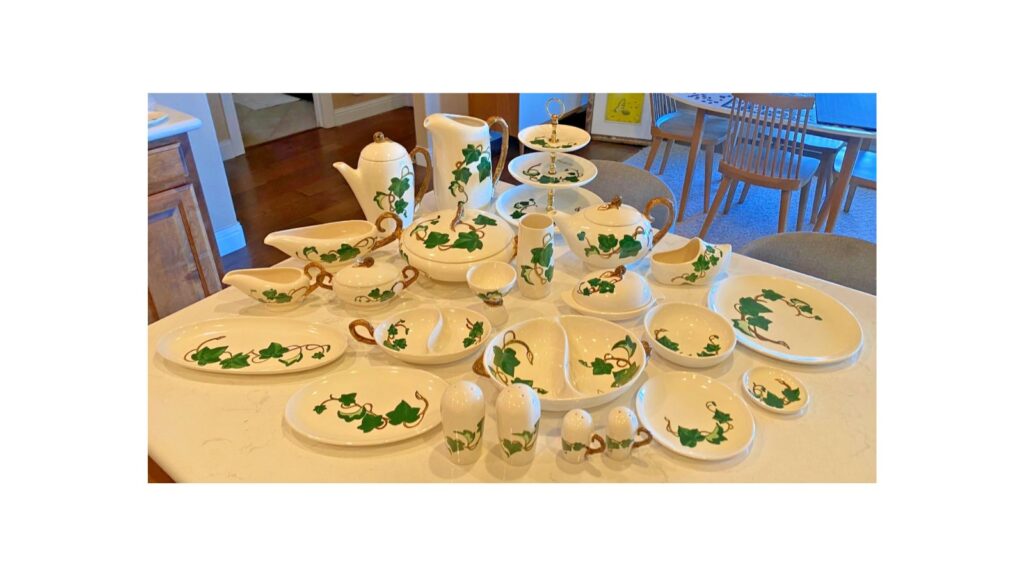
Metlox ran its California Ivy pattern from 1946 all the way to 1986, which means it spans several childhoods depending on how old you are. The cream-colored earthenware with a simple hand-painted green and brown ivy vine has the same casual, sunny appeal as Franciscan’s Desert Rose, at a noticeably lower price point.
A single serving platter in clean condition typically brings around $19, and individual plates and bowls run in a similar range. Where the real value shows up is in complete sets. A run of eighteen matching plates in assorted sizes brings around $75, and larger thirty-plus piece sets with serving pieces intact bring considerably more than that.
Look for the Metlox maker’s mark and the California Ivy pattern name stamped on the base. Hairline cracks near the rim, especially on larger serving pieces, are common on pottery this age and are easy to miss without good light. A set assembled from multiple partial lots, with visible differences in glaze tone between pieces, is worth less than one that matches consistently.
Pfaltzgraff Yorktowne stoneware
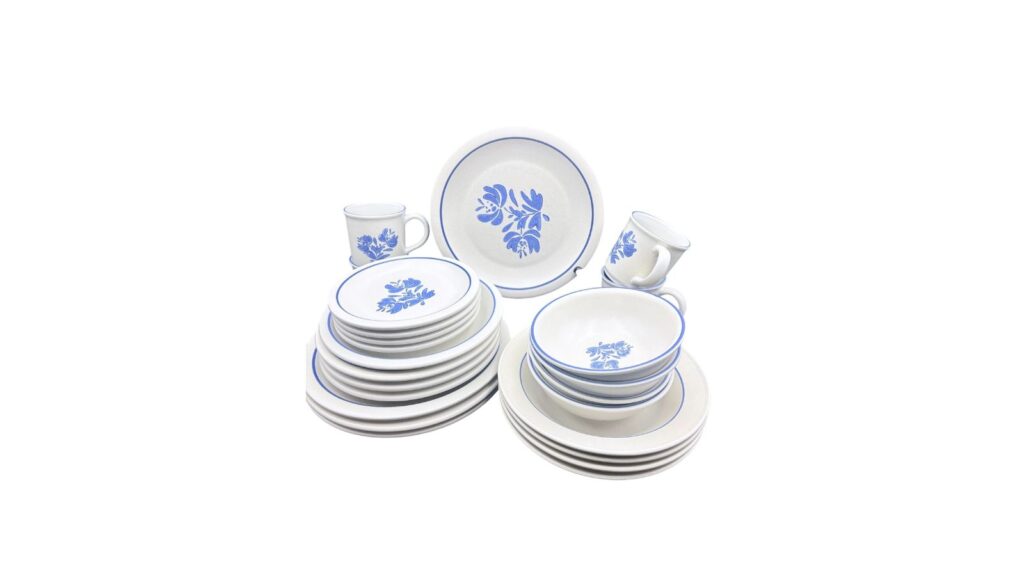
Pfaltzgraff introduced Yorktowne in 1967, and the gray stoneware with hand-applied blue folk art decoration became such a fixture in American kitchens that it stayed in production for decades. It’s the kind of set that shows up at almost every estate sale in the Midwest and mid-Atlantic, which keeps individual pieces affordable.
A single mug or plate typically brings $8 to $25, and a complete matched dinnerware set of around thirty pieces typically brings $90 to $155 depending on condition and completeness. The four-piece canister set, harder to find with all four sizes and their original lids, carries a value closer to $85 than the individual dinnerware pieces do.
Look for the castle-shaped backstamp on the base, which marks the earlier, more collectible production. Chips along the rim are common since this is a dense, heavy stoneware that people used hard for decades, and any crazing across the glaze reduces the price. A set with matching glaze tone across every piece is worth more than one pieced together from different production runs.
Bauer Pottery ringware
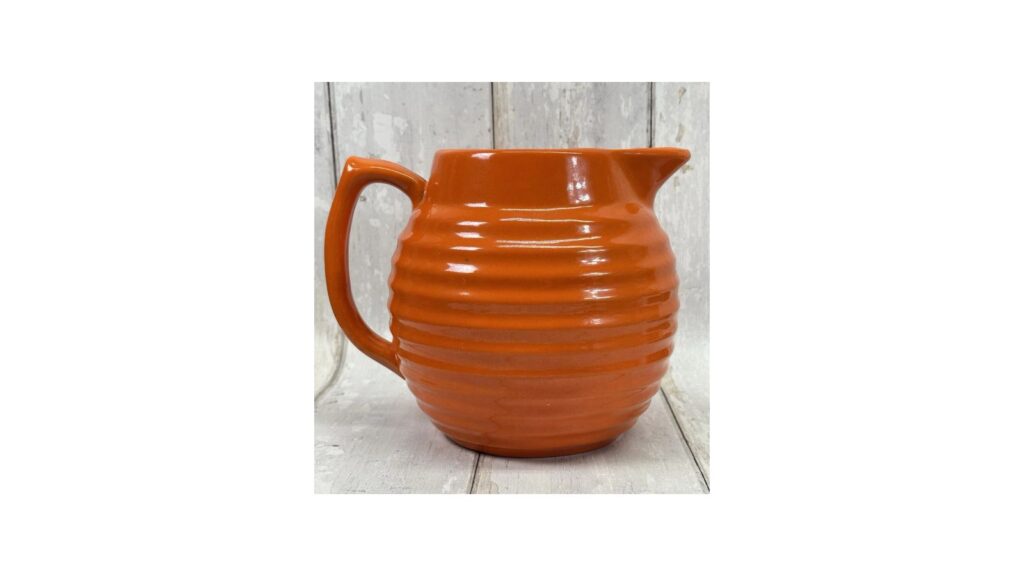
Bauer’s ringware line, with its distinctive concentric rings pressed into brightly colored earthenware, came out of a small Los Angeles pottery in the early 1930s and helped kick off the whole California colored pottery movement that Fiesta and Franciscan later followed. The color range is the appeal here: yellow, orange, cobalt, black, and a sea green turquoise, often mixed within a single set.
A single dinner plate in a solid color typically brings $20 to $45, with cobalt and black commanding the higher end. A set of five nesting mixing bowls in five different colors, the most recognizable Bauer shape, typically brings $300 to $500 as a complete, matched set.
Bauer has been reproduced since the late 1990s under a company that reverse-engineered the original shapes, so check the backstamp closely. Genuine vintage pieces are marked “Bauer” or “Bauer Los Angeles” pressed into the clay rather than printed on top of it. Chips on the raised rings themselves are the most common damage, and they’re easy to miss on a piece with strong color.
Descoware Belgian enamel Dutch oven
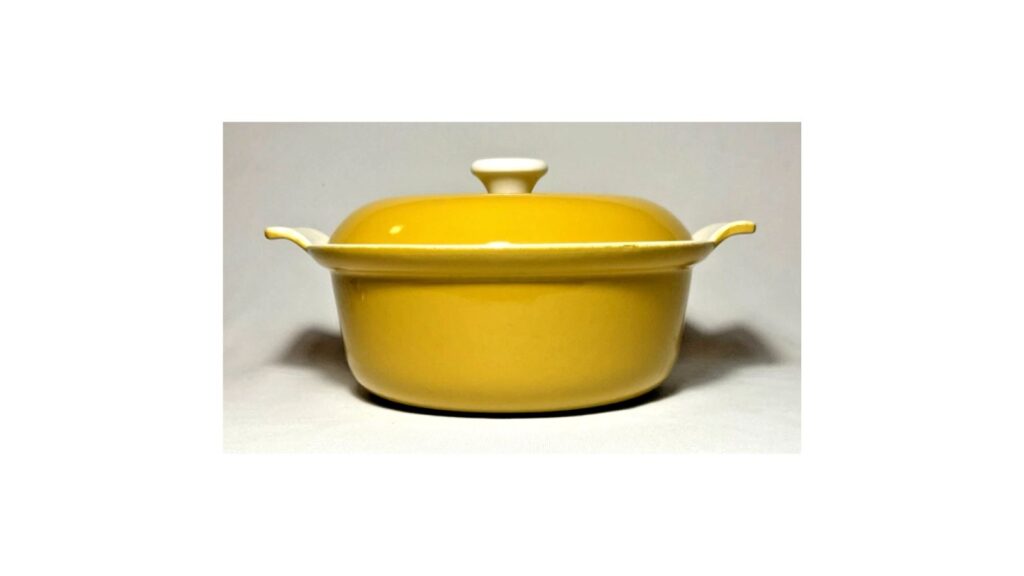
Descoware doesn’t get the attention Le Creuset does, but it was made in Belgium by the same enameling process and imported to the United States starting in the 1940s under the name D.E. Sanford Company. The candy-bright colors, especially flame orange, sunshine yellow, and a turquoise sometimes called Paris blue, are what collectors look for now.
A single Dutch oven with its lid in good condition typically sells for $25 to $65 depending on size, with larger pieces and rarer colors reaching over $100. A complete matched cookware set, Dutch oven, two saucepans, and a skillet all in the same color with original wooden handles, carries a value close to $300.
Check the interior enamel for chips and heavy staining, since a piece with a badly worn cooking surface is worth less even if the exterior color looks great on a shelf. The wooden handles, when present, should be original and secure rather than a replacement, and the base should read “Descoware Belgium” clearly.
Shawnee Corn King salt and pepper shakers
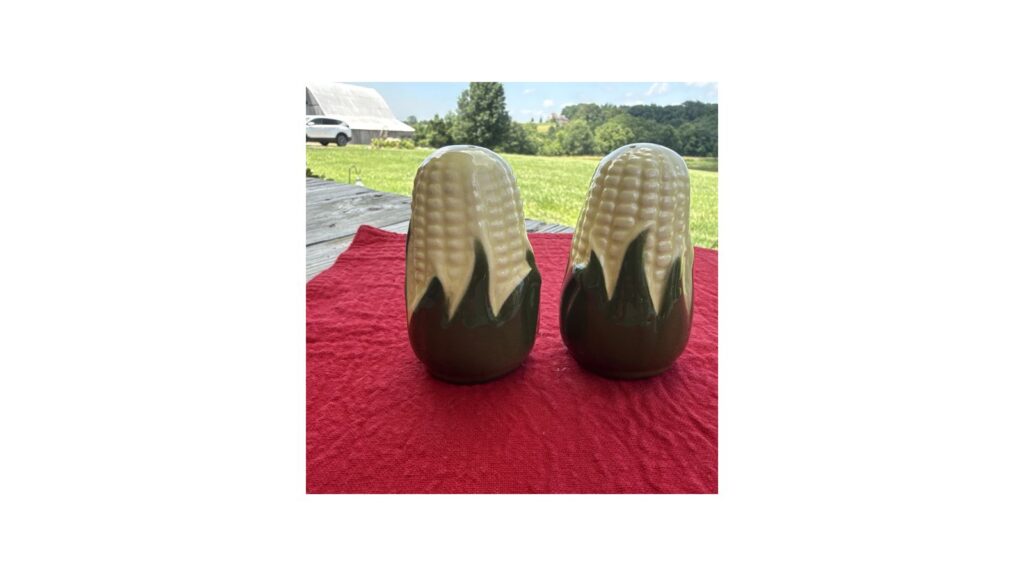
Shawnee Pottery of Zanesville, Ohio, introduced its corn-shaped Corn King line in 1941, and the shakers are the piece most people actually still have a pair of, tucked in a cabinet somewhere. Early production had white kernels with green husks, switching to the more familiar yellow kernels in 1946.
A pair of Corn King shakers in good condition typically sells for $10 to $25, with larger, less common sizes at the top of that range. Individual shakers missing their partner sell for closer to $5 to $10 each, since collectors want a matched set, not a single piece.
The kernel tips and the pepper shaker’s stem are the most fragile points and the first to chip, so check them closely under good light. Original cork or rubber stoppers are frequently missing after decades of use, and a set without them sells for less than a complete one. Look for the impressed Shawnee mark on the base to confirm it’s genuine rather than a similar unmarked corn-themed piece from another maker.
Tupperware pie and cake carrier
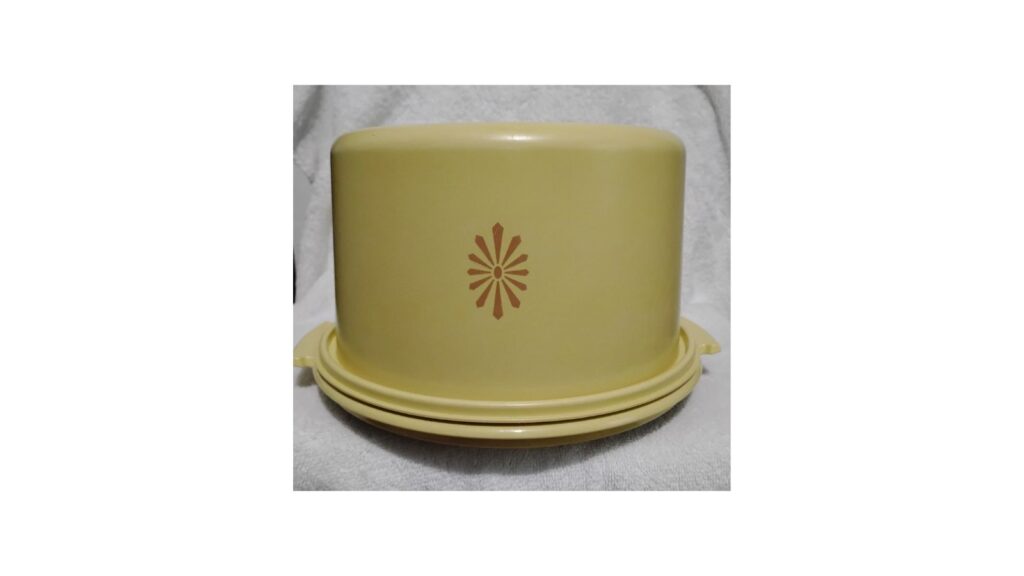
Tupperware’s cake and pie taker, with its snap-on dome lid and a locking handle strap for carrying, was a fixture of every potluck and church supper from the 1970s onward. Harvest gold, the color most associated with the decade, still carries a small nostalgia premium over later solid colors.
A basic pie or cake carrier in harvest gold typically sells for $15 to $25, and a pair sold as a set brings around $25. The Bake N Take model with a locking, snap-tight lid rather than a simple dome is a bit harder to find and typically brings around $40.
Check the lid for yellowing and cracking, which happens with age and sun exposure and is common on pieces that sat in a sunny kitchen window for years. The locking handle strap is often missing or brittle, and a carrier without it is worth less than a complete one. Original Tupperware pieces have the brand and a mold number stamped on the underside.
Ball Perfect Mason blue canning jars
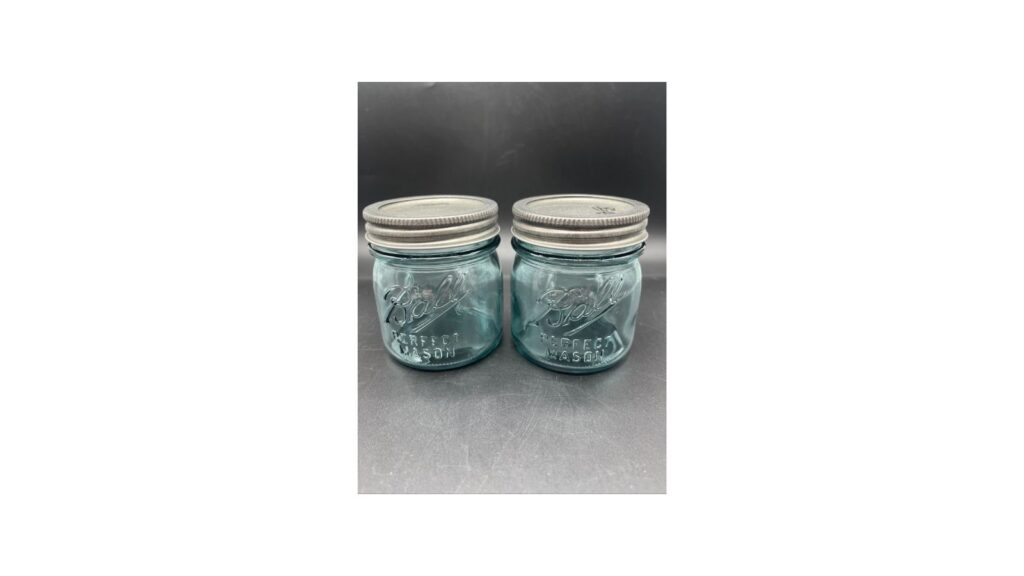
Between 1910 and 1923, the Ball Brothers Glass Manufacturing Company in Muncie, Indiana produced millions of these jars, and the pale aqua blue color comes from iron impurities in the local sand rather than any deliberate design choice. That’s worth knowing because it means the color alone doesn’t make a jar rare, no matter how often people assume it does.
A standard blue quart jar in this color typically sells for $5 to $15, which is genuinely modest given how often these turn up marked as valuable antiques. The jars actually worth chasing are the ones in true green, citron, amber, or cobalt, which can bring $50 to $300 or more depending on the intensity of the color and the jar’s size.
Hold the jar up to natural light to judge the color honestly, since indoor lighting can make ordinary aqua look greener than it is. Check the embossed logo style on the front, since the specific lettering helps date the jar, and look for a ground, hand-finished lip on anything that might predate 1900, which adds age-related value on top of color.
Welch’s jelly jar character glasses
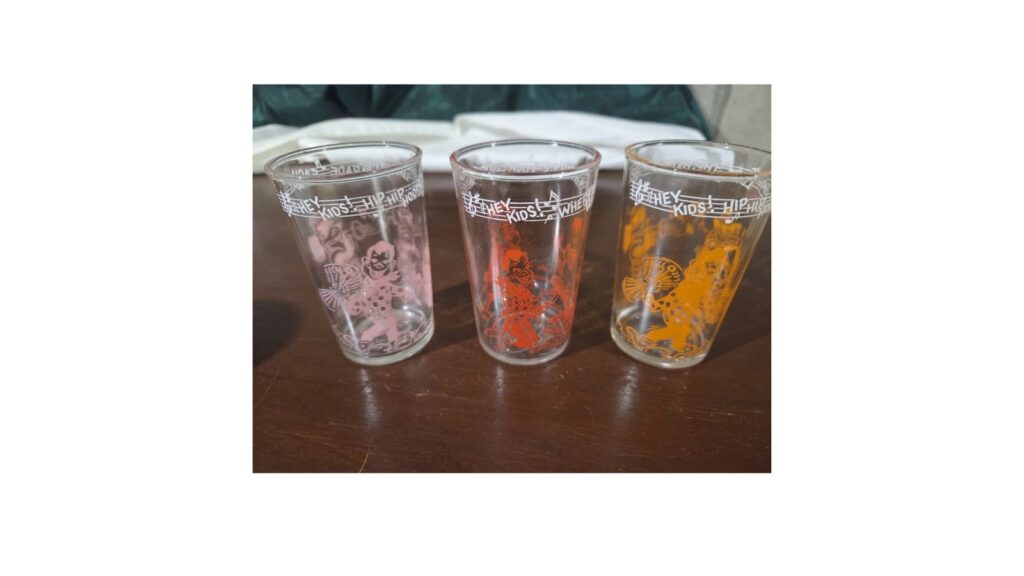
Welch’s started packaging jelly in reusable glass tumblers in 1953, and decades of licensing deals turned them into a rotating cast of cartoon characters, the Flintstones in the 1960s, Looney Tunes and Tom and Jerry through the 1990s. Almost every American kid drank orange juice out of one of these without realizing it doubled as a jam jar first.
Most individual jelly jar glasses from any era, including the Looney Tunes collector series, typically bring $5 to $15. A small matched set of three or more with their original lids typically brings $20 to $30.
The earliest 1960s Flintstones examples, made when the show was new, are the ones worth the closest look, since they’re older and thinner glass than the reissues that followed. Check the printed design under good light, since decades of dishwasher use fades the ink, and a glass with a washed-out image is worth noticeably less than one with crisp, saturated color.
Vintage Toastmaster chrome toaster
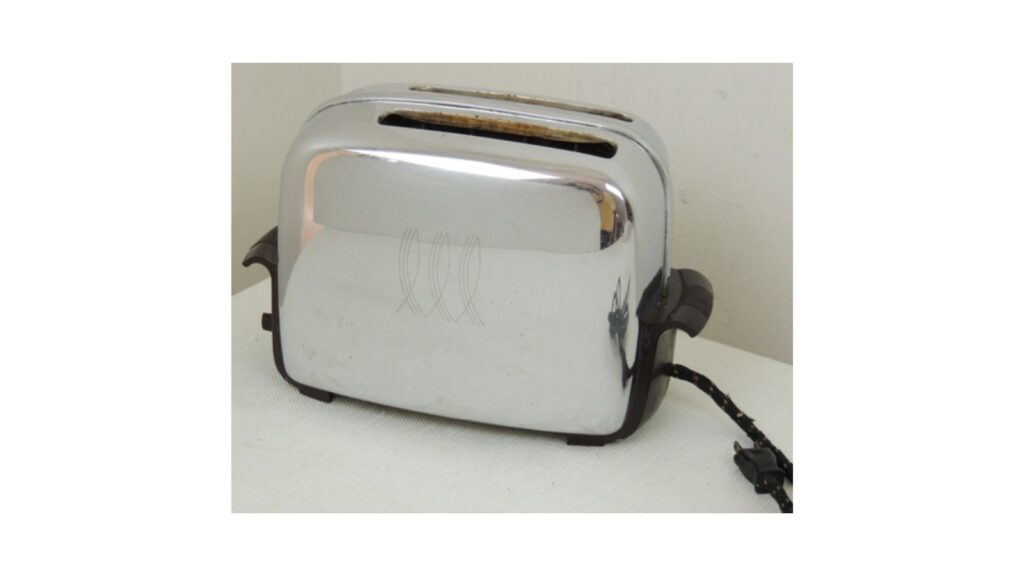
Toastmaster’s chrome pop-up toasters with Bakelite handles were the standard in American kitchens through the 1950s and 60s, built with an art deco simplicity that still looks sharp on a counter today. Plenty of them still work, which matters a lot to buyers who actually want to use one rather than just display it.
A standard chrome two-slice model, tested and working, typically sells for $25 to $45. The Sovereign model from the 1970s, with a floral or fruit pattern printed on the chrome rather than plain metal, is harder to find in good condition and typically brings $150 to $200.
Ask for it to be plugged in and tested before you buy, since frayed cloth cords and worn heating elements are common on appliances this age and a repair can cost more than the toaster is worth. Chrome that’s pitted or scratched reduces the value noticeably, while a piece with its original cord and clean, mirror-bright chrome is worth the most.











