
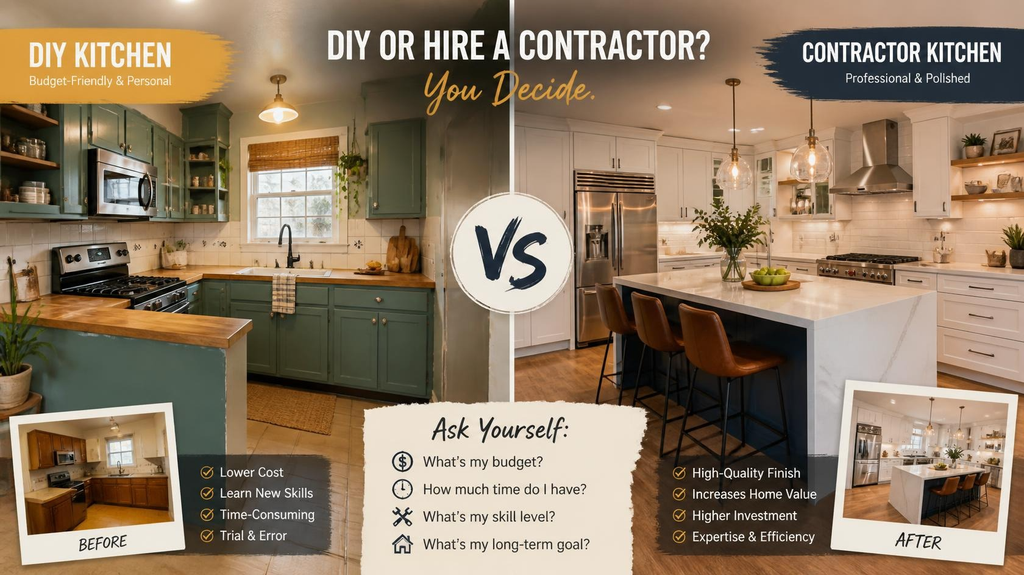
The most expensive kitchen I’ve ever seen was in a two-bedroom flat worth considerably less than the sum of its parts. Full custom cabinetry, a range cooker that could have serviced a restaurant, a marble island the owner had shipped in, and a wine fridge nobody used.
They spent an amount that made me wince. When they sold, eighteen months later, the agent’s honest assessment was that the kitchen had added roughly a third of what it cost, and had probably narrowed the buyer pool by making the flat feel like it belonged to someone with very particular taste.
Meanwhile a friend spent one weekend and a modest budget painting her cabinets, changing the handles, and replacing a fluorescent strip with three pendant lights. Her flat sold in nine days.
The gap between those two outcomes is the entire subject of this article, and it has almost nothing to do with quality.
Table of contents
Two different questions people keep merging
Before anything else, separate these.
Do I want this? A legitimate reason to spend money. If you’re staying ten years and you cook every day, a kitchen you love is worth real money and nobody should talk you out of it.
Will this come back when I sell? A completely different question with a completely different answer.
Trouble starts when people justify the first with the second. They want the island, so they tell themselves it adds value, and then feel cheated at valuation. Decide which question you’re answering and be honest about it, because the right kitchen for living in and the right kitchen for selling are rarely the same kitchen.
The pattern in the return data
Renovation return figures move around by market and year, but the direction of the finding has been stubbornly consistent for two decades.
Minor kitchen work recovers a high proportion of its cost. Major kitchen work recovers considerably less. The annual Cost vs. Value report from Remodeling magazine has shown minor midrange kitchen remodels outperforming upscale full remodels on cost recouped almost every year it has run, frequently by twenty or thirty percentage points.
The National Association of Realtors’ Remodeling Impact Report finds something similar from the agent’s side, with the added observation that some projects deliver most of their benefit through speed of sale and buyer appeal rather than through a higher price.
Why? Because buyers price a kitchen in categories, not in increments. There’s “needs replacing,” “fine,” and “genuinely lovely.” Moving from the first to the second is where nearly all the value is created. Moving from the second to the third costs several times as much and moves the valuation surprisingly little, because most buyers weren’t going to reject the house over a kitchen that was already fine.
What earns its money
These consistently deliver, and several are within reach of a competent amateur.
Cabinet fronts, painted or replaced. The carcasses in most kitchens are perfectly sound. It’s the doors that date. Painting is genuinely DIY-able if you’re patient about degreasing and priming, which is where every bad job goes wrong. Replacement doors on existing carcasses cost a fraction of new units and change the room completely.
Handles and hinges. Absurd return for the money. An afternoon, a screwdriver, and a room that reads as ten years younger.
Lighting. The most underrated kitchen upgrade there is. Replacing a single overhead fitting with layered lighting, meaning under-cabinet task lights plus something over the eating area, transforms how the space photographs and how it feels at night. Fitting the lights is straightforward. The electrical connection should not be DIY unless you’re qualified, and in many jurisdictions it legally can’t be.
Taps and sinks. Visible, tactile, immediately noticed. Moderate DIY difficulty, and a plumber’s half-day if you’d rather not.
Splashback. Contained, cheap, high visual impact. Tiling a small area is a reasonable first tiling project.
Worktops. The one big-ticket item that usually justifies itself, because a tired worktop makes an entire kitchen read as worn out regardless of what else you’ve done. Template and installation are specialist work for stone and quartz. Laminate is DIY-adjacent.
A practical walkthrough of the easy steps to transform your kitchen covers the sequencing on these smaller jobs, which matters more than people expect. Doing lighting after the splashback, for instance, means cutting into work you’ve just finished.
What tends to be a trap
Moving plumbing or gas. The single most reliable way to double a kitchen budget. The moment the sink or the hob shifts location, you’re into pipework, possibly floor work, certainly regulated trades, and a chain of consequences that keeps unfolding. Sometimes necessary. Never cheap, and almost never recovered at sale.
Ultra-premium appliances in a mid-market property. Buyers notice a bad appliance and barely register a spectacular one. The upgrade from poor to good is worth paying for. The upgrade from good to exceptional is a gift to the next owner.
Highly personal finishes. Bold cabinet colours, dramatic patterned tile, unusual layouts. Wonderful if you’re staying. If you’re selling within a couple of years, every distinctive choice shrinks the pool of buyers who can imagine themselves in the room.
Over-improving relative to the street. There’s a ceiling on what any given property will fetch, set by its location and its neighbours. A kitchen that pushes past that ceiling doesn’t lift the price, it just costs more. NAHB research on what buyers actually want is a useful corrective here, since buyer priorities skew far more practical than renovation marketing implies.
Structural work sold as a kitchen upgrade. Knocking through to open plan can be transformative and can add real value. But it’s a building project with a kitchen at the end of it, and it should be budgeted as one.
Drawing the DIY line
The rule I’d give anyone: do the work where a mistake is visible and reversible. Don’t do the work where a mistake is invisible and expensive.
Painting badly means sanding and repainting. Annoying, cheap. Wiring badly means a fire risk you can’t see. Plumbing badly means a leak that reaches the ceiling below three months later, at which point you’ve destroyed more value than the whole renovation created.
Paint, handles, splashback, shelving, and assembling flat-pack carcasses are fair game. Electrical, gas, structural alterations, and anything involving waste pipes belong to someone insured. Worktop templating sits in between, and the cost of getting it wrong is high enough that I’d pay for it.
There’s also a hybrid worth considering: hire a handyman by the day for the fiddly bits and do the preparation yourself. Stripping, sanding, and clearing are the hours that make a professional’s bill large, and they require no skill at all.
Final thoughts
If you’re selling within two years, spend modestly, choose neutrally, and put the money into cabinet fronts, lighting, and worktops. You’ll recover most of it and sell faster.
If you’re staying five years or more, build the kitchen you want and stop calculating. Just don’t pretend it’s an investment while you do it.
The genuine money pit isn’t any single upgrade. It’s starting without deciding which of those two people you are, and discovering the answer halfway through, with the units already ripped out.










