
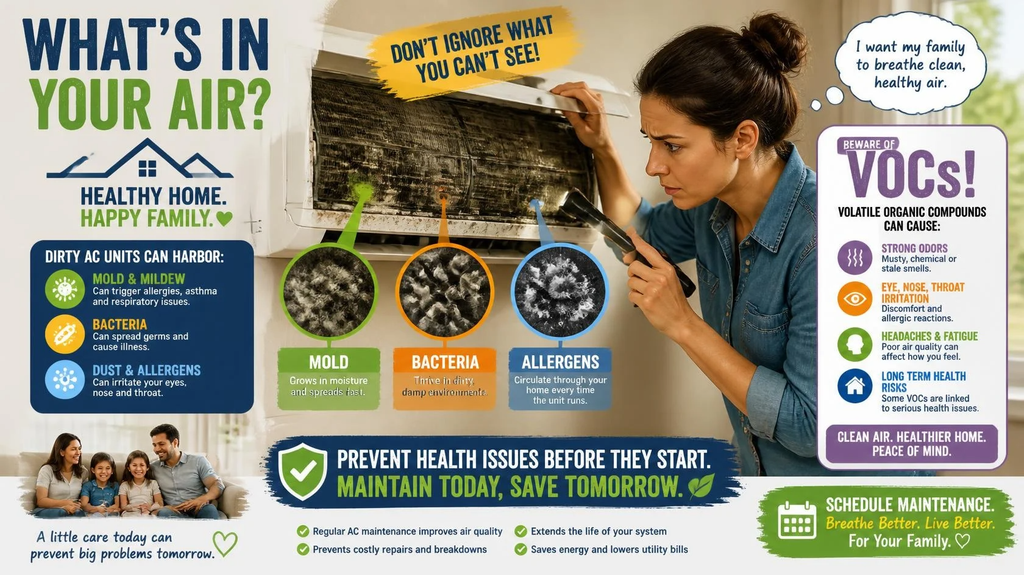
A friend spent four months and a small fortune trying to work out why her seven-year-old woke up congested every single morning and cleared up within an hour of getting to school. Allergy testing. A new mattress. Dust-mite covers on everything. An air purifier that cost more than her washing machine.
The problem was a blocked condensate drain in the AC unit above his bedroom door. Standing water, a warm coil, and a fan blowing across the top of it for eight hours a night.
Total cost of the actual fix: about the price of a takeaway.
This happens constantly, and the reason it happens is that nobody thinks of the air conditioner as a thing that can make you ill. It’s furniture. It’s been there since you moved in. But an AC system is a warm, dark, permanently damp box that pushes air directly into the rooms where your children sleep, and if something is growing in there, they are breathing it.
Table of contents
Your nose is a decent diagnostic instrument
Different problems smell different, and the smell tells you a surprising amount before anyone opens a panel. Learn these five and you’ll know whether you’re facing a twenty-minute job or a real one.
Musty, earthy, wet-basement. The classic, and the most common. This is microbial growth on the evaporator coil, in the drain pan, or inside the ductwork. It’s usually strongest in the first minute after the unit kicks on, because the fan is disturbing whatever has settled. If your house smells like a cellar only when the AC runs, you’ve basically diagnosed it.
Dirty socks. Yes, really. It has a nickname in the trade because it’s so recognisable, and it’s caused by bacterial buildup on a coil that stays damp through short cycles. It tends to appear at the start of a season and it is not fixed by air freshener, though people try.
Sharp, chemical, faintly sweet. Possible refrigerant leak. Stop guessing and call someone. This one is not a cleaning problem.
Rotten eggs. Leave. If you have gas in the property, sulphur smell means evacuate first and phone from outside. Do not investigate, do not flip switches. This is the one item on the list where curiosity is genuinely dangerous.
Burning, hot metal, or electrical. Shut the system off at the breaker and get it looked at. Could be dust burning off after a long idle period, could be a failing motor or wiring.
There’s a sixth category that’s harder to describe: a faint, sweetish plasticky smell that isn’t quite any of the above. That’s often volatile organic compounds, and the source is frequently not the AC itself but something the AC is circulating, which is a distinction that matters for what you do next.
The VOC confusion
People blame the air conditioner for VOC problems reasonably often, and it’s usually only half right.
VOCs come off new furniture, fresh paint, laminate flooring, adhesives, cleaning products, and air fresheners. The AC doesn’t create them. What it does is redistribute them, and in a well-sealed home running on mostly recirculated air, it concentrates them, because the same air keeps going round with nowhere to escape.
The EPA’s indoor air quality guidance is blunt about this: indoor concentrations of many pollutants routinely run several times higher than outdoors, and the biggest lever is ventilation rather than filtration. Which is a slightly awkward truth in hot climates where opening a window at 2pm in July is not a serious suggestion.
The practical version is to ventilate at the coolest part of the day, run extractor fans properly, and be careful about what you’re introducing. Plug-in air fresheners in a child’s bedroom are a bad trade, since you’re adding a continuous low-level VOC source to mask a smell you should be fixing.
What the symptoms actually look like in children
Kids present differently to adults, and the pattern is what gives it away rather than any single symptom.
Morning congestion that clears within an hour or two of leaving the house. Coughing that starts at night and stops on holiday. Recurring “colds” that never quite become colds and never quite go. Itchy eyes in one specific room. Asthma that got worse for no reason anyone can identify, around the time the cooling season started.
The tell is location and timing. If symptoms track a room or a schedule rather than a season, the building is a stronger suspect than the child’s immune system. The CDC’s guidance on mold and health effects is measured about what mould does and does not cause, and worth reading precisely because it avoids the catastrophising that dominates this topic online. Damp buildings are associated with respiratory symptoms. That’s established. Most of the more dramatic claims are not.
Do these five things before you spend anything significant
Almost every AC smell problem I’ve come across turned out to be one of these, and all five are within reach of an ordinary person on a Saturday morning.
Check the filter. Pull it out and look at it in daylight. If it’s grey, it’s been there too long. A choked filter reduces airflow, which keeps the coil damp, which is the root of most microbial smells. Replace it and note the date somewhere you’ll actually find it.
Check the condensate drain. This is the single most common culprit and the one people never think of. The drain line carries water away from the coil. Blocked with sludge, it backs up, the pan sits full, and you have a small permanent pond in your ceiling. Look for water stains near the indoor unit.
Look at the coil. With the power off, get a torch on it. A healthy evaporator coil looks like clean metal fins. If it’s furred with grey-brown biofilm, that’s your smell.
Check for standing water anywhere near the unit. Including the drain pan, the pipe run, and the outdoor discharge point.
Note when the smell appears. Only on startup? Continuously? Only in one room? Write it down before you call anyone, because it changes the diagnosis and stops you paying for the wrong investigation.
A clear walkthrough of how to get rid of bad smell from air conditioner covers the sequence in more detail, and it’s worth working through it before you accept a quote for duct replacement, which is the expensive answer to a question most people haven’t asked properly yet.
When it genuinely is a big job
Sometimes it is. Visible growth inside the ducts rather than at the vent face, water damage in the ceiling or wall cavity, symptoms across the whole house rather than one room, or a smell that returns within weeks of a professional clean all point to something structural.
Ductwork that was never sealed properly, sits in an unconditioned roof space, or is undersized for the system will keep producing condensation no matter how often it’s cleaned. ASHRAE’s standards for ventilation and indoor air quality exist because these are design problems, and a design problem cannot be cleaned away.
Final thoughts
The reason this is worth an afternoon of your attention is the ratio. A blocked drain and a filthy filter cost almost nothing to fix and can be behind months of a child sleeping badly. Duct replacement costs thousands and is occasionally necessary.
Nearly everyone jumps to the second without checking the first.
Go and look at your filter. Right now, before you forget. If it’s grey, you’ve already found something.










