
You’ve got a box of jewelry that belonged to someone you loved, and now you’re trying to figure out what to do with it. Maybe you need the money. Maybe you just don’t want to keep it in a drawer for the next twenty years. Either way, you’re staring at a pile of rings, chains, brooches, and earrings with no real idea what any of it’s worth, or where to start.
Most inherited jewelry sells for less than people hope. A few pieces sell for significantly more. The difference almost always comes down to knowing what you have before you walk into a buyer’s shop or fill out an online quote form. The less you know going in, the less you walk away with.
Table of contents
- Emotional value and market value are not the same number
- The karat stamp tells you most of what you need to know about gold
- How to calculate gold’s melt value yourself
- Sterling silver and silver plate are not the same thing
- Diamonds don’t hold their value the way most people think
- A grading certificate changes everything for a diamond
- Designer and signed pieces are a completely different market
- Vintage and antique jewelry has its own buyer pool
- Don’t clean, repair, or alter anything before getting a quote
- An appraisal and an offer are two very different numbers
- Pawnshops, estate buyers, and gold buyers want different things
- Online buyers are a legitimate option, with caveats
- Auction houses make sense for some pieces, not all
- Broken and incomplete pieces still have scrap value
- Costume jewelry almost never belongs in a jewelry buyer’s shop
- Colored gemstones are difficult to value without a specialist
- Always get multiple offers before accepting anything
- Selling inherited jewelry may have tax implications
Emotional value and market value are not the same number

The hardest thing about selling inherited jewelry isn’t finding a buyer. It’s the gap between what something meant to the person who wore it and what a stranger will pay for it. A ring your grandmother wore every day of her adult life is precious to you. To a gold buyer, it’s worth the weight of the metal minus their cut.
That’s not cynicism. It’s just how the market works. Jewelry buyers, whether they’re local shops, online dealers, or auction houses, are not buying memories or sentiment. They’re buying metal, stones, and in some cases, craftsmanship or brand name. The sooner you separate those two things in your mind, the cleaner the whole process becomes.
If certain pieces feel too significant to sell for melt value, that’s a completely reasonable conclusion. Not everything has to go. But the pieces you do sell will be priced on their physical components, and knowing that going in keeps the experience from feeling like a betrayal.
The karat stamp tells you most of what you need to know about gold
Turn any gold piece over and look for a small stamped number: 24K, 18K, 14K, or 10K. That number tells you what percentage of the metal is pure gold. 24K is 99.9% pure gold, which is too soft for most jewelry. 18K is 75% gold. 14K, the most common in American jewelry, is 58.3% gold. 10K is 41.7% gold and is the minimum legal karat for jewelry to be sold as gold in the United States.
The stamp may also appear as a three-digit number: 750 means 18K (75%), 585 means 14K (58.5%), 417 means 10K. European pieces often use this decimal format instead of the karat mark. If you don’t see any stamp, the piece may be gold-filled, gold-plated, or costume and not solid gold.
Karat matters because it directly determines the melt value. A 14K ring and an 18K ring of the same weight are worth meaningfully different amounts. If there’s no stamp and you’re not sure, a jeweler can test the metal for a few dollars, sometimes for free.
How to calculate gold’s melt value yourself

You don’t need a buyer to tell you what your gold is worth. You can figure it out yourself in about two minutes. Weigh your piece in grams, a postal scale works fine, then multiply that weight by the purity percentage of the karat. That gives you the pure gold content by weight. Convert grams to troy ounces by dividing by 31.1, then multiply by the current spot price of gold.
For example: a 14K ring weighing 5 grams contains 5 × 0.583 = 2.9 grams of pure gold. Divided by 31.1, that’s about 0.093 troy ounces. At $3,300 per troy ounce, the melt value is roughly $307. A buyer will offer less, typically 70–80% of melt value to cover their margin, so a realistic offer on that ring might be $215–$245.
That number is your floor. It’s the minimum any buyer should offer you. If someone quotes you less than 70% of melt value, you’re being lowballed. Knowing your floor before you walk in changes the conversation entirely.
Sterling silver and silver plate are not the same thing
Silver jewelry stamped 925 or marked “sterling” is 92.5% pure silver and has real melt value. Silver-plated jewelry has a thin layer of silver over a base metal, usually copper or brass, and is worth very little to a silver buyer. Most won’t take it at all.
The easiest way to tell the difference is to look for the stamp. Sterling pieces will say 925, 900, 800, or “sterling.” If there’s no stamp, or if it says “silver plate,” “EP,” “EPNS,” or “IS,” the piece is plated. Another clue: sterling silver is lighter and slightly flexible, while plated pieces tend to feel heavier and more rigid because the base metal is denser.
It matters because selling expectations need to match what you actually have. A box of sterling silver bracelets and a box of silver-plated bracelets look almost identical, but their values are completely different. One is worth weighing and selling to a silver buyer. The other belongs at a thrift store or on Facebook Marketplace.
Diamonds don’t hold their value the way most people think

The diamond in your inherited ring is probably worth far less than what was paid for it. The retail markup on diamonds can be 100–200%, which means the resale value of a typical diamond is often 20–50 cents on the dollar compared to its original purchase price. This surprises almost everyone.
Buyers who are purchasing diamonds to resell them need room to make a profit. They’re not going to pay retail for a stone they then have to retail again. A diamond that cost $4,000 new might realistically sell to a buyer for $800–$1,500 depending on size, quality, and whether it has a certificate.
There are exceptions, very large stones, exceptional quality, and certified diamonds all command better prices, but for the typical half-carat or one-carat diamond in a classic setting, you should expect to recover a fraction of original cost. That’s not a reason not to sell. It’s just a reason not to be shocked by the offer.
A grading certificate changes everything for a diamond
A GIA (Gemological Institute of America) or AGS certificate is a formal grading report that documents a diamond’s cut, color, clarity, and carat weight. If the jewelry you inherited came with one of these documents, keep it as it can significantly increase what a buyer will pay.
Uncertified diamonds are harder for buyers to price confidently, so they offer less to account for uncertainty. A certified diamond, especially one with a GIA grading report, gives the buyer verifiable information about what they’re getting. That certainty is worth money. A one-carat certified diamond and a one-carat uncertified diamond of similar quality can generate offers that are hundreds of dollars apart.
If you don’t have a certificate, you can have a stone certified. The cost is typically $100–$150 for a standard round diamond. For high-value stones, it’s often worth doing before you sell. For smaller or lower-quality diamonds, the cost may not be justified so ask a jeweler to give you a rough estimate of value first.
Designer and signed pieces are a completely different market
Jewelry from Tiffany & Co., Cartier, Van Cleef & Arpels, Bulgari, David Yurman, or other recognizable luxury names sells for a premium that has nothing to do with melt value. A Tiffany sterling silver bracelet that contains maybe $30 worth of silver can sell for $200–$400 because of the brand. A Cartier Love bracelet in 18K gold that might have a melt value of $1,500 might sell for $4,000–$6,000 at resale.
The key is documentation and presentation. Original boxes, pouches, and receipts all help. So does the designer’s hallmark with most signed pieces are stamped with the maker’s name somewhere on the piece, usually in a discreet location. If you think a piece might be designer but aren’t sure, take it to a reputable estate jeweler before taking it to a gold buyer. A gold buyer will give you melt value. A designer reseller will give you market value, and those numbers can be very far apart.
Not every designer piece commands a premium. Lesser-known or regional designers may add little or nothing to the value. But for major international names, the difference is substantial enough to justify seeking out a specialist.
Vintage and antique jewelry has its own buyer pool

Jewelry made before 1930 is generally considered antique. Pieces from roughly 1930–1980 are often called vintage or estate. These categories matter because certain buyers, estate auction houses, antique dealers, collectors, pay for the style, craftsmanship, and period of a piece, not just its metal and stone content.
Art Deco platinum-and-diamond pieces from the 1920s. Victorian gold mourning jewelry. Edwardian filigree work. Retro 1940s gold brooches. These all have collector markets where the right buyer will pay more than melt. The challenge is finding that buyer, which typically means going through an estate auction house, an antique jewelry dealer, or a platform like 1stDibs rather than a standard gold buyer.
If you don’t know what era your pieces are from, look at the style and construction. Pre-1950 jewelry is often hand-fabricated with fine detail work, intricate settings, and platinum or yellow gold rather than white gold. A local antique jewelry dealer can usually date a piece quickly and tell you whether it has collector value beyond its metal content.
Don’t clean, repair, or alter anything before getting a quote
This one costs people money every year. Before selling inherited jewelry, leave everything exactly as you found it. Don’t clean it, don’t polish it, don’t attempt repairs, and don’t remove stones to sell them separately. What looks like dirt or tarnish to you might be original patina that a collector or dealer values. What looks like a loose stone might be an intentional design feature.
More practically: a professional buyer will clean and assess pieces themselves. They don’t need you to do it first, and cleaning can actually damage certain materials, antique enamel, pearls, certain porous gemstones, or destroy the surface characteristics that help date a piece accurately.
The same applies to repairs. A broken clasp or missing stone is a common condition for inherited jewelry and doesn’t necessarily reduce value significantly. Having it repaired before selling almost never recouped the repair cost in a higher offer, and in some cases, particularly with antique or signed pieces, amateur repairs actively reduce what a specialist will pay.
An appraisal and an offer are two very different numbers
Insurance appraisals value jewelry at retail replacement cost, what it would cost to buy a comparable piece today at full retail price. That number is almost always significantly higher than what anyone will pay you for the piece. If your aunt’s ring has an insurance appraisal of $5,000, a buyer may still offer you $800.
This isn’t fraud. It’s just two different measurements. The insurance appraisal tells you what it would cost to replace the item. A buyer’s offer tells you what the secondary market will bear. Resale value for most jewelry runs 20–50% of insurance appraisal value, sometimes less.
If you have appraisals with your inherited pieces, read them carefully. The purpose of the appraisal is usually stated at the top, “insurance replacement value” is not the same as “fair market value” or “liquidation value.” For selling purposes, fair market value is the relevant number, and getting that estimate means going to a buyer or a dealer who will tell you what they’d actually pay, not what it would cost to replace it in a jewelry store.
Pawnshops, estate buyers, and gold buyers want different things

Not all jewelry buyers are the same, and the type of buyer you approach changes the offer you’ll get. A pawnshop needs to be able to resell your piece quickly from a retail case. They price accordingly, typically offering 40–60% of resale value. That’s not a bad deal for a fast transaction on a common piece, but it’s not the ceiling.
A gold and silver buyer is primarily interested in melt value. They’ll pay a percentage of the metal content and aren’t particularly interested in the design, brand, or stones unless those stones are significant. This is the right option for broken pieces, plain gold chains, or anything without collector or brand value.
An estate jeweler or consignment dealer looks at the whole piece, metal, stones, craftsmanship, condition, and desirability, and may offer more for quality pieces that they can resell at a premium. They typically pay less upfront than a cash buyer but can yield significantly more for pieces with real resale appeal. Know what you have before you decide which door to walk through.
Online buyers are a legitimate option, with caveats
Several reputable online precious metal buyers will accept mailed jewelry, assess it, and send you a check, or return the piece if you decline their offer. For straightforward gold, silver, or platinum pieces, this can be a convenient and competitive alternative to local buyers, particularly if you’re in an area without many options.
Before using any online buyer, check their Better Business Bureau rating and Trustpilot reviews. Confirm that they offer insured shipping both ways, that their return policy is clearly stated, and that you’ll receive an itemized offer showing how they valued each piece. Reputable services will also provide a prepaid shipping label and insure your package for its estimated value.
The limitation of online buyers is that they work best for metal and straightforward pieces. If you have potentially valuable vintage jewelry, signed pieces, or significant stones, an online buyer is unlikely to offer what a specialist would. Use online buyers for scrap gold, silver chains, broken pieces, and any jewelry you’re confident is valued primarily by its metal content.
Auction houses make sense for some pieces, not all

A major auction house like Christie’s, Sotheby’s, or Bonhams is not the right venue for a 14K gold chain. But for an exceptional diamond, a signed designer piece, or a rare antique jewelry item, auction can yield far more than any private buyer would offer. because two or more motivated collectors bidding against each other drive the price up in a way a single buyer never will.
The threshold varies by house, but most major auction houses won’t accept individual pieces valued under $5,000–$10,000. Regional auction houses and estate auction specialists work with lower-value pieces and are worth considering for Victorian, Art Deco, or other period jewelry with genuine collector interest. Auction houses typically charge a seller’s commission of around 10% of the final hammer price, so factor that into your expectations.
If you’re not sure whether a piece is auction-worthy, consignment shops and estate dealers can often tell you quickly. Most reputable dealers would rather send you to auction than underpay you, they have reputations to protect, and it’s a bad look to give someone $300 for a piece that subsequently sells at auction for $3,000.
Broken and incomplete pieces still have scrap value
A necklace with a missing clasp, a ring with a lost stone, a bracelet someone bent out of shape, none of that makes a piece worthless if the metal is real. Gold and silver are melted down and refined regardless of condition. A broken 14K gold bracelet has exactly the same melt value as an intact one of the same weight.
The same is true of partial sets, odd earrings without their partners, and watches that no longer run. The metal content doesn’t care about the condition. Collect everything in the box, even the pieces that look like junk, and weigh them together before deciding anything should be thrown out. What looks like a tangled mess of cheap chains might be several ounces of sterling silver.
The exception is pieces where the value is primarily in the design or brand. A Tiffany bracelet with a broken clasp is still a Tiffany bracelet, but a buyer may offer less for it because the repair cost comes out of their margin. For those pieces, getting the repair done first may make financial sense. Ask a jeweler to give you a repair cost estimate alongside a rough value estimate so you can do the math.
Costume jewelry almost never belongs in a jewelry buyer’s shop
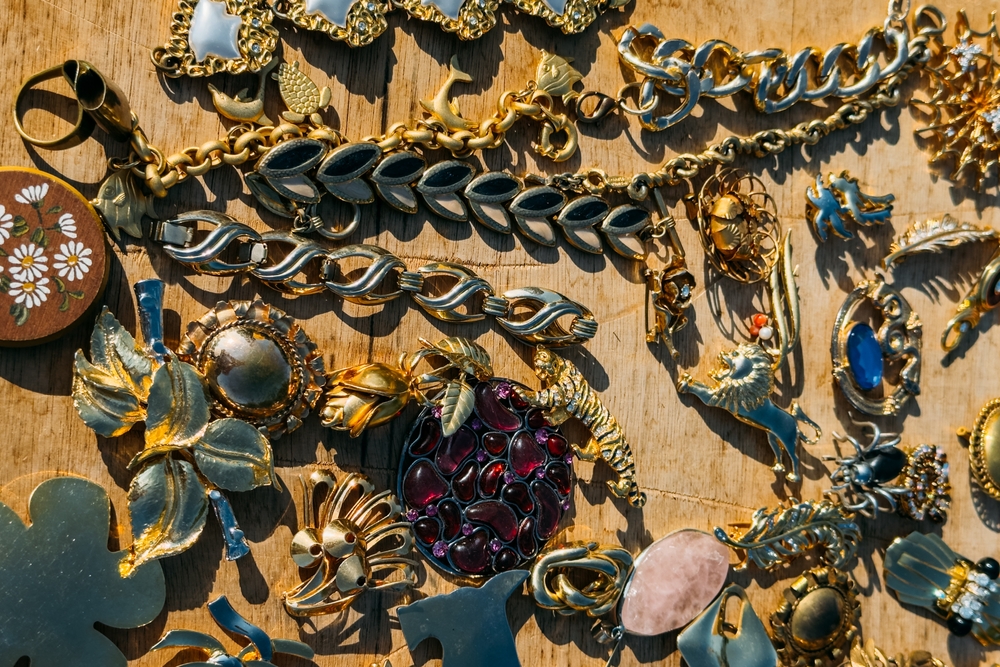
Costume jewelry, pieces made from base metals, glass, plastic, rhinestones, or other non-precious materials, has essentially no melt value and most jewelry buyers won’t give you anything for it. The exceptions are rare: signed pieces by recognized costume jewelry designers like Miriam Haskell, Schiaparelli, Eisenberg, or Trifari can have real collector value, sometimes reaching hundreds or thousands of dollars for a single piece.
For the vast majority of costume jewelry, the right venue is not a jeweler, it’s eBay, Etsy, a consignment shop, or an estate sale. Costume pieces from the 1930s–1960s in particular have strong collector markets on those platforms. A box of vintage brooches that a gold buyer won’t touch might yield $200–$400 sold individually on eBay to collectors who value them for what they are.
If you have a large quantity of costume jewelry, an estate sale company can often sell it more efficiently than you could piece by piece. They know what’s worth putting on display, what sells quickly, and how to price it, and their commission comes out of what they sell, not out of your pocket upfront.
Colored gemstones are difficult to value without a specialist
Rubies, sapphires, emeralds, and other colored stones are harder to price than diamonds because their value depends on color, origin, treatment history, and clarity in ways that require trained eyes and sometimes laboratory testing. A ruby that looks similar to another ruby can be worth ten times as much if it came from Burma rather than Thailand and hasn’t been heat-treated.
Most general jewelry buyers and gold buyers will price colored stones conservatively if they’re uncertain about quality and origin, so they offer less to protect themselves. For any piece with a significant colored stone, a gemological appraisal from someone who specializes in colored stones is worth the cost before you sell. The American Gem Trade Association maintains a directory of members who can give you a proper assessment.
The difference in value between a low-quality and a high-quality colored stone of the same size can be enormous. A one-carat sapphire can range from $50 to $50,000 depending on those factors. Don’t let a generalist buyer set the price on a piece with a significant colored stone without a specialist’s opinion first.
Always get multiple offers before accepting anything
This is the single most practical piece of advice in this list, and the one most people skip because the process feels uncomfortable. Get at least three offers from different buyers before you accept anything. The spread between the lowest and highest offer for the same piece can be 50–100%.
Buyers know that most people selling inherited jewelry are not experts, are often dealing with an emotionally charged situation, and want to be done with the process. Some count on getting a quick yes before you find out what the piece is actually worth. Getting multiple offers doesn’t require any special knowledge, you just have to do it.
Keep a simple record: write down who you talked to, when, and what they offered for each piece. If you’re selling multiple items, ask for itemized offers so you can compare piece by piece. Some buyers will increase their initial offer when they know you’re shopping around. That’s not adversarial, it’s just how any transaction works when the seller has information.
Selling inherited jewelry may have tax implications

When you inherit jewelry, the IRS generally allows a stepped-up basis, meaning your cost basis for tax purposes is the fair market value of the piece on the date of the original owner’s death, not what they paid for it decades ago. In practice, this means that if you sell inherited jewelry for close to its appraised value at the time you received it, you may owe little or no capital gains tax.
If you sell for more than the stepped-up basis, say, a piece appraised at $2,000 at inheritance that you later sell for $3,500, you would owe capital gains tax on the $1,500 difference. Jewelry held for more than a year before sale is typically taxed at the long-term capital gains rate rather than the higher short-term rate.
This is worth knowing, not panicking about. For most people selling typical inherited jewelry for melt or close-to-melt value, the tax impact is minimal or zero. But if you have high-value pieces, or if you’re selling a substantial collection, talking to a tax professional before you sell is a reasonable precaution.
Having some idea of what you own, and what different buyers are actually looking for, puts you in a completely different position than walking in blind.











