
There were two heavy brass fighting roosters at the estate sale, priced at two dollars each. They were solid cast, nicely detailed, and out the door in minutes. The person who bought them sold the pair for $165 that weekend. Most brass animals are worth almost nothing. A smaller number are worth real money. The difference usually lives on the bottom of the piece, in the weight of it in your hand, and in whether you’re holding one of a genuine matched pair or the only survivor of a set.
The brass animal category splits into two very different worlds. One is the flood of lightweight Indian- and Taiwanese-manufactured pieces that filled American homes from the 1960s through the 1980s. Most are worth $5 to $20 at best. The other world is quality mid-century European casting, Hollywood Regency floor sculptures, and a handful of named Austrian designers whose work is now actively collected. Learning to tell them apart takes about ten minutes.
Condition note across the board: brass that has been polished repeatedly looks worse, not better. Aggressive cleaning removes natural patina and wears down fine casting detail. Pieces with original unpolished surface in good condition bring more than over-cleaned examples every time.
Table of contents
- Matched pair of mid-century brass fighting roosters
- Mid-century solid brass horse head bookends
- MCM brass owl bookends and figurines
- Brass ibex head bookends (1960s and 70s)
- Hollywood Regency large brass floor animal sculptures
- Walter Bosse small brass animals, Herta Baller, Austria
- Walter Bosse hedgehog stacking ashtray set (complete six-piece)
- Mid-century brass crane or heron pair
- Karl Hagenauer (WHW) marked brass animal figurines
Matched pair of mid-century brass fighting roosters
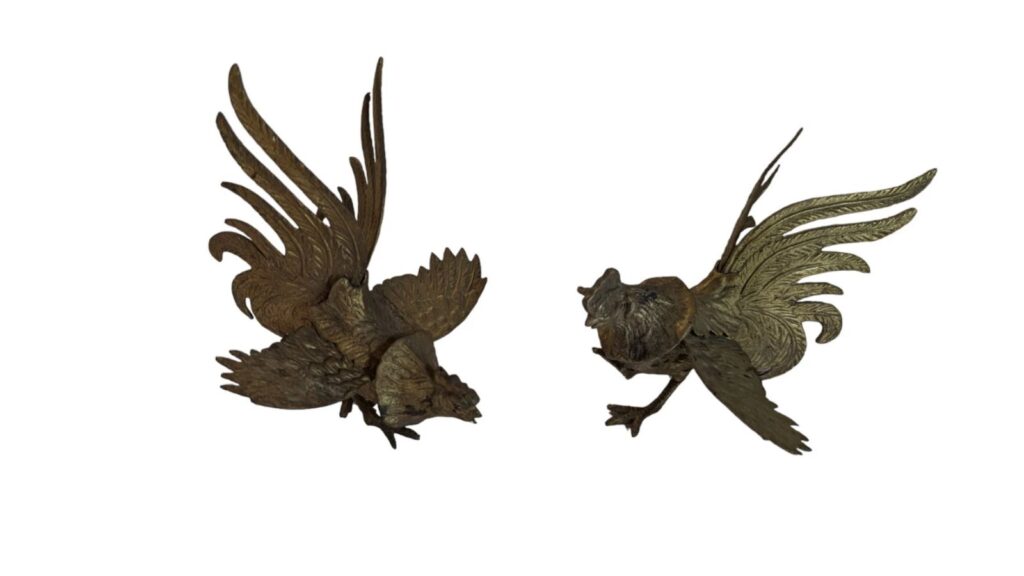
A pair of brass fighting roosters is one of the most common finds at estate sales and thrift stores, and one of the most consistently underpriced. Quality mid-century pairs in solid cast brass, typically produced in Spain, Italy, and Japan during the 1950s and 60s, feature sharply cast feather and comb detail and stand 7 to 9 inches tall. Matched pairs in good condition with original patina and no repairs bring $75 to $200, with large, finely cast French or Italian examples reaching higher.
Condition and matching are the two deciding factors. The casting quality on genuine mid-century pairs is noticeably heavier and more detailed than later reproductions, with crisp feather ridges and a well-defined comb. Apply the weight test: quality cast brass birds feel substantial for their size. Feather detail should be sharp under light rather than blurry and undefined. Many pairs have been over-polished, which strips the original surface and reduces value. A “Japan” or “Spain” stamp on the base usually confirms mid-century manufacture. Examples stamped “Korea” or left unmarked are more likely to be later production with softer casting.
The pair premium is real. Two matched birds in confrontational pose are worth meaningfully more than a single bird, and meaningfully more again than two birds of different sizes or styles assembled from different sources. The pair format is what buyers want.
Mid-century solid brass horse head bookends
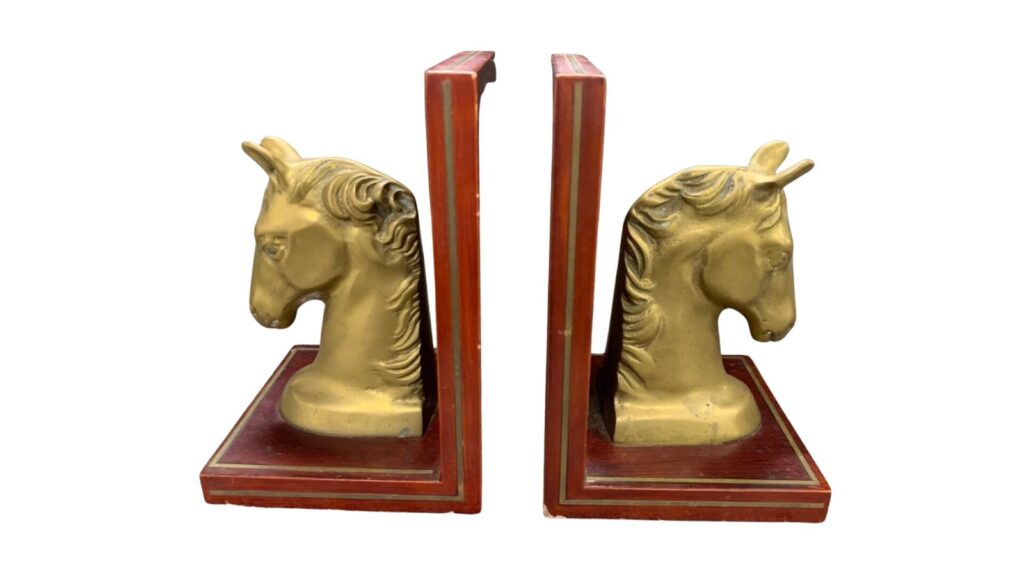
Horse head bookends in solid cast brass were a fixture of mid-century American interiors, and quality pairs bring more than their typical thrift store or estate sale pricing suggests. A pair from the 1950s or 60s in genuine solid cast brass, standing 6 to 8 inches tall with detailed mane and facial casting, typically brings $100 to $300. The maker matters considerably at the upper end of that range.
Philadelphia Manufacturing Company (PMC) produced a wide range of mid-century brass bookends that are easy to identify by their original felt base pads and PMC labels. Virginia Metalcrafters produced a pair called “The Stallion” in 1954, and it is among the most desirable horse bookends in the category. Any pair bearing the Virginia Metalcrafters mark should be looked up before pricing. Hagenauer-style pairs, produced in Austria in the 1940s and 50s with a distinctively minimal silhouette, also bring collector attention and command more.
What separates real solid brass from brass-plated zinc or resin: lift the pair and feel the weight. Plated pieces feel lighter and have blurrier detail around fine areas like the nostrils and ears. Cracks at the base mount point are common and reduce value. Pairs must be genuinely matched to bring the premium. Two identical horses both facing right are not a matched pair. One facing right and one facing left, in mirror image, are.
MCM brass owl bookends and figurines
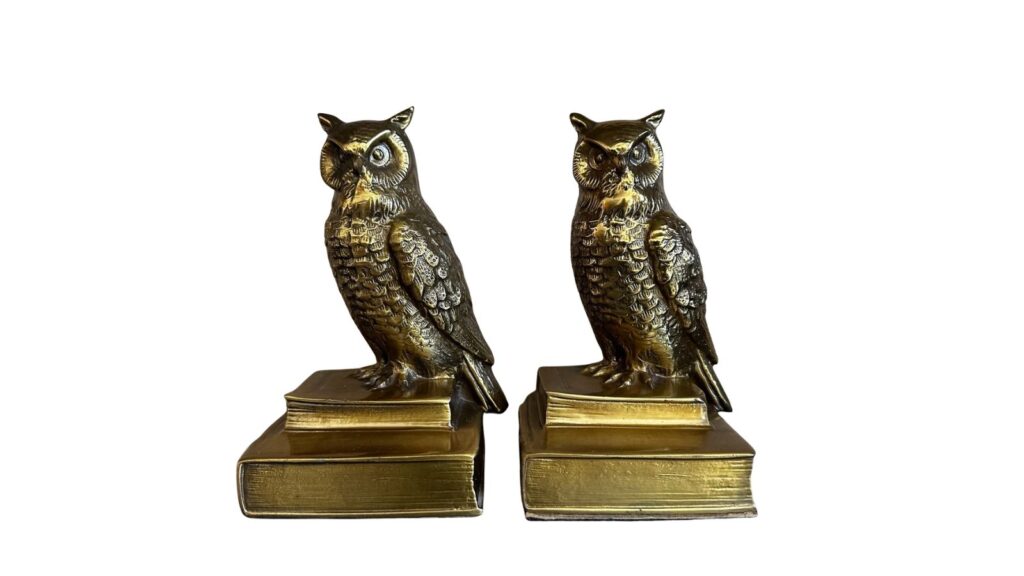
Owls were everywhere in 1960s and 70s decor, which means quality brass examples surface constantly at estate sales. A clean pair of mid-century brass owl bookends with sharp feather texture, original patina, and no repairs typically brings $150 to $350, with large heavily detailed examples at the upper end. Single brass owl figurines serving as paperweights or shelf ornaments bring $40 to $80 apiece in good condition and considerably more if they carry a maker’s mark.
The quality range in this category is enormous. The best mid-century examples are heavily cast with crisp feather and facial detail, notably around the brow ridge and eyes. Later examples from the 1970s and 80s have softer features and noticeably lighter weight. Pieces carrying an India-made label from this era sit at the lower end of the value range. European examples without labels but with finer casting detail command more. Brutalist-style brass owl bookends from the 1970s, with angular geometric forms rather than realistic carving, have their own collector base and bring comparable prices when the quality of construction is evident.
Bookends should sit flat on a surface without wobble. Pairs must genuinely match. Any casting crack across the body drops value significantly, and a repaired crack makes an example almost unsellable to serious buyers. Unmarked single owls with no obvious origin are common and usually worth $30 to $50 regardless of how detailed they appear.
Brass ibex head bookends (1960s and 70s)
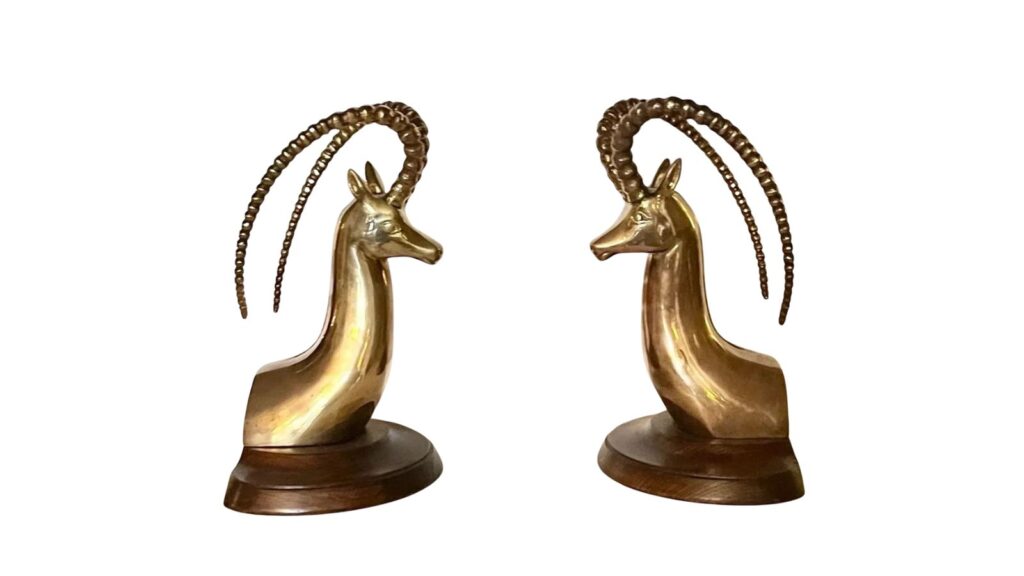
The brass ibex, with its dramatically sweeping curved horns and sharply detailed head, was one of the defining shapes of 1960s Hollywood Regency decorating. Estate sales still throw them up regularly, often unidentified and underpriced. Quality pairs with crisp casting and original surface intact typically bring $100 to $275, with larger and more architecturally detailed examples pushing beyond that range.
What separates good ibex from generic production: the horns on quality pieces are cast from heavy solid brass with sharp ridges running along the curve. Facial detail around the eye socket and nostril is well-defined. Poor-quality reproductions and later pieces have smooth, undifferentiated horn surfaces and flat, uninvolving facial expressions. Larger pairs where each bookend stands 8 or 9 inches or more are consistently more valuable than compact examples. Pairs with original marble or stone bases are more desirable than fully brass versions, as the stone base format was the upmarket configuration when these were sold new.
A Spanish or Italian origin mark adds credibility. Many of the best mid-century ibex bookends were produced in Spain and Italy for the Hollywood Regency furniture market. The marble base should be intact with no chips at the edges, which is a common failure point. A chipped or cracked marble base reduces value by a meaningful amount and is easy to miss unless you’re looking carefully.
Hollywood Regency large brass floor animal sculptures
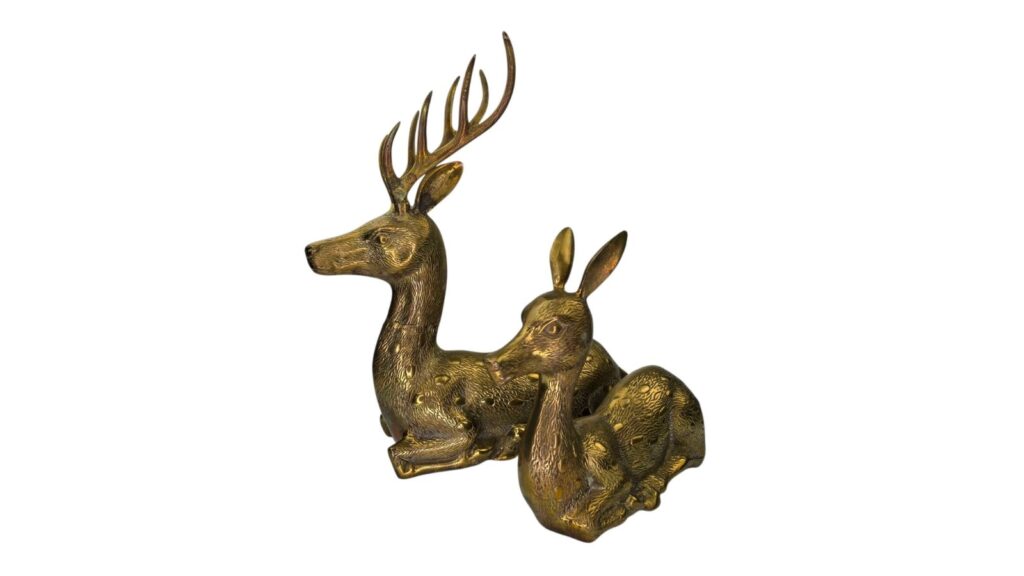
A pair of large brass giraffes standing two to three feet tall gets donated to thrift stores because nobody knows what to do with them. That pair can be worth $600 to $1,500 in good condition. Sarreid Ltd., which produced large-format Hollywood Regency brass animals in Spain during the 1960s and 70s, made giraffe and stag sculptures that collectors actively seek out. Tall single stag or deer figures, standing three feet to the antler tips, bring $300 to $800 depending on size and condition.
The Sarreid name, typically stamped on the base along with “Made in Spain,” is a significant identifier. Unsigned pieces by similar makers are still valuable but bring less than confirmed Sarreid examples. The casting quality on good Sarreid-style floor animals is immediately apparent: giraffe coat pattern detail and stag antler texture are precise and finely articulated, not simplified or blurred. Later, cheaper versions of the same format are noticeably less detailed and lighter in construction.
Condition considerations for large floor pieces differ from small figurines. Check that all legs are intact and have not been repaired or resoldered at the base. Any wobble on a tall piece matters: these sculptures should stand perfectly erect. Large giraffe legs are often hollow and prone to denting. Run a hand along each leg and check carefully. Original unpolished surface is far preferable to a polished example. These pieces are time-consuming to polish, which is why most authentic unpolished examples have survived in their original state.
Walter Bosse small brass animals, Herta Baller, Austria
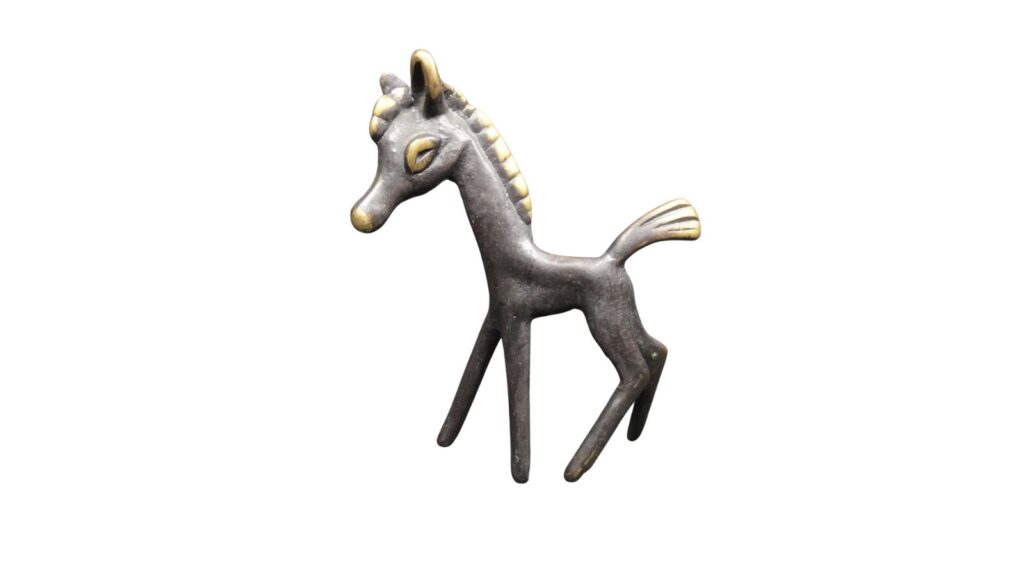
Walter Bosse was an Austrian designer working primarily in the 1950s, producing small brass animals through the Herta Baller workshop in Vienna. His pieces are playful, geometric, and specific: spare forms with simplified but expressive shapes drawn from the Bauhaus tradition. A single marked Walter Bosse small animal, typically a cow, deer, fawn, bear, or seahorse, brings $190 to $270 in good condition. Functional pieces such as the donkey pen holder or the key hanger with animal figures bring more.
Identification is critical. Authentic pieces are marked on the base with “Herta Baller Austria” or “Made in Austria,” sometimes with a “Bosse Austria” stamp. Stamps are occasionally faint, which is why genuine pieces surface at estate sales unidentified and underpriced. The forms themselves are distinctive: Bosse’s animals are not realistic but stylized in a specific way, with clean geometric volumes and smooth polished surfaces that are immediately recognizable once you’ve seen a confirmed example.
Fakes and reproductions are a genuine problem. The Herta Baller workshop has produced modern reproductions using original molds with matching stamps. The distinction comes down to wear and patina: vintage pieces have consistent oxidation in recessed areas and wear on base edges consistent with decades of handling. Recent reproductions look newer and more uniformly bright. When comparing, oxidation in the deep crevices of a vintage piece should not wipe off with a cloth. If a piece described as vintage shows no sign of age whatsoever, the price should reflect that uncertainty.
Walter Bosse hedgehog stacking ashtray set (complete six-piece)
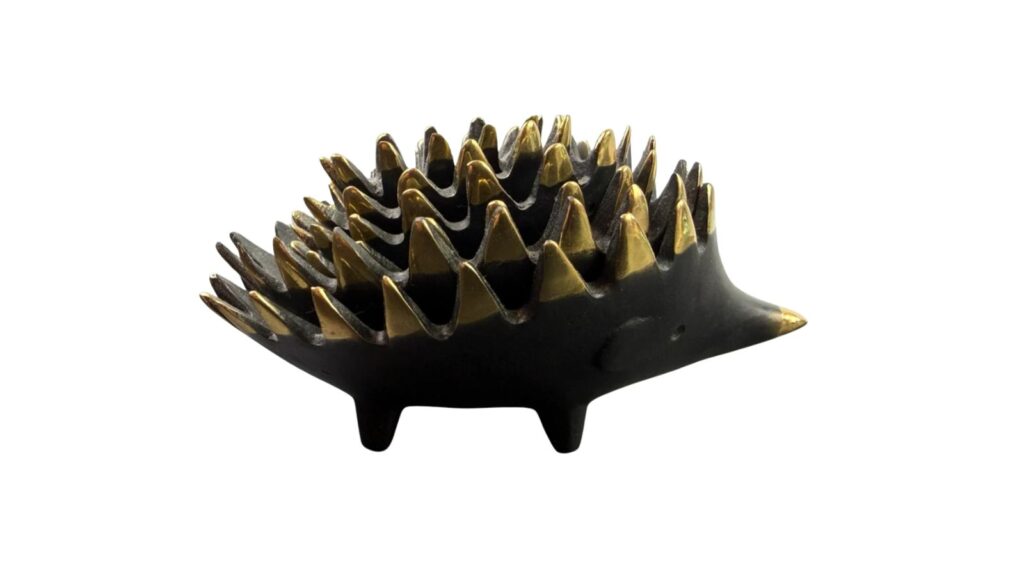
The most sought-after single item in the Walter Bosse catalogue is the complete six-piece stacking hedgehog ashtray set, produced in the 1950s by the Herta Baller workshop. Each hedgehog is designed to stack on top of the next, with each back serving as the tray surface. A complete set of six with no bent tines, intact spiny texture, and legible markings on each piece brings $800 to $1,100. Exceptional examples in pristine condition push higher.
Completeness is everything in this set. Collectors want all six hedgehogs stacking correctly, all marked. A set of four or five is worth considerably less than a complete six. Any bent or damaged tines on the tray portion reduce value. The fine spiky surface texture on each hedgehog should be crisp and intact. Sets that have been aggressively cleaned are more problematic than naturally aged ones, as strong cleaning can obscure the surface detail and remove the patina in the recesses between spines.
Modern reproductions of this set are made and sold. The age test applies just as it does for single Bosse pieces: genuine vintage sets show age-appropriate oxidation deep in the spaces between the spines, while modern reproductions look recently produced. If someone is selling what they describe as a vintage complete set for well under $500, the price itself warrants scrutiny. Complete original sets at that level are extremely rare and should be confirmed before purchase.
Mid-century brass crane or heron pair
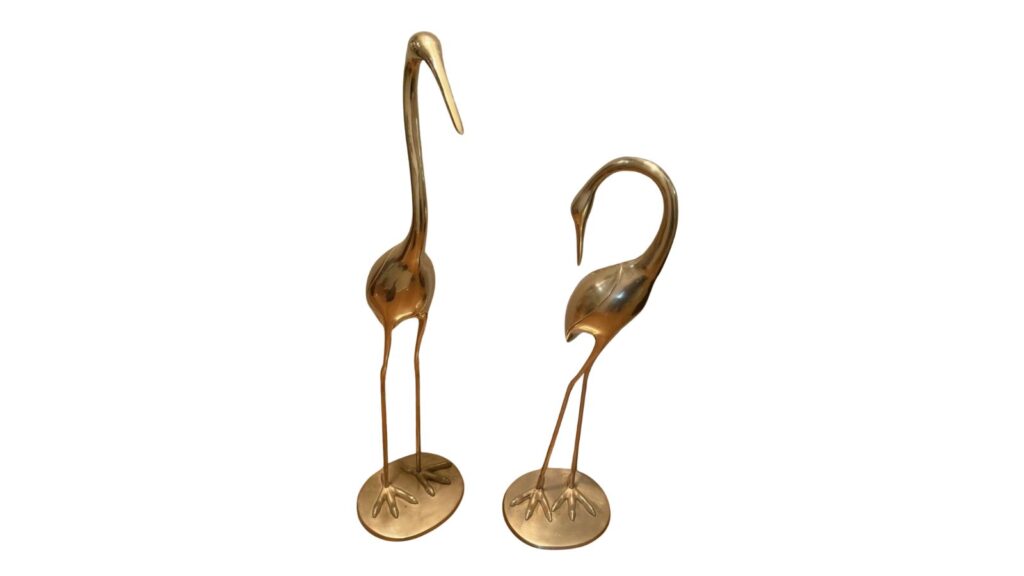
Tall, slender brass cranes and herons are among the most underpriced mid-century finds at estate sales. Most sellers treat them as generic decorative brass and price them accordingly. A quality matched pair with both birds in the same style, similar height, and original patina intact typically brings $150 to $400, with large pairs standing 12 inches or more at the higher end of that range. The crane became a fixture of mid-century Hollywood Regency and Asian-influenced decorating, and quality versions were produced in Europe, Japan, and the United States through the 1950s and 60s.
The best examples have precise casting on the feather detail at the wing base and a convincingly tapered leg construction. The weakness point on all brass crane sculptures is the legs: hollow or thin-walled legs bend and crack, and any leg repair drops value significantly. Check each leg individually by applying light pressure. Legs that flex or feel unstable have likely been previously damaged.
Pairs must genuinely match. Two cranes of different poses or different production origins are not a matched pair and should not be priced as one. Two birds with identical stance, finish, and base detail are. Original round or disk bases, if present, should be intact with no cracks. The pair format is essential to the value. A single quality crane is worth $40 to $80 on its own. The matched pair brings three to five times that.
Karl Hagenauer (WHW) marked brass animal figurines
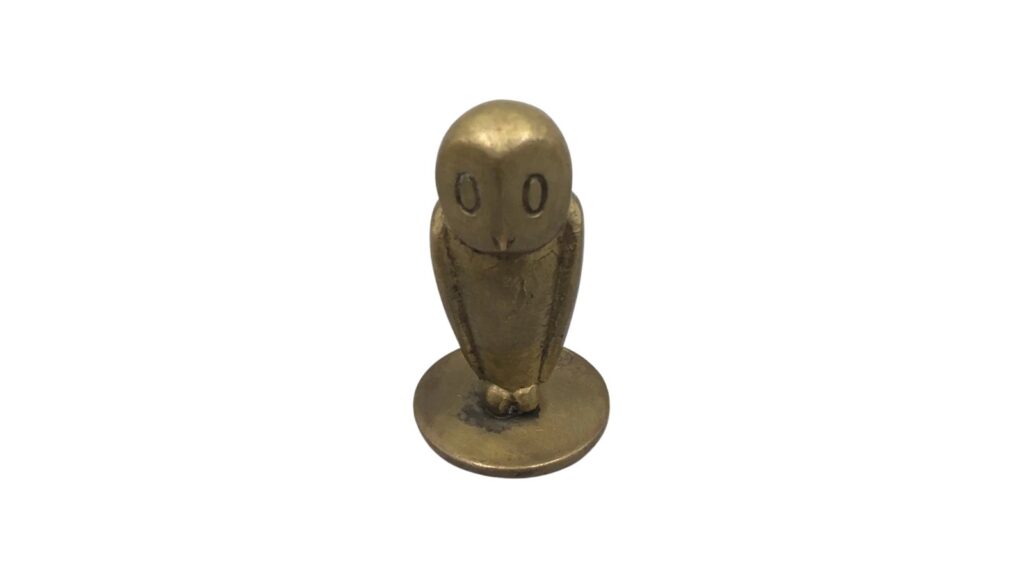
Karl Hagenauer worked out of Vienna from the 1920s through the 1950s, producing stylized brass animals that are immediately recognizable once you know the style: a greyhound rendered as pure silhouette, a panther with body lines that prioritize geometry over anatomy. Marked examples stamped with the workshop mark “WHW” (Werkstätte Hagenauer Wien), along with “Hagenauer Wien” and “Made in Austria,” bring $300 to $900 for individual animal figures in good condition. Rarer subjects and larger pieces push well into four figures.
These do surface at estate sales, typically unidentified and priced at generic brass rates. The stamps are on the underside of the base and are well-defined on genuine pieces. The quality of the metalwork is apparent the moment you handle it: Hagenauer pieces are crisp, precisely finished, and have a weight and solidity that sets them apart from generic mid-century brass animals.
Fakes have been circulating for decades. The giveaways are blurry or shallow stamps, slightly off proportions compared to documented examples, and casting that looks softer or less precisely finished than originals. Never pay collector-level prices on a piece with faint or hard-to-read stamps. The difference between a clear, fully legible WHW stamp and a muddy partial impression is the difference between a significant find and a well-made fake.











