
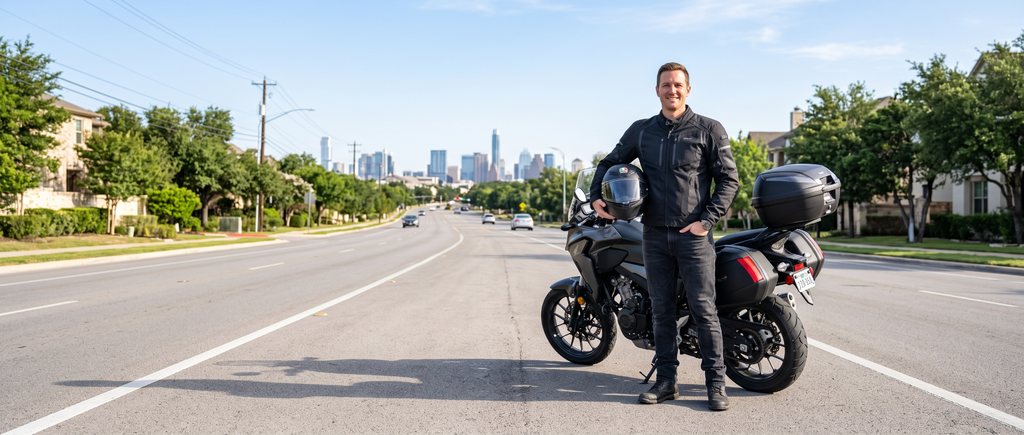
Motorcycles are a genuinely rational financial decision for a lot of single parents. The purchase price is a fraction of a car’s, the fuel economy is better, insurance is often cheaper, and in a city like Houston or Dallas, the commute time drops.
What is not rational is the amount of misinformation attached to the legal requirements. Ask five Texas riders what the helmet law says and you will get five answers, most of them wrong in the same direction: they overstate the exemption and understate the consequences. Here is what the statute actually says.
Table of contents
The default rule is that helmets are required
Texas law starts from a mandatory position. Under Section 661.003 of the Texas Transportation Code, a person commits an offense by operating or riding as a passenger on a motorcycle on a public street or highway without protective headgear meeting state safety standards. Carrying a passenger who is not wearing one is a separate offense by the operator.
That last part gets missed constantly. If your teenager rides on the back without a helmet, the citation is yours.
The exemption is narrower than people think
The statute creates an exception, and this is where the folk version diverges from the real one. The exception applies only if the person required to wear headgear was at least 21 years old and either:
- successfully completed a motorcycle operator training and safety course under Chapter 662 of the code, or
- was covered by a health insurance plan providing medical benefits for injuries incurred in a motorcycle collision.
It is one or the other, not both. And it does nothing for anyone under 21, for whom a helmet is required without exception, regardless of what the rider carrying them has completed or purchased.
The “$10,000 insurance” figure is not in the statute
A specific dollar amount circulates widely in rider forums. Read the section: it requires coverage for injuries incurred as a result of a collision while operating or riding on a motorcycle, without setting a minimum. Riders relying on a remembered number rather than their actual policy language are relying on the wrong thing.
An officer cannot pull you over just to check
The statute also constrains enforcement. A peace officer may not arrest or cite a rider who is at least 21 and presents sufficient evidence of the course or the coverage. This is why the exemption feels like permission but the underlying offense still exists, and the burden of showing the exception applies sits with the rider.
The safety course is worth taking on its own merits
Chapter 662 governs the operator training and safety courses that satisfy the exemption. Setting the helmet question aside entirely, the course is the cheapest risk reduction available to a new rider, and completion frequently produces an insurance discount that offsets much of the cost.
For a household where one adult’s ability to work is the entire financial plan, that math is not close.
Insurance is a separate requirement entirely
Riders sometimes conflate the health coverage in the helmet exemption with the liability insurance every Texas motorist must carry. They are unrelated.
Liability minimums are set by statute at $30,000 per injured person, $60,000 per collision, and $25,000 for property damage, the figures the Texas Department of Insurance auto insurance guide refers to as 30/60/25. Those limits protect people you injure. They do nothing for you.
The coverage that actually protects a single-income household
Uninsured and underinsured motorist coverage is the one to examine. Texas has a substantial uninsured driver population, and a rider hit by someone carrying minimum limits or nothing has no realistic source of recovery beyond their own policy. Personal injury protection matters for the same reason: it pays regardless of fault, which is what keeps a household solvent during the months a liability claim takes to resolve.
What a policy has to say to qualify
If you are relying on the insurance branch of the exemption, the question is whether your plan provides medical benefits for injuries from a motorcycle collision. Some plans carve out motorcycle-related injuries or treat them differently, and a high-deductible plan still counts as coverage even though it may leave you paying most of a hospital bill yourself. The exemption asks whether you are covered, not whether the coverage is adequate, which is a distinction worth understanding before treating it as protection.
What not wearing a helmet does to a claim
According to Eric “Brad” McClelland, an Associate Attorney in RTRLAW’s Texas personal injury practice, the most common misunderstanding among riders is assuming that a lawful helmet exemption also insulates them from the argument in a civil case; it does not, and insurers routinely raise helmet use to argue that a head injury was made worse by the rider’s own choice. Texas allocates fault proportionally, and a claimant found more than 50 percent responsible recovers nothing, which is why Houston bike crash lawyers treat that argument as something to be met with medical evidence about injury mechanism rather than dismissed as irrelevant.
The practical checklist
If you ride in Texas and you are 21 or over, know which branch of the exemption you are relying on and be able to prove it. If you are relying on health coverage, read the policy language rather than trusting the number you heard. If you carry a passenger under 21, the helmet is not optional.
And review the uninsured motorist line on your own policy before you need it, because that is the coverage most likely to be the only thing standing between a serious crash and a household with no income.










