
A fifty tucked inside a birthday card, folded into a wallet pocket for months, maybe years, before anyone spends it. Fifty-dollar bills live differently than twenties. People hold onto them longer, tuck them into books and envelopes, pass them down instead of running them through a register every week. That habit alone means more old fifties have survived in good condition than you’d expect.
It also means the denomination carries its own quirks. Fewer fifties get printed each year than tens or twenties, so a fancy serial number or an odd print quirk that’s fairly ordinary on a smaller bill is scarcer here and worth more. Grant’s portrait has looked out from this bill since 1929, through a design that barely changed for most of a century, which makes it easy to miss a bill that’s actually from an earlier, scarcer run.
None of this requires a safe deposit box. Most of what follows is still something you could plausibly find in an inherited envelope of cash, a forgotten gift, or the bottom of a cash box nobody’s opened in years.
1. $50 bill with a radar or repeater serial number
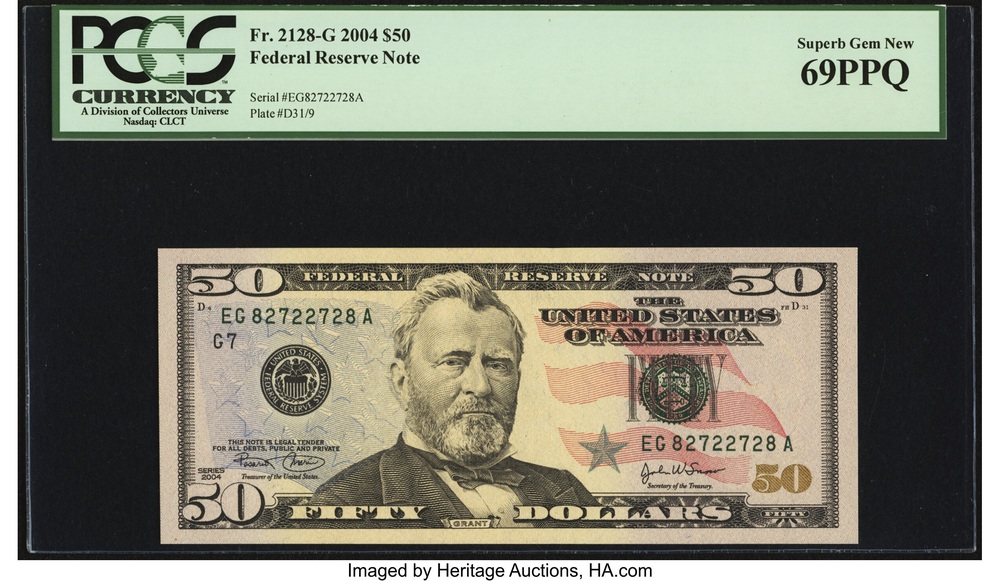
Every bill carries an eight-digit serial number, and collectors sort them into the same handful of categories regardless of denomination. A radar reads the same forward and backward, something like 61455416. A repeater splits into two identical four-digit halves, like 38273827.
What’s different on a fifty is the math behind it. Fewer $50 bills get printed each year than ones, fives, tens, or twenties, so an unusual pattern on a high denomination is mathematically scarcer than the identical pattern on a one, and currency specialists consistently point to higher-denomination notes as the stronger pick when the pattern itself is otherwise equal. Plain radars typically bring $20 to $150, and a super radar, where only the two middle digits differ, can reach $75 to $400 in crisp condition, with repeaters following a similar scale.
Check the eight digits only, ignoring the prefix and suffix letters. Condition matters enormously here, since a folded, well-circulated fifty with a great serial number sells for a fraction of a crisp one pulled straight from a bank strap.
2. $50 bill with a low serial number
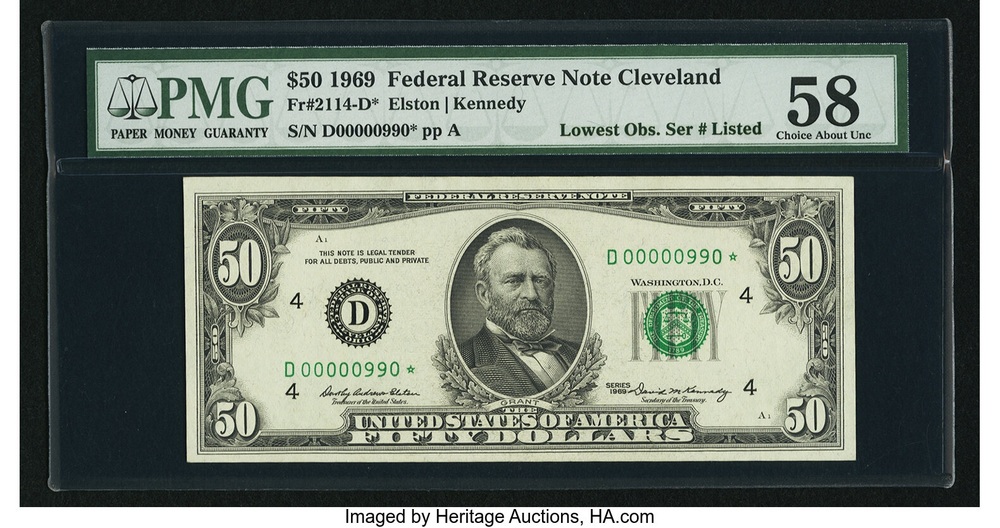
Every new series restarts its serial numbers at 00000001, and the very first notes off a given press run rarely make it into general circulation. Most get pulled aside for bank officials, ceremonial purposes, or collectors before they ever reach a cash drawer.
A handful still slip through. Numbers from 00000010 through roughly 00000099 typically bring $50 to $300, and anything under ten is a genuine trophy that can bring several hundred to several thousand dollars depending on series and condition. On a fifty specifically, the premium tends to sit toward the higher end of these ranges compared with a one or a five, since so few low-numbered fifties were saved relative to smaller bills.
The catch is proving which series and district you have, since a low serial number only matters within its own combination of the two. Pair the serial with the series year printed in small type near the portrait before assuming anything. A worn, common series with an unusually low number still won’t bring much if the series itself was printed in huge volume.
3. $50 bill with a solid, ladder, or binary serial number
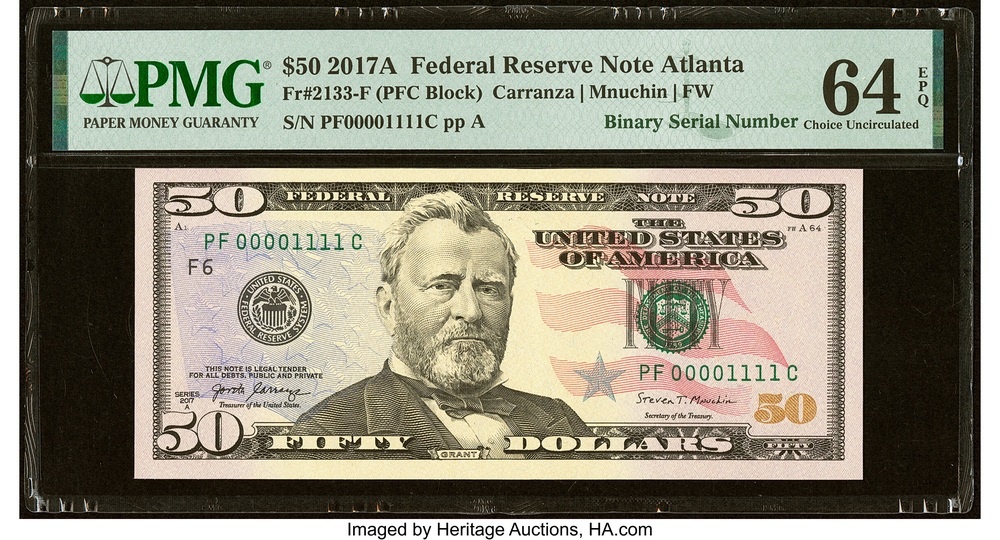
Beyond radars and repeaters, serious serial-number collectors chase a smaller group of rarer patterns. A solid repeats one digit eight times, like 33333333. A ladder runs in strict sequence, either direction, like 23456789. A binary uses only two digits throughout the whole number, in any combination.
Solids are the scarcest of the bunch and bring $1,000 to $4,000 in strong condition, since the odds of a press landing on eight identical digits are vanishingly small regardless of denomination. Binaries are more forgiving to find and typically bring $20 to $75, with true ladders falling somewhere in between depending on how clean the sequence is.
These patterns are easy to overlook at a glance, since a number like 23456789 doesn’t announce itself the way a run of eights does. Read all eight digits slowly before spending an unusual fifty, and remember the pattern has to be exact. A near-ladder with one digit out of sequence is just an ordinary bill, no matter how close it looks.
4. $50 bill with an ink smear or off-center printing error
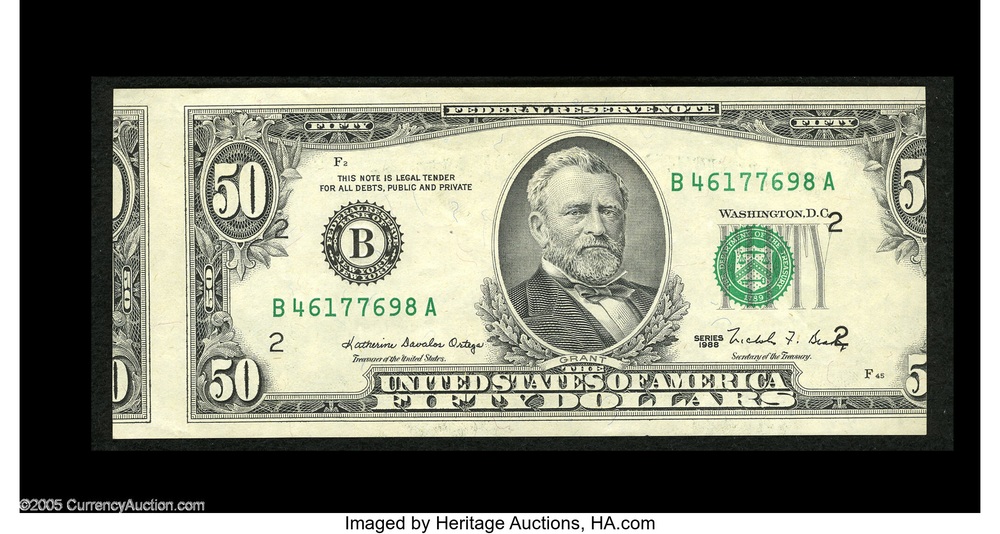
Modern currency is printed with extraordinary consistency, but with billions of notes produced every year, something occasionally goes wrong on the press. The most common results are ink smears, where loose ink transfers onto the paper, and off-center or misaligned overprints, where the seal and serial numbers land noticeably closer to one edge than they should.
Common ink smear and misalignment errors typically trade in the $50 to $300 range on an ordinary note, but dramatic over-inking or a badly shifted overprint on a higher-denomination bill like a fifty tends to command a stronger premium than the identical error on a one or a five, since error collectors weigh face value into what they’re willing to pay.
Genuine errors happen inside the Bureau of Engraving and Printing, not after the bill leaves the building, so anything torn, stained, or altered later is just wear, not an error. Get a promising example certified by a professional grading service before selling it. An authenticated error carries far more weight with serious buyers than an unverified claim, especially at this denomination.
5. $50 star note from a documented low print run
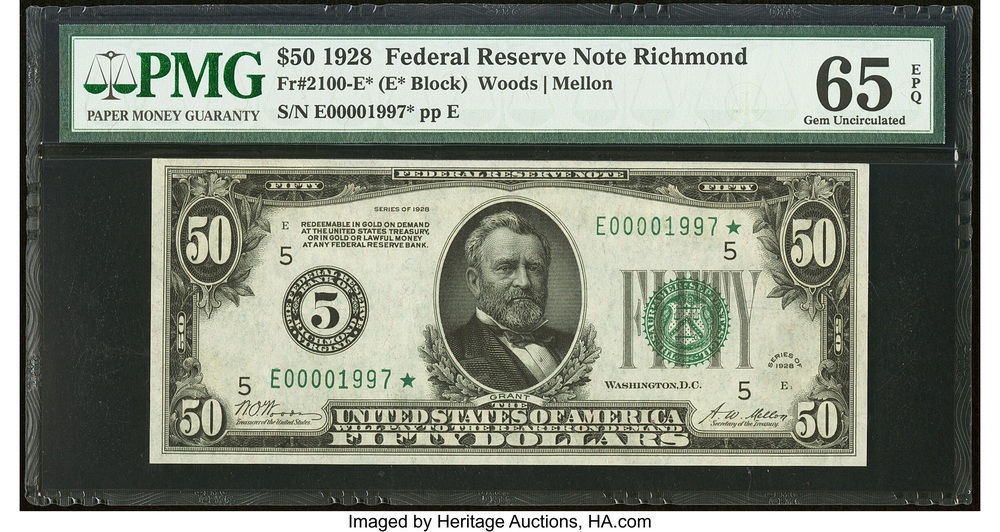
A star at the end of the serial number marks a replacement note, printed when a damaged or misprinted sheet needed to be pulled from the regular run. Replacement notes get their own separate, usually much smaller print run, tracked by series and district.
Fifty-dollar star notes start from a smaller baseline than smaller bills simply because fewer fifties are printed overall, so a documented low run carries real weight here. Pre-1950 Federal Reserve Note stars can bring $50 to $1,500 or more in strong condition, and even a modern star from a genuinely small run can clear a real premium in crisp, uncirculated shape.
The single biggest mistake is assuming any star automatically means value. Look up the specific print run for your series, district letter, and serial block before getting excited, since plenty of stars come from runs in the millions and are worth nothing extra. Condition and print-run size both have to line up before a star note is worth setting aside.
6. 1950E $50 Federal Reserve Note
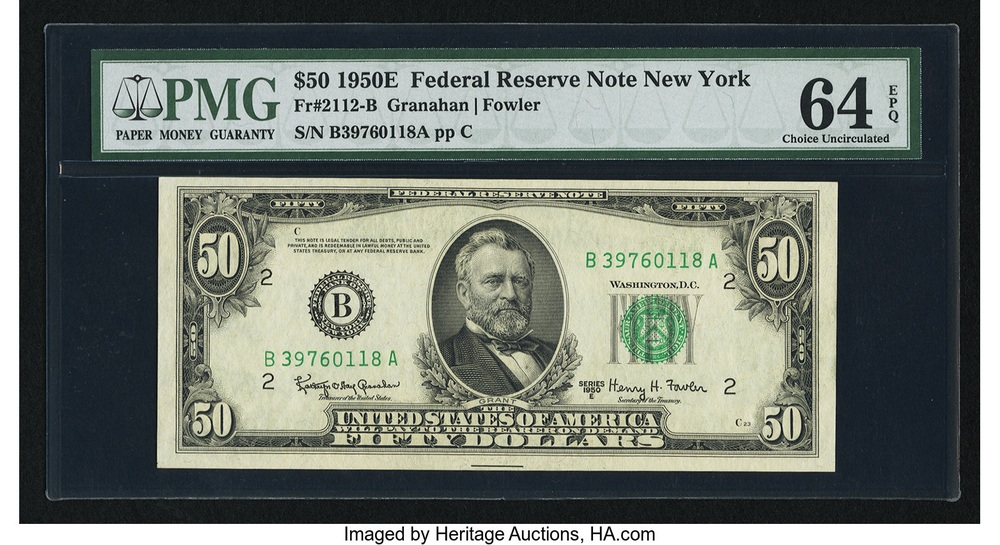
The 1950E series was the last of the “wide” small-size $50 design before the Federal Reserve moved to the modern layout, and it was printed from only three Federal Reserve districts, New York, Chicago, and San Francisco, in notably smaller numbers than the sub-series that came before it.
That limited distribution shows up clearly in the pricing. New York examples typically bring $135 to $300, Chicago notes run $160 to $700, and San Francisco issues land around $135 to $425, with the scarcer Chicago star-replacement version reaching $1,000 to $1,750 and the New York star climbing even higher in top grade.
Check the series designation printed in small type near the portrait, since 1950E looks nearly identical to the far more common 1950 through 1950D notes that preceded it at a casual glance. Only three districts ever issued this sub-series, so confirming both the series letter and the Federal Reserve Bank seal is the only reliable way to tell an ordinary fifty from one worth real money.
7. 1928 $50 Federal Reserve Note
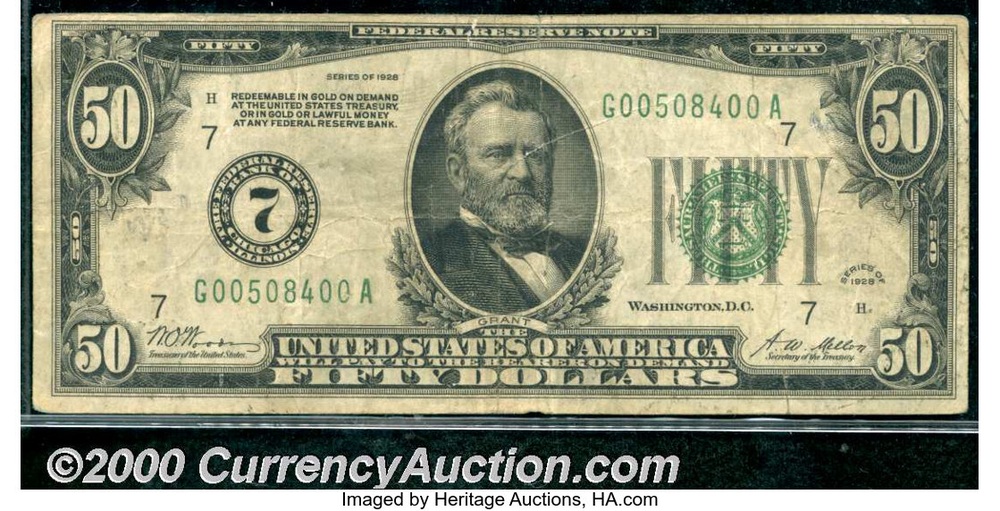
The 1928 series marked the first small-size $50 bills, shrunk down to the size still used today, and it’s the first series to carry the phrase about redemption in gold printed across the top, a holdover from a monetary policy that didn’t survive the 1930s.
Most circulated examples are genuinely affordable for a note this old. Typical circulated notes bring $70 to $600 depending on district and condition, with crisp uncirculated examples reaching $400 to $600 in the more common districts.
Grant’s portrait and the plain green Treasury seal are the quickest way to confirm you have an ordinary Federal Reserve Note rather than the gold-seal certificate from the same era, which looks similar at a glance but carries a different value entirely. Paper this old is often brittle at the folds, so handle it by the edges and store it flat if you plan to keep it rather than sell it.
8. 1928 $50 gold certificate
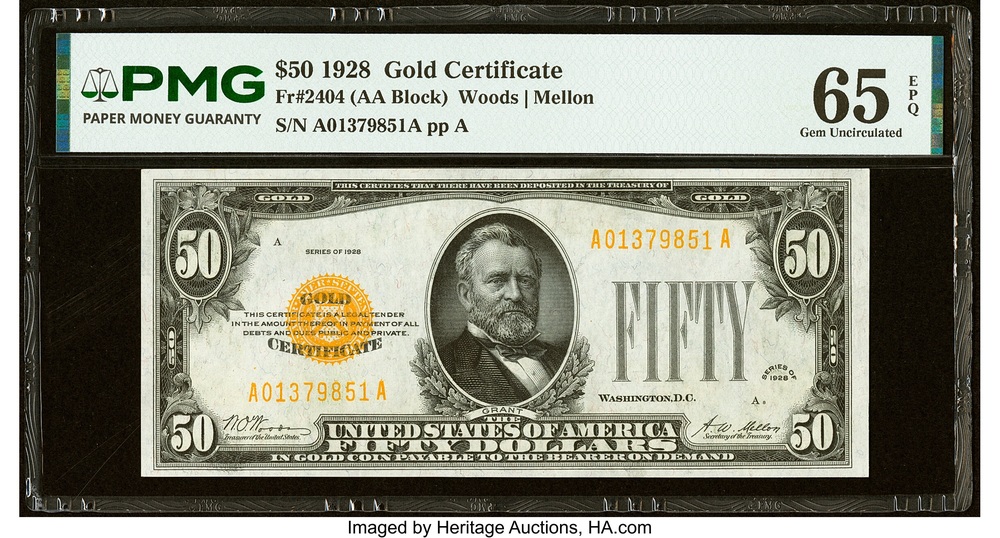
Gold certificates were a different animal entirely: a promise printed on paper that the US Treasury would hand over the bill’s face value in actual gold coin on demand. The 1928 small-size $50 is identified by its bright yellow-gold Treasury seal in place of the familiar green.
Most gold certificates were turned in and destroyed after the government recalled private gold ownership in 1933, part of why even a common series like this one carries a real premium over face value. The full range runs from roughly $185 in worn circulated condition up to $17,000 for an exceptional, high-grade example.
The yellow seal and yellow serial numbers are the fastest way to confirm what you have, since the portrait and layout otherwise look nearly identical to an ordinary Federal Reserve Note. Watch for staining and soft, re-folded corners, both common on notes this age, and don’t confuse an ordinary circulated example with the far scarcer star-replacement version, which commands a dramatically different price on its own.
9. 1929 $50 Federal Reserve Bank Note
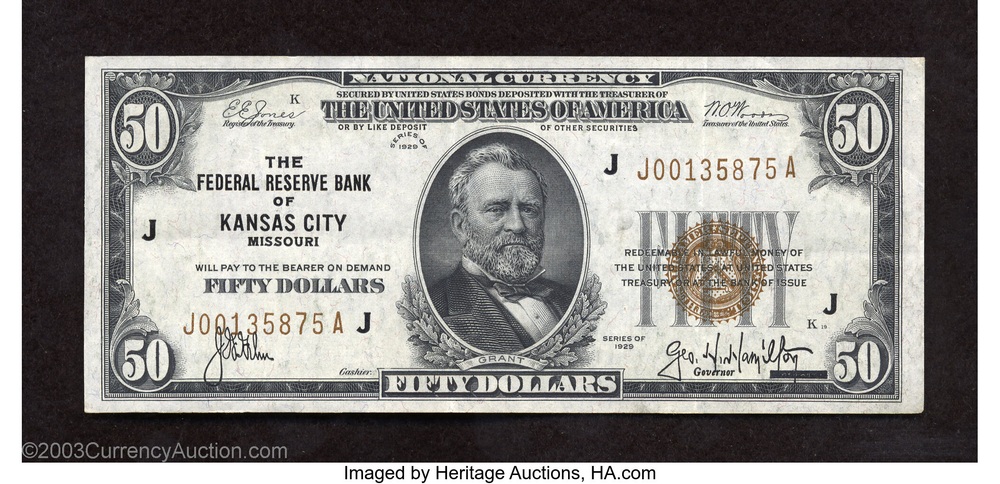
Not to be confused with the ordinary Federal Reserve Note, this is a separate category issued only in 1929 and backed by a single Federal Reserve Bank rather than the system as a whole. It’s identified by its brown seal and serial numbers, a design holdover from the National Bank Notes it was printed alongside.
These notes were an emergency measure, rushed into circulation during the early banking crisis of the Great Depression, and all small-size $50 Federal Reserve Bank Notes were printed in relatively low numbers to begin with. Circulated examples typically bring $160 to $250 depending on condition and district, with higher grades reaching $650 to $850 or more.
Ulysses S. Grant’s portrait and the brown seal are the fastest way to identify one of these. Watch for soft corners and center folds, which are common on a note this old that circulated hard before most examples were pulled from use. A crisp, well-centered example is worth noticeably more than a worn one with the same district letter.
10. Small-size $50 National Bank Note
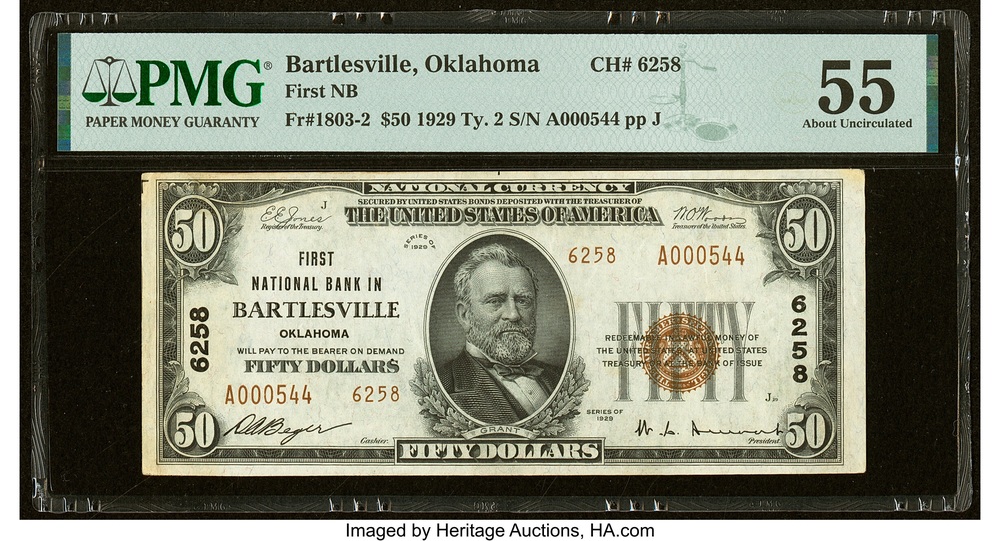
Until 1935, individual banks across the country could issue their own currency, backed by government bonds and overprinted with the local bank’s name. The small-size versions, issued from 1929 until the program ended, look almost like an ordinary Federal Reserve Note at a glance, with the bank’s name and location printed across the top instead of “Federal Reserve Bank.”
Typical examples bring $30 to $800 depending on condition and issuing bank, and specific National Bank issues, particularly those tied to a small-town or now-defunct bank, can be worth considerably more once a collector who specializes in that state or that bank gets involved.
Check the bank name and charter number printed on the face, then look up how many notes that specific bank issued at that denomination before deciding it’s common. High-denomination notes like fifties were requested far less often than fives and tens by most small-town banks, which makes a surviving $50 National genuinely scarcer within its own bank’s output than the same bank’s smaller bills.
11. 1969B $50 Federal Reserve Note
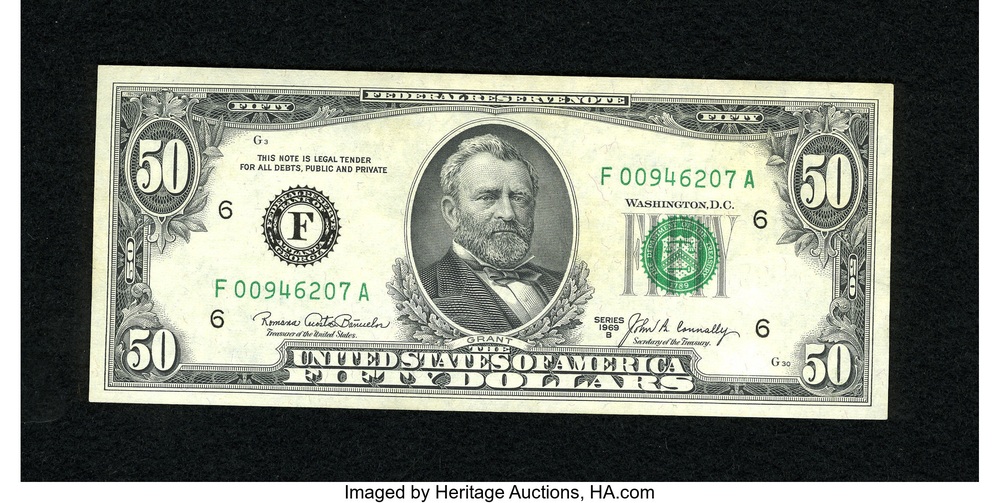
Most late-twentieth-century $50 bills are common enough to be worth exactly face value, but the 1969B sub-series breaks that pattern. It was printed in notably smaller numbers than the series around it, and the gap shows up clearly once you compare the pricing.
Regular 1969B examples typically bring $225 to $900 depending on district and condition, with the scarcest districts reaching toward $2,500 in top grade, and the star-replacement version of the same sub-series commands $1,250 to $2,500 across the board.
The series designation sits in small type near the portrait, easy to miss if you’re not specifically checking for it, since a 1969B fifty looks identical to an ordinary 1969 series bill at a glance. Most people who find one have no idea they’re holding anything other than face value. A careful look at that series letter is the entire difference between an ordinary fifty and one worth real money.
12. $50 bill with an obstructed or foreign-object printing error
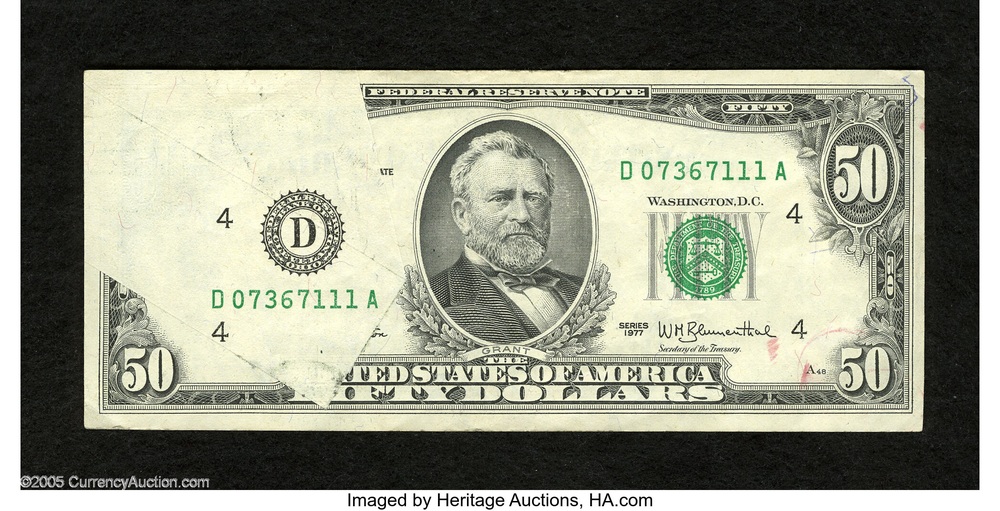
This is the rarest and strangest category of currency error: something physical, a scrap of paper, a sticker, a piece of tape, gets caught between the printing plate and the sheet during one of the three production stages. The object blocks ink from reaching that part of the paper, leaving an unprinted void in its exact shape, sometimes with the object itself still stuck to the note.
These are genuinely uncommon finds, but modest examples do surface and trade in the market. Collectors typically start building this category in the $100 to $500 range for a certified example, and a dramatic obstruction on a high-denomination note like a fifty tends to outperform the same error on a smaller bill, since face value factors into what serious buyers will pay.
Authentication matters enormously here, since the premiums involved have made fabricated obstruction errors a real problem in the hobby. A legitimate example should show genuine ink voids with sharp, consistent edges, not something that looks chemically treated or trimmed after the fact. Submit anything promising to a professional grading service before assuming you’ve found something significant.
13. 1922 $50 gold certificate
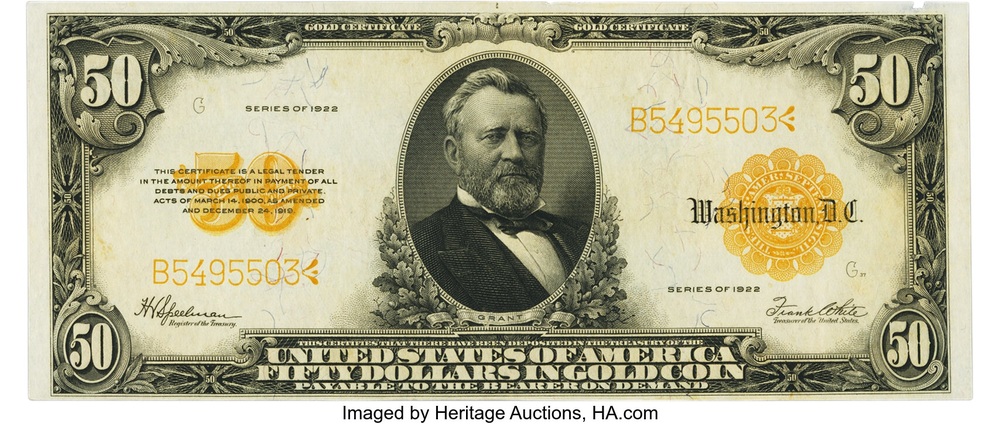
Before small-size notes arrived in 1928, gold certificates came in the larger “horse blanket” format used for all US currency through the 1920s. The 1922 series is the more available of the large-size $50 gold certificates, which makes it the more realistic entry point into the category for anyone without a specialist’s budget.
Even the more available version is still a genuinely scarce note next to an ordinary modern bill, since most large-size gold certificates were destroyed along with their small-size successors. Clean circulated examples typically run $300 to $7,500 depending on condition and specific Friedberg variety, with a scarcer sub-variety reaching considerably higher in top grade.
Look for the gold-colored seal and serial numbers that mark every note in this category, set against the larger physical dimensions common to all large-size currency, nearly an inch bigger in each direction than a modern bill. Fold lines and center wear are common on survivors this old, and a crisp, bright example is worth meaningfully more than a soft, repeatedly handled one.
14. 1928A $50 Federal Reserve Note
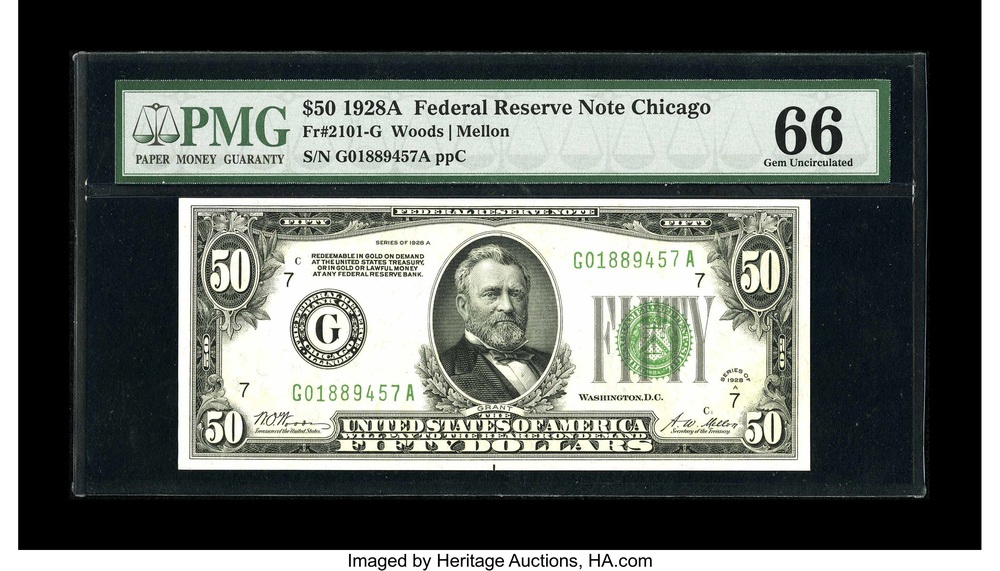
Most 1928-series fifties are affordable, but the lettered sub-series that followed tells a different story. The 1928A designation, marked by a small letter next to the series year, was issued in smaller numbers than the plain 1928 series it replaced, and certain districts within it are considerably scarcer than others.
The full range runs from $60 in heavily worn condition up to $2,450 for a crisp uncirculated example, with a handful of specific district and plate combinations reaching higher still in top grade. That’s a dramatically wider spread than the baseline 1928 series covered earlier on this list.
The letter suffix sits directly after “1928” in the small series designation near the portrait, easy to miss if you’re not specifically checking for it. Most people who find one of these have no idea what they’re holding, since the bill looks identical to an ordinary 1928 fifty at a casual glance. A magnifying glass and a careful look at that one small letter makes the entire difference in value.
15. 1914 large-size $50 Federal Reserve Note
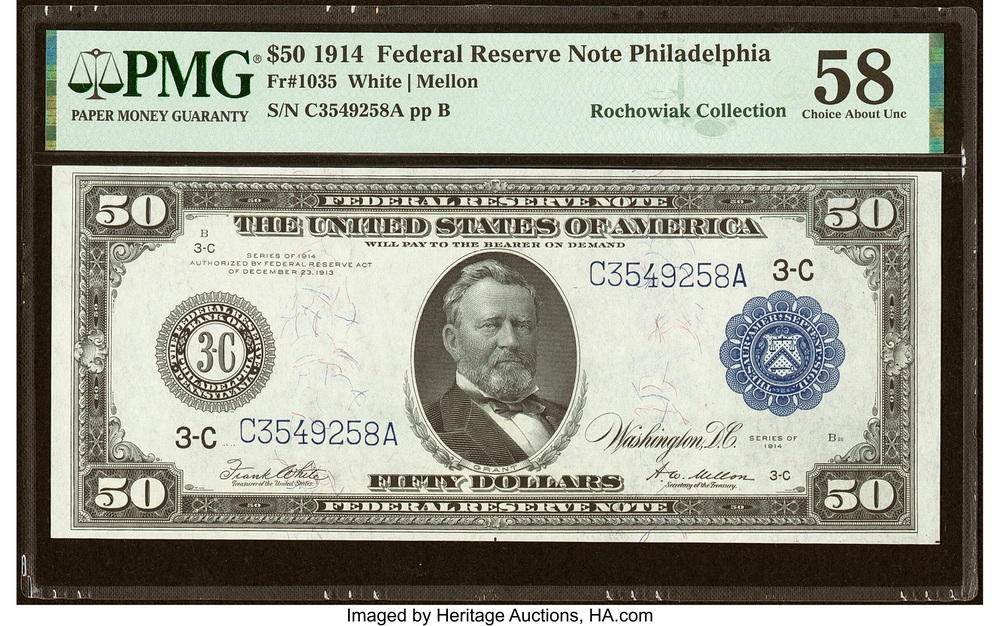
The 1914 series was the first issue of Federal Reserve Notes, created the year after the Federal Reserve itself was established, and it came in two distinct versions. An early red-seal printing, issued in runs as small as 8,000 to 80,000 notes depending on district, was quickly replaced by the far more common blue-seal version that continued for the rest of the large-size era.
The blue-seal 1914 fifty is genuinely findable and typically brings $500 to $900 in very fine condition depending on district and grade, while the red-seal version, scarce enough that surviving examples are tracked individually by specialists district by district, commands a significant multiple of that at every grade level.
The seal color is the fastest way to sort one from the other. These notes also measure noticeably larger than a modern bill, almost an inch bigger in each dimension, which is often the first clue that you’re holding something older than typical pocket change. Grant’s portrait appears here too, decades before it settled permanently onto the small-size fifty.
16. 1928 $50 gold certificate star note
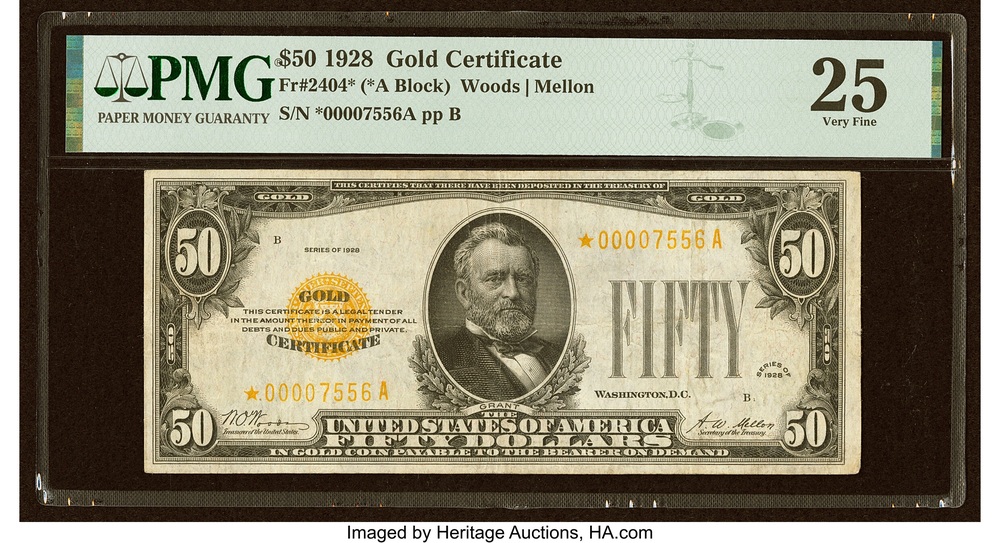
Every category of currency has a replacement-note version, printed when a damaged sheet needed to be pulled and swapped out during production, and gold certificates are no exception. A star at the end of the serial number marks these replacements, and on an already-scarce series like the 1928 $50 gold certificate, that star multiplies the rarity considerably.
Replacement gold certificates were printed in far smaller numbers than their regular counterparts to begin with, since fewer defective sheets needed replacing than complete runs required. The full range for a 1928 star-replacement $50 gold certificate runs from roughly $1,200 in heavily circulated condition up to $170,000 for a pristine, high-grade example, a dramatically wider spread than the plain non-star version covered earlier on this list.
The star sits at the very end of the serial number, easy to overlook next to the far more eye-catching yellow seal that already marks the note as a gold certificate. Anyone sorting through inherited currency should check every gold-seal fifty for that symbol specifically, since the difference between an ordinary 1928 gold certificate and its star-replacement counterpart is a single character that completely changes the value math.
17. 1918 $50 Federal Reserve Bank Note
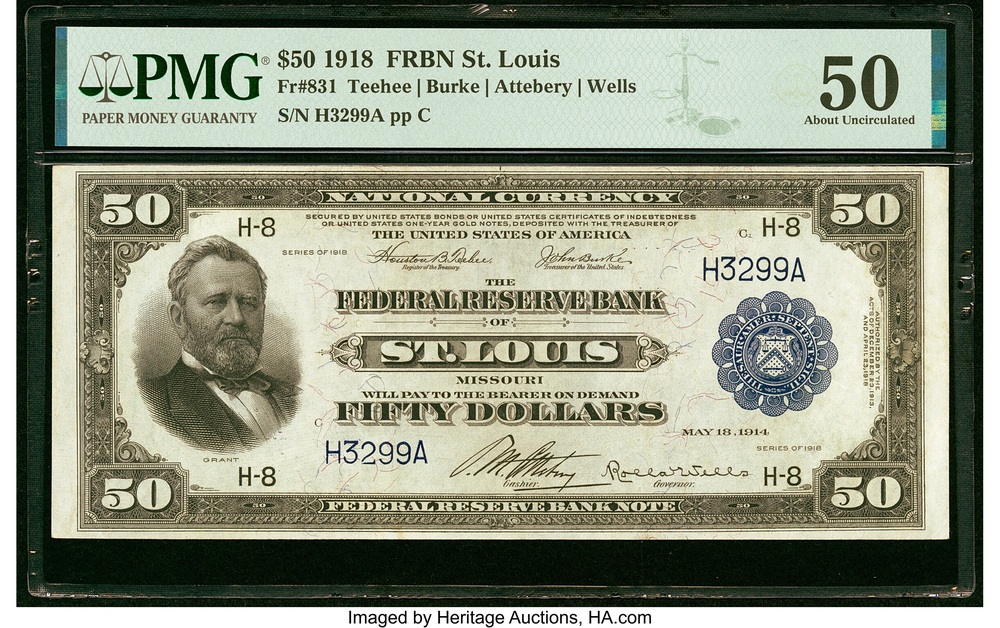
The 1918 $50 Federal Reserve Bank Note is a large-size issue with an unusually narrow origin: St. Louis was the only Federal Reserve district to issue it, and just 4,000 were produced. That makes it a distinct collecting target rather than simply another old fifty with a different district letter.
A surviving example graded PMG About Uncirculated 50 sold for $31,200 at Heritage Auctions on October 10, 2025. That is a documented result for one particular note, not a promise that every example will bring the same amount. Condition, repairs and the quality of the paper all affect what collectors will pay.
Look for the 1918 series date and the St. Louis Federal Reserve Bank wording on the face. It is different from both the 1914 Federal Reserve Note and the smaller 1929 Federal Reserve Bank Note elsewhere on this list. If one turns up in a family collection, professional authentication is a sensible first step before assigning it a value.
18. Large-size $50 National Bank Note
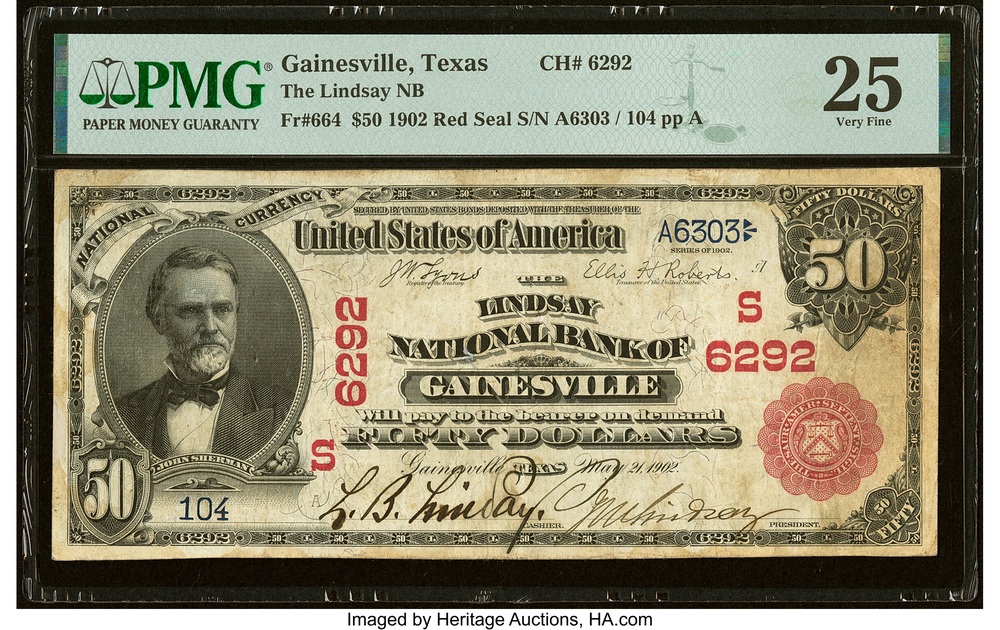
Before the small-size notes of 1929, individual banks issued their own currency in the larger “horse blanket” format, prominently engraved with the bank’s own name. Fifty-dollar denominations within this category are considerably scarcer than the $5 and $10 notes the same banks issued, because the Treasury printed $50 and $100 notes together on shared sheets, and most banks simply never ordered them.
The more available blue-seal 1902 series typically brings $750 to $1,250 in clean circulated condition for a well-known bank. The earlier red-seal version of the same series is dramatically scarcer; specialists estimate only around 100 examples survive across every bank that ever issued one, which pushes value well beyond the blue-seal range for any confirmed example.
Seal color is the fastest way to sort the two apart, with red seals predating blue. As with any National Bank Note, the issuing bank matters as much as the series. A note from a well-documented city bank is a different animal from one tied to a small-town bank that issued only a handful of high-denomination sheets, even when both look similar at a glance.











