
You’re cleaning out a parent’s dresser drawer and find a rubber banded stack of twenties, some crisp, some soft with age, tucked behind old passports and expired coupons. Your first instinct is to count them and move on. Your second instinct, the one worth trusting, is to actually look at what you’re holding before it goes back into circulation.
Most old $20 bills are worth exactly $20. The Bureau of Engraving and Printing turns out more twenties than almost any other denomination, so plain, worn, ordinary ones stay ordinary. But the twenty has a stranger history than people realize. It went through gold certificates, a wartime emergency printing meant to be declared worthless if Japan invaded Hawaii, and decades of small design changes that collectors track down to the letter after the series year. Somewhere in that history is a real chance the bill in your hand is worth ten, fifty, or a thousand times what it says on the corner.
You could genuinely have one of these in a relative’s savings, a coin jar, an estate sale box of old papers, or a bill that’s been sitting folded in a wallet since the Clinton administration. Condition decides almost everything, so treat any candidate gently and skip the temptation to iron it flat or tape a torn corner.
Table of contents
- 1. $20 bill with a solid, ladder, or repeater serial number
- 2. $20 bill with a low serial number
- 3. $20 star note from a small print run
- 4. Series 1969B $20 bill
- 5. Series 1950E $20 bill
- 6. $20 bill with a genuine printing error
- 7. Series 1928 $20 federal reserve note
- 8. 1928 $20 gold certificate
- 9. Large-size 1914 $20 federal reserve note
- 10. Series 1929 $20 federal reserve bank note
- 11. Hawaii overprint $20 bill
1. $20 bill with a solid, ladder, or repeater serial number
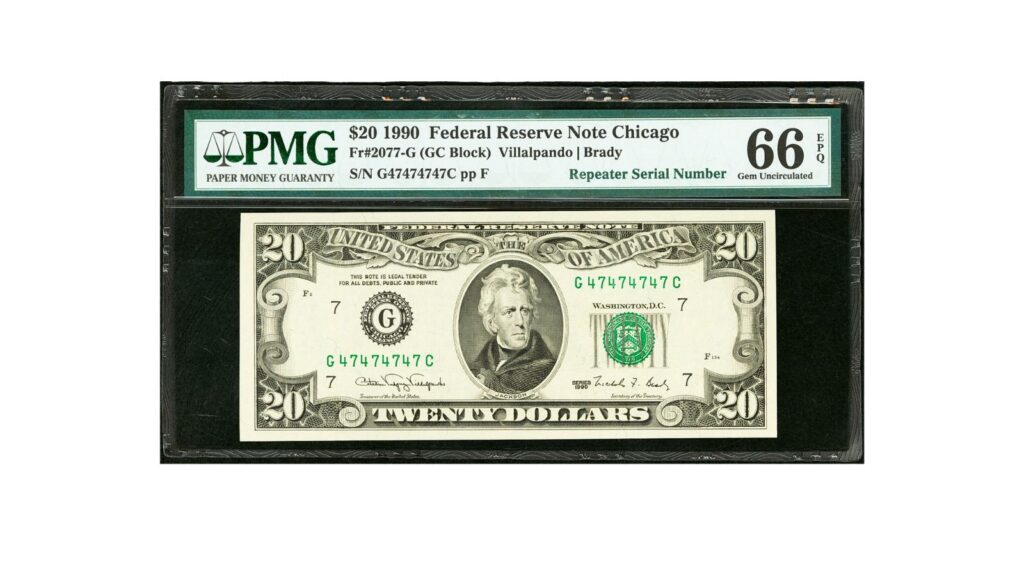
Every $20 bill carries an eight digit serial number printed twice on the front, and most are meaningless strings nobody looks at twice. Occasionally the digits line up into something a collector actually wants: a solid number where every digit matches, something like 33333333, a ladder that climbs or falls in perfect sequence like 23456789, or a repeater where a short block of digits copies itself across the whole string.
These patterns are rare by definition, since only a handful of the roughly one hundred million serial numbers issued per series will ever line up this cleanly. On a $20 bill specifically, solid serial numbers add $200 to $1,500 or more over face value, ladders typically add $100 to $750, and simpler repeater or radar patterns bring a smaller but real premium in the $25 to $100 range. A star note with a fancy serial number on top pushes the price higher still.
Crisp, never folded bills bring multiples of what a worn one does, so if you spot a pattern like this, resist the urge to smooth out the folds or clean it up. Set it aside and get it in front of someone who buys currency for a living before you decide what it’s worth.
2. $20 bill with a low serial number
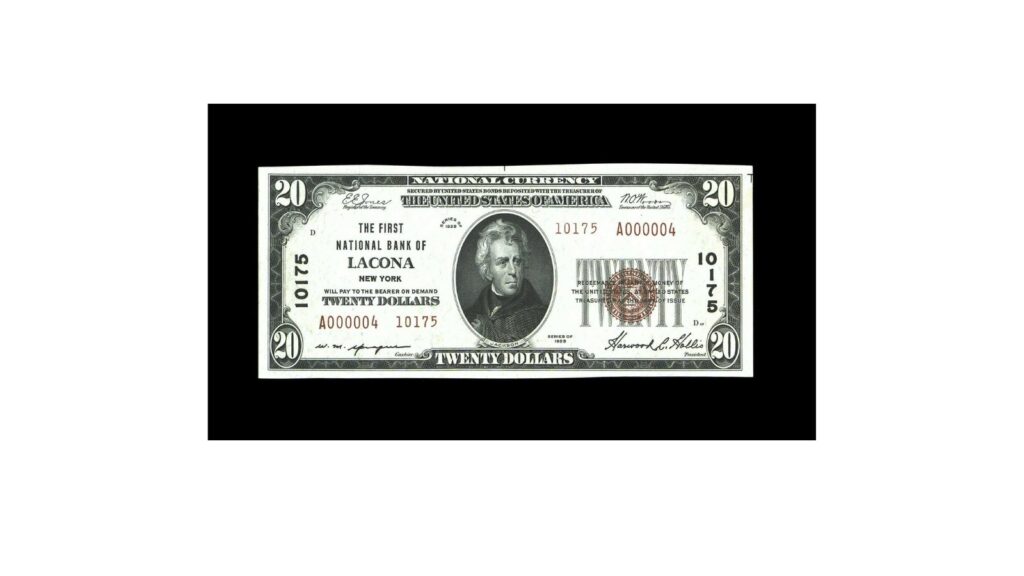
Low serial numbers mark a bill as one of the very first off the press for that particular series and Federal Reserve district, and collectors chase them the way sports fans chase the number one jersey. A serial reading 00000001 through about 00000100 is genuinely uncommon, since most low runs get pulled aside by bank staff or collectors before they ever reach a cash register.
On $20 bills, numbers under 1,000 typically add $100 to $500 or more to the bill’s value, with the very lowest numbers, 00000001 through 00000010, pulling the strongest premiums. Once you’re past the first few thousand, the premium fades fast, and a number in the tens of thousands is essentially back to face value.
Check both printed copies of the serial number on the front, since they should match exactly. Condition still matters here just as much as it does with any other collectible twenty. A worn, heavily circulated bill with a low number is worth a fraction of a crisp uncirculated one with the same digits, so this is one case where it genuinely pays to leave the bill flat and untouched until you know what you have.
3. $20 star note from a small print run
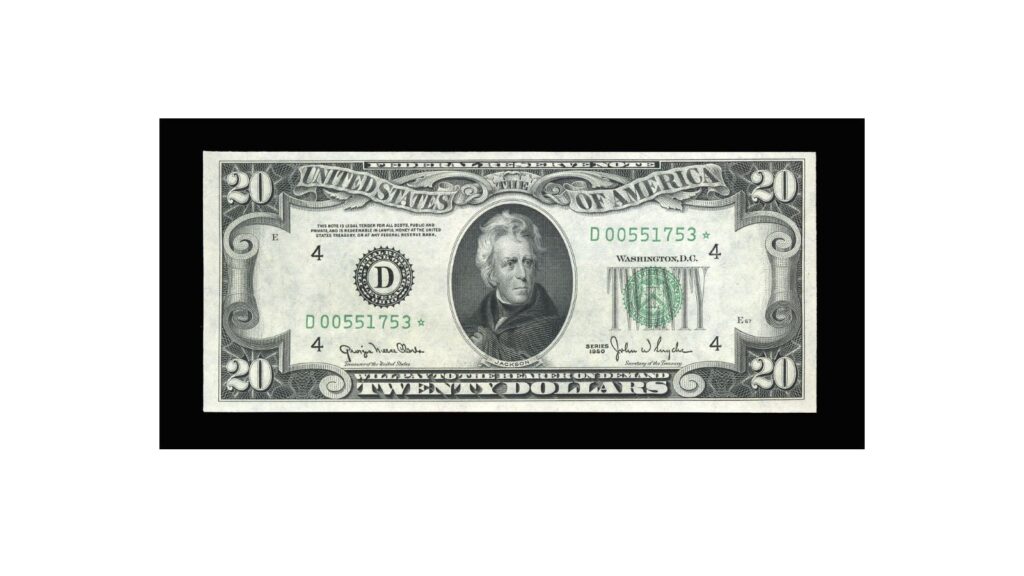
A star printed at the end of the serial number means the bill replaced one that was damaged or misprinted during production, and it’s the single easiest thing to check on any twenty in your wallet right now. Star notes exist for every series back to the 1930s, and they’re always scarcer than the regular run because they only get printed when something needs replacing.
What separates a valuable star note from a common one is the size of its specific print run. Some $20 star note runs from the last two decades total as few as 160,000 notes, compared to standard runs that can top three million. On modern series, that scarcity typically translates to a 5 to 15 percent premium over face value in circulated condition, more if the bill is crisp and uncirculated.
That’s not life changing money for a single note, but it costs nothing to check, and older star notes from the 1950s through 1970s carry meaningfully bigger premiums than modern ones, so the older the star, the more worth digging for.
4. Series 1969B $20 bill
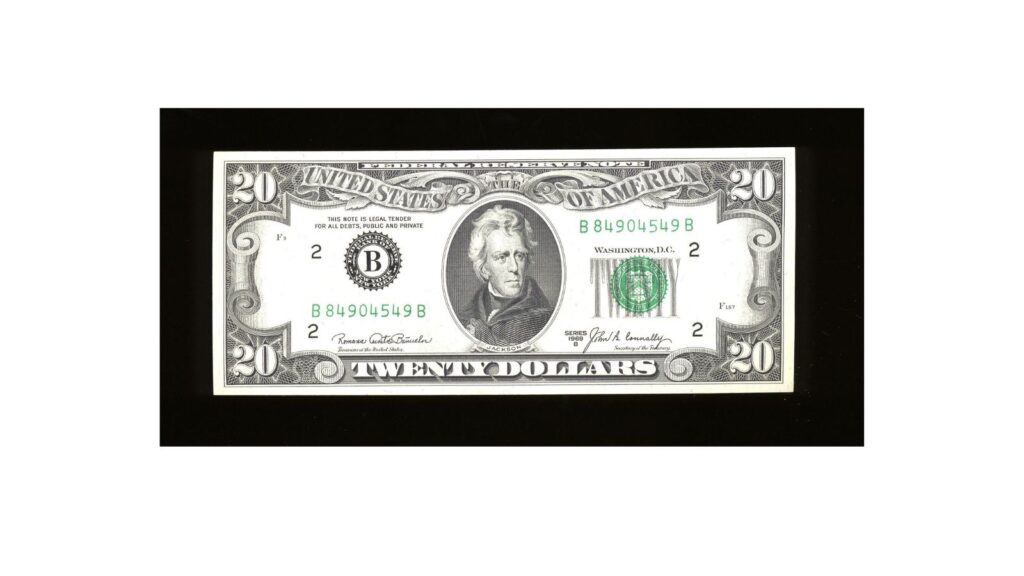
Not every scarce twenty is decades older than its neighbors. The 1969B series sits in an awkward middle ground, recent enough that most people assume it’s just an old bill worth face value, and rare enough that it genuinely isn’t. The Bureau of Engraving and Printing ran a noticeably smaller print for this series than for the 1969, 1969A, and 1969C that surround it.
That smaller run shows up directly in the price. Circulated 1969B twenties typically bring $28 to $35, a real step up from the $20 to $25 you’d get for most bills from the same general era, and uncirculated examples climb to $55 to $85.
The series letter is printed in small type near the bottom right of the portrait, right after the year, so it’s easy to miss if you’re not specifically looking for it. Most people spending a bill from this era never check. A worn, heavily circulated 1969B still commands its premium, just at the lower end of the range, so a bill that’s clearly been through a few wallets isn’t disqualified the way it would be for rarer series.
5. Series 1950E $20 bill
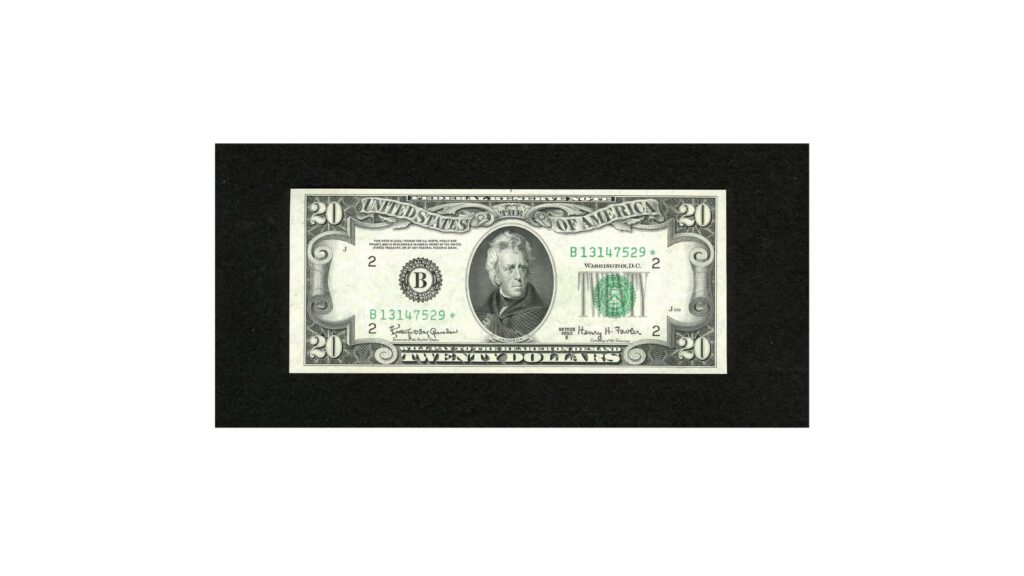
The 1950 series ran through five sub-variants, 1950 through 1950E, before the 1963 redesign that introduced the small head portrait people are used to seeing today. Of the five, 1950E is the scarcest, printed in smaller numbers and correspondingly harder to find now in any condition.
Circulated 1950E twenties bring $28 to $40, compared to $25 to $35 for most of the earlier 1950-series letters, and a crisp uncirculated example can reach $60 to $100. That’s a modest but genuine premium for a bill that looks, at a glance, exactly like every other twenty from the era.
Look for the series designation printed just below the series year, near the bottom right of Andrew Jackson’s portrait. The letter is small and easy to overlook if you’re not specifically checking for it. As with the rest of this era, condition does most of the heavy lifting on price, so a soft, well worn 1950E won’t reach anywhere near the top of its range. It’s easy to overlook precisely because it looks so unremarkable at first glance, which is exactly why it’s worth a second look.
6. $20 bill with a genuine printing error
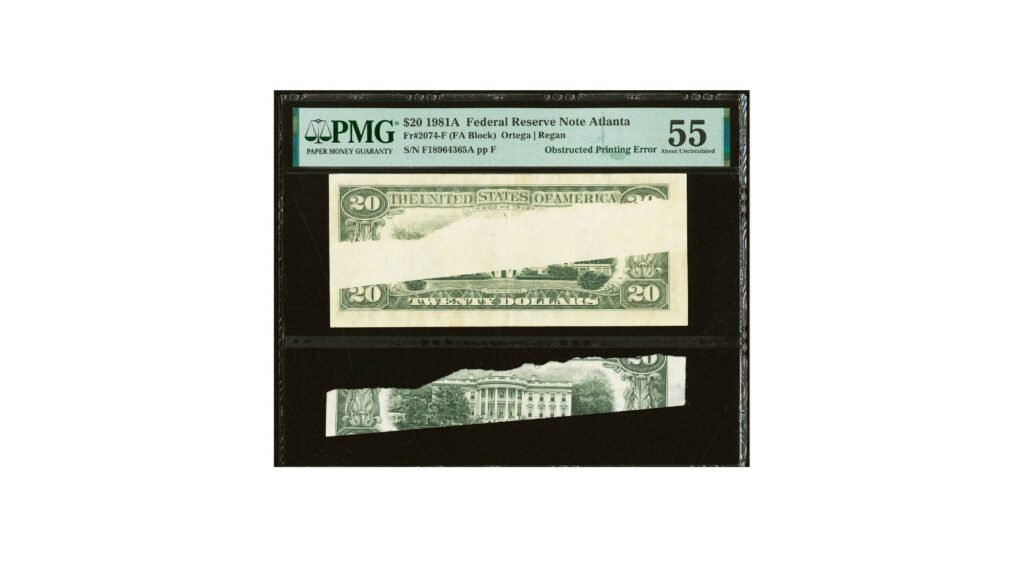
Twenties are the most heavily printed denomination in the country, which sounds like bad news for rarity but is actually good news for error hunters. More volume means more chances for something to go wrong on the press, and $20 error notes do turn up in ordinary circulation more often than people expect.
The most common types are ink smears, where loose ink from the intaglio press transfers onto the paper, off-center printing, where the design sits noticeably closer to one edge than it should, and misaligned overprints, where the seal or serial number lands in the wrong spot relative to the portrait. Minor smears and misalignments typically bring $25 to $60, while dramatic, full-width ink streaks or major misprints can reach $1,500 or more depending on how visually striking the error is.
Genuine errors happen at the Bureau of Engraving and Printing itself, not after the bill leaves the building, so anything that looks damaged, torn, stained, or altered after the fact isn’t an error, it’s just wear. If you think you have a real one, get it professionally graded before you sell it, since an authenticated error carries far more weight with serious buyers than an unverified one.
7. Series 1928 $20 federal reserve note
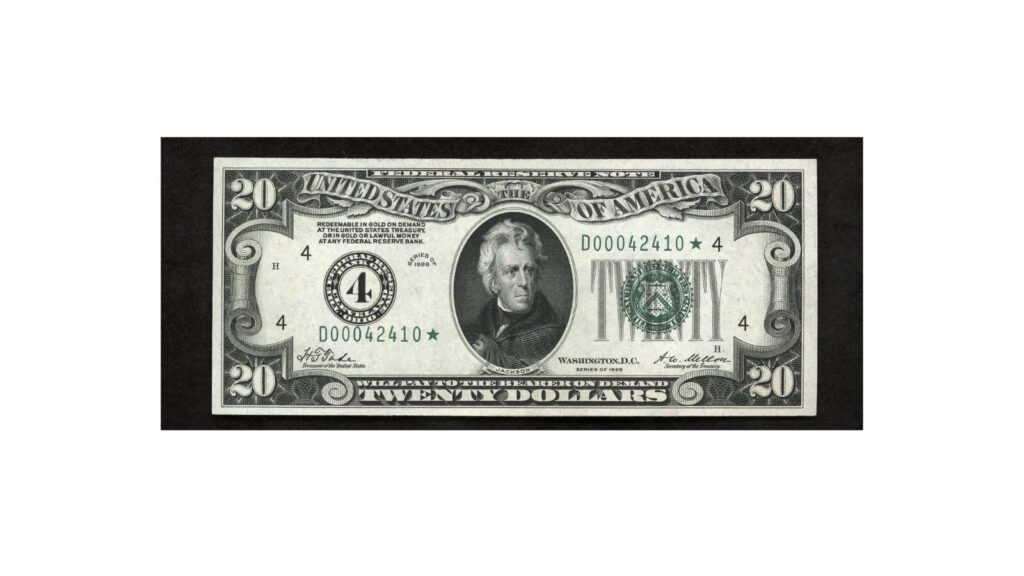
The 1928 series marked the first small-size $20 bills, shrunk down to the size we still use today after decades of larger currency. It’s also the first series to carry the phrase about being redeemable in gold printed across the top, a holdover from a monetary policy that wouldn’t survive the 1930s.
Because it was the first year of the new size and format, the plain 1928 series carries a real premium over the sub-series that followed it. Circulated examples typically bring $40 to $65, and uncirculated notes can reach $125 to $350, noticeably more than the 1928A and 1928B that came after as production ramped up and the notes became more common.
Check the series year in the bottom right of the portrait, and look for a plain green Treasury seal rather than the gold seal used on gold certificates from the same era. Paper this old is often brittle at the folds, so handle it by the edges and store it flat rather than folded if you plan to keep it rather than sell it.
8. 1928 $20 gold certificate
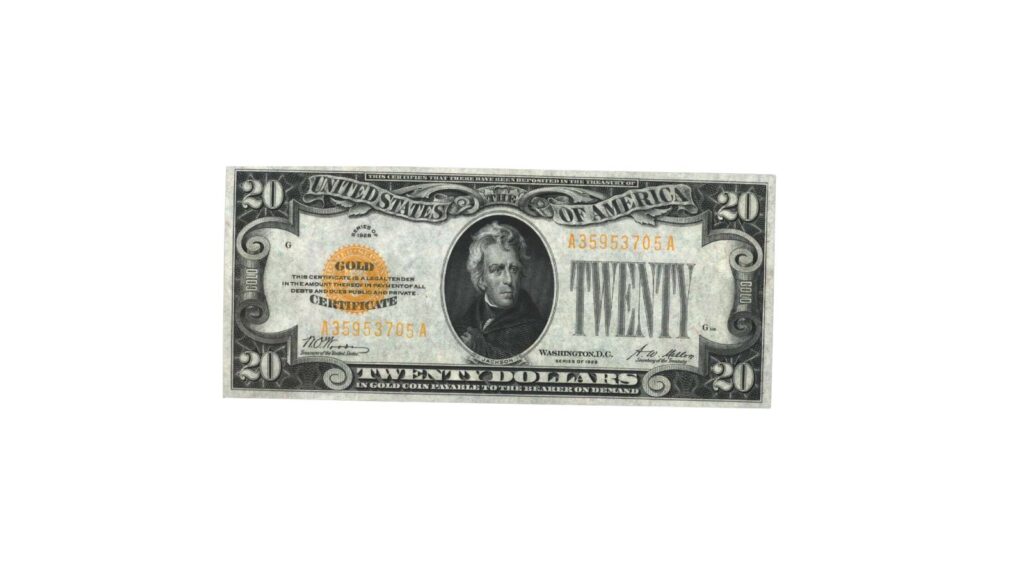
Gold certificates are where old $20 bills start looking genuinely different from the twenty in your wallet now. Instead of the familiar green Treasury seal, these carry a gold colored seal and gold colored serial numbers, and the text across the top reads redeemable in gold coin rather than the standard language.
These notes stopped being legal to privately hold in 1933, when the government recalled gold certificates as part of a broader move off the gold standard, and ownership wasn’t legalized again until 1964. That decades long gap is a big part of why fewer survived than you’d expect from something originally printed in large numbers. Worn, well circulated 1928 $20 gold certificates bring $50 to $150, and uncirculated examples climb to $400 to $800 or more.
These sometimes turn up in family collections from a grandparent who quietly held onto one for decades rather than turning it in during the recall. Check carefully for the gold seal before assuming a green seal bill is a gold certificate. The two are easy to confuse from across a room but obvious once you have it in hand.
9. Large-size 1914 $20 federal reserve note
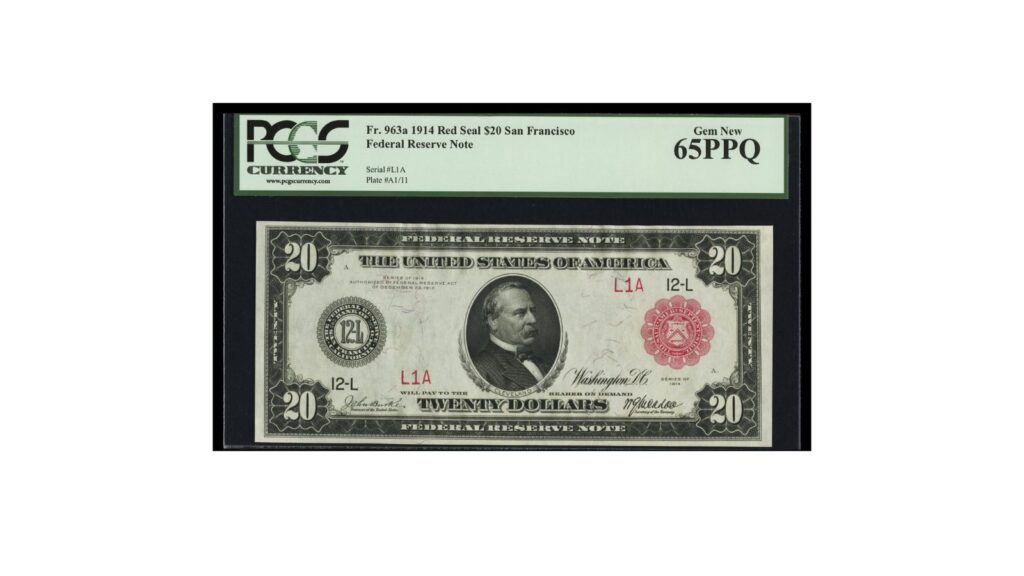
Before 1929, every American bill was noticeably bigger than the currency we use now, roughly 7.4 inches long compared to today’s 6.1, and the difference is obvious the moment you hold one next to a modern twenty. The 1914 series was the first $20 Federal Reserve Note ever issued, printed in two variants: an early red seal version and a more common blue seal that followed shortly after.
The red seal is the one to hope for. Red seal 1914 twenties typically bring $100 to $750 or more depending on condition and which Federal Reserve district issued them, while the more common blue seal brings $75 to $400. Notes from smaller, less active districts like Minneapolis or Dallas tend to sit at the higher end of these ranges.
Large-size notes from this era are over a century old, so brittleness and edge wear are common and expected rather than a red flag. What matters more is whether the paper has been trimmed down at some point to fit a modern wallet or frame, which happens more often than you’d think and meaningfully hurts the value.
10. Series 1929 $20 federal reserve bank note
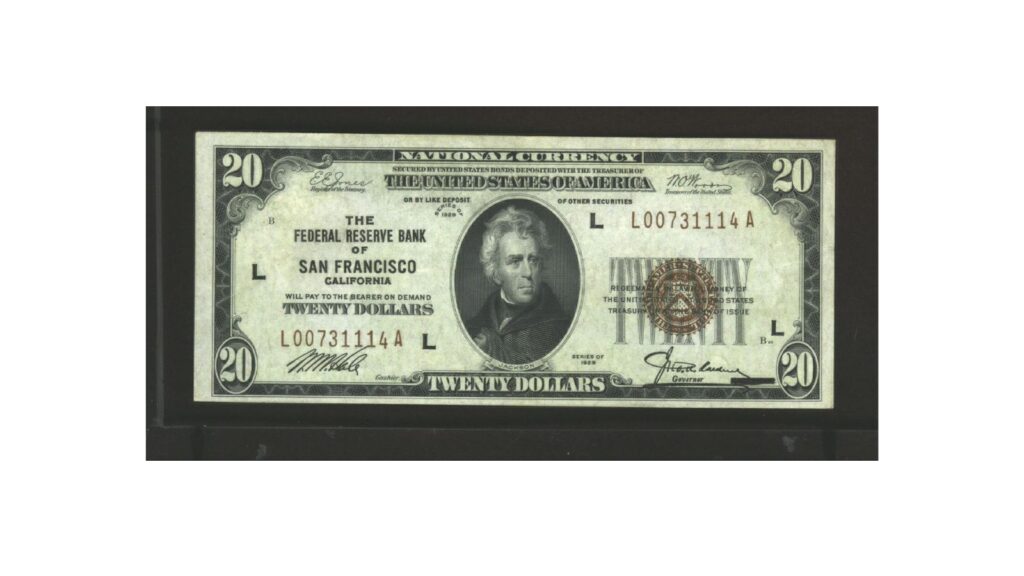
This one gets confused with the more familiar Federal Reserve Note constantly, and the two really are different things. Federal Reserve Bank Notes were an emergency measure from 1933, created by taking existing national bank note printing plates and overprinting them for use by individual Federal Reserve Banks during the depths of the Depression, when the country badly needed more currency in circulation fast.
They’re identifiable by the brown Treasury seal and the specific Federal Reserve Bank named on the face, one of all twelve major banks from Boston to San Francisco. Most standard examples without a star or unusual serial number are common enough that circulated $20 notes bring around $30, with crisp, never folded examples reaching $100 or more. Star note replacements are the real prize here. Only around 300 star notes are known to survive across every denomination of this entire series, making a genuine $20 star from this issue a legitimate rarity.
Look for serial numbers with six or seven leading zeros too, which carry their own smaller premium separate from the star note rarity.
11. Hawaii overprint $20 bill
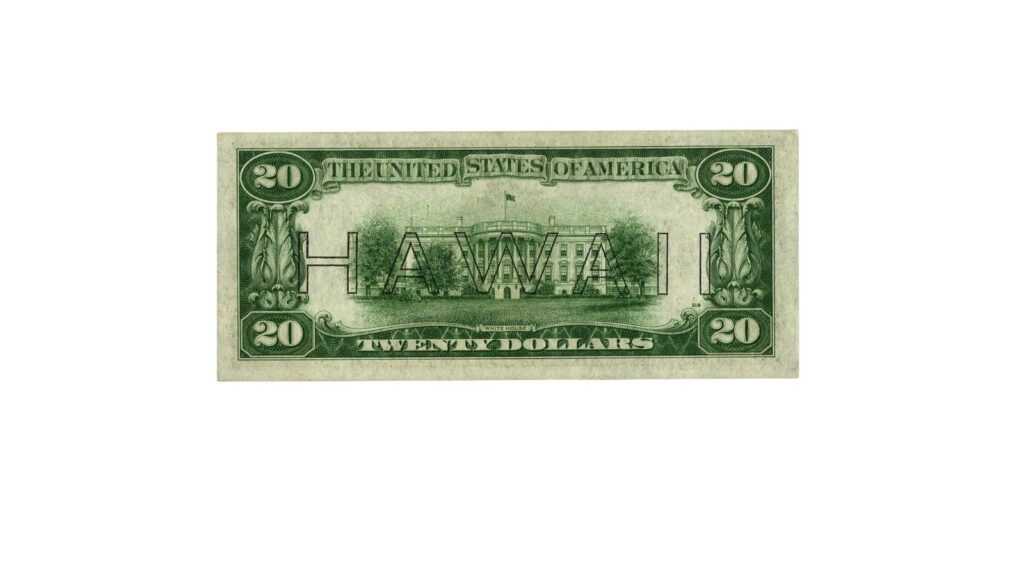
After Pearl Harbor, the government printed a special version of $20 bills specifically for circulation in Hawaii, overprinted with the word HAWAII in bold letters on both sides and stamped with a brown Treasury seal instead of the usual green. The idea was blunt: if Japan invaded and captured the currency, the government could instantly declare any Hawaii marked bill worthless.
The notes were recalled after the war, and what survived has become one of the most recognizable specialty issues in American currency. Circulated 1934A Hawaii twenties bring around $110 in very fine condition, climbing to roughly $230 in extremely fine, and $750 or more for a crisp uncirculated example. Star note replacements from this series are considerably rarer still and can reach well into four figures in top condition.
These do genuinely turn up in family collections, particularly from anyone who served in or passed through Hawaii during the war years. That said, a genuine example is still a real find rather than something to expect in an ordinary stack of inherited cash, so treat it as a pleasant surprise rather than a realistic bet.











