
Three weeks without a paycheck and the refrigerator gets scary very quickly. Whether you’ve been laid off, took a voluntary exit, or are between contracts, the gap between “I’ll figure it out” and “we’re out of groceries” can close faster than anyone wants to admit.
A family of four with a gross income up to $41,795 a year still qualifies for SNAP food benefits in 2026. A pregnant woman or parent of kids under five can qualify for WIC with household income up to nearly $60,000. These programs are built for exactly this kind of gap, and they’re not the only options.
Most people between jobs qualify for several of the resources below at the same time, and most can be set up within the week.
Table of contents
- Apply for SNAP before your last check clears
- Find your nearest food bank
- If you have young kids or are pregnant, apply for WIC
- Call 211 for local food resources
- Apply for free or reduced school meals for your kids
- Get free USDA commodity food through TEFAP
- Look up church and community pantries near you
- Check for a community fridge near you
- Download Too Good To Go for restaurant and bakery surplus
- Use Flashfood for discounted near-expiry groceries
- Switch to ALDI, Lidl, or another deep-discount grocer
- Use Ibotta and other cashback apps to get money back on groceries
- Check Buy Nothing groups and Nextdoor for free food
- Build your meals around the cheapest nutritious staples
- Batch cook and freeze to make every food dollar go further
Apply for SNAP before your last check clears

The Supplemental Nutrition Assistance Program issues benefits back to the date you submitted your application, not the date you were approved. That means the sooner you file, the sooner the clock starts. For a family of three with no income at all, that benefit is up to $785 per month in fiscal year 2026. Even households with some income can qualify if their gross income falls below 130% of the federal poverty level.
The application process varies by state, but many now allow you to apply online. You can find your state’s SNAP office and application link at the USDA’s state directory. If your household has less than $100 in liquid resources and under $150 in monthly gross income, you may qualify for expedited processing and receive an EBT card within seven days of applying.
Work requirements tightened under rules that took effect in 2025 and 2026. If you have kids under 14 at home, you’re exempt from them. If you don’t have dependents, check your state’s specific rules, since many states have active waivers in areas with higher unemployment.
Find your nearest food bank

Feeding America’s network of 200 food banks and 60,000 food pantries serves more than 46 million people a year. They are not exclusively for people in deep poverty. Many food banks operate with no strict income verification, and some require nothing more than showing up.
A food bank is a large distribution warehouse that supplies food to local pantries and community programs. A food pantry is the neighborhood-level location where you actually receive food. When you search your zip code on the Feeding America site, you’ll be connected to the food bank nearest you, which can then direct you to local pantries, along with their hours and any documentation they require.
What you receive varies by pantry, but most distribute shelf-stable items, produce, proteins, and dairy. Some now operate more like grocery stores where you walk the shelves yourself. There’s no limit on how often you can visit, and no obligation to prove a specific level of financial hardship.
If you have young kids or are pregnant, apply for WIC

WIC, the Special Supplemental Nutrition Program for Women, Infants, and Children, covers a specific group: pregnant women, breastfeeding women up to one year postpartum, and children under five. If you fall into any of those categories and your household income is at or below 185% of the federal poverty level, you likely qualify. For a family of four, that’s roughly $59,478 a year.
If your household already receives SNAP, Medicaid, or TANF, you’re automatically income-eligible for WIC, which means the income paperwork is already done. You’ll still need to complete a brief nutritional screening at a WIC clinic, which typically involves height, weight, and a short diet review. The clinic schedules this as part of the enrollment appointment.
WIC provides a specific list of approved foods, not a general grocery allowance. That includes milk, eggs, cheese, whole grains, beans, canned fish, peanut butter, juice, and fresh produce. For families with infants who aren’t breastfeeding, formula is covered. The value of a full WIC package adds up quickly, particularly for households with more than one child under five.
Call 211 for local food resources

211 is a free helpline and searchable database that connects people to food pantries, meal programs, and emergency assistance in their area. You can call it, text it, or search by zip code online. It routes to social services rather than emergency responders, and it’s available in every state.
The value of 211 is that it surfaces resources that aren’t widely advertised online and are hard to find through a standard search. A church food pantry that distributes every Thursday morning, a school district that gives out food boxes on Fridays, a community organization running weekly produce giveaways, those programs are often listed in 211’s database but nowhere else. The database also tends to be more current than most local government websites.
If you’re new to an area or not sure what’s available locally, this is often the fastest single call you can make to map what exists within a few miles of your address. Many people are surprised at how much is operating nearby.
Apply for free or reduced school meals for your kids

For the 2025-2026 school year, a family of four qualifies for free school lunches with an annual income at or below $42,107. Reduced-price meals are available for incomes up to $59,922 a year. The maximum reduced price is 40 cents for lunch and 30 cents for breakfast.
If you just lost your job, you don’t have to wait for the next school year to apply. Schools accept income change notifications mid-year. Contact the school nutrition office directly, explain that your household income has dropped, and your child can be approved within days, backdated to your application date. If your household receives SNAP or TANF, your kids are automatically eligible for free meals and typically don’t need a separate application.
A family with two school-age children eating free lunch and breakfast every school day can save $4,000 or more per year. That’s a number that’s easy to overlook when you’re focused on the immediate grocery bill, but it’s real money.
Get free USDA commodity food through TEFAP
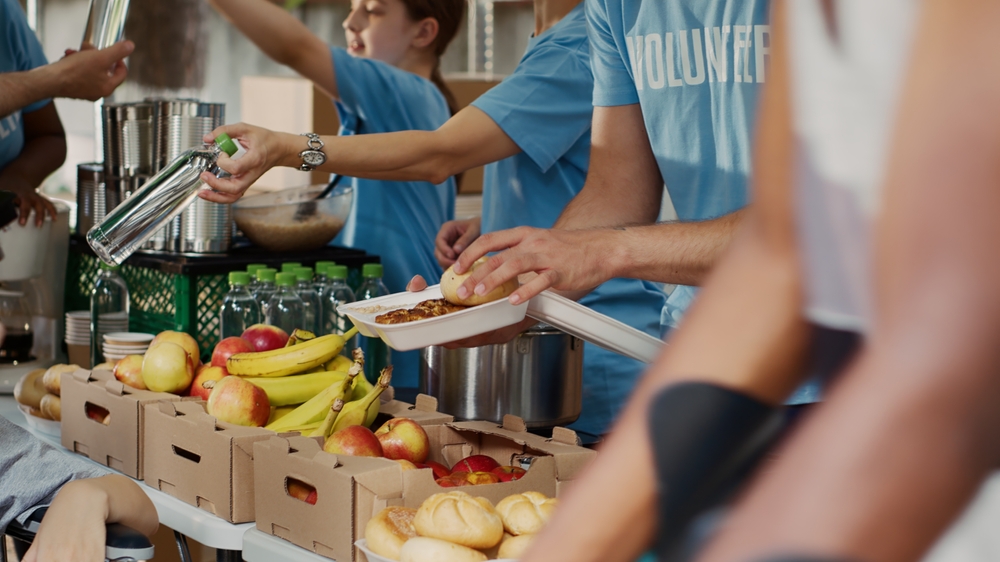
TEFAP, the Emergency Food Assistance Program, is a federal program that distributes free USDA-purchased commodity foods to low-income households through food pantries, soup kitchens, and food banks. The income threshold is set by each state, but it typically falls between 185% and 300% of the federal poverty level, which is considerably more generous than SNAP.
The food itself comes from USDA agricultural purchases and covers more than 130 different products: canned fruits and vegetables, chicken, ground beef, fish, cheese, milk, rice, pasta, flour, cornmeal, and more. The specific items vary by state and by what USDA has purchased seasonally, but the selection is genuinely useful for stocking a pantry rather than just filling a gap.
You access TEFAP food through participating food pantries, not through a separate application process. When you visit a food pantry, ask whether they distribute TEFAP commodities. Many do. And participation in TEFAP doesn’t affect your SNAP benefits, regular pantry food, or any other program you’re enrolled in.
Look up church and community pantries near you
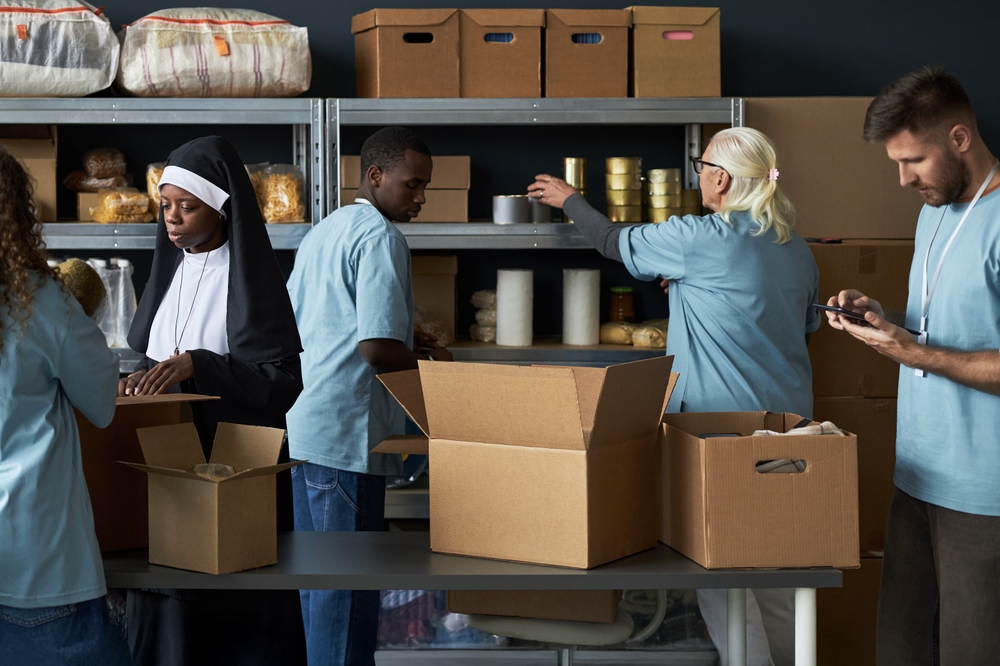
Faith-based food programs are often the most accessible option available, with minimal or no income verification, walk-in access, and distribution that happens multiple times a week. Catholic Charities, United Methodist churches, Southern Baptist networks, synagogues, mosques, and nondenominational community organizations all run food programs across the country. Many are not listed on Feeding America’s site because they operate independently of the national network.
Calling 211 will surface many of these, and you can also search directly for “[your city] food pantry” or “[denomination] food ministry [your city]” to find programs in your neighborhood. Pantry hours tend to be limited and may shift seasonally, so calling ahead is worth the two minutes. Many church pantries also don’t publicize themselves, so direct contact often reveals options that aren’t visible online.
These programs frequently complement what larger food banks distribute. A neighborhood church pantry might hand out fresh produce through a restaurant rescue partnership or prepared meals that a larger food bank doesn’t carry. For people who feel more comfortable in a smaller setting, a local church pantry can be a lower-key alternative to a large distribution center.
Check for a community fridge near you

Community fridges are public refrigerators and pantries stocked with free food, maintained by volunteers, and available to anyone at any hour. There are no income checks, no appointments, no paperwork. You show up and take what you need. FridgeFinder maps community fridges across the United States.
Availability varies significantly by city. Dense urban areas often have many; rural and suburban areas may have none. What’s stocked changes daily, since community fridges are filled by donations from individuals, restaurants, and grocery stores. Fresh produce, dairy, bread, and prepared meals are common. Some fridges are also paired with a dry goods pantry stocked with shelf-stable items.
Community fridges operate entirely outside the traditional food assistance system. For people in between jobs who need food today but haven’t yet applied for programs or don’t qualify for existing ones, they may be the most immediate option on this list.
Download Too Good To Go for restaurant and bakery surplus
Too Good To Go is a food marketplace app that lets you buy “surprise bags” of unsold food from restaurants, bakeries, cafes, and grocery stores at roughly one-third of the original price. A typical bag costs $3 to $6 and contains $9 to $18 worth of food. You reserve it in the app and pick it up during a designated window, usually toward the end of the business day when surplus is being cleared.
The app has more than 15 million users in the United States and partners with Whole Foods Market, Circle K, Peet’s Coffee, Eataly, and thousands of independent bakeries and restaurants. Use increased 67% in the first seven months of 2025, and the company was actively expanding to every major U.S. city by year-end. Coverage is strongest in urban and suburban areas where restaurant density makes the inventory more consistent.
The “surprise” element is real. You won’t know exactly what you’re getting, and results vary. A bakery bag might yield a dozen croissants and a loaf of sourdough. A restaurant bag might include several prepared dinners. Some days it’s exactly what you needed; some days it’s random. But at $4 or $5 for what amounts to two restaurant meals worth of food, the math holds even when the luck doesn’t.
Use Flashfood for discounted near-expiry groceries
Flashfood is a grocery deals app that works differently from Too Good To Go. Instead of mystery bags from restaurants, Flashfood shows specific items listed by your local grocery store that are nearing their best-by date, discounted by up to 50%. You see exactly what you’re buying, purchase it in the app, and pick it up from a dedicated section of the store, often a cooler near the entrance.
The categories that regularly appear on Flashfood are the ones that matter most when money is tight: beef, pork, chicken, dairy, produce, eggs, and baked goods. The app operates in more than 2,000 stores across the United States, including Meijer, Kroger, and Giant. At some participating stores, SNAP EBT is accepted as a payment method. The app is free to download and use.
Unlike Too Good To Go, Flashfood functions more like a planned shopping trip. You can browse available items a few days ahead and plan meals around what appears. The top categories in the app are beef and produce, and the discounts are real: a Flashfood user profiled in the press described saving $200 a month on groceries using the app regularly, which totals $2,400 a year.
Switch to ALDI, Lidl, or another deep-discount grocer

ALDI and Lidl are both German-owned discount chains built on a private-label model: nearly everything they sell is their own brand, which eliminates the marketing and packaging overhead that drives up prices at conventional supermarkets. Prices run 30 to 40 percent lower than major chains on a full cart of groceries. If you’ve been shopping at a regular supermarket and haven’t tried either chain, the first visit is usually a genuine surprise.
The trade-offs are real and worth knowing. You won’t find 12 varieties of pasta sauce. ALDI and Lidl carry a limited, carefully curated selection, and you’ll need to bring your own bags. Neither chain participates in loyalty card programs or coupon campaigns, which is actually a feature when you’re already shopping at the lowest possible prices. Both chains also run rotating “specialty” sections with unrelated merchandise, which some people love and some ignore entirely.
If you don’t have a discount grocer nearby, store brands at your regular chain are the next-best option. Major grocery chains now carry private-label products across virtually every category. In blind taste tests, store brands frequently match name brands. The savings on a full cart can run $40 to $80 a week compared with buying all name brands, which over a month between jobs adds up to real money.
Use Ibotta and other cashback apps to get money back on groceries
Ibotta is a free cashback app that works at more than 2,000 retailers, including Walmart, Kroger, Target, and most major grocery chains. You browse offers in the app before you shop, add the ones that match what you’re buying, make your purchase as normal, and then submit a photo of your receipt or link your store loyalty card for automatic redemption. Once your balance hits $20, you can cash out to PayPal, Venmo, or your bank account.
The typical savings for a regular grocery shopper run $15 to $30 per month. Heavy users who shop at multiple supported chains and are willing to switch brands to match available offers can push that to $60 per month. Individual offers range from $0.25 to $5.00, with occasional bonuses that push higher. If you shop at Walmart, you can link your Walmart account and skip receipt scanning entirely, since purchases match automatically against available offers.
Fetch Rewards is worth running alongside Ibotta. It works differently: you earn points just by scanning any receipt from any store, with no offers to activate in advance. The rewards are smaller, but the effort is lower. Running both consistently can recoup $20 to $40 a month, and the friction is genuinely minimal once you’ve set up the accounts.
Check Buy Nothing groups and Nextdoor for free food

Buy Nothing groups are hyper-local gift economies organized by neighborhood, where members give and receive freely without money changing hands. They operate through Facebook groups and the Buy Nothing app. On any given day, members post excess produce from their garden, pantry items they’re clearing out, home-cooked meals, and baked goods. Posting a specific Ask, such as “looking for pantry staples” or “does anyone have eggs to spare,” often gets responses within hours.
To find your local group, search “Buy Nothing [your neighborhood or city name]” on Facebook, or download the Buy Nothing app and browse the directory by address. There are more than 8,500 registered communities worldwide, and most populated areas in the U.S. have at least one active group. The only expectation is that you give something yourself when you eventually can. There’s no income verification, no application, and no minimum need threshold.
Nextdoor, the neighborhood social platform, is also worth checking regularly. Neighbors routinely post surplus garden harvests, bulk order overages, and food they won’t use before a trip. It’s less organized than Buy Nothing but reaches a broader geographic area. Both platforms work best when you’re specific about what you’re looking for, and both are effective precisely because the ask is going to your actual neighbors rather than a general audience.
Build your meals around the cheapest nutritious staples

Eggs are the most cost-efficient protein most people have access to: $3 to $5 for a dozen, each one containing 6 grams of protein along with vitamins B12, D, and B2. Dried lentils and dried beans run under $2 per pound and yield multiple full meals per pound when cooked. A large container of oats feeds a family of four for breakfast the better part of a week for around $4. Canned tuna and sardines provide high-quality protein and omega-3 fats for $1 to $2 per can.
The key is knowing a small number of recipes well enough to cook them fast and vary them. Lentils become soup, tacos, or curry with the same base and different spices. Beans become bowls, burritos, or soup. Eggs become scrambled, frittata, fried rice, or shakshuka depending on what else is in the kitchen. Rotating through five or six dishes built on these foundations makes cheap eating feel considerably less like a punishment.
Frozen vegetables are worth a separate mention. Frozen produce is often more nutritious than fresh produce that has spent days in transit, and it costs a fraction of fresh at the store. A bag of frozen spinach, broccoli, or mixed vegetables fills out meals built on the staples above without adding much to the cost. A genuinely balanced diet on a near-zero grocery budget is achievable; it just requires planning around these foundations.
Batch cook and freeze to make every food dollar go further
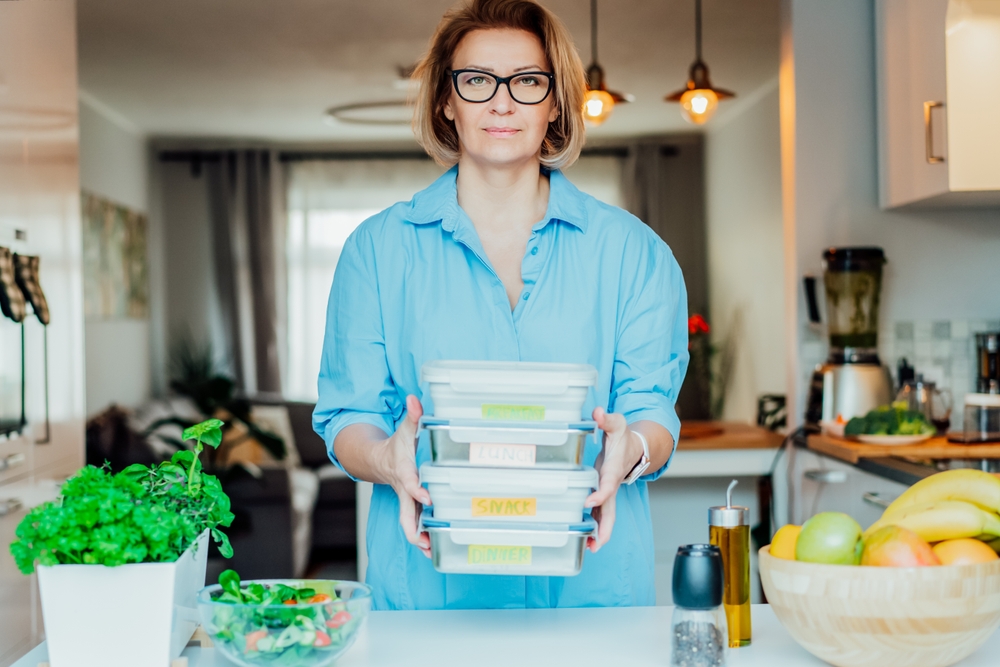
When you’re between jobs, time is one thing you have more of. Using it to cook in volume, when ingredients are on hand, reduces food waste and builds a buffer that makes it much easier to eat well over the coming weeks. A pot of lentil soup that costs $4 to make yields eight to ten servings. A batch of cooked black beans that costs $2 to produce yields six cups. Frozen properly, both last up to three months.
The logistics are simple: cook larger amounts than you need for one meal, portion the rest into freezer bags or containers, label them with the date, and freeze. Soups, stews, chilis, cooked grains, and beans all freeze well. Bread does too, sliced before freezing so you can pull individual pieces as needed. When the pantry looks thin later in the week, you have a buffer you built when you had the ingredients.
Batch cooking also removes the moment that breaks a lot of tight-budget eating plans: the evening when you’re tired from a day of job searching and there’s nothing ready in the house. That moment pulls strongly toward takeout or delivery, which at current prices can cost $20 to $40 for a single meal. Having something already made and waiting in the freezer removes that decision entirely.
Tips and advice for saving money on food and grocery tips on Wealthy Single Mommy:

18 simple tricks to eating well on a shoestring budget: Enjoy healthy, delicious meals without spending much with these surprising tips.
15 sneaky tricks grocery stores use to make you spend more: In this post, learn about surprising ways grocery stores profit so you can avoid them and stick to your budget.
Dozens of ways to get free groceries, food, and meals: If you’re struggling to feed your family, dive into this guide to help you find free food in your local community.











