
Your Social Security statement lands in your inbox around your birthday every year, and most people in their 40s delete it without opening it. Retirement still feels far enough away that the numbers on that page don’t feel like they belong to you yet.
Here’s the part that does belong to you right now. The average Social Security retirement benefit in 2026 is $2,071 a month. That’s what most retirees actually live on, on top of whatever else they’ve saved. Social Security was never built to replace a full paycheck, and the choices you make in your 40s decide how close that monthly number gets to something you can actually live on.
None of those choices require a financial advisor or a spreadsheet. The first one takes about ten minutes and starts with actually opening that email.
Table of contents
- Open your Social Security statement and check every year of earnings
- Your raises this decade can replace your worst-paid years
- Know your real full retirement age before you assume it’s 65
- If you work in the public sector, the rules changed in your favor
- A marriage near the ten-year mark is worth thinking through before you finalize a divorce
- Gig work and side income only count if Social Security tax actually gets paid on it
- Get your real number, then build the rest of retirement around it
Open your Social Security statement and check every year of earnings
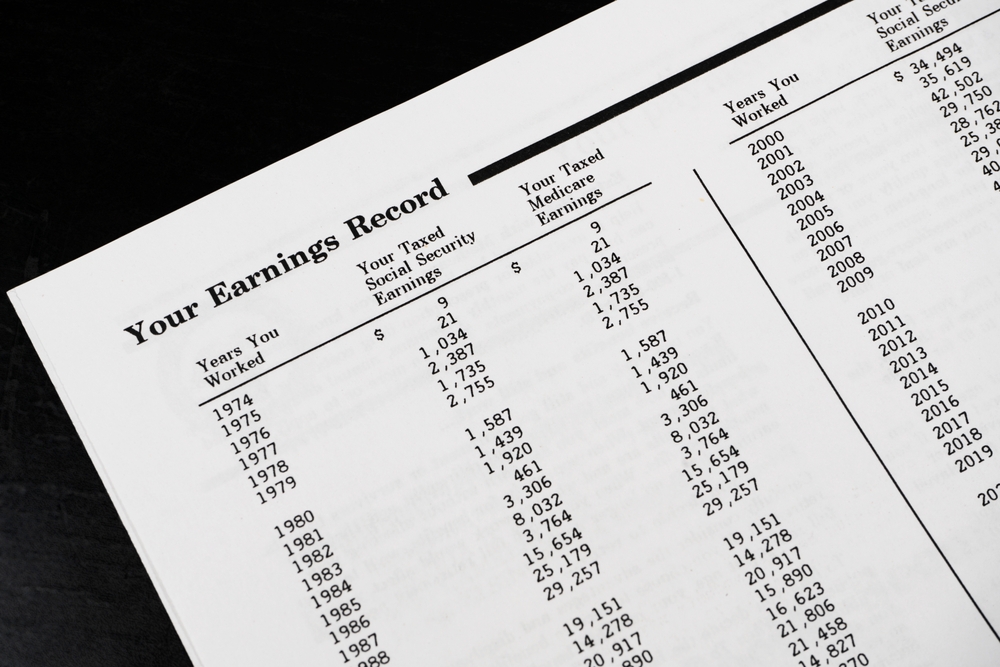
Your Social Security benefit isn’t calculated off a hunch. It’s built entirely from your actual earnings record, the exact wages your employers reported to the Social Security Administration for every year you worked. If one of those years got recorded wrong, a job that never reported wages, a typo in your Social Security number, a maiden name that never got updated after you married, it can quietly shrink your future check and you’d have no way of knowing unless you looked.
This is the decade to look. Create or log into your personal my Social Security account and pull up your full earnings history, not just the summary page. Compare it against old W-2s or tax returns if you still have them, especially from jobs you held in your 20s or 30s. Errors get harder to fix the further back they go, because pay records and old employers eventually disappear. Fixing a wrong number now is a phone call. Fixing it at 68 can mean tracking down a company that closed years ago.
Your raises this decade can replace your worst-paid years

Social Security doesn’t average your whole career. It takes your highest-earning 35 years of wage-indexed earnings and bases your benefit on that number alone. If you have fewer than 35 years in the system, every missing year counts as a zero in the average, which drags the number down hard. If you already have 35 years logged, a low-earning year from your 20s, the one where you were waitressing through grad school or home with a newborn on unpaid leave, gets replaced automatically the moment a higher-earning year comes along.
Your 40s tend to be peak earning years for a lot of people. A promotion, a job change, or steady freelance income now isn’t just extra cash today. It’s actively rewriting the average your future benefit gets calculated from, pushing out old low years one at a time. That makes this decade worth more to your eventual Social Security check than most people realize while they’re living it.
Know your real full retirement age before you assume it’s 65
If you were born in 1960 or later, your full retirement age is 67, not 65 and not 66. That single number decides how much you lose by claiming early or gain by waiting, and the difference is steeper than most people expect. Claim at 62 and your benefit is permanently reduced for the rest of your life. Wait until 70 and it’s permanently increased, with no ceiling reset once you hit full retirement age.
The dollar difference is real at every income level, not just for high earners. In 2026, the maximum possible benefit is $2,969 a month if you claim at 62, versus $5,181 a month if you wait until 70, for someone who earned the taxable maximum every working year. Most people won’t hit those exact numbers, but the same percentage swing applies to whatever your own benefit turns out to be. Claiming at 62 instead of 70 can cut your monthly check by close to half. That’s not a decision to make the week you turn 62. It’s one to start modeling now, while you still have decades to plan around it.
If you work in the public sector, the rules changed in your favor
For decades, teachers, police officers, firefighters, and other public employees with a pension from a job that didn’t withhold Social Security tax had their own Social Security benefit cut, and sometimes their spousal or survivor benefit wiped out completely. Those two rules, the Windfall Elimination Provision and the Government Pension Offset, are gone. The Social Security Fairness Act repealed both provisions in January 2025, and the change is permanent under current law.
If you’re in your 40s and currently working, or considering, a public-sector job with a pension that doesn’t pay into Social Security, this matters for how you plan. Any Social Security you’ve earned or will earn from other jobs, teaching summer school, a spouse’s private-sector career, work before or after your public service years, now gets paid in full. It’s no longer reduced because you also collect a government pension. That changes whether a public-sector career move still makes financial sense the way it might not have a few years ago.
A marriage near the ten-year mark is worth thinking through before you finalize a divorce

Social Security has a rule most people don’t find out about until it’s too late to use it. If you were married at least 10 years before a divorce becomes final, you may be able to claim a benefit based on your ex-spouse’s earnings record later in life, even if you never remarry them and even years after the split. Come in under 10 years, and that option disappears entirely.
This isn’t a reason to stay in a marriage that isn’t working. But if you’re in your 40s and separated, or heading toward divorce, and the marriage is close to that ten-year line, it’s worth knowing exactly where that date falls before paperwork gets filed. Claiming a divorced-spouse benefit later doesn’t reduce what your ex-spouse receives, and it doesn’t affect what their current spouse might be entitled to either. It’s a completely separate benefit, and the only thing that determines eligibility is that one date.
Gig work and side income only count if Social Security tax actually gets paid on it

Freelance projects, consulting, a side business, driving for a delivery app, all of that income can build your Social Security record the same way a W-2 job does, but only if the self-employment tax on it actually gets paid. That tax covers both the employee and employer share of Social Security, and it’s on you to report it and pay it, not an employer. Income that gets paid in cash or never shows up on a return doesn’t count toward your record at all, no matter how real the work was.
This matters most if you have gaps in your work history or are still short of the 40 credits needed to qualify for a benefit at all. In 2026, one credit requires $1,890 in reported earnings, and you can earn up to four credits a year. If you’re building a side business in your 40s partly to catch up on retirement savings, make sure it’s also catching you up on Social Security credits, which means reporting the income, not just banking it.
Get your real number, then build the rest of retirement around it
The average Social Security retirement benefit in 2026 is $2,071 a month, and that number is tied to your own actual earnings record, not a national average you’ll magically hit. Your my Social Security account includes a benefit calculator that runs your real numbers against different claiming ages, from 62 through 70, so you can see your specific figure instead of guessing.
That number is worth pulling now, in your 40s, while there’s still time to do something about the difference between what it shows and what you’ll actually need every month. Social Security was designed to replace part of a working income, not all of it. Whatever isn’t covered has to come from savings, and money saved in your 40s has considerably longer to grow than money saved in your late 50s.











