
That milky green mixing bowl in the back of your cabinet, the one holding odd buttons or loose screws now, is probably jadeite. Anchor Hocking made most of it under the Fire-King name from the late 1940s through the mid-1970s, and it shows up constantly in estate sales, inherited kitchen boxes, and thrift store glass bins because it was genuinely everyday dinnerware, not a luxury item anyone treated carefully.
Fire-King gets most of the attention, but it wasn’t the only company making this glass. Jeannette Glass and McKee Glass were both producing their own jadeite kitchenware before Fire-King even started, and their pieces turn up unmarked just as often, misidentified as plain green glass by people who don’t know what they’re holding.
Condition decides almost everything here. A chip on the rim or a hairline crack near a handle can cut a piece’s value by more than half, and the 2000 Anchor Hocking reissue, along with decades of look-alike green glass from other makers, means you need to check the base and the glass itself before assuming what you have is the real thing.
1. Fire-King jadeite restaurant ware diner mug
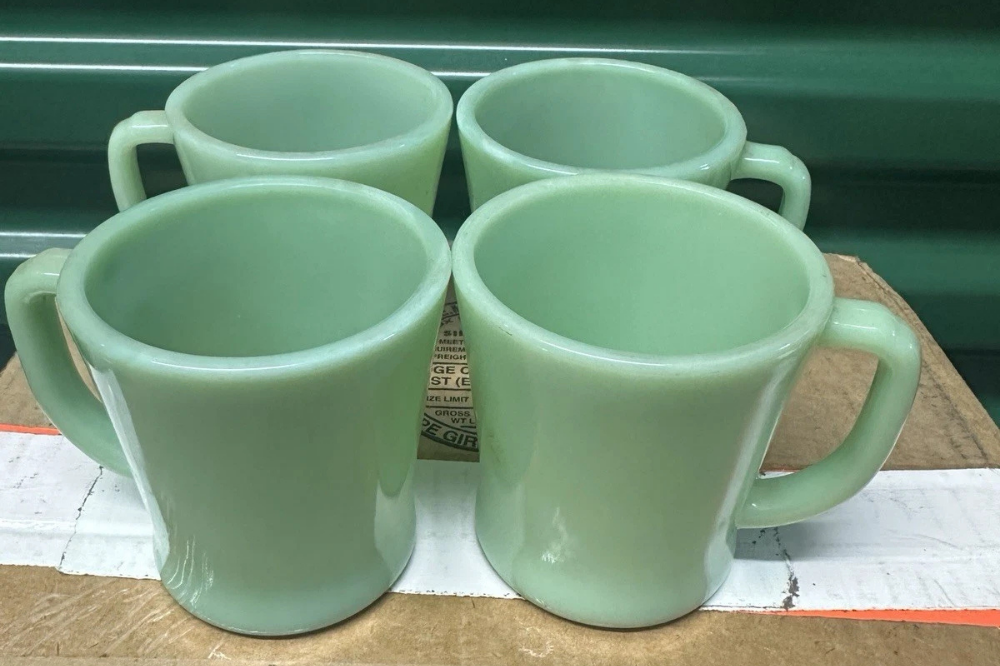
The thick, straight-walled mug that diners and truck stops used for decades is heavier in the hand than any household Fire-King mug, built to survive a dishwasher-free commercial kitchen for years. A clean single mug typically brings $20 to $40, and a matched set of four or more climbs toward $80 to $100 once you factor in how rarely a full set shows up with even wear.
Check the base first. Marked vintage examples bear a Fire-King mark whose lettering varies by period, sometimes with “MADE IN USA” added later in the production run. Vintage Fire-King jadeite is generally not uranium glass, so strong uranium-style fluorescence would warrant a closer look. A blacklight response alone cannot identify the maker or authenticate a mug; compare its profile and base mark with documented examples.
Most of what turns up has heavy scratching on the inside from stirring spoons and years of stacking, which is normal and doesn’t hurt value much. What does hurt it is a chipped rim or a crack running down from the handle, both common after decades of commercial use, and either one drops the price fast.
2. Fire-King jadeite restaurant ware cup and saucer
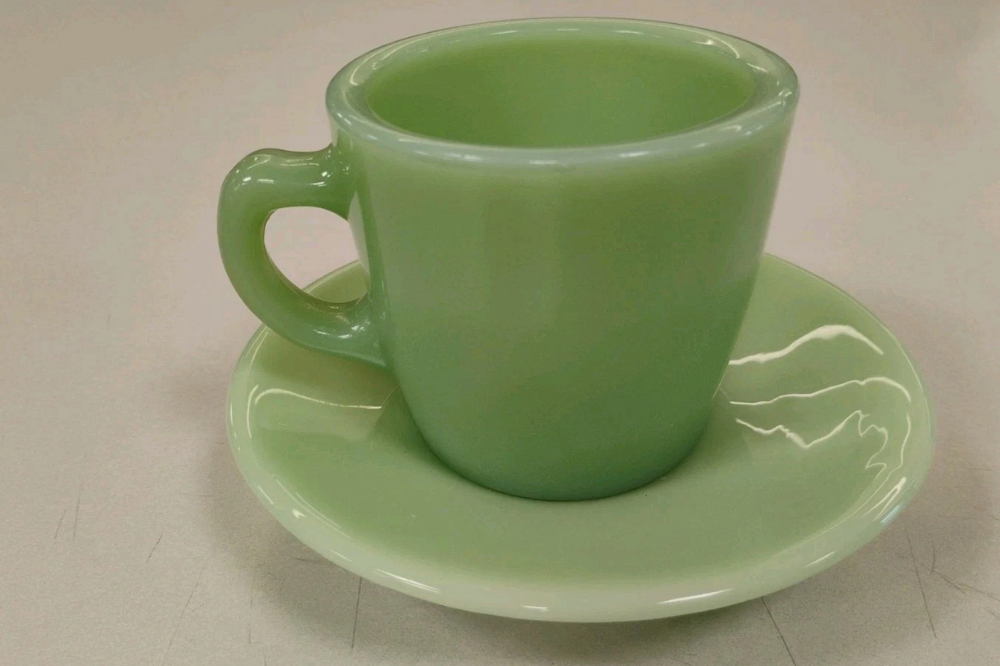
This is the smooth-walled, heavy diner cup, not the ribbed Jane Ray pattern most people picture when they think of Fire-King jadeite. It’s noticeably thicker in the hand, built for the same commercial kitchens as the diner mug, and a single cup with its matching saucer regularly sells for $25 to $45 in clean condition.
A matched pair that’s survived without a single chip is harder to find than you’d expect. Saucers took the brunt of the damage in a busy kitchen, since they got stacked and slid across counters constantly, so a saucer with no rim flakes is doing more work toward the price than the cup is.
Look at the base markings to date what you have: the same block-letter “FIRE-KING OVEN WARE” stamp applies here, and the glass should stay dark under UV light. Sets of four or more in consistent, unworn condition are genuinely uncommon, since most surviving examples are odd singles pulled from mismatched diner closures rather than complete sets someone kept together.
3. Fire-King jadeite restaurant ware oval serving platter
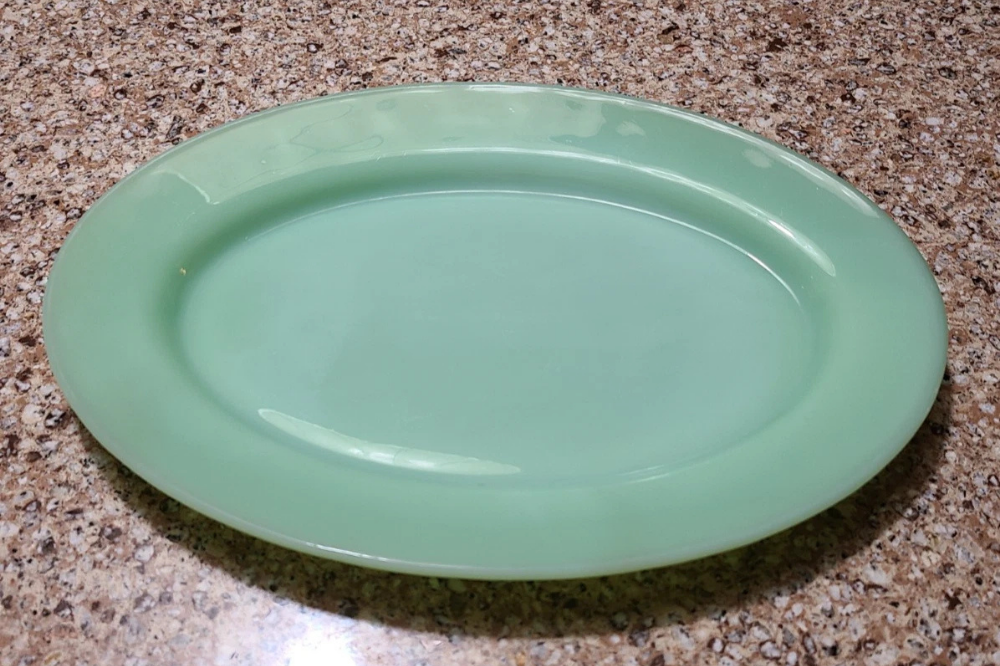
The oval serving platter, usually around 9 to 11 inches long, is one of the less commonly recognized restaurant ware shapes because it doesn’t look like typical “cute” jadeite the way a small mug or creamer does. Clean examples typically bring $30 to $50, with the larger 11-inch size usually landing at the top of that range.
This shape warped more than flatware did, since it went through repeated reheating in commercial ovens, so the single biggest value check is whether it sits flat on a table. Set it on a hard, level surface and look for rocking. Even a slight wobble tells you the glass has shifted from heat stress, and that knocks a meaningful amount off what a buyer will pay, even with no visible cracks.
The rim is the other weak point. Long oval edges chip more easily than round ones, especially at the narrow ends, so run a finger carefully around the whole perimeter before buying. A platter with even color, no cloudy patches, and a rim free of flea bites is a genuinely good find at this size.
4. Fire-King jadeite restaurant ware small bowl
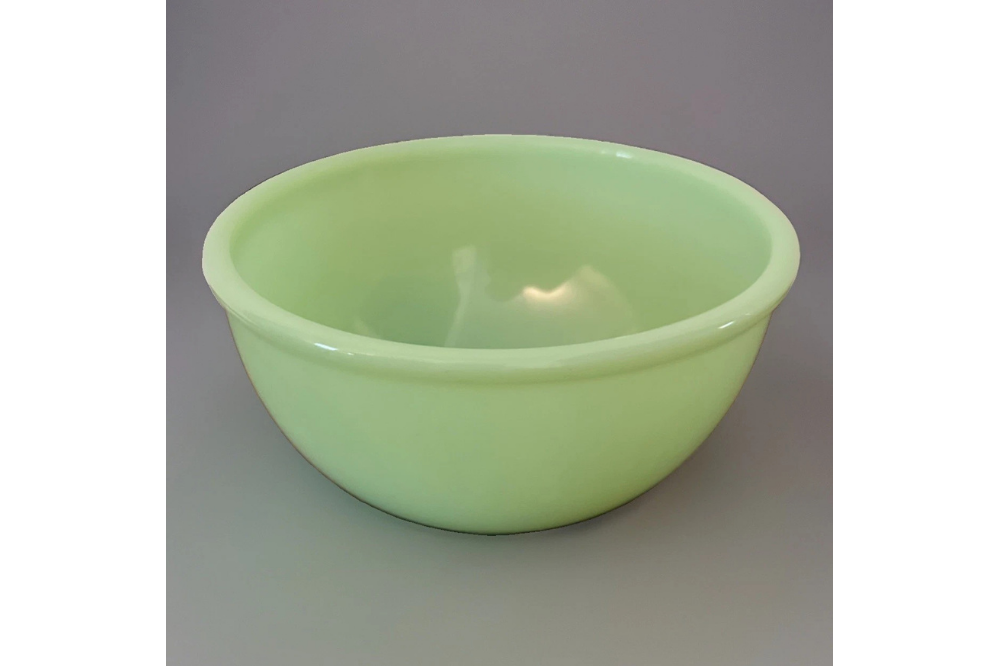
Diners used this bowl in three label-only variations, chili, soup, and cereal, but they’re the same glass in roughly the same 4.75 to 5-inch size, just marketed differently depending on what went in them. Bought as singles or small lots, they’re common enough that a group of them recently moved for well under $10 each, which makes this one of the more affordable, genuinely findable pieces on this list.
The exception is the flat-rimmed 9-inch soup bowl, a larger, flat-sitting variant of the same line that’s considerably scarcer than the small bowls. It rarely turns up for sale, and when it does, a clean example can bring $150 or more, a sharp jump from its smaller siblings.
On the small bowls, scratching on the interior from spoons is standard and barely affects price. What matters is the rim, since these stacked constantly in commercial kitchens and took chips at the edges from being knocked together. A set with consistent, even color and no rim damage is worth more than the individual pieces would suggest.
5. Fire-King jadeite batter mixing bowl
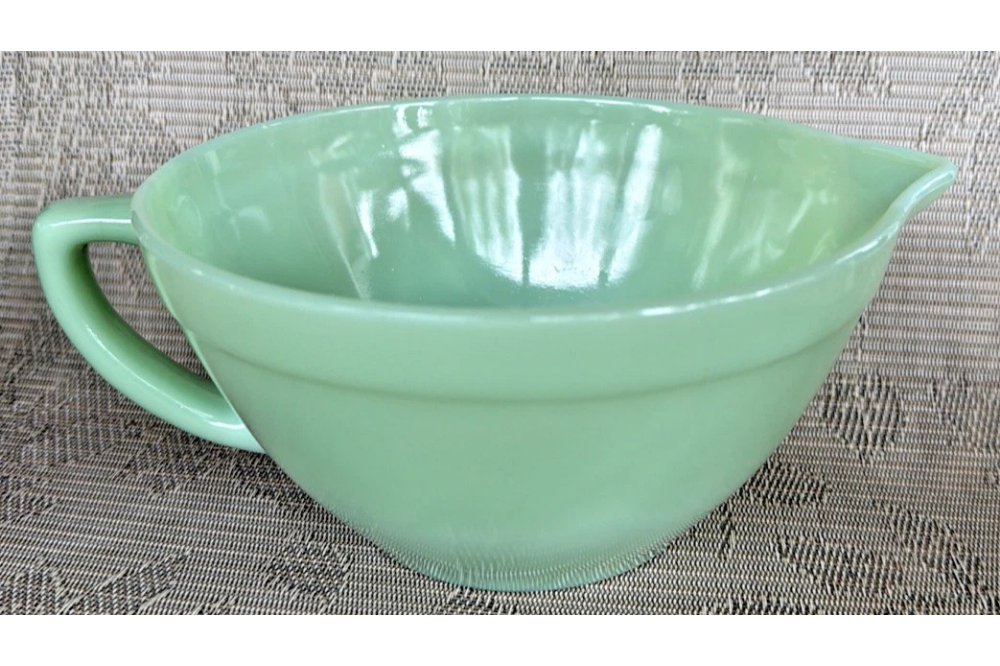
This is the bowl with a pour spout and a small side handle, built for mixing batter without it sloshing over the edge, and it’s distinct from the better-known Swirl or Swedish Modern nesting bowl sets. In genuinely excellent, barely-used condition, this exact shape has sold for $69.95, while ordinary used examples with normal kitchen wear bring closer to $30.
That’s a wide spread for one shape, and it comes down almost entirely to how the spout held up. It’s the thinnest, most exposed part of the bowl, and decades of pouring batter and setting the bowl down on a counter edge means most surviving examples have at least a small chip or flea bite right at the pour point. A spout with no damage at all is genuinely uncommon.
The handle is the second weak spot. Check where it meets the body for hairline cracks, which don’t always show up until you run a fingernail along the seam. A bowl that’s flat-sitting, has an intact spout, and shows only light scratching inside from mixing spoons is the one worth holding onto rather than using.
6. Fire-King jadeite oven-ware casserole with lid
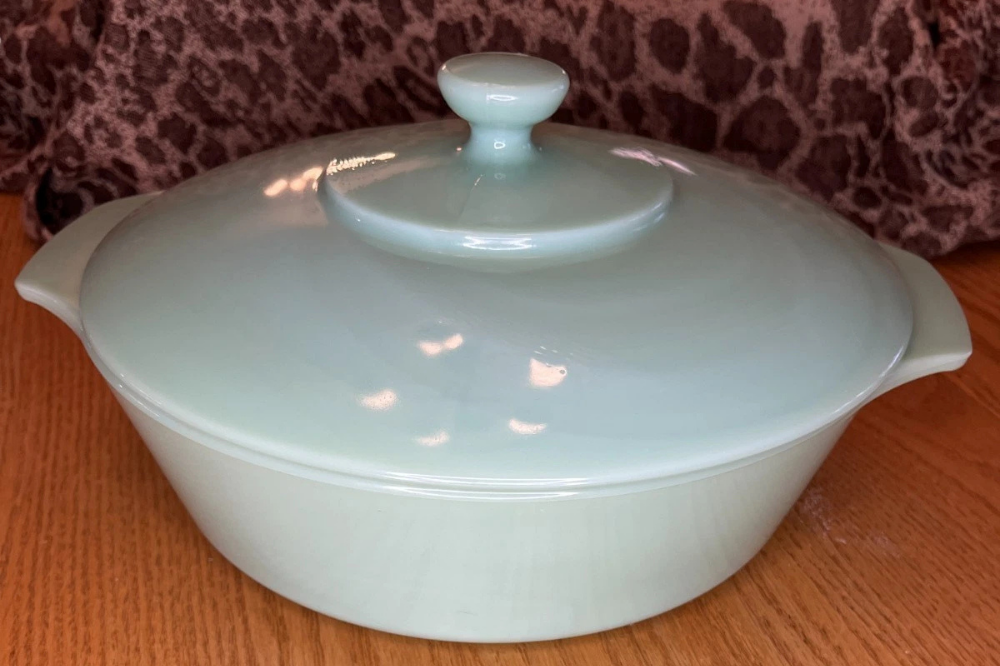
The covered casserole, usually sold in 1.5 to 2-quart sizes with a clear glass lid, was built for actual oven cooking rather than table service, which means more of them show real heat wear than most jadeite pieces. Complete examples with their original lid typically bring $50 to $150, with the lid doing a lot of the work in that range.
Lids wander. Decades of kitchen use means plenty of jadeite casserole bases have ended up with a lid from a different piece entirely, or no lid at all, and an unmatched or missing lid cuts the value substantially even when the base itself is flawless. Check that the lid’s rim sits flush all the way around rather than rocking or gapping on one side.
The other thing to check before you get excited is the base. Anchor Hocking brought jadeite back in 2000 in a limited reissue, and those pieces carry a small “2000” stamp alongside the Fire-King mark. It’s a legitimate, functional piece of glass, just not a vintage one, and it won’t bring anywhere near the same price.
7. Fire-King jadeite nesting mixing bowl set, plain
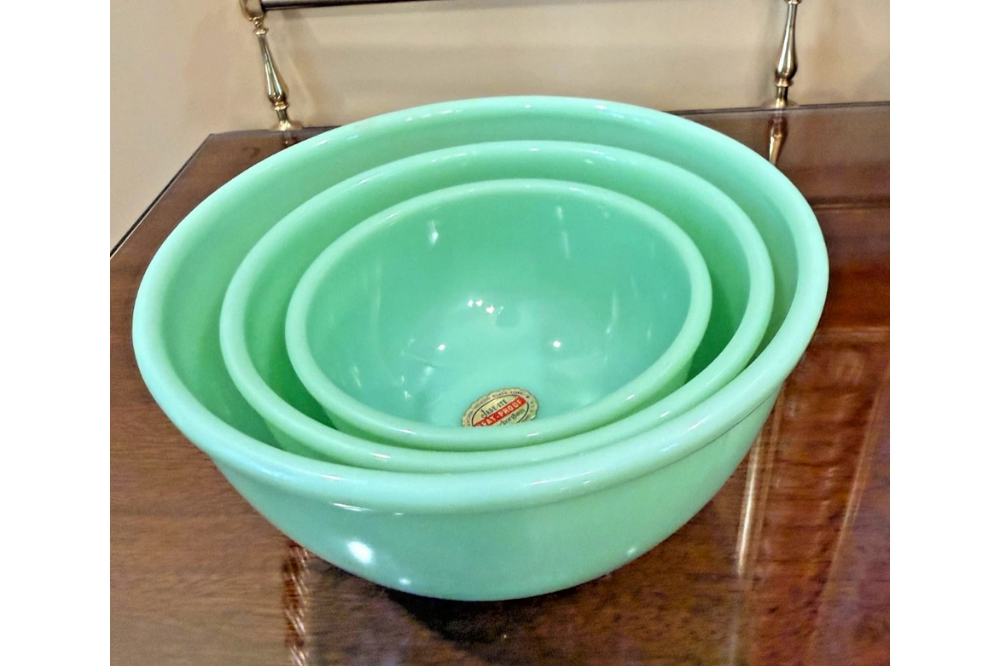
Not every Fire-King mixing bowl carries a pattern name. The plain, unribbed nesting sets include three bowls in graduating sizes of about 4.5, 6 and 7.5 inches, are easy to walk past at an estate sale because they don’t have the visual interest of Swirl or a named line. A clean three-piece set in consistent color brings roughly $40 to $90, with single bowls selling for a fraction of that.
Because there’s no pattern to catch the eye, buyers are paying almost entirely for condition and completeness. A set where all three bowls match in shade, with no chips on any of the rims, is worth noticeably more than three individually decent bowls that happen to nest together but came from different production runs.
These saw heavy daily use in most households, so expect scratching on the interior from mixing spoons and whisks. That’s normal and not something to worry about. What you’re checking for is rim damage and whether the color is even across all three, since a slightly different shade on one bowl usually means it’s a replacement for a lost original.
8. Jeannette jadite tea canister with lid
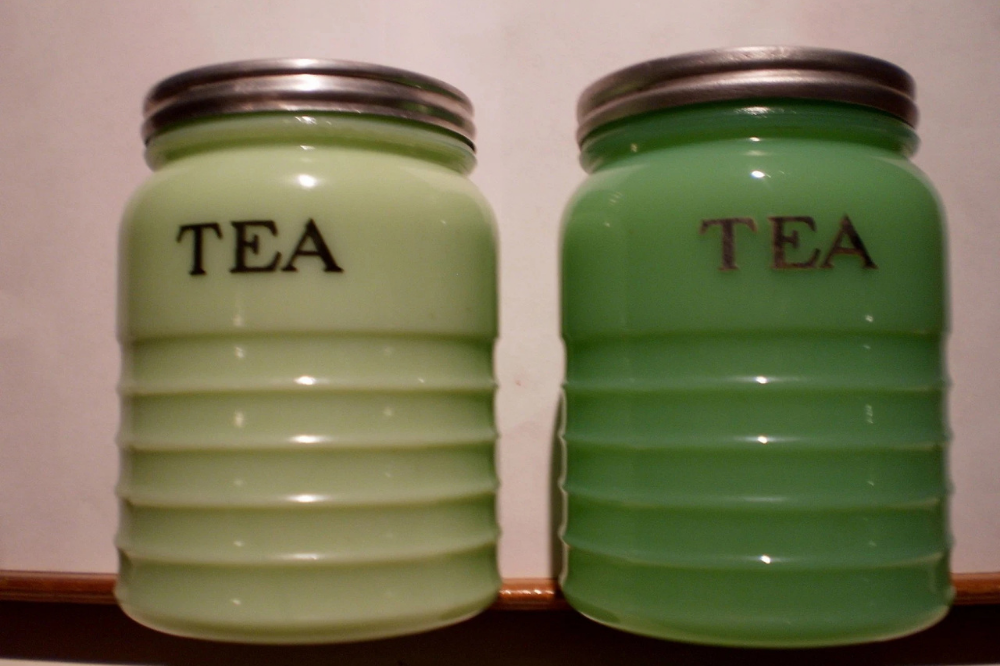
Jeannette Glass was making jadite kitchenware before Fire-King existed, out of its Jeannette, Pennsylvania plant through the 1930s and 40s, and its canister sets are a genuinely different collecting lane from anything Anchor Hocking made. The tea canister, marked with the word “TEA” and topped with its original metal lid, is valued at roughly $180 to $230 in excellent condition.
The metal lid is almost always the weak point. Decades in a humid kitchen means most surviving lids show some rust or dents, and a canister with its lid intact and not heavily corroded is worth considerably more than one that’s lost its lid entirely. A full matched set, sugar, coffee, tea, and flour together, brings meaningfully more than any single canister.
Unlike Fire-King’s jadeite, Jeannette’s glass contains uranium, so a genuine piece glows a distinct green under a blacklight. That glow is a useful clue to composition, but it cannot confirm the maker or age on its own. Compare the shape, lettering and lid with a documented Jeannette example.
9. Jeannette jadite reamer and juicer
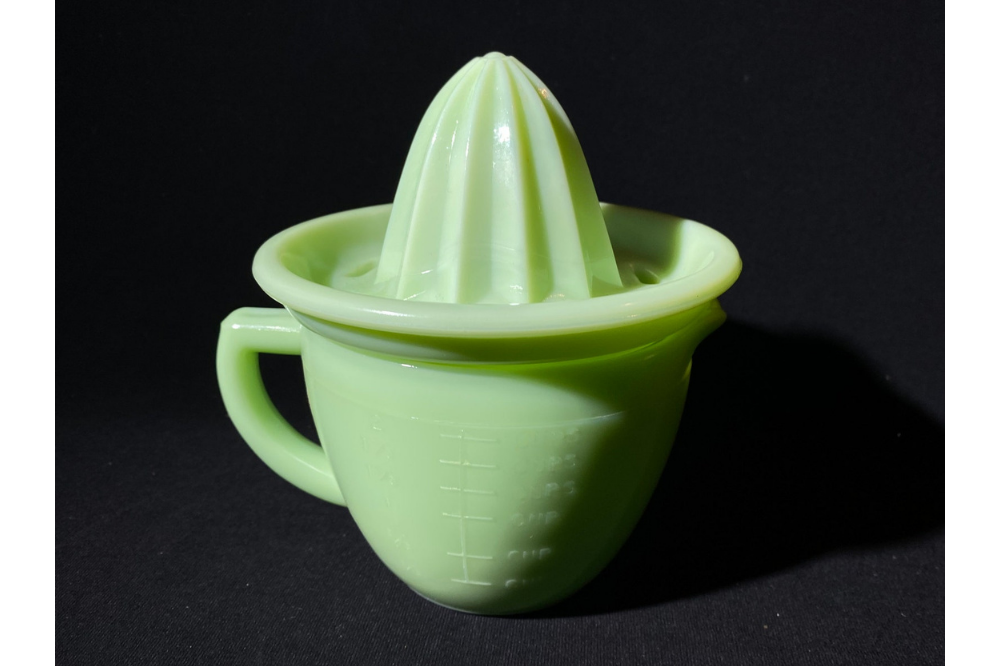
The two-piece citrus reamer, with a ridged cone on top and a pour spout built into the base, is one of the more overlooked Jeannette shapes because it gets lumped in with ordinary green glass kitchen tools at a glance. Clean examples typically bring $25 to $90, with the rarer two-cup, pitcher-style version reaching well above that when the uranium glow is especially strong.
A blacklight can reveal fluorescence associated with the glass composition. Use that as a supporting clue, then compare the cone, strainer, pitcher and markings with documented Jeannette examples. A green glow alone cannot authenticate the maker.
The ridged cone is the most fragile part of the piece and the one buyers check first. Years of twisting half an orange or lemon against it wears the ridges down and occasionally chips the tip, and either issue reduces the price. A reamer with sharp, undamaged ridges and no chips at the pour spout is the one worth setting aside rather than using for your morning juice.
10. Jeannette jadite 4-piece nesting measuring cup set
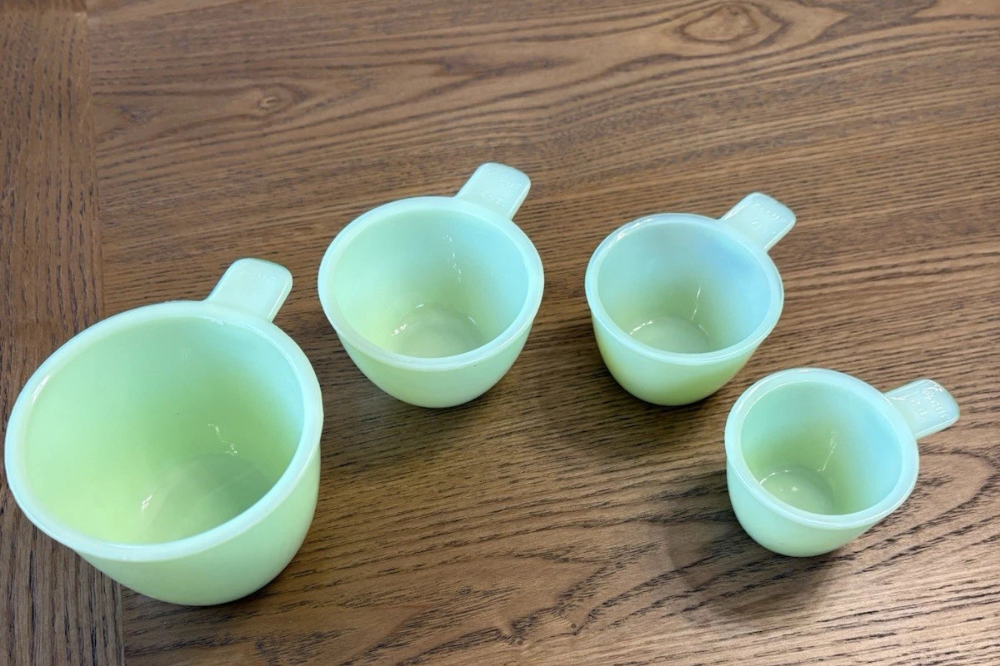
This is the kind of thing that genuinely sits in a kitchen drawer for decades without anyone realizing what it is: four nesting measuring cups, usually unmarked, in the same milky Jeannette jadite green. Sets in excellent shape, with all four cups intact and consistent color throughout, have sold for around $195, and examples with only minor flea-bite chips still bring close to $339.
Because these pieces are almost always unmarked, the blacklight test matters more here than on nearly anything else on this list. A genuine Jeannette set glows under UV light; an ordinary, non-uranium green glass measuring cup set from a later era does not. That check is a clue to composition, not proof of the maker or age. Compare the cup shapes and measurements with a documented Jeannette set as well.
“Flea bite” chips, the tiny nicks along rims and handles that are almost invisible until you run a finger over them, are extremely common on this shape and the single biggest thing separating a $339 set from one worth a fraction of that. Check every handle and rim edge carefully under good light before you get your hopes up.
11. Unmarked jadite mixing bowl with pour spout
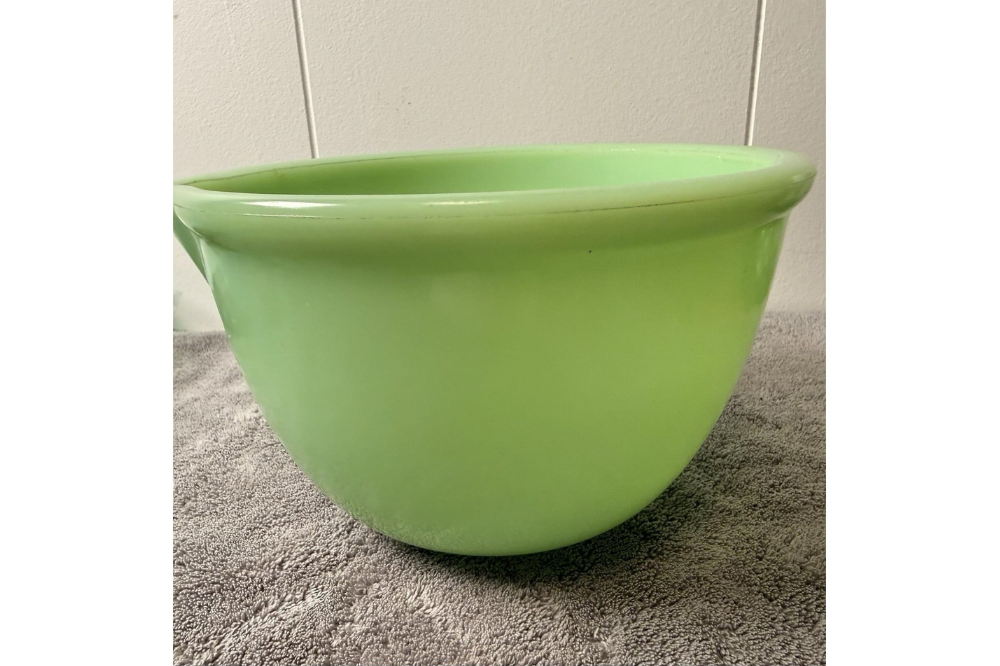
Small jadite mixing bowls with a smooth exterior and a built-in pour spout, usually in the 4 to 6.5-inch range, can be unmarked, which makes them easy to overlook in a box of mismatched kitchen glass. The maker of an unmarked example needs to be checked against documented shapes rather than assigned from its green color alone. Typical examples bring $25 to $60, with especially clean pieces reaching closer to $100.
Since there may be no maker’s mark to lean on, compare the profile, rim and spout with documented examples. A yellow-green glow under blacklight can be a clue to the glass composition, but fluorescence alone does not establish its maker, age or value.
The spout chips easily, the same way it does on the larger Fire-King batter bowl, since it’s the thinnest and most exposed point on the piece. A bowl with a clean spout, even color, and no cloudiness in the glass is a solid find, especially given how often these get sold for a dollar or two by someone who assumes it’s just old green glass.
12. McKee jadite Roman Arch salt and pepper range shaker set
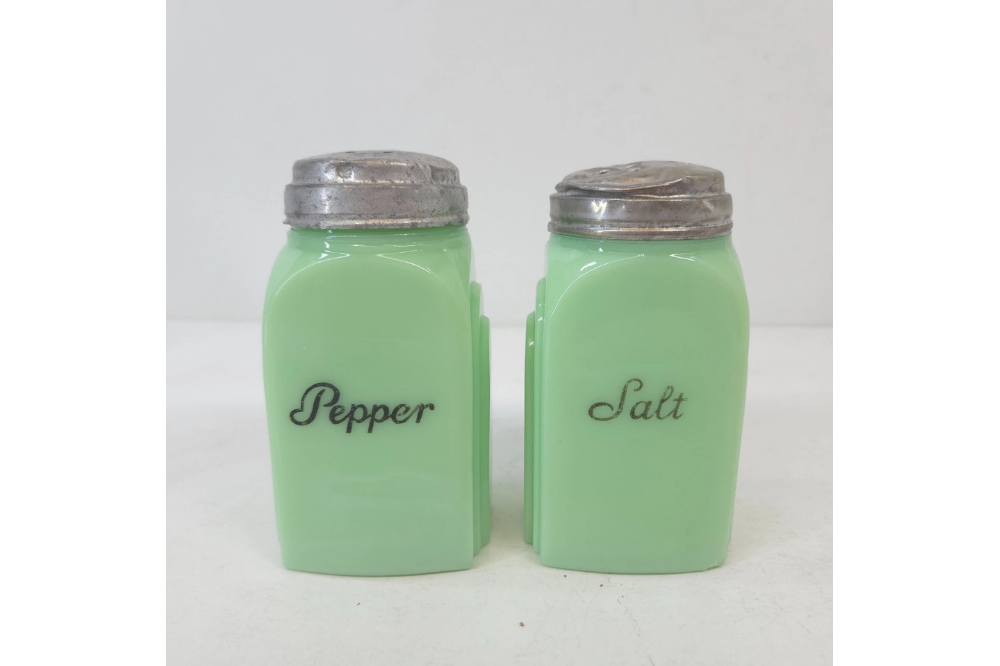
McKee Glass made its own jadite kitchenware starting around 1930, and the Roman Arch pattern, with its narrow arched panels pressed into the glass, is one of its more recognizable range shaker shapes. A complete pair with original pewter lids and legible “SALT” and “PEPPER” lettering typically sells for $100 to $200.
The pewter lids are the first thing to check. They tarnish and dent over decades near a hot stove, and a set with lids that still fit snugly and show only light surface tarnish is worth considerably more than one with rusted-through or missing lids. Painted lettering also wears off with handling, so crisp, legible “SALT” and “PEPPER” text adds real value over a pair where the paint has faded to almost nothing.
Most McKee pieces carry a small “McK” mark on the base, unlike Jeannette’s largely unmarked glass, which makes attribution easier here. As with other McKee and Jeannette jadite, the glass contains uranium and glows under a blacklight, a useful check if the base mark has worn away or was never there to begin with.
13. McKee jadite Laurel pattern creamer and sugar bowl set
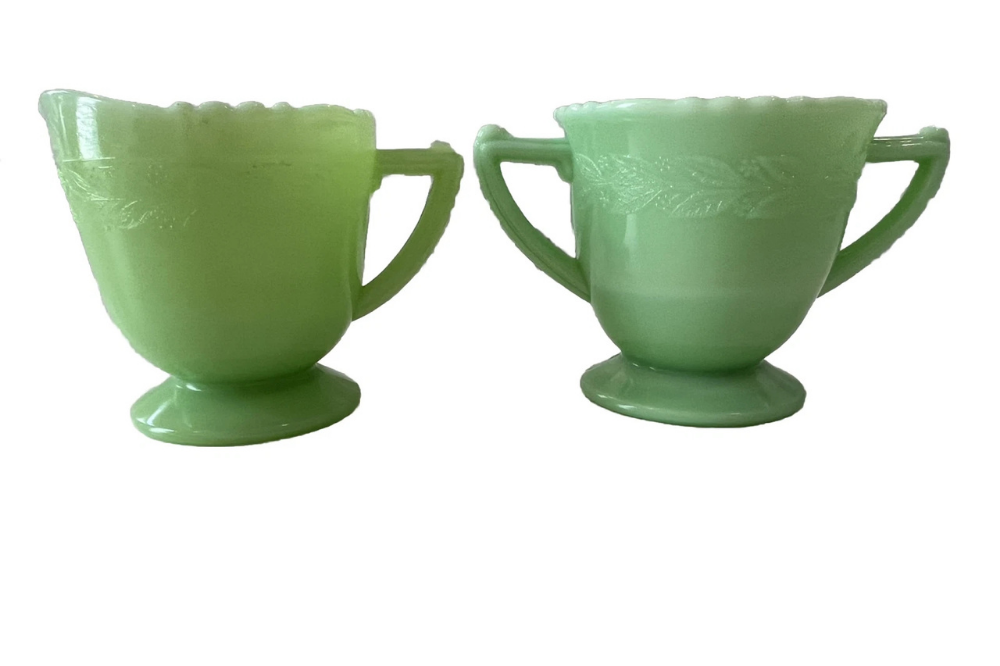
The Laurel pattern, with a leaf motif embossed around the exterior of each piece, is one of McKee’s more distinctive jadite lines, and the matched creamer and sugar bowl set, each about 3.25 inches tall, has sold for around $175 in clean condition with both pieces signed “McK” on the base.
A faint white ring sometimes visible on one piece is usually a straw mark, a minor flaw from the original manufacturing process rather than damage, and it doesn’t meaningfully affect value the way a chip or crack would. Don’t mistake one for the other. A genuine crack runs through the glass and catches light differently than a straw mark, which sits on the surface.
This pattern is harder to find than McKee’s plainer shaker and canister lines, since it wasn’t produced in the same volume, and a complete matched pair in good condition without replacement pieces mixed in is a better find than the price alone suggests. The uranium glow test provides a clue to composition here as well, but it does not authenticate the maker or age. Check the Laurel pattern and base marks alongside the fluorescence.
14. McKee jadite Cocotte bowl, Skokie Green
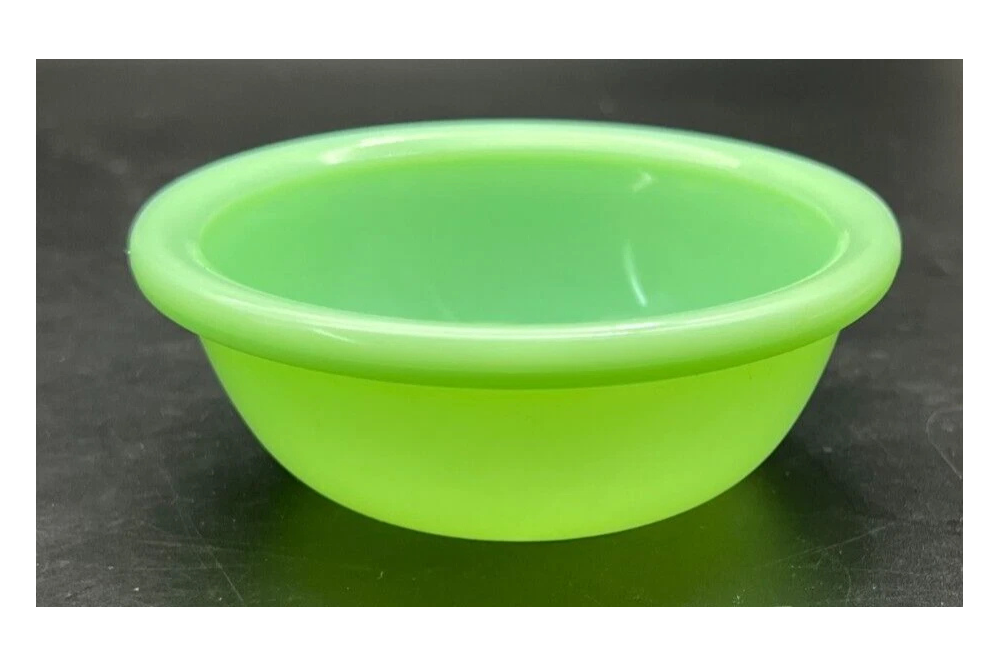
Skokie Green was McKee’s own name for its jadite-toned opaque glass, and the small Cocotte bowl is one of the more unusual shapes the company made in it. The cited example is an open bowl, so a fitted original lid should not be assumed. Clean examples typically sell for $40 to $65.
Because it’s a small, single-serving piece rather than a showy centerpiece bowl, it gets passed over constantly by people who don’t recognize the shape or the color name. Examine the rim and base closely for chips, cracks and wear. If a separate lid is offered with it, verify that the lid belongs to this particular shape before paying a premium for a supposedly complete set.
As with McKee’s other jadite pieces, this one contains uranium and glows under a blacklight, which is worth checking if the base marking has worn smooth with age. A bowl with an intact rim, an even base and a documented McKee attribution is worth a closer look. Fluorescence is a supporting clue to composition, not proof of maker or age.
Jadeite rewards a careful look more than luck. Most of what turns up in a kitchen box is worth a modest amount, and that’s fine. The real value is in knowing which base mark, which glow, and which chip-free rim separates an ordinary green bowl from one worth setting aside.











