
You’re at Goodwill on a Saturday afternoon, sorting through a rack of khakis and off-brand fleeces, and nothing is clicking. Meanwhile, the person two aisles over just put a 1970s Pendleton wool coat in their basket for $9. They didn’t get lucky. They got there at the right time, knew what they were looking at, and had a phone in their pocket loaded with the right tools.
Thrifting for real vintage finds is a skill, and like any skill, it mostly comes down to a handful of things most people either don’t know or don’t bother with. The tips below are the ones that actually make a difference.
Table of contents
- Go early in the week, not on weekends
- Learn the color tag system at every store you visit
- Check eBay sold listings, not active ones
- Use Google Lens before you put anything back on the shelf
- Read clothing labels like they’re telling you something, because they are
- Shop the sections everyone skips
- Know which seasons and months produce the best hauls
- Treat estate sales as a separate discipline
- Build a relationship with your regular stores
- Set a price limit before you walk in, and stick to it
- Don’t confuse asking prices with actual value
- Look at the neighborhood before you look at the store
- Understand what’s genuinely vintage and what’s made to look like it
- Check the bottom, back, and underside of everything
- Know which categories are reliably worth looking for
- Sign up for estate sale company mailing lists
- Don’t buy things you wouldn’t want at full price
- Strategies for making money outside of a traditional job:
Go early in the week, not on weekends

Most people donate on weekends, when they have time to load up their car and make the drop. Stores process those donations over the following day or two, which means Monday and Tuesday mornings are when fresh inventory actually hits the floor. By Saturday afternoon, the good stuff has been picked through by every reseller in the area.
The other reason to go early in the week is competition. Serious flippers tend to shop on weekends when they’re off work. Showing up Tuesday morning puts you ahead of that crowd. You’re also less likely to be fighting a cart into a narrow aisle while someone’s kid blocks the housewares section.
Morning matters too. Most stores restock overnight or before opening, so the first hour after the doors open is your best window for seeing items before anyone else. If you have a store you really like, find out when they put new items out and plan around it.
Learn the color tag system at every store you visit

Most major thrift chains use rotating color tag systems to mark down older inventory, often by 50 percent. The color that’s on sale rotates weekly, and if you know the schedule, you can shop the day a color goes on sale to get first pick at half price. If you show up after half the store has already been through those tags, you’re getting the leftovers.
Ask an employee which tag color is currently discounted, or follow the store’s social accounts. Some chains post their discount schedule publicly. One tactic that works especially well: visit the evening before a sale day to scout what you want, then come back first thing the next morning when the discount kicks in.
Beyond weekly markdowns, most chains run 50 percent off sales on major holidays. Memorial Day and Labor Day tend to be reliably good. Many stores also offer standing discounts for seniors, students, and military, so bring ID if that applies to you.
Check eBay sold listings, not active ones

Standing in a thrift store wondering if something is worth buying is a situation everyone has been in. The right tool is already on your phone: eBay sold listings show what items actually sold for, not what sellers are asking. Those are very different numbers, often 30 to 50 percent apart.
Search eBay for the item, then filter by “Sold Items” in the left sidebar on desktop, or under the filter menu on mobile. Look at the last 10 to 15 sales and find the cluster in the middle, ignoring the outlier that sold for three times the going rate. That cluster is your realistic number. From there, subtract fees and shipping if you’re reselling, and you’ll know in about two minutes whether the price tag makes sense.
One thing to note: active listings are what sellers want to get. They don’t reflect reality. A vintage item with an asking price of $200 on Etsy might have a sold price of $60. Skipping the sold data check is how people overpay, and it’s also how they walk past something worth $150 because the thrift store priced it at $18 and they assumed it must not be worth much.
Use Google Lens before you put anything back on the shelf

Many vintage items have maker’s marks, stamps, or labels that are easy to look up, but plenty don’t, or the mark means nothing to you in the moment. Google Lens closes that gap. Open the Google app, tap the camera icon, photograph the item or its mark, and similar items will surface from eBay, Etsy, and other platforms within seconds.
This works especially well for ceramics, glassware, silver, and vintage clothing with unusual tags or logos you don’t recognize. It’s also useful for dating items when you’re not sure if something is genuinely vintage or just made to look that way. If it’s modern, Google will likely pull the exact current retail page. If it’s old, you’ll typically see resale results from secondhand platforms, which tells you both that it has a market and roughly what it’s trading for.
The habit to build: before you put something back because you’re not sure about it, photograph it. Takes ten seconds. Costs nothing. Catches things a quick glance would miss.
Read clothing labels like they’re telling you something, because they are

Fabric content and country of origin are two of the fastest ways to sort real vintage from everything else on the rack. A “Made in USA” label on a Ralph Lauren or Calvin Klein garment is a vintage indicator, because those brands moved manufacturing overseas decades ago. “Made in Korea” is another marker, common in quality garments from the 1970s and 1980s when South Korea was a major textile manufacturer.
Beyond origin, older labels were typically sewn in rather than printed. Check side seams for union labels, which show up on American-made clothes from much of the 20th century. If you find an International Ladies’ Garment Workers’ Union tag, the piece is likely pre-1995, when the union dissolved. These details add up quickly once you know what to look for.
Fabric content is the other thing worth checking every time. Natural fibers, specifically wool, cashmere, linen, and 100 percent cotton, hold up far better than synthetics and tend to have real resale or personal value. A cashmere sweater with no obvious wear for $7 is a find. A polyester pullover for $5 is just a pullover.
Shop the sections everyone skips
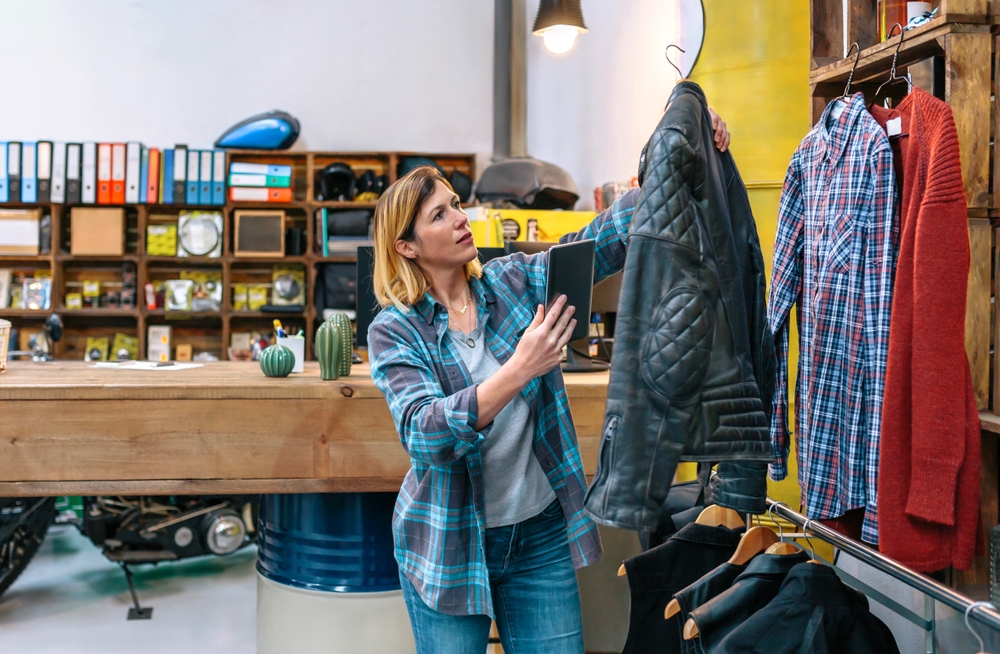
Vintage finds show up in unexpected places inside thrift stores, because donations don’t get sorted by era. Gorgeous 1980s blazers turn up in the generic jacket section. Vintage slips get hung between modern pajamas. Practically every blazer and light jacket section in a thrift store has something from the 1980s or 1990s once you start looking.
If the store has a costume section, check it. People donate genuine vintage pieces that end up there because someone decided it was “old” or “costume-like.” The men’s section is worth a look regardless of your gender if you’re after vintage shirts, because oversized vintage flannels and button-downs in men’s sizing are often stacked five to a hanger. The furniture section yields more when you check it for hardware, legs, and frames rather than overall style, since a piece with solid bones is worth the look even if it needs work.
Go through everything systematically. Shops are not curated. The good stuff is rarely in the obvious spot.
Know which seasons and months produce the best hauls

Donation volume spikes at predictable times. January brings a rush of post-holiday purging, including clothing with tags still on, gear people received as gifts and didn’t want, and items cleared out to make room for new things. Late December donors also tend to be motivated by tax deduction deadlines, which puts quality donations on the floor right at the start of the new year.
Spring cleaning is real. April and May bring waves of donations as people go through closets. Summer is particularly good for furniture, as people donate before moving. Garage sale season also feeds thrift stores: whatever doesn’t sell at neighborhood sales often goes straight to the nearest Goodwill that weekend. If you hit thrift stores in late spring and early summer, you’re getting the overflow from a lot of garage sales all at once.
Counter-intuitively, the worst time to look for vintage clothing at thrift stores is right before Halloween. The costumes are already gone, and what’s left has been picked through extensively. Stick to early autumn before the pre-Halloween rush starts if you need that era of the thrift calendar.
Treat estate sales as a separate discipline

Estate sales and thrift stores are not the same game, and the strategy differs significantly. At an estate sale, the first day has the best selection but fixed prices. The last day, usually Sunday, commonly brings 50 to 60 percent markdowns as organizers work to clear the house. If you want a specific item and can’t risk it selling, pay full price on day one. If you’re hunting for deals and can work with whatever’s left, come back on the final day.
Before you go, use EstateSales.net, which lets you search by zip code and browse preview photos. Many listings are posted mid-week for weekend sales, which gives you time to study photos, research any items that look interesting with Google Lens or eBay sold data, and plan a route if multiple sales are running the same weekend. Prioritizing sales in more affluent neighborhoods tends to yield better results for furniture, collectibles, and quality housewares.
When you find something you want at full price, buy it and take it to your car. At busy estate sales, items in a “hold” pile or left on a table while you keep looking can disappear. There are no shopping carts and no guarantees.
Build a relationship with your regular stores

The people working the floor at your favorite thrift stores see everything that comes in. Being a recognizable, friendly regular has real practical value: staff sometimes quietly alert regulars when something in their wheelhouse arrives, or mention when a restock is happening. This is not guaranteed, and it’s not something you ask for directly, but it happens when people know you.
The same principle applies at estate sales and flea markets, where vendors have more flexibility on price. Many secondhand vendors are in the business for love of vintage, and a fellow enthusiast who’s been respectful and regular can find that prices are more negotiable than they’d be for a stranger. A few dollars off isn’t the point. The information flow and the occasional early tip matter more over time.
At thrift stores specifically, note that negotiating the sticker price is generally not done. The price on the tag is the price. Save the negotiation for estate sales, flea markets, and direct sellers on Facebook Marketplace.
Set a price limit before you walk in, and stick to it

The thrill of finding something good can override basic math. The discipline that separates people who consistently find deals from people who consistently overspend at thrift stores is simple: decide what you’re willing to pay for something before you pick it up, and hold to it even if the item is exciting. If you wouldn’t pay $35 for something at a regular store, the fact that it’s at Goodwill doesn’t change the calculus.
If you’re thrifting to resell, the math is specific: the item needs to sell for at least two to three times what you paid, after accounting for shipping, platform fees, and packing materials. A $12 item that sells for $20 online isn’t a good flip once you subtract eBay’s fees and a shipping label. The margin has to actually be there.
If you’re buying for yourself, the same mental exercise helps. Ask yourself whether you’d want the item if the tag had no price on it. If the honest answer is no, and you’re only tempted because it’s cheap, it will end up in a donation bag within the year. Thrift stores have a way of making purchases feel consequence-free when they aren’t.
Don’t confuse asking prices with actual value

Thrift stores, and increasingly estate sale companies, price items by looking at what similar things are listed for online, not what they actually sell for. That’s a significant difference. An asking price of $200 on a vintage item doesn’t mean it’s worth $200 or that anyone will pay $200. The only number that matters is what completed, sold transactions look like.
This cuts both ways. Some items are underpriced because staff didn’t research them. A piece of vintage Pyrex in a desirable pattern, a film camera from a brand that’s had a resurgence, a piece of cast iron with a well-regarded maker’s mark: these can sit on a thrift shelf for $4 while selling consistently for $50 to $150 on eBay. The research habit closes both gaps: it keeps you from overpaying, and it keeps you from walking past something genuinely valuable because it looked like junk.
The underlying skill in all of this is pattern recognition, and it builds over time. The more categories you learn, the more quickly you can scan a store and know what’s worth stopping for. Most experienced thrifters will tell you the same thing: it took a few years of getting it wrong before they got it consistently right.
Look at the neighborhood before you look at the store

Donation quality tracks with local demographics. A thrift store in an area with older, long-term residents is more likely to receive quality vintage housewares, furniture, and clothing from estates and downsizers. Stores near college campuses tend to get more contemporary donations, which can be fine for basics but rarely produces vintage. Stores in wealthier zip codes often receive higher-end items, though some of those stores also price more aggressively.
This doesn’t mean every store in a given area is good or bad, but if you have the flexibility to choose between several locations, the neighborhood is worth factoring in. The same goes for estate sales. A sale in a 1960s ranch house with original wallpaper and furniture that hasn’t been updated in decades is usually a better bet for genuine vintage than a recently renovated home being cleared out by a family in their thirties.
Thrifting across different areas and regions also produces finds you wouldn’t see locally. Regional styles and what tends to get donated vary considerably, and if you travel regularly, an hour at a thrift store in an unfamiliar city is a reliably interesting way to spend it.
Understand what’s genuinely vintage and what’s made to look like it

Reproductions and “vintage-inspired” pieces look old but aren’t. Knowing the difference matters both for resale value and for not overpaying. Real vintage items have specific tells: wear patterns that are consistent with age and use rather than artificially distressed, hardware that shows genuine oxidation, fabrics that predate synthetic blends that weren’t available in a given era.
Clothing tags are reliable dating tools. Older labels were sewn in with raised or embroidered text rather than printed directly onto fabric. Care instruction labels, which became federally required in the United States in 1972, can help narrow a date range. Items made before that requirement won’t have them. A garment with no care label is likely pre-1972. It can also be genuinely worn out, so look at the overall condition alongside the label details.
If you’re unsure whether something is authentic vintage or a newer reproduction, Google Lens is again the fastest check. Reproductions often surface quickly in search results showing their original retail listing. Genuine vintage tends to pull up resale platforms and collector forums instead.
Check the bottom, back, and underside of everything

Most people look at the front of a piece and move on. The useful information is almost always somewhere less obvious. Ceramics and glassware have maker’s marks on the base. Silver has hallmarks stamped on the reverse or on the back of the handles. Furniture has construction details underneath, including joinery techniques and hardware styles that help date a piece. A dovetail joint suggests older craftsmanship. Uniformly machine-cut joints suggest something newer or mass-produced.
For artwork, check the back of the frame for gallery labels, exhibition stickers, and artist signatures or notations in pencil. These details can dramatically change the value of something that looked like a basic landscape in a thrift store. For electronics and cameras, check condition of the lens, shutter, and any mechanical components before buying. A film camera that sold for $120 in working condition might sell for $15 if the shutter is stuck.
The inspection habit takes an extra 30 seconds and prevents a lot of regret in both directions. You either confirm it’s worth buying, or you find the flaw that explains why it was donated in the first place.
Know which categories are reliably worth looking for

Some categories consistently produce finds in thrift stores; others rarely do. Cast iron cookware, especially pieces from brands like Griswold or Wagner, turns up regularly and sells well when it’s in good condition. Vintage Pyrex in sought-after patterns, film cameras from the analog photography revival, vintage board games in complete condition, wool and cashmere knitwear, and mid-century barware are all categories where thrift prices often lag well behind actual market value.
Categories to approach with more skepticism: collectible plates from Bradford Exchange or Franklin Mint, which are abundant and rarely valuable; anything marketed as “limited edition” from the 1990s or 2000s, which was usually mass-produced; and electronics without testing access. A vintage turntable priced at $45 is a good buy if it works and a bad buy if it doesn’t, and you usually can’t plug it in at a thrift store to check.
Building expertise in a few specific categories will serve you better than trying to know everything. Most consistent thrifters have two or three areas where they can make fast, accurate decisions, and they look more carefully at everything else before committing.
Sign up for estate sale company mailing lists

Estate sale listings go up mid-week for weekend sales, usually Wednesday or Thursday. Following estate sale companies on social media or signing up for their email lists gets you early access to preview photos before the listings become widely visible. That 24-hour head start is enough time to research items in the photos, map out multiple sales in priority order, and decide whether the sale is worth the drive.
EstateSales.net and EstateSales.org both let you search by zip code and set up alerts for your area. Many professional companies also run their own mailing lists. If there’s a company in your area that regularly handles good sales, getting on their list directly is worth doing. Over time, you’ll start to recognize which companies price fairly versus which ones price based on wishful thinking, and you can plan accordingly.
The preview-photo habit also helps you avoid wasted trips. A sale with 60 well-photographed items that include the brands and condition of high-value pieces is worth more of your time than a sale with five blurry photos of a pile of things in a garage. The level of care in the listing is often a reasonable indicator of the level of care in the pricing.
Don’t buy things you wouldn’t want at full price

The cheapness of thrift store pricing is a trap as much as it’s an opportunity. Stores are full of things that are inexpensive precisely because nobody wants them, and the low price can make the decision feel lower-stakes than it is. A $4 purchase that ends up at your own donation pile next year is still a waste of $4, and more relevantly, it was a decision that occupied mental space and closet space it didn’t deserve.
The practical filter: if you saw this item in a regular store at roughly what it would cost new, would you buy it? If not, cheap doesn’t make it better. The exceptions are items you’re buying specifically for resale, where the logic is different, and items that are genuinely hard to find any other way. A vintage wool coat in your size and colorway that you’ve been looking for isn’t the same as a generic decorative plate that costs two dollars.
The best thrifters buy less than most people who go to thrift stores. They pass on more things, and they leave with things they actually wanted. That discipline is most of what separates a good haul from a car full of things you’re not sure about.
The skill compounds over time, and most of it is just pattern recognition built through repetition. Go consistently, take notes on what sells and what doesn’t, and the calls get faster.
Strategies for making money outside of a traditional job:

Where to sell sterling silver for the most money: In this post, you’ll learn about the difference between sterling silver and other types of silver, and find places to make the most money from selling your sterling.
What can I sell to make money (or resell)? 38 ideas: Dive into this article to discover things in your house you can sell for quick cash — and where to sell.
What sells quickly at pawn shops: In this post, you’ll find ways to navigate pawnshops, understand how they work and what items are most in demand.











