
The coin jar on the dresser. The change rolled up in your grandfather’s bureau drawer. That handful of pennies you’ve been meaning to take to a machine at the grocery store. The odds that any individual coin hides a mint error worth real money are slim, but they aren’t zero, and the collector market for U.S. error coins runs deep enough that a single mistake at the federal mint has turned into life-changing money for people who knew what they were looking at.
Error coins, sometimes called misprints, cover a wide territory: blanks struck on the wrong metal, coins struck with mismatched dies, designs pressed twice at a slight angle, dies polished so aggressively that a detail got ground away entirely. The Mint catches most of these before they leave the building. Not all of them.
What separates a minor oddity from a real find comes down to how dramatic the error is, how few coins were affected, and whether you can prove it. For anything worth more than a few hundred dollars, professional grading by PCGS or NGC is non-negotiable. Fakes and altered coins are a serious problem in this space, and a certified coin in a grading service holder sells for substantially more than an identical raw example in a plastic bag.
Table of contents
- 1943 copper wheat penny
- 1944 steel wheat penny
- 2000-P Sacagawea dollar/Washington quarter mule
- 1969-S doubled die Lincoln cent
- 1955 doubled die Lincoln cent
- 1937-D three-legged Buffalo nickel
- 1972 doubled die Lincoln cent (type 1)
- 1942/1 Mercury dime overdate
- 2004-D Wisconsin state quarter extra leaf
- 1982 no-P Roosevelt dime
- 11. 1983 copper Lincoln cent
- 12. 1995 doubled die Lincoln cent
- 13. 1999 Wide AM Lincoln cent
- 14. 2007 presidential dollar missing edge lettering
- 15. Off-center Lincoln cent (40% to 60% off center, date visible)
1943 copper wheat penny

In 1943, the U.S. Mint switched penny production from copper to zinc-coated steel to conserve copper for the war effort. Almost every 1943 penny is silver-gray and magnetic. The exceptions are the ones struck on leftover copper planchets that hadn’t been cleared from the presses after 1942, and those are among the most valuable error coins in American history. Fewer than 30 are confirmed to exist across all three mints, with the single known Denver example standing alone as the rarest.
In average circulated condition, a 1943 copper penny from the Philadelphia Mint typically brings $100,000 to $500,000 depending on grade and provenance. The Denver example has reached seven figures in private transactions. Before you get excited: the vast majority of people who think they have one don’t. The easiest test is a magnet. A genuine copper 1943 penny won’t stick. A standard steel version will. The coin should also weigh approximately 3.1 grams, heavier than the steel at 2.7 grams. Copper-plated steel fakes are common, convincing to the eye, and worthless.
Authentication by PCGS or NGC is the only way to confirm the genuine article. No serious buyer will look at an unslabbed example at these prices, and the fakes are good enough that the very first step before any sale conversation is professional certification. The coin also needs specific reverse die markers to authenticate correctly, which the grading services verify as part of their process.
1944 steel wheat penny

The reverse of the 1943 story, and rarer. When the Mint switched back to copper in 1944, a small number of zinc-coated steel planchets left over from the prior year got fed into the presses alongside new copper blanks. The Philadelphia issue is the most common of the three mints, and “most common” here means roughly 25 to 30 confirmed examples across all grades. The San Francisco mint produced only two known examples.
Circulated examples from Philadelphia typically bring $10,000 to $75,000 depending on grade, with San Francisco examples in a category of their own at six figures. One authentication shortcut that works immediately: a genuine 1944 steel penny will stick to a magnet, while a normal 1944 copper penny won’t. Weight matters too, since steel planchets are lighter at approximately 2.7 grams versus copper’s 3.1 grams. The most common counterfeit approach is altering a 1948 penny by grinding down the 8 into a convincing 4, which is why die marker authentication matters beyond the magnet test.
Anyone claiming a 1944 steel penny needs it slabbed before the conversation goes anywhere useful. The grading services apply specific diagnostics to distinguish genuine examples from the fakes and altered coins that circulate through this market, and the value gap between certified and uncertified is enormous.
2000-P Sacagawea dollar/Washington quarter mule

A mule is an error coin struck with dies that were never supposed to be paired together. The most famous American example has a Washington State Quarter obverse and a Sacagawea dollar reverse, both pressed onto a dollar coin planchet. It technically carries a combined face value of $1.25. The error was produced at the Philadelphia Mint during a staff changeover in 2000, and the first example surfaced in a bank roll of uncirculated dollar coins a few months after issue.
About 20 examples are known to exist, and most are now in a single private collection. Individual certified examples have sold for $125,000 to $194,000, making this among the most expensive modern U.S. errors ever offered publicly. Three distinct die pairs are recognized based on specific diagnostic marks, and attribution to a particular die pair is part of the documentation that accompanies any legitimate sale.
The coin’s story resonates with collectors partly because real examples have entered the market through ordinary channels, including circulation and bank rolls. That makes the theoretical possibility of discovery feel real, even though the actual odds are extremely low. A coin presented without recognized grading service attribution and die-pair identification will face significant skepticism from serious buyers regardless of appearance.
1969-S doubled die Lincoln cent

When these coins were initially discovered in 1969, federal agents initially believed they were counterfeits because the error was so obvious. The doubling on “IN GOD WE TRUST,” “LIBERTY,” and the date is visible without magnification. It was real, produced when a working die at the San Francisco Mint was hubbed twice at a slight rotational offset. Approximately 30 examples are known across all grades, and in the decades since, individual coins have been found in rolls, in circulation, and in bank bags that hadn’t been searched.
Typical circulated examples bring $10,000 to $20,000 depending on grade. Uncirculated examples command considerably more, and the finest certified examples are in six-figure territory. What separates this from the better-known 1955 doubled die isn’t the visual drama of the error but the quantity released. Around 30 confirmed examples exist versus the roughly 24,000 that reached the public from 1955, and scarcity is almost always the dominant price driver.
Machine doubling, which mimics the look at a glance, is a common phenomenon on many Lincoln cents and worth close to nothing. On the genuine 1969-S, the doubling shows clear separation between the two images, not the flat, shelf-like effect of machine doubling. The mint mark is also not doubled on the genuine variety. If the “S” appears doubled, it’s machine doubling.
1955 doubled die Lincoln cent

This is the error coin that most Americans have heard of even if they don’t collect. The doubling on the date, “LIBERTY,” and “IN GOD WE TRUST” is dramatic enough to see with the naked eye, and the story of coins being discovered in cigarette vending machine change packets turned it into a household name in the hobby. About 24,000 examples were accidentally released through Philadelphia-area distribution channels, which is why the majority of surviving examples circulated before being pulled by collectors who recognized them.
Typical circulated examples in XF to AU condition bring $2,500 to $3,000. Lower-grade examples with significant wear are less, but even heavily circulated coins with legible doubling move at $1,000 or above. Uncirculated examples in full red color start in the low thousands and escalate sharply at the highest grades. The coin sits at the ideal intersection of fame and accessibility: rare enough to command real money, common enough that the market stays liquid and prices are well established.
Fakes are a significant and documented concern. One diagnostic specific to all genuine examples: vertical die polishing lines appear to the left of the letter “T” in ONE CENT on the reverse. Any coin without those lines needs serious scrutiny before purchase. Professional authentication is mandatory before any sale at these prices.
1937-D three-legged Buffalo nickel
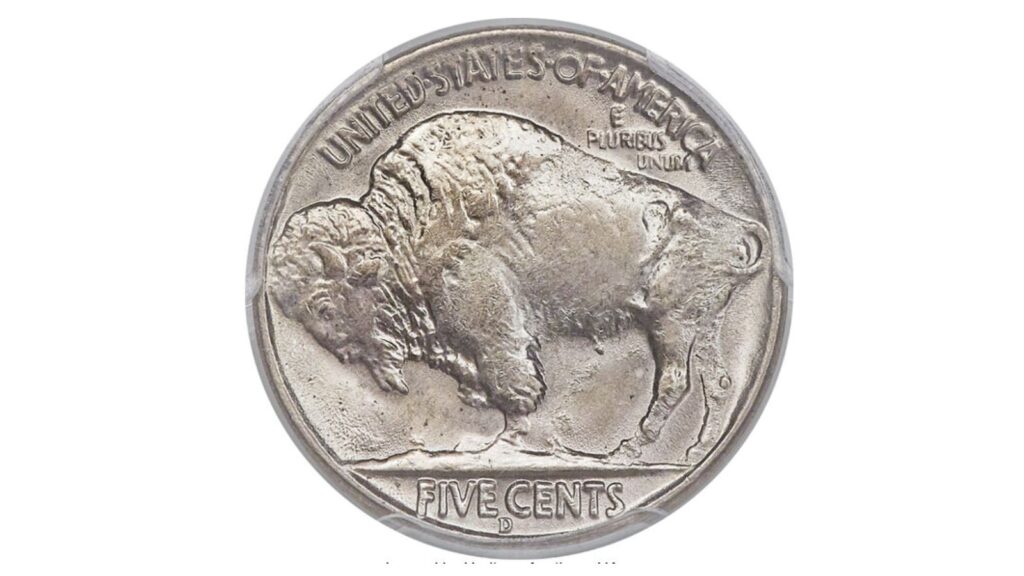
The name is slightly misleading because the Denver Mint didn’t design a three-legged bison. A worn reverse die developed clash marks, and whoever polished it to remove them went too far, grinding away almost the entire front right foreleg of the animal. The hoof remains, which makes the error look odder the more carefully you examine it. All genuine examples come from a single die, and the surviving population is estimated at roughly 10,000 pieces in all grades combined.
Circulated examples in VF to XF condition typically bring $800 to $1,500, with nicer about-uncirculated examples pushing toward $2,500 or higher. Mint state pieces are genuinely scarce and expensive. A specific authentication risk: some normal 1937-D nickels have had the leg filed off to create a counterfeit three-legger. The primary diagnostic on genuine examples is a faint horizontal line running beneath the bison’s belly, what specialists call the “stream,” visible on every authentic piece. No stream, significant doubt.
Many genuine examples show deep rust pitting across the surfaces, a result of the badly worn die condition at the time of striking. Moderate pitting is typical for the variety and doesn’t signal damage. Cleaning, however, collapses value substantially, and any example that looks unnaturally bright or polished should be viewed with skepticism.
1972 doubled die Lincoln cent (type 1)

About ten different doubled die varieties are documented for 1972 Lincoln cents, but only the Type 1 is considered a major variety. The doubling shifts southwest across the date, “IN GOD WE TRUST,” and “LIBERTY” and is clearly visible to the naked eye. It was catalogued in the standard reference guides as soon as it was identified. A few thousand examples are estimated to exist, making this the most accessible of the major Lincoln cent doubled dies by sheer supply.
Circulated examples bring $200 to $400, with choice uncirculated examples in the $1,500 range and top-grade certified pieces reaching several thousand. The southwesterly shift in doubling on the Type 1 is distinct enough from machine doubling that most collectors can learn to recognize it with a loupe and a few comparison examples. Machine doubling shows a flat, shelf-like appearance on the doubled portion; genuine hub doubling shows clear separation between the primary and secondary images with visible depth between them.
Because multiple 1972 doubled die types exist and carry different premiums, variety attribution on any grading service holder matters when you’re buying or selling. Type 1 is the one the market pursues.
1942/1 Mercury dime overdate

Overdates happen when a die receives impressions from two different date hubs, one on top of the other. On the 1942/1 Mercury dime, a 1941 hub was used to begin a working die before the 1942 hub was applied over it. What remains is a “1” clearly visible on the left side of the “2” in the date, and doubling in the middle digits visible with a decent loupe. The error happened simultaneously at Philadelphia and Denver in late 1941 when dies for both years were being produced side by side and some blanks got switched between hubs.
About 3,600 Philadelphia examples and 3,200 Denver examples are estimated to survive. In average circulated grades, both bring $400 to $700, with Denver commanding a modest premium in uncirculated grades. Uncirculated examples with Full Split Bands on the torch reverse push considerably higher, with MS63 examples bringing $2,750 to $3,000 depending on the mint. The silver content keeps the floor price from falling too far, but it’s the collector premium that makes it worth hunting.
To check for the variety: look at the left side of the “2” in the date with a 5x loupe. The undertype “1” should be clearly visible. Doubling at the base of the “4” is a secondary marker. Both should be present on a genuine example.
2004-D Wisconsin state quarter extra leaf
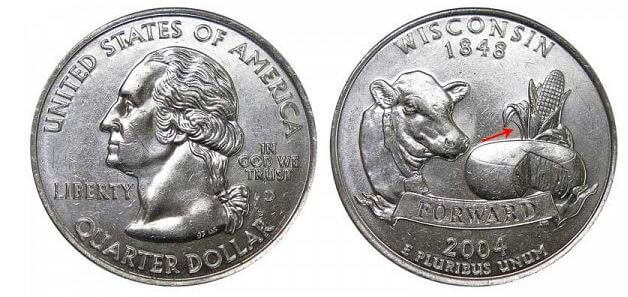
This one lives somewhere between a die variety and a genuine minting accident, and the hobby has been arguing about it for years. The corn stalk on the Wisconsin quarter’s reverse acquired an extra leaf on a small number of Denver Mint dies, pointing either up (high leaf) or down (low leaf). Because both varieties appeared on different dies at the same location on the design, some specialists have suggested the extra leaves may have been deliberately cut by someone at the Denver facility. The Mint has never confirmed anything either way.
The high leaf version is slightly scarcer and typically brings $100 to $300 in typical circulated and lower uncirculated grades, with certified high-grade examples reaching more. The low leaf is more common and sells in the $75 to $150 range for standard grades. Peak certified sales for exceptional examples have reached several thousand dollars. These quarters still surface in rolls and $1 coin bins, which makes them a genuinely accessible entry point into state quarter error collecting.
The error exists only on Denver-minted examples. The extra leaf sits below the large main leaf on the left side of the corn stalk. Philadelphia 2004 Wisconsin quarters do not have this variety.
1982 no-P Roosevelt dime

In 1980, the Philadelphia Mint began adding a “P” mint mark to all its coins for the first time in the denomination’s history. Before that, Philadelphia coins carried no mark. So a 1982 Roosevelt dime missing the “P” was immediately identifiable as wrong when the first examples surfaced near Sandusky, Ohio, where a regional distribution point had received them. An estimated 10,000 or so reached circulation, all produced from a die that was never punched with the required mint mark.
Typical examples in MS65 condition bring $200 to $400, with higher grades pushing toward $600 to $700 and the finest certified examples reaching $2,000 or above. The coin is still theoretically findable in circulation, though the chance of encountering one without specifically searching is low. The identification takes five seconds: look at the right side of the date on a 1982 Roosevelt dime. A Philadelphia coin from any other year in the modern era carries a “P.” One without any letter is the error.
The variety comes in two strengths based on how far the die was from being properly punched. Both Strong and Weak versions are valuable. One practical concern for collectors: a heavily worn “P” is different from a genuinely missing one, and if the letter looks faint rather than absent, it may not be the error. Certified attribution from PCGS or NGC removes that ambiguity.
11. 1983 copper Lincoln cent
Every 1983 Lincoln cent is supposed to be struck on copper-plated zinc. The Mint had completed the composition change mid-year in 1982, and by 1983 the old 95% copper planchets should have been gone entirely. A very small number weren’t. Whether leftover copper blanks from 1982 sat undetected in a hopper, or whether they came from the Philadelphia Mint’s simultaneous contract work striking Belgian coins on similar planchets, a handful of 1983 cents ended up struck on solid copper.
The visual difference between copper and copper-plated zinc is unreliable, so the weight test is the first diagnostic: genuine copper planchets weigh 3.11 grams versus 2.50 grams for the zinc version. A calibrated digital scale is the tool. Any 1983 cent hitting 3.1 grams or above is worth submitting to PCGS or NGC immediately. Certified examples have sold from $5,000 for circulated grades to $29,250 for the finest known example in MS65 Red condition. The total authenticated population remains very small, meaning new discoveries continue to matter.
Do not clean any suspected example. The original copper surface condition affects both grade and authenticity determination. The test takes thirty seconds. If you have a jar of old pennies, this is worth running.
12. 1995 doubled die Lincoln cent
The most accessible of the major Lincoln cent doubled dies, and the last one that will ever be produced. The Mint switched to single-hub production in the late 1990s, a process that eliminated this error type from the production line entirely. The 1995 Philadelphia version is the final chapter in a series of major doubled dies stretching back to 1909. The doubling on “IN GOD WE TRUST” is visible to the naked eye, and hundreds of thousands of examples are estimated to exist across multiple dies, which keeps prices within reach of ordinary collectors.
Circulated finds typically bring $20 to $40, and uncirculated examples in MS65 red condition sell in the $35 to $55 range. The Denver version is a different story: approximately 100 examples are known, it wasn’t discovered until years after the Philadelphia version, and it sells for hundreds of dollars even in circulated grades. On any roll of 1995 cents, if you find one with clear doubling on the motto, check the mint mark before assuming it’s the common version. A “D” changes the conversation significantly.
These coins are still found in change occasionally, making the 1995 DDO one of the few classic Lincoln cent errors where a pocket change discovery remains within the realm of possibility.
13. 1999 Wide AM Lincoln cent
A production mistake where a proof reverse die, intended exclusively for collector sets, was accidentally loaded into a press striking regular circulation coins. The difference shows in the spacing between the “A” and “M” in “AMERICA” on the reverse. On standard 1999 cents, those letters nearly touch. On the Wide AM version, there’s a distinct visible gap between them that matches the proof die spacing, which was never supposed to appear on a business strike.
The 1999 version is the scarcest of three recognized Wide AM dates, with 1998 and 2000 also carrying the same error. Circulated examples of the 1999 bring $100 or more, with uncirculated grades in MS66 and above pushing into the low thousands. The 2000 version is far more common and brings much less. To identify it: look at the “AM” in AMERICA on the reverse under a loupe. The gap between the letters should be obviously wider than on a standard cent from the same era. A secondary check is the designer’s initials “FG” on the reverse, which sit further from the Lincoln Memorial building on the Wide AM die.
These coins are still in circulation, which means roll searching with a loupe remains a legitimate approach for finding them.
14. 2007 presidential dollar missing edge lettering
Starting in 2007, the Mint moved the date, mint mark, “IN GOD WE TRUST,” and “E PLURIBUS UNUM” from the face of the coin to the edge of the new Presidential dollar series. That was also the year the Mint discovered that tens of thousands of coins were leaving the edge-lettering machine without going through it at all. The first release, the George Washington dollar, produced the largest number of missing-edge-lettering errors.
The 2007 Washington version is common enough that certified examples typically bring $50 to $100 and sometimes less. The interesting side of this error is which president and which year: some later releases in the series are substantially scarcer, with certain 2009 and 2010 issues bringing several hundred dollars or more in certified condition. The same error type affected all four annual releases through at least 2010, and populations vary significantly by president and mint.
The identification is immediate. Hold the coin up and examine the edge. A genuine missing-edge-lettering example has a completely smooth, blank edge with no text and no ornamentation. Coins with even partial or faint lettering are different, less valuable varieties. These still turn up at coin shows in $1 bins, making them one of the few modern Presidential dollar errors with genuine accessibility.
15. Off-center Lincoln cent (40% to 60% off center, date visible)
The most broadly accessible category in U.S. error coin collecting, and a genuine entry point for anyone starting out. Off-center strikes happen when a planchet doesn’t seat properly between the dies before the press fires, leaving a crescent-shaped blank area and compressing the struck design into a smaller portion of the coin. The results range from barely noticeable, worth almost nothing, to dramatic, with the design crammed onto one side and nearly half the coin blank.
For Lincoln Memorial cents from the 1960s through 2001, a coin that’s 40% to 60% off center with the date clearly visible typically brings $50 to $200 in average condition, with uncirculated examples and cleaner strikes bringing more. The date has to be visible for the coin to be properly attributed and sold at full value. A heavily off-center coin without a date is worth significantly less. The larger the denomination, the scarcer the off-center error and the higher the premium for equivalent quality. A similarly off-center Kennedy half dollar or Eisenhower dollar is worth several times the equivalent cent.
One thing to verify before assuming you have one: post-mint damage can look superficially like an off-center strike. Genuine off-center coins have a smooth, clean blank crescent where the metal flowed naturally outward from the struck portion. Damage from a vise or press shows different surface characteristics, usually with irregular tool marks or distorted design elements on the struck side.
If the coin market for errors is new to you, off-center strikes are where most collectors start, and for good reason: the errors are visually obvious, they’re affordable enough to build a real collection, and they still surface at coin shows and in estate lots with enough regularity that the hunt stays interesting.











