
Some six-figure jobs sound impressive at dinner. Others involve permits, inspection reports, maintenance schedules, customs paperwork, safety logs, and arguments about whether a loading dock is running three minutes behind.
That second group can be a surprisingly good place to earn a living. Companies still need people who understand complicated rules, keep physical operations moving, catch expensive mistakes, and take responsibility when something goes wrong.
Most of these jobs reward experience more than flash. You may spend years working your way up, but once you know the systems, regulations, equipment, or industry well enough, employers have a strong reason to keep you around.
Table of contents
- 1. Permit manager
- 2. Terminal manager
- 3. Import/export manager
- 4. Food safety manager
- 5. Environmental health and safety manager
- 6. Construction quality control manager
- 7. Healthcare quality and compliance manager
- 8. Biomedical equipment maintenance manager
- 9. Business continuity manager
- 10. Commercial real estate appraiser
- 11. Electrical engineer for power and industrial systems
- 12. Warehouse senior manager
- 13. Case management manager
- 14. Plant superintendent
- 15. Advanced manufacturing engineer
1. Permit manager

Permit managers live in the thrilling world of applications, plan reviews, agency comments, deadlines, and missing signatures. They keep construction, utility, industrial, telecom, and infrastructure projects from getting stranded because somebody forgot an approval. Typical national pay is about $122,523 a year.
The work is boring in a very useful way. A permit manager may spend the morning checking which approvals are outstanding, the afternoon talking with engineers and inspectors, and the end of the day updating schedules. Big projects can require dozens of overlapping permits, and delays can cost serious money. That makes an experienced person who knows how to move paperwork through the system valuable. You usually get here after several years in construction administration, engineering support, planning, utilities, environmental permitting, or project coordination. Regulations still have to be interpreted, agencies still want complete applications, and somebody still has to answer for missed requirements. Continued spending on utilities, energy, telecom, industrial facilities, and other infrastructure gives this niche plenty of work without making it remotely glamorous.
2. Terminal manager

A terminal manager makes sure trucks, trailers, freight, drivers, yard space, and dock schedules all line up. It is a job built around manifests, staffing problems, late arrivals, safety rules, damaged freight, and figuring out why something that was supposed to leave at 6:15 is still sitting there at 7:00. Average pay is about $124,169 a year.
Freight terminals do not run themselves just because routing software has improved. Someone has to deal with weather, broken equipment, absent drivers, overloaded docks, customer problems, and federal transportation rules in real time. The broader transportation and distribution field is expected to keep adding jobs as companies move larger volumes through increasingly complicated networks. Terminal managers commonly work their way up from dispatch, dock supervision, fleet operations, or warehouse management rather than arriving straight from school. A degree may help at larger employers, but deep operating experience carries real weight. The job can mean odd hours and plenty of repetitive reports, but the combination of physical operations, legal responsibility, and constant exceptions makes experienced terminal managers difficult to replace.
3. Import/export manager

If spending your day thinking about tariff classifications, customs documentation, country-of-origin rules, shipping records, and restricted-party checks sounds dull, import/export management delivers. These managers keep goods moving legally across borders and make sure one incorrect code or missing document does not hold up an expensive shipment. Average pay is about $115,852 a year.
The role shows up in manufacturing, pharmaceuticals, medical devices, aerospace, retail, chemicals, machinery, and any other business moving regulated goods internationally. Software can flag errors and organize documents, but companies still need someone who understands the rules, investigates exceptions, and decides what to do when a shipment does not fit neatly into a standard category. People often move into the job after working in trade compliance, customs brokerage, logistics, freight forwarding, or supply chain operations. Certifications in international trade or customs can help, but experience handling real shipments is especially useful. Global trade rules change, sanctions change, product classifications get disputed, and companies face real penalties for getting them wrong. That creates a durable need for people willing to become experts in paperwork few coworkers want to touch.
4. Food safety manager

Food safety managers worry about temperatures, sanitation logs, allergens, pest-control records, cleaning procedures, supplier documentation, employee hygiene, and whether a production line passed inspection. There is not much glamour in checking corrective-action forms after somebody found the wrong residue on a conveyor. The job pays about $121,062 a year on average.
Large food processors, beverage companies, commercial kitchens, distribution operations, and ingredient manufacturers need people who can keep facilities compliant and stop contamination problems before products reach customers. The stakes are high enough that companies cannot simply hand the responsibility to a dashboard. Managers investigate failures, question employees, review laboratory findings, inspect production areas, deal with auditors, and decide whether production can continue safely. Many start in quality assurance, microbiology, sanitation, food science, production supervision, or regulatory work before moving into management. A related degree is common, along with industry safety certifications. Food production is enormous, highly regulated, and permanent. As testing and traceability become more demanding, employers need experienced people who understand both the rulebook and what actually happens on a factory floor.
5. Environmental health and safety manager

Environmental health and safety managers deal with incident reports, machine guards, chemical storage, protective equipment, training records, noise exposure, waste handling, emergency plans, and the endless question of whether somebody followed procedure. Average pay is about $121,701 a year.
You find these managers in factories, warehouses, utilities, construction companies, transportation operations, laboratories, energy facilities, and other workplaces where mistakes can hurt people or trigger expensive violations. Demand for occupational safety professionals is growing strongly as employers face tighter expectations around worker protection and more complicated equipment. An EHS manager cannot monitor a facility entirely from a desk. The job includes walking sites, investigating accidents, talking with employees, evaluating hazards, dealing with inspectors, and deciding what corrective action is actually practical. Many managers have a degree in safety, environmental science, engineering, or a related field, although experienced tradespeople and safety specialists can also work upward. Professional safety credentials can make the jump into management easier. It is paperwork-heavy, repetitive, rule-bound work, but the person signing off on workplace safety carries responsibility employers cannot casually eliminate.
6. Construction quality control manager

Construction quality control managers spend their days checking whether work matches drawings, specifications, codes, contracts, and inspection requirements. Concrete tests, welding records, material certifications, punch lists, submittals, photos, and corrective-action reports are all part of the routine. Average pay comes in around $117,901 a year.
The role is especially common on large commercial, industrial, infrastructure, and government-related projects where contractors must document exactly what was installed and prove it met the standard. Construction management employment is expected to grow faster than average, and quality control becomes more important as projects get larger and more technically complicated. You generally need years of field experience before anyone trusts you with the job. Many quality managers come from superintendent, inspector, engineer, skilled-trade, or construction-management backgrounds and add certifications tied to concrete, welding, safety, or specific project types. Computers can organize inspection records, but they cannot crawl through a mechanical room, spot sloppy workmanship, question a subcontractor, and decide whether an installation should be rejected. It is detail-heavy work with plenty of documentation and arguments over specifications, which is precisely why experienced people can command strong pay.
7. Healthcare quality and compliance manager

Healthcare quality and compliance managers spend far more time with audit findings, policies, incident trends, accreditation requirements, corrective-action plans, and committee meetings than with anything resembling a television medical drama. Average pay is about $120,200 a year.
Hospitals, clinics, health systems, specialty practices, rehabilitation organizations, and other care providers need people who can prove procedures are being followed and fix problems when they are not. Healthcare management is one of the faster-growing parts of the labor market as the population ages and the system handles more patients, records, regulations, and reimbursement requirements. Quality managers often come from nursing, healthcare administration, clinical quality, accreditation, compliance, or process-improvement backgrounds. A bachelor’s degree is common, and some roles strongly favor people who already understand patient care. Software is useful for finding patterns in data, but somebody still has to investigate why a problem happened, interview staff, interpret requirements, design a workable response, and defend that response during an audit. For people who can tolerate meetings, policies, and documentation, that responsibility can turn into a durable six-figure career.
8. Biomedical equipment maintenance manager
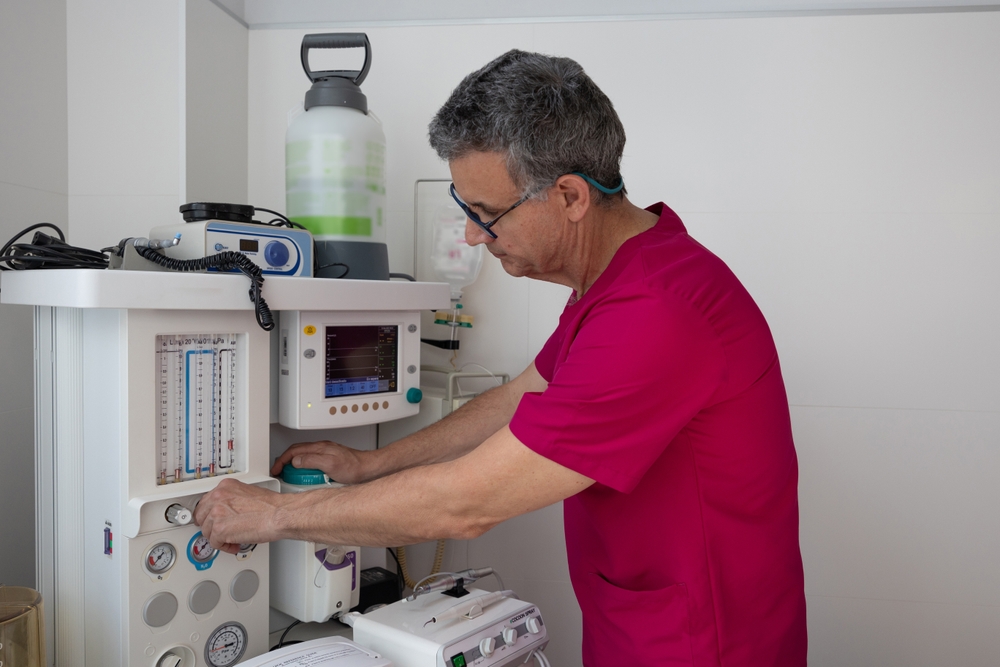
Biomedical equipment maintenance managers keep track of the machines hospitals depend on, including patient monitors, infusion pumps, imaging equipment, ventilators, sterilization systems, and other clinical technology. Much of the day revolves around preventive-maintenance schedules, repair backlogs, parts, service contracts, safety checks, and equipment records. Average pay is roughly $120,110 a year.
This is a particularly solid niche because hospitals keep adding increasingly complicated equipment, while the technicians who maintain medical devices are expected to see strong employment growth. A manager needs enough technical knowledge to understand failures, prioritize urgent repairs, supervise technicians, work with clinical departments, and decide when a machine should be fixed or replaced. People commonly start with an associate degree or technical training in biomedical equipment technology, electronics, or a related field, then build years of hands-on experience before supervising a department. Certification can help at higher levels. Remote diagnostics may identify some problems, but someone still has to enter the building, test the equipment, repair it safely, document the work, and take responsibility for machines attached to actual patients. That makes experienced managers unusually sticky employees.
9. Business continuity manager

Most business continuity work is not disaster-movie excitement. It is spreadsheets listing critical operations, backup locations, phone trees, recovery times, vendor dependencies, emergency procedures, and reminders that three departments still have not completed their annual test. Average pay is about $120,559 a year.
Banks, manufacturers, healthcare companies, utilities, insurers, transportation businesses, large retailers, and other organizations hire continuity managers because operations still need to function when a building closes, a supplier fails, a system goes down, or a major disruption hits. The manager interviews department heads, figures out what absolutely cannot stop, coordinates drills, documents backup arrangements, and pushes people to fix weaknesses before an emergency exposes them. Common backgrounds include operations, risk management, emergency planning, compliance, security, or project management. Professional continuity certifications can help. Templates and planning tools make the administrative parts easier, but they do not settle arguments over priorities or coordinate people when the real plan starts falling apart. The job is mostly preparation for bad days that may never happen, which is about as unglamorous as six-figure work gets.
10. Commercial real estate appraiser

Commercial real estate appraisers value office buildings, warehouses, apartment properties, retail centers, industrial sites, and other income-producing real estate. That means property inspections, lease reviews, zoning research, comparable sales, income records, photographs, measurements, and lengthy valuation reports. Experienced commercial appraisers average about $117,260 a year.
Basic property valuation has become more automated, but complicated commercial property is a different problem. Two warehouses that look similar on a database may have different tenants, lease terms, access, environmental issues, layouts, deferred maintenance, or redevelopment potential. Lenders, investors, tax authorities, attorneys, and other clients still need a qualified person to inspect the property and defend the final opinion. Employment in appraisal is projected to remain stable overall, with continuing replacement needs as experienced workers retire. The path usually involves coursework, supervised appraisal experience, examinations, and professional licensing or certification before you can handle major assignments independently. It is a research-heavy career for people who do not mind digging through leases, property records, maps, market data, and building details for days at a time. Complex commercial work also provides more protection from automated valuation tools than routine residential assignments.
11. Electrical engineer for power and industrial systems

A lot of electrical engineering has nothing to do with designing flashy consumer gadgets. Engineers working around power distribution, industrial equipment, substations, building systems, control panels, and large facilities can spend days reviewing drawings, calculating loads, checking specifications, investigating faults, and documenting changes. Median pay for electrical engineers is about $120,630 a year.
The occupation is projected to grow strongly as utilities upgrade the grid and businesses build more electrical infrastructure, generation, storage, manufacturing equipment, and high-demand facilities. These systems eventually have to exist in the physical world, pass safety requirements, and work without setting expensive equipment on fire. That keeps engineers involved in site visits, testing, commissioning, troubleshooting, and design approval even as engineering software gets better. A bachelor’s degree in electrical engineering is the standard entry route, and professional licensure becomes valuable for engineers who take responsibility for certain designs. It can be deeply repetitive work, especially when you are reviewing the twentieth equipment schedule or tracing an intermittent fault through pages of diagrams. But electrical infrastructure is becoming more important, not less, and employers need people who understand what happens beyond the computer screen.
12. Warehouse senior manager

A warehouse senior manager oversees the less glamorous end of getting products to customers: receiving schedules, storage capacity, labor coverage, inventory errors, damaged goods, safety problems, equipment downtime, and trailers that arrived at exactly the wrong time. Average pay is about $123,972 a year.
Transportation, storage, and distribution management is expected to grow faster than average as companies handle larger and more complicated flows of goods. Warehouses may use more robots, scanners, and automated storage systems, but that does not remove management. It changes what managers supervise. Someone still has to handle staffing, maintenance problems, bottlenecks, safety incidents, carrier disputes, inventory discrepancies, and the hundred unusual cases a normal shift can produce. Senior managers usually work up through warehouse supervision, distribution, inventory control, logistics, or transportation roles. Some large employers prefer a degree, while others place heavy weight on operating experience and a record of running increasingly large facilities. The hours can be inconvenient because distribution centers may run around the clock. If you can manage people and physical operations without losing track of thousands of moving pieces, that boring background can become surprisingly valuable.
13. Case management manager

Case management managers supervise the people coordinating patients’ care, discharge plans, referrals, insurance requirements, follow-up services, and movement between hospitals, rehabilitation facilities, nursing care, and home. The job involves staffing schedules, utilization reviews, difficult cases, documentation audits, meetings, and plenty of phone calls. Average pay is around $115,663 a year.
This is healthcare without the adrenaline of an emergency room. Much of the work is making sure patients do not get stuck in the wrong setting because a referral, authorization, transportation arrangement, or care plan fell through. As healthcare demand grows, organizations need experienced managers who can coordinate increasingly complicated cases while controlling delays and meeting regulatory requirements. Many case management managers are registered nurses or social-work professionals who first spend years handling cases themselves, although requirements depend on the employer. Clinical experience matters because the manager has to make judgment calls when a tidy policy does not match a messy human situation. Systems can suggest next steps and flag missing records, but patients, families, doctors, insurers, and outside facilities still need a person to resolve disagreements and build a workable plan.
14. Plant superintendent

Plant superintendents keep manufacturing facilities producing what they are supposed to produce. Their days revolve around output targets, shift coverage, downtime, maintenance, scrap, quality problems, safety meetings, production reports, and figuring out why yesterday’s plan no longer works today. Average pay is about $122,386 a year.
This role tends to reward people who know a particular kind of operation from the floor up. Superintendents can work in food plants, materials production, machinery, chemicals, packaging, building products, and other industrial settings. They usually arrive after years as operators, engineers, maintenance staff, frontline supervisors, or production managers. A degree is common in some plants, but practical operating experience can be equally important in others. Manufacturing management is expected to remain broadly stable, with thousands of openings created as experienced leaders retire or move on. Modern plants may automate repetitive production, yet automation itself creates maintenance issues, process failures, safety questions, staffing changes, and expensive downtime. Someone still has to walk onto the floor, understand what is happening, coordinate the people fixing it, and decide when production is safe to restart.
15. Advanced manufacturing engineer

Advanced manufacturing engineers figure out how factories should build things repeatedly without wasting time, materials, energy, or money. A senior engineer might study a bottleneck, redesign a workstation, specify new equipment, run production trials, troubleshoot defects, document procedures, and then spend weeks proving that the revised process actually works. Advanced Manufacturing Engineer IV roles average about $121,365 a year.
The title sounds futuristic, but much of the job is painstaking process work. Manufacturing companies need experienced engineers whenever they install new machinery, increase capacity, change products, move production, or discover that an expensive line cannot consistently hit its targets. The usual route starts with an engineering degree and several years in manufacturing, process engineering, industrial engineering, equipment engineering, or production support. Senior roles require a person who can deal with technicians, operators, vendors, managers, quality teams, and real machinery rather than simply produce a theoretical design. Factories will continue adding automation, but somebody has to decide how that equipment fits into the process, make it reliable, validate the results, and solve the strange problems that appear once production begins.











