
Plenty of family homes have a shoebox or a binder of Pokémon cards that nobody has touched in years. If you’re clearing space or want a little extra cash before the holidays, it’s fair to wonder whether they’re worth anything. Some might be. Most won’t be. The useful part is working out which is which without losing a whole weekend to it.
The prices below are sold prices tracked by UltraBall, a Pokémon card price guide, at the start of November 2026. Unless stated otherwise they’re for a raw (ungraded) card in near-mint condition, meaning it looks unplayed.
Table of contents
Talk to your kids first
Before anything goes online, ask whose cards they are. A child who hasn’t opened the binder in years may still care a lot about one particular card, and a teenager may happily help sell in exchange for a cut. Agreeing on that upfront saves an argument later.
Set your expectations
Across every English card UltraBall has good sales data for, nearly half have an ungraded price under a dollar. That’s the honest starting point. A typical recent common, like Rotom from the 2024 Surging Sparks set, sells for about $0.10.
The reason to look anyway is that value is uneven. A Magikarp from Paldea Evolved, a 2023 set, sells for about $301, and it came out of the same kind of booster pack. Older cards can surprise you too. The plain Pikachu from the original 1999 Base Set is a common, and it still sells for about $9.74.
How to look up a card
Every card has a number printed near the bottom, something like “58/102”. The first number is the card’s place in the set and the second is the size of the set. Next to it there’s usually a small set symbol. Search with the card name and that number and you’ll normally land on one match. Cards from the original Base Set have no symbol at all, which is itself a clue.
Watch out for reprints, because classic cards have been reissued and look a lot like the originals. An original Base Set Charizard sells for about $677 raw. The Base Set 2 reissue goes for about $400, and the Celebrations: Classic Collection reprint for about $175. They’re all real cards, but you’d want to know which one you’re listing.
Use sold prices, not asking prices. A card is worth what buyers have recently paid, which is usually less than sellers hope for.
Be honest about condition, too. Cards that lived in a pocket or a rubber band will have white edges or bent corners, and played cards sell for a fraction of the near-mint price.
Sort before you sell
Sorting is where most of the money gets made or lost. Pull out anything shiny, like holographic and full-art cards. Set those aside with any older cards and anything featuring popular characters such as Charizard, Pikachu, Umbreon and the other Eeveelutions, which tend to sell above their rarity.
Everything else is bulk, which sells by the box or by count to a local game shop or a bulk buyer. It isn’t worth listing a 10-cent card on its own.
Fees matter more on cheap cards
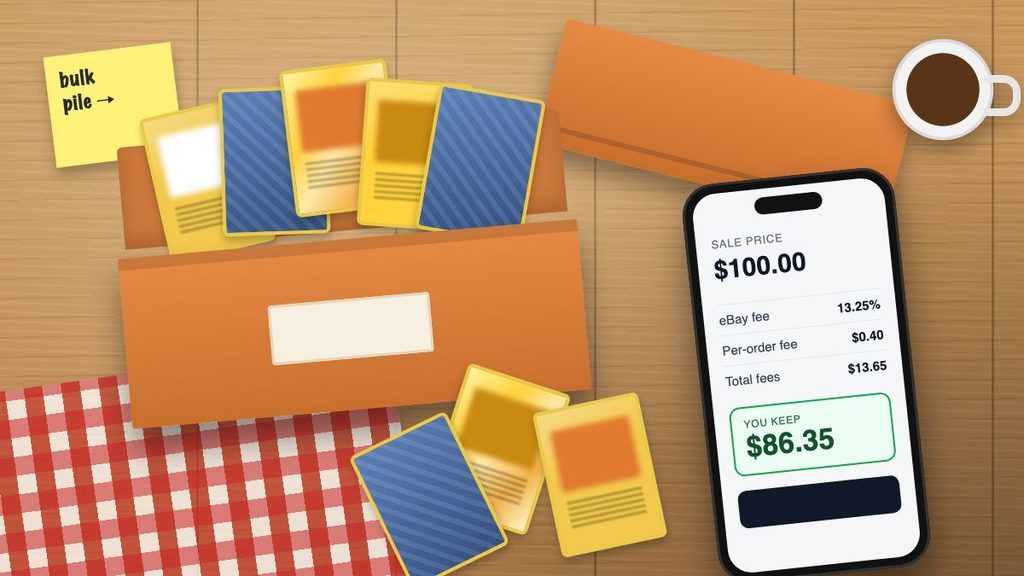
Selling platforms take a cut, and on cheap cards it hurts. As of September 2026, eBay charges 13.25% of the total sale, including shipping and sales tax, plus $0.30 per order on orders of $10 or less and $0.40 above that. On a $5 card the fee works out to $0.96, or 19.2% of the price, leaving you $4.04 before postage. On a $100 card the fee is $13.65 and you keep $86.35.
So list the best cards individually and group the middling ones into lots. Plenty of single cards are worth less than the stamp and sleeve needed to post them.
Picking a place to sell
Where you sell depends on your time and the cards. A local card shop pays on the spot but offers below market, since it has to resell what it buys, and many shops offer more in store credit than in cash. A card show puts several dealers in one room, so you can collect a few offers before accepting one. Online marketplaces usually get you closer to full price, at the cost of fees and trips to the post office. For a fuller comparison of the options, local ones included, see this guide on where to sell Pokémon cards.
If you’re selling to a stranger, keep payment on the platform, or meet somewhere public and count the cash before handing anything over. A buyer who wants to pay outside the platform “to save fees” is a common setup for a scam.
Should you get anything graded?
Grading means sending a card to a company like PSA, which seals it in a plastic case with a condition score from 1 to 10. As of September 2026, PSA’s cheapest open service is $59.99 per card before shipping. That only makes sense for a card worth far more in top grade and clean enough to get there. A Base Set Charizard is about $677 raw and about $40,800 as a PSA 10, but a copy that spent years in a kid’s binder is very unlikely to score a 10. For most family collections, skip grading and sell the cards as they are.
If the sort turns up a handful of cards worth $20 or more, that’s a decent return on an afternoon. Box up the rest for a bulk buyer, and phone local shops before driving over, since some only buy certain kinds of cards.










