
Open an old sewing box and you expect spare needles, odd buttons and tangled reels of thread. But what is that tiny metal wheelbarrow doing beside the scissors? Why does a brass bird have a screw under its feet? And why would anyone keep a thimble inside a miniature suitcase? Those are the objects worth examining before you clear the box out.
Some antique sewing tools have brought hundreds of dollars, and exceptional examples have sold for much more. Everyday versions often sell for far less. What matters is the actual item: its maker, materials, distinctive shape, working parts and whether it still has its original companions.
A complete set can be much more interesting than a handful of isolated tools. Before separating anything, take photographs of the contents exactly as you found them.
Table of contents
- Chinese export sewing boxes with fitted interiors
- W. Avery & Son novelty needle cases
- Victorian sewing birds and animal-shaped clamps
- Sterling silver sewing thimbles
- Miniature thimble cases and holders
- Stork-shaped embroidery scissors
- Complete antique embroidery kits
- Picture buttons and organized button collections
- Old needle-company countertop tins
- Porcelain half-doll pincushions
- Strawberry emeries and other figural pincushions
- World War I sweetheart pincushions
- Mauchlineware souvenir sewing accessories
- Mother-of-pearl spool covers
- Sterling silver needle cases
- Sterling-handled darning eggs
- Advertising needle books
Chinese export sewing boxes with fitted interiors
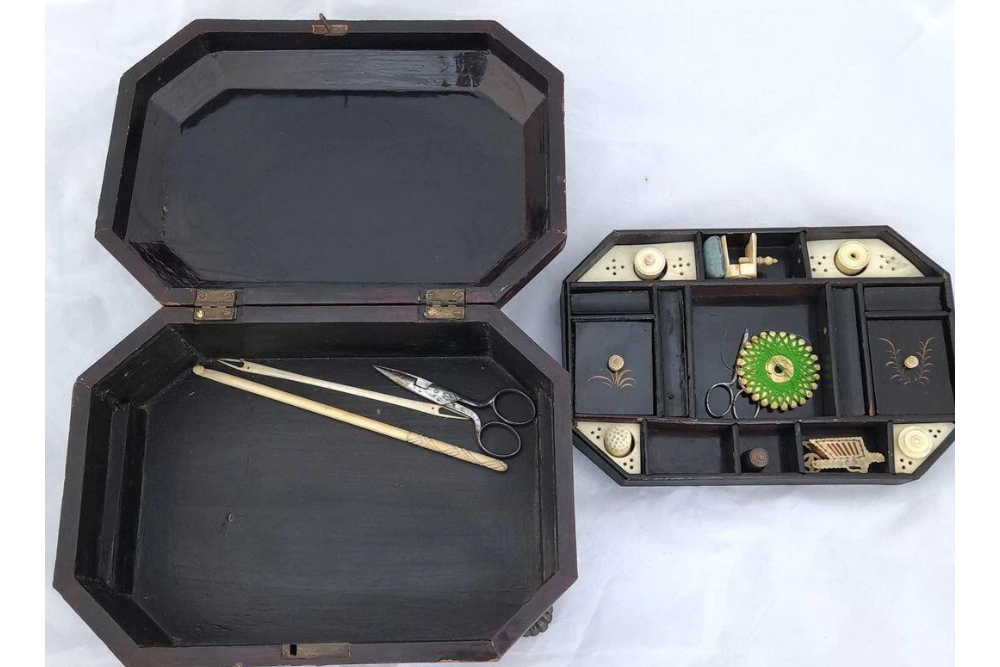
A 19th-century Chinese gilt-lacquer sewing box, still holding an assortment of its needlework fittings, brought $3,360. Decorated with gold scenes of figures and landscapes, it stood on winged dragon feet and opened to reveal covered compartments, a removable tray and a lower drawer. It was furniture in miniature, made to be admired on a table as well as used.
Inspect the inside before judging the outside. Carved bobbins, thread holders, a thimble, fitted dividers and a surviving key can help establish what is original. Lacquer may show rubbed corners or old repairs without making the entire piece worthless. Look for empty fitted spaces too, because a missing implement may have been put in a different tin. Avoid abrasive polishing; those gilded scenes and the lining are part of what collectors want.
W. Avery & Son novelty needle cases
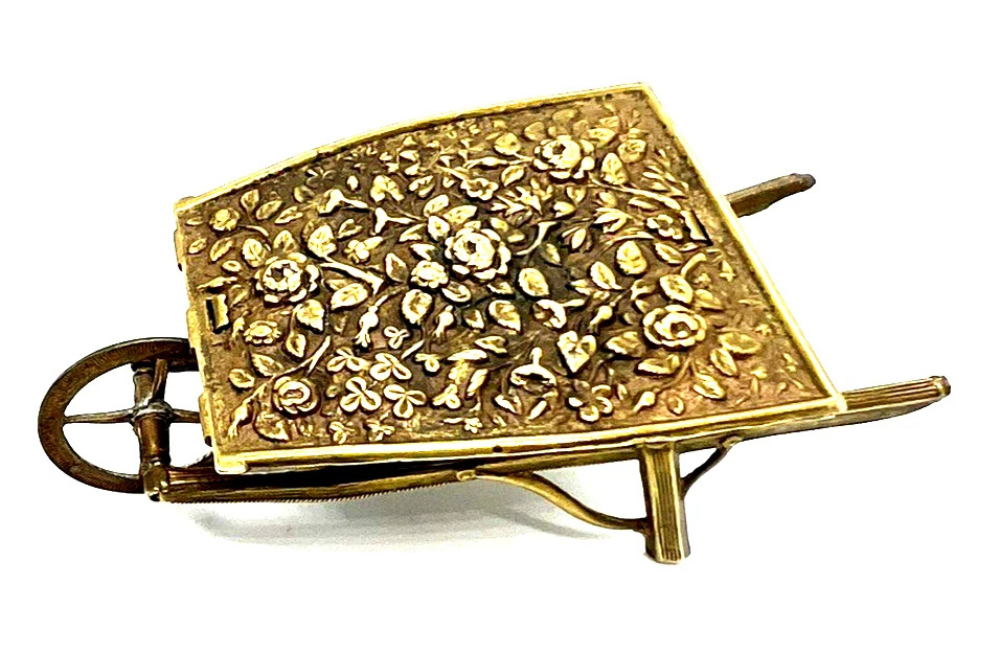
An 1874 W. Avery & Son needle case shaped like a tiny wheelbarrow sold for $220. It might look like a doll’s toy in the bottom of a sewing box, but it was made to hold needles. The Redditch firm produced a series of inventive brass needle cases and other accessories that are recognizable by their unusual shapes.
Check how the case opens, look closely for a maker or patent mark and see whether the tiny lid or compartment still works. Never force a stuck hinge. A broken handle or missing movable piece changes the desirability of a small novelty like this far more than a little dulling of the metal. Photograph the top, base and opening mechanism; those details will help distinguish a period needle case from a much later decorative miniature.
Victorian sewing birds and animal-shaped clamps
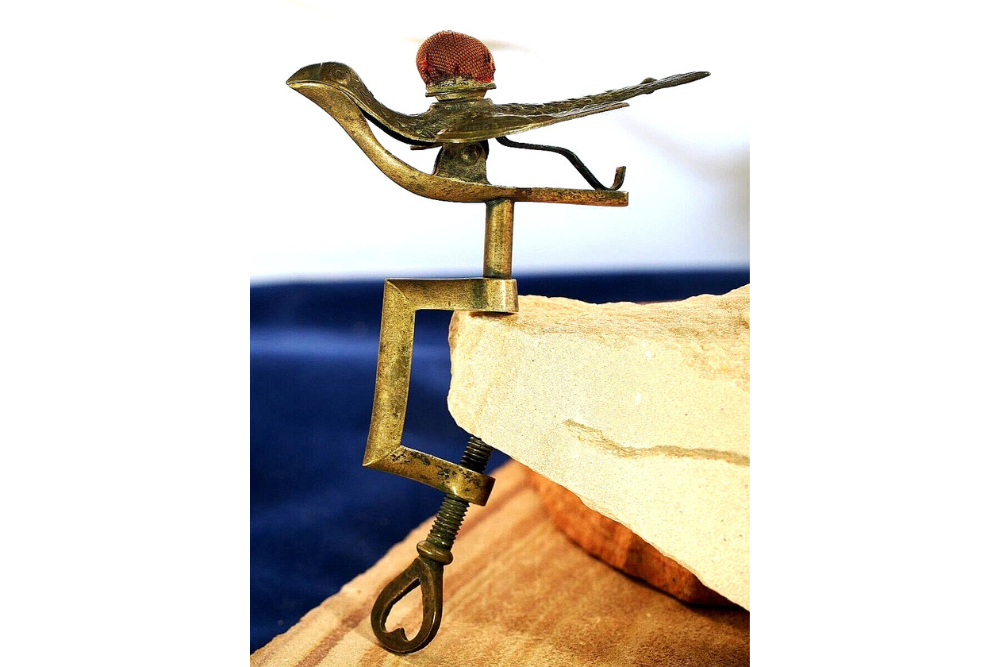
A particularly scarce butterfly-shaped sewing clamp with two pincushions brought $1,495. Its nickel-plated brass jaws held fabric taut while someone stitched. Antique clamps also took the forms of birds, dogs, snakes and other creatures, often with springs, little jaws and screws that fastened them to a table.
The animal is not the only thing worth examining. Look for the complete screw assembly, a sound spring and an original pincushion mount. Elaborate animal designs required more work than the familiar plain clamps. Sewing birds have been reproduced for decades, however, so an old patent date stamped on a wing is not enough to authenticate one. Compare the casting or sheet-metal work, feather detail and construction with established period examples.
Sterling silver sewing thimbles
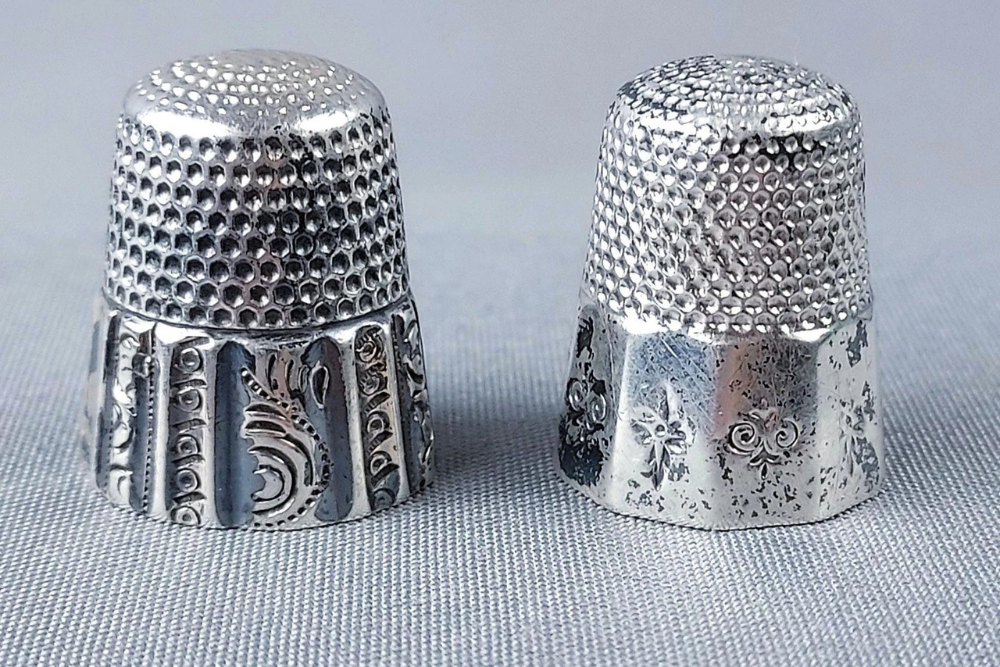
A vintage sterling silver thimble brought $21. That is a useful sum for an object small enough to vanish in a pocket, but it also puts ordinary silver thimbles in perspective. A genuine silver mark is worth checking; it does not automatically turn every sewing thimble into a four-figure treasure.
Inspect the inside rim for a maker’s mark, a sterling stamp or hallmarks. Decorative borders, engraved initials and the arrangement of the small dimples are worth photographing. A split rim, worn-through crown or deep dent is a problem on a thimble intended to be used or displayed. Plated base metal may have a similar color after years in a sewing tin, so avoid assuming the metal is solid silver until the mark has been checked.
Miniature thimble cases and holders
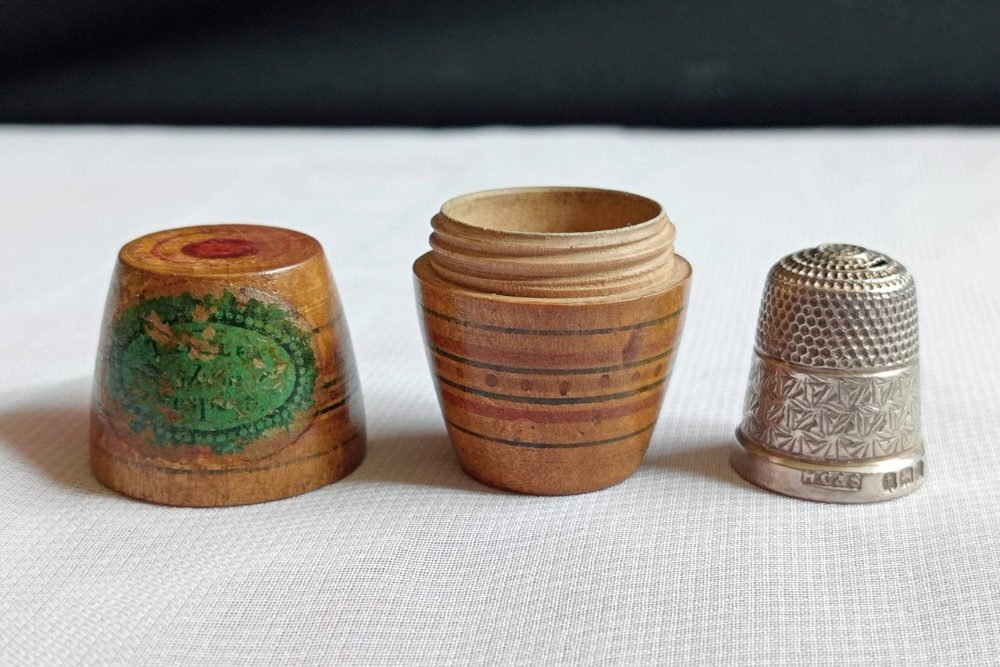
A 21-piece group of antique thimbles and their cases brought $348. Among the holders were a hinged W. Avery & Son brass box with a pincushion top, a shell-mounted case, turned wooden containers and a lithographed tin case shaped like a little travel bag advertising a Wisconsin hotel. The total was for the entire group.
These containers often get mistaken for pillboxes or souvenirs after the thimble has been removed. Check for a fitted interior, worn velvet, an old chain or the impression of a thimble in the lining. Named makers and specific advertising pictures offer more identification clues than an anonymous plain case. Keep a thimble with its original container if the pairing has survived, and leave fragile printed paper or leather surfaces alone rather than scrubbing them clean.
Stork-shaped embroidery scissors
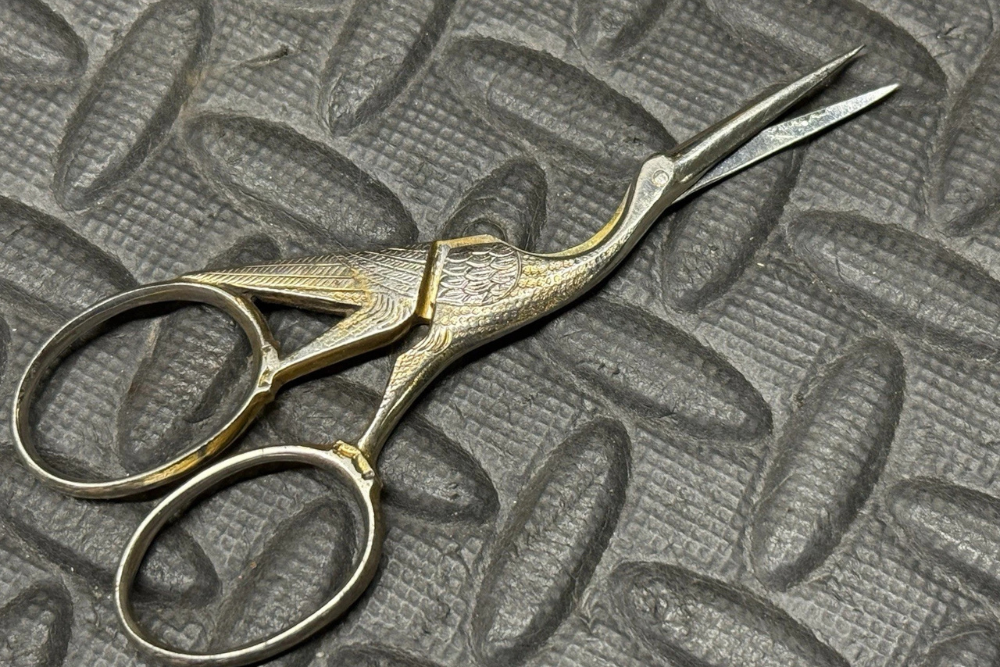
A vintage pair of stork embroidery scissors, one with a gold-tone finish and the other with a silver-tone finish, brought $14. Their long, pointed beaks form the blades, while the bird’s body makes the handles. The design was useful for trimming embroidery threads close to the fabric, and it is still recognizable decades later.
Look for a maker, country-of-origin stamp and blades that meet properly at the point. The bird shape itself was widely made, so it is not proof of age or rarity. A damaged tip or loose pivot matters more than a little patina on the handles. Older scissors sometimes retain a small original sheath. Keep that with the pair; it both protects the blades and tells a prospective buyer that the accessory has not been lost.
Complete antique embroidery kits
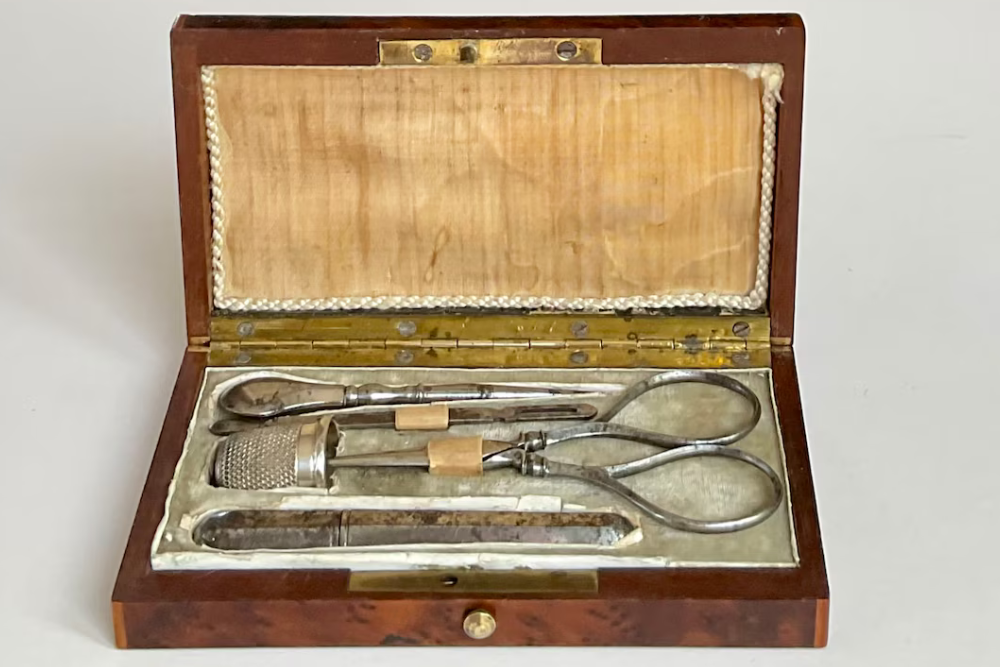
Two antique embroidery kits with their original-style contents brought $348 together. One wooden box was labeled “The Little Embroiderer/La Petite Brodeuse” and contained a miniature frame and bookmark patterns. Another was labeled “Mercerie” and held floss, needles, printed patterns, scissors and a thimble.
The pictures and paperwork are part of the attraction. Look for small hoops, bookmark cards, pattern sheets, needle packets and tools made to fit a particular compartment. A box full of modern replacement thread is not the same as a kit that has retained its old contents. Before you remove anything, photograph the arrangement. Loose printed instructions found elsewhere in the sewing box may belong to the kit, and even torn originals are worth keeping.
Picture buttons and organized button collections
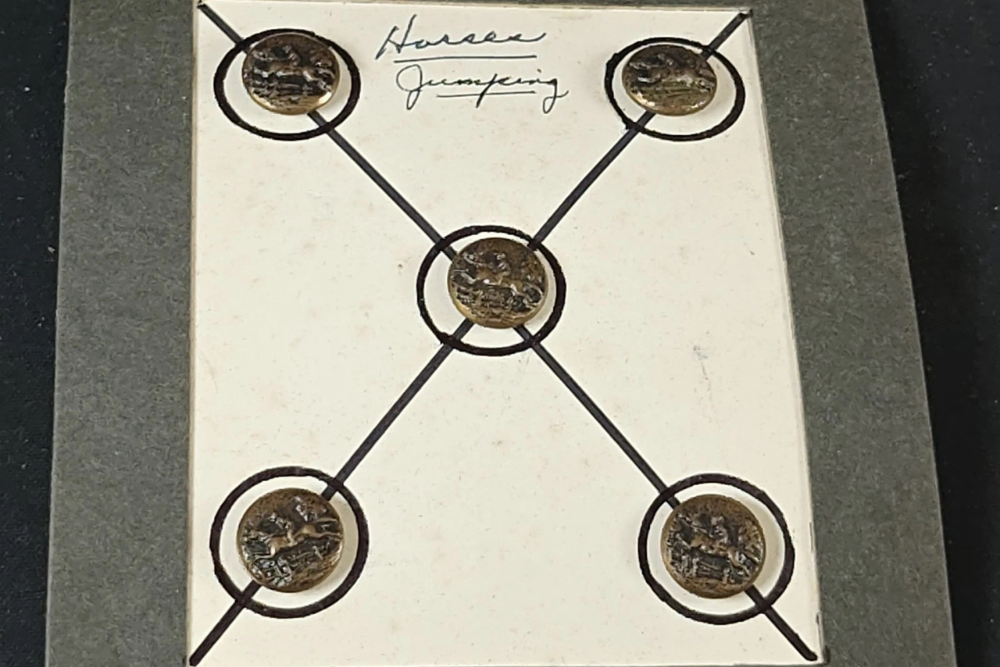
A carefully organized collection of more than 1,000 buttons, accompanied by seven specialist books, brought $2,596. The collection included picture buttons, military designs, enamel, black glass, mosaic, cameo, animal and other unusual examples. That figure is for the entire documented collection, not a single button from an old tobacco tin.
Turn promising buttons over. A distinctive shank, maker’s name, unusual material or recognizable scene may explain why somebody saved it. Glass buttons can be chipped around the back even when the front looks fine; matching sets are also easier to sell when they remain together. If your grandmother mounted her better buttons on cards or kept notes about them, preserve those too. The organized, identifiable examples are a different proposition from a jar of anonymous spares.
Old needle-company countertop tins
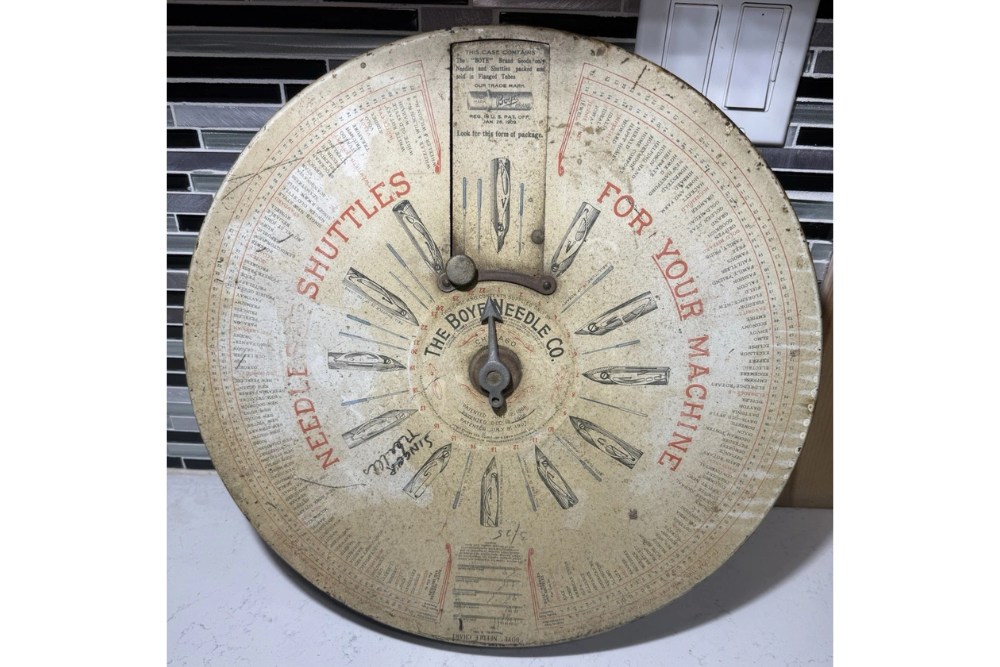
An H.S.B. & Co. tin display containing packets of O.V.B. sewing-machine needles brought $126.50. The maker’s initials stood for Hibbert, Spencer, Bartlett & Co., and O.V.B. was the “Our Very Best” line. It was a shop display, complete with divisions for different needle packets, rather than a regular household sewing tin.
You are more likely to find the surviving paper packets than the whole display, but both are worth recognizing. Printed needle sizes, company names, machine types and older illustrations help identify what you have. Packet corners can become brittle, especially if the needles have rusted inside. Keep original envelopes together, and check an old sewing-machine drawer or cupboard if the main box only holds part of a group.
Porcelain half-doll pincushions
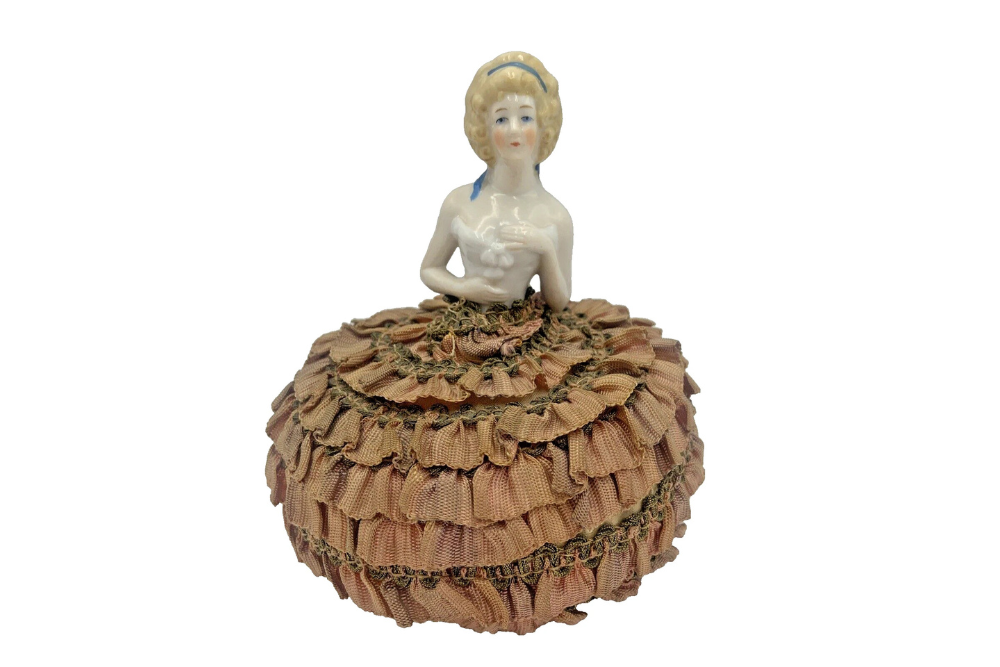
A porcelain lady pincushion with a fabric skirt, measuring about six inches high, brought $20. Half-doll pincushions have a painted upper body attached to a stuffed textile base, sometimes surrounded by lace or an elaborate skirt. What looks like a miniature ornament was often made to hold dressmaking pins.
Check the fingers, neck and painted face for chips, and look for a factory mark on the underside if it can be seen without disturbing the fabric. Replaced skirts are common, but the state of the original porcelain and the quality of the costume still deserve attention. The join between the porcelain and stuffed base can become weak with age. If a hand or piece of trim has come loose, save it in a small labeled bag instead of trying a quick glue repair.
Strawberry emeries and other figural pincushions
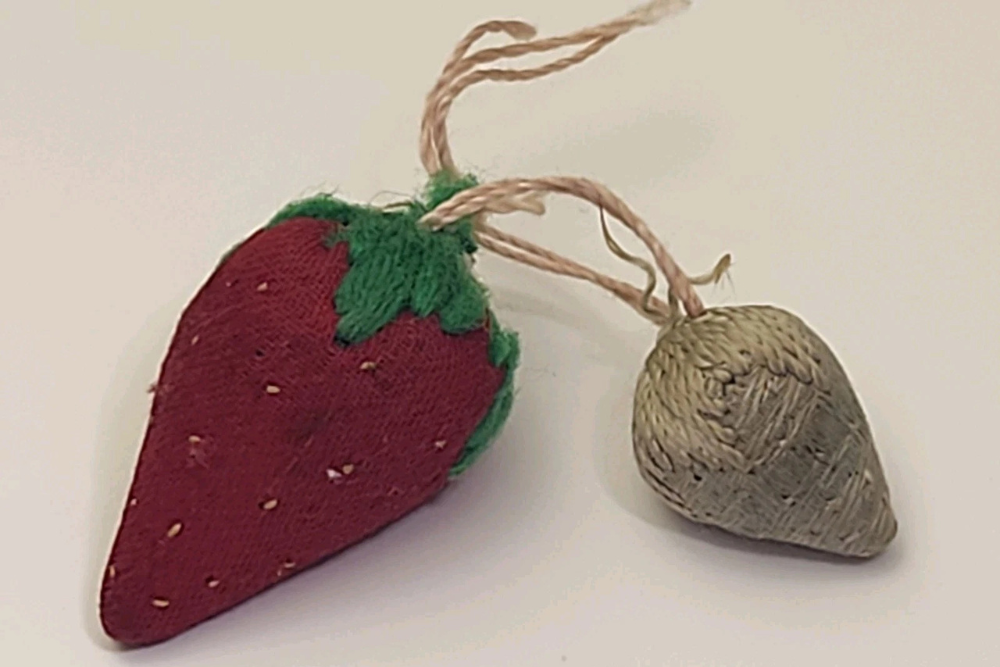
A 14-piece group of novelty emeries and pincushions brought $116. There were silk strawberries, a green carrot, a little cat, a shoe, an advertising heart and a peach still in its box. Emery cushions held gritty material used to clean needles, which is why a small fruit-shaped object sometimes hangs from an old tomato pincushion.
Look for original ribbons, carefully stitched leaves and printed advertising. The condition of the fabric matters: split seams, leaking fill, missing animal ears and staining are all easy to overlook in a crowded sewing box. A loose vintage emery with recognizable features deserves to be photographed separately. Do not cut one open to check its stuffing. It may have survived intact for a century and the fill is not needed to identify its purpose.
World War I sweetheart pincushions
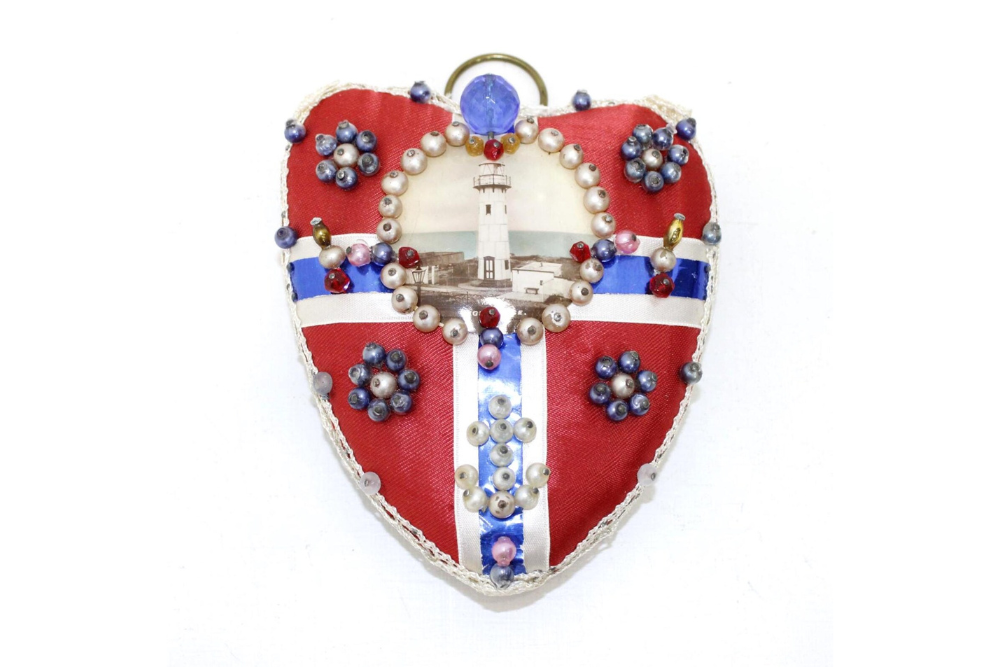
Eight antique sewing accessories, including a World War I sweetheart pincushion, brought $553 as a group. The heart-shaped cushion carried military patches, beadwork and messages including “Forget Me Not.” The same group contained other decorative needlework cases and pincushions, so the price was not for the heart alone.
These small textile keepsakes are worth examining for embroidered words, regiment insignia, dates or unusual decoration. Faded silk and missing beads do not erase their history, but they affect condition. Save any accompanying letters or family notes without assuming you know who made the cushion. Fragile examples are better stored flat than hung by old ribbons, which may no longer be strong enough to take the weight.
Mauchlineware souvenir sewing accessories
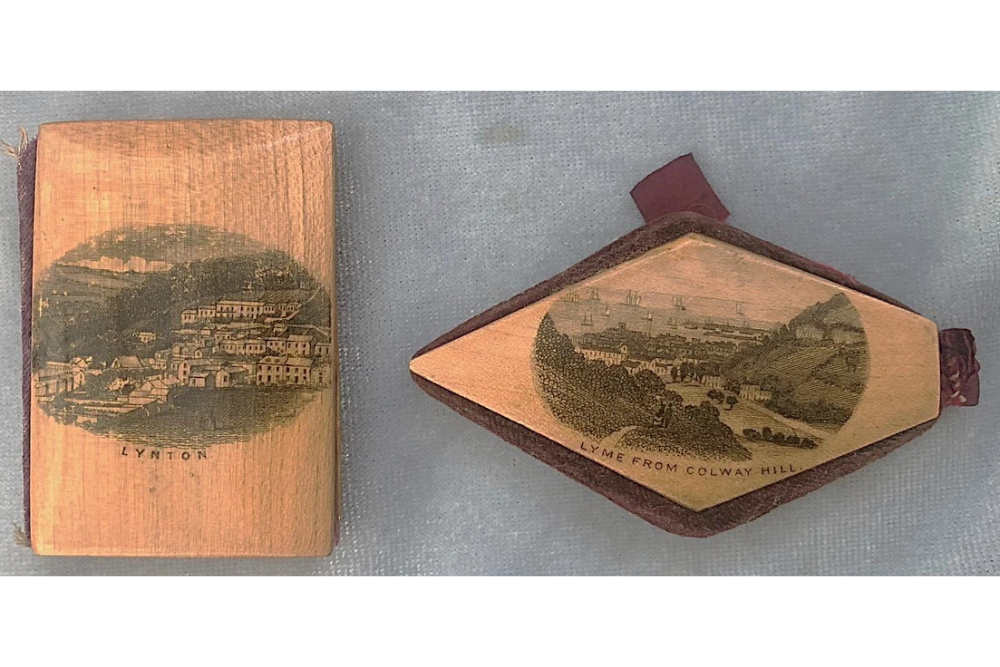
A group of Scottish Mauchlineware and tartan-covered sewing accessories brought $464. It included a needle book showing Edinburgh’s Scott Monument, a souvenir pincushion decorated with a Catskills hotel scene, a tartan holder and a folding miniature sewing box. They were useful tools that doubled as keepsakes from places people had visited.
Look for the place name or scenic print first. Small boxes, needle books, spool holders and pincushions can all carry this type of decoration. Hinges and tiny compartments often reveal a sewing purpose that is not obvious from the outside. Many surfaces are paper-covered or have delicate printed scenes; water and vigorous rubbing can remove them. Keep a damaged original cover with its accessory instead of replacing it with a new decorative one.
Mother-of-pearl spool covers
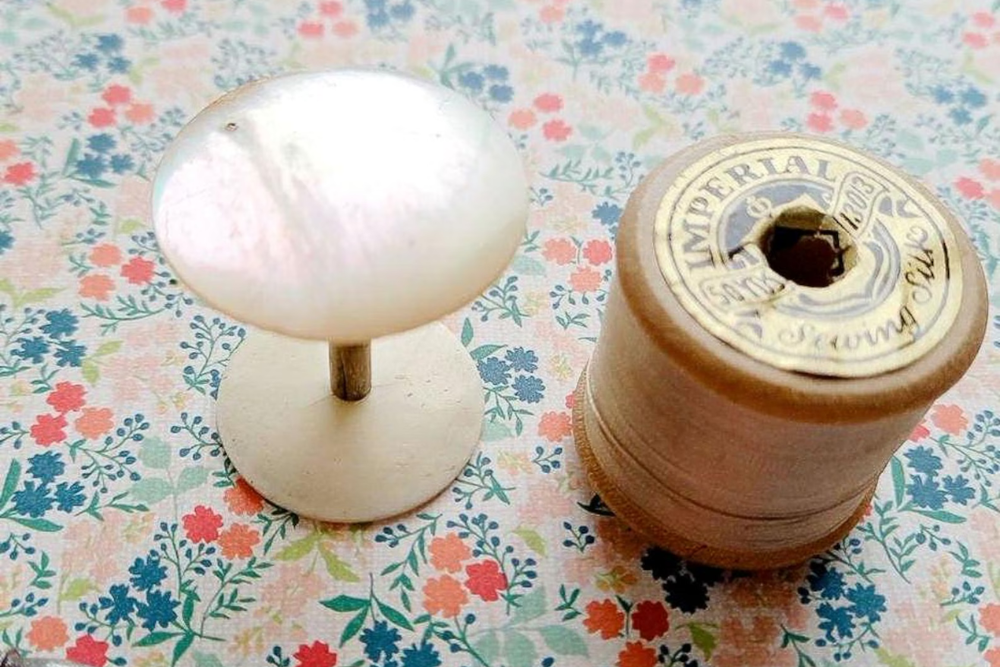
A Victorian black-lacquer sewing box containing eight large and three small mother-of-pearl spool covers, a gold thimble and other original-style pieces brought $1,044. That was the price for the complete decorated box and its contents. The iridescent shell covers sat over thread reels and helped keep a fitted sewing set looking orderly.
If you find several matching shell discs, do not assume they are loose game counters or discarded jewelry pieces. Check whether they fit thread reels and whether the box has compartments for them. Genuine mother-of-pearl shows a shifting natural sheen, although chips and hairline cracks may be visible only in angled light. Matching sizes and the presence of the original reels are useful clues. Photograph the arrangement before sorting the pieces into separate containers.
Sterling silver needle cases
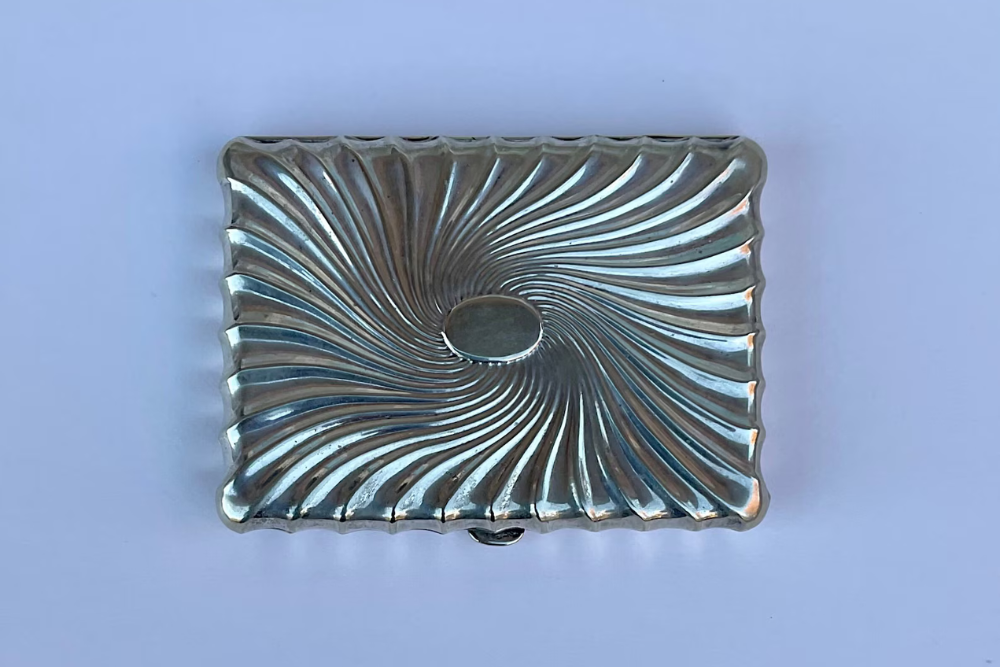
An antique sterling silver needle case weighing nine grams brought $45. A case like this may be a short, narrow tube with a cap or an ornate little container small enough to disappear among buttons. Silver examples can have engraved designs or decorative ends even when their construction is quite simple.
Check the cap, the rim and any hallmarks, and make sure the case really is designed to hold needles. Steel needles can rust inside and make a lid difficult to remove. Deep dents, split seams and broken hinges are more serious than normal tarnish. Keep a case separate from loose scissors to avoid further scratching, and show both the exterior and the hallmarks in any photographs.
Sterling-handled darning eggs
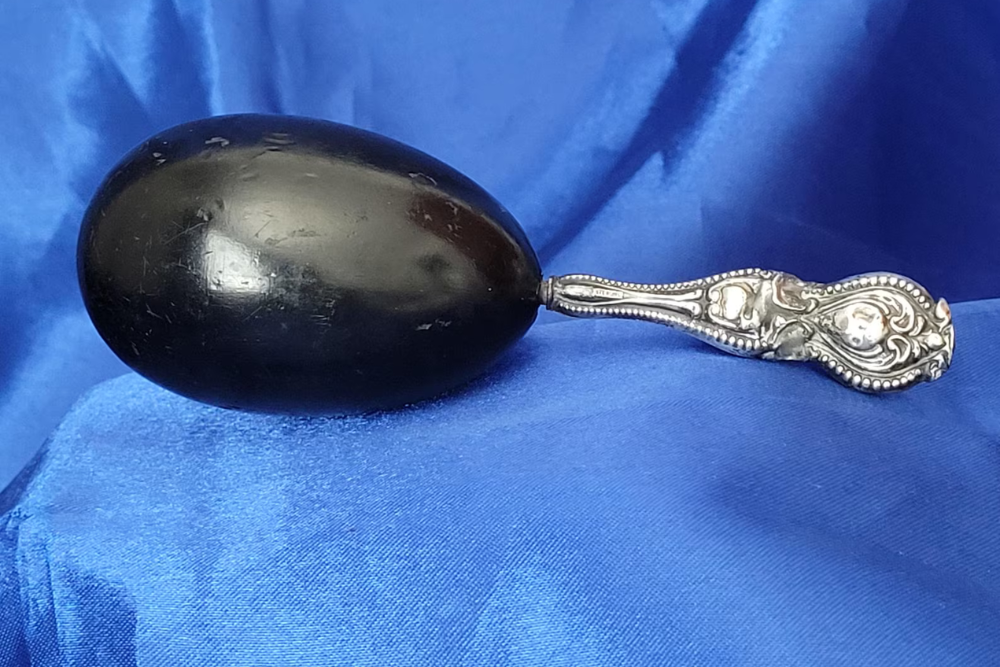
An antique assortment of sewing tools that included three darning eggs with sterling silver handles brought $696. The same group held a fitted needlework case, decorative thimble holders and numerous thimbles. The darning eggs were part of that larger collection rather than individual $696 items.
A darning egg was slipped into a sock to hold the fabric smooth while a hole was repaired. Look for an evenly rounded working end and a firmly attached handle. A silver fitting may carry a hallmark, while the wooden or other body often shows wear from use. If you have a matching set, keep it together. The combination of a familiar household function and unusual materials is what makes these worth checking instead of tossing into a general craft-supplies box.
Advertising needle books
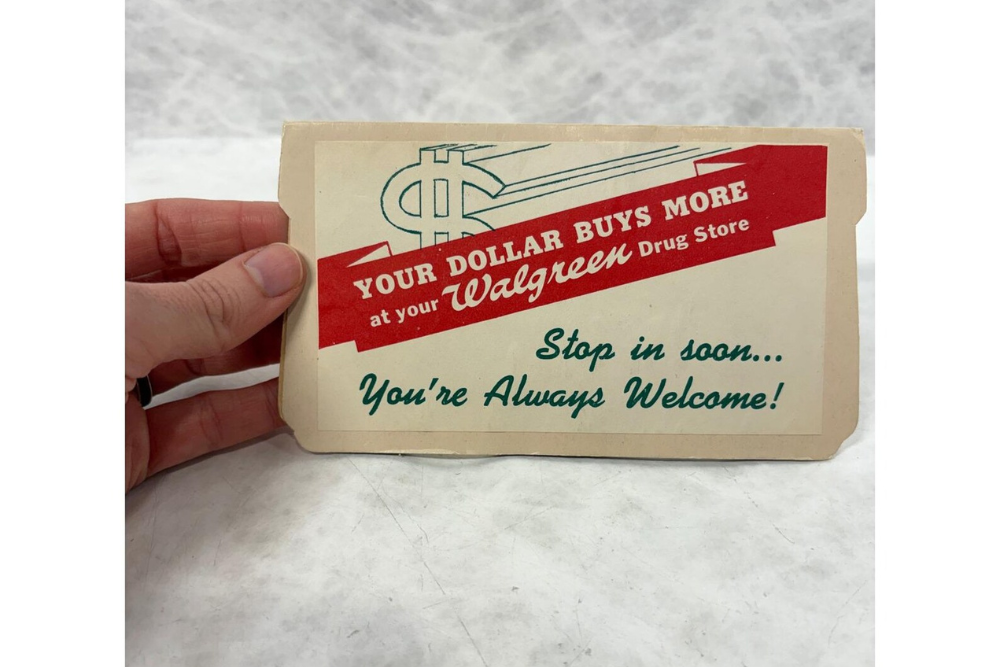
A collection of vintage sewing needle books brought $27.50. These folded paper packets often have colorful covers, family scenes or business advertising, with a card of needles stitched or fixed inside. They were inexpensive household essentials, which is why it is surprising how easily an attractive old packet can be mistaken for rubbish.
Inspect the printing before deciding that an almost-empty book has no use. The shop name, needle maker, illustrations or a particular advertising slogan can make it identifiable. Old paper tears along the folds, while steel needles can leave rust marks. Leave the original needle card attached where possible and photograph the small print on both sides. An orderly little group of varied designs is more interesting than torn paper envelopes mixed with modern replacements.











