
That yellow and blue plastic house in the basement, the one with the doorbell that still rings and the garage door that still rolls up, is not just clutter waiting for a garage sale sticker. Fisher-Price has been making toys since 1930, and a surprising number of the ones that ended up in attics, toy chests, and church rummage sale boxes are worth real money today.
Most of what the company made was built to survive decades of hard play, which means millions of examples still exist and most of them are worth very little. The toys that command real prices are usually older, licensed, or tied to a specific version that only ran for a short time. Condition and completeness decide almost everything else. A toy missing one small plastic horse or one paper sticker can be worth a tenth of the same toy with every original piece intact.
Fisher-Price Pushcart Pete pull toy (1936 to 1937)
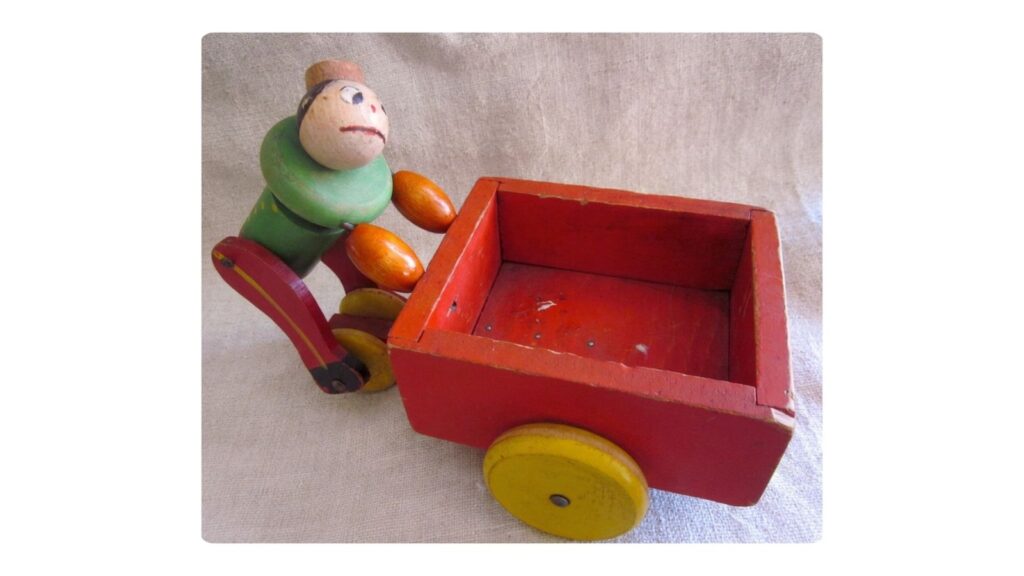
Pushcart Pete was one of Fisher-Price’s earliest toys, a wooden figure about nine inches long with a scowling painted face pushing a small red cart on yellow wheels and topped with a matching red hat. His head and body swivel on a pin joint as he moves forward, which is part of what made him charming enough for parents to buy in the 1930s and rare enough that almost none survived intact into the present.
A pristine, all-original example in excellent condition has reached as much as $9,200, though that figure reflects an exceptional early sale rather than a typical outcome. More realistically, clean examples with original paint and an intact cart bring $1,500 to $2,500 today. Because so few exist, reproductions and heavily restored examples are a real risk, so any wear pattern, paint texture, or joint construction that looks too fresh or too uniform is worth a second look before assuming you have an original. Confirming the swivel mechanism moves the way period examples describe is a good first check.
Fisher-Price Raggedy Ann and Andy pull toy (1941)
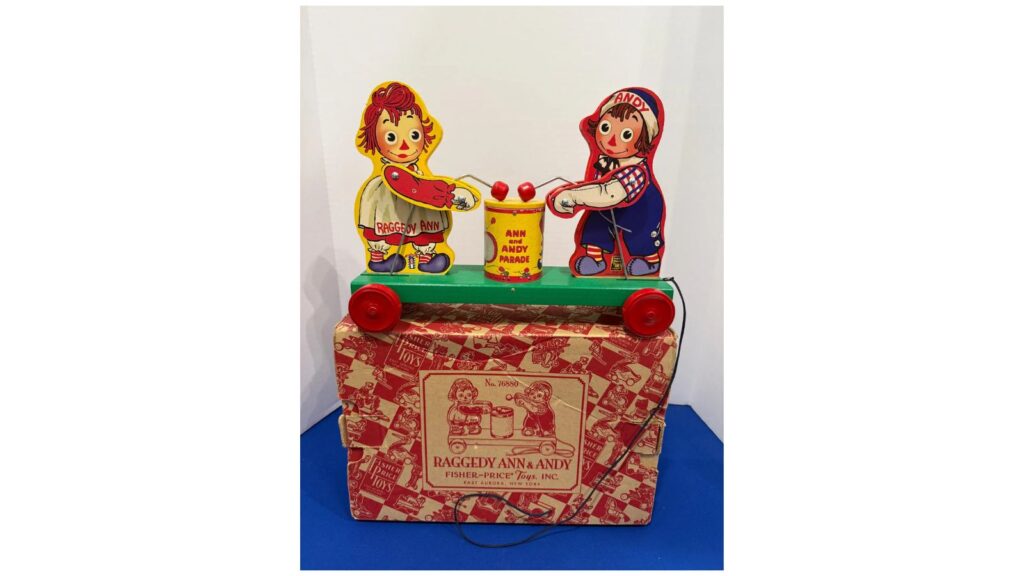
Fisher-Price made this one for a single year: two flat wooden figures of Raggedy Ann and Andy that beat a small drum with their mallets when the toy rolls forward, a mechanism the company reused across several of its character pull toys from this era. That one-year production window is what makes it scarce, regardless of which example you happen to find, since there simply wasn’t much time for the company to build up inventory before moving on to other licenses.
Complete, clean examples typically bring $2,500 to $3,000 today, with an especially strong early sale once reaching over $6,000. The completeness gap here is dramatic: an incomplete example missing Andy’s arms and the drum top still found a buyer, but for only a few hundred dollars. Check that both figures, both mallets, and the full drum assembly are present and that the mallets still strike the drumhead before getting excited about the higher end of that price range.
Fisher-Price Walt Disney’s Easter Parade pull toy (1936 to 1938)
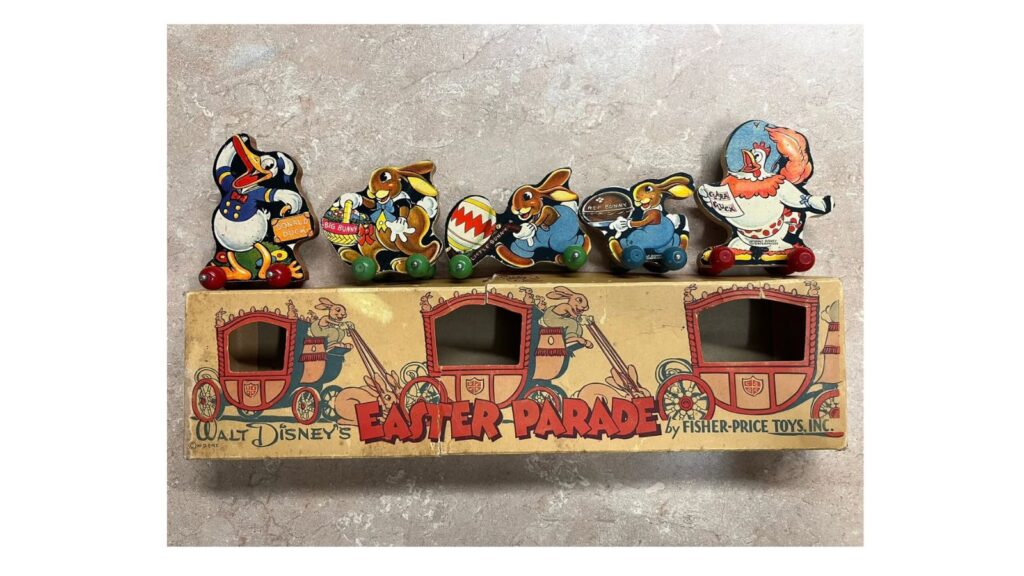
This toy features five separate wooden cutout figures, Donald Duck, Clara Duck, Big Bunny, Wee Bunny, and Little Bunny, each with paper lithograph detailing glued to a flat wooden silhouette and mounted on small wooden bead wheels that let the whole parade roll forward together. It’s one of the more elaborate Disney-licensed pull toys the company made in its earliest years, released during the same wave of Snow White and Mickey Mouse tie-ins that produced several of its most valuable pieces.
Clean examples with the original box typically bring $1,440 to $2,340, and standout examples have climbed considerably higher. The small bead wheels and delicate cutout figures were never built to survive rough handling, so a complete set of all five figures with no cracking, warping, or paint loss is genuinely uncommon. Missing even one figure meaningfully lowers what a buyer will pay, and a box adds a real premium on top of that.
Fisher-Price Doc and Dopey Dwarfs pull toy (1938)
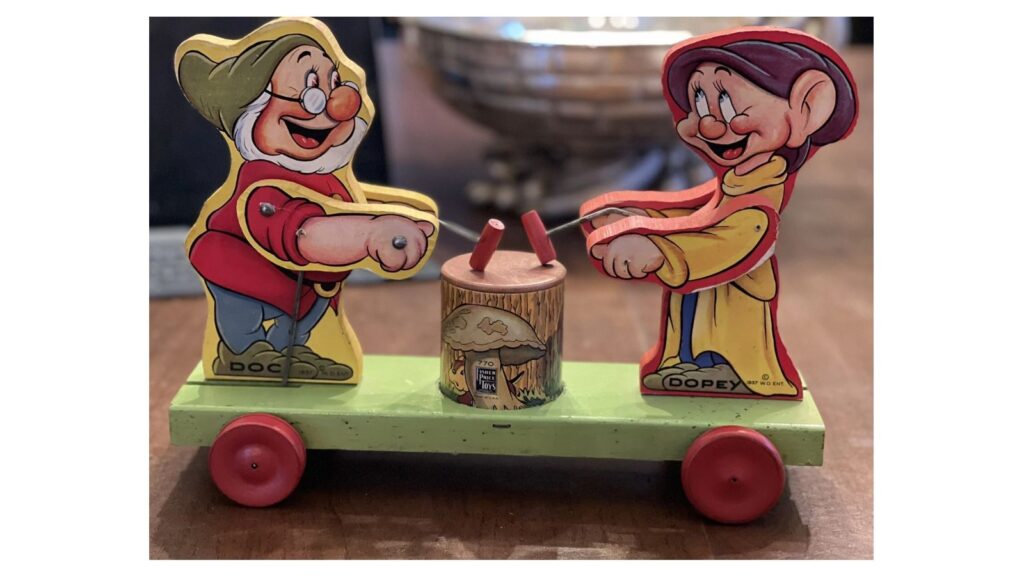
Released right after Snow White hit theaters, this pull toy features flat wooden cutout figures of Doc and Dopey that beat a small drum as it rolls, part of a wider run of Seven Dwarfs-themed toys Fisher-Price produced to capitalize on the film’s popularity. Disney-licensed toys from the company’s first decade sit at the top of most collectors’ lists, and this pairing is a good example of why that licensing era commands such a premium over the company’s unlicensed designs.
Clean, complete examples typically bring $1,200 to $2,000. As with the other Disney pull toys from this era, the paper lithograph work is what drives the price, since the printing detail on the dwarves’ faces and costumes is what collectors are really paying for. A played-with survivor with intact figures can still clear four figures, but cracking, water staining, or a broken drum top will cut that number substantially.
Fisher-Price Big Performing Circus wagon (1962 to 1969)
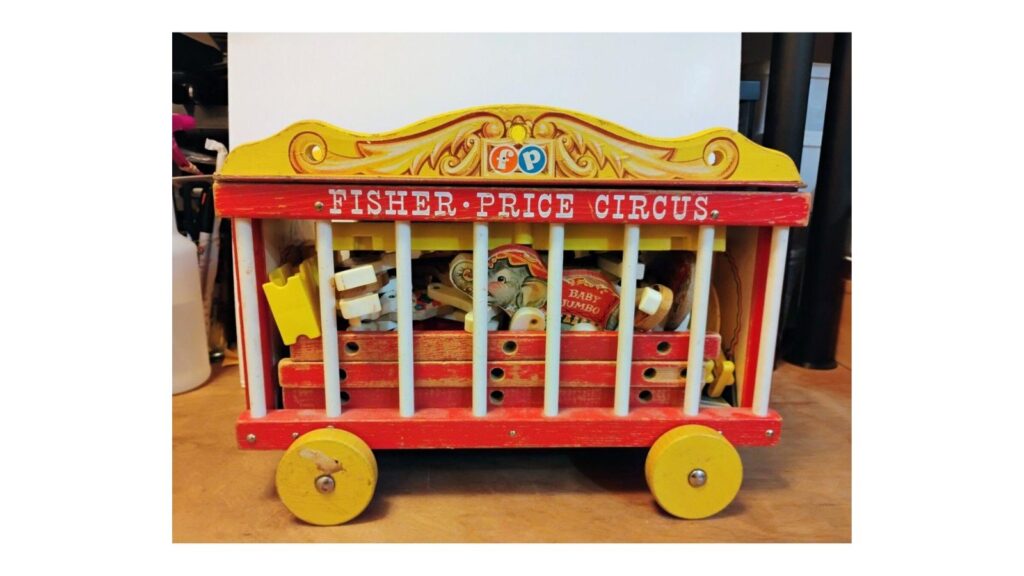
One of the most recognizable Fisher-Price pieces from the 1960s, this wagon came with eleven performer figures and twenty pieces of circus equipment, including ladders, a trapeze, ring sections, and a small ringmaster figure, all designed to be set up and torn down like a real traveling show. It’s a common enough sight loose at flea markets, but a genuinely complete example is a different story.
A bare wagon with a handful of pieces typically brings $50 to $150, while sealed, fully complete boxed examples have cleared as much as $800. The gap between those two numbers comes entirely down to whether every ladder, trapeze bar, and small prop survived four or five decades of play in the hands of a child. Count every piece against a checklist before assuming what you have is complete, since a wagon that looks full at a glance is often missing several of the smallest parts.
Fisher-Price Play Family Airport #996 (1972)
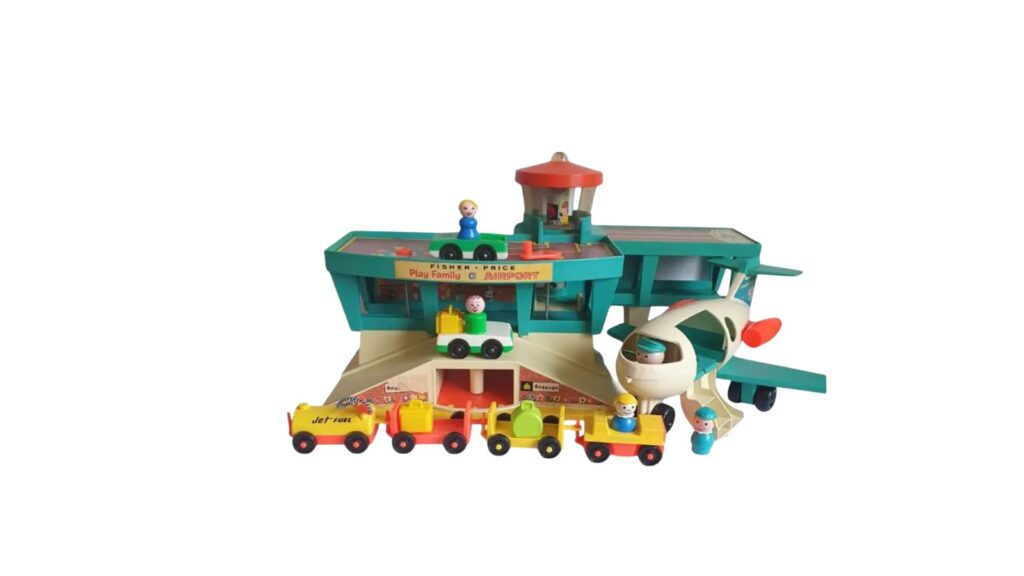
Widely considered one of the best-designed Little People playsets Fisher-Price ever made, the Airport has a swing-out runway and concourse, a control tower on top, a drive-up ramp for cars, and a revolving luggage conveyor that turns by hand crank alongside a helicopter with spinning blades and a rotating landing pad. It stayed in the lineup for years and went through several color and figure updates before being discontinued.
Complete examples with working mechanisms typically bring $200 to $400, and a factory-sealed example has reached as much as $1,000. The conveyor belt and crank mechanism are the first things to check, since they’re mechanical and prone to seizing up after decades in storage. Missing luggage carts, the helicopter itself, or any of the small passenger figures will drop the price noticeably even if the base structure still works fine.
Fisher-Price Play Family House #952 with the cardboard moving van (1969 to 1979)
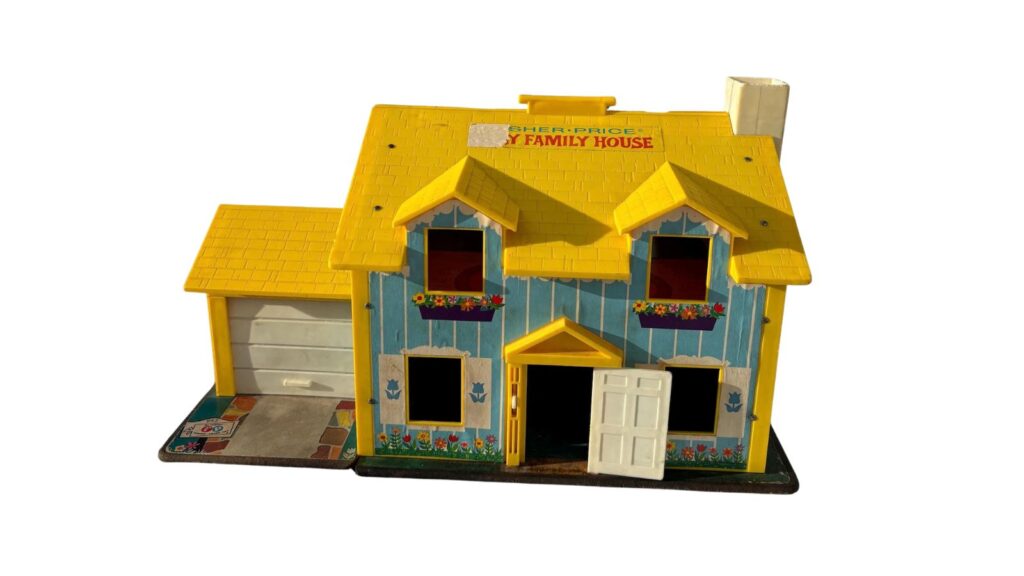
This yellow and blue two-story dollhouse, complete with a working doorbell and a roll-up garage door, is one of the most common Fisher-Price toys still floating around basements and attics, and the furniture colors were updated roughly every two years, so there’s no shortage of variations to sort through. On its own, a complete example with its original wooden and plastic Little People and furniture typically brings modest money, generally $20 to $150 depending on how much furniture and how many figures survived.
The real find here is a small, easily overlooked accessory: a cardboard moving van that shipped with the house for only its first year of production before being discontinued because it simply wasn’t durable enough to survive play. Surviving examples in decent shape have brought over $500 on their own, entirely separate from the house itself. Most people who own this house have never heard of the van, which is exactly why it’s worth digging through any box of loose accessories before donating them.
Fisher-Price Safety School Bus #983 (1959)
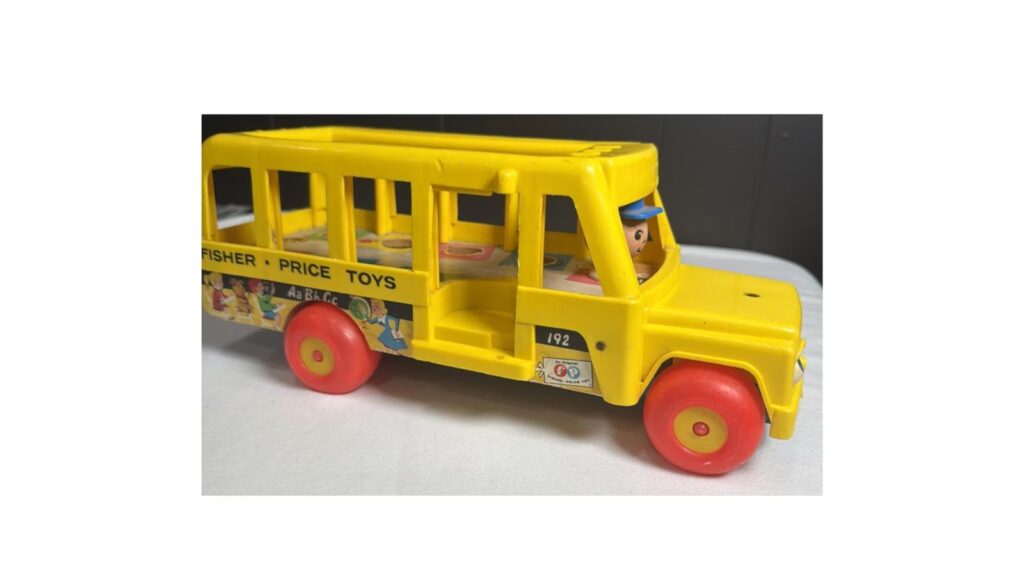
This plastic-bodied bus was the first Fisher-Price toy built with removable figures, a design choice that led directly to the entire Little People line the company still sells in a different form today. Six small wooden peg passengers can be lifted out through the clear plastic top, while the driver stays permanently fixed in place behind the wheel, and the bus features a rolling-eyes mechanism on the front grille that was a genuine novelty for the era.
Complete examples with all six original passengers and a functioning eye mechanism typically bring $165 to $700, with the wide range reflecting how much condition and completeness matter on a toy this old. A bus with a cracked windshield, a stuck eye mechanism, or missing passengers sits at the low end regardless of how charming it looks on a shelf, so functionality matters just as much as appearance here.
Fisher-Price Play Family Castle #993 (1974)
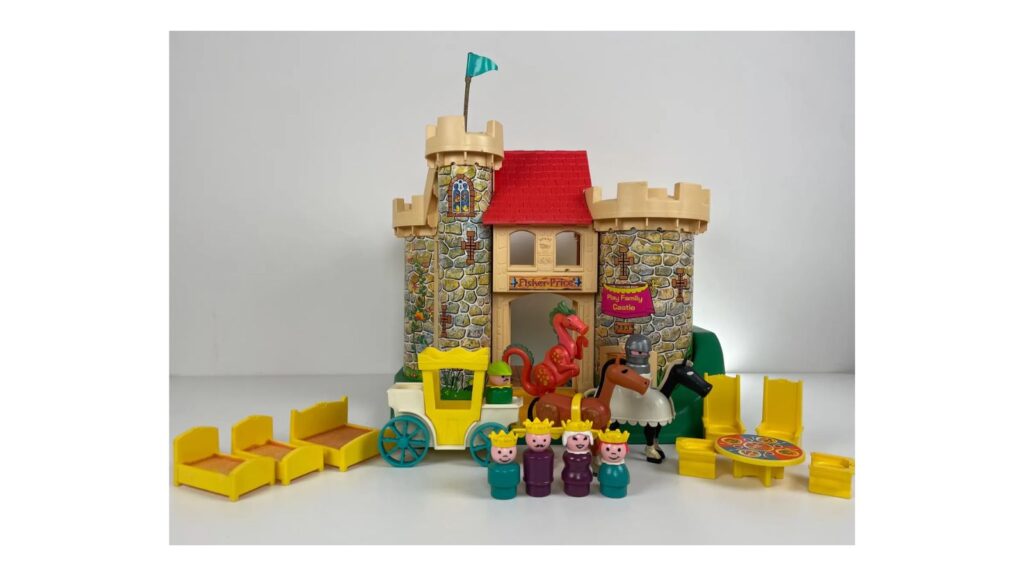
This is one of the heaviest and most detailed Little People sets Fisher-Price ever produced, with a working drawbridge, sliding stairs, trap doors, a dungeon, a horse-drawn carriage, thrones, beds, and a pink dragon among its 21 pieces. It’s also a good example of a set from the transitional era when figures came with wooden bodies and plastic heads, except for the all-plastic knight, which makes the mixed figures themselves a useful dating clue.
A genuinely complete set typically brings $200 to $500, but that number falls off fast with any missing piece. A set missing just one horse, otherwise in nice shape, has sold for as little as $65. Beds usually need replacement foam by now, which buyers generally accept without much penalty, but a missing king, queen, knight, or dragon is a different kind of problem that hits the price much harder.
Fisher-Price Play Family Farm #915, wood-base version (1967 to 1968)
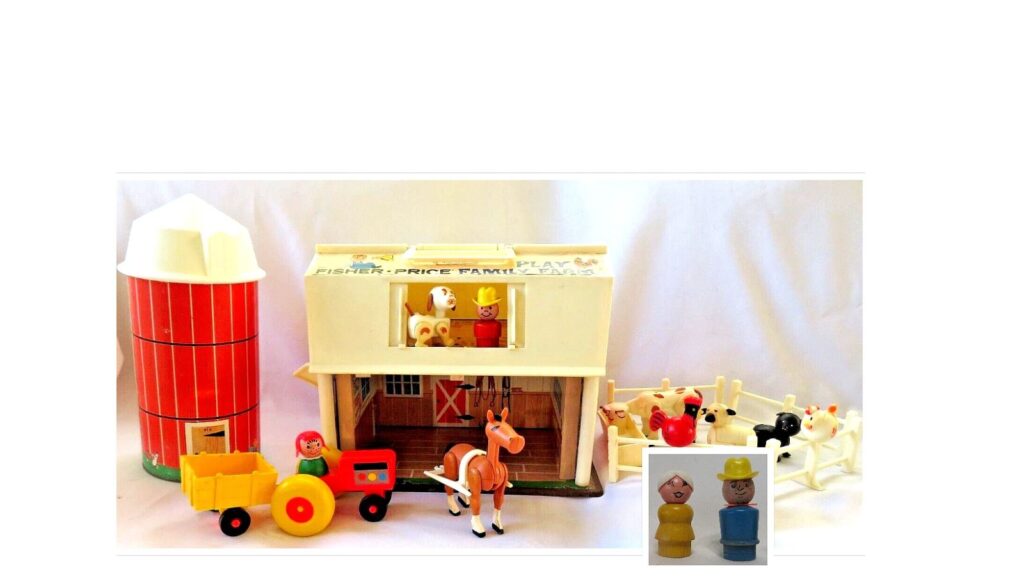
The Play Family Farm is the toy that turned Little People into Fisher-Price’s flagship line, thanks largely to the satisfying “moo” sound when the barn door swings open and the fact that every piece packs away inside the barn itself for easy carrying. The earliest run, built on a solid wood base rather than the Masonite and later plastic construction that followed, carries the strongest premium among farm collectors today.
Complete sets with the full run of animals, the tractor, cart, silo, and fencing typically bring $100 to $600, with the wood-base 1967 to 1968 examples pushing toward the top of that range when everything is present. A loose barn with a couple of stray animals is worth much less, closer to $20 to $30, so it’s the full roster of small pieces, not the barn itself, that really determines where a given farm lands on that scale.
Fisher-Price Play Family Sesame Street Clubhouse #937 (1977 to 1979)
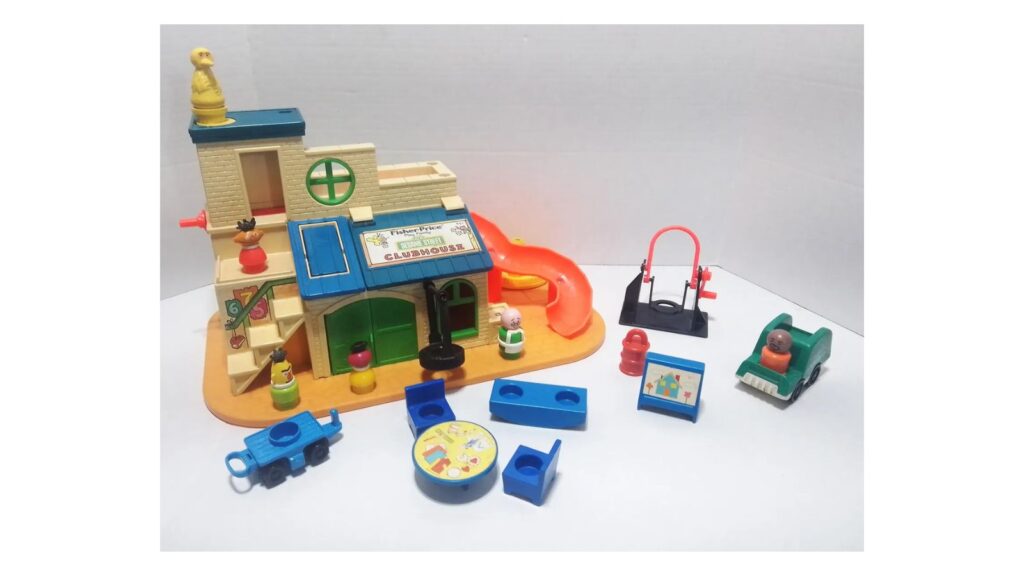
This is a separate set from the more famous Sesame Street brownstone Fisher-Price released a couple of years earlier, and the two get confused constantly because they share a theme and a similar-looking box. The Clubhouse came with Big Bird, Grover, Bert, Ernie, and the Count, plus a slide, a wagon, ramps, and a small tire swing mounted on the front of the structure.
Complete examples typically bring $30 to $155. The Roosevelt Franklin figure is the detail that matters most here: he shipped with the set only briefly before being pulled from the Sesame Street lineup entirely, and a Clubhouse that still has him is genuinely uncommon today. The tire swing is also usually broken or missing altogether, and the paper lithograph tends to peel at the edges over time, so an intact example earns a real premium over the ones that turn up at most estate sales.
Fisher-Price Chatter Telephone #747, wood-base version (1961 to 1966)
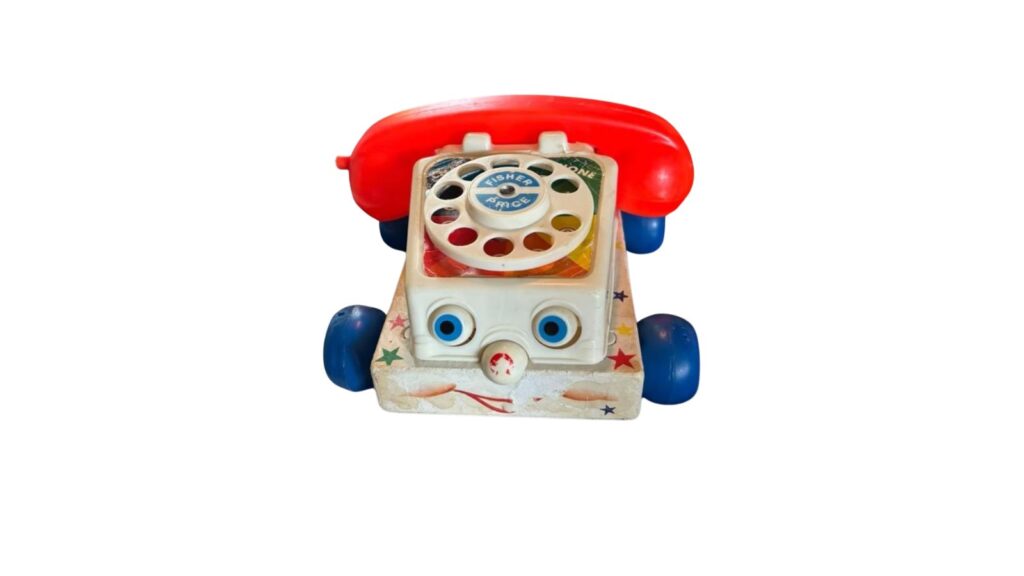
Most people recognize this toy from its cameo in the Toy Story movies, but the earliest version, with a solid wood base and a black and white twisted cotton pull cord, predates that fame by decades. Later versions through the 1970s and 1980s switched to plastic wheels and a plastic base, which is the easiest way to tell a scarce early example apart from the very common later ones still turning up in nearly every thrift store toy bin.
General examples across all production years bring anywhere from $15 to $150, but boxed examples specifically from the 1961 to 1966 wood-base run bring $80 to $150 on their own even without the box in some cases. Wooden wheels are the single clearest sign of a pre-1967 build worth a closer look. The rotary dial and the moving googly eyes both need to still function properly for a phone to bring anything near the top of that range.
Fisher-Price Music Box Record Player (1971)
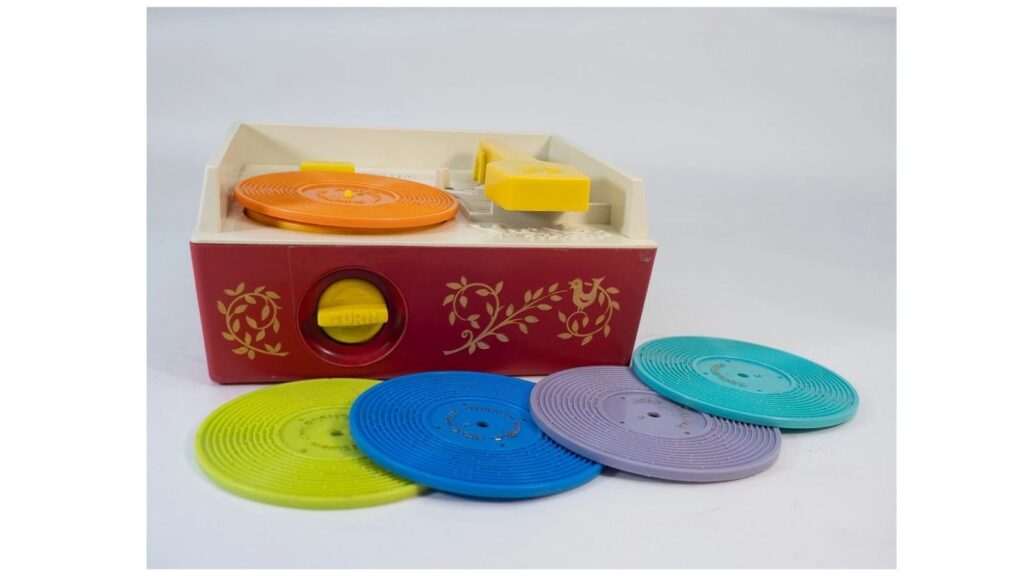
This wind-up toy record player came with five double-sided plastic records that play ten different tunes when cranked, a design meant to mimic real record players kids saw their parents using at home. It’s a genuinely charming design and a common one, distinct from the separate Fisher-Price Phonograph the company introduced later in the decade, which keeps prices modest but still worth checking before it goes in a donation box.
Working examples with all five original records intact typically bring $30 to $150, with boxed sets landing at the higher end of that range. The wind-up spring is the mechanism most likely to have failed after fifty years of storage, and a broken or weak spring cuts the value by more than half even if the records themselves are all present and undamaged. Missing records hurt the price almost as much as a broken spring does.











