
Somebody’s grandmother had a cabinet full of these. Yours probably did too, stacked three deep with mismatched lids, dragged out every Thanksgiving for the green bean casserole and shoved back in a hurry once the dishes were done. CorningWare was never treated as precious. It went through dishwashers, got scraped with metal spoons, sat stacked wet in a drying rack, and did all of that for forty years without complaint. That’s exactly why the pieces that survived clean, with their original lids and their pattern still crisp, are worth real money now.
Corning Glass Works stumbled onto the material by accident in 1953, when a lab furnace overheated and produced a white glass ceramic strong enough to go from a freezer straight into a hot oven without cracking. By 1958 that accident had a name, Pyroceram, and a product line. Over the next forty years Corning ran dozens of patterns through that same durable body, some for three decades, some for a single year before they got pulled. Production length is the single biggest thing separating a fifteen-dollar casserole from a two-hundred-dollar one.
Before anything else, check the bottom of the dish. If it reads “CorningWare” or “Corning Ware” with “Made in USA” and shows a faint glow when held up to a bright light, it’s the real glass-ceramic. If it says “Not for Stovetop Use” or “Made in China,” it’s the later stoneware version, and no pattern name on it will change that.
Table of contents
- Country Festival covered skillet
- French White fluted oval baker
- Floral Bouquet gift-line casserole
- Pastel Bouquet casserole with lid
- Grab-It individual serving bowl
- Medallion “Shell Oil” promotional casserole
- Blue Cornflower stovetop percolator
- Shadow Iris casserole set
- Blue Heather casserole with lid
- Wildflower large covered casserole
- Spice of Life French-inscription roaster
- Butterscotch buffet server
Country Festival covered skillet
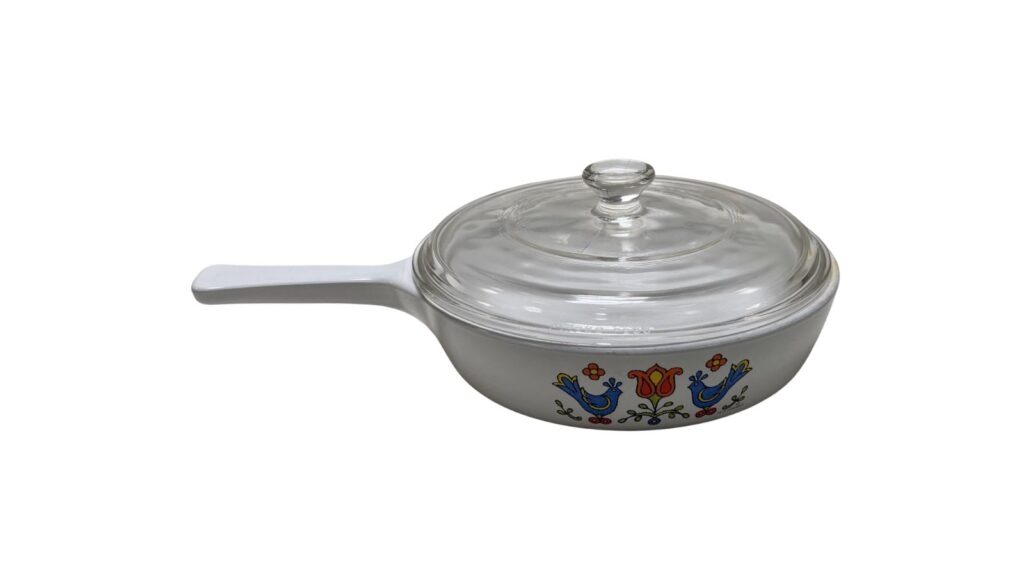
Two blue birds face each other across a spray of red and orange flowers on Country Festival, one of the easiest CorningWare patterns to spot in a box of donated dishes. Corning introduced it around 1975 as a stand-alone folk-art design that never coordinated with a matching dinnerware line, which is part of why it still turns up on its own rather than as part of a set. Collectors sometimes call it “Friendship” or the “Blue Bird” pattern, and the symmetrical, cross-stitch-style layout is unmistakable once you’ve seen it once.
This is one of the more common patterns still circulating, so don’t expect a windfall from a single casserole. Loose pieces without a lid typically bring $5 to $15, with larger sizes and pristine, unfaded print at the top of that range. The real money is in complete matched sets with every lid present, since Country Festival lids crack and go missing at the same rate as any other pattern’s. Check the print closely under good light: the blue on the birds fades fastest, and a piece with dull, grayish birds instead of clean cobalt blue has been through too many dishwasher cycles to command a premium.
French White fluted oval baker
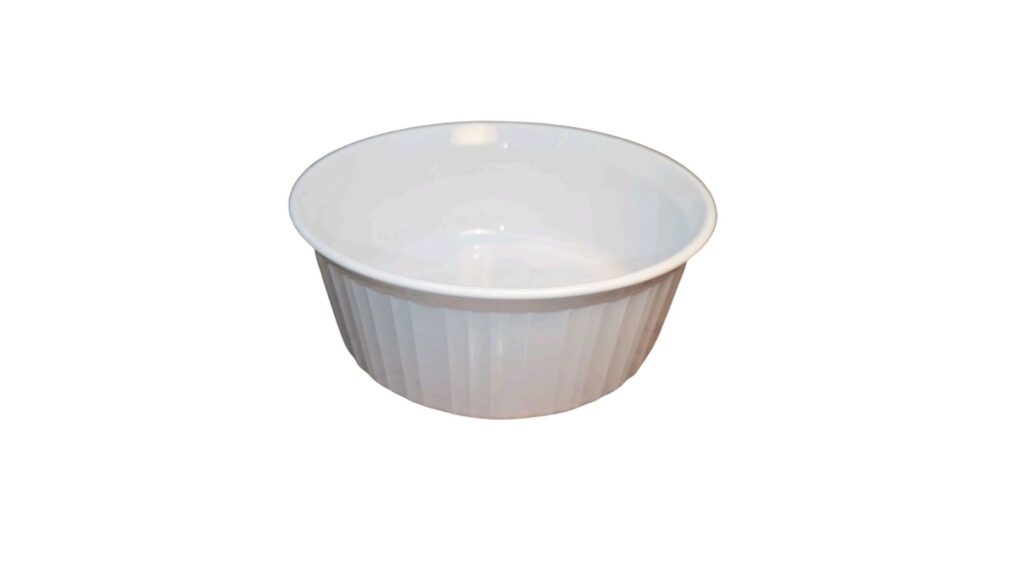
French White has no printed pattern at all, just a plain white body with embossed fluting running around the sides, which is exactly why it gets overlooked in a stack of floral casseroles. Corning introduced it in 1978 and, unlike almost everything else on this list, kept some version of it in production for decades. That means the plain white piece at a thrift store could be genuine 1980s Pyroceram or a much newer stoneware reissue, and the two are not worth the same thing.
That distinction matters more here than with any patterned piece. Vintage Pyroceram French White brings $10 to $40, with unusual shapes like the fluted oval lasagna baker or a quiche dish at the higher end and common round casseroles at the lower end. Hold the piece to a bright light: genuine Pyroceram shows a faint translucent glow, while the later stoneware version is completely opaque and usually stamped “Not for Stovetop Use” on the base. Fluting depth and sharpness matters too, since decades of scrubbing round off the embossed lines on the oldest examples. A crisp flute pattern with no chips along the rim brings more than a worn one in the same size.
Floral Bouquet gift-line casserole
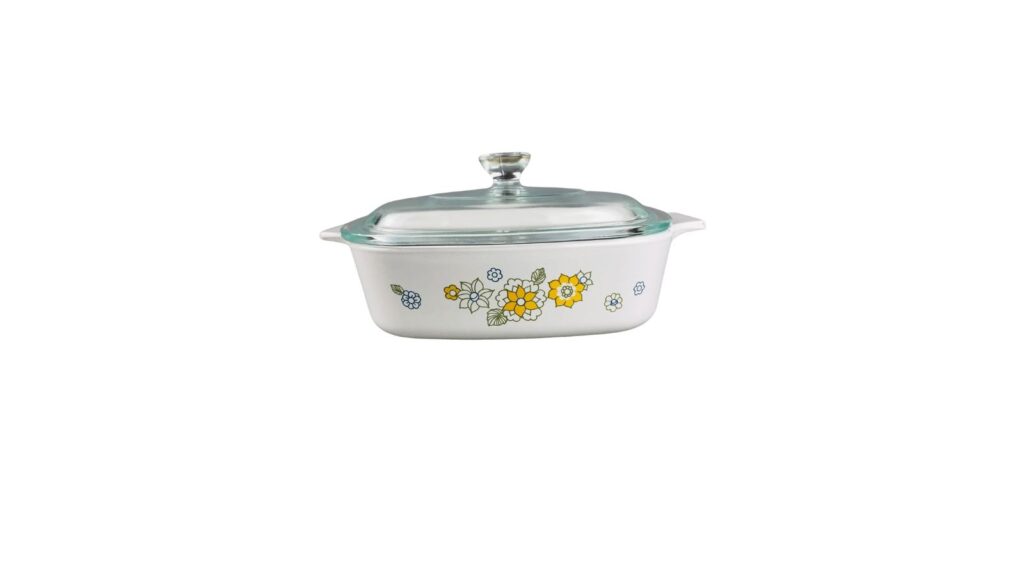
Floral Bouquet showed up first as a gift-line item in 1969 before Corning put it into general production the following year, and it reads as noticeably softer than the bold, graphic patterns that came both before and after it. Loose outlined blooms in blue and gold cluster across the white body in a hand-drawn style that lasted in production only until about 1975, a short enough run that clean examples aren’t as common as the pattern’s gentle look might suggest.
Single pieces typically bring $15 to $80, with the spread driven almost entirely by size and how vivid the gold accents still look. Because the outlines are delicate rather than bold, they show wear faster than a pattern like Blue Cornflower, so a piece with the gold still bright and unrubbed is worth meaningfully more than one where the color has gone flat and gray. Original gift-boxed sets, when they turn up complete, sit at the top of the range. As with any CorningWare from this era, a matching Pyrex lid roughly doubles what the dish alone is worth, and a missing lid is the single biggest thing capping the price.
Pastel Bouquet casserole with lid
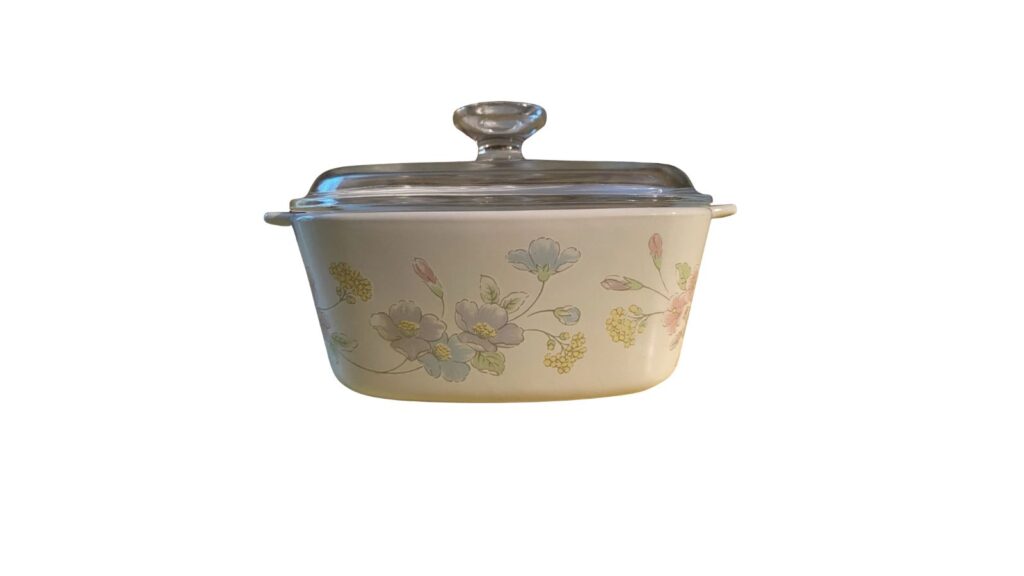
By 1985 CorningWare’s florals had gone soft and pastel, and Pastel Bouquet is the clearest example: pink, blue, and lavender blossoms arranged in a lighter, airier cluster than anything from the 1970s. It ran into the early 1990s, long enough that individual pieces are genuinely easy to find, but complete matched sets with every lid intact are not.
A single casserole in clean condition brings $10 to $100 depending on size, and full sets with lids can reach $350. That’s a wide range, and the size of the piece does most of the work: small individual casseroles sit at the bottom, while a large covered roaster or oval baker with its lid intact sits at the top. Ironically, dating to the mid-1980s rather than the 1970s helps this pattern now, since 80s kitchen style has come back into fashion and buyers are actively decorating around it. Look for even, unfaded color across the whole piece and a lid that matches the dish’s exact size, since mismatched replacement lids are common and reduce value.
Grab-It individual serving bowl
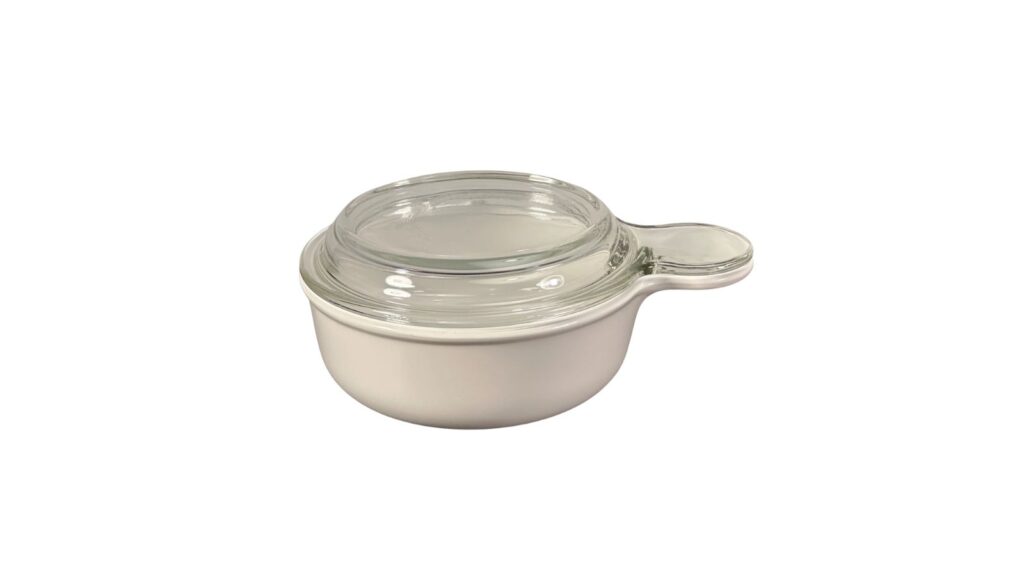
The Grab-It is a single-serving bowl with a stubby handle on one side, designed for a quick reheated lunch rather than a family dinner, and it has developed a following completely disproportionate to how humble it looks. Because it was a smaller, secondary item in most patterns rather than the main event, Grab-Its in scarcer patterns are genuinely harder to find than the casseroles that made those patterns famous.
A loose Grab-It bowl typically brings $15 to $40, but that number changes fast once the original lid, plastic or glass depending on the era, is still with it. A complete bowl and lid in a sought-after pattern has brought well over $100. The lids are the weak link: they’re thinner than the bowl itself and were treated as disposable by most households, so they cracked, warped in the dishwasher, or simply got left behind at potlucks. If you find a box of loose CorningWare at an estate sale, it’s worth digging specifically for the handled Grab-It shape, since sellers who don’t recognize it often price it the same as a common saucer.
Medallion “Shell Oil” promotional casserole
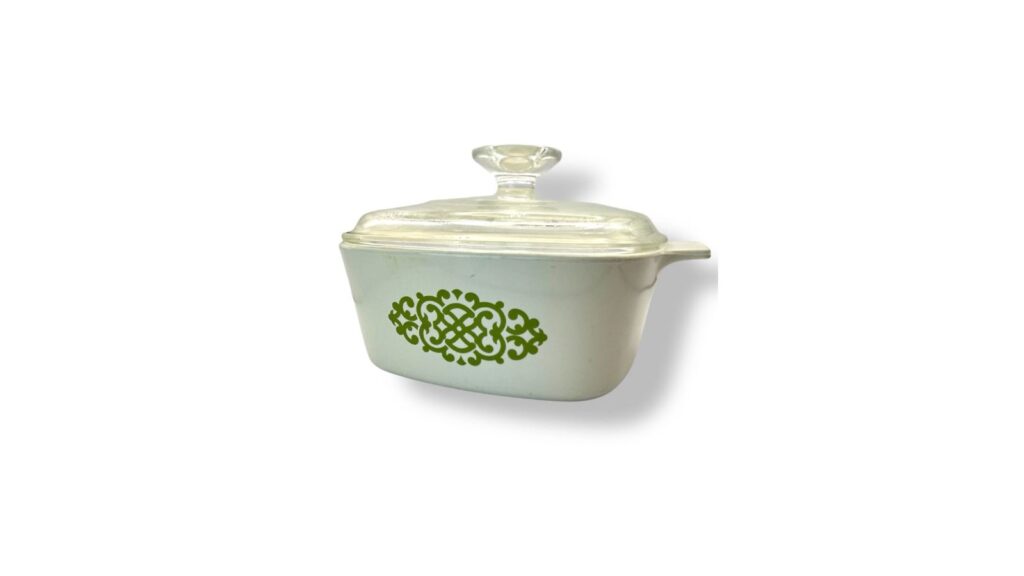
Medallion never went near a store shelf. Corning made it exclusively for Shell Oil, and the only way to get a piece was to be a Shell gas credit card holder in the early-to-mid 1970s, when the dishes showed up as a promotional offer tucked into the monthly bill. It came in two colorways, an olive-green stenciled geometric design and a blue version collectors call Blue Macrame, both built around interlocking lines that form the medallion shape giving the pattern its name.
Because it skipped retail distribution entirely, far fewer pieces exist than for any pattern Corning actually sold in stores, and pieces bring $30 to $100 in clean condition, with unusual forms like the open roaster bringing more. What makes Medallion a genuinely findable piece of history rather than a museum-only rarity is that it landed in ordinary households simply because they filled up their gas tank, not because anyone sought it out as a collectible. The full run of known Medallion pieces, including both the blue and green colorways, has been documented by longtime collectors, which makes authenticating a suspected piece fairly straightforward.
Blue Cornflower stovetop percolator
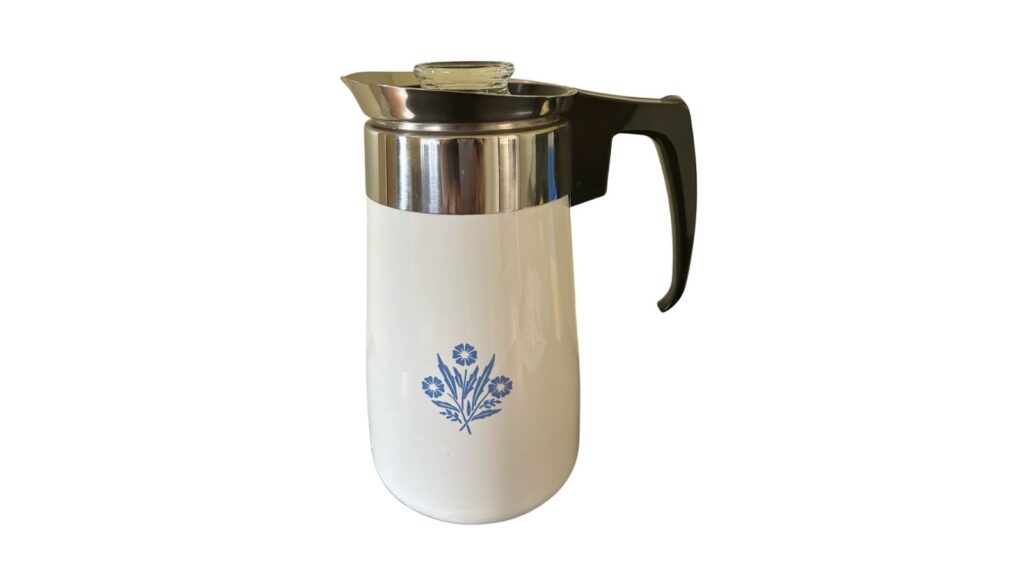
CorningWare made a lot more than casseroles, and the Blue Cornflower stovetop percolator is proof that the flagship pattern extends well past the dish everyone remembers from Thanksgiving. Assembling a complete, working percolator is a genuinely different challenge than finding a casserole with a lid, since the glass basket, the metal stem, and the knob all had to survive together, and most surviving units are missing at least one piece.
A complete percolator brings $30 to $100 or more, with pristine, fully original examples pushing toward the top of that range and beyond. Because the internal parts are what typically go missing first, a percolator with its original glass perk knob, metal filter basket, and stem all present and undamaged is worth substantially more than an incomplete one, even if the Pyroceram body itself looks flawless. These were also functional appliances that saw daily use for years, so check the body carefully for hairline cracks near the base and confirm the cord and heating element are intact before assuming a percolator is display-only. One that still actually works is a genuine rarity at this point and worth noting separately from one that’s decorative only.
Shadow Iris casserole set
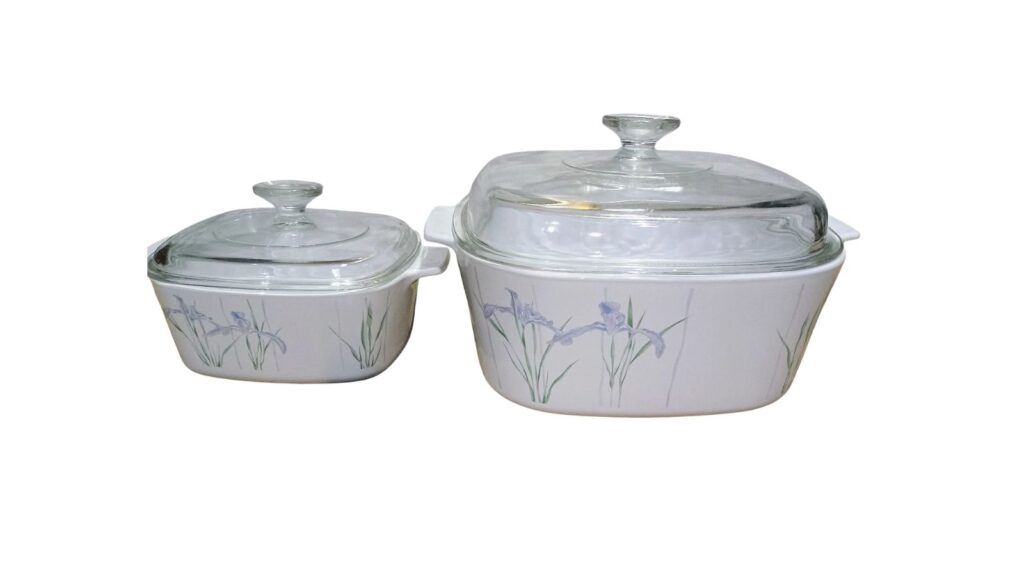
Shadow Iris trades CorningWare’s usual bright florals for something quieter: tall, wispy purple iris stems arching across the white body in a design that reads more graphic than botanical. Corning introduced it around 1985, discontinued it in the early 1990s, then briefly relaunched it years later, which says something about how well it sold the first time around even though it never became a flagship pattern.
Single pieces bring $10 to $135 depending on size and condition, while complete matched sets climb to $150 to $350. The cooler, more monochrome palette has found a specific audience among buyers decorating black-and-white or minimalist kitchens, which keeps demand steady even though the pattern itself isn’t especially old. As with any pattern built around fine linework rather than bold color blocks, the irises show wear faster than you’d expect, so check closely for rubbing along the high points of the stems where a sponge would have made the most contact. A piece with the purple still crisp and unbroken is worth chasing over one where the lines have started to blur into the white.
Blue Heather casserole with lid
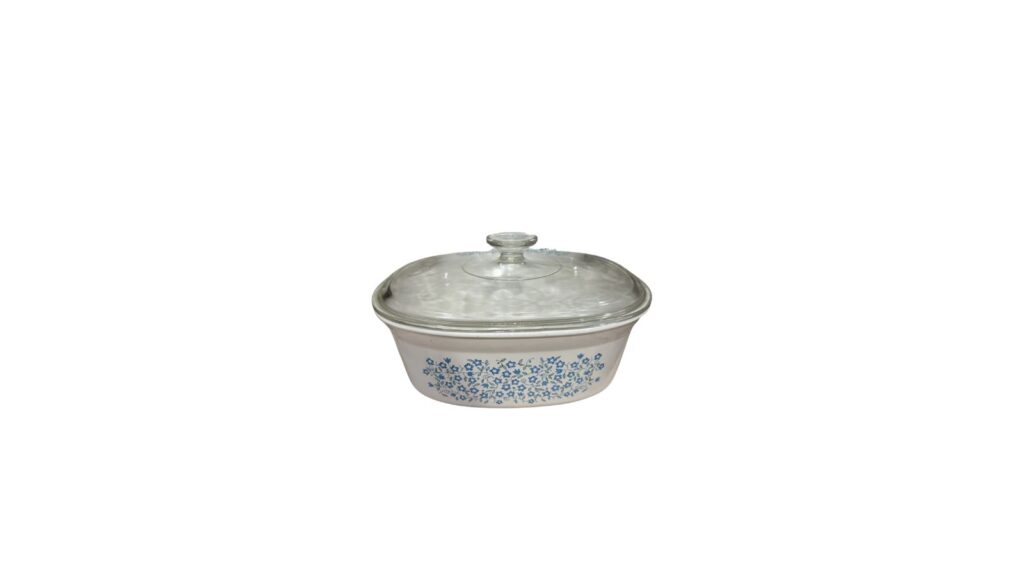
Blue Heather ran for barely a year, maybe two depending on the source, making it one of the shortest production windows of any mainstream CorningWare pattern. Small five-petal blue flowers connected by thin vines cover most of the dish’s surface, a busier, more delicate treatment than the original Blue Cornflower it’s often mistaken for at a glance.
That brief run is exactly why it’s worth more than patterns that look similarly floral but stuck around for a decade. Clean pieces bring $30 to $150, with larger casseroles and pieces that still have their original lid toward the top of that range. Because Blue Heather uses a busier, more detailed print than most CorningWare patterns, faded or rubbed examples are common and sell for noticeably less, so pattern clarity is worth checking closely before assuming a piece is worth top dollar. Confirm you actually have Blue Heather and not the far more common Blue Cornflower before getting excited: the flower count and connecting vines are the tell, since Cornflower uses three simple blossoms while Heather scatters many more, smaller ones across the whole surface.
Wildflower large covered casserole
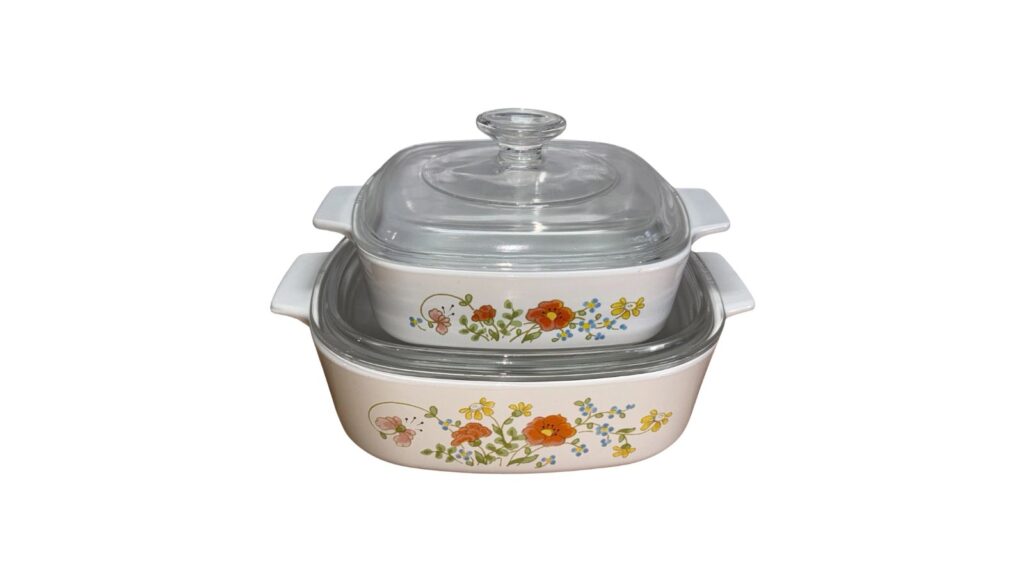
Wildflower is one of the more intricate patterns CorningWare ever ran, orange-red poppies, yellow daisies, and small blue blossoms scattered across the white body in a design busier than almost anything that came before it. It had a shorter run than Blue Cornflower or Spice of Life, about seven years, and the detailed print shows wear more visibly than simpler patterns, which keeps genuinely clean examples in real demand.
Individual pieces bring $20 to $60 in clean condition, with the large covered casserole or oval roaster at the top of that range and small saucepans at the bottom. Complete sets in excellent condition, all lids present and the floral print still bright rather than rubbed to a blur, can reach into the low hundreds. Because the pattern was originally sold in coordinated sets of around seven pieces, a lone casserole found at a thrift store is only ever going to be worth a fraction of what a complete run would bring, so it’s worth checking whether other Wildflower pieces are sitting nearby on the same shelf before assuming you’ve found everything.
Spice of Life French-inscription roaster
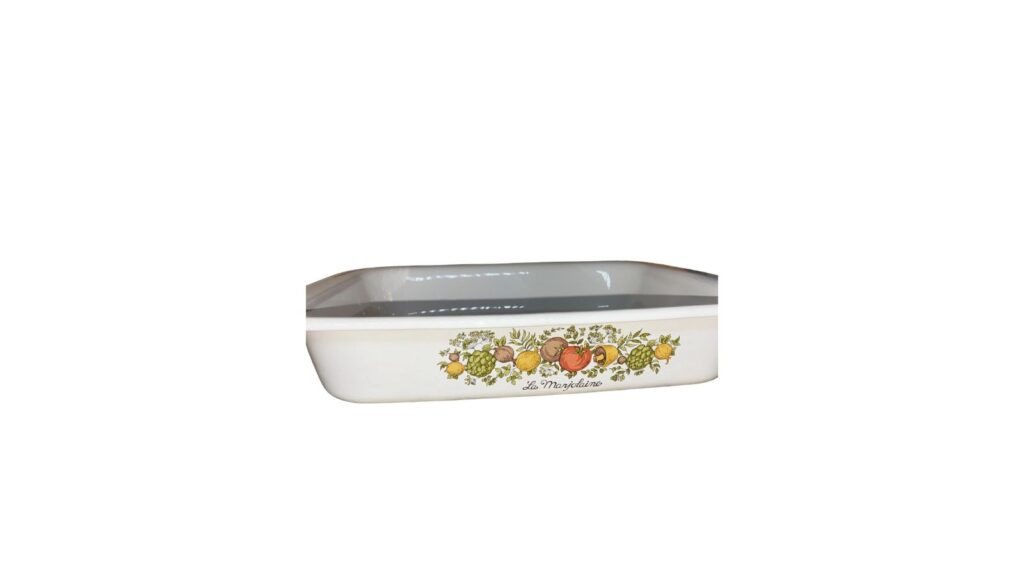
Spice of Life is the second most produced CorningWare pattern after Blue Cornflower, vegetables and herbs printed in earth tones that were everywhere in 1970s kitchens. What most people miss is that the earliest pieces carry a French word beneath the vegetable band, L’Echalote, La Marjolaine, or Le Romarin among others, and Corning dropped that lettering from later production runs entirely.
Because the pattern ran for fifteen years, common sizes without the French script are genuinely inexpensive, typically $15 to $50 per piece. The pieces worth seeking out are the larger forms from the earliest years: a big oval roaster or Dutch oven still carrying the French inscription and its original lid moves well past that everyday range. Ignore any listing that treats the French words alone as proof of extraordinary value; the internet is full of Spice of Life priced in the thousands that never actually sells at that number. Size, completeness, and the vintage of the backstamp matter far more than the lettering by itself. As always, Pyroceram from this era shows a faint glow against light, while any post-1998 stoneware reissue does not.
Butterscotch buffet server
artistictouch25 via eBay
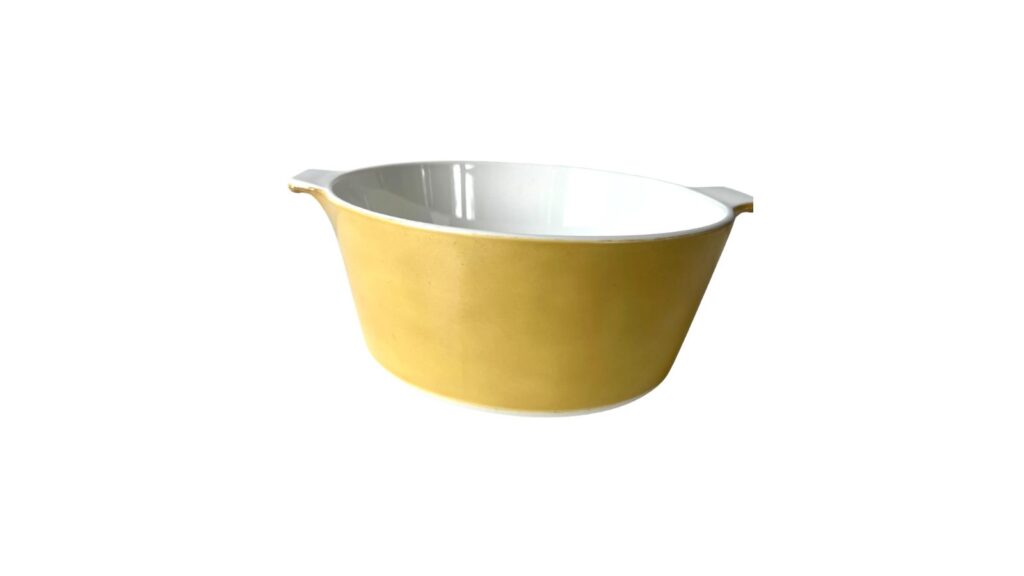
Butterscotch skips the printed pattern entirely: the whole Pyroceram body is cast in a warm, solid amber-yellow color instead of the usual white, a striking departure from everything else Corning made that decade. It was part of the short-lived “Corning Ware Round” buffet line, sold for exactly one year in 1969 alongside an avocado-green counterpart, and Corning dropped it after that single season.
That one-year run makes genuine Butterscotch pieces worth $40 to $150, with the larger 4-quart buffet server or Dutch oven at the top of the range and smaller casseroles lower. Because there’s no printed decoration to fade or wear away, condition assessment here mostly comes down to the ceramic knob on the lid, which is prone to loosening or cracking, and the amber glaze itself, which can show heat staining from decades of stovetop use that’s harder to disguise on a solid color than on a busy print. A tight-fitting original lid with an intact knob and a body free of dark staining is what separates a top-of-range Butterscotch piece from an ordinary one.











