
You’re cleaning out your grandfather’s dresser and there’s a cigar box shoved in the back of a drawer. Inside is a rubber-banded stack of old $5 bills, the kind with red or blue ink instead of green, portraits that look slightly different from the one in your wallet. Your first instinct is to count them as five dollars each and move on to the next box.
Don’t, at least not yet. The $5 bill has one of the deepest collector markets in American currency, mostly because so many people quietly kept them. A five was real money for most of the 20th century, worth setting aside instead of spending, which is exactly why so many ended up folded into wallets, tucked into Bibles, or stashed in cigar boxes instead of wearing out in circulation. That habit is the reason $5 bills turn up in family collections far more often than people expect.
What separates a bill worth five dollars from one worth five hundred comes down to a short checklist: the color of the Treasury seal, the series year printed near the signatures, whether there’s a tiny star in the serial number, and whether that serial number does anything unusual. None of it requires special equipment. It just requires actually looking.
Table of contents
- 1. 1963 $5 red seal legal tender note
- 2. 1953 $5 blue seal silver certificate
- 3. 1928 $5 red seal legal tender note
- 4. $5 star notes, any series
- 5. Fancy serial number $5 bills
- 6. Low serial number $5 bills
- 7. 1934 $5 blue seal silver certificate
- 8. 1953B $5 silver certificate star note
- 9. 1929 $5 National Bank Note
- 10. 1929 $5 Federal Reserve Bank Note, brown seal
- 11. 1899 $5 silver certificate “Indian Chief”
- 12. 1907 $5 legal tender “Woodchopper” note
- 13. Ink smear error $5 bills
- 14. Off-center or misaligned print error $5 bills
- 15. Inverted overprint error $5 bills
- 16. Fold-over (butterfly) error $5 bills
- 17. 1934A $5 Hawaii overprint note
- 18. Mismatched serial number error $5 bills
1. 1963 $5 red seal legal tender note
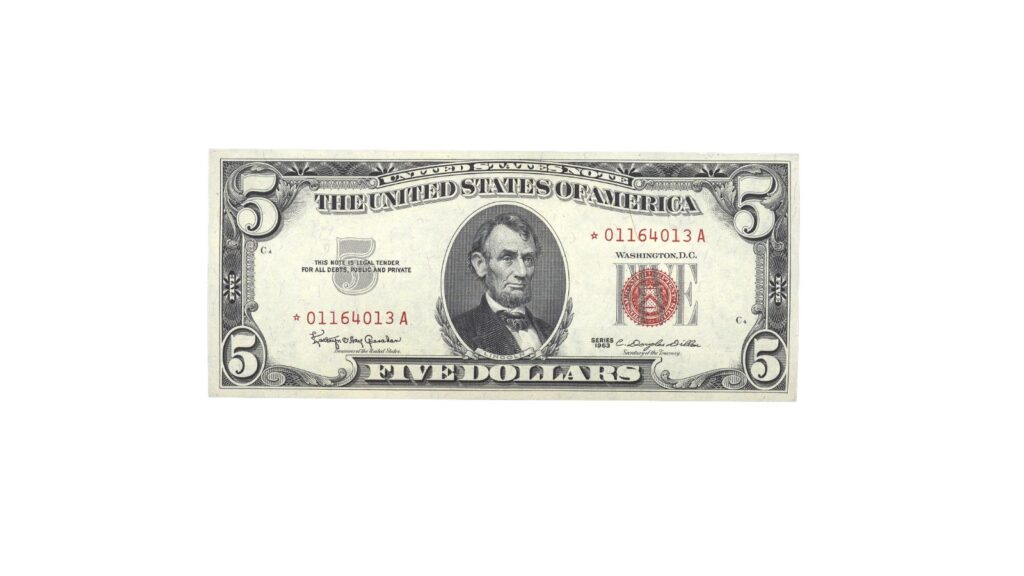
The easiest red seal $5 to find is also the last one the government ever issued. Series 1963 legal tender notes carry a bright red Treasury seal and red serial numbers instead of the green ink used on every $5 bill printed since, along with the words “United States Note” rather than “Federal Reserve Note.” Production stopped in 1966, which gives the series a clean stopping point that collectors like.
Circulated examples are common and only bring a modest premium, typically $6 to $10 over face value. Crisp uncirculated notes with no folds do better, usually landing in the $15 to $25 range. The detail that changes things is a star in place of the first letter of the serial number, which marks a replacement note printed to cover a defective sheet. Star examples run somewhat higher than standard issues in the same grade.
Condition is easy to judge on this series because the paper is still fairly recent by currency standards. Look for hard folds, soft corners, and staining, all of which push a note toward face value fast. A flat, bright, uncirculated example is the one worth setting aside rather than spending.
2. 1953 $5 blue seal silver certificate
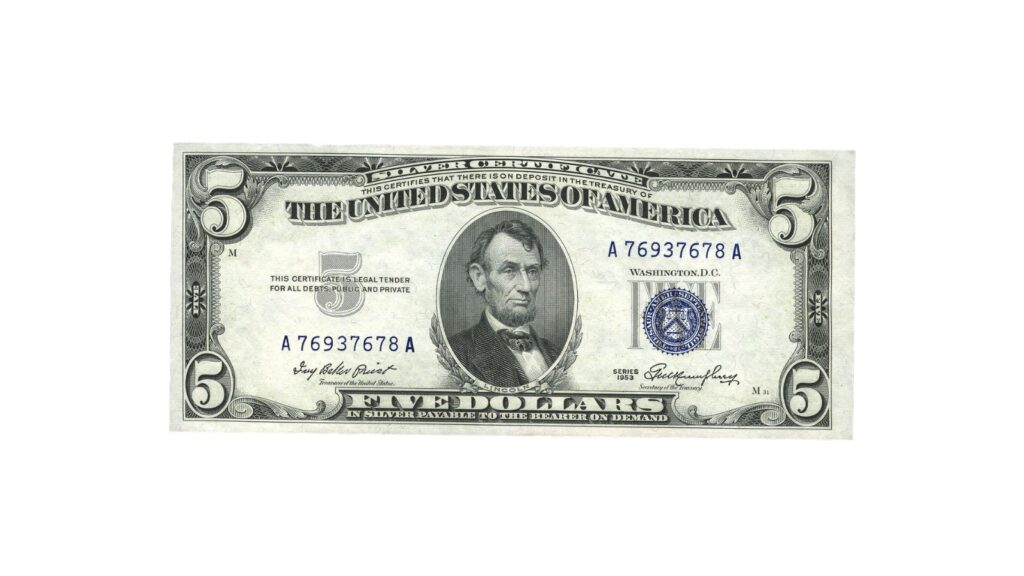
Before 1968, the government promised to exchange silver certificates for actual silver on demand, and the $5 denomination carried that promise right up until the series ended. A 1953 $5 silver certificate is identified by its blue Treasury seal, blue serial numbers, and the words “Silver Certificate” printed across the top rather than “Federal Reserve Note.”
These are common. A circulated example is worth about $6 to $10, and a crisp uncirculated one brings closer to $20. The series comes in three nearly identical varieties, 1953, 1953A, and 1953B, and none of the three plain versions is scarce. What is scarce is one specific star note buried inside that third variety, covered further down this list, so don’t assume every 1953B silver certificate you find is the rare one. Check for the star symbol before getting excited.
Handling and storage matter more than people expect with these. A bill folded into a wallet for decades loses crispness fast, and crispness is most of what separates the low end of this range from the high end. If you find a stack, look for the notes that still snap when handled rather than fold limply.
3. 1928 $5 red seal legal tender note
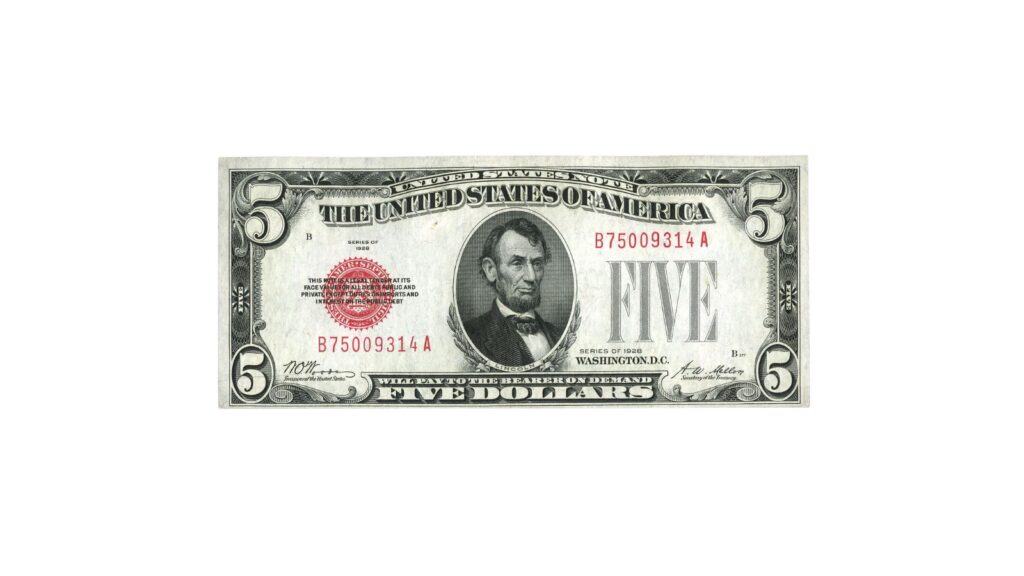
The 1928 series was the first $5 bill printed in the smaller size still used today, and it’s easy to tell apart from its 1953 and 1963 red seal cousins once you know where to look: the red Treasury seal sits to the left of Lincoln’s portrait instead of the right. These were printed across six sub-series, 1928 through 1928F, and heavily circulated for decades before people started setting them aside.
Circulated examples typically bring $7 to $10, not far above face value. The real difference shows up in uncirculated condition, where crisp, unfolded notes with sharp corners can reach $50 to well over $100 depending on the specific sub-series and how well-centered the printing is. Star notes and fancy serial numbers push individual examples higher still.
Because this series predates most family currency habits by a generation, most surviving examples show real wear. A 1928 $5 that’s been kept flat rather than folded is genuinely uncommon, which is exactly why condition drives almost all the value here. If you find one that’s never been through a wallet, it’s worth a second look before you spend it.
4. $5 star notes, any series
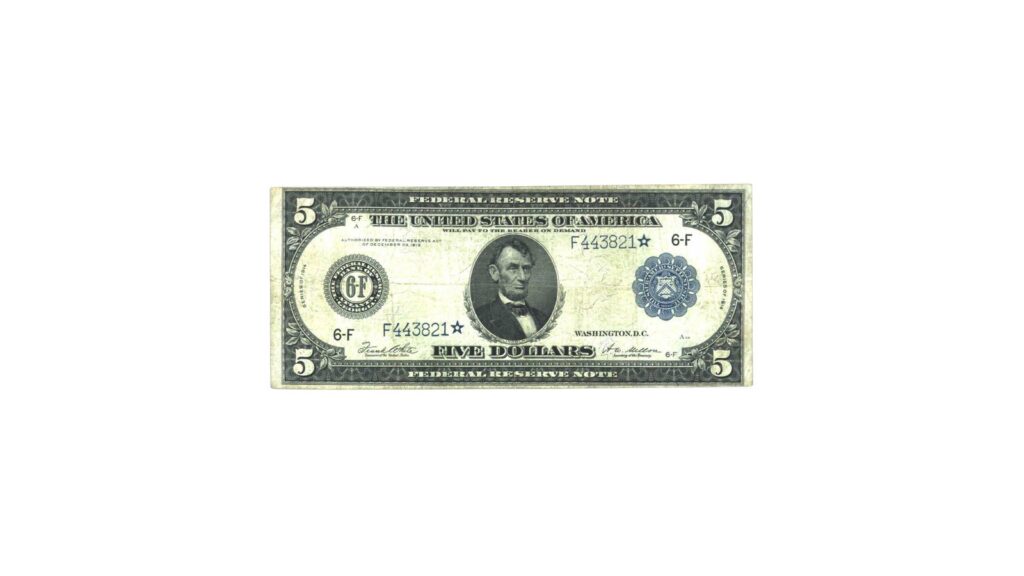
Every series of $5 bill, from the 1928 red seals through the purple-tinted notes in circulation today, includes replacement notes marked with a small star instead of a letter in the serial number. The Bureau of Engraving and Printing uses them whenever a sheet is caught as defective partway through the numbering process, and rather than reprint the same serial number, the replacement gets a star so nothing in the run duplicates.
On red seal legal tender notes the star sits at the front of the serial number. On green seal Federal Reserve Notes it sits at the end. Common modern star notes bring only a small premium, but a 1963 red seal $5 star note runs roughly $10 to $25 depending on condition, and older red and blue seal stars from smaller print runs go considerably higher.
The number that matters most is how many were printed in that particular run. Star notes from small print runs, sometimes well under a million for a given series and district, are genuinely scarce even though nothing about the bill looks unusual at a glance. A quick search of the series and Federal Reserve district printed on the note will tell you whether the run was small enough to matter.
5. Fancy serial number $5 bills
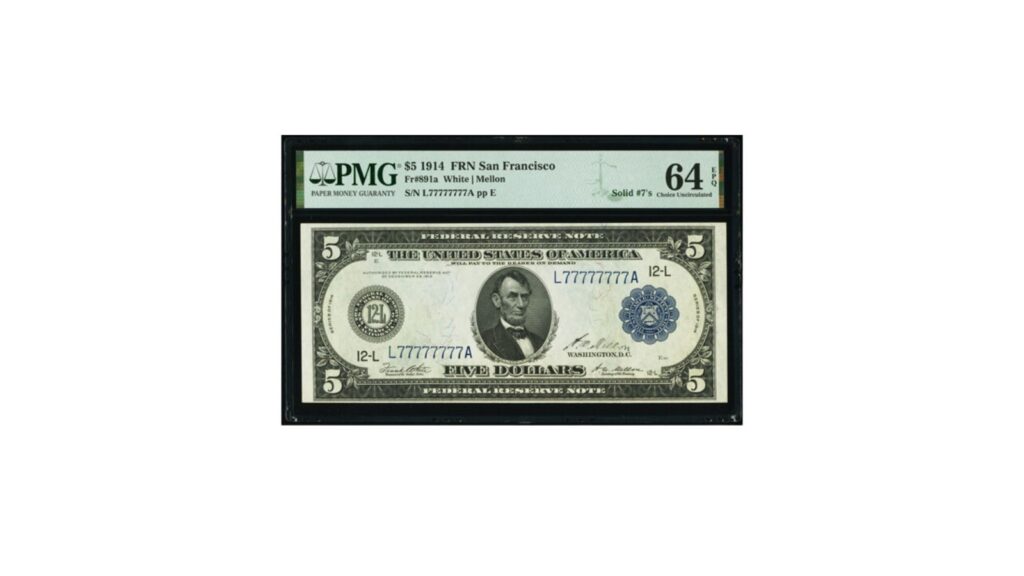
Every bill carries an eight-digit serial number, and most of them are just random noise. Every so often one isn’t. Solid numbers where all eight digits match, ladders that run in perfect sequence like 12345678, radars that read the same forward and backward, and repeaters where a four-digit block repeats twice, all catch collectors’ attention regardless of the year or series.
The premiums scale with how dramatic the pattern is. Solid numbers bring $500 to $5,000 or more, a true ascending or descending ladder brings $200 to $1,500, and a straightforward radar or repeater typically brings $20 to $100. A $5 bill carries roughly the same premium structure as a $1, so the pattern itself matters more than the denomination it’s printed on.
This is the one item on this list that applies to a bill sitting in your wallet right now, not just old currency. Before you spend any $5 note, glance at the serial number printed twice on the front. It takes five seconds, and it’s the only entry here where a fresh, ordinary bill fresh from an ATM has a real shot at being worth something.
6. Low serial number $5 bills
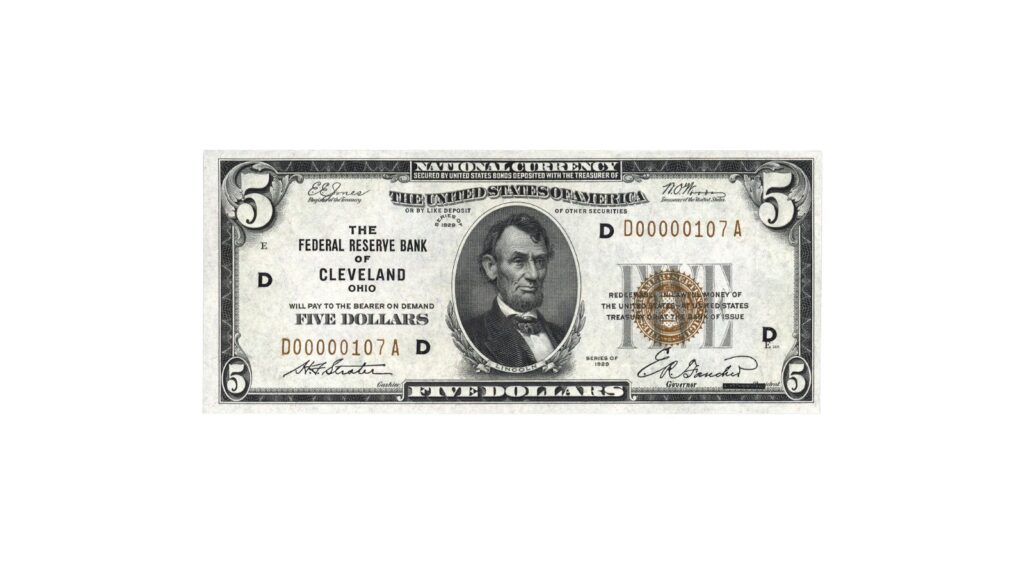
Low serial numbers are their own category, separate from the fancy patterns above, because they mark a bill as one of the very first off the press in a given run. A bill numbered under 100 rarely made it into general circulation. Most low numbers were pulled aside by bank officials, government offices, or collectors before they ever reached a cash register.
The scale runs steeply. Serial number 00000001 can bring $2,000 to $15,000 depending on the series and condition, numbers 2 through 9 typically bring $500 to $2,000, and anything under 100 still commands $100 to $500. Once you’re past the first thousand, the premium drops off fast, down to a modest $20 to $50 for numbers in the low thousands.
Condition affects a low serial number bill just as much as any other collectible note, so a crisp, uncirculated example with a low number is worth considerably more than a worn one with the same digits. Because banks sometimes hold back the first straps of a fresh print run for internal use, these do occasionally surface in ordinary circulation decades later, usually already well worn by the time anyone notices.
7. 1934 $5 blue seal silver certificate
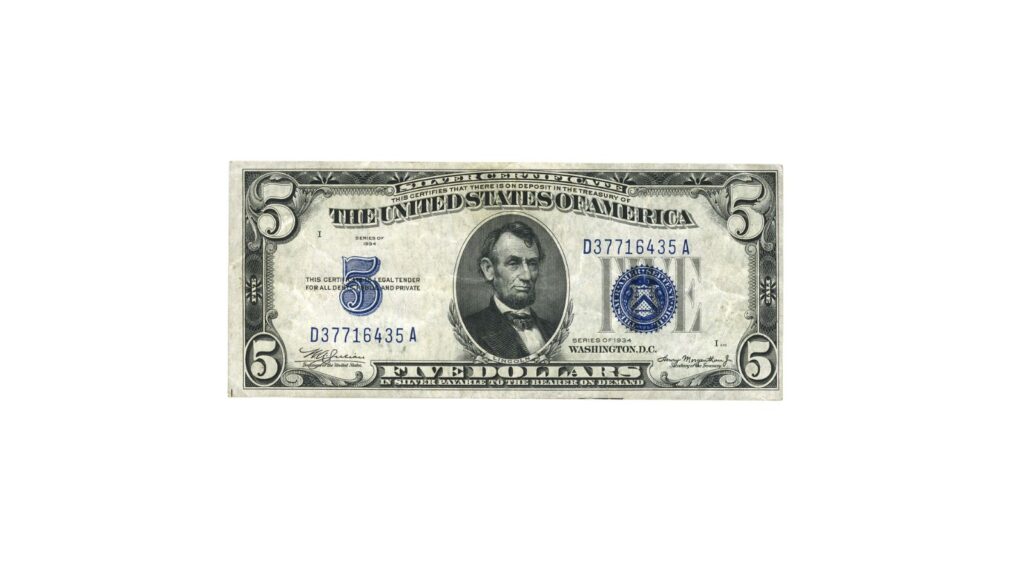
The 1934 series predates the more familiar 1953 blue seal by two decades and comes with more variety to track. Five sub-series exist, 1934, 1934A, 1934B, 1934C, and 1934D, each marked with a letter near the bottom right of Lincoln’s portrait, and the value swings meaningfully between them.
Circulated examples across the group run about $12 to $30, with the plain 1934 series generally bringing the most since it’s the scarcest of the five. Uncirculated notes tell a bigger story: a gem-quality plain 1934 can reach $800 to $2,500, while the more common 1934A tops out closer to $175 to $275 in the same grade. The 1934D series also comes in “wide” and “narrow” back-plate varieties that collectors track separately.
Star notes exist for every sub-series here too, and the 1934B star is considered the scarcest of the group, commanding real premiums even in circulated grades. Before assuming you have a common 1934A, check the letter suffix carefully. It’s a small detail with an outsized effect on what the note is actually worth.
8. 1953B $5 silver certificate star note
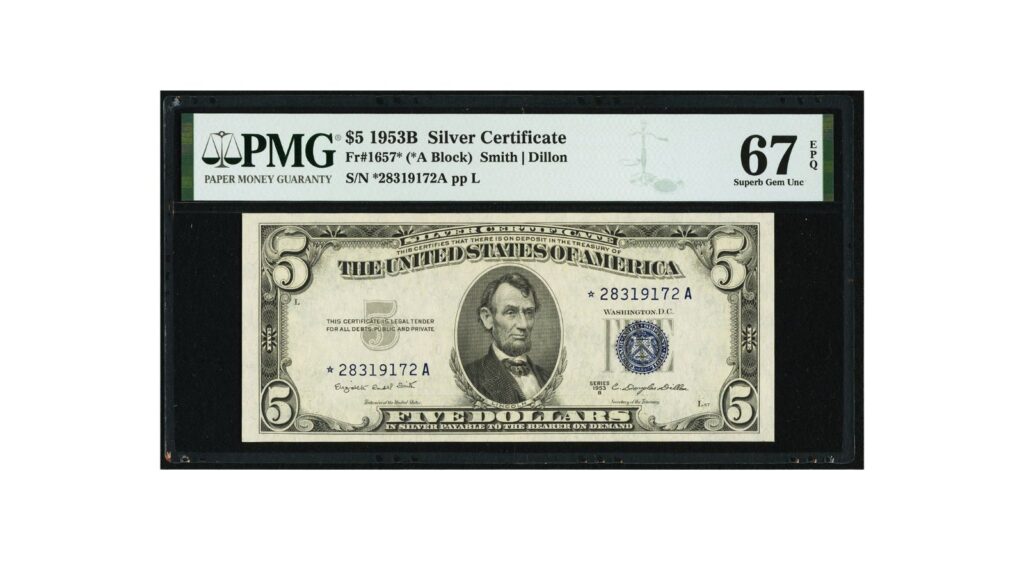
This is the trap entry on this list, because it looks nearly identical to the common bill in entry two. Three sub-series of 1953 blue seal silver certificate exist, 1953, 1953A, and 1953B, and the plain versions of all three are equally unremarkable. The exception is the 1953B star note specifically, and it’s genuinely rare: over three million were printed, but fewer than 400,000 were actually released into circulation before the rest were destroyed.
That scarcity shows up in the price. Lightly circulated 1953B star notes sell for over $1,000, and uncirculated examples come up for sale so rarely that dealers simply describe them as worth thousands, without a firm ceiling. Compare that to the common 1953 and 1953A stars, which bring only about $15 to $30 in circulated grades, and the gap is obvious once you know to look for it.
The identification is simple: blue seal, “1953B” printed near the signatures, and a star symbol in the serial number. All three conditions have to be true at once. Miss any one of them and you have an ordinary bill worth a small premium at most, not a four-figure note.
9. 1929 $5 National Bank Note
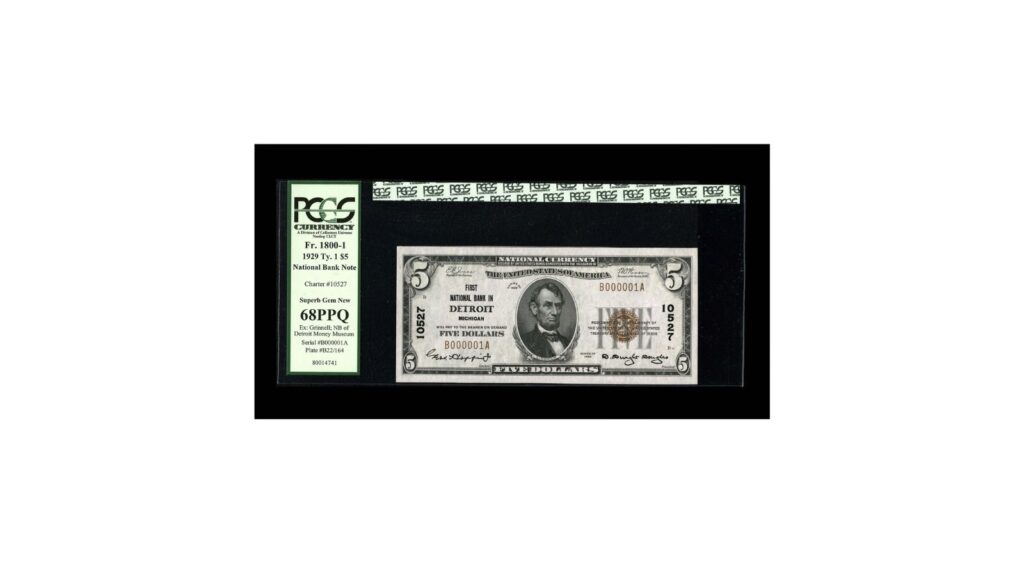
Before the modern Federal Reserve system printed every dollar in circulation, thousands of local banks across the country issued their own $5 bills under federal charter, each one printed with that specific bank’s name across the front instead of “Federal Reserve Note.” A 1929 National Bank Note reading “The First National Bank of” some small town isn’t a novelty item. It’s a real piece of that town’s banking history, and exactly the kind of bill that turns up in collections from families who banked locally for generations.
Common examples from well-known banks bring modest but real premiums, around $80 to $95 in lightly circulated condition and $150 to $225 uncirculated. What changes everything is the issuing bank itself. Some small-town banks issued only a handful of notes before closing or converting to a different charter, and surviving examples from those banks can bring hundreds or thousands of dollars regardless of condition.
The charter number and bank name are printed directly on the note, which makes research straightforward. If you have one, look up the specific charter number before assuming it’s a common example. Rarity here is almost entirely about the bank, not the year.
10. 1929 $5 Federal Reserve Bank Note, brown seal
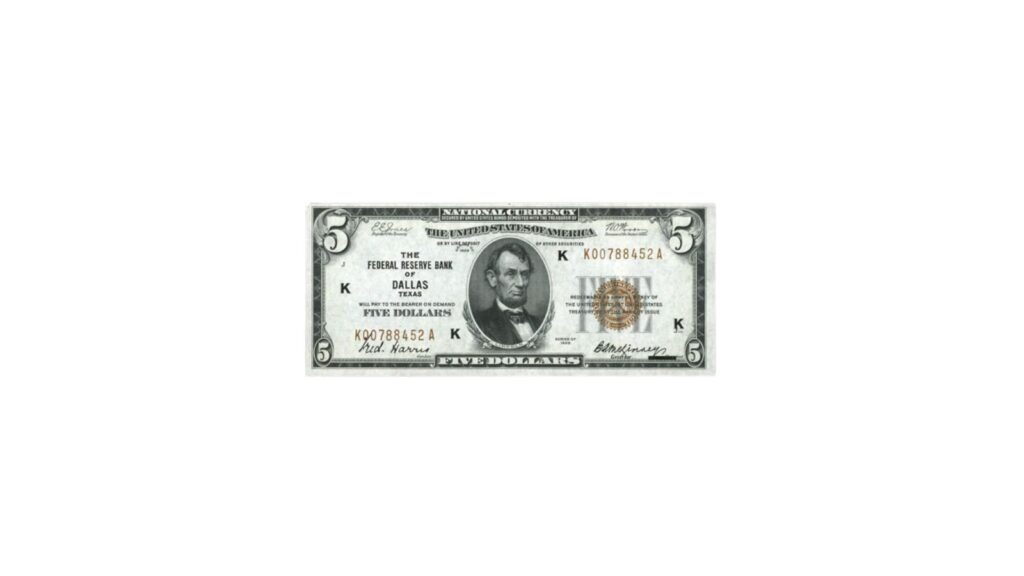
Easy to confuse with the National Bank Note above, but genuinely different: a 1929 Federal Reserve Bank Note was issued by one of the twelve regional Federal Reserve Banks rather than a local chartered bank, and it carries a brown Treasury seal instead of the standard green. These were a Depression-era measure, printed using leftover currency paper stock to get more cash into circulation quickly during the 1933 banking crisis.
Standard examples bring around $60 in circulated condition and closer to $185 uncirculated, but the issuing district matters. Notes from the Minneapolis, St. Louis, and San Francisco Federal Reserve Banks are scarcer than the others and bring meaningfully more, and star notes from those same smaller districts can climb into the hundreds or low thousands.
The district is identified by a letter and number printed in the black Federal Reserve seal on the left side of the note. Boston, New York, and Chicago notes are common enough that most examples aren’t worth much beyond the standard premium. It’s worth checking the district before deciding a brown seal $5 isn’t anything special.
11. 1899 $5 silver certificate “Indian Chief”
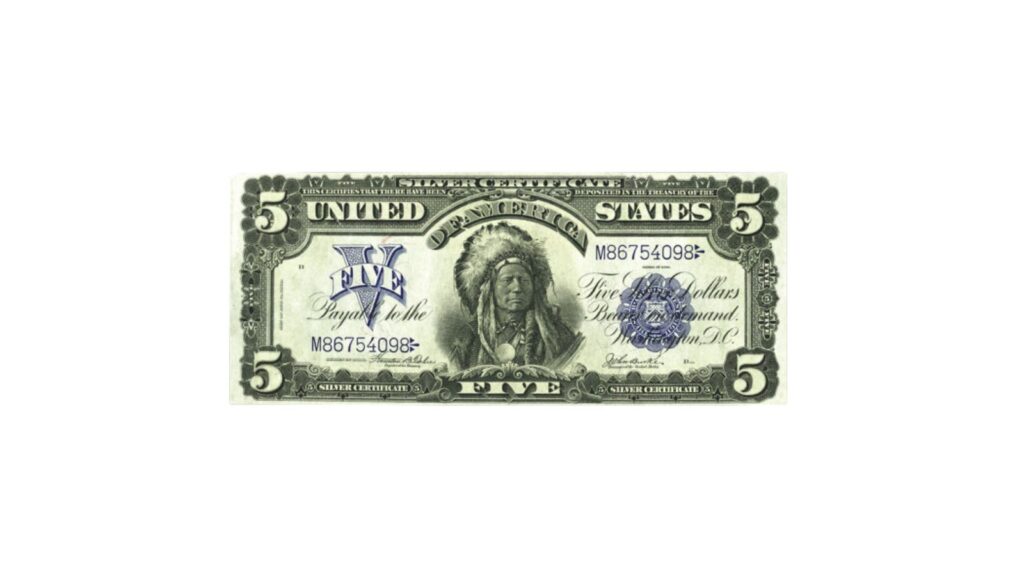
This is the most recognizable large-size $5 bill most people will ever encounter, and it’s a genuinely striking piece of design: a portrait of Running Antelope, chief of the Hunkpapa Lakota, filling most of the front, printed between 1899 and the early 1920s. It was the only time a Native American appeared as the central figure on U.S. paper money, and tens of millions were printed, which means it shows up in old collections more often than its history might suggest.
Value tracks condition closely. Heavily worn examples typically bring under $300, fine to very fine notes run $300 to $1,250, and anything approaching uncirculated jumps to $1,500 and up, with true gem examples reaching $3,000 or more. A serial number under 100, or a star symbol at the start of the serial number, adds a further premium at any grade.
Because millions survive, this isn’t a needle-in-a-haystack find the way some large-size notes are. It’s more a question of condition. If a family collection includes an old, oversized $5 bill with a portrait in full headdress, this is very likely it, and it’s worth an appraisal rather than an assumption.
12. 1907 $5 legal tender “Woodchopper” note
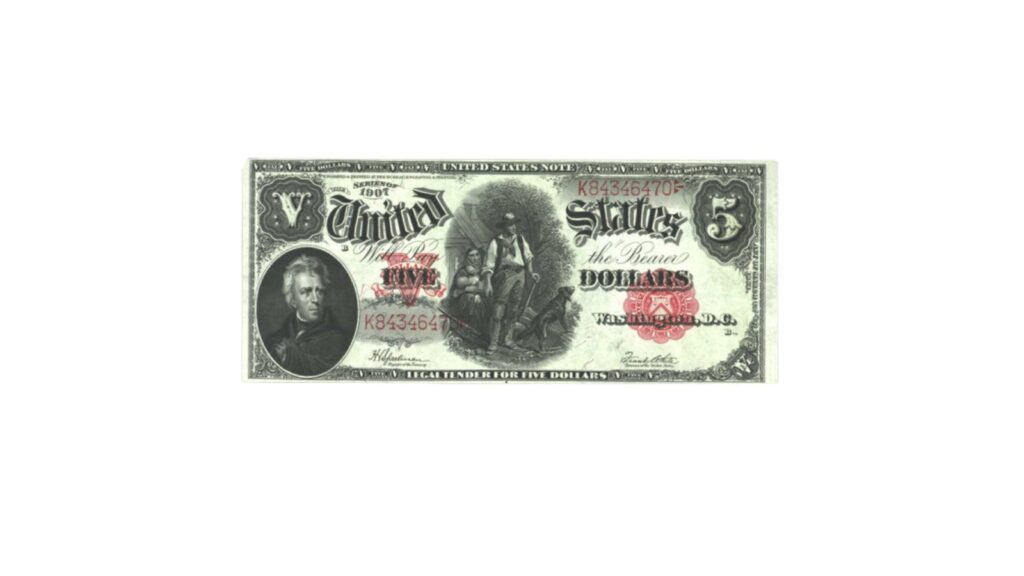
Nicknamed for its central image of a pioneer with an axe, his wife, their baby, and a dog, the 1907 series was the last large-size $5 bill the government ever printed before currency shrank to its modern dimensions in 1929. At roughly 40 percent bigger than a current bill, it’s obvious in a stack of old currency before you even check the date.
Well-worn examples bring around $50 to $75, fine condition runs $75 to $125, and very fine climbs to around $200 to $235. Extremely fine to about-uncirculated notes bring $300 to $450, and choice or gem uncirculated examples can reach $600 to $900. Tens of millions were printed, and runs of consecutive, uncirculated notes still surface occasionally, so high grades aren’t as impossible to find as the price range suggests.
One quirk worth knowing: a printing plate error nicknamed the “PCBLIC” error, where part of the word “PUBLIC” was misspelled, shows up often enough on this series that it only adds about a 15 percent premium rather than a dramatic one. Fun to check for, even if it won’t make or break what you have.
13. Ink smear error $5 bills
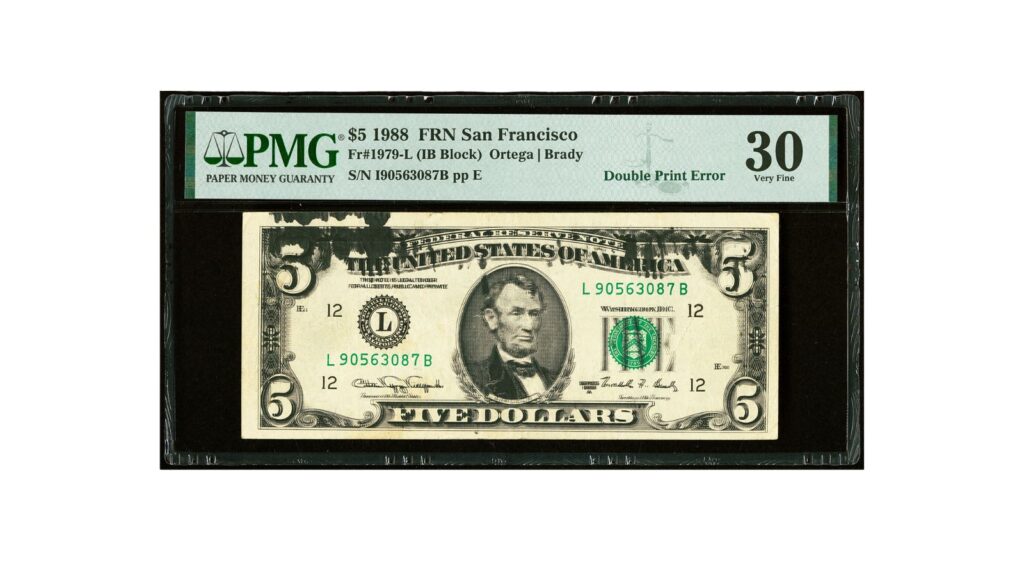
Currency prints in three separate passes, the back, then the face, then the black serial numbers and seals, and excess ink on any one of those passes can transfer onto the sheet as a smear or blotch. The result ranges from a small dark smudge in one corner to a dramatic streak running most of the width of the note.
Size and placement drive the price. Minor smears bring around $50, while a large, dramatic smear crossing a significant portion of the design can reach $1,000 or more. A smear that lands directly over the portrait or the Treasury seal draws more collector interest than one tucked into a plain border area.
The hardest part of this one is telling a genuine press error from ordinary staining picked up over decades in a wallet or drawer. A real ink smear has the same texture as the rest of the intaglio printing since it came from the same press pass, while later staining tends to sit differently on the paper. For anything beyond a minor smear, professional authentication is worth the fee before you try to sell it.
14. Off-center or misaligned print error $5 bills
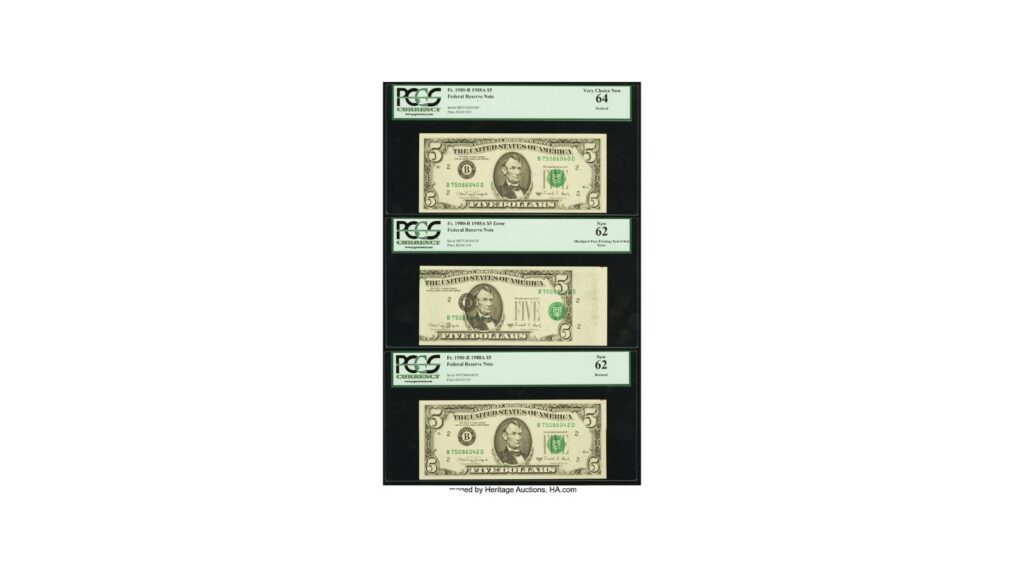
The most common error type by far, and the one most likely to actually turn up in ordinary circulation, is simple misalignment: the printed design shifts off-center during one of the printing passes, leaving uneven margins or a design that runs noticeably close to one edge.
Severity sets the price almost entirely. A barely noticeable shift brings $25 to $50, a clearly crooked note with visibly uneven margins runs $50 to $200, and a dramatic shift where part of the portrait or lettering actually runs off the edge of the paper can bring $200 to $500 or more. The more obvious the mistake is without a ruler, the more collectors will pay for it.
Because this error is common enough to check for on any bill, it’s worth a habit rather than a one-time search: hold new bills up to the light and compare the border width on all four sides. Most notes are perfectly centered, which is exactly what makes an off-center one easy to spot once you know to look. A bill with the portrait or serial number partially cut off by the edge of the paper is worth setting aside rather than spending.
15. Inverted overprint error $5 bills
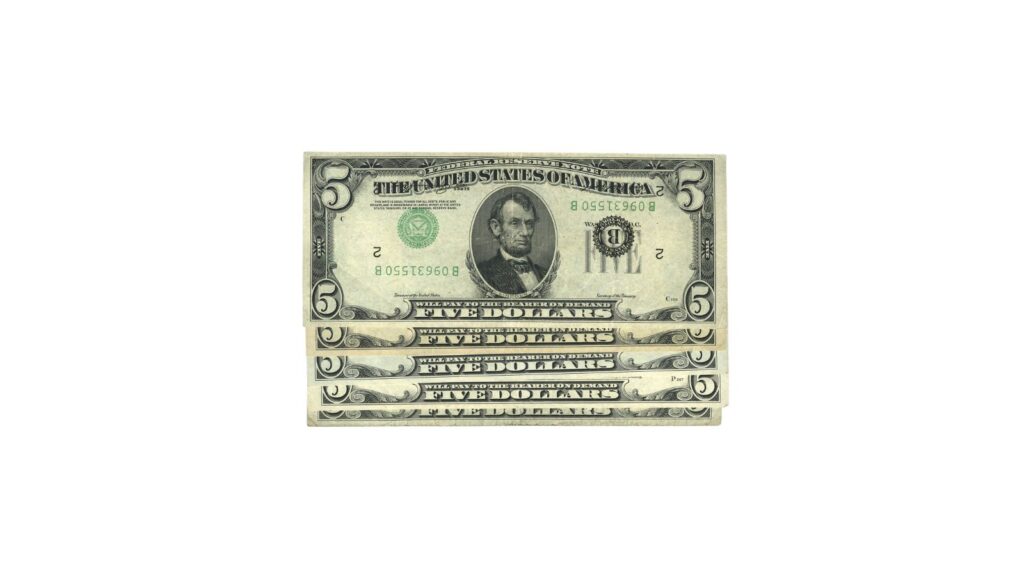
The final printing pass on any $5 bill adds the black serial numbers, the Treasury seal, and the Federal Reserve district markings as an overprint layer on top of the already-printed face. On rare occasions that layer gets fed through the press upside down relative to everything underneath it, so the serial numbers and seal appear inverted while the portrait and border sit right side up.
This is a dramatic, immediately obvious error, and it prices accordingly. Inverted overprints typically bring $200 to $2,500, with the higher end reserved for notes where the inversion is complete and unmistakable rather than a partial or minor shift. The more the two layers contradict each other at a glance, the more collectors compete for it.
Authentication matters enormously here because the error is dramatic enough to fake convincingly with a careful alteration. Genuine inverted overprints show ink and pressure consistent with the Bureau’s actual printing process under magnification, which only a professional grading service can confirm with confidence. Given the price gap between a certified and an uncertified example, that step is worth taking before any sale.
16. Fold-over (butterfly) error $5 bills
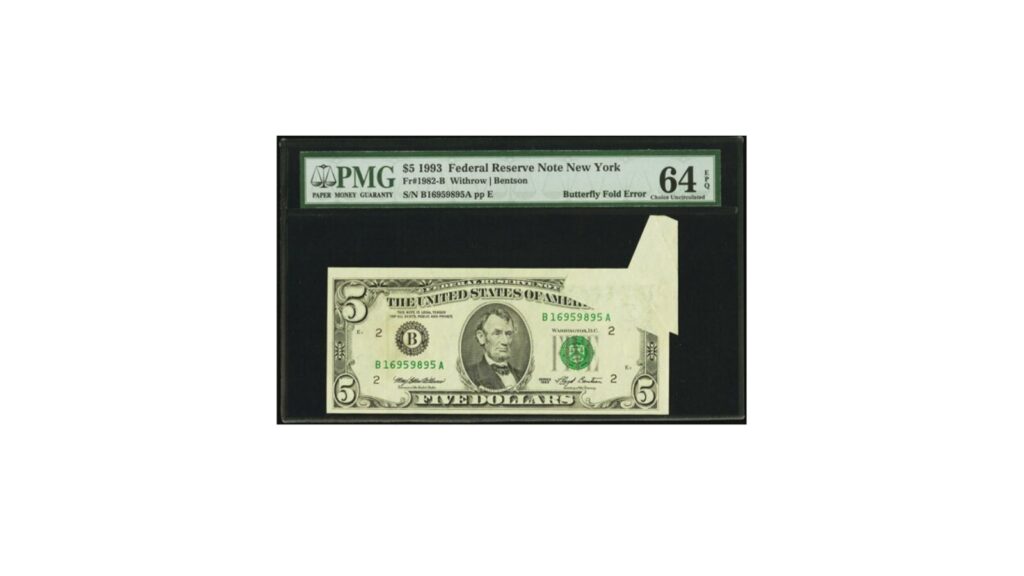
When a corner or edge of a currency sheet folds over on itself before it goes through the press, the folded section receives no ink on one side while the flip side of that same section gets printed twice. Once the sheet is unfolded and cut into individual notes, the result is a bill with a startling blank patch on one side and an extra, oddly placed printed section on the other, sometimes called a butterfly note for the shape the fold leaves behind.
The size and position of the fold set the value. Significant fold-over errors bring $500 to $3,000 at the higher end, while smaller folds affecting only a corner bring less. Whether the fold happened during an early or later printing pass also matters, since folds during later passes tend to produce more visually dramatic results.
These are unmistakable even to a non-collector, which is part of why they command strong prices. If a bill in a family collection has an oddly shaped blank section or printing that clearly doesn’t belong where it is, don’t try to flatten it out or explain it away. Get it in front of a currency dealer before doing anything else to it.
17. 1934A $5 Hawaii overprint note
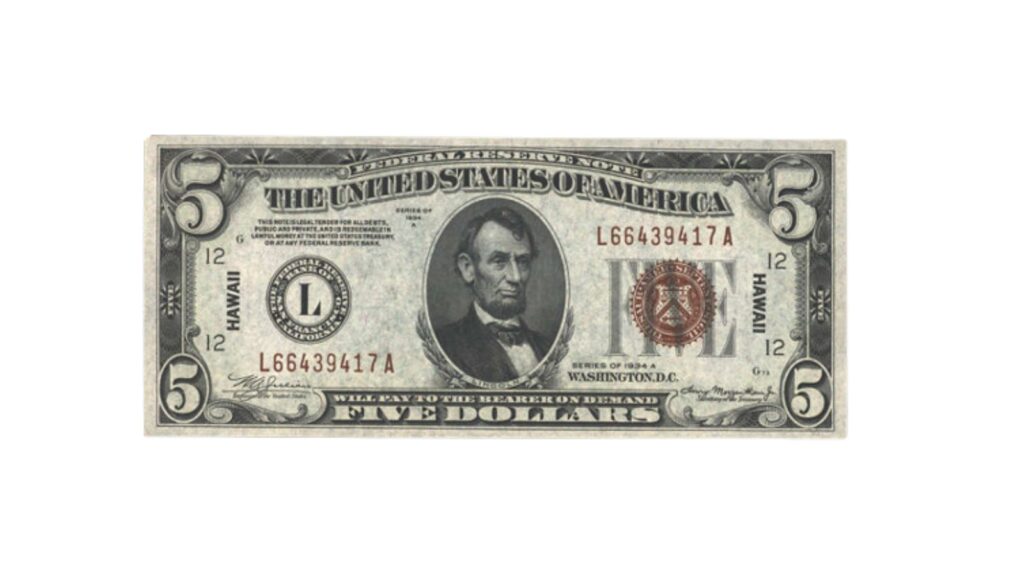
After the attack on Pearl Harbor, the government printed special emergency currency for use in Hawaii in case the islands were invaded and the currency needed to be declared worthless on short notice. A 1934 or 1934A $5 Hawaii note looks like an ordinary Federal Reserve Note with two changes: a brown Treasury seal instead of green, and the word “HAWAII” printed in large letters across the back with smaller overprints on the front. Around 9.4 million of the $5 denomination were printed, making it the scarcest of the four Hawaii denominations issued.
Circulated examples bring $60 to a few hundred dollars, with uncirculated notes climbing into the thousands depending on centering and paper quality. Star replacement notes are considerably scarcer still, running from roughly $1,500 in circulated grades up toward $8,000 for the best uncirculated examples.
These notes carry a real family-history angle, since so many were kept as souvenirs by service members stationed in the Pacific rather than spent. If a relative served during the war and kept currency as a memento, a Hawaii overprint note is a genuinely plausible find, not a long shot.
18. Mismatched serial number error $5 bills
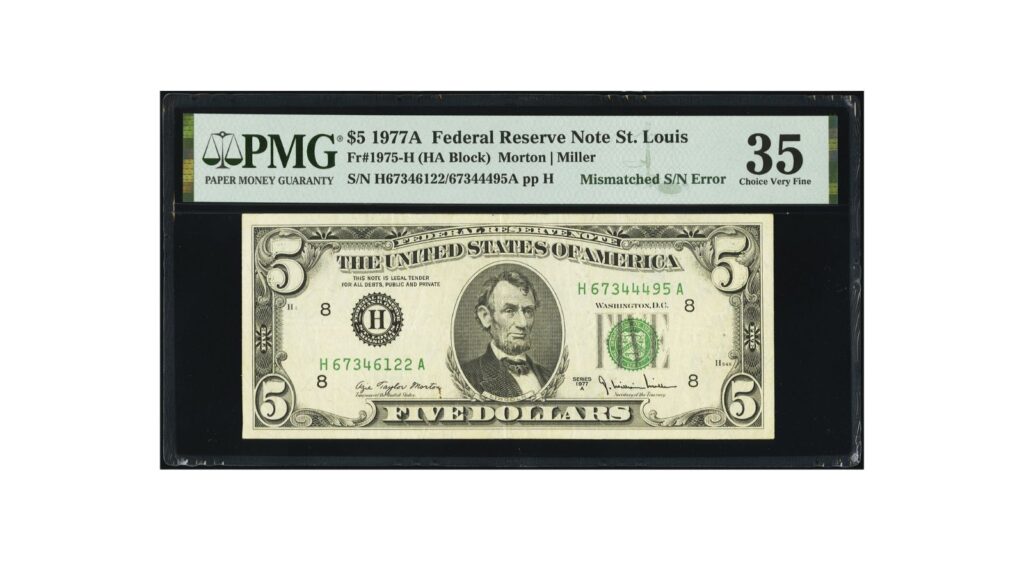
Every U.S. bill carries its serial number printed twice, once in the upper right and once in the lower left of the face, and the two are supposed to be identical down to the last character. When a numbering wheel sticks or fails to advance properly during the overprint pass, the two numbers can end up differing by a digit, or occasionally by more, without anything else about the bill looking unusual.
Because the mistake is subtle, plenty of these go completely unnoticed in circulation. A single mismatched digit brings $300 to $600 circulated and roughly double that uncirculated, while a mismatch affecting multiple digits or the prefix and suffix letters can reach $700 to $2,500. A mismatch found on a star note goes higher still.
This is the one error on this list you genuinely can’t spot at a glance, so it’s worth developing the habit of comparing the two serial numbers character by character rather than assuming they match because they’re supposed to. Because altered serial numbers are also a known forgery method, any note you suspect has a genuine mismatch needs professional certification before it changes hands. Buyers won’t take an uncertified example seriously at this price level.











