
The tray is sitting at the back of a folding table, tarnished and a little grimy, tagged $5. It looks like it came out of a church hall kitchen circa 1975. Flip it over, though, and you might see the word “Sterling” stamped on the bottom. At current silver prices close to $76 an ounce, that tray could be worth $200 or more just on scrap value.
Most people walk past it. That’s the whole opportunity.
Serving trays, platters, and tea services are among the most consistently underpriced items at estate sales and thrift stores. They’re unglamorous, often tarnished, and the people setting prices usually don’t know what they have. The most useful thing you can bring is knowing what’s on the bottom.
Table of contents
Sterling silver serving trays
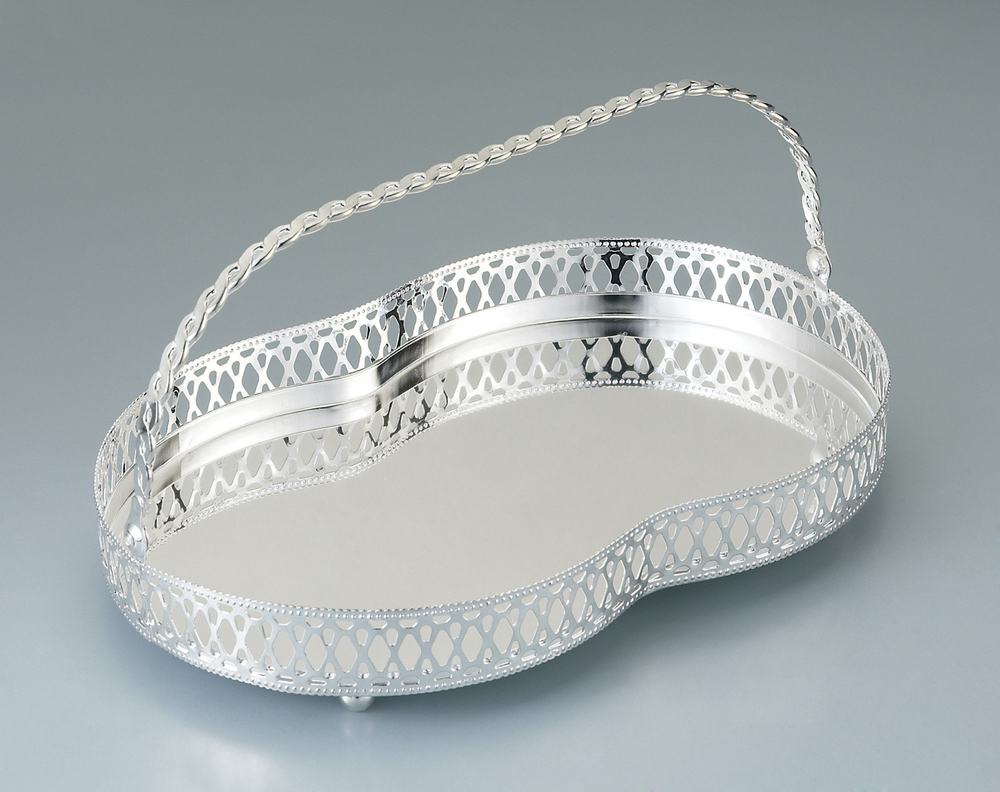
The hallmark stamped on the underside is everything. “Sterling” or “925” means the piece is 92.5% pure silver. “EPNS” (electroplated nickel silver) means it’s a base metal dipped in silver and worth very little to anyone who wants the metal value. “EPBM” (electroplated Britannia metal) is the same story.
Sterling serving trays vary enormously in weight, and weight drives the dollar value. A small cocktail tray might weigh 5 or 6 troy ounces. A large formal tray from the 1930s or 1940s can weigh 20 troy ounces or more. A 20-ounce sterling tray is worth around $1,100 before a buyer’s commission at today’s silver prices. Silver buyers typically take around 20%, which still leaves you with roughly $875 for something someone tagged at $20.
Tarnish doesn’t reduce value. It polishes out. Dents matter more, though they don’t disqualify a piece. Engraving, whether a monogram or a presentation date, is largely neutral: it proves age but adds little to most buyers’ calculations. A real sterling tray is non-magnetic, which gives you a quick test if you carry a small magnet. Hold one against the surface: if it sticks, the piece isn’t silver. If it doesn’t, you have more reason to look carefully at the mark.
The silver tea and coffee service
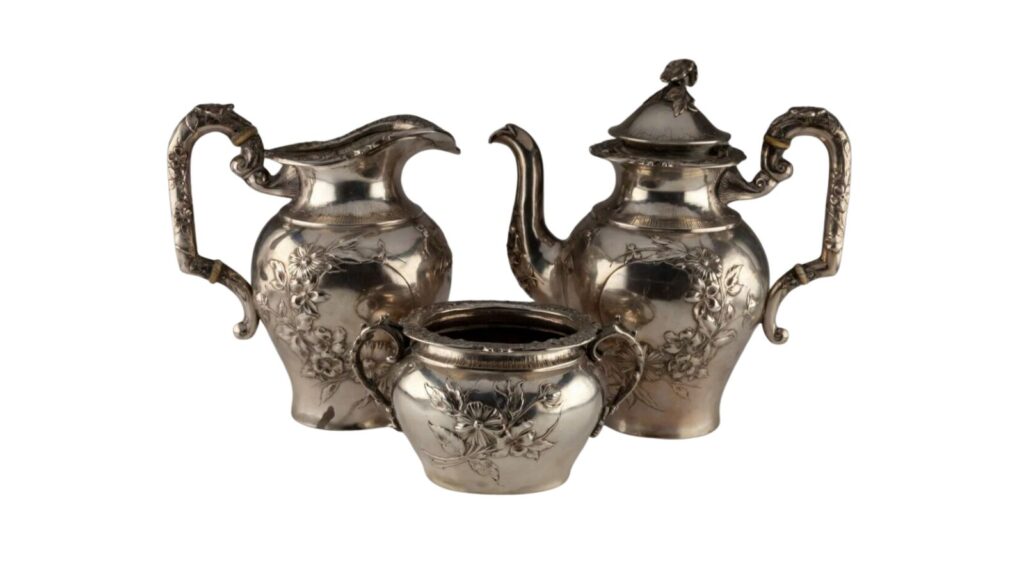
A tray is often not just a tray. It’s the anchor piece of a silver tea or coffee service, and a complete set is worth considerably more than the tray alone. A sterling silver tea service can start at $1,000 and climb well beyond that depending on the maker, the number of pieces, and whether the set is intact. Sets by Gorham, Reed and Barton, and Tiffany command the most, but any complete sterling set in good condition has real value.
The pieces get separated constantly. Someone donates the tray to one thrift store and the teapot ends up at another estate sale three towns over. Before you evaluate any silver tray in isolation, look around for the rest of the set. A creamer, a sugar bowl, a teapot, and a coffee pot nearby all suggest the service traveled together. Look for matching patterns and compatible weight. Even two or three pieces of a matching sterling service are worth more together than apart.
The same hallmark rules apply across every piece. Check the bottom of each item for “Sterling” or “925.” A teapot, coffee pot, creamer, and sugar bowl that are all marked and all match represent a meaningful find. The completeness of the set matters: a service missing a lid or one piece loses value, but not so much that it stops being worth buying at thrift store prices.
Old Sheffield plate
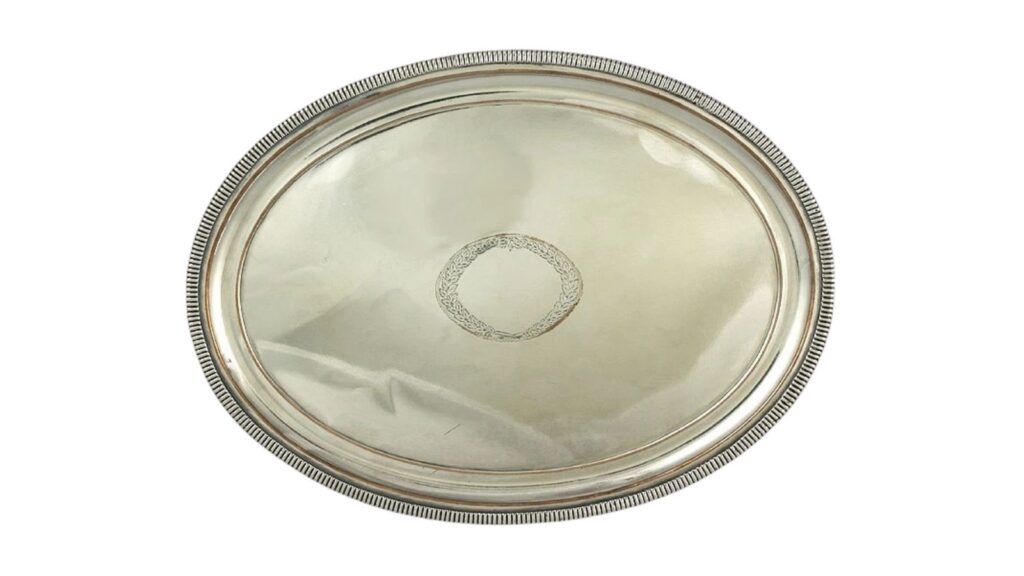
Not every silver-colored serving tray without a “Sterling” mark is worthless. Old Sheffield plate, made between roughly 1750 and 1840, is a specific type of fused silver that predates modern electroplating and has its own collector market. It was made by fusing a sheet of silver directly onto a copper base using heat, a more labor-intensive process than the electroplating that came later. Fine pieces by makers like Matthew Boulton can sell for hundreds or thousands of dollars at auction.
The identification is counterintuitive. Most Old Sheffield plate is unmarked, because makers at the time were legally prohibited from using marks that resembled sterling hallmarks. So if a silver-colored tray has no stamp at all, or only a maker’s device (a small symbol rather than words), it may be Old Sheffield plate rather than cheap modern plating. If it says “EPNS,” that’s modern electroplating from after 1840, which is a completely different thing. If the piece has no mark and you can see a warm copper glow at the edges or at points of heavy wear where the silver has thinned, that copper underlayer is one of the signs of authentic Sheffield plate.
The design is also a clue. Old Sheffield plate was made primarily in the Georgian and early Regency periods, so the styling tends to be ornate and heavy: reeded borders, gadroon edges, engraved cartouches, and sometimes shell or scroll feet. An unmarked silver tray with Georgian styling, heavy construction, and copper showing at worn edges is worth taking to an appraiser before you conclude it has no value.
Antique transferware and flow blue platters
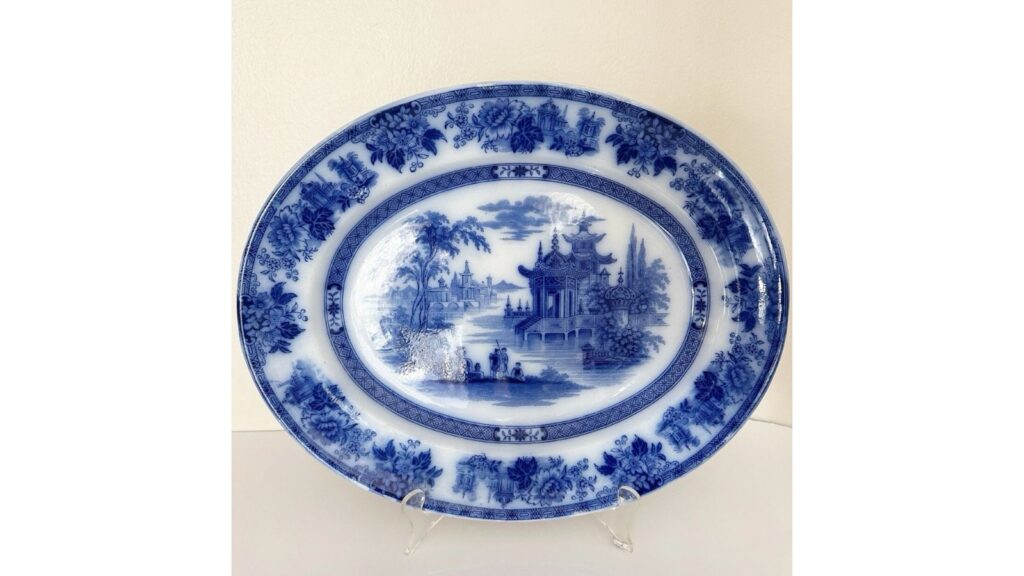
The same estate sale table that holds a tarnished silver tray often also holds a large blue-and-white pottery platter that nobody is looking at. Antique English transferware, and flow blue in particular, has a real collector market, and the pieces are identified by what’s stamped on the bottom.
Flow blue refers to a 19th-century technique in which cobalt blue ink was deliberately fired to bleed slightly beyond the pattern lines, creating a soft, watercolor-like effect. It was produced primarily from the 1820s through the early 1900s and is most closely associated with Staffordshire potteries in England. A well-preserved large flow blue serving platter in a desirable pattern can sell for $100 to $500 or more. The pattern name and the maker’s mark on the bottom are the two things that drive value most.
Flip any large blue-and-white pottery platter over and look for three things: the manufacturer’s mark, the pattern name, and the country of origin. Pieces marked “England” or “Made in England” date to after 1891, when U.S. import law required country-of-origin labeling. Pieces marked only with a city like “Staffordshire” or with no country at all may predate that, and are often more valuable. The condition standard is strict: a hairline crack visible under light reduces value significantly, and a chip on the rim is worse. A chip-free, crack-free platter in a clear, well-defined pattern is the one to pick up.
The habit is the same across all of it: flip the piece over before you put it down. The mark on the bottom of a serving piece is almost always more informative than whatever price is on the tag.











