
The box in the garage has been there since the last move. Maybe the one before that. You know what’s in it, roughly, because you’re the one who packed it: old game stuff, an ugly beige computer, some kind of electronic toy with a cracked battery cover. You’ve been meaning to deal with it for years.
Before you haul it to the thrift store, pull it out and take a closer look. Certain 1980s tech has developed a serious collector market over the past decade, driven by nostalgia, genuine historical significance, and the fact that working examples are getting rarer every year. Some of it is worth exactly what you’d expect. But a handful of pieces, including things that look unimpressive and were never particularly glamorous to own, have become genuinely valuable.
The rule across nearly everything on this list is the same: condition and completeness are everything. A working unit beats a broken one by a factor of three or four. Original box and manual can double the price. And within each category there are specific versions, models, and markings that matter a great deal, while nearby versions that look almost identical are worth next to nothing. The difference is always in the details.
Table of contents
- Texas Instruments Speak & Spell (1978 original, raised-button version)
- Original Nintendo Game Boy DMG-01 (1989, gray)
- Commodore 64 breadbin (1982)
- Atari 2600 Heavy Sixer (1977) vs. common woodgrain consoles
- Sony Walkman WM-2 (1981)
- Nintendo Power Glove (1989, with sensor bar)
- Nintendo Entertainment System Deluxe Set with R.O.B. (1985)
- GCE Vectrex console (1982)
- Sony Walkman TPS-L2 (1979)
- Apple Macintosh 128K (1984)
Texas Instruments Speak & Spell (1978 original, raised-button version)
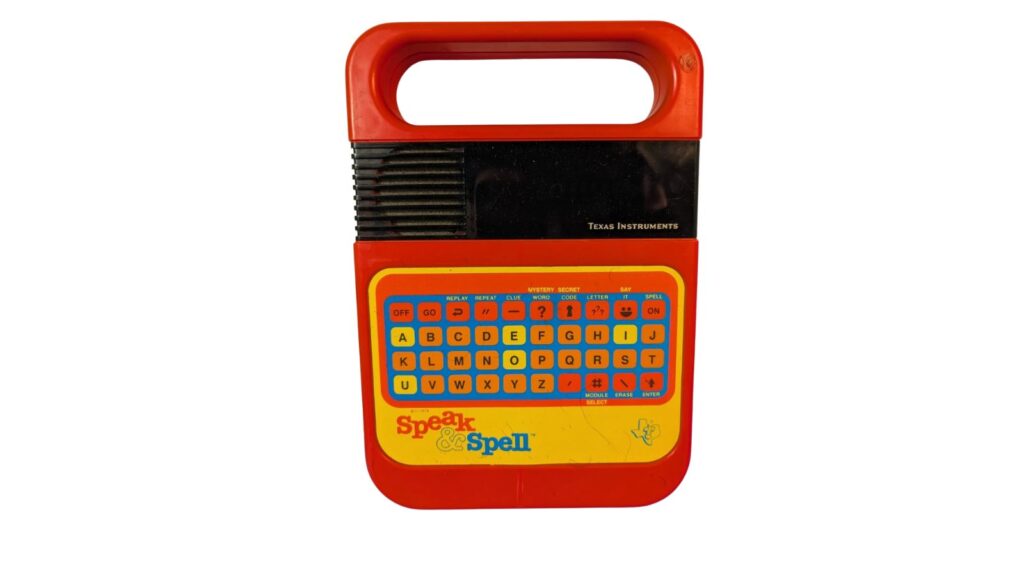
The Speak & Spell was a genuine engineering landmark when it debuted in 1978. It contained the world’s first single-chip speech synthesizer, a feat that Texas Instruments engineers had once thought was years away from being achievable. For most of the kids who owned one, it was just the toy that told you when you’d spelled something wrong. But the original 1978 and early 1980 versions have developed real collector interest, partly because of the Speak & Spell’s cameo as E.T.’s improvised phone in the 1982 Spielberg film, and partly because the original hardware genuinely matters to people who care about the history of electronics.
The version that commands the most attention is the original raised-button model, where the keyboard has distinct, physical keys rather than the flat membrane keyboard introduced with the 1980 redesign. The raised-button units are distinctly earlier and feel more substantial. Working examples bring $30 to $80, with original box and cartridges pushing into the low hundreds. Broken or non-working units still fetch $10 to $20 for parts. Condition focuses on two things: does it power on and speak clearly, and are the buttons fully functional without sticking? The vacuum fluorescent display should be bright and even. Any dead segments drop value quickly. The Speak & Spell’s place in electronics history is secure, but the market is realistic about what common examples are worth. You’re not going to retire on one. You might, however, be pleasantly surprised by what a thrift store find cleans up for.
Original Nintendo Game Boy DMG-01 (1989, gray)
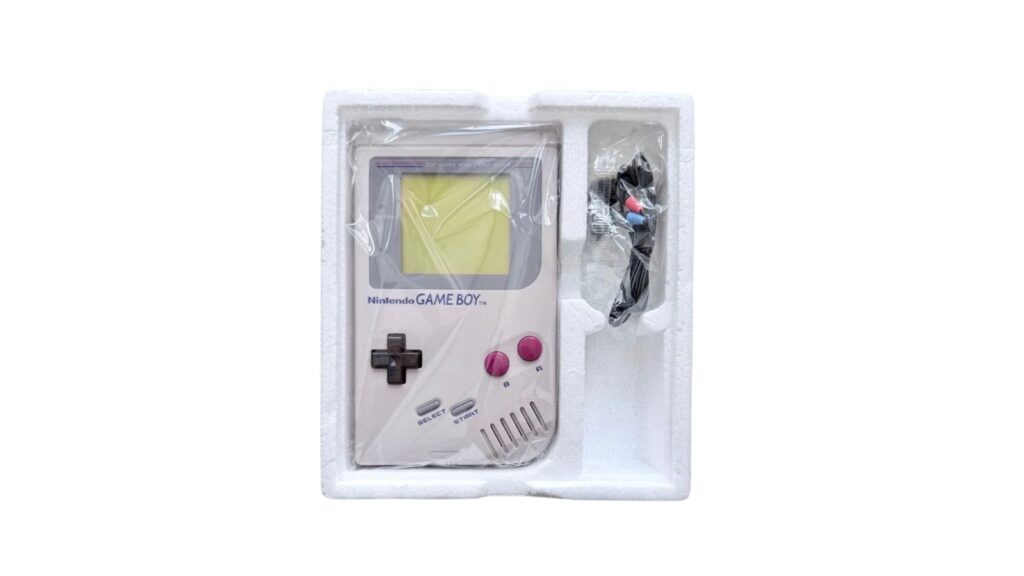
Nintendo sold over 118 million Game Boy units between 1989 and the early 2000s, which means an enormous number of them survived in attics, basements, and bins. So the standard gray DMG-01 isn’t rare. A working unit without a box brings $40 to $70, which is a reasonable return on something you might find in a junk drawer. The jump comes with completeness. A Game Boy with its original box, foam insert, manual, and warranty card regularly reaches $150 to $300, and particularly clean examples push higher.
There are several condition points that matter more than people expect. Yellowing of the plastic shell is very common and reduces value by 20 to 30 percent. Collectors want units that have held their original off-white color. The screen should be fully functional with no dead lines across it, which is an extremely common failure mode; horizontal or vertical lines appearing on the display indicate a loose ribbon cable and drop value sharply. The speaker should produce clean audio. Check that the battery cover is the original and not a replacement, which is surprisingly easy to spot from the plastic texture. Modifications, including backlit screen upgrades and shell replacements, are popular with players but hurt value with collectors who want an unaltered unit. The Game Boy that came in original packaging and was then put away, which some parents absolutely did, is the one worth tracking down.
Commodore 64 breadbin (1982)
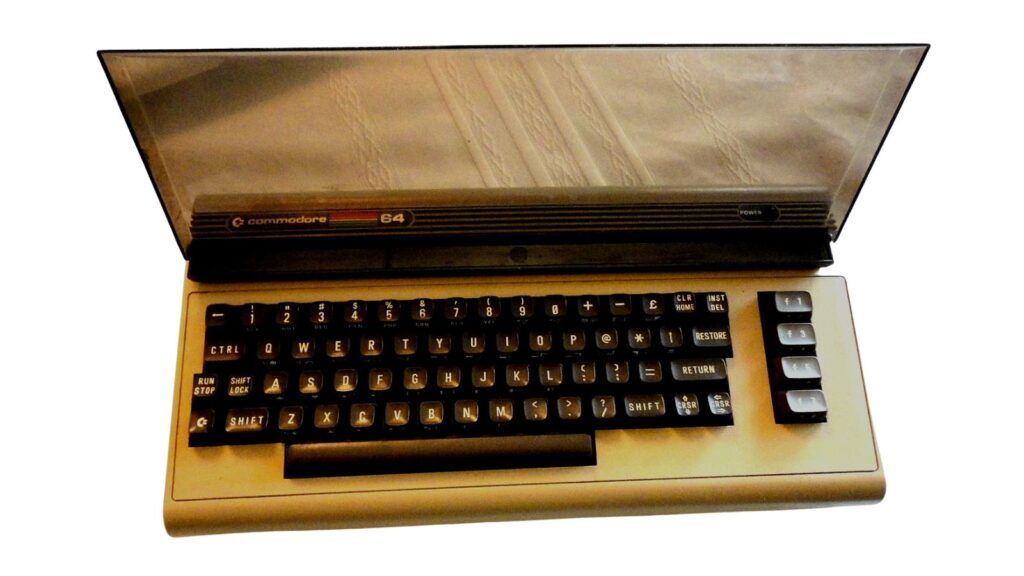
The Commodore 64 is the best-selling computer model ever made, a fact that sounds like it should make it worth nothing. A few million things don’t usually become collectibles. But several factors work in its favor. The earlier “breadbin” design, named for its resemblance to a bread box, is more desirable than the later flat Commodore 64C. The very earliest examples, with a silver label and low serial numbers made in West Germany, have sold for over $600, though that’s the high end. A standard working breadbin in decent cosmetic condition brings $80 to $200, and a full setup with the original 1541 disk drive, power supply, manuals, and box can reach $300 to $500.
Condition testing requires more than a power-on check. The SID sound chip, which generated the C64’s iconic audio, is worth around $50 on its own and frequently fails. Any C64 with a silent or distorted sound chip is worth significantly less. The power supply is the bigger hazard: the original brick power supplies are notorious for failing in a way that puts excess voltage through the computer and destroys chips. Any power supply more than a few years old should be tested before use. Keys on the membrane keyboard can stick or fail. The unit should boot to the blue screen showing 38911 BASIC BYTES FREE and the READY prompt. Anything less suggests problems that will be difficult and expensive to trace. A unit that boots clean and sounds right is worth substantially more than one that “mostly works.”
Atari 2600 Heavy Sixer (1977) vs. common woodgrain consoles
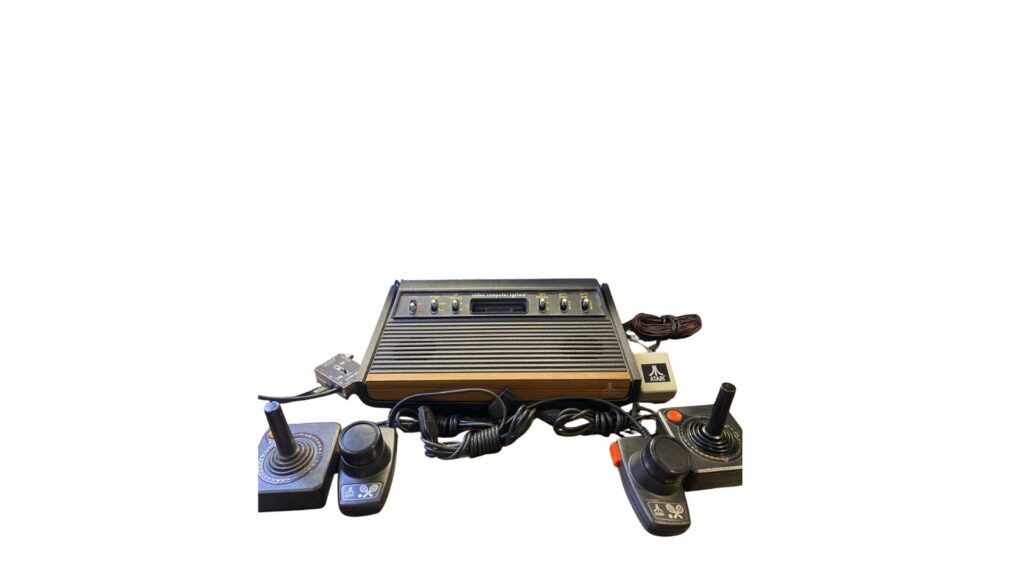
Not all Atari 2600 consoles are created equal, and the difference between the most desirable and the most common is larger than most people realize. The Heavy Sixer, produced from late 1977 through 1978, is the earliest version of the console. It has six switches across the top (including a color/black-and-white toggle), a rounded, thick-plastic case, and was built in Sunnyvale, California. It’s heavier than any subsequent version, hence the name. Working Heavy Sixers bring $200 to $500, with complete-in-box examples going higher.
The common woodgrain four-switch consoles from the early 1980s are a different story entirely. Working examples with controllers bring $40 to $80, which is still not nothing if you found one for free. The all-black “Darth Vader” model is worth a little less than the woodgrain. The later Atari 2600 Jr., the small, rainbow-striped version, has minimal collector value and typically sells for under $30. To identify a Heavy Sixer, look for the distinctive rounded case design, all six switches, and “Made in USA” on the bottom. Flip it over and check. The woodgrain vinyl across the front should be fully intact, since peeling or lifting reduces value on any version. A Heavy Sixer with an original joystick, power supply, and game cartridge is the setup worth bothering with.
Sony Walkman WM-2 (1981)
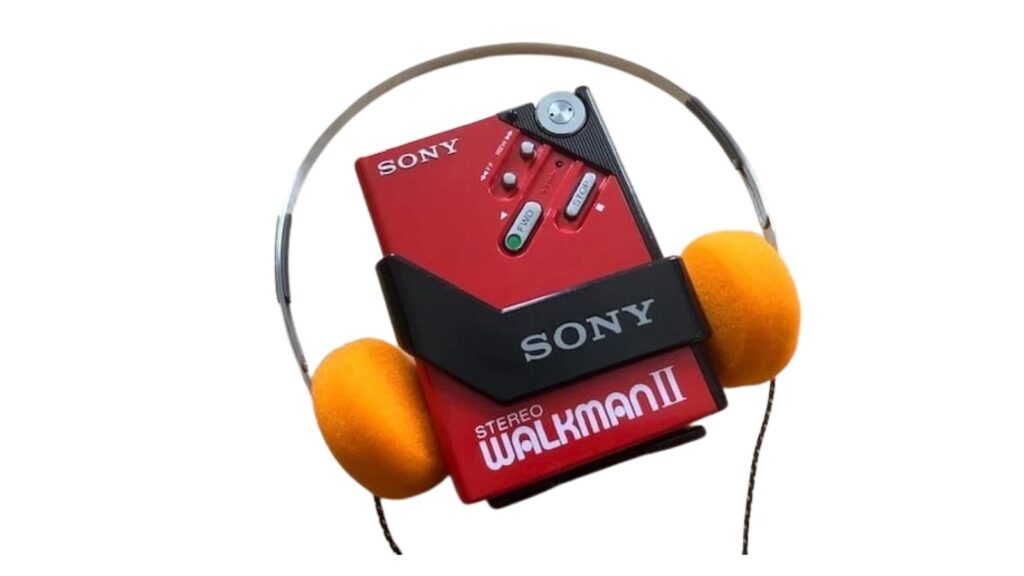
The WM-2 was the second Walkman Sony ever made, introduced in February 1981, and it sold 2.58 million units in its first year, roughly doubling the reach of its predecessor. It was significantly smaller than the original TPS-L2, coming in at about the size of a cassette case, and it came in red, black, and silver. That combination of iconic design, strong production numbers, and the sheer cultural weight of the name has made it a genuine collector piece. Working WM-2 units in good cosmetic condition bring $220 to $490, with examples described as “restored” or “serviced” pushing toward the higher end.
The single most common failure point is the drive belt, a rubber band inside the mechanism that powers the tape transport. These degrade and snap with age, meaning a WM-2 that does nothing when you press play usually just needs a new belt, a repair that costs about $15 in parts and takes an afternoon. A unit with a dead belt but otherwise good cosmetics is worth considerably less than a working one. The original carrying strap, which wraps around the WM-2’s distinctive loop hooks, adds value. So does the leather carrying case Sony sold for it. Units with any paint loss, deep scratches, or replaced battery compartment covers are worth notably less than clean examples. If the buttons still click crisply and the plastic has no warping, you have something worth pursuing.
Nintendo Power Glove (1989, with sensor bar)
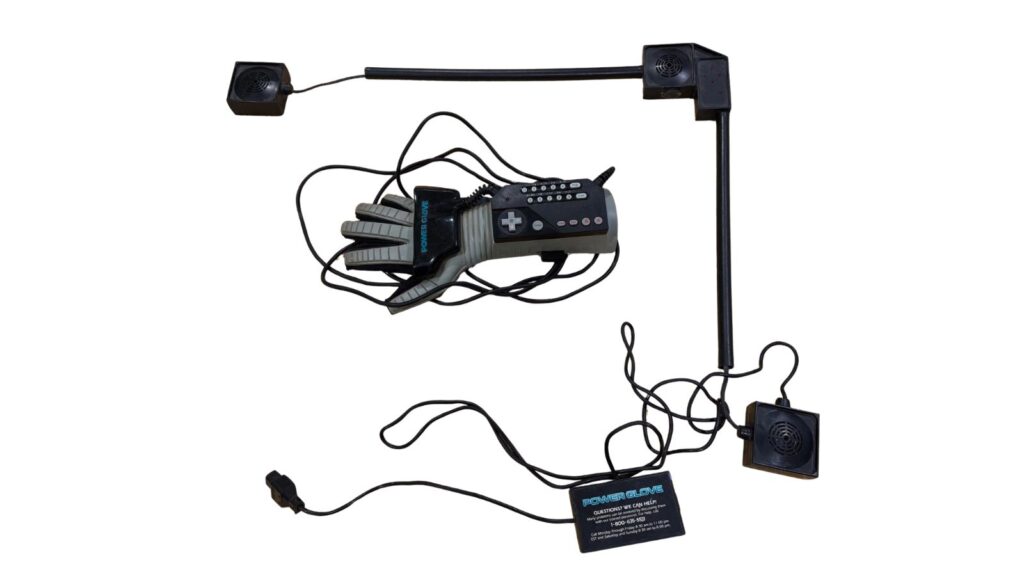
The Power Glove failed commercially and spectacularly, selling for less than a year before being discontinued. It was hard to program, imprecise in practice, and came with almost nothing specifically designed for it. The line “I love the Power Glove. It’s so bad,” delivered by the villain in the 1989 film The Wizard, has been a fixture of internet nostalgia culture ever since. None of that hurt the collector market. The Power Glove is one of the most visually distinctive objects in gaming history, and complete working examples are harder to find than you’d expect, since the sensor strips inside the fingers degrade and the sensor bar is frequently lost.
A working Power Glove with the sensor bar brings $100 to $200 depending on how well the sensors actually function. Complete in its original box with all inserts and programming chart pushes into the $200 to $350 range. Testing is essential: the glove should connect to the sensor bar with its proprietary cable, and the fingers should register flexion when bent. Units where the sensors have fully failed are worth considerably less and are primarily of interest to people who want to display them. Check that the wrist strap is intact, the arm guard is uncracked, and that the front-panel buttons are all present. Missing the sensor bar almost completely kills the value.
Nintendo Entertainment System Deluxe Set with R.O.B. (1985)
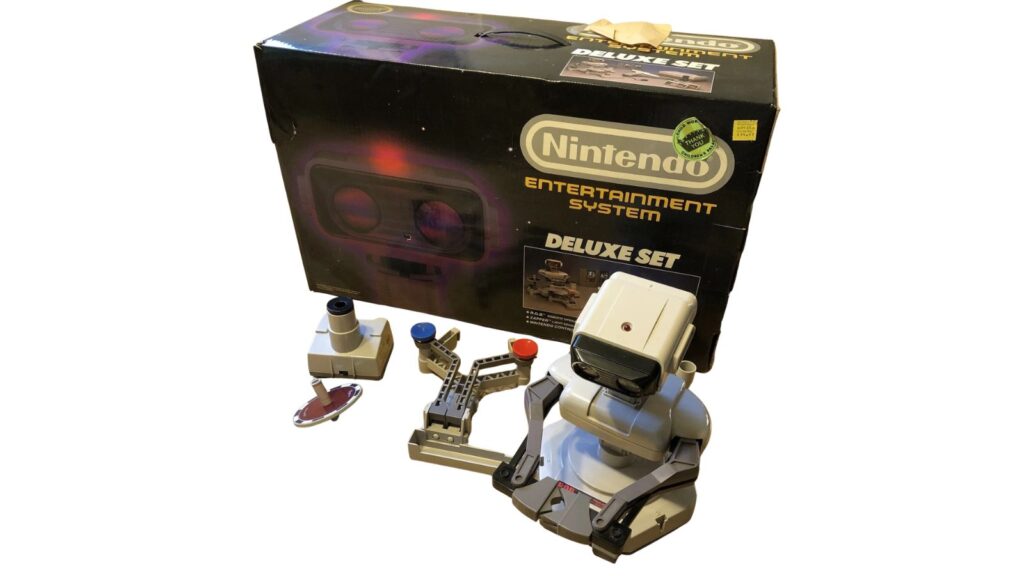
The standard NES Action Set, which included the console, two controllers, the Zapper light gun, and a Super Mario Bros./Duck Hunt cartridge, is the version most people owned. Working Action Sets in good condition bring $50 to $150. That’s useful to know because it sets a baseline. The Deluxe Set, released for the 1985 test market, is a completely different situation. It included the console, R.O.B. the Robotic Operating Buddy, Gyromite, Duck Hunt, the Zapper, and the original packaging. R.O.B. was Nintendo’s strategy for getting stores to stock the NES in the wake of the 1983 gaming crash, by positioning it as a toy rather than a video game system. It worked. And complete surviving sets are genuinely scarce.
Complete Deluxe Sets with R.O.B., both games, all gyros and stacking rings, sensor bar, original box, and paperwork bring $350 to $800 depending on how complete they are and the condition of the box. The R.O.B. alone, tested and working, is worth $100 to $200 as a standalone. The gyros are the piece most often missing; they’re small, orange, and look like toys, which they are. No gyros means no confirmed R.O.B. functionality, which hurts value. The styrofoam inserts and inner packaging are another frequent casualty. A Deluxe Set with all pieces present, working, and in its original box is an increasingly difficult find. If you have one and haven’t looked at it in 30 years, now is a good time.
GCE Vectrex console (1982)
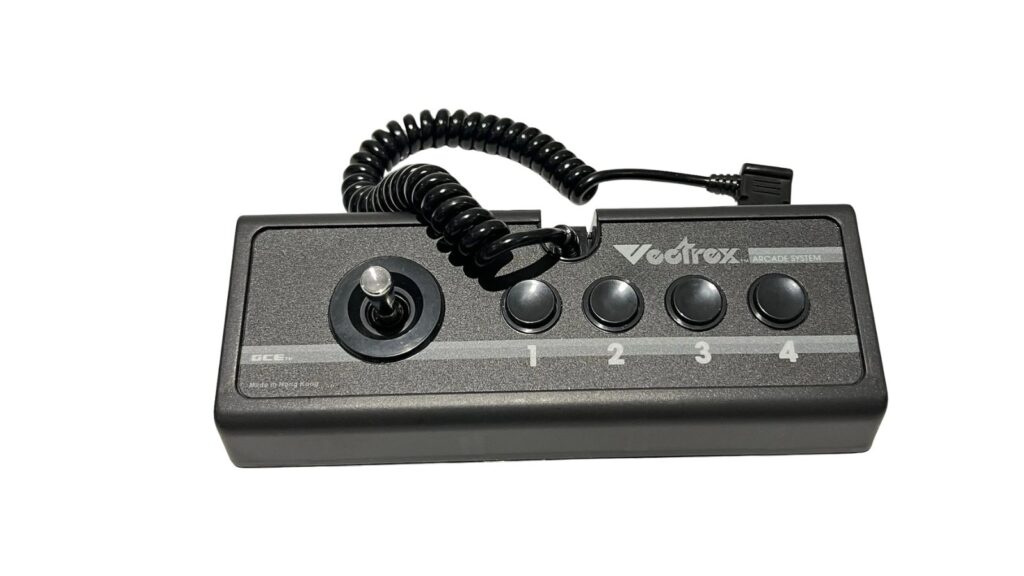
The Vectrex is the only home game console in history that came with its own built-in screen. Every other console requires a television. The Vectrex came with a 9-inch vector graphics CRT built into the unit, producing the same type of razor-sharp line graphics used in arcade games like Asteroids and Tempest. It was developed by Western Technologies/Smith Engineering, released in late 1982, and discontinued after the 1983 gaming crash. About 1.5 million units were made. The games came with plastic color overlay screens to add color to the display, and each title has its own set.
Working units without a box bring $250 to $400. Boxed examples with overlays and all original accessories push into the $400 to $700 range. The 3D Imager headset, a visor accessory that created genuine stereoscopic effects, commands $200 to $400 on its own and is considered the holy grail accessory for the system. The built-in CRT is the key concern with any Vectrex: capacitors degrade, and a system with display issues, including geometry problems, burn-in from a frozen game, or a dim image, needs significant repair. If the screen looks crisp and the Mine Storm game loads correctly from the built-in ROM, you have a working unit. The overlays for each game should be present and uncracked. Complete in box, with the overlays, the original controller, and any game cartridges, is the combination worth real money.
Sony Walkman TPS-L2 (1979)
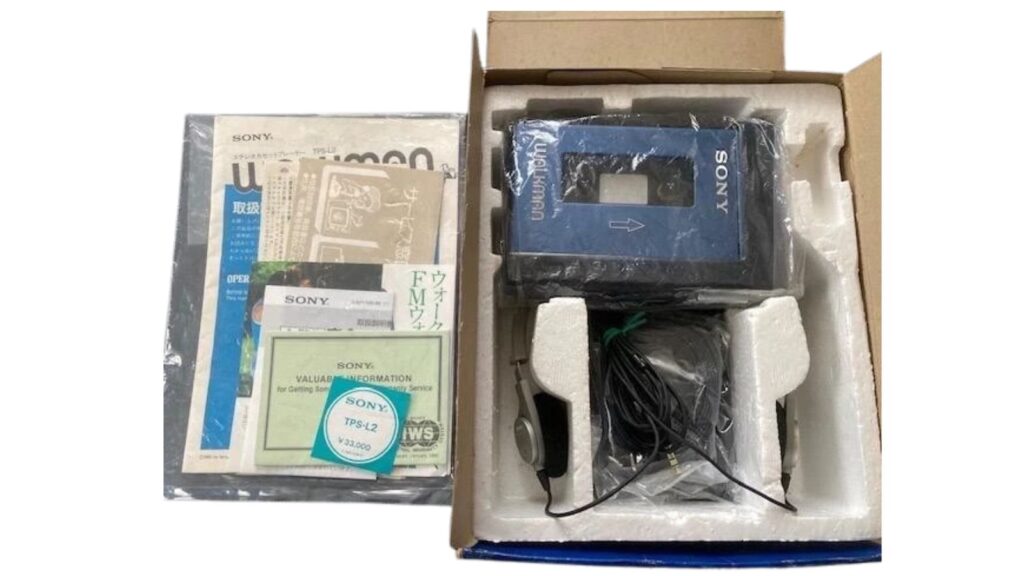
The TPS-L2 is the original Walkman, the first one Sony ever made. It went on sale in Japan on July 1, 1979, sold 30,000 units in its first two months, and changed how people related to music and public space. The design is immediately recognizable: a blue-and-silver metal cassette player with chunky silver buttons, a distinctive orange “hotline” button, and two headphone jacks, because Sony’s research suggested people would want to listen together. They were right, at least for a while. The TPS-L2 was prominently featured in the Guardians of the Galaxy films, which drove a new round of collector interest beginning in 2014.
Working examples in good cosmetic condition bring $400 to $700, with the highest prices going to units with the original strap, leather carrying case, and both headphone jacks confirmed functional. The hotline button should engage and lower the tape volume when pressed. Drive belts almost always need replacement after four decades; a unit that simply won’t play is often just a belt away from being fully functional. The blue plastic covering on the body should be intact with no peeling or cracking. Missing the orange hotline button entirely drops value significantly. Broken or heavily worn TPS-L2 units still bring $100 to $200 because the parts market remains active. A clean, working, complete example is genuinely rare.
Apple Macintosh 128K (1984)
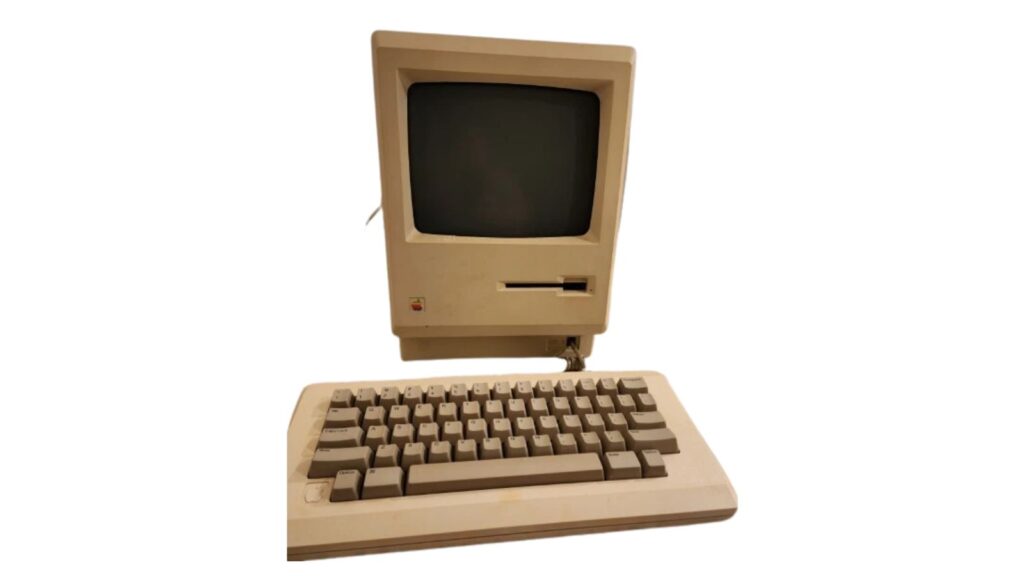
Apple introduced the Macintosh 128K on January 24, 1984 with one of the most famous television commercials ever made, directed by Ridley Scott and aired once during Super Bowl XVIII. The computer itself was revolutionary: it was the first mass-market computer to ship with a graphical user interface, a mouse, and a 9-inch built-in screen. Only 372,000 were produced before it was replaced by the 512K model later that year. Fewer than 10,000 are estimated to survive in functional condition.
Working examples bring $1,500 to $2,000, with units that include the original travel bag, manuals, system disks, and keyboard pushing higher. The original packaging with its Picasso-inspired artwork is extremely rare and adds several hundred dollars by itself. The model number M0001 appears on the bottom of the unit; the 512K “Fat Mac,” which looks identical but has a different designation, is worth considerably less. Key failure points include the internal floppy drive, whose lubricant solidifies after decades of non-use, and the capacitors on the logic board, which have a known failure mode that can corrupt the video signal. A unit that boots to the desktop is worth materially more than one that shows a sad Mac face or boots to gray with no further progress. Anyone with an early Macintosh in a closet owes it to themselves to power it on carefully before assuming it’s just a decorative object.
Most of this stuff has been sitting undisturbed for so long that owners genuinely don’t know what they have. A few minutes of identification and a careful power-on test can make the difference between a donation and a meaningful windfall.











