
Pull all the loose change out of your junk drawer, check your grandmother’s coin collection, and dig through any old mint sets you’ve been ignoring for decades. Some of those ten-cent coins aren’t worth ten cents. They’re worth hundreds. A few are worth thousands. Two of them, if you happened to stumble upon the right ones, have sold for more than a major car.
The thing about dimes is that they’re easy to overlook. They’re small, they pile up in jars, and most people assume coins from the 1950s or 1960s are just pocket change from another era. A lot of them are. But some aren’t, and the difference between the two comes down to a single digit in the date, a tiny letter underneath the design, or an invisible manufacturing error you can only see under magnification.
You don’t need an expensive collection to have something valuable. A single dime tucked into an old paper roll could be worth more than the rest of your savings account. The entries below cover the full range, from coins that anyone might genuinely turn up at a yard sale or in a forgotten tin, to the kind of pieces serious collectors spend decades hunting.
Table of contents
- Roosevelt silver dimes, 1946 to 1964
- Common-date Mercury dimes, 1934 to 1945
- Common-date Barber dimes, 1892 to 1916
- 1996-W Roosevelt dime
- 1982 No-P Roosevelt dime
- Barber dime semi-key dates: 1901-S, 1903-S, and 1913-S
- 1921-D Mercury dime
- Mercury dime “Full Bands” designation on common dates
- 1916-D Mercury dime in worn circulated condition
- 1895-O Barber dime
- 1965 silver transitional error Roosevelt dime
Roosevelt silver dimes, 1946 to 1964
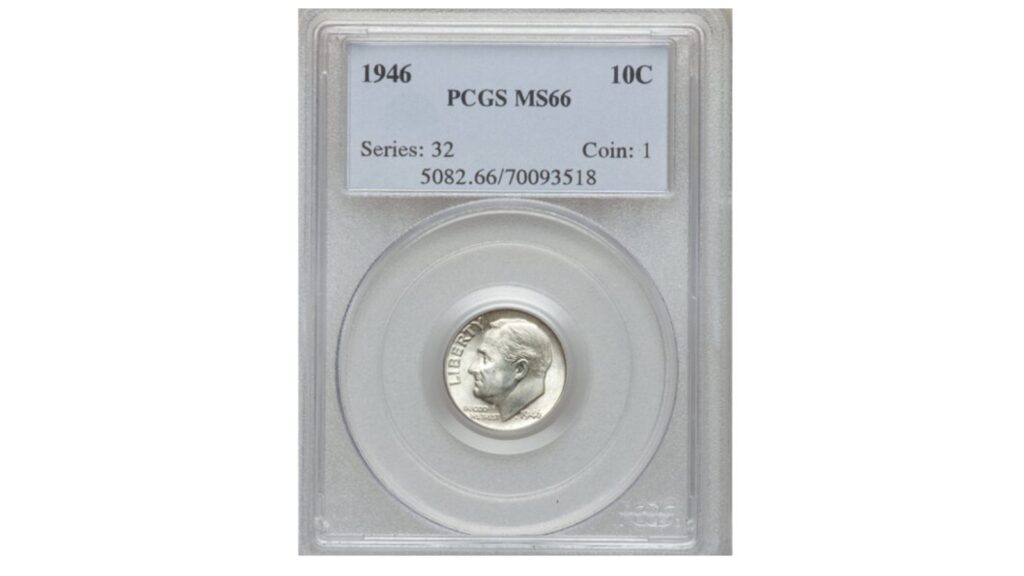
Before 1965, every Roosevelt dime was made of 90% silver. From 1965 onward, the Mint switched to a copper-nickel clad composition, and that was the end of silver in everyday circulation. The result is a very simple rule: if it’s a Roosevelt dime dated 1964 or earlier, it’s worth several dollars just for the metal it contains.
Each of those coins holds about 0.072 troy ounces of pure silver. At current silver prices, even a heavily worn example from a common date brings $3 to $5 just in melt value, with the better-date and higher-grade examples worth considerably more. Rolls of them turn up constantly in estate lots, old bank bags, and the backs of coin albums. The easiest way to spot them is the date, but you can also check the edge: a silver dime shows a solid silver rim all the way around, with no copper stripe. The clad coins have a visible orange layer on the edge.
Don’t clean them, don’t polish them, and don’t separate them from their original rolls if they’re sealed. Cleaning destroys the surface and removes the collector value above the silver floor. A common 1954-D in honest worn condition is worth roughly the silver; the same coin in untouched near-mint condition can bring $10 to $25.
Common-date Mercury dimes, 1934 to 1945
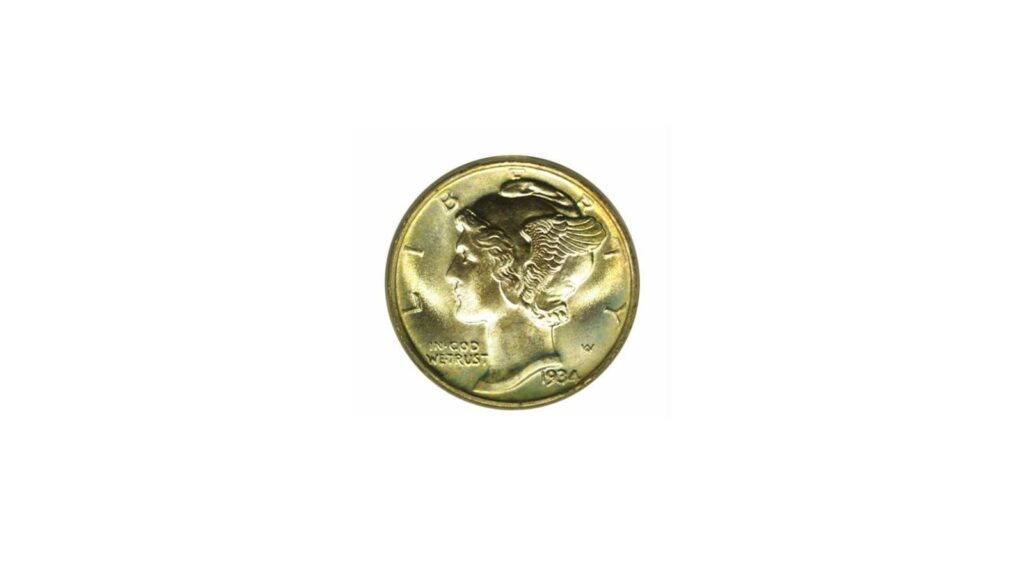
Mercury dimes, the winged Liberty Head coins minted from 1916 to 1945, are some of the most beautiful small coins the United States ever produced. The design by sculptor Adolph Weinman has a legible, specific elegance that the later Roosevelt portrait can’t match, and collectors have never stopped chasing them. The good news for anyone who turns up a roll or a collection: common dates from the mid-1930s onward are genuinely accessible and worth more than their silver content.
A worn 1940, 1941, 1943, or 1944 Mercury dime from Philadelphia or Denver brings $3 to $10 in heavily circulated condition. In better shape, with clean surfaces and no deep scratches, the same coin climbs to $15 to $30. The 1945-S “Micro S” variety, where an unusually small mintmark was used, carries a premium above regular S-mint examples. Don’t assume any Mercury dime is just silver scrap before checking the date and mint mark.
What destroys value here is cleaning. Mercury dimes in particular suffer badly from polishing or acid baths, which strip the surface and leave a bright, fake-looking sheen. An original, gently toned coin in its natural state is worth more to a collector than a scrubbed bright example even if the scrubbed one looks shinier to an untrained eye.
Common-date Barber dimes, 1892 to 1916
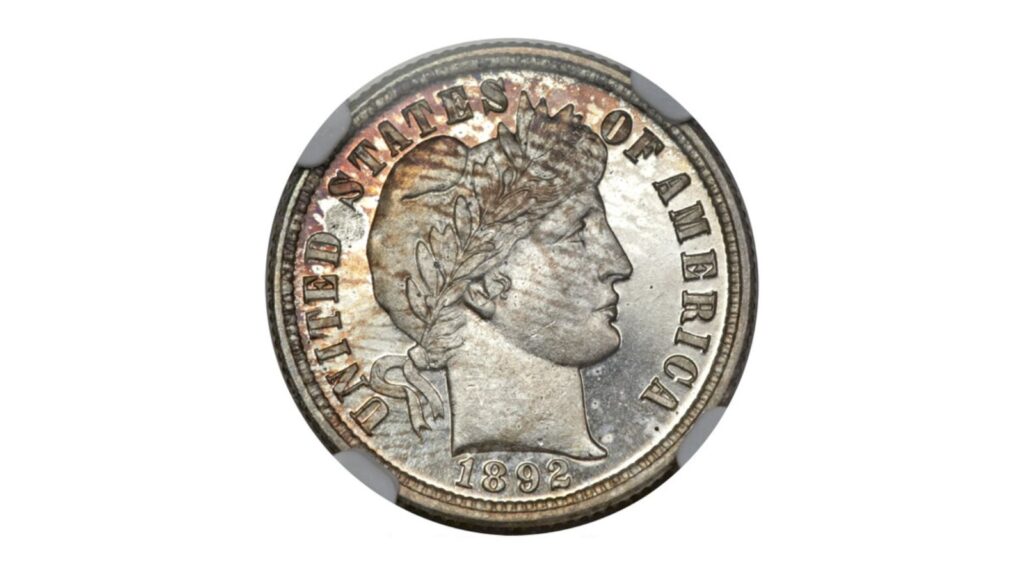
Barber dimes, the Liberty Head coins designed by Chief Engraver Charles Barber, circulated for over two decades and most of them were used hard. A heavily worn common date from the 1900s to 1910s, something like a 1907 Philadelphia or a 1908-D, brings $8 to $15 in circulated condition and reflects both the silver content and a modest collector premium for the series type.
These aren’t exciting finds on their own, but they show up constantly in inherited collections and old jars of coins, and they’re easy to misidentify. The obverse design features Liberty with a laureate wreath on her head and the word LIBERTY on the headband. The reverse has a simple wreath surrounding “ONE DIME.” The mint mark, if present, appears on the reverse below the wreath, not on the front. Coins from the New Orleans Mint bear an O, San Francisco bears an S, Denver bears a D, and Philadelphia has no mark at all.
Where this gets interesting is when the date and mint mark combination falls outside the common range. Most Barber dimes from 1906 onward are relatively plentiful. Anything dated before 1900, especially from branch mints, is worth checking carefully. The difference between a common Philadelphia date and a scarce New Orleans or San Francisco date in the same condition can be a factor of ten or twenty in value.
1996-W Roosevelt dime
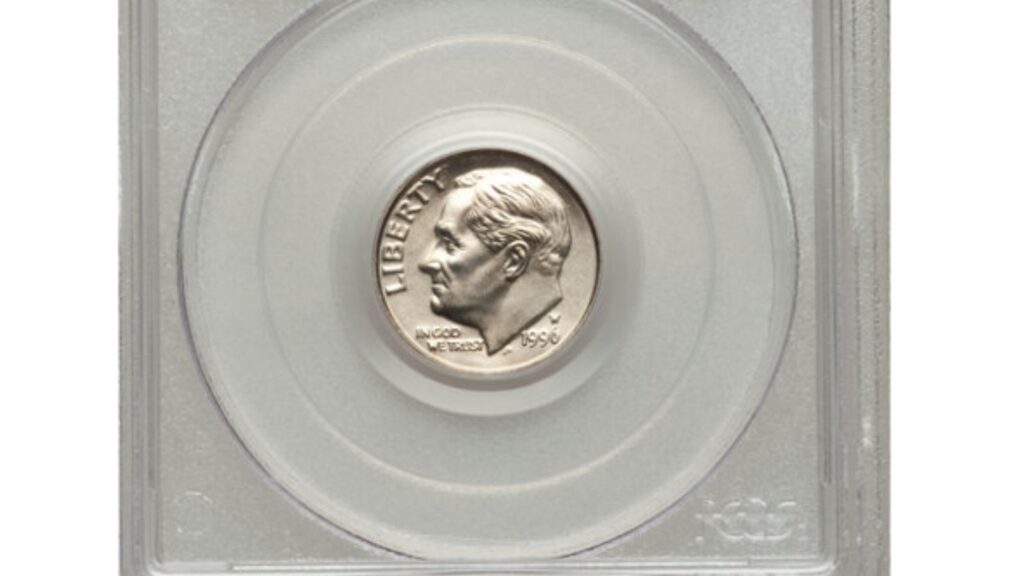
The West Point Mint produced exactly one Roosevelt dime for general release: this one. It was included exclusively in 1996 uncirculated coin sets, sold to collectors to mark the 50th anniversary of the design, and it has never been available any other way. No other non-bullion coin in the entire Roosevelt series carries a W mint mark. If you bought mint sets in the mid-1990s and held onto them, you likely have one sitting in a sealed plastic folder.
In typical circulated or lower uncirculated condition, this coin brings $20 to $40. In top grades, MS68 with Full Bands, values climb well into the hundreds. The mint mark appears on the obverse just above the date, near Roosevelt’s neck, the same location as every other post-1968 clad Roosevelt dime. Look for a W where you’d normally see a P or D.
Because it was only available in collector sets, it was never put into change. Any example you find has been kept intentionally. That also means these coins are often in better shape than their age would suggest. The most important thing to confirm is that the W is genuinely present and clearly struck, not a shadow or a grease-filled D from Denver. A jeweler’s loupe or a coin magnifier will tell you.
1982 No-P Roosevelt dime
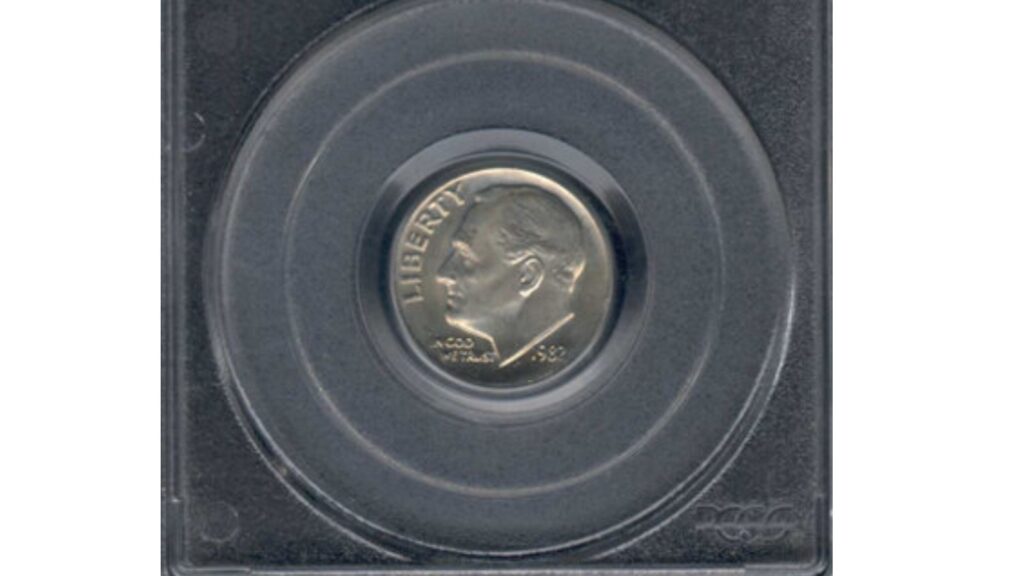
Every Roosevelt dime from the Philadelphia Mint was supposed to carry a P mint mark from 1980 onward. In late 1982, a small batch left the Mint without it. The P was simply not punched into the die. The result was the first business-strike coin in modern U.S. history to accidentally leave the Mint without its intended mint mark.
Most examples were found in Sandusky, Ohio, some reportedly recovered at the Cedar Point amusement park. Estimates put the surviving population at somewhere under 150,000, from two different die varieties: a strong strike with crisp details and a weak strike with softer lettering. Circulated strong-strike examples bring $150 to $225. Uncirculated strong-strike coins climb to $300 and above, depending on the grade. The weak strike is worth less and is easier to find.
To confirm the error, check the obverse just above the date near Roosevelt’s neck. There should be no letter of any kind. Most 1982 Philadelphia dimes carry a clear P in that spot. The absence of the mark isn’t subtle once you know to look for it. If you find one in a jar of old change or in a coin roll, get it certified by PCGS or NGC before doing anything else.
Barber dime semi-key dates: 1901-S, 1903-S, and 1913-S
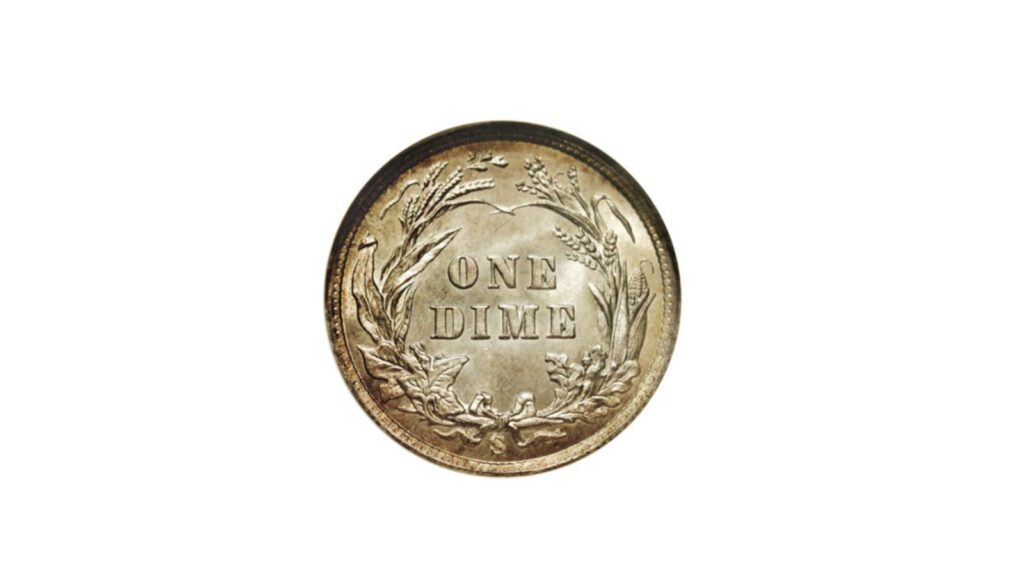
Three Barber dimes from the San Francisco Mint stand well above the common-date crowd and turn up unexpectedly in inherited collections, estate lots, and general accumulations of old silver coins. The 1901-S, 1903-S, and 1913-S each had lower mintages than most of the series and fewer surviving examples in collectable condition.
The 1901-S in worn circulated condition brings $55 to $250, with better-grade examples climbing considerably higher. The 1903-S follows a similar pattern, with verified sales of VG and Fine examples in the $150 to $480 range. The 1913-S runs from $55 in well-worn condition to over $900 in the best circulated grades. These coins look identical to common Barber dates at first glance, so the date and the S mint mark under the reverse wreath are the only things that distinguish them.
These aren’t coins most people deliberately seek out at estate sales. They appear because someone inherited a silver coin collection and didn’t know what they had. If you’re sorting through old dimes and find an S-mint Barber from the early 1900s, look up that specific date and mint combination before treating it as bulk silver. The difference between a 1903-S and a 1903-P in the same condition is not a small one.
1921-D Mercury dime
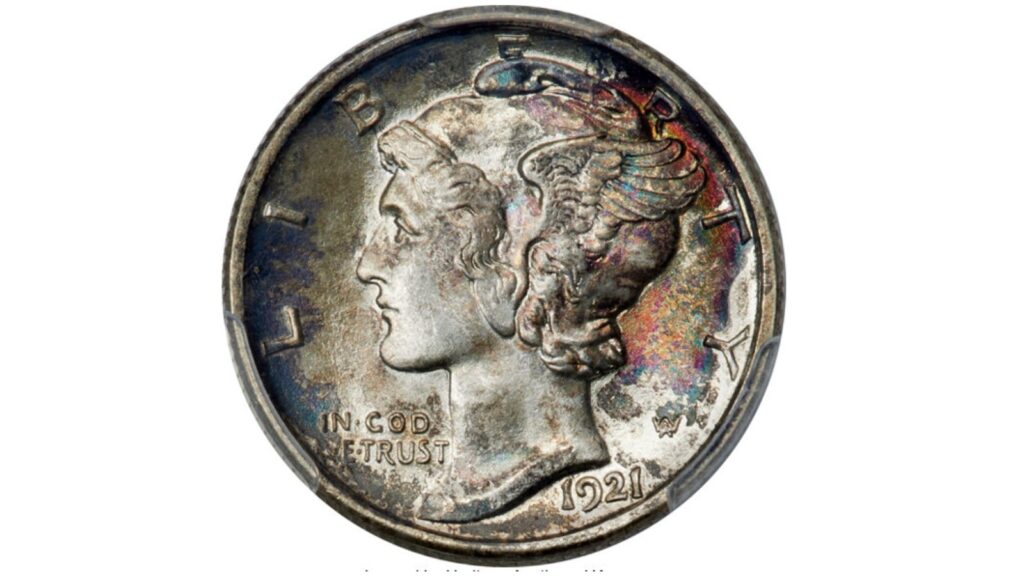
The Denver Mint’s 1921 dime is even scarcer than the Philadelphia issue. Only 1.08 million were struck, making it the second rarest issue in the entire Mercury dime series after the 1916-D. Like the Philadelphia coin, nearly all of them circulated until they were nearly flat. The combination of low mintage and heavy wear means that even a slick, barely-dated example carries real value.
Worn circulated examples bring $80 to $150. In Very Good condition, expect $150 to $400 depending on how cleanly the details are preserved. Fine and Very Fine examples have sold in the $400 to $800 range, and anything approaching Extremely Fine commands strong four-figure prices. The mint mark is a small D on the reverse of the coin, to the right of the fasces design, just above the bottom rim.
Authentication matters here. The 1921-D and the 1916-D are the two dates in this series most likely to be faked. On a genuine example, the D mint mark uses the same punch as contemporaneous Denver cents. Any coin presented raw and described as a 1921-D should go to PCGS or NGC before money changes hands. A certified example in any grade tells you exactly what you have.
Mercury dime “Full Bands” designation on common dates
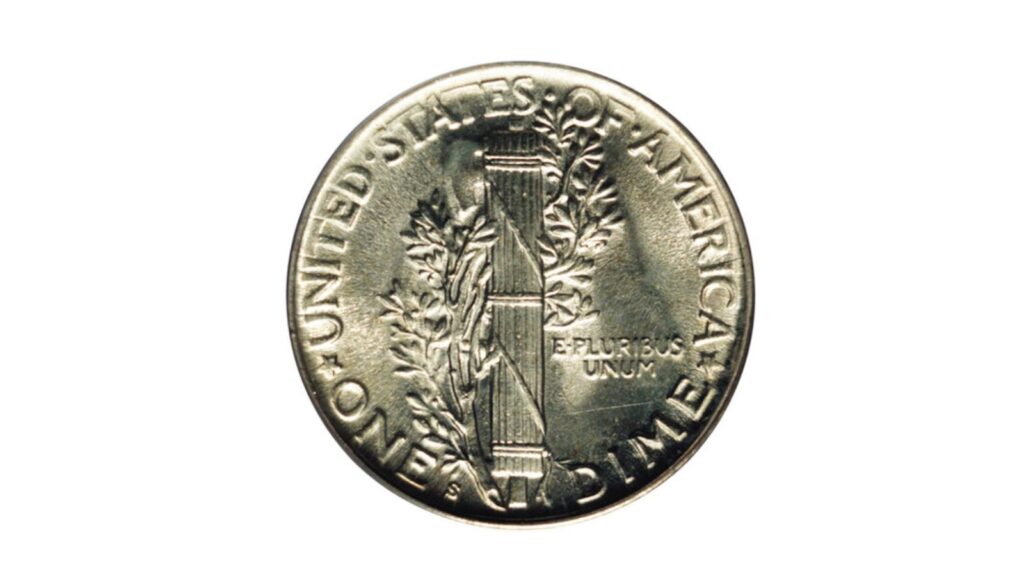
This one doesn’t require owning a key date. It requires paying attention to the reverse of any Mercury dime under a loupe. On the reverse, a bundle of rods called a fasces has horizontal bands tied around it. On most Mercury dimes, those bands are weakly struck and the individual lines run together. When every horizontal line is sharp and fully separated, the coin qualifies for the Full Bands designation at certification, and the premium can be ten to a hundred times the value of a normally struck example from the same year.
A common 1944 Mercury dime in average uncirculated condition might bring $15 to $25. The same coin with certified Full Bands in MS65 can reach $200 to $400. Some dates are so consistently weak in the bands that a fully struck example barely exists in any grade, making them condition rarities regardless of total mintage. The 1919-D and 1926-S are famous for this.
Common late dates from 1940 onward are the easiest place to find Full Bands examples, because those years generally had better strikes than earlier issues. If you have a collection of Mercury dimes that haven’t been checked, run a loupe across the reverses before treating them as silver. A coin you assumed was worth $8 could be worth $300.
1916-D Mercury dime in worn circulated condition
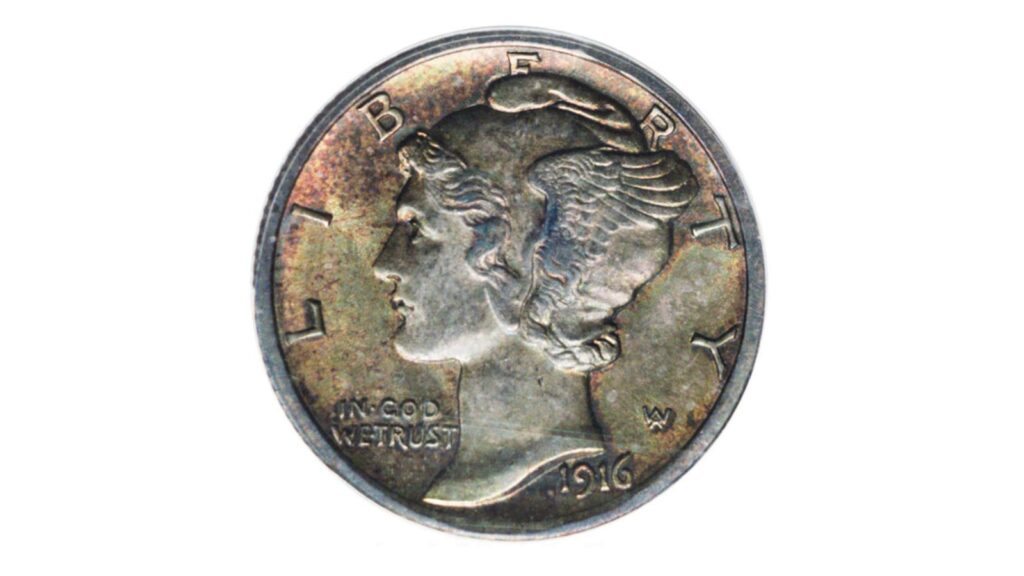
The 1916-D is the key date of the entire Mercury dime series. Denver struck only 264,000 of them before the dies were reallocated, and most that entered circulation were worn to near-nothing over the following decades. Today, roughly 10,000 are estimated to survive in all grades combined, and the large majority of those are heavily worn.
Even a coin in About Good condition, where the date is present but the rim is almost gone, brings $650 to $900. A Fine example runs $2,500 to $4,000. This is an aspirational find, not a yard sale discovery, but it’s not impossible. It shows up in inherited collections from people who assembled sets in the 1950s and 1960s, in old albums, and occasionally in unsorted silver lots where nobody knew what they had.
The problem is fakes. The 1916-D is one of the most counterfeited coins in U.S. numismatics. The most common method is adding a D mint mark to a common 1916 Philadelphia dime. On a genuine 1916-D, the D mint mark uses the same punch as 1914-D Lincoln cents: examine the shape of the D closely and compare it to a reference image. Never buy a raw, uncertified 1916-D from any source. A certified example from PCGS or NGC is the only safe purchase.
1895-O Barber dime
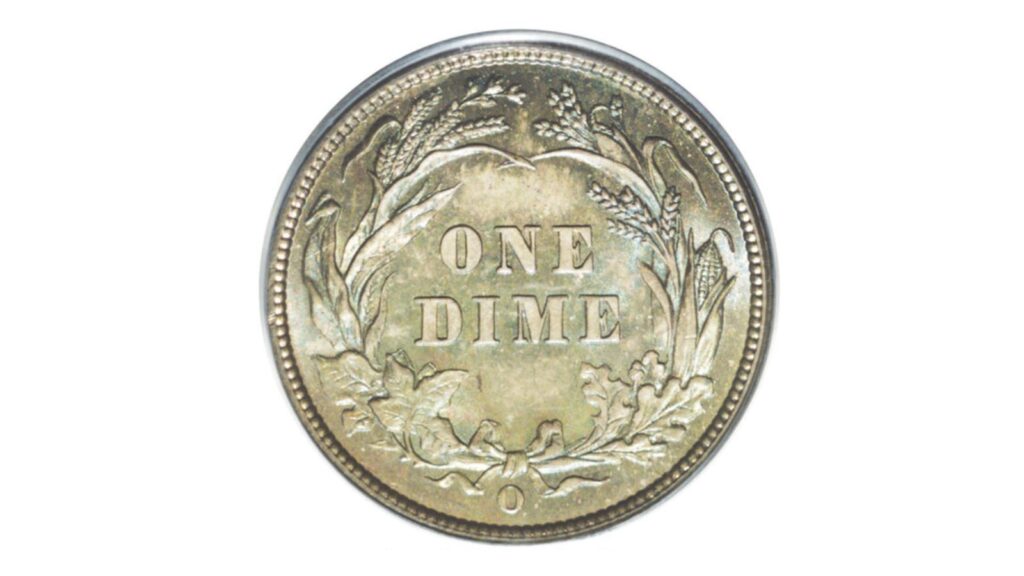
The New Orleans Mint was operating through a severe economic depression in the mid-1890s, and its output reflected it. The 1895-O Barber dime had a mintage of only 440,000, and the coins it produced went straight into hard use. Today, the 1895-O is considered one of the four rarest dates in the entire Barber dime series, alongside the 1901-S and 1903-S.
A coin in worn circulated condition, readable but flattened from decades in commerce, brings $260 to $500 depending on how much detail survives. Better-grade examples in Fine or Very Fine have sold for $600 to $1,200. The top circulated grades push into several thousand dollars. Mint State examples are genuinely rare, and the auction records for those are much higher.
Counterfeiting is a concern here too. Check the coin carefully for any sign that the O mint mark was added after the fact: look for irregularities in the metal around the mark, differences in wear between the mark and the surrounding field, or a mark that sits at a slightly wrong angle. Certified examples remove this concern entirely. A raw 1895-O in any significant grade warrants professional authentication before you attach a value to it.
1965 silver transitional error Roosevelt dime
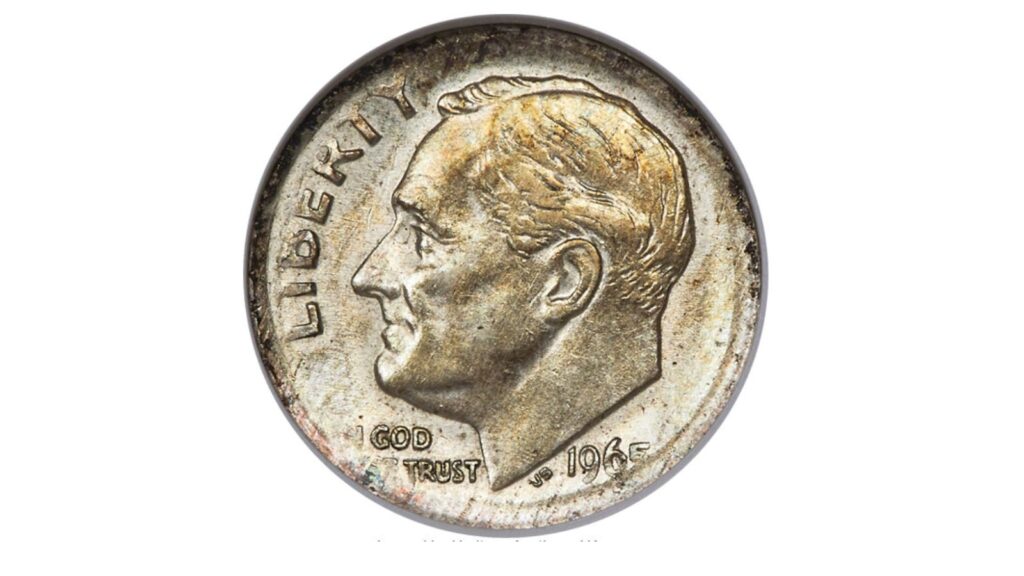
In 1965, the U.S. Mint made its most significant compositional change in decades, switching from 90% silver to copper-nickel clad. The transition wasn’t perfectly clean. A small number of dimes were accidentally struck on leftover silver planchets instead of the new clad blanks, creating coins that carry the 1965 date but have the silver content and weight of the pre-1965 series.
These transitional errors are genuinely rare, and examples in strong condition have sold around $12,000 to $13,000. The easiest way to check whether a 1965 dime is silver rather than clad is weight: a silver dime weighs 2.5 grams, while the clad version weighs 2.27 grams. A precise digital scale can tell the difference. The edge test works too: silver shows a solid rim with no copper stripe, while clad shows the orange copper layer.
Most 1965 dimes are common clad coins worth face value. The silver version is extremely rare. If your scale confirms 2.5 grams on a 1965 dime, don’t clean it, don’t test it with anything acidic, and take it directly to a professional numismatist or coin grading service. The weight reading alone is not enough to confirm authenticity; certification is required before any serious value can be established.











