
The change bowl on the counter has state quarters in it. The junk drawer probably does too. For ten years starting in 1999, the US Mint released five new quarter designs every year honoring a different state, and half of America made a point of saving them. The other half just let them accumulate.
Most of those quarters are worth 25 cents. The program ran from 1999 to 2008 and produced more than 34 billion coins. Nearly all of them will spend their retirement at face value, cycling through vending machines until they're worn smooth. That is fine. But a handful of specific dates, mint marks, and minting accidents pushed certain coins into real money, and some of that money is still sitting in old binders, bank rolls, and coin jars that nobody has looked at carefully.
A few items on this list extend into the “America the Beautiful” series that followed the original fifty-state program through 2021. Those are still Washington quarters, and two of the most interesting coin-hunt stories in modern numismatics came out of that run.
1999-P Delaware “spitting horse” quarter

The Delaware quarter was the first coin ever released in the program, on January 4, 1999. On certain Philadelphia-struck examples, the die developed a crack that produced a raised line running diagonally from the horse's mouth down through the inscription below. Coin collectors named it the spitting horse. It sounds dramatic, but this is one of the most accessible error finds in the entire series. Circulated examples with a clearly visible crack consistently bring $3 to $20.
Certified uncirculated examples in MS65 with a bold, prominent crack push higher, typically $40 to $50, though the math on grading fees matters at that price point. Values peaked much higher when the error was first discovered and came back down as it became clear that thousands of examples existed. What keeps collector interest alive is the coin's historical status: the first error in the most successful coin program in American history.
This is a Philadelphia coin only. Denver-struck Delaware quarters do not show this crack. To check, look at the reverse under a loupe or a desk lamp held at a low angle. The raised metal of a genuine die crack will catch the light and cast a shadow. A genuine crack is a consistent raised line, not a scratch, not a gouge.
2004-D Wisconsin Extra Leaf Low quarter
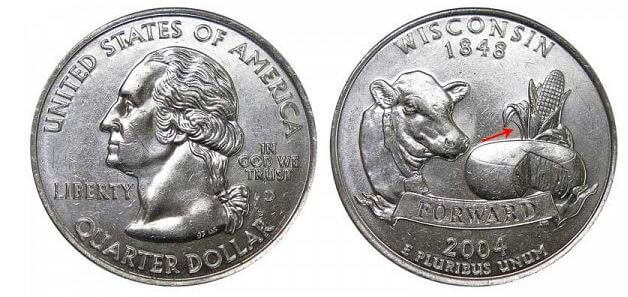
In December 2004, a Tucson collector spotted something odd on a new Wisconsin quarter: a raised extra leaf on the ear of corn on the reverse, pointing down toward the base of the stalk. The discovery triggered a nationwide roll hunt. Most of the affected coins turned up in San Antonio and Tucson, suggesting something about how they were distributed after leaving the Denver Mint, though the Mint has never officially explained how the leaf got there.
The low-leaf version is the more common of the two Wisconsin extra leaf varieties. Both are the only officially recognized major die varieties in the entire fifty-state program. Circulated examples with a clear, visible leaf bring $20 to $50. Uncirculated MS63 to MS65 examples typically bring $100 to $160. The gem end of the market gets considerably more interesting.
Every extra leaf Wisconsin quarter is a Denver coin. No Philadelphia examples are confirmed. Look for a third leaf curving downward from the left side of the corn, below and distinct from the two leaves that belong in the original design. A coin where you are squinting and second-guessing probably is not it. The error is visible to the naked eye on a good example.
2004-D Wisconsin Extra Leaf High quarter

The high-leaf version of the Wisconsin error places the extra leaf higher on the stalk, pointing upward toward the ear rather than downward toward the base. It is the scarcer of the two varieties with fewer confirmed examples across all grades, and it commands a meaningful premium over an equivalent-grade low-leaf example.
Circulated pieces with a visible high leaf bring $50 to $200. Gem uncirculated MS65 examples typically trade for $200 to $300, and the finest certified examples have sold well into four figures. Nobody has ever definitively explained how the leaf appeared. The Mint's official position is die damage during production. Some collectors have long suspected a Mint employee altered the die deliberately. The debate has never been resolved, which adds a layer of story that keeps collectors engaged.
Telling high from low is straightforward. The low leaf points toward the base of the stalk; the high leaf points toward the ear. Both require the Denver D mint mark on the obverse, and both should be certified by PCGS or NGC before selling at prices above circulated grade. The certification will attribute the specific variety, which matters because dealers and buyers want documented confirmation.
2005-P Minnesota Extra Tree DDR-001 quarter

The Minnesota quarter depicts a lake scene with a row of spruce trees along the shoreline, two fishermen in a canoe, and a loon on the water. On certain Philadelphia-struck examples, a ghostly partial tree appears to the right of the fourth spruce in the grouping just right of the state outline. The discovery in 2005 prompted the same kind of nationwide roll hunt that followed the Wisconsin extra leaf announcement the year before, with early examples selling for $500 and more before the market settled down.
There are over fifty documented doubled die varieties for this issue. The most desirable and clearly visible is officially designated by PCGS as the FS-801 Doubled Tree DDR-001, which shows three distinct spruce boughs floating to the right of the fourth tree. In certified grades, the FS-801 brings $40 at lower mint state grades and up to $275 at MS67. Raw examples with a clear, unmistakable extra tree sell for $100 and above from knowledgeable sellers.
The problem is that most of the fifty-plus varieties show faint doubling that is hard to distinguish from machine doubling, which carries no premium. Machine doubling looks flat and shelf-like under a loupe; genuine hub doubling shows rounded, three-dimensional secondary images. Get any strong candidate attributed before selling. Minor varieties bring $5 to $20 at most.
2019-W America the Beautiful quarters

In April 2019, the US Mint released business-strike coins from the West Point Mint directly into general circulation for the first time in nearly ninety years. Each of the five America the Beautiful quarter designs for 2019 was struck at West Point in a mintage of just two million per design, the lowest for any regular circulating quarter since 1937. The coins were mixed into standard bags alongside Philadelphia and Denver strikes, so anyone breaking a roll from their bank might have one.
The West Point coins carry a W mint mark on the obverse, below the motto, which makes them easy to identify. A circulated example showing some pocket wear brings $20 to $40 across all five designs. Uncirculated examples in MS65 to MS66 typically start at $75 and rise from there. The higher the certified grade, the sharper the premium: coins that survived minting, bagging, and distribution without contact damage are genuinely rare, and certain designs in MS67 and above have traded into the thousands.
The five designs honor Lowell National Historical Park in Massachusetts, American Memorial Park in the Northern Mariana Islands, War in the Pacific in Guam, San Antonio Missions in Texas, and Frank Church River of No Return Wilderness in Idaho. Fake W mint marks do exist. Buy certified examples from PCGS or NGC for anything above circulated grade, and verify that the certification label specifically states the W designation.
2020-W V75 privy mark quarters

The Mint repeated the 2019 West Point experiment in 2020 with an added element: a small privy mark in the shape of a V75, honoring the 75th anniversary of the end of World War II. The mark appears as a stylized V75 inside an outline of the Rainbow Pool from the National World War II Memorial in Washington. Two million of each 2020 design were struck at West Point with both the W mint mark and the privy mark, then mixed into regular circulation.
A worn circulated 2020-W V75 quarter brings $5 to $10. Uncirculated MS65 examples typically sell for $35 to $85. The price jump at MS67 and above is dramatic: very few coins survived minting, bagging, and distribution in that condition, and certified MS67 examples regularly bring over $1,100, with exceptional examples going considerably higher.
These are the last W-mint-mark quarters ever struck for general circulation. The Mint has not repeated the program since 2020. That fact alone caps the supply permanently. As these coins age into established collectibles rather than recent releases, the gap between typical circulated examples and gem survivors tends to hold. No 2021 or later W quarters for circulation exist, which is easily verified.
1999 first-series state quarters in MS67 or better

The five state quarters released in 1999 (Delaware, Pennsylvania, New Jersey, Georgia, Connecticut) went directly into circulation during a period when the program was new and nobody was thinking about preservation. Most sat in registers, change cups, and pockets for years. That history explains why coins from this first release that survived in pristine condition are now treated as condition rarities, even though hundreds of millions were minted.
A standard 1999-P state quarter grades MS65 for a few dollars. At MS67, the numbers shift considerably. The 1999-P Pennsylvania quarter holds an MS67 auction record above $10,000 because so few coins made it through mint bags and distribution without acquiring contact marks. The 1999-D New Jersey quarter in MS68 has sold for $8,750. These are not errors or varieties. They are simply original strikes that happened to survive their early lives undamaged.
Any 1999 state quarter with strong original luster and no visible contact damage is worth having evaluated. The first-year Delaware issue is specifically documented as particularly difficult to find in top grades. Coins pulled from original Mint rolls or sets are the most likely candidates, since they never circulated. Certification fees make sense at this grade level because the premium over raw coins at MS67 and above is substantial.
State quarters on Roosevelt dime planchets

Wrong planchet errors occur when a coin blank intended for a different denomination finds its way onto the wrong press. When a quarter die strikes a Roosevelt dime planchet, the result is a smaller, lighter coin with a truncated state quarter design, showing only what fits within the dime-sized disc. The detail inside the strike is clear and sharp. Everything outside the planchet simply does not exist on the finished coin.
The 2002-D Tennessee quarter struck on a dime planchet is one of the most documented examples, with certified pieces bringing around $6,600. The 2007-D Montana on a Roosevelt dime planchet has sold for up to $9,600 in top certified condition. These are not coins that turn up in circulation today. They almost always surface through dealers or grading service submissions, typically from Mint bags examined long after distribution.
Fakes are a serious concern at this price level. A small dime with a scratched surface is not a wrong planchet error. Professional certification by PCGS or NGC is mandatory. The certification label will explicitly state “Struck on a Roosevelt Dime Planchet” as part of the designation. Any raw coin offered at these prices should be treated as unverified. The certified population for most of these varieties is in the single digits.











