
That jar of old coins your grandmother kept on the kitchen windowsill. The rubber-banded stack of bills tucked in the back of an estate box. The change that's been sitting at the bottom of a dresser drawer since your uncle moved into assisted living.
Most of it is worth exactly what it says. But some of it isn't. Pre-1965 coins are made of silver that's now worth a multiple of face value. Printing errors and manufacturing mistakes turned ordinary pennies into four-figure collector pieces. A handful of specific bills are worth real premiums to the right buyer, and a few in the wrong condition are worth precisely nothing beyond what you can spend them for.
These 18 pieces of currency range from silver coins you might find in any old collection, banknotes that turn up in estate boxes regularly, die errors that circulated for decades before anyone caught on, and a few aspirational pieces worth knowing about in case you get lucky. Prices are based on what these things actually sell for in their current condition, not asking prices or record highs.
Table of contents
- 1942-1945 Jefferson war nickels
- 1943 steel Lincoln cent
- 1957 blue seal silver certificate
- 1963 red seal $2 legal tender note
- 1976 $2 bicentennial bill
- Low print run star notes
- Fancy serial number bills
- Error notes with offset printing or gutter folds
- 1972 doubled die Lincoln cent
- 2005-D speared bison Jefferson nickel
- 1982 no-P Roosevelt dime
- 2004-D Wisconsin extra leaf quarter
- 1955 doubled die Lincoln cent
- 1916-D Mercury dime
1942-1945 Jefferson war nickels

A five-cent coin made of silver sounds wrong, but it happened. During World War II, the government needed nickel for armor plating and artillery, so from late 1942 through 1945 the Mint changed the five-cent piece's composition to 56% copper, 35% silver, and 9% manganese.
Each war nickel contains about 0.056 troy ounces of silver, putting the current melt value around $3 to $4, which is 60 to 80 times face value. Identification is easy: look at the back of any 1942-1945 nickel. On standard Jefferson nickels, the mintmark sits to the right of Monticello. On war nickels, there's a large P, D, or S mintmark sitting directly above Monticello's dome. That large elevated mintmark is the definitive tell.
Circulated examples sell at or just above melt. Nicely uncirculated examples with the Full Steps designation, meaning the horizontal lines on Monticello's entrance steps are complete and unbroken, bring $30 to $80 depending on the mint year. A good number of these turn up in old collections because families deliberately saved them during the war years.
1943 steel Lincoln cent

In 1943, the government needed copper for ammunition and shell casings, so that year's Lincoln cent was struck on zinc-coated steel instead. The result looks silver, sticks to a magnet, weighs less than a normal penny, and comes from a single dramatic year in American history. Over a billion were minted, which is why they're common.
A circulated 1943 steel cent with rust or discoloration is worth a few cents above face value. A bright uncirculated example with intact zinc coating is worth $5 to $30 in gem grades, considerably more in the highest certified grades.
What matters much more: a 1943 penny that does not stick to a magnet is potentially a genuine bronze transitional error, one of the rarest and most valuable Lincoln cents in existence. Real copper 1943 cents number fewer than 20 known examples and are worth hundreds of thousands of dollars in any condition. If you find a 1943-dated penny that a magnet won't attract, do not clean it, and do not try to sell it before having it authenticated by PCGS or NGC. Most “copper” 1943 cents are fakes made by copper-plating steel ones, but genuine examples exist and the authentication test is simple.
1957 blue seal silver certificate

Before 1964, the standard $1 bill was a silver certificate, a note the Treasury was legally obligated to exchange for silver on demand. The blue seal on the front and the words “Silver Certificate” across the top are the identifiers. The 1957 series is the most common version you'll encounter.
A circulated 1957 silver certificate in average condition is worth $1.25 to $4 depending on the specific series letter and how well preserved it is. Crisp uncirculated examples bring $6 to $15. Star note versions, identified by a small star symbol at the end of the serial number, are worth $8 to $45 in good condition. The 1935 series predates the 1957 and generally brings a bit more in equivalent condition. Earlier small-size silver certificates in the $5 and $10 denominations are more collectible still.
Not a life-changing find, but a genuine premium over face value, and they show up regularly in old wallets, inherited envelopes, and boxes of loose bills from estates. Anything with a blue seal is worth setting aside.
1963 red seal $2 legal tender note

The 1963 $2 bill carries a red seal and red serial numbers, the identifiers of a United States Note, a type of government-issued legal tender distinct from today's Federal Reserve Notes. Production of the $2 US Note stopped in 1966, and when the denomination was revived in 1976, it returned as a Federal Reserve Note with a green seal. The red seal $2 is genuinely a different category of currency.
In circulated condition, a 1963 or 1963A $2 bill is worth $8 to $16, with crisp uncirculated examples reaching $25 to $50. Star note versions command $30 to $150. The 1928 red seal $2 bills, the earliest small-size version of the denomination, bring $10 to $30 in average condition and significantly more in nice uncirculated grades.
Not all old $2 bills are valuable, but the red seal versions from 1928 through 1963 consistently bring a genuine premium over face, and they're easy to identify on sight. If you find one while sorting through old currency, it goes in the keeper pile, not the spending pile.
1976 $2 bicentennial bill

Here's the one most families think is valuable. When the $2 bill was reintroduced on April 13, 1976, people treated it like a commemorative issue and stashed them away. The Bureau of Engraving and Printing printed roughly 590 million of them. They are not rare.
Most circulated 1976 $2 bills are worth $2. A crisp uncirculated example might bring $5 to $15. Bills that collectors had stamped at post offices on April 13, 1976, the first day of issue, with a cancellation mark across the attached postage stamp, are worth $10 to $20.
Where things get interesting: star notes from the Kansas City Federal Reserve district (the “J” letter on the front) had the lowest print run of any district that year, and those bring $25 to $100 depending on condition. A bill with a serial number below 100 is worth several hundred dollars. A solid repeating number can bring more. If you have a plain circulated 1976 $2 with an ordinary serial number, it's worth exactly $2. Check the serial number before getting your hopes up.
1935A $1 WWII Hawaii overprint silver certificate

After Pearl Harbor in December 1941, the US government feared a Japanese invasion of Hawaii. The solution: issue special $1 bills for use in Hawaii only, overprinted with the word HAWAII in large letters on both sides of the note, with brown seals and serial numbers instead of the usual blue. If Hawaii were captured, the Treasury could immediately declare those distinctively marked notes worthless, preventing Japan from using seized American cash as a functioning currency.
These notes circulated in Hawaii from July 1942 until October 1944. The HAWAII overprint is large and unmistakable on both sides, and the brown seal makes them visually unlike any other American paper money of the era.
The 1935A $1 version is the most common of the four denominations (there were also $5, $10, and $20 versions) and brings about $20 in average circulated condition, with crisp uncirculated examples reaching $75 to $100. Star note versions are rarer and considerably more sought after. Higher denominations bring more. They surface in estate lots with some regularity, particularly from families with military connections to the Pacific, and they're one of the most historically compelling pieces in all of American paper money.
Low print run star notes

Every time a bill is damaged or misprinted during production, the Bureau of Engraving and Printing replaces it with a star note, a bill with the same serial prefix but a star symbol at the end of the number instead of a letter. The replacement is necessary because no two bills can legally share an identical serial number.
Star notes are printed in batches called runs, and that run size determines scarcity. Most modern star notes come from standard runs of 3.2 million, which makes them common and worth face value in any condition. But sometimes the BEP only needs a small number of replacements for a short print run of a particular series, and star notes from runs of 640,000 or fewer can be worth two to fifty times face value depending on denomination and condition.
A crisp $1 star note from a 640,000-print run can bring $10 to $50. A $100 star from an unusually scarce run is worth multiples of its face value. Checking is free: the Bureau of Engraving and Printing publishes its star note production records, and free lookup tools at sites like Look Up Star Note or My Currency Collection let you enter your denomination, series year, and serial number to find the production run in seconds. Most of what you'll find is common. Occasionally, it won't be.
Fancy serial number bills

Collectors pay premiums for bills with serial numbers that form unusual patterns, and the market for them is active enough that a $1 bill with the right combination of digits can sell for hundreds.
The most sought-after types are solid serials (all eight digits identical, like 77777777), ascending or descending ladders (12345678 or 87654321), and radar notes (palindromes that read the same forwards and backwards, like 12344321). Radar notes are accessible enough that a circulated $1 radar can bring $25 to $100 in nice condition. A solid serial on any denomination in gem uncirculated condition commands several hundred dollars or more. Very low serial numbers, particularly those below 100, bring serious premiums regardless of denomination.
Checking takes thirty seconds. Pull out your wallet. Look at the eight digits in the middle of the serial number, ignoring the prefix and suffix letters. Does it form any pattern? Free serial number checkers at SerialWorth.com and FancySerialNumberPriceGuide.com will analyze the pattern and give you a ballpark value range. The overwhelming majority of bills check out as ordinary. Every now and then, one doesn't.
Error notes with offset printing or gutter folds

The Bureau of Engraving and Printing processes billions of notes annually with extraordinary consistency. When something goes wrong and a misprinted bill gets through quality control into circulation, it becomes a collectible because it's not supposed to exist.
The most common findable errors are gutter folds, where the paper folded slightly before printing, leaving a blank white stripe across the note where the ink never reached, and offset printing, where one side's design partially transferred onto the other. A complete face-to-back offset can exceed $1,000. A severe gutter fold or dramatic miscut showing partial design from an adjacent note is worth several hundred. Minor misalignments add a modest premium.
Authentication matters for anything substantial. A chemically stripped bill can mimic a missing print error, which is why PMG grading makes a meaningful difference for error notes worth over $100. The errors worth most in this category are mechanically obvious ones: a visible fold or crease that was present when the note was printed (meaning it's part of the paper, not damage from handling), or a dramatic ink transfer that's clearly structural rather than a stain. If you find a bill that looks like a production mistake rather than wear, it's worth a quick comparison against error note databases before you spend it.
1972 doubled die Lincoln cent

The 1955 doubled die gets all the attention, but the 1972 version is significantly more accessible and still brings a real premium. In 1972, a Philadelphia Mint working die received a second hub impression at a slightly rotated angle, producing visible doubling on the date, the motto IN GOD WE TRUST, and the word LIBERTY. About ten varieties are known; the major Type 1 is the one with obvious spread visible to the naked eye.
Circulated examples in fine to extra fine condition bring $75 to $250 depending on how well the doubling shows. Uncirculated red examples in gem grades push to $500 to $1,500. A few thousand are estimated to exist, mostly in circulated grades, and they surface in coin dealer stock, old coin rolls, and estate lots more often than you'd expect.
The main authentication challenge: machine doubling is extremely common on 1972 cents and produces a flat, shelf-like appearance on the letters and date that looks superficially similar but is worthless. Genuine doubled die doubling is rounded and shows clear separation with distinct secondary elements. On the major 1972 variety, the doubling is strong enough that the difference between the real thing and machine doubling is visible without much magnification. If you're not certain, PCGS and NGC will authenticate it.
2005-D speared bison Jefferson nickel

In 2005, the US Mint brought back the bison reverse for a one-year commemorative design. At Denver, some coins were struck from a die with a significant gouge running through it, creating a raised line that looks exactly like a spear piercing straight through the bison's body from back to belly. These became the Speared Bison variety.
The raised line is the key diagnostic: a genuine Speared Bison has a raised mark above the coin's surface because it came from a damaged die. A scratch from post-mint damage would be incused. Circulated examples in good shape bring $30 to $60. Mint state coins push to $75 to $700 depending on grade. The record for a top-certified example sits at $2,650.
This is one of the better modern cherrypicking opportunities in coins because the error is visible without magnification. Look at the reverse of any 2005-D bison nickel and check for a raised line running through the animal's midsection. Most will be clean. The ones with the spear are not subtle once you know what you're looking for, and coin dealers will recognize it immediately.
1982 no-P Roosevelt dime

Since 1980, Roosevelt dimes from Philadelphia have carried a small “P” mintmark on the obverse. In 1982, some working dies were prepared without the “P” punch, creating dimes that look like pre-1980 issues but aren't. The Mint also stopped producing annual collector sets that year, meaning most 1982 coins went straight into circulation without anyone saving them.
A circulated 1982 no-P dime in extra fine condition is worth $30 to $75. A gem uncirculated example with full torch bands commands $150 to $500. The highest certified grades have pushed toward $2,000. Two varieties exist: strong strike and weak strike. The strong strike is significantly more valuable.
To check a 1982 dime: look on the obverse just above the date for the “P” mintmark. If the date reads 1982 and there's no “P” present, you have either a pre-1980 issue (before the Philadelphia mintmark was added) or the genuine 1982 error. Since no-P dimes from 1965 to 1979 are common and worth nothing beyond silver melt or face value, the only no-P dime with serious collector value is dated specifically 1982.
2004-D Wisconsin extra leaf quarter

The Wisconsin state quarter shows a wheel of cheese and an ear of corn. On some coins from the Denver Mint's 2004 run, an extra leaf appears on the corn stalk near the base. Two versions exist: the extra leaf high (the additional leaf points upward) and the extra leaf low (it points downward). Both are die gouges.
Circulated examples bring $50 to $200 depending on the version and how well preserved they are. Well-preserved mint state examples can reach $400 to $1,500. The estimated population of each variety runs between 20,000 and 50,000 coins, which means they show up regularly in dealer stock and estate lots.
Both varieties are recognized and labeled by PCGS and NGC, confirming they aren't post-mint alterations. The extra leaf is visible with the naked eye on a decent specimen: look at the ear of corn on the reverse and check the lower husk area for an additional leaf that doesn't appear on standard 2004-D Wisconsin quarters. A 2004-D Wisconsin quarter without the extra leaf is a normal coin worth 25 cents.
1955 doubled die Lincoln cent

This is the famous one. In the spring of 1955, a Philadelphia Mint obverse die received two hub impressions at a slight misalignment. The result is a dramatic doubling visible without magnification on the date, the word LIBERTY, and the motto IN GOD WE TRUST. About 24,000 examples entered circulation, many distributed as change in cigarette vending machines across New England.
Even heavily worn examples bring $1,000 to $3,000 in the lower circulated grades. A solid extra fine to about uncirculated example is worth $2,500 to $5,000. Nice red uncirculated examples bring $10,000 to $20,000. Top-certified specimens are in a different league.
Fakes are the primary concern. Because the coin is famous, counterfeiting has been ongoing since the 1960s. The most common version involves a genuine 1955 cent with machine doubling, which is common and worthless, presented as the real thing. On a genuine 1955 doubled die, the secondary impressions are rounded and show clear, distinct separation. Machine doubling produces a flat, shelf-like secondary image with no real depth. Authentication by PCGS or NGC is non-negotiable before any purchase or sale. Do not buy a raw 1955 doubled die from a private seller.
1916-D Mercury dime
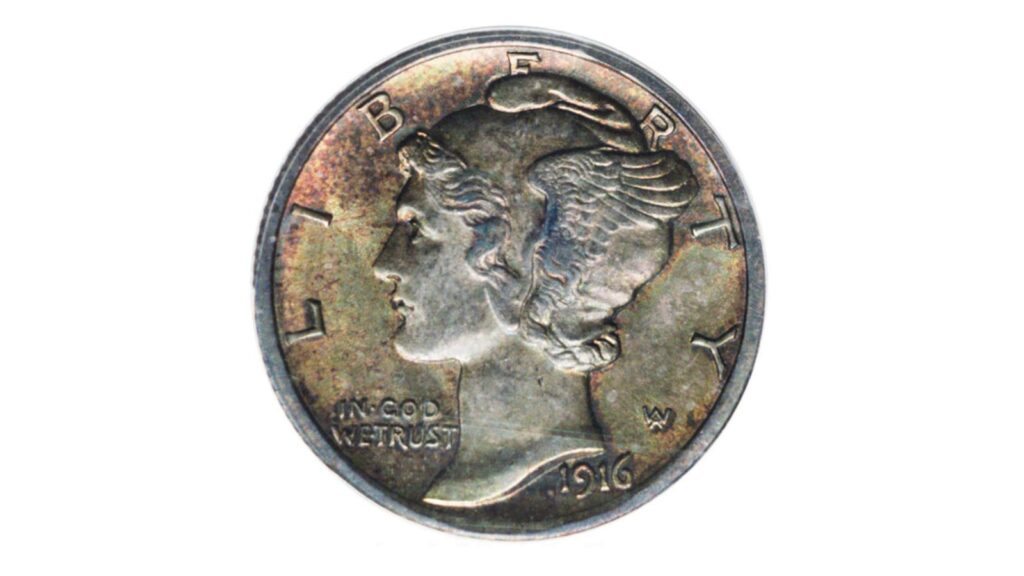
The Mercury dime, formally the Winged Liberty Head dime, ran from 1916 to 1945 and is considered one of the most beautiful coins the US Mint has ever produced. The Denver Mint struck only 264,000 in its first year, a tiny number that makes the 1916-D the key date of the entire series, comparable in significance to the 1909-S VDB Lincoln cent. Perhaps 10,000 survive today in all grades combined.
Even a heavily worn example in Good condition brings $700 to $1,200. A coin in Fine to Very Fine grade, showing honest circulation wear with the design still readable, commands $1,500 to $3,500. An About Uncirculated example pushes $5,000 to $10,000. Choice mint state pieces have sold for $20,000 and above.
Counterfeiting is a serious issue. The most common fake is a genuine 1916 Philadelphia dime with a “D” mintmark added, a process that's been practiced since the 1950s. On a genuine 1916-D, the mintmark sits to the left of the fasces on the reverse at a specific height and has a particular shape consistent with period Denver Mint dies. Any soft, shallow, or off-center “D” is a red flag. This coin should only ever be purchased in a certified holder from PCGS, NGC, or CAC. No exceptions.











